1. Introduction
DC-AC conversion is a cornerstone of modern power electronic systems, enabling grid integration of renewables, motor drives, traction systems, and high-frequency power supplies [
1,
2]. Resonant and quasi-resonant inverter families are particularly important when efficiency, electromagnetic performance, and switching stress must be managed under high switching frequency or harsh operating conditions [
3,
4,
5].
A symmetry-oriented viewpoint offers an alternative lens to conventional topology-centered classification. Inverters are inherently periodic dynamical systems in which switching actions and reactive energy exchange shape the waveform structure. From this perspective, operating regimes are structured manifestations of symmetry in time, frequency, and energy flow. The classical duality between voltage-source and current-source inverters reflects an important source-domain symmetry [
2,
4]; however, restricting inverter duality to source type captures only a projection of a broader symmetry space.
In resonant inverters, inverter behavior is strongly governed by frequency-domain symmetry [
4,
5]. Operation below, at, and above resonance forms a natural symmetry axis, with resonance acting as a symmetry-centered operating point. Crossing resonance changes the sign of the effective reactance, exchanges leading/lagging phase relations between voltage and current and reshapes the commutation environment. These changes often create ZVS-favorable or ZCS-favorable switching tendencies as consequences of regime selection, rather than as independently imposed design goals [
5].
Motivated by these observations, this paper develops a generalized symmetry framework for inverter operation in which duality extends beyond source type. The contributions are: (i) an explicit multidimensional symmetry description of inverter regimes; (ii) an extended-duality formulation integrating source, frequency-domain, commutation, and modal symmetries; and (iii) symmetry-guided design implications emphasizing robustness and the cost of symmetry in stress and losses.
Related Work and Positioning
Resonant DC-AC inverters have been developed along two partially overlapping lines. Classical treatments and comparative topology studies describe the main resonant inverter families and their above-resonance design and stress implications [
3,
6,
7,
8]. One line treats the inverter as a tuned power amplifier, where the resonant tank enforces waveform symmetry (e.g., Class-E operation and its variants) and the operating point is chosen by frequency-domain balance between device capacitances and tank reactance [
9,
10,
11]. A second line adds resonant transitions to PWM inverters via resonant DC links, resonant poles, and auxiliary commutation networks, achieving soft switching while retaining PWM control degrees of freedom [
12,
13,
14]. Survey treatments emphasize that these families must be analyzed in a joint state-space of operating point, commutation boundary, and auxiliary-network timing rather than by topology alone [
15].
Induction heating and cooking have been a key application driver for high-frequency resonant inverters, motivating systematic comparisons of current-source and voltage-source realizations, phase-shift and fixed-frequency control, and load-adaptive tuning strategies [
16,
17,
18]. Comprehensive reviews highlight the broad design space of single- and multiple-output resonant inverters and the central role of detuning relative to resonance for maintaining ZVS/ZCS under load drift [
19,
20,
21,
22]. The “multi-load/single-converter” viewpoint further illustrates how modal structure (multiple excitation paths and operating states) becomes a practical symmetry variable in zone-controlled systems [
23,
24,
25].
Recent work has extended classical series-resonant half-bridge inverters using controlled reactive elements (e.g., variable transformers/inductors) and energy-recovery switches to enlarge the ZVS-feasible region at fixed switching frequency [
26,
27,
28]. In parallel, current-fed resonant inverter platforms remain attractive in wireless power-transfer systems, where the input constraint is naturally current-like and where switching safety depends critically on detuning and commutation phase relations [
29,
30,
31]. These application-driven studies consistently return to the same structural question: how do input constraints, detuning sign, switch-path reversibility, and mode structure co-determine commutation symmetry and stress redistribution?
Most existing analyses organize results along one dominant axis—topology families, control methods, or application constraints—while duality is often treated narrowly as VSI versus CSI [
32,
33]. Recent modeling contributions make this duality explicit in averaged and state-space form, highlighting the deeper structural correspondence between current- and voltage-excitation domains [
34,
35]. The present paper builds on this foundation by proposing a multidimensional symmetry hierarchy and a compact signature map that (i) unifies these axes and (ii) converts them into a design-oriented workflow.
Specific novelty relative to the author’s prior work. The present manuscript extends the author’s earlier symmetry/duality studies [
4,
5,
6,
36] in several non-redundant directions. First, it introduces an explicit multidimensional symmetry hierarchy operationalized through a compact inverter signature vector s = (σS, σF, σC, σP, σM) and corresponding symmetry operators (
Section 2.5), which provide a reusable regime-level language beyond source duality alone. Second, it adds a symmetry-guided design workflow with compact screening metrics (e.g.,
kV(AC),
kI(AC),
kRMS(AC), |
φ|,
mZVS,
mZCS) that connect regime selection to commutation feasibility and stress/circulation trade-offs (
Section 4.1 and
Section 5). Third, it demonstrates the framework using an explicit extended-duality pairing of two application-oriented case studies (open-input super-resonant ZVS-like corridor and closed-input sub-resonant ZCS-like corridor), including device-class-aware screening implications for WBG platforms (
Section 5.5,
Section 5.6 and
Section 5.7). Thus, while the paper builds on earlier duality/symmetry concepts, its contribution here is a regime-organizing and screening-oriented methodology that integrates signature formalization, operator-based pairing, and design interpretation in a single framework.
To make the novelty of the present manuscript more explicit relative to the author’s earlier studies on duality and symmetry in resonant converters,
Table 1 summarizes the conceptual progression from prior work to the present contribution. The purpose of this comparison is not to restate previous results, but to clarify what was already established, what remained unresolved, and what is added here in terms of regime classification, formal operator structure, stress-oriented screening, and applicability to both open-input and closed-input operating conditions.
As shown in
Table 1, the present manuscript goes beyond the earlier descriptive use of duality and symmetry by introducing a more explicit regime-level structure. In particular, the contribution of the paper lies in combining a formal signature representation, a bounded but useful transformation logic, and practical screening metrics for comparing paired operating regimes under source-condition and frequency-side inversion. This progression clarifies that the present work is not a simple restatement of earlier ideas, but a more structured extension of them. Accordingly, the manuscript does not attempt to replace converter-specific switched analysis; instead, it proposes a structured pre-synthesis and regime-screening framework intended to reduce ambiguity during the early comparison of resonant inverter operating classes.
It is also important to clarify the intended scope of this work. The paper does not propose a new circuit model of resonant inverters. The analytical relations used in the manuscript rely on well-established resonant-tank descriptions commonly employed in power electronics analysis (for example, series RLC representations and normalized detuning coordinates). The novelty of the present contribution lies instead in the regime-level organization of inverter operation through a symmetry-oriented framework that integrates source-domain interpretation, detuning side symmetry, commutation tendencies, and path feasibility into a unified signature representation.
In this sense, the proposed framework complements existing analytical models rather than replacing them, providing a structured language for organizing and comparing resonant inverter operating regimes.
The remainder of the paper is organized as follows. The Related Work and Positioning section positions the contribution relative to representative resonant inverter families and common analysis approaches.
Section 2 introduces the symmetry framework and corresponding normalized regime coordinates.
Section 3 formalizes extended inverter duality beyond source type.
Section 4 interprets soft switching and stress distribution as global symmetry consequences.
Section 5 develops a symmetry-guided design methodology and practical implications, and
Section 6 concludes.
2. Symmetry Framework for Inverters
Inverters can be viewed as periodic cyber-physical dynamical systems in which switching actions and reactive energy exchange shape waveform structure and commutation boundary conditions. In the proposed framework, inverter operation is described through a hierarchy of symmetry domains: source-domain symmetry (input constraint), frequency-domain symmetry (detuning relative to resonance), commutation symmetry (soft-switching boundary alignment), switch-path symmetry (reverse-conduction capability), and modal symmetry (single- versus multi-mode operation). This hierarchy extends the commutation-centered symmetry viewpoint commonly used in quasi-resonant PWM converters—where local resonant transients are introduced to restore ZVS or ZCS—toward a broader regime-level interpretation in which the commutation environment emerges as a consequence of the selected resonant operating condition [
1,
2,
3,
4,
5].
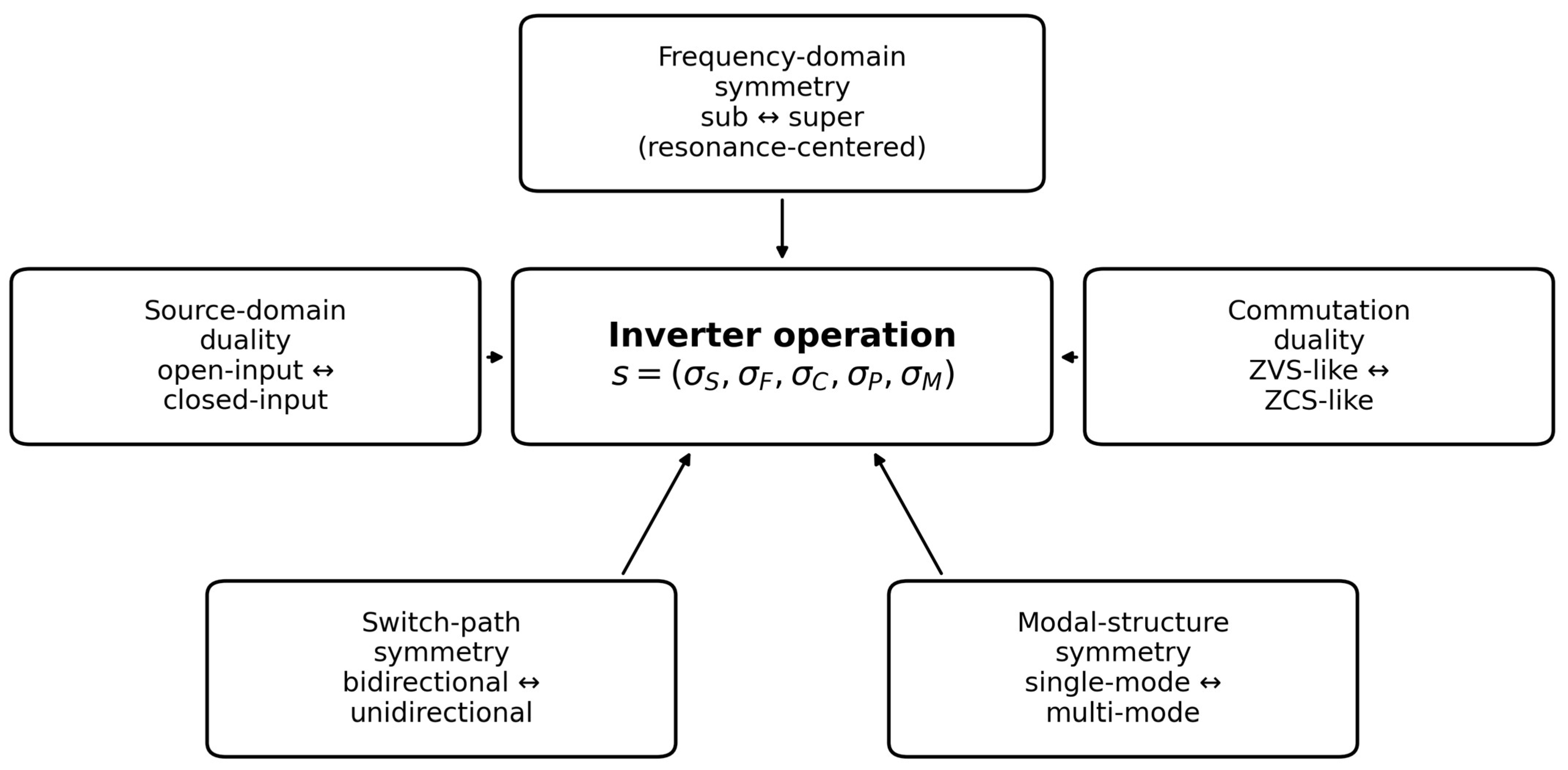
To visualize this hierarchy in a compact form,
Figure 1 summarizes the principal symmetry axes used throughout the paper to classify resonant inverter operation. The figure is intended as a conceptual map rather than a strict mathematical diagram: it shows how source-side condition, detuning relative to resonance, commutation tendency, switch-path feasibility, and modal structure together define the multidimensional symmetry space within which the subsequent regime analysis is developed. This representation also clarifies that the proposed framework does not reduce inverter symmetry to a single soft-switching criterion but organizes it across several coupled operating dimensions.
2.1. Source-Domain Symmetry: Open-Input Versus Closed-Input Excitation
Resonant inverters are commonly classified by their input nature as open-input (voltage-fed) and closed-input (current-fed) structures [
2,
4]. Open-input inverters are driven by a voltage-dominated DC link (typically supported by a large capacitor), whereas closed-input inverters are driven by a current-dominated DC link (typically supported by a large inductor). In the proposed framework, this open-/closed-input distinction represents the source-domain duality axis, which coexists with frequency-domain, commutation, and modal dualities rather than defining inverter behavior on its own.
To make this source-domain distinction more explicit,
Table 2 summarizes the principal structural and interpretive differences between open-input and closed-input resonant inverter classes. The comparison is not intended as a complete topology taxonomy, but as a compact source-side reference that supports the subsequent symmetry mapping and extended-duality analysis. In particular, it highlights that the open/closed classification defines the source-domain operating character, while the full regime interpretation still depends on frequency detuning, commutation tendency, path feasibility, and modal structure.
As shown in
Table 2, source-domain duality establishes the input-side operating character of the inverter but does not by itself determine the full commutation or modal behavior of the resonant regime.
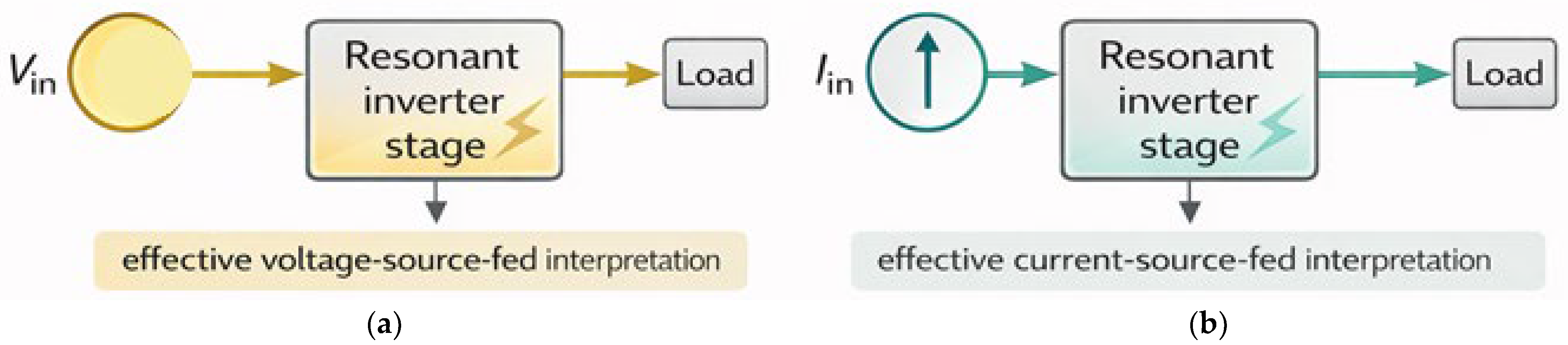
To clarify the physical meaning of the source-side regime descriptor used in the proposed signature formalism,
Figure 2 presents the two simplified equivalent source-side interpretations that underlie the regime comparison developed in this paper. In the open-input regime, the resonant inverter is interpreted as effectively voltage-source-fed, whereas in the closed-input regime it is interpreted as effectively current-source-fed. The figure is conceptual and intended to support regime interpretation rather than to provide a detailed switching-topology schematic.
Figure 2 should therefore be read as an interpretive aid for the source-side meaning of the regime descriptor, rather than as a taxonomy of converter implementations. Its role is to make explicit the input-side distinction that supports the extended-duality comparison developed in the following sections.
2.2. Frequency-Domain Symmetry: Sub-Resonant and Super-Resonant Regimes
A defining symmetry feature of resonant and quasi-resonant inverters is the dependence of behavior on the relation between operating angular frequency
ω and resonant frequency
ω0. A compact detuning coordinate is
δ =
ω/
ω0. Sub-resonant operation (
δ < 1) and super-resonant operation (
δ > 1) form a dual pair, while
δ = 1 is a symmetry-centered operating point. Crossing resonance reverses the sign of the effective reactance and exchanges the phase-leading/phase-lagging behavior between voltage and current [
3,
5].
For a series RLC tank, the impedance is
Z(
jω) =
R +
j(
ωL − 1/(
ωC)) [
3,
9]. In the sign convention used here, operation at
ω =
ω0 = 1/√(
LC) is the resonance-centered symmetry point where the reactive part vanishes and voltage and current are in phase. A convenient normalized description follows by defining the characteristic impedance
Z0 = √(
L/
C), the detuning ratio
δ =
ω/
ω0, and the quality factor
Q =
Z0/
R. Then the tank impedance can be written as
Z(
jω) =
R[1 +
jQ(
δ − 1/
δ)], and the fundamental phase shift is
φ(
δ,
Q) = arctan(
Q(
δ −
1/
δ)). Crossing
δ = 1 flips the sign of
φ, exchanging lead/lag relations and reshaping the commutation environment. This detuning sign therefore acts as a frequency-domain symmetry axis that partitions sub-resonant (
δ < 1) and super-resonant (
δ > 1) regimes.
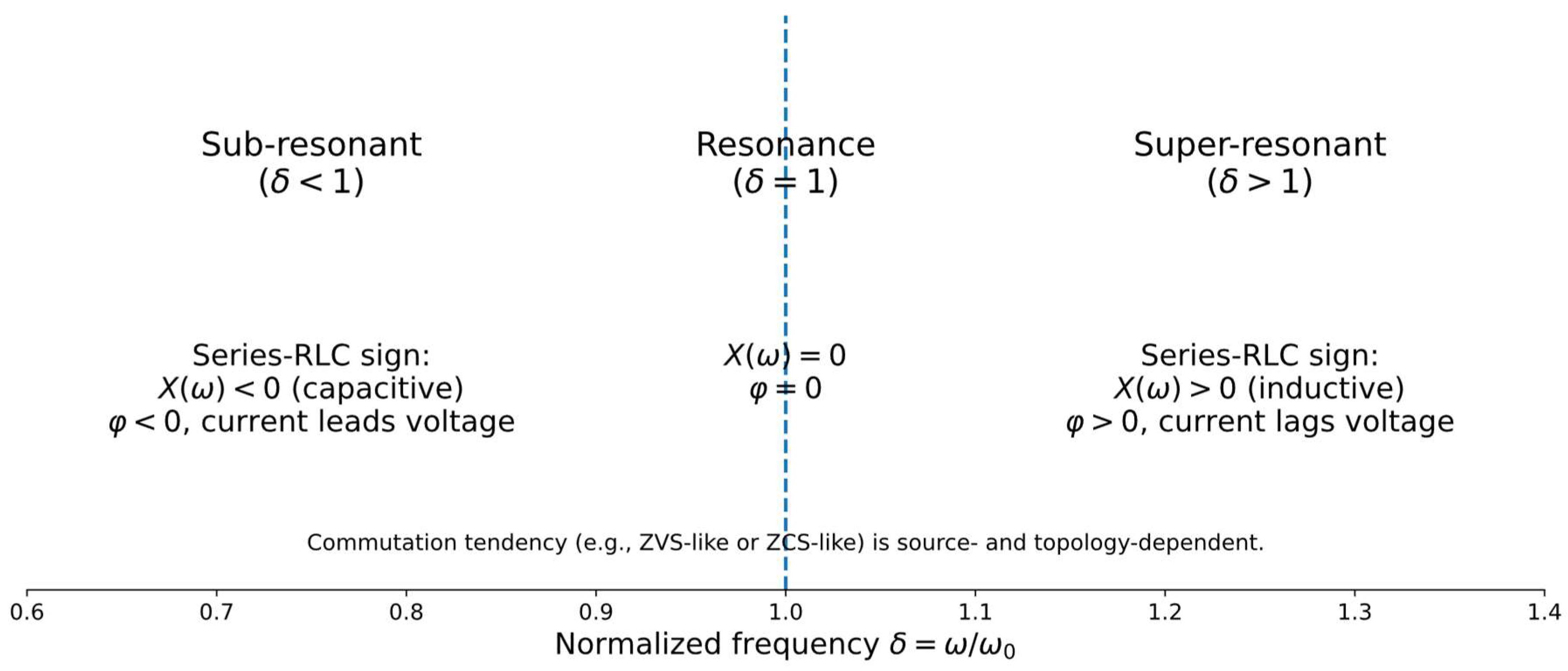
To make the frequency-side interpretation more explicit,
Figure 3 visualizes the resonance-centered symmetry structure induced by the detuning ratio
δ. The figure is intended as a conceptual frequency-domain map showing that resonance (
δ = 1) acts as the central symmetry point, while operation below and above resonance forms a dual regime pair with opposite phase orientation. In this way, the figure provides a compact visual anchor for the role of detuning as a primary symmetry axis in the proposed framework.
Figure 3 therefore makes explicit that the frequency-domain symmetry used in this paper is not merely a resonance condition, but a regime-partitioning principle that reshapes phase relation, commutation tendency, and the interpretation of dual operating states.
Example 1 (phase sign flip and regime labeling). Consider a series RLC tank with L = 20 μH and C = 100 nF, which yields f0 = 1/(2π√(LC)) ≈ 112.5 kHz and Z0 = √(L/C) ≈ 14.14 Ω. For an equivalent load resistance R = 5 Ω, the quality factor becomes Q = Z0/R ≈ 2.83. Using φ(δ,Q) = arctan(Q(δ − 1/δ)), we obtain φ(0.8,2.83) ≈ −51.8° (capacitive, δ < 1), φ(1,2.83) = 0°, and φ(1.2,2.83) ≈ +46.0° (inductive, δ > 1). Thus, crossing δ = 1 flips the sign of φ and swaps lead/lag relations, which in turn re-labels the commutation tendency on the signature map (e.g., for a voltage-fed half-bridge with reverse conduction paths, δ > 1 is typically ZVS-favorable, whereas δ < 1 tends to shrink the ZVS window and may shift operation toward ZCS-like or hard-switching behavior, depending on σP and dead time).
In signature notation, one may label the two operating points as s(δ = 0.8) = (open-input, sub-resonant, ZCS-like, bidirectional path, single-mode) and s(δ = 1.2) = (open-input, super-resonant, ZVS-like, bidirectional path, single-mode), emphasizing that the commutation tendency σC is regime-dependent and naturally linked to the detuning sign σF.
2.3. Commutation Symmetry and Modal Symmetry
Regardless of topology, inverter commutation can be interpreted as a boundary condition on switching waveforms. Voltage-symmetric commutation (ZVS-like behavior) corresponds to turn-on near a zero-voltage boundary, while current-symmetric commutation (ZCS-like behavior) corresponds to turn-off near a zero-current boundary. In resonant inverters, these tendencies often emerge as consequences of frequency-domain phase relations.
Inverters also exhibit modal symmetry because energy transfer is distributed across spectral components. Single-mode operation is dominated by one resonant mode (or the fundamental component), whereas multi-mode structures introduce additional symmetry degrees of freedom through multiple resonant frequencies and mode coupling [
3,
5].
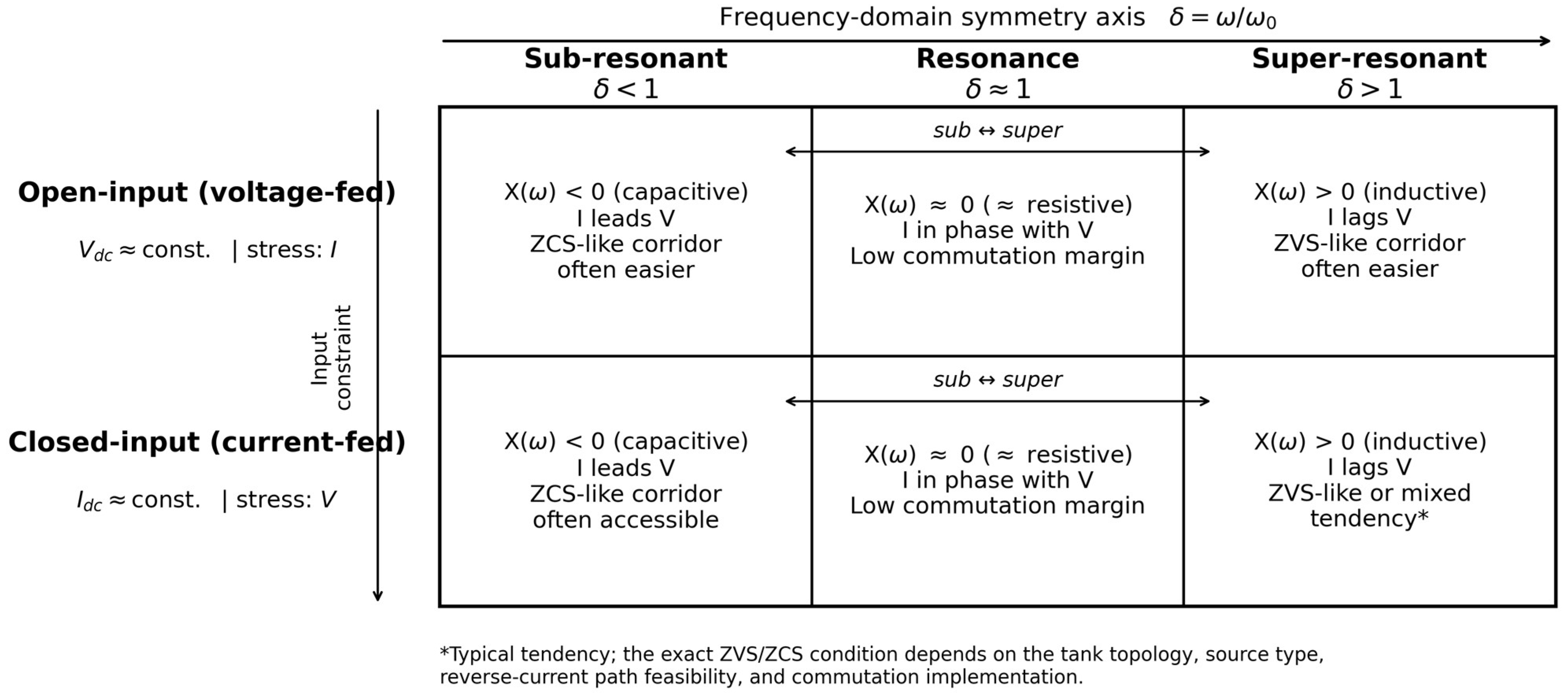
Figure 4 summarizes the combined source-domain and frequency-domain symmetry coordinates into a compact signature map that highlights the dual pairing of sub- and super-resonant operation for both open-input and closed-input resonant inverter structures. The map combines input-constraint symmetry (open-input/voltage-fed versus closed-input/current-fed) with frequency-domain symmetry (sub-resonant, near-resonant, and super-resonant operation). The sign of the effective tank reactance determines the lead/lag phase relation and typical ZVS-like or ZCS-like commutation tendencies (topology dependent).
Table 3 condenses the regime-level consequences of the symmetry axes introduced above. By combining the input-constraint symmetry (open-input/voltage-fed vs. closed-input/current-fed excitation) with the detuning coordinate
δ (sub-, near-, and super-resonant operation), the table provides a compact qualitative guide to phase behavior, commutation tendency, and stress/circulation redistribution (“cost of symmetry”).
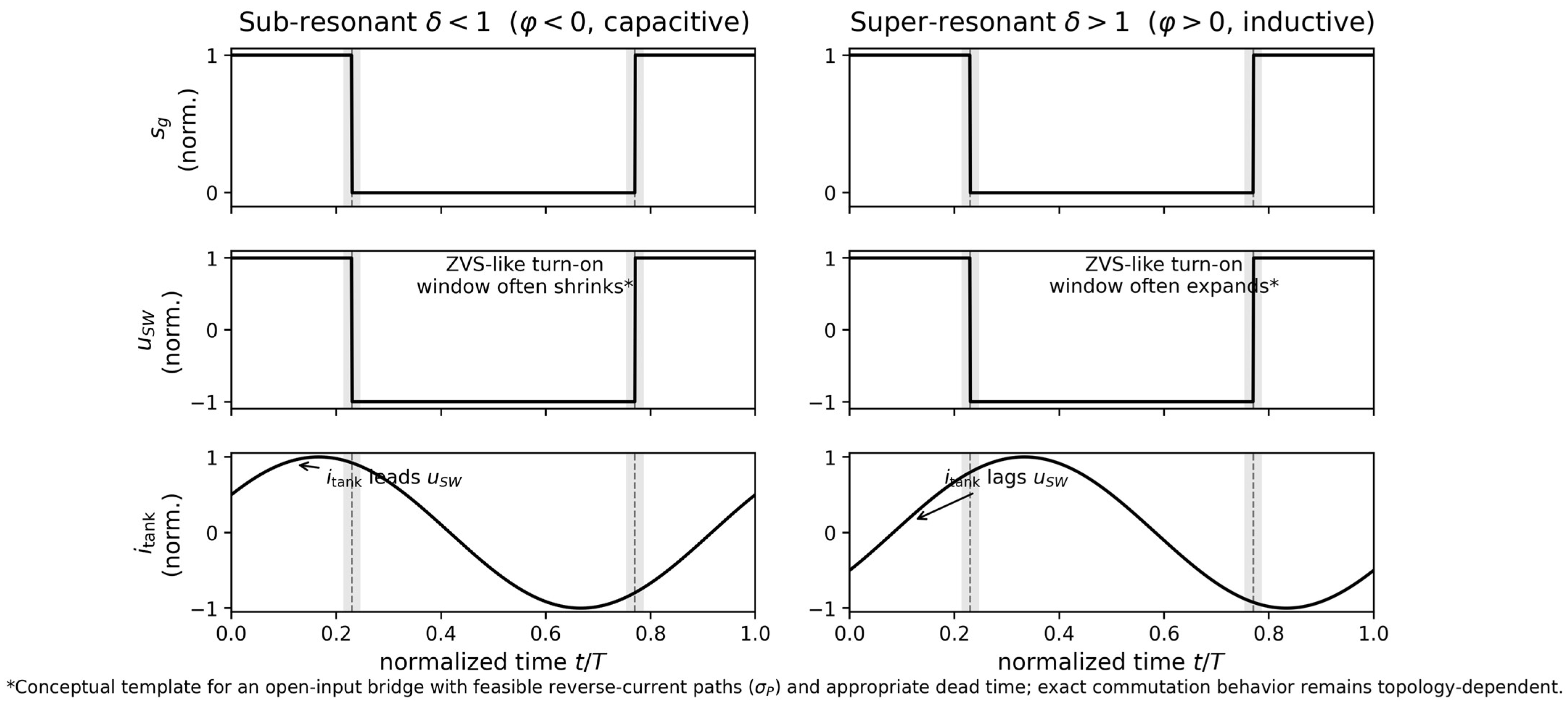
Figure 5 provides a time-domain template that complements the frequency-domain symmetry map. Since
φ(
δ,
Q) = arctan(
Q(
δ − 1/
δ)) changes sign at
δ = 1, the lead/lag relation between tank current and the switching function flips when crossing resonance. This flip is not merely descriptive: it changes the commutation environment and thus the typical soft-switching tendency. In particular, when reverse commutation paths exist (σP) and dead time is properly set, operation on the inductive side (
δ > 1) often supports ZVS-like turn-on because resonant current can complete capacitive charge/discharge during commutation, whereas operation on the capacitive side (
δ < 1) typically reduces that window and may require different timing or auxiliary measures.
2.4. Switch-Path Symmetry: With and Without Reverse Diodes
Beyond source- and frequency-domain symmetries, practical inverter realizations are strongly influenced by a device-level constraint: whether the switch leg provides a reverse-current path via antiparallel (reverse) diodes. This “switch-path symmetry” determines if the resonant current can naturally reverse through the switching network and how reactive energy is redistributed during dead times [
5,
7,
11].
In open-input (voltage-fed) bridge inverters, antiparallel diodes enable freewheeling intervals and clamp the switch-node voltage during commutation. Depending on the operating point, diode conduction can invert the instantaneous output voltage and may also allow partial energy return to the DC link.
In resonant inverters, antiparallel diodes (or MOSFET body diodes) typically support full-wave current trajectories and widen the domain of soft-switching-friendly operation, particularly in super-resonant regimes where current reversal naturally completes the charge/discharge paths of device and tank capacitances.
In contrast, resonant inverters without reverse diodes (or employing reverse-blocking switch legs) constrain current reversal and often reduce accessible operating regimes to half-wave or truncated trajectories unless an alternative commutation path is provided. As a consequence, operating modes become more tightly tied to detuning (ω/ω0), and forced commutation in continuous conduction tends to increase switching stress.
A useful symmetry-centered boundary regime occurs at ω = ω0, separating ω < ω0 (discontinuous trajectories with predominantly natural commutation) from ω > ω0 (continuous trajectories with forced commutation and a hard-switching tendency).
Therefore, the presence/absence of reverse diodes can be interpreted as a device-level symmetry axis that acts as a feasibility filter on the regime map: it does not change the source-domain (open-/closed-input) or frequency-domain (sub/near/super resonance) coordinates, but it affects which symmetry classes are practically achievable and how the “cost of symmetry” is distributed.
To make the device-level role of the switching path more explicit,
Table 4 summarizes how the presence or absence of reverse (antiparallel) diodes modifies the practical symmetry accessibility of resonant inverter operation. The comparison is intended to show that this device-level symmetry axis does not redefine the source-domain or frequency-domain coordinates of a regime, but strongly affects waveform continuity, commutation path availability, and the practical distribution of soft-switching “payment” and stress. In this sense, reverse-current capability acts primarily as a feasibility filter on the multidimensional regime map introduced earlier.
As shown in
Table 4, device-level symmetry mainly determines whether a formally meaningful regime remains practically accessible, and under what commutation or stress penalty this accessibility is achieved.
2.5. Symmetry Operators and Inverter Signature Vector
To make the symmetry framework operational (and closer to a formal symmetry language), it is useful to define a compact signature vector that records the discrete symmetry choices associated with a given inverter realization and regime. Let
s = (σS, σF, σC, σP, σM), where σS encodes the source-domain excitation (open- vs. closed-input), σF encodes the detuning side relative to resonance (sub- vs. super-resonant), σC encodes the commutation tendency (ZVS-like vs. ZCS-like), σP encodes switch-path reversibility (with vs. without reverse conduction), and σM encodes modal structure (single- vs. multi-mode). The signature components and their qualitative interpretation are summarized in
Table 5.
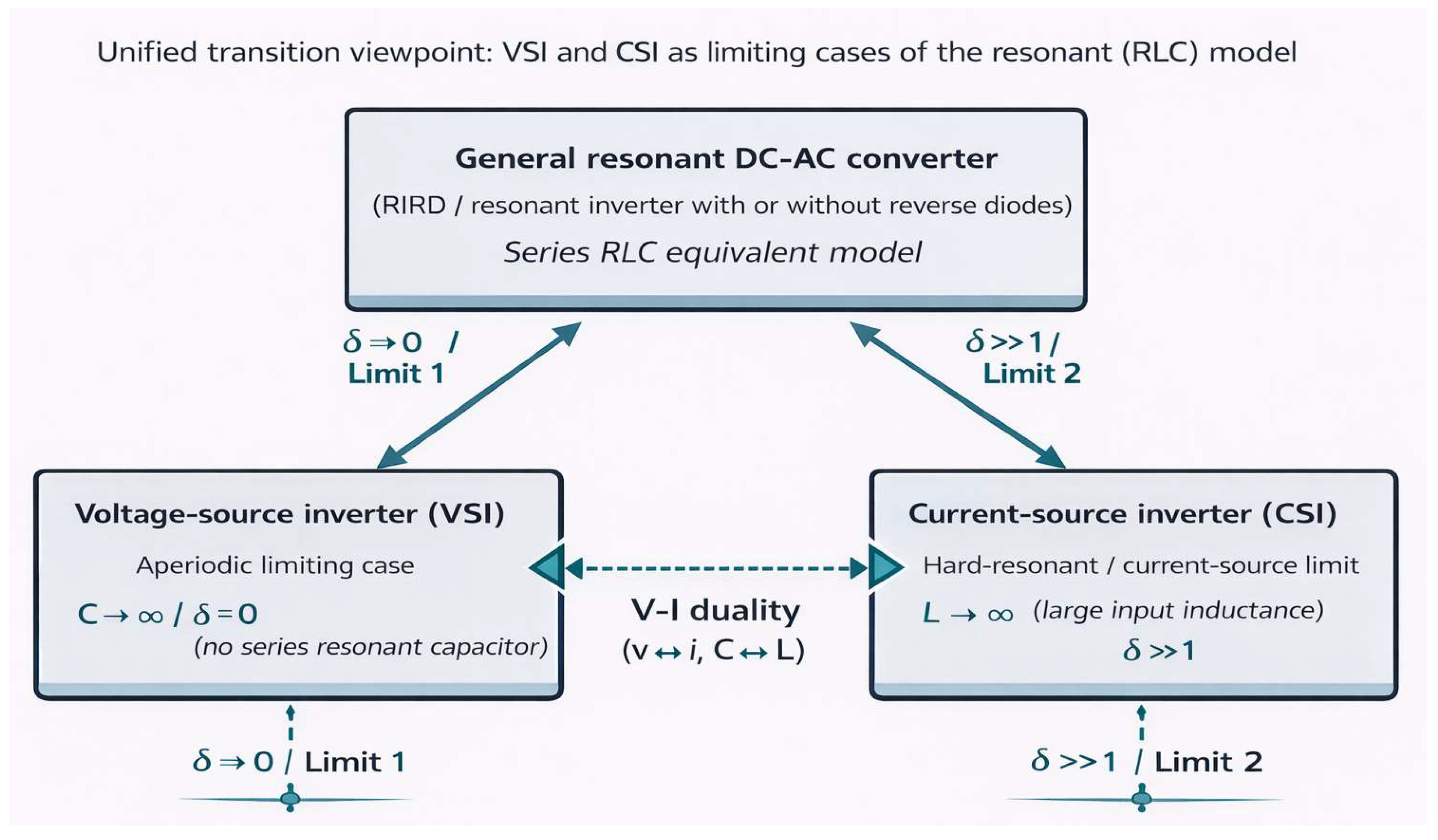
With this notation, classical duality transformations can be interpreted as operators that flip selected signature components. For example, source duality (VSI ↔ CSI) exchanges voltage and current variables and swaps the energy storage roles of capacitors and inductors, which corresponds to σS inversion; detuning inversion corresponds to σF inversion; and commutation duality corresponds to σC inversion. This operator viewpoint provides a concise bridge between the descriptive maps (
Figure 1,
Figure 2 and
Figure 3) and the design workflow developed in
Section 5.
To make the extended-duality viewpoint explicit and reusable,
Table 6 defines a minimal set of symmetry operators acting on the signature vector
s = (σS, σF, σC, σP, σM). Each operator flips one symmetry axis, while compositions generate dual regime pairings. These operators are descriptive rather than prescriptive: σP and σM act as feasibility filters, and specific topologies/control laws determine which signatures are practically attainable.
The operator view is intended for regime organization and does not imply that every topology supports every signature without additional commutation paths or control constraints.
Example 2 (extended-duality pairing in signature space). Consider an operating signature: s1 = (open-input, super-resonant, ZVS-like, bidirectional path, single-mode), which is representative of a voltage-fed bridge operated on the inductive side (δ > 1) with feasible reverse commutation paths. Applying the composed operator D_ext = D_S ∘ D_F ∘ D_C yields, s2 = D_ext(s1) = (closed-input, sub-resonant, ZCS-like, bidirectional path, single-mode). This pairing expresses, at regime level, how source-domain duality, detuning side inversion, and commutation-tendency inversion jointly map a ZVS-favorable operating corridor into its ZCS-favorable dual corridor under the adopted sign convention for φ(δ,Q).
In this interpretation, σP and σM do not generate duality by themselves; instead, they act as feasibility/robustness filters that determine whether a given signature is practically attainable and stable under drift.
2.6. Remarks on Operator Properties, Applicability, and Limits
The symmetry and duality operators introduced in this work are intended as regime-level descriptive mappings, not as a complete algebraic synthesis theory for all resonant inverter topologies. Their purpose is to organize operating regimes, reveal structured correspondences, and support early-stage interpretation of stress, commutation tendency, and dual operating behavior. In this sense, the framework is deliberately intermediate in scope: more structured than a purely qualitative analogy, but less general than a full graph-theoretic or network-theoretic equivalence formalism.
A useful distinction must therefore be made between descriptive commutation of operators and practical realizability of the corresponding transformed regime. At the descriptive level, operators such as frequency-side inversion and source-side inversion may be composed to generate meaningful regime pairings in the signature space. However, the physical interpretation of the transformed regime still depends on whether the resulting topology, current path, and switching sequence remain feasible under the relevant device, source, and resonant-tank constraints. Thus, operator composition is meaningful as a structured interpretive tool, but it does not guarantee direct implementability without additional topological and control verification.
Within this regime-level perspective, several quantities can be regarded as practical invariants or semi-invariants. These include:
- (1)
the dimensional structure of the regime signature vector;
- (2)
the resonance-centered interpretation of δ = ω/ω0 as a separator between below-resonance and above-resonance behavior;
- (3)
the descriptive pairing logic produced by combined source, frequency, and commutation inversion;
- (4)
the normalized interpretation of stress and commutation screening metrics as comparative indicators across related operating regimes.
At the same time, quantities such as soft-switching feasibility, current circulation severity, and stress distribution are not strict invariants; they are precisely the properties whose redistribution motivates the use of the extended-duality mapping.
The commutativity of the operators must also be interpreted with care. At a descriptive level, D_S and D_F may often be applied in either order without changing the broad regime interpretation, since they act on different semantic components of the operating signature. By contrast, operators associated with commutation tendency, path availability, and modal structure are more sensitive to contextual constraints. In particular, D_C, D_P, and D_M should not be interpreted as universally commuting in a strict algebraic sense, because the feasibility of a transformed commutation regime depends on path continuity, resonant current polarity, device conduction direction, and control timing. For this reason, the present manuscript does not claim a complete commutative operator algebra; rather, it proposes a structured transformation logic whose applicability is bounded by converter topology and operating regime.
This is especially important for the roles of σP and σM. In the present formulation, these terms are best understood as feasibility and robustness descriptors, not as primary duality generators. The path descriptor σP indicates whether the transformed regime preserves or loses a physically meaningful resonant current path, while the modal descriptor σM indicates whether the regime remains structurally coherent across the interval of operation or undergoes boundary-sensitive modal transition. In other words, these descriptors act as filters on the practical usefulness of a regime transformation rather than as independent sources of duality.
The limits of the framework should therefore be stated explicitly. First, the proposed operators do not establish circuit isomorphism in the strict topological sense. Second, parasitics, dead time, nonlinear output capacitance, reverse recovery effects, and layout-dependent current paths may degrade or even invalidate an otherwise neat descriptive pairing. Third, mode transitions near resonance or near conduction-boundary conditions may destroy simple dual correspondence even when the signature-level mapping remains formally meaningful. Accordingly, the framework should be interpreted as a regime-screening and organization tool that supports insight, comparative reasoning, and early-stage design exploration, while detailed waveform verification, non-ideal simulation, and experimental assessment remain necessary for final engineering validation.
For these reasons, the extended-duality formalism proposed in this paper should be interpreted as a structured methodology for mapping, screening, and comparing resonant DC-AC inverter operating regimes under source-condition and frequency-side inversion. The additional path and modal descriptors are introduced primarily to assess practical feasibility and regime consistency.
It should also be emphasized that the purpose of the proposed symmetry operators is not to introduce a new analytical model of resonant converters. Instead, the operators provide a structured language for organizing and comparing operating regimes that are already described by classical resonant-tank models and switching analysis. In this sense, the framework complements existing modeling approaches rather than replacing them.
4. Soft Switching and Stress Distribution as Global Symmetry Consequences
The mathematical expressions used in this section follow standard resonant-tank relations widely used in the analysis of resonant power converters. These expressions are not introduced as new models, but rather as a common analytical basis that allows the symmetry-based regime interpretation to be expressed in a compact and comparable form.
Soft switching in resonant inverters is often presented as a design objective achieved through specific circuit arrangements or modulation strategies. Within the symmetry-based view, soft switching is interpreted as a global consequence of symmetry selection in the combined source-frequency–commutation space.
Voltage-symmetric (ZVS-like) commutation emerges when the switching-node voltage is naturally driven toward a near-zero boundary before turn-on via resonant charge/discharge processes. Current-symmetric (ZCS-like) commutation emerges when resonant current trajectories naturally cross zero near turn-off. In many resonant inverter applications, these behaviors are regime consequences governed by detuning and load phase rather than independent goals [
2,
35].
Importantly, symmetry restoration redistributes stress. When commutation symmetry protects one variable at the switching boundary, the conjugate variable typically experiences increased peak or RMS stress during the resonant interval. Thus, soft switching should not be interpreted as a lossless improvement, but as a trade between reduced switching losses and increased conduction/reactive losses or stress. This perspective motivates the notion of a cost of symmetry, expressed in stress margins and circulating energy.
Section 4.1 formalizes these tendencies using normalized stress, circulation, and margin metrics [
3,
5].
4.1. Symmetry-Based Stress, Circulation, and Margin Metrics
To complement the qualitative symmetry axes introduced in
Section 2 and the extended-duality discussion in
Section 3, it is useful to attach compact, dimensionless metrics to inverter operating regimes. The purpose of these metrics is not to replace topology-specific loss models, but to provide symmetry-sensitive indicators that (i) quantify the commutation-stress “payment”, (ii) capture the circulating/RMS burden associated with resonant shaping, and (iii) express robustness margins under detuning and parameter drift.
Let usw(t) denote the switch-node voltage and isw(t) the switch current in a representative semiconductor device (or bridge leg) over one steady-state period. Let UDC and IDC denote the DC-link voltage and current, used as natural normalization references for open-input (voltage-fed) and closed-input (current-fed) excitation, respectively. Let I1 denote the RMS value of the fundamental component of the AC tank/load current. On this basis, the following minimal metric set is introduced.
Commutation-stress factors (boundary-centered). We define the normalized peak-voltage stress factor and peak-current stress factor as:
These factors quantify the peak commutation stress associated with restoring a given commutation symmetry tendency. Regimes that are ZCS-like often shift the burden toward higher switch-node voltage excursions (higher kV(AC)), whereas regimes that are ZVS-like often require resonant current trajectories that increase current peaks (higher kI(AC)). The symmetry map predicts this directionality at family level, while topology-dependent details set the numerical magnitude.
RMS/circulation factor (cost of symmetry). Soft switching reduces switching loss but generally redistributes burden into conduction and reactive circulation. To express this effect, we define an RMS circulation factor normalized to the fundamental load current:
When kRMS(AC) > 1, the switching network carries additional circulating current beyond what is needed to deliver the fundamental load power, which typically maps into increased conduction loss (in switches and passive elements) and increased tank loss. Under a fixed on-resistance (or equivalent static conduction model), conduction-related loss scales approximately with Irms2; thus, the penalty associated with RMS inflation scales as kRMS(AC)2.
Frequency-domain phase margin. Because detuning relative to resonance is a primary symmetry axis, the fundamental phase shift provides a compact robustness handle. For a series-RLC interpretation of the tank (
Section 2.2), the phase shift can be written as [
5]:
Crossing δ = 1 flips the sign of φ, exchanging lead/lag relations and reshaping the commutation environment. From a design viewpoint, |φ| provides a commutation “margin”: maintaining |φ| ≥ φmin over the expected operating corridor (load drift, component tolerances, and temperature variation) preserves the intended detuning side symmetry and reduces the risk of mode transitions that invalidate soft-switching expectations.
Boundary-alignment margin metrics (commutation feasibility). In addition to peak/RMS stress and detuning margin, practical soft switching requires boundary alignment at the switching instants. To express this requirement in a compact, implementation-agnostic form, we define two dimensionless boundary-alignment margins.
ZVS-like boundary margin. Let
Qeq denote the effective charge swing required to commutate the switch-node voltage to (or near) zero before turn-on (e.g., based on device/node charge data at
UDC). Let
icomm(
t) denote the commutating current available during dead time (typically a tank/leg current component that charges/discharges the effective node capacitances). Over the allocated dead-time interval DT, the available net commutating charge is:
The ZVS-like boundary-alignment margin is then defined as:
A first-order estimate often used for screening is when icomm(t) is approximately constant over DT.
ZCS-like boundary margin. Let
istart denote the switch-path current at the start of the turn-off commutation interval CT. Let
Leq be an equivalent commutation inductance governing the current change during CT and let
uL(
t) be the corresponding voltage across this inductance (topology/control dependent). The available magnitude of current change during CT is:
The ZCS-like boundary-alignment margin is defined as:
A first-order screening estimate is , when uL(t) ≈ Ueq over CT.
In this interpretation, mZVS ≥ 1 indicates sufficient commutation “effort” to reach usw ≈ 0 within dead time, while mZCS ≥ 1 indicates sufficient volt–second action to drive the current to (or through) zero before turn-off. Both margins are intended for regime screening and robustness reasoning under drift (load/Q, detuning, parasitics), rather than as replacements for detailed time-domain verification.
The metric definitions and their design interpretation are summarized in
Table 7.
Illustrative dual examples (method demonstration). The following half-sinusoidal examples are intentionally illustrative and local to the dominant commutation interval; they demonstrate symmetry-induced RMS/peak inflation trends rather than full-period loss calculations.
Current-domain illustration (ZVS-like RMS inflation). Assume a commutation-stage current approximated over its dominant interval by a half-sinusoid i(t) = Ipk·sin(ωt), 0 ≤ ωt ≤ π. Its RMS value over that interval is Ipk/√2. If, illustratively, enforcing a ZVS-like boundary requires Ipk = 2·I1, then kRMS(AC) ≈ (2/√2) ≈ 1.41, and the conduction-loss penalty scales as kRMS(AC)2 ≈ 2.0 for a fixed on-resistance model.
Voltage-domain dual illustration (ZCS-like voltage excursion). Analogously, assume a commutation-stage switch-node voltage approximated by u(t) = Upk·sin(ωt), 0 ≤ ωt ≤ π, with RMS value Upk/√2. If enforcing a current-symmetric (ZCS-like) boundary requires Upk = 2·UDC, then kV(AC) = 2 and a corresponding RMS-based voltage factor evaluates to (2/√2) ≈ 1.41. This dual example mirrors the current-based case and reinforces the “cost of symmetry” interpretation: ZVS-like regimes tend to pay primarily through increased current peaks and RMS circulation, whereas ZCS-like regimes tend to pay primarily through increased voltage excursions.
Taken together, these metrics provide a compact quantitative layer above the signature map: they enable early screening of feasible commutation classes, identification of the dominant stress channel, and prioritization of detailed circuit-level modeling in the subsequent symmetry-guided design workflow (
Section 5).
4.2. Recommended Use of the Symmetry Formalism in Engineering Screening
The proposed symmetry formalism is intended to be used as a structured engineering screening tool rather than as a substitute for topology-specific switched analysis. Its practical role is to reduce ambiguity during early-stage regime comparison by organizing source-side interpretation, frequency-side detuning, commutation tendency, path feasibility, and modal coherence within a single descriptive framework.
A practical use sequence can be summarized in four steps. First, the candidate regime is classified using the signature vector s = (σS, σF, σC, σP, σM), which identifies the source-domain excitation, detuning side relative to resonance, intended commutation orientation, reverse-path feasibility, and modal structure. Second, the nominal regime is screened using the comparative indicators kI(AC), kV(AC), kRMS(AC), |ϕ|, mZVS and mZCS, which identify the source-domain excitation, cost, stress redistribution, and commutation feasibility. Third, the screened regime is interpreted as margin-rich, boundary-sensitive, or stress-dominated, depending on whether the relevant commutation margin remains comfortably above unity or approaches the practical threshold. Fourth, only the most promising candidates are carried forward to more detailed non-ideal waveform simulation, timing-sensitivity assessment, and hardware-oriented validation.
In this role, the formalism does not claim to determine the final converter implementation directly. Instead, it provides a compact regime-screening layer that helps narrow the candidate operating space before more expensive validation steps are undertaken. This staged interpretation is particularly useful when several inverter families or detuning corridors must be compared under similar commutation or stress objectives.
5. Design Implications
The proposed symmetry framework is intended to be actionable: it turns qualitative regime selection into a structured methodology that connects (i) input constraints, (ii) detuning side, and (iii) device-level commutation paths to the expected soft-switching tendency and dominant stress/loss channel. The normalized stress/circulation and phase-margin metrics introduced in
Section 4.1 provide compact quantitative handles for this screening.
5.1. Symmetry-Guided Design Methodology
The methodology starts by choosing the primary symmetry constraint imposed by the surrounding system. If the front end naturally behaves as a stiff voltage source (large DC-link capacitor), a voltage-fed (open-input) inverter is a natural match; if it behaves as a stiff current source (large DC-link inductor), a current-fed (closed-input) inverter is natural. The signature then guides the subsequent choices of tank type and operating region.
Next, detuning is treated as a symmetry control knob rather than an afterthought. Near resonance (δ ≈ 1) the tank is symmetry-balanced (small reactive part), often yielding good efficiency and reduced stress, but potentially reduced commutation margin. Moving away from resonance increases |φ| and may strengthen a particular commutation tendency, at the expense of increased RMS circulation and sensitivity. The map therefore suggests selecting a detuning corridor that preserves the desired sign of φ while meeting power regulation needs.
Finally, device-level symmetry (σP) and modal structure (σM) are checked. For example, antiparallel diodes may be essential to guarantee the intended commutation path during dead time, while start-up and light-load operation may introduce additional modes that require explicit treatment rather than being viewed as “exceptions”. Current-fed resonant inverter implementations in wireless power-transfer systems illustrate how blocking diodes and overlap-time management can become part of the symmetry signature that ensures safe commutation under frequency drift [
31,
32,
33,
34].
5.2. Symmetry-First Workflow and Robustness Checks
A key point is that the frequency-domain phase relation φ(δ,Q) provides a quantitative handle on frequency-domain symmetry: the sign of φ fixes whether the tank is effectively inductive or capacitive, while |φ| provides a commutation “margin.” In practice, designers may specify a minimum phase margin |φ| ≥ φmin at the switching instants to maintain ZVS/ZCS under parameter drift (e.g., component tolerances, temperature variation, and load-dependent Q). Within this workflow, the symmetry signature s becomes a compact label for the assumptions that must remain invariant across the operating range.
When a fixed-frequency strategy is required (EMI constraints, magnetic design, or system-level synchronization), the map clarifies which additional degree of freedom must compensate for load drift: reactive-element control, phase shift, pulse density modulation, or auxiliary commutation networks that enlarge the symmetry-feasible region without changing the fundamental operating frequency [
27,
28,
29,
30].
To translate the proposed symmetry formalism into a more design-oriented perspective,
Table 8 summarizes a qualitative symmetry-first workflow derived from the signature map. The purpose of the table is not to prescribe a rigid synthesis algorithm, but to show how the regime descriptors (σS, σF, σC, σP, σM) can be used as a structured sequence of engineering questions that guide source-side selection, detuning choice, commutation targeting, device-path feasibility, and modal robustness. In this way, the symmetry map is connected more explicitly to early-stage inverter design reasoning.
As shown in
Table 8, the proposed symmetry formalism is useful not only for regime interpretation, but also as a compact pre-synthesis framework for organizing early-stage resonant inverter design decisions.
To further delimit the intended use of the proposed framework,
Table 9 summarizes what the regime-level formalism captures well and what still requires detailed converter-specific validation. This clarification is important because the value of the method lies in structured comparison and screening, not in replacing switched-model analysis or experimental engineering verification.
As shown in
Table 9, the strength of the proposed symmetry formalism lies in early-stage regime organization, qualitative comparison, and screening-oriented engineering reasoning. Its limitation is equally important: final converter acceptance still depends on detailed switched-model simulation, parasitic-aware timing analysis, and application-specific validation.
5.3. Practical Design Conveniences
The main practical benefit of the symmetry map is that it provides quick, topology-agnostic screening rules before detailed time-domain design:
Open-input (voltage-fed) realizations tend to “pay” for soft commutation in current stress; closed-input (current-fed) realizations tend to pay in voltage stress. This guides early semiconductor and passive sizing.
For series-resonant voltage-fed bridges, super-resonant (δ > 1) operation is typically ZVS-favorable because the tank appears inductive and diode/freewheel paths naturally pre-commutate device capacitances; the dual current-fed case tends to favor ZCS under the corresponding detuning sign.
Reverse diodes (or MOSFET body diodes) are not a minor implementation detail: they change the admissible commutation paths and therefore the effective symmetry class σP, especially near the resonance-centered boundary δ ≈ 1.
A robust design target is not a single operating point but a symmetry-feasible region in (δ,Q) where the phase sign is preserved and the commutation margin is nonzero. Fixed-frequency control strategies can be interpreted as maintaining this region while regulating power by pulse density or phase shift.
5.4. Topology and Regime Selection Heuristics
Practitioners often ask a forward design question: given a target load corridor and a semiconductor platform, which inverter family is the most natural starting point? Although the symmetry map is intentionally topology-agnostic, it supports compact selection heuristics that mirror the ZVS/ZCS trade intuition in quasi-resonant DC–DC converters: protecting the voltage boundary (ZVS-like) typically increases current peaks and RMS circulation (
kI(AC),
kRMS(AC)), whereas protecting the current boundary (ZCS-like) typically increases voltage excursion (
kV(AC)). Device physics often provides the first commutation preference: MOSFET-based high-frequency legs tend to benefit from ZVS-like turn-on because of reduced capacitive switching loss, whereas IGBT-based high-power legs may benefit from ZCS-like turn-off to mitigate tail-current-related losses. Load drift primarily acts through the effective quality factor
Q and detuning
δ, often shrinking |
φ| at lighter loading (larger effective
R); therefore, |
φ| should remain at or above
φmin over the expected load range to preserve the intended commutation tendency (
Section 4.1).
To make this practitioner-oriented selection logic more explicit,
Table 10 summarizes representative engineering scenarios together with the corresponding symmetry targets and first design checks. The table is not intended as a rigid design prescription, but as a compact guide showing how dominant constraints—such as semiconductor type, load uncertainty, fault exposure, fixed-frequency operation, or reverse-path limitations—map onto preferred regime choices within the proposed symmetry framework.
As shown in
Table 10, the proposed symmetry framework can support not only descriptive regime classification, but also early topology-screening decisions by linking source-side choice, commutation objective, and stress-oriented verification metrics.
Practical note (quick estimation). For series-RLC-dominated tanks, the phase relation φ(δ,Q) can be estimated directly from nominal L, C and the expected equivalent-load corridor R, providing an immediate regime pre-check: the sign of φ selects the commutation tendency, while |φ| provides a robustness margin. A first-order circulation estimate can be obtained by relating Isw,rms to the fundamental load current I1 via waveform factors (e.g., half-sinusoidal commutation segments yield kRMS(AC) ≈ Ipk/(√2·I1)). If the resulting kRMS(AC)2 penalty becomes unacceptable at the target power level, the symmetry map suggests two systematic relief options: (i) shift the commutation tendency toward the dual boundary (ZVS-like ↔ ZCS-like), accepting the conjugate stress channel; or (ii) move to a different source constraint (open ↔ closed) or modal structure (single ↔ multi) so that commutation is protected without excessive circulation.
These heuristics formalize common inverter-design intuition into a symmetry-consistent selection step, allowing detailed circuit- and control-level optimization to be focused on the most structurally plausible regime class.
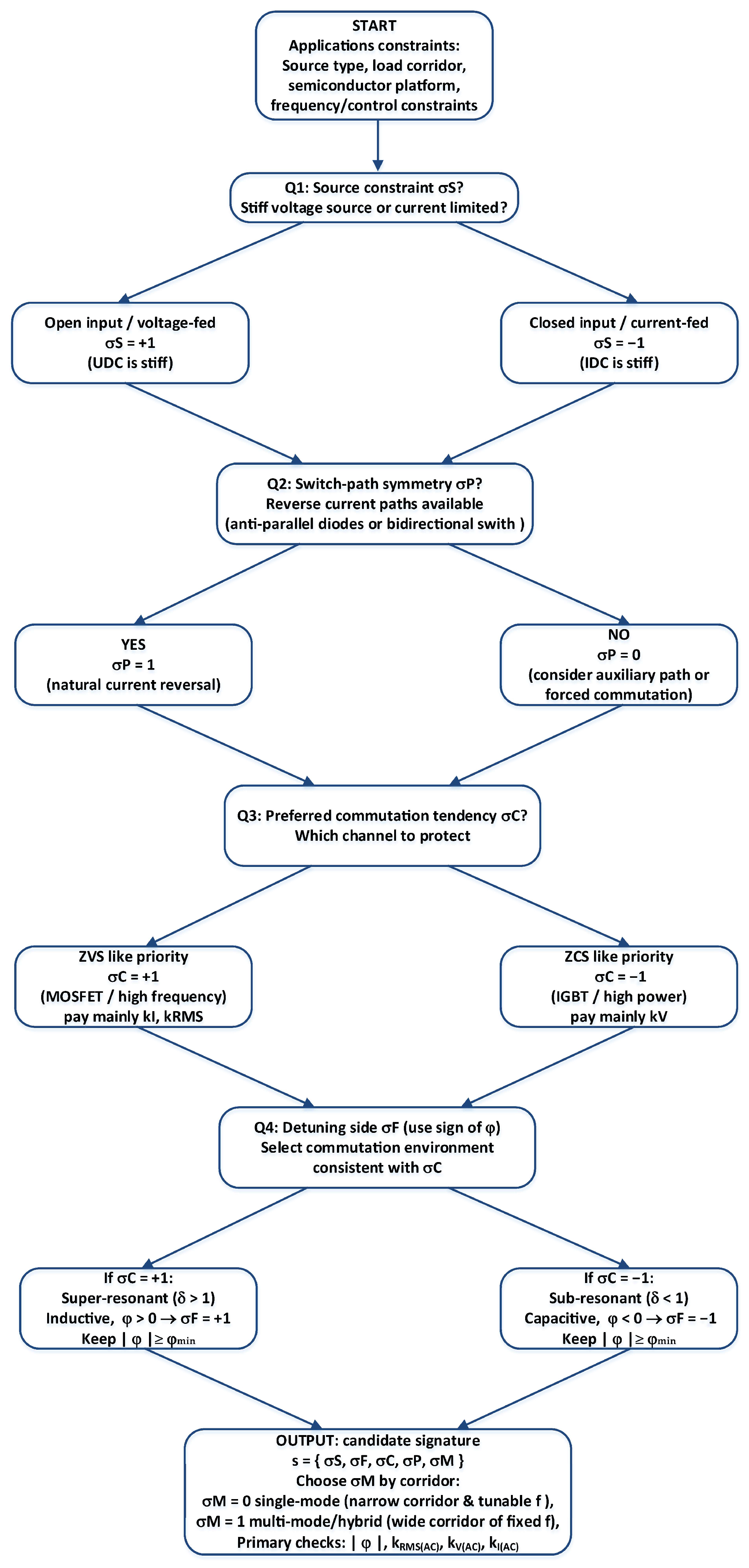
For fast early-stage screening,
Figure 7 provides a compact, signature-driven decision tree that maps typical application constraints into a candidate symmetry signature
s and highlights the primary check metrics.
5.5. Case Study A: Wide-Bandgap Voltage-Fed Series-Resonant Half-Bridge Above Resonance (ZVS Corridor and Qoss Sensitivity)
This case study operationalizes the signature-guided workflow in a device-relevant setting by explicitly connecting the ZVS-like boundary-alignment margin mZVS to wide-bandgap (WBG) semiconductor node-charge characteristics. The target regime signature is sA = (open-input, super-resonant, ZVS-like, bidirectional path, single-mode), representing a voltage-fed bridge operated on the inductive side of resonance with reverse current paths available (σP).
Tank and regime coordinates. To preserve comparability with Example 1, the same series RLC tank is used: L = 20 μH and C = 100 nF (f0 ≈ 112.5 kHz, Z0 ≈ 14.14 Ω). The normalized detuning coordinate is δ = ω/ω0 and the quality factor is Q = Z0/R. The tank impedance is Z(jω) = R[1 + jQ(δ − 1/δ)], with phase shift φ(δ,Q) = arctan(Q(δ − 1/δ)). For a half-bridge producing a square output voltage ±UDC/2, the RMS value of the fundamental component is V1,rms = (√2/π)UDC, yielding I1,rms = V1,rms/|Z| and Ipk = √2·I1,rms.
WBG-linked ZVS screening margin. In the symmetry-based metric layer (
Section 4.1), ZVS-like boundary alignment is captured by a charge-based margin
mZVS =
Qav/
Qeq. For early-stage screening,
Qav can be approximated as |
iedge|·DT, where DT is the dead time and
iedge is the commutating current available during DT. Using a fundamental-only approximation, |
iedge| ≈
Ipk·|sin
φ|. The effective node-charge swing
Qeq is preferably evaluated using device output-charge data at
UDC (e.g.,
Qoss) rather than a linear capacitance approximation. For a symmetric half-bridge leg, a practical screening approximation is
Qeq,leg ≈
Qoss,H(
UDC) +
Qoss,L(
UDC) ≈ 2·
Qoss,device(
UDC).
Table 11 summarizes representative (illustrative) device-class
Qoss values used here to visualize how WBG technology shifts the ZVS-feasible corridor. These values are not tied to a specific part number; they only represent typical separation between Si, SiC and GaN device classes.
Screening results and ZVS corridor shift.
Table 12 reports screening values of
mZVS for representative operating points (
δ,
Q) on the super-resonant side. A robust ZVS-like boundary alignment is expected when
mZVS ≥ 1, while
mZVS < 1 indicates insufficient commutating charge within DT under the adopted screening assumptions. The table illustrates a key WBG implication: reducing
Qoss reduces
Qeq and therefore increases
mZVS at fixed (
δ,
Q,DT), expanding the ZVS-feasible corridor toward lighter loading (smaller
Q) and toward
δ → 1.
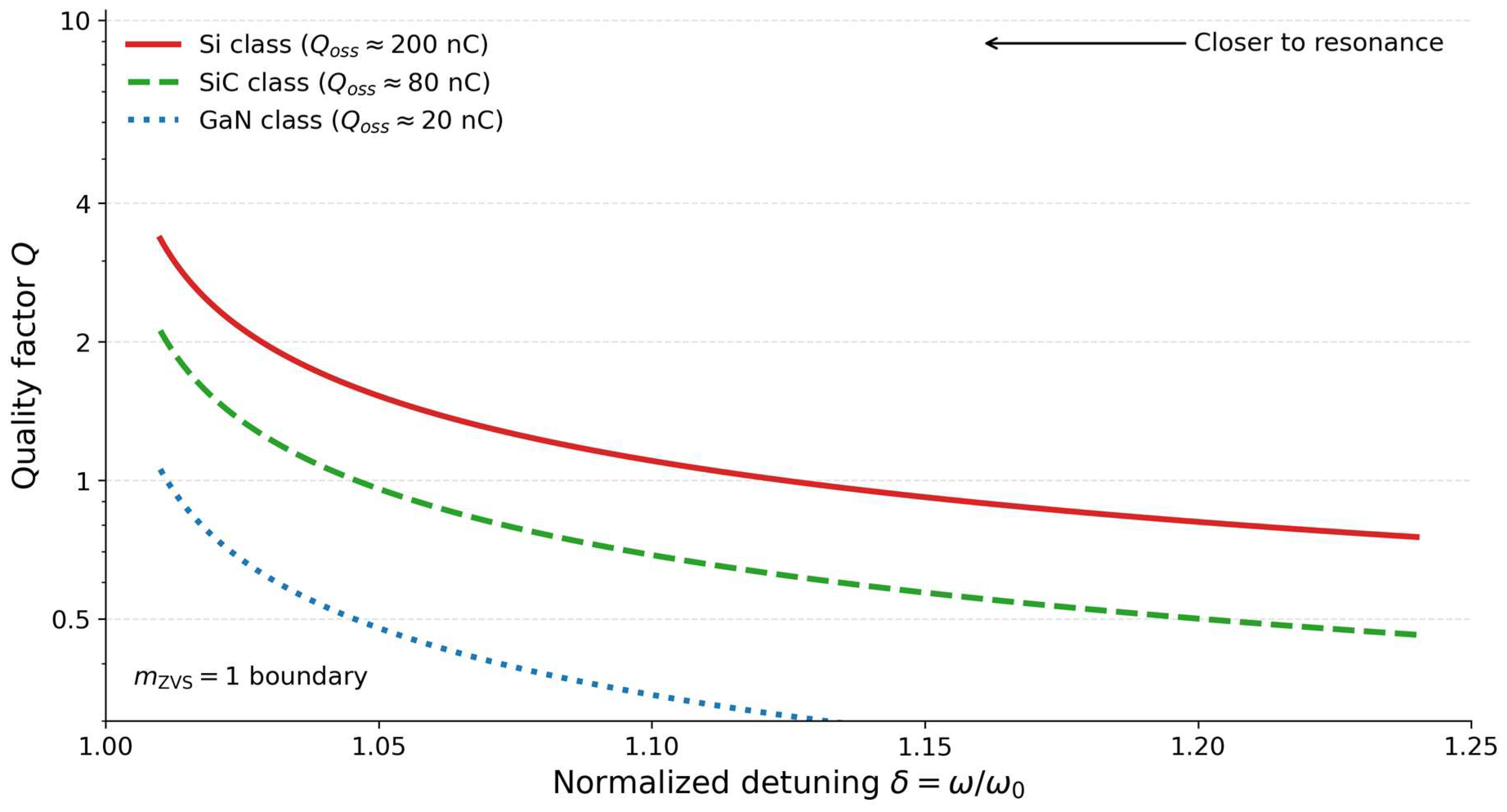
Figure 8 visualizes the ZVS-feasible corridor by plotting the boundary
mZVS(
δ,
Q) = 1 for the three device classes of
Table 11. For a fixed tank and DT, the boundary shifts toward resonance as
Qoss decreases, which is particularly relevant for GaN and SiC devices.
Time-domain verification (Simulink/LTspice). To confirm the screening trends, a switching time-domain model is set up in Simulink (Simscape Electrical) or LTspice with: (i) an ideal half-bridge with explicit dead time DT; (ii) nonlinear device output charge implemented either via a
Coss(v) element or via a
Qoss(v) table; (iii) a bidirectional reverse-current path consistent with σP (body diode for Si/SiC MOSFETs, third-quadrant conduction model for GaN); and (iv) the series RLC tank and load corresponding to the selected Q values. Boundary alignment is checked by sampling the switch-node voltage at each device turn-on instant (
usw(
t_
on)), while stress/circulation factors
kI(AC) and
kRMS(AC) are computed from peak and RMS device currents over a steady-state period. A practical validation point is that operating points with
mZVS ≥ 1 from
Table 10 should correlate with
usw(
t_
on) approaching zero before turn-on, whereas
mZVS < 1 should correlate with partial commutation and increased turn-on loss.
Simulation setup for Case A. A complementary half-bridge switching model was implemented with the same tank parameters as above (
L = 20 μH,
C = 100 nF), with the series resistance R chosen to realize the targeted
Q at each operating point (
R =
Z0/
Q,
Z0 ≈ 14.14 Ω). The DC bus was set to
UDC = 400 V and complementary gating was applied with dead time DT = 100 ns. Device output charge was represented by an equivalent nonlinear node capacitance parameterized by the device-class
Qoss values of
Table 10 (implemented either as a voltage-dependent
Coss in SPICE or as an energy/charge-consistent capacitor element in Simulink). All other non-idealities (gate-drive delays, package inductances, diode reverse recovery) were kept idealized in this verification step so that the waveforms isolate the regime- and
Qoss-driven ZVS margin trend predicted by
mZVS.
ZVS-like alignment was evaluated by checking whether the switch-node voltage completed the transition to the opposite rail within DT before device turn-on (|vSW| approaching 0 V or UDC, respectively), while the tank current sign at the boundary matched the expected commutating direction. Each simulation was run for sufficient cycles to reach periodic steady state; reported waveforms correspond to the last cycle.
To validate the regime-level screening based on the ZVS boundary-alignment margin
mZVS, time-domain switching simulations were carried out for two representative operating points located on different sides of the screening boundary
mZVS = 1.
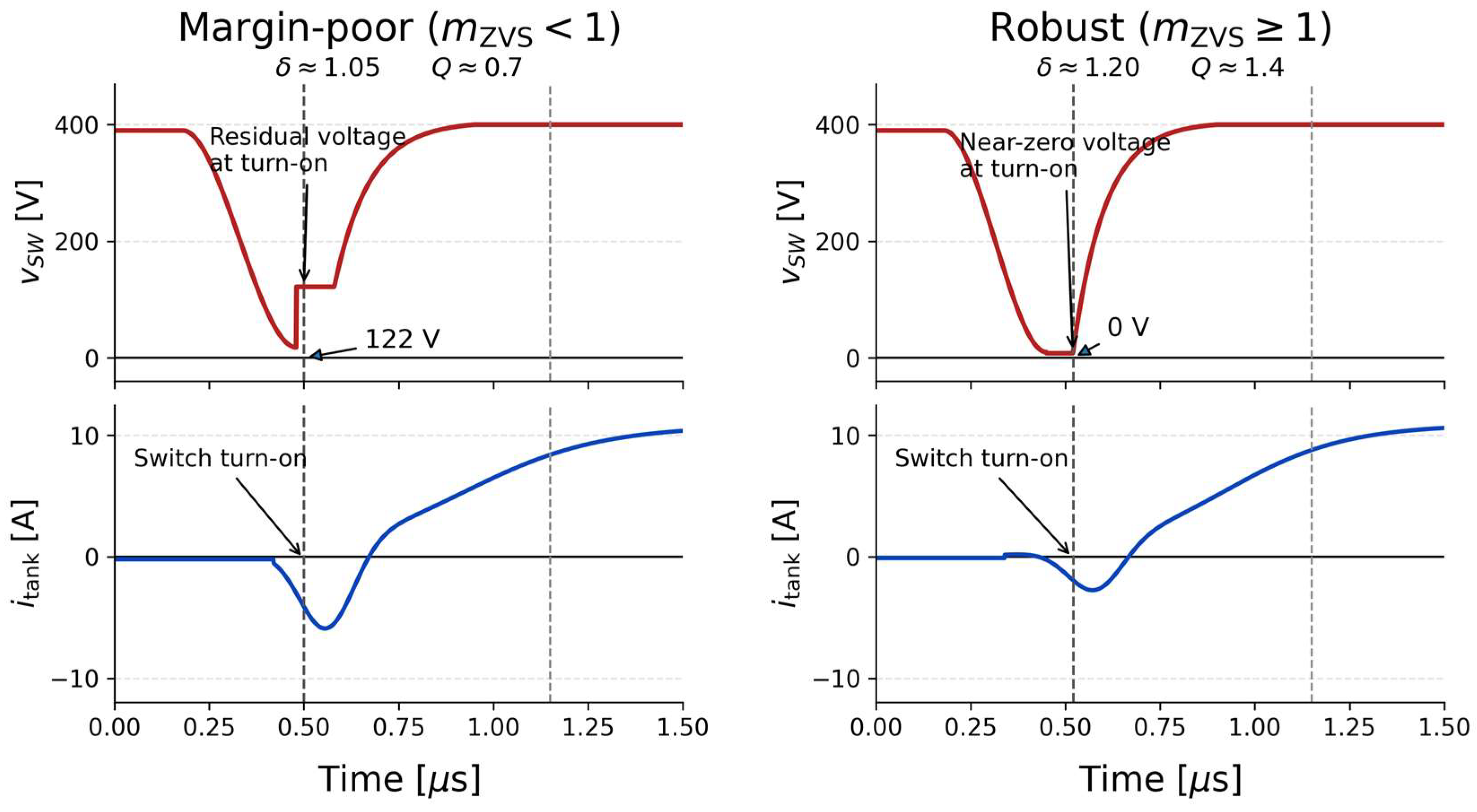
Figure 9 compares a margin-poor point (
mZVS < 1) close to resonance and under lighter loading with a robust super-resonant point (
mZVS ≥ 1) at higher detuning and moderate load.
In the margin-poor case (e.g., δ ≈ 1.05, Q ≈ 0.7), the available commutating charge during dead time is insufficient to fully discharge the switch-node capacitances before turn-on. As a result, the switch-node voltage remains significantly above zero at the switching instant, indicating partial or lost ZVS-like boundary alignment. In contrast, in the robust case (e.g., δ ≈ 1.20, Q ≈ 1.4), the larger phase shift ∣φ∣ provides higher commutating current during dead time, enabling the switch-node voltage to approach zero before turn-on. This confirms the predictive value of the symmetry-based margin mZVS.
The waveforms also illustrate the associated cost of symmetry: strengthening ZVS feasibility by moving further into the super-resonant regime increases current excursion and RMS circulation, consistent with the trends captured by the stress and circulation metrics introduced in
Section 4.1.
To make the waveform-level meaning of the screening margin more explicit,
Figure 9 compares two representative operating points from Case Study A: a margin-poor point with
mZVS < 1 and a margin-rich point with
mZVS ≥ 1. The purpose of this comparison is not to replace detailed switched-model validation, but to illustrate how the proposed margin interpretation is reflected in the time-domain relation between switch-node voltage and resonant-tank current at the commutation instant.
Cost of symmetry note (WBG context). While lower Qoss expands the ZVS corridor, WBG devices also enable higher dv/dt and di/dt, which can increase EMI and ringing sensitivity. In this framework, these effects can be interpreted as additional implementation-level “payment” (layout/clamp requirements) on top of the current-domain inflation captured by kI(AC) and kRMS(AC).
5.6. Case Study B: Wide-Bandgap Closed-Input Excitation Below Resonance (Dual ZCS Corridor and Voltage-Stress Payment)
This case study provides the dual counterpart of Case A under closed-input (current-fed) excitation. While Case A (open-input, super-resonant) protects the voltage boundary and shifts the dominant payment to the current domain, Case B (closed-input, sub-resonant) protects the current boundary and shifts the dominant payment to the voltage domain. In signature notation, sB = (closed-input, sub-resonant, ZCS-like, bidirectional path, single-mode) is obtained from sA by applying the composed symmetry operator D
ext introduced in
Section 2.5.
Excitation model and screening normalization. For regime screening, the closed-input source is represented as an approximately constrained square-wave current excitation ±IDC feeding the same series RLC tank as in Case A. The RMS value of the fundamental current component is approximated as I1,rms ≈ (2√2/π)·IDC (full-wave square excitation). Then V1,rms = I1,rms·|Z| and Vpk ≈ √2·V1,rms provide a first-order estimate of voltage excursion. The peak-voltage stress factor is kV,pk ≈ Vpk/UDC,nom, where UDC,nom is a nominal DC voltage used for normalization.
Voltage-stress payment and device voltage class.
Table 13 reports screening estimates of
Vpk and
kV,pk for representative sub-resonant operating points. The same table also evaluates
Vpk relative to two common WBG voltage classes (650 V and 1200 V), illustrating how closed-input/light-load corridors can violate the 650 V class even when the normalized stress
kV,pk is moderate with respect to a 400 V nominal bus. This simple screening step therefore acts as an early feasibility filter when selecting GaN versus SiC platforms for closed-input resonant operation.
ZCS-like boundary-alignment margin (screening). In the metric layer of
Section 4.1, ZCS-like feasibility is expressed by a volt–second margin
mZCS comparing the available current-change capability during a commutation interval CT to the current that must be reduced to reach a zero-current boundary. For screening, one may use
mZCS ≈ (|
ucomm|·CT)/(
Leq·|
istart|). The commutating voltage u
comm is topology dependent; for a regime-level estimate it scales with the tank voltage at the commutation instant and therefore increases with |sin
φ(
δ,
Q)|, while it collapses as
φ → 0 near resonance. Accordingly, sub-resonant operation (
δ < 1,
φ < 0) tends to widen ZCS-like corridors, but at the price of increased voltage excursion (higher
kV).
It is important to emphasize that the proposed margins mZVS and mZCS are not formal proofs of commutation success. They are structured regime indicators whose usefulness lies in comparative pre-selection. Final acceptance of a candidate operating regime still requires waveform-level confirmation under non-ideal timing, parasitic, and device-dependent conditions.
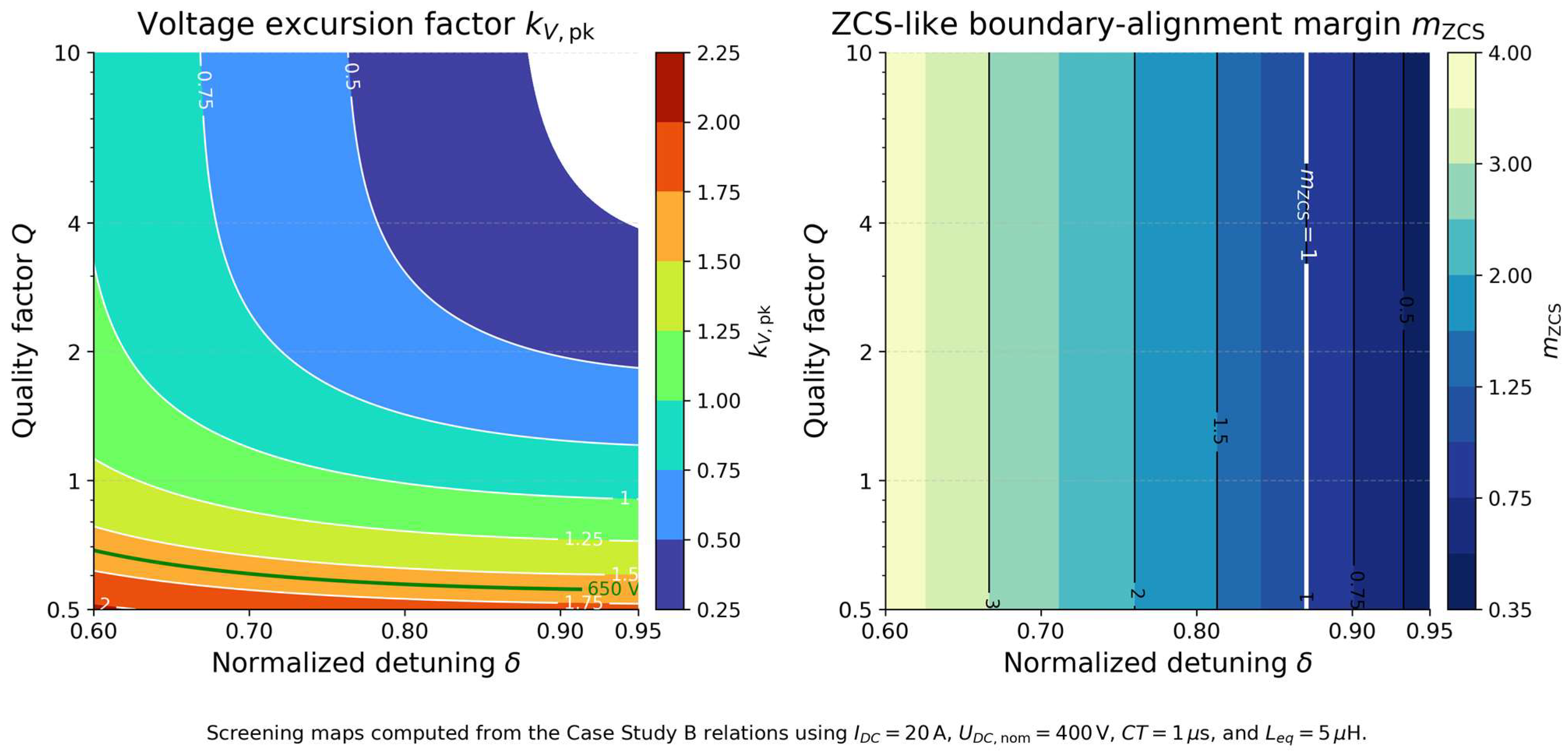
Figure 10 visualizes this dual corridor by plotting (i)
kV,pk(
δ,
Q) contours and (ii) the boundary
mZCS(
δ,
Q) = 1 for the chosen (CT,
Leq,
IDC) commutation setting. The combined plot makes the dual trade-off explicit: moving deeper sub-resonant strengthens ZCS-like feasibility (higher
mZCS) while increasing voltage stress (higher
kV,pk), especially at light load (smaller
Q).
Time-domain verification (Simulink/LTspice). A switching model of a representative current-fed resonant inverter (e.g., current-fed full-bridge or push–pull with input inductor and clamp network) is then used to verify: (i) that device current at turn-off reaches (or crosses) zero within the commutation interval (ZCS-like boundary alignment), and (ii) that peak switch-node/clamp voltages remain within the selected device voltage class. Measured waveforms should include switch current around turn-off, switch-node voltage, and clamp/diode currents (if present).
Simulation setup for Case B. A current-fed switching model was configured by enforcing the input constraint with a large input inductor (LDC ≫ L, e.g., on the order of mH) or an ideal controlled current source, delivering IDC = 20 A (square-wave excitation ±IDC) into the same series RLC tank. A practical overvoltage path was represented with a clamp to the DC link (e.g., diode/active clamp to UDC,nom = 400 V), allowing the model to capture the expected voltage-excursion ‘payment’ when operating below resonance. Operating points were selected with δ < 1 and Q values matching the screening table, using R = Z0/Q for consistency with the normalized map.
ZCS-like alignment was evaluated by inspecting device current around turn-off and confirming that
iSW(
t_
off) reached (or crossed) zero within the commutation interval CT (used in the screening estimate of
mZCS), while simultaneously checking peak switch-node and clamp voltages (
Vpk) against the chosen device voltage class. Waveforms recorded for
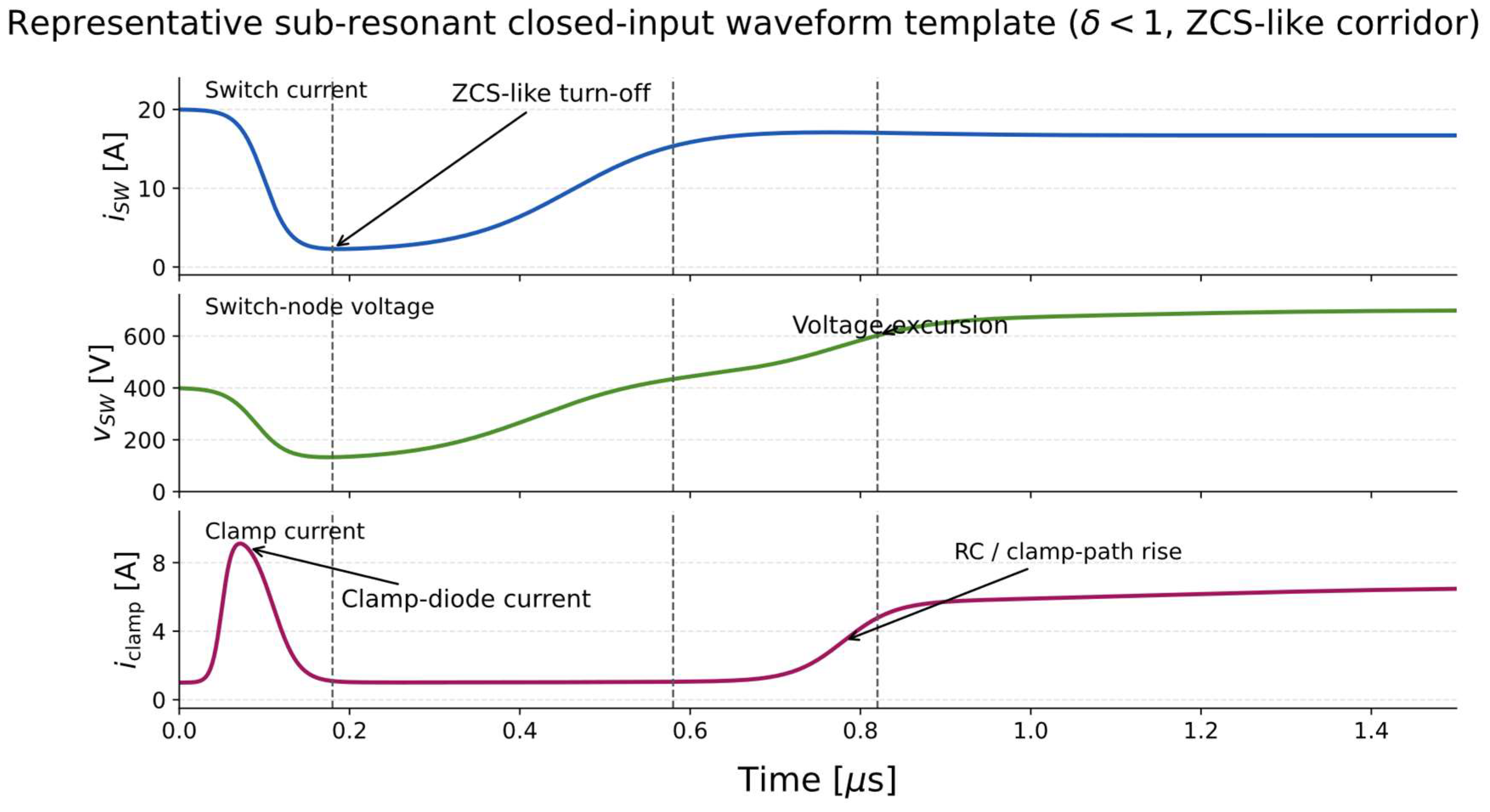
Figure 11 include
iSW,
vSW, and clamp current (if present) in the last steady-state cycle.
To corroborate the sub-resonant screening results of
Figure 8, time-domain switching simulations were performed for representative operating points within and near the predicted ZCS-like corridor.
Figure 11 illustrates a case in which the screening margin
mZCS ≥ 1 is satisfied, highlighting the characteristic current-symmetric (ZCS-like) turn-off behavior and the associated voltage-domain “payment”.
At the selected sub-resonant operating point (δ < 1), the resonant current naturally approaches zero within the commutation interval CT, and the device current crosses (or nearly crosses) zero before turn-off. This confirms current-boundary alignment consistent with a robust ZCS-like margin. However, as predicted by the symmetry-based screening maps, the strengthened ZCS feasibility is accompanied by increased switch-node voltage excursion. The voltage rise during commutation activates the clamp/diode path, redistributing energy and limiting peak stress but introducing additional voltage-domain burden.
The combined current, voltage, and clamp-current waveforms therefore make explicit the dual trade-off identified in the regime map: moving deeper into the sub-resonant corridor increases mZCS while shifting the dominant stress channel toward voltage excursion and clamp involvement. This time-domain verification confirms that the symmetry-based metrics mZCS and kV,pk provide consistent early-stage predictors of commutation feasibility and stress redistribution.
To illustrate the waveform-level meaning of the ZCS-oriented screening interpretation,
Figure 11 presents the representative time-domain verification for Case Study B at the selected sub-resonant operating point. The figure is intended to show how current-boundary alignment, switch-node voltage rise, and clamp-path activation appear together when the regime is driven toward stronger ZCS-like turn-off. In this way, the waveform set provides a direct visual counterpart to the symmetry-based indicators
mZCS and
kV,pk.
The numerical results presented in this paper are intended as regime-verification studies rather than as benchmark optimization campaigns. To improve reproducibility, the selected case studies specify the tank structure, detuning regime, normalized screening quantities, and the qualitative operating targets used for waveform verification. The figures were generated directly from the corresponding numerical simulations to ensure consistency between the analytical screening interpretation and the observed time-domain behavior.
5.7. Sensitivity of the Regime-Screening Interpretation to Non-Idealities
The regime-screening interpretation developed in this paper is intentionally formulated at an idealized or near-idealized descriptive level, so that the symmetry and extended-duality structure can be expressed in a compact and comparable way across operating conditions. However, practical resonant inverter operation is inevitably influenced by non-idealities that may alter commutation margins, redistribute stress, or weaken an otherwise clear regime pairing.
The most relevant non-idealities include:
- (1)
dead-time variation and timing mismatch;
- (2)
voltage-dependent output capacitance and nonlinear device charge effects;
- (3)
parasitic inductance in the commutation path;
- (4)
reverse-path conduction non-idealities associated with finite recovery or conduction asymmetry.
These effects do not necessarily invalidate the proposed regime-level interpretation, but they can reduce the reliability of margin-based screening if they are ignored in detailed design validation.
From a regime-screening perspective, the main impact of such non-idealities is to shift the practical threshold at which a nominally favorable commutation tendency becomes robust in waveform-level behavior. For example, a regime classified as margin-rich under idealized assumptions may become only boundary-feasible when dead time increases or when parasitic inductance delays the intended current transition. Similarly, nonlinear output capacitance may alter the effective charge-displacement requirement for voltage-side commutation, thereby modifying the practical interpretation of mZVS even when the idealized signature remains unchanged.
For this reason, the screening indicators proposed in this work should be interpreted as first-stage comparative metrics rather than as final acceptance criteria. Their value lies in identifying promising regimes, stress redistribution trends, and symmetry-consistent pairings before detailed non-ideal simulation or experimental refinement is performed. In practical design workflows, the regime-screening stage should therefore be followed by parasitic-aware simulation, timing-sensitivity analysis, and hardware-oriented verification.
To make this limitation more explicit,
Table 14 summarizes the expected qualitative influence of several common non-idealities on commutation margins and stress-oriented interpretation.
Table 14 reinforces an important point of the present work: the proposed formalism is most useful as a structured regime-screening framework, not as a substitute for non-ideal design validation. Non-idealities primarily affect the practical robustness of the margin interpretation rather than the descriptive logic of the regime pairing itself. This distinction is important for maintaining both the usefulness and the proper limits of the extended-duality approach.
5.8. Discussion: Dual Pairing and WBG Design Implications
Taken together, the two case studies instantiate the extended-duality pairing on the signature map. Case A (open-input, δ > 1) emphasizes a ZVS-like corridor whose feasibility scales with commutating current and the effective node charge Qeq; WBG devices reduce Qeq via lower Qoss and therefore enlarge the ZVS-feasible region. The dual Case B (closed-input, δ < 1) emphasizes a ZCS-like corridor whose feasibility grows with available commutating volt–seconds, while the dominant cost of symmetry appears as voltage excursion and clamp/device voltage stress. Thus, the framework predicts and organizes a device-aware trade: WBG benefits (low Qoss, high-speed commutation) directly strengthen soft-switching margins, but also demand explicit attention to voltage class selection, dv/dt-related parasitics, and EMI-oriented implementation constraints.
5.9. Consistency Between Screening Metrics and Time-Domain Verification
To clarify the practical meaning of the proposed screening indicators,
Table 15 summarizes the consistency between the regime-level commutation margins and the time-domain behavior observed in the representative numerical case studies. The purpose of this comparison is not to claim that the metrics replace detailed waveform validation, but to show that they provide a useful early-stage indication of soft-switching tendency, circulation severity, and regime robustness. In this sense, the metrics are intended as structured screening tools for comparative regime assessment rather than as stand-alone guarantees of final converter performance.
The comparison in
Table 15 supports the intended role of the proposed screening metrics: they do not replace detailed switched-model simulation, but they do provide a meaningful regime-level indication of commutation favorability, circulation severity, and stress redistribution. This is particularly useful in early-stage exploration, where many candidate regimes must be screened before detailed non-ideal validation is performed.
5.10. Scope and Limitations
The proposed symmetry/extended-duality map is intended as a regime-level framework for early-stage reasoning, screening, and explanation. Accordingly, the quantitative corridor indicators (e.g., mZVS, mZCS, kV,pk) are deliberately low-order and rely on simplifying assumptions (fundamental approximation for tank waveforms, idealized switch timing, and reduced device parasitic representation). They should be interpreted as comparative design metrics rather than as final-rating calculations.
In practical hardware, additional effects can shift the boundaries and alter the ‘cost of symmetry’, including package and layout inductances, voltage-dependent Coss and reverse recovery behavior, magnetic nonlinearities, dead-time jitter, and EMI-constrained gate-drive shaping. For publication-quality design closure, the workflow therefore requires a second stage consisting of detailed device models, thermal limits, and experimentally validated parasitic extraction, while the symmetry coordinates (source constraint, detuning sign, commutation boundary, and mode count) remain useful as a consistent organizing backbone across that refinement.
6. Conclusions
This paper proposed a symmetry-oriented interpretation of resonant DC-AC inverter operation in which duality is treated as a global organizing principle rather than a topology-specific observation. While open-input versus closed-input excitation remains a fundamental source-domain duality axis, practical inverter behavior is jointly governed by frequency-domain detuning relative to resonance, commutation boundary alignment, and modal structure.
Within the proposed framework, soft switching is interpreted as an emergent consequence of symmetry selection, and stress redistribution is recognized as the cost of symmetry. The framework complements conventional topology-based classifications by providing a compact conceptual map linking operating regimes, phase behavior, soft-switching tendencies, and stress/loss trade-offs. Future extensions include explicit treatment of multi-resonant and multi-mode families, where modal symmetry and higher-dimensional detuning become central organizing variables.
The contribution of the present manuscript should therefore be understood as a structured regime-level formalism for interpreting symmetry and extended duality in resonant DC-AC inverter operation, rather than as a complete topology-isomorphism theory or a substitute for detailed non-ideal validation. Its main value lies in providing a consistent framework for comparing open-input and closed-input operating regimes, organizing dual-pair reasoning, and supporting early-stage screening of commutation tendency, circulation severity, and stress redistribution. In this sense, the proposed approach is intended to improve conceptual clarity and design-stage regime selection, while leaving final waveform-level verification, parasitic-aware simulation, and experimental assessment as necessary steps for engineering deployment.
Future work should extend this regime-level framework toward parasitic-aware validation, experimentally supported dual-pair assessment, and broader applicability across additional resonant inverter classes and modulation conditions.