1. Introduction
Sustainable development concerns the well-being of all humanity, and higher education plays an important role in achieving sustainable development goals. In this regard, the United Nations has expanded the focus of sustainable development goals from primary and secondary education to higher education, incorporating the advancement of higher education into the global development agenda through a series of charters. In 2015, the United Nations released Transforming Our World: The 2030 Agenda for Sustainable Development, which included education as one of the global sustainable development goals. In November of the same year, the United Nations Educational, Scientific and Cultural Organization (UNESCO) adopted the Education 2030 Framework for Action, which stated that education is not only an important goal of sustainable development, but also an important means to successfully achieve other sustainable development goals. In 2022, during the 77th UN Education Summit, it was emphasized that education must drive global sustainable development. By 2024, at the UN Higher Education for Sustainable Development Initiative (HESI) Forum, education was further elevated to a fundamental public good and prioritized at the forefront of the global political agenda [
1]. Contemporary sustainable theory considers economic growth, social welfare, and ecological environment as the three goals of sustainable development, forming a perfect “three-dimensional composite system” of sustainable development. Under the guidance of this theoretical framework, the tripartite game system established in this article, consisting of local governments, local universities, and teachers, has also formed a miniature version of a sustainable “three-dimensional composite system” [
2]. The sustainable investment of local governments in the transformation of local universities is related to the effective and responsible optimization of limited educational resources to maximize the long-term stable development of local universities; the sustainable development of local universities is related to the ability of the university system to maintain long-term goals; the sustainability of teacher development is related to fair participation, empowerment, shared status recognition, and the stability of the allocation system.
As a strategic pivot in the classification-based reform of higher education, the transformation of local undergraduate institutions into applied technology universities has become a crucial support for building an upgraded version of China’s economy. Consequently, how to effectively facilitate the transformation and development of these universities has drawn extensive scholarly attention. Within academic circles, two divergent perspectives have emerged. One group of scholars advocates that the government should streamline administration and delegate power, minimizing intervention in the allocation of educational resources during the transformation process [
3]. Another group, however, contends that the government should enhance the supply of mandatory institutional measures, arguing that this aligns with the logical collective response of organizations adapting to changes in their institutional environment [
4]. In practice, due to the complexity of local university transformation and the multiplicity of stakeholders involved, focusing solely on the influence of macro-level policies may lead to partial or biased conclusions. The endogenous drivers of transformation in local universities mainly stem from two sources: the institution’s own recognition and exploration of transformation, and the extent of teachers’ proactive engagement [
5]. Nevertheless, as the transformation progresses, conflicts among various stakeholders have become increasingly intertwined. The remarkable stability and significant inertia displayed by local universities throughout this process still fall considerably short of the expectations held by the policymakers who designed the official transformation policies [
6,
7,
8,
9].
The transformation and development of local universities constitute a complex systemic endeavor with broad implications—one that depends primarily on external support from local governments, while drawing endogenous momentum from the combined agency of both the institutions and their faculty. Within the driving system of transformation involving local governments, universities, and teachers, the latter hold comparatively fewer resources, less influence, and a weaker voice, creating a distinct power asymmetry relative to the government and university authorities. In the top-down implementation of transformation policies, faculty interests are often overlooked. Under the dual governance of government and university administration—and often incentivized by material reward policies—teachers may appear to engage proactively in the transformation process. In reality, however, their participation tends to be delayed and half-hearted, falling short of a wholehearted commitment to the profound institutional changes required. Therefore, unless local governments can adequately represent the interests of the teaching community, the vision of a collaborative transformation ecosystem—built on consultation, co-creation, and shared benefits—will remain little more than rhetoric.
Based on evolutionary game theory, this paper constructs a tripartite evolutionary game model involving local governments, universities, and teachers. Using numerical simulations, it depicts the evolutionary paths of the system under different transformation processes and further identifies key factors that influence the promotion of transformational development in universities. The findings indicate that the transformation of local universities requires coordinated efforts from both external and internal actors. Externally, local governments should improve policy communication, strengthen financial support and regulatory oversight, and broaden university revenue channels by guiding industry–academia collaboration. Internally, universities should enhance incentive mechanisms for faculty and increase compensation for participation in transformation activities. Within the tripartite game framework, it is essential to identify the optimal equilibrium point where external support and internal motivation are aligned, enabling the three parties to collaborate effectively in building a harmonious transformation ecosystem.
2. Literature Review
Evolutionary game theory originated in the 1970s with the work of Smith and Price, who introduced the core concept of the “Evolutionarily Stable Strategy” (ESS). Initially applied to study evolutionary dynamics in biological populations [
10], this theory moves beyond the traditional assumption of perfect rationality in classical game theory. Instead, it builds on the concept of bounded rationality and helps explain the emergence and evolution of social behaviors—such as cooperation, punishment, and fair distribution—thus becoming an important tool for interdisciplinary research. Over time, evolutionary game theory gained recognition and developed rapidly as it provided insights into significant issues across various fields. Through continuous theoretical refinement and empirical application, it has evolved into the relatively comprehensive theoretical system in use today [
11,
12,
13,
14,
15,
16,
17,
18,
19].
In recent years, evolutionary game theory has been effectively applied in studies on financial innovation and regulation [
20,
21,
22,
23,
24,
25,
26,
27]. Tian Yongjie and Li Tongshan (2024) [
28] developed a tripartite evolutionary game model and conducted a dynamic analysis of the strategic choices of the government, e-commerce platforms, and consumers, and then used numerical methods to simulate the evolutionary paths influenced by key variables. Qingbin Gong et al. (2025) [
29] constructed a tripartite evolutionary game model for the financial innovation product market, incorporating the interrelationship between investor participation and market risk levels, as well as their influence on participant behavior. By establishing a time-varying payoff matrix and employing dynamic system analysis, they derived the model’s equilibrium points and their stability conditions. Their research demonstrates that factors such as the risk level of financial innovation products, innovation costs, regulatory costs, regulatory efficiency, and investment costs significantly affect market equilibrium and evolutionary trajectories [
29].
Evolutionary game theory has made remarkable contributions to the study of the origins of financial crises and has yielded abundant results. The revised Krugman model of financial crises modifies the assumption of government inaction, emphasizing the multiple game processes between the government and economic agents. This multi-party game provides a detailed interpretation of the role of market expectations, leading to numerous research findings and helping people to profoundly understand that the probability of a currency crisis actually occurring stems from the self-fulfilling process of anticipated depreciation [
30,
31,
32,
33,
34,
35,
36,
37,
38,
39,
40,
41,
42,
43,
44,
45,
46,
47,
48].
Since the beginning of the 21st century, amid rapid economic development and intensifying global competition, the scope of evolutionary game theory has continued to expand, with particularly prominent applications in the field of economics [
49,
50,
51,
52,
53,
54,
55,
56,
57,
58,
59,
60,
61,
62,
63,
64,
65,
66,
67,
68]. The outbreak of the COVID-19 pandemic severely impacted higher education systems worldwide, raising urgent questions about how to restore and advance their development. This context has opened up new avenues for the application of evolutionary game theory [
69,
70,
71]. Particularly within the digital economy, the strategic interactions among governments, local universities, and teachers exhibit novel evolutionary dynamics, making it a worthwhile endeavor to explore these processes using evolutionary game-theoretic frameworks.
Nevertheless, high-quality practical applications of evolutionary game theory in the field of higher education remain relatively scarce [
72,
73]. Theoretically, evolutionary game models have evolved from symmetric models based on birth–death processes to asymmetric two-party models, and further to tripartite asymmetric evolutionary game models [
74,
75,
76,
77,
78,
79,
80,
81]. Corresponding analytical conclusions regarding the stability and dynamic behavior of equilibrium states in game systems have also been established [
29].
Is it from contradiction to harmony, or from harmony to conflict? Scholars both domestically and internationally have observed in practice that, against the backdrop of government diligence or inaction, there exist significant disparities between university administrators and faculty groups in terms of both values and interest management. The strategic interactions between these two parties may lead to various evolutionary outcomes beyond people’s will, thereby affecting the depth of university reforms and the sustainability of their development. Traditional incentive mechanism theories have proven insufficient, and they often fail to achieve the desired results expected by both the government and universities in practical implementation by continuing to rely on those theories to guide university reforms.
Currently, while numerous studies focus on game interactions and stability analysis between two or three parties, few have explored the tripartite evolutionary game process in the context of local university transformation—specifically, by examining the pairwise evolutionary games among the three stakeholders and comparing their differences. In this paper, we consider the collaborative involvement of multiple stakeholders in the transformation and development of local universities. We construct a tripartite evolutionary game model involving local governments, universities, and teachers, and employ numerical simulations to illustrate the evolutionary paths of the system under different transformation scenarios. This approach helps identify key factors that influence the promotion of university transformation and development.
3. The Proposed Method
It is assumed that the transformation game of local universities involves three interest parties. All three parties are bounded rational and engage in repeated games under conditions of incomplete information to seek optimal strategies. In the process of local university transformation, the government is denoted as Z, local universities as U, and the teacher group as T. Based on reality, the role of the government is discussed in two modes: First is diligent performance of duties, which includes allocating funds for the transformation and reorientation of higher education institutions and rectifying the higher education ecological environment (relatively high cost), with a cost of 1; second is perfunctory performance of duties, which includes changing or delaying fund allocations and reducing fund allocations to universities with slow or superficial progress in transformation during stage assessments (very low cost), with a cost of 0. Therefore, there are a total of eight game strategies among the three participating groups (local universities: U, teacher group: T, and government entity: Z), which are: (cooperate, cooperate, and diligently perform duties), (cooperate, non-cooperate, and diligently perform duties), (non-cooperate, cooperate, and diligently perform duties), (non-cooperate, non-cooperate, and diligently perform duties), (cooperate, cooperate, and perfunctorily perform duties), (cooperate, non-cooperate, and perfunctorily perform duties), (non-cooperate, cooperate, and perfunctorily perform duties), and (non-cooperate, not cooperate, and perfunctorily perform duties). The benefits for local colleges (U) and teachers (T) in the process of educational reform without transforming the colleges are A and B, respectively. If the two parties do not cooperate, one party will inevitably incur a certain search cost while trying to find the other party for cooperation, so the cost to be paid by both parties is Cf. If both parties cooperate, the benefits that local colleges (U) and teachers (T) can obtain are and , respectively.
Consider the following two scenarios. First, in the case where the government proactively provides incentives, both local universities U and teachers T actively respond to the government’s calls and arrangements. In this case, the cost the government incurs for transformation due to proactive incentives is C, and the corresponding probability of successful transformation is
, with the government’s financial support to both parties being L
A. Second, in the scenario where the government passively allocates funds, the three parties do nothing during the game process, so no costs are incurred for the transformation, and the corresponding probability of successful transformation is
, with the government’s financial support to both parties being L
N (see
Table 1).
4. The Model Solution
First of all, we consider a model in which the government takes the initiative to provide incentives. If local universities and teachers do not cooperate, their initial payoff is (A-C, B-C, -CG). If both choose to cooperate, local universities gain an additional payoff increment of , while teachers receive an additional payoff increment of from the local universities for their labor. Under the active incentive model, the probability of successful transformation for local universities is a, and the severity of penalties imposed by the local government on both parties is LA. In this case, the payoff space becomes (A + 1 − αθ1 − αLA − C, B – 1 − αθ2 − αLA − C, 2αLA − CG). If teachers choose not to cooperate, their gains will not increase at all, and the cost for local colleges to undergo transformation is CF, with the corresponding benefit space being (A-CF-C, B-C, -CG). Similarly, if local colleges choose not to cooperate and only teachers choose to cooperate, the benefit space is evidently (A-C, B-CF-C, -Cg). Finally, if both local colleges and teachers choose not to cooperate, the benefit space can be represented as (A-C, B-C, -CG).
Similarly, by imitating the government’s mode of taking proactive incentives, we can describe four different payoff combinations of the tripartite game strategy under the government’s passive funding mode. The specific payoff combinations are shown in
Table 2 (U = universities, T = Teachers, and Z = government).
The expected benefits and group average benefits of “cooperation” among local universities are
WX1 and
, respectively:
Denote the expected benefits and group average benefits of teachers engaging in “cooperation” as
WY1 and
, respectively, then we have the following:
The expected benefits and group average benefits of local governments implementing “proactive incentives” are represented by
WZ1 and
, respectively, and then we get:
According to Hung’s (2025) research results [
4], we define the relevant RD in the form of the most commonly used differential equation in continuous time, which is
, where s(
x) is the proportion of participants who have chosen strategy
x at time
t,
w is the average payment of all participants, and
w (
x) is the expected payment of participants in strategy
x. If
, then strategy
x is called an evolutionary stable strategy (ESS). Therefore, we can prove the following results.
Proposition 1. The ESS of local universities in the transformation of universities must satisfy:
(i)
, “non-cooperation” is ESS.
(ii)
, “cooperation” is ESS.
Proof.
Construct a copy dynamic equation for local universities adopting the “cooperation” ratio:
Using elementary mathematics knowledge, it can be deduced that both conditions (i) and (ii) of Proposition 1 can ensure that the derivative F(x) is less than zero, so the conclusion of Proposition 1 is true. □
We further reduce the three-party asymmetric evolutionary game model to a two-dimensional game model that only includes local universities and teachers. This is a classic coordination evolutionary game. Since there is no government in the model, we combine the two regulatory modes, and the probability of government funding under the two different diligence states is unified as .
Corollary 1. Assuming the probability of government funding is α, then the positive equilibrium point for local universities and teachers is a saddle point.
Proof. Construct a copy dynamic equation for local universities and teachers as follows:
The system composed of expressions (9) and (10) has only one positive equilibrium point, which is:
The determinant of the Jacobian matrix of the system at this point is negative; therefore, this positive equilibrium point is a saddle point and belongs to an unstable equilibrium point.
Denote the copy dynamic equation for teachers as follows:
According to the sign of the first derivative of F(y) and following the proof path of Proposition 1, we can obtain the following conclusion. □
Proposition 2. The ESS of teachers must satisfy:
“non-cooperation” is ESS.
“cooperation” is ESS.
Introduce a copy dynamic equation for local governments as follows: Based on the sign of the derivative of F(z), we can prove the following proposition to be true by using a method similar to Proposition 1.
Proposition 3. The ESS of local government must satisfy:
, then is a point of equilibrium, and “proactive motivation” is ESS;
, then is a point of equilibrium, and “passive funding” is ESS.
, then is a point of equilibrium, and “passive funding” is ESS;
, then is a point of equilibrium, and “proactive motivation” is ESS.
5. Simulation
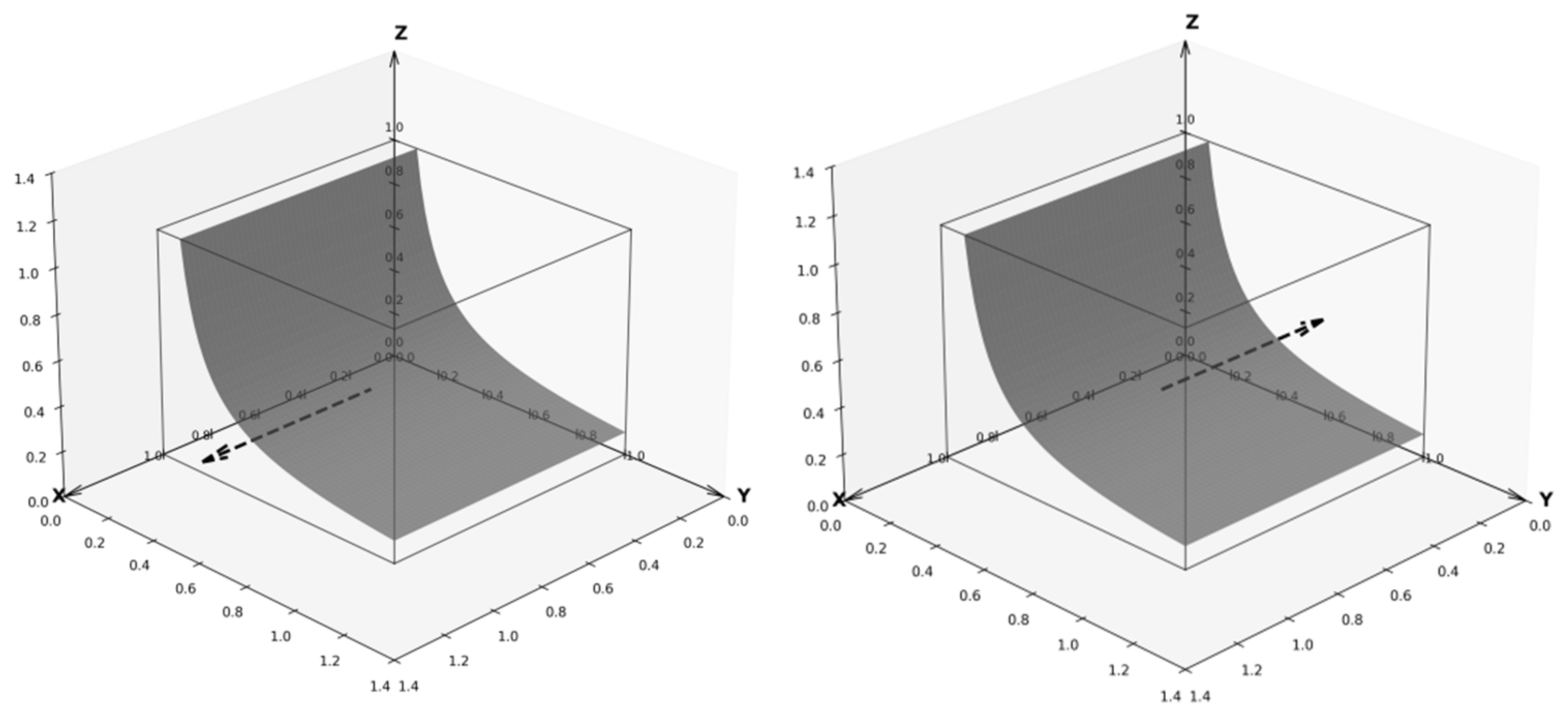
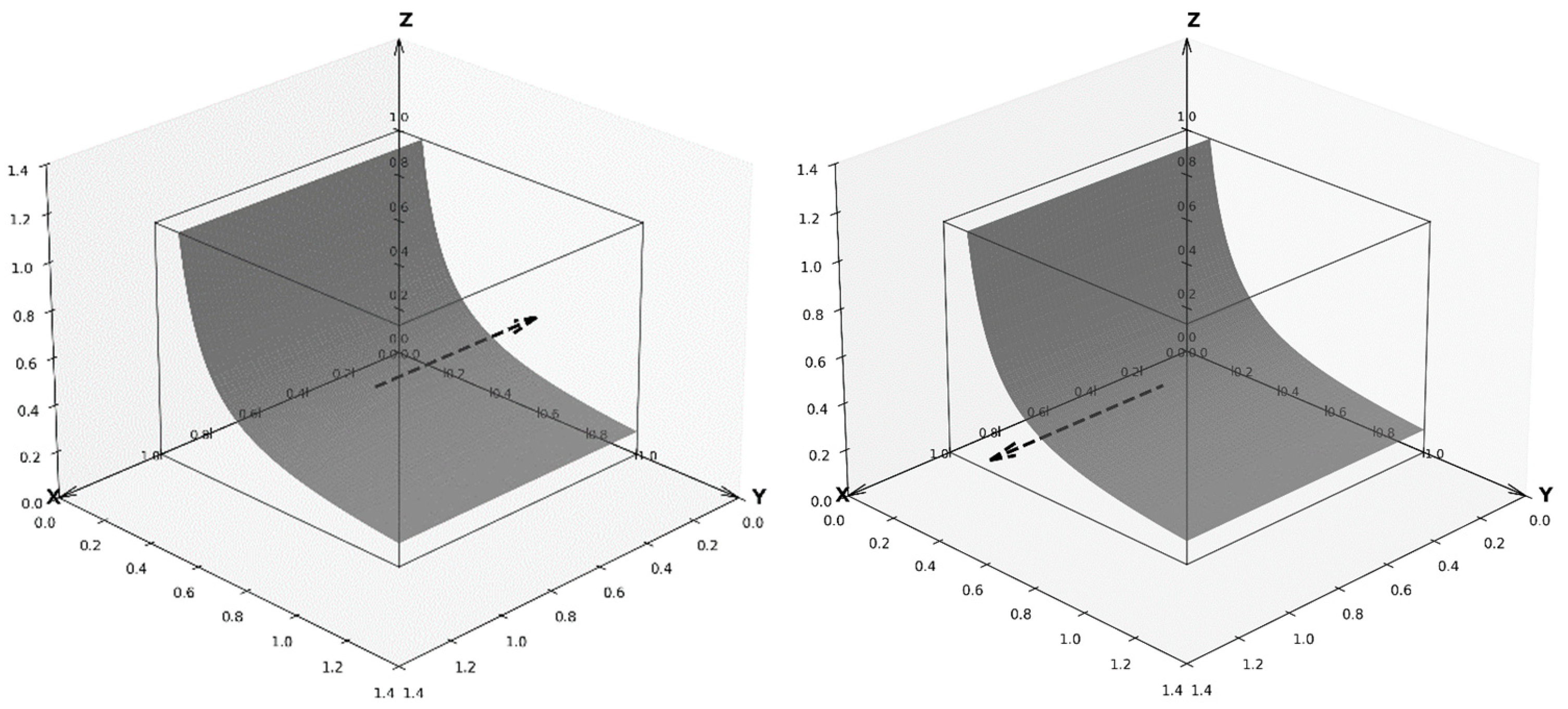
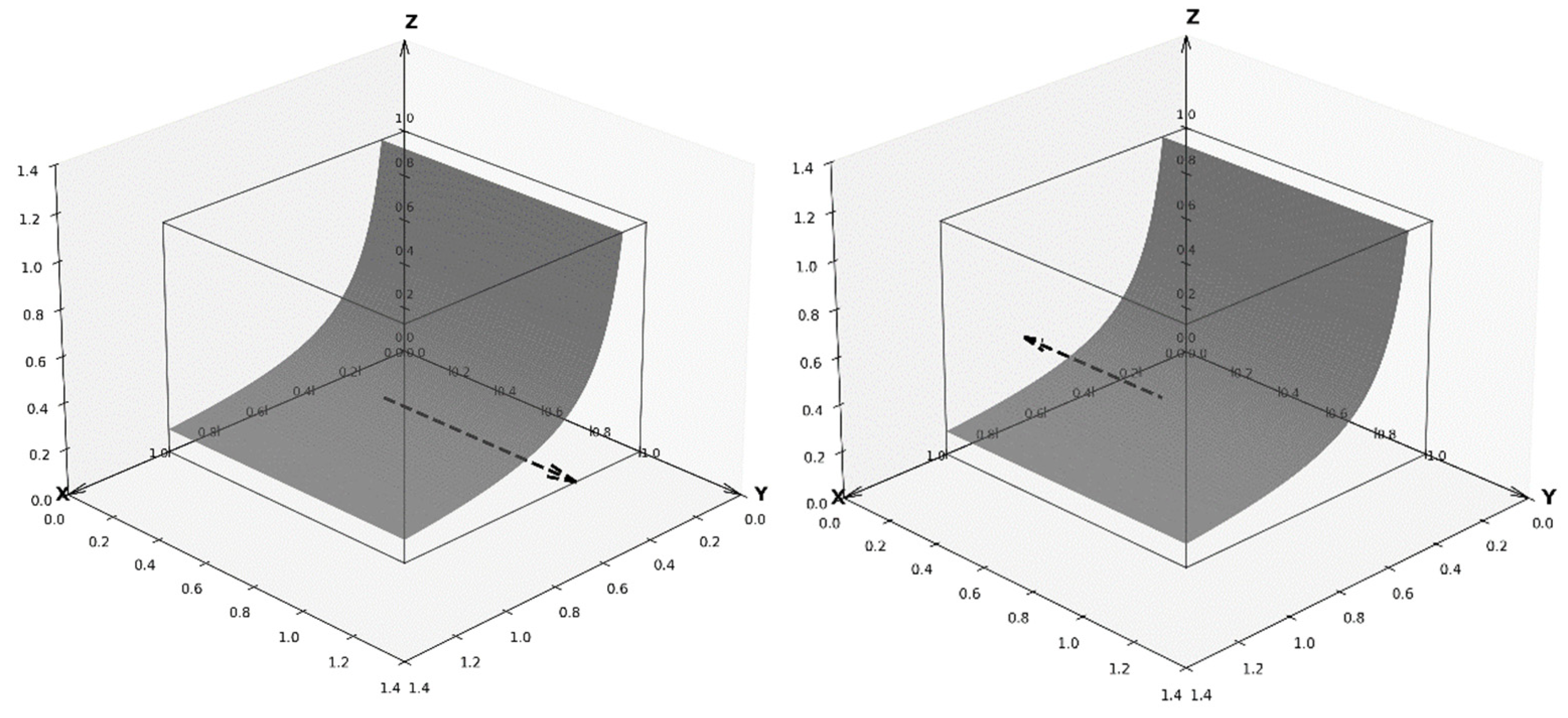
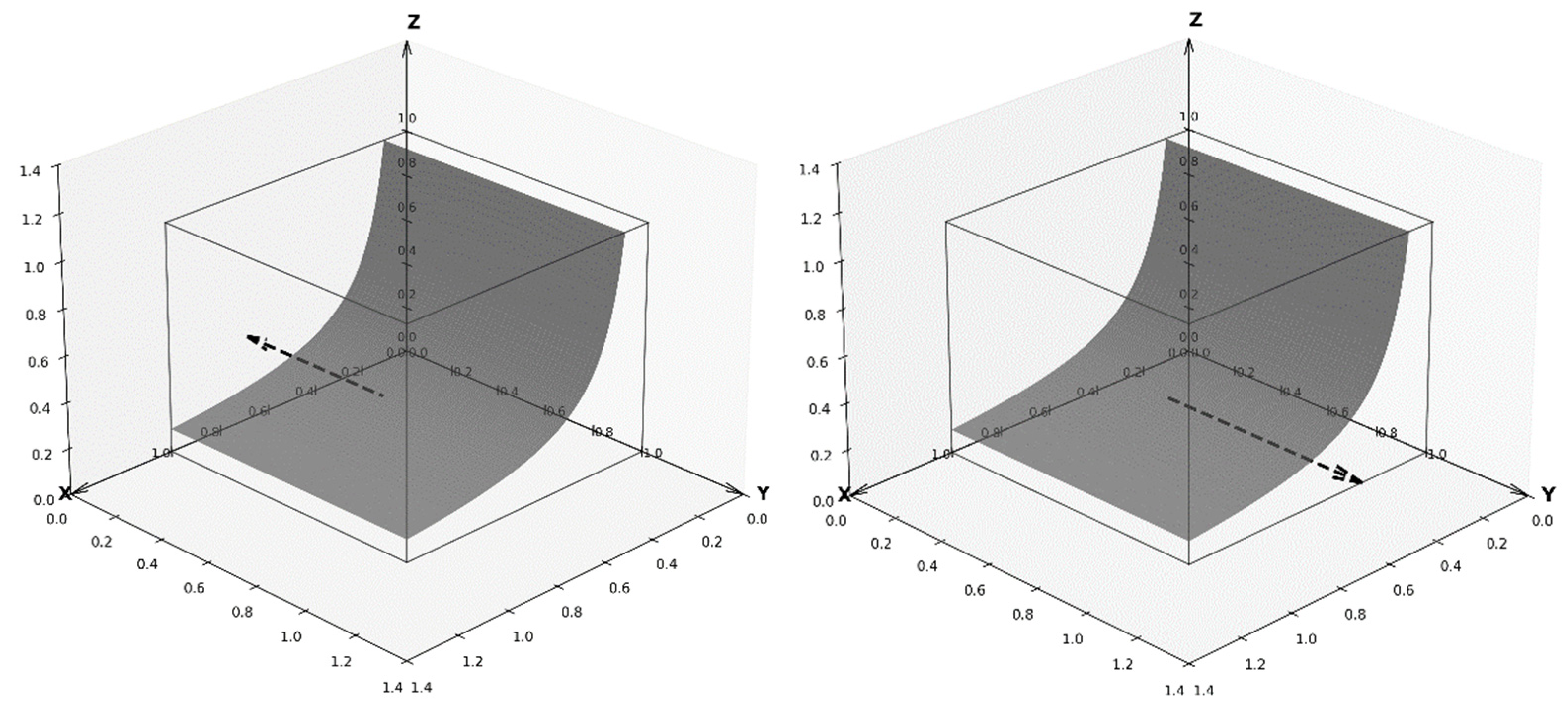
In this part, according to six different parameter ranges, we illustrate the differences between the evolutionary results given by the three propositions in a three-dimensional geometric intuitive way. By discussing the changes in various parameters such that , we can analyze and obtain possible evolutionary stable strategies.
Case 1: In the region represented by the inequality , if parameters satisfied , due to is a stable equilibrium point, and local universities’ “cooperation” is ESS.
, since
then
x = 0 is a stable equilibrium point, and local universities’ “non-cooperation” is ESS (see
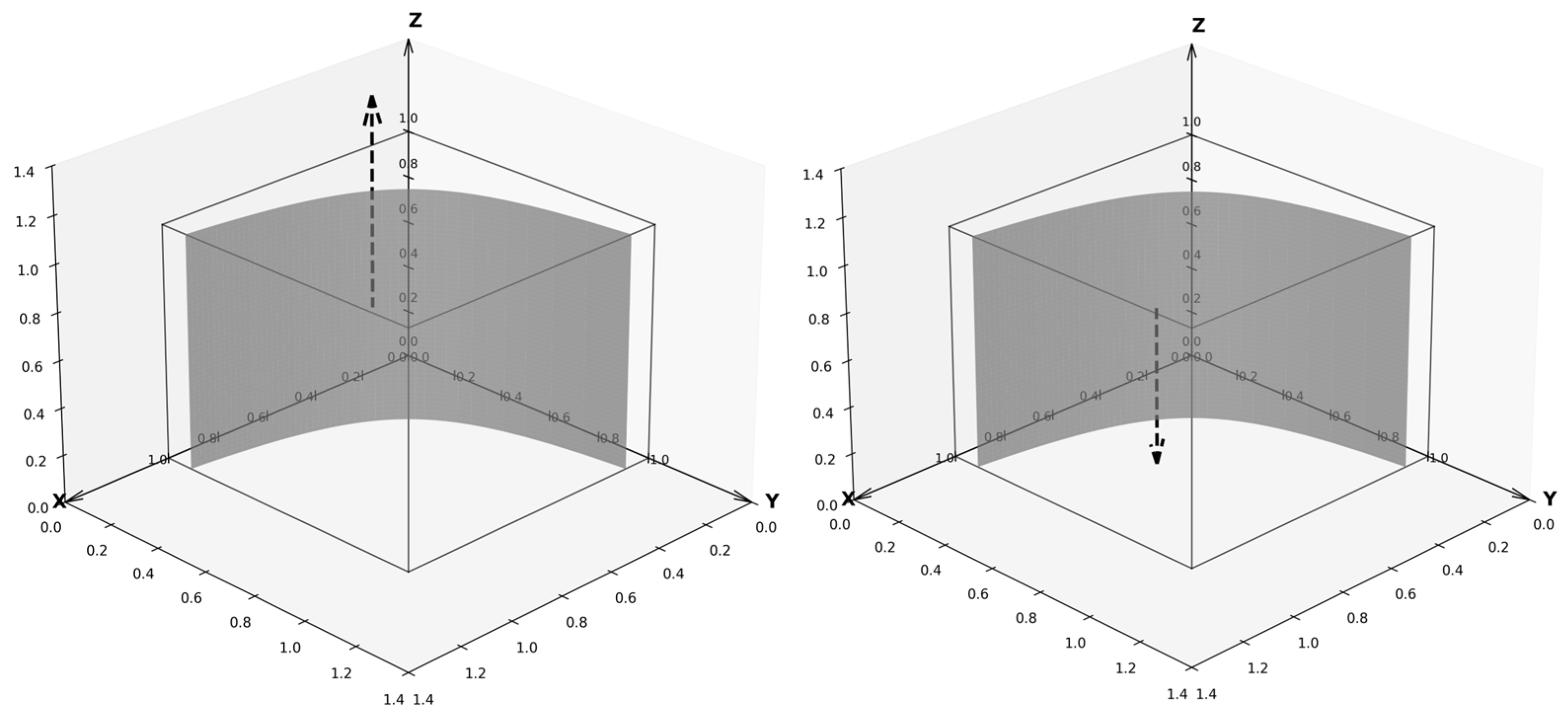
Figure 1).
Case 2: In the region represented by the inequality
, and if parameters satisfied
, then
and hence
x = 0 is a stable equilibrium point, and local universities’ “non-cooperation” is ESS; If
,
and local universities’ “cooperation” is ESS (
Figure 2). Notice that the first derivative of the function F(y) has the following form:
Therefore, we can simulate the following results.
Case 3: In the region suppose that the parameters are satisfied. since , and hence y = 1 is a stable equilibrium point, and teachers’ “cooperation” is ESS.
Suppose that
, since
and hence y = 0 is a stable equilibrium point, and teachers’ “non-cooperation” is ESS (
Figure 3).
Case 4: In the region
, suppose that parameters satisfied
since
, and hence y = 0 is a stable of equilibrium point, and teachers’ “non-cooperation” is ESS; suppose
since
and hence y = 1 is a stable of equilibrium point, and teachers’ “cooperation” is ESS (
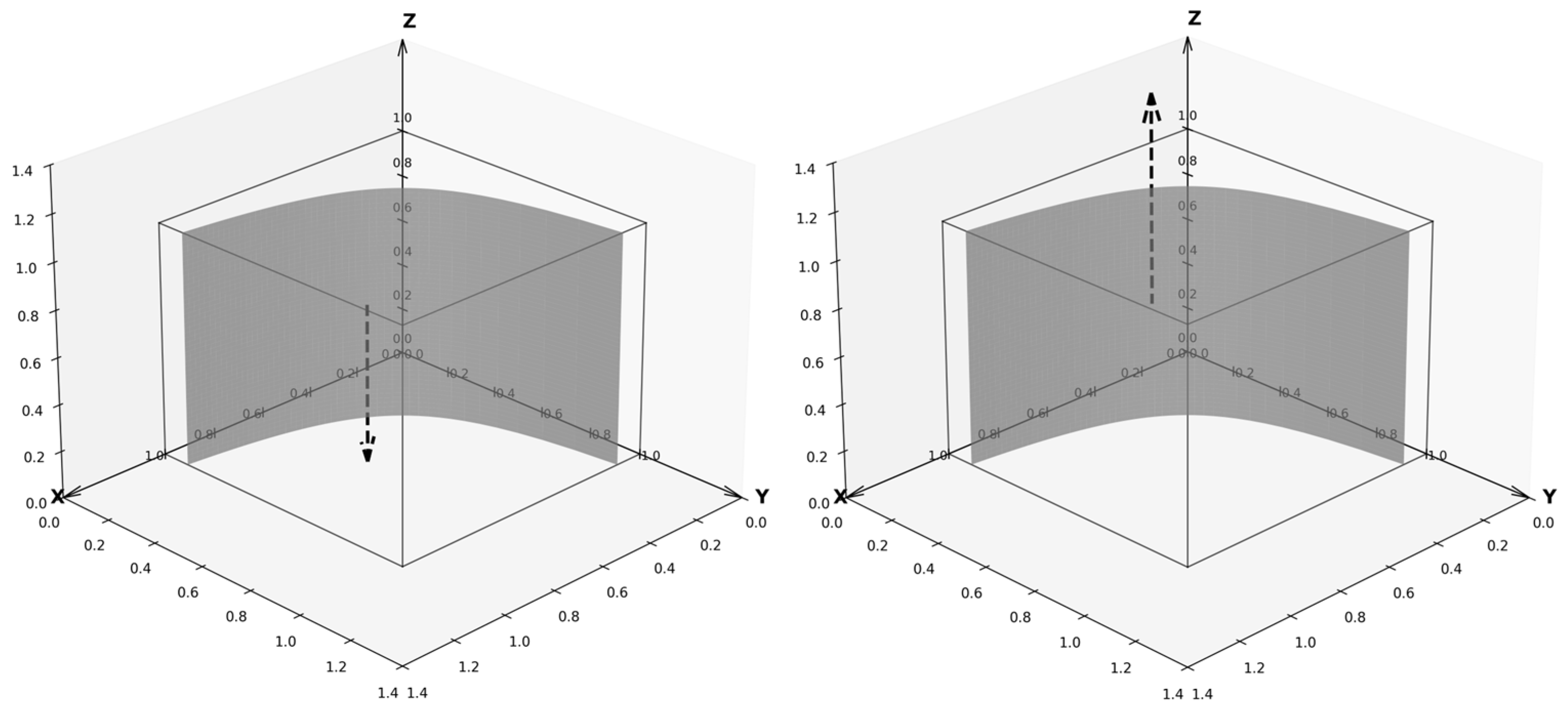
Figure 4).
Case 5: Consider the region
parameters satisfy
and therefore
a stable equilibrium point, and local government’s “proactive motivation” is ESS; if parameters satisfy
, then
and therefore
is a stable equilibrium point, and local government’s “passive funding” is ESS (
Figure 5).
Case 6: In the region
if parameters satisfy
, we know that
, and hence z = 0 is a stable equilibrium point, and “passive funding” is ESS; if parameters satisfy
then z = 1 is a stable equilibrium point, and “proactive motivation” is ESS (
Figure 6).
6. Discussion
For the sake of discussion, denote that .
The replication dynamic equation for the proportion of “cooperation” adopted by local universities reveals that represents a critical threshold for this evolutionary game system. This threshold partitions the strategy space, and the region in which the system resides relative to this point determines the ultimate strategic choices of the implementer group at evolutionary equilibrium. Note that can be decomposed into two parts, i.e., . This difference can be understood as the difference in revenue (defined as relative revenue) between local universities under two different management models of the local government. When , the proactive motivation of local governments is higher than the proportion at the interface (defined as positive transformation space), (positive relative return) indicates that the return of local university under active incentives from local governments is greater than its return under passive funding. Since local university does not have a better choice at the moment, regardless of the initial proportion of local university choosing “non-cooperation”, “cooperation” is the only evolutionary stable strategy, and it will eventually reach a stable equilibrium. The equation (negative relative return) indicates that the return of local university under active incentives from local governments is smaller than its return under passive funding. Since local universities can still secure sufficient benefits even with reduced funding from local governments, opting for “non-cooperation” emerges as their rational choice. This strategy, under the given conditions, constitutes the sole evolutionary stable strategy (ESS) and will inevitably lead the system to a stable equilibrium.
When , the willingness of local governments to actively incentivize is lower than the threshold ratio (defined as negative transition space), and (relative return is positive) indicates that under active incentives by local governments, local universities’ return is greater than their return under passive funding. Therefore, choosing “non-cooperation” is the only evolutionary stable strategy for local university, and it will eventually reach a stable equilibrium; the equation (negative relative return) indicates that the return for local universities under passive government funding still exceeds that under active incentives. Faced with no superior alternative, “cooperation” emerges as the sole evolutionary stable strategy, and the system will inevitably converge to this stable equilibrium.
Now, let us discuss the role of C
F in the case where
has been determined. By adjusting the value of C
F, the relative position of the critical surface S
1 can be moved, and thus the volume of the two solids on both sides of S
1 can be changed, thereby achieving a change in the size of the parameter space for each evolutionary stable strategy. When
, C
F increases, and the difficulty of “cooperation” increases. Local governments will also tend to adopt a passive funding model accordingly, in order to encourage a relatively larger proportion of “cooperative” teachers to enter the space of active transformation. From
Figure 1, it can be seen that the critical surface S1 moves upward, the volume V
1 decreases, the volume V
3 increases, and the parameter space for negative transformation becomes larger. At this point, in the parameter space of negative transformation, the “non-cooperative” evolutionary stability strategy occupies more possibilities; when
, C
F decreases, the difficulty of “cooperation” decreases, and local governments will correspondingly increase the intensity of active incentives. Teachers with a relatively lower proportion of “non-cooperation” actively enter the space of active transformation. As shown in
Figure 1, the interface S
1 moves downwards, the volume V
2 increases, the volume V
4 decreases, and the space for active transformation increases. In the space of active transformation, the “non-cooperative” evolutionary stability strategy occupies more possibilities.
Due to the desire for local universities/teachers to ultimately adopt a “cooperative” evolutionary stability strategy, and given the symmetry between local universities and teachers in replicating dynamic equations and evolutionary stability strategies, we can draw the following conclusion: (i) Based on the corresponding expectations of local universities and teachers for different policies, we can select appropriate strategies with targeted approaches. In order to enable local universities/teachers to enter a positive transformation space, local governments can increase the intensity of proactive incentives or reduce the punishment for local universities under passive funding models, so that the relative benefits of local universities or teachers are positive; in order to prevent local universities/teachers from entering the negative transformation space, local governments can increase the punishment for local universities under the passive funding model, in order to promote the evolution of the only stable strategy for local universities/teachers into “cooperation” and maintain a long-term balanced and stable state, thus playing a role in promoting the transformation of local universities. (ii) By effectively expanding the corresponding strategic space and strengthening the stability of expected strategies, local governments can reduce the negative transformation space by lowering CF when the relative returns are negative; when the relative returns are positive, the government can expand the space for positive transformation by increasing CF, which helps to increase the possibility of local universities or teachers entering cooperative evolutionary stable strategies and reduce their likelihood of entering non-cooperative evolutionary stable strategies.
Although evolutionary game theory has seen new attempts and breakthroughs in various applications such as economics and management, in recent years, research on its application in higher education reform still largely remains within the theoretical framework of traditional game theory. Only a few studies have introduced evolutionary game theory, and these are confined to two-player evolutionary game subjects. However, the actual game process of higher education reform involves three or more participating entities. There is a scarcity of relevant literature discussing this aspect both domestically and internationally. From the perspective of analytical depth, many existing references focus solely on two-player groups or three-player subjects for game discussions and stability equilibrium analysis; only a few scholars have tried to explore a three-player evolutionary game process while simultaneously examining pairwise evolutionary games among the three players and comparing their fundamental differences. Proposition 1 and its corollary in this paper provide valuable insights, offering meaningful guidance for future research in this field.
Regarding the discussion of Proposition 2, according to symmetry, it can be discussed in a completely similar manner to Proposition 1, and we will not elaborate further.
In order to discuss Proposition 3 more clearly, two symbols are introduced here, .
From the replicated dynamic equation of the cooperative proportion adopted by local governments, it can be seen that represents the critical boundary S3 of this evolutionary system. This boundary divides the parameter space into two disjointed parameter spaces, which will determine the different strategic choices of local university transformation groups after reaching equilibrium in evolution. It is noted that can be interpreted as the difference in gains and losses for local universities under two distinct management models of local governments. When , the willingness of teachers and local universities to cooperate is higher than that of the interface ratio, and indicates that the relative profit and loss between local universities and teachers is positive, and the corresponding local government benefits more from active incentives. The evolutionary stability strategy of local governments is active incentives; the equation indicates that the relative profit and loss between local universities and teachers is negative, and local governments have greater benefits under the passive funding model. Therefore, in this case, the punishment of local governments under the active incentive model is stronger than that under the passive funding model. Therefore, active incentives will be the only evolutionary stability strategy that local governments can choose. When , the willingness of teachers to cooperate is lower than the proportion at the interface, as indicates that the punishment received by local universities and teachers under the active incentive mode will be greater than that under the passive funding mode. Therefore, for the local government, passive funding, which is the only evolutionary stability strategy, will ultimately be chosen; the equation indicates that local universities and teachers will receive greater punishment under the passive funding model than under the active incentive model. This administrative measure makes the transformation of local universities more likely to be carried out under the active incentive model, so local governments will ultimately choose active incentives as the only evolutionary stability strategy.
Now, let us discuss the role of C
G in the case where
has been determined. By changing the size of the C
G, the relative position of the critical surface S
3 can be moved, and thus the volume of the space on both sides of S
3 can be changed, thereby achieving a change in the size of the parameter space of each evolutionary stable strategy. When
, C
G increases, indicating that the local government has increased the intensity of proactive incentives, prompting relatively more teachers and local universities to join the ranks of “cooperation”; from
Figure 2, it can be seen that as the critical surface S
3 moves to the right, the volume V
11 decreases and the volume V
9 increases. This shape helps local governments to prefer a passive funding model; When
, C
G decreases, indicating that the local government has reduced the intensity of proactive incentives. In order to encourage more teachers and local universities to join the ranks of “cooperation”, the local government has to increase the intensity of punishment. From
Figure 2, it can be seen that the critical surface S
3 shifts to the left, resulting in a decrease in volume V
12 and an increase in volume V
10. This pattern increases the possibility of local governments entering the evolutionary stability strategy of passive funding.
Based on the above discussion on the equilibrium conditions of evolutionary games, we can draw a conclusion based on expectations and strategy space: when the relative punishment is positive, local governments can reduce the space for teachers’ willingness to “cooperate” by increasing CG; When the relative punishment is negative, local governments can reduce CG to reduce the willingness space of teachers to be “non-cooperative”, which helps to increase the possibility of the government entering the passive funding evolutionary stability strategy and reduce the possibility of it entering the active incentive evolutionary stability strategy.
The preceding analysis is grounded in the independent stability analysis of local universities, teachers, and governments. Their respective equilibrium points (surfaces S1, S2, and S3) partition the three-dimensional strategy space into multiple interconnected regions. These interlocking sections divide the strategic cube into distinct evolutionary subspaces. This structural complexity illustrates that a wide range of factors can influence the strategic choices of the three parties during the transformation of local universities. A change in any single factor may alter the equilibrium state and strategic tendency of one group, which, in turn, affects the strategic decisions of the other two. Consequently, regardless of the initial strategic position of local universities, teachers, or local governments within any of these subspaces, the evolutionary process will not converge toward a single predetermined set of strategies. Instead, the strategic choices of all three parties will continuously adjust and co-adapt in response to evolving external conditions.
7. Conclusions
The core goal of higher education is to cultivate talents to provide essential intellectual support for economic, social and ecological sustainability. Based on the analysis of the above-mentioned tripartite game model and numerical simulation, this paper puts forward the following suggestions for the sustainable development of higher education.
Firstly, the sustainability of resources is mainly ensured by local governments. The meaning of resource sustainability refers to the efficient allocation and long-term supply of educational resources, including stable growth in local government financial investment, a diversified financing mechanism involving social participation, the development of a tiered teaching staff, and intensive use of campus resources (including energy-efficient campuses and shared digital resources). Undoubtedly, the government has overwhelming advantages in these areas, and its position among the three parties is clearly asymmetric. Within China’s current top-down governance system, administratively driven empowerment by local governments will continue to play a fundamental and decisive role for the foreseeable future. According to the simulation analysis in
Section 4, to advance the transformation of local universities, local governments should establish an efficient phased evaluation mechanism to promptly penalize opportunistic behaviors—such as “superficial transformation” or “utilitarian participation”—by certain institutions, thereby ensuring that transformation measures are effectively implemented. On the other hand, in the face of dual challenges—tight local finances and insufficient university funding—local governments should guide universities and enterprises toward deep collaboration through well-designed policies. By constructing a coordinated development mechanism between applied universities and industries, they can help broaden universities’ revenue channels and facilitate a shift from reliance on external “transfusions” to self-generated “blood production.” Therefore, it can fundamentally ensure the sustainable development of local universities. Based on modern enterprise theory, the tripartite game model proposed in this study offers an optimal strategic framework for the government. It helps remind local governments to establish clear and well-defined priority lists in advance during the transformation of local universities, thereby mitigating overconfidence and policy paradoxes and reducing intentional or unintentional intervention in university affairs. By fostering full consensus between the government and universities, the model helps activate the enthusiasm of organizational structures and promote the maximization of organizational efficiency. Farsighted policy insight is an essential quality that policymakers must possess, as it can fundamentally resolve the paradoxes inherent in policy design. From the perspective of decision science, such policy paradoxes can be alleviated through scientific and institutionalized mechanism design. Therefore, in addressing the practical challenges and potential obstacles in the transformation of local universities, the conclusions derived from evolutionary game theory can effectively guide the government in designing institutions along a correct and optimized trajectory. This approach enables the sustainable development of local universities through concentrated wisdom and collective effort.
Secondly, the sustainability of quality is mainly ensured by both local universities and teachers. Quality sustainability refers to local universities and teachers taking ‘moral development and talent cultivation’ as the foundation, establishing a talent-training system that meets the needs of the times; strictly controlling the minimum standards of education quality, and setting up a dynamic quality assessment and feedback mechanisms to avoid the imbalance of ‘focusing on quantity over quality’ and ‘focusing on research over teaching.’ Typically, local universities and their teaching staff are regarded as an integrated entity. Although the initial drive for transforming local universities into applied technology institutions may originate from preferential policy support by local governments and the need to diversify funding sources, achieving meaningful and sustainable transformation requires coordinated optimization among internal stakeholders, cohesive collaboration, and synergy with external incentives. Simulation analysis in
Section 4 reveals a positive correlation between teacher engagement in the transformation process and the resulting benefits to the university: the more actively teachers participate, the greater the institutional gains, and the more likely the university is to adopt substantive and implementation-oriented strategies. Correspondingly, enhanced incentive mechanisms from the university bolster teacher motivation and involvement. Therefore, it is essential for universities to establish a well-structured reward and incentive system and to design a scientifically grounded salary-distribution framework. For instance, increasing recognition and compensation for teachers who contribute through practical teaching and applied technology development—translating such efforts into measurable outcomes—can significantly elevate participation. Consequently, the advanced phase of university transformation should evolve from a primarily externally driven model to one that balances external support with robust internal motivation, taking internal institutional optimization as a starting point, as it promotes the sustainable development of higher education.
The equilibrium conditions of any game are subject to change as the external environment evolves. When exogenous conditions shift, the dynamics of institutional survival within higher education will likewise transform. In the near future, we can expect to observe several key developments: first, the wave of modern technological innovation, led by artificial intelligence, will profoundly reshape the development models of traditional universities; second, the government’s recalibration of financial arrangements to alleviate fiscal pressures will reconfigure the allocation of university funding; Moreover, this continuous stream of changes will drive universities to undergo persistent organizational adaptation under uneven external conditions. Therefore, local governments should play a leading role in implementing sustainable development education projects, taking measures in policy support, funding support, teacher team development, curriculum development, assessment, and evaluation, as well as management systems to ensure the smooth implementation of sustainable development education and promote the achievement of its goals.