Article

Parameter Optimization for Torsion-Balance Experiments Testing d = 6 Lorentz-Violating Effects in the Pure-Gravity Sector

1
MOE Key Laboratory of Fundamental Physical Quantities Measurement, School of Physics, Huazhong University of Science and Technology, Wuhan 430074, China
2
College of Physics, Chongqing University, Chongqing 401331, China
*
Authors to whom correspondence should be addressed.
Symmetry 2026, 18(4), 559; https://doi.org/10.3390/sym18040559
Submission received: 11 February 2026 / Revised: 19 March 2026 / Accepted: 23 March 2026 / Published: 25 March 2026
(This article belongs to the Section Physics)

Abstract

Local Lorentz Invariance is one of the fundamental postulates of General Relativity, making its experimental verification of paramount importance. Given that various frontier theoretical models predict potential symmetry breaking, the Standard Model Extension framework has been established to systematically study such phenomena. Within the Standard Model Extension gravitational sector, the high-order Lorentz-violating terms with mass dimension d = 6 exhibit a rapid signal decay with distance, providing a distinct detection advantage in short-range gravity experiments. This work is dedicated to optimizing the testing schemes for d = 6 Lorentz-violating coefficients. Based on a high-precision torsion balance platform, we propose a novel scheme featuring a comb-stripe design. The improvements are twofold: first, the spatial orientation of the experimental apparatus is optimized to leverage the modulation effects of the Earth’s rotation, thereby enhancing the capability to distinguish and constrain different violation parameters; second, the test and source masses are reconfigured into specifically designed stripe patterns to significantly amplify the fringe-field signals sensitive to Lorentz-violating effects. This paper systematically elaborates on the theoretical foundation and design principles of the new scheme. By performing a detailed comparison of the constraint potentials of various stripe configurations, the five-stripe geometry is identified as the optimal experimental configuration. This study provides a new experimental methodology for exploring physics beyond the Standard Model at higher levels of precision.

1. Introduction

At present, our understanding of the physical world is encapsulated by two foundational frameworks: General Relativity (GR), which describes gravitational phenomena, and the Standard Model (SM), which accounts for fundamental interactions other than gravity. Nevertheless, these theories are widely regarded not as the ultimate description of nature, but as low-energy effective limits of a more fundamental theory [1,2,3,4,5,6,7,8,9]. According to the traditional perspective, information regarding this underlying theory could be gleaned when experimental characteristic energies approach the Planck scale, allowing for the induction of a fundamental theory. However, such experiments remain technologically unattainable in the foreseeable future [10,11]. An alternative approach involves searching for minute deviations from established physics (SM and GR) in existing experiments. The discovery of such anomalies would provide profound clues for the development of fundamental physics, while null results serve to exclude certain theoretical pathways [10,12].
Local Lorentz Invariance (LLI), a cornerstone of GR, dictates that physical laws remain invariant under local boosts and rotations. Testing LLI is an essential direction in modern physics. Various candidate theories, such as string theory [13], quantum gravity [11], non-commutative geometry [14], multiverse scenarios, random dynamics models, and brane-world scenarios [15,16], predict that Lorentz symmetry may be broken at certain scales. String theory, particularly the D-foam model, typically predicts that Lorentz symmetry breaking occurs near the Planck scale ( 10 19 GeV) [13]. However, when considering observable effects on the speed of light, analysis of Fermi satellite gamma-ray burst data (e.g., GRB 090510) constrains the corresponding Lorentz-violating scale to approximately 3 × 10 17 GeV. Phenomenological quantum gravity theories generally anticipate Lorentz violation within the 10 16 to 10 19 GeV range, a regime spanning from the grand unification scale to the Planck scale [11]. The mechanism for Lorentz violation in the non-commutative geometry framework differs: it introduces a fixed background field through the non-commutativity parameter, with the associated symmetry breaking scale linked to a length scale l [14]. Specifically, in the spontaneously broken SO(2,3) gravity model, the emergence of a vacuum expectation value l triggers symmetry breaking, a mechanism that can be mapped onto the Standard-Model Extension (SME) framework. Multiverse scenarios are often associated with quantum fluctuations during inflation; theoretical frameworks suggest that the three-momentum scale P L V for Lorentz violation may significantly exceed the inflationary Hubble parameter H, with the suppression of Lorentz-violating effects potentially following a power-law form ( H / P L V ) α , where the exponent α depends on specific geometric details. As low-energy effective theories, random dynamics models typically expect Lorentz violation to occur at sub-Planckian scales to maintain compatibility with causality and stability requirements in the infrared regime. Brane-world scenarios exhibit a richer energy scale structure: four-dimensional Lorentz invariance is broken at a high three-momentum scale P L V that can substantially exceed the inflationary Hubble parameter H, with the transmission of symmetry-breaking effects depending on the coupling mechanism between the brane and the bulk [15,16]. Overall, the symmetry breaking scales predicted by these theoretical frameworks converge within the 10 16 10 19 GeV range (from the grand unification to the Planck scale). However, due to different detection methodologies, high-energy astrophysical observations directly constrain dispersion relations, while precision laboratory experiments impose indirect limits via SME coefficients, the testable energy scales across these theories exhibit complementary characteristics. In contrast, this paper focuses on the model-independent effects of Lorentz violation proposed by Kostelecký, A., where theoretical frameworks can only provide parametric descriptions, and short-range gravity experiments can test and constrain these parameters.
Currently, the most prominent framework for these tests is the SME, which provides a comprehensive basis for studying Lorentz-violating (LV) and Charge-Parity-Time (CPT) violating effects [10]. It summarizes potential effects arising from Lorentz violation and allows for the comparison of results from diverse experimental tests. Within this framework, LV effects are categorized into three sectors: the purely matter sector, the purely gravitational sector, and the matter-gravitational coupled sector. For the purely gravitational sector, the Lagrangian density can be expanded according to mass dimension d, including the Einstein-Hilbert term, the cosmological constant term, the matter term, and the LV terms [12]. The violating terms contain numerous coefficients that require experimental verification. Odd-d terms are generally neglected as they lack non-relativistic gravitational effects.
Current research focuses primarily on even-d LV terms. Major detection methods include gravitational Čerenkov radiation, superconducting gravimeters, gravitational-wave detectors, Lunar Laser Ranging (LLR), dual-pulsar observations, planetary ephemerides, and atom interferometers [17,18,19,20,21,22,23,24,25,26,27], each offering unique advantages for constraining different coefficients. Most of these tests target the d = 4 term, as the violating potential is inversely proportional to the first power of distance ( 1 / r ), making the potential effects larger and easier to detect. However, for the d = 6 term, the violating potential is inversely proportional to the cube of the distance ( 1 / r 3 ). As distance increases, the effect decays rapidly; therefore, short-range gravity experiments offer a superior advantage for testing such terms.
Short-range gravity experiments at Huazhong University of Science and Technology (HUST) have been conducted for over 30 years. By utilizing ultra-precision torsion balance technology to test deviations in Newtonian gravity, these experiments can effectively constrain d = 6 effects. Shao et al. utilized data from short-range gravity experiments at HUST (HUST-2012 [28], HUST-2015 [29]) and Indiana University (IU-2002, IU-2012 [30]) to provide the most stringent limits on high-order d = 6 LV coefficients at the 10 9 m 2 level [31], and on d = 8 coefficients at the 10 12 m 4 level [32].
However, some designs in inverse-square-law (ISL) tests do not maximize the LV effects. Accordingly, in 2016 we introduced a striped test-mass geometry to enhance the signal [33]. Subsequently, the design was further optimized, and the relationship between Cartesian and spherical coordinates under this stripe-based configuration was presented [34]. Last year, we proposed two experimental strategies and separately investigated the azimuth-angle configurations that correspond to the optimal constraints on the local Lorentz-violating coefficients [35]. In this paper, we utilize a comb-shaped design for both the test and source masses and, within the spherical coordinate system, analyze the constraining precision for the d = 6 Lorentz-violating coefficients. Based on the principles of torsion balance experiments, we design and analyze the experimental scheme with two primary improvements: first, adjusting the orientation of the experimental apparatus relative to the Earth’s rotation to obtain more data for constraining the 14 coefficients; second, exploiting the edge-sensitivity of LV effects by replacing flat plates with striped patterns for the attractor and test masses to amplify the signal. Most importantly, we emphasize the analysis of how different stripe designs affect the constraints on various coefficients to determine an optimal configuration.
The structure of this paper is as follows: Section 2 analyzes the principles of testing d = 6 violation terms; Section 3 introduces the experimental design based on high-precision torsion balance technology; Section 4 compares the constraints of different stripe designs on LV coefficients; and Section 5 provides a summary.

2. Theoretical Analysis of Constraints on d = 6 Lorentz Violation in Torsion Balance Experiments

To quantitatively evaluate the LV effects of various experimental components, it is essential to derive the explicit expression for the LV potential. For components with complex geometries, expressing the potential in a local Cartesian coordinate system is highly advantageous for performing spatial integrations.

2.1. Expression of the Lorentz-Violating Potential

In the framework of the SME, the purely gravitational sector for mass dimension d = 6 introduces a leading-order correction to the Newtonian potential. In the laboratory spherical coordinate system, this potential is given by [27]:
V LV ( r ) = G j , m m 1 m 2 r 3 Y j m ( θ , ϕ ) k j m lab ,
where G is the gravitational constant, r is the distance vector between two point masses m 1 and m 2 , Y j m are spherical harmonics, and k j m lab are the LV coefficients in the laboratory frame. For d = 6 effects, the multipole indices are j = 2 and j = 4 , with m ranging from j to j.
The coefficients k j m lab are observer-dependent [36]. To ensure comparability, we define the Sun-based frame as the standard inertial frame [37]. In this frame, the Z-axis aligns with the Earth’s rotation axis, and the X-axis points toward the vernal equinox on the celestial sphere. Neglecting the Earth’s orbital motion, the laboratory coefficients are related to the coefficients k j m via the transformation [27]:
k j m lab = m e i m θ e i m ω T d m m ( j ) ( χ ) k j m ,
where ω 2 π / ( 23 h 56 min ) is the Earth’s sidereal rotation frequency, T is the local sidereal time [38], χ is the laboratory colatitude, and d is the little Wigner matrix. Substituting Equation (2) into Equation (1), the potential between two point masses expands as a Fourier series in sidereal time:
V LV ( r ) = G m 1 m 2 r 3 c 0 + m = 1 4 c m cos ( m ω T ) + s m sin ( m ω T ) .
The nine Fourier amplitudes ( c 0 , c 1 4 , s 1 4 ) are linear functions of the 14 independent coefficients ( k 20 , k 21 , k 22 , k 40 , k 41 , k 42 , k 43 , k 44 ). A single experiment can determine these nine independent signals, but at least two experiments with different parameters (e.g., orientation or location) are required to resolve all 14 coefficients [32].
To distinguish Lorentz-violating (LV) effects from other GR extensions (e.g., scalar-tensor or Yukawa-like models), we exploit the inherent anisotropy of the SME framework. Unlike most modified gravity theories that are isotropic and distance-dependent, LV signals arise from couplings with fixed background fields, manifesting as periodic modulations at the Earth’s sidereal frequency ( ω ) and its harmonics ( 2 ω , 3 ω , 4 ω ). This unique time-dependence, coupled with a specific dependence on laboratory orientation, is absent in standard non-Newtonian models. Consequently, the sidereal modulation serves as a definitive “fingerprint” to decouple LV effects from other gravitational modifications, ensuring the results are uniquely attributable to Lorentz symmetry violation.

2.2. Cartesian Decomposition of LV Coefficients

Modern torsion balance experiments typically employ planar mass geometries. This configuration is chosen to facilitate the balancing of the Newtonian background gravity and to suppress systematic errors from angular oscillations [33,39]. For such geometries, calculating the LV signal is more efficient using a local Cartesian coordinate system. The spherical harmonics in Equation (1) can be decomposed into Cartesian tensors as follows [40]:
Y j m ( θ , ϕ ) = c m j J n J ( x , y , z ) ,
where the unit-vector power series n J is defined by:
n J ( x , y , z ) = r j + 1 ( 1 ) j ( 2 j 1 ) ! ! J 1 r .
The tensor c j m J accounts for the mapping between the spherical and Cartesian bases:
c j m J = ( 2 j + 1 ) ! ! 4 π j ! n J Y j m ( θ , φ ) d Ω .
Combining these relations, we obtain the explicit mapping between the nine observable amplitudes and the 14 SCF coefficients:
c 0 = γ 1 k 2 , 0 + γ 2 k 4 , 0 , c 1 = γ 9 Re k 2 , 1 + γ 10 Im k 2 , 1 + γ 11 Re k 4 , 1 + γ 12 Im k 4 , 1 , s 1 = γ 10 Re k 2 , 1 γ 9 Im k 2 , 1 + γ 12 Re k 4 , 1 γ 11 Im k 4 , 1 , c 2 = γ 3 Re k 2 , 2 + γ 4 Im k 2 , 2 + γ 5 Re k 4 , 2 + γ 6 Im k 4 , 2 , s 2 = γ 4 Re k 2 , 2 γ 3 Im k 2 , 2 + γ 6 Re k 4 , 2 γ 5 Im k 4 , 2 , c 3 = γ 13 Re k 4 , 3 + γ 14 Im k 4 , 3 , s 3 = γ 14 Re k 4 , 3 γ 13 Im k 4 , 3 , c 4 = γ 7 Re k 4 , 4 + γ 8 Im k 4 , 4 , s 4 = γ 8 Re k 4 , 4 γ 7 Im k 4 , 4 .
In Equation (7), we use the property k j m = ( 1 ) m k j , m [41] to restrict m to non-negative values, denoting these real coefficients with a comma for clarity (e.g., k j , m ).
The coefficients satisfy k j m = ( 1 ) m k j , m [41]. Using the local coordinate transformation:
x ¯ = x r cos θ cos χ y r sin θ cos χ + z r sin χ , y ¯ = x r sin θ + y r cos θ , z ¯ = x r cos θ sin χ + y r sin θ sin χ + z r , cos χ
the geometric sensitivity factors γ j ( r ^ , χ ) are derived as:
γ 1 = 1 4 5 π ( 3 z ¯ 2 1 ) , γ 2 = 3 16 π ( 3 30 z ¯ 2 + 35 z ¯ 4 ) , γ 3 i γ 4 = 1 2 15 2 π ( x ¯ + i y ¯ ) 2 , γ 5 i γ 6 = 3 4 5 2 π ( x ¯ + i y ¯ ) 2 ( 1 7 z ¯ 2 ) , γ 7 i γ 8 = 3 8 35 2 π ( x ¯ + i y ¯ ) 4 , γ 9 i γ 10 = 15 2 π ( x ¯ + i y ¯ ) z ¯ , γ 11 i γ 12 = 3 4 5 π ( x ¯ + i y ¯ ) z ¯ ( 3 7 z ¯ 2 ) , γ 13 i γ 14 = 3 4 35 π ( x ¯ + i y ¯ ) 3 z ¯ .
These coefficients define the modulation amplitude of the LV signal relative to the spatial distribution of the experimental masses.

3. Experimental Design Based on High-Precision Torsion Pendulum Technology

3.1. Lorentz Violation Experimental Scheme

The torsion pendulum is currently one of the most sensitive experimental apparatuses for measuring macroscopic forces on the ground. By measuring the rotation of the pendulum in conjunction with its torsional stiffness, the torque acting on the system can be precisely determined. To utilize torsion pendulum technology for high-precision tests of Lorentz violation effects within the framework of the Standard-Model Extension (SME), it is essential to maximize the potential LV forces while minimizing other parasitic influences.
The following considerations have been incorporated into our design:
  • Signal Amplification: The first step in amplifying the LV force is to minimize the distance between the source mass and the test mass. Since the LV force associated with mass dimension d = 6 is inversely proportional to the fourth power of the distance, the ratio of the distance to the dimensions of the masses must be maintained at a high precision. Furthermore, the test and source masses are arranged asymmetrically to ensure that the LV torques generated at both ends of the pendulum add constructively rather than canceling each other out.
  • Noise Mitigation: Reducing systematic errors primarily involves suppressing Newtonian gravitational signals and electromagnetic interference (EMI). To mitigate Newtonian influence, the masses are designed to be gravitationally symmetric. Due to the extreme sensitivity of the torsion pendulum, the source and test masses must be machined and positioned with micrometer-level precision to ensure that Newtonian errors are comparable to thermal noise levels. To address EMI, an electrostatic shielding membrane is inserted between the source and test masses to reduce the coupling of residual surface charges. A control experiment is also conducted to measure the background influence in the absence of the source mass.
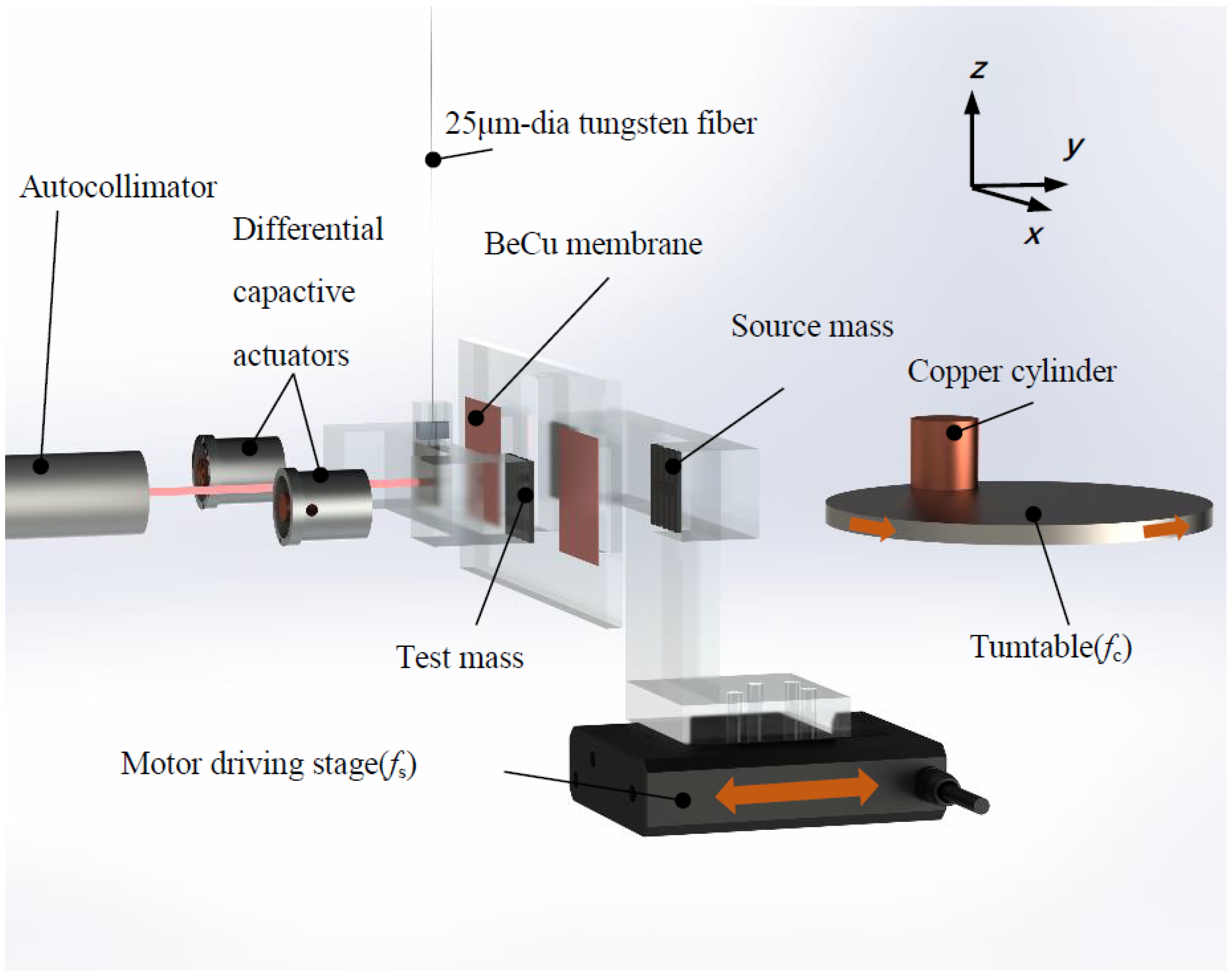
The resulting experimental setup is illustrated in Figure 1. The system consists of an angular measurement system, a drive modulation system, a calibration system, an environmental monitoring system, gravitational source components, and a torsion pendulum. Both the membrane frame and the source mass components are mounted on a six-degree-of-freedom displacement platform. An autocollimator measures the twist angle of the pendulum, which is precisely adjusted via two sets of differential capacitive drivers. A rotating copper cylinder is used to calibrate the sensitivity parameters.
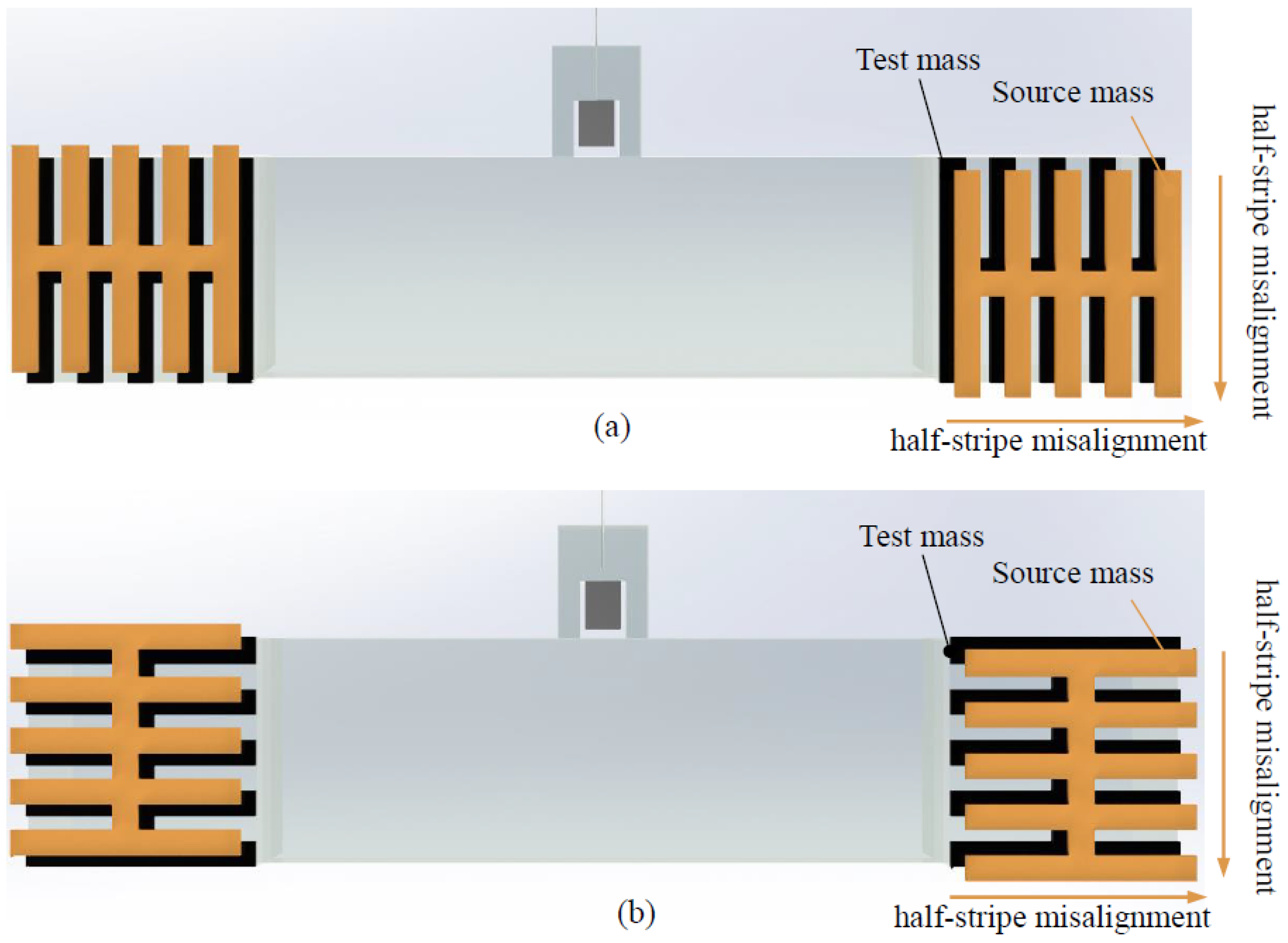
The specific arrangement of the source and test masses is shown in Figure 2. The torsion fiber consists of a tungsten wire with a 25 μm diameter. Both the source and test masses are tungsten plates (19.8 × 19.8 mm, 1.3 mm thick), with a surface-to-surface separation ranging from 0.4 to 1 mm. A 30 μm beryllium-copper (BeCu) foil serves as the electrostatic shield, with its closest distance to the test mass surface being approximately 200 μm. Supporting components are made of K9 glass to maintain symmetry. According to the SME theory, a static source mass would result in an LV torque signal at frequencies corresponding to 1–4 times the Earth’s rotation frequency. To further suppress environmental noise such as seismic vibrations and thermal fluctuations, the source mass is modulated periodically (varying the gap between 0.4 and 1 mm), allowing the LV signal to be extracted from the modulated frequency.

3.2. Striped Structure Design

In high-precision measurements of Lorentz violation, the core physical advantage of a striped design lies in its ability to actively construct and enhance high-gradient “edge-field” interactions. The SME predicts LV and CPT-violating effects through the coupling of background tensor fields with the experimental matter [12,17]. In a uniform mass distribution, the net torque generated by such coupling may vanish due to symmetry. By designing periodic stripes on the source or test masses, we effectively create a sharp spatial modulation of the matter density at small scales. This ensures that as the pendulum rotates, the edges of the test mass periodically enter the extreme near-field regions of the source mass stripes, thereby maximizing the spatial gradient of the interaction potential [33].
From an experimental perspective, the striped design is a key technical path for “parameter modulation amplification” and “noise spectrum separation.” Two critical points are implemented based on the system described in Section 3.1:
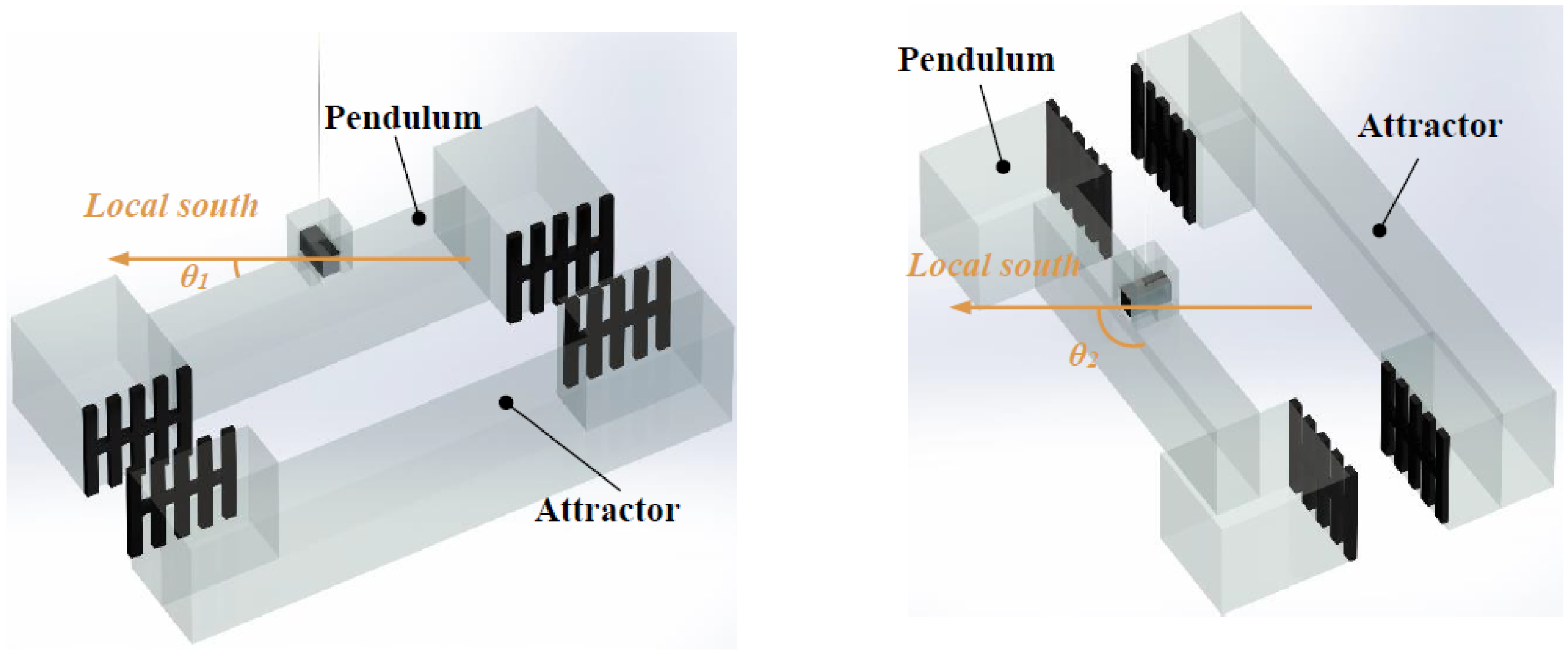
First, at least two sets of independent experiments are required to simultaneously constrain all 14 LV coefficients for the d = 6 sector. We can vary two types of conditions: (1) performing experiments with horizontal and vertical stripes respectively (Figure 2), and (2) varying the azimuth angle θ between the apparatus and the Earth’s North–South axis (Figure 3).
Second, we utilize the “edge effect” dominance predicted for finite-sized objects [33]. As shown in Figure 2, we design striped tungsten plates and intentionally adopt a half-stripe offset configuration to enhance these edge effects. These plates are arranged centrosymmetrically at both ends of the torsion pendulum and rotationally symmetrically on the source mass blocks. This ensures that while the Newtonian torque remains null during reciprocal modulation, the LV effects emerge as a function of distance.
The uncertainties in the measured torque amplitudes are analyzed based on their respective frequency components. For the C 0 term, which is modulated at the source mass frequency, the total uncertainty is approximately 11.7 × 10 16 Nm . This systematic error primarily arises from the positional accuracy of the mass plates (contributing 37%), the alignment precision between the source mass and the torsion pendulum (25%), and the straightness of the source mass trajectory during modulation (12%). In contrast, the uncertainties for the C m and S m terms, which are further extracted at the Earth’s sidereal frequency, are estimated to be 0.45 × 10 16 Nm . These terms are predominantly limited by thermal noise, representing the fundamental statistical floor of our experiment.
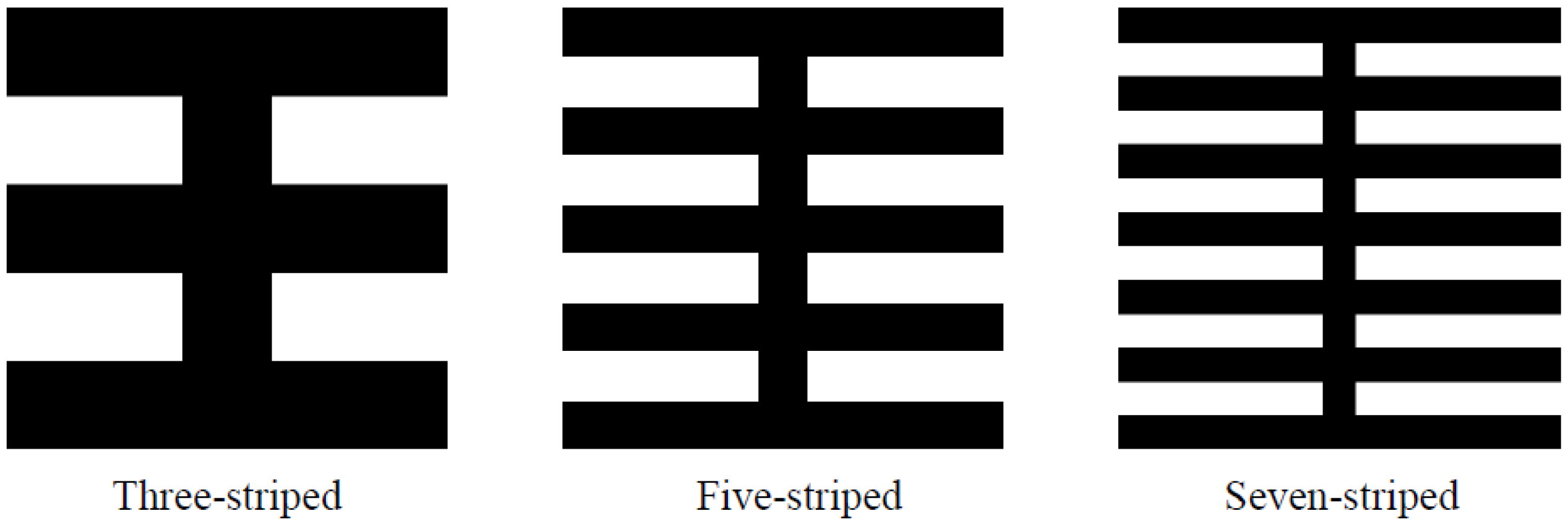
In this study, we design plates with 3, 5, and 7 stripes, as shown in Figure 4, to compare their performance. Furthermore, we analyze the optimal azimuth angle θ for these different stripe configurations. The theoretical basis and optimization results will be detailed in the following section.

4. Expected Performance of Lorentz-Violating Coefficients

4.1. Estimation Methodology for Individual Coefficients

To determine the optimal orientation angle θ and the ideal number of stripes, it is necessary to analyze the relationship between the 9 torsion pendulum amplitudes and the 14 LV coefficients. By replacing mass with volume density in the gravitational potential equations and integrating over the source mass and the test mass within the experimental configuration, the expression for the integrated LV torque in the new experiment is derived as:
τ LV ( r ) = C 0 + m = 1 4 C m cos ( m ω T ) + S m sin ( m ω T )
The relationship between the torque amplitudes and the LV coefficients follows a structure similar to the standard framework in short-range gravity tests. The transfer function Γ must be transformed as follows:
Γ i = G ρ 1 ρ 2 θ rat γ i ( θ , r , χ ) r 3 d V 1 d V 2
While the coefficients k 4 , 4 and k 4 , 3 can be constrained by a single experimental run, other coefficients require at least two independent experiments with different configurations to be simultaneously bounded. This necessitates two sets of torsion balance amplitudes and their corresponding transfer function matrices. Considering both systematic and random uncertainties, which are assumed to follow a normal distribution, the relationship between the measured amplitudes and the LV coefficients can be expressed in the following matrix forms:
C 0 C 0 = Γ 1 Γ 2 Γ 1 Γ 2 k 2 , 0 k 4 , 0 + n C 0 n C 0 ,
C 2 S 2 C 2 S 2 = Γ 3 Γ 4 Γ 5 Γ 6 Γ 4 Γ 3 Γ 6 Γ 5 Γ 3 Γ 4 Γ 5 Γ 6 Γ 4 Γ 3 Γ 6 Γ 5 Re k 2 , 2 Im k 2 , 2 Re k 4 , 2 Im k 4 , 2 + n C 2 n S 2 n C 2 n S 2 ,
C 1 S 1 C 1 S 1 = Γ 9 Γ 10 Γ 11 Γ 12 Γ 10 Γ 9 Γ 12 Γ 11 Γ 9 Γ 10 Γ 11 Γ 12 Γ 10 Γ 9 Γ 12 Γ 11 Re k 2 , 1 Im k 2 , 1 Re k 4 , 1 Im k 4 , 1 + n C 1 n S 1 n C 1 n S 1 ,
C 4 S 4 = Γ 7 Γ 8 Γ 8 Γ 7 Re k 4 , 4 Im k 4 , 4 + n C 4 n S 4 ,
C 3 S 3 = Γ 13 Γ 14 Γ 14 Γ 13 Re k 4 , 3 Im k 4 , 3 + n C 3 n S 3 ,
where n represents the amplitude noise, and the variation in the angle θ characterizes the distinction between Γ j and Γ j . By denoting the transfer matrix as A , the first three transfer matrices are defined as A 1 ( θ , ϕ ) , A 2 ( θ , ϕ ) , and A 3 ( θ , ϕ ) , whereas the remaining two are expressed as A 4 ( θ ) and A 5 ( θ ) .
Although the orientation of the stripes (horizontal or vertical) also modifies the transfer function Γ j , the significant time required to fabricate a new torsion pendulum and source masses limits the formal experiment to a single apparatus configuration. Therefore, the scenarios described in Equations (12)–(14) do not involve the simultaneous coexistence of both horizontal and vertical stripe configurations.
We utilize the Maximum Likelihood Estimation (MLE) method to determine the model parameters. The likelihood function L ( λ ) = P ( x i | λ ) represents the total probability of observing the data set x i given the parameter λ . To simplify the computation, we maximize the log-likelihood ln ( L ) . For our model, the observed data are the amplitudes c , and the parameters λ are the LV coefficients k . Assuming independent Gaussian noise n N ( 0 , σ 2 ) , the log-likelihood is:
ln ( L ) = Constant i = 1 m ( c i ( Ak ) i ) 2 2 σ i 2 .
Maximizing ln ( L ) is equivalent to minimizing the weighted sum of squares, which is the core of the Weighted Least Squares (WLS) method. Assuming the amplitude errors are approximately equal for the same frequency harmonics ( σ i σ ), the estimation of the LV coefficients follows a normal distribution:
k N A 1 c , σ 2 ( A T A ) 1 .
The volume of the uncertainty ellipsoid S, which serves as the metric for the coefficient bounds, is given by:
S σ m det ( A T A ) 1 / 2 .
To achieve more stringent constraints on the LV coefficients, one must either improve the measurement precision σ or optimize the experimental design to maximize the determinant of the transfer matrix A .
Specifically, for a 2 × 2 matrix A = a b c d given, for example, by Equation (12), the metric is det ( A ) = | a d b c | . For more complex matrices, such as those in Equation (13), we consider block matrices of the form A = M 1 M 2 M 3 M 4 , where each M i represents a sub-matrix defined as follows:
M i = r i sin θ i r i cos θ i r i cos θ i r i sin θ i = a i b i b i a i .
The determinant can be expanded as:
det ( A ) = r 1 2 r 4 2 + r 2 2 r 3 2 2 r 1 r 2 r 3 r 4 cos ( θ 1 θ 2 θ 3 + θ 4 ) = 2 a 1 a 4 b 2 b 3 + 2 a 2 a 3 b 1 b 4 + ( a 2 2 + b 2 2 ) ( a 3 2 + b 3 2 ) + ( a 1 2 + b 1 2 ) ( a 4 2 + b 4 2 ) 2 a 3 a 4 b 1 b 2 2 a 2 a 4 b 1 b 3 2 a 1 a 3 b 2 b 4 2 a 1 a 2 b 3 b 4 2 a 1 a 2 a 3 a 4 2 b 1 b 2 b 3 b 4 .
Based on these analytical metrics, we proceed to analyze the optimal orientation angle θ for 3-stripe, 5-stripe, and 7-stripe configurations to maximize the sensitivity to LV effects in the gravitational sector.

4.2. Comparison of 3, 5, and 7-Stripe Configurations

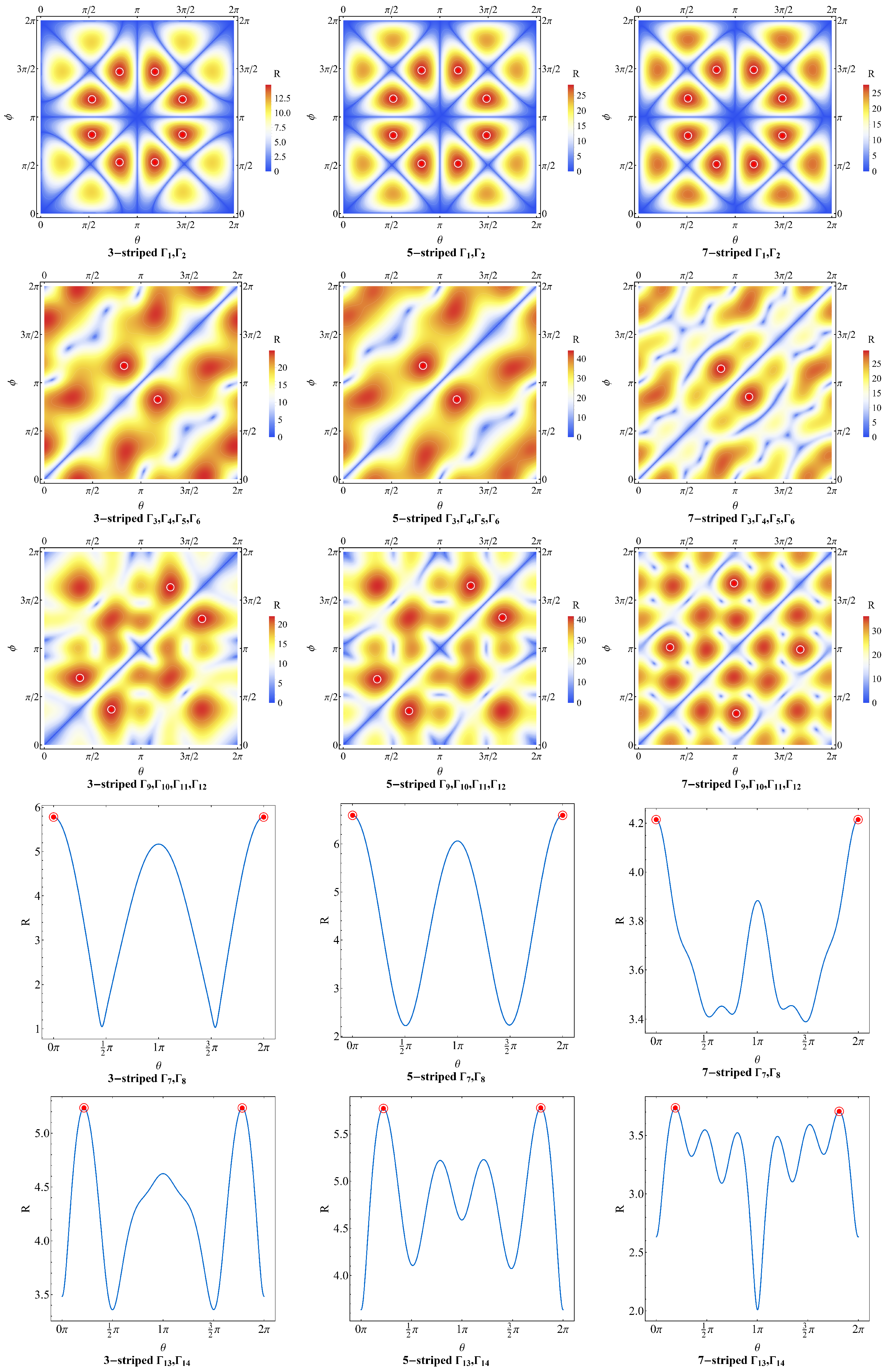
The optimal azimuth angle θ and stripe count are critical parameters. To facilitate a comparison among various configurations and to ensure dimensional consistency with the transfer function Γ j ( 10 9 Nm / m 2 ), we define a characteristic value R. Specifically, for transfer matrices A 1 , A 2 , and A 3 , R is defined as:
R i = | det A i | 1 / 2 ,
with i = 1 , 2 , 3 . while for A 4 and A 5 , it is expressed as:
R i = | det A i | 1 / 4 ,
with i = 4 , 5 . The relationship between R and the angles θ , ϕ for horizontal stripes was calculated, as shown in Figure 5, with the maximum values summarized in Table 1. Across all coefficient groups, the 5-stripe configuration yields higher | det A | values.
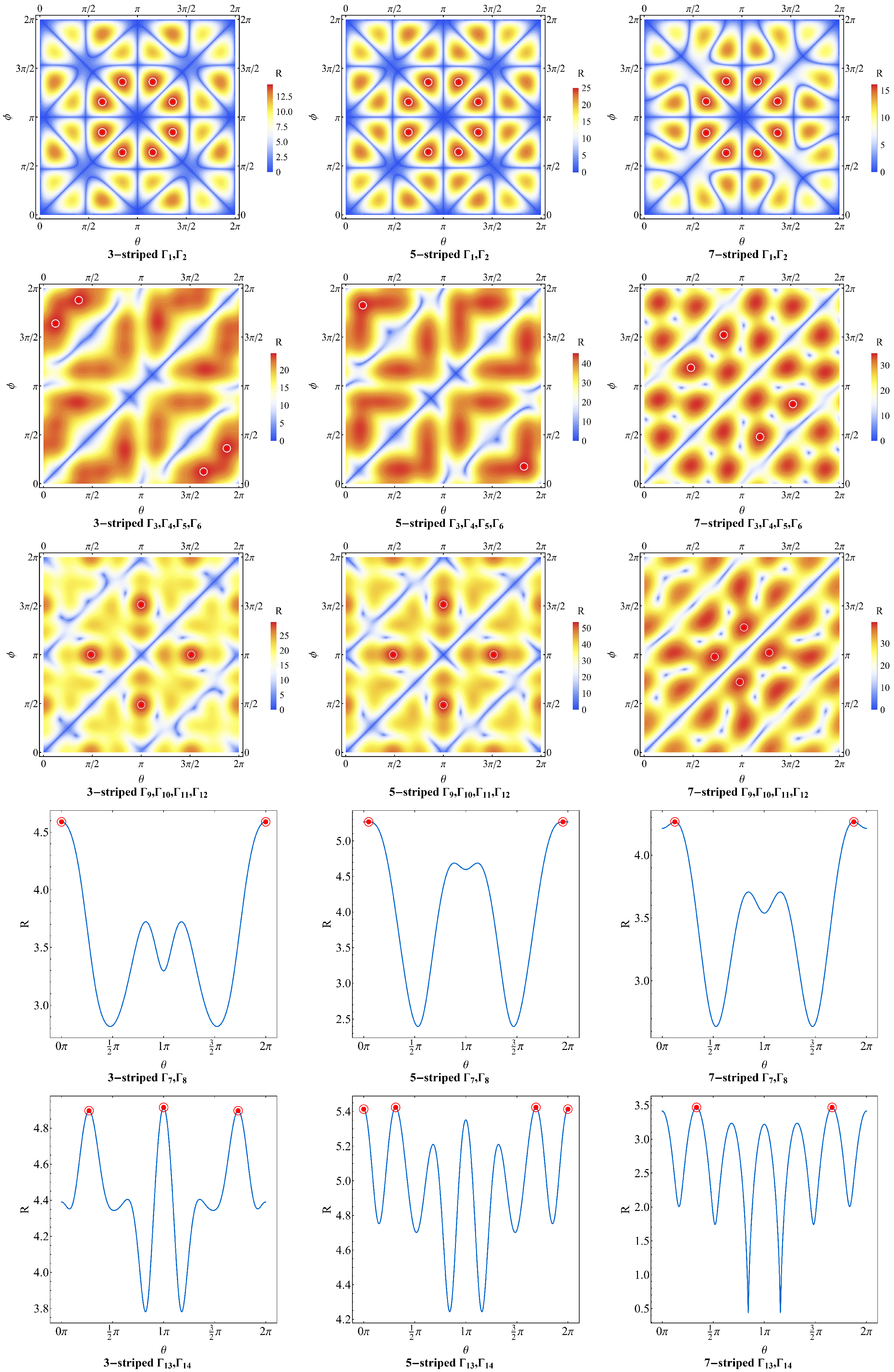
Similarly, for vertical stripes as depicted in Figure 6, the 5-stripe design maintains superior performance, a result corroborated by the data in Table 2.

5. Summary

This study focuses on the experimental test of Local Lorentz Invariance (LLI), specifically aiming to improve the constraints on the d = 6 mass dimension coefficients within the SME framework. While existing short-range gravity experiments provide the current best limits, their designs are not fully optimized for LV effects. We proposed an enhanced torsion pendulum scheme with two key innovations: (1) adjusting the apparatus’s azimuth angle relative to the Earth’s rotation to obtain multi-directional data, thereby strengthening the joint constraints on the 14 LV coefficients, and (2) utilizing the sensitivity of LV effects to mass edges by implementing horizontal and vertical striped configurations for the source and test masses.
A systematic comparison of 3-, 5-, and 7-stripe geometries demonstrates that the 5-stripe design is the optimal configuration for maximizing the LV signal. This research provides a novel methodology for probing d = 6 Lorentz violation at current experimental precisions and offers a valuable reference for future gravity-based searches for new physics beyond the Standard Model.

Author Contributions

Conceptualization, C.-G.S. and P.-P.W.; methodology, C.-G.S., P.-P.W. and T.J.; software, R.L. and W.H.; validation, T.J. and Y.-J.T.; formal analysis, T.J. and P.-P.W.; investigation, T.J.; resources, C.-G.S.; data curation, T.J. and R.L.; writing—original draft preparation, T.J.; writing review and editing, C.-G.S. and P.-P.W.; visualization, T.J. and W.H.; supervision, C.-G.S.; project administration, C.-G.S.; funding acquisition, C.-G.S. and P.-P.W. All authors have read and agreed to the published version of the manuscript.

Funding

This research was funded by the National Natural Science Foundation of China (Grant No. 12405060, No. 12305062 and No. 12150012).

Data Availability Statement

The original contributions presented in the study are included in the article, further inquiries can be directed to the corresponding authors.

Acknowledgments

During the preparation of this manuscript, the authors used ChatGPT (GPT-5) for assistance in translating parts of the text from Chinese to English. The authors have reviewed and edited all output and take full responsibility for the content of this publication.

Conflicts of Interest

The authors declare no conflict of interest.

References

  1. Nambu, Y. Quantum Electrodynamics in Nonlinear Gauge. Prog. Theor. Phys. Suppl. 1968, E68, 190–195. [Google Scholar] [CrossRef]
  2. Amelino-Camelia, G.; Ellis, J.; Mavromatos, N.E.; Nanopoulos, D.V. Distance Measurement and Wave Dispersion in a Liouville-String Approach to Quantum Gravity. Int. J. Mod. Phys. A 1997, 12, 607–623. [Google Scholar] [CrossRef]
  3. Ellis, J.; Mavromatos, N.E.; Nanopoulos, D.V. Quantum-Gravitational Diffusion and Stochastic Fluctuations in the Velocity of Light. Gen. Relativ. Gravit. 2000, 32, 127–144. [Google Scholar] [CrossRef]
  4. Amelino-Camelia, G.; Majid, S. Waves on noncommutative space–time and gamma-ray bursts. Int. J. Mod. Phys. A 2000, 15, 4301–4323. [Google Scholar] [CrossRef]
  5. Alfaro, J.; Morales-Técotl, H.A.; Urrutia, L.F. Loop quantum gravity and light propagation. Phys. Rev. D 2002, 65, 103509. [Google Scholar] [CrossRef]
  6. Gambini, R.; Pullin, J. Nonstandard optics from quantum space-time. Phys. Rev. D 1999, 59, 124021. [Google Scholar] [CrossRef]
  7. Alfaro, J. Quantum Gravity and Lorentz Invariance Violation in the Standard Model. Phys. Rev. Lett. 2005, 94, 221302. [Google Scholar] [CrossRef]
  8. Ellis, J.; Mavromatos, N.E.; Nanopoulos, D.V. Microscopic recoil model for light-cone fluctuations in quantum gravity. Phys. Rev. D 1999, 61, 027503. [Google Scholar] [CrossRef]
  9. Debono, I.; Smoot, G.F. General Relativity and Cosmology: Unsolved Questions and Future Directions. Universe 2016, 2, 23. [Google Scholar] [CrossRef]
  10. Tasson, J.D. What do we know about Lorentz invariance? Rep. Prog. Phys. 2014, 77, 062901. [Google Scholar] [CrossRef]
  11. Amelino-Camelia, G. Quantum-Spacetime Phenomenology. Living Rev. Relativ. 2013, 16, 5. [Google Scholar] [CrossRef]
  12. Kostelecký, A. Gravity, Lorentz violation, and the standard model. Phys. Rev. D 2003, 69, 105009. [Google Scholar] [CrossRef]
  13. Kostelecký, V.A.; Samuel, S. Spontaneous breaking of Lorentz symmetry in string theory. Phys. Rev. D 1989, 39, 683–685. [Google Scholar] [CrossRef] [PubMed]
  14. Carroll, S.M.; Harvey, J.A.; Kostelecký, V.A.; Lane, C.D.; Okamoto, T. Noncommutative Field Theory and Lorentz Violation. Phys. Rev. Lett. 2001, 87, 141601. [Google Scholar] [CrossRef] [PubMed]
  15. Bjorken, J.D. Cosmology and the standard model. Phys. Rev. D 2003, 67, 043508. [Google Scholar] [CrossRef]
  16. Cline, J.M.; Valcárcel, L. Asymmetrically warped compactifications and gravitational Lorentz violation. J. High Energy Phys. 2004, 2004, 032. [Google Scholar] [CrossRef]
  17. Kostelecký, V.A.; Russell, N. Data tables for lorentz and CPT violation. In CPT and Lorentz Symmetry; World Scientific Publishing Co Pte Ltd.: Singapore, 2008; pp. 308–321. [Google Scholar] [CrossRef]
  18. Sanner, C.; Huntemann, N.; Lange, R.; Tamm, C.; Peik, E.; Safronova, M.S.; Porsev, S.G. Optical clock comparison for Lorentz symmetry testing. Nature 2019, 567, 204–208. [Google Scholar] [CrossRef]
  19. Illuminati, F.; Lambiase, G.; Petruzziello, L. Spontaneous Lorentz Violation from Infrared Gravity. Symmetry 2021, 13, 1854. [Google Scholar] [CrossRef]
  20. Kostelecký, V.A.; Mewes, M. Testing local Lorentz invariance with gravitational waves. Phys. Lett. B 2016, 757, 510–514. [Google Scholar] [CrossRef]
  21. Qin, C.G.; Ke, J.; Li, Q.; Chen, Y.F.; Luo, J.; Tan, Y.J.; Shao, C.G. Testing Lorentz symmetry with space-based gravitational-wave detectors. Class. Quant. Grav 2023, 40, 205005. [Google Scholar] [CrossRef]
  22. Qin, C.G.; Tan, Y.J.; Shao, C.G. Test of Einstein Equivalence Principle by frequency comparisons of optical clocks. Phys. Lett. B 2021, 820, 136471. [Google Scholar] [CrossRef]
  23. Flowers, N.A.; Goodge, C.; Tasson, J.D. Superconducting-Gravimeter Tests of Local Lorentz Invariance. Phys. Rev. Lett. 2017, 119, 201101. [Google Scholar] [CrossRef] [PubMed]
  24. Hohensee, M.A.; Müller, H.; Wiringa, R.B. Equivalence Principle and Bound Kinetic Energy. Phys. Rev. Lett. 2013, 111, 151102. [Google Scholar] [CrossRef] [PubMed]
  25. Aker, M.; Batzler, D.; Beglarian, A.; Behrens, J.; Berlev, A.; Besserer, U.; Bieringer, B.; Block, F.; Bobien, S.; Bornschein, B.; et al. Search for Lorentz-invariance violation with the first KATRIN data. Phys. Rev. D 2023, 107, 082005. [Google Scholar] [CrossRef]
  26. Tasson, J.D. The Standard-Model Extension and Gravitational Tests. Symmetry 2016, 8, 111. [Google Scholar] [CrossRef]
  27. Kostelecký, V.A.; Mewes, M. Testing local Lorentz invariance with short-range gravity. Phys. Lett. B 2017, 766, 137–143. [Google Scholar] [CrossRef]
  28. Yang, S.Q.; Zhan, B.F.; Wang, Q.L.; Shao, C.G.; Tu, L.C.; Tan, W.H.; Luo, J. Test of the Gravitational Inverse Square Law at Millimeter Ranges. Phys. Rev. Lett. 2012, 108, 081101. [Google Scholar] [CrossRef]
  29. Tan, W.H.; Yang, S.Q.; Shao, C.G.; Li, J.; Du, A.B.; Zhan, B.F.; Wang, Q.L.; Luo, P.S.; Tu, L.C.; Luo, J. New Test of the Gravitational Inverse-Square Law at the Submillimeter Range with Dual Modulation and Compensation. Phys. Rev. Lett. 2016, 116, 131101. [Google Scholar] [CrossRef]
  30. Long, J.C.; Kostelecký, V.A. Search for Lorentz violation in short-range gravity. Phys. Rev. D 2015, 91, 092003. [Google Scholar] [CrossRef]
  31. Shao, C.G.; Tan, Y.J.; Tan, W.H.; Yang, S.Q.; Luo, J.; Tobar, M.E.; Bailey, Q.G.; Long, J.C.; Weisman, E.; Xu, R.; et al. Combined Search for Lorentz Violation in Short-Range Gravity. Phys. Rev. Lett. 2016, 117, 071102. [Google Scholar] [CrossRef]
  32. Shao, C.G.; Chen, Y.F.; Tan, Y.J.; Yang, S.Q.; Luo, J.; Tobar, M.E.; Long, J.C.; Weisman, E.; Kostelecký, V.A. Combined Search for a Lorentz-Violating Force in Short-Range Gravity Varying as the Inverse Sixth Power of Distance. Phys. Rev. Lett. 2019, 122, 011102. [Google Scholar] [CrossRef]
  33. Shao, C.G.; Chen, Y.F.; Tan, Y.J.; Luo, J.; Yang, S.Q.; Tobar, M.E. Enhanced sensitivity to Lorentz invariance violations in short-range gravity experiments. Phys. Rev. D 2016, 94, 104061. [Google Scholar] [CrossRef]
  34. Chen, Y.F.; Tan, Y.J.; Shao, C.G. Experimental Design for Testing Local Lorentz Invariance Violations in Gravity. Symmetry 2017, 9, 219. [Google Scholar] [CrossRef]
  35. Li, J.R.; Tan, Y.J.; Jin, T.; Huang, W.S.; Huang, H.; Qin, C.G.; Shao, C.G. Experimental design for testing local Lorentz invariance violation in gravity. Class. Quant. Grav. 2025, 42, 025012. [Google Scholar] [CrossRef]
  36. Colladay, D.; Kostelecký, V.A. CPT violation and the standard model. Phys. Rev. D 1997, 55, 6760–6774. [Google Scholar] [CrossRef]
  37. Bluhm, R.; Kostelecký, V.A.; Lane, C.D.; Russell, N. Clock-Comparison Tests of Lorentz and CPT Symmetry in Space. Phys. Rev. Lett. 2002, 88, 090801. [Google Scholar] [CrossRef]
  38. Ding, Y.; Kostelecký, V.A. Lorentz-violating spinor electrodynamics and Penning traps. Phys. Rev. D 2016, 94, 056008. [Google Scholar] [CrossRef]
  39. Shao, C.G.; Tan, Y.J.; Tan, W.H.; Yang, S.Q.; Luo, J.; Tobar, M.E. Search for Lorentz invariance violation through tests of the gravitational inverse square law at short ranges. Phys. Rev. D 2015, 91, 102007. [Google Scholar] [CrossRef]
  40. Poisson, E.; Will, C.M. Gravity: Newtonian, Post-Newtonian, Relativistic; Cambridge University Press: Cambridge, UK, 2014. [Google Scholar] [CrossRef]
  41. Kostelecký, V.A.; Mewes, M. Electrodynamics with Lorentz-violating operators of arbitrary dimension. Phys. Rev. D 2009, 80, 015020. [Google Scholar] [CrossRef]
Figure 1. Schematic diagram of the torsion pendulum, source mass, and electrostatic shielding membrane system.
Symmetry 18 00559 g001
Figure 2. Misalignment schematic of the striped test mass and source mass, showing the half-stripe offset configuration. (a) vertical stripes; (b) horizontal stripes.
Symmetry 18 00559 g002
Figure 3. Schematic of the azimuth angle θ between the experimental apparatus and the Earth’s North–South meridian.
Symmetry 18 00559 g003
Figure 4. Design of the striped tungsten plates with different stripe counts (3, 5, and 7 stripes).
Symmetry 18 00559 g004
Figure 5. Relationship between the characteristic value R and angles ( θ , ϕ or θ ) for horizontal stripe transfer functions. The top three rows illustrate the R ( θ , ϕ ) distributions (heatmaps), while the bottom two rows represent the R ( θ ) variations (line plots). The positions of the maximum values are marked by white circles with red dots. Units are 10 9 N · m / m 2 .
Symmetry 18 00559 g005
Figure 6. Relationship between the characteristic value R and angles ( θ , ϕ or θ ) for vertical stripe transfer functions; the circles indicate the locations of the maximum R values. Units are 10 9 N · m / m 2 .
Symmetry 18 00559 g006
Table 1. Maximum values of the characteristic values R for various horizontal stripe configurations. For R 1 , R 2 , R 3 , the values represent the maxima over ( θ , ϕ ) , while for R 4 , R 5 , they represent the maxima over ( θ ) . All values are in units of 10 9 N · m / m 2 .
ConfigurationMax R ( θ , ϕ ) Max R ( θ )
R 1 R 2 R 3 R 4 R 5
3-Stripe14.8424.9222.135.785.24
5-Stripe28.4744.2641.556.605.77
7-Stripe27.5429.4636.104.213.72
Table 2. Maximum values of the characteristic values R for various vertical stripe configurations. Units are 10 9 N · m / m 2 .
ConfigurationMax R ( θ , ϕ ) Max R ( θ )
R 1 R 2 R 3 R 4 R 5
3-Stripe14.5524.7529.574.594.90
5-Stripe25.3945.2953.655.275.42
7-Stripe16.1034.8039.734.263.47
Disclaimer/Publisher’s Note: The statements, opinions and data contained in all publications are solely those of the individual author(s) and contributor(s) and not of MDPI and/or the editor(s). MDPI and/or the editor(s) disclaim responsibility for any injury to people or property resulting from any ideas, methods, instructions or products referred to in the content.