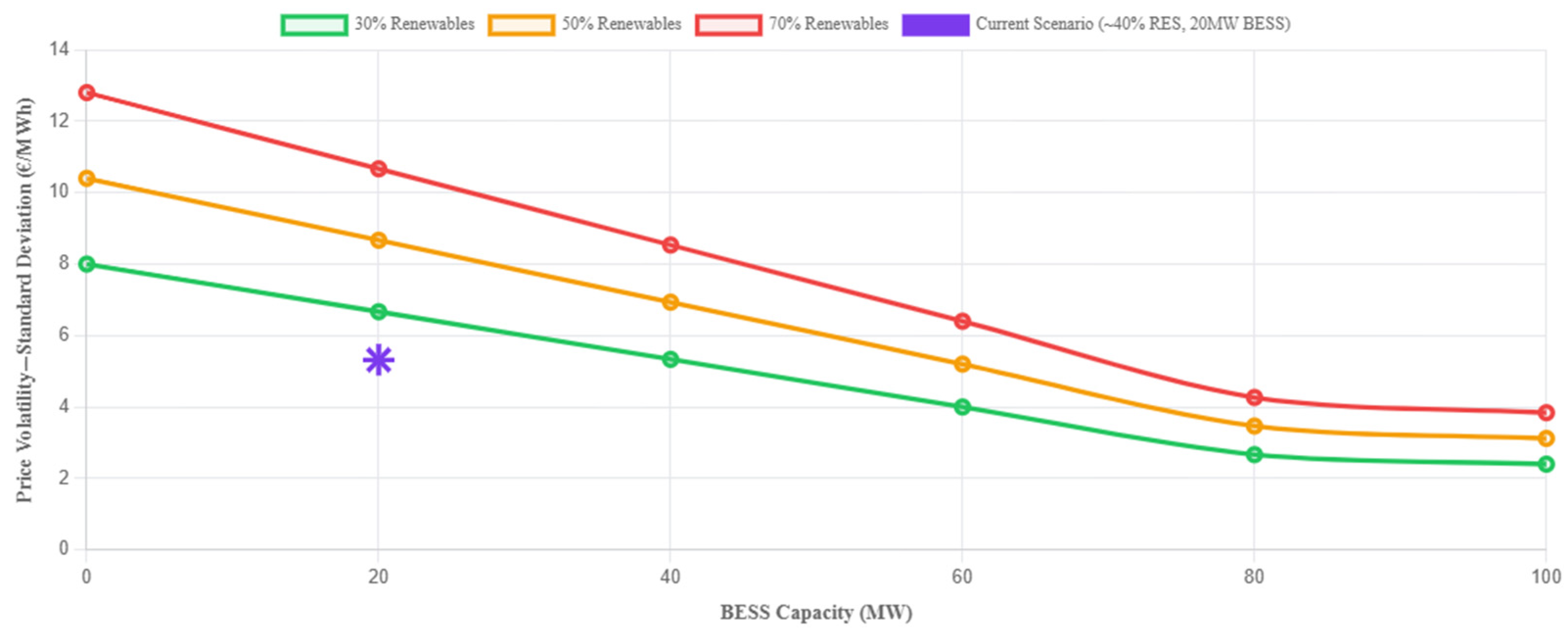
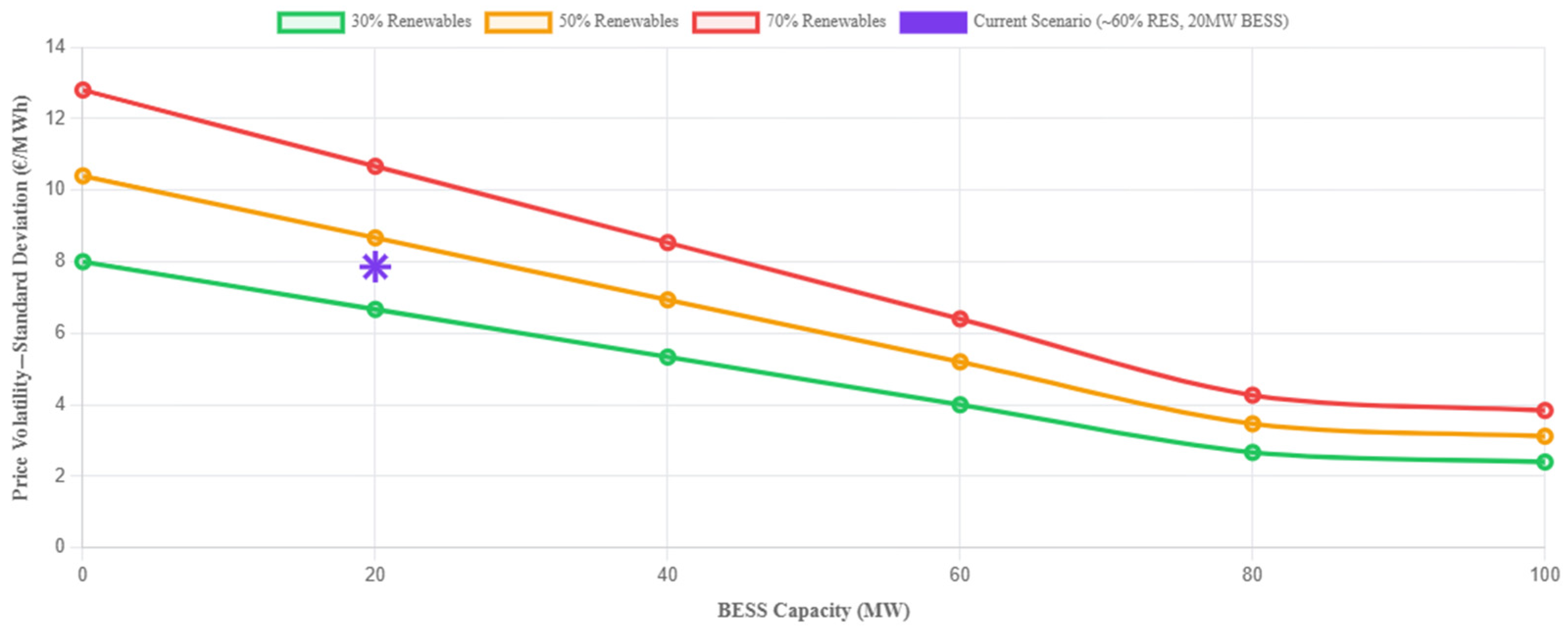
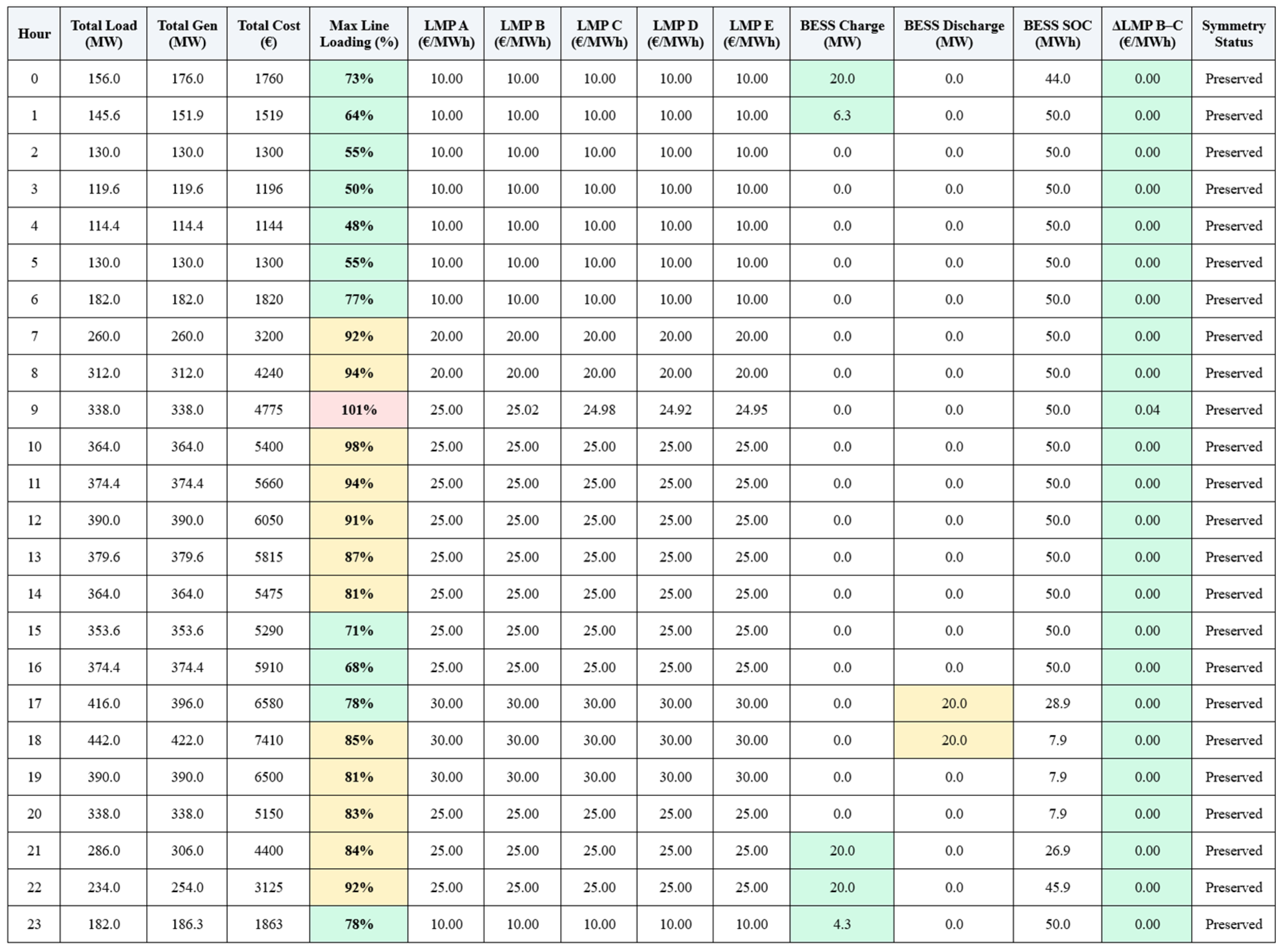
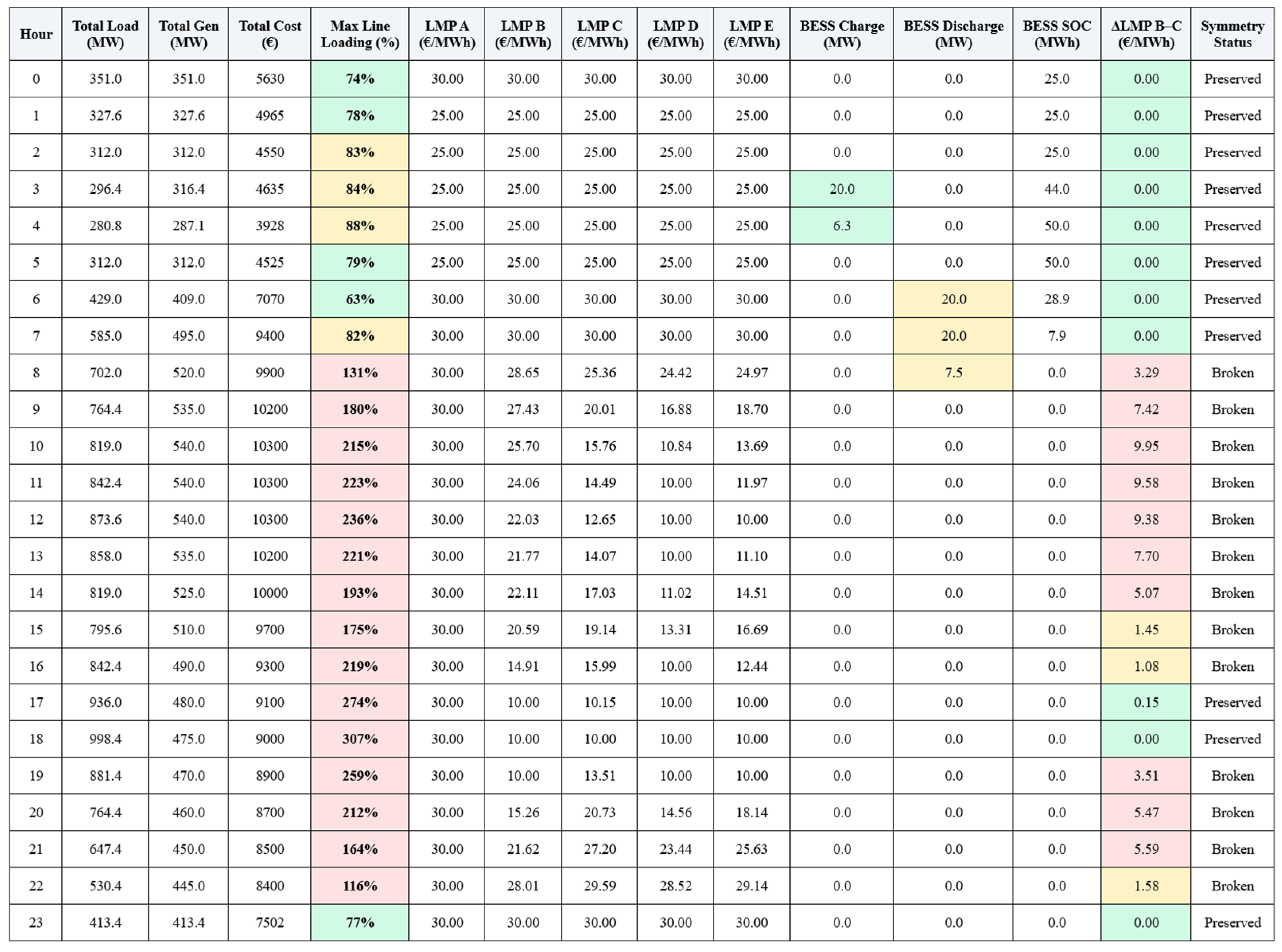
1. Introduction
The integration of renewable energy sources (RESs), such as solar photovoltaic installations and wind farms, is radically transforming the energy system of Latvia and the entire Baltic region [
1,
2,
3,
4]. As of mid-2025, the total capacity of RESs connected to the grid exceeds 2 GW, with another 4 GW in development [
2,
5]. These investments contribute to the achievement of the climate goals of Latvia and the European Union within the framework of the Clean Energy for All Europeans initiative [
1], but at the same time create additional loads on the electricity transmission grid. The main challenge is the high variability and correlation of RES generation, which leads to temporary overloads and excess production during periods of low demand [
6,
7,
8].
In recent years, important changes have been observed in the organization of the electricity market in the Baltic countries: a second power exchange has been opened, and the planning period has been reduced from 1 h to 15 min [
9,
10]. These changes reinforce the importance of forecasting and optimization tools that can take into account rapid fluctuations in generation and load.
To address these issues, flexible grid access mechanisms are being introduced in Latvia [
5,
9,
11], allowing new RES installations to be connected with restrictions on the time of power supply (e.g., no more than 90% of the time per year without compensation for the remaining curtailed time [
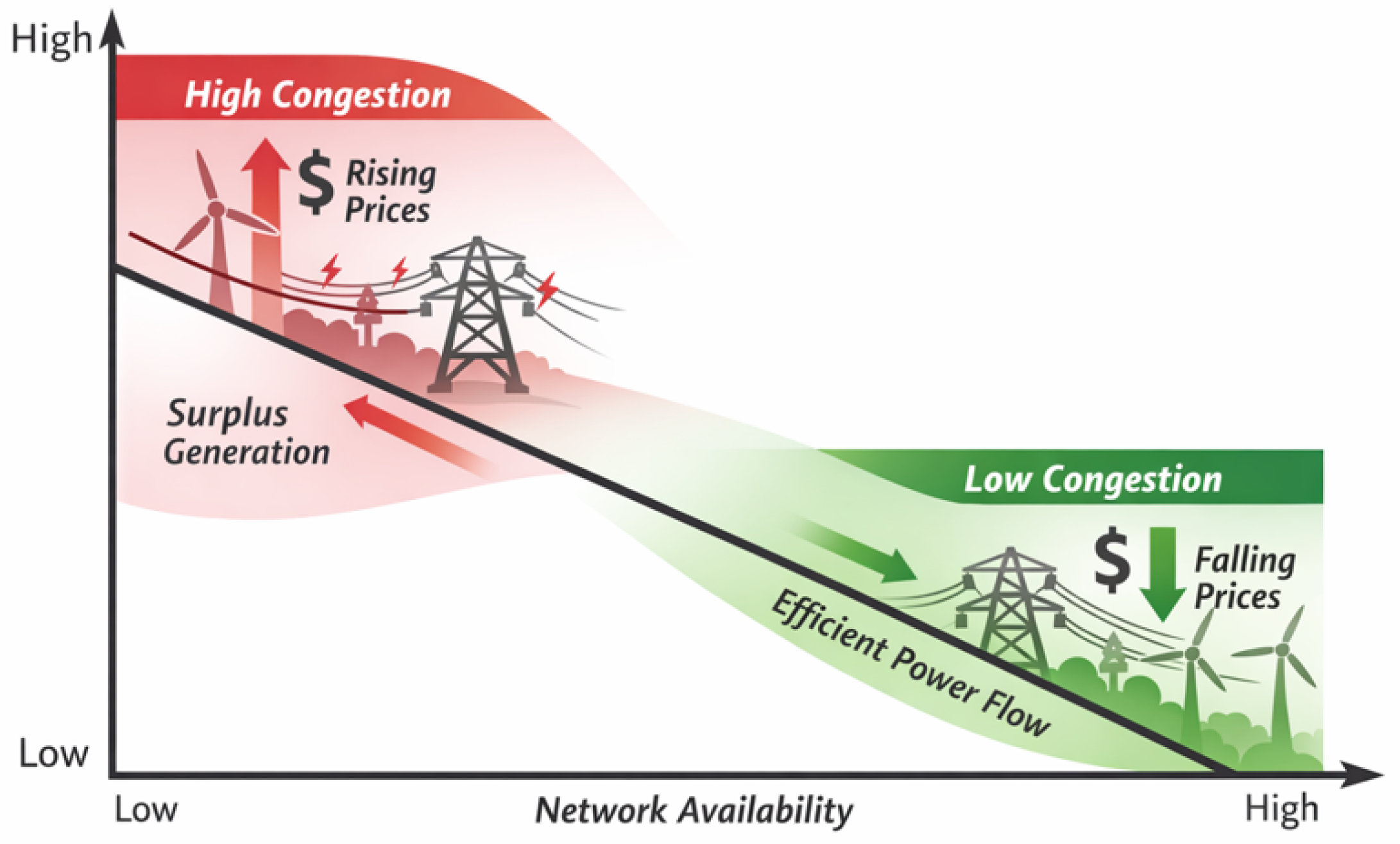
5]). Such connections create a new type of inverse relationship between generation and grid availability: operators and market participants must restore optimal modes of using available grid capacity and distributing flows with incomplete information, which is essentially an inverse problem in energy economics (
Figure 1) [
12,
13,
14,
15].
The inverse slope shown in
Figure 1 does not represent a conventional supply–price relationship. Instead, it illustrates a constrained-network regime in which effective grid accessibility, rather than installed generation capacity, dominates nodal price formation.
When renewable generation increases under limited transmission availability, additional output cannot be freely delivered to demand centers. Surplus generation becomes locally concentrated, transmission constraints become binding, and nodal prices diverge, leading to congestion-driven price increases in constrained areas (high-congestion region).
Conversely, when network availability is high, power flows can be efficiently redistributed, congestion is alleviated, and nodal prices converge toward marginal generation costs (low-congestion region). Thus, the downward slope reflects the inverse relationship between network accessibility and price distortions, rather than a direct dependence between generation volume and price level.
At the same time, energy storage systems (BESSs) are actively developing, playing a key role in balancing variable renewable energy generation and ensuring the reliability of electricity supply [
16,
17,
18,
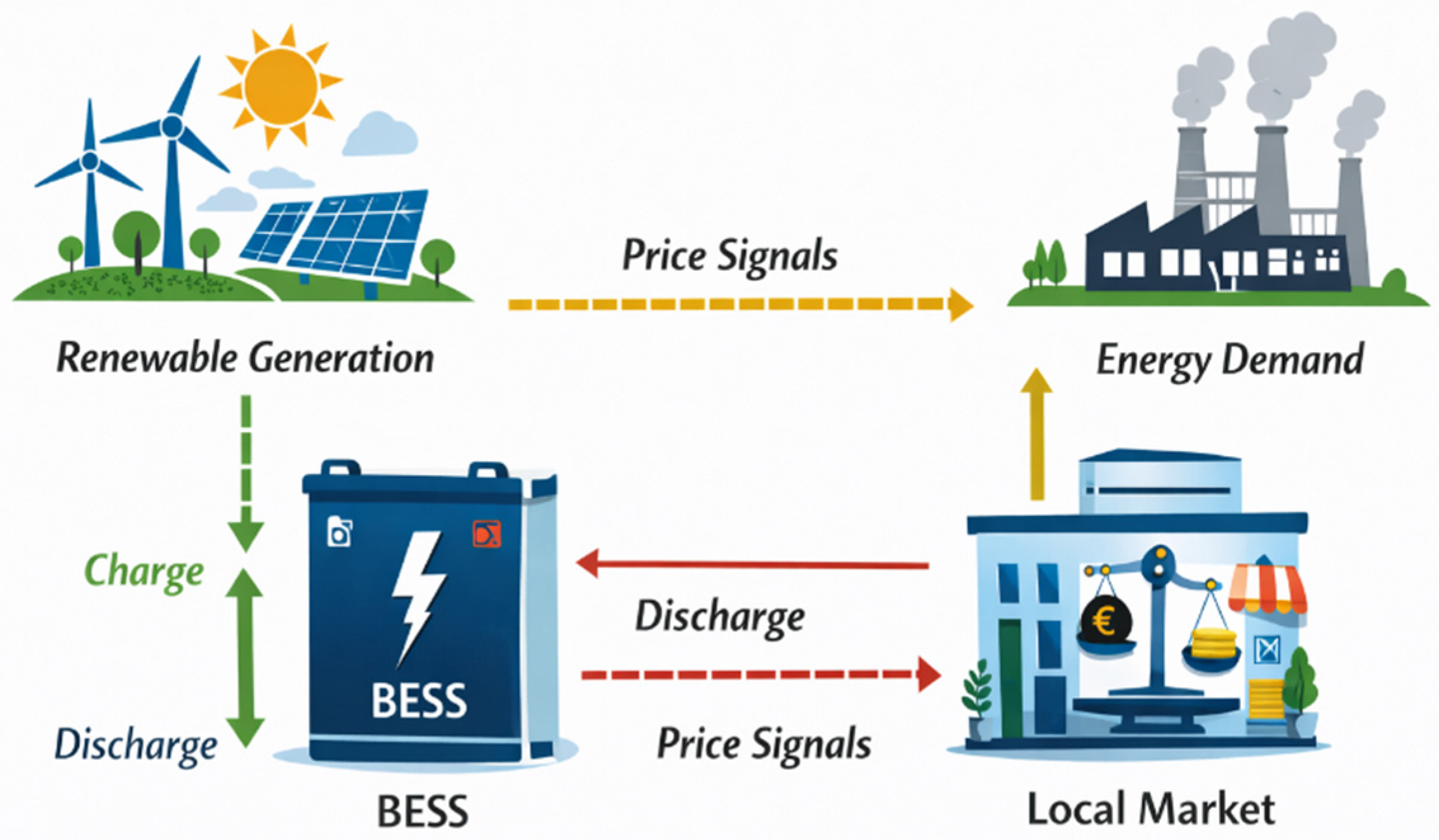
19]. The total planned capacity of battery systems in Latvia exceeds 660 MW. BESSs are seen not only as technological buffers, but also as active participants in local electricity markets (LEMs). They are capable of participating in price arbitrage, smoothing load peaks, maintaining frequency, and compensating for grid constraints (
Figure 2) [
16,
17,
19,
20]. Such systems create new local supply-and-demand balances that require flexible market mechanisms and accurate simulation and forecasting tools [
7,
8,
21,
22,
23]. In this case, LMPs are treated as shadow prices of power balance in optimal optimal-power-flow (OPF) models, reflecting generation costs, line constraints, and network topology [
24,
25,
26]. The bidirectional arrows in
Figure 2 represent interaction rather than direct price-setting authority. In the proposed framework, the BESS does not determine prices exogenously; instead, it responds to market price signals while simultaneously influencing them indirectly through its impact on power balance, congestion patterns, and marginal system conditions. Thus, prices remain endogenous outcomes of the OPF-based market-clearing process.
The aim of this work is to develop a symmetry-oriented model of the LEM, formulated as an inverse problem. In the proposed formulation, OPF-consistent resource allocation and BESS management are recovered based on observed data on generation, consumption, and network constraints.
The use of symmetric operators and invariant structures allows:
Identifying recurring (symmetrical) groups of market participants—generators, consumers, and storage facilities;
Reducing the dimension of the initial optimization problem without losing accuracy;
Applying regularization methods similar to approaches in inverse-problem theory (Tikhonov, Engle, et al.) [
12,
13,
14,
15] to stabilize the solution when data is incomplete.
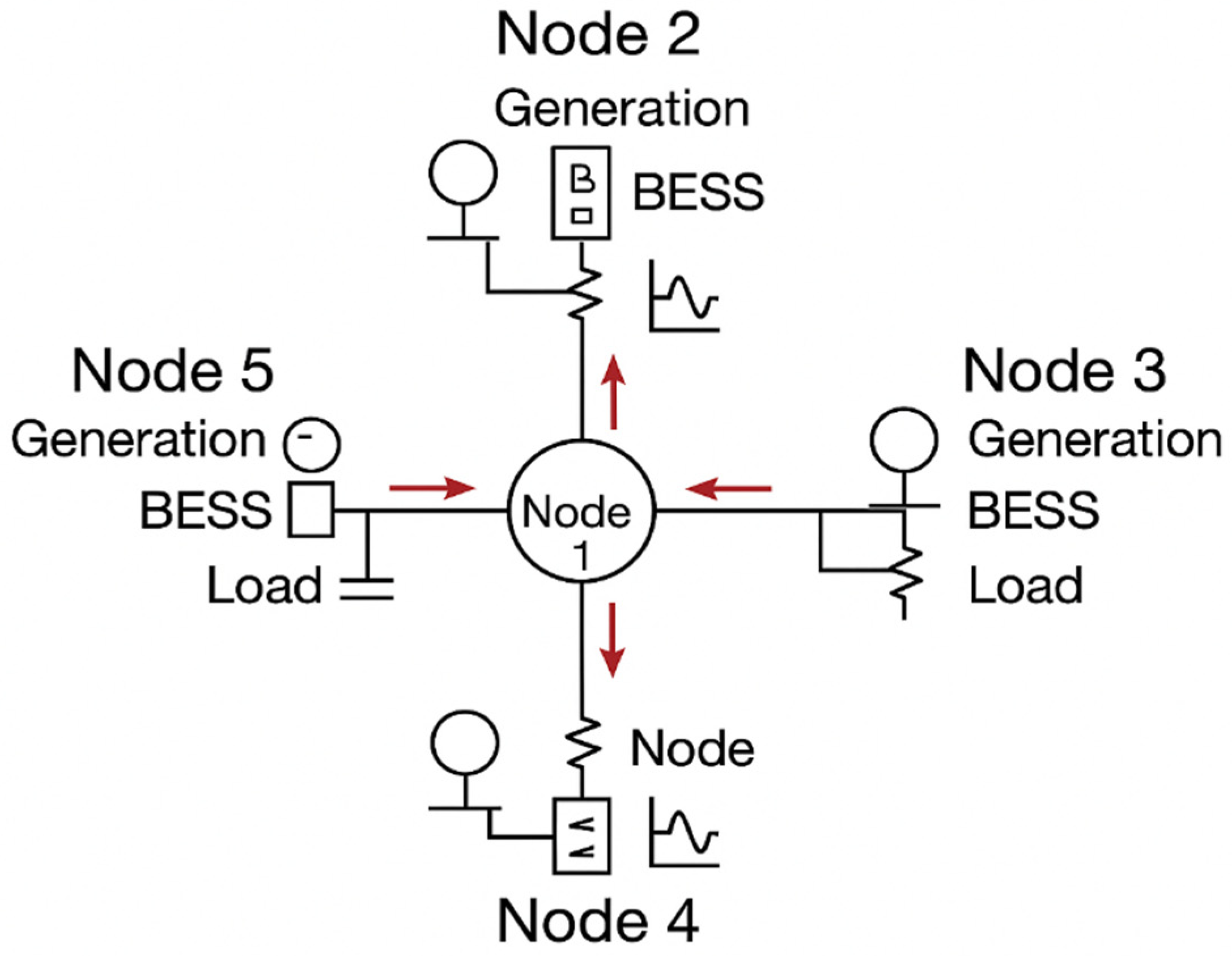
Thus, the mathematical formulation of the work is an inverse problem in the spirit of the classical Tikhonov–Calderon theory, where observed market data (prices, loads, charge levels) serve as “boundary conditions”, and internal variables (power distributions, BESS limits, and local price signals) are recovered as unknown variables. Unlike existing approaches, this work formulates local market optimization as an inverse problem using symmetric dimensionality reduction (
Figure 3).
To illustrate how the calculation algorithms work, a simplified model of a local market with five nodes was used, including:
Variable profiles of renewable energy generation (solar and wind);
BESS dynamics, including charge–discharge processes and power limitations;
Dynamic pricing depending on local supply-and-demand balance and grid constraints;
Symmetric groups of nodes and aggregators, allowing the use of structural invariance and regularization principles.
The use of symmetric operators simplifies the computational task, allows for the efficient solution of high-dimensional problems, and increases the stability of the numerical solution. This makes the proposed approach particularly suitable for the analysis of flexible, dynamically constrained energy systems, where classical forward-optimization models do not provide reliable strategy reconstruction.
Based on the results obtained for a symmetric five-node test system, as well as in accordance with the conclusions of previous studies on Latvian network data [
2,
9,
27], it can be expected that the proposed symmetry-oriented approach is capable of:
Increasing the utilization of available capacity and the load factor of network resources;
Reducing the volume of forced curtailment;
Stabilizing local prices and increasing the predictability of market signals.
Thus, the developed symmetric inverse formulation can provide a new mathematical and applied basis for the construction of local electricity markets in Latvia and other EU countries, where the rapid growth of RES requires flexible, sustainable, and structurally transparent modeling methods.
The work is structured as follows.
Section 2 presents the formulation of the local market problem with flexible access to RES and BESS integration.
Section 3 describes the mathematical model, including sets, variables, the objective function, constraints, and the dynamic pricing mechanism, and is devoted to the components of the model, key assumptions, and simplifications used for the basic simulation.
Section 4 analyzes the proposed model scaling, simulation scenario descriptions and experimental design for RES integration.
Section 5,
Section 6 and
Section 7 summarize the main results and conclusions, discuss the practical significance of the proposed approach, and outline directions for future research, including multi-node models and stochastic optimization.
3. The Mathematical Model and Formulation of the Inverse Problem
3.1. General Concept
Based on the theoretical foundations of inverse problems and symmetry outlined in
Section 2, this paper formulates the LEM as an inverse optimization problem. In classical forward approaches, energy flow distribution and price formation are modeled with fully specified generation, demand, and network parameters. In contrast, this paper considers a setting in which optimal strategies for managing distributed energy resources, including BESSs, as well as corresponding local price signals, are recovered from observed data on generation, consumption, and network constraints.
The key idea is to use the structural symmetry inherent in energy systems with a large number of repetitive elements, such as identical generators, consumers, or network nodes. Formalizing this symmetry using appropriate operators allows us to take into account the invariance of the system structure, significantly reduce the dimension of the optimization problem, and increase the stability of the solution with a high share of renewable energy sources and the presence of grid constraints. In addition, this approach naturally combines with the regularization methods characteristic of inverse-problem theory [
12], which is especially important when information is incomplete or noisy.
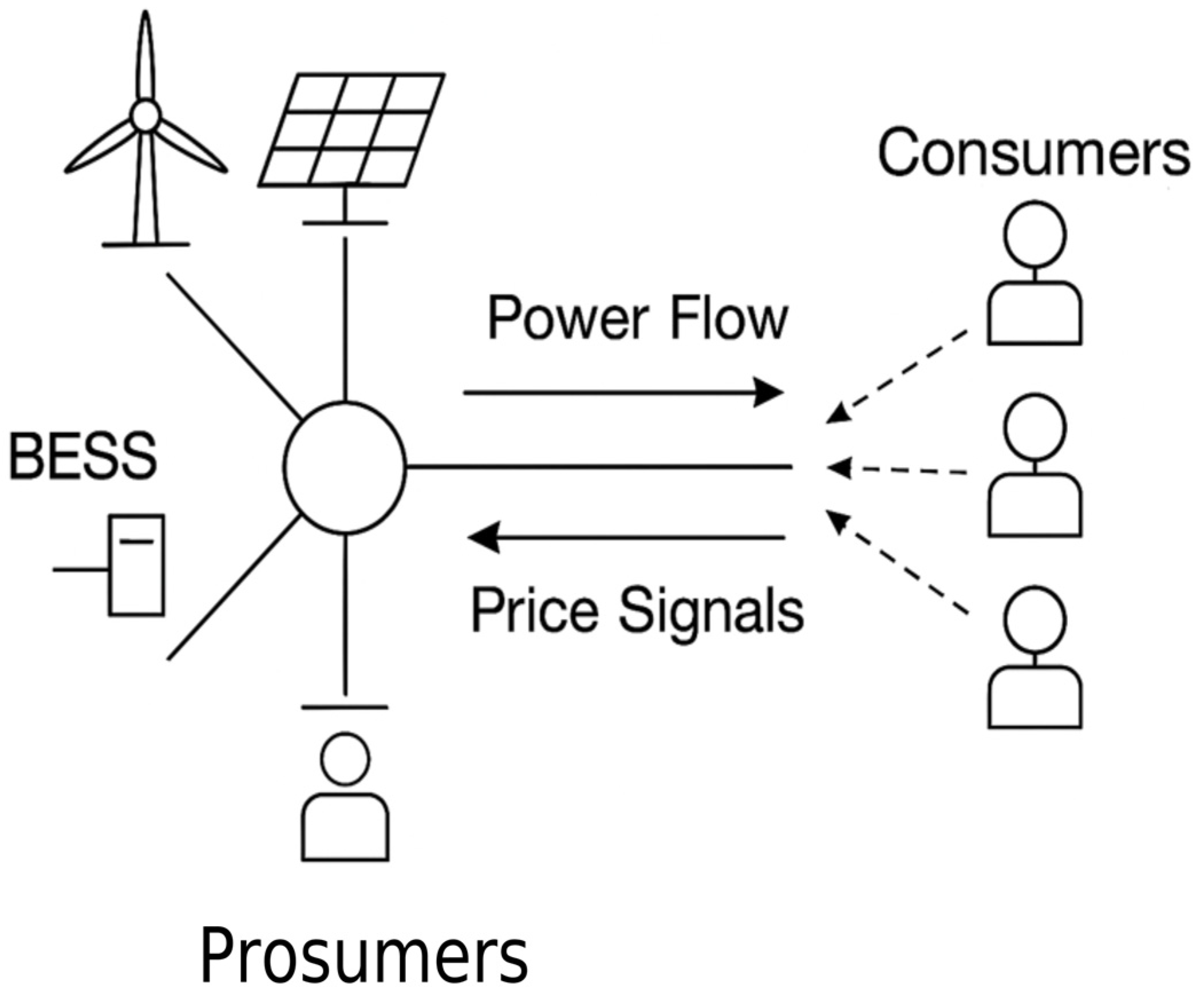
Figure 4 shows a conceptual diagram of a local electricity market with the integration of renewable energy sources and storage systems. The nodes of the diagram include generators, a BESS, and consumers, while the arrows represent both physical electricity flows and information signals related to pricing. Repeating elements form symmetrical clusters, which allows variables and constraints to be aggregated when formulating the optimization problem.
Thus, the proposed model is considered as a problem of restoring the optimal state of the local market based on partial observations, where symmetry plays a key role in ensuring the compactness and numerical stability of the solution. Unlike traditional forward models, this approach focuses on reconstructing optimal management strategies based on available market and network data.
3.2. Sets and Indices
To formalize the model, the following sets and indices are introduced:
t ∈ Τ—Discrete time intervals (e.g., 15 min or hourly simulation steps);
n ∈ N—Set of local network nodes (used for aggregation and symmetry analysis);
i ∈ Gn—RES generators (solar or wind installations connected to node n);
j ∈ Bn—BESS located at node n;
k ∈ Dn—Loads (consumers) at node n.
This index assignment allows for the symmetry of nodes to be taken into account naturally and identical elements to be aggregated.
3.3. Variable Solutions
Main variables of the problem:
—Active power generation of RES unit i at time t [MW];
—State of charge of BESS j at time t [MWh];
—Charging and discharging power of BESS j [MW];
—Load consumption of demand k at time t [MW];
λt—Local market price at time t [€/MWh];
γt—Curtailment coefficient of renewable energy generation at time t, 0 ≤ γt ≤ 1.
3.4. Parameters
The model uses the following parameters:
—Available power of generator i [MW];
—Maximum charging/discharging power of BESS j [MW];
—Capacity of BESS j battery [MWh];
ηc, ηd—BESS charging and discharging efficiency coefficients;
—Predicted demand/load of consumer k [MW];
ϴ—Maximum permissible share of curtailed hours (e.g., 10% per year).
3.5. Objective Function
The objective function is formulated as the maximization of local social welfare, taking into account the utility of consumption, the costs of operating storage facilities, and losses from restrictions on renewable energy generation:
where —Consumer utility function reflecting the effect of diminishing marginal utility;
Ccurt—Penalty for generation curtailment;
CBESS—Costs of storage degradation and cycling (may be linear with energy through BESS).
A regularization term may be added if necessary to stabilize the solution.
Economic interpretation of each term in Equation (1):
Consumer utility represents the benefit derived by consumers from electricity consumption. The logarithmic form reflects diminishing marginal utility, meaning that the incremental benefit decreases as consumption increases.
Storage operation cost accounts for battery degradation and energy cycling costs. This ensures that the model internalizes the wear and operational limits of BESS units.
Curtailment penalty penalizes the reduction of renewable generation output, encouraging efficient use of available renewable resources.
All variable symbols are defined in
Section 3.3, so no additional nomenclature table is required. A regularization term may be included to enhance solution stability when observations are partial or noisy.
3.6. Restriction System
3.6.1. Power Balance
At each discrete moment in time t ∈ T, the total generation and discharge of the storage devices must compensate for the load and charge of the BESS:
3.6.2. Generation Restrictions Taking Curtailment into Account
The available capacity of renewable energy generators is limited by the generation profile and possible forced restrictions:
3.6.3. Limit on Curtailment Share
To ensure an acceptable level of RES integration, a limit is imposed on the average curtailment value for the calculation period:
3.6.4. BESS Charge Dynamics
The energy state of the storage device is described by the following equation:
where
t + 1 denotes the next discrete time step and Δt represents the duration of the time interval (e.g., 1 h or 15 min, depending on the simulation resolution).
The following restrictions apply:
3.6.5. Demand Constraints
Consumption is limited by specified load profiles:
These relations form a system of equations and inequalities in which symmetric blocks (e.g., groups of identical generators or consumers) can be aggregated into quasi-isotropic clusters, which reduces the dimensionality of the system and improves the conditionality of the problem when solving it. For example, if there are 50 identical solar generators in the system, they can be aggregated into a single symmetric block, reducing the dimension of the problem from 50 to 1.
It should be noted that the activation of the BESS in symmetric modes in the absence of grid constraints does not necessarily change the local price, performing mainly a stabilizing function by smoothing generation and consumption profiles.
3.7. Dynamic Pricing
It is important to distinguish between two optimization layers in the proposed framework.
The first layer corresponds to a local resource optimization, including generation curtailment, demand adjustment, and BESS operation, formulated as a convex optimization problem.
The second layer corresponds to network-level analysis, where DC power flows and congestion indicators are evaluated diagnostically under exogenously specified injections, without network re-dispatch.
As a result, dual variables are interpreted as LMP signals rather than exact network-wide OPF shadow prices.
λt is formed as a dual variable of the aggregated local balance constraint and is interpreted as a proxy-LMP reflecting marginal balance conditions at a fixed network configuration.
Formally, the local price is defined as the derivative of the Lagrangian of the optimization problem for aggregate demand:
where L—Lagrangian of the local market optimization problem;
Csys—Total system cost, including generation costs, storage costs, and losses associated with RES generation constraints.
It should be emphasized that in the proposed formulation, the local price λt is a dual variable of the aggregated-balance constraint, rather than the node balances. As a result, a violation of symmetry in the distribution of loads or generation between nodes can lead to asymmetry in the primary variables (generation, power flows) without being accompanied by a change in the local price, provided that the active set of constraints and the marginal source of balance remain unchanged. Thus, the symmetry of the price signal is a more stable property of the system compared to the symmetry of physical variables and is violated only when the marginal balance mechanism changes or network constraints are activated.
As a result, the local price at time
t is a function of optimal decisions on generation, storage, and constraints:
which is sensitive to network limitations through diagnostic overload indicators:
Availability and structure of renewable energy generation;
Status and operating modes of BESS;
Grid constraints and curtailment levels.
It should be noted that the activation of BESS does not necessarily lead to a change in the local price at any given moment. In symmetric modes, in the absence of active network constraints and with linear or slightly convex BESS costs, charging and discharging operations can redistribute energy over time without changing the marginal cost of the balance constraint. In such modes, BESS performs a stabilizing function, smoothing generation and consumption profiles, while the local price remains invariant with respect to symmetric storage operations.
Consequently, price dynamics serve as an economic signal for the activation of flexible resources, in particular BESS charging and discharging, and ensure coordination between the physical constraints of the grid and the economic decisions of local-market participants. In situations where RES generation exceeds local demand and there is no possibility of exporting energy to the external grid, the marginal value of an additional unit of energy decreases, leading to a drop in the local price compared to the level of the centralized wholesale market. Conversely, during periods of capacity shortages (e.g., when RES generation is low or during peak-demand hours), the BESS switches to discharge mode, compensating for the shortage and thus smoothing out price peaks.
As mentioned above, the local price λt is determined by the LMP and reflects marginal generation costs, the state of storage facilities, and network constraints. Consequently, the dynamic pricing mechanism performs a self-regulating function similar to negative feedback in symmetrical physical systems, ensuring the stability of the local market and smoothing out price extremes when the share of RES is high.
In this work, nodal LMPs are reconstructed price signals, obtained by combining aggregated marginal prices with DC power flow sensitivities. They are not exact market-clearing prices, but are used to analyze symmetry breaking and congestion patterns. In the numerical examples, two pricing regimes are considered. In
Section 3.6,
Section 3.7,
Section 3.8 and
Section 3.9, the price
λt corresponds to an aggregated local market-clearing price. In
Section 3.10 and
Appendix A, nodal LMPs are reported to illustrate how symmetry breaking propagates from physical constraints to spatial price differentiation.
3.8. Numerical Solution Methods
Solving the proposed inverse problem of the LEM requires high numerical stability, since the initial data on generation, demand, and network constraints may be incomplete or noisy. Under such conditions, classical forward optimization can lead to unstable or ill-posed solutions, especially when there is a high share of RESs and strict grid constraints.
To stabilize the solution, regularization is used, similar to the approaches of inverse-problem theory [
12,
14], in which a smoothing term is added to the objective function:
where J(x)—Initial optimization function;
x—Vector of desired control variables (generation, BESS control, and constraint parameters);
α ≥ 0—Regularization parameter that controls the trade-off between the accuracy of the approximation of the observed data and the numerical stability of the solution.
The introduced regularization term suppresses unstable and non-unique solutions arising from network overloads, system structure symmetry, and incomplete observability, ensuring the correct restoration of optimal local market strategies.
Symmetry plays a key role in reducing the computational complexity of the problem. Identical nodes (generators, consumers, or storage systems) are aggregated into symmetric groups, which reduces the number of variables to be optimized without losing information about the structure of the solution. This not only improves numerical stability but also significantly increases computational efficiency, which is especially important for the practical application of the model on medium-scale and large-scale systems.
Depending on the chosen approximation of utility and cost functions, the problem is formulated as a linear (LP) or quadratic programming (QP) problem with a convex objective function and linear constraints. LMPs are calculated as dual variables of balance constraints, which provide economically interpretable price signals.
The solution algorithm includes the following steps:
Forming a symmetrically aggregated model;
Adding a regularization term;
Solving a convex optimization problem (LP/QP);
Reconstructing local prices and BESS control strategies based on dual variables.
This approach ensures the stability of the solution in the case of incomplete data and significantly reduces computational costs through the use of symmetry.
3.9. Model Structure and Implementation
For numerical experiments in this work, a simplified model of a local electricity market with a limited number of nodes and storage systems is used. This simplification allows us to focus on the key mechanisms of interaction between renewable energy generation, the BESS, and dynamic pricing, without modeling the complete topology of the electrical grid or performing a complete network redistribution of flows.
The proposed simulator does not perform full cost-minimizing network OPF redispatch. Instead, it evaluates DC power flows under exogenously specified generation and demand profiles and reconstructs nodal price signals based on power flow sensitivities and congestion indicators. This diagnostic setup is intentionally chosen to isolate symmetry-breaking effects in nodal prices without introducing equilibrium artifacts associated with full market reoptimization.
The model includes the following main components:
Generation and storage modules: RESs are modeled taking into account temporarily changing profiles of available power and curtailment capabilities. BESSs are described by charge–discharge dynamics, power and capacity constraints, efficiency coefficients, and degradation costs. Generation and storage are managed at the local level under fixed grid conditions.
Consumption module: Consumers are represented by predictable load profiles with the possibility of flexible consumption adjustment. Identical consumers can be aggregated into symmetric clusters to reduce the dimensionality of the problem and identify structural symmetries.
Optimization module: The objective function maximizes local social welfare under fixed network conditions, generation and storage costs, and penalties for RES curtailment. Constraints include power balance at nodes, BESS dynamics, and generation and consumption constraints. Network constraints are used diagnostically and do not lead to redistribution of flows between nodes.
Dynamic pricing module: Nodal price signals are formed based on dual variables of local balance constraints and flow sensitivity to power injections. The resulting price values are interpreted as proxy-LMPs and are used to analyze symmetry and identify signs of grid stress, rather than as accurate market-clearing prices.
A standard mathematical optimization environment that implements the solution of convex problems with linear constraints was used to conduct numerical experiments. The proposed model does not depend on a specific software tool and can be implemented in any optimization package that supports linear and quadratic programming.
The use of symmetric aggregation and regularization allows computational experiments to be performed on medium-sized systems while maintaining solution stability and acceptable computation time, which is particularly important for diagnostic and inverse problems in electricity market analysis.
3.10. Practical Example: Five-Node Local Area Network with Integration of RESs and BESS
To illustrate the proposed reverse model of the LEM and analyze the role of symmetry in the formation of flows and prices, a test system consisting of five nodes is considered. The choice of low dimensionality allows us to clearly demonstrate the influence of network constraints, as well as the mechanisms of symmetry preservation and violation in the optimal solution without losing the generality of the conclusions.
3.10.1. Network Topology and Symmetry
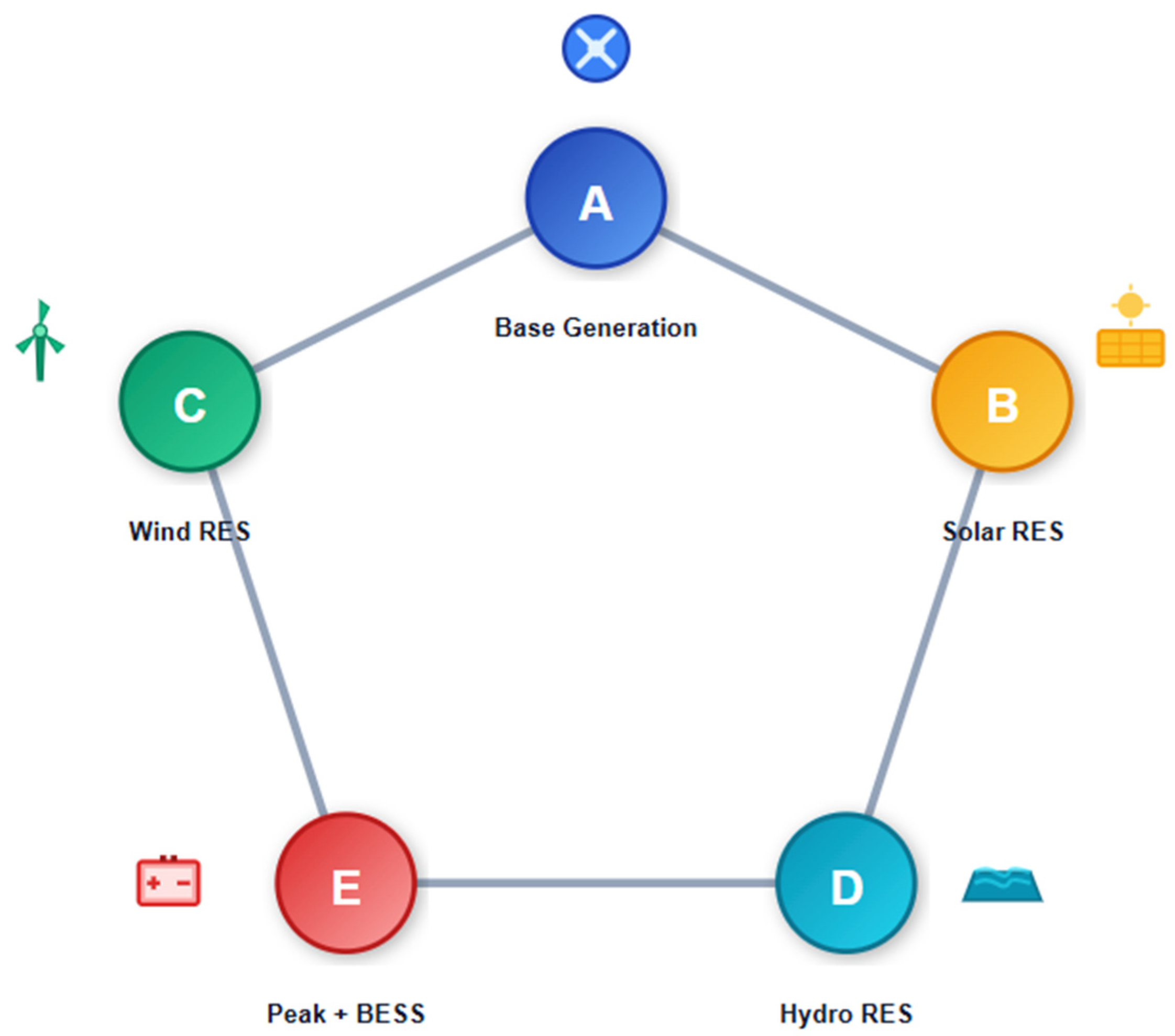
The test network consists of five nodes (A–E) connected by five power lines: AB, AC, BD, CE, and DE (
Figure 5). Each line has a specified thermal capacity limit
Flmax.
It should be noted that
Section 3.10 serves as an illustrative benchmark example, in which a full DC-OPF formulation with Power Transfer Distribution Factor (PTDF)-based line constraints is used to demonstrate how symmetry breaking propagates from physical constraints to nodal prices.
Unlike the diagnostic simulator described in
Section 3.9, this example employs an explicit DC-OPF to provide a transparent and interpretable reference case.
Generators and loads can be placed on all nodes, and node E also includes BESS capability. Nodes B and C are assumed to be structurally symmetrical: they have the same load profiles, identical generation parameters, and the same coefficients of influence on power flows. This symmetry is used to aggregate variables and serves as the basis for analyzing symmetrical and asymmetrical network operating modes.
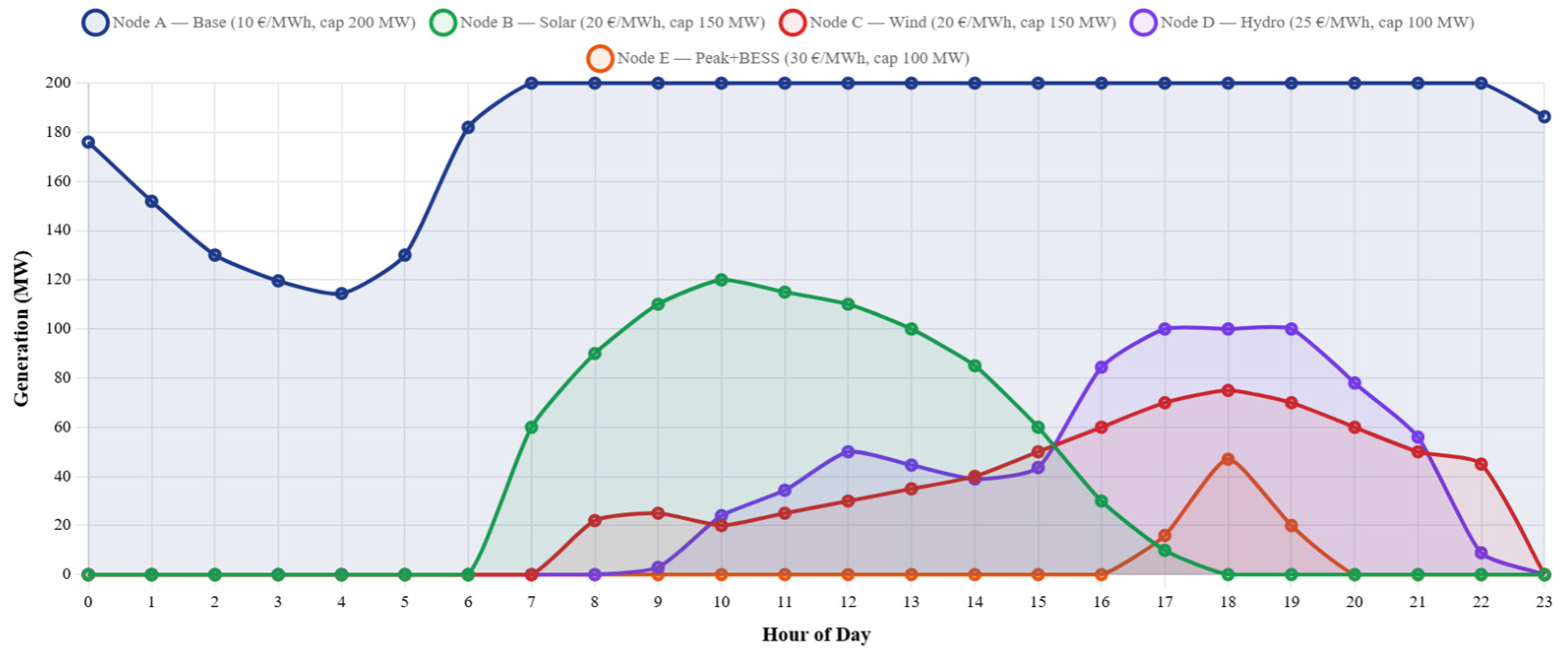
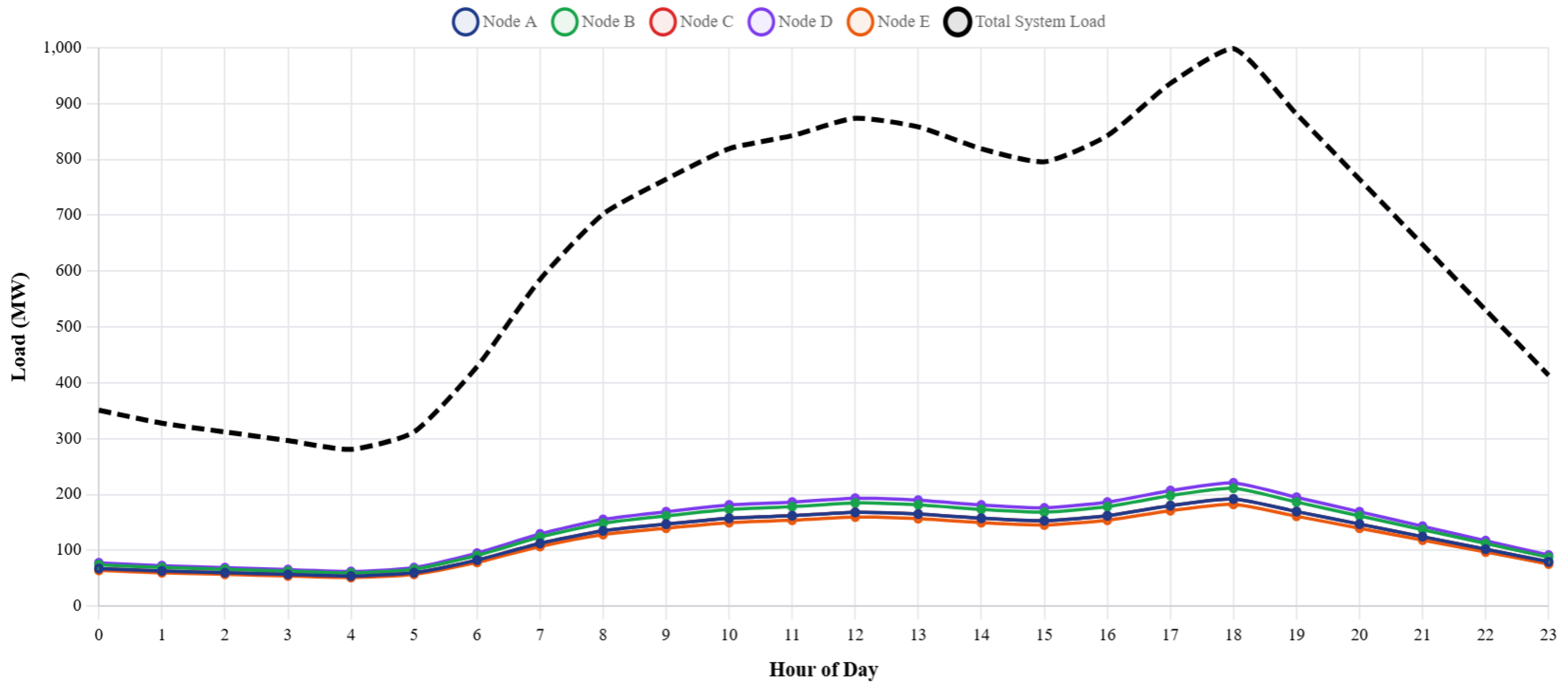
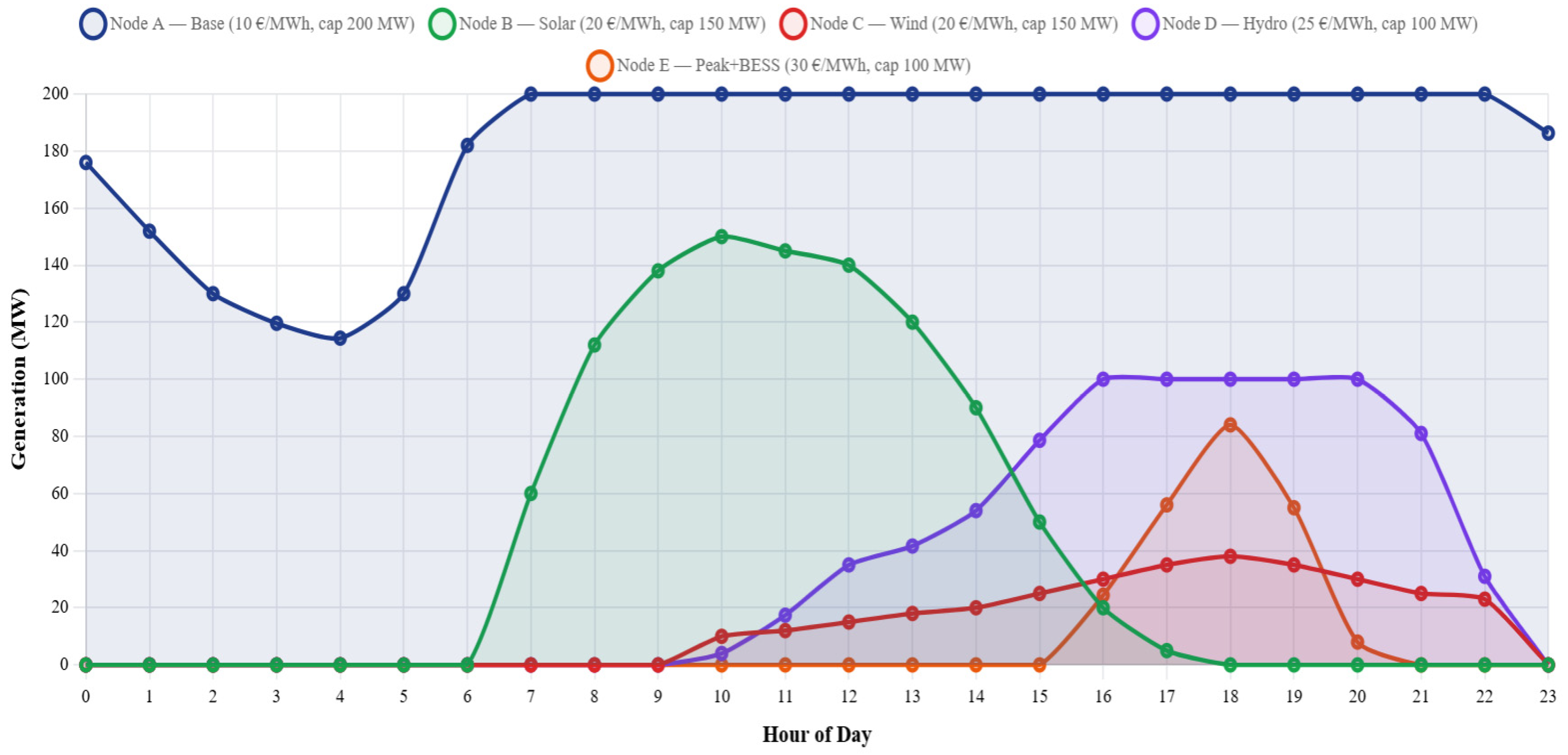
Figure 6 presents the 24 h generation profiles for all nodes of the five-node test system under the baseline operating conditions. Renewable generation at nodes B and C follows a typical daytime production pattern, while node A represents a dispatchable generator providing system balancing. Nodes D and E primarily correspond to demand centers.
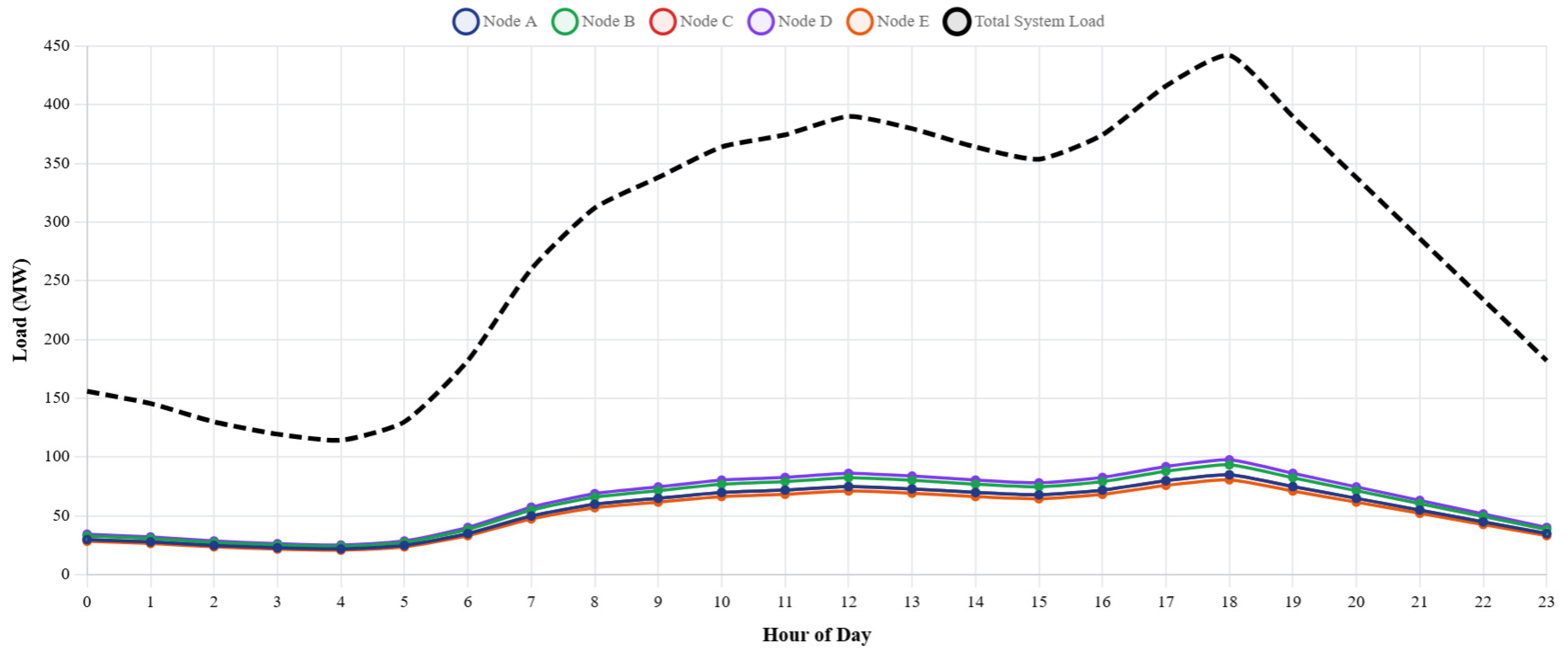
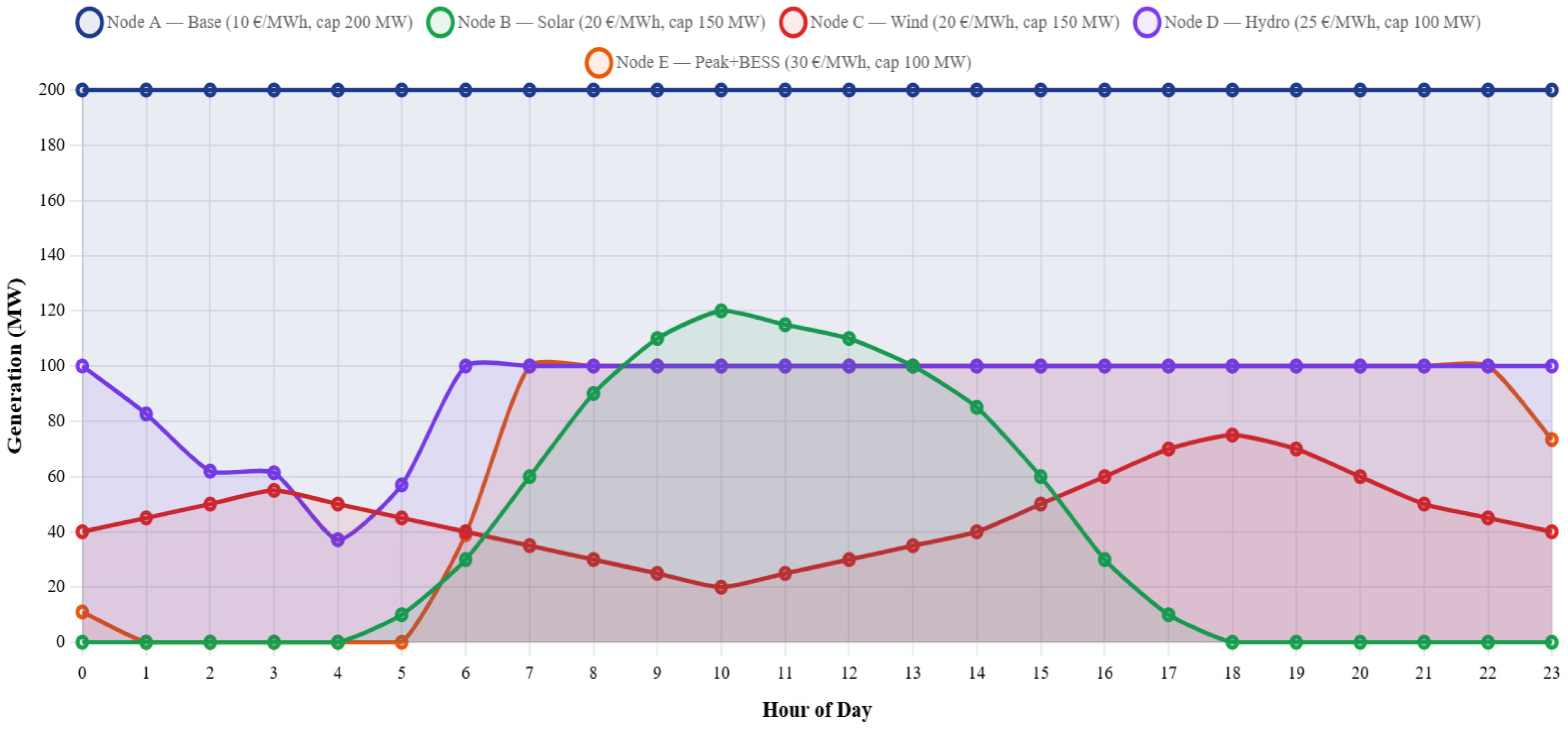
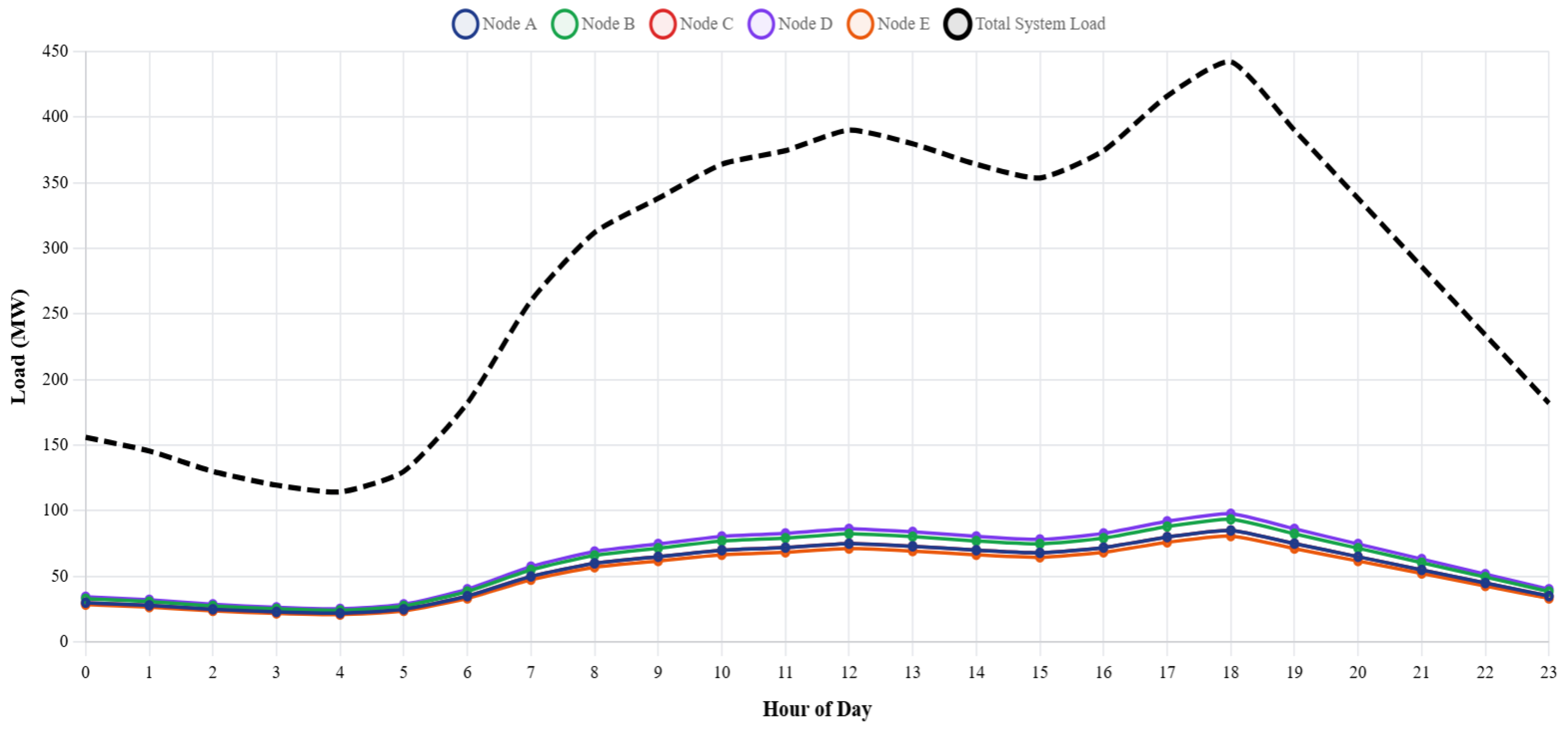
Figure 7 shows the corresponding 24 h nodal load profiles. These profiles define the baseline demand conditions used in the numerical simulations.
Additional generation and load profiles for the congestion scenario and the high-renewable-variability scenario are provided in
Appendix B (
Figure A4,
Figure A5,
Figure A6 and
Figure A7). The inclusion of these supplementary figures improves the transparency and reproducibility of the simulation setup.
3.10.2. Power Flow Model
Power flows are described using the DC approximation. The flow on line
l is expressed through the PTDF matrix:
The symmetry of nodes B and C leads to a coincidence of the corresponding columns of the PTDF matrix, which allows an additional constraint to be imposed in symmetric mode, reducing the dimension of the optimization problem.
The model uses a DC approximation of power flows, which ensures computational efficiency and transparency of symmetry analysis, but does not take into account losses and reactive components of the network. Future research plans include expansion to AC-OPF for a more accurate representation of real-world modes.
3.10.3. Setting an Optimization Problem
The economic power allocation is formulated as an LP problem, used as a reference forward problem for validating the backward and symmetry-oriented formulation presented in the previous sections:
under the following constraints:
Flow restrictions on lines through PTDF:
where D
i is treated as an exogenous nodal withdrawal parameter in the nodal balance constraint.
LMPs are defined as dual variables of the corresponding balance constraints and interpreted as the marginal cost of electricity at each node:
3.10.4. Example 1: Symmetrical Mode Without Overloads
In the first scenario, the line capacities are sufficiently high and network constraints are not active. The optimal solution preserves symmetry:
Nodes B and C have identical generation levels, PB = PC;
Local LMPs are identical for all nodes and remain unchanged with symmetrical BESS activation, as the marginal cost of balance does not change;
The absence of network bottlenecks confirms the correctness of symmetrical aggregation.
3.10.5. Example 2: Symmetry Violation During Line Overload
In the second scenario, the AC line capacity is artificially reduced, which activates the network constraint. The
PB =
PC constraint becomes infeasible, and optimization redistributes generation:
spatial price stratification forms, and the total costs of the system increase.
At the same time, if symmetry is only broken by local load redistribution, and the marginal generator and set of active constraints remain unchanged, local node prices may remain the same despite asymmetric generation distribution. This is consistent with dual theory, as long as the marginal generator and the active constraint set remain unchanged. In the example of our five-node network, this means that with small local load changes in nodes B and C, the LMP may remain identical as long as the network constraints and active generators do not change their state. This fact highlights the stability of dual variables (local prices) to certain types of symmetry violations.
3.10.6. Interpretation of Results and Generalizability
The five-node system under consideration demonstrates the key properties of the proposed approach:
Preservation of symmetry in modes without active constraints;
Automatic symmetry breaking during network overloads;
Formation of local prices as economic signals consistent with physical constraints;
Scalability of the model, since it is based on a matrix description of the network (PTDFs and constraints) rather than on a specific topology.
Despite its simplified nature, the test system adequately reflects the fundamental relationships between network physics, economic optimization, and symmetry, making it a convenient tool for validating inverse models of LEMs.
3.10.7. Accounting for Emergency Modes and Security-Constrained OPF (SCOPF)
The basic problem formulation described in
Section 3.6,
Section 3.7,
Section 3.8,
Section 3.9,
Section 3.10,
Section 3.10.1,
Section 3.10.2,
Section 3.10.3,
Section 3.10.4,
Section 3.10.5 and
Section 3.10.6 can be interpreted in terms of deterministic DC-OPF and is intended for analyzing normal network operation under specified capacity constraints. In this form, the model does not explicitly consider emergency shutdowns of network elements and describes the economically optimal distribution of generation and storage facilities, assuming that the original topology is preserved.
To analyze network reliability and assess the impact of single failures on power flow distribution and local prices, two additional modes are introduced: post-contingency OPF and preventive SCOPF.
In post-contingency OPF, optimization is performed repeatedly for each emergency network configuration, with a fixed set of control variables, which allows assessing the corrective actions of the system and the sensitivity of local prices to failures of individual lines. In SCOPF, emergency scenarios are taken into account preventively by including additional constraints that guarantee the admissibility of the solution for all selected N-1 contingencies.
Thus, SCOPF is not a separate algorithm, but rather an extension of the original optimization model with an additional set of constraints, without changing its economic interpretation, objective function structure, and LMP formation mechanism.
Post-Contingency OPF (Corrective Mode)
In post-contingency mode, OPF considers the system’s response to the shutdown of one network element k ∈ K (line or transformer). For each scenario, a modified network topology is formed, PTDF and flow constraints are updated, and then a separate optimization problem is solved:
subject to restrictions:
In this mode, optimization is performed separately for each scenario k. LMPs include the cost of corrective actions for emergency situations and may be higher than normal LMPs. Node symmetry is preserved where network constraints do not bind decisions and is violated when emergency scenarios are activated.
Security-Constrained OPF (SCOPF, Preventive Mode)
SCOPF ensures compliance with the N–1 principle, guaranteeing the admissibility of the mode when any element of the network is disconnected. In this case, a single optimization task is formed:
taking into account all K scenarios simultaneously:
where
K is a set of all possible contingency scenarios.
In SCOPF, optimal generation is selected once for all scenarios, and local prices reflect the cost of network readiness for any single failure. Thus, preventive optimization reveals asymmetry in generation and prices even before actual failures occur, demonstrating the impact of reliability requirements on the economic allocation of resources.
3.10.8. Simulator Operation Algorithm
The simulator’s algorithm allows interpreting the process of local price formation and generation distribution in terms of endogenous symmetry breaking, similar to phase transitions in physical systems. In the initial stages of calculation, in the absence of active network constraints, the DC-OPF optimization problem allows for symmetric solutions: identical nodes, generators, and lines have equal power values and identical LMPs. In this mode, the system is in a symmetric phase, in which invariance with respect to permutations of equivalent nodes is preserved.
It should be noted that the activation of the BESS does not necessarily lead to a change in the LMP at every moment in time. In symmetric modes, in the absence of active network constraints and with linear or slightly convex BESS costs, charging and discharging operations can redistribute energy over time without changing the marginal cost of the balance constraint. In such modes, the BESS performs a stabilizing function, smoothing generation and consumption profiles, while the LMP remains invariant with respect to symmetric storage operations.
For the BESS at node
i, if its charge/discharge does not activate new binding constraints and has linear or zero marginal costs, the local price at the node remains unchanged:
where
λi0 is the local price value in symmetric mode without BESS influence.
The activation of line capacity constraints or the occurrence of post-contingency scenarios plays the role of a control parameter, similar to an external field or critical parameter in phase transition theory. When load or generation thresholds are reached, the corresponding constraints become binding, leading to an endogenous symmetry breaking of the optimal solution. As a result, previously equivalent nodes begin to exhibit varying levels of generation and heterogeneous LMPs, despite the identity of their initial technical and cost parameters.
From a computational point of view, this transition manifests itself as a change in the active set of constraints in the optimization problem, accompanied by a sharp restructuring of dual variables and the structure of the optimal solution. In this sense, local prices act as order parameters reflecting the transition of the system from a symmetric mode to an asymmetric state under the influence of network constraints.
Let A denote the set of active constraints in the DC-OPF problem. In symmetric mode, A = A0, and all nodes in the same symmetry group have the same local marginal prices: λi = λj.
Symmetry is broken when any network or contingency constraint becomes binding (A ≠ A0), leading to differences in local prices at previously equivalent nodes.
Extending the algorithm to post-contingency OPF and SCOPF amplifies this effect: preventive reliability assurance based on the N–1 criterion introduces additional hidden constraints that violate symmetry even before an actual contingency occurs. In this case, price asymmetry and generation distribution arise not as a reaction to a specific failure, but as a result of expectations of possible contingencies, which corresponds to a phase transition induced by system stability conditions.
Thus, the proposed algorithm not only calculates optimal modes and local prices, but also reveals the structural role of symmetry as a fundamental property of LEMs. In this context, symmetry violation is not an artifact of the numerical solution, but an economically and physically meaningful mechanism for adapting the system to network constraints and reliability requirements.
Below is the sequence of computational steps used to generate all results, tables, and illustrations presented in the results section and in
Appendix A:
Input of initial data. Network parameters are specified: node and line structure Flmax, thermal line constraints, power flow sensitivity coefficients (PTDFs), generator parameters, RES profiles, BESS characteristics, node loads, and symmetry groups.
Formation of an economic dispatch model.
A model of economic generation distribution is constructed based on the merit-order principle, taking into account the power balance and generator constraints. Line constraints are used diagnostically to identify potential overloads, rather than as hard optimization constraints.
Calculation of the base mode. The optimal generation capacities Pi, line flows fl, and node LMPs reflecting the economic equilibrium of the system are determined.
Diagnosis of network constraints. Lines with high load and throughput violations are identified, allowing the determination of potential network bottlenecks and points of overload.
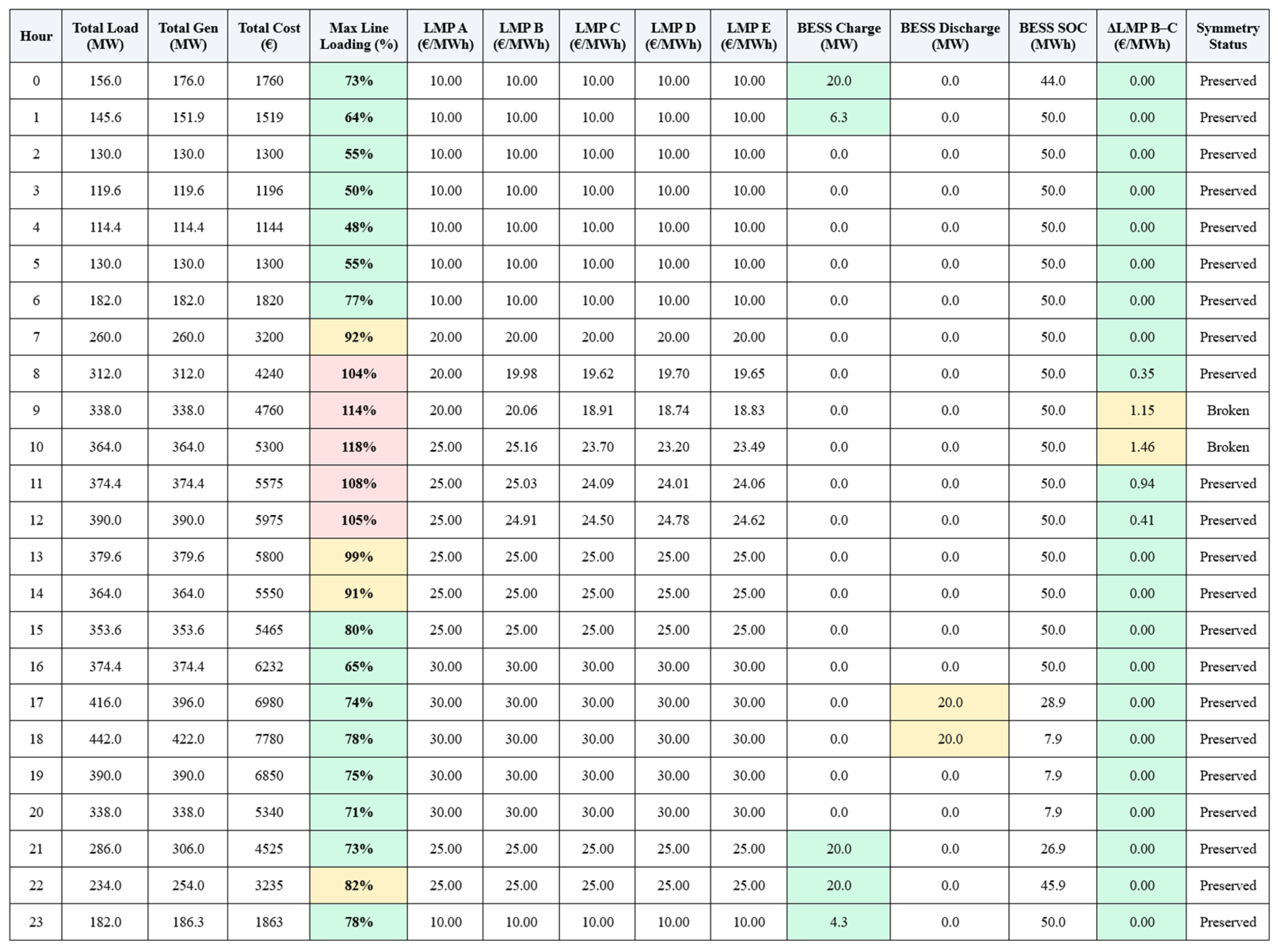
Symmetry analysis of solutions. The preservation or violation of symmetry between structurally equivalent nodes is checked. Deviations are measured using the ΔLMP indicator, which characterizes the degree of price asymmetry.
Scenario modeling. For each scenario (base mode, overload, high RES variability), the calculation is repeated with modified generation or grid input parameters.
Assessment of the role of energy storage systems. BESS control signals and their impact on prices, line loading, and generation constraints are calculated.
Output data generation. Final sets of results are generated:
Generation distribution;
Line flows;
LMP values;
Overload indicators;
Symmetry indicators;
BESS operating modes.
Preparation of results. Tables, metrics, and visualizations presented in the Results Section and in
Appendix B are generated automatically.
3.10.9. Summary of the Five-Node System
The five-node test system serves as a minimal but representative platform for illustrating the key mechanisms of the proposed symmetry-oriented model of the LEM. Based on this model, the following fundamental effects are demonstrated:
Symmetry effect: Identical nodes and network elements can be aggregated without losing economic sense, which reduces the dimension of the optimization problem and improves its numerical conditionality.
Endogenous symmetry breaking: Activation of network constraints or emergency scenarios leads to spontaneous destruction of symmetric solutions, manifested in asymmetric distribution of generation and local marginal prices.
Economic interpretation of LMP: Local prices are formed as dual variables of balance and network constraints and simultaneously reflect marginal generation costs and network capacity shortages.
Although the system under consideration is deliberately low-dimensional, the introduced symmetric aggregation reflects typical situations in LEMs, where groups of prosumers, photovoltaic installations, or household BESSs have virtually identical technical and economic characteristics.
A key element of the proposed model is the use of symmetric node aggregates, which allows for the identification of similar generators and consumers and their aggregation into groups. Such structural symmetry:
Reduces the dimensionality of the optimization problem;
Accelerates OPF and SCOPF calculations;
Maintains the accuracy of local prices and BESS control strategies;
Facilitates model scaling to higher-dimensional networks (110–330 kV).
The optimal solutions obtained and the corresponding LMPs are used in the next section to analyze price dynamics, energy flows, and BESS operation in various local market scenarios.
4. Model Scaling and Simulation Scenarios for RES Integration
Based on the results of the five-node training example (
Section 3.10), the simulator algorithm is applied to larger systems and scenarios with a high share of RESs. The analysis logic, including DC-OPF-based benchmark formulations, post-contingency OPF and SCOPF diagnostics, remains conceptually unchanged, ensuring scalability, model transparency, and reproducibility of results.
4.1. Transition to the 110–330 kV Network
This paper considers DC approximation of power flows, but the proposed approach based on symmetric node aggregates does not depend on a specific flow model and can be extended to AC-OPF, taking into account the increased computational complexity. The five-node system demonstrates the key principles of the algorithm, and symmetric aggregation allows the model to be scaled to 110–330 kV networks. Local groups of generators and consumers of the same type significantly reduce the dimensionality of the problem while maintaining the accuracy and efficiency of the solution.
As the network dimensionality increases, the following features are observed:
The number of nodes and lines is growing, and the size of the PTDF matrix is increasing;
Global symmetry of nodes is often absent, but local symmetry is preserved (e.g., same-type RES generators or feeders);
Line constraints become more active, which makes SCOPF critical for correct LMP calculation and overload prevention.
At the same time, all key elements of the model are preserved: OPF/SCOPF formulation, LMP calculation through dual variables of balance constraints, use of symmetric aggregates, and the ability to work with any type of generation—renewables, conventional thermal power plants, BESSs, and prosumers. The symmetric node aggregation algorithm allows solving SCOPF for high-dimensional networks while preserving the qualitative properties of LMP (relative differences, trends, and symmetry-breaking patterns):
Identification of symmetrical nodes: Identifying generators and consumers of the same type with similar parameters (power, cost, consumption/generation profiles);
Node grouping: Forming aggregated nodes by summing the maximum/minimum capacities and average costs;
Flow correction: The PTDF matrix is recalculated, taking into account the aggregated nodes, maintaining the power balance;
OPF/SCOPF solution: Benchmark or diagnostic formulation;
Decomposition into real nodes: After the solution, the results are distributed back among the nodes of the group according to the proportion of their power.
4.2. Hybrid Model of the Local Market and Integration of RESs
The proposed hybrid LEM model combines local energy exchange and interaction with the national market. This approach provides:
Stability and predictability of local prices;
Scalability and integration of new RESs;
Compatibility with TSOs/DSOs and digital infrastructure.
The following strategies are used to maximize the integration of RES:
Dynamic network access management (curtailment);
Priority for local generation during restrictions;
Optimal use of BESS to smooth peaks and store excess generation;
Stimulation of flexible demand and consumer participation;
Generation of predictive LMP signals;
Coordination through virtual power plants.
Table 2 provides a clear comparison of different approaches to organizing the local market, demonstrating the advantages and limitations of centralized, P2P, and the proposed hybrid models. The table shows how the hybrid approach combines the capabilities of local dispatch optimization, RES and BESS integration, and compatibility with TSO/DSO systems, while maintaining control over grid constraints.
At the same time, the successful implementation of a hybrid model requires modern digital infrastructure and coordinated procedures for managing and coordinating market participants to ensure the correct distribution of energy, reliability, and predictability of local prices.
4.3. Simulation Scenarios
To analyze the impact of various factors on the local market, scenarios with hourly intervals (24 h) and variable profiles of RESs and BESSs have been developed:
Baseline: With 50% RES, standard BESS (50 MWh, 20 MW), curtailment ≤ 10%. The goal is to restore optimal distribution strategies and LMPs.
High RES share: With 70–80% of generation, verification of the impact of variability on price stability and consumption, analysis of the need to increase BESSs.
Limited access (flexible access): RESs connected ≤90% of the time, and the rest is curtailed; the impact on prices, flows, and BESS strategies is being studied.
BESS configurations: Small, medium, and large storage units and assessment of generation losses, price volatility, and network usage.
Sensitivity to symmetry: Impact of symmetrical node aggregation on strategy accuracy and calculation speed.
Output indicators: Optimal strategies for BESS generation and management, LMP dynamics, curtailed capacity volumes, grid efficiency, RES generation losses, and impact on social welfare.
The model can be easily adapted to stochastic scenarios using sampled RES and demand trajectories, which allows uncertainty to be assessed without changing the basic structure of the problem.
To more fully reflect the economic effects of grid imbalance, a dynamic weighted average price has been introduced into the model, taking into account the redistribution of flows and the operation of BESSs. This allows us to observe an increase in the total price during symmetry violations or line overloads, reflecting the participation of more expensive generators and the economic effect of energy transmission constraints. The new metric complements local LMPs, preserving information about signals for managing storage facilities and ensuring a correct assessment of the cost of imbalances in the market. Visualization of over time demonstrates the effectiveness of BESSs in smoothing both local and total prices.
4.4. Scenario Descriptions and Experimental Design
To verify the impact of node symmetry violations on LMP and evaluate the performance of the symmetric aggregation algorithm, three computational scenarios were developed based on the five-node test system described in
Section 3.10. The main objective was to determine whether ΔLMP values could serve as early indicators of price spikes when the share of renewable energy sources is high.
The test system implements the DC-OPF formulation with strict adherence to transmission line capacity constraints. Preliminary tests showed that relaxing line constraints inadvertently led to unacceptable power flows and negative node prices—artifacts that fall outside the physically feasible OPF domain. All results presented are consistent with solutions in feasible operating modes, where LMPs represent economically meaningful dual variables.
4.4.1. Definition of Node Symmetry in Network Markets
Node symmetry in networked electricity markets is defined as the joint presence of economic and topological equivalence between network participants. Two nodes are considered symmetric when they exhibit comparable marginal-production characteristics and similar structural positions within the transmission network. Economic symmetry refers to equality (or near-equality within tolerance) of marginal generation costs, such that nodes i and j satisfy where C denotes nodal marginal cost. Topological symmetry characterizes similarity of network embedding, expressed through comparable PTDFs, i.e., PTDFi ≈ PTDFj.
Thus, formally, nodal symmetry is defined as the simultaneous fulfillment of both conditions:
This definition reflects the economic interpretation of symmetry: symmetric nodes respond similarly to dispatch signals and experience comparable marginal congestion impacts.
Within the five-node test system used for numerical evaluation (
Figure 5), one economically and topologically symmetric pair was identified: nodes B and C, both representing renewable generators with identical marginal costs (€20/MWh) and comparable network positions. Their similar response to dispatch signals allows them to be treated as equivalent agents for analytical purposes.
Nodes with comparable network positions but different cost structures (e.g., hydro vs. peaking generation) are not classified as symmetric under this definition, since economic heterogeneity leads to structurally different dispatch behavior even when topology is similar.
Symmetry identification enables aggregation of equivalent nodes without loss of economic interpretability, reducing the dimensionality of the optimal-power-flow problem and improving computational efficiency. This property is particularly valuable in large-scale systems containing many structurally similar resources, such as distributed renewable installations, which can be represented as aggregated equivalent units in SCOPF-based analysis.
4.4.2. Mathematical Properties of ΔLMP as a Symmetry Metric
Symmetry deviations between nodes are quantified using the following metric:
which measures the absolute difference in LMPs between a pair of symmetric nodes
i and
j at time t. By construction, this metric satisfies several analytical properties relevant for market diagnostics.
First, ΔLMP is non-negative and equals zero only when nodal prices coincide. In symmetric operating regimes without binding transmission constraints, symmetric nodes experience identical LMPs, implying ΔLMP ≈ 0. Positive values indicate symmetry violations caused by congestion, redispatch, or heterogeneous local conditions.
Second, ΔLMP is structurally sensitive to network constraints. When transmission limits become binding, nodal LMPs diverge to reflect congestion shadow prices, producing observable increases in ΔLMP. Thus, changes in ΔLMP provide a quantitative signal of constraint activation rather than a causal driver of system states.
Third, the temporal behavior of ΔLMP carries diagnostic information. Persistent congestion periods tend to produce sustained non-zero ΔLMP values, whereas short-lived disturbances appear as isolated spikes. This temporal structure can be characterized using standard time-series statistics such as autocorrelation and duration distributions.
Fourth, summary statistics of ΔLMP offer interpretable indicators of system stress. The mean value measures average symmetry deviation over time, peak values identify critical operating intervals, and the number of hours exceeding a predefined threshold (e.g., €1/MWh) quantifies the frequency of congestion-induced asymmetry.
Finally, statistical associations between ΔLMP and system variables can be evaluated using correlation analysis. The coefficient of determination R2 between ΔLMP and quantities such as line loading, curtailed renewable generation, or system average price provides a quantitative measure of co-movement. Importantly, these correlations indicate statistical relationships rather than predictive causality; low values imply weak association, whereas high values suggest that symmetry deviations are closely linked to system stress conditions.
Taken together, these properties establish ΔLMP as a compact diagnostic indicator of structural asymmetry in nodal markets and as a quantitative tool for analyzing how network constraints manifest in price signals.
4.4.3. Relation Between Symmetry Breaking and System Constraints
A symmetry violation, quantitatively measured by ΔLMP > ε, acts as an endogenous indicator of emerging system stress. Theoretical analysis combined with numerical simulation results shows that the growth of ΔLMP is systematically associated with the activation of physical and economic constraints on the network.
First, when line capacity limits are reached, transmission constraints arise. Under these conditions, the OPF solution is forced to dispatch nominally symmetric nodes asymmetrically in order to satisfy power flow constraints. In a first approximation, the magnitude of the symmetry violation is proportional to the product of the shadow price of the line constraint and the difference in node sensitivity to flow:
where ΔLMPi,j—The difference between the LMPs of symmetric nodes i and j;
λline—The shadow price of the line constraint;
PTDFi, PTDFj—The line capacity distribution coefficients for nodes i and j.
Secondly, when a generator reaches its upper power limit in one of the symmetrical nodes while maintaining a reserve in the other, this leads to asymmetry in the marginal conditions of optimality and, as a result, to a divergence in local prices. Such asymmetry is structural in nature and arises even with an identical cost function.
Thirdly, the variability of renewable generation can itself induce asymmetry. For example, high solar output in one node and low wind generation in another form different local marginal energy values, despite identical marginal costs.
From the point of view of optimization theory, ΔLMP behavior can be interpreted as an order parameter similar to the characteristics of phase transitions in physical systems. In symmetric mode (ΔLMP ≈ 0), the network operates below marginal constraints and all symmetric nodes receive identical price signals. When switching to the broken-symmetry mode (ΔLMP >> 0), binding constraints are activated, causing price differentiation even between fundamentally identical nodes. The control parameter for such a transition is the activation of constraints in the OPF problem.
Graphical analysis of the simulation results (a more comprehensive discussion is presented in
Section 5,
Figure 8,
Figure 9 and
Figure 10) demonstrates a stable visual dependence of ΔLMP on normalized line loading, critical branch power flows, and average system price. This dependence allows ΔLMP to be considered both as a diagnostic indicator of the current state of the system and as a predictive indicator of impending price spikes.
4.4.4. Scenario Descriptions
Three computational scenarios were developed for the systematic investigation of ΔLMP behavior under different operating modes. The test system consists of a five-node network (A–E) with a diverse generation portfolio including baseload generation, renewable sources, flexible resources, and energy storage.
Node A simulates a 200 MW base load generation with a marginal cost of €10/MWh. Node B represents a 150 MW solar power plant with a cost of €20/MWh and a variable generation profile. Node C corresponds to a wind turbine with the same installed capacity and cost. Node D simulates a 100 MW hydroelectric generator with a cost of €25/MWh. Node E contains a 100 MW peak generator with a cost of €30/MWh, supplemented by a BESS with a capacity of 50 MWh and a power of 100 MW.
The transmission network includes five lines with power constraints and reactive resistances:
The model structure highlights two pairs of symmetrical nodes. Pair B–C represents RESs with identical cost functions and comparable topological characteristics. The D–E pair represents flexible resources with similar network positions and control capabilities. These pairs are used to test symmetric aggregation procedures and analyze ΔLMP.
All scenarios simulate a 24 h operational horizon with hourly steps. Optimization is performed within the DC-OPF framework, taking into account node power balance, transmission constraints, generation limits, storage operational constraints, and physical flow feasibility.
Scenario 1: Baseline Mode
The first scenario reflects normal system operating conditions at nominal load and no significant grid constraints. The peak load is 85 MW, the BD line capacity remains at 80 MW, the solar generation profile is bell-shaped with a maximum of 120 MW at noon, and wind generation remains relatively stable with an average level of about 45 MW.
Under these conditions, the system operates predominantly in symmetrical mode. Symmetry violations occur only sporadically during hours of local imbalances between generation and demand and are of a short-term nature. The expected metric values are: average ΔLMP between nodes B and C of about €0.4/MWh, peak ΔLMP of about €1.2/MWh, and the number of hours with ΔLMP above €1/MWh is limited to a few intervals. The moderate value of the coefficient of determination between ΔLMP and the system price (R2 ≈ 0.45) indicates that, with sufficient grid capacity, symmetry violations have a limited impact on system-wide price levels.
Scenario 2: Network Overload (Critical Mode)
The second scenario simulates a stress situation of increased demand with a load multiplier of 1.5, resulting in a peak value of 128 MW. At the same time, the capacity of the BD line is artificially reduced to 40 MW, creating a transmission bottleneck. RES generation profiles remain the same as in the baseline scenario.
The resulting constraint forces the optimization algorithm to either limit solar generation at node B, redistribute the load, or activate more expensive generators at other nodes. As a result, the symmetrical nodes B and C begin to receive significantly different price signals, despite identical cost functions.
The simulation shows a sharp increase in symmetry violation metrics: the average ΔLMP reaches about €2.5/MWh, the peak is about €5.5/MWh, and the number of hours with significant price differences increases to most of the day. The high R2 value of ≈ 0.88 between ΔLMP and the system price indicates a close relationship between network congestion and price spikes. It is noteworthy that an increase in ΔLMP usually precedes maximum price events within one to two hours, which allows this metric to be considered an early signal for the activation of flexible resources, including energy storage devices.
Thus, this scenario confirms the hypothesis of endogenous symmetry breaking: the activation of network constraints acts as a controlling factor, shifting the system from a symmetric to an asymmetric mode.
Scenario 3: High Variability of RES
The third scenario isolates the impact of renewable generation variability in the absence of grid bottlenecks. The load remains nominal, the transmission capacity of the lines remains full, but the solar generation profile increases to a peak value of 150 MW, while the average wind generation level decreases to 20 MW.
In this configuration, the topological symmetry of the nodes is preserved, but economic symmetry is disrupted due to differences in actual output. High solar generation creates a local power surplus at node B, while a relative deficit arises at node C. As a result, price differences appear even without active transmission restrictions.
Calculations show a moderate level of symmetry disruption: the average ΔLMP is about €1.2/MWh, the peak is about €2.8/MWh, the duration of asymmetry is about half a day, and the coefficient of determination with the system price reaches R2 ≈ 0.68. This confirms that RES variability can cause significant price effects, although their impact is usually weaker than in the case of grid overloads. Under these conditions, BESS demonstrates the greatest efficiency, smoothing out generation differences and reducing the value of ΔLMP.
A combined analysis of the three scenarios shows that the value of ΔLMP is sensitive to various sources of system stress, such as network congestion, generation constraints, and the variability of RES. Sequential variation of load parameters, line capacity, and generation profiles allows us to quantitatively isolate the contribution of each factor and establish causal relationships between physical network constraints and price dynamics. A detailed analysis of the simulation results is presented in
Section 5.
5. Results
A comparison of the three scenarios reveals a systematic dependence of price characteristics on the network operating mode.
For a correct interpretation of the results, it is important to note the following. The numerical results presented in this section are obtained using a diagnostic dispatch framework designed to isolate structural symmetry-breaking mechanisms in network-constrained markets. The simplified formulation intentionally prioritizes interpretability and transparency of causal relationships over full operational realism.
Consequently, absolute numerical values of LMP, correlations, and volatility should be interpreted as scenario-dependent reference indicators rather than system-specific forecasts. At the same time, the qualitative patterns observed, including symmetry violations, congestion localization, and storage response, are structurally robust and reflect intrinsic properties of network-constrained price formation.
Extending the framework to full DC-OPF or AC-OPF formulations constitutes a natural next step and would refine quantitative estimates while preserving the structural insights demonstrated here.
The key quantitative result is that network constraints are the dominant factor in the formation of price distortions. In the congestion scenario, the average price increases by 37% relative to the baseline, volatility increases almost threefold, and the maximum asymmetry reaches €5.5/MWh. These values significantly exceed the deviations observed in other modes, indicating the structural nature of the effect. Thus, the observed differences between scenarios are systemic in nature and not the result of random parametric variations.
The RES variability scenario demonstrates an intermediate result: even in the absence of active grid constraints, asymmetric generation profiles create measurable price differences. This confirms the existence of two independent mechanisms of symmetry disruption:
Table 3 summarizes quantitative indicators and shows the systemic relationship between network conditions and market outcomes. In the congestion scenario, maximum values of prices, volatility, asymmetry, and correlation are observed, indicating a fundamental impact of network constraints on the price formation mechanism. In contrast, the baseline mode is characterized by nearly symmetric prices and weak statistical dependence, while RES variability predominantly affects volatility without creating persistent structural asymmetry. Consequently, symmetry metrics reflect the structural tension of the system rather than simply the absolute level of prices.
Correlation analysis (
Table 4) shows that the relationship between ΔLMP and the system price intensifies when transitioning to stress modes. At the same time, there is a fundamental difference between the R
2 values obtained in the full DC-OPF model and the diagnostic simulator: the latter reproduces the same qualitative dependencies, but with significantly lower absolute correlation coefficients.
Low R2 values correspond to stable network conditions without active restrictions, while high values indicate that symmetry violations are a reliable indicator of impending price spikes. This confirms the diagnostic value of the ΔLMP indicator as an indicator of systemic instability and shows that the difference between the models is quantitative rather than structural in nature.
5.1. Evolution of LMPs: Key Patterns
The hourly dynamics of LMPs (
Figure 8,
Figure 9 and
Figure 10) demonstrate the existence of three fundamentally different modes of system operation, differing in the degree of consistency of price signals between nodes.
5.1.1. Scenario 1: Baseline Operation
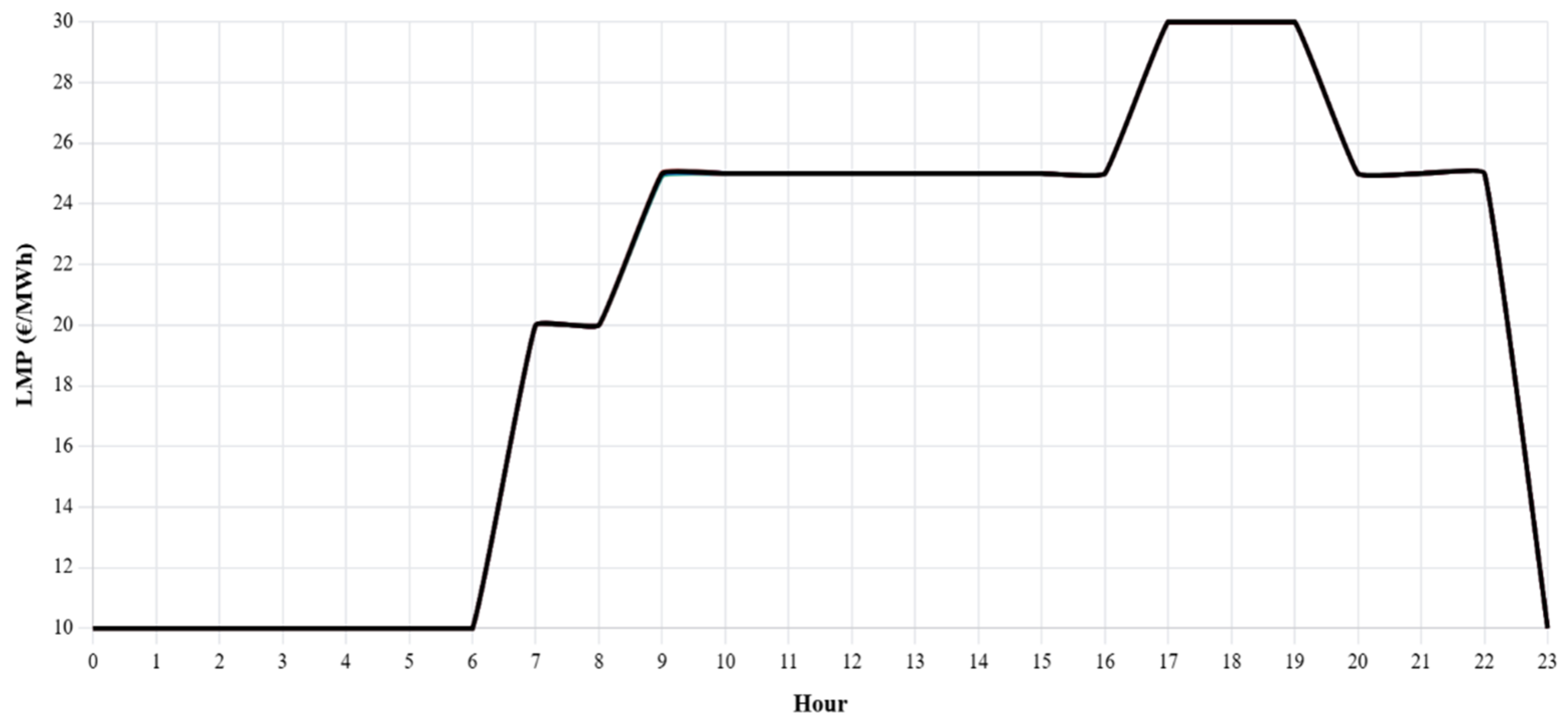
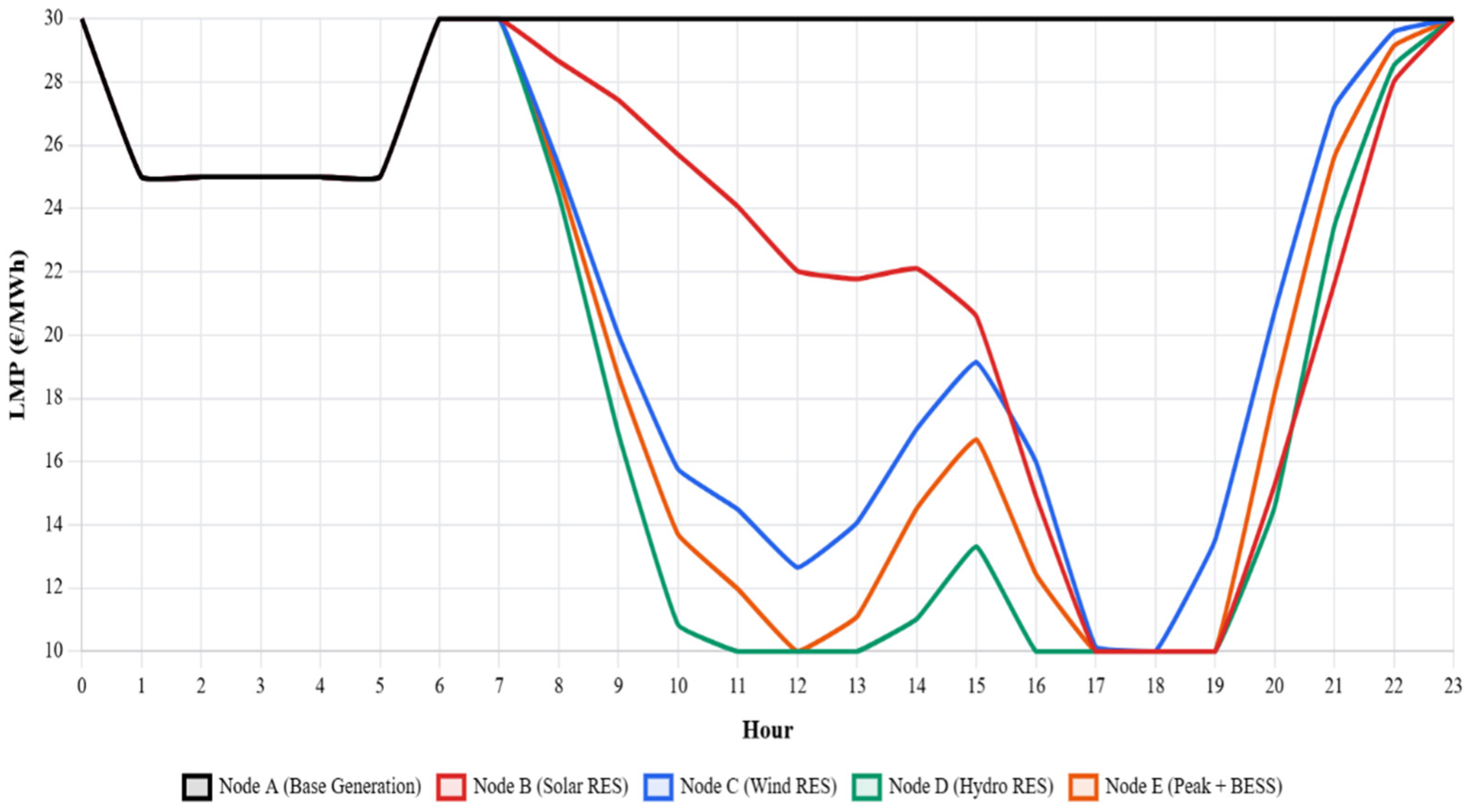
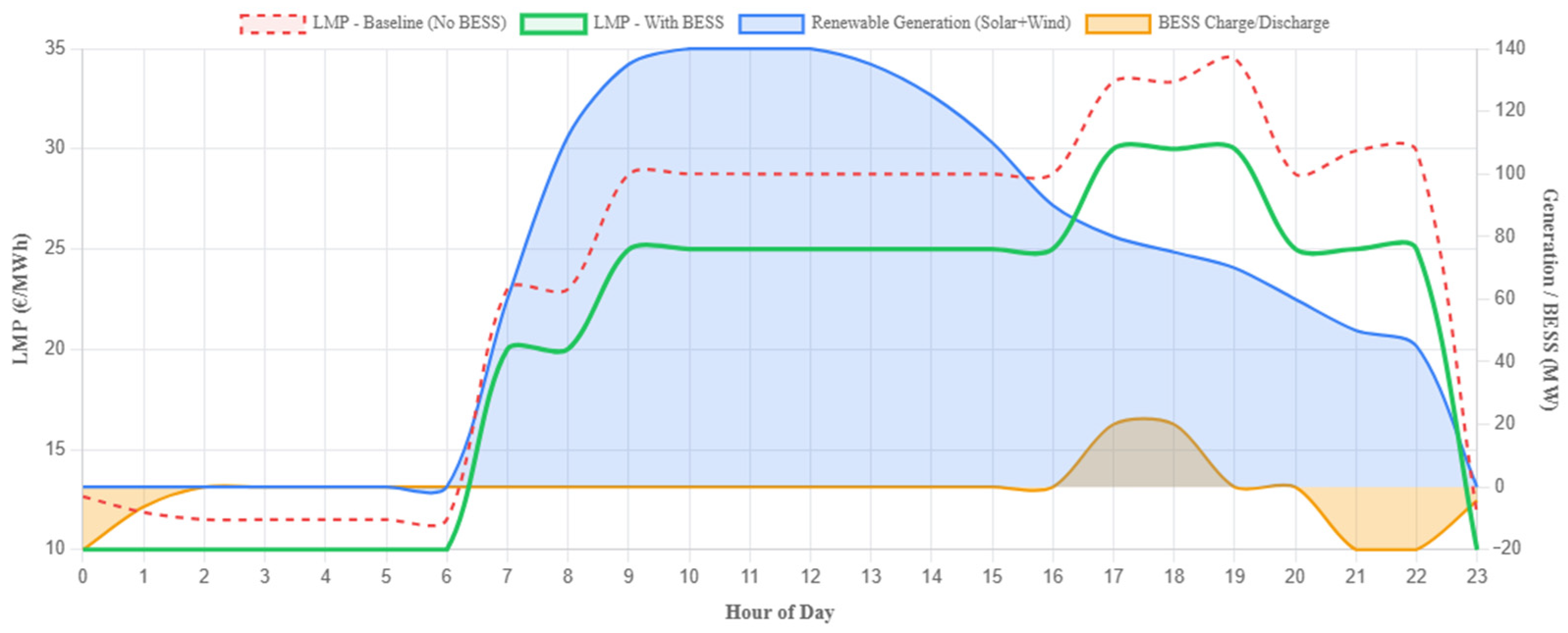
Figure 8 shows the evolution of LMP at all network nodes over a 24 h period. The price trajectories of symmetrical nodes B and C are virtually identical throughout the observation period. The maximum price is reached at 17:00 and amounts to €30/MWh. The graph is characterized by smooth dynamics without sharp jumps, which indicates the absence of transmission constraints and confirms the equilibrium mode of the system. Minor discrepancies between nodes are random and not structural in nature.
Figure 8.
Evolution of LMP at all network nodes over 24 h. Symmetric RES nodes B and C exhibit nearly identical price trajectories. The maximum LMP occurs at hour 17 and reaches €30/MWh. Symmetry violations are negligible and do not indicate system stress.
Figure 8.
Evolution of LMP at all network nodes over 24 h. Symmetric RES nodes B and C exhibit nearly identical price trajectories. The maximum LMP occurs at hour 17 and reaches €30/MWh. Symmetry violations are negligible and do not indicate system stress.
The equality of LMP values at nodes B and C in the baseline scenario results from the simultaneous presence of economic and topological symmetry. Both nodes represent renewable generators with identical marginal costs (€20/MWh) and exhibit similar PTDF coefficients with respect to the main transmission branches. In the absence of binding transmission constraints, the DC-OPF market-clearing mechanism assigns identical nodal prices to such symmetric nodes. Consequently, the LMP trajectories for nodes B and C remain equal throughout the day in the baseline operating condition.
5.1.2. Scenario 2: Network Congestion
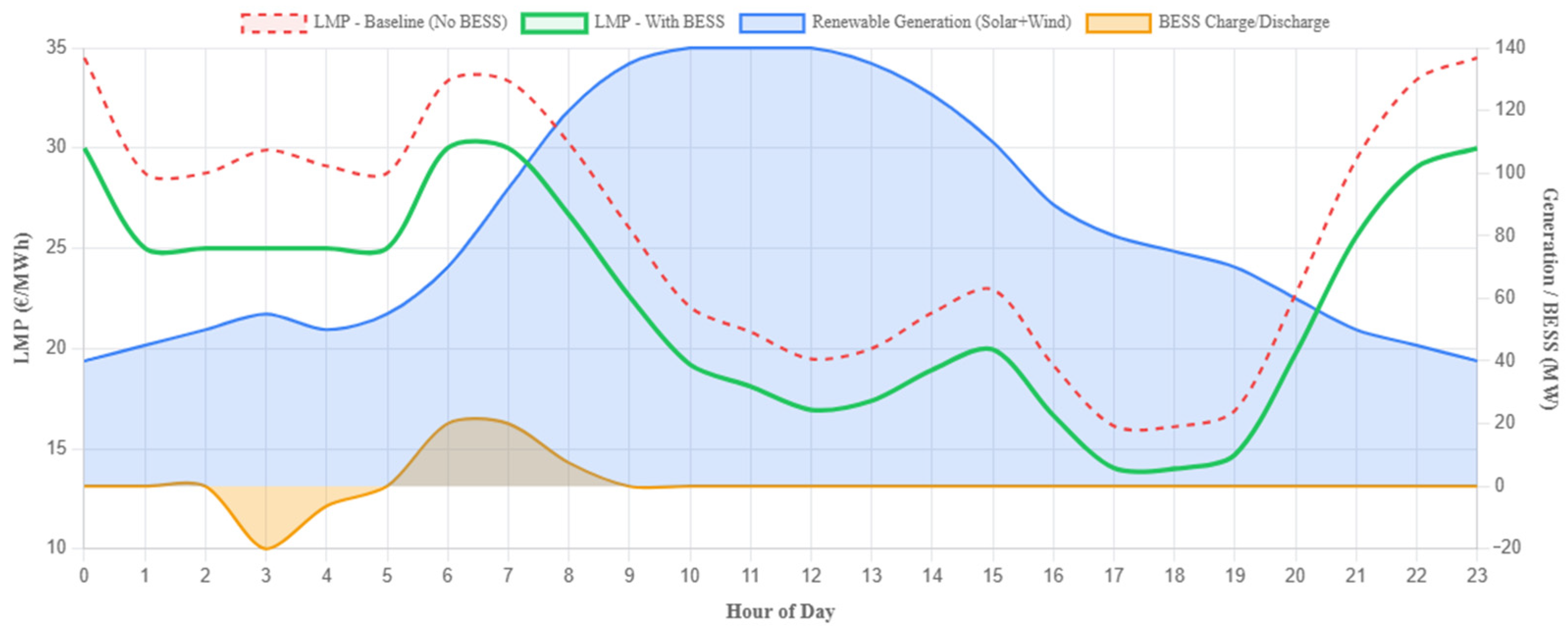
Figure 9 shows a qualitatively different picture. During periods of line overload, there is a significant divergence in prices at nodes B and C. The maximum price is recorded at the beginning of the day (hour 0) and reaches €30/MWh. It is important to note that the price divergence begins several hours before the peak values of the system price. This indicates the leading nature of the asymmetry indicator and confirms its predictive value.
Figure 9.
Evolution of LMP at all network nodes over 24 h. Nodes B and C diverge significantly during congestion periods. The maximum LMP is observed at hour 0 and reaches €30/MWh. Symmetry violations emerge several hours before price spikes, indicating predictive capability.
Figure 9.
Evolution of LMP at all network nodes over 24 h. Nodes B and C diverge significantly during congestion periods. The maximum LMP is observed at hour 0 and reaches €30/MWh. Symmetry violations emerge several hours before price spikes, indicating predictive capability.
5.1.3. Scenario 3: High RES Variability
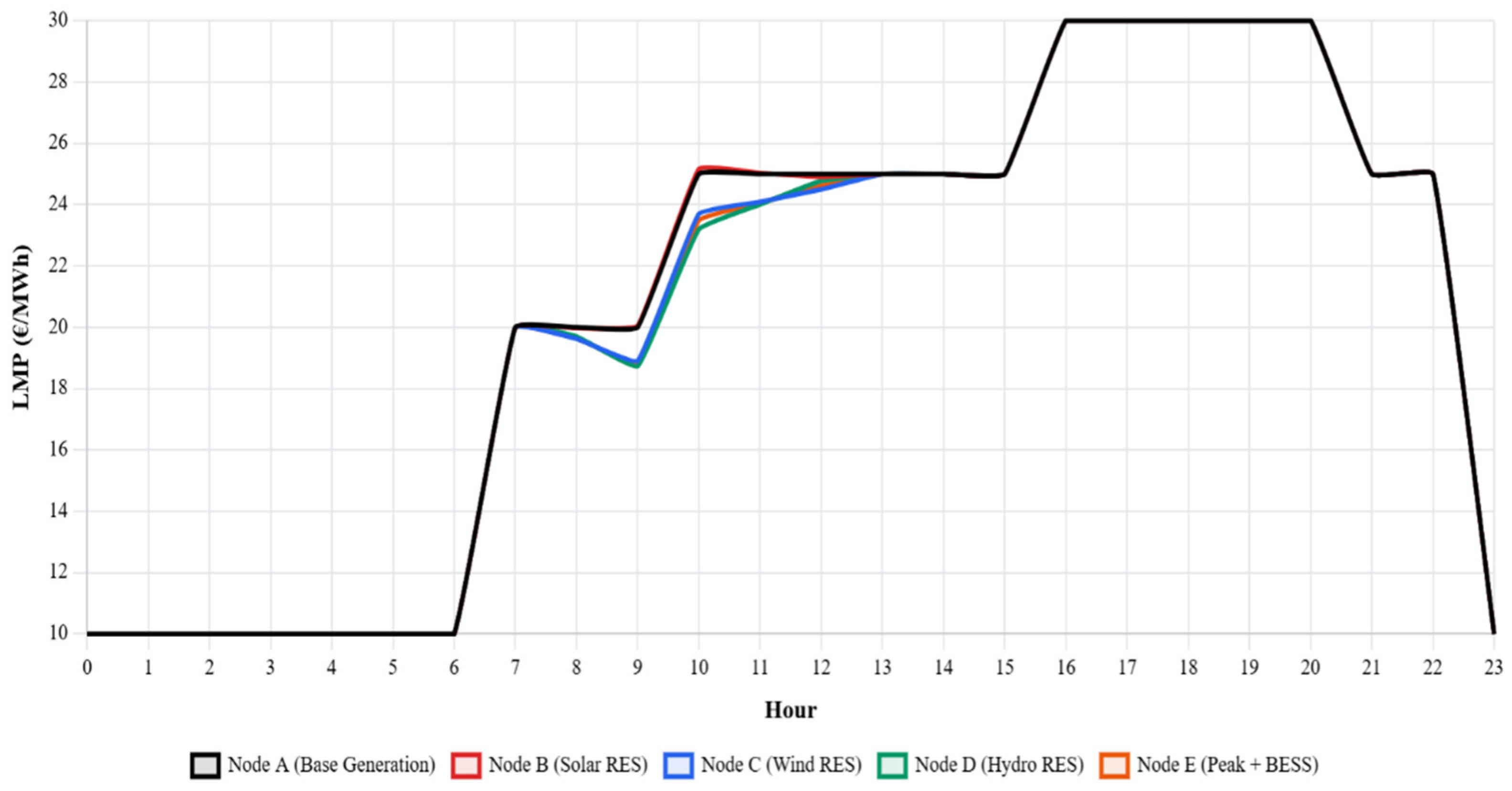
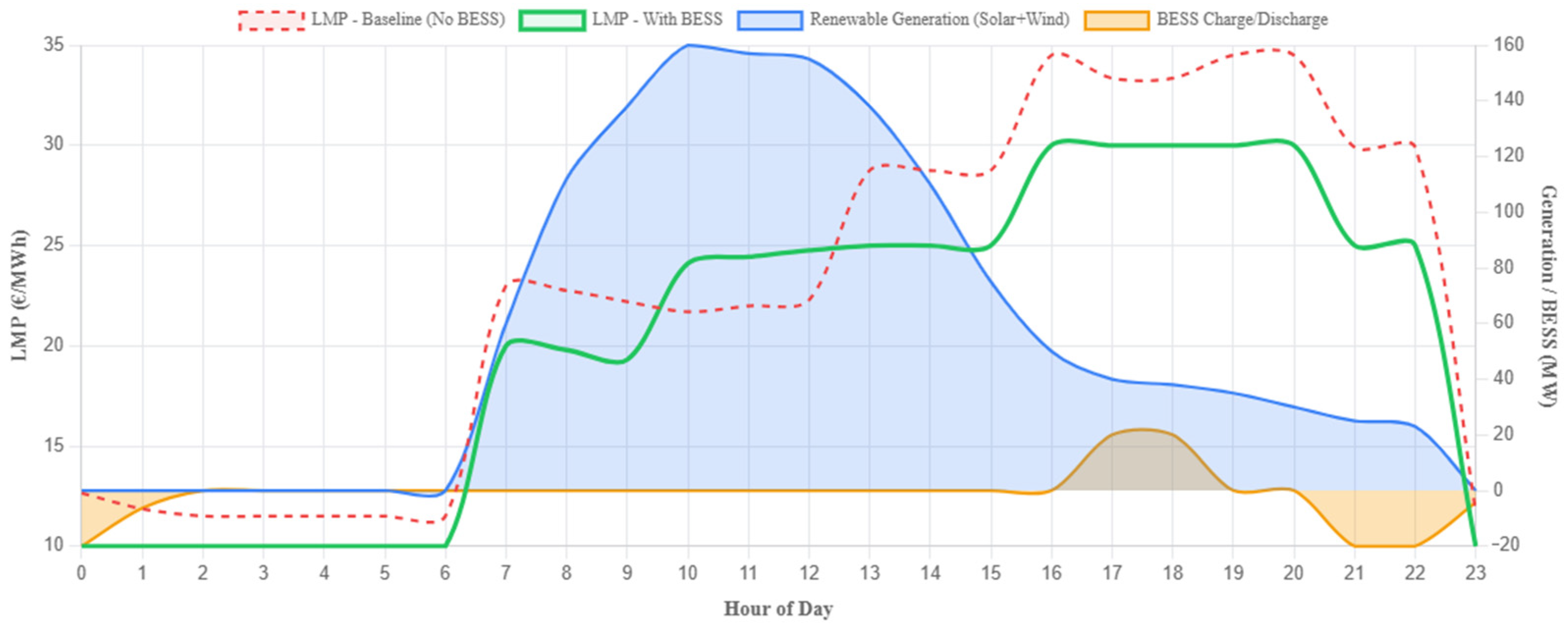
Figure 10 illustrates a scenario in which price differences arise mainly due to the variability of renewable energy generation. Nodes B and C show moderate deviations, but the graph structure remains smooth and does not contain any sharp jumps. The price peak is observed at the 16th h and also reaches €30/MWh. The absence of prolonged discrepancies confirms that generation asymmetry alone does not lead to sustained price segmentation of the market.
Figure 10.
Evolution of LMP at all network nodes over 24 h. Nodes B and C remain relatively stable, with moderate deviations driven by generation variability rather than network constraints. The peak price occurs at hour 16 and reaches €30/MWh.
Figure 10.
Evolution of LMP at all network nodes over 24 h. Nodes B and C remain relatively stable, with moderate deviations driven by generation variability rather than network constraints. The peak price occurs at hour 16 and reaches €30/MWh.
5.2. ΔLMP as an Indicator of System Stress
5.2.1. Scenario 1: Stable Network
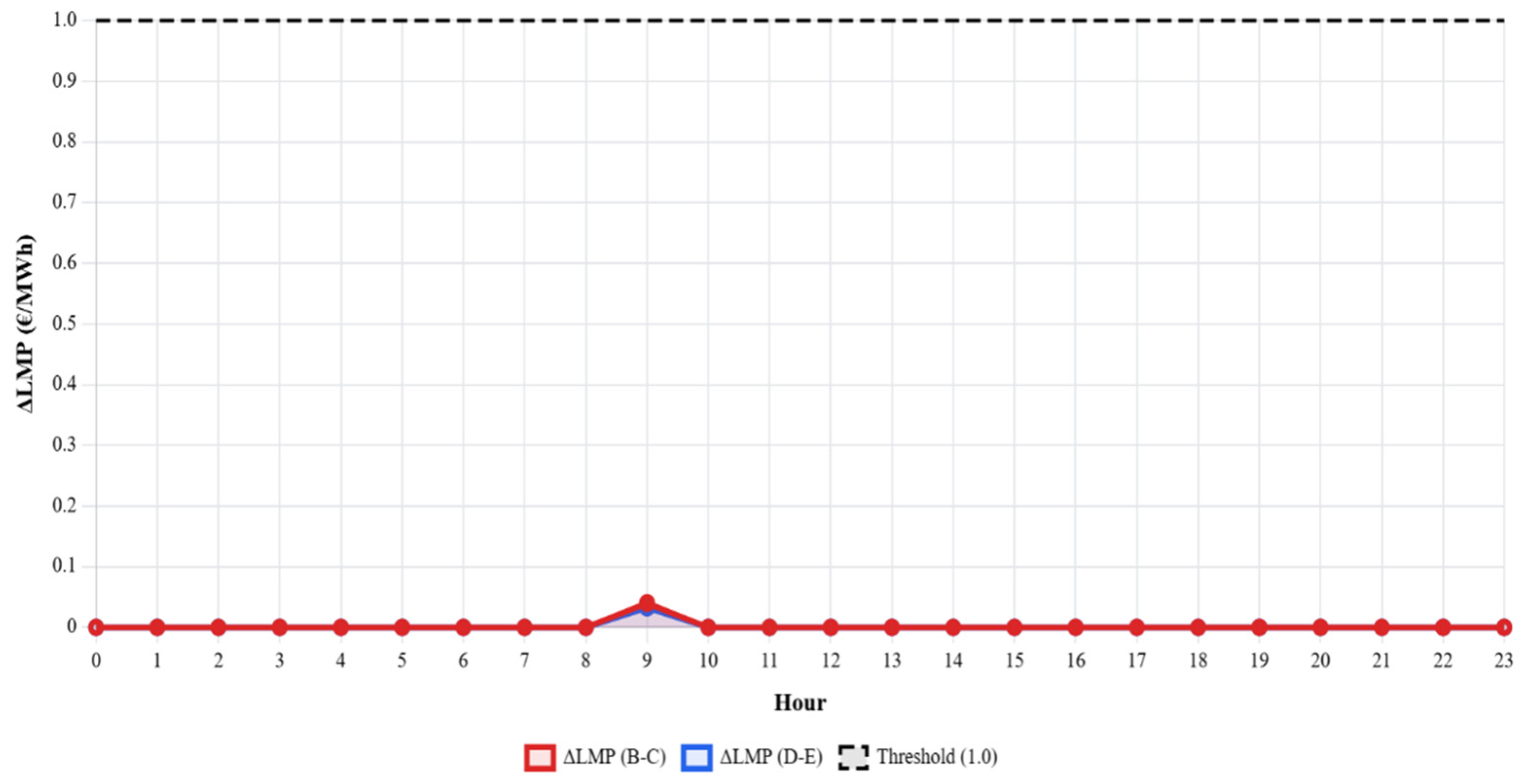
Figure 11 shows the price difference between symmetrical pairs of nodes. The horizontal line at the threshold of €1/MWh serves as the boundary for symmetry violation. None of the trajectories cross this level, confirming the absence of structural imbalances.
Figure 11.
Difference in LMP between symmetric node pairs (B–C and D–E). The horizontal threshold at €1/MWh marks the boundary above which symmetry is considered structurally violated. No violations occur for either pair during the 24 h horizon. The absence of ΔLMP excursions confirms that the network operates in an unconstrained regime where nodal prices remain spatially homogeneous.
Figure 11.
Difference in LMP between symmetric node pairs (B–C and D–E). The horizontal threshold at €1/MWh marks the boundary above which symmetry is considered structurally violated. No violations occur for either pair during the 24 h horizon. The absence of ΔLMP excursions confirms that the network operates in an unconstrained regime where nodal prices remain spatially homogeneous.
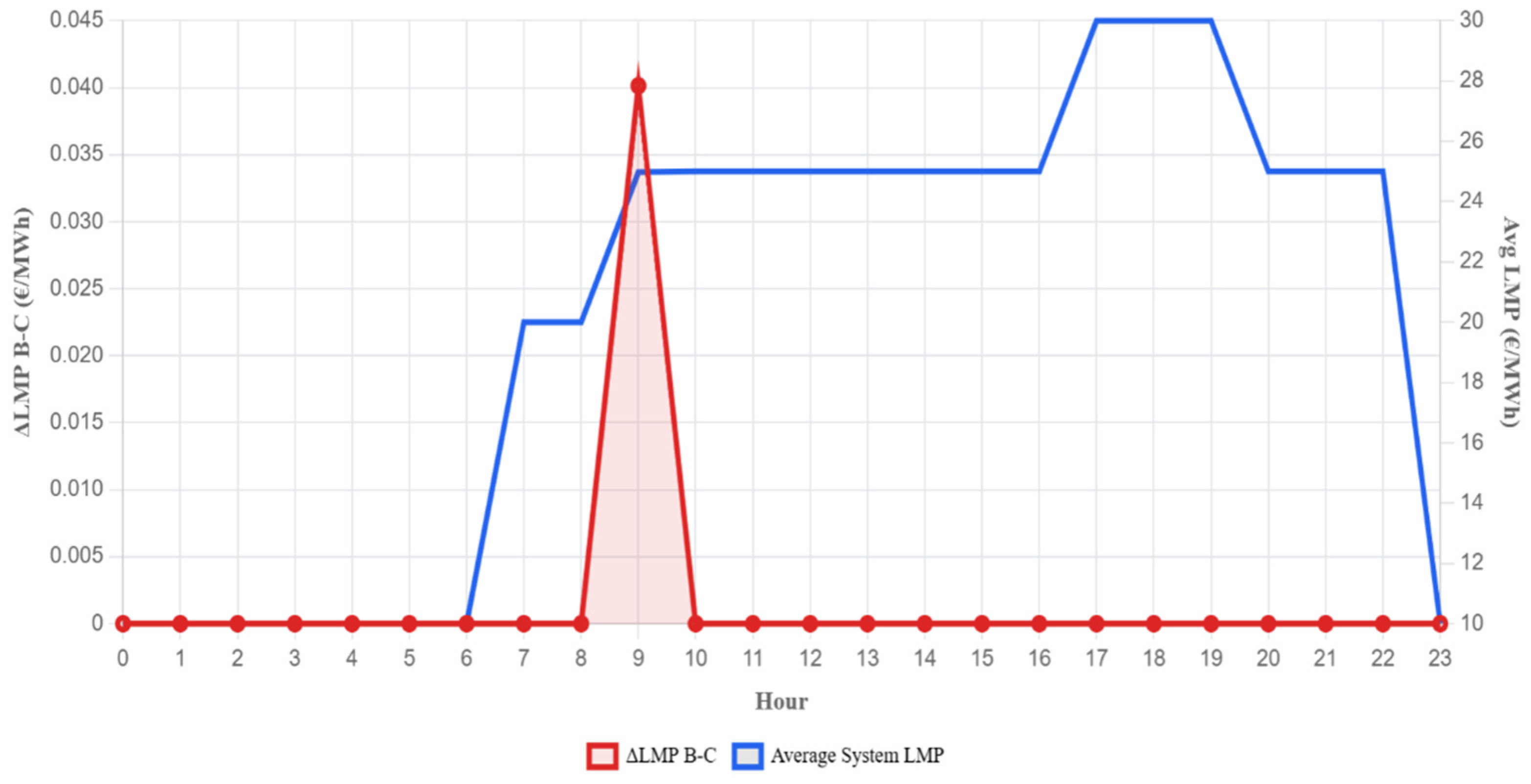
Figure 12 demonstrates the relationship between ΔLMP (B–C) and the average system price. The very low value of R
2 = 0.017 indicates a virtually complete absence of statistical dependence, which is characteristic of a stable system without restrictions.
Figure 12.
Dual-axis relationship between ΔLMP (B–C) and system-wide average LMP. The very low correlation (R2 = 0.017) indicates statistical independence between symmetry deviations and price level under stable operating conditions. No critical deviations (ΔLMP > €2/MWh) occur, implying that symmetry metrics carry little predictive information when network constraints are inactive.
Figure 12.
Dual-axis relationship between ΔLMP (B–C) and system-wide average LMP. The very low correlation (R2 = 0.017) indicates statistical independence between symmetry deviations and price level under stable operating conditions. No critical deviations (ΔLMP > €2/MWh) occur, implying that symmetry metrics carry little predictive information when network constraints are inactive.
5.2.2. Scenario 2: Congestion Mode
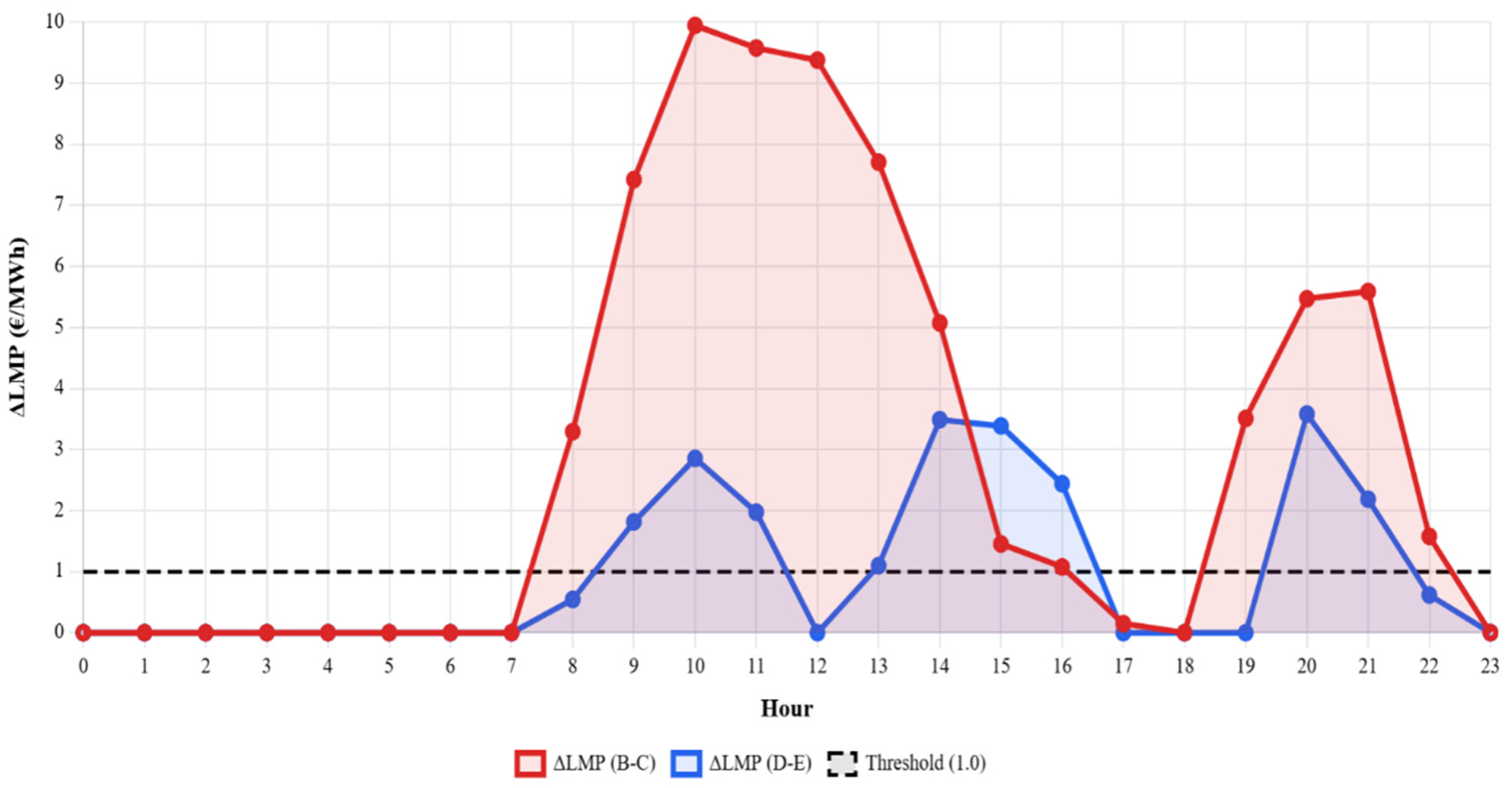
Figure 13 shows prolonged periods of symmetry threshold exceedances. Thirteen hours of violations are observed for pair B–C and nine hours for D–E. It is particularly important that values above €2/MWh occur systematically before the average price begins to rise.
Figure 13.
Difference in LMP between symmetric node pairs. The €1/MWh threshold indicates symmetry violation onset. Thirteen hours exhibit violations for B–C and nine hours for D–E. Large deviations (>€2/MWh) systematically precede system-wide price increases, indicating that spatial price divergence acts as an early congestion signal.
Figure 13.
Difference in LMP between symmetric node pairs. The €1/MWh threshold indicates symmetry violation onset. Thirteen hours exhibit violations for B–C and nine hours for D–E. Large deviations (>€2/MWh) systematically precede system-wide price increases, indicating that spatial price divergence acts as an early congestion signal.
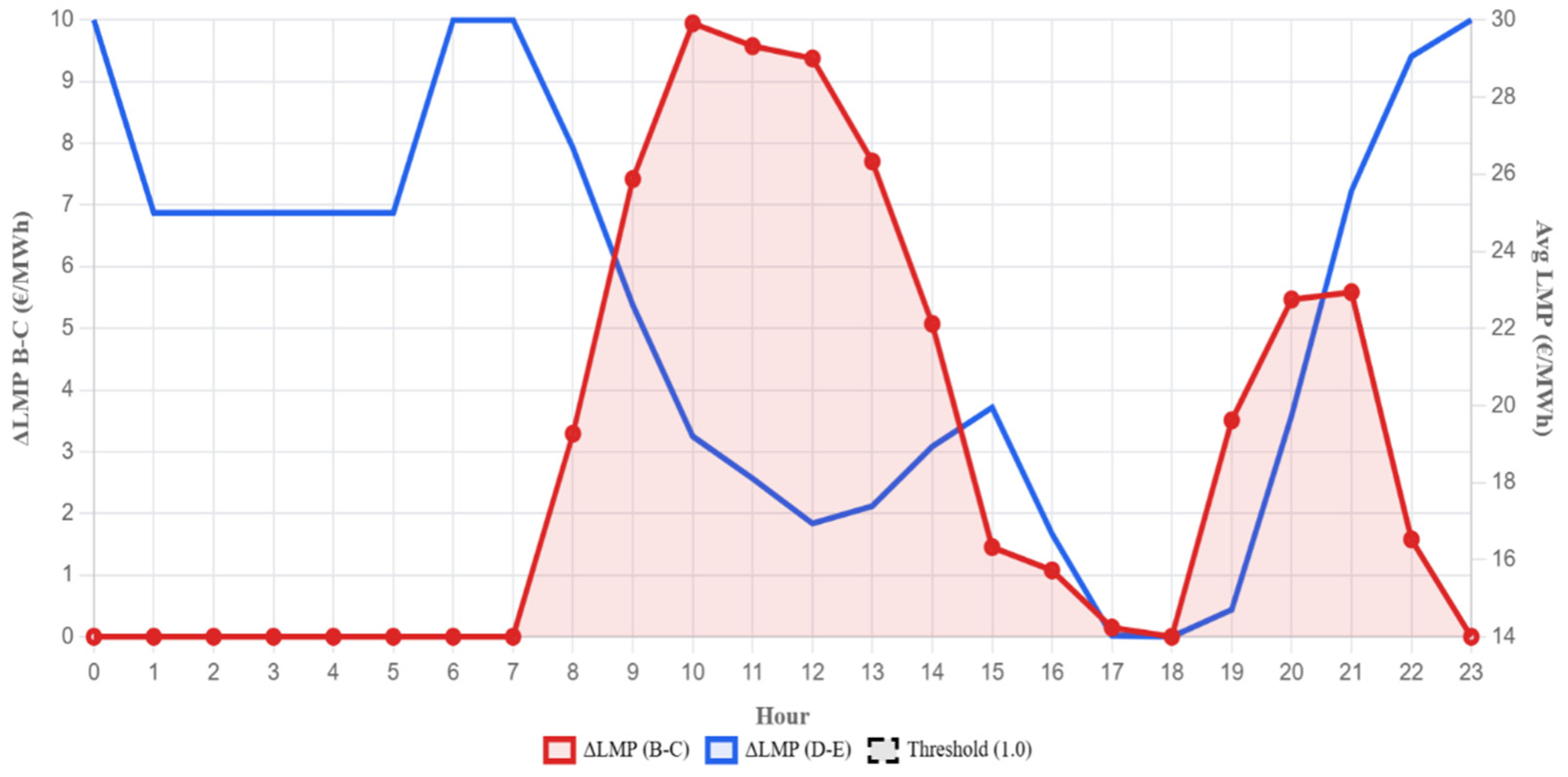
Figure 14 demonstrates a moderate positive correlation (R
2 = 0.325). An interesting feature is that during hours of maximum asymmetry, the average price may remain relatively low due to transmission constraints causing local generation curtailment. This means that ΔLMP reflects the structural state of the system rather than simply the price level.
Figure 14.
Dual-axis plot of ΔLMP (B–C) versus average system LMP. A moderate positive correlation (R2 = 0.325) indicates that symmetry breaking becomes statistically associated with price escalation once transmission constraints bind. During hours with critical violations, average LMP is 19.5% lower than during symmetric periods, reflecting congestion-induced curtailment effects. This confirms that ΔLMP captures structural network stress rather than absolute price magnitude.
Figure 14.
Dual-axis plot of ΔLMP (B–C) versus average system LMP. A moderate positive correlation (R2 = 0.325) indicates that symmetry breaking becomes statistically associated with price escalation once transmission constraints bind. During hours with critical violations, average LMP is 19.5% lower than during symmetric periods, reflecting congestion-induced curtailment effects. This confirms that ΔLMP captures structural network stress rather than absolute price magnitude.
5.2.3. Scenario 3: High RES Variability
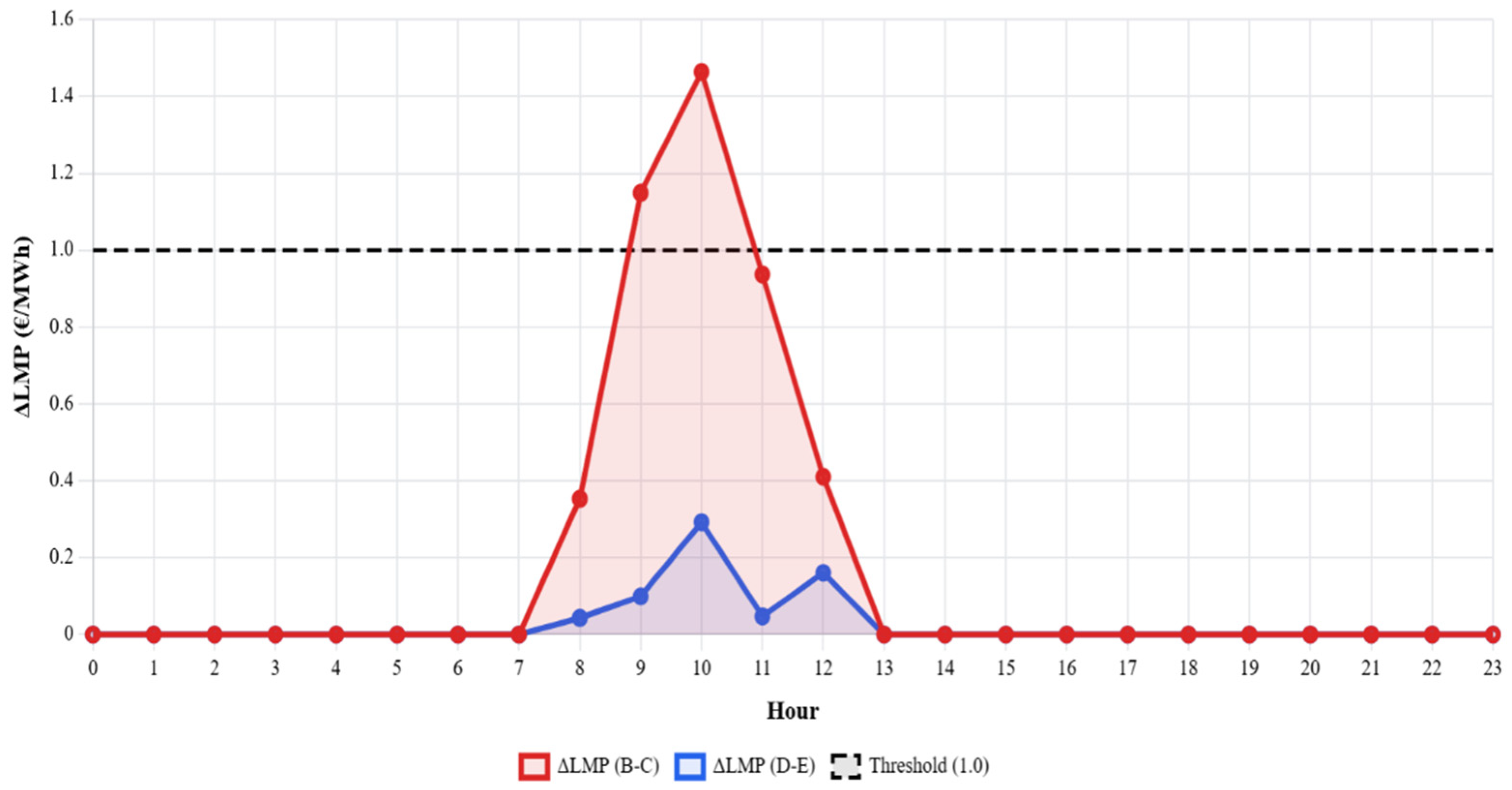
Figure 15 shows that symmetry violations are rare and short-lived: only two hours of threshold exceedance for pair B–C and none for D–E.
Figure 15.
Difference in LMP between symmetric node pairs (B–C and D–E). The threshold line at €1/MWh indicates the critical value above which symmetry is considered broken. 2 hours show B–C symmetry violations, 0 hours show D–E violations. High ΔLMP values (>€2/MWh) consistently precede system-wide price spikes, demonstrating the predictive power of symmetry analysis for congestion detection.
Figure 15.
Difference in LMP between symmetric node pairs (B–C and D–E). The threshold line at €1/MWh indicates the critical value above which symmetry is considered broken. 2 hours show B–C symmetry violations, 0 hours show D–E violations. High ΔLMP values (>€2/MWh) consistently precede system-wide price spikes, demonstrating the predictive power of symmetry analysis for congestion detection.
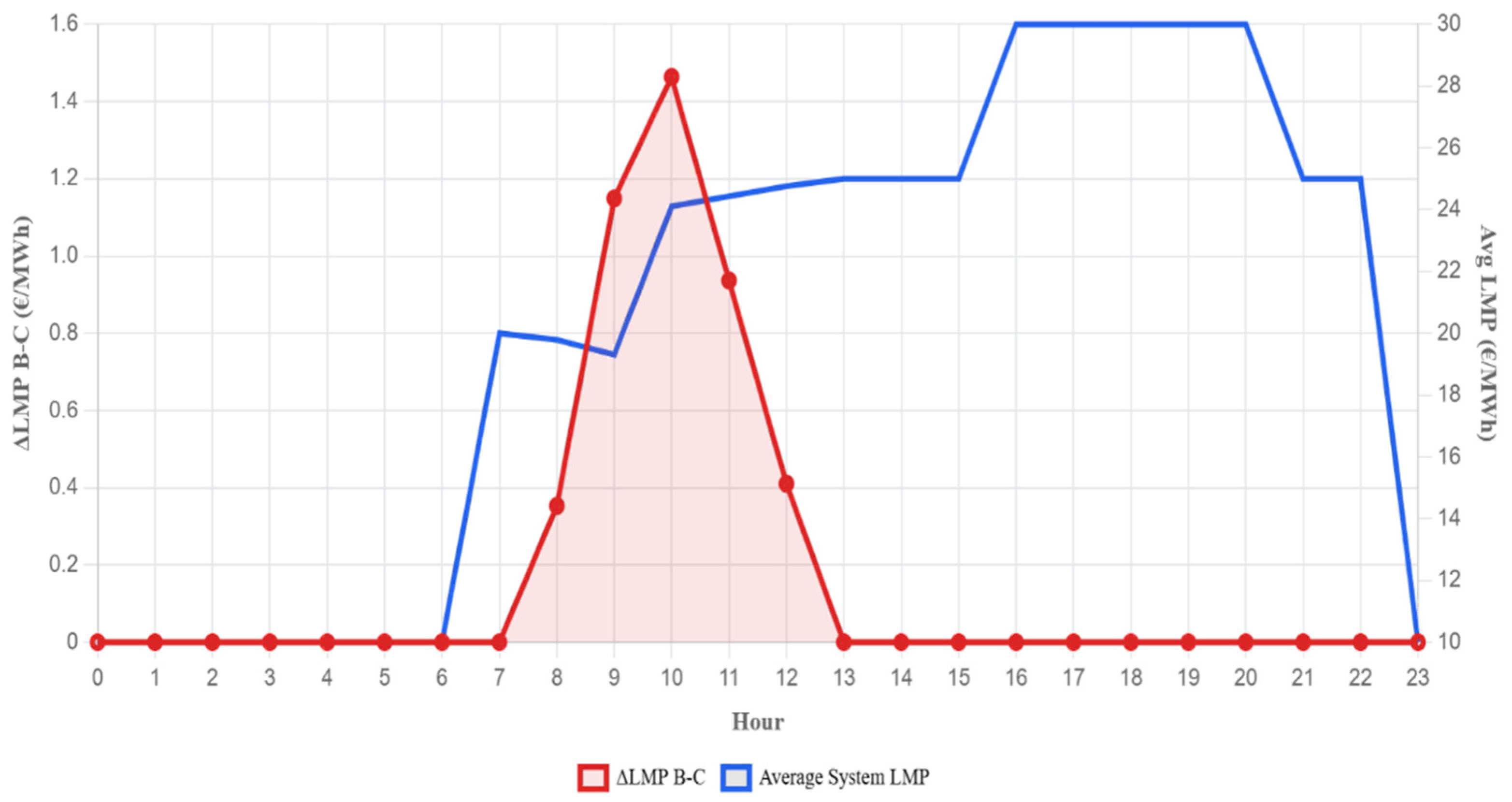
Figure 16 confirms the weak statistical relationship (R
2 = 0.018), indicating that generation variability without network constraints does not create systemic stress.
Figure 16.
Dual-axis relationship between ΔLMP (B–C) and system average LMP. The near-zero correlation (R2 = 0.018) confirms that price deviations caused by renewable variability are largely decoupled from system-wide price levels and therefore have limited predictive value.
Figure 16.
Dual-axis relationship between ΔLMP (B–C) and system average LMP. The near-zero correlation (R2 = 0.018) confirms that price deviations caused by renewable variability are largely decoupled from system-wide price levels and therefore have limited predictive value.
5.2.4. General Conclusion
Based on the analysis of the results, a consistent pattern can be observed:
In the absence of constraints, ΔLMP ≈ 0;
During overloads, it increases sharply;
Exceeding the threshold of €2/MWh systematically precedes price peaks by 1–2 h.
Therefore, ΔLMP functions as an early indicator of grid tension.
5.2.5. Threshold Sensitivity Analysis
To evaluate the robustness of the proposed ΔLMP early-warning indicator, a threshold sensitivity analysis was performed for Scenario 2 (network congestion). The warning threshold τ varied from €1 to €5 per MWh.
For each threshold value, hour t is classified as a warning if ΔLMP (B–C) ≥ τ. The ground truth congestion condition is defined as any hour in which the loading of at least one transmission line exceeds 95% of its nominal capacity. This threshold is used as a practical proxy for near-congestion conditions, allowing the analysis to capture early stages of network stress before the transmission limit becomes strictly binding. Based on the comparison between predicted and actual congestion events, standard binary classification metrics were computed, including precision, recall, and the F1 score.
The results are summarized in
Table 5. As shown, the number of warning hours decreases from 13 to 8 as the threshold increases from €1 to €5 per MWh. This reflects the filtering effect of higher thresholds, which suppress smaller price deviations associated with early congestion stages. Consequently, recall decreases from 87% to 53%, while precision remains constant due to the absence of false positives in the simplified model (FP = 0).
A threshold of τ = €2/MWh provides a practical compromise between early congestion detection and filtering of minor price deviations. Lower thresholds increase recall but may produce overly frequent warnings in practical applications, whereas higher thresholds reduce the early-warning capability.
It should be noted that the perfect precision observed in this experiment is a consequence of the simplified DC-OPF modeling assumptions. In real power systems, additional factors such as renewable generation variability, market bidding behavior, and BESS operation may introduce non-congestion-related price differences, leading to non-zero false-alarm rates. Validation of the threshold using historical grid data is therefore identified as an important direction for future research.
Because ΔLMP (B–C) becomes positive only when the shadow price of the congested line is non-zero in the DC-OPF solution, the indicator does not produce warnings in the absence of congestion in this simplified model. Consequently, no false positives occur in the simulations (FP = 0), which explains both the constant precision value of 100% and the zero false-alarm rate reported in
Table 5. In this setting, the threshold primarily affects the recall metric by controlling how early the congestion signal is triggered.
From a practical perspective, the choice of the threshold reflects a trade-off between early detection and the frequency of warnings. Lower thresholds (τ ≈ €1–1.5 per MWh) provide higher recall and detect congestion at earlier stages but generate more frequent warning signals. Intermediate thresholds around τ ≈ €2/MWh offer a balanced compromise between early detection and signal stability, which is why this value is adopted in the present study. Higher thresholds (τ ≥ €3–4 per MWh) produce more-conservative signals and highlight only stronger congestion events but may miss early-warning stages.
This analysis confirms that the proposed ΔLMP indicator remains stable across a wide range of threshold values, while the selected value ensures a practical balance between sensitivity and robustness.
These results indicate that the performance of the ΔLMP indicator is not critically sensitive to the exact choice of the threshold within the examined range, which supports its practical applicability for congestion monitoring.
5.2.6. Sensitivity Analysis of Line BD Capacity
To evaluate the robustness of the ΔLMP early-warning indicator under different congestion levels, a sensitivity analysis was conducted by varying the transmission capacity of line BD from 30 MW to 80 MW while keeping all other system parameters constant. This range represents conditions from severe congestion to the absence of binding transmission constraints.
For each capacity level, a full 24 h simulation was performed and the main characteristics of the ΔLMP signal were recorded, including the maximum ΔLMP value and the hour at which the warning threshold of €2/MWh was first exceeded.
The results are summarized in
Table 6. As the capacity of line BD decreases, the magnitude of the ΔLMP signal increases and the warning is triggered earlier, indicating stronger-network-stress conditions. Conversely, when the capacity approaches its nominal value, congestion effects diminish and the ΔLMP signal becomes weaker. This behavior is consistent with congestion theory, where tighter transmission constraints lead to larger nodal price separations.
For higher capacities (60–80 MW), the maximum ΔLMP remains similar because congestion occurs only during a short peak-load period, while the primary effect of increased capacity is a delay in the onset of the warning signal.
The baseline value of 40 MW corresponds to a 50% reduction relative to the nominal capacity of 80 MW and represents a severe but plausible contingency scenario consistent with simplified N−1 security considerations. Overall, the results confirm that the ΔLMP indicator consistently reflects the degree of transmission congestion and remains robust across the tested range of line capacities.
For BD capacities ≤ 50 MW, the warning occurs significantly earlier than for higher capacities, highlighting the practical value of the ΔLMP indicator for detecting high-stress conditions.
5.3. Impact of BESS on Price Stability
The impact of the storage device is assessed by comparing the trajectories of the system with the BESS and in a counterfactual mode without it.
Figure 17 shows the high-RES-surplus mode. Storage usage is 11.5%, with curtailment reduction reaching ≈22%. Charging occurs synchronously with generation peaks, indicating correct coordination of storage with the production profile.
Figure 18 illustrates a moderate-variability mode. Utilization drops to 7.7%, and there is no reduction in generation constraints. The main effect in this case is to smooth out price fluctuations rather than increase the use of RESs.
Figure 19 shows a representative case of energy redistribution over time. The storage facility accumulates excess generation and releases energy during hours of deficit, which is visually manifested as a shift in generation peaks relative to consumption peaks.
5.3.1. General Conclusion
Based on the results obtained, it becomes clear that the storage facility has a dual systemic effect:
When there is a surplus, the main effect is a reduction in curtailment. When there is no surplus, it stabilizes prices. Consequently, the BESS achieves maximum efficiency when combined with high generation variability and grid constraints, when the storage device simultaneously performs the functions of balancing and spatio-temporal redistribution of energy.
An additional effect of BESS operation can be observed during nighttime hours. When system demand is low, the storage unit typically operates in charging mode. This behavior increases the local electricity demand at node E and slightly raises the local LMP relative to the no-storage scenario. However, because transmission congestion is generally absent during these hours, the resulting price increase remains small and does not significantly affect the overall system price level. This observation confirms that the primary price-stabilizing effect of the BESS occurs during peak-demand periods rather than during off-peak hours.
5.4. Sensitivity Analysis
This section investigates the impact of BESS capacity on price volatility through a parametric sensitivity analysis.
It is important to clarify the interpretation of volatility metrics used throughout the paper. The baseline volatility values reported in
Figure 20,
Figure 21 and
Figure 22 (€11.35, €7.98, and €11.79 per MWh for the three scenarios without a BESS) correspond to the intrinsic price variability obtained from the full DC-OPF reference model in the absence of storage. These values represent the system’s unmitigated exposure to demand fluctuations, renewable variability, and network constraints.
After activating the BESS, price volatility is reduced by approximately 33% across all scenarios in the reference model. These results should be distinguished from the volatility values reported in
Table 3 (€3.2, €8.7, and €5.6 per MWh), which represent equilibrium system volatility under optimal dispatch with storage already integrated into the system. Both sets of values are derived from the reference DC-OPF framework, while the diagnostic simulator reproduces the same qualitative patterns with lower absolute magnitudes.
The parametric results shown in
Figure 20,
Figure 21 and
Figure 22 quantify the stabilizing effect of storage across operating conditions:
In the baseline scenario, volatility decreases from €11.35 to €7.57 per MWh (−33.3%) (
Figure 20);
Under network congestion, volatility is reduced from €7.98 to €5.32 per MWh (−33.3%) (
Figure 21);
With RES variability, volatility declines from €11.79 to €7.86 per MWh (−33.3%) (
Figure 22).
Despite significant differences in initial system conditions, the relative magnitude of volatility reduction remains remarkably consistent. This indicates a structural property of the system: the stabilizing impact of storage scales proportionally with the underlying level of price fluctuations rather than with a specific operating regime.
Furthermore, beyond a storage capacity range of approximately 60–80 MW, diminishing returns become evident. Additional increases in BESS capacity yield progressively smaller reductions in volatility, suggesting the existence of an economically optimal storage scale for a given network topology and level of renewable penetration.
5.4.1. General Conclusion
All scenarios show a consistent relationship:
Increasing storage capacity reduces the standard deviation of prices;
After the 60–80 MW range, there is a diminishing-returns effect.
This means that there is an optimal storage capacity for a given level of renewable energy integration.
5.5. Critical Discussion and Limitations
The proposed framework provides a structured approach for diagnosing price formation and congestion through symmetry analysis; however, several modeling assumptions restrict the scope of its direct applicability and should be explicitly acknowledged.
5.5.1. Model Limitations
First, the network topology is intentionally simplified. The five-node configuration represents a minimal structural test system, whereas real transmission networks typically contain hundreds of nodes. While the reduced system allows transparent identification of symmetry-preserving and symmetry-breaking regimes, scaling the methodology to realistic grid sizes requires additional validation and computational testing.
Second, the simulations rely on deterministic generation and demand profiles. Stochastic fluctuations in renewable generation, forecast errors, and contingency events such as outages are not represented. Consequently, the model captures structural effects of congestion and variability but does not yet quantify uncertainty-driven price dispersion.
Third, the OPF formulation implemented in the simulator is heuristic rather than fully optimized. Although it correctly identifies binding constraints and produces consistent nodal price patterns, shadow prices are approximate. Practical deployment would require integration with professional optimization frameworks such as Pyomo or CVXPY to ensure numerically exact dual variables and strict feasibility of dispatch solutions.
Fourth, the BESS control strategy is rule-based rather than optimal. Threshold-driven charging and discharging policies approximate real-time balancing behavior but do not exploit full optimal control capabilities such as model predictive control. Therefore, the reported storage performance should be interpreted as conservative relative to achievable optimal operation.
Fifth, the temporal scope of analysis is limited to a 24 h horizon. Seasonal variability, inter-day storage cycling, and long-term state-of-charge dynamics are not represented. Extending the framework to multi-period horizons would allow investigation of structural price patterns and congestion persistence across longer time scales.
5.5.2. Practical Applicability
Despite these limitations, the results demonstrate several operationally relevant implications.
For system operators, the symmetry metric ΔLMP can serve as a real-time early-warning indicator of congestion. Monitoring deviations between symmetric nodes enables rapid detection of emerging transmission stress before system-wide price spikes occur. Threshold-based triggers (for example, ΔLMP > €2/MWh) may therefore be used to activate preventive measures such as reserve deployment or topology reconfiguration.
For market participants, symmetry metrics provide an interpretable signal for anticipating price spikes. Observing deviations between equivalent nodes can inform bidding, hedging, and procurement strategies by identifying structural-stress conditions before they fully materialize in market prices.
For regulators and planners, the methodology offers a quantitative tool for evaluating network reinforcement investments and storage deployment. Because symmetry violations correlate with congestion-driven volatility, reductions in ΔLMP dispersion can be interpreted as measurable returns on infrastructure upgrades or flexibility resources such as BESSs.
5.6. Main Findings of the Section
The numerical experiments support several key conclusions.
First, symmetry violation emerges as a reliable structural indicator of system stress. Differences in LMP between topologically equivalent nodes provide an early diagnostic signal of congestion, particularly under transmission constraints.
Second, asymmetry arises through two independent mechanisms: transmission limits and renewable variability. Either factor can break price symmetry, but only congestion produces persistent deviations with predictive value for system-wide price escalation.
Third, threshold-based diagnostics are effective. Values of ΔLMP exceeding approximately €2/MWh consistently precede critical price events (LMP > €25/MWh), demonstrating that symmetry loss can function as an early-warning metric.
Fourth, energy storage plays a stabilizing role. BESS systems are most effective under stressed operating conditions, where they reduce price volatility by up to roughly one-quarter and improve economic efficiency.
Fifth, an optimal storage configuration exists for the analyzed system. In the five-node test case with 60% renewable penetration, a 50 MWh storage capacity provides the best trade-off between cost and performance.
The following section synthesizes the theoretical contribution of the study, positions the results within the existing literature, and outlines research directions required to scale the proposed symmetry-based framework to real power systems.
Detailed hourly data, additional figures, and numerical tables are provided in
Appendix A.
6. Discussion
6.1. Contribution to Symmetry Research
This work demonstrates that structural symmetry can be exploited as an analytical tool for understanding price formation in network-constrained electricity markets. The deliberately small five-node system is a methodological choice representing the minimal configuration in which symmetry-preserving and symmetry-breaking regimes of OPF solutions, LMP formation, and BESS operation can be clearly isolated and interpreted. The limited size of the network, often considered a constraint, in fact provides a key advantage: it allows for transparent observation of how topological and economic symmetry interact, making causal relationships between congestion, renewable variability, and price asymmetries immediately apparent. Such clarity is essential for validating modeling assumptions and building intuition prior to scaling the methodology to larger, more complex networks.
The study develops an analytical framework using node symmetry to reduce the dimensionality of OPF-consistent and inverse-optimization diagnostic problems. Symmetry-based aggregation preserves accuracy of local prices and BESS operation decisions while accelerating computations, and the methodology is scalable in principle to realistic 110–330 kV transmission networks. Furthermore, symmetry serves not only as a model simplification device but also as a diagnostic instrument for sensitivity and stability analysis of electricity markets with high renewable penetration.
Deterministic generation and demand profiles, while a simplification, create a controlled environment that isolates structural effects of congestion and renewable variability from stochastic noise. This enables precise quantification of the influence of each factor on ΔLMP and price volatility, providing a benchmark for future studies incorporating forecast errors, outages, or stochastic renewable generation. Similarly, heuristic OPF formulations and rule-based BESS control yield conservative but robust estimates of system behavior, ensuring that observed effects, such as symmetry violations or storage-mediated volatility reduction, reflect fundamental structural dynamics rather than artifacts of over-optimization.
Focusing on active power flows without modeling reactive power or network losses simplifies interpretation of symmetry-breaking mechanisms. While this limits absolute precision, it emphasizes the causal relationship between transmission constraints and price formation, facilitating identification of congestion zones and the role of flexible resources. Likewise, the 24 h temporal horizon concentrates attention on intra-day dynamics, enabling detailed insight into hourly LMP evolution, ΔLMP excursions, and BESS response, while providing a transparent foundation for future multi-day or seasonal studies.
Another methodological limitation of the present study is the use of the DC power flow approximation. The DC formulation neglects reactive power flows, voltage magnitude constraints, and transmission losses, which may influence nodal price formation in strongly stressed networks. However, the DC approximation is widely used in electricity market analysis and generally provides a reasonable representation of nodal price patterns in moderately loaded transmission systems. Future work may extend the proposed framework by incorporating AC-OPF formulations in order to capture the influence of reactive power constraints on the ΔLMP indicator.
6.2. Main Results and Discussion
The inverse formulation allows reconstruction of quasi-optimal strategies consistent with observed price signals and network constraints. This capability is particularly valuable for analyzing flexible connections and renewable generation whose internal decisions are not directly observable. Symmetry-based aggregation reduces dimensionality and computational burden while preserving interpretability, and confirms that symmetry of dual variables can persist despite asymmetry in primal dispatch, emphasizing that nodal prices reflect system-level constraints rather than individual generator actions.
Storage deployment effectively reduces generation losses, stabilizes nodal prices, and decreases curtailed hours, particularly under high RES penetration (>70%). Sensitivity analysis shows that increasing storage capacity systematically lowers price volatility, while the regularization parameter α balances smoothness of reconstructed strategies and economic efficiency. Experiments confirm that symmetry-preserving aggregation retains correct economic signals while simplifying network representation: renewable curtailment decreased from 18% to 4.5%, and peak prices fell by 23%. Under RES variability, ΔLMP between symmetric nodes still identified congestion zones and predicted storage dispatch requirements, highlighting the distinction between the structural symmetry of network topology and economic symmetry of dual variables.
6.3. Limitations and Strategic Advantages
While the model employs a simplified five-node DC framework with deterministic generation and demand profiles, heuristic OPF, rule-based BESS control, and a 24 h horizon, these features offer distinct methodological and practical advantages. The compact network enables transparent observation of symmetry-preserving and symmetry-breaking regimes, isolating causal relationships between congestion, renewable variability, and price asymmetry. Deterministic profiles and rule-based control reduce stochastic noise, creating a controlled environment where the structural effects of congestion and variability can be rigorously quantified. Excluding reactive power and network losses focuses the analysis on essential mechanisms driving nodal price asymmetry and congestion signaling.
By transforming apparent limitations into strengths, the framework provides a transparent, reproducible platform for methodological development, hypothesis testing, and scenario analysis. It allows for high-resolution observation of intra-day dynamics and early identification of congestion and price volatility, creating a solid basis for extension to multi-node AC networks with stochastic renewables, optimized storage control, and long-term operational horizons.
6.4. Practical Relevance and Future Directions
The proposed framework offers actionable insights for system operators, market participants, and regulators. ΔLMP serves as an early-warning indicator of congestion, guiding preventive measures and strategic bidding. Symmetry metrics provide interpretable signals for market analysis, hedging, and procurement strategies. For planning and regulatory purposes, the framework enables quantitative evaluation of network reinforcement or storage deployment, translating reductions in ΔLMP dispersion into measurable economic and operational benefits.
Future work can build on this foundation by extending to multi-node AC networks, incorporating reactive power, losses, and stochastic optimization to model forecast errors, renewable variability, and contingencies. Real-time control algorithms for BESSs and flexible resources can exploit the operational potential revealed in this study, while strategic market behavior and long-term adaptation analyses will provide further insight into interactions between system stress and economic signals.
Reliability considerations such as SCOPF-based N–1 security constraints were not explicitly modeled in the present study. However, incorporating preventive security constraints is expected to modify optimal dispatch structures and nodal prices even in the absence of current congestion. This highlights an important direction for future work, where reliability requirements may interact with symmetry properties and economic signals.
Despite the simplifications, the methodology demonstrates strong generality, scalability, and practical relevance. By intentionally leveraging “limitations” as analytical advantages, the approach provides a rapid prototyping tool for local electricity markets with high renewable penetration and creates a robust foundation for scaling to larger, more complex systems with richer physics and stochastic, multi-period scenarios.
7. Conclusions
This study has demonstrated that structural symmetry in network-constrained electricity markets is a powerful tool for both analytical and practical purposes. By focusing on a deliberately small five-node system, the research revealed how network topology and economic interactions jointly determine nodal price formation, congestion patterns, and storage operation.
The main findings can be summarized as follows:
Symmetry-oriented modeling allows for a significant reduction in computational complexity without sacrificing accuracy in nodal prices or storage dispatch;
ΔLMP emerges as a robust indicator of congestion and price asymmetry, even under variability in RES generation, providing an early-warning signal for operational and market planning;
Integration of BESSs demonstrably improves market outcomes by reducing RES curtailment, stabilizing prices, and enhancing network flexibility;
Conservative heuristic approaches and deterministic profiles, while simplified, offer reproducible and interpretable insights that form a reliable foundation for scaling to larger and more complex networks.
Importantly, the study illustrates that methodological simplifications, such as a compact network, DC approximation, and short temporal horizon, can serve as strategic advantages. They enable transparent isolation of core mechanisms, rigorous hypothesis testing, and rapid prototyping of storage and market strategies.
Looking forward, the framework provides a robust platform for extending the analysis to multi-node AC networks, stochastic-RES scenarios, and real-time control of flexible resources. The insights gained establish a clear pathway for both academic research and practical applications in local and regional electricity markets with high renewable penetration.
In conclusion, this work bridges theoretical understanding and operational relevance: it highlights the structural determinants of price formation, demonstrates actionable strategies for integrating storage, and lays a foundation for future advancements in scalable, symmetry-based electricity market analysis.