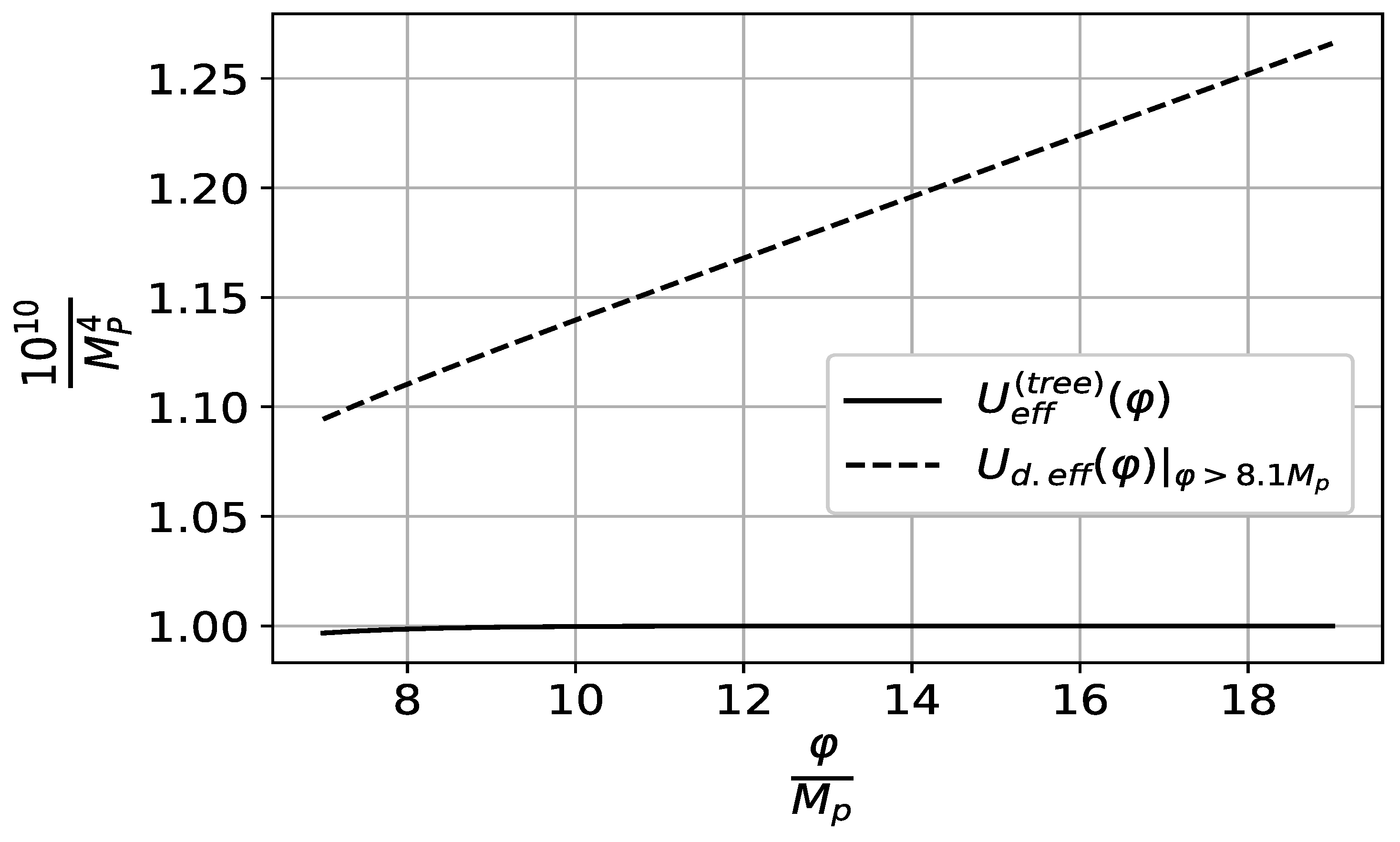
Article

Two-Measure Electroweak Standard Model and Its Realization During Cosmological Evolution

by
Alexander B. Kaganovich
1,2
1
Physics Department, Ben Gurion University of the Negev, P.O. Box 653, Beer-Sheva 8410501, Israel
2
Mathematics Department, Sami Shamoon College of Engineering, P.O. Box 950, Beer-Sheva 8410802, Israel
Symmetry 2026, 18(3), 508; https://doi.org/10.3390/sym18030508
Submission received: 21 January 2026 / Revised: 10 March 2026 / Accepted: 13 March 2026 / Published: 16 March 2026

Abstract

The possibility of realizing Higgs inflation in a model with a small non-minimal coupling constant, which was demonstrated recently, provides grounds for further development of the model. Incorporating the electroweak SM into the Two-Measure theory (TMT) in a way that fully accounts for the TMT structure leads to a theory we call the Two-Measure Standard Model (TMSM). The TMSM is realized in the context of cosmology as a set of cosmologically modified copies of the Glashow–Weinberg–Salam (GWS) theory, such that each of the copies exists as a local quantum field theory defined on the classical cosmological background at the appropriate stage of its evolution. This basic idea is studied in detail for two stages of the cosmological background evolution: for slow-roll inflation and for the stage of approaching the vacuum. Mainly due to the presence of the ratio of two volume measures in all equations of motion, all TMSM coupling constants turn into a kind of “running” (classical) TMT-effective parameters. During the evolution of the cosmological background, changing these parameters yields new results: (1) the classical “running” TMT-effective Higgs self-coupling parameter increases from λ 10 11 (which provides Higgs inflation consistent with the Planck CMB data at ξ = 1 6 ) to λ 0.1 at the stage close to the vacuum; (2) the mass term in the TMT-effective Higgs potential changes sign from positive to negative, which provides SSB in the standard way of GWS theory; (3) the classical “running” parameters of the gauge and Yukawa couplings change by several orders of magnitude; (4) the GWS theory is reproduced when the Yukawa constant in the original action is chosen to be universal for three generations of fermions. We show that, due to these classical-level results, taking into account quantum corrections in the one-loop approximation preserves the slow-roll inflation regime and does not violate the vacuum stability during inflation.

1. Introduction

The study of possible ways of extrapolating the Standard Model (SM) to the Planck scale has been the subject of numerous papers; see, for example, Refs. [1,2,3,4,5,6,7,8,9,10,11]. When gravity is taken into account, a central problem arising at the interface between particle field theory and cosmology is establishing a link between physics at the low energies typical for the SM collider experiments and the inflationary energy scale. The standard approach to solving the latter problem can be roughly described as follows. The Glashow–Weinberg–Salam theory is defined in Minkowski space, and it can also be described in a general covariant form that allows to include gravity in the model. Such a combination of particle physics and gravity will be referred to as SM + Gravity. In such a way, the Higgs sector of the SM is typically described at energies significantly higher than the accelerator’s energy scale. But the tree-level Higgs sector (like other SM fields) in this picture is actually the same as in the SM in Minkowski space. Inflation can be successfully described if a non-minimal coupling is added. However, agreement between the predicted inflation parameters and the observed CMB data is possible only if the non-minimal coupling constant ξ is huge: it varies in the range 10 4 ξ 10 8 depending on the type of model, metric [12,13,14,15,16,17,18,19], or Palatini [20,21,22,23,24,25,26,27]. However, with the exception of some non-minimal coupling effects (see, e.g., the review [16]), Higgs inflation models formulated within the SM + Gravity approach and studied at the tree level do not provide a reasonable connection between physics at accelerator energies and at the inflation energy scale. One might expect that such a connection could manifest itself in the form of running coupling constants as solutions of the renormalization group (RG) equations; that is, only when quantum effects are taken into account. However, the presence of gravity makes these Higgs inflation models perturbatively non-renormalizable. Moreover, in both the metric Higgs inflation models [12,13,14,15,16] and the Palatini formulation [20,21,22,23,24,25,26,27], the transition in the original action to the Einstein frame leads to an essentially non-polynomial Lagrangian, which is also the reason for non-renormalizability. Therefore, to calculate the energy dependence of the SM coupling constants, and, in particular, the value of the Higgs field self-coupling constant λ on the inflationary scale, it becomes necessary to use the UV cutoff, higher-dimensional operators, and construct effective field theory models. Within this approach, for example, it was shown [24] that the corresponding modifications of the potential shape can be consistent with the measured CMB data only if there is a very clear correlation between the constraint on the value of ξ and the bounds on the low-energy value of the top Yukawa coupling. Nevertheless, given that the reliability of such methods is difficult to control, a more field-theoretic-based approach to solving the problem would be desirable. Thus, the need to use an unnaturally huge value of ξ , the non-renormalizability and vacuum stability problems in existing Higgs inflation models do not allow us to be confident that we are indeed dealing with the proper application of particle physics to the cosmology of the early Universe.
Motivation.
This paper is a logical continuation of paper [28], and the main goal of these papers is to show that the radical changes that Two-Measure theory (TMT) introduces to the way of combining gravity with particle physics (compared to SM + Gravity) allow us to successfully overcome the above-mentioned problems. Indeed, the structure of TMT is such that the original action must include gravity, meaning that TMT models cannot be formulated directly in Minkowski space. The equations derived from the principle of least action describe a self-consistent system of gravity and matter. Represented in the Einstein frame, this system of equations is valid at any energy accessible to classical field theory. Incorporating the electroweak SM into TMT in a way that fully accounts for the structure of TMT leads to a theory we call the Two-Measure SM (TMSM). In the context of cosmology, the TMSM describes what the tree-level SM looks like at various stages of cosmological evolution, which is equivalent to the description at any admissible energy. Particular attention should be paid to the fact that in TMSM, the description of matter in Minkowski space can be achieved only by the limiting transition from curved space-time, that is, by approaching the vacuum state with a zero cosmological constant (CC). Moreover, the latter turns out to be possible only as a result of fine-tuning when choosing the integration constant M . This means that the problem of the cosmological constant (CC) and the method of ensuring its desired value also turn out to be built into the TMT in a fundamentally different way than in SM + Gravity: ensuring, for example, a zero value of the CC with a special choice of the integration constant M leads to a corresponding fixation of the TMT-effective parameter values in the equations of all particle fields. This is indeed radically different from SM+Gravity, where it is usually assumed that somehow the zero value of the vacuum energy is already ensured, and so the CC in the Lagrangian is set to zero “by hand”. This means that the Higgs-inflation models [12,13,14,15,16,17,18,19,20,21,22,23,24,25,26,27] are formulated within a theory that is not self-sufficient in such a fundamental topic.
From a structural point of view, comparing SM + Gravity models with TMSM, we can say that SM + Gravity belongs to the “conventional” type of models, in the sense that in the original action there is only the usual volume element g d 4 x . In models of the TMT, in the integral of the primordial action, along with terms with the standard volume measure d V g = g d 4 x , there are terms with an alternative, metric-independent volume measure d V Y constructed as the following 4-form using four scalar functions φ a ( a = 1 , , 4 )
d V Y = Y d 4 x ε μ ν γ β ε a b c d μ φ a ν φ b γ φ c β φ d d 4 x = 4 ! d φ 1 d φ 2 d φ 3 d φ 4 .
Here, Y is a scalar density, that is under general coordinate transformations with positive Jacobian it has the same transformation law as g (see footnote 1 in Appendix D). A specific dynamic feature of TMT is that the ratio of volume measures
ζ = Y g
appears in all equations of motion, and all coupling constants become ϕ -dependent due to ζ ( ϕ ) . On the other hand, the function ζ ( ϕ ) is determined by a constraint, which is a self-consistency condition of the equations obtained by varying the metric g μ ν and the functions φ a . Although Einstein’s equations are reproduced exactly, due to the constraint and the function ζ ( ϕ ) it defines, the energy-momentum tensor, in general, has a structure fundamentally different from conventional models; moreover, the function ζ ( ϕ ) has a significant influence on the dynamics of matter fields. Thus, it turns out that the function ζ ( ϕ ) plays a key role in obtaining all the new results presented both in the paper [28] and in this paper (see footnote 2 in Appendix D). To illustrate this, the following two examples can be given, based on the results of paper [28]. During the cosmological evolution after the end of inflation, a change in ζ ( ϕ ) leads to a change in the sign of the TMT-effective Higgs mass term in the TMT-effective Lagrangian. This effect provides the TMSM answer to the mystery of the Higgs potential structure and leads to spontaneous symmetry breaking (SSB) in a standard way. The second example is related to the model parameter λ of the Higgs self-coupling, equal to λ 10 11 , which was allowed in Ref. [28] to realize a slow-roll inflation in agreement with the CMB data, while the constant of non-minimal coupling to the scalar curvature is small, e.g., ξ = 1 / 6 . But at the stage of the cosmological evolution approaching the vacuum, due to the ζ ( ϕ ) dependence, the TMT-effective Higgs self-coupling turns out to be λ ( n e a r v a c ) 0.1 required by the GWS theory. It is important to note that in this effect, the role of non-minimal coupling turns out to be minor. These examples demonstrate that in the TMSM formulated as a model of classical field theory, the TMT-effective mass and the Higgs self-coupling behave as a kind of classical “running” parameters. Thus, in TMSM, to achieve very non-trivial results in the entire admissible energy spectrum (from the energies of the electroweak SM to inflationary scales), it is sufficient to use the classical TMT-effective action. This suggests that the standard approach to quantization and finding the effective potential used in conventional Higgs inflation models may be irrelevant in TMSM.
Main idea.
In light of the above, a more radical idea suggests itself: Since the homogeneous scalar field ϕ ( t ) used in the Higgs inflation model is the result of cosmological averaging of the local Higgs field H ( x ) , ϕ ( t ) should be regarded as a classical field defined globally (see footnote 3 in Appendix D). Such definition of the field ϕ ( t ) makes it meaningless to include ϕ ( t ) in the SM quantization procedure. Instead, the field ϕ ( t ) , together with the function ζ ( ϕ ) and the curvature, describe the classical cosmological background on which the electroweak SM exists as a local quantum field theory. It should be emphasized once again that the presence of the function ζ ( ϕ ) and the role it plays in TMSM are the main reason that leads to the need for such fundamental theoretical changes compared to conventional models. In this paper, we explore how this idea can be implemented, and we will call the approach developed on the basis of this idea the “Concept of the cosmological realization of TMSM”. Following this concept, in this paper, we show that in addition to the above examples, a similar effect of the appearance of a kind of classical running coupling constants occurs for all electroweak TMSM coupling parameters.
For a clearer understanding of the main idea of the concept of the cosmological realization of the TMSM, it is worth paying special attention to the fact that the Higgs field plays a dual role in the theory being developed. Since the Higgs field fills the entire space of the Universe, it can be averaged. At each stage of the evolution of the Universe (of course, in a simplified model without matter), this cosmologically averaged field ϕ ( t ) together with the curvature and the scalar ζ forms the cosmological background. But when studying the SM at a certain stage of cosmological evolution, the Higgs field and other SM fields should be considered as local quantum fields, which we must study on the corresponding cosmological background.
Main results and organization of the paper. In Section 2 and Section 3 we define the TMT primordial action (see footnote 4 in Appendix D) for the bosonic and fermion sectors of the S U ( 2 ) × U ( 1 ) gauge-invariant electroweak TMSM, which also contains the TMT-modification of the gravitational action in the Palatini formulation. According to the prescription of TMT, all gravity and matter terms of the primordial action contain additional factors in the form of linear combinations ( b i g ± Y ) , where b i is a set of dimensionless model parameters. Another fundamentally important novelty is that, unlike conventional models, the TMT structure implies the need to take into account the possibility of two different types of vacuum-like terms. A summary of the main results of Ref. [28] is also given in Section 2.
The concept of cosmological realization of the TMSM is based on the use of two different frames for obtaining and describing results following from the primordial TMSM action. In Section 4.1, we explain what the cosmological frame (CF) is and what the local particle physics frame (LPPF) is. A general method for describing the cosmological background in CF is also given. In the FLRW universe, this background is determined by a homogeneous field ϕ ( t ) , a curvature, and a scalar function ζ . Then, in Section 4.2, we explore how the classical Higgs + Gravity sector of the TMSM can serve as a cosmological background on which a local particle field theory must be built. The presence of ζ radically distinguishes the description of the cosmological background and its evolution in the TMSM from conventional models. We analyze in particular detail two stages of evolution of the cosmological background: the inflationary stage in the slow-roll regime and the stage of approaching the vacuum.
Following the concept of the cosmological realization of TMSM, in Section 5, we study general features of the description of a local particle field theory on an arbitrary cosmological background. If we consider the Glashow–Weinberg–Salam (GWS) theory as a pattern, then at each specific stage of the evolution of the cosmological background, the particle field theory is realized as a cosmologically modified copy of the electroweak SM. To describe the latter, we have to operate with a set of variables for which we use the term LPPF.
In Section 6, we show that the realization of the TMSM in LPPF at the stage of evolution of the cosmological background approaching vacuum reproduces the tree-level GWS theory. The attractiveness of this realization is due to the new possibilities existing in the TMSM, which allow us to obtain the following fundamentally new results that may have great significance both in cosmology and in the GWS theory.
  • The above mentioned effect of the sign reversal of the TMT-effective Higgs mass term in the TMT-effective Lagrangian provides the TMSM answer to the mystery of the Higgs potential structure.
  • The above mentioned effect of the change in the TMT-effective parameter of the Higgs self-coupling from its primordial value λ 10 11 at the inflationary stage (which is in agreement with the CMB data) to the value λ ( n e a r v a c ) 0.1 required by the GWS theory.
  • Near the vacuum, the TMT effective gauge coupling parameters take the values required by the GWS theory, while the values of the primordial gauge parameters (in the primordial TMT-action) are of the order of g g 10 3 . This effect turns out to be very important in studying the influence of one-loop quantum corrections on slow-roll inflation.
  • The possibility of implementing fermion mass generation in a standard way due to SSB arises when the Yukawa coupling constants in the primordial TMT action are chosen to be universal (the same) for all charged leptons and similar for all up-quarks. Despite the choice of the primordial universal Yukawa coupling parameters 10 10 for leptons and ≈ 10 9 for up-quarks, the values of the TMT-effective Yukawa coupling parameters near the vacuum of the GWS theory give the correct values of the fermion masses.
In Section 7, we study the cosmologically modified copy of the electroweak SM in the LPPF when the cosmological background is in the slow-roll inflation stage. For brevity, we use the name “up-copy” to denote this copy of the electroweak SM, and we also add the prefix ‘up’ to the names of physical quantities and effects to distinguish them from the corresponding names in the GWS theory. The study is carried out in the approximation where we neglect relative corrections of the order ≲ 3 · 10 2 . Using the notations ϕ b ( t ) for the classical slow-rolling background Higgs field and R b for the background scalar curvature, we obtain that ξ R b < 0 plays the role of the squared mass in the classical TMT-effective Higgs potential. The latter has a minimum at v ˜ = 6 M P , which, within the above-specified accuracy, turns out to be independent of the background field ϕ b ( t ) . The up-SSB generates masses of the up-Higgs boson m h ˜ 2.9 · 10 13 GeV and the up-gauge bosons M W ˜ 7.8 · 10 15 GeV , M Z ˜ 8.8 · 10 15 GeV .
Section 8 is devoted to additional discussion of some important quantitative results concerning the concept of cosmological realization of TMSM.
In Section 9, the features of the quantization of the up-copy in the LPPF are studied in detail, and the one-loop effective potential is calculated. It is shown that, in contrast to the conventional theory, the radiative corrections g 4 g 4 have a weak effect on the effective quartic Higgs self-interaction. On the other hand, due to the extreme smallness of the primordial universal Yukawa coupling parameters, it turns out that the contribution of the gauge fields significantly dominates the fermion contribution to the one-loop effective potential. Therefore, the minimum of the one-loop effective potential is absolute, and the vacuum of the up-copy of the electroweak SM is stable (although its description is possible only in the adiabatic approximation). Finally, we show that taking into account quantum corrections in the one-loop approximation does not change the fact that inflation quickly turns into a slow-roll regime.
In Section 10, we analyze some key aspects of TMSM and discuss possible directions for its further development. Appendix A, Appendix B and Appendix C provide some important technical calculations and discussions. All footnotes with corresponding serial numbers are collected in Appendix D.

2. Bosonic Sector of the Electroweak TMSM at the Tree Level

2.1. Primordial Action of the Bosonic Sector

The bosonic sector of the electroweak TMSM includes the gravitational, Higgs, and gauge fields. Gravity is described in the Palatini formulation; therefore, the metric tensor and affine connection are treated as independent variables in the principle of least action. The scalars φ a ( x ) , from which the density Y of the alternative volume element is constructed, are additional degrees of freedom; their inclusion in the principle of least action is of key importance for the emergence of fundamentally new results that distinguish TMSM from SM + GR. The primordial action describing gravity and the bosonic sector of TMSM is chosen as follows:
S g r , b o s = S g r + S n o n m i n + S H + S g + S v a c ,
where
S g r = M P 2 2 d 4 x g + Y R ( Γ , g ) ,
is the TMT-modification of the gravitational action in the Palatini formulation (for more details see Ref. [29]). Here M P is the reduced Planck mass; Γ stands for the affine connection; R ( Γ , g ) = g μ ν R μ ν ( Γ ) , R μ ν ( Γ ) = R μ ν λ λ ( Γ ) and R μ ν σ λ ( Γ ) Γ μ ν , σ λ + Γ γ σ λ Γ μ ν γ ( ν σ ) . The TMT-modification of the non-minimal coupling of the Higgs isodoublet
H = ϕ + ϕ 0
to the scalar curvature is described by
S n o n m i n = ξ d 4 x g + Y R ( Γ , g ) H 2 ,
where | H | 2 = H H . In our notations, in a theory with only the volume element g d 4 x , the model of a massless scalar field non-minimally coupled to scalar curvature would be conformally invariant if the parameter ξ were equal to ξ = 1 6 .
The TMT-primordial action S H for the Higgs field H has a standard S U ( 2 ) × U ( 1 ) gauge invariant structure
S H = d 4 x b k g Y g α β D α H D β H b p g + Y λ H 4 b p g Y m 2 H 2 ,
where additional factors associated with the existence of two types of volume elements are selected in a special way. In paper [28], this choice played a decisive role in the possibility of realizing the idea of Higgs inflation at small ξ . The parameters b k > 0 , b p > 0 , λ > 0 and m 2 > 0 are chosen to be positive. The standard definition for the operator
D μ = μ i g T ^ A μ i g 2 Y ^ B μ ,
is used with the primordial gauge coupling parameters g and g . Here, as usual, T ^ stands for the three generators of the S U ( 2 ) group and Y ^ is the generator of the U(1) group.
With standard notations F μ ν = μ A ν ν A μ + g A μ × A ν and B μ ν = μ B ν ν B μ for the field strengths of the isovector A μ and isoscalar B μ , the gauge fields’ primordial action has the standard S U ( 2 ) × U ( 1 ) gauge invariant structure
S g = d 4 x b k g Y 1 4 g μ α g ν β F μ ν F α β 1 4 g μ α g ν β B μ ν B α β ,
where the density of the volume measure is chosen to be the same as in the kinetic term of S H .
Contribution of the vacuum-like terms to the primordial action is defined by (see footnote 5 in Appendix D)
S v a c = d 4 x g V 1 Y 2 g V 2 .
It is convenient to introduce a parametrization V 2 = ( q M P ) 4 . In the model of Ref. [28], and in this paper, we use the choice
V 1 = V 2 = ( q M P ) 4 ( 10 16 GeV ) 4 , which means that q 4 3 · 10 10 .

2.2. Higgs + Gravity Sector—Summary of the Main Results of Ref. [28]

In paper [28], which was mainly devoted to the application of the TMSM to the study of inflation and in which we worked in the CF, all contributions of gauge fields were omitted. Therefore, the TMT primordial action of the Higgs + Gravity sector reduces from the action (3) to the following:
S H + g r = d 4 x [ g + Y M P 2 2 1 + ξ 2 | H | 2 M P 2 R ( Γ , g ) + g + Y 2 g q 4 M P 4 + b k g Y g α β α H β H b p g + Y λ | H | 4 b p g Y m 2 | H | 2 ] .
Large-scale homogeneity and isotropy of our Universe allows to study its evolution as a whole, neglecting inhomogeneities on smaller scales. This means that using the approximation of a homogeneous and isotropic universe is based on the procedure of “cosmological averaging” over an appropriate scale. If a homogeneous and isotropic spatially flat universe is described by the Friedmann–Robertson–Walker (FRW) metric
d s 2 = d t 2 a 2 ( t ) d x 2 ,
then the value of the classical scalar field ϕ ( t ) , which drives the cosmological evolution at the moment t of the cosmological time, is a result of the cosmological averaging of an inhomogeneous field ϕ ( x ) . Applying this idea to the Higgs isodoublet H ( x ) , we have
H ( x ) c o s m . a v e r . = 0 1 2 ϕ ( t )
where the field ϕ ( t ) / 2 is the only nonzero component of the Higgs isodoublet H ( x ) obtained as a result of the cosmological averaging, or, using the terminology of Refs. [17,18,19], the cosmological state. In this paper, we adopt the view that ϕ ( t ) , obtained by this method, is a classical field whose quantization is meaningless in the context of the electroweak SM quantization procedure.
Following the prescription of the TMT procedure, we first obtain equations by varying the primordial action (12) with respect to φ a , Γ μ ν λ , g μ ν and ϕ . It is very important that, as a result of varying the primordial action with respect to φ a , an arbitrary integration constant M appears. The equations are then rewritten in the Einstein frame using the Weyl transformation
g ˜ μ ν = 1 + ζ Ω g μ ν ,
where
Ω = 1 + ξ ϕ 2 M P 2
and ζ , which was defined in Equation (2), turns out to be present in all equations of motion. The value of the integration constant M is chosen so that the TMT-effective vacuum energy density Λ satisfies the natural constraint 0 Λ ( e l e c t r o w e a k s c a l e ) 4 and it is achieved if
M = 2 ( q M P ) 4 ( 1 + δ ) , w h e r e | δ | 1 .
Then the self-consistency condition of the resulting system of equations determines ζ as the following function of ϕ and X ϕ
ζ ( ϕ , X ϕ ) = 2 ( q M P ) 4 ζ v ( 1 + ζ v ) ( 2 b p 1 ) λ 4 ϕ 4 ( 2 b p + 1 ) m 2 2 ϕ 2 + ( 1 + b k ) Ω X ϕ 2 ( q M P ) 4 ( 1 + ζ v ) + λ 4 ϕ 4 m 2 2 ϕ 2 ( 1 + b k ) Ω X ϕ ,
where we have neglected δ compared to 1, and the following definition has been used:
X ϕ = 1 2 g ˜ μ ν μ ϕ ν ϕ .
A very important novelty in the TMSM, formulated in the Introductory Section 1 and studied in detail in Section 5, Section 6, Section 7 and Section 8 of this paper, is the need to distinguish between the results of the description in the cosmological frame (CF) and in the local particle physics frame (LPFF). In particular, it turns out that the VEV of the Higgs field in LPPF differs from the value σ of the field ϕ at the minimum of its potential in CF
σ = ϕ c f .
When the field ϕ is in the vacuum state σ , the value of the scalar function ζ ( σ ) = ζ v is
ζ v = 1 + O λ σ 4 ( q M P ) 4 .
To refer to the equality (18), we use the term ‘constraint’ (see footnote 6 in Appendix D).
The gravitational equations in the Einstein frame have the canonical GR form
R μ ν ( g ˜ ) 1 2 g ˜ μ ν R ( g ˜ ) = 1 M P 2 T μ ν ( e f f ) ,
with the same Newton constant as in the primordial action. Here, R μ ν ( g ˜ ) and R ( g ˜ ) are the Ricci tensor and the scalar curvature of the metric g ˜ μ ν , respectively. The ζ -dependent form of the TMT-effective energy-momentum tensor T μ ν ( e f f ) is as follows:
T μ ν ( e f f ) ( ϕ ; ζ ) = 1 Ω b k ζ 1 + ζ ϕ , μ ϕ , ν + g ˜ μ ν X ϕ + g ˜ μ ν U e f f ( t r e e ) ( ϕ ; ζ ) ,
U e f f ( t r e e ) ( ϕ ; ζ ) = 1 ( 1 + ζ ) 2 Ω 2 q 4 M P 4 ( ζ v 2 ζ 2 ) + ( 1 b p ) λ 4 ϕ 4 ( 1 + b p ) m 2 2 ϕ 2 .
After substituting ζ ( ϕ , X ϕ ) into T μ ν ( e f f ) ( ϕ ; ζ ) , its expression reduces to
T μ ν ( e f f ) = K 1 ( ϕ ) Ω · ϕ , μ ϕ , ν g ˜ μ ν X ϕ K 2 ( ϕ ) · X ϕ M P 4 ϕ , μ ϕ , ν 1 2 g ˜ μ ν X ϕ + g ˜ μ ν U e f f ( t r e e ) ( ϕ ) ,
where the TMT effective potential U e f f ( t r e e ) ( ϕ ) and functions K 1 ( ϕ ) and K 2 ( ϕ ) are defined as follows:
U e f f ( t r e e ) ( ϕ ) = q 4 ( ζ v + b p ) λ ϕ 4 2 ( ζ v b p ) m 2 ϕ 2 + 1 M P 4 λ 4 ϕ 4 m 2 2 ϕ 2 2 4 Ω 2 q 4 ( 1 + ζ v ) 2 + ( 1 b p ) λ 4 ϕ 4 M P 4 ( 1 + b p ) m 2 ϕ 2 2 M P 4 ,
K 1 ( ϕ ) = 2 q 4 ( 1 + ζ v ) ( b k ζ v ) + ( 2 b p + b k 1 ) λ 4 ϕ 4 M P 4 + ( 2 b p + 1 b k ) m 2 ϕ 2 2 M P 4 2 q 4 ( 1 + ζ v ) 2 + ( 1 b p ) λ 4 ϕ 4 M P 4 ( 1 + b p ) m 2 ϕ 2 2 M P 4 ,
K 2 ( ϕ ) = ( 1 + b k ) 2 2 q 4 ( 1 + ζ v ) 2 + ( 1 b p ) λ 4 ϕ 4 M P 4 ( 1 + b p ) m 2 ϕ 2 2 M P 4 .
The ϕ -field equation in the Einstein frame reads
1 g ˜ μ b k ζ ( 1 + ζ ) Ω g ˜ g ˜ μ ν ν ϕ + b p + ζ ( 1 + ζ ) 2 Ω 2 λ ϕ 3 + b p ζ ( 1 + ζ ) 2 Ω 2 m 2 ϕ + ξ Ω 2 R ( g ˜ ) ϕ = 0 ,
where the last term appears in the equation due to non-minimal coupling. The expression for the scalar curvature R ( g ˜ ) is obtained from the Einstein Equation (22)
R ( g ˜ ) = 1 M P 2 2 K 1 ( ϕ ) Ω X ϕ 4 U e f f ( t r e e ) ( ϕ ) .
The performed procedure, which also includes the substitution of R ( g ˜ ) into Equation (29), means that we are dealing with an explicitly formulated self-consistent system “Higgs field + gravity”.
In the vicinity of the vacuum, where ζ ζ v = 1 and ϕ c f = σ , Equation (29) reduces to
1 g ˜ μ g ˜ g ˜ μ ν ν ϕ + V e f f , v a c ( ϕ ) = 0 ,
where the derivative V e f f , v a c ( ϕ ) of the Higgs field potential in the vicinity of the vacuum has the form (see footnote 7 in Appendix D)
V e f f , v a c ( ϕ ) = 1 ( 1 + ζ v ) ( b k ζ v ) ( b p + ζ v ) λ ϕ 2 . + ( b p ζ v ) m 2 ϕ
One should pay special attention to the fact that, in order to obtain Equation (31) in canonical form, it was necessary to divide Equation (29), considered near the vacuum, by the constant b k ζ v 1 + ζ v . It is seen that if ζ v > b p , SSB occurs with the following expression for the VEV of the classical scalar field ϕ in the CF
σ 2 = ζ v b p b p + ζ v · m 2 λ .
Equations (31) and (32) can be rewritten in the typical SM form
1 g ˜ μ g ˜ g ˜ μ ν ν ϕ + λ ( c f ) ϕ 3 m ( c f ) 2 ϕ = 0 ,
where the expressions in the CF for the parameters of the quartic self-coupling and the mass squared near a vacuum appear
λ ( c f ) = b p + ζ v ( 1 + ζ v ) ( b k ζ v ) λ , m ( c f ) 2 = ζ v b p ( 1 + ζ v ) ( b k ζ v ) m 2 .
The cosmological constant Λ , which is defined as the energy density in the vacuum state σ , is Λ = U e f f ( σ ) . The expression U e f f ( t r e e ) ( ϕ ) in Equation (26) was obtained using the value of the integration constant M = 2 ( q M P ) 4 (see Equation (17)), that is, by setting δ = 0 . In fact, playing with possible values of | δ | 1 , one can obtain any value of Λ in the interval, for example, 0 Λ ( e l e c t r o w e a k s c a l e ) 4 .
Instead of the system of the Einstein Equation (22) with the energy-momentum tensor (25)–(28) and the field ϕ -equation (29), it is more convenient to proceed with the TMT-effective action, the variation of which gives these equations. As usual, if g ˜ α β ϕ , α ϕ , β > 0 , the TMT-effective energy-momentum tensor T μ ν ( e f f ) can be rewritten in the form of a perfect fluid. Then the pressure density plays the role of the matter Lagrangian in the action, and we arrive at the tree-level TMT-effective action
S e f f ( T M T ) = M P 2 2 R ( g ˜ ) + L e f f ( t r e e ) ( ϕ , X ϕ ) g ˜ d 4 x ,
with the following tree-level TMT-effective Lagrangian
L e f f ( t r e e ) ( ϕ , X ϕ ) ) = K 1 ( ϕ ) X ϕ Ω 1 2 K 2 ( ϕ ) X ϕ 2 M P 4 U e f f ( t r e e ) ( ϕ ) .
Note that L e f f ( t r e e ) ( ϕ , X ϕ ) ) has the form typical for K-essence models [30,31,32,33]. This is why the variation of the action (36) with respect to ϕ gives Equation (29) with non-canonical kinetic term.
In Ref. [28], after redefining the field ϕ using the relation
ϕ = M P ξ sinh ξ φ M P ,
the TMT-effective potential U e f f ( ϕ ) was expressed in terms of φ
U e f f ( t r e e ) ( φ ) = λ M P 4 4 ξ 2 tanh 4 z · F ( z ) , where z = ξ φ M P ,
F ( z ) = ( ζ v + b p ) q 4 + λ 16 ξ 2 sinh 4 z λ m 2 4 ξ M P 2 sinh 2 z + m 4 4 λ M P 4 2 ( ζ v b p ) q 4 ξ m 2 λ M P 2 · sinh 2 z ( 1 + ζ v ) 2 q 4 + ( 1 b p ) λ 4 ξ 2 sinh 4 z ( 1 + b p ) m 2 2 M P 2 ξ sinh 2 z .
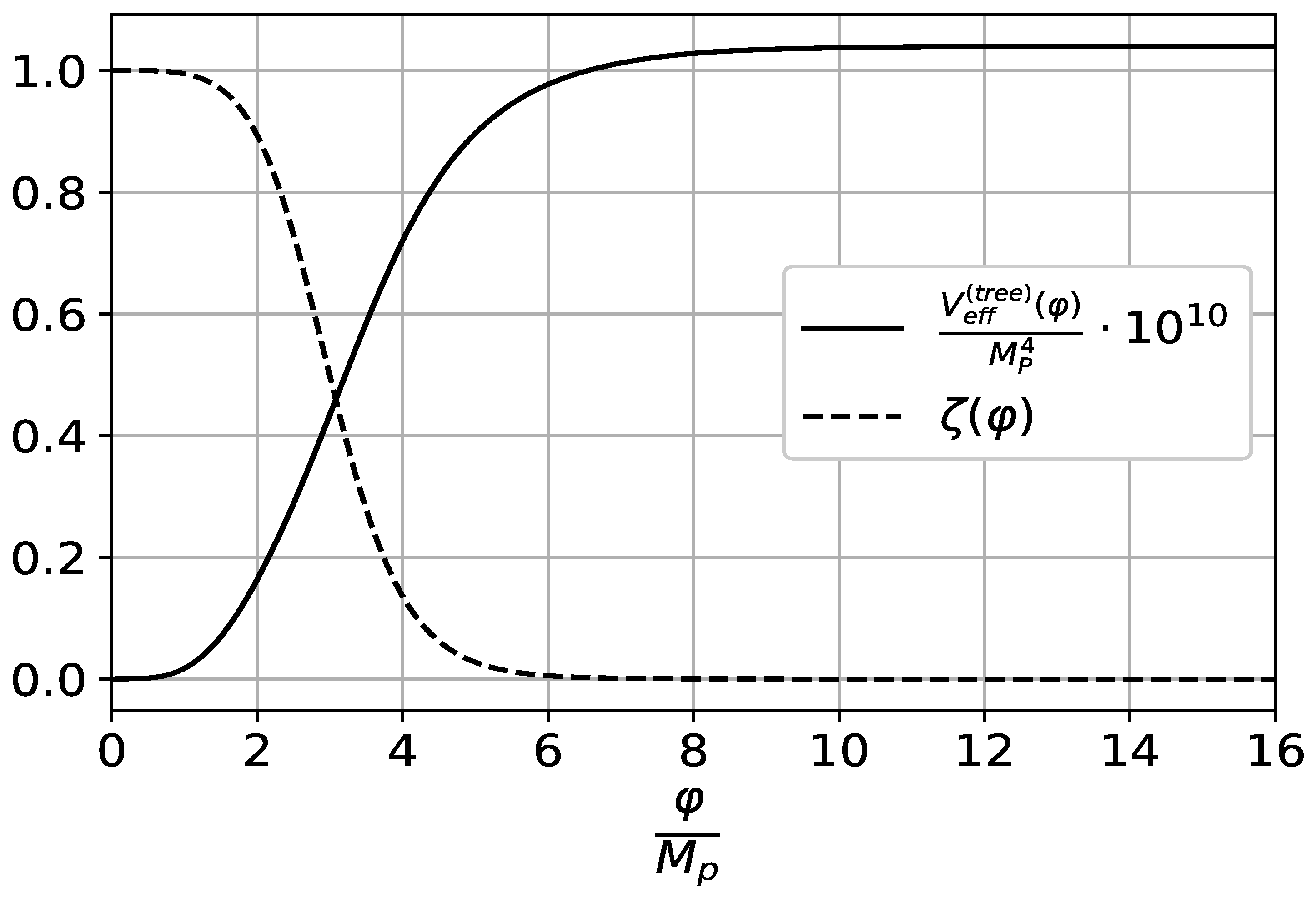
The model parameter b p 0.5 . It turns out that U e f f ( t r e e ) ( φ ) can have one or two plateaus, depending on the value of the model parameter q 4 . In the case of choosing parameters as in Equation (11), U e f f ( t r e e ) ( φ ) has one plateau of height
U e f f ( t r e e ) | p l a t e a u λ 8 ξ 2 M P 4
and its shape is shown in Figure 1. The study of the slow-roll inflation was carried out with the choice of a non-minimal coupling constant to the scalar curvature ξ = 1 6 . The resulting inflation parameters are consistent with Planck’s observational data if λ 8 ξ 2 10 10 , that is, if the parameter λ in the primordial action (7) is of order λ 10 11 . Such a tiny value of the primordial self-coupling constant of the Higgs field obviously contradicts the SM. This problem is well known in Higgs inflation models and is usually solved by choosing a giant value of ξ 10 4 10 8 . In the model of Ref. [28], the key to solving this problem is that in our TMSM the TMT-effective expression for λ near vacuum, λ c f , Equation (35), contains a factor ( b k ζ v ) 1 , which can compensate for the exceptional smallness of λ . It is important that this is achieved by a completely natural selection of the very small deviation of the parameter b k from ζ v = 1 . In Section 6.1, we will show that for comparison with what is known near the vacuum of the GWS theory, the results should be presented in LPPF. Then, to ensure the value of λ S M 0.1 required by the GWS theory, we should choose b k such that b k 1 10 5 . It will also be shown there that m 0.7 GeV , that is m 2 M P 2 8 · 10 38 .

3. Fermions in the Primordial TMSM Action

To include fermions in the TMSM, we start by adding the appropriate fermion-sector terms to the primordial TMT action (3), which describes the gravitational and bosonic sector of the TMSM. This will be performed in accordance with the basic idea of TMT, that is, involving two volume elements g d 4 x and Y d 4 x in the primordial action.

3.1. Leptons

We will study a model, including three generations of leptons.
L l = 1 γ 5 2 ν ( l ) l ; l R = 1 + γ 5 2 l ; ν R ( l ) = 1 + γ 5 2 ν ( l ) ; l = e , μ , τ
To construct a generally coordinate-invariant kinetic term of the action for the fermionic sector, we have to use the covariant operator
μ = D μ + 1 2 ω μ i k σ i k ,
where D μ defined by Equation (8), σ i k = 1 2 ( γ i γ k γ k γ i ) , ω μ i k is the affine spin-connection
ω μ i k = 1 2 V i λ μ V λ k + Γ μ λ β V β k ( i k )
and V k μ is vierbein ( i , k are Lorentz indices).
To obtain the required values of the charged leptons masses arising from SSB in the GWS theory, the Lagrangian must contain Yukawa coupling terms with a spread of more than three orders of magnitude in their Yukawa constants: y e : y μ : y τ = m e : m μ : m τ . Similarly, for the up-quarks, the spread of the corresponding Yukawa constants is five orders of magnitude. This large spread in the Yukawa coupling constants, necessary to obtain the masses of three lepton and three quark generations, is known as the fermion mass hierarchy problem. It turns out that TMSM offers a way to circumvent or at least mitigate this problem. Specifically, to construct a realistic TMSM with three lepton generations, we can assume that the Yukawa coupling constant y ( c h ) in the primordial action is universal for all charged leptons. Then the mass hierarchy problem is solved simply by freely choosing the coefficients in the linear combination of the densities of the volume measures g and Y from which the volume elements are combined. As with the choice of signs in the primordial action of the bosonic sector, Equations (7) and (9), for charged leptons, we choose the volume elements ( b l g Y ) d 4 x for the kinetic terms and ( b l g + Y ) d 4 x for the Yukawa coupling terms in the primordial action. Then, obtaining the known masses of charged leptons with a single universal Yukawa coupling constant in the primordial action is achieved by fitting the b l parameters ( l = e , μ , τ ). It turns out that for this to happen, the deviations of all b l parameters ( l = e , μ , τ ) from unity must be small. Although the result is also achieved by fitting, instead of a spread of several orders of magnitude in the Yukawa constants, it is sufficient to restrict the b l parameters ( l = e , μ , τ ) to very close ones.
To simplify the first attempt to implement the conceived idea, in this paper, we completely ignore neutrino mixing and limit ourselves to considering only the electron neutrino ν e , focusing on explaining the exceptional smallness of the electron neutrino mass. For brevity, we will further omit the subscript e in ν e . For the right isoscalar neutrino ν R , we choose the volume elements ( b e g Y ) d 4 x and ( b ν g + Y ) d 4 x in the primordial action for the kinetic term and for the Yukawa coupling term, respectively. The neutrino Yukawa coupling constant y ν will be chosen differently from the one for the charged leptons: y ν y ( c h ) .
Following these ideas, we adopt the following general coordinate invariant and S U ( 2 ) × U ( 1 ) gauge-invariant primordial TMSM action for the lepton sector
S ( l e p t ) = d 4 x l = e , μ , τ [ ( b l g Y ) i 2 ( L l ¯ γ μ μ L l ( μ L l ¯ ) γ μ L l + l ¯ R γ μ μ l R ( μ l ¯ R ) γ μ l R ) ( b l g + Y ) · y ( c h ) L ¯ l H l R + l ¯ R H L l ] + d 4 x ( b e g Y ) i 2 ν R ¯ γ μ μ ν R ( μ ν R ¯ ) γ μ ν R d 4 x ( b ν g + Y ) · y ν L ¯ e H c ν R + ν R ¯ H c L e ,
where γ μ = V k μ γ k , γ k are Dirac matrices; H c is the charged conjugated to the Higgs isodoublet H.

3.2. Quarks

We will consider three generations of quarks of the electroweak S U ( 2 ) × U ( 1 ) gauge invariant theory, and use the following notations for the left S U ( 2 ) doublets:
L q = 1 γ 5 2 q K q d d + K q s s + K q b b , q = u , c , t
and for the right singlets of the up-quarks u, c, t
r q = 1 + γ 5 2 q , q = u , c , t .
To preserve the general principles of the construction of our TMSM, we must assume that, like leptons, the quarks Yukawa coupling constants in the primordial action must also be universal: one for all up-quarks and perhaps another for all down-quarks (with the corresponding modification caused by the Kobayashi–Maskawa mixing matrix K q d j , q = u , c , t ; j = 1 , 2 , 3 ; d 1 = d , d 2 = s , d 3 = b ). Again, as in the case of leptons, the implementation of such an approach to describing quarks, taking into account quark mixing, would require too many detailed calculations, which could become an obstacle to demonstrating the main issues of the model under study. Therefore, in this paper, we ignore the mass generation of down quarks and concentrate only on some of the specific fundamental issues that distinguish TMSM from SM + Gravity. Namely, the description of the up-quarks and their mass generation in TMSM is one of them. That is why with this approach we will not need to use the right singlets of the down-quarks.
The general coordinate invariant and S U ( 2 ) × U ( 1 ) gauge-invariant primordial TMSM action with the universal Yukawa coupling constant y ( u p ) , which allows one to study the up-quarks, is chosen as follows (see footnote 8 in Appendix D)
S ( q u a r k s ) = d 4 x q = u , c , t [ ( b q g Υ ) i 2 ( L q ¯ γ μ μ L q ( μ L q ¯ ) γ μ L q + r q ¯ γ μ μ r q ( μ r q ¯ ) γ μ r q ) ( b q g + Υ ) · y ( u p ) L q ¯ H c r q + r q ¯ H c L q ] .

4. Higgs + Gravity Sector as a Cosmological Background of the Tree-Level TMSM

4.1. What Is the Cosmological Frame (CF) and What Is the Local Particle Physics Frame (LPPF)? Description of a Background in the CF

The TMSM differs fundamentally from conventional models in the way the Higgs sector of the electroweak SM is used to study cosmology. Returning to the Higgs + Gravity sector of TMSM investigated in Ref. [28] and briefly described in Section 2.2, we argue that Equation (29) together with the Einstein Equation (22) with the TMT effective energy-momentum tensor (25)–(28), or, equivalently, the TMT-effective action (36), (37) are applicable over the entire range of values of ϕ σ allowed by classical cosmology. Thus, TMSM provides us with a unique opportunity to study cosmology in the interval of ϕ from ϕ σ up to ϕ M P , corresponding to the energy scale of inflation, while remaining in the tree approximation of the electroweak SM. The possibility of Higgs inflation with a small non-minimal coupling constant, together with the ability to provide the Higgs field self-coupling constant necessary for the electroweak SM, which was demonstrated in paper [28], shows the effectiveness of this approach. A key role in the ability of TMSM to realize such a cosmological scenario is played by the scalar ζ , determined by the constraint (18), which will now be conveniently used in the following equivalent form:
ζ ( ϕ , X ϕ ) = 2 q 4 ζ v ( 1 + ζ v ) ( 2 b p 1 ) λ ϕ 4 4 M P 4 ( 2 b p + 1 ) m 2 ϕ 2 2 M P 4 + ( 1 + b k ) Ω · X ϕ M P 4 2 q 4 ( 1 + ζ v ) + λ ϕ 4 4 M P 4 m 2 ϕ 2 2 M P 4 ( 1 + b k ) Ω · X ϕ M P 4 .
In the model of the Universe constructed and studied in Ref. [28], we completely ignored the gauge and fermion fields of the electroweak SM, as well as the S U ( 2 ) × U ( 1 ) gauge symmetry. Equally important, in studying cosmological evolution, instead of describing the Higgs isodoublet as a local quantum field that can be represented as
H ( x ) = 1 2 0 ϕ ( x )
in the unitary gauge, we used the cosmological average (14) over the entire space of a spatially flat FLRW Universe, that is
ϕ ( x ) c o s m . a v . = ϕ ( t ) .
We now define the background scalar field ϕ b a c k ( t ) at a certain stage of cosmological evolution as the function ϕ ( t ) that is obtained by solving the cosmological equations corresponding to that stage of evolution
H ( x ) c o s m . a v . | b a c k = 1 2 0 ϕ b a c k ( t ) .
Continuing, as in paper [28], the study of the evolution of the cosmological background considered in the CF, we will be able to further clarify the idea of describing particle physics in the LPPF on a cosmological background. It is evident that the cosmological evolution can be divided into stages, such as inflation in the slow-roll regime, the last stage of inflation, the post-inflationary stage, the stage of approaching the vacuum. Here, it is necessary to explain in more detail the main idea of the CF, which, firstly, allows us to describe each of these stages of cosmological evolution separately, and secondly, allows us to describe the cosmological background formed during these stages. Recall that before finding the TMT effective action (36)–(40) in the final step of the TMT procedure, we used constraint (49) to substitute ζ into the ζ -dependent form of the ϕ field Equation (29) and into the ζ -dependent form of the energy-momentum tensor (23), (24). But if we were to similarly substitute ζ into the equations of all SM fields, we would be dealing with an insoluble system of equations. Instead, it turns out that, with the exception of the short stage immediately after inflation, the entire range of ζ values can be divided into a set of nearly constant values, each of which corresponds to a specific stage of the Universe’s evolution. Due to this, at almost all stages of evolution, the kinetic terms in the equations of all SM fields can be reduced to a canonical form without complicating the equations, and, therefore, the technique of functional quantization can be applied. Based on the above explanation, we can formulate the precise meaning of the terms CF and LPPF. The term CF is used for everything performed with the ϕ field, including finding the value of ζ at each stage of cosmological evolution. This allows us to describe the cosmological background separately at each stage. The study of the SM fields on a cosmological background corresponding to a certain stage is carried out within the LPPF, and the first step in this study consists of redefinitions leading to a canonical form of the kinetic terms of all SM fields. It is obvious that at each of these stages the SM is realized with certain modifications, and for the model thus obtained, we use the term “cosmologically modified copy of SM” at the corresponding stage of evolution.
The description of a background in the CF implies that we use the coordinates ( t , x ) and metric (13), and we know:
(1)
The classical field ϕ b a c k ( t ) , which fills all space, drives the cosmological evolution and satisfies Equation (29);
(2)
The scalar ζ = ζ b a c k defined by Equation (49), where ϕ is replaced by ϕ b a c k ( t ) , and the corresponding replacement is made for X ϕ ;
(3)
The Ricci tensor and scalar curvature obtained from the Einstein Equation (22) using the TMT-effective energy-momentum tensor, Equations (25)–(28). In particular, the scalar curvature R ( g ˜ ) is defined by Equation (30).
In this paper, we will limit ourselves to only studying how the electroweak TMSM is realized at two background stages: at the stage of approaching a vacuum and at the stage of inflation in the slow-roll regime. But before we do this, we will need a more detailed study of the relevant background stages.

4.2. Some Features of the Evolution of the Cosmological Background

As explained above, at each stage of evolution, we need to know the values of ζ , which are determined using constraint (49). When ϕ is only a few orders of magnitude larger than σ , the contribution of terms X ϕ M P 4 to the value of ζ can obviously be neglected. In Appendix A, it is shown that during inflation in the slow-roll regime, the contribution of the terms X ϕ M P 4 to the constraint is negligible. But immediately after the end of inflation, that, according to the results of Ref. [28], occurs at φ 2 M P (that corresponds to ϕ 2.2 M P ), the contribution of the terms X ϕ M P 4 to the constraint can be significant. In this paper, we focus on studying the new effects that TMSM predicts for the inflationary era and for the stage of approaching the energy scale of the electroweak SM. Therefore, leaving for future study the predictions of TMSM for the stage immediately after the end of inflation, we can consider the contribution of the terms X ϕ M P 4 to the constraint (49) to be subdominant or negligible. In this context, the monotonic dependence of ζ on ϕ under the condition X ϕ = 0 , shown in Figure 1 (using φ instead of ϕ ) is correct in the regions ϕ M P and ϕ M P , and ζ changes from ζ 0 for ϕ M P to ζ ζ v = 1 for ϕ M P .
(1) The graph of ζ ( φ ) in Figure 1 does not provide sufficient information about the behavior of ζ ( ϕ ) after inflation. As shown in Ref. [28], for ϕ 0.1 M P , constraint (49) reduces to the form
ζ | ϕ 0.1 M P 2 q 4 ζ v ( 1 + ζ v ) 2 q 4 ( 1 + ζ v ) + λ 4 ϕ 4 M P 4 1 4.8 · 10 3 ϕ 4 M P 4 ,
Therefore, neglecting relative corrections of the order 5 · 10 7 , one can use the value of ζ in the vacuum, ζ v = 1 , as the background scalar ζ b a c k during cosmological evolution when | ϕ | 0.1 M P . Unexpectedly small deviation of ζ from its value in vacuum already at ϕ 0.1 M P leads to a remarkable result. After the end of inflation, but long before reaching the vacuum state, the TMT-effective self-coupling parameter of the Higgs field ϕ runs from the model parameter λ = 2.3 · 10 11 to a value practically coinciding with the self-coupling constant of the Higgs field in the GWS theory. A similar effect occurs with the TMT-effective gauge and Yukawa coupling parameters. Moreover, the oscillatory solutions for ϕ ( t ) and the preheating of fermions as one of the channels in a preliminary study of the preheating were also obtained in Ref. [28].
(2) The cosmological background formed during the stage of slow-roll inflation was studied in detail in Ref. [28]. In addition to what was performed there, as part of the description in the CF, in the next section, we will also need to know both the expression for the scalar curvature R ( g ˜ ) and the behavior of ζ ( ϕ ) during slow-roll inflation. For the chosen model parameters, the latter occurs at ϕ 14.2 M P , which corresponds to φ 6 M P , where the kinetic terms in the TMT effective energy-momentum tensor, Equation (25), are negligible with respect to the TMT effective potential U e f f ( t r e e ) ( ϕ ) , Equation (26), which, in turn, is almost flat. Thus, at the stage of slow-roll inflation, the expressions for the Ricci tensor and the scalar curvature in the Einstein frame are reduced to
R μ ν g ˜ | ϕ > 14.2 M P g ˜ μ ν 1 M P 2 U e f f ( t r e e ) ( ϕ ) , R g ˜ | ϕ > 14.2 M P 4 M P 2 U e f f ( t r e e ) ( ϕ ) ,
where U e f f ( t r e e ) ( ϕ ) given by Equation (26), up to relative corrections of the order ≲ 3 · 10 2 , is equal to a constant (see also Equations (39) and (41))
U e f f ( t r e e ) ( ϕ ) | ϕ > 14.2 M P λ M P 4 8 ξ 2 .
Therefore, we obtain
R ( g ˜ ) | ϕ > 14.2 M P λ 2 ξ 2 M P 2 = 18 λ M P 2 ,
where ξ = 1 6 was used. In the Appendix A, we analytically found an upper bound for the function ζ ( φ ) ; representing it also through ϕ , we obtain
0 < ζ 32 q 4 λ / 8 ξ 2 · e 8 3 φ M P 209 · M P ϕ 4 5 · 10 3 .
Thus, during slow-roll inflation, a monotonic increase in ζ can begin from a value arbitrarily close to zero; a monotonic decrease in ϕ ( t ) to ϕ 14.2 M P is accompanied by a monotonic increase in ζ , limited from above by the value ζ 5 · 10 3 .
(3) An increase in ζ from ζ 0 to ζ = 1 inevitably leads to a change in the sign of the mass term ( b p ζ ) m 2 ϕ in the ϕ -equation (29). This new TMSM effect enables spontaneous symmetry breaking (SSB) near the vacuum, providing an answer to the mystery of the origin of the negative mass term in the Higgs potential. It would be interesting to know at what stage in the evolution of the cosmological background this effect occurs. According to the iilustrative curve ζ ( φ ) in Figure 1, this can be at φ 3 M P .

5. Towards a Cosmologically Modified Copy of the SM in the LPPF on an Arbitrary Cosmological Background

To implement TMSM, which includes all SM fields, it seems logical to treat the model constructed in the CF as a background on which all SM fields are considered locally: in a certain interval of cosmic time Δ t (such as, for example, the duration of one of the listed above stages of cosmological evolution) and in an arbitrarily large region of space. Using general coordinate invariance, the theory of the electroweak SM fields in this four-dimensional spacetime can be described in arbitrary local coordinates ( x ) . In what follows, we will use the notation V 4 for this four-dimensional space-time (see footnote 9 in Appendix D).

5.1. Specificity of the Description in the LPPF on a Cosmological Background

In accordance with the general principles of TMT, to obtain the physical results of the model, we must start from the primordial action, which is the sum of the actions described by Equations (6), (7), (9), (45), (48)
S p r i m o r d i a l ( p a r t i c l e s ) = S H + S g + S ( l e p t ) + S ( q u a r k s ) ,
and follow all the procedures. When starting to study physics in the LPPF on a cosmological background, we must take into account the following fundamental differences from the general principles of TMT:
(1)
Integration in the primordial action S p r i m o r d i a l ( p a r t i c l e s ) must be performed over the spacetime V 4 using the coordinates ( x ) (see Section 4.1).
(2)
In all terms of the Lagrangian density in the action (58), the background value of ζ = ζ b a c k should be substituted for the ratio Y / g ; this means that variation with respect to functions φ a is excluded from the TMT procedure.
(3)
By limiting ourselves to studying the model of electroweak interaction on the cosmological background, we will neglect the possible back reaction of local gravitational effects on background gravity. Therefore, the variation of the metric is also excluded from the TMT procedure. Since both the metric and the functions φ a do not vary, the vacuum terms in (10) do not participate in the principle of least action.
(4)
According to the Palatini formulation, the variation with respect to the affine connection has already been performed, and by the Weyl transformation (15) of the metric to the Einstein frame, the background Ricci tensor and scalar curvature have been obtained. Therefore, when starting to study the model of electroweak interaction on a cosmological background, the primordial action (58) should be represented in the Einstein frame.
(5)
Based on the definition described by Equation (52), in what follows we will use the notation ϕ b a c k ( t ) or simply ϕ b a c k for the background field to avoid confusion with the real part ϕ ( x ) of the neutral component of the Higgs isodoublet H ( x ) in the arbitrary gauge considered in V 4 . The Higgs isodoublet H ( x ) and all other matter fields are considered as local fields in V 4 , which are dynamical variables independent of the background field ϕ b a c k .
(6)
Bearing in mind that the procedure of functional quantization will be applied to the obtained classical theory, it is necessary to redefine all matter fields so as to absorb factors of type ( b i ± ζ ) in front of the kinetic terms in the Lagrangian densities and thus bring the kinetic terms to a canonical form.
(7)
As already mentioned above, we will study the description of TMSM in the LPPF only at two background stages: at the stage of approaching the vacuum and at the stage of the slow-roll inflation.
Considering the far from simple structure of TMSM, it seems appropriate to note the following. The primordial action S p r i m o r d i a l , defined as the sum of the actions (3), (45), (48), is the starting point for describing the SM extension within the TMT framework. In this action: (a) all degrees of freedom are independent of each other; (b) the energy scale at which this action is applied is not determined a priori; (c) nothing is known a priori about in which frame, CF or LPPF, these degrees of freedom are described. Working in the CF and performing the TMT procedure, we obtain a classical description of the evolution of the Universe from the inflationary stage to the transition to a vacuum. To describe particle physics on a specific cosmological background, we use a different approach, which begins by representing the same action S p r i m o r d i a l in the LPPF on this background by performing the operations listed above.

5.2. The SM Bosonic Sector in the LPPF on a Cosmological Background

Applying the above remarks to the primordial action S H + S g , Equations (7) and (9), we use a description of two stages of the cosmological background characterized by
ϕ b a c k = ( ) σ at the stage near the vacuum , ϕ b ( t ) which is a solution of cos mological equations at slow - roll inflation ,
and, therefore,
Ω b a c k = 1 at the stage near the vacuum , Ω b = 1 + ξ ϕ b 2 / M P 2 at the stage of slow - roll inflation ,
ζ b a c k = 1 at the stage near the vacuum , 0 at the stage of slow - roll inflation ( neglecting correction of the order 5 · 10 3 ) ,
R b a c k = 0 at the stage near the vacuum , R b = λ 2 ξ 2 M P 2 at the stage of slow - roll inflation ,
where the value of R b follows from Equation (56).
Thus, we arrive at the following action of the SM bosonic sector described in the LPPF on a cosmological background
S ( o n b a c k ) ( b o s L P P F ) = L ( o n b a c k ) ( b o s L P P F ) g ˜ d 4 x ,
where the integration is performed over the space-time V 4 and the Lagrangian has the form
L ( o n b a c k ) ( b o s L P P F ) = b k ζ b a c k ( 1 + ζ b a c k ) Ω b a c k g ˜ α β D α H D β H b p + ζ b a c k ( 1 + ζ b a c k ) 2 Ω b a c k 2 λ | H | 4 b p ζ b a c k ( 1 + ζ b a c k ) 2 Ω b a c k 2 m 2 | H | 2 ξ Ω b a c k R b a c k | H | 2 ( b k ζ b a c k ) 1 4 g ˜ μ α g ˜ ν β F μ ν F α β + B μ ν B α β .
Here
D μ = x μ i g T ^ A μ i g 2 Y ^ B μ ,
F μ ν = A ν x μ A μ x ν + g A μ × A ν , B μ ν = B ν x μ B μ x ν .

5.3. The SM Fermionic Sector in the LPPF on a Cosmological Background

Now we need to move on to the action of the TMSM fermion sector in the LPPF on a cosmological background, for the description of which we use the quantities listed in Section 5.2. Applying the analysis given in items (1)–(7) in Section 5.1 to the primordial action S ( l e p t ) + S ( q u a r k s ) , Equations (45) and (48), it is necessary to take into account that in the procedure for finding the background in the CF, we used the Palatini formalism with the subsequent Weyl transformation (15) of the metric to the Einstein frame. In this case, the affine connection Γ μ ν λ is also transformed into the Christoffel connection { μ ν λ } of metric g ˜ μ ν , which must be taken into account in the definition of the spin-connection by replacing Γ μ ν λ { μ ν λ } . And since the transformation of the metric entails the vierbein transformation V k μ = ( 1 + ζ b ) Ω b V ˜ k μ , when moving to the description of fermions in the LPPF, the following transformation of the spin connection takes place:
ω μ i k = 1 2 V i λ μ V λ k + Γ μ λ β V β k ( i k ) ω ˜ μ i k = 1 2 V ˜ i λ V ˜ λ k x μ + { μ λ β } V ˜ β k ( i k ) .
Therefore, the operator μ , Equation (43), transforms to the operator
˜ μ = x μ i g T ^ A μ i g 2 Y ^ B μ + 1 2 ω ˜ μ i k σ i k ,
which acts in the space-time V 4 . Then, we arrive at the following action of the SM fermionic sector, described in the LPPF on a cosmological background
S ( o n b a c k ) ( f e r m L P P F ) = L ( o n b a c k ) ( f e r m L P P F ) g ˜ d 4 x ,
L ( o n b a c k ) ( f e r m L P P F ) = L ( o n b a c k ) ( l e p t L P P F ) + L ( o n b a c k ) ( q u a r k s L P P F )
with the following Lagrangians for leptons and up-quarks (see footnote 10 in Appendix D)
L ( o n b a c k ) ( l e p t L P P F ) = l = e , μ , τ b l ζ b a c k ( 1 + ζ b a c k ) Ω b a c k 3 / 2 · i 2 L l ¯ γ ˜ μ ˜ μ L l ( ˜ μ L l ¯ ) γ ˜ μ L l + l R ¯ γ ˜ μ ˜ μ l R ( ˜ μ l R ¯ ) γ ˜ μ l R l = e , μ , τ b l + ζ b a c k ( 1 + ζ b a c k ) 2 Ω b a c k 2 · y ( c h ) L l ¯ H l R + l R ¯ H L l + b e ζ b a c k ( 1 + ζ b a c k ) Ω b a c k 3 / 2 · i 2 ν R ¯ γ ˜ μ ˜ μ ν R ( ˜ μ ν R ¯ ) γ ˜ μ ν R b ν + ζ b a c k ( 1 + ζ b a c k ) 2 Ω b a c k 2 · y ν L e ¯ H c ν R + ν R ¯ H c L e ,
L ( o n b a c k ) ( q u a r k s L P P F ) = q = u , c , t [ b q ζ b a c k ( 1 + ζ b a c k ) Ω b a c k 3 / 2 · i 2 ( L q ¯ γ ˜ μ ˜ μ L q ( ˜ μ L q ¯ ) γ ˜ μ L q + + r q ¯ γ ˜ μ ˜ μ r q ( ˜ μ r q ¯ ) γ ˜ μ r q ) b q + ζ b a c k ( 1 + ζ b a c k ) 2 Ω b a c k 2 · y ( u p ) L q ¯ H c r q + r q ¯ H c L q ] .

5.4. Concluding Remarks

The sum of the actions S ( o n b a c k ) ( b o s L P P F ) + S ( o n b a c k ) ( f e r m L P P F ) presented in Section 5.2 and Section 5.3 describes the SM fields in the LPPF on an arbitrary cosmological background. Following the concept of cosmological realization of TMSM, the Lagrangian L ( o n b a c k ) ( b o s L P P F ) + L ( o n b a c k ) ( f e r m L P P F ) should be reduced to the canonical form of the electroweak model, which will make it possible to apply the functional quantization method. This is achieved by appropriate, depending on the background stage, redefinitions of fields and model parameters. In the general case, i.e., with an arbitrary cosmological background, this task is difficult to accomplish, since it requires rather cumbersome numerical solutions. In the next two sections, we will see that for two important cosmological backgrounds, these difficulties can be avoided analytically. Namely, we will study the TMSM in the LPPF at two opposite stages of the evolution of the cosmological background: (a) near the vacuum; (b) at the stage of slow-roll inflation. For this, we will use the results collected in Equations (59)–(62).

6. The GWS Theory as the Implementation of the TMSM in the LPPF on the Cosmological Background near Vacuum

In Section 2.2, where we reviewed the main results of paper [28], a vacuum with zero cosmological constant was described in the CF. Near this vacuum, using results collected in Section 5.2, one can take with extraordinary accuracy ζ b a c k = 1 , Ω b a c k = 1 and the action S ( L P P o n b a c k ) ( b o s ) + S ( L P P o n b a c k ) ( f e r m ) can be represented in Minkowski space by replacing g ˜ α β with η α β . One can also replace γ ˜ μ with γ μ and ˜ μ with D μ .

6.1. The SM Bosonic Sector in the LPPF on the Cosmological Background near Vacuum

Near the vacuum, the Lagrangian L ( o n b a c k ) ( b o s L P P F ) reduces to the following:
L ( o n b a c k n e a r v a c ) ( b o s L P P F ) = 1 2 ( b k 1 ) η α β D α H D β H 1 + b p 4 λ | H | 4 + 1 b p 4 m 2 | H | 2 ] 1 4 ( b k 1 ) η μ α η ν β F μ ν F α β + B μ ν B α β .
To bring the Lagrangian to the canonical form of the electroweak GWS theory, we make the following redefinitions:
the Higgs isodoublet
b k 1 2 · H = H
and the corresponding parameters
λ S M = 1 + b p ( b k 1 ) 2 λ , m S M 2 = 1 b p 2 ( b k 1 ) m 2 ;
the gauge fields and gauge coupling constants
b k 1 · A μ = A μ , b k 1 · B μ = B μ , g b k 1 = g , g b k 1 = g
and, correspondently,
b k 1 · F μ ν = F μ ν = A ν x μ A μ x ν + g A μ × A ν , b k 1 · B μ ν = B μ ν = B ν x μ B μ x ν ,
D μ D μ = x μ i g T ^ A μ i g 2 Y ^ B μ .
As a result, the Lagrangian L ( n e a r v a c ) ( b o s L P P F ) takes the form of the Lagrangian of the bosonic sector of the GWS theory
L ( b o s L P P F ) | ( o n b a c k n e a r v a c ) = η α β D α H D β H V ( H ) 1 4 η μ α η ν β F μ ν F α β + B μ ν B α β ,
V ( H ) = λ S M | H | 4 m S M 2 | H | 2 .
With our choice of b p 0.5 , which was dictated by the requirements of the inflationary regime, the mass term in the potential V ( H ) of the Higgs field H has the “wrong” sign. Thus, we have the standard picture of SSB S U ( 2 ) × U ( 1 ) U ( 1 ) as the H develops VEV
0 | H | 0 = 0 1 2 v
with
v 2 = m S M 2 λ S M = 1 b p 1 + b p · ( b k 1 ) m 2 2 λ = ( b k 1 ) m 2 6 λ .
After performing the gauge transformation, we can move on to the unitary gauge, where the Higgs isodouplet is represented, as usual, in the form
H = 0 1 2 ( v + h ( x ) ) , 0 | h | 0 = 0 .
Then the potential (80) reduces to the standard potential of the Higgs boson h
V ( h ) = 1 4 λ S M 2 v h + h 2 2 1 4 λ S M v 4 .
Therefore, the expression for the mass squared of the Higgs boson is as follows:
m h 2 = 2 λ S M v 2 = m 2 2 ( b k 1 ) .
Recall that agreement with the observed CMB data when choosing ξ = 1 6 (as was performed in [28]) requires that the primordial Higgs self-interaction parameter be λ = 2.3 · 10 11 . On the other hand, in [28], it was shown that this value of λ can be consistent with the electroweak SM considered near the vacuum if the parameter b k is very close to unity. But we have not yet been able to find the value of b k 1 . Now, working in LPPF, combining Equations (82) and (85), we obtain the relation
( b k 1 ) 2 = 3 λ v 2 m h 2 .
Substituting the values of v 246 GeV and m h 125 GeV known from particle physics, and the value of λ 2.3 · 10 11 we obtain
b k 1 1.6 · 10 5 .
From Equations (85) and (87) we obtain the estimate
m 0.7 GeV .
Note that, based on this estimate, at some stages of cosmological evolution we can neglect the terms m 2 M P 2 8 · 10 38 in the constraint (49).
As usual in the electroweak SM, we define
W μ ± = 1 2 ( A μ 1 i A μ 2 ) , Z μ = sin θ W B μ cos θ W A μ 3 , A μ = cos θ W B μ + sin θ W A μ 3 ,
where the Weinberg angle θ W is given by
tan θ W = g g = g g .
For the masses generated by the Higgs phenomenon of W and Z-bosons, the Lagrangian (79) gives the standard expressions
M W = g 2 · v , M Z = g 2 + g 2 2 · v , as well as M A = 0 for photon .
Agreement with the experimental data obtained, as usual in the GWS theory, using the effective four-fermion Lagrangian (see footnote 11 in Appendix D) is achieved with the standard VEV v 246 G e V . As usual in the electroweak SM, there are relations between g , g , the Weinberg angle θ W , and the electric charge e = 4 π α
e = g sin θ W , e = g cos θ W ,
from which, using the redefinitions of the gauge coupling constants in Equation (76) and the value of ( b k 1 ) obtained above, Equation (87), we find the values of the primordial model parameters g and g in the primordial action (7)–(9)
g 2.6 · 10 3 , g 1.4 · 10 3 .

6.2. The TMSM Fermionic Sector in the LPPF on the Cosmological Background near Vacuum

In addition to what was described at the very beginning of Section 6, near vacuum, one can substitute ( b l ± ζ b ) = ( b l ± 1 ) , ( b ν + ζ b ) = ( b ν + 1 ) , ( b q ± ζ b ) = ( b q ± 1 ) . Thus, near vacuum, the action for fermions in the LPPF, Equations (69)–(72), takes the form
S ( o n b a c k n e a r v a c ) ( f e r m L P P F ) = L ( o n b a c k n e a r v a c ) ( l e p t L P P F ) + L ( o n b a c k n e a r v a c ) ( q u a r k s L P P F ) d 4 x ,
with the following Lagrangians for leptons and up-quarks
L ( o n b a c k n e a r v a c ) ( l e p t L P P F ) = l = e , μ , τ b l 1 2 3 / 2 · i 2 L l ¯ γ μ D μ L l D μ L l ¯ ) γ μ L l + l R ¯ γ μ D μ l R ( D μ l R ¯ ) γ μ l R l = e , μ , τ b l + 1 4 · y ( c h ) L l ¯ H l R + l R ¯ H L l + b e 1 2 3 / 2 · i 2 ν R ¯ γ μ μ ν R ( μ ν R ¯ ) γ μ ν R b ν + 1 4 · y ν L e ¯ H c ν R + ν R ¯ H c L e ,
L ( o n b a c k n e a r v a c ) ( q u a r k s L P P F ) = q = u , c , t [ b q 1 2 3 / 2 · i 2 ( L q ¯ γ μ D μ L q ( D μ L q ¯ ) γ μ L q + + r q ¯ γ μ r q x μ r q ¯ x μ γ μ r q ) b q + 1 4 · y ( u p ) L q ¯ H c r q + r q ¯ H c L q ] .

6.2.1. Leptons

Using the results of the bosonic sector study in Section 6.1, we introduce redefinitions of the Higgs doublet, Equation (74), gauge bosons and gauge coupling constants, Equation (76), together with a redefinition of the covariant derivative, Equation (78). These manipulations must be supplemented with the following redefinitions of the lepton fields and the Yukawa coupling constants:
b l 1 2 3 / 4 L l = L l , b l 1 2 3 / 4 l R = l R , l = e , μ , τ ; b e 1 2 3 / 4 · ν R = ν R
Y S M ( l ) = b l + 1 ( b l 1 ) b k 1 y ( c h ) , l = e , μ , τ ; Y S M ( ν ) = b ν + 1 ( b e 1 ) b k 1 y ν .
Then the Lagrangian L ( o n b a c k n e a r v a c ) ( l e p t L P P F ) , Equation (95), reduces to the Lagrangian for leptons in the GWS model:
L ( l e p t L P P F ) | ( o n b a c k n e a r v a c ) = l = e , μ , τ [ i 2 L l ¯ γ μ D μ L l ( D μ L l ¯ ) γ μ L l + l R ¯ γ μ D μ l R ( D μ l R ¯ ) γ μ l R Y S M ( l ) L l ¯ H l R + l R ¯ H L l ] + i 2 ν R ¯ γ μ ν R x μ ν R ¯ x μ γ μ ν R Y S M ( ν ) L e ¯ H c ν R + ν R ¯ H c L e .

6.2.2. Quarks

Repeating the manipulations performed for leptons in Section 6.2.1 one can see that the redefinitions to the LPPF in the bosonic sector (74), (76), (78) should be supplemented by the following redefinitions:
b q 1 2 3 / 4 L q = L q , b q 1 2 3 / 4 r q = r q ,
Y S M ( q ) = b q + 1 ( b q 1 ) b k 1 y ( u p ) , q = u , c , t .
Then the Lagrangian L ( o n b a c k n e a r v a c ) ( q u a r k s L P P F ) , Equation (96), reduces to the Lagrangian for up-quarks in the GWS model
L ( q u a r k s L P P F ) | ( o n b a c k n e a r v a c ) = q = u , c , t [ i 2 L q ¯ γ μ D μ L q ( D μ L q ¯ ) γ μ L q + r q ¯ γ μ D μ r q ( D μ r q ¯ ) γ μ r q Y S M ( q ) L q ¯ H c r q + r q ¯ H c L q ]

6.2.3. Fermion Masses with the Universal Primordial Yukawa Constants

Production of fermion masses by the SSB of the gauge symmetry S U ( 2 ) × U ( 1 ) U ( 1 ) at the last stage of cosmological evolution has the same mechanism as in the tree-level GWS theory. But instead of mass values obtained with specially tuned Yukawa constants as model parameters in the original action, in our TMSM, we start from the primordial action with the universal Yukawa coupling constant y ( c h ) for charged leptons and the universal Yukawa coupling constant y ( u p ) for up-quarks. As usual in the SM, from Equations (99) and (102) we obtain expressions for the fermion masses, which, using notations (98) and (101), are represented as follows:
m l = Y S M ( l ) v 2 = b l + 1 ( b l 1 ) b k 1 y ( c h ) v 2 ; l = e , μ , τ , b l = b e , b μ , b τ ,
m ν = Y S M ( ν ) v 2 = b ν + 1 ( b e 1 ) b k 1 y ν v 2 ,
m q = Y S M ( q ) v 2 = b q + 1 ( b q 1 ) b k 1 y ( u p ) v 2 ; q = u , c , t ; b q = b u , b c , b t .
Tuning the fermion masses is carried out by choosing the appropriate values of the model parameters b l , b ν , b q , which appear due to two volume measures in the primordial action—a fundamental feature of TMT.
  • Masses of charged leptons and electron neutrino
    For charged leptons we choose the universal Yukawa coupling constant
    y ( c h ) 10 10 .
    Substituting the values of the masses of charged leptons [34] and v 246 GeV into Equation (103), we obtain the following values of the corresponding parameters
    b e 1 + 1.7 · 10 2 ; b μ 1 + 0.8 · 10 4 ; b τ 1 + 4.9 · 10 6 .
    For the electron neutrino (Dirac, active), taking m ν 1 eV and choosing
    b ν = 1 + δ ν , δ ν 1
    we obtain y ν 2 · 10 16 .
  • Masses of up-quarks
    For up-quarks, we choose the universal Yukawa coupling constant (see footnote 12 in Appendix D)
    y ( u p ) 10 9 .
    Substituting the values of the masses of up-quarks [34] and v 246 GeV into Equation (105), we obtain the following values of the corresponding parameters
    b u 1 + 3.7 · 10 2 ; b c 1 + 6.7 · 10 5 ; b t 1 + 5 · 10 7 .
Thus, instead of incorporating Yukawa coupling constants with a spread of several orders of magnitude into the GWS theory, the proposed model realizes the observed fermion mass hierarchy using a set of parameters b i very close to unity. In this regard, it is also worth paying attention to the fact that in the above calculations, the proximity of the value of another model parameter to 1, namely b k 1 + 1.6 · 10 5 (see Equation (87)), significantly affects the results obtained. To better understand the complexity of the structure (cosmology+particle physics) of the TMSM, it is important to remember that this value of b k was obtained in Section 6.1 by matching the constraints imposed by the CMB data on the parameters of the inflation model, on the one hand, with experimental data from particle physics at accelerator energies, on the other hand.
The necessity of choosing the dimensionless parameters b k , b l , l = e , μ , τ , and b q , q = u , c , t very close to unity is of particular interest from the point of view of the theoretical justification of the TMSM. Namely, it would be attractive to explain the closeness of all these parameters to ζ v = 1 by the existence of a more fundamental theory with a symmetry between g and Y . However, as long as a theory with such a symmetry and with the mechanism of its violation remains completely unknown, one has to treat the choice of these parameters simply as an adjustment to achieve agreement with the measured quantities.
But looking ahead, it is important to recall that, to achieve the required fermion masses, in addition to this adjustment of the b l and b q parameters, the Yukawa coupling parameters y ( c h ) and y ( u p ) were chosen to be universal and very small. As will be shown in Section 7, due to the smallness of y ( c h ) and y ( u p ) , the contribution of fermions to the effective potential in the one-loop approximation is negligible compared to the contribution of bosons.

7. Cosmologically Modified Copy of the Tree-Level SM in the LPPF on the Cosmological Background at the Stage of the Slow-Roll Inflation (Up-Copy)

The stage of inflation in the slow-roll regime is realized as ϕ 14.2 M P (which corresponds to φ 6 M P ). We will study the SM in the LPPF on the cosmological background at this stage, neglecting relative corrections of the order of 3 · 10 2 . There are two reasons for these errors in our use of the Lagrangian (64) and (70)–(72)). The first reason for this error is the neglect of ζ b in the combinations ( 1 + ζ b ) , ( b k ζ b ) and ( b p ± ζ b ) , based on the result ζ b 5 · 10 3 obtained in Appendix A and presented in Section 4.2 in item (2) (see footnote 13 in Appendix D). For the case of fermions, the corresponding approximations made using Equations (70)–(72) will be discussed in Section 7.2. The second source of error is the use of the approximation Ω b 1 M P 2 ξ ϕ b 2 , and the relative value of this error is limited from above by ≲ 3 · 10 2 at ϕ 14.2 M P . In addition, we have to use that b p 1 / 2 + 10 8 1 / 2 and b k 1 + 1.6 · 10 5 1 . The choice of the model parameters b p and b k was made in Ref. [28] and in Section 6.1 of this paper, and was based on the need to provide the desired properties of inflation and for matching the CMB data with the physics at accelerator energy scales. Now we will see that this choice is also very important in the tree-level particle physics at the stage of inflation in the slow-roll regime.

7.1. Bosonic Sector

Operating with the described precision, we reduce the Lagrangian (64) to the following form:
L ( o n b a c k ϕ b > 14 M P ) ( b o s L P P F ) = M P 2 ξ ϕ b 2 g ˜ α β D α H D β H M P 4 2 ξ 2 ϕ b 4 λ | H | 4 M P 2 2 ξ ϕ b 2 m 2 | H | 2 M P 2 ϕ b 2 R b | H | 2 1 4 g ˜ μ α g ˜ ν β F μ ν F α β + B μ ν B α β ,
where the background scalar curvature R b = λ 2 ξ 2 M P 2 ; see Equations (56) and (62).
According to what was explained in Section 5.4, we would like to first redefine the Higgs field to bring the kinetic term to the canonical form. For this, we use the redefinition (see footnote 14 in Appendix D)
H ˜ ( x ) = M P ξ ϕ b ( t ) H ( x ) ,
First of all, note that
M P 2 ξ ϕ b 2 g ˜ i j H x i H x j = g ˜ i j H ˜ x i H ˜ x j .
Assuming a choice of coordinates where g ˜ 0 i = 0 ( i = 1 , 2 , 3 ), we are left to analyze how the redefinition (112) affects the time derivative, which reads
M P ξ ϕ b H ˙ = H ˜ ˙ + H ˜ ϕ b ˙ ϕ b .
Recall that ϕ b ˙ < 0 . It is convenient to use the redefined operator
D μ D ˜ μ = D ˜ k = D k = x k i g T ^ A k i g 2 Y ^ B k , k = 1 , 2 , 3 D ˜ 0 = D 0 + ϕ b ˙ ϕ b = t + ϕ b ˙ ϕ b i g T ^ A 0 i g 2 Y ^ B 0 , μ = 0 .
With the redefinitions (112) and (115), the Lagrangian (111) take the following form:
L ( s l o w r o l l i n f l ) ( b o s L P P F ) = g ˜ α β D ˜ α H ˜ D ˜ β H ˜ V ( H ˜ ) 1 4 g ˜ μ α g ˜ ν β F μ ν F α β + B μ ν B α β .
V ( H ˜ ) = 1 2 λ | H ˜ | 4 + 1 2 m 2 | H ˜ | 2 + ξ R b | H ˜ | 2 .
It is clear that the appearance of ϕ b ˙ / ϕ b in D ˜ 0 shows the possibility of a direct effect of cosmological evolution on the physics described in the LPPF. However, first of all, it is obvious that this does not violate gauge invariance. Moreover, since the background is in a slow-roll inflation stage, it is natural to assume that the background field ϕ b is a slow dynamical variable compared to H ˜ , which is subject to quantization at Planck scales and can therefore be considered as a fast variable. In such a picture, the following strong inequality must hold (see footnote 15 in Appendix D):
ϕ b ˙ 2 ϕ b 2 | H ˜ ˙ | 2 | H ˜ | 2 ,
Using the estimate m 2 M P 2 8 · 10 38 , obtained in Section 6.1, we see that the second term in V ( H ˜ ) is negligible compared to the last term. The potential V ( H ˜ ) has a minimum at
| H ˜ 0 | 2 = 1 2 v ˜ 2 = ξ λ R b = 1 2 ξ M P 2
with
v ˜ = 1 ξ M P = 6 M P
if ξ = 1 6 . This means that, up to relative corrections of order ≲ 3 · 10 2 , during the entire slow-roll inflation stage, the potential V ( H ˜ ) of the Higgs field H ˜ ( x ) in the LPPF has a minimum independent of the slowly rolling background field ϕ b . However, this minimum cannot be regarded as a stationary vacuum state, since the presence of ϕ b ˙ / ϕ b in D ˜ 0 makes it, strictly speaking, impossible for the kinetic term g ˜ α β D ˜ α H ˜ D ˜ β H ˜ to remain exactly zero during slow-roll inflation. The slow change of ϕ b ( t ) apparently allows one to describe this interesting physical effect as adiabatic. However, in this paper, we will limit ourselves to merely stating this phenomenon, leaving its study for the future. Therefore, taking into account inequality (118), we will neglect the contribution of ϕ b ˙ / ϕ b to D ˜ 0 and continue our study in this approximation.
Obviously, the Lagrangian (116) is S U ( 2 ) × U ( 1 ) gauge invariant (see footnote 16 in Appendix D). Therefore, quite analogous to how it is perforemd in the GWS theory, one can go to the unitary gauge, where the Higgs isodoublet H ˜ reduces to
H ˜ = 1 2 0 v ˜ + h ˜ ( x ) .
In accordance with this, we can define a new vacuum state | 0 ˜ for which SSB has the form
0 | ˜ H ˜ | 0 ˜ = 1 2 0 v ˜ ,
where 0 | ˜ h ˜ | 0 ˜ = 0 . To distinguish these SSB and vacuum from the SSB and vacuum in the GWS theory, we will use the terms “up-SSB”, “up-vacuum” and “up-VEV” for v ˜ . Similarly, to denote the difference from the Higgs boson h in the GWS theory, for the h ˜ boson we will use the term “up-Higgs boson”. The potential of the up-Higgs boson h ˜ near the up-vacuum reduces to the form
V ( h ˜ ) = λ 8 2 v ˜ h ˜ + h ˜ 2 2 λ 8 ξ 2 M P 4 ,
from where it follows the expression for the mass squared of the up-Higgs boson h ˜
m h ˜ 2 = λ v ˜ 2 = 6 λ M P 2 .
Therefore, we find that m h ˜ 2.9 · 10 13 GeV .
The properties of gauge bosons studied in the LPPF at the stage of slow-roll inflation differ significantly from their properties in the GWS theory. Therefore, to avoid confusion, we will use the notations W ˜ , Z ˜ and A ˜ for them. Similarly to the GWS theory, we define
W ˜ μ ± = 1 2 ( A μ 1 i A μ 2 ) , Z ˜ μ = sin θ W B μ cos θ W B μ 3 , A ˜ μ = cos θ W A μ + sin θ W A μ 3 ,
where the Weinberg angle θ W is given by Equation (90), that is the same as in the GWS theory. Using the values of g and g found in Section 6.1, Equation (93), we obtain from the Lagrangian (116) that masses of W ˜ and Z ˜ -bosons generated by the up-SSB are equal to
M W ˜ = g 2 · v ˜ 3.2 · 10 3 M P 7.8 · 10 15 GeV ,
M Z ˜ = 1 2 g 2 + g 2 · v ˜ 3.6 · 10 3 M P 8.8 · 10 15 GeV
and M A ˜ = 0 for photon.
The relationship between g, g , Weinberg angle θ W and electric charge is similar to that in the GWS model. But a direct consequence of the values of g and g given by Equation (93) is a “surprising” result: in the up-copy, the electric charge of the W ˜ boson is equal to
e ˜ = g sin θ W = g b k 1 sin θ W = 4 · 10 3 e or α ˜ = e ˜ 2 4 π = 1.6 · 10 5 α .
In what follows, to shorten the name “Cosmologically modified copy of the electroweak SM in the LPPF on the cosmological background at the stage of slow-roll inflation”, we, following the terminology introduced after Equation (122), will often call this copy “up-copy”.

7.2. Fermionic Sector of Up-Copy

Let us start with the action S ( o n b a c k ) ( f e r m L P P F ) , Equations (69)–(72). First of all, we draw attention to the fact that for any real differentiable function f ( x ) and for any fermion field Ψ the following equality holds:
f ( x ) Ψ ¯ γ ˜ μ ˜ μ Ψ ( ˜ μ Ψ ¯ ) γ ˜ μ Ψ = f 1 / 2 Ψ ¯ γ ˜ μ ˜ μ f 1 / 2 Ψ ˜ μ f 1 / 2 Ψ ¯ γ ˜ μ f 1 / 2 Ψ .
Consequently, all kinetic terms in the Lagrangians L ( o n b a c k ) ( l e p t L P P F ) and L ( o n b a c k ) ( q u a r k s L P P F ) are reduced to canonical form using redifinitions
L ˜ l = b l ζ b ( 1 + ζ b ) Ω b 3 / 4 L l , l ˜ R = b l ζ b ( 1 + ζ b ) Ω b 3 / 4 l R , ν ˜ R = b e ζ b ( 1 + ζ b ) Ω b 3 / 4 ν R ,
L ˜ q = b q ζ b ( 1 + ζ b ) Ω b 3 / 4 L q , r ˜ q = b q ζ b ( 1 + ζ b ) Ω b 3 / 4 r q
Considering the Yukawa coupling terms of the Lagrangians L ( o n b a c k ) ( l e p t L P P F ) and L ( o n b a c k ) ( q u a r k s L P P F ) , we have to replace the Higgs isodoublet H using the redefinition (112). The latter was carried out in an approximation in which we neglected relative corrections of the order ≲ 3 · 10 2 . Therefore, when studying the fermion sector, we can limit ourselves to the same accuracy. Taking into account Equation (57) and the results described by Equations (107), (108), (110) obtained in Section 6.2.3, one can make replacements according to the following approximate equalities ( b l ± ζ b ) b l 1 , ( b ν + ζ b ) b ν 1 and ( b q ± ζ b ) b q 1 .
As a result of the described redefinitions, the action S ( o n b a c k ) ( f e r m L P P F ) , Equations (69)–(72), in the case of up-copy (i.e., when the background is in the stage of slow-roll inflation) takes the form
S ( s l o w r o l l i n f l ) ( f e r m L P P F ) = L ( s l o w r o l l i n f l ) ( l e p t L P P F ) + L ( s l o w r o l l i n f l ) ( q u a r k s L P P F ) g ˜ d 4 x
L ( s l o w r o l l i n f l ) ( l e p t L P P F ) = l = e , μ , τ [ i 2 L ˜ l ¯ γ ˜ μ ˜ μ L ˜ l ( ˜ μ L ˜ l ¯ ) γ ˜ μ L ˜ l + l ˜ R ¯ γ ˜ μ ˜ μ l ˜ R ( ˜ μ l ˜ R ¯ ) γ ˜ μ l ˜ R y ( c h ) L ˜ l ¯ H ˜ l ˜ R + l ˜ R ¯ H ˜ L ˜ l ] + i 2 ν ˜ R ¯ γ ˜ μ ν ˜ R x μ ν ˜ R ¯ x μ γ ˜ μ ν ˜ R y ν L ˜ e ¯ H ˜ c ν ˜ R + ν ˜ R ¯ H ˜ c L ˜ e .
L ( s l o w r o l l i n f l ) ( q u a r k s L P P F ) = q = u , c , t [ i 2 L ˜ q ¯ γ ˜ μ ˜ μ L ˜ q ( ˜ μ L ˜ q ¯ ) γ ˜ μ L ˜ q + r ˜ q ¯ γ ˜ μ ˜ μ r ˜ q ( ˜ μ r ˜ q ¯ ) γ ˜ μ r ˜ q y ( u p ) L ˜ q ¯ H ˜ c r ˜ q + r ˜ q ¯ H ˜ c L ˜ q ] .
Using our choices for y ( c h ) , y ( u p ) and y ν made in Section 6.2.3, we find that, up to relative corrections of the order of ≲ 3 · 10 2 , the fermion masses generated by the up-SSB of the S U ˜ ( 2 ) × U ( 1 ) gauge symmetry are
m e ˜ m μ ˜ m τ ˜ y ( c h ) v ˜ 2 3 · 10 10 M P ,
m u ˜ m c ˜ m t ˜ y ( u p ) v ˜ 2 3 · 10 9 M P ,
m ν ˜ y ν v ˜ 2 2 3 · 10 16 M P .

7.3. Summary of the Up-Copy Results (At the Tree-Level)

The sum of the actions with the Lagrangians (116) for the bosonic sector and (133), (134) for the fermionic sector describes the tree-level up-copy (a cosmologically modified copy of the tree-level electroweak SM, considered in the LPPF, which is realized on the cosmological background at the inflation stage in the slow-roll regime). The structure of this action coincides with the structure of the action for SM in an external gravitational field. However, the vacuum parameters and masses of particles differ significantly. In the next sections, we will use many of the results obtained above. For ease of reference, we summarize them here.
As can be seen from Equation (117), the coupling constant of the quartic self-interaction of the Higgs field H ˜ is equal to λ / 2 1.1 · 10 11 . The Higgs field mass term of the “wrong” sign, responsible for the up-SSB, is created by the background scalar curvature R b and is equal to ξ R b | H ˜ | 2 3 λ M P 2 | H ˜ | 2 . The up-VEV is equal to v ˜ = 6 M P .
An important issue for the up-copy concerns the values of the gauge coupling parameters. From the definitions (65), (68) and (115) of the operator ˜ μ it follows that the gauge coupling constants coincide with the corresponding model parameters g and g in the primordial action (see Equations (8) and (43)); their values g 2.6 · 10 3 , g 1.4 · 10 3 were found at the end of Section 6.1. The electric charge e ˜ = g sin θ W 4 · 10 3 e was represented by Equation (128).
An effect similar to that described for g and g was also found for the Yukawa coupling constants y ( c h ) , y ν and y ( u p ) of leptons and up-quarks in the Lagrangians (133) and (134), where these constants coincide with the corresponding universal Yukawa coupling constants in the primordial actions (45) and (48). As we will see in Section 9.2, the smallness of the values of h ( c h ) 10 10 , y ν 10 16 and h ( u p ) 10 9 , as well as the smallness of g and g will be of decisive importance for the up-vacuum stability.
The masses of the W ˜ and Z ˜ bosons are of the order of 10 15 10 16 G e V ; see Equations (126) and (127). The up-Higgs boson mass was obtained in Section 7.1, Equation (124). Interestingly, the found mass of the up-Higgs boson m h ˜ 2.9 · 10 13 GeV agrees with the inflaton mass predicted by the baryogenesis models [35]. However, it is obvious that with such values of coupling constants and masses, the processes of elementary particle physics predicted by the TMSM in the up-copy may differ significantly from those when using the conventional SM + Gravity up to energies of the scale of 10 15 10 16 GeV . But this extremely important and interesting aspect of TMSM is beyond the scope of this paper.

8. Some Quantitative Results Concerning the Concept of Cosmological Realization of TMSM

The results obtained in Section 6.1 and Section 7.1 make it possible to supplement the formulation of the concept of cosmological realization of the TMSM with very important and interesting quantitative content.
At the stage of slow-roll inflation, the potential V ( H ˜ ) , Equation (117), of the Higgs field H ˜ ( x ) in the LPPF has a minimum at H ˜ 0 , defined by Equation (119). The surprising effect mentioned after Equation (120) is that during the entire process of slow-roll inflation H ˜ 0 is independent (see footnote 17 in Appendix D) of the slowly rolling background field ϕ b ( t ) . This effect has a clear explanation. The up-SSB occurs due to the term ξ R b | H ˜ | 2 , which appears in the potential V ( H ˜ ) , Equation (117), as a mass term with “wrong” sign. In general, the background scalar curvature R b is a function of the background field ϕ b , and therefore, the position of the minimum of the potential depends on ϕ b . But the slow-roll inflation, described in the CF, takes place when ϕ 14.2 M P , where the TMT-effective potential U e f f ( t r e e ) ( ϕ ) is flat with high accuracy (see Equations (26) and (39) and Figure 1). In addition, in the regime of slow-roll inflation, the kinetic part of the TMT-effective energy-momentum tensor is negligible compared to U e f f ( t r e e ) . Therefore, it follows from the Einstein equations that the background scalar curvature R b appears to be constant with high accuracy (see Equations (54)–(56) and (62)).
Let us now move on to the analysis of the correspondence between some physical quantities of the TMSM considered in the CF and in the LPPF at the final stage of cosmological evolution, that is, near the vacuum. Following the prescriptions of the concept of the cosmological realization of the TMSM, we obtained two different descriptions of the vacuum state of the Higgs field: one description in CF, which was studied in Ref. [28] and briefly discussed in Section 2.2; the other description in LPPF, which was studied in Section 6.1. From Equations (14), (20), and (33) it follows that the vacuum state in CF can be described as follows:
H c o s m . a v e r . | ( v a c i n C F ) = 0 1 2 σ , where σ = ζ v b p ζ v + b p · m 2 λ 1 / 2 .
When describing particle physics in the LPPF on this background vacuum state, we must take into account that the Higgs field vacuum state in the LPPF is described by Equation (81). Therefore, in Equations (138) and (81) we have different descriptions of the same vacuum. Noting that by redefinition (74), H and H differ by a constant factor b k 1 2 , we obtain that the relation between the corresponding VEV’s is
σ = v 2 b k 1 353.6 v .
Here it is probably worth recalling the “technical” reasons leading to the difference in the descriptions of the vacuum state in the CF and LPPF. In the CF, to reduce the ϕ -equation (29) to the equation near vacuum in the canonical form (31) (with the derivative of the potential (32)) it was necessary to divide all terms of the equation by ( b k ζ v ) . In the LPPF, to reduce the Lagrangian (79) near vacuum to the canonical form of the Lagrangian of the GWS theory, it was necessary to use the redefinition (74) of the Higgs doublet H. As a result, the model parameters λ and m 2 are divided by different powers of ( b k ζ v ) (see Equation (75)), which leads to a VEV different from that obtained in the CF.

9. Quantization Based on the Concept of Cosmological Realization of TMSM

We operate in accordance with the concept of cosmological realization of the TMSM. The essence of the concept is that the electroweak SM manifests itself in the form of cosmologically modified copies of the GWS theory described in the LPPF. Each of these copies is realized on a cosmological background at a certain stage of its classical evolution and the cosmological background is described in the CF. In general, the structure of cosmologically modified copies may differ significantly from the structure of the GWS theory. However, in the previous sections, we discovered that not only at the stage of cosmological evolution at the energy scales of accelerator physics, the tree-level GWS theory is reproduced, but also at the stage of slow-roll inflation, the corresponding copy of the SM differs from the tree-level GWS theory only in the values of coupling constants, masses, and VEV. In the context of cosmology, these two copies of the electroweak SM are separated from each other by a time interval of the order of the lifetime of our Universe. Therefore, two significantly different vacuum states in these copies of the electroweak SM, as well as the physical processes occurring in them, are not able to directly influence each other. Consequently, the quantization of these copies must also be performed as independent procedures.

9.1. Some Features of Quantization Procedures

9.1.1. At the Stage near Vacuum

The results of Section 6 show that the tree-level TMSM considered in the LPPF on the cosmological background near vacuum coincides with the tree-level GWS theory with the Lagrangian
L G W S = L ( b o s L P P F ) + L ( l e p t L P P ) + L ( q u a r k s L P P F ) | ( o n b a c k n e a r v a c )
where the three Lagrangians on the right side are given by Equations (79), (99), and (102). Therefore, by adding the gauge-fixing and ghosts terms to the Lagrangian (140), we obtain an electroweak SM Lagrangian ready for the standard Faddeev–Popov quantization procedure (see, for example, [36]). Thus, near the SM vacuum, the quantization of the TMSM in the LPPF does not differ from the quantization of the GWS theory either in procedure or in results.

9.1.2. At the Stage of the Slow-Roll Inflation (Up-Copy)

Let us now move on to discuss the cosmologically modified copy of the GWS theory in the LPPF on the cosmological background at the stage of slow-roll inflation. In Section 7, we found the contributions of the bosonic and fermionic sectors to the tree-level action of the up-copy, and here they can be conveniently presented as follows:
S ( u p c o p y ) = = L ( u p c o p y ) g ˜ d 4 x
L ( u p c o p y ) = L ( s l o w r o l l i n f l ) ( b o s L P P F ) + L ( s l o w r o l l i n f l ) ( l e p t L P P F ) + L ( s l o w r o l l i n f l ) ( q u a r k s L P P F ) ,
where the Lagrangians on the right side are given by Equations (116), (133), and (134). This action has the same structure as the action of the electroweak SM in curved spacetime, various aspects of quantization of which are well studied in the literature [37,38,39,40,41,42,43,44,45,46,47,48,49,50,51]. One of the differences in the up-copy from the conventional electroweak SM in curved spacetime consists of the values of coupling constants, masses, and VEV. Recall that for the case of up-copy at the tree-level, the corresponding set of values is presented in Section 7.3. Another peculiarity of the up-copy is related to the external (background) curvature invariants that need to be added to the action (141) when constructing the bare action (see footnote 18 in Appendix D) [51,52]. To ensure multiplicative renormalizability of the theory, it is necessary to add the action of an external gravitational field in the form [51]
S ( b a c k c u r v ) = g ˜ d 4 x V 0 a 01 R + a 02 R 2 + a 03 R μ ν R μ ν + a 04 R μ ν α β R μ ν α β + a 05 ˜ R ,
where V 0 , a 01 , a 05 are the bare parameters. When studying up-copy, the scalar curvature of the external gravitational field is the background curvature R b ( g ˜ ) . In addition, since we are operating in an approximation in which relative corrections of the order of ≲ 3 · 10 2 have been neglected, from Equations (54)–(56), (62) it follows that the background space-time can be considered as a de Sitter space with a constant Hubble parameter H 2 = 1 12 R b = c o n s t . . Therefore, the invariants
R μ ν R μ ν = 1 4 R b 2 , R μ ν α β R μ ν α β = 1 6 R b 2
are also constants. Continuing to neglect relative corrections of order ≲ 3 · 10 2 , we also obtain ˜ R b = 0 . Thus, adding S ( b a c k c u r v ) is equivalent to adding an inessential constant to the constructed bare Lagrangian of the up-copy.
To apply functional quantization to the model, the gauge-fixing and ghosts terms must be added to the Lagrangian L ( u p c o p y ) as usual. To avoid confusion with the non-minimal coupling constant ξ when using R ξ gauges, we parameterize the gauge by ω . Taking into account the general coordinate invariance, the gauge-fixing term added to the Lagrangian L ( u p c o p y ) should be chosen as
L G = 1 2 ( G ) 2 , G j = 1 ω 1 g ˜ g ˜ A j μ x μ ω g F a j χ ˜ a , j = 1 , 2 , 3 , 4 ; a = 1 , 2 , 3 ,
where we used the parametrization defined in footnote 16 (see Appendix D) and introduced the definitions [36,37]
g F a j = v ˜ 2 g 0 0 0 g 0 0 0 g 0 0 g , ( A 1 μ , A 2 μ , A 3 μ ) = A μ , A 4 μ = B μ .
Then, similarly to how it happens in the GWS theory [36], the dangerous part in the kinetic term of the Higgs field, mixing A j μ and χ ˜ a , is canceled out by the corresponding term in L G . The ghost contribution to the Lagrangian differs from its expression in the GWS theory [36] by an appropriate modification to satisfy the requirements of general coordinate invariance. But we will not need to use it explicitly later in this paper.

9.2. One-Loop Effective Potential in the Up-Copy of the GWS Theory

There are at least two reasons why accounting for the quantum effects of the Standard Model is fundamentally important in Higgs inflation models. First, in order to avoid conflicts with the CMB data, one should make sure that quantum corrections do not have a significant effect on the flat shape of the potential. Secondly, the vacuum stability must be ensured in some way. A huge number of articles are devoted to solving these issues within the framework of conventional theory in one-loop and higher approximations, improved by the RG method. This is, in particular, motivated by the fact that the stability of the vacuum is extremely sensitive to the experimental values of the masses of the top quark and the Higgs boson. In contrast to this, in this section, we will see that in the TMSM under consideration, the quantum corrections in the one-loop approximation, the vacuum stability and the slow-roll inflation regime are preserved.
The most systematic and exhaustive calculation of the effective potential in the one-loop approximation for the SM in an arbitrary external gravitational field is apparently presented in the paper [37]. In particular, for the case of the SM in de Sitter space, this work includes the results of numerical calculations of the RG improved one-loop potential, accounting for β -functions. At first glance, the discussion in Section 9.1 suggests that the up-copy has a canonical structure in the sense that its functional quantization and the computation of the RG-improved one-loop effective potential are not significantly different from what is performed with the SM in curved spacetime, in general, and in Ref. [37] in particular. But the computational procedure runs into a serious theoretical problem: Unlike the GWS theory, in the up-copy, we do not have experimentally verified values of the physical observables that are needed as boundary conditions in solving the differential equations for the running couplings. However, a more detailed analysis of the situation shows that there are two peculiarities of the up-copy that allow us to circumvent this problem. First, the tree-level up-copy is formulated at the energy scale M W ˜ 10 15 10 16 GeV . Therefore, the renormalization parameter for determining physical observables must be chosen to be approximately equal to μ 0 10 15 10 16 GeV . Then, extrapolation to the Planck scale requires increasing the renormalization scale by only 2–3 orders of magnitude, from μ 0 to μ M P 10 18 GeV . Consequently, the logarithm determining the behavior of the running coupling constants can receive an addition of no more than ln μ μ 0 6.9 . As an example illustrating the situation, let us consider the running S U ( 2 ) gauge coupling g ( μ ) , for which the one-loop β -function is β g = 1 ( 4 π ) 2 19 6 g 3 , that is
g ( μ ) = g ( μ 0 ) 1 + 19 6 ( 4 π ) 2 g 2 ( μ 0 ) ln μ μ 0 1 / 2 .
The second peculiarity of the up-copy is that the coupling constants in the tree-level Lagrangian (142), (116), (133) and (134) are unusually small in comparison with those in the tree-level GWS model. In particular, in the up-copy, g 2.6 · 10 3 , as it is given by Equation (93). Therefore, even if we assume that the physical (see footnote 19 in Appendix D) coupling g ( μ 0 ) is substantially larger than g, say, g ( μ 0 ) 10 2 , then it follows from (147) that the relative difference between g ( μ ) on the Planck energy scale μ M P and g ( μ 0 ) is proportional to g 2 ( μ 0 )
| g ( M P ) g ( μ 0 ) | g ( μ 0 ) 19 12 ( 4 π ) 2 g 2 ( μ 0 ) ln μ μ 0 7 · 10 6 .
A similar analysis can be performed for the relative changes in other running couplings of the up-copy (see footnote 20 in Appendix D). As a result, we obtain estimates of the same order of magnitude or even many orders of magnitude smaller than the estimates on the right-hand side of Equation (148). Important conclusions follow from all this: (1) using the RG improved technique in the up-copy, we remain within the applicability of perturbation theory; (2) working in the up-copy with an effective potential in the one-loop approximation, we can completely neglect the dependence of the running couplings on the renormalization parameter. It is worth adding to this discussion a reminder that the description of the up-copy at the classical level was obtained in an approximation where we neglect relative corrections of the order of ≲ 3 · 10 2 .
The results of the work [37] can be directly applied to find the one-loop effective Higgs potential in the up-copy of the electroweak SM. To explicitly indicate that we are dealing with an effective Higgs potential in the up-copy, in the usual expansion of the real part of the neutral component of the Higgs doublet H ˜ about the classical field, for the latter we will use the notation ϕ ˜
H ˜ ( x ) = 1 2 i χ ˜ 1 i χ ˜ 2 ϕ ˜ + h ˜ + i χ ˜ 3 .
In the one-loop effective potential, the mean field ϕ ˜ enters through the following combinations (we use here Table 1 in Ref. [37]):
M h ˜ 2 = 1 2 m 2 + 3 2 λ ϕ ˜ 2 ξ + 1 6 R b ,
M W ˜ 2 | ( 1 , 2 ) = g 2 4 ϕ ˜ 2 1 12 R b and M W ˜ 2 | ( 3 ) = g 2 4 ϕ ˜ 2 + 1 6 R b ,
M Z ˜ 2 | ( 1 , 2 ) = g 2 + g 2 4 ϕ ˜ 2 1 12 R b and M Z ˜ 2 | ( 3 ) = g 2 + g 2 4 ϕ ˜ 2 + 1 6 R b ,
M f ˜ 2 = 1 2 y f ˜ 2 ϕ ˜ 2 1 12 R b , where y f ˜ = y ( c h ) for f ˜ = e ˜ , μ ˜ , τ ˜ ; y f ˜ = y ν for f ˜ = ν ˜ ; y f ˜ = y ( u p ) for f ˜ = u ˜ , c ˜ , t ˜
M χ ˜ W ˜ 2 = 1 2 m 2 + 1 2 λ ϕ ˜ 2 + ω W ˜ g 2 4 ϕ ˜ 2 ξ + 1 6 R b ,
M χ ˜ Z ˜ 2 = 1 2 m 2 + 1 2 λ ϕ ˜ 2 + ω Z ˜ g 2 + g 2 4 ϕ ˜ 2 ξ + 1 6 R b ,
M c W ˜ 2 = ω W ˜ g 2 4 ϕ ˜ 2 + 1 6 R b ,
M c Z ˜ 2 = ω Z ˜ g 2 + g 2 4 ϕ ˜ 2 + 1 6 R b ,
where separate gauge fixing parameters ω W ˜ and ω Z ˜ are chosen for W ˜ ± and Z ˜ contributions; c W ˜ and c Z ˜ are the corresponding ghosts. According to the conclusions formulated in the previous paragraph, in all the listed M 2 -s, the dependence of the renormalized quantities on the renormalization scale can be neglected. In addition, due to the applicability of perturbation theory, it can be argued that the relative differences between the physical (renormalized) quantities and the corresponding classical quantities are small.
Since the up-VEV is v ˜ = 6 M P , we will be interested in ϕ ˜ 2 6 M P 2 . Taking into account the value of R b = 18 λ M P 2 and using the values of the parameters summarized in Section 7.3, the following estimates can be obtained:
3 2 λ ϕ ˜ 2 9 λ M P 2 | ξ + 1 6 R b | 6 λ M P 2 ,
g 2 4 ϕ ˜ 2 g 2 + g 2 4 ϕ ˜ 2 O ( 1 ) 10 6 M P 2 1 6 | R b | = 3 λ M P 2 7 · 10 11 M P 2 ,
1 2 ( y ( c h ) ) 2 ϕ ˜ 2 3 · 10 20 M P 2 , 1 2 ( y ( u p ) ) 2 ϕ ˜ 2 3 · 10 18 M P 2
and similar estimates are valid in Equations (154)–(157). These estimates will be useful below to simplify some terms in the one-loop effective potential. In particular, according to (159), the contribution of R b can be neglected compared to the contributions of the gauge fields.
In the tree-level potential (117) represented in terms of ϕ ˜
V ( ϕ ˜ ) = 1 8 λ ϕ ˜ 4 + 1 4 m 2 + 1 2 ξ R b ϕ ˜ 2
the contribution of the term m 2 10 37 M P 2 is negligible compared to | ξ R b | λ M P 2 10 11 M P 2 . Using (161) as the boundary function, after some algebra, we obtain the effective potential in the one-loop approximation, which can be conveniently represented in the following form:
V e f f ( ϕ ˜ ) = λ e f f 8 ϕ ˜ 4 + 1 2 ξ e f f R b ϕ ˜ 2 + O ( 1 ) λ 2 M P 4 , where ξ e f f = 1 6 ( 1 + δ ξ ) ,
and λ e f f and δ ξ are given by the following expressions:
λ e f f = λ + 1 8 π 2 [ 9 4 λ 2 1 6 M P 4 5 ϕ ˜ 4 ln 3 λ ( ϕ ˜ 2 + 4 M P 2 ) 2 μ 2 3 2 + Δ ω ( 4 ) + 3 8 g 4 ln g 2 ϕ ˜ 2 4 μ 2 5 6 + 3 16 ( g 2 + g 2 ) 2 ln ( g 2 + g 2 ) ϕ ˜ 2 4 μ 2 5 6 3 · ( y ( c h ) ) 4 1 57 10 λ 2 ( y ( c h ) ) 4 M P 4 ϕ ˜ 4 ln 1 2 ( y ( c h ) ) 2 ϕ ˜ 2 + 3 2 λ M P 2 μ 2 3 2 9 · ( y ( u p ) ) 4 1 57 10 λ 2 ( y ( u p ) ) 4 M P 4 ϕ ˜ 4 ln 1 2 ( y ( u p ) ) 2 ϕ ˜ 2 + 3 2 λ M P 2 μ 2 3 2 ] ,
δ ξ = 1 ( 4 π ) 2 [ 3 λ ln 3 λ ( ϕ ˜ 2 + 4 M P 2 ) 2 μ 2 3 2 Δ ω ( 2 ) 3 2 g 2 ln g 2 ϕ ˜ 2 4 μ 2 7 6 9 2 ( g 2 + g 2 ) ln ( g 2 + g 2 ) ϕ ˜ 2 4 μ 2 7 6 + 6 · ( y ( c h ) ) 2 ln 1 2 ( y ( c h ) ) 2 ϕ ˜ 2 + 3 2 λ M P 2 μ 2 3 2 + 12 · ( y ( u p ) ) 2 ln 1 2 ( y ( u p ) ) 2 ϕ ˜ 2 + 3 2 λ M P 2 μ 2 3 2 ] .
We chose ω W ˜ = ω Z ˜ = ω and for the Landau gauge ( ω = 0 )
Δ ω = 0 ( 4 ) = 3 4 λ 2 ln λ ( ϕ ˜ 2 + 12 M P 2 ) 2 μ 2 3 2 and Δ ω = 0 ( 2 ) = 18 λ ln λ ( ϕ ˜ 2 + 12 M P 2 ) 2 μ 2 3 2 .
For the Feynman gauge ( ω = 1 ), Δ ω = 1 ( 4 ) = 0 and
Δ ω = 1 ( 2 ) = 9 g 2 ln g 2 ϕ ˜ 2 4 μ 2 3 2 + 9 2 ( g 2 + g 2 ) ln ( g 2 + g 2 ) ϕ ˜ 2 4 μ 2 3 2 .
The terms M P 4 ϕ ˜ 4 added to 1 in brackets before logarithms in the first, third and fourth lines in Equation (163) arise due to the influence of the background de Sitter space on the one-loop effective potential in the form of the terms R b 2 ln ( M h ˜ 2 / μ 2 ) and R b 2 ln ( M f ˜ 2 / μ 2 ) . Using estimates (159) valid for ϕ ˜ 2 6 M P 2 , in the arguments of the logarithms of the gauge field contributions in Equations (163) and (164), we omitted 6 λ M P 2 10 10 M P 2 compared to g 2 ϕ ˜ 2 ( g 2 + g 2 ) ϕ ˜ 2 10 5 ϕ ˜ 2 6 · 10 5 M P 2 . For the same reason, in the parentheses of the factor before the logarithm in the first line of Equation (163), 6 M P 4 5 ϕ ˜ 4 1 30 can be omitted compared to 1.
Now we will estimate the coefficients in front of the logarithms of the one-loop contributions of the SM fields to λ e f f :
  • For the Higgs contribution, we find that the factor before the logarithm is
    C ( H i g g s ) = 9 32 π 2 λ 2 10 22 .
  • For the charged leptons contribution to λ e f f , in the third line of (163), inserting λ = 2.3 · 10 11 and y ( c h ) 10 10 (see Section 7.3 and Equation (106)) we find that the factor before the logarithm is
    C l = 3 8 π 2 · ( y ( c h ) ) 4 1 57 10 λ 2 ( y ( c h ) ) 4 M P 4 ϕ ˜ 4 3 8 π 2 · 10 21 3 · M P 4 ϕ ˜ 4 10 19 .
    Similarly, for the up-quarks contribution in the fourth line, inserting y ( u p ) 10 9 (see Section 7.3 and Equation (109)) yields
    C q = 9 8 π 2 · ( y ( u p ) ) 4 1 57 10 λ 2 ( y ( u p ) ) 4 M P 4 ϕ ˜ 4 9 8 π 2 · 10 21 3 · M P 4 ϕ ˜ 4 10 15 .
  • The coefficients in front of the logarithms of the one-loop contributions of the gauge fields to λ e f f is
    C g = 3 64 π 2 g 4 3 128 π 2 ( g 2 + g 2 ) 2 2 · 10 13 .
Thus, the contributions of gauge fields to the one-loop effective quartic self-coupling λ e f f significantly dominate the contributions of all other SM fields: C g 10 9 · max { C ( H i g g s ) , C l , C q } . Similarly, the coefficients in front of the logarithms of the gauge boson contributions to δ ξ are approximately 2 · 10 8 , which is about 10 5 times larger than the corresponding contributions of all other SM fields.
All this has very important consequences:
  • It is well known that in the context of the ordinary (non-Higgs) inflationary model it is rather dangerous if the inflaton field couples to the SM gauge fields, since its tree coupling constant λ 10 11 can acquire large radiative corrections g 4 g 4 , where g and g are the GWS gauge coupling constants. In the Higgs inflation model studied in Ref. [28] and analyzed further in the present paper, the tree coupling constant λ is of the same order ( λ 2.3 · 10 11 ), and the Higgs field playing the role of the inflaton couples to the SM gauge fields. However, this happens in the up-copy of the electroweak SM, where g 4 g 4 10 11 , giving C g 10 13 . That is why this interaction has little effect on λ e f f . The same applies to ξ e f f .
  • The demonstrated significant dominance of gauge field contributions to one-loop corrections allows us to assert that, at the stage of slow-roll inflation, the up-minimum of the one-loop effective potential V e f f ( ϕ ˜ ) in the up-copy of electroweak SM described in the LPPF is absolute; therefore, the up-vacuum of the up-copy of the electroweak SM is stable.
The constant term in Equation (162) comes from contributions to the one-loop corrections of the form R b 2 ln R b μ 2 . Using the results of a detailed study summarized in Table 2 of Ref. [37] and choosing a natural value of the renormalization parameter μ of the order of M W ˜ , i.e., μ 2 10 5 M P 2 , we obtained a constant O ( 1 ) λ 2 M P 4 in V e f f ( ϕ ˜ ) .
With the choice of the renormalization parameter μ M W ˜ 3 · 10 3 M P , for further applications it is convenient to use the effective potential in the one-loop approximation V e f f ( ϕ ˜ ) , Equation (162), with the following expressions for λ e f f and ξ e f f :
λ e f f = λ 1 + 1.7 · 10 2 ln ϕ ˜ 2 v ˜ 2 1.4 · 10 2
ξ e f f = ξ 1 + 7.8 · 10 8 ln ϕ ˜ 2 v ˜ 2 3 · 10 9
Numerical calculations show that radiative corrections in the one-loop approximation shift the position of the absolute minimum of the effective potential V e f f ( ϕ ˜ ) from v ˜ = M p ξ = 6 M p 2.45 M P at the tree level to v ˜ * 0.99 v ˜ 2.42 M P . But given that our entire tree-level up-copy study was implemented with a precision that neglects relative corrections of the order of ≲ 3 · 10 2 , we can ignore this shift and use v ˜ instead of v ˜ * in what follows. By operating with such precision, we will also ignore the numbers 1.4 · 10 2 and 3 · 10 9 in λ e f f and ξ e f f , respectively. For the same reason, for the up-vacuum energy density, we can take its tree-level value following from Equation (123)
V e f f ( v ˜ ) V ( v ˜ ) = λ 8 ξ 2 M P 4 10 10 M P 4 ,
Here we also neglected the constant O ( 1 ) λ 2 M P 4 in the Formula (162), which gives a relative correction of the order of λ 10 11 . The curvature of V e f f ( ϕ ˜ ) in the up-vacuum is equal to V e f f ( v ˜ ) = 6 λ M P 2 1.4 · 10 10 M P 2 (cf. Formula (124)).

9.3. On the Impact of One-Loop Radiative Corrections on Higgs Inflation in the Slow-Roll Regime

Now we want to estimate the extent to which quantum corrections can influence slow-roll inflation. Within the concept of the cosmological realization of the TMSM, inflation should be described in the CF, but the one-loop effective potential V e f f ( ϕ ˜ ) , Equations (162), (171), (172) was obtained in the LPPF. In addition, cosmological evolution consists not only of the inflation stage. To describe the evolution of the cosmological background in the CF, the dependence of the scalar ζ on ϕ , which we find using the constraint (49), is crucial. However, working in the LPPF, we deprive ourselves of the opportunity to find quantum corrections to the constraint (49), and therefore, we do not know the effect of quantum corrections on ζ ( ϕ ) . This analysis implies that, from a more general perspective, that is, not limited to the inflationary stage, after finding the quantum corrections in the LPPF, it is necessary to perform the reverse transition from the LPPF to the CF. This will allow us to reconstruct the primordial action for the Higgs + Gravity system taking into account the quantum corrections. And by applying the TMT procedure to this “quantum effective primordial TMT action”, we can find all the cosmological equations and constraints that take into account the quantum corrections. The reconstruction of the quantum effective primordial TMT action of the Higgs + Gravity system is implemented in detail in the Appendix B, the result of which is given by Equation (A20). The remarkable feature of the quantum effective primordial TMT action in the one-loop approximation is that it has the same form as the classical primordial TMT action (12), where the only difference consists of the replacement of λ and ξ with λ e f f and ξ e f f , that is
S H + g r ( e f f ) = d 4 x [ ( g + Y ) M P 2 2 1 + ξ e f f 2 | H | 2 M P 2 R ( Γ , g ) + g + Y 2 g q 4 M P 4 + ( b k g Y ) g α β α H β H ( b p g + Y ) λ e f f | H | 4 ] .
Here the Higgs mass term is omitted for reasons explained in Appendix B. The explicit ϕ -dependence of λ e f f and ξ e f f , Equations (171) and (172), according to the method of their derivation, is only applicable to the study of inflation provided that the model considered at the tree level ensures the flatness of the potential and hence describes slow-roll inflation. Therefore, we act according to the following algorithm: We will perform all steps of the TMT procedure with the quantum effective primordial TMT action (174) without using the explicit form of λ e f f and ξ e f f . Only at the end, when applying the TMT effective equations to the inflationary stage, we will use the expressions that follow from (171) and (172) after substituting the relation ϕ ˜ ( x ) = v ˜ ϕ ( x ) ϕ b ( t ) based on the redifinition (112) (see Equations (A12) and (A18) and the footnote 9 in Appendix D)
λ e f f = λ 1 + 1.7 · 10 2 ln ϕ 2 ϕ b 2
ξ e f f = ξ 1 + 7.8 · 10 8 ln ϕ 2 ϕ b 2
It is worth paying special attention to the fact that two fields ϕ are involved in the description of quantum corrections: the field variable ϕ ( x ) and the background function ϕ b ( t ) . Namely, the ratio of these functions is the argument of the logarithms in λ e f f and ξ e f f , which makes the structure of quantum corrections in TMSM fundamentally different from quantum corrections in generally accepted theories. The appearance of ϕ b ( t ) in the place where a certain constant parameter with the dimension of mass usually stands is a direct consequence of the fact that quantum corrections for parameters characterizing the field ϕ ˜ are calculated in the LPPF, and the background on which they are calculated is described in the CF using ϕ b ( t ) . This is another manifestation of the adiabatic effect caused by the slowly varying classical background field ϕ b ( t ) and discussed after Equation (120).
Continuing to operate with action (174) up to relative corrections of the order ≲ 3 · 10 2 (as we did with the classical TMT action), we find that the quantum corrections to λ become significant only when ϕ 2.4 ϕ b . However, quantum corrections to ξ become significant when ϕ > ϕ b · exp ( 10 5 ) , which is unrealistically large. Therefore, we can safely take ξ e f f = ξ = 1 6 .
As a result of performing all steps of the TMT procedure with the quantum effective primordial TMT action (174) and using the integration constant M = 2 q 4 M P 4 (see Appendix C), we arrive at equations, a potential, a Lagrangian, and an action that should be called “doubly effective”. Indeed, first, we start with the quantum primordial TMT action (174), which we already call effective because it takes into account quantum corrections in the one-loop approximation. Second, following the terminology we used when working with the classical primordial TMT action, the equations, potential, Lagrangian, and action obtained as a result of performing the TMT procedure should also be called TMT effective. To indicate “doubly effective” in formulas, we will use the subscript d.eff.
It can be shown that the doubly effective picture near the vacuum state σ does not differ significantly from what we learned studying the classical Higgs + Gravity system in CF in paper [28], and what was summarized in Section 2.2 of the present paper. Some further relevant discussions can be found in the first paragraph of Section 9.1 and in Appendix C.
Let us now turn to our main goal in this section—the study of the influence of quantum corrections on Higgs inflation in the slow-roll regime. The form of the doubly effective potential plays a decisive role here. The simplest and most convenient way to obtain the results we are interested in is to find the doubly effective energy-momentum tensor and then use the pressure density as the doubly effective Lagrangian L d . e f f . Adding Einstein’s gravitational term, we obtain the doubly effective action S d . e f f . Similarly to the tree-level model of Ref. [28], we represent the doubly effective action in a form suitable for studying Higgs inflation (that is expressed via φ by the Formula (38)). Note that the doubly effective action and Lagrangian, S d . e f f and L d . e f f , should be compared with the classical effective action and Lagrangian, Equations (36) and (37). Neglecting the contributions proportional to m 2 M P 2 10 37 , we arrive at the following doubly effective action:
S d . e f f = M P 2 2 R ( g ˜ ) + L d . e f f ( φ , X φ ) g ˜ d 4 x
and the doubly effective Lagrangian
L d . e f f ( φ , X φ ) = K 1 , e f f ( φ ) X φ 1 2 K 2 , e f f ( φ ) X φ 2 M P 4 U d . e f f ( φ ) ,
where the doubly effective potential reads
U d . e f f ( φ ) = λ e f f M P 4 4 ξ 2 tanh 4 z · F e f f ( φ ) ,
F e f f ( φ ) = ( ζ v + b p ) q 4 + λ e f f 16 ξ 2 sinh 4 z ( 1 + ζ v ) 2 q 4 + ( 1 b p ) λ e f f 4 ξ 2 sinh 4 z ,
z = ξ φ M P , X φ = 1 2 g ˜ α β φ α φ β .
The functions K 1 , e f f ( φ ) and K 2 , e f f ( φ ) are defined as follows:
K 1 , e f f ( φ ) = 2 q 4 ( 1 + ζ v ) ( b k ζ v ) + ( 2 b p + b k 1 ) λ e f f 4 ξ 2 sinh 4 z 2 q 4 ( 1 + ζ v ) 2 + ( 1 b p ) λ e f f 4 ξ 2 sinh 4 z ,
K 2 , e f f ( φ ) = ( 1 + b k ) 2 cosh 4 z 2 q 4 ( 1 + ζ v ) 2 + ( 1 b p ) λ e f f 4 ξ 2 sinh 4 z .
The last expression for K 2 , e f f ( φ ) takes into account that X ϕ = cosh 2 z · X φ .
From (175) it follows that λ e f f in terms of φ takes the form
λ e f f = λ [ 1 + 1.4 · 10 2 ( φ M P φ b M P ) ] ,
where using Equation (38) we took into account that the tree-level TMT-effective potential U e f f ( t r e e ) ( φ ) has a plateau for φ > 6 M P (see Equation (41) and Figure 1). The above-mentioned condition ϕ > 2.4 ϕ b , under which quantum corrections to λ become significant, when expressed in terms of the field φ , has the form φ M P φ b M P 2.1 . Therefore, if 0 φ M P φ b M P 2.1 , then the doubly effective action (177) leads to results indistinguishable, within relative corrections ≲ 3 · 10 2 , from those obtained in Section 3.2 and 5 of the paper [28] for tree-level picture of the initial stage of cosmological evolution. For this reason, we can focus on studying inflation, where the inequality φ > φ b + 2.1 M P > 8.1 M P holds, and we will neglect φ b compared to φ . In such a case, for the above listed functions we get with very high accuracy: F e f f ( φ ) = 1 2 , K 1 , e f f ( φ ) = 1 ,
K 2 , e f f ( φ ) = 1.93 · 10 10 1 + 1.4 · 10 2 · φ M P ,
and the potential (179) reduces to the following:
U d . e f f ( φ ) | φ 8.1 M P = λ M P 4 8 ξ 2 1 + 1.4 · 10 2 · φ M P ( 1 8 e 2 3 φ M P ) .
The two graphs in Figure 2 allow us to compare the shape of U d . e f f ( φ ) | φ 8.1 M P with the shape of the classical TMT-effective potential U e f f ( t r e e ) ( φ ) .
As was shown in Section 6.3 of paper [28], for φ > 6 M P , the contribution of K 2 ( φ ) to the first and second flatness conditions of the classical TMT-effective potential turns out to be negligibly small. It follows from (185) that quantum corrections to K 2 lead to its decrease: K 2 , e f f ( φ ) < K ˜ 2 ( φ ) , where K ˜ 2 ( φ ) is defined by Formula (6.4) in paper [28]. Therefore, the results of the study of the impact of the K-essence type structure on the slow-roll inflation in paper [28] are also applicable to the action (177) with the Lagrangian (178). Then, taking into account that K 1 , e f f ( φ ) = 1 , it is easy to see by direct calculation that the flatness conditions imposed on U d . e f f ( φ ) are satisfied with a large margin
ϵ | φ 8.1 M P = M P 2 2 U d . e f f U d . e f f 2 10 4 1 + 1.4 · 10 2 · φ M P 2 1 ,
| η | φ 8.1 M P = M P 2 U d . e f f U d . e f f 16 3 · e 2 3 φ M P 1 .
Thus, it can be argued that, as in the classical model of Ref. [28], taking into account quantum corrections in the one-loop approximation does not change the fact that inflation quickly switches to a slow-roll regime.

9.4. Some Additional Important Discussion

In conclusion of this section, it is necessary to discuss the adequacy of the approach used to account for quantum corrections. Our main goal was to determine whether quantum corrections violate the stability of the up-vacuum and whether they affect the slow-roll inflation regime. Since the corresponding calculations were performed in the one-loop approximation, the question arises about the influence of calculations in the two-loop approximation. Returning to the results obtained in the one-loop approximation, we conclude that the weak dependence of λ e f f on ϕ ˜ , Equation (171), is a consequence of the smallness of the gauge parameters in the up-copy, so that 3 64 π 2 g 4 10 2 λ . Due to the extraordinary smallness of the Yukawa coupling parameters, the negative contribution of fermions is suppressed by a factor ≲ ( y ( u p ) / g ) 4 10 25 relative to the positive contribution of gauge bosons. Due to this, it is impossible for λ e f f to decrease with increasing ϕ ˜ , and the up-vacuum turns out to be stable. It should also be noted that the decisive role of the presented numerical estimates allows us to assert that changing the renormalization scheme does not qualitatively alter the results discussed. This qualitative analysis provides grounds not only for confidence in the applicability of perturbation theory but also for the assumption that two-loop quantum corrections cannot alter the aforementioned conclusions obtained in the one-loop approximation.
As is well known, the loopwise perturbation expansion is only reliable for a limited range of ϕ , and this range can be extended using the renormalization group (RG) equations. It turns out that in the TMSM framework, when we try to improve the effective potential in up-copy in the usual way, using well-developed RG methods, we encounter an unexpected obstacle arising from the TMT structure. To see what new things emerge, we apply the TMT procedure to the quantum effective primordial TMT action in the one-loop approximation (174). As usual in TMT, we obtain a constraint that differs from the constraint (18) only by replacing λ with λ e f f and ξ with ξ e f f , Equations (175) and (176), respectively (recall that in the up-copy the terms with m 2 are negligible). As it was noted in the previous subsection, one can take ξ e f f = ξ = 1 6 . In the slow-roll inflation stage, instead of ϕ it is more convenient to use φ defined by Equation (38). It follows from the results in Appendix A that at the slow-roll inflation stage the contribution of X φ to the constraint is negligible. The dependence of λ e f f on φ , Equation (184), plays an insignificant role in the constraint. Therefore, the constraint obtained from the quantum effective primordial TMT action in the one-loop approximation (174) and the constraint (18) are practically the same. One of the key consequences of the constraint is the existence of an upper bound on the admissible values of φ , which is determined by the value of φ m a x where ζ crosses zero (see Figure 1 and footnote 21 in Appendix D). With the parameters used in Figure 1, φ m a x 14 M P . This means that TMT imposes an upper boundary condition on RGE solutions in the inflationary stage, which raises the question of the applicability limit of the RG improved effective potential. This issue will be discussed elsewhere.

10. Discussion and Conclusions

The main results of the paper are obtained in accordance with the concept of the cosmological realization of the TMSM. As was already explained in the formulation of the main idea in the introductory Section 1, the new effects of classical field theory discovered in paper [28] in the description of cosmological evolution arise naturally due to the scalar ζ = Y g . This fact is the main reason leading to the necessity of such fundamental theoretical changes in the application of the TMSM compared to conventional models. Now, analyzing the results of the present work, we want to draw attention to the fact that not only the ratio of the two volume measures, but also the TMT-structure of the primordial action allows us to obtain new important results in a completely natural way. Indeed, keeping in mind the question of naturalness, we note that due to the TMT structure, TMSM contains a set of primordial parameters b i , ( i = k , p , e , μ , τ , ν , u , c , t ), which enter the volume elements through combinations ( b i g ± Y ) d 4 x . Most of the important results of both this paper and the paper [28] are achieved due to small deviations of the primordial parameters b i from 1 (with the exception of b p , which has a very small deviation from 0.5 (see footnote 22 in Appendix D)). Given that the parameters b i characterize the relative contributions of the volume measure densities g and Y in each term of the primordial action, it can be assumed that small deviations of the parameters b i from unity are a consequence of a violation of symmetry of the type g ± Y inherent in some more fundamental theory. If this assumption could be confirmed, it would allow us to conclude that the TMSM under consideration fully satisfies the requirements of naturalness. Unfortunately, at this stage of research, the question of the existence of such a more fundamental theory remains unanswered. Therefore, for now we have to consider the choice of parameters b i as an adjustment to obtain the desired results. However, one can speak of a different kind of naturalness if one takes into account that, for the chosen values of the parameters b i , a close interdependence is revealed between the results associated with slow-roll inflation and the results related to particle physics at accelerator energies.
(1)
As for the value of the parameter b k , which is present in the kinetic term of the primordial Lagrangian density of the Higgs field as a factor in the combination ( b k g Y ) = g ( b k ζ ) , Equation (7), it is fundamentally important that its value b k 1 + 1.6 · 10 5 strictly follows from the need to ensure agreement between
(a)
The value of the non-minimal coupling constant ξ = 1 6 chosen in [28], in combination with the value of the primordial Higgs self-coupling parameter λ = 2.3 · 10 11 obtained by comparing with the CMB data, on the one hand;
(b)
The TMT-effective values of the parameters m | ( n e a r v a c ) and λ | ( n e a r v a c ) near the vacuum that lead to the VEV of the Higgs field and the Higgs boson mass ( v 246 GeV and m h 125 GeV ) required in the GWS theory, on the other hand.
(2)
The parameter b k is also present in the kinetic terms of the primordial Lagrangian density of gauge fields as a factor in the same combination ( b k g Y ) , Equation (9). As a result, due to the small factor b k 1 10 5 , it follows from the requirements of the GWS theory for the values of the gauge coupling constants that the TMT-effective gauge coupling parameters at the stage of slow-roll inflation become equal to their primordial values, which are unusually small: g g 10 3 (see Section 6.1 and Equation (93)). Therefore, the coefficients in front of the logarithms of the one-loop contributions of the gauge fields to the effective Higgs self-coupling parameter turn out to be of the order of 10 13 , which is approximately two orders of magnitude smaller than the tree coupling constant λ 10 11 . This is why the well-known problem that arises in models containing the interaction of the inflaton with gauge fields is absent in TMSM.
(3)
The choice of the parameters b l , l = e , μ , τ , and b q , q = u , c , t , very close to 1, in combination with the closeness of b k to 1, allows us to achieve the correct values of the charged leptons and up-quarks masses, while the primordial Yukawa constants are the same for all charged leptons, y ( c h ) 10 10 , and similarly for all up-quarks, y ( u p ) 10 9 . Similarly to the situation with the gauge coupling parameters, the TMT-effective Yukawa coupling parameters at the stage of slow-roll inflation turn out to be practically equal to their primordial values. Thus, this approach also ensures that the (negative) one-loop fermion contributions to the effective potential ( ( y ( c h ) ) 4 and ( y ( u p ) ) 4 ) are negligible, which guarantees the stability of the vacuum during inflation.
To more fully demonstrate the advantages of TMSM over conventional models, it is worth mentioning the following two important results obtained in paper [28]: (a) the absence of the problem of initial conditions for the onset of inflation; (b) the emergence of a mass term with the wrong sign in the Higgs potential as a result of cosmological evolution. It is also worth noting that, as a preliminary study, in paper [28] it has been shown that the TMSM allows, without any additional assumptions, to successfully describe at least one of the preheating channels after inflation, namely, the preheating of fermions.
Finally, it should be noted that studying the TMSM predictions at the stage of cosmological evolution immediately after the end of inflation, that is, for ϕ 2 M P , and up to ϕ 0.3 M P , requires a numerical solution of the equations taking into account possible particle production. Based on the summary collected in Section 7.3, it can be expected that the particle physics processes predicted by TMSM for the copy of SM at this stage may differ significantly from those known in conventional theory when the SM is used up to energies of the order of 10 15 10 16 GeV . We leave the study of all these very important topics for the future.

Funding

This research received no external funding.

Data Availability Statement

No new data were created or analyzed in this study.

Acknowledgments

The author thanks Gregory Gabadadze for helpful discussion before starting work on this paper, and especially for suggesting the idea of using the scalar function ζ along with curvature to describe the background on which quantum corrections of matter fields are studied.

Conflicts of Interest

The author declares no conflicts of interest.

Appendix A. Kinetic Energy and ζ During Inflation in the Slow-Roll Regime

Taking into account the estimate for the value of m 2 obtained in Section 6.1, Equation (88), the terms m 2 M P 2 10 37 can be omitted in the constraint (49) when considering inflation. Therefore we can start from the constraint rewritten as follows
ζ = 2 q 4 ζ v ( 1 + ζ v ) ( 2 b p 1 ) λ ϕ 4 4 M P 4 + ( 1 + b k ) Ω · X ϕ M P 4 2 q 4 ( 1 + ζ v ) + λ ϕ 4 4 M P 4 ( 1 + b k ) Ω · X ϕ M P 4 .
When studying inflation it is more appropriate instead of the Higgs field ϕ to proceed with the field φ defined by the relation (38). The constraint (A1) represented through φ becomes
ζ ( φ , X φ ) = 2 q 4 ζ v ( 1 + ζ v ) ( 2 b p 1 ) λ 4 ξ 2 sinh 4 ( ξ φ M P ) + ( 1 + b k ) cosh 4 ( ξ φ M P ) · X φ M P 4 2 q 4 ( 1 + ζ v ) + λ 4 ξ 2 sinh 4 ( ξ φ M P ) ( 1 + b k ) cosh 4 ( ξ φ M P ) · X φ M P 4 ,
where
X φ = 1 2 g ˜ α β φ α φ β ,
When ξ φ M P the TMT effective potential (39), (40) has a plateau-like shape
U eff ( tree ) ( φ ) λ M P 4 16 ( 1 b p ) ξ 2 tanh 4 ( ξ φ M P ) λ M P 4 8 ξ 2 1 8 e 8 3 φ M P .
In this appendix we will analyze the function ζ ( φ , X φ ) on the flat segment of the potential U eff ( φ ) . The latter is realized for φ 6 M P , where the constraint (A2) reduces to the following
ζ ( φ , X φ ) = 32 q 4 e 4 ξ φ M P λ 8 ξ 2 δ p + X φ M P 4 32 q 4 e 4 ξ φ M P + λ 8 ξ 2 X φ M P 4 ,
Let us remember that λ 2.3 · 10 11 , ξ = 1 6 , q 4 = 3 · 10 10 , b p = 1 2 ( 1 + δ p ) , δ p 10 8 , that is λ 8 ξ 2 10 10 and 32 q 4 e 4 ξ φ M P 5.3 · 10 13 for φ 6 M P . In the context of the FLRW Universe, we are limited to X φ as kinetic energy, that is, X φ = 1 2 φ ˙ 2 . In Section 6.1 of Ref. [28] it was shown that the classical cosmological evolution starts with a normal dynamics only if the initial value φ ˙ in satisfies the condition 1 2 φ ˙ in 2 < 0.17 · U eff ( tree ) ( φ in ) . Moreover, under this condition, cosmological evolution begins with inflation. A detailed study carried out in Section 6.3 of Ref. [28] showed that in the spatially flat FLRW universe, the Friedmann and field φ equations in the slow-roll approximation with very high accuracy coincide with the usual ones
H 2 = 1 3 M P 2 U eff ( tree ) ( φ ) , 3 H d φ dt = U eff ( tree ) ( φ ) ,
From these equations it follows that in the slow-roll approximation the following equality is satisfied
X φ = 1 2 d φ dt 2 = M P 2 6 U eff ( U eff ( tree ) ) 2 .
Thus, we find that for φ > 6 M P the contribution of X φ to the constraint (A5) is bounded from above according to the following estimate
X φ M P 4 128 λ · e 2 8 3 φ M P < 9 · 10 18 .
Then, using the estimates mentioned after Equation (A5), we see that the first term in the numerator of Equation (A5) is leading and is about 10 5 times larger than the second and third terms. We conclude that in the interval of φ > 6 M P , where U eff ( tree ) ( φ ) is flat and the slow-roll approximation is valid, the scalar ζ can vary within the range
0 < ζ 32 q 4 λ / 8 ξ 2 · e 8 3 φ M P 5 · 10 3 .

Appendix B. Reconstruction of the Quantum Effective Primordial TMT-Action of the Higgs + Gravity System in the 1-Loop Approximation

The potential V eff ( ϕ ˜ ) , Equation (162), was obtained in the LPPF when the Higgs field H ˜ , together with other electroweak SM fields, is studied in the up-copy, i.e., on the background formed during slow-roll inflation. To reconstruct the quantum effective primordial TMT action of the Higgs+gravity system, we must perform in reverse order all the steps that were performed to go from the description in the CF to the description on a cosmological background in the LPPF.
The first step of this procedure is that in the Higgs part of the Lagrangian (116) the Higgs field H ˜ , relation (149), is represented in the unitary gauge
H ˜ ( x ) = 0 1 2 ϕ ˜ ( x ) ,
and the potential V ( H ˜ ) is replaced by the 1-loop effective potential V eff ( ϕ ˜ ) , Equation (162).
In the second step, proceeding in the unitary gauge, we must return from the description in terms of ϕ ˜ to the original ϕ using the redefinition (112), which it is convenient to represent as (see footnote 23 in Appendix D)
H ˜ ( x ) = 0 1 2 ϕ ˜ ( x ) = M P ξ ϕ b ( t ) H ( x ) = v ˜ 0 1 2 ϕ ( x ) ϕ b ( t ) ,
from where we obtain the relation
ϕ ˜ ( x ) = v ˜ ϕ ( x ) ϕ b ( t ) .
It is appropriate to recall here that the effective action Γ [ ϕ ˜ ] is an essentially non-local object, which is usually calculated by expanding in a series in derivatives of the mean field. To obtain an effective action, in the expansion of which one can restrict oneself to the kinetic term to the first power and which in the limit 0 coincides with the classical action, it is customary to assume that the mean field varies slowly in space-time. In the LPPF of the model under consideration, the corresponding local approximation has the form of an expansion (see footnote 24 in Appendix D)
Γ [ ϕ ˜ ] = g ˜ d 4 x V eff ( ϕ ˜ ) + 1 2 Z ( ϕ ˜ ) g ˜ α β ϕ ˜ x α ϕ ˜ x β + .
As ϕ ˜ > v ˜ increases, the first term of the effective potential V eff , Equation (162), becomes dominant and
V eff ( ϕ ˜ ) λ eff 8 ϕ ˜ 4 > λ eff 8 ξ 2 M P 4 λ 8 ξ 2 M P 4 U eff ( tree ) ( ϕ ) | ϕ > 14.2 M P 10 10 M P 4 ;
here U eff ( tree ) ( ϕ ) | ϕ > 14.2 M P is equal to the plateau height of the classical (tree-level) TMT effective potential (see Equations (39), (41)) and (55)), where slow-roll inflation is realized. The regime of the slow-roll inflation, considered at the tree level, implies that 1 2 ( ϕ ˙ b ( t ) ) 2 < 9 · 10 18 M P 4 U eff ( tree ) ( ϕ ) | ϕ > 14.2 M P , where the estimate (A8) was used. Comparing this with the fact that in the expansion (A13) there is no reason to assume that the kinetic term is much smaller than V eff ( ϕ ˜ ) , we conclude that g ˜ α β ϕ ˜ x α ϕ ˜ x β 1 2 ( ϕ ˙ b ( t ) ) 2 . Therefore, substituting H ˜ ( x ) , which is given by (A11) (and (A12)), into the kinetic term of the Higgs part of the Lagrangian (116), yields
g ˜ α β ϕ ˜ x α ϕ ˜ x β = v ˜ 2 g ˜ α β x α ϕ ( x ) ϕ b ( t ) x β ϕ ( x ) ϕ b ( t ) M 2 ξ ϕ b 2 g ˜ α β ϕ ( x ) x α ϕ ( x ) x β ,
where the last approximate equality was obtained using the adiabaticity condition (see discussions after Equations (120) and (176)). Thus, plugging H ˜ ( x ) into the Higgs part of the Lagrangian (116), in which V ( H ˜ ) , Equation (117), is replaced by V eff ( H ˜ ) , we obtain the following effective Lagrangian (instead of the tree level Lagrangian (111))
L ( on back ϕ b > 14 M P ) ( Higgs , eff ) = M P 2 ξ ϕ b 2 g ˜ α β H x α H x β M P 4 2 ξ 2 ϕ b 4 λ eff | H | 4 ξ eff M P 2 ξ ϕ b 2 R b | H | 2 + O ( 1 ) λ 2 M P 4 ,
Given that we will ultimately be interested in slow-roll inflation, and the estimate m 2 M P 2 8 · 10 38 obtained in Section 6.1, we ignored the term m 2 | H | 2 .
In the third step, we have to reconstruct (taking into account radiative corrections) the main features of the structure of the Lagrangian L ( on back ) ( bos LPPF ) , Equation (64), valid for an arbitrary cosmological background. To do this, we need to return from the approximations described at the beginning of Section 7.1 and reconstruct the original structure using the following replacements (the inverse of the approximations made there): M P 2 ξ ϕ b 2 1 Ω ( back ) ; 1 ( 1 + ζ ( back ) ) ; in the kinetic term 1 ( b k ζ ( back ) ) ; in the selfcoupling term 1 2 ( b p + ζ ( back ) ) . As a result, we obtain the 1-loop effective Lagrangian density for the Higgs field in the LPPF on an arbitrary cosmological background given by the field ϕ ( back ) , the scalar ζ back and the scalar curvature R ( back )
g ˜ L ( on back ) ( Higgs LPPF ) | ( eff ) = g ˜ [ b k ζ ( back ) ( 1 + ζ ( back ) ) Ω ( back ) g ˜ α β H x α H x β b p + ζ ( back ) ( 1 + ζ ( back ) ) 2 Ω ( back ) 2 λ eff | H | 4 ξ eff Ω ( back ) R ( back ) | H | 2 + O ( 1 ) λ 2 M P 4 ] .
We have retained the notations λ eff and ξ eff here, keeping in mind that the final result of our manipulations will be applied to the slow-roll inflation, for which λ eff and ξ eff are determined by the Formulas (171) and (172).
In the final, fourth step of reconstructing the effective primordial TMT action we must pass from the description in LPPF to the description in CF. Given how the reverse transition was performed in Section 4.1 and Section 5.1, we do the following:
(a)
we return from the description in coordinates ( x ) in the four-dimensional space-time V 4 to the description in the FLRW Universe in the coordinates of the Friedman metric (13), that is
H ( x ) = 0 1 2 ϕ ( x ) is replaced with H ( x ) = 0 1 2 ϕ ( x ) ,
and respectively
H ( x ) x α is replaced with α H ( x )
(b)
we replace ϕ ( back ) ( t ) = ϕ ( x ) cosm . av . with ϕ ( x ) , that is, Ω ( back ) = 1 + ξ ϕ ( back ) 2 M P 2 is replaced by Ω = 1 + ξ ϕ 2 M P 2 ;
(c)
we replace ζ ( back ) with ζ = Y g ;
(d)
we return from the Einstein frame to the original frame with the help of
g ˜ μ ν = 1 ( 1 + ζ ) Ω g μ ν and , therefore , g ˜ g ˜ μ ν = ( 1 + ζ ) Ω g g μ ν ;
(e)
we replace R ( back ) with R ( Γ , g ) = g μ ν R μ ν ( Γ ) , where Γ stands for affine connection;
(f)
we add the gravitational action in the Palatini formalism and the vacuum terms that are present in the primordial classical TMT action (12).
Thus, the procedure of reconstruction of the 1-loop quantum effective primordial TMT action of the Higgs+gravity system is completed by replacing the classical primordial TMT action (12) with the action
S H + gr ( eff ) = d 4 x [ ( g + Y ) M P 2 2 1 + ξ eff 2 | H | 2 M P 2 R ( Γ , g ) + ( b k g Y ) g α β α H β H ( b p g + Y ) λ eff | H | 4 + g + Y 2 g q 4 M P 4 + g ( 1 + ζ ) 2 Ω 2 O ( 1 ) λ 2 M P 4 ] .
where the mass term m 2 | H | 2 has been omitted since we intend to use S H + gr ( eff ) to study inflation, where it is negligible. Our choice of vacuum parameters V 1 = V 2 = q 4 M P 4 with q 4 = 3 · 10 10 can also be taken into account: since λ 2 10 22 , it is obvious that the effect of 1-loop quantum corrections to the vacuum energy is negligible compared to the contribution of q 4 M P 4 . This observation is reinforced by the fact that in the range of values of the Higgs field where the TMT effective potential becomes flat, Ω 1 .

Appendix C. On the Integration Constant When Perfoming the TMT Procedure with the 1-Loop Effective Primordal TMT Action on the Integration Constant When Perfoming the TMT Procedure with the 1-Loop Effective Primordal TMT Action

It is necessary to recall one of the steps of the TMT procedure (briefly mentioned by means of Equation (17)) which is of fundamental importance for obtaining reasonable physical results. In the detailed description of the TMT procedure in Ref. [28], applied to the classical primordial TMT action (12) of the Higgs+gravity sector of TMSM, it was shown that the zero or extremely small value of the cosmological constant is ensured by the choice of the integration constant M = 2 V 1 V 2 ( 1 + δ ) = 2 q 4 M P 4 ( 1 + δ ) , where δ λ σ 4 q 4 M P 4 1 , and σ is the VEV in the CF, defined by the relation (33); its value was found using Equation (139). To perform this necessary step in the TMT procedure with the quantum effective primordial TMT action S H + gr ( eff ) we must ensure that the latter, in addition to the 1-loop quantum corrections in the up-copy (where ϕ > M P ), is also capable of describing quantum corrections near the vacuum (where ϕ σ ). The results concerning the 1-loop effective potential in the LPPF near the vacuum of GWS theory, discussed briefly in the first paragraph of Section 9.1, imply that the quantum corrections to λ and m 2 at the electroweak energy scale are small (where ξ is not relevant at all). The procedure for reconstructing the quantum effective primordial TMT action implemented in Appendix B, can be repeated (with appropriate modification) also to obtain the 1-loop quantum effective primordial TMT action applicable near the vacuum of GWS theory; it is easy to see that, except for the need to preserve the mass term m eff 2 ϕ 2 , the form of the quantum effective primordial TMT action coincides with (174). It is obvious that in LPPF quantum corrections do not have a significant effect on the value of v , and hence on the value of σ (in CF). Therefore, the value of the integration constant M = 2 q 4 M P 4 used in Section 9.3 remains the same as it was in the operations with the classical primordial action (12). To summarize this discussion, it is worth noting that although the goal of this paper is the inflationary stage, there is a need to take into account the results arising from the quantum effective primordial action near the electroweak SM vacuum. This circumstance once again demonstrates that the applicability of the TMSM in the range from the electroweak SM vacuum to the inflationary energy scales is a direct consequence of the concept of the cosmological realization of the TMSM.

Appendix D. Footnotes

1. For a rationale for using the volume measure dV Y , an introduction to the TMT concept, and typical earlier TMT models, see a recent review [29].
2. To denote the TMT effect, which manifests itself in the appearance of ζ ( ϕ ) in all equations of motion and the ζ ( ϕ ) -dependence of all coupling constants, we will add “TMT-effective” to the names of the corresponding quantities. For example, “TMT-effective parameters”, “TMT-effective energy-momentum tensor” and “TMT-effective potential” will be used for parameters, the energy-momentum tensor and potential that appear after performing all steps of the TMT procedure and passing to the Einstein frame in the field equations. Instead of this system of equations, it is more convenient to operate with an “effective” action, variation of which leads to these equations. For the corresponding action and Lagrangian in Ref. [28], and in this paper, we use the terms “TMT-effective action” and “TMT-effective Lagrangian”. Note that this use of the term “effective” refers to the classical description and, for example, is in no way connected with the usual use of the term “effective potential” calculated taking into account quantum corrections.
3. Of course, local cosmological perturbations are possible, but here we are discussing quantization in the context of the SM.
4. The original action in “conventional” alternative gravity models differs from the Einstein–Hilbert action only in the form of the Lagrangian. Transformation to the Einstein frame, which in conventional theories simply reduces to changing the set of variables in the original action, does not change the theory itself. The main difference in TMT is that the volume measure contains Y , although modification of the Lagrangian is also possible. This means that in TMT, the original action differs from the Einstein–Hilbert action in the form of the Lagrangian density. Hence, to transform the TMT action to the Einstein frame, a conformal transformation must eliminate Y from the gravitational term of the action. But in the resulting theory, the constraint determining ζ cannot arise, which means that we would be dealing with a different theory and not simply with a different frame. Therefore, the use of the term “Jordan frame” for the set of variables in the original TMT action does not have its usual meaning. To account for this distinction, we will henceforth use the terms “primordial variables”, “primordial model parameters”, “primordial Lagrangian” and “primordial action” instead of “variables in the original frame”, “original model parameters”, “original Lagrangian” and “original action”.
5. For the justification of the term with V 2 , see Ref. [28].
6. It is important to note that in Palatini’s formalism, ζ is not a dynamical variable and its value is determined by the constraint (18).
7. In Equations (31) and (32), the corrections σ M P are omitted. In Section 8, we find the value of σ , from which it follows that σ 2 M P 2 10 27 .
8. Of course, as usual in the electroweak model, a standard choice of charges for all fermions is assumed, as well as three color degrees of freedom for the quarks.
9. In studying quantum corrections we will follow the paper [37], where the one-loop effective potential is evaluated on an arbitrary gravitational background. However, in the final application of the results to cosmology, we will restrict ourselves to considering the two simplest (and opposite in the history of the Universe) cases: Minkowski space and de Sitter space. With this in mind, when we need to compare the description of the ϕ field in coordinates ( t , x ) used in the Friedmann metric (13) with the description in coordinates ( x ) used in V 4 , we will be able to choose the time coordinate of ( x ) so that it coincides with the cosmic time t .
10. The notation γ ˜ μ = V ˜ k μ γ k is used.
11. The canonical SM structure of the fermion Lagrangian in the LPPF (see Equations (99) and (102)) provides a standard expression for the effective four-fermion Lagrangian.
12. Note that the simpler choice of y ( up ) = y ( ch ) 10 10 does not lead to qualitative changes in the model results.
13. The presence of a multiplier ( b k ζ back ) before the last term of Lagrangian (64) does not violate gauge invariance. But the dependence of ζ back on ϕ back leads to the appearance of additional terms in the equations for the Green’s functions of gauge fields. However, at the stage of slow-roll inflation ϕ back = ϕ b and these terms are proportional to ϕ b ˙ . Therefore, due to the slow change in ϕ b , the order of magnitude of their relative contribution turns out to be significantly less than 10 2 . Therefore, neglecting ζ b compared to b k in this case is within the framework of the approximation in which we work.
14. Note that here, in contrast to Section 6.1, we leave without redefinition the gauge fields A μ , B μ and the gauge coupling parameters g , g . This is possible because by reducing Equation (64) to form (111), for the factor before the last term in Equation (64) we can approximately take ( b k ζ b ) 1 since | ( b k ζ b ) 1 | 5 · 10 3 .
15. We used the coordinate system ( x ) in which the time component of the vector d x μ coincides with the time component dt of the vector dx μ in the coordinates used for the Friedmann metric. See also footnote 9.
16. Note that the matrix used to describe the SU ( 2 ) gauge transformations near the minimum v ˜ of the potential V ( H ˜ ) must differ from the matrix used in the GWS model near the VEV, v 246 GeV . We are now studying a cosmological modification of the electroweak theory, in which the minimum of the potential is achieved at v ˜ of the order of the Planck scale. Therefore, by analogy with the GWS theory, near the minimum of the potential V ( H ˜ ) in the matrix of the SU ( 2 ) gauge transformations U ˜ it is necessary to use v ˜ = 6 M P instead of v , that is
U ˜ = exp i v ˜ τ a θ ˜ a ( x ) ,
where the isovector of “angular” variables θ ˜ a ( a = 1 , 2 , 3 ) is used. In accordance with this, the field H ˜ near the minimum v ˜ can be represented in the form
H ˜ ( x ) exp i v ˜ τ a χ ˜ a ( x ) 1 2 0 v ˜ + h ˜ ( x ) 1 2 i ( χ ˜ 1 i χ ˜ 2 ) v ˜ + h ˜ + i χ ˜ 3 ,
and the last equality is valid for | χ ˜ a | / v ˜ 1 and | h ˜ | / v ˜ 1 . This parametrization will be convenient to describe the gauge fixing Lagrangian in Section 9.1.
17. Let us recall that all quantitative statements are valid in approximation, when we neglect relative corrections of the order of 3 · 10 2 .
18. For brevity, we will skip the step of rewriting the tree level action (141) as a bare action where the 0-index must be added to all fields and parameters.
19. It should be noted that in fact, unlike the GWS model, when studying the up-copy we do not have sufficiently convincing grounds to call the values of running couplings near the up-vacuum “physical”.
20. By choosing μ 0 10 15 10 16 GeV , we followed the situation familiar from the GWS theory, where the Higgs boson mass is about 1.5 times larger than masses of the gauge bosons W and Z and about 2 times less then VEV, and so M W is a natural choice to describe the typical electroweak energy scale. In contrast, in TMSM the up-VEV exceeds M P by 6 times and masses of the gauge bosons W ˜ and Z ˜ are about two orders of magnitude larger than the mass of the Higgs boson h ˜ . So in TMSM there is some ambiguity in the choice of the typical TMSM energy scale. However, if we choose μ 0 m h ˜ 10 13 GeV instead of μ 0 10 15 10 16 GeV , the above results change slightly: we have ln ( M P / μ 0 ) = 11.5 (instead of 6.9) and on the right-hand side of Equation (148) we get 2.9 · 10 6 .
21. The critical role played by the sign of ζ in TMT and the inadmissibility of ζ = 0 was studied in detail in refs. [28,29,53].
22. In paper [28] it was shown that the choice of b p = 0.5 ( 1 + 10 8 ) affects the constraint in such a way that the resulting function ζ ( φ ) does not contradict the fulfillment of the conditions for the onset of inflation.
23. Recall (see Equations (50)–(52)) that ϕ b ( t ) is the background field that is obtained in the CF (in the FLRW Universe) by cosmological averaging the Higgs field ϕ ( x ) with the subsequent requirement that it, together with the scalar curvature R b = 12 a ˙ / a 18 λ M P 2 , satisfy the cosmological equations of the classical TMSM in the regime of slow-roll inflation.
24. Note that the value of the up-copy anomaleous dimension γ ( up ) is dominated by the contributions of the gauge fields and is of the order of γ ( up ) g 2 16 π 2 10 7 . Therefore, continuing to neglect corrections of order 3 · 10 2 , we can set Z ( ϕ ˜ ) = 1 .

References

  1. Froggatt, C.D.; Nielsen, H.B. Standard Model Criticality Prediction: Top mass 173 +/− 5 GeV and Higgs mass 135 +/− 9 GeV. Phys. Lett. B 1996, 368, 96. [Google Scholar] [CrossRef]
  2. Froggatt, C.D.; Nielsen, H.B.; Takanishi, Y. Standard Model Higgs Boson Mass from Borderline Metastability of the Vacuum. Phys. Rev. D 2001, 64, 113014. [Google Scholar] [CrossRef]
  3. Burgess, C.P.; Di Clemente, V.; Espinosa, J.R. Effective operators and vacuum instability as heralds of new physics. J. High Energy Phys. 2002, 2002, 041. [Google Scholar] [CrossRef]
  4. Isidori, G.; Rychkov, V.S.; Strumia, A.; Tetradis, N. Gravitational corrections to Standard Model vacuum decay. Phys. Rev. D 2008, 77, 025034. [Google Scholar] [CrossRef]
  5. Bezrukov, F.; Shaposhnikov, M. Standard Model Higgs boson mass from inflation: Two loop analysis. J. High Energy Phys. 2009, 2009, 089. [Google Scholar] [CrossRef]
  6. Shaposhnikov, M.; Wetterich, C. Asymptotic safety of gravity and the Higgs boson mass. Phys. Lett. B 2010, 683, 196–200. [Google Scholar] [CrossRef]
  7. Degrassi, G.; Di Vita, S.; Elias-Miro, J.; Espinosa, J.R.; Giudice, G.F.; Isidori, G.; Strumia, A. Higgs mass and vacuum stability in the Standard Model at NNLO. J. High Energy Phys. 2012, 2012, 98. [Google Scholar] [CrossRef]
  8. Buttazzo, D.; Degrassi, G.; Giardino, P.P.; Giudice, G.F.; Sala, F.; Salvio, A.; Strumia, A. Investigating the near-criticality of the Higgs boson. J. High Energy Phys. 2013, 2013, 89. [Google Scholar] [CrossRef]
  9. Steingasser, T.; Kaiser, D.I. Higgs potential criticality beyond the Standard Model. Phys. Rev. D 2023, 108, 095035. [Google Scholar] [CrossRef]
  10. Enguita, V.; Gavela, B.; Steingasser, T. Higgs near-criticality at future colliders. Phys. Rev. D 2025, 111, 115002. [Google Scholar] [CrossRef]
  11. Bednyakov, A.V.; Kazakov, D.I. Renormalization-group analysis of the SM: Loops, uncertainties, and vacuum stability. Phys. Rev. D 2026, 113, 036018. [Google Scholar] [CrossRef]
  12. Bezrukov, F.; Shaposhnikov, M. The Standard Model Higgs boson as the inflaton. Phys. Lett. B 2008, 659, 703–706. [Google Scholar] [CrossRef]
  13. Bezrukov, F.L.; Magnin, A.; Shaposhnikov, M. Standard Model Higgs boson mass from inflation. Phys. Lett. B 2009, 675, 88–92. [Google Scholar] [CrossRef]
  14. Bezrukov, F.; Magnin, A.; Shaposhnikov, M.; Sibiryakov, S. Higgs inflation: Consistency and generalisations. J. High Energy Phys. 2011, 2011, 16. [Google Scholar] [CrossRef]
  15. Bezrukov, F.; Rubio, J.; Shaposhnikov, M. Living beyond the edge: Higgs inflation and vacuum metastability. Phys. Rev. D 2015, 92, 083512. [Google Scholar] [CrossRef]
  16. Rubio, J. Higgs inflation. Front. Astron. Space Sci. 2019, 5, 50. [Google Scholar] [CrossRef]
  17. Barvinsky, A.O.; Kamenshchik, A.Y.; Starobinsky, A.A. Inflation scenario via the Standard Model Higgs boson and LHC. J. Cosmol. Astropart. Physics 2008, 2008, 021. [Google Scholar] [CrossRef]
  18. Barvinsky, A.O.; Kamenshchik, A.Y.; Kiefer, C.; Starobinsky, A.A.; Steinwachs, C.F. Higgs boson, renormalization group, and naturalness in cosmology. Eur. Phys. J. C 2012, 72, 2219. [Google Scholar] [CrossRef]
  19. Barvinsky, A.O.; Kamenshchik, A.Y. Nonminimal Higgs Inflation and Initial Conditions in Cosmology. In Handbook of Quantum Gravity; Springer: Singapore, 2024. [Google Scholar]
  20. Bauer, F.; Demir, D.A. Inflation with non-minimal coupling: Metric versus Palatini formulations. Phys. Lett. B 2008, 665, 222–226. [Google Scholar] [CrossRef]
  21. Rasanen, S.; Wahlman, P. Higgs inflation with loop corrections in the Palatini formulation. J. Cosmol. Astropart. Phys. 2017, 2017, 047. [Google Scholar] [CrossRef]
  22. Markkanen, T.; Tenkanen, T.; Vaskonen, V.; Veermäe, H. Quantum corrections to quartic inflation with a non-minimal coupling: Metric vs. Palatini. J. Cosmol. Astropart. Phys. 2018, 2018, 029. [Google Scholar] [CrossRef]
  23. Rubio, J.; Tomberg, E.S. Preheating in Palatini Higgs inflation. J. Cosmol. Astropart. Phys. 2019, 2019, 021. [Google Scholar] [CrossRef]
  24. Shaposhnikov, M.; Shkerin, A.; Zell, S. Quantum Effects in Palatini Higgs Inflation. J. Cosmol. Astropart. Phys. 2020, 2020, 064. [Google Scholar] [CrossRef]
  25. Tenkanen, T. Tracing the high energy theory of gravity: An introduction to Palatini inflation. Gen. Relativ. Gravit. 2020, 52, 33. [Google Scholar] [CrossRef]
  26. Enckell, V.-M.; Nurmi, S.; Räsänen, S.; Tomberg, E. Critical point Higgs inflation in the Palatini formulation. J. High Energy Phys. 2021, 2021, 059. [Google Scholar] [CrossRef]
  27. Gialamas, I.D.; Karam, A.; Pappas, T.D.; Tomberg, E. Implications of Palatini gravity for inflation and beyond. Int. J. Geom. Methods Mod. Phys. 2023, 20, 2330007. [Google Scholar] [CrossRef]
  28. Kaganovich, A.B. Higgs inflation model with small non-minimal coupling constant. J. Cosmol. Astropart. Phys. 2026, 2026, 006. [Google Scholar] [CrossRef]
  29. Kaganovich, A.B. The Two-Measure Theory and an Overview of Some of Its Manifestations. Universe 2025, 11, 376. [Google Scholar] [CrossRef]
  30. Armendariz-Picon, C.; Mukhanov, V.F.; Steinhardt, P.J. A Dynamical solution to the problem of a small cosmological constant and late time cosmic acceleration. Phys. Rev. Lett. 2000, 85, 4438–4441. [Google Scholar] [CrossRef] [PubMed]
  31. Armendariz-Picon, C.; Mukhanov, V.F.; Steinhardt, P.J. Essentials of k essence. Phys. Rev. D 2001, 63, 103510. [Google Scholar] [CrossRef]
  32. Erickson, J.K.; Caldwell, R.R.; Steinhardt, P.J.; Armendariz-Picon, C.; Mukhanov, V.F. Measuring the speed of sound of quintessence. Phys. Rev. Lett. 2002, 88, 121301. [Google Scholar] [CrossRef] [PubMed]
  33. Guendelman, E.I.; Kaganovich, A.B. Fine tuning free paradigm of Two Measures Theory: K-essence, absence of initial singularity of the curvature and inflation with graceful exit to zero cosmological constant state. Phys. Rev. D 2007, 75, 083505. [Google Scholar] [CrossRef]
  34. Navas, S.; Amsler, C.; Gutsche, T.; Hanhart, C.; Hernandez-Rey, J.J.; Lourenco, C.; Masoni, A.; Mikhasenko, M.; Mitchell, R.E.; Anderson, J.; et al. Particle Data Group; Review of particle physics. Phys. Rev. D 2024, 110, 030001. [Google Scholar] [CrossRef]
  35. Kolb, E.W.; Linde, A.D.; Riotto, A. GUT baryogenesis after preheating. Phys. Rev. Lett. 1996, 77, 4290–4293. [Google Scholar] [CrossRef] [PubMed]
  36. Peskin, M.E.; Schroeder, D.V. An Introduction to Quantum Field Theory; Westview Press, Addison-Wesley: Readings, MA, USA, 1995. [Google Scholar]
  37. Markkanen, T.; Nurmi, S.; Rajantie, A.; Stopyra, S. The 1-loop effective potential for the Standard Model in curved spacetime. J. High Energy Phys. 2018, 2018, 040. [Google Scholar] [CrossRef]
  38. Toms, D.J. Renormalization of Interacting Scalar Field Theories in Curved Space-time. Phys. Rev. D 1982, 26, 2713. [Google Scholar] [CrossRef]
  39. Toms, D.J. The Effective Action and the Renormalization Group Equation in Curved Space-time. Phys. Lett. B 1983, 126, 37–40. [Google Scholar] [CrossRef]
  40. Buchbinder, I.L.; Odintsov, S.D. One loop renormalization of the Yang-Mills theory in curved space-time. Sov. Phys. J. 1983, 26, 359–361. [Google Scholar] [CrossRef]
  41. Hu, B.L.; O’Connor, D.J. Effective Lagrangian for λϕ4 theory in curved space-time with varying background fields: Quasilocal approximation. Phys. Rev. D 1984, 30, 743. [Google Scholar] [CrossRef]
  42. Buchbinder, I.L.; Odintsov, S.D. Effective potential and phase transitions induced by curvature in gauge theories in curved space-time. Yad. Fiz. 1985, 42, 1268. [Google Scholar]
  43. Odintsov, S.D. Renormalization group, effective action and grand unification theories in curved space-time. Fortsch. Phys. 1991, 39, 621–641. [Google Scholar] [CrossRef]
  44. Odintsov, S.D. Two loop effective potential in quantum field theory in curved space-time. Phys. Lett. B 1993, 306, 233–236. [Google Scholar] [CrossRef]
  45. Elizalde, E.; Odintsov, S.D. Renormalization group improved effective potential for gauge theories in curved space-time. Phys. Lett. B 1993, 303, 240–248. [Google Scholar] [CrossRef]
  46. Kirsten, K.; Cognola, G.; Vanzo, L. Effective Lagrangian for selfinteracting scalar field theories in curved space-time. Phys. Rev. D 1993, 48, 2813. [Google Scholar] [CrossRef] [PubMed]
  47. Elizalde, E.; Odintsov, S.D. Renormalization group improved effective Lagrangian for interacting theories in curved space-time. Phys. Lett. B 1994, 321, 199–204. [Google Scholar] [CrossRef]
  48. Elizalde, E.; Odintsov, S.D. Renormalization group improved effective potential for interacting theories with several mass scales in curved space-time. Z. Phys. C 1994, 64, 699–708. [Google Scholar] [CrossRef]
  49. Elizalde, E.; Odintsov, S.D. Renormalization group improved effective potential for finite grand unified theories in curved space-time. Phys. Lett. B 1994, 333, 331–336. [Google Scholar] [CrossRef]
  50. Parker, L.E.; Toms, D. Quantum Field Theory in Curved Spacetime; Cambridge Monographs on Mathematical Physics; Cambridge University Press: Cambridge, UK, 2009. [Google Scholar]
  51. Buchbinder, I.L.; Odintsov, S.D.; Shapiro, I.L. Effective Action in Quantum Gravity; IOP: Bristol, UK, 1992. [Google Scholar]
  52. Birrell, N.D.; Davies, P.C.W. Quantum Fields in Curved Space; Cambridge Monographs on Mathematical Physics; Cambridge University Press: Cambridge, UK, 1982. [Google Scholar]
  53. Kaganovich, A.B. Possible relationship between initial conditions for inflation and past geodesic incompleteness of the inflationary spacetime. J. Cosmol. Astropart. Phys. 2023, 2023, 007. [Google Scholar] [CrossRef]
Figure 1. The solid curve is a plot of the TMT-effective potential 10 10 U e f f ( t r e e ) ( φ ) / M P 4 defined by Equations (39) and (40). It has one plateau due to the choice of q 4 = 3 · 10 10 , i.e., V 1 = V 2 ( 10 16 GeV ) 4 , while other model parameters are λ = 2.3 · 10 11 , ξ = 1 6 , b p = 1 2 ( 1 + δ p ) δ p = 10 8 , m = 0.7 GeV . The dashed line is the graph of the scalar function ζ ( φ ) defined by the constraint (18) represented via φ , where the terms X φ M P 4 are assumed to be negligible compared to the other terms. The ζ ( φ ) curve intersects ζ = 0 at φ 14 M P ; the intersection point is very sensitive to the choice of δ p .
Symmetry 18 00508 g001
Figure 2. Fragments of the graphs of the classical TMT-effective potential U e f f ( t r e e ) ( φ ) and the doubly effective potential U d . e f f ( φ ) for φ 8.1 M P .
Symmetry 18 00508 g002
Disclaimer/Publisher’s Note: The statements, opinions and data contained in all publications are solely those of the individual author(s) and contributor(s) and not of MDPI and/or the editor(s). MDPI and/or the editor(s) disclaim responsibility for any injury to people or property resulting from any ideas, methods, instructions or products referred to in the content.