Article

Finite-Time Actuator Fault Estimation for Polynomial Fuzzy Systems

1
Department of Computer Engineering and Networks, College of Computer and Information Sciences, Jouf University, Sakaka 72341, Al-Jouf, Saudi Arabia
2
Department of Information System, College of Computer and Information Sciences, Jouf University, Sakaka 72341, Al-Jouf, Saudi Arabia
3
Laboratory of Sciences and Technologies of Automatic Control and Computer Engineering, National School of Engineering of Sfax, University of Sfax, P.O. Box 1173, Sfax 3038, Tunisia
4
Department of Computer Science, College of Computer Science and Information, Jouf University, Sakaka 72341, Al-Jouf, Saudi Arabia
*
Author to whom correspondence should be addressed.
Symmetry 2026, 18(3), 505; https://doi.org/10.3390/sym18030505
Submission received: 22 January 2026 / Revised: 1 March 2026 / Accepted: 4 March 2026 / Published: 16 March 2026
(This article belongs to the Section Engineering and Materials)

Abstract

Motivated by the recent progress in Finite-Time Fault Estimation (FTFE) and its application to very few classes of Nonlinear Dynamical Systems (NDSs), this paper aims to drive further advancements in the field. In this research direction, a review of the literature reveals that most studies integrate the Linear Matrix Inequality (LMI) approach with the Takagi–Sugeno fuzzy (TSF) models to approximate nonlinear dynamics. However, the Sum Of Squares (SOS) approach offers numerous advancements and improvements over the LMI approach for TSF models. As an initial effort, by applying the SOS approach, this paper proposes two design procedures to ensure the finite-time boundedness of the state and actuator estimation errors for a class of polynomial fuzzy (PF) models. The first result relies on a polynomial integral observer. The second result is derived using a polynomial proportional-integral observer. Simulation results are provided to compare the two design procedures.

1. Introduction

High nonlinearities and growing complexity make the modeling and control of Dynamic Systems (DSs) particularly challenging. To tackle these challenges, polynomial fuzzy (PF) models are employed to approximate highly Nonlinear DSs (NDSs). They do so by combining multiple polynomial subsystems, each weighted by membership functions [1]. Unlike Takagi–Sugeno fuzzy (TSF) models, whose numerical complexity increases with the number of premise variables, PF models selectively omit certain premise variables, specifically, those of polynomial type. This reduces the number of rules and, in turn, the overall computational burden. Moreover, recent progress in Sum Of Squares (SOS) methods has significantly advanced the theoretical analysis and control design of NDSs represented by PF models.
Beyond accurately modeling significant nonlinearities in complex systems, guaranteeing safety and reliability constitutes a fundamental objective of modern control design. Faults in control components are often unavoidable, they can significantly degrade the system performance. The investigation into Fault Diagnosis (FD) and Fault-Tolerant Control (FTC) has attracted considerable interest. Generally, FD consists of three main tasks: fault detection, fault isolation and fault identification [2]. Particularly, the aim of fault detection is to identify a fault at the earliest opportunity and initiate an alert. Afterward, fault isolation concentrates on determining which part of the system is faulty or straying from its normal operating condition. Fault identification then quantifies the fault and defines its characteristics.
In the last decade, Fault Estimation (FE) has attracted increasing attention due to its key role in FD. Beyond detecting when and where a fault occurs, it provides information about the fault’s type and characteristics. As such, FE has emerged as a versatile approach, inherently enabling fault detection, isolation, and identification within a unified framework. Owing to these strengths, FE methods have been the subject of extensive research. So, various observers have been employed in the literature to achieve FE. For example, adaptive observers have been used to estimate faults for linear DSs in [3] and time-delay NDSs in [4], descriptor NDSs [5], TSF models [6], and time-delay PF models [7]. The use of sliding mode observers for FE has been explored for linear systems in [8] and for Markov jump systems in [9]. Sliding mode observers are widely recognized for their robustness to matched uncertainties. However, their inherent discontinuous switching mechanism may induce chattering phenomena. This high-frequency oscillatory behavior can excite neglected system dynamics and consequently degrade the accuracy of FE. The well-known proportional/integral observers are widely utilized for several classes of DSs such as TSF models [10], time-delay switched systems [11] and NDSs with partially unknown dynamics [12]. The FE problem for interval type-2 PF models subject to both sensor and actuator faults is investigated in [13].
It is worth noting that across all prior results, the augmented estimation error, which combines the state and the Fault Estimation errors, is ensured to be uniformly ultimately bounded or asymptotically stable in infinite time (IT). However, in numerous application such as the problem of controlling rigid manipulators [14], the primary focus is the behavior of the DSs over a finite time (FT). In [15], the principle of stability within FT, which consists of the state vector remaining bounded given some initial conditions, was introduced for linear DSs. This concept was extended in 2001 by leveraging the principle of Finite-Time Boundedness (FTB) which accounts for both bounded initial conditions and external disturbances [16]. Numerous results have been developed for the FT stability and FTB of different classes of DSs such as linear DSs [17], TSF models [18,19] and PF models without delay in [20] and with time delay in [21]. Recent works have focused on Finite-Time Fault Estimation (FTFE) for a few classes of DSs. A novel observer for estimating the system states alongside actuator and sensor fault signals in Markov jump systems is introduced in [22]. In [23], the k-step FE technique was employed to FTFE for switched random systems with multiple time delay. In [24], a reduced-order observer-based FTFE is built for switched models. We notice that the problem of FTFE of PF models has not yet been explored in the existing literature. So, in this paper, our goal is to achieve FTFE for PF models. To jointly estimate the system state and identify actuator faults, an integral polynomial observer is designed. In the second result, a proportional action is incorporated into the observer. Furthermore, to reduce conservatism, a recently proposed relaxation technique is employed. This article presents the following key contributions:
  • In this work, we employ a PF modeling framework, which extends the classical TSF structure by allowing polynomial terms in the local models. This formulation provides a more general representation since the system dynamics are not restricted to affine subsystems. As a consequence, the construction of the PF model does not require treating the polynomial nonlinearities as premise variables, so their lower and upper bounds are not needed. Furthermore, since the polynomial nonlinearities are not considered as premise variables, the PF model typically requires fewer rules than the TSF formulation. We note that these advantages of PF modeling compared to TSF modeling have been extensively exploited in various control problems, including asymptotic stability [1,25], Fault Estimation [13], and finite-time stability [20,21]. However, they have not yet been applied to the problem of FTFE. The present work addresses this gap by proposing a PF-based framework specifically designed for FTFE of nonlinear systems.
  • We adopt an SOS approach for designing FTFE for PF models. Compared to the conventional LMI-based approach applied to TSF models, the SOS method provides significantly less conservative results. In particular, the finite-time fault estimator is designed using polynomial observer gains, where the degree of these polynomials determines the number of decision variables. Increasing the polynomial degree introduces greater flexibility in the observer design, allowing a less conservative solution.
  • A polynomial integral observer is initially designed, and a proportional action is then added to enhance the accuracy of Fault Estimation. The main advantage of this polynomial observer is that its gains can be polynomial, making it more general and less conservative than constant-gain designs. This flexibility cannot be achieved using standard LMI approaches because LMIs require constant gains, and it is possible only through the SOS framework, which allows the design of polynomial gain functions.
  • To further reduce conservatism, the new relaxation technique proposed in [26] for TSF models is adapted for PF models.
This paper begins with a review of the necessary background in Section 2, focusing on the class of PF models considered in this paper and the SOSTOOLS. By applying a polynomial integral observer, a design procedure for FTFE of the considered PF model is proposed in Section 3. In Section 4, a further improved result is proposed based on polynomial proportional integral observer. Simulation results are presented in Section 5, followed by conclusion and notes in Section 6.
  • Notations
Let the following standard notations be used:
  • N , R , R n , and R n × m denote the natural numbers, real numbers, n-dimensional real vector space, and n × m real matrices, respectively;
  • I, d i a g ( · ) , and ∗ denote the identity matrix of appropriate dimension, a block-diagonal matrix, and the transpose of the corresponding off-diagonal block, respectively;
  • λ m i n ( P ) ( λ m a x ( P ) ) represents the minimum (maximum) eigenvalue of P R n × n .
Consider n , p , u , v N ; ρ R n , α R p . We define
  • ρ : = ρ T ρ ; ρ α to mean that ρ and α are independent;
  • L u : = { 1 , , u } ; S u : = h = [ h 1 , , h u ] R u | h i 0 , i L u , i = 1 u h i = 1 ;
  • T n × n : = { P R n × n | P = P T } ; T > 0 n × n : = { P T n × n | P > 0 } ;
  • R [ ρ ] , R u × v [ ρ ] and ρ as the sets of polynomials, u × v polynomial matrices and SOS in ρ , respectively;
  • R 0 [ ρ ] : = { p ( ρ ) R [ ρ ] | p ( ρ ) 0 } ; R > 0 [ ρ ] : = { p ( ρ ) R 0 [ ρ ] | p ( ρ ) > 0 for ρ 0 } ;
  • T n × n [ ρ ] : = { P ( ρ ) R n × n [ ρ ] | P ( ρ ) = P ( ρ ) T } ; T > 0 n × n [ ρ ] : = { P ( ρ ) T n × n [ ρ ] | P ( ρ ) > 0 } ;
  • [ P ( ρ ) ] S : = P ( ρ ) + P ( ρ ) T for P [ ρ ] R n × n [ ρ ] .
In the rest, we define:
  • t f R > 0 as the FT and I : = [ 0 , t f ] its associated interval;
  • L 2 ( I ) as the space of vector-valued functions whose components are square-integrable on I , i.e., E ( . ) L 2 ( I ) I E ( s ) T E ( s ) d s < .

2. PF Models with Actuator Faults

A model representing a general Nonlinear Dynamical System (NDS), affected by external disturbances and additive actuator faults, is expressed as follows:
ρ ˙ ( t ) = F ρ ( t ) , ι ( t ) , a ( t ) , ω ( t ) , y ( t ) = O ρ ( t ) ,
where F = F 1 F n T in which F j , j L n are nonlinear functions; ρ ( t ) R n , ι ( t ) R m , a ( t ) R m , ω ( t ) R p and y ( t ) R q are the vectors of states, control inputs, additive actuator faults, external disturbances and sensor measurement outputs, respectively; and O R q × n is the output matrix.
Building on the widely recognized sector nonlinearity concept and its extension, known as the Taylor series concept [27], the NDS (1) can be exactly expressed by a PF model, where the ith plant rule is formulated as follows:
If x 1 ( t ) is X i 1 and … and x v ( t ) is X i v then
ρ ˙ ( t ) = A i ( ρ ( t ) ) ρ ( t ) + B i ( ρ ( t ) ) ( ι ( t ) + a ( t ) ) + C i ( ρ ( t ) ) ω ( t ) , y ( t ) = O ρ ( t ) ,
where u, v and u × v are the number of rules, premise variables x i ( t ) and fuzzy sets X i j ( i L u , j L v ) , respectively. A i ( ρ ( t ) ) R n × n [ ρ ( t ) ] , B i ( ρ ( t ) ) R n × m [ ρ ( t ) ] and C i ( ρ ( t ) ) R n × p [ ρ ( t ) ] .
Assumption 1. 
We consider that
i  
A i ( ρ ( t ) ) = A i ( α ( t ) ) , B i ( ρ ( t ) ) = B i ( α ( t ) ) and C i ( ρ ( t ) ) = C i ( α ( t ) ) , where α ( t ) is measurable.
ii  
x ( t ) = x 1 ( t ) x v ( t ) T is measurable.
iii 
ω ( t ) , a ˙ ( t ) L 2 ( I ) .
Under Assumption 1, the overall PF model is derived through fuzzy blending as follows:
ρ ˙ ( t ) = i = 1 u h i ( x ( t ) ) { A i ( α ( t ) ) ρ ( t ) + B i ( α ( t ) ) ( ι ( t ) + a ( t ) ) + C i ( α ( t ) ) ω ( t ) } , y ( t ) = O ρ ( t ) ,
where h i ( x ( t ) ) = j = 1 v X i j ( x j ) i = 1 u j = 1 v X i j ( x j ( t ) ) , which leads to
h ( x ) = [ h 1 ( x ) , , h u ( x ) ] S u ,
where we recall that the set S u is defined in the notations.
Lemma 1 
([28]). For v 1 , v 2 R n , and M T > 0 n × n , we have:
2 v 1 T v 2 v 1 T M v 1 + v 2 T M 1 v 1 .
Definition 1 
([1]). Let Q ( ρ ) R [ ρ ] . Q ( ρ ) ρ if there are Q 1 ( ρ ) , , Q s ( ρ ) R [ ρ ] such that
Q ( ρ ) = i = 1 s Q i 2 ( ρ ) .
Obviously, Q ( ρ ) ρ Q ( ρ ) 0 .
Lemma 2 
([1]). Let ρ R n , κ R p such as ρ κ and R ( ρ ) T p × p [ ρ ] , then
κ T R ( ρ ) κ ρ , κ R ( ρ ) 0 .
Remark 1. 
We note that the SOS Condition (7) can not ensure that R ( ρ ) is positive definite. δ ( ρ ) R > 0 [ ρ ] is a predefined parameter introduced in (7) as
κ T ( R ( ρ ) δ ( ρ ) ) κ ρ , κ ,
to ensure the positive definiteness of R ( ρ ) .
In the rest, this type of parameter that guarantees the positive definiteness of a matrix or polynomial matrix is called definiteness parameter.
Definition 2 
([16]). Let ζ 1 , ζ 2 R > 0 with ζ 1 < ζ 2 , and E be a given class of signals. The DS
η ˙ ( t ) = Φ ( t ) η ( t ) + Λ ( t ) E ( t )
is called FTB wrt ( ζ 1 , ζ 2 , E , I ) if
η ( 0 ) T η ( 0 ) ζ 1 η ( t ) T η ( t ) < ζ 2 , t I , E ( t ) E ,
for all E ( . ) E .
The class of signals under consideration is defined as follows:
E : = { E ( . ) | E ( . ) L 2 ( I ) , I E ( s ) T E ( s ) d s E ¯ } ,
where E ¯ R > 0 .
For clarity, the time variable t will be omitted in what follows.

3. FTFE Based on Polynomial Integral Observer

The i-th rule of the observer is given by the following:
Rule i ( i L u ) : If x 1 is X i 1 and … and x v is X i v then
ρ ^ ˙ = A i ( α ) ρ ^ + B i ( α ) ( ι + a ^ ) + G i ( α ) y ˜ , y ˜ = y y ^ , y ^ = O ρ ^ , a ^ ˙ = F i ( α ) y ˜ ,
where ρ ^ and a ^ are the estimated of ρ and a, respectively. G i ( α ) R n × q [ ρ ] and F i ( α ) R m × q [ ρ ] are the observer gains.
By fuzzy blending, we get
ρ ^ ˙ = i = 1 u h i ( x ) { A i ( α ) ρ ^ + B i ( α ) ( ι + a ^ ) + G i ( α ) y ˜ } , y ˜ = y y ^ , y ^ = O ρ ^ , a ^ ˙ = i = 1 u h i ( x ) F i ( α ) y ˜ .
Setting ρ ˜ = ρ ρ ^ and a ˜ = a a ^ , we get
ρ ˜ ˙ = i = 1 u h i ( x ) { ( A i ( α ) G i ( α ) O ) ρ ˜ + B i ( α ) a ˜ + C i ( α ) ω } .
The augmented model, which incorporates the estimation errors of states and faults, is given by:
η ˙ = Φ ¯ η + Λ ¯ E ,
where
η = ρ ˜ a ˜ , Φ ¯ = i = 1 u h i ( x ) ( A i ( α ) G i ( α ) O ) i = 1 u h i ( x ) B i ( α ) i = 1 u h i ( x ) F i ( α ) O 0 , E = ω a ˙ , Λ ¯ = i = 1 u h i ( x ) C i ( α ) 0 0 I .
The following Theorem provides sufficient conditions for the FTB of (15), where some sets, such as L u , T m × m , R m × q [ α ] , and v 1 , are defined in the notations.
Theorem 1. 
Consider v 1 R , v 2 R n + m , v 3 R p , v 4 R m , v 5 R N , where v 5 α and N = n + 2 m + p . In addition, consider the following definiteness parameters:
  • δ k R > 0 with k L 4 ;
  • β i ( α ) = d i a g ( β i 1 ( α ) , , β i n ( α ) , β i ( n + 1 ) , , β i N ) with i L u ,
    in which s L n , β i s ( α ) R > 0 [ α ] , and s { n + 1 , , N } , β i s R > 0 .
For given μ R > 0 , the system (15) is FTB wrt ( ζ 1 , ζ 2 , E , I ) , if there are λ k R with k L 6 ; P 1 T n × n ; P 2 , M T m × m ; P 3 T p × p ; G ˜ i ( α ) R n × q [ α ] and F ˜ i ( α ) R m × q [ α ] with i L u such that:
v 1 ( λ 2 δ 1 ) v 1 v 1 , v 1 ( λ 4 δ 2 ) v 1 v 1 , v 1 ( λ 6 δ 3 ) v 1 v 1 ,
v 1 ζ 2 λ 2 e μ t f λ 1 ζ 1 + Δ δ 4 v 1 v 1 , v 2 T ( λ 1 I P ) v 2 v 2 , v 2 T ( P λ 2 I ) v 2 v 2 , v 3 T ( λ 3 I P 3 ) v 3 v 3 ,
v 3 T ( P 3 λ 4 I ) v 3 v 3 , v 4 T ( λ 5 I M ) v 4 v 4 , v 4 T ( M λ 6 I ) v 4 v 4 ,
v 5 T ( Ξ i ( α ) + β i ( α ) ) v 5 v 5 , α , i L u ,
where
P = d i a g ( P 1 , P 2 ) , Δ = ( μ λ 3 + λ 5 ) E ¯ , Ξ i ( α ) = ξ 1 i ( α ) ξ 2 i ( α ) P 1 C i ( α ) 0 μ P 2 0 P 2 μ P 3 0 M ,
in which
ξ 1 i ( α ) = [ P 1 A i ( α ) G ˜ i ( α ) O ] S μ P 1 , ξ 2 i ( α ) = P 1 B i ( α ) O T F ˜ i ( α ) T .
The polynomial gains are obtained as follows:
G i ( α ) = P 1 1 G ˜ i ( α ) , F i ( α ) = P 2 1 F ˜ i ( α ) .
Proof. 
According to Conditions (18), we have
λ m a x ( P ) λ 1 , λ m i n ( P ) λ 2 , λ m a x ( P 3 ) λ 3 , λ m i n ( P 3 ) λ 4 , λ m a x ( M ) λ 5 , λ m i n ( M ) λ 6 ,
leading to
λ 1 I P λ 2 I , λ 3 I P 3 λ 4 I , λ 5 I M λ 6 I .
In addition, Conditions (16) yields
λ 2 > 0 , λ 4 > 0 , λ 6 > 0 ,
which entails
P > 0 , P 3 > 0 , M > 0 .
The Lyapunov functional (LF) is given by
V ( t ) = η T P η ,
V ˙ ( t ) is given by
V ˙ ( t ) = 2 ρ ˜ T P 1 ρ ˜ ˙ + 2 a ˜ T P 2 a ˙ 2 i = 1 u h i ( x ) a ˜ T P 2 F i ( α ) O ρ ˜ .
By using Lemma 1, we obtain
2 a ˜ T P 2 a ˙ a ˜ T P 2 M 1 P 2 a ˜ + a ˙ T M a ˙ a ˜ T P 2 M 1 P 2 a ˜ + λ 5 a ˙ T a ˙ .
Combining (14)–(26) and (27) yields
V ˙ ( t ) μ ρ ˜ T P 1 ρ ˜ + a ˜ T P 2 a ˜ + ω T P 3 ω i = 1 u h i ( x ) η ˜ T Ξ ˜ i ( α ) η ˜ + λ 5 a ˙ T a ˙ ,
where
η ˜ = ρ ˜ a ˜ ω , Ξ ˜ i ( α ) = ξ 1 i ( α ) ξ 2 i ( α ) P 1 C i ( α ) μ P 2 + P 2 M 1 P 2 0 μ P 3 .
By employing the Schur complement, Conditions (19) imply that
Ξ ˜ i ( α ) < 0 , i L u ,
hence
V ˙ ( t ) < μ V ( t ) + ( μ λ 3 + λ 5 ) E T E .
Let
Y ( t ) = e μ t V ( t ) ,
then, we get
Y ˙ ( t ) = e μ t V ˙ ( t ) μ V ( t ) < ( μ λ 3 + λ 5 ) e μ t E T E .
By integrating Equation (32) over the interval 0 t , where t I , we get
Y ( t ) Y ( 0 ) < Δ ,
then,
V ( t ) < e μ t ( V ( 0 ) + Δ ) .
Since
V ( t ) λ 2 η 2 ,
and
V ( 0 ) λ 1 ζ 1 , for η ( 0 ) T η ( 0 ) ζ 1 ,
then,
η 2 < e μ t λ 2 λ 1 ζ 1 + Δ .
Therefore,
η 2 < e μ t f λ 2 λ 1 ζ 1 + Δ , t I ,
which implies based on (17) that
η 2 < ζ 2 .

4. FTFE Based on Polynomial Proportional Integral Observer

Now, we consider the following overall polynomial proportional integral observer:
ρ ^ ˙ = i = 1 u h i ( x ) { A i ( α ) ρ ^ + B i ( α ) ( ι + a ^ ) + C i ( α ) ω + G i ( α ) y ˜ } , y ˜ = y y ^ , y ^ = O ρ ^ , a ^ ˙ = i = 1 u h i ( x ) F i ( α ) y ˜ + H i ( α ) y ˜ ˙ .
where G i ( α ) , F i ( α ) and H i ( α ) are the observer gains.
In this case, we get
η ˙ = Φ ˜ η + Λ ˜ E ,
where
Φ ˜ = i = 1 u h i ( x ) ( A i ( α ) G i ( α ) O ) i = 1 u h i ( x ) B i ( α ) Φ 21 i = 1 u j = 1 u h i ( x ) h j ( x ) H j ( α ) O B i ( α ) , Λ ˜ = i = 1 u h i ( x ) C i ( α ) 0 i = 1 u j = 1 u h i ( x ) h j ( x ) H j ( α ) O C i ( α ) I ,
in which Φ ˜ 21 = i = 1 u h i ( x ) F i ( α ) O i = 1 u j = 1 u h i ( x ) h j ( x ) H j ( α ) O ( A i ( α ) G i ( α ) O ) .
The following lemma is adapted from [26] to the case of polynomial matrices, as it relies solely on the convexity conditions of h i .
Lemma 3. 
Let α R n , Ψ i j ( α ) T m × m [ α ] for all ( i , j ) L u × L u .
If Ψ i i ( α ) + 1 2 j = 1 , j < i u ϵ j ( Ψ i j ( α ) + Ψ j i ( α ) ) + 1 2 j = 1 , j > i u ϵ j 1 ( Ψ i j ( α ) + Ψ j i ( α ) ) < 0 ,
for all ( ϵ 1 , , ϵ u 1 ) { 0 , 1 } × { 0 , 1 } × × { 0 , 1 } ( u 1 ) times ,
then , i = 1 u j = 1 u h i h j Ψ i j ( α ) < 0 ,
for any h = [ h 1 , , h u ] S u .
The following theorem proposes sufficient conditions that ensure the FTB of (41). For clarity, we recall some sets, such as L u , R > 0 [ α ] and v 5 , α , appearing in this theorem, as given in the notations.
Theorem 2. 
Consider v 1 R , v 2 R n + m , v 3 R p , v 4 R m , v 5 R N , where v 5 α and N = n + ( u + 1 ) m + p . In addition, consider the following definiteness parameters:
  • δ k R > 0 , where k L 4 ;
  • β i ( α ) = d i a g ( β i 1 ( α ) , , β i n ( α ) , β i ( n + 1 ) , , β i N ) , where i L u , in which s L n , β i s ( α ) R > 0 [ α ] , and s { n + 1 , , N } , β i s R > 0 .
For given μ R > 0 , the system (41) is FTB wrt ( ζ 1 , ζ 2 , E , I ) if there are λ k R with k L 6 ; P 1 T n × n ; P 2 , M T m × m ; P 3 T p × p ; G ˜ i ( α ) R n × q [ α ] and F ˜ i ( α ) , H ˜ i ( α ) R m × q [ α ] such that (16)–(18) and the following conditions hold:
v 5 T ( Ψ ¯ i i ( α ) Θ ¯ M ¯ + β i ( α ) I ) v 5 v 5 , α , i L u ,
v 6 T Υ i ( α ) v 6 v 6 , α , i L u
where
Ψ ¯ i i ( α ) = Ψ i i ( α ) + 1 2 j = 1 , j < i u ϵ j ( Ψ i j ( α ) + Ψ j i ( α ) ) + 1 2 j = 1 , j > i u ϵ j 1 ( Ψ i j ( α ) + Ψ j i ( α ) ) , Θ ¯ = Θ ϵ 1 Θ ϵ u 1 Θ , M ¯ = d i a g ( M , , M u times ) ,
in which
Θ = 0 P 2 0 , Ψ i j ( α ) = ξ 1 i ( α ) ψ 2 i j ( α ) P 1 C i ( α ) ψ 3 i j ( α ) B j ( α ) T P 1 C i ( α ) μ P 3 , Υ i ( α ) = σ I B i ( α ) T P 1 H ˜ i ( α ) O σ I ,
with
ψ 2 i j ( α ) = P 1 B i ( α ) O T F ˜ i ( α ) T ( P 1 A i ( α ) G ˜ i ( α ) O ) T B j ( α ) , ψ 3 i j ( α ) = μ P 2 [ B j ( α ) T P 1 B i ( α ) ] S .
The polynomial gains are obtained as follows:
G i ( α ) = P 1 1 G ˜ i ( α ) , F i ( α ) = P 2 1 F ˜ i ( α ) , F i ( α ) = P 2 1 F ˜ i ( α ) .
Proof. 
By choosing the LF as (25), we get
V ˙ ( t ) = 2 ρ ˜ T P 1 ρ ˜ ˙ + 2 a ˜ T P 2 a ˙ 2 i = 1 u h i ( x ) a ˜ T P 2 F i ( α ) O ρ ˜ 2 i = 1 u j = 1 u h i ( x ) h j ( x ) a ˜ T P 2 H j ( α ) O { ( A i ( α ) G i ( α ) O ) ρ ˜ + B i ( α ) a ˜ + C i ( α ) ω } .
For a sufficiently small σ R > 0 , Conditions (45) imply:
B i ( α ) T P 1 = H ˜ i ( α ) O
then, we get
V ˙ ( t ) μ V ( t ) i = 1 u j = 1 u h i ( x ) h j ( x ) η ˜ T Ψ ˜ i j ( α ) η ˜ + Δ ,
where
Ψ ˜ i j ( α ) = ξ 1 i ( α ) ψ 2 i j ( α ) P 1 C i ( α ) ψ 3 i j ( α ) + P 2 M 1 P 2 B j ( α ) P 1 C i ( α ) μ P 3 .
Condition (44) leads to
Ψ ¯ i i ( α ) Θ ¯ M ¯ < 0 ,
which is equivalent, via the Schur complement, to
Ψ ˜ i i ( α ) + 1 2 j = 1 , j < i u ϵ j ( Ψ ˜ i j ( α ) + Ψ ˜ j i ( α ) ) + 1 2 j = 1 , j > i u ϵ j 1 ( Ψ ˜ i j ( α ) + Ψ ˜ j i ( α ) ) < 0 .
From Lemma 3, Inequality (50) leads to i = 1 u j = 1 u h i ( x ) h j ( x ) Ψ ˜ i j ( α ) < 0 .
The rest proceeds as in Theorem 1. □
Remark 2. 
Recently, several studies have investigated the FTFE problem for few classes of systems, including switched systems [13,24,25,26,27,28,29,30,31] and Markov jump systems [22]. To the best of our knowledge, this work presents the first attempt to address FTFE for the class of PF models.
Remark 3. 
The definiteness parameters δ k R > 0 and ( β i ( n + 1 ) , , β i N ) in β i ( α ) are chosen as positive scalars rather than positive polynomial functions. Indeed, selecting positive polynomial parameters instead of scalar parameters leads to infeasible solutions. For example, in the SOS condition v 1 ( P 1 ϵ 1 ( z , z ^ ) ) v 1 v 1 , z , z ^ , proposed in [13], selecting the definiteness parameter ϵ 1 ( z , z ^ ) as a positive polynomial renders the condition infeasible. Accordingly, we remark that in [13], ϵ 1 ( z , z ^ ) is selected as a positive scalar ( 10 3 ) in the numerical example.
Remark 4. 
To guarantee that i = 1 u j = 1 u h i h j Ψ i j < 0 , it is common in the literature, as in [30,31], to require that
{ Ψ i i < 0 , Ψ i j + Ψ j i < 0 , i j } .
The following relaxation, proposed in [29], is well-established in the literature and is commonly employed for designing observers and controllers for broad classes of fuzzy models:
{ Ψ i i < 0 i L u , and 2 u 1 Ψ i i + Ψ i j + Ψ j i < 0 , 1 i < j u } .
The following further relaxation is proposed in [26]:
Ψ i i + 1 2 j = 1 , j < i u ϵ j ( Ψ i j + Ψ j i ) + 1 2 j = 1 , j > i u ϵ j 1 ( Ψ i j + Ψ j i ) < 0 .
To justify the claim regarding conservatism, the authors in [29] prove that (51)(52), and Ref. [26] shows that (52)(53). The converse of these implications is not true. In this paper, the relaxation technique originally proposed in [26] is generalized in Lemma 3 to handle the case of polynomial matrices Ψ i j ( α ) .
Remark 5. 
The FT parameter t f defines the time horizon within which the estimation error is guaranteed to converge to and remain within a prescribed bound. This parameter should be small relative to the steady-state time scale. FTB thereby offers an explicit framework for shaping the transient response.
Remark 6. 
The main challenges associated with the proposed method can be summarized in three key aspects.
  • Addressing models with constant system matrices in an LMI-based framework differs from handling models with polynomial system matrices within an SOS framework. In this work, Lemma 2 is required to properly formulate and derive the proposed SOS-based conditions.
  • Adopt the new relaxation proposed in [26] and extend it to the case of polynomial matrices.
  • In our design approach, we aim to achieve a one-step procedure. For example, replacing the bound in (27) with an alternative version,
    2 a ˜ T P 2 a ˙ a ˜ T M a ˜ + a ˙ T P 2 M 1 P 2 a ˙ a ˜ T M a ˜ + λ m a x ( P 2 M 1 P 2 ) a ˙ T a ˙ ,
    would result in a more conservative, two-step procedure.
Remark 7. 
By increasing the order of the polynomial gains, the conservativeness of the results is reduced, since the observer structure becomes more flexible. However, this improvement comes at the expense of a larger number of decision variables (i.e., the polynomial coefficients), which significantly increases the computational burden in the SOS program. In contrast, when constant gains are considered, the design conditions reduce to standard LMIs, where only the entries of the constant gain matrices are decision variables, resulting in a considerably smaller number of unknowns and lower computational cost. The number of decision variables involved in Theorem 2 is equal to 6 + n ( n + 1 ) 2 + m 2 + m + p ( p + 1 ) 2 + u . n . q . ν 1 + u . m . q . ν 2 + u . m . q . ν 3 , where ν 1 , ν 2 , and ν 3 denote the number of monomial terms in each entry of the polynomial matrices G ˜ i ( α ) , F ˜ i ( α ) , and H ˜ i ( α ) , respectively. We note that for constant matrices, ν 1 = ν 2 = ν 3 = 1 .
  • Discussion. To the best of our knowledge, this work presents the first attempt to address FTFE for a class of PF models. The proposed approach leverages the key advantage of PF models over TSF models: the reduction in the number of premise variables and, consequently, the number of fuzzy rules. Moreover, the proposed framework reduces conservatism by relying on an SOS formulation, which allows the observer gains to be polynomial rather than constant, thereby providing greater design flexibility. Only a limited number of studies have addressed FTFE for TSF models, specifically the singular time-delay case in [30] and the switched case in [31]. In the following numerical example, a direct comparison between the PF model considered in this paper and TSF model in the general case is provided, highlighting the reduction in the number of fuzzy rules. Nevertheless, further comparisons regarding conservatism could be undertaken by extending the proposed framework to more challenging scenarios, such as singular time-delay systems and switched systems. Incorporating sensor faults and cyber-attacks into the model is another challenge that can be addressed in future work.

5. Illustrative Example

Consider the NDS described as the form of (1):
ρ ˙ = F ρ , ι , a , ω y = ρ 1 ,
where ρ R 2 , ι , a , ω , y R and
F 1 ρ , ι , a , ω = sin ( ρ 1 ) ρ 1 3 + ρ 2 + 0.2 ρ 1 ρ 2 + 2 ( ι + a ) + 0.3 ω , F 2 ρ , ι , a , ω = 0.5 ρ 1 3 ρ 2 + ( ι + a ) ,
in which
ι = 1 , a = 0.1 ( 1 e 10 t ) , ω = 0.1 sin ( 2 π t ) .
We take t f = 2 and ζ 1 = 10 2 . It is clear that E ¯ = 0.15 .
The NDS (55) can be rewritten as follows:
ρ ˙ = A ( y ) ρ + B ( ι + a ) + C ω , y = O ρ ,
where
A ( y ) = sin ( y ) y y 2 1 + 0.2 y 0.5 y 2 1 , B = 2 1 , C = 0.3 0 , O = 1 0 .
By treating x = sin ( y ) y [ 0.2172 , 1 ] as a premise variable and adopting the sector nonlinearity concept, we obtain the following PF model, which precisely represents the NDS (56):
ρ ˙ = i = 1 2 h i ( y ) { A i ( y ) ρ + B ( ι + a ) + C ω } , y = O ρ ,
where
A 1 ( y ) = 0.2172 y 2 1 + 0.2 y 0.5 y 2 1 , A 2 ( y ) = 1 y 2 1 + 0.2 y 0.5 y 2 1 , h 1 ( y ) = y sin ( y ) 1.2172 y , h 2 ( y ) = 1 h 1 ( y ) .
For comparison purposes, we now derive the following TSF model for y y m i n , y m a x , which is also capable of describing the NDS (55):
ρ ˙ = i = 1 8 h i ( y ) { A i ρ + B ( ι + a ) + C ω } , y = O ρ ,
where
h 1 ( y ) = y y m i n y m a x y m i n · y 2 b m i n b m a x b m i n · y sin ( y ) 1.2172 y , h 2 ( y ) = y y m i n y m a x y m i n · y 2 b m i n b m a x b m i n · 0.2172 y + sin ( y ) 1.2172 y , h 3 ( y ) = y y m i n y m a x y m i n · b m a x y 2 b m a x b m i n · y sin ( y ) 1.2172 y , h 4 ( y ) = y y m i n y m a x y m i n · b m a x y 2 b m a x b m i n · 0.2172 y + sin ( y ) 1.2172 y , h 5 ( y ) = y m a x y y m a x y m i n · y 2 b m i n b m a x b m i n · y sin ( y ) 1.2172 y , h 6 ( y ) = y y m i n y m a x y m i n · y 2 b m i n b m a x b m i n · 0.2172 y + sin ( y ) 1.2172 y , h 7 ( y ) = y m a x y y m a x y m i n · b m a x y 2 b m a x b m i n · y sin ( y ) 1.2172 y , h 8 ( y ) = y y m i n y m a x y m i n · b m a x y 2 b m a x b m i n · 0.2172 y + sin ( y ) 1.2172 y ,
in which
b m i n = min y m i n y y m a x ( y 2 ) , b m a x = y m a x 2 ·
The matrices A i are not explicitly presented here for the sake of brevity.
It is worth emphasizing that the PF model requires fewer rules compared to the TSF model. It should also be highlighted that the construction of the PF model does not require the lower and upper bounds y min and y max of the measured output y.
For simulation purpose, the initial conditions are set as ρ ( 0 ) = ρ ^ ( 0 ) = 1 2 and μ = 1 , the definiteness parameters are equal to 10 6 , and the degrees of G ˜ i ( y ) and F ˜ i ( y ) are 4 in y.
Firstly, by minimizing ζ 2 in Theorem 1, we get: ζ 2 = 6.8 ,
F 1 ( y ) = 8.757 × 10 6 y 4 0.935 × 10 3 y 3 + 0.295 × 10 1 y 2 + 0.792 × 10 2 y + 31.022 , F 2 ( y ) = 0.681 × 10 5 y 4 0.910 × 10 3 y 3 + 0.273 × 10 1 y 2 + 0.759 × 10 2 y + 31.050 , G 1 ( y ) = 6.819 y 4 0.260 × 10 3 y 3 + 4.758 y 2 + 0.635 × 10 1 y + 12.595 2.191 y 4 0.494 × 10 2 y 3 + 2.0277 y 2 + 2.983 y + 16.440 , G 2 ( y ) = 6.823 y 4 0.461 × 10 3 y 3 + 4.713 y 2 + 0.66 × 10 1 y + 13.759 2.192 y 4 0.464 × 10 2 y 3 + 2.034 y 2 + 2.981 y + 16.152 .
Let the degrees of H ˜ i ( y ) be 0 and σ = 10 3 . By minimizing ζ 2 in Theorem 2, we obtain: ζ 2 = 0.2 ,
F 1 ( y ) = 316.229 y 4 0.63 × 10 1 y 3 + 215.789 y 2 + 0.951 × 10 1 y + 310.137 , F 2 ( y ) = 316.149 y 4 0.69 × 10 1 y 3 + 215.629 y 2 + 0.118 y + 311.124 , G 1 ( y ) = 125.505 y 4 0.126 × 10 1 y 3 + 86.039 y 2 + 0.34 × 10 2 y + 124.058 4.701 y 4 0.76 × 10 3 y 3 + 3.635 y 2 + 0.350 × 10 3 y + 4.598 , G 2 ( y ) = 125.473 y 4 0.148 × 10 1 y 3 + 86.990 y 2 + 0.107 × 10 1 y + 125.740 4.700 y 4 0.854 × 10 3 y 3 + 3.631 y 2 + + 0.137 × 10 3 y + 4.611 , H 1 = H 2 = 0.784 .
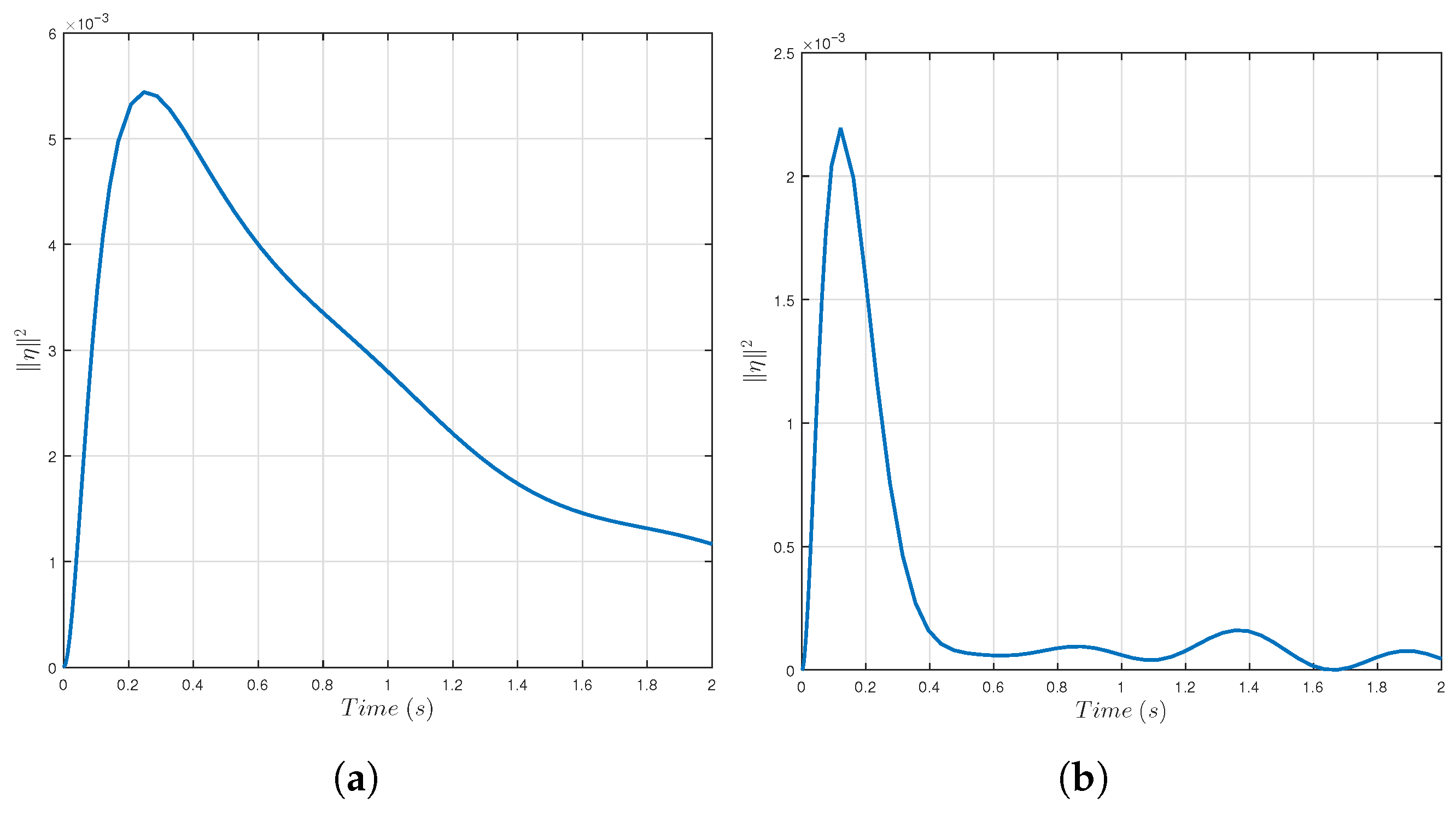
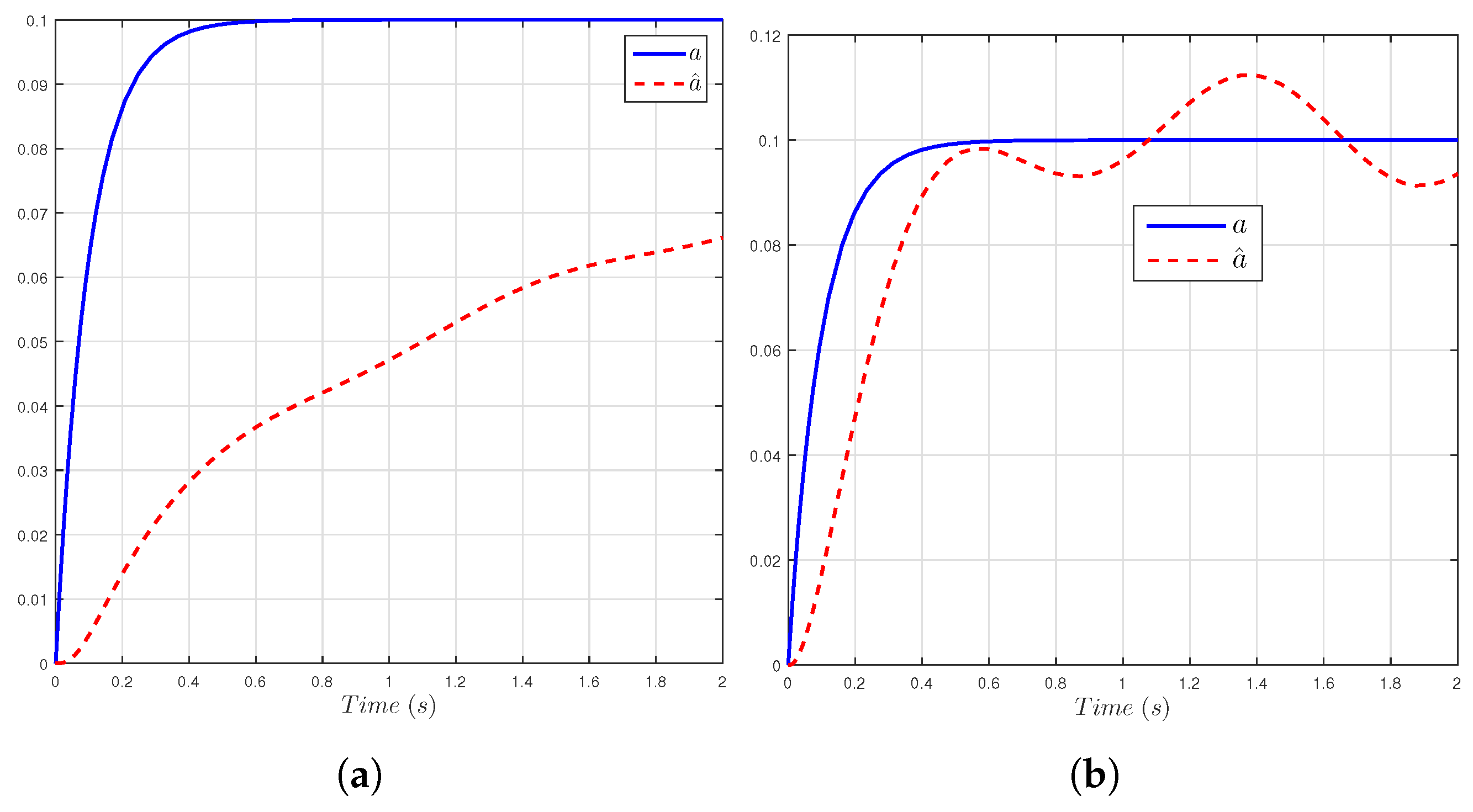
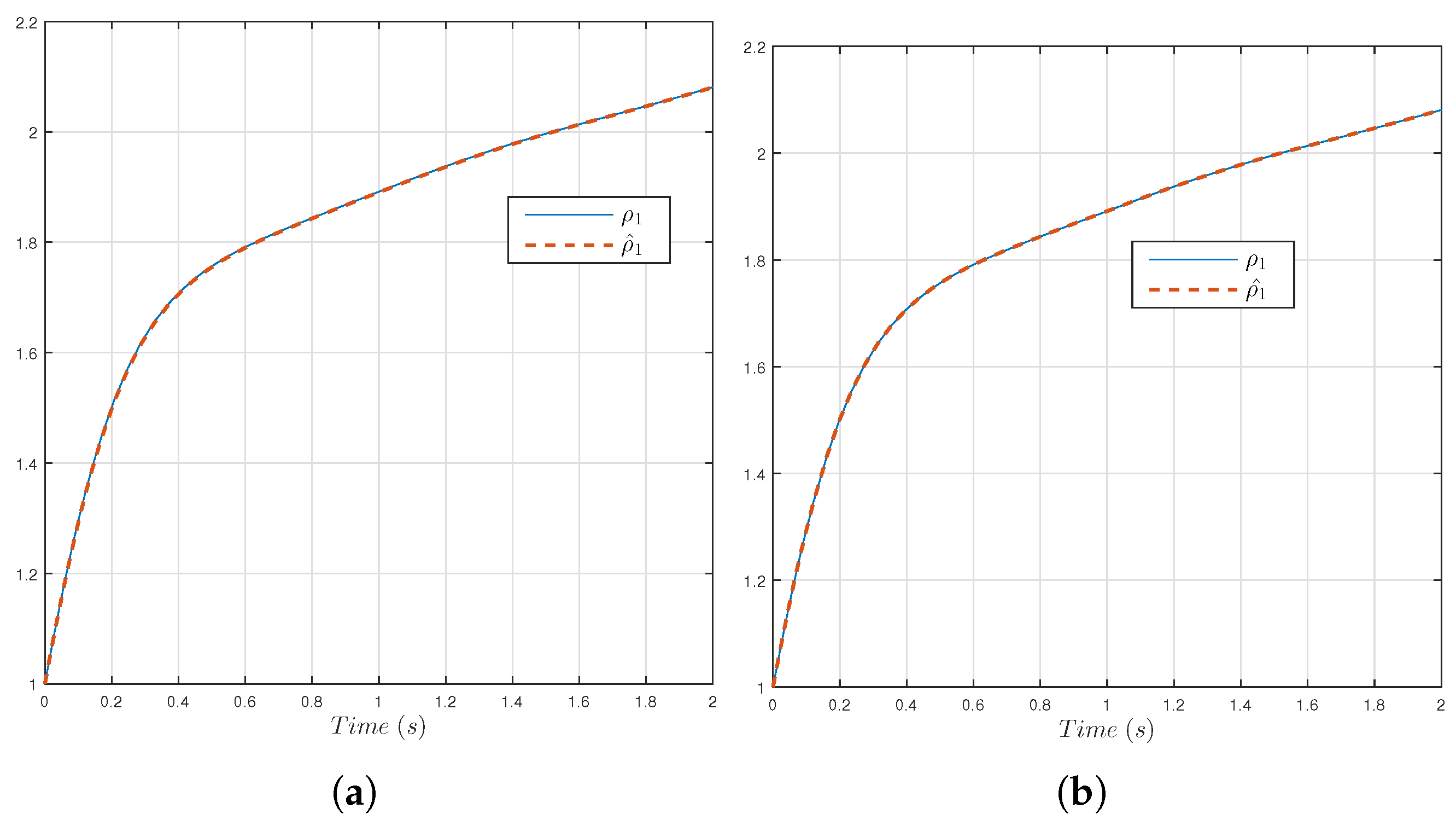
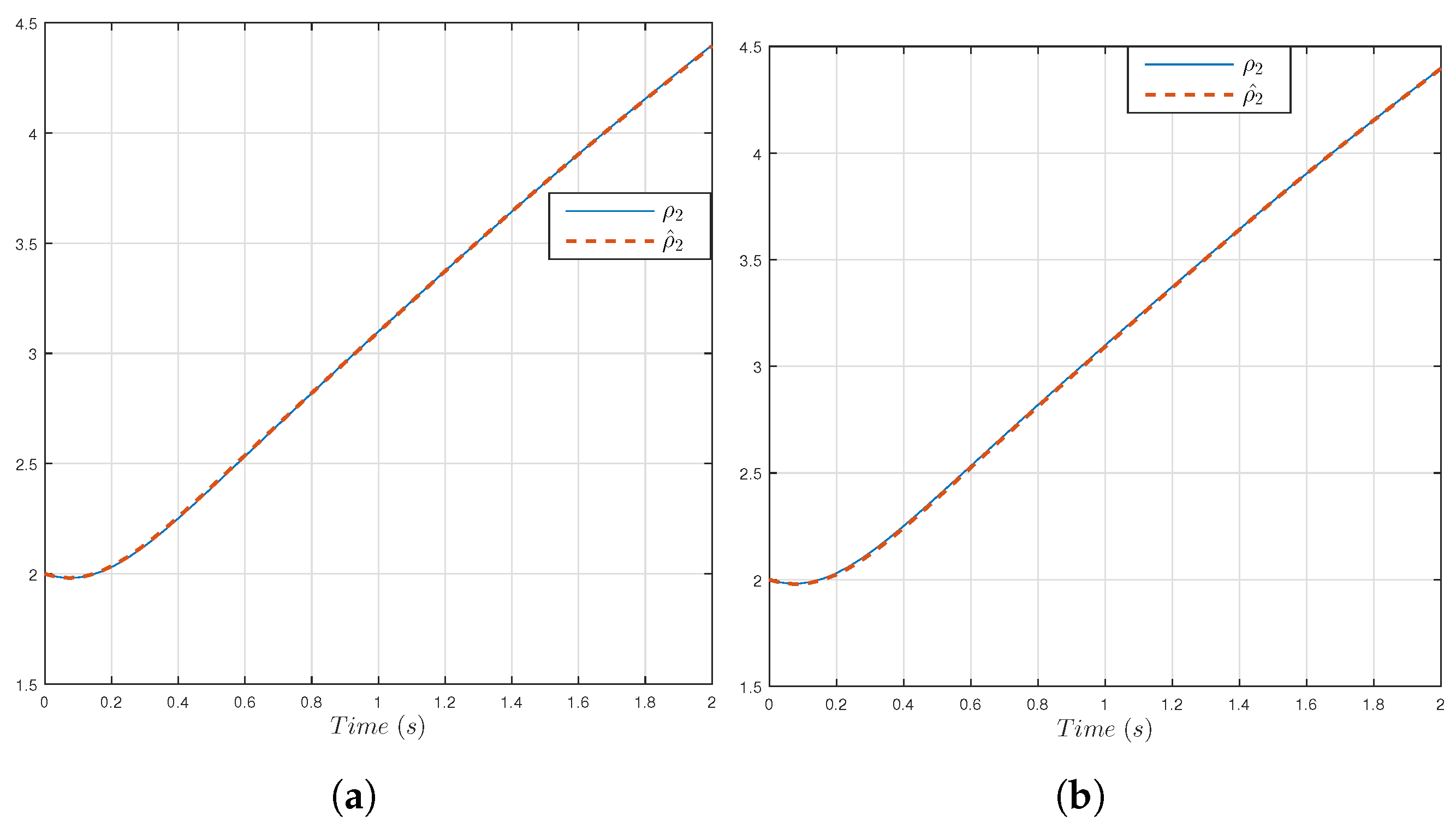
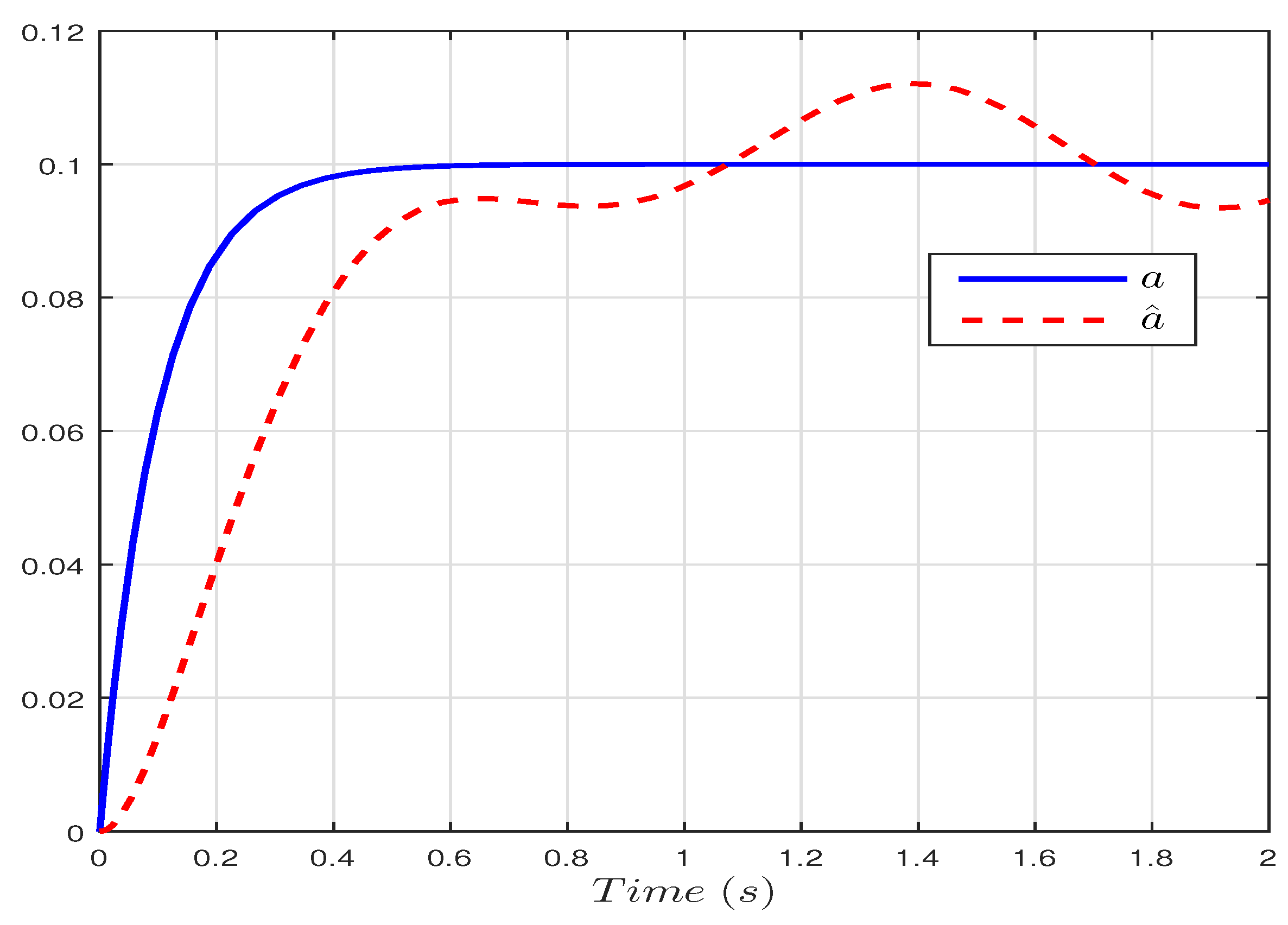
Figure 1, Figure 2, Figure 3 and Figure 4 show the time evolution of η 2 , actuator fault a and its estimated a ^ , ρ 1 and its estimated ρ ^ 1 , and ρ 2 and its estimated ρ ^ 2 , respectively, by applying Theorems 1 and 2. Based on the simulation result, it is evident that the polynomial proportional integral observer significantly enhances the speed of FTFE of PF model.
Table 1 presents the minimum value of ζ 2 obtained by applying Theorem 2 for various degrees of F ˜ i ( y ) and G ˜ i ( y ) regarded as decision variables, ensuring the FTB of the PF model (57). It is observed that Theorem 2 produces the better result as the degrees of these polynomial matrices are raised. However, the number of decision variables also increases, leading to higher computational complexity, which represents the cost of the relaxation.
Unlike infinite-time stability, which is intrinsic to the system structure, FTB is defined with respect to the prescribed bounds ζ 1 , ζ 2 , and the sets E and I . Indeed, for t f = 2 , ζ 1 = 10 2 , and ζ 2 = 0.2 , varying the fault or disturbance level leads to a modification of the set E . For instance, if the disturbance is set to ω = sin ( 2 π t ) , the value of E ¯ increases to 1.05 , compared to 0.15 when ω = 0.1 sin ( 2 π t ) . With the same polynomial gain degrees, the SOS conditions in Theorem 2 turn out to be infeasible. A feasible solution is obtained for a minimum value of ζ 2 equal to 0.99 .
Figure 5 shows the time evolution of the actuator fault a and its estimate a ^ for ω = sin ( 2 π t ) .

6. Conclusions

The FTFE problem for polynomial fuzzy models with actuator faults has been addressed. By adopting a polynomial integral observer, a design procedure is proposed. An enhanced result is achieved by incorporating a proportional action into the observer. SOS-based conditions have been derived for each observer to ensure the finite-time stability of the augmented system, composed of the state estimation error and the actuator Fault Estimation error. To further reduce conservativeness, we adopt a relaxation method recently proposed for double convex combination conditions and generalize it to polynomial matrices, which is then exploited in the design procedure. Finally, the simulation result is presented. Note that other observers and methodologies, such as the reduced-order observer, may be used to further improve the performance of the FTFE for PF models. However, the application of these techniques to derive strict SOS conditions remains an unresolved issue. Other potential research directions include extending the proposed framework to more challenging scenarios, such as singular time-delay systems and switched systems. Additionally, incorporating sensor faults and cyber-attacks into the model represents another important challenge to be explored in future work.

Author Contributions

S.D.: Conceptualization, methodology, formal analysis, investigation, and writing—original draft. E.B.A.: Conceptualization, methodology, and writing—original draft. A.A.: Methodology, formal analysis, funding acquisition, and writing—review and editing. H.G.: Conceptualization, methodology, supervision, and writing—original draft. S.A.: Software, validation, and writing—review and editing. All authors have read and agreed to the published version of the manuscript.

Funding

This work was funded by the Deanship of Graduate Studies and Scientific Research at Jouf University under grant No. DGSSR-2024-02-01209.

Data Availability Statement

The original contributions presented in this study are included in the article. Further inquiries can be directed to the corresponding authors.

Acknowledgments

The authors extend their appreciation to the Deanship of Graduate Studies and Scientific Research of Saudi Arabia for funding this research work through project number DGSSR-2024-02-01209.

Conflicts of Interest

The authors declare that there are no conflicts of interest regarding the publication of this paper.

References

  1. Tanaka, K.; Yosihida, H.; Ohtake, H.; Wang, H. A sum of squares approach to modeling and control of nonlinear dynamical systems with polynomial fuzzy systems. IEEE Trans. Fuzzy Syst. 2009, 17, 911–922. [Google Scholar] [CrossRef]
  2. Hwang, I.; Kim, S.; Kim, Y.; Seah, C.E. A survey of fault detection, isolation, and reconfiguration methods. IEEE Trans. Control Syst. Technol. 2010, 18, 636–653. [Google Scholar] [CrossRef]
  3. Zhang, K.; Jiang, B.; Cocquempot, V. Adaptive observer-based fast fault estimation. Int. J. Control Autom. Syst. 2008, 6, 320–326. [Google Scholar]
  4. Zhang, K.; Jiang, B.; Cocquempot, V. Fast adaptive fault estimation and accommodation for nonlinear time-varying delay systems. Asian J. Control Autom. Syst. 2009, 11, 643–652. [Google Scholar] [CrossRef]
  5. Zhang, J.; Swain, A.K.; Nguang, S.K. Robust H adaptive descriptor observer design for fault estimation of uncertain nonlinear system. J. Frankl. Inst. 2014, 351, 5162–5181. [Google Scholar] [CrossRef]
  6. Kharrat, D.; Gassara, H.; El Hajjaji, A.; Chaabane, M. Adaptive observer-based H FTC for TS fuzzy systems. Application to cart motion model. J. Frankl. Inst. 2020, 357, 12062–12084. [Google Scholar] [CrossRef]
  7. Gassara, H.; Boukattaya, M.; El Hajjaji, A. Polynomial Adaptive Observer-Based Fault Tolerant Control for Time Delay Polynomial Fuzzy Systems Subject to Actuator Faults. Int. J. Fuzzy Syst. 2023, 25, 1327–1337. [Google Scholar] [CrossRef]
  8. Edwards, C.; Spurgeon, S.K.; Patton, R.J. Sliding mode observers for fault detection and isolation. Automatica 2000, 36, 541–553. [Google Scholar] [CrossRef]
  9. Dong, S.; Liu, M.; Wum, Z.-G.; Shi, K. Observer-based sliding mode control for Markov jump systems with actuator failures and asynchronous modes. IEEE Trans. Circuits Syst. Exp. Briefs 2021, 68, 1967–1971. [Google Scholar] [CrossRef]
  10. Youssef, T.; Chadli, M.; Karimi, H.R.; Wang, R. Actuator and sensor faults estimation based on proportional integral observer for TS fuzzy model. J. Frank. Inst. 2018, 354, 2524–2542. [Google Scholar] [CrossRef]
  11. Telbissi, K.; Benzaouia, A. Actuator Fault Estimation Based on Proportional–Integral Observer for Delayed Continuous-Time Switched Systems. Circuits Syst. Signal Process. 2019, 38, 4405–4419. [Google Scholar] [CrossRef]
  12. Han, J.; Liu, X.; Wei, X.; Sun, S. A dynamic proportional-integral observer-based nonlinear fault-tolerant controller design for nonlinear system with partially unknown dynamic. IEEE Trans. Syst. Man Cybern. Syst. 2022, 52, 5092–5104. [Google Scholar] [CrossRef]
  13. Ding, J.; Zhao, Z.; Yu, J.; Cheng, J.; Basin, M. Compensation-based state and fault estimation for IT2 polynomial fuzzy systems under both actuator and sensor faults. Appl. Soft Comput. 2026, 186, 114232. [Google Scholar] [CrossRef]
  14. Feng, Y.; Yu, X.; Man, Z. Non-singular terminal sliding mode control of rigid manipulators. Automatica 2002, 38, 2159–2167. [Google Scholar] [CrossRef]
  15. Dorato, P. Short Time Stability in Linear Time-Varying Systems; Polytechnic Institute of Brooklyn, Microwave Research Institute: New York, NY, USA, 1961. [Google Scholar]
  16. Amato, F.; Ariola, M.; Dorato, P. Finite-time control of linear systems subject to parametric uncertainties and disturbances. Automatica 2001, 37, 1459–1463. [Google Scholar] [CrossRef]
  17. Garcia, G.; Tarbouriech, S.; Bernussou, J. Finite-Time Stabilization of Linear Time-Varying Continuous Systems. IEEE Trans. Autom. Control 2009, 54, 364–369. [Google Scholar] [CrossRef]
  18. Ruan, Y.; Huang, T.; Zhou, K. Finite-time Control for Takagi-Sugeno Fuzzy Systems with Time-varying Delay. Int. J. Control Autom. Syst. 2020, 18, 1353–1366. [Google Scholar] [CrossRef]
  19. Fezazi, N.E.; Fahim, M.; Idrissi, S.; Farkous, R.; Alvarez, T.; Tissir, E.H. New delay-dependent finite-time stabilization of Takagi–Sugeno fuzzy approaches for delayed nonlinear systems. Asian J. Control 2024, 27, 1119–1134. [Google Scholar] [CrossRef]
  20. Chen, X.; Hu, M. Finite-Time Stability and Controller Design of Continuous-Time Polynomial Fuzzy Systems. Hindawi Abstr. Appl. Anal. 2017, 2017, 3273480. [Google Scholar] [CrossRef]
  21. Dhahri, S.; Alaia, E.B.; Gassara, H. Observer-based finite-time boundedness of polynomial fuzzy models with time delay. Int. J. Syst. Sci. 2025. [Google Scholar] [CrossRef]
  22. Zhu, X.; Li, W.; Xia, Y. Finite-time fault estimate and fault-tolerant control for discrete-time Markov jump systems with actuator and sensor faults. Int. J. Robust Nonlinear Control 2023, 33, 6233–6249. [Google Scholar] [CrossRef]
  23. Sun, S.; Su, X.; Han, J.; Cai, Y. Finite-Time Control for Multiple Time Delayed Switched Random Systems via a k-Step Fault Estimation Technique. IEEE Trans. Fuzzy Syst. 2024, 54, 4986–4998. [Google Scholar] [CrossRef]
  24. Han, J.; Liu, X.; Wei, X.; Zhu, X. Reduced-Order Observer-Based Finite Time Fault Estimation for Switched Systems with Lager and Fast Time Varying Fault. IEEE Trans. Circuits Syst. Express Briefs 2024, 71, 350–354. [Google Scholar] [CrossRef]
  25. Selvaraj, P.; Kwon, O.M.; Lee, S.H.; Sakthivel, R.; Lee, S.M. Robust H sliding mode control for uncertain polynomial fuzzy stochastic singular systems. J. Frankl. Inst. 2023, 360, 2893–2912. [Google Scholar] [CrossRef]
  26. Kim, D.W.; Lee, D. Relaxed Conditions for Parameterized Linear Matrix Inequality in the Form of Double Fuzzy Summation. IEEE Trans. Fuzzy Syst. 2024, 32, 1608–1612. [Google Scholar] [CrossRef]
  27. Sala, A.; Ari, C. Polynomial Fuzzy Models for Nonlinear Control: A Taylor Series Approach. IEEE Trans. Fuzzy Syst. 2009, 17, 1284–1295. [Google Scholar] [CrossRef]
  28. Gassara, H.; Hajjaji, A.E.; Chaabane, M. Adaptive Fault Tolerant Control Design for Takagi-Sugeno Fuzzy Systems with Interval Time Varying Delay. Optim. Control Appl. Methods 2014, 35, 609–625. [Google Scholar] [CrossRef]
  29. Tuan, H.D.; Apkarian, P.; Narikiyo, T.; Yamamoto, Y. Parameterized Linear Matrix Inequality Techniques in Fuzzy Control System Design. IEEE Trans. Fuzzy Syst. 2001, 9, 324–332. [Google Scholar] [CrossRef]
  30. Keerthana, N.; Sakthivel, R.; Aravinth, N.; Anthoni, S.M. Unified finite-time fault estimation and fault-tolerant control for Takagi–Sugeno fuzzy singular systems. Int. J. Adapt. Control Signal Process. 2024, 38, 1812–1828. [Google Scholar] [CrossRef]
  31. Keerthana, N.; Sakthivel, R.; Aravinth, N.; Safana, M.A.; Anthoni, S.M. Fault Estimation-Based Sliding Mode Control Design for Uncertain Switched Fuzzy Systems: A Finite Time Case. Int. J. Adapt. Control Signal Process. 2026. [Google Scholar] [CrossRef]
Figure 1. Time evolution of η 2 by applying (a) Theorem 1 and (b) Theorem 2.
Symmetry 18 00505 g001
Figure 2. Time evolution of the actuator fault a and its estimate a ^ by applying (a) Theorem 1 and (b) Theorem 2.
Symmetry 18 00505 g002
Figure 3. Time evolution of the state ρ 1 and its estimate ρ ^ 1 by applying (a) Theorem 1 and (b) Theorem 2.
Symmetry 18 00505 g003
Figure 4. Time evolution of the state ρ 2 and its estimate ρ ^ 2 using (a) Theorem 1 and (b) Theorem 2.
Symmetry 18 00505 g004
Figure 5. Time evolution of the actuator fault a and its estimate a ^ for ω = sin ( 2 π t ) .
Symmetry 18 00505 g005
Table 1. Comparison of minimum ζ 2 for Theorem 2 across various degrees of polynomial matrices.
Degrees of F ˜ i ( y ) and G ˜ i ( y ) 024
Minimum ζ 2 Inf3.40.2
Number of decision variables203244
Disclaimer/Publisher’s Note: The statements, opinions and data contained in all publications are solely those of the individual author(s) and contributor(s) and not of MDPI and/or the editor(s). MDPI and/or the editor(s) disclaim responsibility for any injury to people or property resulting from any ideas, methods, instructions or products referred to in the content.