1. Introduction
The concept of asymptotic non-Hermitian degeneracy, called the intrinsic exceptional point (IEP), was introduced by Siegl and Krejčiřík [
1]. They detected the presence of this characteristic in the imaginary cubic oscillator (ICO) operator
They proved that its eigenstates
do not form a Riesz basis, so they concluded that such an operator cannot be considered diagonalizable and that “there is no quantum-mechanical Hamiltonian associated with it” [
1]. In this context we reconfirmed in [
2] that the applicability of quantum theory at the non-Hermitian IEP dynamical extreme is questionable. We found that many sophisticated construction techniques which still do work for finite matrices cannot be transferred to the IEP dynamical regime.
A brief explanation is that near an
N-by-
N-matrix singularity with
, the “corridor of unitarity” (cf. [
3]) becomes unacceptably (i.e., exponentially) narrow in the
limit. As a consequence, we felt forced to conclude that “the practical realizations of the standard quantum-mechanical ICO model remain … elusive” [
2], and that “the currently unresolved status … of the IEP-related instabilities does not seem to have an easy resolution” [
2].
In our present paper, we intend to propose another (partial) clarification of the puzzle. The not-quite-expected existence of such a new explanation of the problem has two roots. First, we imagined that regularization of the IEP singularity in the ICO model of Equation (1) and its multiple IEP-singular analogues cannot proceed directly via an immediate perturbative regularization of the IEP-singular differential operators themselves. In a “preparatory step” of our proposed treatment of the problem, we decided to mimic the relevant features of
via certain limits of its discrete-coordinate
N-by-
N matrix alternatives. For this purpose, we are going to consider certain
N-by-
N-matrix Hamiltonians of the form
in which the kinetic energy is represented by the discrete Laplacean,
Such an operator is Hermitian for any local and real potential
. Moreover, its kinetic energy component (2) can be interpreted as an immediate discrete analogue of its continuous-coordinate partner
(cf., e.g., the recent preprint [
4] for details and/or further references; here we use units such that
and mass
).
The second root and step of our present IEP-simulation proposal was inspired by our other paper [
5]. In a way proposed in this paper, Hamiltonians
can be also perceived as the discrete-coordinate analogues of certain more general non-Hermitian differential-operator partners as sampled by the ICO model of Equation (1). The correspondence may be mediated, e.g., by the evaluations of a suitable given potential at the grid-point coordinates
,
, …,
(for more details see
Section 2 below). This may be expected to simplify the analysis. Thus, in [
5] we studied these approximants, with the basic message being, from our present point of view, just a mixture of good and bad news (see a few further related comments below).
What remained encouraging was an observation that the construction of the necessary
N-by-
N matrix approximants might be a feasible task, especially when one admits ample use of computer-assisted symbolic manipulations. In parallel, a new discouragement emerged when we noticed that the memory-and-time costs of the construction appeared to increase so quickly with the growth of
N that we were only able to test the performance up to comparatively small
. Thus, we had to conclude temporarily that the desirable “extrapolation to any hypothetical continuous-coordinate limit
does not seem to be feasible at present” [
5].
Very recently, our skepticism faded away when we imagined that for a simulation of the IEP degeneracy it is in fact not necessary for us to insist on the entirely general form of the family of the discrete potentials , especially because the IEP degeneracy itself is merely an asymptotic higher-excitation phenomenon. Therefore, the consequences of the growth of our integer parameter N could be studied equally well using any suitable toy-model .
This idea immediately led to an innovated formulation of our “partial remedy” project (cf.
Section 3). The essence of the innovation was that for the purposes of the IEP-degeneracy simulation during the continuous-coordinate limit
, the structure of the degeneracy itself may and will be kept elementary and fixed. This led to the results which will be described in
Section 4 and
Section 5, with a compact summary added in
Section 6.
2. Difference-Operator Hamiltonians
Although the IEP-singular ICO operator (1) cannot serve as a quantum Hamiltonian, its eigenstates form a complete set [
1] so that one feels tempted to regularize the model using a suitable perturbation. Along such a path of considerations (see, e.g., [
2]) one almost immediately discovers that besides the IEP-related asymptotic degeneracy (6), there emerges also another and possibly equally serious technical obstacle related to the unboundedness of the operator. This is a challenge which was already known to Dieudonné (cf. [
6]). One of its resolutions was recommended and described in review [
7] (cf. also [
8]). As we already mentioned, a not too dissimilar trick based on the discretization of coordinates will also be used in what follows.
2.1. Discrete Large Version of Square Well
At a fixed
in Schrödinger equation
we may start our considerations by letting the potential, inside a finite interval of a fixed length
L, vanish,
. Then, the energy spectrum becomes strictly positive and can be written in closed form. Interested readers may find the details in the recent preprint [
4]; for our present purposes, it is sufficient to recall just the ultimate energy-specifying formula Nr. 3.15 of loc. cit., viz.,
The real width of the infinitely deep square well is equal here to the product
of
N with the distance
between the grid points. This means that
is equivalent to
.
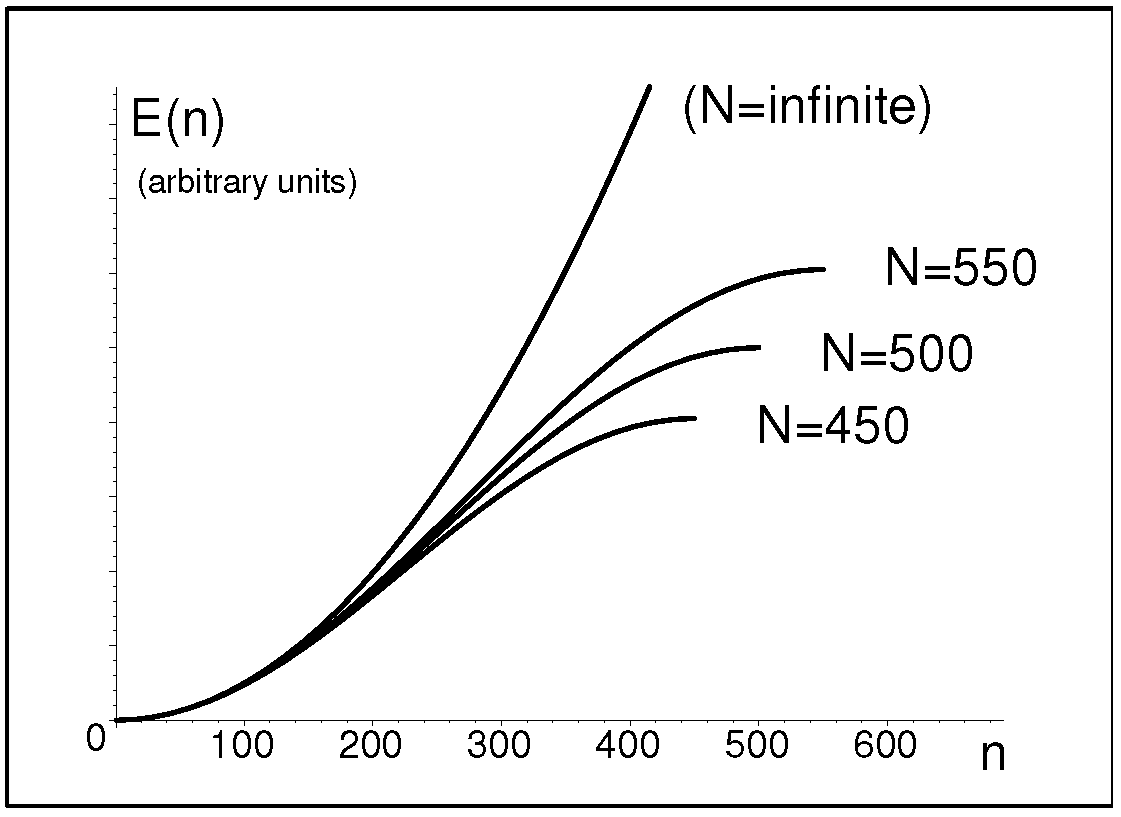
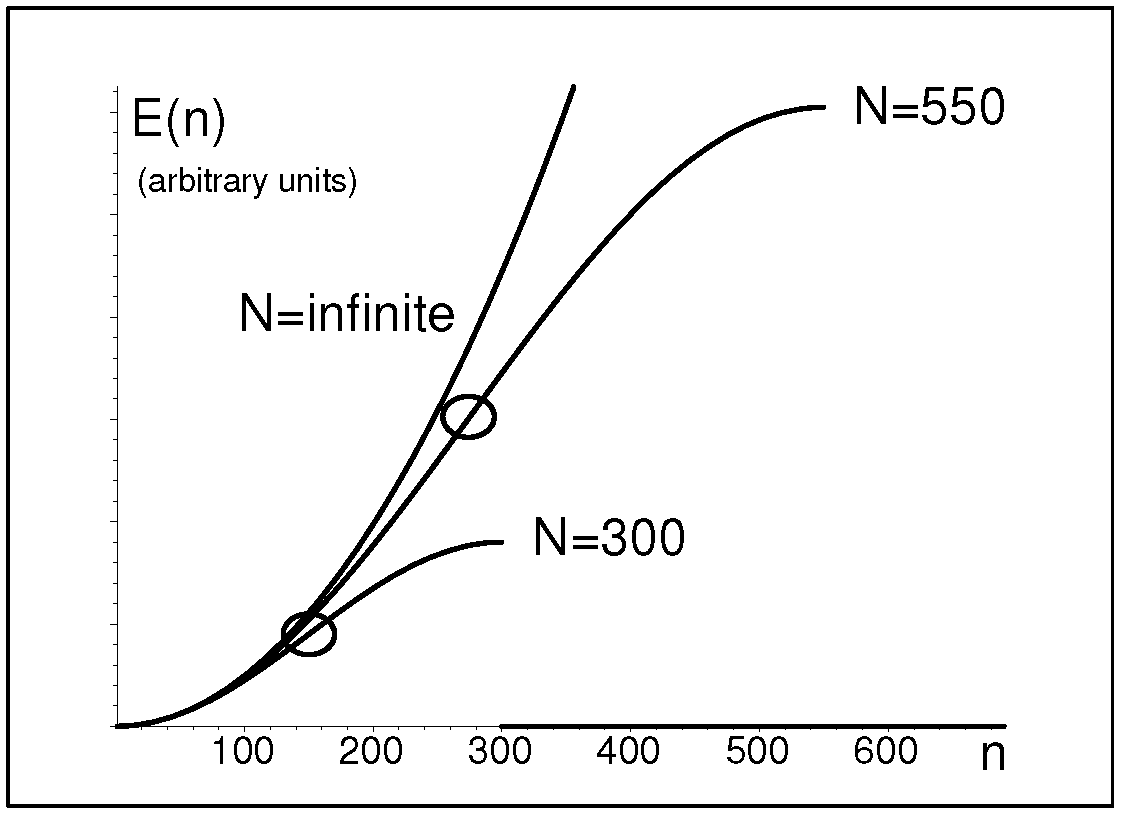
Two aspects of the latter formula are relevant. First, the formula reproduces the continuous-coordinate square-well spectrum in the limit of
(see
Figure 1). Second, the
whole continuous-coordinate square-well spectrum can be perceived as a limit of the mere lower part of the respective
spectrum (see
Figure 2).
2.2. Inclusion of Non-Hermitian Potentials
One of the characteristic features of the square-well spectrum with is the steady growth of the energy-level differences with n. The inspection of the pictures reveals that at any finite , such a feature is inadvertently lost beyond where . Thus, once one decides to take a nontrivial and study the spectra at the large , one can still safely ignore the excited states with as irrelevant.
For our present purposes it is important to know that all of the latter observations remain applicable especially after the inclusion of small perturbations . One should only keep in mind that even then, the spectrum need not be positive definite. In this sense the above-mentioned idea of the asymptotic irrelevance of the upper half of the spectrum of the discrete-coordinate toy models with finite must be properly modified.
The elusive IEP degeneracy can now be perceived as paralleled and mimicked by its finite
simulation mediated by the Kato’s degeneracy-causing exceptional points (EP, [
9]) or more precisely, by the Kato’s exceptional points of order
M (EPM). In this direction we already pointed out in [
2] that the ICO-related singularity finds its analogue in the behavior of eigenstates
of a parameter-dependent non-Hermitian matrix
in the vicinity of its exceptional-point singularity
at a suitable degree of degeneracy
.
Some of these observations were already developed in the paper [
5]. There, we revealed that a consequent and systematic analysis of the multiparametric and
symmetric matrix models
of the form depending on a real
plet of parameters, viz.,
ceases to be easy even in the first nontrivial three-parametric case with
and
. On these grounds, we decided to circumvent the obstacles via a weakening of the strength of the assumptions. In place of the over-ambitious search for the EPMs “with a sufficiently large
M”, we will consider a reduced task in which the number of the free parameters (determining also the maximal order
M of the EPM degeneracies) will be kept fixed and restricted to the first few smallest integers.
2.3. Purely Imaginary Discrete Potentials
In any ordinary differential Schrödinger equation and for an arbitrary unbounded Hamiltonian , as we already pointed out, the real line of coordinates (or possibly its finite segment) may be replaced by a discrete and equidistant (and, say, finite) grid-point lattice . In such a setting, a return to the continuous-coordinate limit can be mediated by the growth of in combination with a simultaneous decrease of the grid-point distance .
For the special ICO-inspired class of models of our present interest, the continuous-coordinate potentials exhibiting the parity-time symmetry will be assumed purely imaginary. Then, the bounded-operator avatar of the initial Hamiltonian with such a symmetry acquires the matrix form of Equation (5) exhibiting the same antilinear symmetry.
Knowledge of the parameters might enable us to reconstruct (or better interpolate/approximate the continuous-coordinate potential in the limit of large . For the sake of definiteness, we will assume that all of the constants A, B, … are real. At a fixed N, our non-Hermitian but symmetric quantum Hamiltonian will then have the N-by-N matrix form (5). Its spectrum will be real, discrete, and non-degenerate in an dependent domain of parameters which may be called “physical”. This domain is not empty, since it contains a subset of the parameters which remain sufficiently small. Model (5) can be then perceived as a perturbation of the conventional square well with Hamiltonian represented by a matrix which is Hermitian, .
2.4. Differential Difference Operator Correspondence
Incidentally, model (1) played the role of an important benchmark example for years in several branches of physics [
10,
11,
12,
13]. Therefore, the disproof of its probabilistic quantum-mechanical tractability was disturbing. Its unacceptability has also been reconfirmed by Günther with Stefani [
14], who provided “clear complementary evidence” that models of such type “are not equivalent to Hermitian models”, mainly due to the IEP property. They called this property “non-Rieszian mode behavior”, and in a way which also inspired our present constructive considerations, they concluded that “what is still lacking is a simple physical explanation scheme for the non-Rieszian behavior of the eigenfunction sets” [
14].
We found it important that the latter IEP-degeneracy property of the eigenstates
of
can be visualized, roughly speaking, as a steady weakening of their mutual linear independence with the growth of excitation,
A deeper insight is obtained when one recalls the notion of an exceptional point (EP) as introduced in Kato’s classical monograph on perturbation theory [
9]. In spite of the fact that Kato’s attention was restricted to finite and parameter-dependent
N-by-
N matrices
, his concept of EP degeneracy can really be found analogous to its “intrinsic” asymptotic version in Equation (6).
The analogy is imperfect, of course; it only finds partial support in the fact that at a finite
, the EP can be also defined as an instant of parallelization of several (i.e., in general, of
M) eigenvectors
of
at
with suitable
. In comparison with IEP, the other formal difference is that in the EP limit (i.e., in the EPM limit)
, the Kato’s finite
degeneracy involves not only an
plet of certain properly normalized eigenvectors,
but also the related eigenvalues,
In [
2] we found the “simplification” provided by the absence of the energy degeneracy (8) to be more than compensated in the IEP context by the technical complications arising from the “non-Rieszian mode behavior” (6). For this reason, Siegl with Krejčiřík emphasized that the IEP singularity is “much stronger than any EP associated with finite Jordan blocks” [
1]. Thus, our present tentative replacement of the IEP-singular systems by their discrete EPM analogues could help us to understand at least some of the deeper mathematical roots of the rather subtle IEP-unacceptability enigma.
4. Two-Parametric Models
with Arbitrary Even N = 2K
One of the beneficial consequences of the not overly complicated structure of our Hamiltonian matrices (5) is that irrespective of the parity of N, we always have to search for the squared-energy roots of a polynomial of degree K. At the same time, a deeper inspection of the problem reveals a not quite expected structural difference between the systems with the even and those with the odd . In and only in the latter case, for example, there exists an odd central constant energy level .
For this reason, we will study the respective two subsets of the Hamiltonians separately.
4.1. The Next-to-Elementary Hamiltonian with
When we decide to keep our Hamiltonians just two-parametric, the most complicated three-parametric
model of [
5] becomes simplified:
It is written here in partitioned form which emphasizes not only the absence of the third parameter,
, but also a certain enhancement of the symmetry of the matrix which encourages us to recall the
analysis as a methodical guide.
At
, our first task is the evaluation of the secular polynomial
Its real and non-degenerate roots
with
(i.e., the sextuplet of bound-state energies) could be written in closed form. The formulae (easily generated using computer-assisted symbolic manipulations) become too long for a printed display. Still, whenever needed, their graphical presentation remains instructive and straightforward (cf., e.g., [
18]).
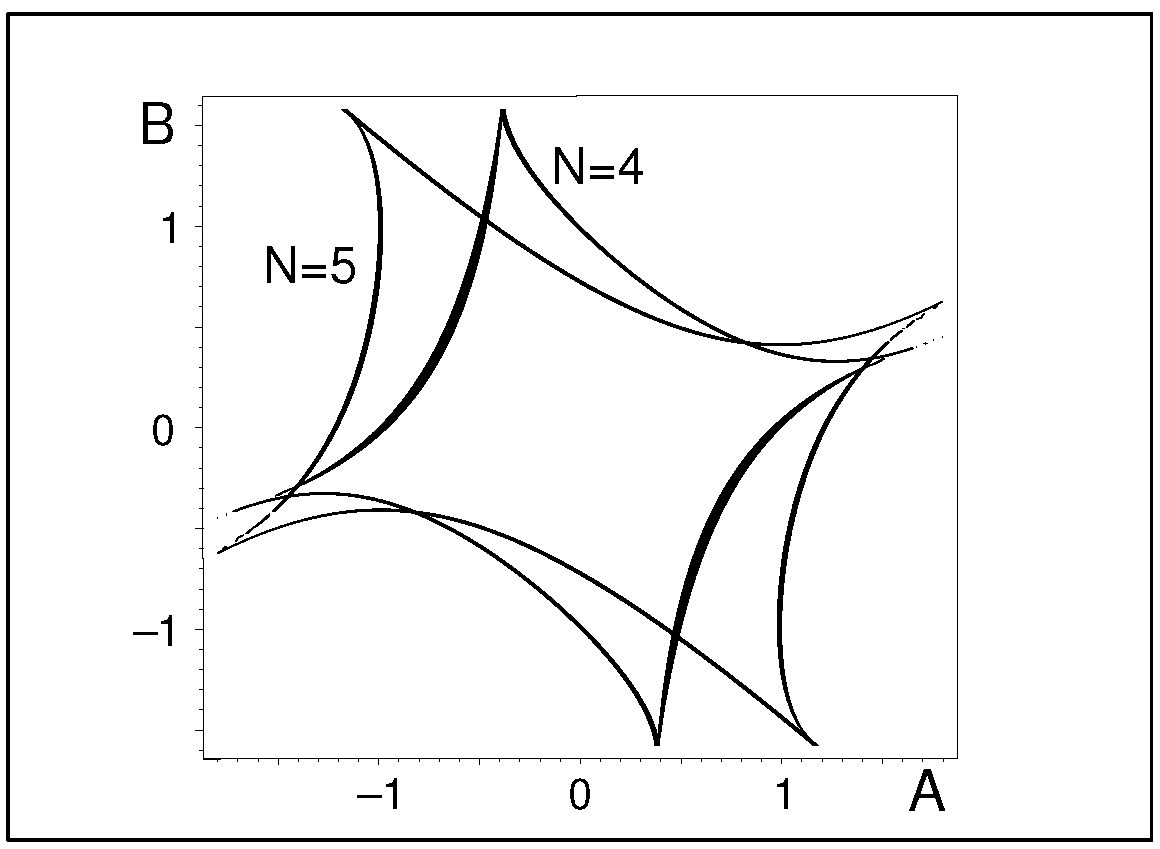
In particular, it is important to notice and emphasize that the purely numerically determined star-shaped domain
of the reality of the energy spectrum at
has been found to be similar and very close to its
predecessor of
Figure 3. Thus, although we are not going to provide a rigorous formal proof (which could be based on the increase-of-precision method of paper [
19] and as such would be feasible), we believe that all of the similar numerical tests seem to confirm a hypothesis that the spikes of the boundaries of
really represent the non-degenerate EPM singularities of order four (at the even
Ns) or five (at the odd
Ns).
4.2. Arbitrary and the EPMs with
In what follows, the even matrix dimensions will be allowed to be arbitrary, rendering our understanding of the behavior of the large-matrix models possible.
Theorem 1. The degeneracy of the four central eigenvalues (i.e., of the four smallest eigenvalues) to is encountered at any even when one considers the pair of polynomialsandand, making use of their exact solvability, when one determines the respective quadruplets of their roots and with . Whenever one finds that these roots are real (which can be shown to be true for ), the sets of the eligible EP4-supporting parameters in become specified by the formulae Proof. At any
, the coupled pair of Equation (16) can immediately be solved using the elimination of the unknown quantity
B from the second item of Equation (16). This can be done by taking the two alternative (viz., positive or negative) square roots of the latter constraint, which may be characterized by the subscripted sign to yield two options, viz.,
After the elimination and insertion of
into the first item of Equation (16), we get the two respective polynomials (17), (18) and the two respective relations
. The quadruple degeneracy of the eigenvalues at
is guaranteed. □
A detailed classification based on the explicit proofs of the reality of the roots
of the respective polynomials
remains
K-dependent (i.e.,
N-dependent). Even though the polynomial is merely of the fourth order in
x (i.e., exactly solvable), by far the most straightforward insight in the
K- or
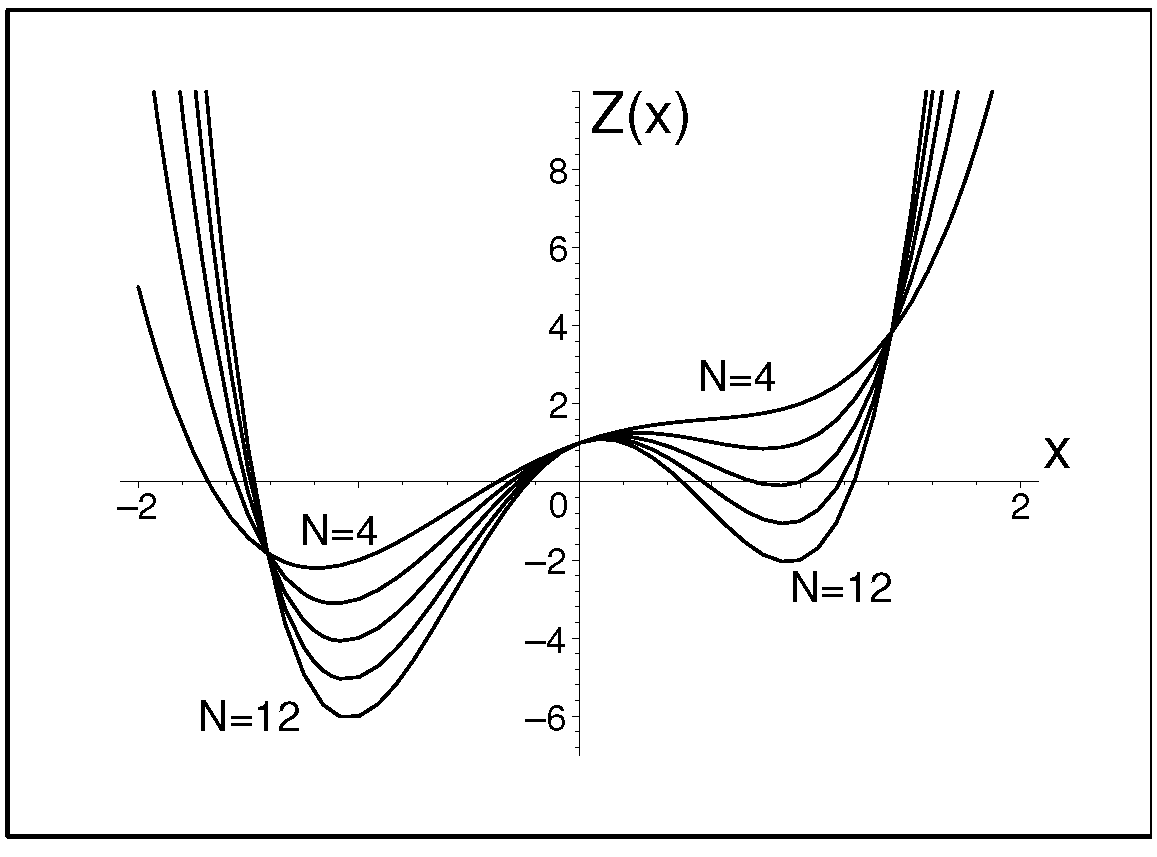
N-dependence of the roots is provided graphically. In
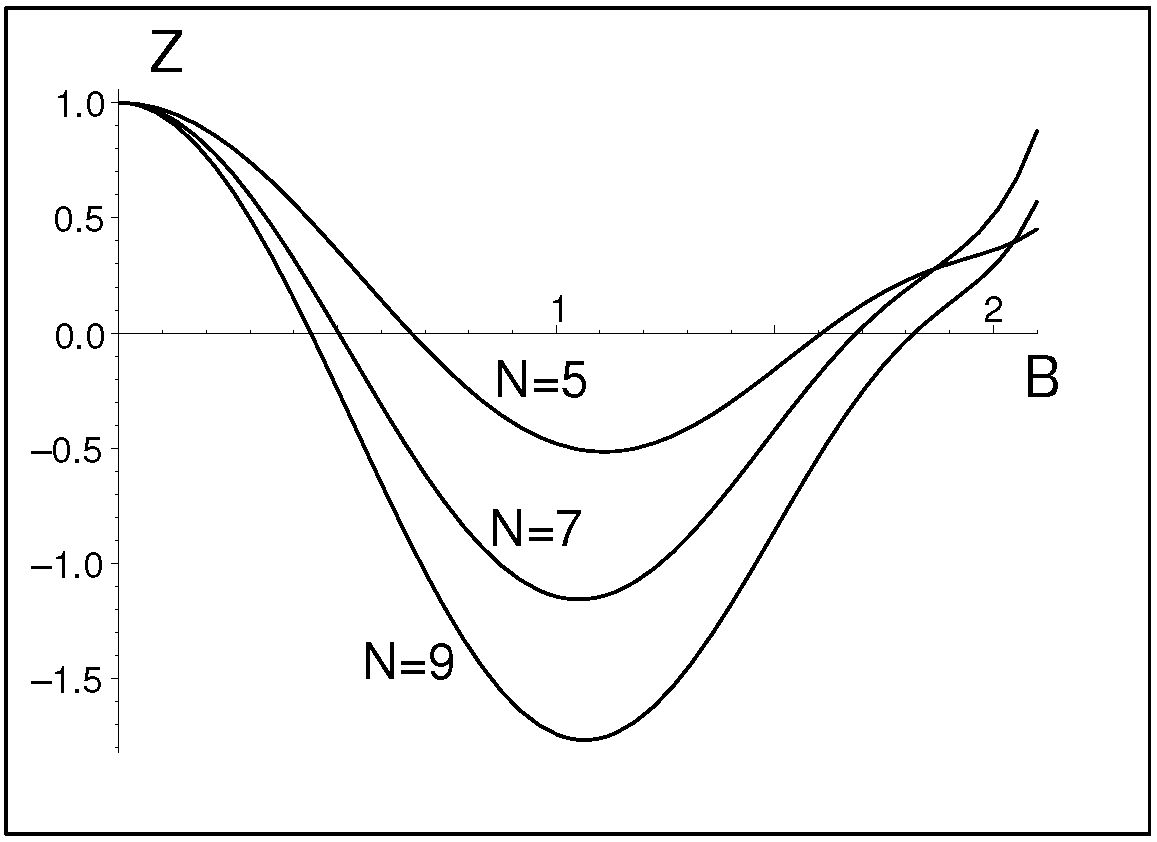
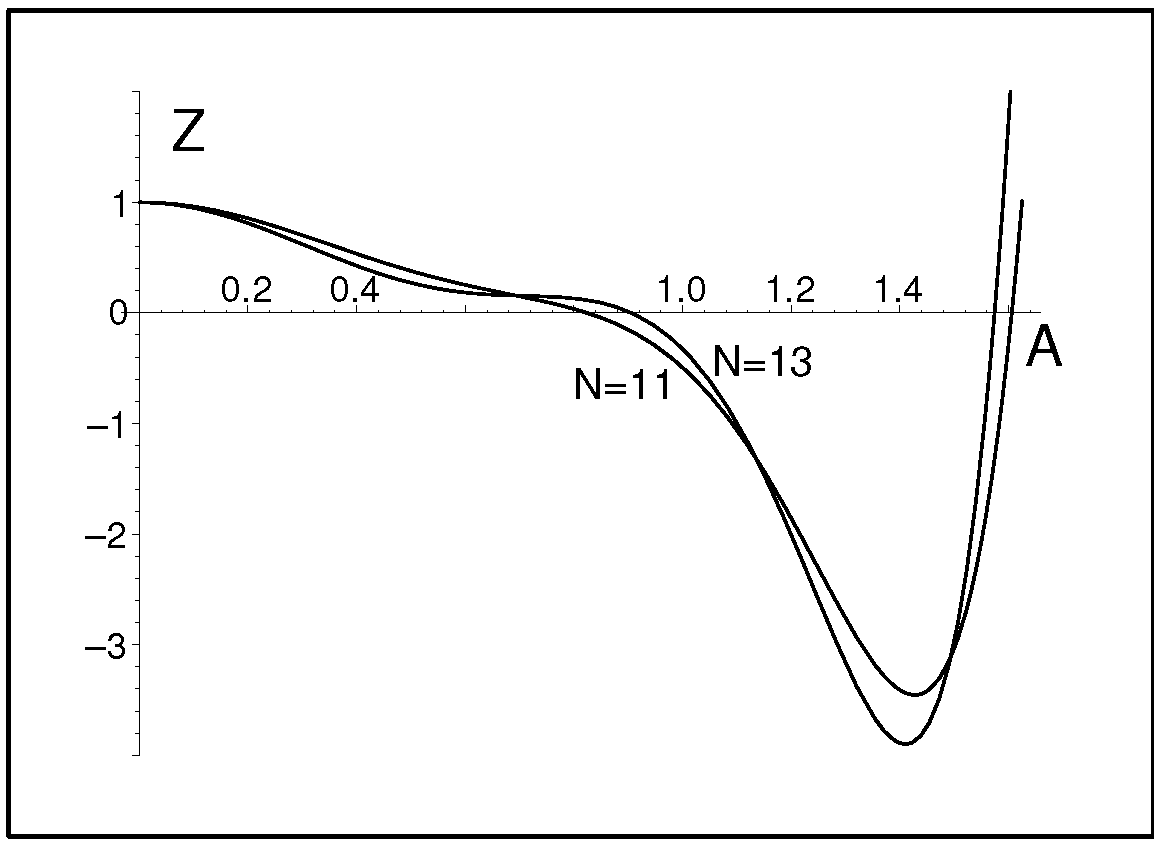
Figure 4, we display the six shapes of polynomial functions
with
, and 6. As long as both of the local minima of these curves decrease with the growth of
K, the picture clearly shows the convergence of the roots
in the limit of
. Numerically, this convergence is also confirmed by
Table 1.
The values of are unique. For completeness, the table could also have been extended to contain the other sets of roots with opposite sign and subscript, viz., with as well as with the related .
4.3. Numerical Detour
Table 1 together with
Figure 4 can be recalled as a sample of the use of a solvable model admitting an internally consistent extrapolation of an EPM-supporting quantum model to the large
or even towards the limit of
. This transition can be read as a tentative interpolation, approximation, or even just a mere simulation of a singular differential operator, with the idea of its possible (though not yet sufficiently well understood) regularization realized via a return to the simplified, non-EPM (i.e., diagonalizable and, as quantum Hamiltonians, acceptable) discrete perturbed-EPM
models.
In light of Refs. [
3] or [
20], for instance, at least a few highly-excited eigenvectors of the
model tend to overlap at the EPM singularity. in this manner, they mimic the behavior of the deeply singular and manifestly unacceptable IEP-singular model as well as that of its eigenvectors, with their asymptotically-high-excitation degeneracy being characterized by Equation (6) above. Such an argument, even still just intuitive as it is at present, might explain the asymptotic (i.e., high-energy) parallelization of eigenvectors via its EPM-mimicked reinterpretation. Simultaneously, we also circumvent the very essence of the quantum-theoretical unacceptability of the IEP-singular operators as sampled by
, due to the finite-dimensional form of the EPM models. According to the dedicated perturbation theory as outlined in [
3], the reason lies in the existence of a small-perturbation-induced and quasi-unitarity-compatible [
7] regularization of the EPM singularity in any
model. For example, in light of
Figure 4 one can expect that at large
the quickest asymptotic
convergence will be encountered in the case of the leftmost EP4 root
, while the slowest asymptotic
convergence can be expected to occur for the two central roots.
Therefore, for illustrative purposes we will pick up the value “in between” (i.e., the rightmost root
of
alias), due to the left-right symmetry, the leftmost root
of the other, plus the subscripted polynomial
where we have changed the normalization factor and introduced a new asymptotically small parameter
.
We will always have
, so that for a purely numerical localization of any one of the four EP4 roots we may try to use an asymptotic-series ansatz
As long as the very choice of our ansatz has been based on our knowledge of the solution of equation
in the limit of small
(i.e., of large
; cf. the last line of
Table 1), the zero-order
form of equation
is an identity. The next first-order
component can be read as an explicit definition of coefficient
Similarly, the second-order
constraint leads to coefficient
while on the third-order level of precision
we get
etc.
In this context, we have to emphasize that although equation
is solvable in closed form, it still makes sense to construct and work with our “redundant” asymptotic expansion (
19), becaus (a) all of its coefficients can be given a closed exact form and (b) even after its drastic truncation, the expansion yields a fairly reasonable numerical precision even when
and
is not too small (see
Table 2).
6. Summary
Detailed analysis of a family of comparatively elementary bound-state models enabled us to reveal and describe an intimate correspondence between the asymptotic behavior of certain non-Hermitian potentials and a non-Hermiticity-related EP degeneracy of the spectra. As one byproduct, this led to a deeper understanding of the so-called intrinsic exceptional point (IEP) feature of certain maximally non-Hermitian but still -symmetry-exhibiting operators.
IEP-singular behavior has recently been noticed to characterize a fairly broad family of ill-conceived candidates for quantum Hamiltonians. Even though such a property (i.e., basically the Riesz-basis loss of diagonalizability) makes every such operator unacceptable as a quantum observable, we proposed a partial remedy which lies in a perturbation-theory based weakening, if not removal, of its singular nature.
The regularization process has three parts. In the first, we follow theory and circumvent the unbounded-operator status of
[
7]. In our present paper, this goal has been achieved by discretization of the Schrödinger equation, thanks to which we can reinterpret operator
as an
limit of a sequence of certain
N-by-
N matrices
.
In the second step we have made use of the elementary matrix nature of every , which we reinterpret and generalize as parameter-dependent, , admitting that the symbol g may represent an arbitrary multiplet of auxiliary variables, . Even though our new matrices forming a broader family are non-Hermitian by construction, their spectra should remain real and non-degenerate: This restricts the variability of g to a certain non-empty physical domain .
In the third step, we recall the fact that the boundary of the latter physical parametric domain is formed by the EP values at which one encounters the mergers of energy levels. Localization of these degeneracies appeared to be the most difficult part of our regularization recipe. Still, in our models we managed to localize the most relevant part of the EP boundary at which the number M of the merging energy levels was maximal.
The latter maxima appeared to be reached at the isolated EPs of order M (EPMs), and for the energies forming, at a given matrix-dimension , a precise center of the spectrum. In other words, the key point was that at every separate N and in spite of the singular nature of every auxiliary operator in the and dependent EP limit of , the physical unitary-evolution compatibility of every becomes restored for in an arbitrarily small vicinity of .
On these grounds, becomes possible to conclude that in spite of the strictly unphysical nature of our preselected operator , its phenomenologically acceptable vicinity could be understood as operators obtained as an limit of their phenomenologically acceptable predecessors , provided only that one would be able to construct such a limit.
In our present paper, we have managed to perform such a constructive regularization, using a subset of matrices which varied with two-parametric . As a consequence, the finite-N EPM-related central-spectral parallelization of the middle-of-spectrum eigenstates of appear successfully tractable as mimicking the IEP-related asymptotic parallelization in the continuous-coordinate limit of , i.e., as mimicking one of the most relevant characteristics of the IEP degeneracy singularity.