Article

Haptic Flow as a Symmetry-Bearing Invariant in Skilled Human Movement: A Screw-Theoretic Extension of Gibson’s Optic Flow


Ingenieria Mecanica, Universidad de Ingenieria y Tecnologia—UTEC, Lima 15063, Peru
Symmetry 2026, 18(3), 471; https://doi.org/10.3390/sym18030471
Submission received: 14 January 2026 / Revised: 4 March 2026 / Accepted: 6 March 2026 / Published: 10 March 2026

Abstract

Gibson’s concept of optic flow established that perception is grounded in lawful structure generated by action. However, no formal mechanical framework has described the invariant structure of action-generated kinesthetic information during skilled manipulation. This study introduces haptic flow as a screw-theoretic invariant defined by the coupled rotational–translational organization of a body–object system. Motion capture data from a two-case comparison (one proficient and one novice golfer) were analyzed using instantaneous screw axes (ISA), pitch evolution, and cylindroid geometry derived from a linear line-complex formulation. The proficient golfer exhibited (1) progressive convergence of ISAs toward a coherent bundle, (2) stabilization of screw pitch through impact, and (3) co-cylindrical alignment of harmonic screws consistent with inertial–restoring conjugacy. In contrast, the novice golfer showed fragmented ISA organization and elevated pitch variability. These differences were descriptive rather than inferential and do not imply population-level generalization. The findings suggest that skilled manipulation is characterized by stabilization of symmetry-bearing screw invariants rather than by independent joint control. Interpreted ecologically, haptic flow is proposed as a mechanically specified candidate invariant generated by lawful body–object coupling. The present study establishes a geometric framework for quantifying such invariants while identifying the need for cross-task and perceptual validation.

1. Introduction

1.1. Symmetry as an Organizing Principle in Human Movement

Human movement exhibits striking regularities despite the apparent redundancy of the musculoskeletal system. Since the seminal work of Bernstein, skilled action has been understood not as the control of individual degrees of freedom but as the emergence of coordinated patterns that reduce complexity through functional organization [1]. These patterns are often described in terms of symmetry: recurrent spatial–temporal structures that remain stable under variation in speed, load, or environmental conditions.
From an ecological perspective, Gibson further argued that such regularities are not imposed by internal programs but are specified by lawful relations between action and the information generated by that action [2,3]. In this view, perception and action form a closed loop: movement produces structured stimulation, and this stimulation in turn guides further movement. Symmetry, therefore, is not merely descriptive but reflects invariants in the perception–action coupling that underlies skilled behavior.
Despite its conceptual importance, in the movement science literature, symmetry has typically been described either qualitatively—through coordination patterns and phase relations—or statistically, using indices derived from kinematic or kinetic time series [4,5,6,7]. Explicit geometric formulations of symmetry as invariant structures in space–time remain comparatively rare. In particular, the coupling between rotational and translational components of movement—central to whole-body actions such as striking, throwing, or locomotion—remains difficult to quantify using conventional vector-based descriptions.

1.2. From Harmonic Modes in Locomotion to Harmonic Screws in Manipulation

In locomotion research, coordinated movement has long been described in terms of harmonic modes—natural oscillatory patterns that emerge from the interaction of inertia, elasticity, and gravity. During steady gait or hopping, the human body behaves as a compliant system whose dynamics can be captured by spring–mass models [8,9]. Rather than being imposed by central control commands, these oscillatory patterns arise from the mechanical structure of the leg–ground system and are perceived directly by the mover as stable repeatable modes of action.
In earlier work on hopping and running, we modeled the leg as a multi-degree-of-freedom spring chain operating near a position of stable equilibrium [10]. When the leg spring is displaced during hopping, the resulting forces do not act independently but evoke a structured set of internal reactions. Importantly, we showed that, if the leg is displaced about a harmonic mode, the forces generated by the system tend to restore motion along the same mode, leading to sustained oscillation about that direction. In this context, a harmonic mode corresponds to a direction in the system’s configuration space along which inertial and elastic effects are dynamically conjugate. This property explains the leg’s natural shock absorption capability and the robustness of rhythmic locomotion.
From the perspective of screw theory [11], such harmonic modes in hopping can be reinterpreted as a degenerate case of harmonic screws. Because hopping is dominated by motion along a single principal direction, rotational components are minimal, and the harmonic screw reduces to an effective oscillatory direction with near-zero pitch. The harmonic mode identified in the leg spring is therefore a special case in which the coupled rotation–translation structure collapses to predominantly translational oscillation.
The present work extends this idea beyond locomotion to skilled manipulation, where rotational and translational components cannot be separated. Manipulative actions such as the golf swing require coordinated motion across the entire body–implement system, with rotation and translation tightly coupled and continuously evolving. In this regime, harmonic modes are no longer sufficient descriptors. Instead, a more general geometric framework is required—one that preserves rotation–translation coupling and remains invariant under changes of reference frame.
Screw theory provides precisely this generalization. By representing motion as twists and forces as wrenches, harmonic modes in locomotion are extended to harmonic screws in manipulation. A harmonic screw defines a direction in screw space along which inertial and restoring effects are dynamically aligned, allowing motion to evolve coherently without dispersing into competing degrees of freedom. Just as harmonic modes stabilize hopping, harmonic screws stabilize skilled manipulation by constraining motion to symmetry-bearing directions in the combined body–object system.
In this sense, harmonic screws constitute the natural continuation of harmonic modes from locomotion to manipulation. They provide a unified description of how biological systems exploit mechanical structure to generate stable, perceivable, and efficient movement patterns across qualitatively different tasks.
Screw theory provides such a framework. Unlike vectors, which encode magnitude and direction alone, screws encode the coupled structure of rotation and translation and remain invariant under changes of reference frame [12,13]. A screw therefore specifies not only how much and where motion occurs but also how rotational and translational components are intrinsically linked.
This distinction is critical for understanding action-produced information [3]. The structured stimulation arising from movement—traditionally described in vision as optic flow—cannot, in the haptic–kinesthetic domain, be represented by vectors alone. Instead, the information generated by movement through muscle tension, joint constraint, and inertia is inherently screw-structured. In the present manuscript, we refer to this structured action-generated field of force–moment relations as haptic flow, by direct analogy with optic flow.
Importantly, this usage follows Gibson’s original logic. Just as optic flow [3] specifies self-motion through lawful transformations of the ambient optic array, haptic flow specifies self-motion through lawful transformations of the internal force–moment structure produced by action. This information is obtained, not imposed; it does not depend on specialized proprioceptive receptors but arises from the continuous reafference generated by movement itself.
Within this framework, harmonic modes of locomotion generalize naturally to harmonic screws in manipulation: screw directions along which inertial and restoring effects align, producing mechanically efficient and perceptually salient movement.
In this study, haptic flow is not proposed as a sensory equivalent of optic flow at the level of neural calibration or behavioral control. Rather, the analogy is drawn at the level of mechanical information: both optic flow and haptic flow are specified by lawful global invariants generated by movement itself. Accordingly, haptic flow is introduced here as a mechanically defined invariant structure derived from screw dynamics. Whether such invariants are perceptually accessible through tactile or kinaesthetic channels remains an open empirical question.

1.3. Screw Theory in Movement Science: From Joint Kinematics to Global Invariants

Screw theory has been previously applied in biomechanics and robotics to describe spatial motion in a coordinate-invariant manner. Early applications focused primarily on joint kinematics, functional axis estimation, and robotic analogues of limb motion [12,14,15]. In these contexts, instantaneous screw axes have been used to estimate joint centers, characterize knee or shoulder motion, and improve numerical stability in axis tracking under noisy data conditions. Such approaches demonstrated the practical advantages of Plücker coordinates and line-complex formulations for representing spatial motion.
Despite these advances, most prior applications of screw theory in human movement have remained localized—typically confined to individual joints or articulated subsystems. The emphasis has been on accurate axis reconstruction or mechanical interpretation of joint behavior, rather than on the identification of global invariants governing whole-body coordination.
Conventional biomechanical analyses continue to describe movement using separate angular and linear quantities, such as angular velocity, linear velocity, and their corresponding momentum components. Although mathematically complete, this decomposition treats rotation and translation as independent variables. In rigid-body mechanics, however, these quantities are intrinsically coupled.
Screw theory provides a unified geometric representation in which rotation and translation are expressed as a single entity—a twist. Rather than reconstructing coupling post hoc from independent vectors, the screw formulation preserves rotational–translational structure explicitly. The associated pitch,
p = v · ω ω 2 ,
quantifies the ratio of translation to rotation along the instantaneous screw axis and serves as a scalar invariant describing how these components co-evolve.
Beyond kinematics, screw theory maintains the dual relationship between twist and wrench, allowing motion and force–moment structure to be analyzed within a common geometric framework. When motion unfolds along a harmonic screw, inertial and restoring effects remain aligned, yielding a dynamically admissible direction in screw space.
The present study extends prior screw-theoretic applications in three important ways. First, the analysis is not confined to joint-level axis estimation but addresses the coordinated organization of the whole-body–implement system. Second, rather than treating screws primarily as kinematic descriptors, we examine their role as symmetry-bearing invariants emerging from coupled inertial and restoring structures. Third, screw parameters such as ISA alignment, pitch stabilization, and cylindroid organization are interpreted as candidate global invariants of skilled action.
In this sense, screw-theoretic analysis here does not merely repackage vector quantities, nor does it serve solely as a numerical tool for axis reconstruction. Instead, it provides a geometric framework for identifying low-dimensional structure within high-dimensional movement, revealing invariant organization underlying skilled human performance.

1.4. Aim and Hypothesis

The golf swing provides an ideal context in which to investigate this hypothesis. It is a high-speed whole-body action involving strong inertial coupling between the golfer and the club, where efficiency, timing, and repeatability are essential. Despite substantial joint motion and large external forces, skilled golfers reliably reproduce impact conditions, suggesting the existence of an underlying invariant structure.
The aim of this study is to formalize harmonic screws as symmetry-bearing invariants of skilled human movement and to demonstrate their relevance in a representative manipulation task—the golf swing. Using screw-theoretic analysis of kinematic data, we examine how translational and rotational components of motion co-vary along instantaneous screw axes and how this coupling differs between skilled and novice performers.
We hypothesize that skilled golfers stabilize movement by selecting a harmonic screw along which inertial and restoring wrenches coincide, giving rise to a coherent haptic flow that supports perceptual kinesthesis and efficient action. In contrast, novice performance is expected to exhibit unstable screw coupling and fragmented haptic flow, reflecting the absence of such symmetry-based invariants.
By linking ecological theory, screw geometry, and empirical kinematics, this work seeks to provide a unified account of how symmetry, perception, and mechanics coalesce in skilled human movement.
Clarification of Terminology. In this manuscript, we distinguish between (i) the mechanically computed screw field derived from kinematic data and (ii) the hypothesis that such screw-structured invariants may constitute informational variables available to perception. The former is demonstrated geometrically; the latter remains a theoretical proposal requiring independent empirical validation.

2. Materials and Methods

If haptic flow exists, it must appear as a coherent continuous structure in screw space. We therefore quantify motion using instantaneous screw axes, pitch, and striction curves.

2.1. Participants and Study Design

This study leveraged a previously validated biomechanical dataset [16] that recorded full-body golf swing dynamics of two female participants representing contrasting levels of expertise (Table 1).
The selection of this dataset was motivated by its comprehensive multi-modal instrumentation, which included high-speed motion capture synchronized with ground reaction force (GRF) data, providing a robust platform for advanced mechanical modeling.
The original data acquisition was conducted using a 12-camera Qualisys optoelectronic motion capture system (model: Oqus-300, Qualisys AB, Gothenburg, Sweden) operating at a sampling frequency of 300 Hz. A total of 24 retroreflective markers, in conjunction with 4 rigid-body clusters, were affixed to key anatomical landmarks following ISAK anthropometric protocols. This configuration enabled accurate 3D tracking of major body segments (e.g., head, thorax, pelvis, upper and lower limbs) and the golf club. Simultaneously, kinetic data were acquired via a Kistler force platform, aligned with the lead foot to define the global reference frame based on the initial center of pressure (COP).

2.1.1. Global Coordinate Frame

The global reference frame was defined with its origin located at the lateral plantar aspect of the lead (left) foot, as illustrated in the original dataset publication [16]. The vertical axis was aligned with gravity, and the horizontal plane was defined relative to the initial center of pressure (COP). All segmental kinematics and screw calculations were expressed in this fixed laboratory frame.

2.1.2. Linear Line-Complex Formulation

Instantaneous Screw Axes (ISAs) were estimated frame-by-frame using the linear line-complex algorithm of Dooner and Seireg (1995) [17,18]. A line complex is defined as a three-parameter family of lines represented in Plücker coordinates. For each time frame, the spatial velocity field was reconstructed from measured marker trajectories. The linear complex parameters were then computed directly from marker coordinate differences between successive frames.
The ISA corresponds to the central axis of this line complex and was extracted by solving the associated Plücker coordinate relations. Let ( ω , v ) denote the angular and linear velocity components derived from marker motion. The central axis satisfies
v = ω × r + h ω ,
where h denotes pitch and r a point on the axis. The striction point was obtained as the minimum-distance point between successive ISAs, yielding the striction curve over time.

2.1.3. Noise Handling and Regularization

Because the numerical differentiation of marker trajectories amplifies the measurement noise, smoothing was performed using Tikhonov regularization in Plücker coordinate space, following our previously validated methodology [19]. This approach stabilizes the estimation of functional axes while preserving geometric consistency. The discrete Riccati-type filtering structure described in our earlier work was used to ensure robustness to sampling noise at 300 Hz.
To mitigate the noise amplification inherent in instantaneous screw axis estimation, we adopted a Tikhonov Regularization Filtering (TRF) framework previously validated in Plücker-coordinate-based kinematic analyses of the knee joint [19]. This approach formulates the inverse problem within a regularized least-squares framework, where the L-curve criterion is employed to determine the optimal regularization parameter and ensure numerical stability. The method has demonstrated robustness in estimating functional joint axes under soft tissue artifact contamination and ill-posed measurement conditions, particularly when screw quantities are expressed using homogeneous Plücker coordinates. The present implementation follows this validated analytical formulation to ensure geometrically consistent and dynamically stable motion estimation.
This regularized line-complex formulation has been previously validated in functional joint axis tracking and biomechanical screw estimation [18]. The present implementation extends that framework to whole-body golf swing dynamics.

2.1.4. Striction Curve and Cylindroid Construction

For each pair of successive ISAs, the central point was computed using the minimum-distance condition between skew lines. The ordered locus of these points defines the striction curve over the downswing interval. Cylindroid geometry was subsequently reconstructed from the family of admissible screws derived from the linear complex representation.
In the present study, instantaneous screw axes were computed frame-by-frame from experimentally measured marker trajectories using a linear line-complex formulation. For each pair of successive ISAs, the corresponding central point was computed according to Equation (25). The striction curve was then obtained as the ordered locus of these central points over the downswing interval.

2.2. Computation of the Principal Inertia Axis of the Club

The principal inertia axis of the club was computed using the spatial inertia formulation previously established in the screw-theoretic analyses of articulated systems [20]. All spatial quantities were initially expressed with respect to the center of mass of the club.
The wrench–acceleration relation at the center of mass is written as
f τ c = m 1 0 0 J a c α ,
where m is the club mass, 1 is the 3 × 3 identity matrix, J is the rotational inertia tensor about the center of mass, a c is linear acceleration at the center of mass, and α is angular acceleration.
To express the inertia tensor at the origin of the joint or segment coordinate system, Equation (3) was transformed using the spatial shift formulation:
f τ 0 = m 1 H H T I a 0 α ,
where H = C × m , I = J + C × m C × T , and C × denotes the skew-symmetric matrix associated with the vector C from the origin to the center of mass:
C × = 0 C z C y C z 0 C x C y C x 0 .
The resulting 6 × 6 spatial inertia tensor
M 0 = m 1 H H T I
is symmetric and positive definite. Transformation to any point A in the global laboratory frame was performed using the spatial Jacobian Φ :
M A = 1 0 r A / 0 × 1 M 0 1 0 r A / 0 × 1 T ,
where r A / 0 denotes the position vector from the origin to point A.
The eigenvalue decomposition of M 0 yields
M 0 = E m f 0 0 m γ E T ,
where the eigenvectors e 1 , e 2 , e 3 correspond to the principal inertia directions associated with the principal moments of inertia I 1 I 2 I 3 .
In the present study, e 3 was defined as the eigenvector associated with the largest principal moment of inertia I 3 , representing the longitudinal mass distribution of the club. At each time frame, e 3 was expressed in the global laboratory reference frame defined by the motion capture system (origin located at the lateral plantar aspect of the lead foot, as illustrated in Figure 2) [16]. This ensured consistent comparison between the instantaneous screw axis (ISA) direction and the club’s principal inertia axis throughout the downswing.

2.3. Screw-Theoretic Representation (Twist, Pitch, Inertia)

2.3.1. Motor Units and Muscle Synergy as a Geometric Manifold

Bernstein [4] described coordination as the functional organization of redundant degrees of freedom into coherent movement structures. Rather than acting independently, muscles operate through distributed motor units embedded within a continuous myofascial network [21,22,23]. Force transmission therefore occurs through spatially extended tension pathways rather than isolated anatomical elements.
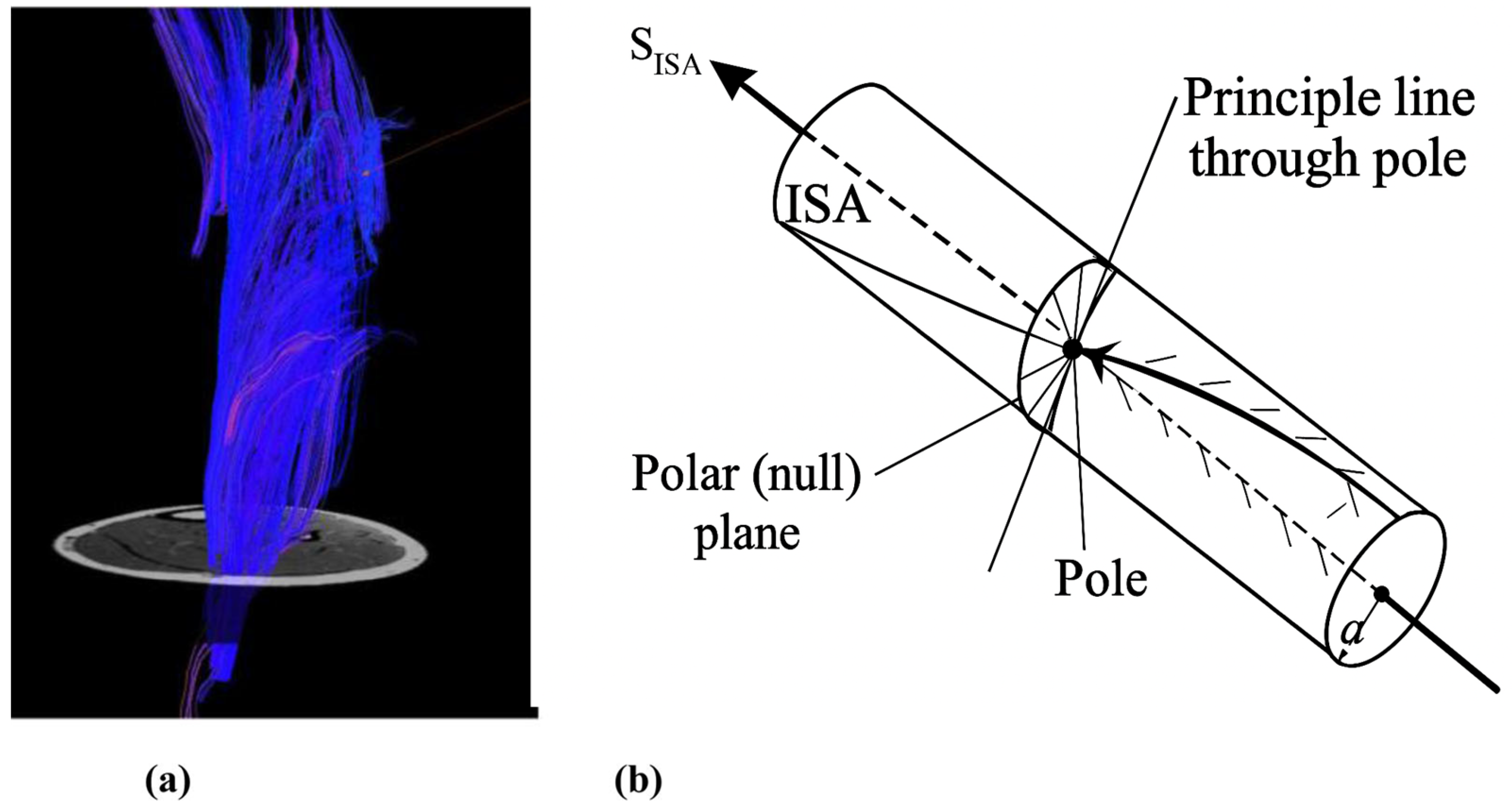
As illustrated in Figure 1, this organization may be abstracted as a manifold of tension lines. Panel (a) shows fiber tractography of the lateral gastrocnemius; panel (b) represents this distributed structure geometrically as an instantaneous screw IS ( p ) with perpendicular pole q. The screw representation provides a compact description of how distributed tensions give rise to coupled rotational–translational motion.
Rigid-Body Abstraction
The screw formulation does not assume anatomical rigidity. The musculoskeletal system contains compliant tissues and distributed internal degrees of freedom. The rigid-body representation applies only to the resultant motion field at the macroscopic scale. The instantaneous screw therefore serves as a geometric descriptor of organized motion, not as a denial of internal complexity. Internal compliance may influence screw evolution, but the external twist remains a coordinate-invariant description of observed movement.
This abstraction bridges distributed muscular action and whole-body motion, allowing synergy structure to be analyzed within screw geometry.

2.3.2. Spatial Screw Representation and Pitch

In screw theory, instantaneous rigid-body motion is represented as a twist in Plücker coordinates [15]:
s = ω v R 6 ,
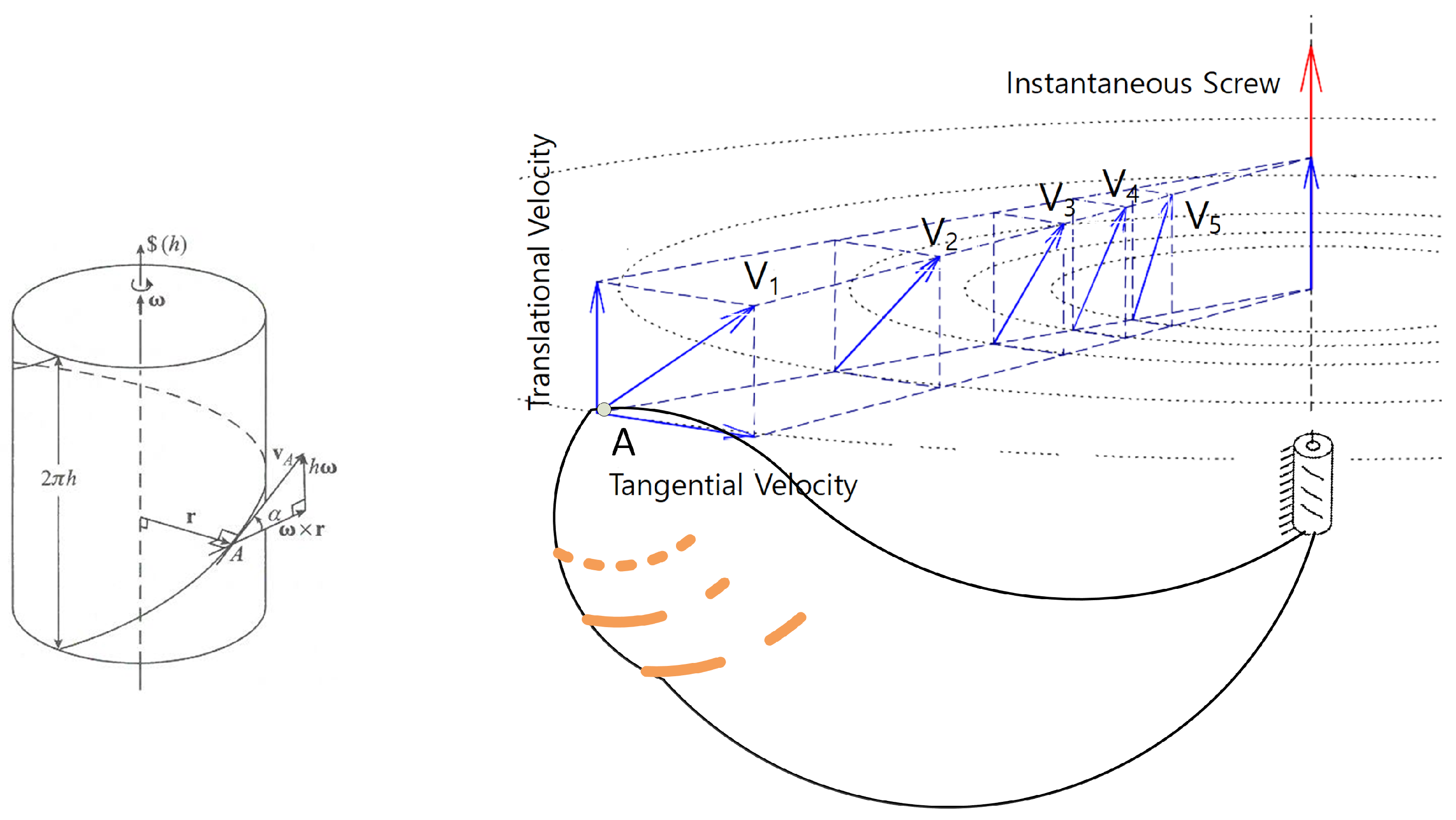
where ω and v denote angular and linear velocity. Geometrically, a twist defines a helicoidal velocity field whose axis coincides with the instantaneous screw axis (ISA) (Figure 2).
The pitch,
p = v · ω ω 2 ,
quantifies the rotational–translational coupling along the screw axis. p = 0 corresponds to pure rotation, while p corresponds to pure translation. Intermediate values describe helicoidal motion. In the present framework, pitch functions as a scalar descriptor of motion organization along a preferred screw direction.
Dynamics enter through the spatial inertia tensor [20]:
h = I s = τ f ,
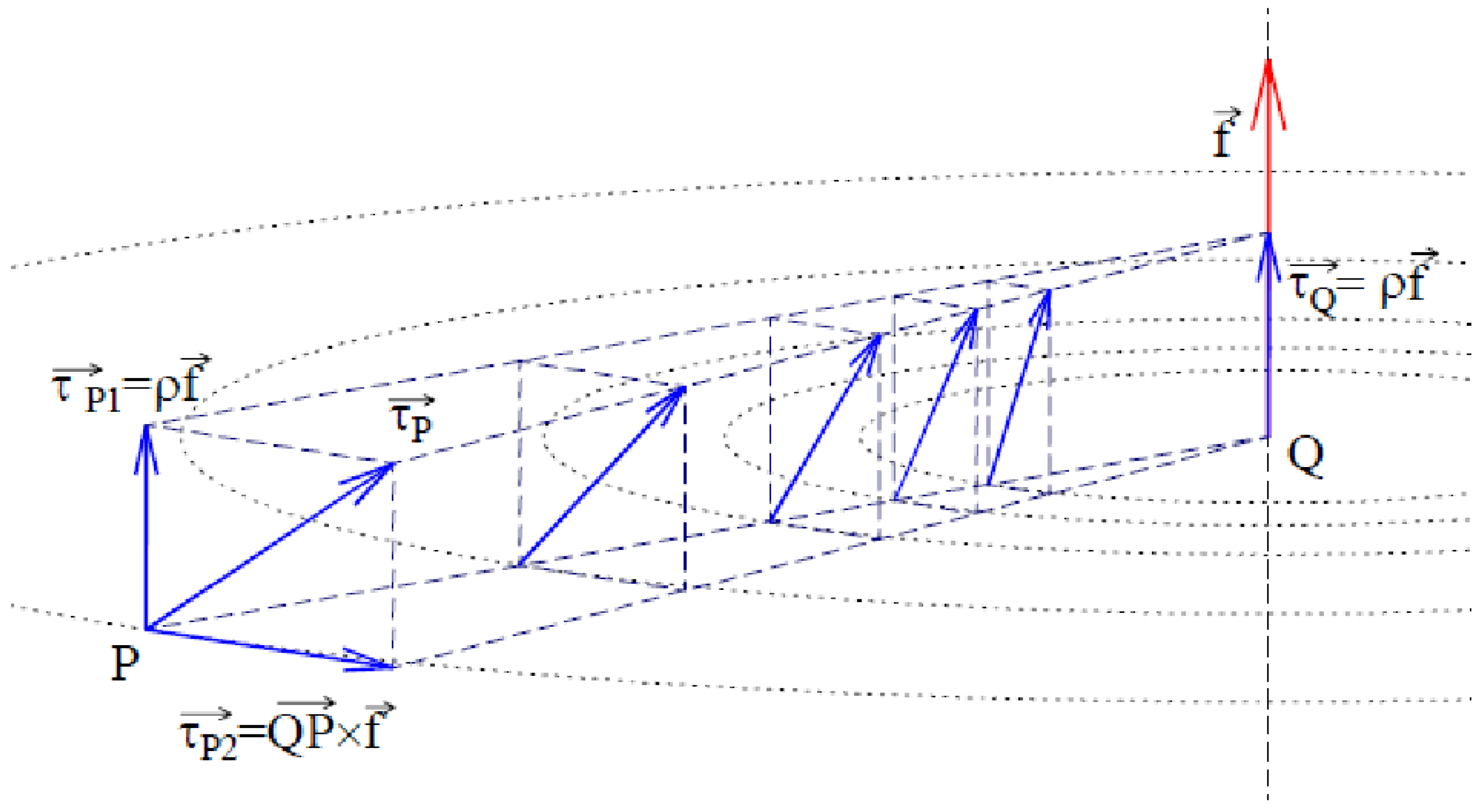
where h is the momentum screw combining moment τ and force f . This mapping relates the helicoidal velocity structure to a dual helicoidal wrench structure (Figure 3). When wrench and twist remain aligned, motion evolves along a harmonic screw, preserving proportional coupling between kinematics and dynamics.

2.3.3. From Helicoidal Fields to Optic and Haptic Flow

A moving rigid body generates a helicoidal velocity field organized about the ISA. Each material point traces a helix whose tangent vector belongs to a linear complex of lines determined by the screw axis. Motion is therefore structured as a spatially coherent line field rather than as independent point trajectories.
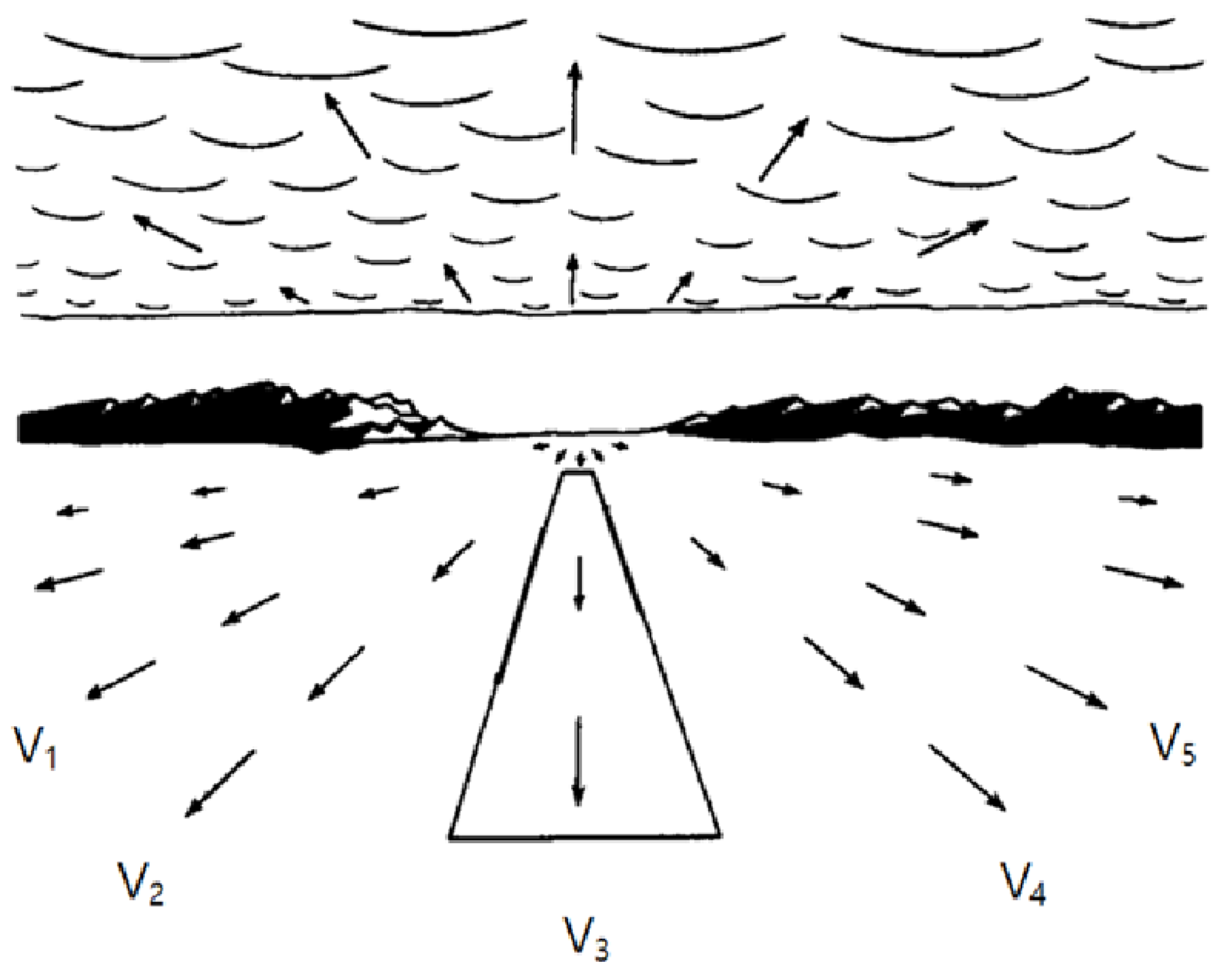
Gibson’s optic flow (Figure 4) can be interpreted as a limiting case of this structure. During forward locomotion, optical vectors radiate from a focus of expansion (FOE). In screw-theoretic terms, this corresponds to pure translation (infinite pitch) along a central axis. Optic flow thus reflects the projection of a translational screw onto the visual manifold.
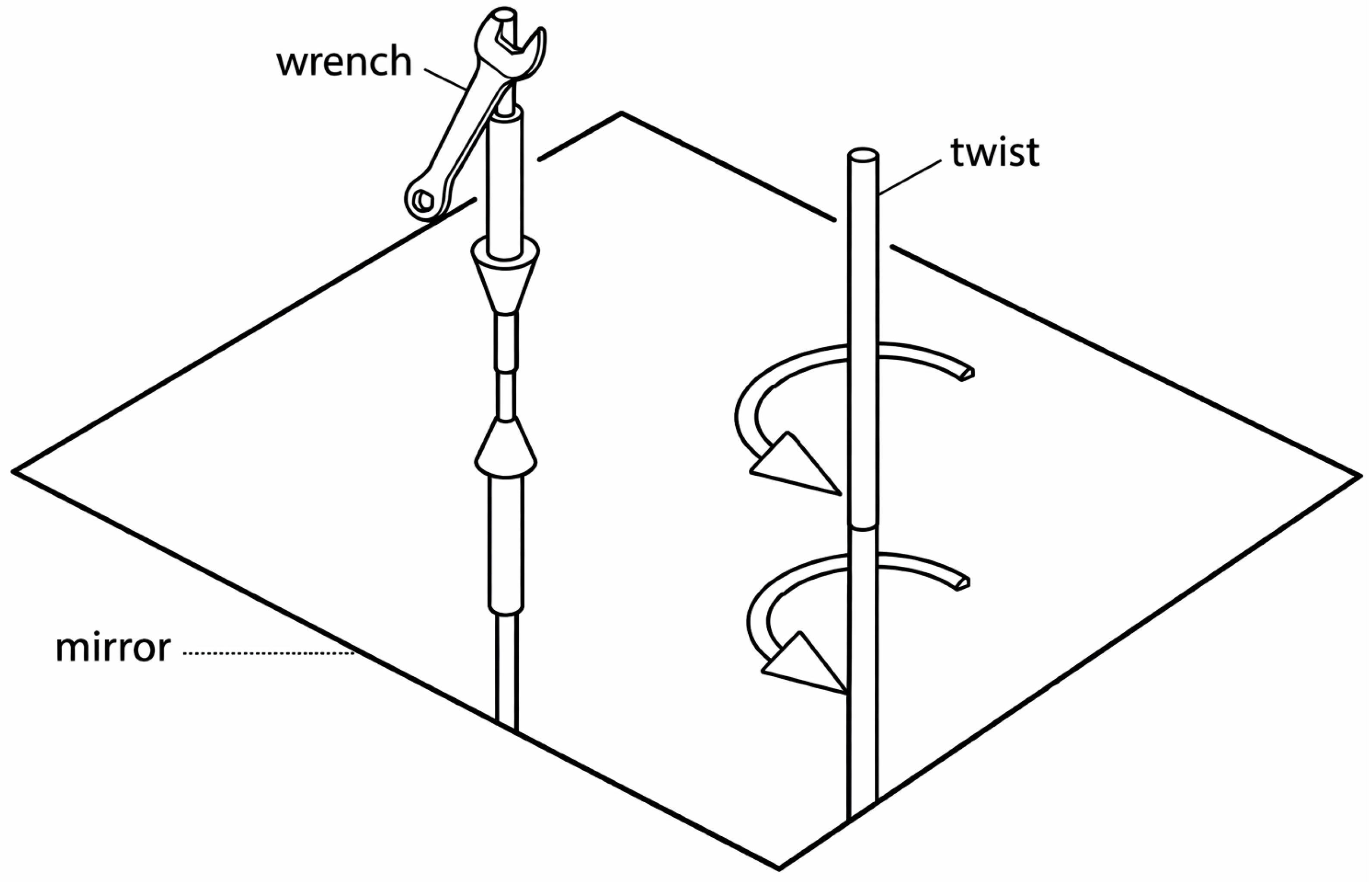
Featherstone’s “Vampire” thought experiment [24] (Figure 5) highlights a geometric asymmetry: forces (polar vectors) reverse under mirror reflection, whereas rotations (axial vectors) do not. Consequently, twist and wrench representations obey distinct transformation properties. This distinction motivates treating velocity fields and force–moment fields as dual geometric complexes.
Extending the helicoidal description from twists to wrenches yields a corresponding helicoidal wrench field. At each instant, forces and moments may be expressed as a screw: a force along an axis combined with a moment about that axis. We refer to the organized evolution of this wrench field as haptic flow.
Importantly, the present work demonstrates the geometric existence and coherence of such screw-structured fields. A more extended ecological interpretation of these screw-theoretic invariants is provided in Appendix A. The hypothesis that these invariants constitute perceptual information remains a theoretical proposal requiring independent validation.

2.3.4. Harmonic Screws Aligning Inertial and Restoring Screw Structures

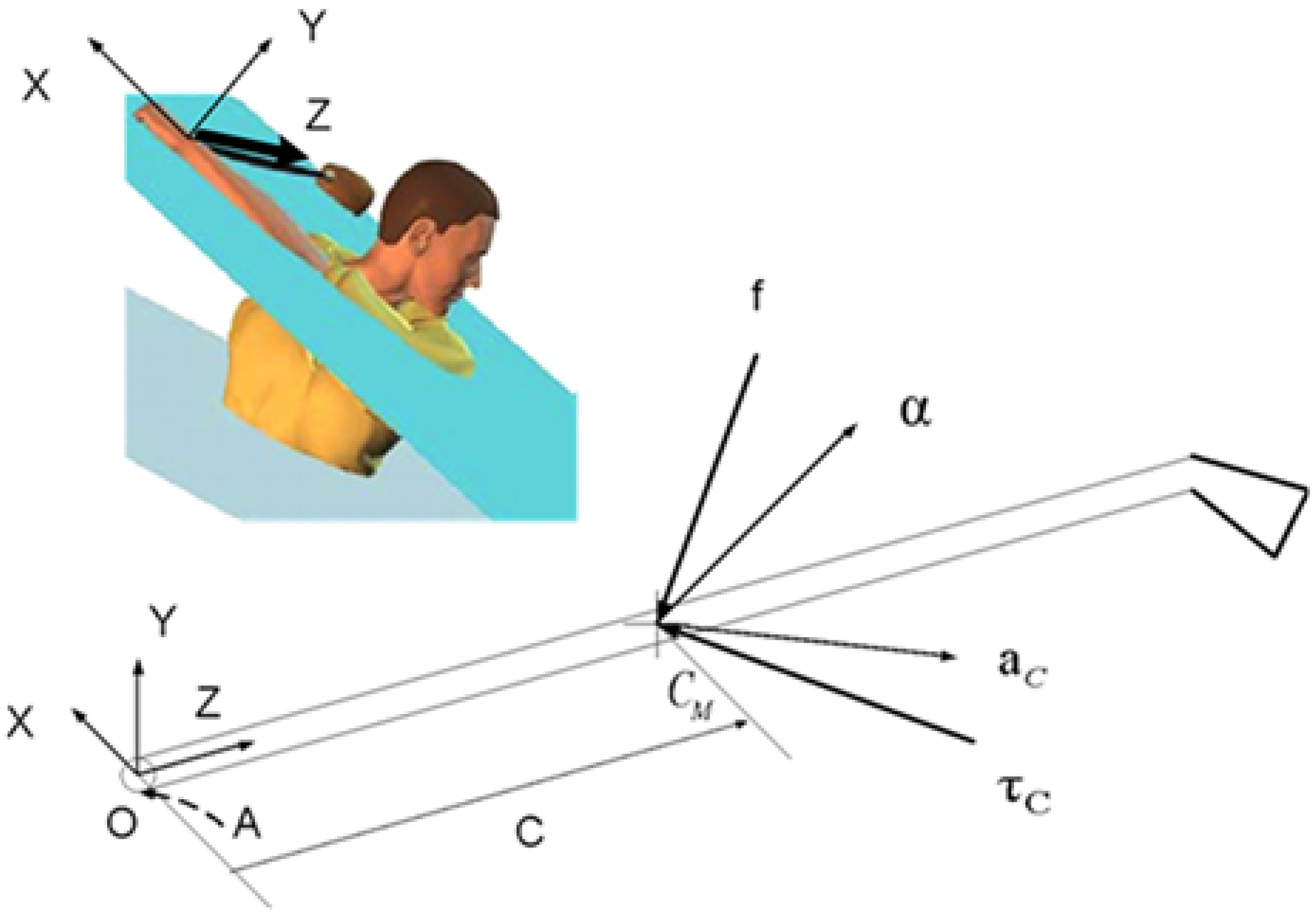
The inertial properties of the golf club are represented by the spatial inertia tensor M R 6 × 6 (Figure 6), which maps a twist to its corresponding momentum screw:
h = M s .
The spatial inertia matrix of the club expressed relative to the grip reference frame is given by
M = m 1 H H I = 0.788 0 0 0 29.241 1.001 0 0.788 0 29.241 0 1.108 0 0 0.788 1.001 1.108 0 0 29.241 1.001 2855.908 5.206 123.719 29.241 0 1.108 5.206 2859.116 111.823 1.001 1.108 0 123.719 111.823 20.966 .
The original values of the physical parameters and the associated anatomical sketch were originally published by MacKenzie and Sprigings (2009) [25] and are used here with the permission of Professor Sasho MacKenzie. All quantities are expressed relative to the grip reference frame.
The principal screws of inertia are obtained by solving the eigenvalue problem:
M s I = μ s I ,
where s I denotes an inertial eigenscrew and μ its associated eigenvalue.
Similarly, restoring forces arising from muscular stiffness and ground support are modeled using a potential (stiffness) tensor K , which maps twists to restoring wrenches:
w = K s .
The principal screws of stiffness satisfy
K s P = κ s P ,
where s P denotes a stiffness eigenscrew.
Assuming conservative dynamics with light damping, the coupled motion of the club–body system is governed by
M q ¨ + K q = 0 .
Seeking harmonic solutions of the form q ( t ) = s e i ω t yields the generalized eigenvalue problem:
K s H = ω 2 M s H ,
where s H defines a harmonic screw [11] and ω the associated natural frequency. It should be emphasized that, in the present study, the tensor K is not estimated from subject-specific stiffness measurements. Rather, K is introduced as a modeling construct to define the harmonic screw formulation and to illustrate inertia–restoration conjugacy. The harmonic interpretation is applied descriptively to the empirically computed screw field, without attempting parameter identification of system stiffness.
Accordingly, the harmonic screw framework is used here as a geometric interpretive tool rather than as a fully identified dynamical model. A harmonic screw represents a direction along which inertial and restoring effects are dynamically aligned. Motion along this screw minimizes internal work while preserving the geometric coherence of the movement.

2.4. Quantification of Haptic Flow

2.4.1. Instantaneous Screw Axis (ISA) Estimation from Marker Coordinates

The instantaneous screw axis (ISA) was computed directly from the measured marker trajectories using a linear line complex formulation in Plücker coordinates [18].
Let three non-collinear markers on a rigid segment occupy positions x i ( t ) and x i ( t + Δ t ) for i = 1 , 2 , 3 . Each marker displacement defines a line
i = x i ( t + Δ t ) x i ( t ) ,
with midpoint (pole)
r i = x i ( t ) + x i ( t + Δ t ) 2 .
The path normal through each marker is defined as the line perpendicular to i at r i . In Plücker coordinates, a line is represented as
S = n m = n r × n ,
where n is the unit direction vector, and m is its moment.
All path normals S i belong to a linear line complex defined by the ISA, such that
S i T D S I S A = 0 ,
where D is the Plücker interchange operator.
The optimal S I S A is obtained by minimizing the quadratic form
F ( S I S A ) = i = 1 k S i T D S I S A 2 ,
subject to S I S A = 1 , yielding a generalized eigenvalue problem.
The resulting S I S A defines the instantaneous screw axis in the global reference frame.

2.4.2. ISA Computation Pipeline

The instantaneous screw axis (ISA) was computed using the following procedure:
  • Marker positions were sampled at 300 Hz.
  • Linear velocities were obtained via first-order central finite differences.
  • The angular velocity ω was computed from the rigid-body transformation between successive frames.
  • A linear line-complex formulation in Plücker coordinates was applied to extract the central screw axis.
  • Tikhonov regularization [19] was performed in Plücker space to stabilize axis estimation under kinematic noise.
  • The regularization parameter was selected using the L-curve criterion [19].
  • The resulting ISA direction vector was normalized to unit length.

2.4.3. Geometric Interpretation and Cylindroid Constraint

Under effective two-degree-of-freedom constraints, harmonic screws reside on a cylindroid, a ruled surface generated by the combination of inertial and stiffness eigenscrews. The instantaneous screw axis (ISA) observed during the golf downswing corresponds to an intermediate screw on this surface.
Importantly, all screws in Ball’s formulation are defined in a global spatial frame [26]. Consequently, the effective degrees of freedom are not associated with individual anatomical segments but with the dominant global screw tendencies arising from club inertia and muscular restoring constraints.
The harmonic screw thus emerges as the motion mode that both the body and the club dynamically and perceptually “agree upon”, providing a unified geometric description of skilled movement.

2.4.4. Ruled Surface Generated by Instantaneous Screw Axes

During a finite movement, the instantaneous screw axis (ISA) does not remain fixed in space but evolves continuously. The family of successive ISAs therefore generates a ruled surface [17] composed of a one-parameter set of straight-line generators. Let the instantaneous screw at time t be expressed in Plücker coordinates as
$ ISA ( t ) = s ( t ) s 0 ( t ) , s ( t ) = 1 ,
where s ( t ) is the unit direction vector of the screw axis, and s 0 ( t ) = r ( t ) × s ( t ) is its moment vector with respect to the origin.
As t varies, the locus of the corresponding screw axes forms a ruled surface in space. In classical screw theory, such surfaces include cylindroids and axodes, which arise naturally from families of screws related by a law of pitch distribution [14]. In the present context, the ruled surface is empirically determined from measured kinematic data and represents the evolving geometric structure of the motion.

2.4.5. Definition of the Striction Curve

Associated with any ruled surface is a distinguished curve known as the striction curve [17]. In screw-theoretic terms, the striction curve is defined as the locus of central points, that is, the points of minimum distance between neighboring generators of the ruled surface [17].
Consider two infinitesimally separated instantaneous screw axes, $ ISA ( t ) and $ ISA ( t + d t ) . The common perpendicular between these two lines intersects each generator at a unique point. The intersection point on $ ISA ( t ) is referred to as the central point. The collection of all such points defines the striction curve.
Following the classical derivation of Hunt [13], the position vector of the central point c ( t ) can be written as
c ( t ) = s ( t ) × s 0 ( t ) s ( t ) 2 ,
where ( · ) denotes differentiation with respect to the curve parameter t. Equation (25) defines the striction curve intrinsically from the screw field and is independent of the choice of coordinate frame.
The striction curve is thus given by
C = { c ( t ) t [ t 0 , t f ] }
and represents the geometric backbone of the ruled surface generated by the ISA family.
Geometrically, the striction curve identifies where successive screw axes are most closely organized in space. Physically, it represents the locus about which the instantaneous motion exhibits maximal coherence. While each ISA describes a local instantaneous constraint, the striction curve captures a global time-integrated invariant of the movement.
In the context of skilled human motion, the ruled surface generated by ISAs reflects the available kinematic freedom of the moving segment or tool, whereas the striction curve reflects how this freedom is structured and progressively constrained. Smoothness and continuity of the striction curve are therefore indicative of coordinated stable movement organization, whereas fragmentation or abrupt changes in the curve signal kinematic asymmetry or loss of control.

2.4.6. Special Case: Cylindroid with One Screw of Infinite Pitch

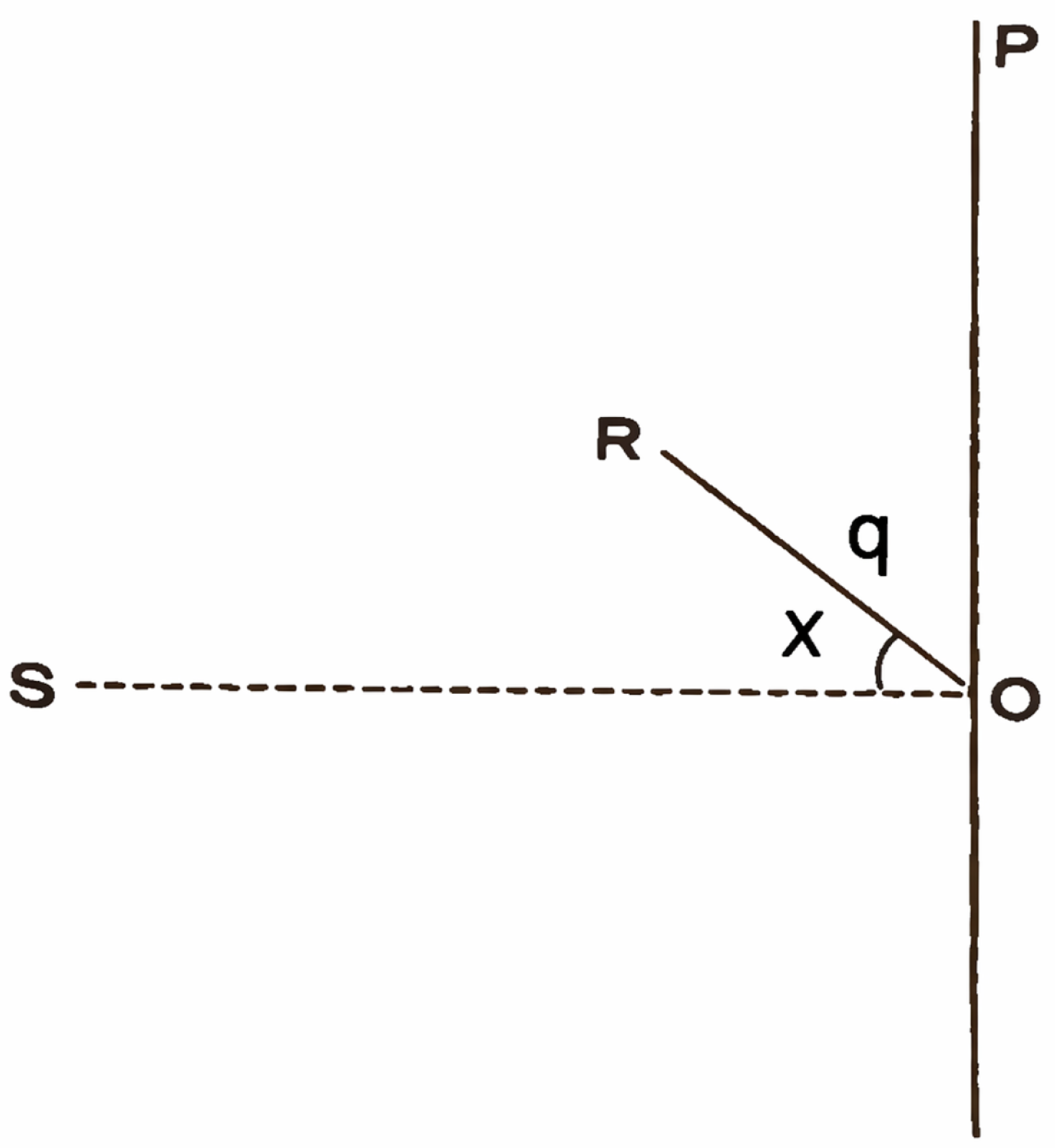
Consider a rigid body subjected to two elementary motions. Let S 1 be a screw of finite pitch [11] p about the axis O P (Figure 7), about which the body receives a small twist of amplitude ω . Let S 2 be a screw of infinite pitch, corresponding to a pure translation of magnitude p along a direction O R , parallel to itself.
The objective is to determine the cylindroid generated by the combination of these two screws.
Let the plane P O R be defined by the axes O P and O R . In this plane, draw a line O S perpendicular to O P , and denote the angle R O S by X. The translation of magnitude q along O R can then be resolved into two components:
  • A component q sin X parallel to the screw axis O P ,
  • A component q cos X parallel to O S .
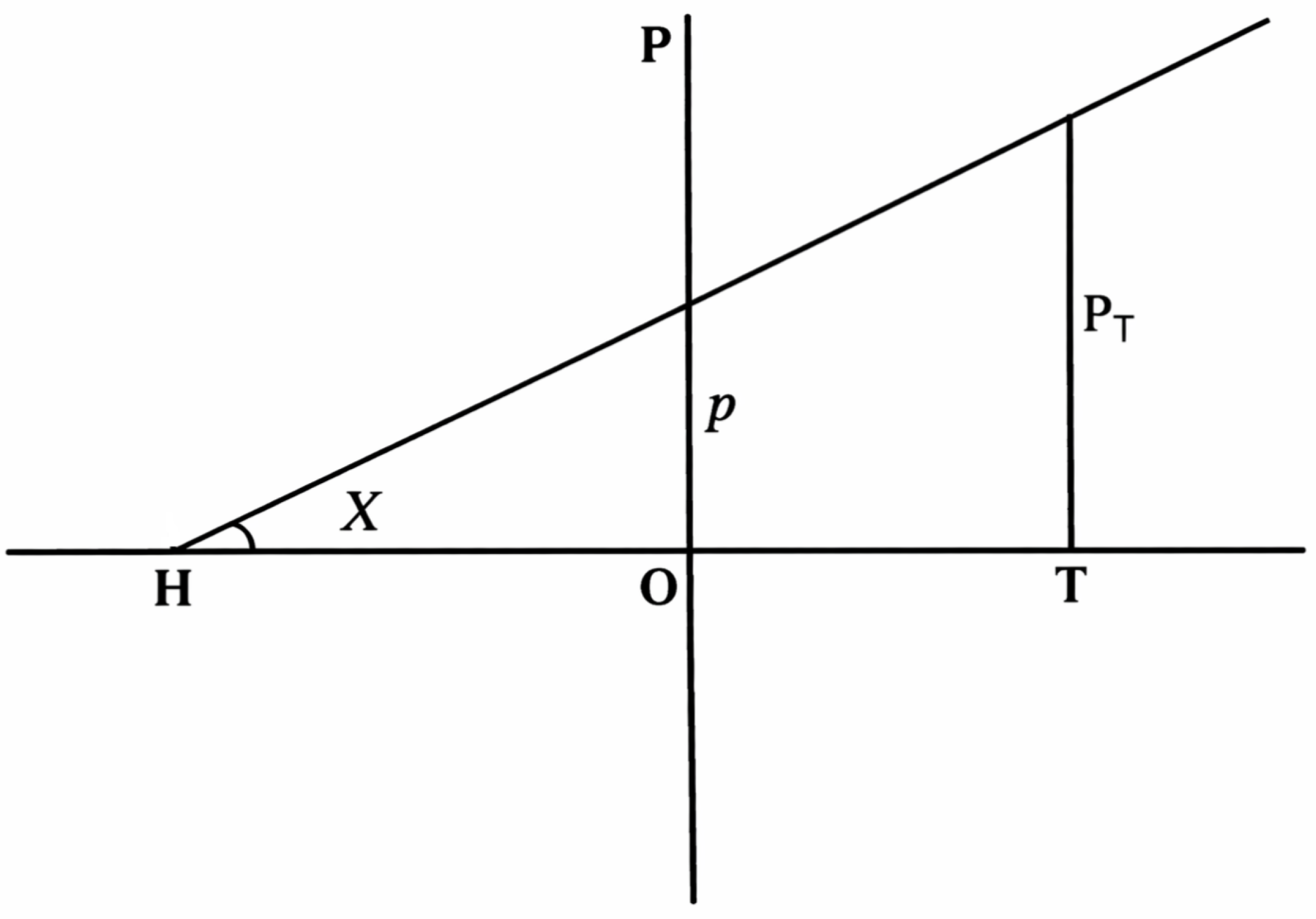
Next, erect a normal O T perpendicular to the plane P O R , such that its length satisfies the condition
ω O T = q cos X .
The combined effect of the rotational twist about O P and the translational motion along O R is therefore equivalent to a single twist of amplitude ω about a screw S T passing through the point T and parallel to O P .
The pitch p T of this resultant screw is given by
ω p T = ω p + q sin X ,
which yields
p T p = O T tan X .
To visualize this result, consider the plane perpendicular to O P that intersects the line O T (Figure 8). In this plane, the ordinate of each point corresponds to the pitch of the screw passing through that point. When p T = 0 , the point T coincides with a point H on the normal such that O T = O H . The point H therefore lies on the screw of zero pitch contained within the cylindroid.
This construction leads to the following theorem [11].
Theorem 1.
If one screw on a cylindroid has infinite pitch, the cylindroid reduces to a plane. The screws on the cylindroid form a system of parallel lines, and the pitch of each screw is proportional to its perpendicular distance from the screw of zero pitch.

2.4.7. Conceptual Quantification of Screw Field Organization

The present study introduces the geometric structure of haptic flow at a conceptual and descriptive level. Although visual comparison of ISA bundles, pitch evolution, and striction curves suggests differences in geometric coherence between the two cases, no formal dispersion or variability metrics were computed in this exploratory analysis.
Future developments of the framework may incorporate quantitative descriptors of screw field organization, including the following:
(1)
ISA Angular Dispersion.
The coherence of an ISA bundle could be quantified by the angular spread of direction vectors relative to their mean axis, providing a measure of bundle concentration.
(2)
Pitch Variability.
The temporal stability of pitch could be summarized using variance or coefficient of variation across the downswing phase, offering a scalar descriptor of pitch stabilization.
(3)
Striction Curve Geometry.
The smoothness of the striction trajectory could be characterized by the total arc length and curvature measures, distinguishing geometrically organized screw evolution from fragmented trajectories.
These descriptors are not computed in the present work, as the primary aim is to establish the geometric and ecological conceptualization of haptic flow rather than to provide a fully developed statistical framework. The introduction of such metrics represents a methodological extension necessary for future population-level validation, reliability assessment, and predictive modeling.
Accordingly, the current results should be interpreted as demonstrating the existence of structured screw invariants in the measured kinematics, without claiming quantitative discrimination capability or inferential generalization.

3. Results

3.1. Emergence of Haptic Flow in Skilled Manipulation

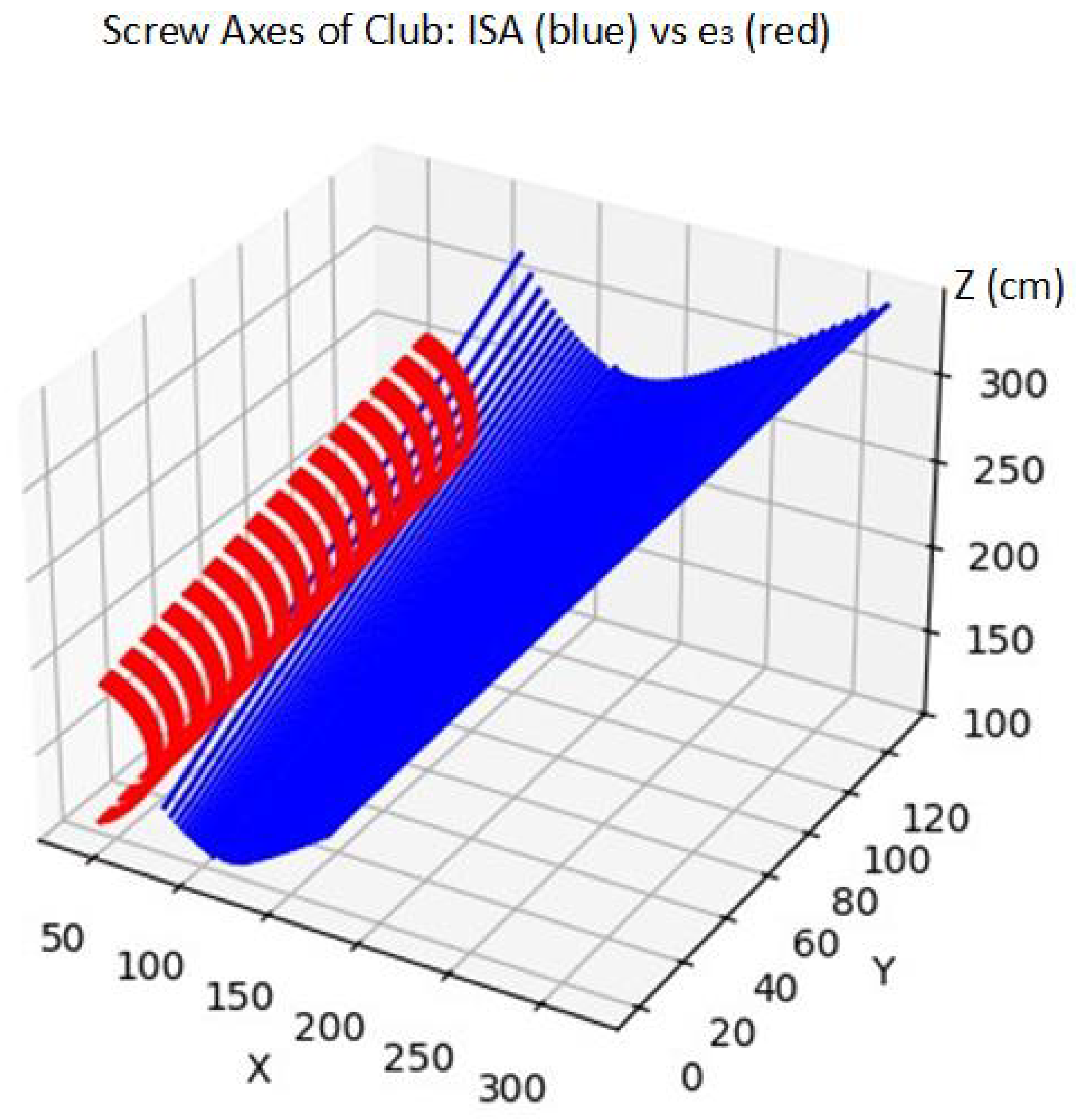
Figure 9 and Figure 10 compare the spatial organization of the instantaneous screw axes (ISA) and the principal inertia axis e 3 for proficient and novice golfers. In the proficient golfer, the ISA trajectories form a coherent bundle that evolves smoothly through the downswing and converges toward alignment with e 3 near impact. This organization yields a well-defined ruled surface whose striction curve is continuous and extended.
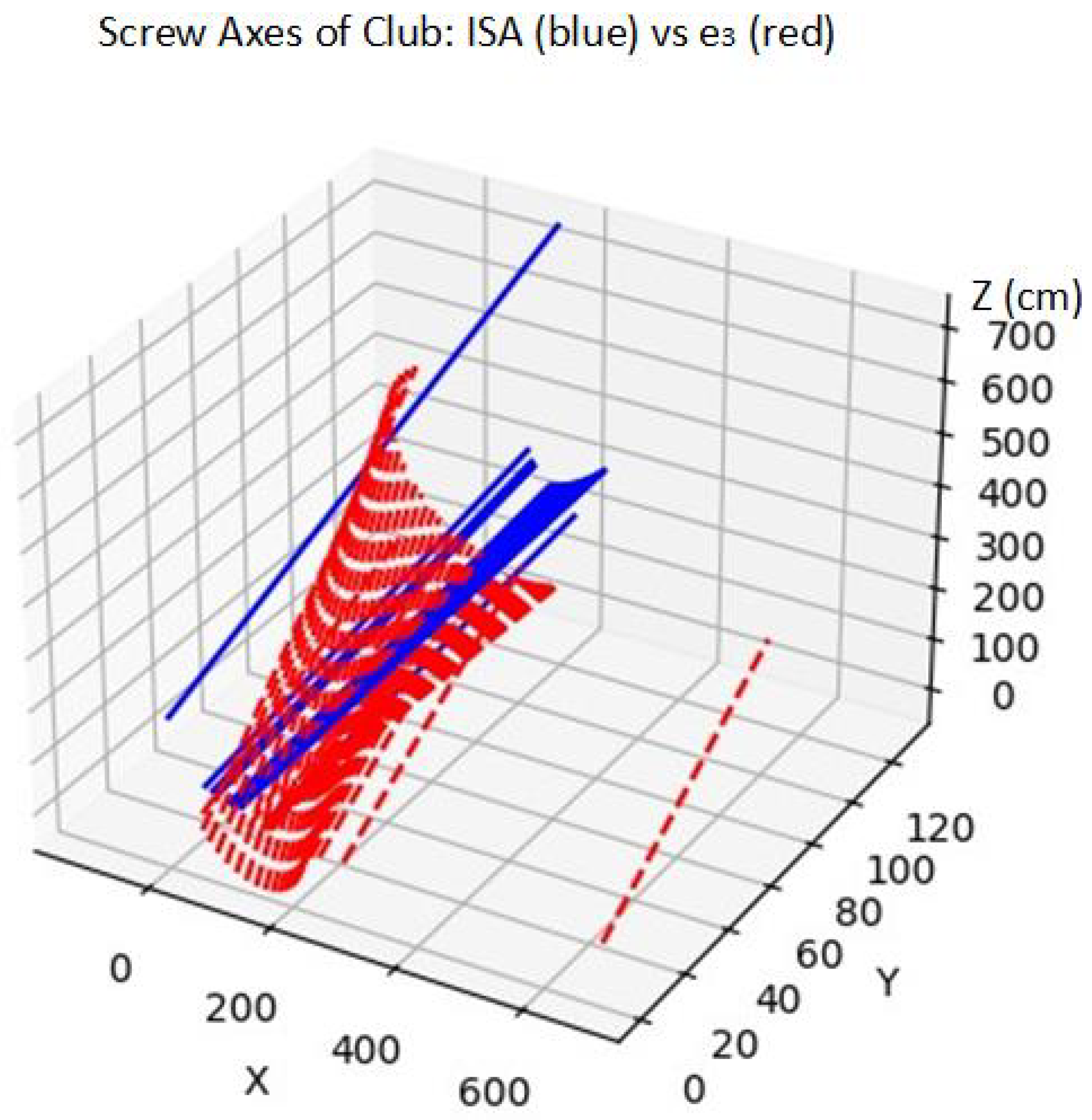
In contrast, the novice golfer exhibits dispersed ISA trajectories with frequent reorientation and reduced alignment with e 3 . The resulting ruled surface is fragmented, and its striction curve is shorter and irregular, with abrupt curvature changes near impact.
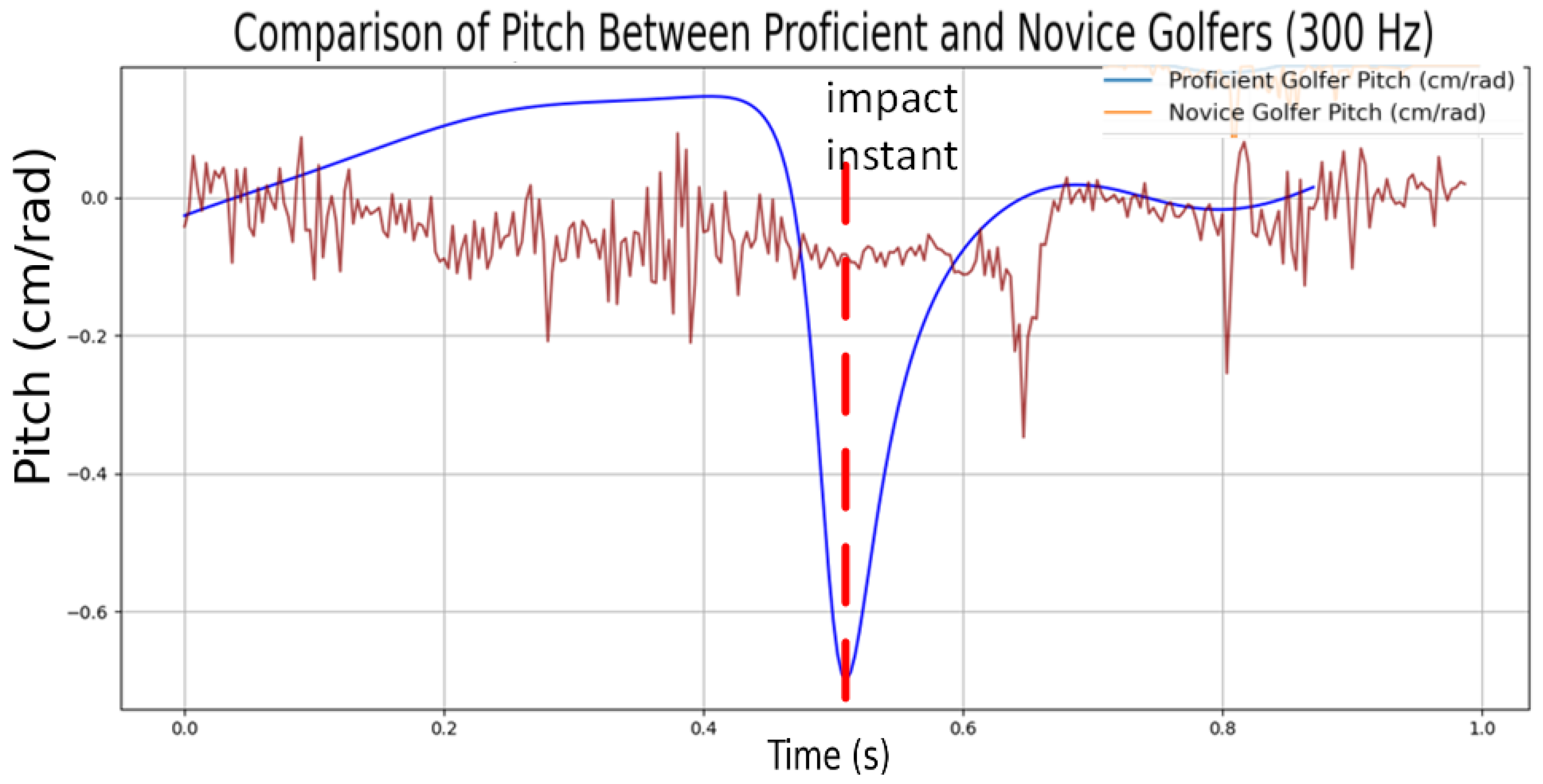
Figure 11 shows the temporal evolution of the screw pitch for both golfers. The proficient golfer demonstrates a smooth pitch trajectory with low variance and a pronounced extremum localized at impact. The novice golfer exhibits higher variability and multiple local extrema, indicating unstable coupling between rotational and translational components of motion.
The convergence of instantaneous screw axes, ISAs with e 3 , stabilization of pitch, and co-cylindrical organization observed in the proficient performer describe a coherent screw-structured field of motion. These results demonstrate the existence of stable geometric invariants within the measured kinematics of skilled action. We interpret this organization as consistent with the proposed haptic flow framework; however, the present analysis remains descriptive and does not establish perceptual utilization or causal determination. The findings therefore document mechanical structure rather than infer functional or neural mechanisms.
Consistent with the pitch results, the spatial distribution of the ISAs extracted throughout the downswing converged toward a narrow bundle in the skilled golfer, evolving smoothly in time rather than exhibiting abrupt reorientation. These ISAs clustered around a dominant direction coincident with the club’s principal inertia axis e 3 , indicating a strong alignment between the direction of motion and the club’s internal inertial structure. This alignment was most pronounced in the interval immediately preceding and including impact.
Geometric reconstruction of the resulting screw structure further revealed that the dominant screws observed at impact lay on a common cylindroid surface. The co-cylindrical arrangement demonstrates that the motion at impact was not an isolated event but the culmination of a continuous screw evolution initiated earlier in the downswing. The harmonic screws observed at impact therefore emerged from the global dynamics established by the golfer’s prior movement, rather than being generated locally at ball contact.
This screw-based organization corresponds to a continuous flow of internally generated mechanical information. The mapping from twist to momentum,
P = I s ,
reveals that the golfer’s motion produced a structured distribution of internal forces and moments that evolved lawfully over time. Rather than fluctuating irregularly, this distribution formed a smooth directed field aligned with the dominant screw direction.
The observed structure reflects a continuous action-generated pattern of mechanical information that remains invariant across the critical phase of performance, supporting the claim that skilled movement is guided by internally generated screw-structured information rather than by discrete feedback signals.
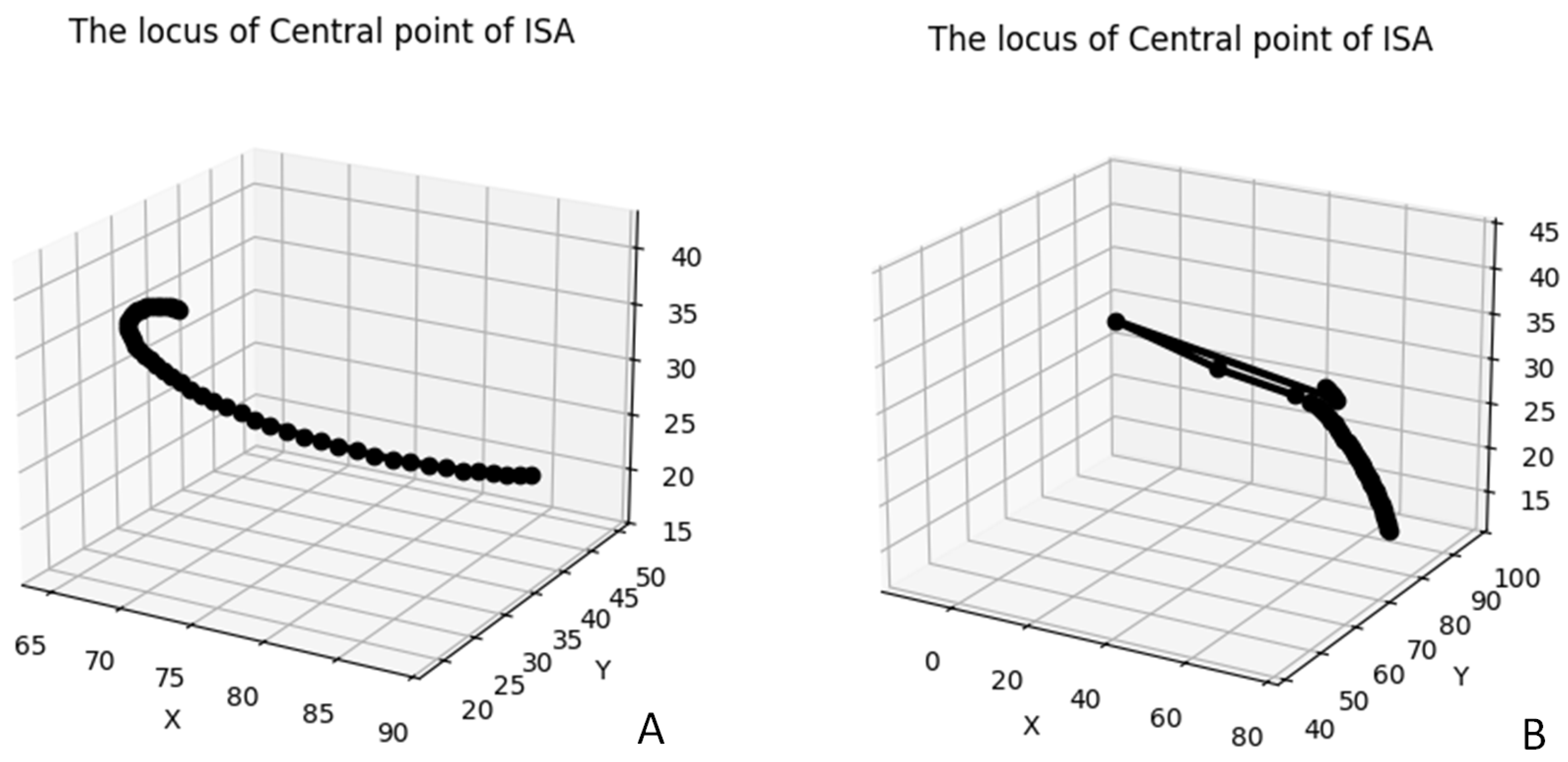
Figure 12 shows the striction curves, defined as the locus of central points of the ISA ruled surface. In the proficient golfer (Figure 12A), the striction curve is smooth and continuous, extending from early downswing through impact and into the follow-through. The novice golfer (Figure 12B) displays a shorter irregular striction curve with clustering and abrupt curvature changes near impact.
Across both representations, in the present proficient case, ISA– e 3 organization appears coherent and geometrically continuous, whereas in the present novice case, the screw structure exhibits higher asymmetry and reduced spatial coherence.

3.2. Harmonic Screws and Cylindroid Geometry at Impact

To interpret the observed ISA convergence and pitch stabilization, the screw dynamics were examined in the context of harmonic screws. Figure 13 illustrates a cylindroid surface generated by two independent global screw tendencies: one associated with the inertial properties of the club–body system and the other associated with restoring constraints arising from muscular action and ground interaction.
Two harmonic screws, shown as red lines, lie on this cylindroid surface and represent eigen-solutions of the combined inertia–stiffness system. At impact, these harmonic screws were found to be co-cylindrical [11], sharing the same ruled surface and geometric origin. The ISAs observed in the proficient golfer closely approximated these harmonic screws during the late downswing, indicating convergence toward dynamically admissible screw modes.
This co-cylindrical alignment implies that skilled impact does not arise from arbitrary joint coordination but from motion constrained to a family of geometrically permissible screw paths. The observed ISA trajectories reflect the selection of an intermediate screw on the cylindroid, consistent with harmonic motion that balances inertial and restoring influences.

3.3. Relation Between Harmonic Screws and Pitch Invariance

The alignment of ISAs with harmonic screws provides a geometric explanation for the pitch invariance in the skilled performance. As the motion converges toward a harmonic screw, the ratio between the translational and rotational velocity components remains approximately constant, resulting in a stable pitch profile. This behavior reflects dynamic equilibrium between inertia and restoring constraints, producing a helicoidal motion that is both mechanically efficient and temporally predictable.
In the novice golfer, the lack of convergence toward harmonic screws corresponds to unstable pitch behavior and irregular force–motion coupling. The absence of a dominant screw mode prevents the stabilization of pitch and contributes to variability at impact.

3.4. Summary of Key Findings

The results demonstrate that skilled golf swing dynamics are characterized by the following:
  • Progressive convergence of instantaneous screw axes toward a low-dimensional geometric structure;
  • Stable pitch profiles temporally synchronized with a single well-timed vertical GRF peak;
  • Co-cylindrical alignment of harmonic screws at impact on a common cylindroid surface;
  • Approximation of executed motion to dynamically admissible harmonic screw modes.
Together, these findings indicate that expert performance emerges from the stabilization of global screw geometry rather than from independent control of individual joints or segments.

3.5. Special Case at Impact: Cylindroid with Infinite Pitch

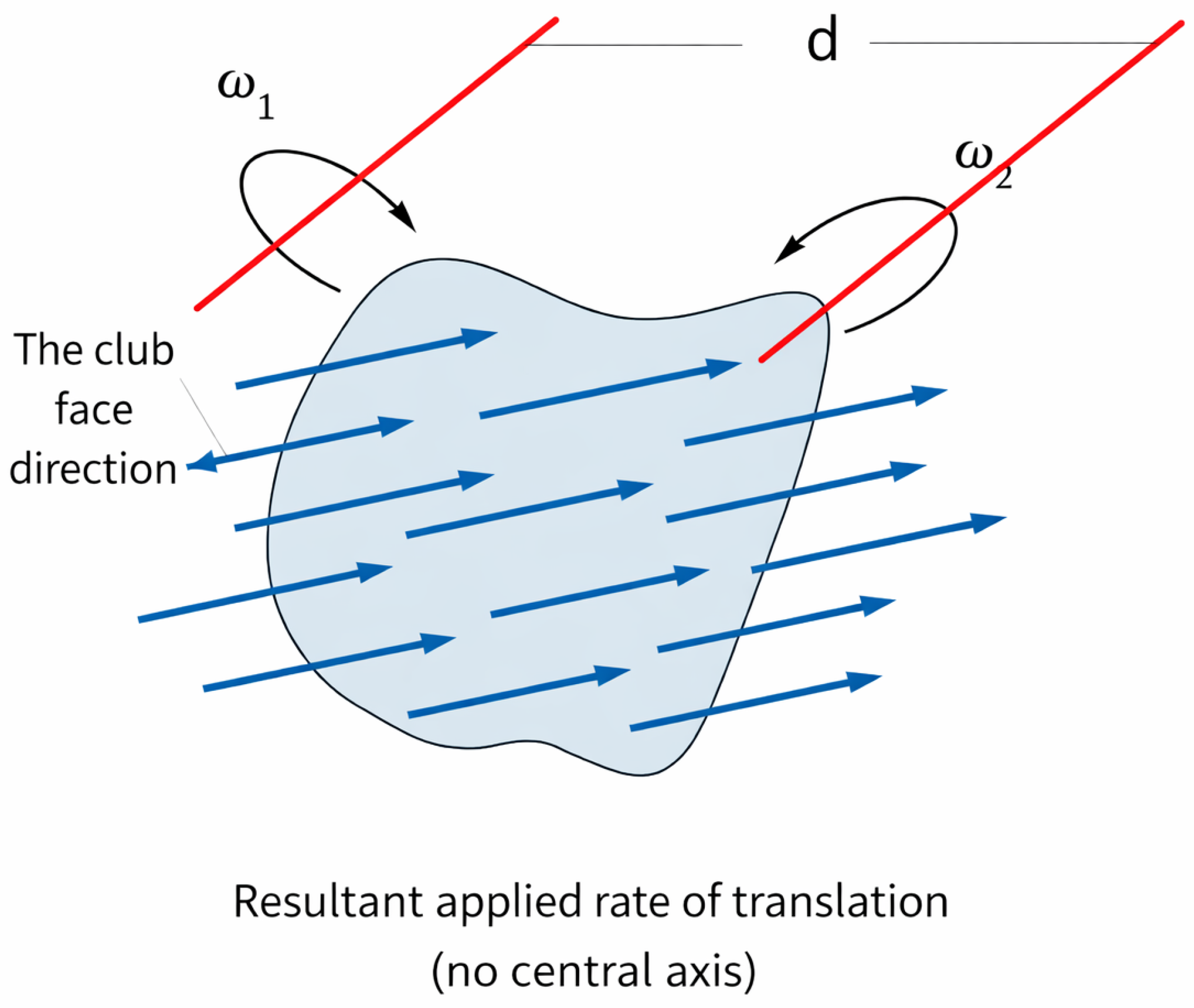
Near impact, the club–ball interaction approaches a transient state approximating pure translation. In screw-theoretic terms, this corresponds to a cylindroid containing a screw of infinite pitch [11]. In such a configuration, rotational components combine such that the net angular velocity locally vanishes, yielding a translational velocity field without a finite screw axis.
In the present dataset, this phenomenon is reflected in the temporal evolution of pitch (Figure 11). The proficient golfer exhibits a pronounced pitch extremum immediately preceding impact, consistent with a transient approach toward infinite pitch. The novice golfer displays irregular pitch fluctuations without a comparable singular structure.
Mechanically, this configuration may be interpreted as the superposition of two screw components of equal intensity and opposite pitch. Let the two contributing twists be expressed as
s 1 = ω v 1 , s 2 = ω v 2 ,
with pitches p and p , respectively. Their sum yields
s R = s 1 + s 2 = 0 v R ,
corresponding to translation with infinite pitch. The applied rate of translation is given by
v = ω × d ,
where d denotes the separation vector between the two screw axes.
This translational state arises geometrically from rotational superposition rather than from direct linear actuation. It exists transiently and represents a specific screw configuration within the admissible cylindroid.
The proficient golfer’s approach toward this configuration suggests stabilization of a dynamically admissible screw mode at impact, whereas the novice case shows no comparable convergence. These observations describe the mechanical structure derived from kinematic data and do not constitute perceptual measurements.

3.6. Mechanical Realization of Opposing Angular Velocities

For pure translation to emerge from rotational components, the contributing angular velocities must be arranged so that their superposition cancels net rotation while preserving linear velocity illustrated in Figure 13. When two angular velocities of equal magnitude and opposite direction act about parallel axes separated by distance d , their combined effect produces the translational field defined by Equation (33) [27].
This behavior does not imply the direct control of linear motion. Rather, translation arises as a consequence of rotational organization within the coupled body–implement system. In skilled performance, coordinated rotations of lower and upper body segments project onto a dynamically admissible screw direction, producing effective translation at the club head.
The mechanical effect depends on the projection onto the allowable screw of motion rather than on specific joint torques. Accordingly, the impact dynamics may be understood as stabilization of screw geometry within a cylindroid of admissible motions.
The present interpretation remains mechanical and descriptive. No inference is made regarding perceptual pickup or neural regulation of screw parameters.

4. Discussion

4.1. Harmonic Screws as Symmetry-Bearing Invariants

The observed convergence of instantaneous screw axes (ISAs) toward the principal inertia axis e 3 , stabilization of pitch, and cylindroid organization indicate the emergence of low-dimensional screw structure in skilled performance. In the proficient golfer, the ISA trajectories formed a coherent bundle and generated a smooth striction curve, reflecting stable rotational–translational coupling throughout the downswing.
In contrast, the novice golfer exhibited dispersed ISAs and irregular pitch evolution, indicating reduced geometric coherence.
These findings demonstrate that skilled manipulation is characterized by stabilization of global screw invariants rather than by independent joint-level regulation. Harmonic screw organization thus constitutes a symmetry-bearing structure in spatial motion space.

4.2. Relation to Contemporary Motor Control Frameworks

The screw-theoretic formulation complements established motor control perspectives.
The Uncontrolled Manifold (UCM) hypothesis analyzes task stability through variance structure in joint space [28,29]. By contrast, screw theory operates in spatial motion space, identifying geometric invariants—ISA alignment, pitch stabilization, and cylindroid structure—that describe global organization independent of specific joint parameterizations.
Similarly, dynamical systems theory conceptualizes coordination as the emergence of attractor states under biomechanical and environmental constraints [30,31]. Harmonic screws may be interpreted as geometric attractors in screw space: dynamically admissible directions along which inertial and restoring effects remain aligned.
The present framework therefore extends the coordination analysis from joint variance structure to invariant spatial motion geometry.

4.3. Haptic Flow as Mechanical Organization

In the present study, haptic flow refers operationally to the time-evolving screw structure of the body–object system, quantified through ISA trajectories, pitch evolution, and cylindroid geometry.
The proficient golfer demonstrated progressive ISA convergence, pitch stabilization, and co-cylindrical organization at impact. These features indicate the preservation of rotational–translational coupling within a coherent screw field.
The novice golfer exhibited fragmented screw organization and unstable pitch behavior, suggesting diminished geometric coherence.
The analysis remains mechanical and descriptive. It establishes the existence of structured screw invariants in skilled performance but does not demonstrate perceptual utilization of those invariants.

4.4. Mechanical Invariants and Informational Hypothesis

A conceptual distinction is necessary.
At the mechanical level, haptic flow denotes the computed screw structure derived from motion capture data. These invariants are geometric properties of the motion field.
At the informational level, one may hypothesize that such invariants could constitute candidate informational structures in ecological terms. However, the present study does not measure perceptual sensitivity, nor does it demonstrate pickup of screw invariants.
Accordingly, the informational interpretation remains theoretical. The empirical contribution of this study is the formal identification of symmetry-bearing screw structure in skilled manipulation.
A complementary ecological elaboration of the informational hypothesis is presented in Appendix A.

4.5. Skilled vs. Novice Performance as Symmetry Stabilization

The distinction between proficient and novice performance can be understood as differential stabilization of screw symmetry.
In skilled impact, translation of the club head emerges from coordinated rotational components whose geometric superposition yields a dynamically admissible screw. The mechanical effect depends on projection onto the allowable screw direction rather than on specific joint torques.
This projection-based organization explains the robustness: similar impact outcomes can arise from different joint-level strategies, provided that the global screw structure is preserved.
Importantly, this account does not imply the explicit regulation of instantaneous screw parameters. Coherent screw organization emerges from constraint-based self-organization of the coupled body–implement system.
The findings are limited to a two-case comparison and remain descriptive. No population-level inference or perceptual claims are made.

4.6. Predictive Implications and Real-Time Prospects

The present study is descriptive and does not implement the real-time prediction of club-face angle error or behavioral correction within a neural delay window. All screw-theoretic quantities were computed offline from motion capture data. Accordingly, no claim is made that feed-forward control has been empirically demonstrated.
While the geometric structure of harmonic screws suggests potential suitability for real-time computation, such predictive functionality has not been evaluated in the present study. We are currently developing a wearable IMU-based streaming system in which the pitch and ISA alignment are computed in near-real time for neurorehabilitation applications.
For example, rehabilitation protocols could target the stabilization of pitch variability during constrained manipulation tasks as a quantitative marker of coordination recovery. This ongoing work aims to test whether screw-theoretic invariants can support actionable model-free movement stabilization under realistic timing constraints.

5. Conclusions

This study formalized haptic flow as a mechanically defined invariant expressed through instantaneous screw axes, pitch evolution, and cylindroid structure. Using a two-case comparison of skilled and novice golf swings, we showed that proficient performance was associated with convergence toward harmonic screw modes, stabilization of pitch at impact, and coherent ISA organization aligned with the club’s principal inertia axis.
These results describe a symmetry-bearing geometric structure emerging from body–object coupling. The analysis is descriptive and does not demonstrate neural control mechanisms or perceptual pickup. Instead, it provides a coordinate-invariant framework for identifying global rotational–translational organization in skilled manipulation.
Several limitations must be emphasized. The study is based on a single proficient and single novice performer and does not support population-level inference. Sensory contributions were not experimentally manipulated, and perceptual sensitivity to screw-theoretic invariants remains untested. Furthermore, the golf swing represents a constrained rigid-tool interaction; generalization to other tasks requires empirical validation.
Future work should (i) examine harmonic screw invariants across diverse manipulation contexts, (ii) test robustness under perturbation, (iii) evaluate real-time estimation using wearable sensing systems, and (iv) investigate relationships between screw-structured invariants and behavioral or clinical outcome measures.
By distinguishing mechanical invariants from neural implementation, this work positions screw theory as a geometric framework for analyzing symmetry and asymmetry in human movement while maintaining conceptual clarity regarding its theoretical scope.

Funding

This research was funded by PROCIENCIA, grant No. PE501080681-2022-PROCIENCIA Proyectos Especiales: Proyectos de Investigadores Visitantes.

Institutional Review Board Statement

The study was conducted in accordance with the Declaration of Helsinki. Ethical review and approval were waived for this study due to its non-invasive observational nature and the research regulations in Portugal at the time of data collection in 2011. Nevertheless, all participants provided written informed consent prior to participation.

Data Availability Statement

The original contributions presented in this study are included in the article. Further inquiries can be directed to the corresponding author.

Acknowledgments

The author would like to acknowledge Miwon Kim, Sofia Camacho, and Jorge Infante for their help during data acquisition for this study. The first author would also like to thank Sangdo Kim for his stimulating discussions regarding the perfection of the golf swing. This research was funded by PROCIENCIA under contract No. PE501080681-2022-PRO-CIENCIA Proyectos Especiales: Proyectos de Investigadores Visitantes.

Conflicts of Interest

The author declares no conflicts of interest.

Appendix A. Ecological Interpretation of Screw-Theoretic Invariants

This appendix elaborates the ecological interpretation of the screw-theoretic invariants described in the main text. The distinction between mechanical demonstration and perceptual hypothesis is maintained explicitly.

Appendix A.1. Mechanical Invariants and Informational Structure

The primary result of the present study is the geometric identification of organized screw structure in skilled movement: convergence of instantaneous screw axes (ISAs), stabilization of pitch, and cylindroid coherence. These quantities are computed directly from kinematic data and represent coordinate-invariant properties of the motion field.
Within an ecological framework, invariants generated by lawful organism–environment interaction may constitute candidate informational structures. In vision, optic flow specifies heading through global invariants of the ambient array. By structural analogy, screw-theoretic invariants may define a mechanically specified field emerging from action itself.
Importantly, the present study demonstrates only the geometric existence and stability of such invariants. No perceptual measurements were collected, and no claim is made that performers explicitly detect instantaneous screw axes or pitch values.

Appendix A.2. Twist–Wrench Duality and Ecological Reaction Fields

In screw theory, motion (twist) and force–moment structure (wrench) are geometrically dual. A helicoidal velocity field generated by action induces a corresponding helicoidal wrench field through spatial inertia. The organized evolution of this wrench field is termed haptic flow in the main text.
From an ecological standpoint, both optic flow and haptic flow may be viewed as reaction structures: lawful transformations generated by movement. Optic flow reflects the transformation of the visual array during locomotion. Haptic flow reflects the structured distribution of force–moment relations during mechanical engagement with the environment.
The analogy is structural rather than functional. The optic domain involves projection onto a visual manifold, whereas the haptic domain involves internal mechanical coupling. The present work establishes the mechanical structure of the latter without asserting perceptual equivalence.

Appendix A.3. Invariance, Skill, and Symmetry

The comparison between a proficient and a novice performance revealed differences in the geometric coherence of screw structure. In the proficient case, the ISAs converged toward a dominant axis, and the pitch evolved smoothly through impact. In the novice case, screw organization was fragmented and less stable.
From a symmetry perspective, skilled movement may be characterized by the stabilization of a low-dimensional screw structure within a high-dimensional system. Such stabilization reduces the effective degrees of freedom at the level of spatial motion, even though anatomical complexity remains.
This interpretation is consistent with ecological and dynamical systems accounts of coordination as constraint-based self-organization. However, the present results remain descriptive. Whether screw invariants are directly exploited perceptually, or whether they emerge as by-products of biomechanical constraints, requires independent empirical investigation.

Appendix A.4. Scope and Limitations

The haptic flow construct introduced in this manuscript is a mechanically defined invariant derived from screw geometry. It should not be interpreted as a verified perceptual variable. Demonstrating perceptual sensitivity to such invariants would require perturbation experiments, sensory manipulation, or behavioral tests beyond the scope of the current dataset.
Accordingly, Appendix A clarifies that the ecological interpretation offered here is theoretical. The main contribution of the article remains the formalization and empirical description of screw-structured invariants in skilled human movement.

References

  1. Bernstein, N.A. The problem of interrelation between coordination and localization. Arch. Biol. Sci. 1935, 38, 1–35. [Google Scholar]
  2. Gibson, J. The Senses Considered as Perceptual Systems; Houghton: Boston, MA, USA, 1966. [Google Scholar]
  3. Gibson, J. The Ecological Approach to Visual Perception; Houghton Mifflin: Boston, MA, USA, 1979. [Google Scholar]
  4. Bernstein, N.A. The Coordination and Regulation of Movements; Pergamon Press: Oxford, UK, 1967. [Google Scholar]
  5. Kelso, J.S. Dynamic Patterns: The Self-Organization of Brain and Behavior; MIT Press: Cambridge, MA, USA, 1995. [Google Scholar]
  6. Sadeghi, H. Local or global asymmetry in gait of people without impairments. Gait Posture 2003, 17, 197–204. [Google Scholar] [CrossRef] [PubMed]
  7. Patterson, K.K.; Gage, W.H.; Brooks, D.; Black, S.E.; McIlroy, W.E. Evaluation of gait symmetry after stroke: A comparison of current methods and recommendations for standardization. Gait Posture 2010, 31, 241–246. [Google Scholar] [CrossRef] [PubMed]
  8. Ferris, D.P.; Farley, C.T. Interaction of leg stiffness and surface stiffness during human hopping. J. Appl. Physiol. 1997, 82, 15–22. [Google Scholar] [CrossRef] [PubMed]
  9. McMahon, T.A.; Cheng, G.C. The mechanics of running: How does stiffness couple with speed? J. Biomech. 1990, 23, 65–78. [Google Scholar] [CrossRef] [PubMed]
  10. Kim, W.; João, F.; Mota, P.; Aguiar, L.; Veloso, A. Natural Shock Absorption of the Leg Spring. J. Biomech. 2012, 45, S221. [Google Scholar] [CrossRef]
  11. Ball, R. A Treatise on the Theory of Screws; Cambridge University Press: Cambridge, UK, 1900. [Google Scholar]
  12. Davidson, J.; Hunt, K. Robots and Screw Theory: Applications of Kinematics and Statics to Robotics; Oxford University Press: Oxford, UK, 2004. [Google Scholar]
  13. Hunt, K.H. Kinematic Geometry of Mechanism; Clarendon Press: Oxford, UK, 1990. [Google Scholar]
  14. Hunt, K.H. Special configurations of robot-arms via screw theory. Robotica 1986, 4, 171–179. [Google Scholar] [CrossRef]
  15. Kiat Teu, K.; Kim, W. Estimation of the axis of a screw motion from noisy data—A new method based on Plucker lines. J. Biomech. 2006, 39, 2857–2862. [Google Scholar] [CrossRef] [PubMed]
  16. Kim, W.; Veloso, A.; Araújo, D.; Machado, M.; Vleck, V.; Aguiar, L.; Cabral, S.; Vieira, F. Haptic Perception-Action Coupling Manifold of Effective Golf Swing. Int. J. Golf Sci. 2013, 2, 10–32. [Google Scholar] [CrossRef]
  17. Dooner, D. Kinematic Geometry of Gearing; Cambridge University Press: Cambridge, UK, 2012. [Google Scholar]
  18. Kim, W.; Veloso, A.P.; Araújo, D.; Vleck, V.; João, F. An informational framework to predict reaction of constraints using a reciprocally connected knee model. Comput. Methods Biomech. Biomed. Eng. 2015, 18, 78–89. [Google Scholar] [CrossRef] [PubMed]
  19. Kim, W.; Kim, Y.H.; Veloso, A.P.; Kohles, S.S. Tracking knee joint functional axes through Tikhonov filtering and Plűcker coordinates. J. Nov. Physiother. 2013, 3, 117. [Google Scholar] [CrossRef] [PubMed]
  20. Ciblak, N. Analysis of Cartesian Stiffness and Compliance with Applications; Georgia Institute of Technology: Atlanta, GA, USA, 1998. [Google Scholar]
  21. Shaw, R.E.; Turvey, M. Ecological foundations of cognition. II: Degrees of freedom and conserved quantities in animal-environment systems. J. Conscious. Stud. 1999, 6, 111–124. [Google Scholar]
  22. Myers, T.W. Anatomy Trains: Myofascial Meridians for Manual and Movement Therapists; Elsevier Health Sciences: Amsterdam, The Netherlands, 2009. [Google Scholar]
  23. Huijing, P.A. Myofascial force transmission. In Encyclopedia of Exercise Medicine in Health and Disease; Springer: Berlin/Heidelberg, Germany, 2012; p. 617. [Google Scholar]
  24. Featherstone, R. On the Limits to Invariance in the Twist/Wrench and Motor Representations of Motion and Force Vectors. Proc. R. Soc. A Math. Phys. Eng. Sci. 2000, 456, 115–132. [Google Scholar]
  25. MacKenzie, S.J.; Sprigings, E.J. A three-dimensional forward dynamics model of the golf swing. Sport. Eng. 2009, 11, 165–175. [Google Scholar] [CrossRef]
  26. Crane, C.D., III; Griffis, M.; Duffy, J. Screw Theory and Its Application to Spatial Robot Manipulators; Cambridge University Press: Cambridge, UK, 2022. [Google Scholar]
  27. Phillips, J. Freedom in Machinery; Cambridge University Press: Cambridge, UK, 2007; Volume 1. [Google Scholar]
  28. Scholz, J.P.; Schöner, G. The uncontrolled manifold concept: Identifying control variables for a functional task. Exp. Brain Res. 1999, 126, 289–306. [Google Scholar] [CrossRef] [PubMed]
  29. Latash, M.L. Motor Control: Studying the Organization of Human Movement; Academic Press: Cambridge, MA, USA, 2010. [Google Scholar]
  30. Scott Kelso, J.A. Dynamic Patterns: The Self-Organization of Brain and Behavior. Electroencephalography and Clinical Neurophysiology; The MIT Press: Cambridge, MA, USA, 1997; Volume 103, p. 576. [Google Scholar]
  31. Turvey, M.T. Coordination. Am. Psychol. 1990, 45, 938–953. [Google Scholar] [CrossRef] [PubMed]
Figure 1. (a) Fiber tractography of a portion of the lateral gastrocnemius muscle, illustrating a distributed manifold of individual muscle fibers under tension. (b) Conceptual abstraction of this manifold as an instantaneous screw IS ( p ) and its perpendicular pole q, representing coupled rotational and translational effects of muscular tension.
Symmetry 18 00471 g001
Figure 2. Screw-based representation of coupled rotational and translational motion and its relation to haptic flow. (Left) Classical helical motion generated by a rigid body rotating about an axis with angular velocity ω and translating with pitch h, illustrating the geometric coupling inherent to screw motion. (Right) Decomposition of local point velocities along a curved trajectory into tangential and translational components relative to the instantaneous screw. The sequence of velocity vectors ( V 1 V 5 ) demonstrates how rotational and translational components evolve coherently along the motion path. Within the present framework, this evolving velocity field constitutes haptic flow: a structured force–moment information field generated by action and specified relative to the instantaneous screw, rather than isolated kinematic vectors.
Symmetry 18 00471 g002
Figure 3. Geometric organization of force–moment relations underlying haptic flow expressed as a screw system. A force f applied at different points (P, Q) generates corresponding moments ( τ P 1 , τ P 2 , τ Q ), whose combined effect defines a wrench aligned with the instantaneous screw. The spatial distribution of these wrenches forms a coherent screw field rather than independent force vectors. In the context of haptic flow, this screw-aligned wrench field represents the perceptual–mechanical information generated during movement, specifying stability and motion through invariant force–moment coupling rather than through localized force measurements.
Symmetry 18 00471 g003
Figure 4. Gibson’s representation of optic flow during forward locomotion. The center of the flow pattern corresponds to the field’s central axis and coincides with the animal’s virtual heading direction (focus of expansion, FOE). Each vector V i ( i = 1 , , 5 ) represents the optical motion of a corresponding environmental element. All vectors radiate outward from the FOE, reflecting the projection of a translational screw axis (infinite pitch case) onto the visual manifold.
Symmetry 18 00471 g004
Figure 5. “Featherstone’s Vampire” mirror analogy. A force directed toward a mirror reverses direction under reflection (polar vector), whereas a rotation about the same axis does not reverse (axial vector). The contrast illustrates that force and rotation obey different transformation rules, motivating the dual (twist vs. wrench) treatment of velocity fields and force–moment fields in screw theory.
Symmetry 18 00471 g005
Figure 6. A club has a mass m; its center of mass, denoted C M , is specified by the position vector C ; and the inertia tensor about its center of mass is J . The club is initially at rest and experiences a force f acting along a line passing through the center of mass, together with a couple τ C M . The resulting motion is characterized by an angular acceleration α about an axis passing through C M and a linear acceleration a C M of the center of mass (units in kg · cm2).
Symmetry 18 00471 g006
Figure 7. Cylindroid with one screw of infinite pitch. Geometric construction illustrating the special case in which one constituent screw has infinite pitch. The vertical line OP represents a screw of finite pitch p. Let O R be the direction along which the rigid body is translated through an equal distance q, parallel to O R . The resultant screw of pitch P T is represented by the cylindroid determined by the combination of these two screws. This configuration demonstrates how pure translation can emerge transiently from the symmetric composition of opposing screw actions, providing the geometric basis for the applied rate of translation observed at impact.
Symmetry 18 00471 g007
Figure 8. Planar construction of a cylindroid generated by the composition of a screw of finite pitch with a screw of infinite pitch, illustrating the linear variation of pitch across parallel screws.
Symmetry 18 00471 g008
Figure 9. Trajectories of the instantaneous screw axes during the downswing for the proficient golfer. The helical structure of the screw axes is shown relative to the club coordinate system. Here, e 3 denotes the principal axis of the club’s inertia tensor, representing its dominant rotational direction. The instantaneous screw axis (ISA) is also shown for reference.
Symmetry 18 00471 g009
Figure 10. Trajectories of the instantaneous screw axes during the downswing for the novice golfer. The spatial distribution of the screw axes is shown relative to the club coordinate system. Here, e 3 denotes the principal axis of the club’s inertia tensor, representing its dominant rotational direction. The instantaneous screw axis (ISA) is also shown for reference.
Symmetry 18 00471 g010
Figure 11. Time evolution of screw pitch during the downswing and impact phases for a proficient (blue) and a novice (red) golfer. The vertical dashed line indicates the instant of ball impact. The proficient golfer exhibits a smooth low-variance pitch trajectory with a pronounced extremum localized at impact, whereas the novice golfer shows irregular fluctuations and multiple local extrema, indicating unstable rotational–translational coupling.
Symmetry 18 00471 g011
Figure 12. Striction curves of the instantaneous screw axis (ISA) ruled surface for (A) a proficient golfer and (B) a novice golfer. The striction curve represents the locus of central points of the ISA surface over time. The proficient golfer exhibits a smooth continuous striction curve extending from early downswing through impact and into the follow-through, whereas the novice golfer shows a shorter irregular curve with clustering and abrupt curvature changes near impact. In the present proficient case, ISA– e 3 organization appears coherent and geometrically continuous, whereas in the present novice case, the screw structure exhibits higher asymmetry and reduced spatial coherence.
Symmetry 18 00471 g012
Figure 13. Harmonic screws and cylindroid geometry underlying translational motion at impact. This figure illustrates the mechanical origin of pure translation generated by a couple of equal, parallel, and opposite angular velocities applied at a finite separation d. Two parallel shafts impose angular velocities ω 2 and ω 3 of equal magnitude and opposite direction, producing a uniform field of linear velocities v = ω × d .
Symmetry 18 00471 g013
Table 1. Participant demographics and golfing background. Key performance indicators include age, height, mass, years of experience, and golf handicap.
ParticipantAge (Years)Height (cm)Mass (kg)HandicapExperience (Years)Rounds/Year
Proficient Golfer (A)171675432110
Novice Golfer (B)5116555815110
Disclaimer/Publisher’s Note: The statements, opinions and data contained in all publications are solely those of the individual author(s) and contributor(s) and not of MDPI and/or the editor(s). MDPI and/or the editor(s) disclaim responsibility for any injury to people or property resulting from any ideas, methods, instructions or products referred to in the content.