


Abstract
To offer multi-edge type low-density parity-check (MET-LDPC) codes with better performance, this paper proposes a regional message scaling min-sum (RMS) decoding algorithm which improves the performance of the traditional min-sum (MS) decoding algorithm and its modified versions. The contributions of this study are as follows. First, based on the edge-type topology of MET-LDPC codes, we fully exploit their inherent structural information to develop a cross-region decoding architecture by dynamically partitioning the edges of the Tanner graph into three functional regions. Second, we introduce cross-region message scaling (CMS) factors to establish an asymmetric information flow control mechanism, which adaptively regulates the intensity of information exchange across regions. Third, by integrating the multi-edge structure, the cross-region decoding architecture, and the asymmetric information flow control mechanism into a unified framework, we propose the RMS decoding algorithm tailored for MET-LDPC codes. For various code lengths, simulation results demonstrate that the proposed algorithm achieves a significantly lower error floor compared to the traditional MS decoding algorithm and its modified versions over the additive white Gaussian noise (AWGN) channel.
1. Introduction
Low-density parity-check (LDPC) codes [1,2,3], introduced by Gallager in 1962, have played a crucial role in modern communication systems such as Digital Video Broadcasting [4], Wi-MAX [5], Advanced Television Systems Committee 3.0 [6], and the 5G New Radio [7]. With the increasing demands for high reliability, high data rate, and low latency in communication systems, the trade-off between decoding performance and implementation complexity has become increasingly critical.
Although traditional LDPC decoding algorithms, such as belief propagation (BP) [8,9], offer superior error-correction performance, their high computational complexity presents a significant challenge for hardware implementation. To address this challenge, the min-sum (MS) algorithm [10] was introduced as a more efficient alternative. By simplifying the check node update rule, the MS algorithm significantly reduces the computational overhead. However, this simplification causes an overestimation of check node message reliability, which degrades decoding performance. To mitigate this performance loss, improved versions of the MS algorithm such as the normalized MS (NMS) [11,12] and offset MS (OMS) algorithms [13,14,15] have been proposed. Although these improvements yield significant gains over the standard MS (SMS) decoder, a noticeable performance gap with the optimal BP algorithm persists.
Traditionally, the MS and its modified versions employ flooding scheduling [16]. However, this scheduling method enforces a strict alternation between variable node and check node updates, leading to information transmission delays and slow convergence. In contrast, the layered MS (LMS) schedule [17,18] partitions the parity-check matrix into multiple layers and processes them sequentially. This enables the immediate propagation of soft information, thereby significantly enhancing the decoding efficiency.
Multi-edge type low-density parity-check (MET-LDPC) codes [19,20,21], introduced by Richardson and Urbanke, extend the standard LDPC framework by allowing multiple edge types in the Tanner graph. This structural flexibility enables the construction of complex topological relationships that are inexpressible with LDPC codes, offering greater potential for the optimization of encoding and decoding. However, the traditional MS decoding algorithm and its modified versions for MET-LDPC codes often suffer from high error floors due to insufficient exploitation of their inherent structural information. There is still a scarcity of dedicated research on the decoding of MET-LDPC codes.
Recent investigations into this issue have generally followed two directions, namely decoding scheduling optimization and normalization factor adjustment. Regarding scheduling strategies, reference [22] addressed the challenge of memory access conflicts in multi-edge type quasi-cyclic LDPC codes during layered belief propagation decoding. The authors proposed a cross-layer scheduling (CLS) approach, which pairs layers with relatively small common degrees and updates them alternately. This method effectively mitigates memory conflicts without compromising decoding performance.
Meanwhile, the focus of references [23,24,25] shifted toward MET-LDPC codes incorporating two edge types. These studies aimed to enhance decoding performance by tuning the normalization factor of the NMS algorithm. Although their objectives were similar, the optimization methodologies employed varied significantly. Reference [23], for instance, integrated a deep learning framework to develop a neural NMS algorithm tailored for multi-edge type codes. In contrast, reference [24] adopted a different strategy by introducing an improved multi-edge density evolution tool to predict the asymptotic performance of quantized decoding algorithms, subsequently proposing an adaptive quantized NMS algorithm. Reference [25] conducted a theoretical investigation into the performance degradation of the MS algorithm relative to the sum-product algorithm across various edge types, and further employed the multi-edge density evolution framework to efficiently search for optimal normalization factors.
Although these methods can achieve significant performance improvements, they are typically constrained by specific structures, such as two edge types or quasi-cyclic configurations, making it difficult to generalize them directly to more generalized MET-LDPC codes. Meanwhile, the deep learning scheme for the decoding of MET-LDPC codes often suffers from high computational complexity and poor generalization under varying channel conditions. Density evolution methods are typically limited to asymptotic analysis, require known channel statistics, and cannot be directly applied to finite-length codes or practical adaptive scenarios.
In contrast, this paper proposes a regional message scaling MS (RMS) decoding algorithm for MET-LDPC codes to address these gaps. This algorithm offers a practical solution that is not constrained by specific structures, enabling effective reduction of the high error floor with low computational complexity.
The main contributions of this paper are as follows:
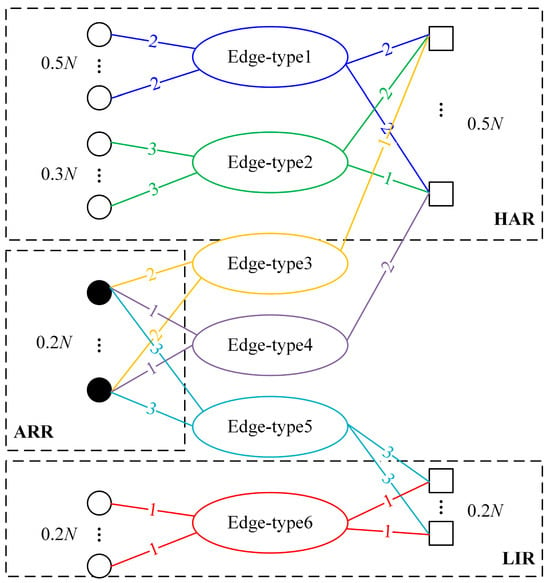
- First, based on the multi-edge structure of MET-LDPC codes, we develop a novel cross-region MS (CR-MS) decoding architecture. This architecture is realized by dynamically partitioning the Tanner graph into three distinct regions: the low-reliability information injection region (LIR), the high-reliability information aggregation region (HAR), and the adaptive information relay region (ARR).
- Second, we introduce cross-region message scaling (CMS) factors within the ARR to form an asymmetric information flow control mechanism. This mechanism adaptively adjusts the strength of message passing between different regions in response to real-time channel conditions.
- Third, tailored for MET-LDPC codes, we propose the RMS decoding algorithm by integrating the multi-edge structure, the CR-MS decoding architecture, and the asymmetric information flow control mechanism into a unified framework.
The remainder of this paper is organized as follows. Section 2 introduces fundamentals of LDPC code-decoding algorithms. Section 3 presents the proposed CR-MS decoding architecture for MET-LDPC codes. Section 4 elaborates on the asymmetric information flow control mechanism. Section 5 describes the proposed RMS decoding algorithm for MET-LDPC codes. Section 6 provides simulation results and performance analyses. Finally, Section 7 concludes the paper.
2. Fundamentals of LDPC Code-Decoding Algorithms
LDPC codes are a class of linear block codes. Typically, linear block codes are represented by generator matrix G, but LDPC codes are represented by parity check matrix H. The matrix H of LDPC codes has a highly sparse form, where the vast majority of its elements are 0, with only a few being 1. LDPC codes can be visually represented by a Tanner graph, which consists of two types of nodes, namely variable nodes and check nodes. Variable nodes correspond to the bits in the codeword, while check nodes correspond to the parity-check equations. The edges connecting variable nodes and check nodes represent the 1 in the parity-check matrix H. The message-passing decoding algorithm iteratively exchanges information along the edges in the Tanner graph, gradually correcting the posterior probabilities of the variable nodes, ultimately achieving error correction.
In this work, we denote the n-th variable node and the m-th check node as and , respectively. The set of all check nodes connected to is denoted by , and the set of all variable nodes connected to is denoted by . For message updating, represents the set , excluding the specific check node , and represents the set , excluding the specific variable node .
By using above notations, we present the commonly used decoding algorithms for LDPC codes as follows.
2.1. BP Algorithm
BP algorithm is an iterative algorithm based on message passing between check nodes and variable nodes. As the number of iterations increases, the decoding reliability continuously improves. The decoding process of the BP algorithm can be described as follows.
2.1.1. Message Initialization
The maximum number of iterations is set to , and the iteration counter i is initialized to 1. The messages of variable nodes are initialized using the information received from the channel, while all messages of check nodes are initialized to 0.
Denote the received signal corresponding to the n-th transmitted bit as . The initial channel message for is defined as
2.1.2. Message Update for Check Nodes
During the check node update, calculate the log-likelihood ratio (LLR) from to in the i-th iteration using
2.1.3. Message Update for Variable Nodes
During the variable node update, the LLR from to in the i-th iteration is computed by
2.1.4. Decision
Calculate the total LLR of , given by
The estimated bit value at the is determined by
2.1.5. Stopping Criterion
If or , the decoding ends and the iteration stops. Otherwise, set and return to Section 2.1.2.
2.2. MS Algorithm
Despite its remarkable decoding performance, the BP algorithm presents hardware implementation challenges due to the computational complexity of the check node message update. It is clear that tanh(x) and tanh−1(x) are all difficult to compute, which makes (2) have very high hardware complexity [26]. By simplifying the check node message calculation in the BP algorithm, the MS decoding algorithm is proposed where the check node message update is simplified to (6), while all other steps remain unchanged.
2.3. NMS Algorithm
Although the MS decoding algorithm reduces computational complexity, it suffers from an overestimation issue that leads to a significant degradation in decoding performance. To mitigate this performance loss, the NMS decoding algorithm was proposed. By introducing a multiplicative correction factor α, the check node message update calculation is modified by
where .
2.4. OMS Algorithm
To further improve the decoding performance of the NMS decoding algorithm, the OMS decoding algorithm is proposed. An offset factor β is introduced to correct the minimum value in the check node update, thereby achieving a performance closer to that of the BP algorithm. The check node update calculation for OMS is given by
2.5. LMS Algorithm
The flooding schedule divides an iteration into two distinct phases. All check node messages are updated in parallel, followed by a parallel update of all variable node messages. This strict alternation between variable nodes and check nodes introduces a delay as the updated information from one phase cannot be utilized until the next iteration.
In contrast, layered decoding schedule divides the parity-check matrix into several layers by rows and sequentially performs the immediate update of the check nodes within each layer and their connected variable nodes. This allows the latest generated message to propagate immediately to adjacent layers, effectively enhancing information-passing efficiency and convergence speed.
3. The Proposed CR-MS Decoding Architecture for MET-LDPC Codes
3.1. MET-LDPC Codes
In the factor graph representation of LDPC codes, all edges are statistically equivalent and interchangeable. This assumption implies that the code structure is characterized by degree distribution, which only specifies the number of edges connected to variable nodes and check nodes without considering edge types. Consequently, the design space for encoding and decoding are narrowed, which limits the potential performance.
MET-LDPC codes overcome the performance and design limitations of LDPC codes by introducing multiple edge types. MET-LDPC codes adopt a node perspective instead of an edge perspective to describe the code structure, providing a more refined representation. In this node-perspective representation, the edge degree connected to a node is no longer a scalar but a vector. This vector not only specifies the number of connected edges, but defines the types of edges and the number of each edge type connected to the node.
The performance advantages of MET-LDPC codes [27] can be attributed to the deliberate incorporation of three specific structures:
- Degree-1 edges are connected to a single variable node and a single check node. As noted in [28], they provide significant design flexibility. Their function is primarily to rapidly inject channel information into the decoding process, which is crucial for initializing iterations and rate adaptation. However, because the information carried by these edges is not verified by multiple sources, it can lead to error propagation in the early decoding stages.
- Degree-2 accumulated edges form an accumulate structure, characteristic of repeat-accumulate codes [29]. This structure enables the rapid aggregation and propagation of highly reliable information, thereby lowering the signal-to-noise ratio (SNR) threshold required for convergence. This is a key factor in determining the decoding threshold.
- Punctured variable nodes are intentionally omitted during the encoding process. These punctured variable nodes possess no initial channel information and rely on iterative messages from other nodes for recovery during decoding. This design not only allows flexible adjustment of the code rate, but also introduces controlled randomness, which helps suppress the error floor and enhances performance in the waterfall region.
3.2. CR-MS Decoding Architecture
The three special structures of MET-LDPC codes not only form the encoding framework, but also naturally divide the decoding process into three functionally distinct regions as follows:
- The LIR comprises degree-1 edges and the nodes directly connected to them. Due to the single-path dependency of degree-1 edges, this region is the most noise sensitive and least reliable part of the decoding process. Its reliability can be enhanced by adaptively increasing the number of local iterations and employing a more aggressive error correction strategy.
- The HAR is dominated by degree-2 accumulated edges and their connected nodes. The multiple connections and rapid feedback mechanism established by degree-2 accumulated edges enable information to be repeatedly verified and amplified within this region. Due to its structural stability, this region requires fewer iterations and favors an information-preserving strategy.
- The ARR is centered on punctured variable nodes [30] and is primarily responsible for transmitting messages across regions.
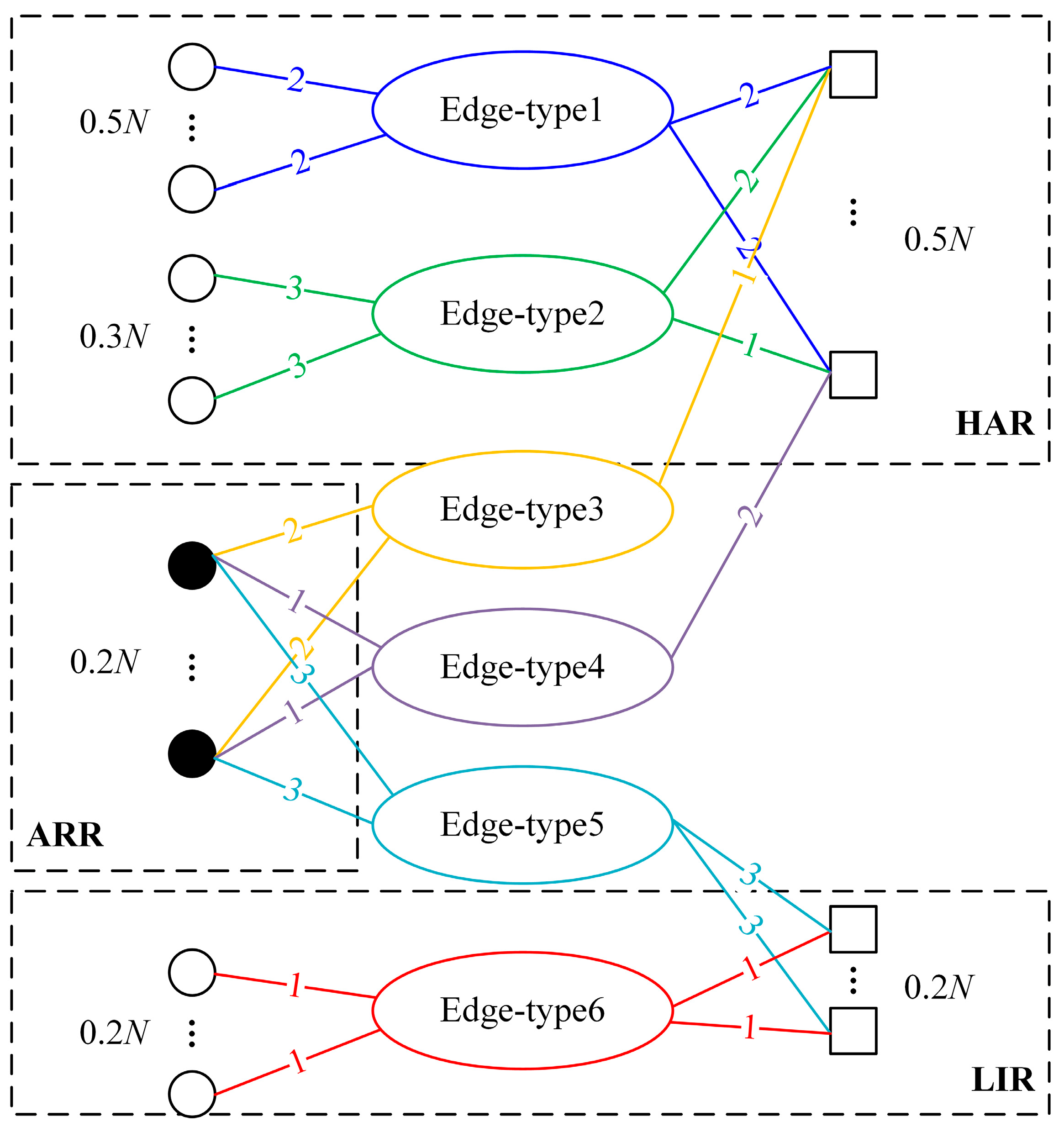
Figure 1 illustrates a graphical representation of the three-region partitioning scheme for a MET-LDPC code with six edge types. In the figure, ○ represents unpunctured variable nodes, ● represents punctured variable nodes, and □ represents check nodes. The numbers on the connecting lines indicate the edge count of that particular type connected to the corresponding variable or check node. The number of nodes for different edge types are shown as fractions of the code length N, where N is the number of transmitted code bits [31].
Figure 1.
Graphical representation of the three-region partitioning scheme for a MET-LDPC code with six edge types.
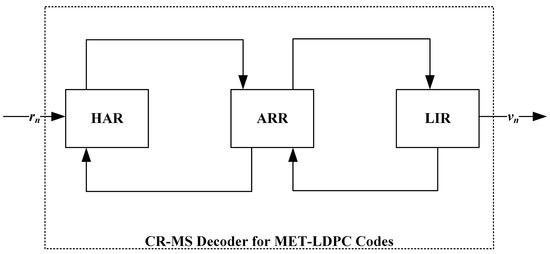
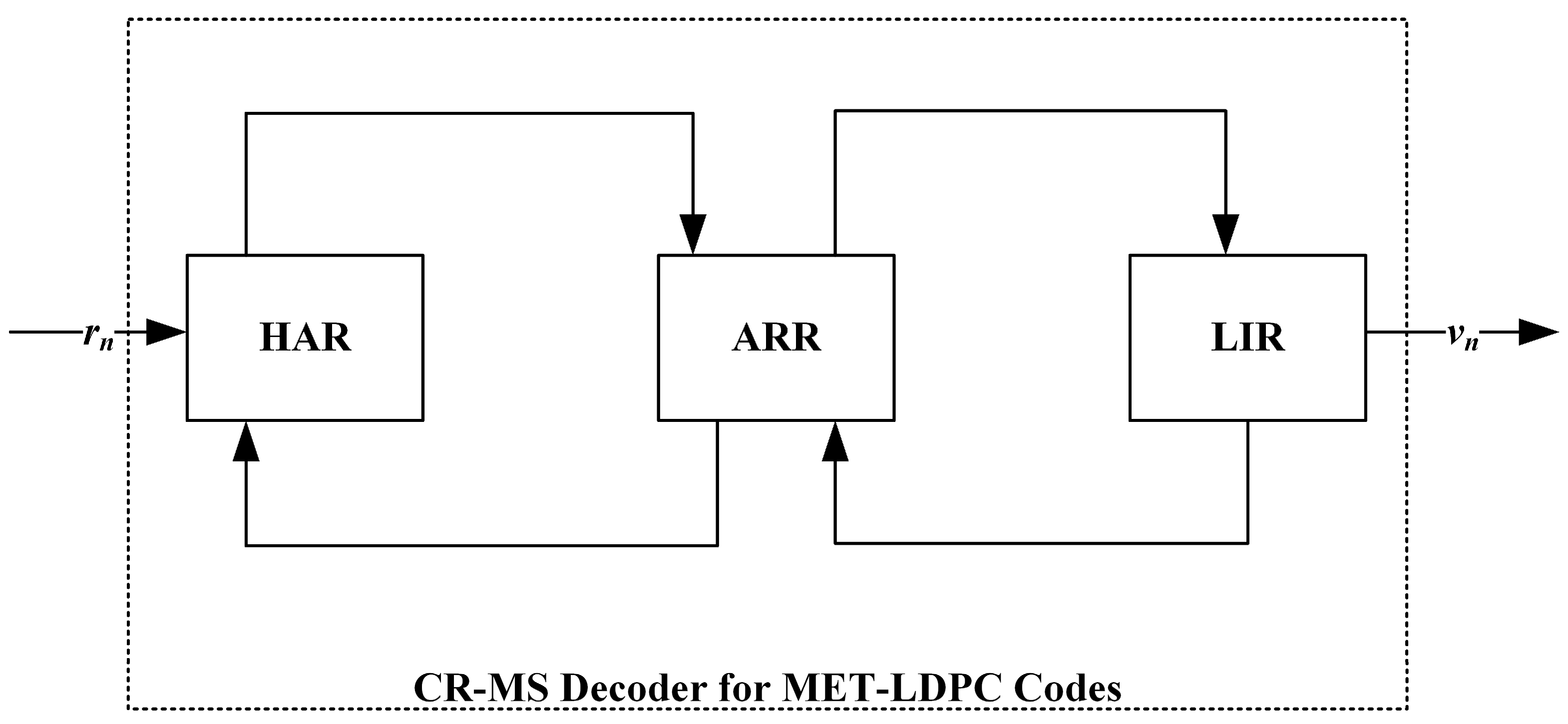
The three-region partitioning defines a cross-region decoding architecture for MET-LDPC codes, which serves as the framework for the proposed RMS decoding algorithm. The CR-MS decoder operates via a strictly unidirectional and multi-stage iterative process. Figure 2 shows the decoding flow of the CR-MS decoder. This architecture ensures a directed information flow, which is critical for isolating the HAR from low-reliability inputs during early iterations.
Figure 2.
Block diagram of the CR-MS decoder.
3.3. Performance of the Proposed CR-MS Decoder
The proposed CR-MS decoder is compared against the traditional decoding algorithms, such as the SMS, LMS, NMS, and OMS decoders over the AWGN channel. The normalization factor for NMS is 0.9, and the offset factor for OMS is 0.3, respectively, which yields their better performance. The simulated code rate is set to 0.5 for all simulations. The system parameters and variables used in this section are summarized in Table 1 for clarity.
Table 1.
System parameters and variables.
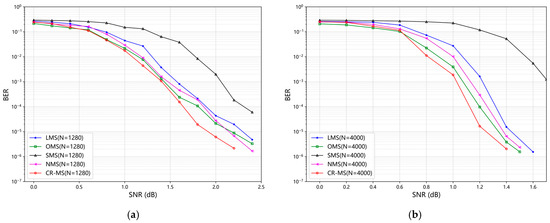
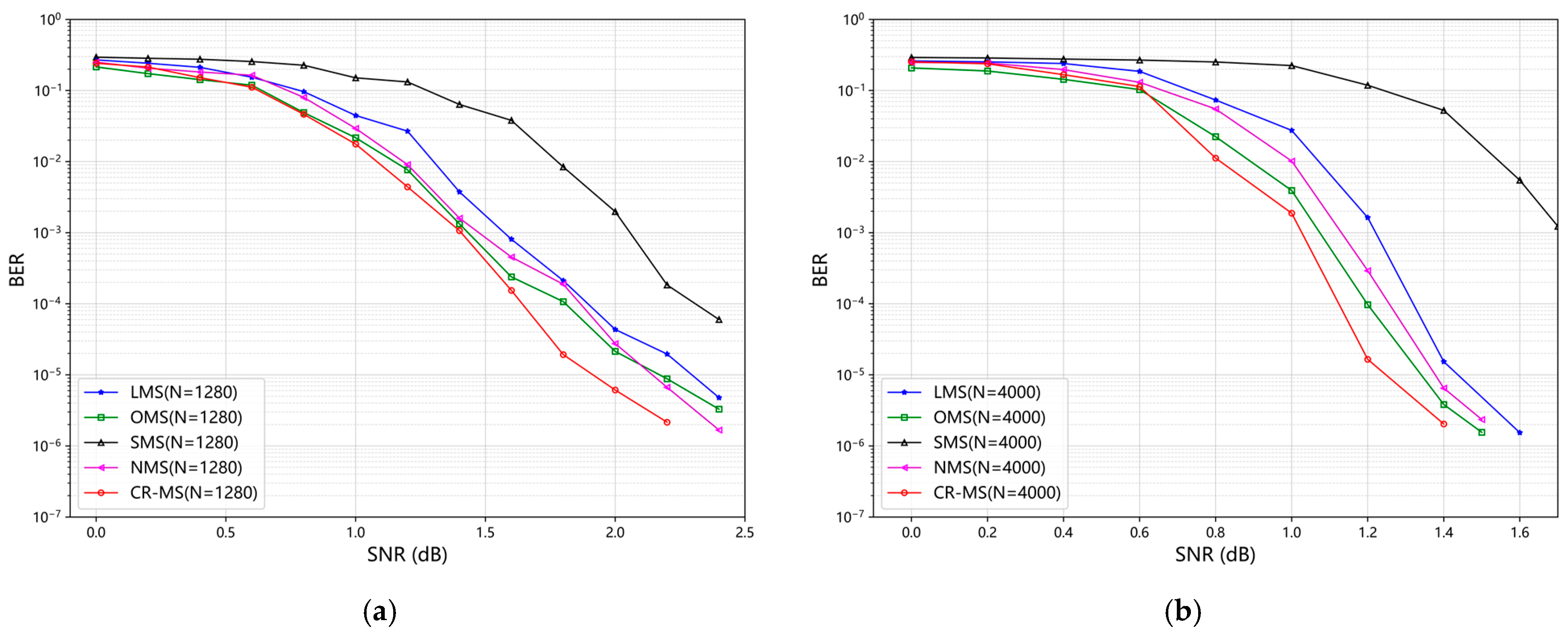
In Figure 3, the bit error rate (BER) performance over the AWGN channel with BPSK modulation is presented. It can be observed that the CR-MS decoder achieves the best decoding performance, while the SMS decoder exhibits the worst performance. Figure 3a and Figure 3b show the results for code lengths of 1280 and 4000, respectively.
Figure 3.
BER performance comparison of the proposed CR-MS decoding algorithm and the traditional decoding algorithms for different code lengths over the AWGN channel. (a) Code length N = 1280; (b) code length N = 4000.
For a code length of 1280, the proposed CR-MS decoder achieves significant performance gains. At the BER of 10−5, it outperforms the SMS algorithm by approximately 0.8 dB. At the BER of 10−6, the CR-MS decoding algorithm has a gain of 0.4 dB in performance over the LMS decoding algorithm which does not differentiate regional reliability. Similarly, compared to the OMS decoding algorithm, the CR-MS algorithm exhibits a performance gain of about 0.3 dB at the BER of 10−6. Furthermore, relative to the NMS decoding algorithms, the CR-MS algorithm maintains a performance improvement of approximately 0.2 dB at the BER of 10−6.
For a code length of 4000, the CR-MS decoder achieves performance gains of 0.2 dB, 0.15 dB, and 0.1 dB at the BER of 10−6, over the LMS, NMS, and OMS decoding algorithms, respectively. In particular, this gain is increased to 0.7 dB over SMS at the BER of 10−3.
Above all, the results demonstrate that the proposed CR-MS decoding architecture effectively enhances the error-correction performance of MET-LDPC codes through its cross-region decoding architecture.
4. Asymmetric Information Flow Control Mechanism
Based on the CR-MS decoding architecture of MET-LDPC codes, this section introduces a novel asymmetric information flow control mechanism, which applies differentiated gain control to inter-regional messages via the ARR. The control is based on message direction. Its goal is to suppress noise, amplify useful signals, and achieve directed information flow. Specifically, this is implemented by modifying the message update rule within the CR-MS algorithm.
Let indicate the direction of information flow across regions, where represents that the direction of information flow is from the HAR to the LIR, and represents that the direction of information flow is from the LIR to the HAR. For each direction, a corresponding CMS factor is defined as . The LLR transmitted in direction is denoted by . The scaled message is given by
4.1. Optimization Method for CMS Factors
This section proposes an adaptive layered grid search (ALGS) method to systematically minimize the decoding BER within the scaling factor parameter space. The ALGS method employs a phased optimization framework comprising three stages: coarse global search, potential region identification, and fine search.
4.1.1. Stage 1: Coarse Search
Denote as the minimum value of the CSM factor and as the maximum value of , whereby the feasible value ranges for the CSM factors are determined as
A two-dimensional joint parameter space is defined by
To systematically cover the parameter space , a uniform grid partitioning strategy is adopted. For the coarse search stage, the grid step sizes are set to
for the first dimension and for the second dimension.
The total number of grid points is given by
where and represent the number of grid points along each dimension.
Let denote the i-th scaling factor from the HAR to the LIR, and denote the j-th scaling factor from the LIR to the HAR. The complete set of parameter pairs can be expressed as
where
and
For each parameter pair , the corresponding BER performance is evaluated across different SNR levels, generating the raw data for subsequent analysis.
Let represent the original test dataset obtained from the coarse search. Each record in D is defined as
representing the BER achieved by parameter pair at .
To select the optimal parameter pair for each SNR level, we reorganize the data by grouping all records that share the same SNR. For each SNR level, the dataset is defined by
where K is the total number of SNR levels tested. This grouped representation serves as the input to the potential region identification stage.
4.1.2. Stage 2: Potential Region Identification
Based on the preprocessed dataset from Stage 1, we propose a multi-condition frequency-based selection scheme to identify potential parameter regions. The detailed steps are as follows:
Step 1: optimal parameter extraction
Let M denote the number of candidate parameter sets retained at each SNR. For instance, setting M = 3 means that the three parameter sets with the lowest BER at each given SNR are selected for refinement.
For the k-th SNR level, consider all parameter pairs evaluated at that SNR. Sort them in ascending order of and select the top M optimal parameter pairs to form the candidate set
where m denotes the performance rank at the k-th SNR level.
Step 2: frequency statistical model
Let denote the m-th optimal parameter for the k-th SNR, where , and . Single-parameter marginal frequency statistics are given by
where is the indicator function. The value of equals to 1 when the m-th optimal parameter for the k-th SNR takes the value , and 0 otherwise.
Parameter combination joint frequency statistics are given by
Step 3: robust parameter selection criterion
This method primarily relies on the joint frequency of parameter combinations for selection. When multiple combinations have similar frequencies, the single frequencies of each parameter are referenced. Based on the above analysis, we propose a comprehensive scoring function by
where , with and being weight coefficients satisfying . This paper recommends , to emphasize the dominant role of the combination frequency.
Denote as the best-performing parameter of the coarse search stage, which maximizes the comprehensive scoring function . Using as the center, define the fine search potential region as
4.1.3. Stage 3: Fine Search
A fine grid search is implemented within the potential region . The grid step sizes are reduced to one-fifth of those in the coarse search and are defined as
The total number of grid points is calculated as
During the fine search stage, each parameter combination is systematically evaluated at multiple SNR points. The parameter corresponding to the best performance in the fine search is determined as the final optimal parameter configuration .
Experiments indicate that the optimal CMS factors are closely dependent on the SNR. To address this, we proposed an ALGS strategy, which dynamically configures the optimal scaling factors for different SNR. Through SNR estimation and parameter adaptive adjustment, the system can maintain near-optimal decoding performance under different channel conditions, significantly improving the overall robustness and adaptability of the system.
4.2. Performance of the CMS Factor
In order to verify our theory of CMS factor, a simulation is done on the MET-LDPC codes with length 640 and rated 1/2 over the AWGN channel with BPSK modulation, set to , , and . The simulation results are shown as follows.
To determine the selection range M for subsequent simulations, a trade-off between statistical sufficiency and computational complexity must be considered. Excessively small values, such as M = 1, result in an insufficient sample size for constructing a meaningful statistical distribution. Accordingly, this study adopts as the statistically valid range for evaluating parameter robustness, thereby avoiding the statistical biases associated with an overly small sample size.
Table 2 illustrates the evolution of the best-performing parameter during the coarse search stage under different selection ranges M, where M denotes the number of candidate parameters selected for each SNR condition. The comprehensive score S, calculated based on the joint and marginal frequencies in (22), is used to evaluate the robustness of the parameter.
Table 2.
The best-performing parameter during the coarse search stage under different M for SNR from 0.0 to 1.9 dB.
It can be observed that the parameter mainly appears in two typical configurations, namely (1.10, 0.85) and (1.00, 0.90). The evolutionary patterns and statistical characteristics of these two parameter configurations are analyzed as follows.
Case 1: when the selection range is relatively small, such as M = 2 and M = 3, the parameter consistently stabilizes at (1.10, 0.85).
- At M = 2, the combination (1.10, 0.85) first emerges as the optimal parameter, with a comprehensive score S = 0.0507. As one of the lower bounds of the statistically valid range, M = 2 provides preliminary evidence of the superiority of this parameter under strict selection criteria, although the statistical sample size remains limited.
- At M = 3, (1.10, 0.85) maintains its optimal status, with the score remaining at S = 0.0507. Compared to M = 2, M = 3 provides a more substantial statistical sample, rendering the result more representative.
Case 2: when the selection range expands to M ≥ 4, the optimal parameter converges to (1.00, 0.90) and remains stable for all values of M ≥ 4.
- At M = 4, (1.00, 0.90) first becomes the optimal parameter, achieving a comprehensive score S = 0.0531.
- At M = 5, (1.00, 0.90) retains its optimal status, and its comprehensive score reaches a peak value of S = 0.0552. Within this selection range, this parameter exhibits the highest comprehensive score and statistical representativeness.
- When M > 5, (1.00, 0.90) enters a state of complete convergence, with its comprehensive score gradually decaying and stabilizing. This phenomenon is attributed to the dilution of the joint frequency caused by the introduction of a greater number of suboptimal parameters.
Based on the analysis results presented in Table 2, simulation validation will be performed for the two optimal parameter combinations, with (1.10, 0.85) corresponding to M = 3 and (1.00, 0.90) corresponding to M = 5. Table 3 presents the parameters corresponding to the ALGS algorithm when M = 3 or M = 5. As can be seen from Table 3, when M is varying, the parameters associated with the ALGS algorithm are different.
Table 3.
The parameters corresponding to the ALGS algorithm when M = 3 or M = 5 for SNR from 0.0 to 1.9 dB.
The parameters exhibit a complex coupling effect on BER performance. To adapt to dynamic channel conditions while maintaining optimal performance, this study proposes a rapid configuration scheme based on preset parameters.
are pre-optimized for different channel states and stored in a lookup table. For instance, Table 4 lists the optimal scaling factors configured by the ALGS strategy for different SNR levels.
Table 4.
The optimal scaling factors configured by the ALGS strategy. denotes the scaling factor for messages from the HAR to the LIR, and denotes the factor for messages from the LIR to the HAR.
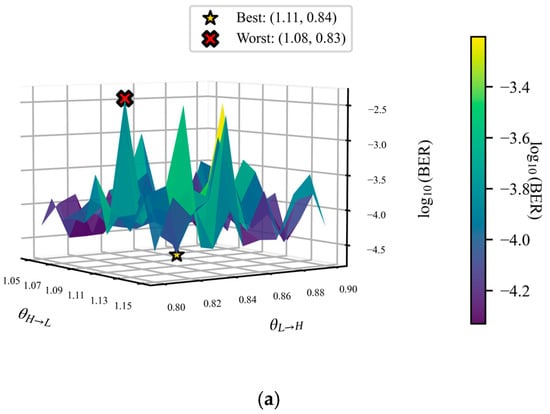
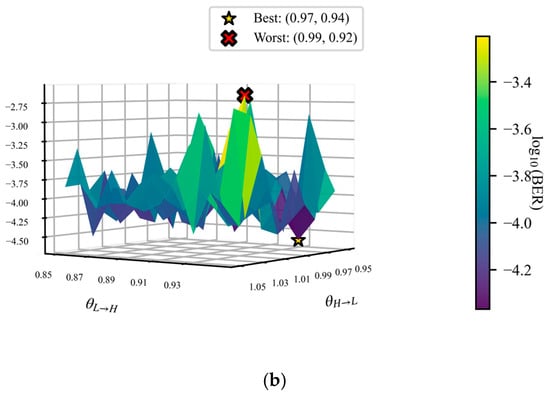
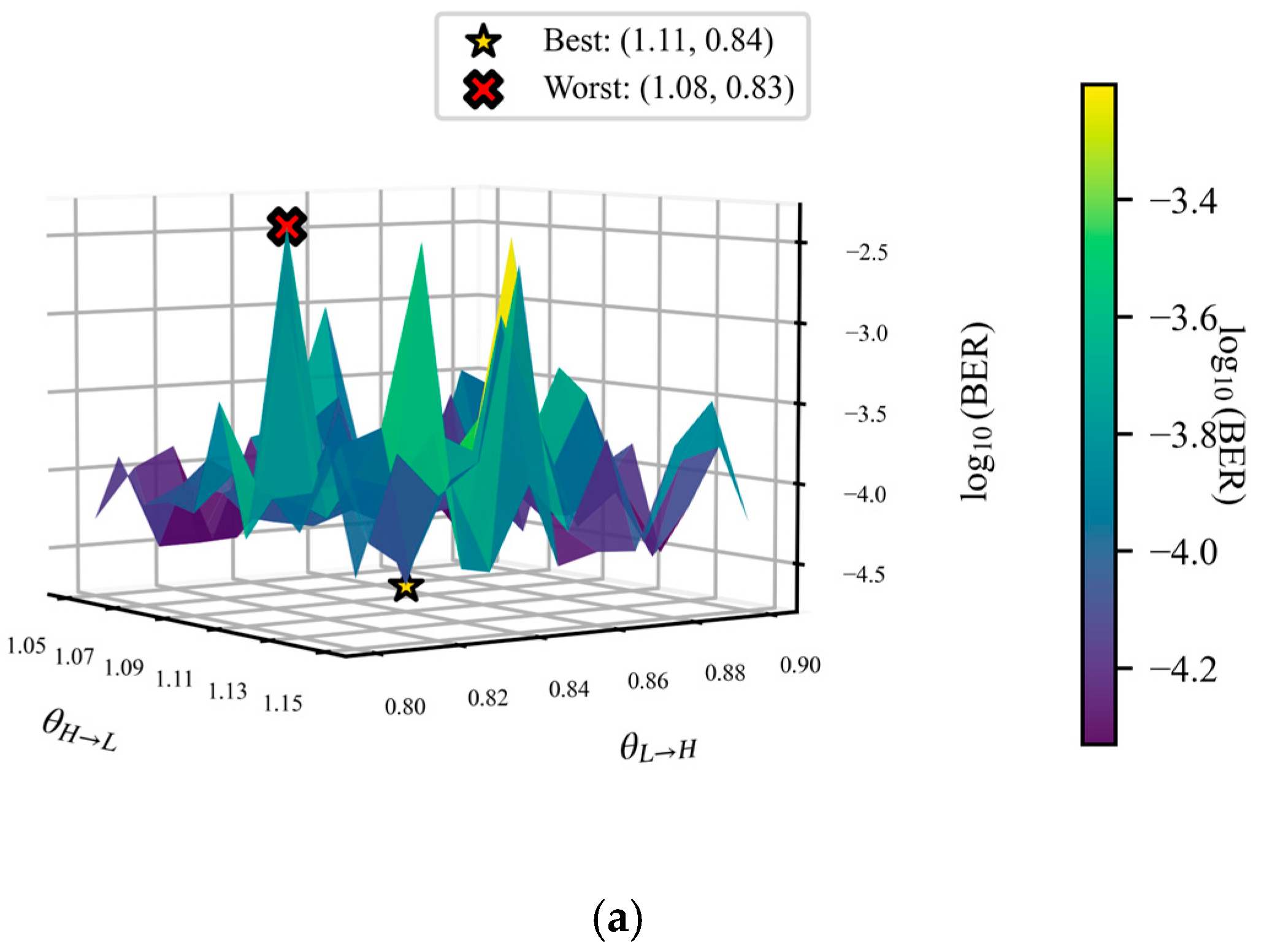
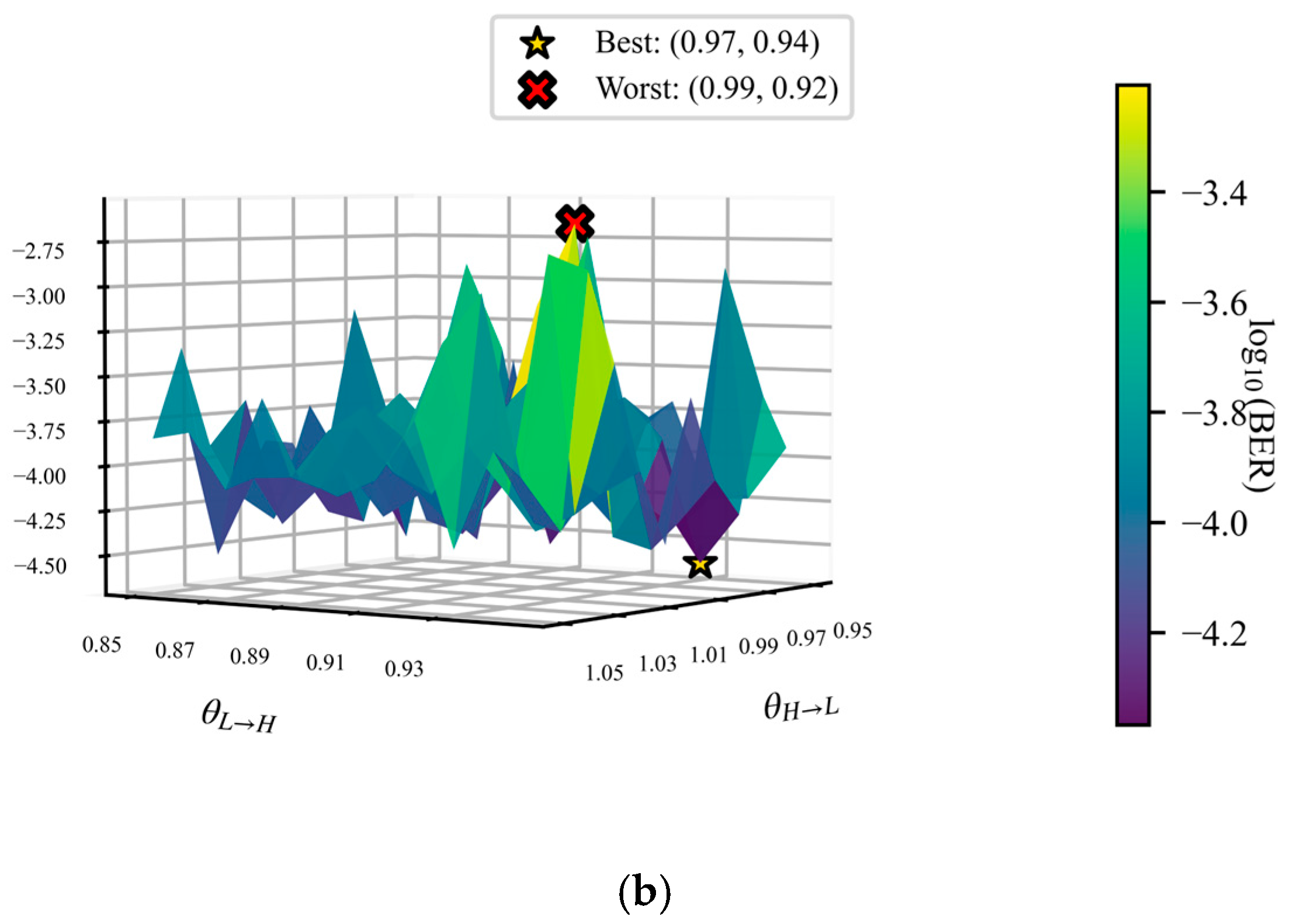
Figure 4 shows a three-dimensional surface plot depicting the BER variation with respect to parameters at SNR = 1.6 dB, for different numbers of retained candidate parameter sets M. The 3D surface illustrates the nonlinear dependence of the BER on .
Figure 4.
The BER performance of different parameters of with different values of M at the SNR = 1.6 dB. (a) M = 3; (b) M = 5.
Figure 4a shows the cases for M = 3. The optimal parameter combination, marked by a star symbol (★), is , achieving the lowest BER of 2.294757 × 10⁻⁵. In contrast, the worst-case combination, marked by a cross symbol (x), is , which yields the BER of 3.734110 × 10⁻³.
Figure 4b presents the result for M = 5 and M = 10. The star symbol (★) marks the optimal combination , corresponding to the lowest BER of 2.642706 × 10⁻⁶. The cross symbol (x) indicates the worst-case combination , yielding the BER of 2.228484 × 10⁻³.
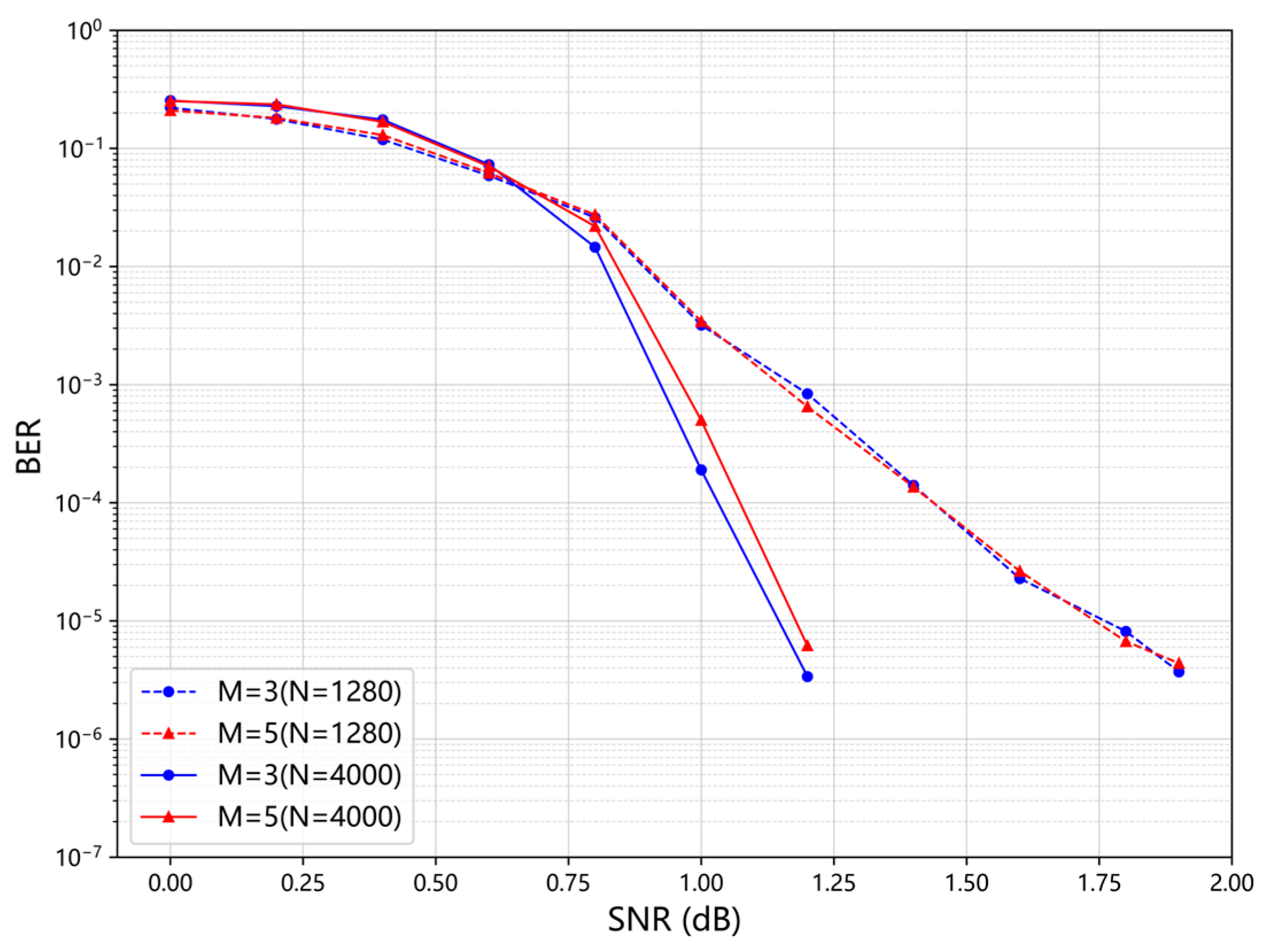
Figure 5 presents a comparison of the BER performance for code lengths of 1280 and 4000, using parameters from Table 4, which were configured by the ALGS, with different values of M.
Figure 5.
The BER performance for code lengths of 1280 and 4000 with different values of M.
For a code length of 1280, the BER remains nearly stable across different M values, indicating the existence of a reachable lower performance bound for this configuration. The fact that multiple parameter combinations achieve this bound suggests an equivalent optimal region within the parameter space.
In contrast, for a code length of 4000, M = 3 outperforms M = 5. This is because the larger candidate set M = 5 includes some suboptimal parameter combinations, which degrades the overall BER. Therefore, M = 3 is adopted for all subsequent simulations.
5. The Proposed RMS Decoding Algorithm for MET-LDPC Codes
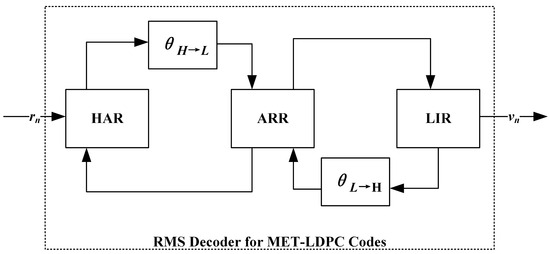
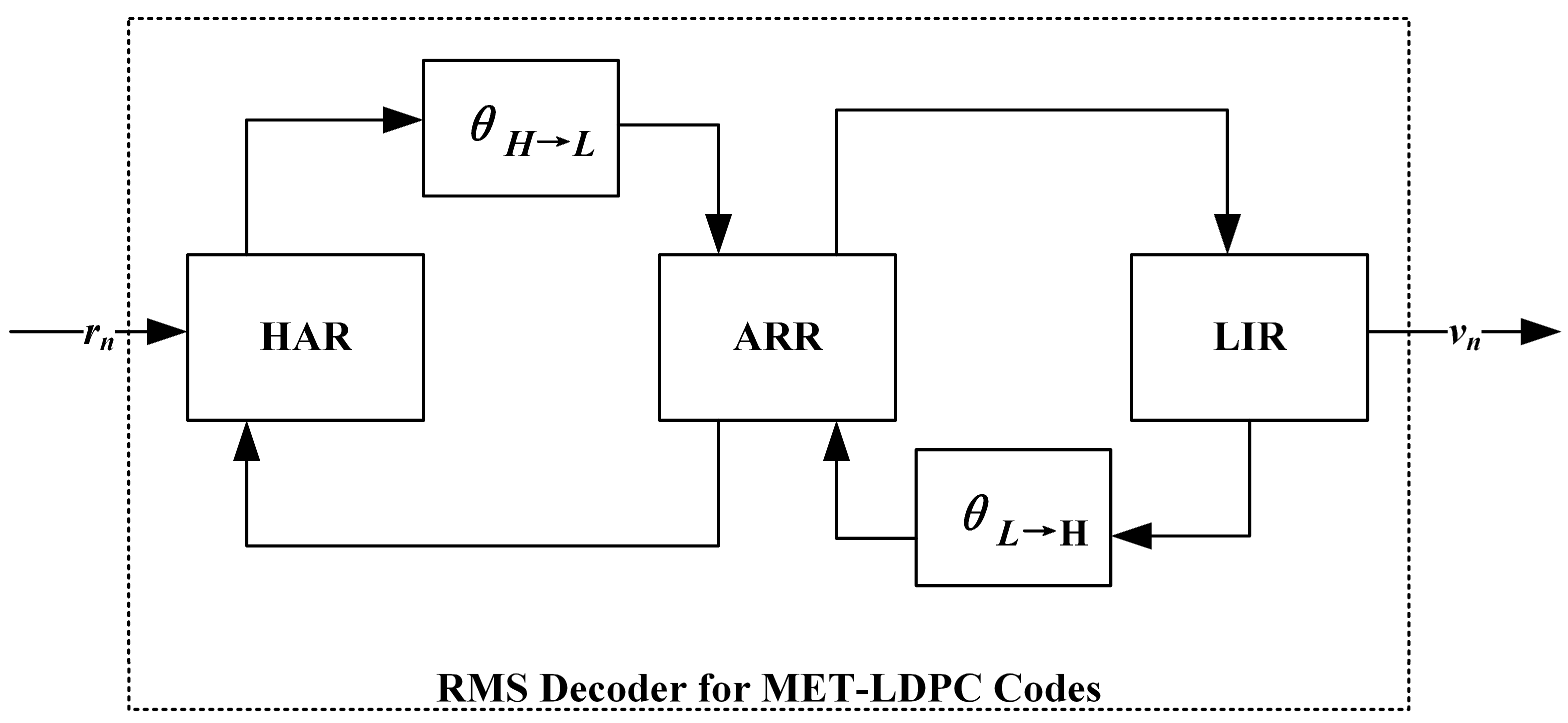
From a node perspective, we propose the RMS decoding algorithm for MET-LDPC codes by integrating the multi-edge type structure, the CR-MS decoding architecture, and the asymmetric information flow control mechanism into a unified framework. As illustrated in Figure 6, this architecture enforces a directed information flow, which is critical for isolating the HAR from low-reliability inputs during early iterations.
Figure 6.
Block diagram of the RMS decoder.
5.1. Notation and System Model
To facilitate the description of the proposed RMS decoding algorithm, this section defines the key notations used in Section 5.
5.1.1. Edge Type and Region Classification
For a MET-LDPC code with T edge types, let denote the edge type index. Based on the CR-MS architecture introduced in Section 3, each edge is assigned a region label , corresponding to the HAR, the LIR, and the ARR, respectively. A composite identifier uniquely specifies an edge of type t located in region k.
5.1.2. Node Sets and Neighborhood Relationships
Let denote the n-th variable node and denote the m-th check node. The neighborhood relationships are defined as follows.
- : the set of all check nodes connected to via an edge of type (t,k).
- : the set of all variable nodes connected to via an edge of type (t,k).
- : the set excluding .
- : the set excluding .
5.1.3. Message Variables
During the i-th global iteration, the messages exchanged between nodes are defined as follows.
- : the message passed from to over an edge of type (t,k).
- : the message passed from to over an edge of type (t,k).
- : the initial channel LLR for variable node .
For inter-region messages that are exchanged via the ARR, we introduce the following notation. Let , , , and represent the LLR passed from the ARR to the LIR, from the ARR to the HAR, from the LIR to the ARR, and from the HAR to the ARR, respectively, via variable node in the i-th global iteration.
5.1.4. CMS Factors
5.1.5. Iteration Parameters
The iterative decoding process is governed by the following key parameters.
- : maximum number of global iterations.
- : maximum number of local iterations within the HAR.
- : maximum number of local iterations within the LIR.
- : global iteration counter, .
- i: local iteration counter for the HAR, .
- j: local iteration counter for the LIR, .
By using above notations, the specific steps of the RMS decoding algorithm are as follows.
5.2. Decoding Process for the HAR
In HAR iterative decoding, the input and output parameters need to be clearly defined. The input and output parameters of this process are shown in Algorithm 1.
| Algorithm 1: HAR Decoding Process |
| Input: channel LLRs for variable nodes , initial messages from the ARR to the HAR , maximum HAR iterations . |
| Output: updated messages from the HAR to the ARR , early termination flag . |
5.2.1. Initialization
Set the HAR iteration counter i = 0.
5.2.2. Variable Nodes Message Update over the Edge Type
For an edge of type , the LLR from to , , is calculated as
5.2.3. Check Nodes Message Update over the Edge Type
For an edge of type , the LLR from to , , is given by
where the sign is defined as
and the magnitude can be obtained by
5.2.4. Early Termination Check
For each check node, calculate the current hard decision values of all its adjacent variable nodes. If the result equals 1, the check node is marked as unsatisfied. Otherwise, it is marked as satisfied. If all check nodes are satisfied, decoding is successful within HAR. In this case, the success flag is set to true. Terminate the iteration and proceed to Step 5.3. Otherwise, continue to Step 5.2.5.
5.2.5. Iteration Control
If , set , and return to Step 5.2.2 for the next iteration. If , terminate HAR processing and proceed to Step 5.3.
For variable node , the LLR transmitted from the HAR to the ARR is computed by
5.3. Information Scaling from the ARR to the LIR
After HAR decoding completes, the reliable information accumulated in the HAR needs to be transferred to the LIR to assist its decoding. This transfer occurs through the punctured variable nodes in the ARR.
According to Table 4, the optimized scaling factors are applied at the ARR. The compensated LLR from the ARR to the LIR is calculated as
5.4. Decoding Process for the LIR
In LIR iterative decoding, the input and output parameters need to be clearly defined. The input and output parameters of this process are shown in Algorithm 2.
| Algorithm 2: LIR Decoding Process |
| Input: channel LLRs for variable nodes , initial messages from the ARR to the HAR , maximum HAR iterations . |
| Output: updated messages from the HAR to the ARR . |
5.4.1. Initialization
The maximum number of iterations for the LIR is set to and the current iteration counter is initialized to j = 0.
5.4.2. Variable Nodes Message Update over the Edge Type
For an edge of type , the LLR from to , , is computed as
5.4.3. Check Nodes Message Update over the Edge Type
For an edge of type , the LLR from to , , is given by
where the sign is defined as
and the magnitude is obtained by
5.4.4. LIR Iteration Control
Set . If , return to Step 5.4.2. Otherwise, terminate iterations and proceed to Step 5.5.
For variable node , the LLR transmitted from the LIR to the ARR is computed by
5.5. Information Scaling from the ARR to the HAR
After LIR decoding completes, the processed information needs to be fed back to the HAR for the next global iteration.
Simultaneously, according to Table 4, the optimized scaling factors
are applied at the ARR. Update the compensated LLR from the ARR to the HAR as
5.6. Global Iteration Control
Set . If , return to Section 5.2 and begin a new global iteration. Otherwise, proceed to the final decision Section 5.7.
5.7. Final Decision and Output
For punctured nodes, denotes the LLR delivered to a punctured variable node via edge class in the i-th iteration, and stands for the estimated value of a punctured variable node
connected through an edge of type at the i-th global iteration. Similarly,
represents the estimated value of an unpunctured variable node
connected via an edge of type at the i-th global iteration.
For each punctured variable node , the posterior LLR is calculated as
Perform a hard decision by
For each unpunctured variable node, aggregate the final extrinsic information from all connected edges of type and the channel information, where the posterior LLR is computed by
Perform a hard decision by
Arrange the hard decision results of all nodes in the original order to generate the final decoded codeword .
5.8. Overall RMS Decoding Algorithm
Algorithm 3 summarizes the complete RMS decoding procedure, integrating the HAR decoding, ARR message scaling, and LIR decoding into a unified iterative framework.
| Algorithm 3: Regional Message Scaling Min-Sum (RMS) Decoding for MET-LDPC Codes |
| Input: received channel values , maximum global iterations , maximum HAR iterations , maximum LIR iterations: , CMS factor lookup table (Table 4) indexed by SNR. |
| Output: estimated codeword . |
| /* Stage 1: Global Initialization */ 1: Initialize global iteration counter 2: Compute initial channel LLRs for all variable nodes using (1) 3: Set , for all variable node 4: Determine current SNR and select CMS factors from Table 4 /* Stage 2: Main Decoding Loop */ 5: while do 6: /* Phase 1: HAR Decoding (Section 5.2) */ 7: Run HAR decoding process with: 8: Input: , . 9: Output: , . 10: if = true then 11: go to Phase 2 12: end if 13: for each variable node in ARR do 14: compute using (30) 15: end for 16: 17: /* Phase 2: ARR Scaling (HAR → LIR) (Section 5.3) */ 18: for each variable node in ARR do 19: apply CMS scaling: using (31) 20: end for 21: 22: /* Phase 3: LIR Decoding (Section 5.4) */ 23: Run LIR decoding process with: 24: Input: , . 25: Output: . 26: for each variable node in ARR do 27: compute using (36) 28: end for 29: 30: /* Phase 4: ARR Scaling (LIR → HAR) (Section 5.5) */ 31: for each variable node in ARR do 32: apply CMS scaling: using (37) 33: end for 34: 35: 36: end while /* Stage 3: Final Decision (Section 5.7) */ 37: Compute posterior LLRs for all variable nodes using (38) and (40) 38: Make hard decisions using (39) and (41) 39: Output estimated codeword |
6. Simulation Results
This section illustrates the performance of the proposed RMS decoding algorithm. The simulation platform is selected for experiments. Based on the MET-LDPC code shown in Figure 1, BPSK modulation and the AWGN channel are adopted. For comparison, we also plot the performance of the min-sum algorithm using the CLS proposed in [22], the OMS algorithm using an offset factor β of 0.5 mentioned in [23], and the NMS algorithm with a normalization factor α of 0.675 proposed in [24]. Additionally, the performance of the CR-MS algorithm introduced in Section 3 is plotted.
6.1. BER Performance Comparison
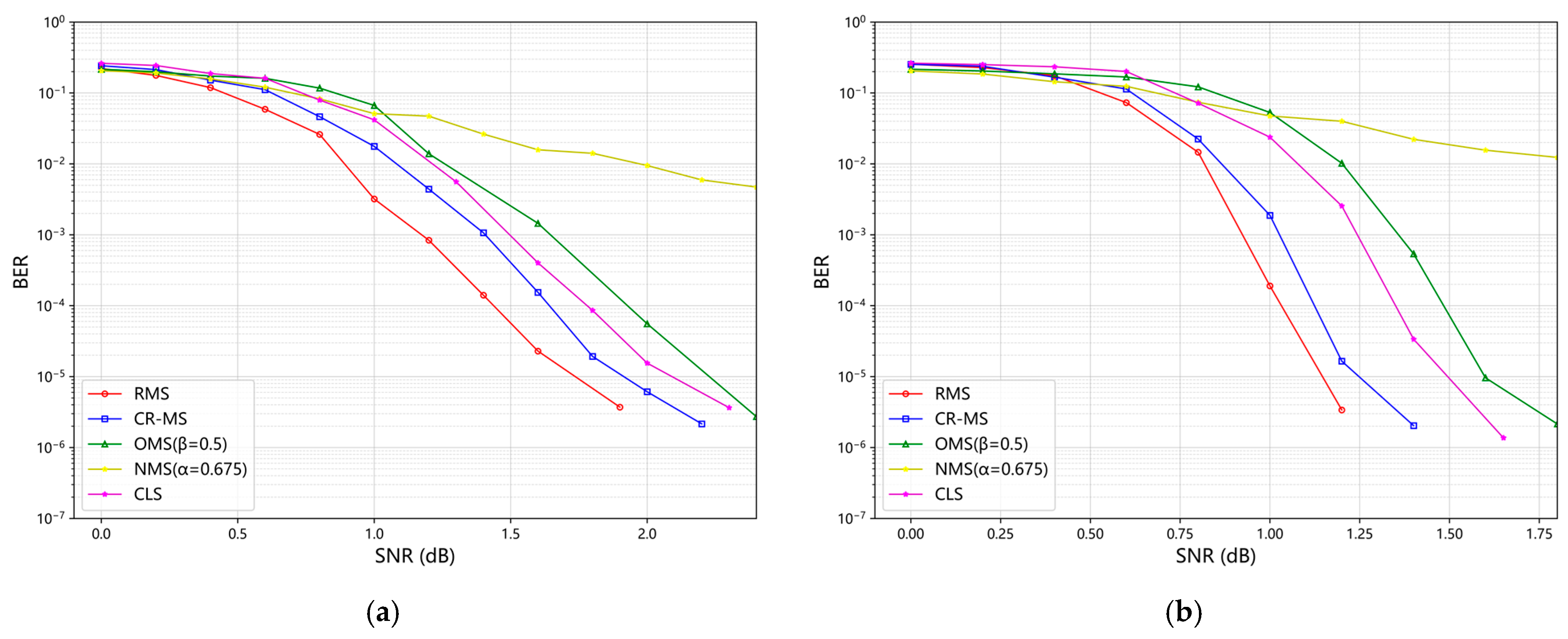
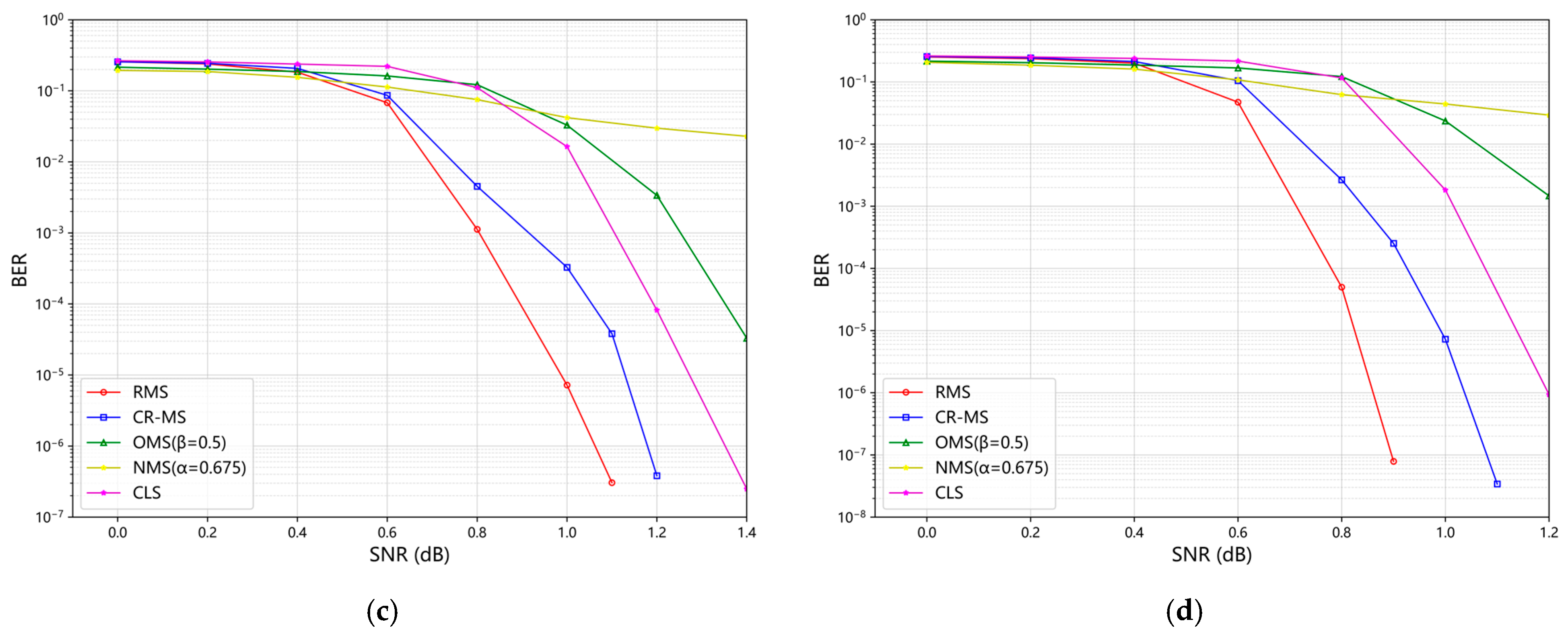
As expected, the RMS decoding algorithm performs better than those traditional decoding algorithms. We can also see that the NMS decoding algorithm exhibits a high error floor. This is because that the normalization factor α of 0.675 is not suitable for MET-LDPC codes with a general architecture.
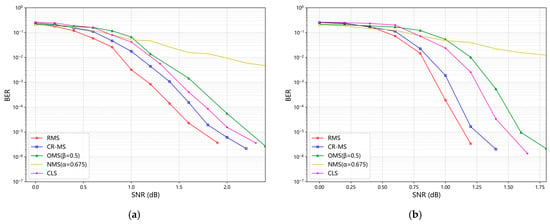
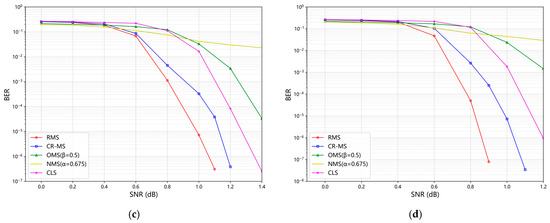
Figure 7 illustrates the performance of the proposed RMS algorithm across various code lengths with code rate 0.5. The simulation results fully validate its excellent performance and strong adaptability under different channel conditions.
Figure 7.
BER performance comparison of the proposed RMS decoding algorithm and the traditional decoding algorithms across various code lengths over AWGN channel. (a) Code length N = 1280; (b) code length N = 4000; (c) code length N = 8000; (d) code length N = 16,000.
For the code length of 1280 in Figure 7a, the RMS algorithm shows significant performance advantages. Compared to the conventional NMS algorithm, it achieves a gain of approximately 1.1 dB at the BER of 10−3. At a BER of 10−6, it maintains advantages of about 0.42 dB over the OMS algorithm and 0.4 dB over the CLS algorithm. Moreover, even against the high-performance CR-MS algorithm introduced in Section 3, the RMS algorithm retains a performance gain of roughly 0.2 dB, clearly demonstrating its effectiveness and robustness in short code scenarios.
When the code length increases to 4000 as shown in Figure 7b, the RMS algorithm continues to provide stable performance gains. At a BER of 10−6, it achieves a 0.4 dB gain over the CLS algorithm and a 0.5 dB gain over the OMS algorithm. As the BER increases to 10−2, the gain relative to the NMS algorithm widens to 1 dB. Compared to the well-performing CR-MS algorithm, RMS still maintains a gain of about 0.2 dB. These results further confirm its competitiveness for medium-length codes.
As the code length is extended to 8000 in Figure 7c, the RMS algorithm remains effective. At the BER of 10−2 it outperforms the NMS algorithm by approximately 0.8 dB, and at the BER of 10−5 it holds a 0.5 dB advantage over the OMS algorithm. Even at a BER of 10−7, RMS achieves a 0.3 dB gain over the CLS algorithm and maintains a 0.1 dB advantage relative to the CR-MS algorithm. These results highlight its consistent performance across a range of code lengths.
When the code length reaches 16,000 in Figure 7d, both the conventional NMS and OMS algorithms exhibit high error floors, while the RMS algorithm still delivers pronounced performance gains. At a BER of 10−7, RMS achieves a 0.35 dB gain over the CLS algorithm. Furthermore, at the BER of 10−8, RMS achieves a gain of about 0.2 dB over the CR-MS algorithm. This result not only validates the effectiveness of the algorithm for long code applications but also suggests its potential to approach the Shannon limit more closely.
Compared to the CLS algorithm, which also employs layered processing, the performance advantage of RMS lies primarily in its analysis of information reliability between layers, thereby clarifying the direction of information flow. In contrast to the CR-MS algorithm, which likewise establishes clear information flow paths, the superiority of RMS stems from its introduction of a novel asymmetric information flow control mechanism. This mechanism is designed to suppress noise, amplify useful signals, and achieve directed information flow.
In summary, the proposed RMS decoding algorithm consistently delivers stable and significant performance gains across all tested code lengths. It not only outperforms the traditional NMS and OMS algorithms, but also surpasses the high-performance CLS and CR-MS algorithms, demonstrating considerable practical value and promising application prospects.
It is worth noting that we also conducted simulations for QPSK modulation. The resulting BER curves exhibit similar trends to those of BPSK under the same signal-to-noise ratio conditions, as QPSK can be decomposed into two independent BPSK-like channels. Therefore, for brevity and clarity, we present only the BPSK results in Figure 7, with the understanding that the conclusions hold for QPSK as well.
6.2. Complexity Analysis
The computational complexity of MET-LDPC decoders is listed in Table 5, where N is the number of transmitted code bits and T is average number of iterations.
Table 5.
Complexity comparison of MET-LDPC decoders.
It can be observed that the RMS decoder offers lower complexity than both the NMS and OMS decoders. Compared to the CR-MS decoder and the CLS decoder, the RMS decoder requires additional computations to obtain the optimal scaling factors prior to decoding. Although this procedure involves considerable computational effort, it is performed offline, typically during system initialization or the design stage. Once the scaling factors are obtained, they can be precomputed and stored in a hardware lookup table. Consequently, this computational overhead is excluded from the iterative complexity of real-time decoding and does not affect the online execution efficiency of the algorithm. It is worth noting that the CLS decoder exhibits complexity comparable to that of the CR-MS decoder, as both methods rely primarily on layered min-sum operations without additional offline optimization.
During real-time decoding, although extra lookup operations and multiplications are introduced, the RMS decoder delivers noticeable performance gains. As shown in Figure 7, it achieves better BER performance than both the CR-MS decoder and the CLS decoder, and clearly outperforms the conventional NMS and OMS decoders. In summary, the RMS decoder strikes a favorable balance between decoding performance and hardware cost, achieving near-optimal performance with only moderate additional overhead.
7. Conclusions
This paper proposes a novel RMS decoding algorithm for MET-LDPC codes. First, we develop a CR-MS decoding architecture based on the multi-edge structure. Second, CMS factors are introduced to establish an asymmetric information flow control mechanism for adaptive message regulation. Third, the RMS decoding algorithm is proposed by integrating the above components. Simulation results demonstrate that the proposed RMS decoding algorithm shows considerable performance gains over the existing MS decoding algorithms at a rate of 0.5. Consequently, the RMS decoding algorithm is an excellent choice for decoding schemes for MET-LDPC codes.
Despite the performance improvements achieved by the proposed RMS algorithm, several research directions remain open for exploration:
Theoretical foundations of CMS factors. The current work determines CMS factors through simulation-based optimization. Establishing a theoretical connection between these factors and the multi-edge structure via density evolution or extrinsic information transfer analysis would provide valuable insights. Such analysis could reveal how asymmetric information flow control affects convergence behavior, thereby guiding factor selection without exhaustive simulations.
Extension to other coding frameworks. The asymmetric information flow control mechanism introduced in this work is not inherently limited to MET-LDPC codes. Investigating its integration into the decoding processes of other channel codes would help establish the broader applicability of this concept.
Performance under realistic channel conditions. The current evaluation assumes ideal channel conditions. Future works should assess the RMS algorithm in more realistic scenarios, including fading channels, impulsive interference, and higher-order modulations (e.g., 16 QAM, 64 QAM). Unlike BPSK and QPSK, these modulations introduce non-uniform bit reliabilities that may require adaptive region partitioning. Such investigations would further demonstrate the algorithm’s practical utility in deployed communication systems.
Author Contributions
Conceptualization, Y.Y.; methodology, Y.Y. and G.S.; software, Y.Y. and W.L.; validation, Y.Y. and W.L.; formal analysis, Y.Y. and G.S.; writing—original draft preparation, Y.Y.; writing—review and editing, Y.Y., G.S. and W.L.; visualization, G.S.; project administration, G.S.; funding acquisition, Y.Y. and G.S. All authors have read and agreed to the published version of the manuscript.
Funding
This research was funded by Fujian Provincial Natural Science Foundation of China (Grant No. 2023J011118), the Education Scientific Research Project for Young Teachers of Fujian Province under Grant (Grant No. JAT220257), and Open Fund of Xiamen Public Technology Service Platform for Software Supply Chain Security (Grant No. 3502Z20231042).
Data Availability Statement
All the data supporting the findings of this study can be made available upon reasonable request.
Conflicts of Interest
The authors declare no conflicts of interest.
Abbreviations
The following abbreviations are used in this manuscript:
| MET-LDPC | multi-edge type low-density parity-check |
| RMS | regional message scaling min-sum |
| MS | min-sum |
| CMS | cross-region message scaling |
| AWGN | additive white Gaussian noise |
| LDPC | low-density parity-check |
| BP | belief propagation |
| NMS | normalized MS |
| OMS | offset MS |
| SMS | standard MS |
| LMS | layered MS |
| CLS | cross-layer scheduling |
| LLR | log-likelihood ratio |
| CR-MS | cross-region MS |
| LIR | low-reliability information injection region |
| HAR | high-reliability information aggregation region |
| ARR | the adaptive information relay region |
| SNR | signal-to-noise ratio |
| BPSK | Binary Phase Shift Keying |
| BER | bit error rate |
| ALGS | adaptive layered grid search |
References
- Gallager, R. Low-density parity-check codes. IRE Trans. Inf. Theory 1962, 8, 21–28. [Google Scholar] [CrossRef] [Scilit]
- MacKay, D.J.C.; Neal, R.M. Near Shannon limit performance of low density parity check codes. IEEE Electronic Lett. 1996, 32, 1645–1646. [Google Scholar] [CrossRef] [Scilit]
- Zou, L.; Yan, H.; Dong, J.; Li, Y.; Chen, P.; Lau, F.C.M. On construction of low-density parity-check codes for ultra-reliable and low latency communications. IEEE Trans. Commun. 2024, 72, 5290–5301. [Google Scholar] [CrossRef] [Scilit]
- Gal, B.L. Scalable high-throughput and low-latency DVB-S2(x) LDPC decoders on SIMD devices. IEEE Open J. Commun. Soc. 2024, 5, 7216–7227. [Google Scholar] [CrossRef] [Scilit]
- Chen, W.; Li, Y.; Liu, D. High-throughput LDPC decoder for multiple wireless standards. IEEE Trans. Circuits Syst. I Reg. Papers 2025, 72, 383–396. [Google Scholar] [CrossRef] [Scilit]
- Lim, B.M.; Jung, H.; Ahn, S.; Park, S.I.; Kwon, S.; Hur, N.; Kim, J. Implementation and field verification of ATSC 3.0 channel bonding. In Proceedings of the 2025 IEEE International Symposium on BMSB, Dublin, Ireland, 11–13 June 2025. [Google Scholar]
- Dong, H.; Niu, K.; Wang, B.; Chen, J. Rate-compatible joint source-channel coding scheme based on 5GNR LDPC codes. In Proceedings of the 2023 4th ICTC, Nanjing, China, 17–19 May 2023. [Google Scholar]
- Fossorier, M.P.C.; Mihaljevic, M.; Imai, H. Reduced complexity iterative decoding of low density parity check codes based on belief propagation. IEEE Trans. Commun. 1999, 47, 673–680. [Google Scholar] [CrossRef] [Scilit]
- Chen, W.; Wu, X. Design of parity-check Polar codes under belief propagation list decoding. IEEE Wireless Commun. Lett. 2025, 15, 121–125. [Google Scholar]
- Chen, J.; Dholakia, A.; Eleftheriou, E.; Fossorier, M.P.C.; Hu, X.Y. Reduced-complexity decoding of LDPC codes. IEEE Trans. Commun. 2005, 53, 1288–1299. [Google Scholar] [CrossRef] [Scilit]
- Chen, J.; Fossorier, M.P.C. Density evolution for two improved BP-Based decoding algorithms of LDPC codes. IEEE Commun. Lett. 2002, 6, 208–210. [Google Scholar] [CrossRef] [Scilit]
- Zhang, H.; Han, S.; Chen, H. A task-guided normalized min-sum decoding network for LDPC codes-based DJSCC. In Proceedings of the 2025 IWCMC, Abu Dhabi, United Arab Emirates, 12–16 May 2025. [Google Scholar]
- Chen, J.; Fossorier, P.M.C. Density evolution for BP-based decoding algorithms of LDPC codes and their quantized versions. In Proceedings of the IEEE Global Telecommunications Conference, Taipei, Taiwan, 17–21 November 2002; IEEE: New York, NY, USA, 2002; Volume 2, pp. 1378–1382. [Google Scholar]
- Chen, J.; Fossorier, M.P.C. Near optimum universal belief propagation based decoding of low-density parity check codes. IEEE Trans. Commun. 2002, 50, 406–414. [Google Scholar] [CrossRef] [Scilit]
- Lv, L.; Wang, Y.; Fang, Y.; Chen, P. Parallel network structure-aided neural shuffled offset min-sum decoder. In Proceedings of the 2024 IEEE GC Wkshps, Cape Town, South Africa, 8–12 December 2024. [Google Scholar]
- Farsiabi, A. Code-Independent Error Floor Estimation Techniques for Flooding and Layered Decoders of LDPC Codes. Ph.D. Thesis, Carleton University, Ottawa, ON, Canada, 2020. [Google Scholar]
- Su, C.; Kang, P.; Chen, P.; Fang, Y. Layered SEMS decoding for non-binary LDPC-coded PNC systems. IEEE Wireless Commun. Lett. 2025, 14, 866–870. [Google Scholar] [CrossRef] [Scilit]
- Jia, X.; Zhou, Y.; Qin, Z.; Zhu, J.; Wang, Z. Reduced complexity dynamic schedule for layered decoding of LDPC codes. IEEE Trans. Veh. Technol. 2025, 74, 13156–13160. [Google Scholar] [CrossRef] [Scilit]
- Richardson, T.; Urbanke, R. Modern Coding Theory; Cambridge University: Cambridge, UK, 2008; pp. 381–410. [Google Scholar]
- Nguyen, L.; Nguyen, T. Efficient design of MET-LDPC code ensembles via multinomial parameter optimization. In Proceedings of the 2025 MILCOM, Los Angeles, CA, USA, 6–10 October 2025. [Google Scholar]
- Jeong, S.; Ha, J. On the design of multi-edge type low-density parity-check codes. IEEE Trans. Commun. 2019, 67, 6652–6667. [Google Scholar] [CrossRef] [Scilit]
- Chang, D.; Wang, G.; Yan, G. A cross-layer scheduling method for pipelined layered multi-edge type QC-LDPC decoder with better conflict resolution. IEEE Commun. Lett. 2025, 29, 1385–1389. [Google Scholar] [CrossRef] [Scilit]
- Du, T.; Ju, H.; Xu, Y.; Zhang, W. A deep learning based multi-edge-type decoding algorithm for 5G NR LDPC codes. In Proceedings of the 2023 IWCMC, Marrakesh, Morocco, 19–23 June 2023. [Google Scholar]
- An, X.; Zhang, C.; Peng, K.; He, Z.; Song, J. Adaptive quantized and normalized MSA based on modified MET-DE and its application for 5G-NR LDPC codes. IEEE Access 2025, 11, 101123–101133. [Google Scholar] [CrossRef] [Scilit]
- Gao, N.; Xu, Y.; He, D.; Park, S.I.; Hong, H.; Ju, H.; Chen, C.; Zhang, W. Min-sum algorithm using multi-edge-type normalized scheme for ATSC 3.0 LDPC decoders. IEEE Trans. Broadcast. 2020, 66, 729–736. [Google Scholar] [CrossRef] [Scilit]
- Xu, Y.; Ju, H.; He, D.; Gao, N.; Wu, Y.; Huang, Y.; Zhang, W. A polygonal line min-sum decoding scheme for low density parity check codes. IEEE Trans. Broadcast. 2022, 68, 203–214. [Google Scholar] [CrossRef] [Scilit]
- Richardson, T.J.; Urbanke, R.L. Multi-Edge Type LDPC Codes. School of Computer and Communication Sciences, 1 May 2004. Available online: https://infoscience.epfl.ch/record/95821 (accessed on 1 January 2025).
- Jeong, S.; Ha, J. MET-LDPC code ensembles of low code rates with exponentially few small weight codewords. IEEE Trans. Commun. 2021, 69, 3517–3527. [Google Scholar] [CrossRef] [Scilit]
- Lentner, D.; Wiegart, T.; Wesel, R.D. Efficient probabilistic parity shaping for irregular repeat-accumulate LDPC codes. In Proceedings of the 2025 13th ISTC, Los Angeles, CA, USA, 18–22 August 2025. [Google Scholar]
- You, Y.; Xie, Z.; Chen, P.; Lin, Z. Construction of rate-compatible physical layer network coding in two-way relay systems. IEEE Access 2019, 7, 24420–24429. [Google Scholar] [CrossRef] [Scilit]
- Jayasooriya, S.; Johnson, S.J.; Ong, L.; Chen, P. A new density evolution approximation for LDPC and multi-edge type LDPC codes. IEEE Trans. Commun. 2016, 64, 4044–4056. [Google Scholar] [CrossRef] [Scilit]

Disclaimer/Publisher’s Note: The statements, opinions and data contained in all publications are solely those of the individual author(s) and contributor(s) and not of MDPI and/or the editor(s). MDPI and/or the editor(s) disclaim responsibility for any injury to people or property resulting from any ideas, methods, instructions or products referred to in the content. |
© 2026 by the authors. Licensee MDPI, Basel, Switzerland. This article is an open access article distributed under the terms and conditions of the Creative Commons Attribution (CC BY) license.