Article

Active Disturbance Rejection Control for Nonlinear Systems Subject to Prescribed Performance Under Unknown Initial Tracking Conditions

1
School of Electronic and Information Engineering, University of Science and Technology Liaoning, Anshan 114051, China
2
School of Electrical and Automation Engineering, Liaoning Institute of Science and Technology, Benxi 117004, China
3
School of Mechanical Engineering and Automation, University of Science and Technology Liaoning, Anshan 114051, China
*
Author to whom correspondence should be addressed.
Symmetry 2026, 18(3), 424; https://doi.org/10.3390/sym18030424
Submission received: 30 January 2026 / Revised: 16 February 2026 / Accepted: 24 February 2026 / Published: 28 February 2026
(This article belongs to the Section Mathematics)

Abstract

This paper proposes a novel active disturbance rejection prescribed performance controller for a class of strictly feedback nonlinear systems under unknown initial tracking conditions. By introducing a novel algebraic saturation function, the initial value of tracking error is transformed into a bounded range, effectively overcoming the limitation of traditional prescribed performance control that requires prior knowledge of the initial value of tracking error. To address the differential explosion issue arising from the backstepping method, this paper employs dynamic surface processing techniques. The integration of active disturbance rejection control with prescribed performance control significantly enhances the robustness of nonlinear systems. The designed controller ensures that closed-loop systems under unknown initial tracking conditions converge to any small neighborhood near the origin within finite time. The system output satisfies the requirements of the prescribed performance function and exhibits excellent suppression capability against external disturbances.

1. Introduction

Traditional prescribed performance methods typically require prior knowledge of the initial value of tracking error, i.e., the initial state, which, to some extent, constrains their further development and application [1,2,3]. To overcome this limitation, existing approaches commonly employ saturation functions first to transform tracking errors with arbitrary initial values into a bounded range, followed by the imposition of further constraints. Researchers commonly employ different saturation functions, primarily categorized into two types: one exhibits non-negative output characteristics [4], meaning the output value is always greater than zero. Yao, Y. et al. adopted a saturation function with output values greater than zero and less than or equal to 1, incorporating an exponential form with fractional square terms in the power exponent [5]. Wang Q.S. et al. selected a saturation function with output values greater than or equal to 0 and less than 1, featuring a quadratic form [6]. Zhou S.Y. et al. and Deng D.D. et al. employed saturation functions with output ranges defined by intervals formed from two distinct constants, mapping tracking error initial values—which may be positive, negative, or zero—to intervals composed of two positive numbers. Such saturation functions inherently possess limitations, as errors themselves can be positive, negative, or zero [7,8], not merely non-negative. Another approach employs the hyperbolic tangent function, which possesses odd-function properties, as the saturation function. This ensures the transformed tracking error is mapped between −1 and +1 [9,10,11], leveraging the boundedness of the hyperbolic tangent function. The hyperbolic tangent saturation function preserves the sign of the initial value of tracking error, offering an advantage over saturation functions with non-negative outputs. However, the hyperbolic tangent function’s complex structure—combining exponential and power terms—makes differentiation difficult. Therefore, further exploration of simpler, more practical saturation functions for achieving unknown initial tracking conditions control is necessary.
The traditional backstepping method offers distinct advantages in controller design, simplifying the design process. However, its application involves continuously differentiating the virtual control law, leading to the differential explosion problem. Currently, researchers have conducted a series of studies. On one hand, command filtering techniques address the differential explosion problem, employing methods such as second-order filters [12]. Z.B. Xu et al. explored tracking control for nonlinear systems, incorporating command filtering into controller design to effectively resolve the differential explosion issue in the backstepping method [13]. However, command filter parameter tuning is relatively complex, limiting its practicality. Alternatively, dynamic surface techniques address differential explosion using first-order filters [14]. L.P. Xin et al. proposed an adaptive fuzzy backstepping control for cascaded continuous stirred tank reactor systems based on dynamic surface control. Dynamic surface techniques significantly reduce the online computational load of controllers, offering advantages for practical engineering applications [15]. J. Wu et al. employed adaptive dynamic surface control to design target controllers for a class of stochastic nonlinear uncertain systems featuring non-strict feedback forms and prescribed tracking accuracy [16]. Due to its simple structure, ease of implementation, and strong practical applicability, dynamic surface technology has been widely adopted in control processes across various industrial sectors.
Prescribed performance ensures the system’s transient performance and enhances steady-state performance, but it cannot handle unknown functions within the system. To address this issue, researchers have conducted a series of studies. On one hand, advanced neural network techniques are employed to approximate unknown functions in nonlinear systems [17,18]. Bounded H∞ control is applied to suppress disturbances within the system, thereby improving its disturbance rejection capability. On the other hand, active disturbance rejection control techniques have emerged to address both unknown functions and disturbances [19]. Z. Xu et al. proposed a sensorless rotor position and speed estimation scheme for permanent magnet synchronous motor (PMSM) drives in vehicle traction systems, which frequently encounter rapidly varying load disturbances. This scheme employs a nonlinear extended state observer. This observer combines nonlinear feedback capability with fast convergence and disturbance rejection, enabling higher-precision rotor position and speed estimation [20]. Y. Hu et al. enhanced system control performance by observing disturbances via a state observer to address evolving industrial operating conditions [21]. H. Aliamooei-Lakeh et al. employed active disturbance rejection control to address potential stability issues arising from constant-power loads. They utilized an extended state observer to estimate external disturbances affecting the controlled object and employed a tracking differentiator to mitigate differential blowout problems [22]. Researchers typically employ ADRC technology to address random disturbances and utilize neural networks to approximate unknown system functions, integrating ADRC and neural networks to leverage the strengths of both approaches [23]. To enhance control accuracy in nonlinear registration systems for flexographic printing, Liu, L. et al. proposed a feedforward ADRC strategy based on radial basis functions with parameter self-tuning decoupling to address coupled disturbances and multiple operating conditions [24]. Ding, H. et al. implemented ADRC using a hybrid structure of nonlinear state error feedback and extended state observers, replacing the ESO in ADRC with a radial basis function neural network [25]. To address operational challenges for quadcopter UAVs in dynamic, complex disturbance environments, Liu, P.F. et al. synergistically applied enhanced backpropagation neural networks with PID control and ADRC [26]. Yang X.H. et al. investigated attitude tracking control for a specific vertical takeoff and landing aircraft under uncertain disturbance conditions. They employed ADRC to handle uncertainties while incorporating a radial basis function neural network to address unknown nonlinear dynamics [27].
Compared with existing research, the contributions of this paper are as follows:
(1) To design a prescribed performance controller under unknown initial tracking conditions, a novel algebraic saturation function is proposed. Compared with the hyperbolic tangent saturation functions used in [9,10,11], the proposed function eliminates exponential terms, thereby providing a more effective proof of Lyapunov stability.
(2) In contrast to the command filtering techniques in [12,13], this paper adopts the simpler and more practical dynamic surface technique, which features a simpler structure and is easier to implement.
(3) Unlike the neural network approximation of unknown functions in [17,18], this paper employs an extended state observer to estimate unknown functions and disturbances for feedback, thereby achieving active disturbance rejection control (ADRC) of the system.

2. Problem Description and Preliminary Knowledge

2.1. Problem Description

Consider the following strict feedback nonlinear system [28].
x ˙ i ( t ) = f i ( x ¯ i ( t ) ) + g i ( x ¯ i ( t ) ) x i + 1 ( t ) + d i ( t ) , x ˙ n ( t ) = f n ( x ¯ n ( t ) ) + g n ( x ¯ n ( t ) ) u ( t ) + d n ( t ) , y = x 1 ,
where x i ( t )   ( i = 1 , 2 , ... , n ) , u ( t ) , y ( t ) are system state variables, control signal, and output respectively; the initial value of x 1 ( t ) is unknown, f i ( ) is unknown smooth functions, g i ( ) 0 is known smooth functions, x ¯ i ( t ) = [ x 1 ( t ) , x 2 ( t ) , ... , x i ( t ) ] T , and d i ( t ) are bounded disturbances. For convenience, the time variable t is omitted below.
Assumption 1
([29]). The desired signal is continuous, bounded, and n-order differentiable.
The control objectives of this paper are as follows: for a class of strictly feedback nonlinear systems with prescribed performance under unknown initial tracking conditions, system unknown functions, and disturbances, an adaptive finite-time controller (UDAP) is designed using prescribed performance functions, dynamic surface techniques, obstacle Lyapunov functions, algebraic saturation functions, extended state observers, and the backstepping method. The controller must satisfy the following goals:
(1) The designed controller ensures that the closed-loop system with prescribed performance under unknown initial tracking conditions satisfies the prescribed performance criteria: tracking the desired signal within a finite time, converging the tracking error to a small neighborhood around the origin, maintaining boundedness of the remaining system states, and ensuring boundedness of the controller output.
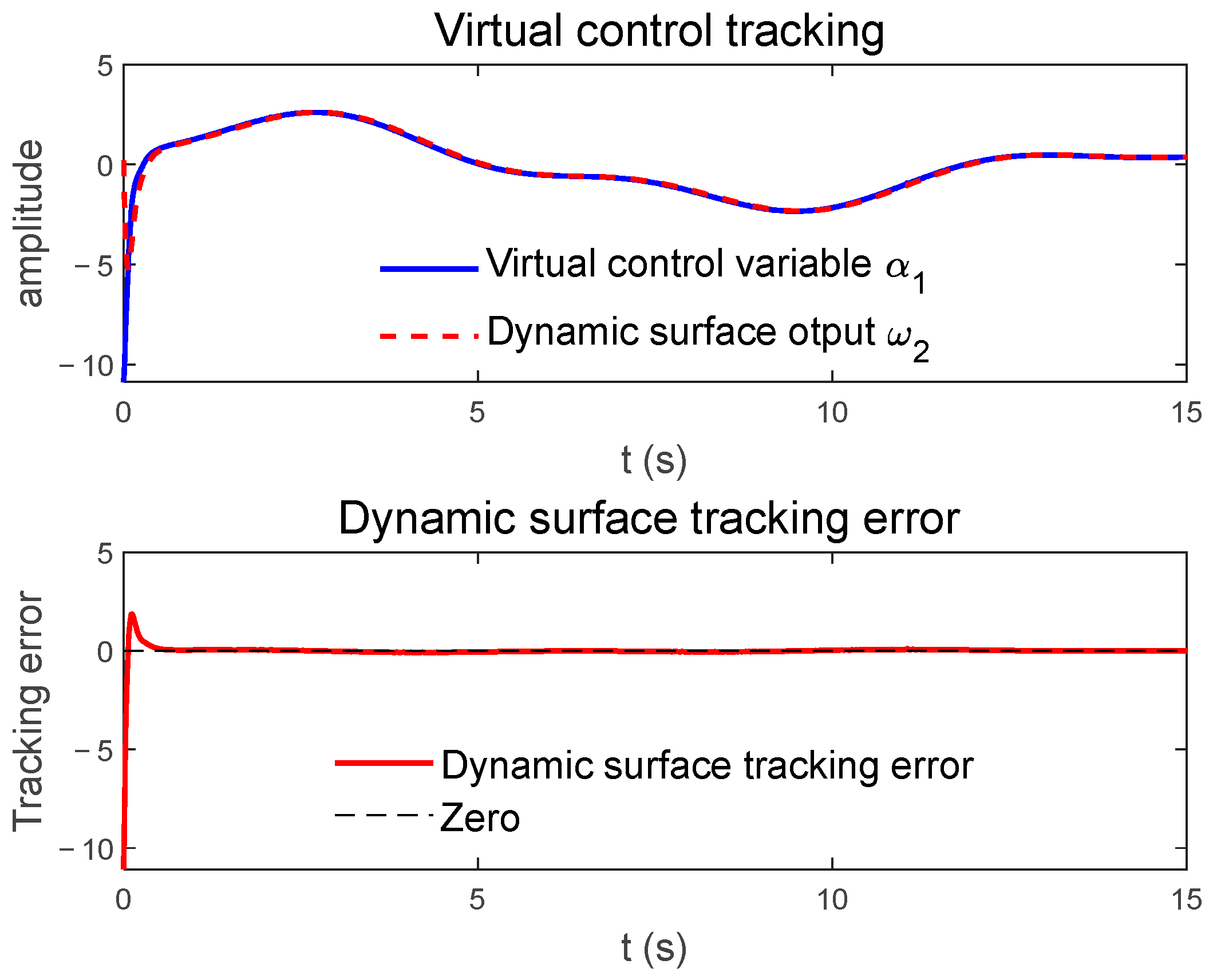
(2) Effectively addresses the differential explosion problem, with the dynamic surface technique proving effective and the virtual control quantity achieving good tracking performance.
(3) The closed-loop system exhibits a certain degree of suppression against external disturbances, achieving active disturbance rejection control, with the observer providing good estimation performance.

2.2. Preliminary Knowledge

Lemma 1
([15]). Consider a nonlinear system x ˙ ( t ) = f ( x ( t ) ) , where x ( t ) represents the state,  f ( ) represents nonlinear smooth functions, and if there exists a positive definite continuous function, V ( x ( t ) ) satisfies the following inequality:
V ˙ ( x ( t ) ) a 1 V ( x ( t ) ) + b 1 ,
where a 1 > 0  and b 1 > 0 , then the system is bounded.
In this paper, the ESO is employed to estimate the unknown functional terms within the system. Following the methodology outlined in [30], the second-order ESO used here is presented as follows:
E i = Z i 1 x 1 Z ˙ i 1 = Z i 2 + b u β i 1 E i Z ˙ i 2 = β i 2 fal ( E i )
where Z i 1 , Z i 2 are the ESO states. E i is estimation error Z i 1 for y or x 1 , Z i 2 is estimation to F i , F i = f i + d i ,   β 11 > 0 and β 12 > 0 are expansion state observer gain, and fal ( ) is a suitably constructed nonlinear function. Selecting appropriate parameters enables the ESO to achieve good approximation performance [30].
fal ( E i ) = | E i | 1 / 2   sgn ( E i ) .
This paper employs dynamic surface technology to prevent differential explosion. The low-pass filter used in this paper is shown in (5) [14].
τ i ω ˙ i + ω i = α i 1 , ω i ( 0 ) = α i 1 ( 0 ) , i = 2 , ... n ,
where α i 1 and ω i are the input and output signals of the filter respectively, and τ i > 0 is the design parameter.
Lemma 2
([31]). For ρ > z 1 , z 1 R , the following inequality holds.
ln ρ 2 ρ 2 z 1 2 z 1 2 ρ 2 z 1 2 .
Lemma 3
([32]). For a , b R , L i > 0 , the following inequality holds.
a b 1 2 L i 2 a 2 + L i 2 2 b 2 .

2.3. Unknown Initial Tracking Conditions

In traditional PPC design, tracking error is required:
z 1 ( t ) = x 1 y r .
satisfy
a ( t ) < z 1 ( t ) < a ( t ) , t 0
where a finite time PPF is as follows:
a ( t ) = a 0 ( 1 t T 2 ) exp ( λ t ) + a , 0 t < T 2 , a ,   t T 2 ,
where λ and T 2 are the prescribed normal constant and convergence time, a ( t ) > 0 ,   a 0 > a > 0 .
When | z 1 ( 0 ) | < a ( 0 ) , (9) holds, thus requiring prior knowledge of the range of z 1 ( 0 ) . However, in practical applications, the range of z 1 ( 0 ) cannot be precisely obtained, limiting the applicability of traditional prescribed performance settings.
Remark 1.
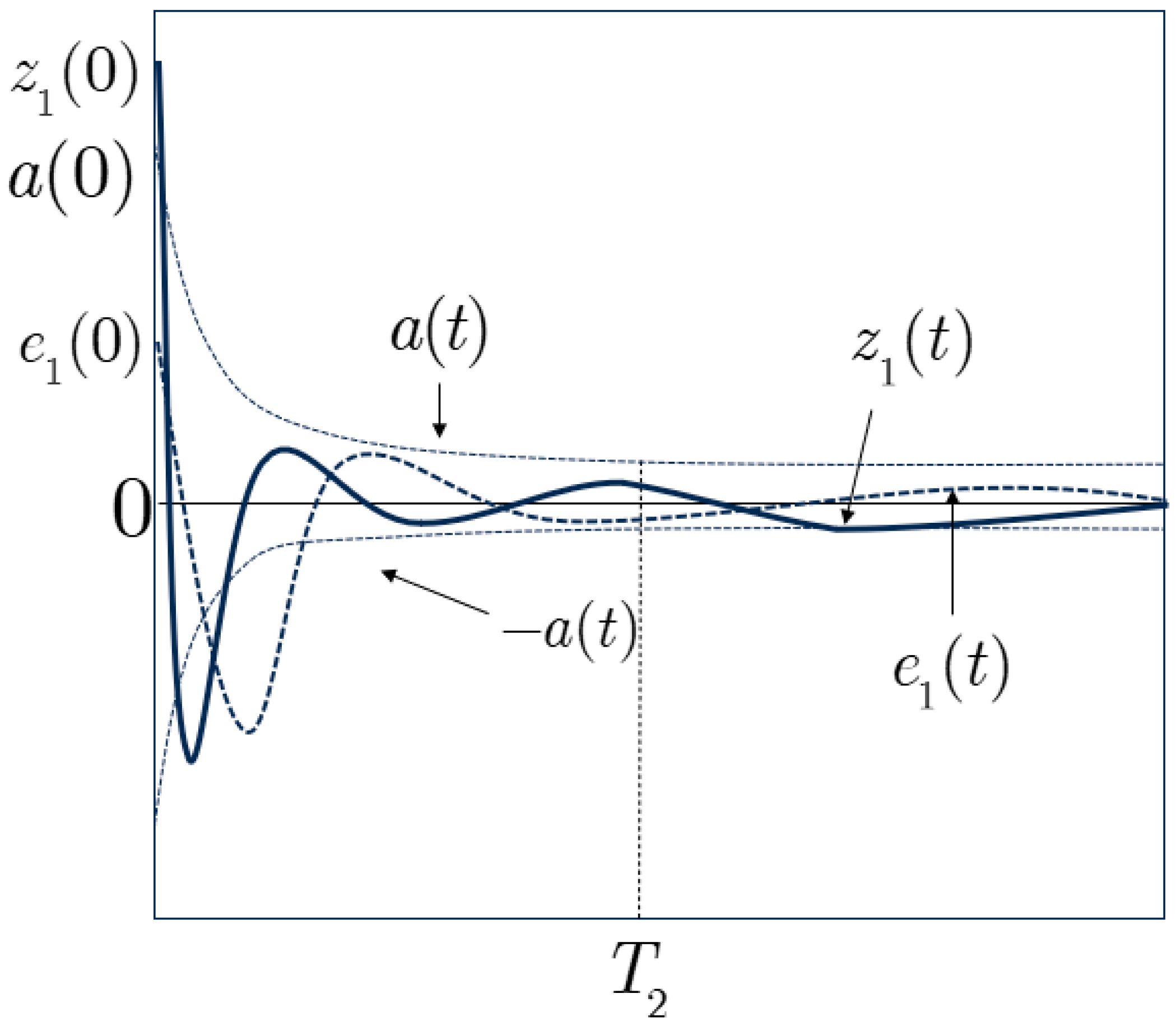
Traditional prescribed performance, as shown in Figure 1, requires the initial value of tracking error to fall within a constrained range for the prescribed performance to function properly, as | e 1 ( 0 ) | < a ( 0 ) , making it difficult to use normally. In contrast, the unknown initial tracking conditions adopted in this paper, as illustrated in Figure 1, do not require the initial value of tracking error to be within a constrained range, permit | z 1 ( 0 ) | > a ( 0 ) .
The algebraic saturated function selected for this paper is as follows:
ħ ( z 1 ) = z 1 / 1 + z 1 2 ,
Remark 2.
The selection in this paper differs from the hyperbolic tangent function used in [9,10,11]. The algebraic saturated function form chosen in this paper is simpler, facilitating computation and differentiation.
To transform the constraints (9) into constraints on ħ ( z 1 ) , this paper utilizes an algebraically saturated function and a finite-time prescribed performance function a ( t ) to design the constraint function ο ( t ) for ħ ( z 1 ) . Then | ħ ( z 1 ( t ) ) | < o ( t ) , t 0 , to ensure ħ ( 0 ) < o ( 0 ) , select ο ( t ) for
ο ( t ) = M exp ( τ t ) ( a ( t ) a ) a 0 + a ,
where ο ( t ) is the intermediate constraint function, M 1 is the designed parameter, and τ > 0 is the convergence rate.
Remark 3.
This paper employs a finite-time constraint function a ( t )  that converges the tracking error to a steady state within a finite time interval. As a one-step constraint, it offers a simpler and more easily implementable approach compared to the two-step constraint methods described in [9,10,11].
Proof. 
Selecting a suitable parameter M 1 for o ( t ) to satisfy o ( 0 ) = M + a , M + a 1 the condition | ħ ( 0 ) | < 1 , so | ħ ( 0 ) | < o ( 0 ) is achieved. This yields a prescribed performance controller whose functionality is unrelated to the initial value of tracking error z 1 ( 0 ) . □
When t T 2 , ο ( t ) = a > 0 reaching steady state.
So, | ħ ( z 1 ) | < o ( t ) , select the barrier Lyapunov function to impose constraints. At the same time, | ħ ( z 1 ) | < o ( t ) is equivalent to a ( t ) < e 1 ( t ) < a ( t ) .
Property 1.
When M 1 , | ħ ( 0 ) | < o ( 0 ) , and o ( 0 )  is unrelated of the initial value of tracking error z 1 ( 0 ) .

3. Controller Design

In this section, we begin to design the active disturbance rejection prescribed performance controller under unknown initial tracking conditions.
Step 1:
Solving the first-order derivative of z 1 yields
z ˙ 1 = x ˙ 1 y ˙ r ,
According to (11) yield
ħ ˙ = A z ˙ 1 ,
where A = ( 1 + z 1 2 ) 3 / 2 .
Let Lyapunov as
V 1 = 1 2 ln o 2 o 2 ħ 2 + 1 2 m 2 2 ,
where m 2 is the filtering error, e 2 = x 2 ω 2 , m 2 = ω 2 α 1 .
Substituting (14) into the first-order derivative of (15) yields
V ˙ 1 = Q ( ħ ħ ˙ o ˙ o ħ 2 ) + m 2 m ˙ 2 = Q ħ ( A ( F 1 + g 1 ( e 2 + m 2 + α 1 ) y ˙ r ) o ˙ o ħ ) + m 2 m ˙ 2 ,
where Q = 1 / ( o 2 ħ 2 ) ,   F 1 = f 1 + d 1 , e 2 is the tracking error in the next step.
ESO 1:
E 1 = Z 11 x 1 Z ˙ 11 = Z 12 + g 1 x 2 β 11 E 1 Z ˙ 12 = β 12 fal ( E 1 )
Substituting the state observer estimate into (16) yields
V ˙ 1 = Q ħ ( A ( Z 12 + g 1 α 1 y ˙ r ) o ˙ o ħ ) + Q ħ A ( ε 1 + g 1 e 2 + g 1 m 2 ) + m 2 m ˙ 2 .
where ε 1 = F 1 Z 12 , ε 1 is the estimation error.
According to Lemma 3, it follows that
Q ħ A g 1 e 2 1 2 Q 2 A 2 ħ 2 g 1 2 + 1 2 e 2 2 .
Q ħ A g 1 m 2 1 2 Q 2 A 2 ħ 2 g 1 2 + 1 2 m 2 2 .
Q ħ A ε 1 1 2 Q 2 A 2 ħ 2 + 1 2 ε 1 2 .
Substituting (19–21) into (18) yields
V ˙ 1 Q ħ ( Q A 2 g 1 2 ħ + 1 2 Q A 2 ħ + A Z 12 + A g 1 α 1 A y ˙ r o ˙ o ħ ) + 1 2 e 2 2 + 1 2 m 2 2 + 1 2 ε 1 2 + m 2 m ˙ 2 .
Design virtual control laws as
α 1 = 1 A g 1 ( k 1 h Q A 2 g 1 2 ħ 1 2 Q A 2 ħ A Z 12 + A y ˙ r + o ˙ o ħ ) .
Substituting (23) into (22) yields
V ˙ 1 Q k 1 h 2 + 1 2 e 2 2 + 1 2 m 2 2 + 1 2 ε 1 2 + m 2 m ˙ 2 .
From (5) and (15), through simple derivation, we can obtain
m ˙ 2 = m 2 τ 2 α ˙ 1 .
Equation (25) multiplying both sides by m 2 yields
m 2 m ˙ 2 = m 2 2 τ 2 m 2 α ˙ 1 .
where 0 < τ 2 < 2 3 .
By Lemma 3, we can obtain
m 2 α ˙ 1 m 2 2 + ς ¯ 1 2 4 .
Assume | α ˙ 1 | ς ¯ 1 ( z 1 , a ˙ , y r , y ˙ r ) , where ς ¯ 1 is a continuous function. For simplicity, abbreviate ς ¯ 1 ( z 1 , a ˙ , y r , y ˙ r ) as ς ¯ 1 .
According to (26) and (27), we obtain
m 2 m ˙ 2 m 2 2 τ 2 + m 2 2 + ς ¯ 1 2 4 .
Substituting (28) into (24) yields
V ˙ 1 Q k 1 h 2 + 1 2 e 2 2 + 1 2 ε 1 2 ( 1 τ 2 3 2 ) m 2 2 + ς ¯ 1 2 4 .
According to Lemma 2, (29) can be transformed as
V ˙ 1 K 1 V 1 + 1 2 e 2 2 + 1 2 ε 1 2 + ς ¯ 1 2 4 .
where K 1 = min { 2 k 1 , 2 ( 1 / τ 2 3 / 2 ) } .
Step i i = 2 ... n 1 .
Tracking error
e i = x i α i 1 .
According to (1), (5) and (31), we obtain
e ˙ i = x ˙ i α ˙ i 1 = x ˙ i + m i + 1 τ i + 1 .
Let the Lyapunov function be
V i = 1 2 e i 2 + 1 2 m i + 1 2 ,
where m i + 1 is the filtering error, e i = x i ω i , m i + 1 = ω i + 1 α i .
Solving the first-order derivative of (33) and substituting (32) yields
V ˙ i = e i ( F i + g i α i + m i τ i ) + m i + 1 m ˙ i + 1 + e i ( g i e i + 1 + g i m i + 1 ) ,
where F i = f i + d i , e i + 1 is the tracking error in the next step, m i + 1 is the filtering error.
ESO i:
E i = Z i 1 x i Z ˙ i 1 = Z i 2 + g i x i + 1 β i 1 E i Z ˙ i 2 = β i 2 fal ( E i )
Substituting the state observer estimate into (34) yields
V ˙ i = e i ( Z i 2 + g i α i + m i τ i ) + m i + 1 m ˙ i + 1 + e i ( ε i + g i e i + 1 + g i m i + 1 ) ,
where ε i = F i Z i 2 , ε i is the estimation error.
According to Lemma 3, it follows that
e i ε i 1 2 e i 2 + 1 2 ε i 2 .
e i g i e i + 1 1 2 g i 2 e i 2 + 1 2 e i + 1 2 .
e i g i m i + 1 1 2 g i 2 e i 2 + 1 2 m i + 1 2 .
Substituting (37–39) into (36) yields
V ˙ i e i ( g i 2 e i + e i + Z i 2 + g i α i + m i τ i ) + 1 2 ε i 2 + 1 2 m i + 1 2 + 1 2 e i + 1 2 1 2 e i 2 + m i + 1 m ˙ i + 1 .
Design virtual control laws as
α i = 1 g i ( k i e i g i 2 e i e i Z i 2 m i τ i ) .
Substituting (41) into (40) yields
V ˙ i k i e i 2 + m i + 1 m ˙ i + 1 + 1 2 ε i 2 + 1 2 m i + 1 2 + 1 2 e i + 1 2 1 2 e i 2 .
From (5) and (15), through simple derivation, we can obtain
m ˙ i + 1 = m i + 1 τ i + 1 α ˙ i .
Equation (43) multiplying both sides by m i + 1 yields
m i + 1 m ˙ i + 1 = m i + 1 2 τ i + 1 m i + 1 α ˙ i .
where 0 < τ i + 1 < 2 / 3 .
By Lemma 3, we can obtain
m i + 1 α ˙ i m i + 1 2 + ς ¯ i 2 4 .
Assume | α ˙ i | ς ¯ i ( e i , Z i 2 , m i ) , where ς ¯ i is a continuous function. For simplicity, abbreviate ς ¯ i ( e i , Z i 2 , m i ) as ς ¯ i .
According to (44) and (45), we obtain
m i + 1 m ˙ i + 1 m i + 1 2 τ i + 1 + m i + 1 2 + ς ¯ i 2 4 .
Substituting (46) into (42) yields
V ˙ i k i e i 2 ( 1 τ i + 1 3 2 ) m i + 1 2 + ς ¯ i 2 4 + 1 2 ε i 2 + 1 2 e i + 1 2 1 2 e i 2 .
According to Lemma 2, (47) can be transformed as
V ˙ i K i V i + ς ¯ i 2 4 + 1 2 ε i 2 + 1 2 e i + 1 2 1 2 e i 2 .
where K i = min { 2 k i , 2 ( 1 / τ i + 1 3 / 2 ) } .
Step n:
Tracking error
e n = x n α n 1 .
According to (1), (5) and (49), we obtain
e ˙ n = x ˙ n α ˙ n 1 = x ˙ n + m n τ n .
Let the Lyapunov function be
V n = 1 2 e n 2 ,
Substituting (50) and solving the first-order derivative of (51) yields
V ˙ n = e n ( F n + g n u + m n τ n ) .
where F n = f n + d n .
ESO n:
E n = Z n 1 x n Z ˙ n 1 = Z n 2 + g n u β n 1 E n Z ˙ n 2 = β n 2 fal ( E n )
Substituting the state observer estimate into (53) yields
V ˙ n = e n ( Z n 2 + g n u + m n τ n ) + e n ε n .
where ε n = F n Z n 2 , ε n is the estimation error.
According to Lemma 3, it follows that
e n ε n 1 2 e n 2 + 1 2 ε n 2 .
Substituting (55) into (54) yields
V ˙ n e n ( ε n + Z n 2 + g n u + m n τ n ) + 1 2 ε n 2 1 2 e n 2 .
Design virtual control laws as
u = 1 g n ( k n e n e n Z n 2 m n τ n ) .
Substituting (57) into (56) yields
V ˙ n k n e n 2 + 1 2 ε n 2 1 2 e n 2 .
According to Lemma 2, (58) can be transformed as
V ˙ n K n V n + 1 2 ε n 2 1 2 e n 2 .
where K n = 2 k n .

4. Stability Proof

According to (15), (33) and (51), the system’s Lyapunov function can be written as
V = V 1 + ... V n .
According to (30), (48), and (59), we have
V ˙ K V + i = 1 n 1 ς ¯ i 2 4 + i = 1 n 1 2 ε i 2 = K V + b 1 ,
where K = min { K 1 , ... K i } .
From Lemma 1, the following theorem [1] can be derived. When assumption [1] is satisfied, the virtual control laws are given by (23), (41), and the actual control law (57), by appropriately selecting, k i > 0   ( i = 1 , 2 , , n ) , the closed loop system (1) is bounded stable. If a system is stable, its total energy should gradually decrease over time, ultimately returning to the equilibrium point.

5. Simulation

5.1. General Simulation

To justify the effectiveness of the UDAP controller designed in this paper, the following second-order system is selected [33]:
x ˙ 1 = f 1 + g 1 x 2 + d 1 , x ˙ 2 = f 2 + g 2 u + d 2 ,
where f 1 = x 1 3 , f 2 = x 1 x 2 , g 1 = 1 , g 2 = 1 .
To validate the unknown initial tracking conditions characteristics of the proposed algebraic saturation function and the hyperbolic tangent saturation functions from [9,10,11], identical control parameters were employed while varying only the saturation function. The performance of the system under both saturation functions was then compared. Initial state and controller parameters x 1 ( 0 ) = 1.8 ,   x 2 ( 0 ) = 1.5 ,   x 3 ( 0 ) = 2 ,   x 4 ( 0 ) = 1 ,   x 5 ( 0 ) = 2 ,   x 6 ( 0 ) = 1 ,   x 7 ( 0 ) = 0.2 ,   k 1 = 8 ,   k 2 = 30 ,   a 0 = 1 ,   a = 0.1 ,   M = 1 ,   γ = 1 ,   β 11 = 100 ,   β 12 = 100 ,   β 21 = 100 ,   β 22 = 100 ,   τ 2 = 0.05 ,   λ = 1 ,   τ = 1 ,   A = 1 ,   y r = sin ( A t ) + A cos ( 0.5 A t ) ,   d 1 = 0.1 sin ( t ) 0.05 ,   d 2 = 0.1 cos ( t 1.5 ) .
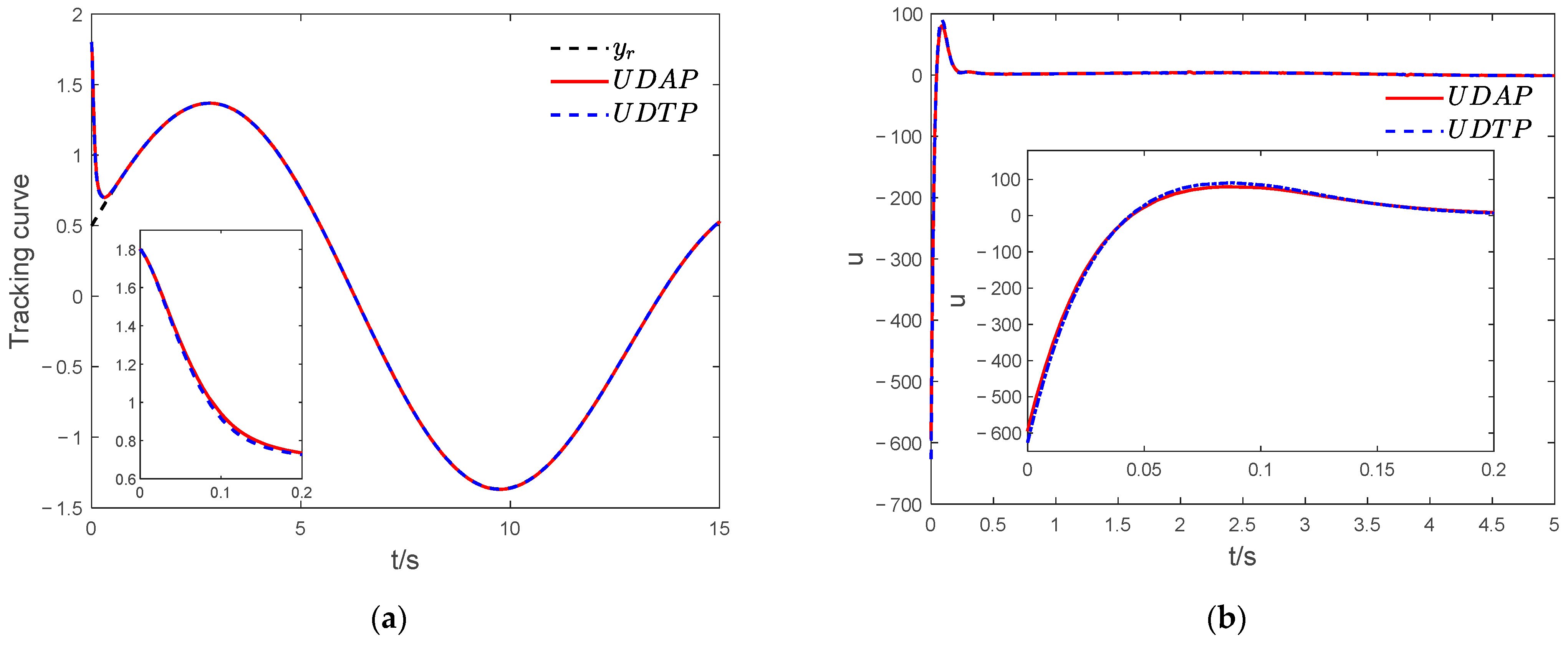
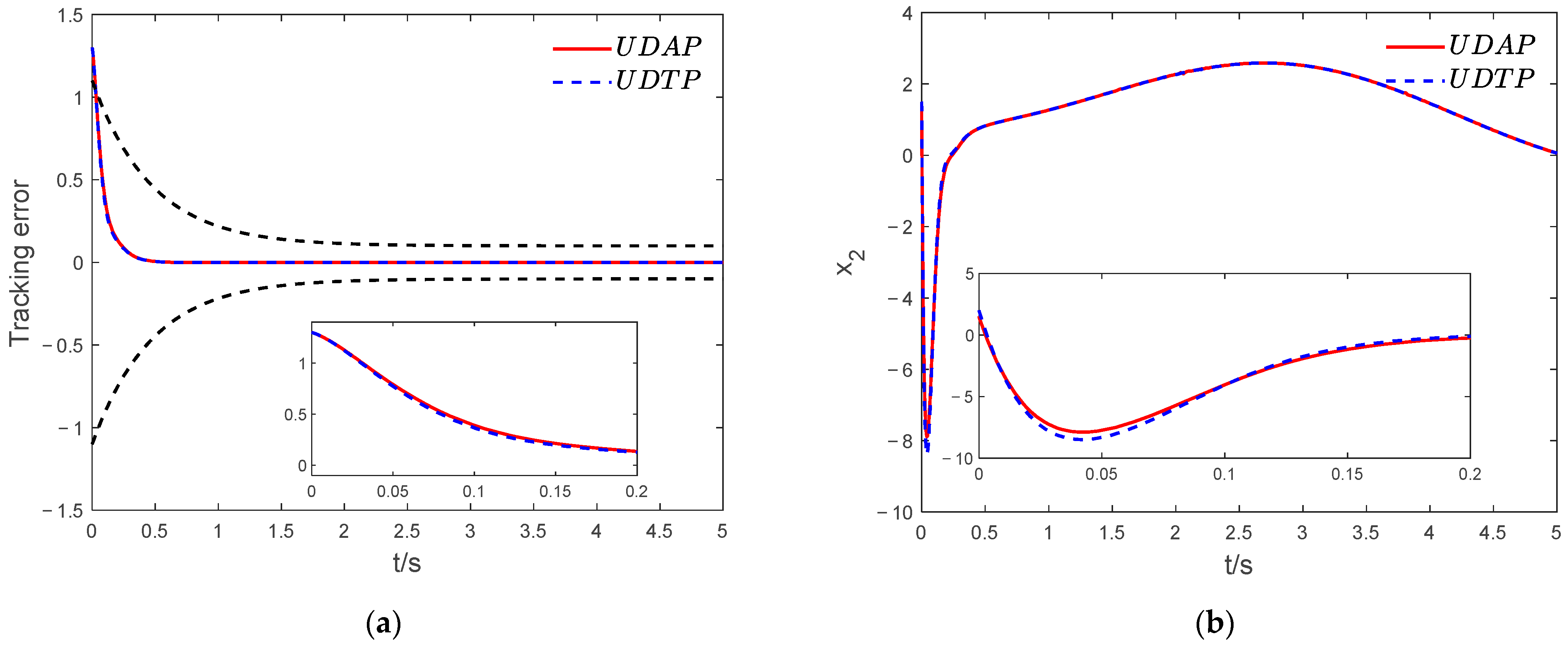
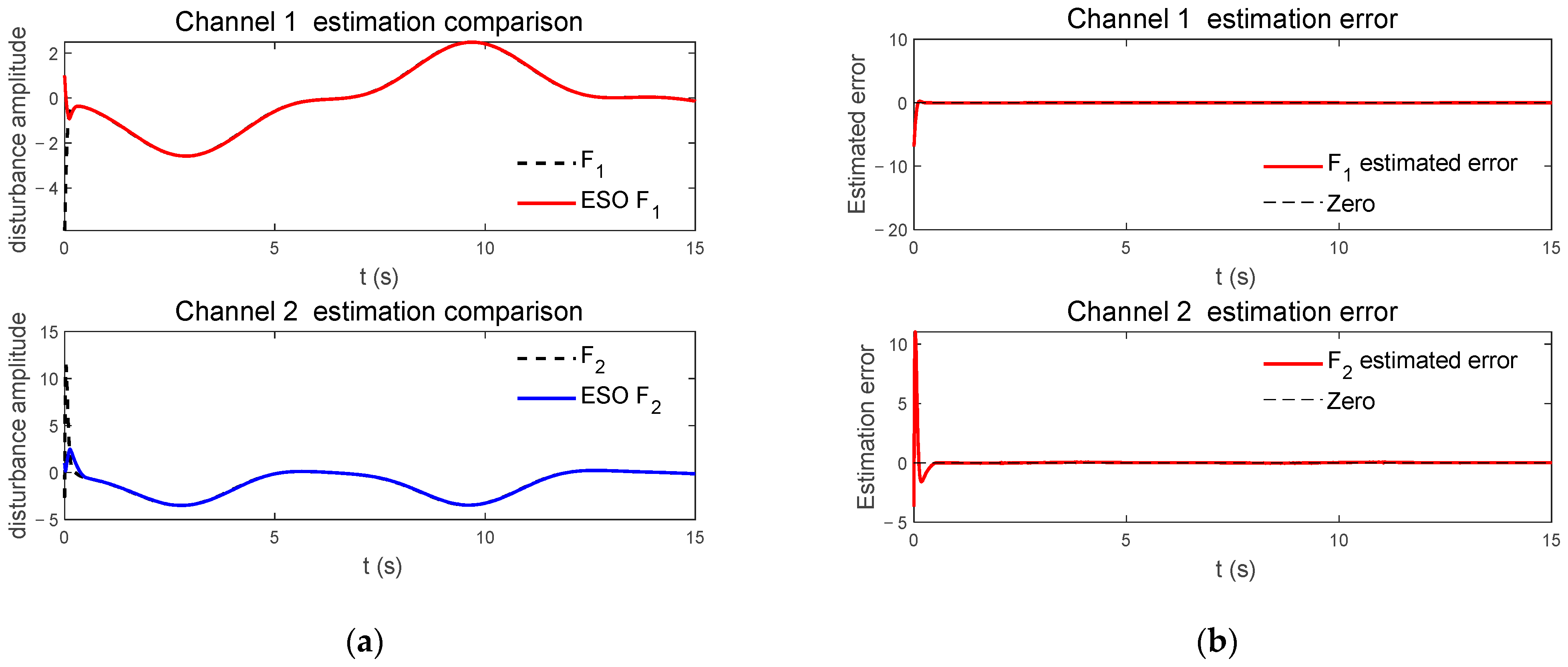
Figure 2 is the system tracking curve and control signal. Figure 3 is the tracking error and state variable. Figure 4 is the state observer estimation. Figure 5 shows dynamic surface control.
As shown in Figure 2a, both methods exhibit identical tracking performance, with both demonstrating good results. As illustrated in Figure 2b, the controller outputs of both methods are smooth and converge rapidly, making them easy to implement.
As shown in Figure 3a, under unknown initial tracking conditions, the proposed algebraic saturation function exhibits nearly identical performance to the hyperbolic tangent saturation function (UDTP) in [9] regarding prescribed performance control. The convergence times are 0.60 s (UDAP) and 0.61 s [9], respectively, with both demonstrating comparable convergence times and effectiveness in tracking error. However, the proposed algebraic saturation function features a simpler structure and is easier to differentiate, whereas the hyperbolic tangent saturation function in [9] has a complex structure and cumbersome differentiation, which is unfavorable for formula derivation. As shown in Figure 3b, the state variables of the general model are all constrained and converged.
To address unknown functions and disturbances in general models, this paper employs a state observer for monitoring. The observation results are fed back to the controller for compensation, achieving active disturbance rejection control that significantly enhances the system’s disturbance rejection capability and robustness. As shown in Figure 4, the estimation performance for channel 1 and channel 2 is satisfactory, with estimation errors converging.
As shown in Figure 5, to address the differential explosion issue in the inverse method, this paper employs the dynamic surface technique for filtering. The filtering results are satisfactory, with bounded filtering errors that converge rapidly.

5.2. Actual System Simulation

To validate the effectiveness of the proposed UDAP method, the UDAP controller designed in this paper is applied to a rigid robotic arm [34,35]. In the automotive manufacturing sector, spot welding and arc welding processes demand extremely high repeatability in positioning accuracy while requiring robust load-bearing capacity to securely hold the welding gun. Rigid robotic arms meet these requirements. The rigid robotic arm model is as follows:
x ˙ 1 = x 2 , x ˙ 2 = f 2 + g 2 u + d 2 ,
where x 1 , x 2 and u are the angular position, angular velocity and input torque of the robotic arm, respectively; f 2 = m r g v l r cos ( x 1 ) / J 0 , g 2 = 1 / J 0 , inertial coefficient J 0 = 4 m r l r 2 / 3 , load mass m r = 5   kg , gravitational acceleration g v = 9.8   m / s 2 , and length of the robotic arm l r = 0.25   m [34]. x 1 ( 0 ) = 1.8 ,   x 2 ( 0 ) = 1.2 ,   x 3 ( 0 ) = 3 ,   x 4 ( 0 ) = 1 ,   x 5 ( 0 ) = 3 ,   x 6 ( 0 ) = 0 ,   x 7 ( 0 ) = 0.1 ,   d 1 = sin ( 2 t ) + 0.3 cos ( t ) ,   k 1 = 8 ,   k 2 = 5 ,   d 2 = 0.3 cos 5 π t e x p 0.5 t .
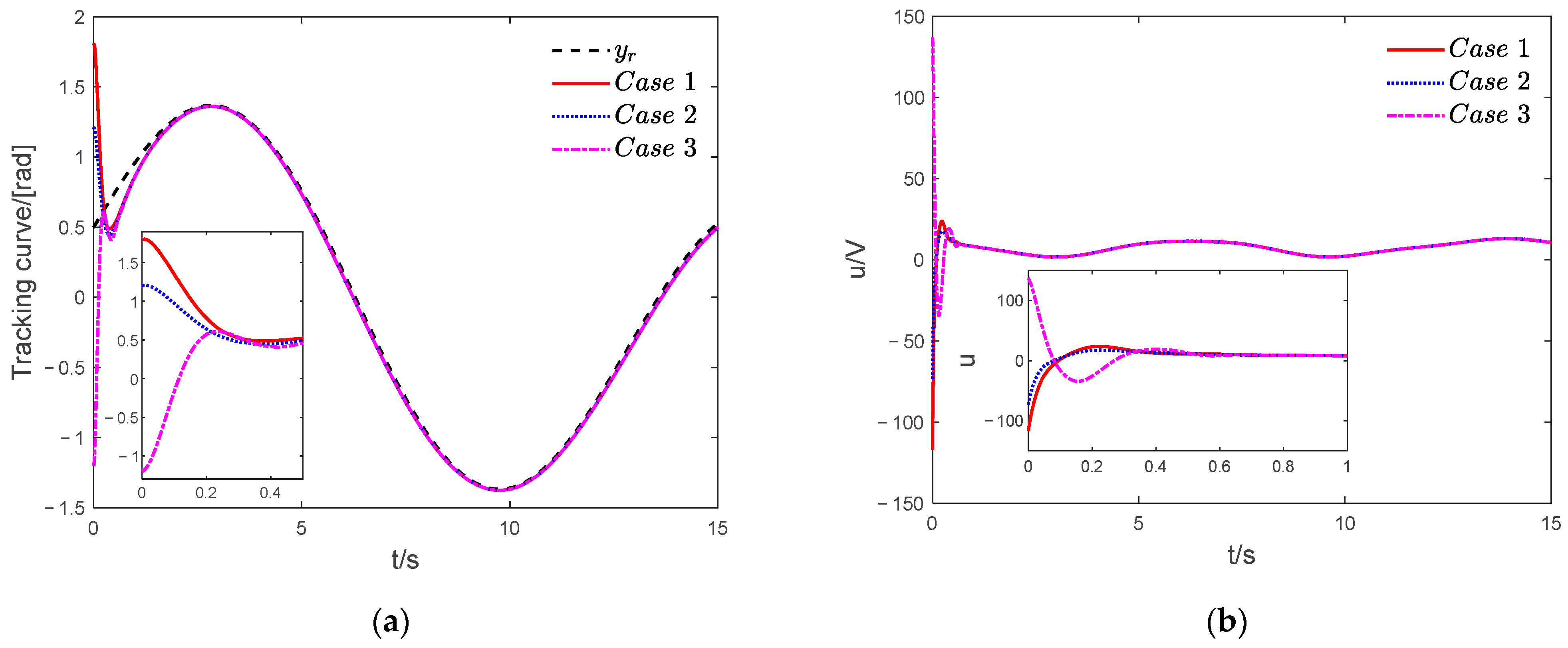
To fully demonstrate the effectiveness of the proposed prescribed performance under unknown initial tracking conditions, simulations were conducted under the following 3 Cases based on different initial values. Case 1: x 1 ( 0 ) = 1.8 . Case 2: x 1 ( 0 ) = 1.2 . Case 3: x 1 ( 0 ) = 1.2 .
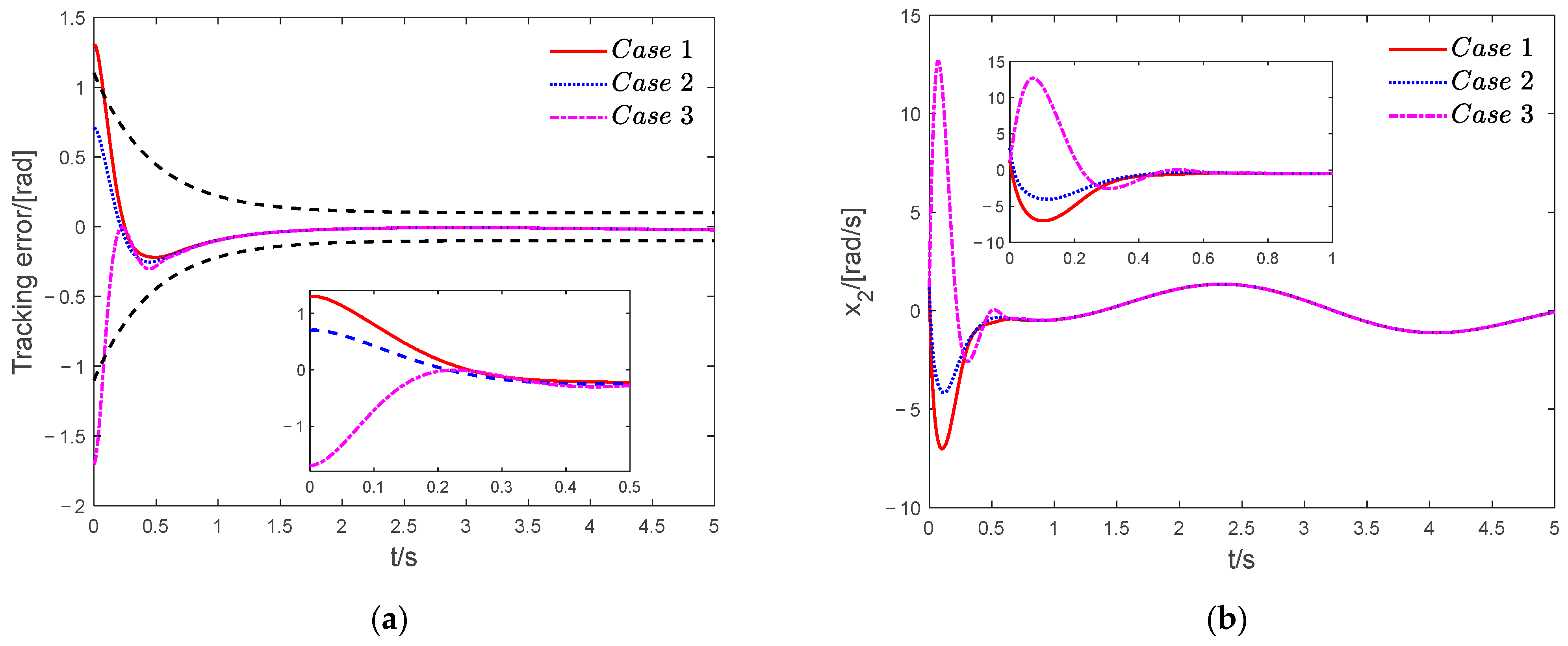
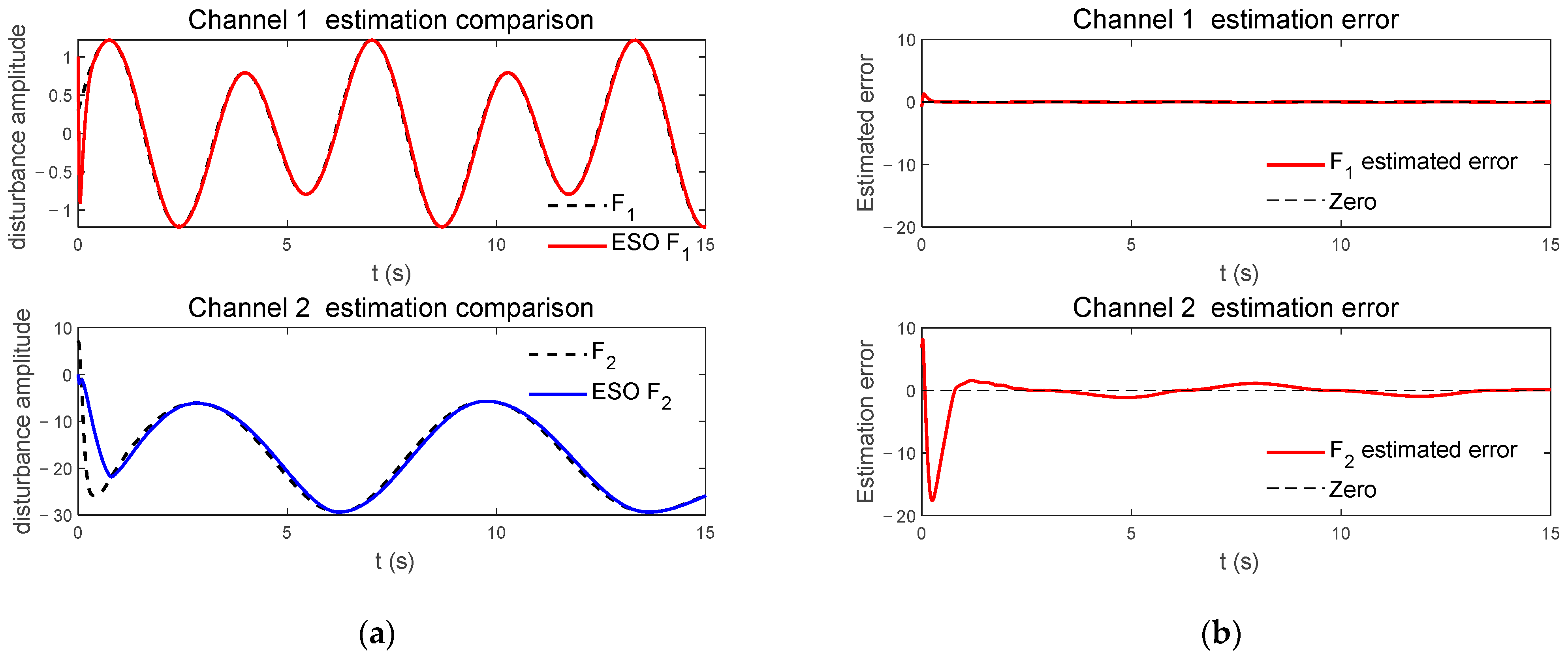
Figure 6 shows the system tracking curve and control signal. Figure 7 shows the tracking error and state variable. Figure 7 shows the tracking error. Figure 8 shows the state observer estimation. Simulations were conducted for three different initial conditions of the system, as shown in Figure 6a. In all three cases, the system rapidly tracked the desired signal regardless of the initial values, fully validating the effectiveness of the proposed prescribed performance under unknown initial tracking conditions. The system’s prescribed performance is entirely independent of its initial values. Compared to traditional prescribed performance, which requires the initial value of tracking error to lie within a constrained space, this approach offers significant advantages, substantially expanding the application scenarios and scope of prescribed performance. Figure 6b shows that under three initial values, the controller output remains smooth and converges rapidly within approximately 1 s, fully demonstrating the controller’s feasibility.
To enhance clarity, Figure 7 displays the response curve of the control system during the initial 5 s, clearly illustrating the curve’s variation characteristics. As shown in Figure 7a, three distinct initial values of tracking errors enter the prescribed performance constraints from the upper, middle (the only feasible case for traditional prescribed functions), and lower sides of the constraint function, respectively. The tracking errors reach essentially the same level at 0.2 s, the system reaches steady state at 1.5 s, with all tracking errors confined within the constraint space and converging to ±0.1 rad. This effectively validates the feasibility of the proposed prescribed performance method under unknown initial tracking conditions. Figure 7b demonstrates the rapid convergence achieved in the rigid robotic arm’s state x 2 .
For unknown functions and disturbances in rigid robotic arm systems, extended state observer-based model estimation, as shown in Figure 8, demonstrates estimation performance with bounded estimation errors and rapid convergence.

6. Conclusions

This paper effectively achieves the design of a prescribed performance controller under unknown initial tracking conditions through a novel algebraic saturation function. The new saturation function form is simpler, facilitates differentiation and the proof of Lyapunov stability. The differential explosion problem is resolved using dynamic surface techniques, which are easier to implement, have broader applicability, and possess strong practical relevance. By extending the state observer, estimation of unknown functions and disturbances is achieved, completing the design of an anti-disturbance controller. This significantly enhances the system’s disturbance rejection capability. Currently, the proposed controller only designs output constraints; future work can focus on application scenarios and controllers for prescribed performance [36,37].

Author Contributions

Conceptualization, X.L. and Q.Q.; methodology, Q.Q.; software, X.L.; validation, X.L., Y.M. and H.G.; formal analysis, Q.Q.; investigation, Q.Q.; resources, Q.Q.; data curation, X.L.; writing—original draft preparation, X.L.; writing—review and editing, X.L. and Y.M.; visualization, H.G.; supervision, Q.Q.; project administration, X.L. and Q.Q.; funding acquisition, Q.Q. All authors have read and agreed to the published version of the manuscript.

Funding

This research was funded by the Basic Research Project of Liaoning Provincial Department of Education (LJKMZ20220655 and LJ232410146053), National Natural Science Foundation of China (U21A20483), Liaoning Institute of Science and Technology Pioneer Research and Innovation Team XKT202405, and Undergraduate Innovation and Entrepreneurship Training Program 202511430131.

Data Availability Statement

The data presented in this study are available upon request from the corresponding author; the data are not publicly available due to privacy concerns.

Conflicts of Interest

The authors declare no conflicts of interest.

Abbreviations

The following abbreviations are used in this manuscript:
ADRCActive Disturbance Rejection Control
UDAPunknown disturbances adaptive prescribed performance control
PPCprescribed performance control
PPFprescribed performance function

References

  1. Cheng, X.H.; Liu, S.; Wang, W.B.; Zhang, C. Adaptive finite-time prescribed performance control of nonlinear power systems with symmetry full-state constraints. Symmetry 2024, 16, 857. [Google Scholar] [CrossRef]
  2. Zhang, X.L.; Zhang, Y.; Hu, Q.; Guo, X.; Yan, Y.X. Model-free based fixed-time control for the uncertain wearable exoskeleton with preset performance. Control Eng. Pract. 2024, 151, 106011. [Google Scholar] [CrossRef]
  3. Gao, S.H.; Liu, X.P.; Jing, Y.W.; Dimirovski, G.M. A novel finite-time prescribed performance control scheme for spacecraft attitude tracking. Aerosp. Sci. Technol. 2021, 118, 107044. [Google Scholar] [CrossRef]
  4. Zou, S.N.; Li, X.H.; Liu, Y. Safe tracking control based on a secure boundary protection method for nonlinear systems with unknown initial tracking condition. Int. J. Syst. Sci. 2024, 55, 1655–1672. [Google Scholar] [CrossRef]
  5. Yao, Y.; Tan, J.Q.; Yao, Y.G.; Zhang, X.; Chen, P. Prescribed-time prescribed performance control for stochastic nonlinear input-delay systems with arbitrary bounded initial error. Neurocomputing 2024, 571, 127200. [Google Scholar] [CrossRef]
  6. Wang, Q.S.; Fu, M.; Wang, Y.; Xu, Y.J. State-constrained safety trajectory tracking control with prescribed performance for a hovercraft under arbitrary initial conditions. Ocean Eng. 2024, 309, 118378. [Google Scholar] [CrossRef]
  7. Zhou, S.Y.; Song, Y.D.; Luo, X.S. Fault-tolerant tracking control with guaranteed performance for nonlinearly parameterized systems under uncertain initial conditions. J. Frankl. Inst. 2020, 357, 6805–6823. [Google Scholar] [CrossRef]
  8. Deng, D.D.; Zhao, X.W.; Lai, Q.; Liu, S. Fuzzy adaptive containment control of non-strict feedback multi-agent systems with prescribed time and accuracy under arbitrary initial conditions. Inf. Sci. 2024, 663, 120306. [Google Scholar] [CrossRef]
  9. Liu, H.; Li, X.H.; Li, X.P. A bounded-mapping-based prescribed constraint tracking control method without initial condition. Nonlinear Dyn. 2023, 111, 3451–3468. [Google Scholar] [CrossRef]
  10. Liu, Y.; Li, X.H.; Zou, S.N. A variable-barrier-function-based prescribed finite-time bounded-formula omitted reinforcement learning optimal tracking control strategy without dependence on initial condition. J. Frankl. Inst. 2024, 361, 107120. [Google Scholar] [CrossRef]
  11. Liu, H.; Li, X.H. A prescribed-performance-based adaptive finite-time tracking control scheme circumventing the dependence on the system initial condition. Appl. Math. Comput. 2023, 448, 127912. [Google Scholar] [CrossRef]
  12. Wang, Y.; Yang, Y.H.; Wu, L.B. Fuzzy adaptive event-triggered control of multi-agent systems with command filter. Int. J. Control Autom. Syst. 2025, 23, 175–186. [Google Scholar] [CrossRef]
  13. Xu, Z.B.; Gao, C.; Jiang, H.Z. High-gain-observer-based output feedback adaptive controller design with command filter and event-triggered strategy. IAENG Int. J. Appl. Math. 2023, 53, 463–469. [Google Scholar]
  14. Ding, F.; Huang, J.; Xu, W.X.; Yang, C.G.; Sun, C.; Ai, Y. Dynamic surface control with a nonlinear disturbance observer for multi-degree of freedom underactuated mechanical systems. Int. J. Robust Nonlinear Control. 2022, 32, 7809–7827. [Google Scholar] [CrossRef]
  15. Xin, L.P.; Yu, B.; Zhao, L.; Yu, J.P. Adaptive fuzzy backstepping control for a two continuous stirred tank reactors process based on dynamic surface control approach. Appl. Math. Comput. 2020, 377, 125138. [Google Scholar] [CrossRef]
  16. Wu, J.; Chen, X.; Zhao, Q.; Li, J.; Wu, Z.G. Adaptive neural dynamic surface control with prespecified tracking accuracy of uncertain stochastic non-strict-feedback systems. IEEE Trans. Cybern. 2022, 52, 3408–3421. [Google Scholar] [CrossRef]
  17. Liu, H.; Li, X.H.; Wang, H.Q. Adaptive prescribed finite-time asymptotic tracking control for switched systems with unknown initial conditions and full-state constraints. Int. J. Syst. Sci. 2024, 55, 370–390. [Google Scholar] [CrossRef]
  18. Wu, L.B.; He, X.Q.; Guo, L.D.; Huang, S.J.; Hui, Y.H. Neural network adaptive switched fault-tolerant control of uncertain nonlinear systems with full state constraints. Neurocomputing 2024, 598, 128034. [Google Scholar] [CrossRef]
  19. Chen, M.; An, S.Y.; Peng, K.X.; Sun, H. Fixed-time bounded H∞ tracking control of a single-joint manipulator system with input saturation. Int. J. Control. 2023, 96, 2303–2312. [Google Scholar] [CrossRef]
  20. Xu, Z.; Zhang, T.R.; Bao, Y.L.; Zhang, H.; Gerada, C. A nonlinear extended state observer for rotor position and speed estimation for sensorless IPMSM drives. IEEE Trans. Power Electron. 2019, 35, 733–743. [Google Scholar] [CrossRef]
  21. Hu, Y.X.; Yang, X.H.; Yang, L.; Huang, C.; Liu, X.P. Improved-third-order-extended-state-observer-based sliding-mode control using singular perturbation theory for flexible-joint robot. Int. J. Control. 2025, 98, 2789–2802. [Google Scholar] [CrossRef]
  22. Aliamooei-Lakeh, H.; Aliamooei-Lakeh, S.; Toulabi, M.; Amraee, T. Enhancement in robust performance of boost converter-based distributed generations utilizing active disturbance rejection controller. IEEE Trans. Autom. Sci. Eng. 2023, 21, 6094–6108. [Google Scholar] [CrossRef]
  23. Liu, S.H.; Ding, H.D.; Wang, Z.Y.; Li, M.; Li, Z. An ADRC parameters self-tuning control strategy of tension system based on RBF neural network. J. Renew. Mater. 2023, 11, 1991–2014. [Google Scholar] [CrossRef]
  24. Liu, L.; Liu, Y.X.; Zhou, L.L.; Wang, B.; Cheng, Z.T.; Fan, H.J. Cascade ADRC with neural network-based ESO for hypersonic vehicle. J. Frankl. Inst. 2023, 360, 9115–9138. [Google Scholar] [CrossRef]
  25. Ding, H.D.; Liu, S.H.; Wang, Z.W.; Zhang, H.; Wang, C.Y. An ADRC parameters self-tuning controller based on RBF neural network for multi-color register system. Machines 2023, 11, 320. [Google Scholar] [CrossRef]
  26. Liu, P.F.; Tian, H.M.; Wang, H.T. Research on control of quadrotor UAV based on improved BP neural network PID and ADRC. In Proceedings of the 2024 IEEE 2nd International Conference on Sensors, Electronics and Computer Engineering (ICSECE), Jinzhou, China, 29–31 August 2024; pp. 104–112. [Google Scholar] [CrossRef]
  27. Yang, X.H.; Deng, X.F. Attitude tracking control for VTOL aircraft with uncertain disturbances based on adaptive neural network ADRC method. Unmanned Syst. 2025, 13, 1053–1064. [Google Scholar] [CrossRef]
  28. Tian, D.Z.; Song, X.Y. Addressing complex state constraints in the integral barrier Lyapunov function-based adaptive tracking control. Int. J. Control. 2023, 96, 1202–1209. [Google Scholar] [CrossRef]
  29. Wang, Y.Q.; Xu, N.; Liu, Y.J.; Zhao, X.D. Adaptive fault-tolerant control for switched nonlinear systems based on command filter technique. Appl. Math. 2021, 392, 125725. [Google Scholar] [CrossRef]
  30. Han, J.Q. Active Disturbance Rejection Control Technique—The Technique for Estimating and Compensating the Uncertainties; National Defense Industry Press: Beijing, China, 2008. [Google Scholar]
  31. Huang, Y.C.; Wang, J.H.; Wang, F.; He, B.T. Event-triggered adaptive finite-time tracking control for full state constraints nonlinear systems with parameter uncertainties and given transient performance. ISA Trans. 2011, 108, 131–143. [Google Scholar] [CrossRef]
  32. Luo, X.; Mu, D.R.; Wang, Z.; Ning, P.J.; Hua, C.C. Adaptive full state constrained tracking control for mobile robotic system with unknown dead-zone input. Neurocomputing 2023, 524, 31–42. [Google Scholar] [CrossRef]
  33. Liu, M.R.; Wu, L.B.; Wang, H.Q.; Guo, L.D.; Huang, S.J. Disturbance observer-based nonsingular fixed-time fuzzy adaptive event-triggered output feedback control of uncertain nonlinear systems. Fuzzy Sets Syst. 2024, 498, 109132. [Google Scholar] [CrossRef]
  34. Liu, X.P.; Wang, H.Q.; Gao, C.; Chen, M. Adaptive fuzzy funnel control for a class of strict feedback nonlinear systems. Neurocomputing 2017, 241, 71–80. [Google Scholar] [CrossRef]
  35. Liu, Y.; Liu, X.P.; Jing, Y.W. Adaptive neural networks finite-time tracking control for non-strict feedback systems via prescribed performance. Inf. Sci. 2018, 468, 29–46. [Google Scholar] [CrossRef]
  36. Gui, M.Z.; Dai, M.Z.; Zhang, C.X.; Zhang, X.; Wu, J. Prescribed performance spacecraft attitude control with multiple convergence rates. Symmetry 2024, 16, 789. [Google Scholar] [CrossRef]
  37. Jiang, K.Y.; Mao, L.; Su, Y.M.; Zheng, Y.X. Trajectory tracking control for underactuated USV with prescribed performance and input quantization. Symmetry 2021, 13, 2208. [Google Scholar] [CrossRef]
Figure 1. Unknown initial tracking conditions.
Symmetry 18 00424 g001
Figure 2. This is the tracking curve and control signal of system 1: (a) Tracking curve of system 1. (b) Control signal of system 1.
Symmetry 18 00424 g002
Figure 3. This is the tracking error and state variable of system 1: (a) Tracking error of system 1. (b) State variables x 2 of system 1.
Symmetry 18 00424 g003
Figure 4. This is the state observer estimation of system 1: (a) Observer estimation of system 1. (b) Observer estimation error of system 1.
Symmetry 18 00424 g004
Figure 5. Dynamic surface control.
Symmetry 18 00424 g005
Figure 6. This is the tracking curve and control signal of system 2: (a) Tracking curve of system 2. (b) Control signal of system 2.
Symmetry 18 00424 g006
Figure 7. This is the tracking error and state variable of system 2: (a) Tracking error of system 2. (b) State variables x 2 of system 2.
Symmetry 18 00424 g007
Figure 8. This is the state observer estimation of system 2: (a) Observer estimation of system 2. (b) Observer estimation error of system 2.
Symmetry 18 00424 g008
Disclaimer/Publisher’s Note: The statements, opinions and data contained in all publications are solely those of the individual author(s) and contributor(s) and not of MDPI and/or the editor(s). MDPI and/or the editor(s) disclaim responsibility for any injury to people or property resulting from any ideas, methods, instructions or products referred to in the content.