1. Introduction
Fuzzy set employs a membership degree to describe fuzziness between things, which was proposed by Zadeh [
1] in 1965, attracted many researchers’ interest, and is widely applied in many information-fusion-related fields, such as intelligence control, etc. To enlarge the application range and meet actual needs, more and more extensions are proposed by scholars so that they can describe uncertainty in the real world better. Intuitionistic fuzzy sets [
2] introduce a positive membership degree and negative membership degree to depict the relationship between belonging and not belonging. Based on intuitionistic fuzzy sets, Yager [
3] proposed a Pythagorean fuzzy set by releasing the restriction, which can depict fuzzy information in a wider range. In some real scenarios, it is more realistic to adopt interval values to describe the membership degree; the interval-valued fuzzy set [
4,
5,
6] plays a more adaptable role in fuzzy information fusion. The type-2 fuzzy set [
7] introduces a lower membership function and upper membership function to further fuzzify the membership degree and describe fuzziness comprehensively. To simulate multiple experts’ judgment, the hesitant fuzzy set (HFS) [
8,
9] adopts several values in the range
to describe grades from different experts. The data structure of a hesitant fuzzy element (HFE) is
n elements tuple, where the value
n depends on the number of experts. Compared with classical fuzzy sets and other extensions, HFS depicts hesitancy more objectively, owing to the common decision-making process. With the efforts of scholars, HFS-related topics and meaningful conclusions are proposed. Weighted hesitant fuzzy set theory can further describe fuzziness by adding weights for every value in HFE, which helps decision makers give more objective results from a broad perspective.
Based on these extensions of fuzzy theory, researchers proposed many operators aiming at information fusion under different scenarios. Wang et al. [
10] proposed power operators based on Aczel–Alsina T-norm/conorm for logistic service provider selection. Ulucay [
11] proposed prioritized operators for the evaluation of renewable energy sources. Kavitha et al. [
12] employed Einstein and Dombi aggregation operators under a hesitant fuzzy scenario for ensemble feature selection. Shit and Ghorai [
13] developed a novel kind of Aczel–Alsina operator to obtain a solution for the selection of the best brand of educational institution. Sun et al. [
14] developed novel aggregation operators under the hybrid Pythagorean hesitant fuzzy scenario combining the Aczel–Alsina norm for decision making. Özlü [
15] developed novel Dombi operators for Bipolar-valued complex aggregation. Dong et al. [
16] proposed operators under a probabilistic linguistic hesitant fuzzy scenario for a rural revitalization project selection in China. Muhammad [
17] developed Muirhead mean aggregation operators for regenerative energy source selection under interval-valued probabilistic dual hesitant fuzzy scenarios. Gupta et al. [
18] proposed a Bonferroni mean pre-aggregation operator-assisted dynamic fuzzy histogram equalization for retina vascular segmentation. Maneckshaw et al. [
19] proposed hesitant fuzzy aggregation with a non-dominated sorting genetic algorithm for multi-object allocation. Mahmood et al. [
20] constructed complex fuzzy frank aggregation operators for choosing an optimal encryption algorithm candidate. Jiang et al. [
21] proposed a rough integrated asymmetric cloud model under multi-granularity linguistic environments for MCDM. Hu et al. [
22] proposed a three-parameter generalized weighted Heronian mean for MADM problems. For MCDM tasks in different scenarios, operators were combined with different extensions of fuzzy theory display availability and flexibility.
The Bonferroni mean operator [
23], as a popular aggregation operator, has attracted researchers’ interests since being proposed by Bonferroni. It can complete information fusion and yield value for obtaining rankings. It consists of common arithmetic mean and geometric mean operators. Owing to its prominent ability to integrate and compute averages of different elements, many scholars have investigated it and given it more extension operators. Wei et al. [
24] introduced an uncertain linguistic Bonferroni mean and investigated related properties. Xu and Chen [
25] developed an interval-valued Bonferroni mean. Xia et al. [
26] provided a generalization and extension of the Bonferroni mean operator based on an intuitionistic fuzzy environment. Beliakov et al. [
27] provided generalization by composing aggregation functions. Recently, more scholars gave more extensions in novel scenarios. Liu et al. [
28] introduced a novel definition and concept of the Bonferroni mean operator based on picture fuzzy set theory. Debnath [
29] introduced the Aczel–Alsina generalized weighted Bonferroni mean operator into MABAC methods. Gowtham [
30] employed a Bonferroni mean and fuzzy pattern tree in epileptic EEG classification. Vommi [
31] constructed a novel filter for feature selection with the help of a fuzzy kNN based on the Bonferroni mean. In this paper, HFWA/HFWG is introduced to propose a definition of the novel operator, hesitant fuzzy geometric Bonferroni mean (HFGBM); further, the Bonferroni mean WHFS is integrated to propose a weighted hesitant fuzzy geometric mean (WHFGBM) operator. The novel operator will aggregate information in a symmetrical way. Finally, comparisons with other operators are given to show effectiveness.
The organization of this paper is as follows: In
Section 2, basic concepts, including HFS and their related functions, are reviewed. Classical and geometric Bonferroni operators are given, and their properties are investigated. In
Section 3, WHFWA and WHFWG are introduced. The Bonferroni mean operator is integrated to propose WHFGBM based on WHFE, and related properties are provided. In
Section 4, the proposed operator is applied in practical tasks to display validation and effectiveness. Conclusions are given in the last section.
3. Weighted Hesitant Fuzzy Geometric Bonferroni Mean
For a given set
, Zhang and Wu [
37] introduced the concept of WHFS
defined on
X, which can be represented by the following mathematical symbol:
where
;
, forming a non-descending collection containing
m membership degrees in range [0, 1]; and weight
,
, which represents the importance of the membership degree
. On the other hand, weights display the preference of the decision maker in real decision-making processes. Therefore,
is called a WHFE.
Furthermore, Zhang and Wu [
37] introduced some operations of WHFSs below. These operators are used to construct the whole computing system based on WHFEs.
Given three WHFEs and , for , then
(1) ;
(2) ;
(3) ;
(4) ;
(5) ;
(6) ;
(7) .
After that, Zeng et al. [
38] pointed out the shortcoming of “⋃” and “⋂” operations on WHFSs, redefined their novel operations and investigated their properties.
Here, the operations, such as “⊕” and “⊗”, on WHFEs are investigated in the following:
Example 2. For a given WHFE , there isBased on the above operations, the following results are obtained:Hence, . Obviously, these results are in contradiction with our tuition. Hence, providing novel definitions of “⊕” and “⊗” not only will make results more objective and accurate but also accord with human perception. Given WHFEs , , where and are the lengths of WHFEs and , respectively.
Owing to the difference in the number of experts, the number of corresponding elements in WHFEs is also different. In most cases, and have different lengths (). To make WHFEs comparable, every WHFE with a less-than-opimal length will be complemented by adding a maximal, minimal, or any value. Optimists and pessimists will decide which value is used for complementation to make all the WHFEs have the same length. In this paper, the minimal value will be utilized for complementation. For convenience, is adopted.
Definition 5. For given WHFEs , , then
, where ;
, where .
For , , then:
;
.
Here, the Example 2 is recalculated.
For a given WHFE,
; then
Furthermore, the following property is obtained:
Property: For a given WHFE , then:
- (1)
;
- (2)
.
Proof. (1) Firstly, for , applying the mathematical induction, then:
Case 1: Basic step: For
, then
Case 2: Induction step: Assume that the property (1) holds for some fixed . Namely, .
Now, for
, then
holds.
(2) For , applying the mathematical induction:
Case 3: Basic step: For
, then
Case 4: Induction step: Assume that the property (2) holds for some fixed
. Namely,
.
Hence, the proof of Property 1 is completed. □
Furthermore, Zhang and Wu [
37] introduced the score function and variance function of WHFE
, respectively, and Zeng et al. [
38] proposed the ranking rule to compare any two WHFEs,
and
.
Considering that WHFS is a useful tool for handling uncertainty and fuzzy information and is widely applied in the decision-making field and evaluation system, motivated by the idea of the geometric Bonferroni mean proposed by Li et al. [
36], in this paper, the geometric Bonferroni mean operator and WHFS theory are integrated.
Let
be a collection of HFEs,
, then the geometric Bonferroni mean of HFE is proposed as follows:
For the HFGBM operator, three properties are discussed as follows:
1. Idempotency if for all i.
2. Monotonicity , if for all i.
3. Boundedness
Let
be a collection of WHFEs,
, then the geometric Bonferroni mean of WHFE is proposed in the following:
where the ⊗ operator can be implemented through:
the ⊕ operator can be implemented through:
and the multiplication and power operator can be implemented through:
For the WHFGBM operator, three properties are discussed as follows:
1. Idempotency: For the WHFGBM operator, when
for all
i, the WHFGBM operator can be written as
.
Therefore, idempotency holds.
2. Monotonicity: For two groups of WHFEs, , , which meet the condition that for all i. In the WHFGBM operator, basic operators are multiplication and power operators. These two operators are based on element-by-element multiplication and power, which meets monotonicity. Owing to weights , if , then . Therefore, monotonicity holds.
3. Boundedness: Let , , owing to , then holds according to monotonicity. On the other hand, the holds, owing to . Therefore, owing to the existence of upper and lower boundaries, the boundedness of the WHFGBM operator holds.
The WHFGBM operator is specially developed for handling weighted hesitant fuzzy data. Since WHFS allows every membership degree to have weights, a special extension of Bonferroni mean operator is necessary. Existing Bonferroni mean operators extensions are based on different environments, such as hesitant fuzzy scenarios and other fuzzy environments. The main differences among these operators lie in the types of data they handle. Traditional hesitant fuzzy data lack weights, interval valued fuzzy data discard single value to describe things, intuitionistic fuzzy data adopt positive and negative membership degrees to depict fuzzy relation.
WHFS includes multiple membership degrees with weights, which improves the depiction of relationships between things. However, multiple membership degrees with weights will cause computation burden in practical operators running process. When the problem to be solved become more and more complex, the attributes will also increase. In programming implementation, multiple loops are adopted to construct the proposed operator. Hence, if decision-making problems become complex enough, the computation burden will lead to difficulty in providing solutions within limited time.
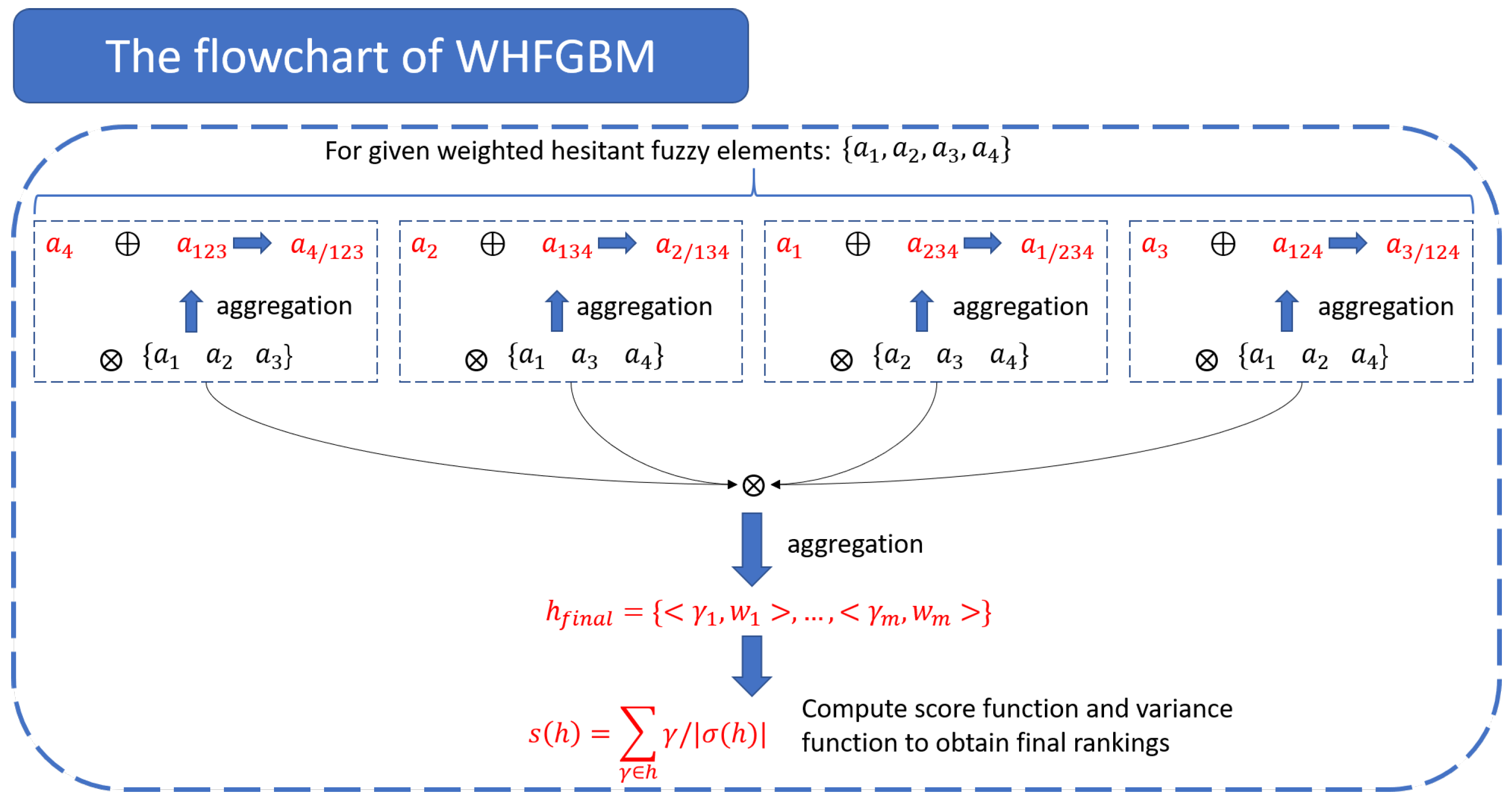
The flowchart and algorithm of the proposed operator, WHFGBM, are displayed in
Figure 1 and Algorithm 1, respectively.
| Algorithm 1 Weighted hesitant fuzzy geometric Bonferroni mean |
Input: The collection of WHFEs , the constant . Output: Aggregation result f.
- 1:
Initialize relative parameters and WHFEs. - 2:
Construct empty set . - 3:
for to n do - 4:
Construct empty set . - 5:
for to n do - 6:
if j is not equal to i then - 7:
Compute through and operators and put into set . - 8:
end if - 9:
end for - 10:
Adopt ⊗ to aggregate WHFEs from to produce . - 11:
Adopt ⊕ to aggregate and , obtain result and put in . - 12:
end for - 13:
Adopt ⊕ operator to aggregate all WHFEs from with the constant . - 14:
Obtain final result f of fuzzy information fusion.
|
4. Numerical Example
In this section, a series of numerical examples is provided to compare the proposed method with existing methods.
Example 3. To enhance the working efficiency, the university is considering purchasing a new information system. Assuming there are some software packages available, the managers from the university need to obtain the best plan after comprehensive consideration. After the initial selection, are the four candidates. Then, three experts, , will give their final scores from different views to decide which information system will be the best choice. In the whole decision-making process, three experts give their own preferences, respectively. The following four attributes will be the main factors taken into consideration:
Capitalized costs for information system construction ().
Performance improvement for the whole organization ().
Migration costs and sunk costs ().
The reliability of software developer ().
For different attributes (
), these attributes have different weights
.
(seen in
Table 1) is constructed, and
represents the evaluation degree of every expert
to every alternative
under attribute
. Through our proposed method, we provide solutions to this problem.
In comparison, two aggregation operators, WHFHA/WHFHG, are used to aggregate hesitant fuzzy information. To illustrate results, a comparison with WHFWA and WHFWG operators [
37] is made. The definition of these operators is as follows:
Case 5 In this case, assume that the weight of every expert is unknown, and evaluation results from decision makers are anonymous.
Step 1 Firstly, WHFSs are obtained as follows:
For
For
For
For
Step 2 The WHFHA operator is applied to aggregate WHFEs of every sample. The results are displayed in
Table 2.
Step 3 Through the equation above, the score and variance of are obtained:
, , , , , , , .
Step 4 To produce the final ranking results, these samples are ranked according to . Therefore, the rankings of every sample: are obtained, and the best sample is .
Step 2: The WHFWG operator is applied to aggregate WHFEs of every sample. The results of the WHFWG operator are displayed in
Table 3.
Step 3: Through the equation above, the score and variance of the of every sample are obtained. , , , , , , , .
Step 4: To produce the final ranking results, these samples are ranked according to and . Therefore, the rankings of every sample () are obtained, and the best sample is .
For this example, the proposed method—WHFGBM operator—is applied to aggregate these WHFEs. After computation, the novel rankings of these examples is obtained (), and the best sample is . It is easy to know that WHFGBM has the same ranking as WHFWG; these two operators provide the same best choice. However, WHFWA provides a divergent result, owing to the difference between and .
Example 4 ([
37]).
Site choice is a common multi-criteria decision-making problem a factory considers when adding new construction for production capacity expansion. Three attributes are factors influencing the final decision, including: Price;
: Location;
: Environment.
After the initial selection and experts’ evaluation, the decision-making matrix, including weighted hesitant fuzzy data, is obtained. WHFE can be represented by
, where
and
are weights and membership degree values, respectively, which describe the candidate
to the attribute
. These data, described by WHFEs, are displayed in
Table 4.
Remark 1. The score and variance of of every sample are obtained. The results of WHFWA: , , , , , . The results of WHFWG: , , , , , . The rankings of WHFWA and WHFWG are: and , respectively. The proposed operator WHFGBM is applied to obtain the final rankings: . WHFGBM gives the same best choice as WHFWG, but both of them have differences regarding and . Even though this case has only three samples, WHFWA yields contradiction rankings with WHFWG.
Example 5. To further validate the proposed operator, the hesitant fuzzy data from the paper [32] are utilized. Weights to transfer HFEs data to WHFEs data are added by fusing equal weights. All the data are shown in Table 5. Remark 2. The score and variance of for each sample are obtained. The results of WHFWA: , , , , , , , . The results of WHFWG: , , , , , , , . The rankings of WHFWA and WHFWG are and , respectively. The proposed operator WHFGBM is applied to obtain the final rankings of samples: . WHFGBM gives the same best choice as WHFWG. These two operators have a slight difference between and samples. However, WHFWA provides an almost contradiction best choice.
Example 6. To compare different methods, data from the paper [39] are adopted. Assume the ideal solution is , and aggregation operator and score function are used for obtaining results. Related decision-making data, as shown in Table 6, are collected to form weighted hesitant fuzzy sets. Remark 3. Score and variance of for each sample are obtained. The results of WHFWA: , , , , , , , . , . The results of WHFWG: , , , , , , , . , . The rankings of WHFWA and WHFWG are and , respectively. Generalized hybrid hesitant weighted distance is proposed by [39]; when , the ranking is . The proposed operator WHFGBM is applied to obtain the final rankings of samples: . This case includes the most samples compared with other cases. Experts give different judgments based on attributes . Experts give a concentrated judgment for , which can be seen from WHFEs with short length. WHFWA and generalized hybrid hesitant weighted distance give an almost consistent ranking, only having a slight difference in inferior samples. WHFWG and WHFGBM provide consistent rankings. Parameter selection: For the WHFGBM operator, there exist two parameters, p and q. When these two parameters are assigned, the WHFGBM operator will finalize. When the decision-making process begins, the WHFEs, as input data, will be sent to the WHFGBM to complete aggregation. Typically, the parameters p and q are small values, which makes the values of the final results to be in a reasonable range for comparison. For above numeric examples, the two parameters values, and , are assigned, respectively. If the values of parameters become bigger, the power operator and ⊗ operator will make the values become very small, which is not conducive to comparison. Hence, these two parameters are usually 1 or 2.
Parameter sensitivity: Due to the influence of parameter values, the sensitivity of the proposed operator should be considered. From the above analysis, the values of two parameters should be greater than 0 but not too large. Values of and are assigned for the above numeric examples. Combinations of , , and are assigned for further analysis. For example 3, the same ranking results are obtained: . For example 4, when , , and , the results are , which are slightly different from those when . For example 5, when , the same results are obtained: . When and , the results are slightly different: . For example 6, the same results are obtained: . From the above results, in example 3 and example 6, any combination can provide the same results. In example 5, one combination provides slightly different results from the other three combinations. In example 4, results from different combinations are slightly different. Hence, the proposed operator can provide stable results, and it has robustness for decision-making tasks.