Absence of Phase Transition in the Biswas–Chatterjee–Sen Model on Directed Barabási–Albert Networks

 , , and
Abstract
1. Introduction
2. Model and Simulations
- For each of the N nodes of the network, we assign an opinion variable in the continuous interval . The state of the network is given by the set . The dynamics of the system is initialized by randomly selecting the opinion states of each of the N nodes of the network, assigning them random numbers drawn from a uniform distribution in the interval .
- At each step of the dynamics, a node i of the network is randomly chosen to have its state updated.
- Next, a node j among the neighbors of the node i is randomly chosen to have its state updated as well. The affinity of the link between nodes i and j is randomly selected. The affinity parameter is an annealed random variable in the interval , which can be negative with probability q. This affinity is also allowed to be either discrete or continuous.
- The two nodes i and j are updated according to the following expressions:where and are the opinion states immediately before the update, and and are the updated opinion states.
- If any of the opinion states of nodes i and j satisfy , they are set to in order to keep the opinion states restricted to the interval . Similarly, if any of the updated opinion states satisfy , the updated states become . This constitutes a source of nonlinearity in the BChS model.
3. Results
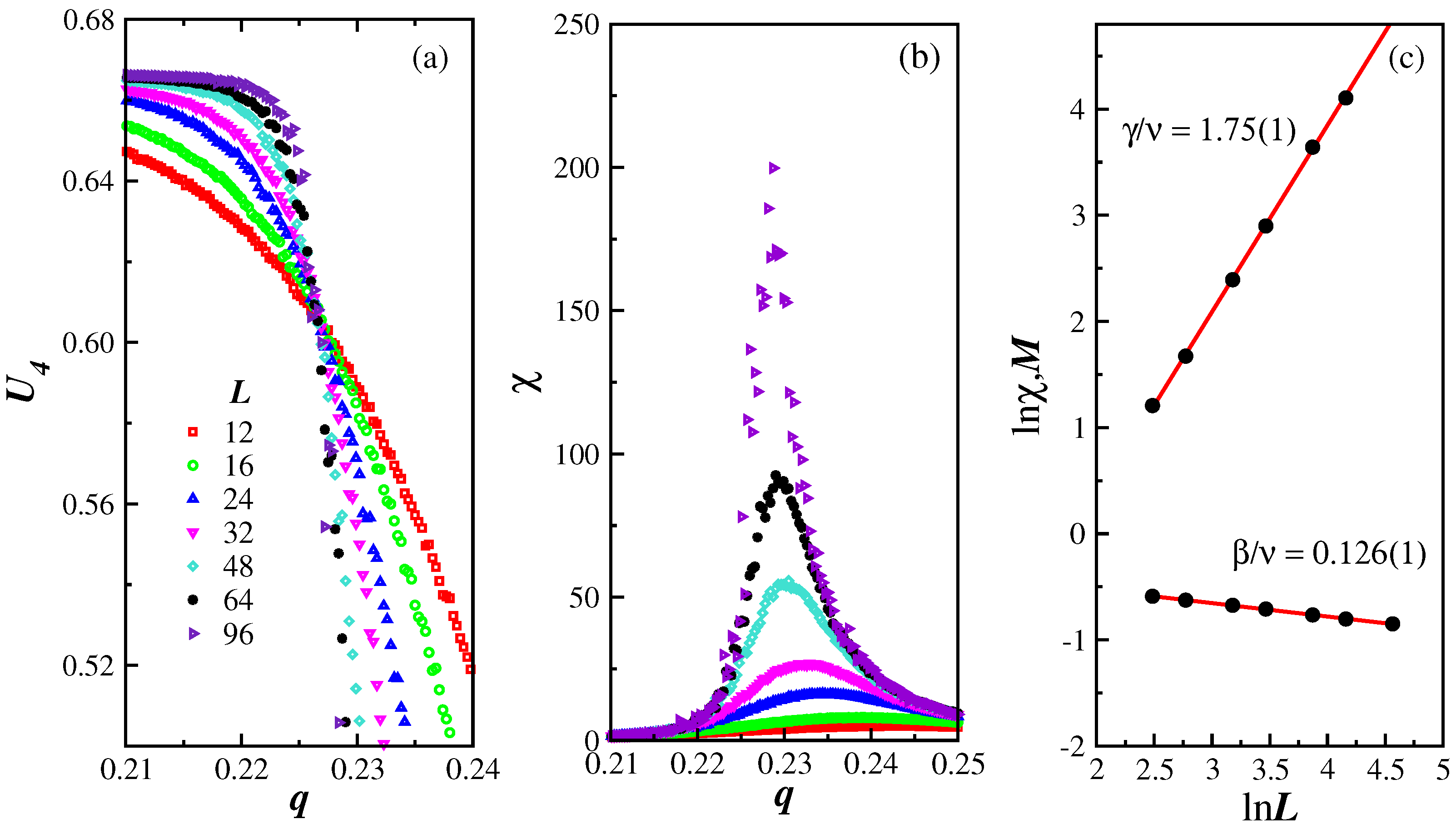
3.1. Square Lattice
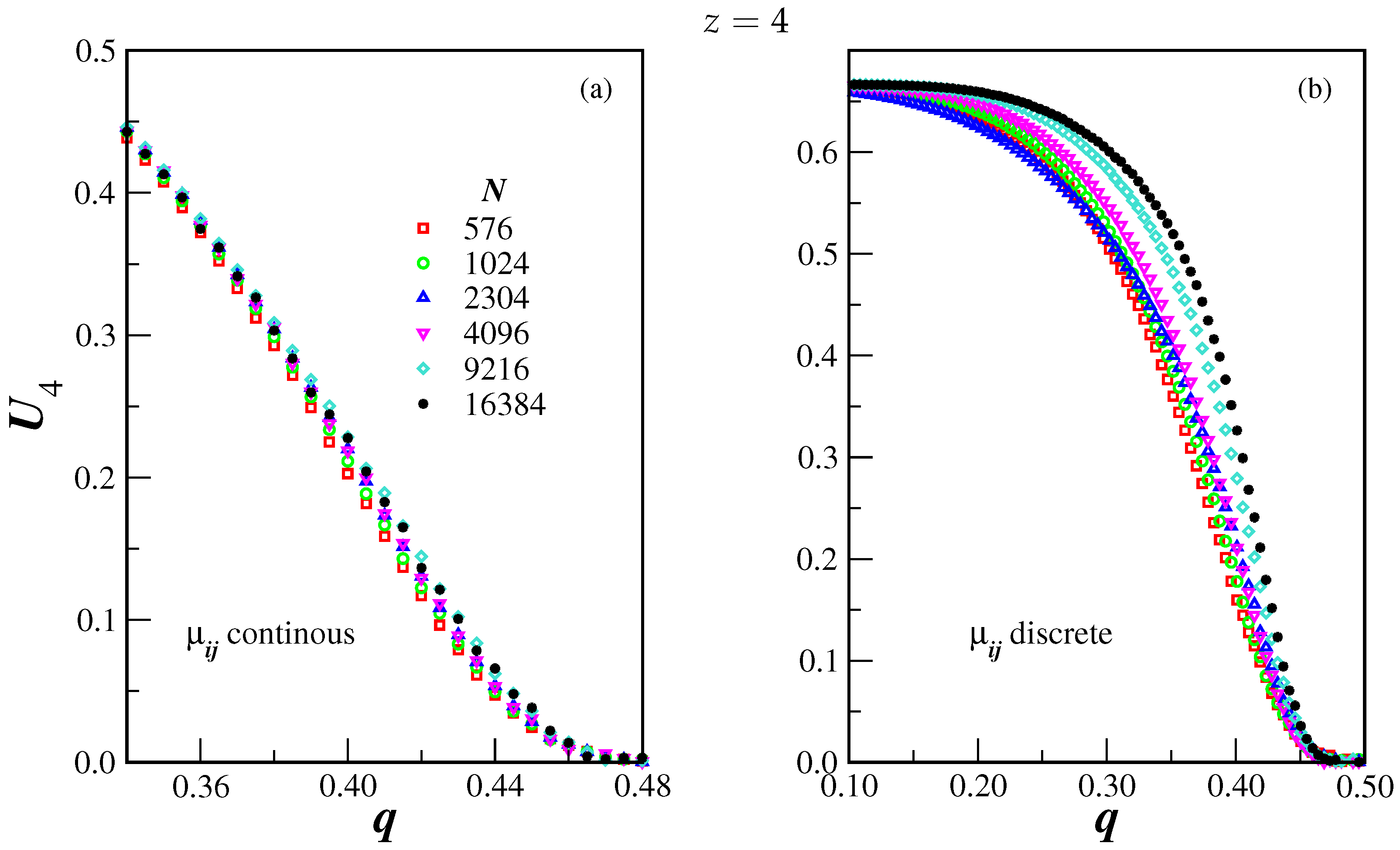
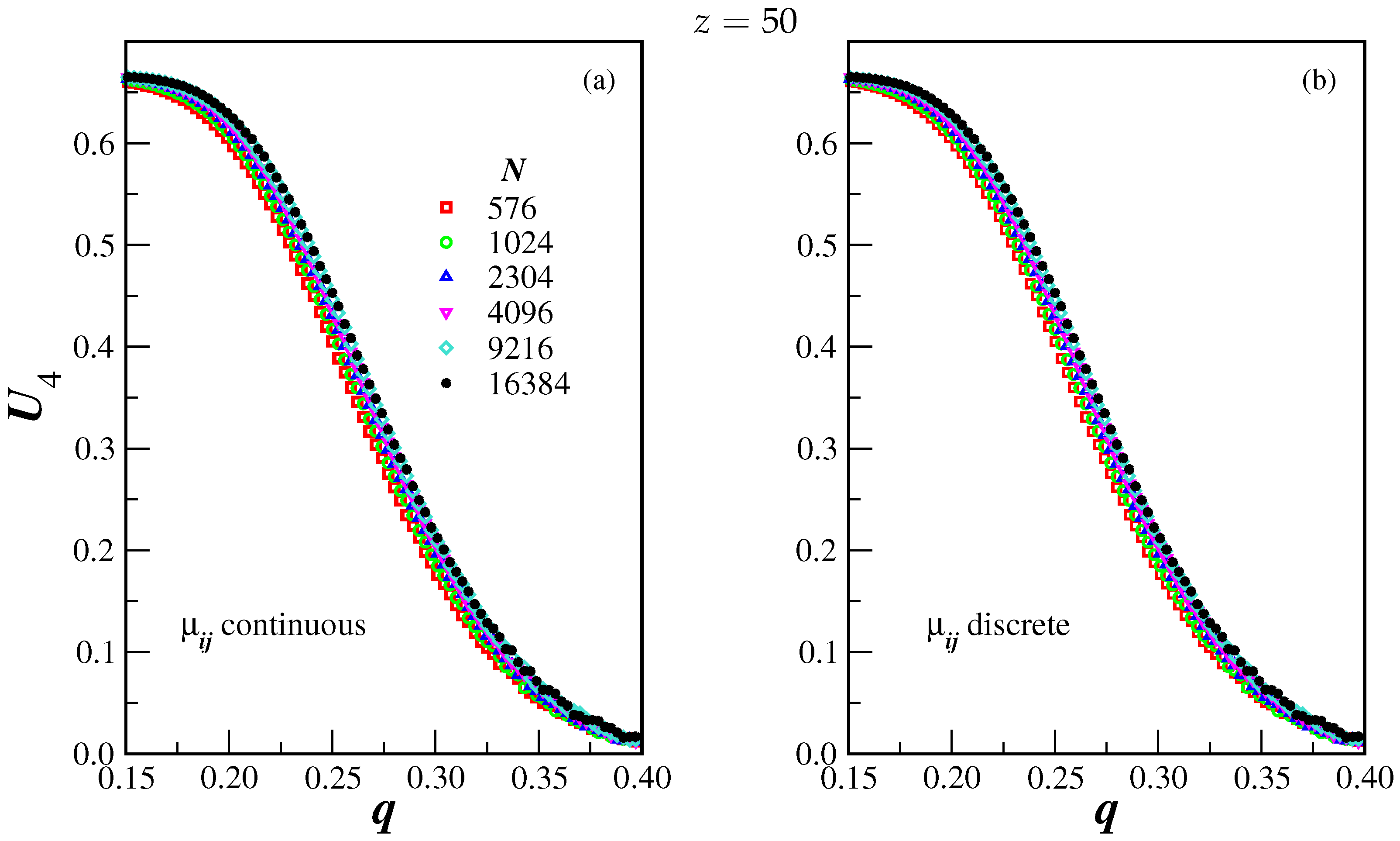
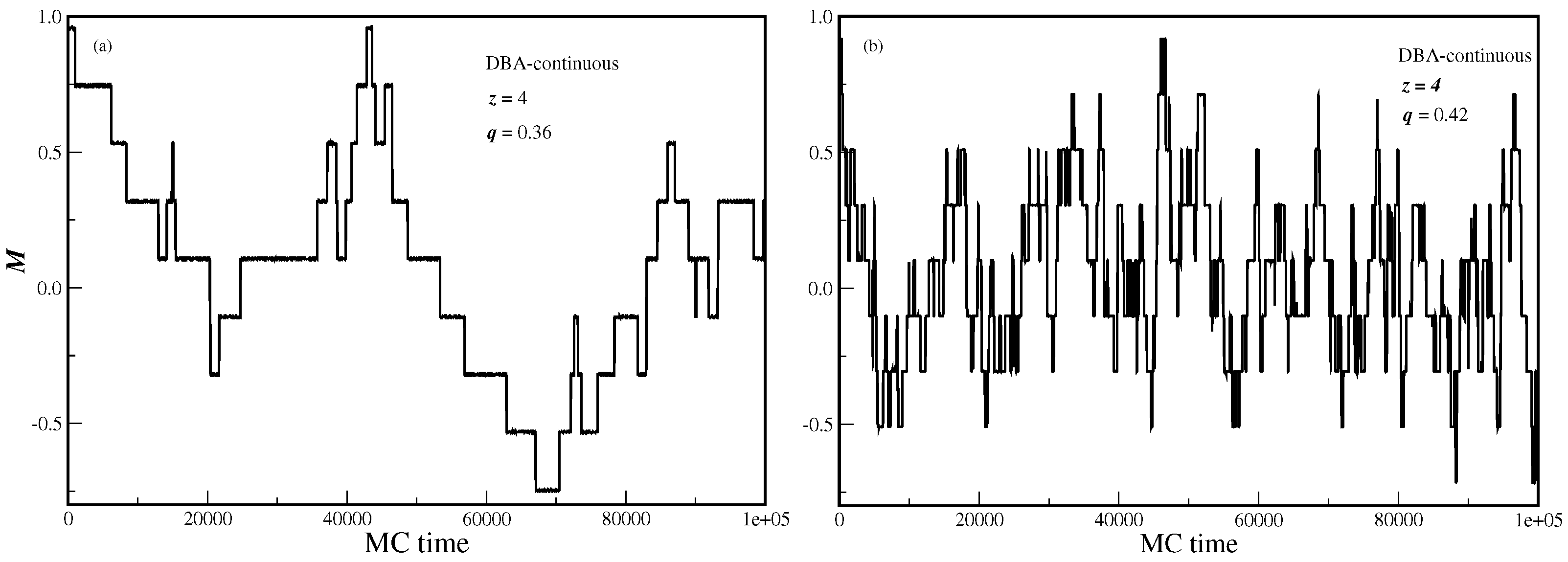
3.2. Directed Barabási–Albert Networks
4. Conclusions
Author Contributions
Funding
Data Availability Statement
Conflicts of Interest
Abbreviations
| MVM | Majority-Vote Model |
| BChS | Biswas, Chatterjee, and Sen |
| DBAN | directed Barabási–Albert network |
References
- Ising, E. Beitrag zur Theorie des Ferromagnetismus. Z. Phys. 1925, 31, 253–258. [Google Scholar] [CrossRef] [Scilit]
- Stanley, H.E. Introduction to Phase Transitions and Critical Phenomena; Oxford University Press: Oxford, UK, 1971. [Google Scholar]
- Onsager, L. Crystal statistics. I. A two-dimensional model with an order-disorder transition. Phys. Rev. 1944, 65, 117–149. [Google Scholar] [CrossRef] [Scilit]
- McCoy, B.M.; Wu, T.T. The Two-Dimensional Ising Model; Harvard University Press: Cambridge, MA, USA, 1973. [Google Scholar]
- Ferrenberg, A.M.; Jiahao, X.; Landau, D.P. Pushing the limits of Monte Carlo simulations for the three-dimensional Ising model. Phys. Rev. E 2018, 97, 043301. [Google Scholar] [CrossRef] [Scilit]
- Castellano, C.; Fortunato, S.; Loreto, V. Statistical physics of social dynamics. Rev. Mod. Phys. 2009, 81, 591. [Google Scholar] [CrossRef] [Scilit]
- de Oliveira, M.J. Isotropic majority-vote model on a square lattice. J. Stat. Phys. 1992, 66, 273–281. [Google Scholar] [CrossRef] [Scilit]
- de Oliveira, M.J. Majority-vote model with noise. Braz. J. Phys. 2000, 30, 97–104. [Google Scholar]
- Biswas, S.; Chatterjee, A.; Sen, P. Disorder-induced phase transition in kinetic models of opinion dynamics. Phys. A 2012, 391, 3257–3265. [Google Scholar] [CrossRef] [Scilit]
- Mukherjee, S.; Chatterjee, A. Disorder-induced phase transition in an opinion dynamics model: Results in two and three dimensions. Phys. Rev. E 2016, 94, 062317. [Google Scholar] [CrossRef] [Scilit]
- Biswas, S.; Sen, P. Model of binary opinion dynamics: Coarsening and effect of disorder. Phys. Rev. E 2009, 80, 027101. [Google Scholar] [CrossRef] [Scilit] [PubMed]
- Chatterjee, A.; Sen, P. Phase transitions in kinetic models of opinion dynamics. Phys. Rev. E 2011, 83, 016101. [Google Scholar]
- Grinstein, G.; Jayaprakash, C.; He, Y. Statistical mechanics of probabilistic cellular automata. Phys. Rev. Lett. 1985, 55, 2527–2530. [Google Scholar] [CrossRef] [Scilit]
- Herrmann, H.J. Monte Carlo simulations of majority vote models. Phys. A 1991, 170, 45–50. [Google Scholar]
- Fiore, C.E.; de Oliveira, M.J. Majority-vote model on random graphs. Phys. Rev. E 2007, 76, 041103. [Google Scholar] [CrossRef] [Scilit] [PubMed]
- Mukherjee, S.; Biswas, S.; Chatterjee, A.; Chakrabarti, B.K. The Ising universality class of kinetic exchange models of opinion dynamics. Phys. A 2021, 567, 125692. [Google Scholar] [CrossRef] [Scilit]
- Raquel, M.T.S.A.; Lima, F.W.S.; Alves, T.F.A.; Alves, G.A.; Macedo-Filho, A.; Plascak, J.A. Non-equilibrium kinetic Biswas–Chatterjee–Sen model on complex networks. Phys. A 2022, 603, 127825. [Google Scholar] [CrossRef] [Scilit]
- Mukherjee, S.; Biswas, S.; Sen, P. Long route to consensus: Two-stage coarsening in a binary choice voting model. Phys. Rev. E 2020, 102, 012316. [Google Scholar] [CrossRef] [Scilit]
- Biswas, K.; Sen, P. Virtual walks and phase transitions in the two-dimensional Biswas–Chatterjee–Sen model with extreme switches. Phys. Rev. E 2024, 110, 024105. [Google Scholar] [CrossRef] [Scilit]
- Oliveira, G.S.; Alves, T.F.A.; Alves, G.A.; Lima, F.W.S.; Plascak, J.A. Biswas–Chatterjee–Sen model on Solomon networks with two three-dimensional lattices. Entropy 2024, 26, 587. [Google Scholar] [CrossRef] [Scilit]
- Neto, J.F.S.; Alencar, D.S.M.; Brito, L.T.; Alves, G.A.; Lima, F.W.S.; Filho, A.M.; Ferreira, R.S.; Alves, T.F.A. Deep learning of the Biswas–Chatterjee–Sen model. Entropy 2025, 27, 1173. [Google Scholar] [CrossRef] [Scilit]
- Suchecki, K.; Biswas, K.; Hołyst, J.A.; Sen, P. Biswas–Chatterjee–Sen kinetic exchange opinion model for two connected groups. Phys. Rev. E 2025, 112, 014304. [Google Scholar] [CrossRef] [Scilit] [PubMed]
- Sumour, M.A.; Shabat, M.M. Monte Carlo Simulation of Ising model on Directed Barabási-Albert network. Int. J. Mod. Phys. C 2005, 16, 585. [Google Scholar] [CrossRef] [Scilit]
- Albert, R.; Barabási, A.L. Statistical mechanics of complex networks. Rev. Mod. Phys. 2002, 74, 47. [Google Scholar] [CrossRef] [Scilit]
- Sumour, M.A.; Shabat, M.M.; Stauffer, D. Absence of ferromagnetism in Ising model on directed Barabasi-Albert network. Islam. Univ. J. 2006, 14, 209. [Google Scholar]
- Indekeu, J.O. Special attention network. Phys. A 2004, 333, 451. [Google Scholar] [CrossRef] [Scilit]
- Lima, F.W.S.; Plascak, J.A. Kinetic Models of Discrete Opinion Dynamics on Directed Barabási–Albert Networks. Entropy 2019, 21, 942. [Google Scholar] [CrossRef] [Scilit]
- Landau, D.P.; Binder, K. A Guide to Monte Carlo Simulations in Statistical Physics; Cambridge University Press: Cambridge, MA, USA, 2015. [Google Scholar]
- Newman, M.E.J.; Barkema, G.T. Monte Carlo Methods in Statistical Physics; Clarendon Press: Oxford, UK, 1999. [Google Scholar]
- Selke, W. Critical Binder cumulant of two-dimensional Ising models. Eur. Phys. J. B 2006, 51, 223. [Google Scholar] [CrossRef] [Scilit]
- Nicolaides, D.; Bruce, A.D. Critical exponents of the three-dimensional Ising model: A finite-size-scaling analysis. J. Phys. A Math. Gen. 1988, 21, 233. [Google Scholar] [CrossRef] [Scilit]


Disclaimer/Publisher’s Note: The statements, opinions and data contained in all publications are solely those of the individual author(s) and contributor(s) and not of MDPI and/or the editor(s). MDPI and/or the editor(s) disclaim responsibility for any injury to people or property resulting from any ideas, methods, instructions or products referred to in the content. |
© 2026 by the authors. Licensee MDPI, Basel, Switzerland. This article is an open access article distributed under the terms and conditions of the Creative Commons Attribution (CC BY) license.
Share and Cite
Rodrigues, T.d.C.; Alencar, D.S.; Alves, T.A.; Alves, G.A.; Lima, F.W.; Plascak, J.A. Absence of Phase Transition in the Biswas–Chatterjee–Sen Model on Directed Barabási–Albert Networks. Symmetry 2026, 18, 415. https://doi.org/10.3390/sym18030415
Rodrigues TdC, Alencar DS, Alves TA, Alves GA, Lima FW, Plascak JA. Absence of Phase Transition in the Biswas–Chatterjee–Sen Model on Directed Barabási–Albert Networks. Symmetry. 2026; 18(3):415. https://doi.org/10.3390/sym18030415
Chicago/Turabian StyleRodrigues, Talia da Costa, David Santana Alencar, Tayroni Alencar Alves, Gladstone Alencar Alves, Francisco Welington Lima, and João Antônio Plascak. 2026. "Absence of Phase Transition in the Biswas–Chatterjee–Sen Model on Directed Barabási–Albert Networks" Symmetry 18, no. 3: 415. https://doi.org/10.3390/sym18030415
APA StyleRodrigues, T. d. C., Alencar, D. S., Alves, T. A., Alves, G. A., Lima, F. W., & Plascak, J. A. (2026). Absence of Phase Transition in the Biswas–Chatterjee–Sen Model on Directed Barabási–Albert Networks. Symmetry, 18(3), 415. https://doi.org/10.3390/sym18030415