Article

Third-Order Fuzzy Differential Results for Meromorphic Functions Using a Linear Operator: Subordination and Superordination

by
Mays S. Abdul Ameer
1,*,
Abdul Rahman S. Juma
2 and
Hassan Hussien Ebrahim
1
1
Department of Mathematics, Tikrit University, Tikrit 34001, Iraq
2
Department of Mathematics, University of Anbar, Anbar 31001, Iraq
*
Author to whom correspondence should be addressed.
Symmetry 2026, 18(3), 413; https://doi.org/10.3390/sym18030413
Submission received: 14 January 2026 / Revised: 17 February 2026 / Accepted: 20 February 2026 / Published: 27 February 2026
(This article belongs to the Section B: Mathematics)

Abstract

While over a hundred articles discuss second-order differential inequalities and subordinations in the complex plane, very few address the relatively unexplored classes of third-order fuzzy differential subordination and superordination. This paper builds upon the recently proposed concepts of third-order fuzzy differential subordination and superordination, which are developed using a linear operator and a meromorphic function. By applying techniques based on the fundamental notion of admissible functions, we begin by defining the appropriate class of such functions necessary for deriving new results in third-order fuzzy differential subordination. The study reveals the establishment of sandwich-type theorems, linking these new findings with established methods in third-order fuzzy differentiation and superordination theory.

1. Introduction

The concept of third-order fuzzy functions represents a significant advancement in the field, as it captures complex interactions beyond the scope of conventional first- and second-order fuzzy mappings. Within this framework, the notions of subordination and superordination play a crucial role in understanding how one fuzzy function may be embedded within or dominate another, while preserving specific structural and analytical properties. Accordingly, this line of research investigates the necessary conditions and criteria under which a fuzzy function can be regarded as subordinate or superordinate to another within a third-order fuzzy logic setting.
Building upon recently introduced extensions of third-order fuzzy differential subordination and superordination, the present study seeks to further advance the investigation of these dual theories, developed for dual fuzzy systems, to drive novel results for third-order fuzzy differential subordination and superordination. Moreover, the dual results are interconnected through sandwich-type outcomes, which are commonly encountered in the study of dual theories within geometric function theory.
A fuzzy set is defined as a class of elements characterized by continuous degrees of membership, as introduced by Zadeh. Each element is assigned a membership value ranging between zero and one through a membership function. This framework has been extended to encompass concepts such as embedding, union, intersection, complement, relations, convexity, and other related notions. Numerous properties of these concepts have been demonstrated within the context of fuzzy sets. Notably, in 1965, a disjunction theorem for convex fuzzy sets was established without requiring the sets to be disjoint [1]. The seminal work Differential Dependencies and Univalent Functions by Miller and Mocanu, published in the Michigan Mathematical Journal in 1981, laid the foundation for differential dependency theory and its applications in geometric function theory, particularly in the study of univalent functions. This work, along with several subsequent contributions by the same authors, helped establish the differential dependency method, which employs differential equations to characterize classes of analytic functions and deduce their properties [2]. The notion of fuzzy differential subordination emerged during the period 2011–2012, with a foundational contribution by Oros and Oros in 2011. This concept generalizes classical differential subordination by incorporating Zadeh’s fuzzy logic framework, thereby enabling a more nuanced, non-binary analysis of analytic functions. While some references indicate that the formal definition appeared in 2011, others suggest that the foundational theory was fully established in 2012, extending the earlier concept of fuzzy subordination itself [3,4]. Subsequently, the authors introduced essential notions for research on admissible function classes within fuzzy differential superordination theory, as well as its third-order extension [5,6]. The extension of second-order fuzzy differential superordination naturally led to the recent development of two related concepts within fuzzy differential superordination theory [7], utilizing the fuzzy differential superordination theory’s fundamental pattern set [8]. The earliest published research on the evolution of fuzzy differential subordination and superordination theory was generated by the usage of several operator types [9,10,11]. As demonstrated in more recent works [12,13,14], the application of diverse operators within fuzzy differential subordination and superordination theory has yielded a wide range of novel results. However, third-order fuzzy differential subordination and superordination, viewed as dual concepts, have so far been addressed primarily in papers introducing the theoretical framework itself [15,16,17,18]. Consequently, the present study plays a significant role in advancing these newly developed areas.
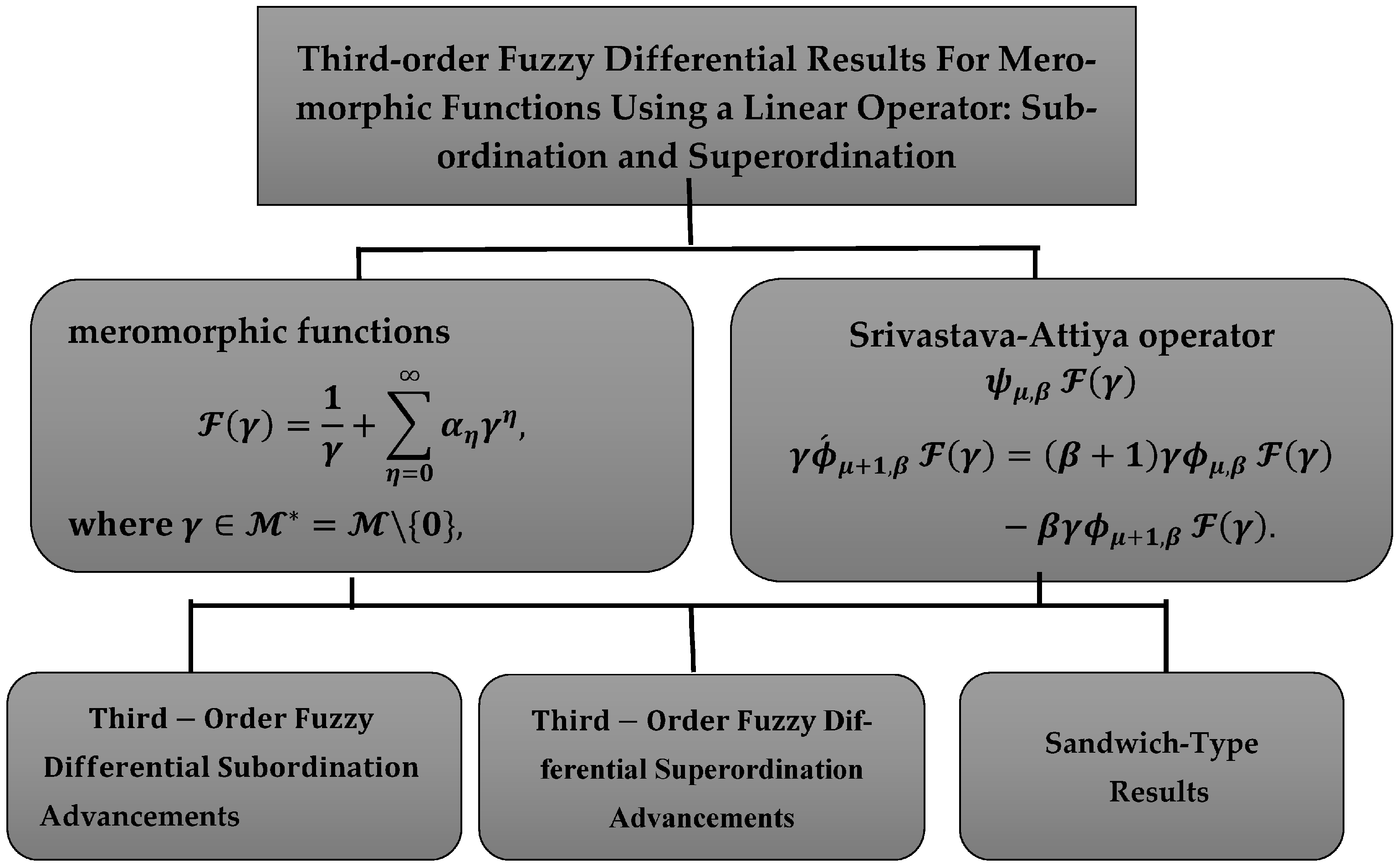
The paper is organized as follows. In Section 2, we present the materials and methods, including definitions, preliminaries, and essential background results required for the subsequent analysis. Section 3 contains the main results on third-order fuzzy differential subordination and superordination. Specifically, Section 3.1 focuses on advancements in third-order fuzzy differential subordination, Section 3.2 addresses developments in third-order fuzzy differential superordination, and Section 3.3 establishes sandwich-type results connecting these dual theories. To provide a clear overview of the structure of the study and the interconnections among its principal topics, a schematic diagram is presented in Figure 1.

2. Materials and Methods

Let M = { γ   C : | γ | <   1 } be the class of meromorphic functions being the unit disk, denoted by Σ , including functions expressed as
F ( γ ) = 1 γ + η = 0 α η γ η , w h e r e   γ M = M \ \ { 0 } ,
the punctured unit disc is denoted by M = { γ : γ C   a n d   0 < | γ | < 1 } .
If, F Σ as in (1), and g are given by
g ( γ ) = 1 γ + η = 0 β η γ η ,
Consequently, the representation of the Hadamard product of F and g is
  ( F     g ) ( γ ) = 1 γ + η = 0 α η β η γ η ,
L ( M ) represent the class of analytic functions in M , where M = { γ : γ C   a n d   | γ | < 1 } is the complex plane unit disk, and M ¯   =   { γ     C   :   | γ |     1 } and M = { γ   C : | γ |   =   1 } .
For this work, the known subclasses of L ( M ) are crucial:
K η = { F L ( M ) : F ( γ ) = α + α η + 1 γ η + 1 +     γ M } ,
where L [ α , η ] = { F L ( M ) : F ( γ ) = α + α η γ η +   α η + 1 γ η + 1 + } ,  such t h a t   L 0 = L [ 0,1 ] ,   w i t h   α C   a n d   η N .
The class of normalized starlike functions
R = { F L ( M ) : R e ( γ F ( γ ) ´ F ( γ ) ) > 0 ,   F ´ ( 0 ) 0 , γ M } .
We refer to a linear operator M   =   { γ     C   :   | γ |     1 } defined by
φ ( γ , μ , β ) = η = 0 γ η ( β + η ) μ ,
( β C \ Z 0 ; μ C   w h e n   γ M ; R ( μ ) > 1   w h e n   γ M
The Riemann Zeta function is one of the unique instances of the function φ ( γ , μ , β ) and is given by
I ( μ ) = φ ( 1 , μ , 1 ) ,
The Hurwitz Zeta function provides
I ( μ , β ) = φ ( 1 , μ , β ) ,
the Zeta function of Lerch is provided by
ξ μ θ = φ ( e 2 π i θ , μ , 1 )   w h e r e   θ R ; ( R ( μ ) > 1 ) ,
see [19] for further information. The polylogarithm function is supplied by
F i μ = γ φ ( γ , μ , 1 ) .
The normalized function below was taken into consideration by Srivastava and Attiya [20,21].
R µ , β ( γ ) = ( 1 + β ) µ [ φ   ( γ , µ , β ) β µ ] = 1 γ + η = 2 ( β + 1 β + η ) μ γ η ,   ( γ M ) .
They made use of R µ , β   ( γ ) to introduce the extensively studied operator, which has the following convolutional definition:
ψ μ , β F ( γ ) = R µ , β   ( γ ) F ( γ ) = 1 γ + η = 2 ( β + 1 β + η ) μ α η γ η .
In the literature, the operator ψ μ , β F ( γ ) is now commonly referred to as the Srivastava and Attiya operator. Extensive applications of the Srivastava and Attiya operator ψ μ , β   F ( γ ) can be found in the literature, including [22,23,24,25,26,27,28]. From (4), it is evident that
γ ϕ ´ μ + 1 , β F ( γ ) = ( β + 1 ) γ ϕ μ , β F ( γ ) β γ ϕ μ + 1 , β F ( γ ) .
Several other linear operators that are introduced in previous works for suitable parameter selections are provided by the above-defined operator ϕ μ , β F ( γ ) . As an illustration, we have
  • ϕ 0 , β F ( γ ) = F ( γ ) ;
  • ϕ 1,0 F ( γ ) = 0 γ F ( γ ) γ d γ = A F ( γ ) ;
  • ϕ 1 , η F ( γ ) = 1 + η γ η 0 γ γ η 1 F ( γ ) d γ = B η F ( γ ) ;
  • ϕ υ , 1 F ( γ ) = 1 γ + η = 2 ( 2 η + 1 ) υ α η γ η = C υ F ( γ ) ,   ( υ > 0 ) ,
where the integral operators A ( F ) and B η are closely related to the Jung–Kim–Srivastava integral operator, C υ ( F ) developed by Alexander and Bernardi, respectively, pertaining to the multiplier transformation that Flett researched. We direct the interested reader to the preceding work for more information [22].
Additionally,
= { F K : F ( γ ) = γ + α 2 γ 2 + , F ( 0 ) = 0 , F ´ ( 0 ) = 1     F   i s   u n i v a l e n t   f o r   γ M } .
With F , g L ( M ) ,   F is subordinate to g or g is superordinate to F , written F g or F ( γ ) g ( γ ) , if there exists a Schwarz function ω L ( M ) satisfying ω ( 0 ) = 0 and | ω ( γ ) | < 1 ,   γ M   s u c h   t h a t   F ( γ ) = g ( ω ( γ ) ) . If g ,   t h e n   F g F ( 0 ) g ( 0 )   a n d   F ( M ) g ( M ) .
Next, we go over the offered definitions for third-order differential subordinations.
Definition 1 ([5]).
Let  Ρ  represent the set of analytic and univalent functions q on the set M ¯ \ H ( q )  where
H ( q ) = { ξ M : lim γ ξ   q ( γ ) = }
and are such that  m i n | q ( ξ ) ´ | = ρ > 0   f o r   ξ M \ H ( q ) .   H ( q )  is said to be “the exception set”, where  Ρ ( a )  represents of  Ρ   when  q ( 0 ) = a .
Example 1.
Consider the function
q α ( 1 + γ 1 γ ) γ ,         0 < α < 1 .
The following definitions of fuzzy subordination were presented in [4] with the aim of generalizing the classical concept of subordination:
Definition 2 ([4]).
A fuzzy subset of   is a pair  ( u , F u ) ,  where the support of the fuzzy subset  ( u , F u )  is denoted by  u = { Y ϰ : 0 < F u ( Y ) 1 } = s u p p ( u , F u ) ,  and  F υ : ϰ [ 0,1 ]  is known as the membership function of the fuzzy set  ( u , F u ) .  Let  F , g L ( M ) .
F ( M ) = s u p p ( F ( M ) , F F ( M ) ) = { F ( γ ) : 0 < | F F ( M ) ( F ( γ ) ) | 1 ,   γ M } ,
and
g ( M ) = s u p p ( g ( M ) , F g ( M ) ) = { g ( τ ) : 0 < | F g ( M ) ( g ( γ ) ) | 1 ,   γ M } .
Definition 3 ([4]).
Let  γ 0  be in  M  and  F , g L ( M ) .  The expression  F  is fuzzy subordinate to  g  and is expressed as  F F g  or  F ( τ ) F g ( τ )  if
F ( γ 0 ) = g ( γ 0 )   a n d   | F F ( M ) ( F ( γ ) )   | | F g ( M ) ( g ( γ ) ) | ,   γ M .
Proposition 1 ([4]).
Let  γ 0 M   a n d   F , g L ( M ) .    If   F ( γ ) F g ( γ ) ,   γ M ,  then
 i.
F ( γ 0 ) = g ( γ 0 ) ;
ii.
F ( M ) g ( M )   a n d   | F F ( M ) ( F ( γ ) ) | | F g ( M ) ( g ( γ ) ) | ,   γ M ,
where F ( M ) and g ( M ) are given by (8) and (9), respectively.
Definition 4 ([5]).
Let  q P ,   X 2 ,  and  I C  be a function. Functions  ψ : C 4 × M ¯ C ,  belong to the called class of admissible functions, which is represented by   Ψ κ [ I , q ]  if the admissibility condition is met. They are known as admissible functions.
ψ ( s r , t s , d t , u ; ξ ) I ,
when
s = q ( γ ) ,   t = γ q ´ ( γ ) X ,
R e { d t + 1 } X R e { 1 + γ q ( γ ) q ( γ ) } ,
R e { u t } X 2 R e { γ 2 q ( γ ) q ( γ ) } ,
where  γ M , ξ M \ H ( q )   a n d   X N \ { 1 } .
Definition 5 ([8]).
Let  q P , X 2 ,  and  I C  be a function. Functions  ψ : C 4 × M ¯ C ,  denote by  P κ [ I , q ] ,  satisfying the condition 
F ψ ( C 4 × M ¯ ) ψ ( s , t , d , u ; ξ ) < F I ( γ ) ,   0 < F I ( γ ) 1 ,
where
s = q ( γ ) ,       t = γ q ´ ( γ ) X ,
R e { d t + 1 } 1 X R e { 1 + γ q ( γ ) q   ´ ( γ ) } ,
R e { u t } 1 X 2 R e { γ 2 q ( γ ) q ´ ( γ ) } ,
where  γ M , ξ M \ H ( q )   a n d   X κ 2 .  Condition (8) is called the admissibility condition.
Definition 6 ([8]).
Consider  ψ :   C 4 × M C , ψ     Q κ [ I , q ]  and let  λ L ( M ) . If  ω L ( M )  is satisfied, then the function is referred to as a third-order fuzzy differential subordination solution. 
  F ψ ( C 4 × M ) ( ψ ( ω ( γ ) , γ ω ´ ( γ ) , γ 2 ω ( γ ) , γ 3 ω ( γ ) ; γ ) )     F λ ( M ) λ ( γ ) ,
i.e.,
ψ ( ω ( γ ) , γ ω ( γ ) , γ 2 ω ( γ ) , γ 3 ω ( γ ) ; γ )   F   λ ( γ ) .
If a function  q L ( M )  meets the fuzzy subordination  ω   F   q  for every solution  ω  of the fuzzy differential subordination of the third-order, it is called a dominant of the solutions of the subordination (9). A dominating  q  that meets the fuzzy subordiation requirements  t h e   f u z z y   b e s t   d o m i n a n t  for any dominant q of (9) is   q   F   q .
Definition 7 ([8]).
(i) Let  ψ :   C 4 × M C , ψ     Q κ [ I , q ]  and let  λ L ( M ) . A function  ω L ( M )  satisfying 
F λ ( M ) λ ( γ )   F ψ ( C 4 × M ) ( ψ ( ω ( γ ) ,   γ ω ´ ( γ ) , γ 2 ω ( γ ) , γ 3 ω ( γ ) ; γ ) ) ,   γ M ,
i.e.,
λ ( γ )   F   ψ ( ω ( γ ) , γ ω ´ ( γ ) , γ 2 ω ( γ ) , γ 3 ω ( γ ) ; γ ) ,
is referred to as the fuzzy differential superordination solution (10).
(ii) A univalent function  q  is referred to as a fuzzy differential subordination and superordination (10) if fuzzy differential superordination (10) is also known as “fuzzy differential superordination of the third-order”.
q ( γ )   F   ω ( γ ) ,   o r   F q ( M ) q ( γ )   F ω ( M ) ( ω ( γ ) ) ,   γ M .
(iii) “The third-order fuzzy differential superordinant’s fuzzy best” subordinant (10), which is a fuzzy subordinant  q   t h a t   i s   u n i v a l e n t   and satisfies  q ( γ )   F   q ( γ ) ,  or is equivalently written  F q ( M ) q ( γ )     F q ( M ) ( q ( γ ) ) , γ M  or every fuzzy subordinant q of the fuzzy differential of third-order.
The proof of the initial findings in the next two sections will make use of the following proven outcomes.
Lemma 1 ([27]).
Let  κ     2   a n d   p L [ α , η ]   ] . Examine a function  q     P ( α )  for which  R e   { ξ q ( ξ ) q ( ξ ) } 0 ,   | γ p ´ ( γ ) q ( ξ ) | X ,  and  F : C [ 0,1 ] ,   where    γ M , ξ     M \ H ( q ) ,   a n d   X   κ ,   q ´ ( ξ )   0 ,   γ p ( λ )   q ( ξ )  X.  p ( γ )   F   q ( γ )   o r   F p ( M ) p ( γ )     F q ( M ) q ( γ )   if  I  is a set in  C ,  ψ   Q κ [ I , q ]   satisfying 
{ ψ ( p ( γ ) , γ p ´ ( γ ) , γ 2 p ( γ ) , γ 3 p ( γ ) ; γ ) I } .
Lemma 2 ([7]).
Let  κ     2 ,   q L [ α , η ]  and  I C , a function  ψ     Q κ [ I , q ] ,   F :
C [ 0,1 ]  given by  p ( 0 )     P ( α ) ,   p ( 0 )   =   q ( 0 )   =   α , and    F ( τ )   =   1 1 + | γ | , satisfying 
R e   { ξ q ( ξ ) q ´ ( ξ ) } 0 , | γ p ´ ( γ )   q ´ ( ξ ) | X ,
then 
I { ψ ( p ( γ ) , γ p ´ ( γ ) , γ 2 p ( γ ) , γ 3 p ( γ ) ; γ ) : γ M } ,
where  X κ 2   a n d   γ M , ξ M \ H ( q ) , if  ψ ( p ( γ ) , γ p ´ ( γ ) , γ 2 p ( γ ) , γ 3 p ( γ ) ; γ )    and  p ( γ )   a r e   univalent   in   M ,  or equivalently,
1 1 + | γ |     1 1 + | ψ ( p ( γ ) , γ p ( γ ) , γ 2   p ( γ ) , γ 3   p ( γ ) ; γ |   ,  
implying that
  1 1 + | q ( γ ) |   1 1 + | p ( γ ) |   o r   q ( γ ) F p ( γ ) ,   ( γ M ) .
After a thorough discussion of the study’s general backdrop, the part that follows will emphasize the main conclusions of our investigation into fuzzy differential subordination and superordination of the third-order.

3. Results

3.1. Third-Order Fuzzy Differential Subordination Advancements

In order to illustrate the main fuzzy differential subordination of the third-order advancement theorems for the operator ϕ μ , β F ( γ ) indicated, the following new set of admissible functions is introduced in this section.
Definition 8.
Let  I  be a set in the complex plane  C  and  q P 1 L 1 . The class  P κ [ I , q ]  of admissible function consists of those function  ψ : C 4 × M C  that satisfy the admissibility conditions:
ψ ( δ , ζ , τ , λ ; γ ) I ,
whenever
δ = q ( ξ ) ,   ζ = X ξ q ´ ( ξ ) + β q ( ξ ) β + 1 ,
R e { ( 1 + β ) 2 τ δ β 2 ( 1 + β ) ζ δ β } X R e { ξ q ( ξ ) q ( ξ ) + 1 } ,
R e { λ ( 1 + β ) τ ( 1 + β ) 2 ( 3 + 3 β ) + β 2 δ ( 2 β + 3 ) ( β ( ζ δ ) + ζ ) + 3 β 2 + 6 β + 2 } X 2 R e { ξ 2   q ( γ ) q ( ξ ) } ,  
where  γ M , ζ M \ H ( q )   a n d   X 2 .
Theorem 1.
Let  ψ Ψ κ [ I , q ] .  If the function  F Σ   and  q Ρ 1 L 1   satisfy
R { ξ 2   q ( γ ) q ( ξ ) } 0   a n d   | ( 1 + β ) γ ϕ μ , β F ( γ ) β γ ϕ μ + 1 , β F ( γ ) | X | q ( ξ ) | ,
and
  F ψ ( C 4 × M ) ψ (   γ ϕ μ + 1 , β F ( γ ) ,   γ ϕ μ , β F ( γ ) , γ ϕ μ 1 , β F ( γ ) , γ ϕ μ 2 , β F ( γ ) ; γ M ) F   I ( γ ) ,      
then
  γ ϕ μ + 1 , β F ( γ ) F q ( γ ) ( γ M ) ,
or
  F γ ϕ ( μ + 1 , β ) F ( γ ) ( γ ϕ ( μ + 1 , β ) F ( γ ) ) F q ( M ) q ( γ ) .
Proof. 
The function h ( γ ) in M is defined by
h ( γ ) = ϕ μ + 1 , β F ( γ ) .
With the help of (5) and (20), we have
ϕ μ , β   F ( γ ) = γ h ´ ( γ ) + β h ( γ ) 1 + β .  
Likewise, by differentiating (19) and applying the feature seen in (5) in conjunction with relation (18), we write
γ ϕ μ 1 , β F ( γ ) = γ 2 h ( γ ) + ( 1 + 2 β ) γ h ( γ ) + β 2 h ( γ ) ( 1 + β ) 2
and
γ ϕ μ 2 , β F ( γ ) = γ 3 h ( γ ) + ( 3 + 3 β ) γ 2 h ( γ ) + ( 1 + 3 B + 3 β 2 ) γ h ( γ ) + β 3 h ( γ ) ( 1 + β ) 3
The change from C 4 to C is then expressed as
δ ( s , t , d , u ) = s ,       ζ ( s , t , d , u ) = t + β s 1 + β ,
τ ( s , t , d , u ) = d + ( 1 + 2 β ) t + β 2 s ( 1 + β ) 2 ,          
and
λ ( s , t , d , u ; γ ) = u + ( 3 + 3 β ) d + ( 1 + 3 β + 3 β 2 ) t + β 3 s ( 1 + β ) 3
Let
ψ ( s , t , d , u ) = ψ ( δ , ζ , τ , λ )
= ( s , t + β s 1 + β , d + ( 1 + 2 β ) t + β 2 s ( 1 + β ) 2 ,   u + ( 3 + 3 β ) d + ( 1 + 3 β + 3 β 2 ) t + β 3 s ( 1 + β ) 3 ; γ ) .
Applying Lemma 1 and Equations (18) and (25) yields.
ψ ( h ( γ ) + γ h ( γ ) + γ 2 h ( γ ) + γ 3 h ( γ ) ; γ )
= ψ ( γ ϕ μ + 1 , β F ( γ ) γ , γ ϕ μ , β F ( γ ) , γ ϕ μ 1 , β F ( γ ) , γ ϕ μ 2 , β F ( γ ) ;   γ ) .
Therefore, (16) leads to
F ψ ( C 4 × M ) (   ψ ( h ( γ ) + γ h ( γ ) + γ 2 h ( γ ) + γ 3 h ( γ ) ; γ ) ) F I ( γ ) .
Furthermore, by applying (24) and (26), we obtain
d t + 1 = ( 1 + β ) β ( τ δ ) ( ζ ( 1 + β ) δ β ) 2 ( β + 1 ) ,
and
u t = 1 ( β ( ζ δ ) + β ) [ λ ( 1 + β ) 3 τ ( 1 + β ) 2 ( 3 + 3 β ) + β 2 δ ( 2 β + 3 ) ]
Thus, ψ Ψ κ [ I , q ] is meets the admissibility requirement under Definition 8 in the same way as ψ Ψ d [ I , q ] does under Definition 4. Therefore, we may determine that F h ( M ) h ( γ ) F q ( M ) h ( γ )   b y   a p p l y i n g   ( 15 )   a n d   L e m m a   1 , or equivalently.
F γ ϕ ( μ + 1 , β ) F ( M ) ( γ ϕ μ + 1 , β F ( γ ) ) F q ( M ) q ( γ ) ,
γ ϕ μ + 1 , β F ( γ ) F   q ( γ ) .
The proof is complete. □
Example 2.
By Theorem 1, taking  ψ = ζ δ 1 , we get 
ψ ( δ , ζ , τ , λ ; γ ) = t + β s ( 1 + β ) s 1 = t s ( 1 + β ) s = ( 1 + β ) γ ϕ ( μ , β ) F ( γ ) β s s s = γ ϕ ( μ , β ) F ( γ ) γ ϕ ( μ + 1 , β ) F ( γ ) 1 ,
which is analytical in  M  and
  F ψ ( C 4 × M ) ψ   ( γ ϕ ( μ , β ) F ( γ ) γ ϕ ( μ + 1 , β ) F ( γ ) 1 ) F I ( γ )
then 
γ F ( γ ) F q ( γ ) ( γ M ) .
or 
F γ ϕ ( μ + 1 , β ) F ( M ) ( γ ϕ ( μ + 1 , β ) F ( M ) ) F q ( M ) q ( γ ) .
When the way  M  behaves is unclear, Theorem 1 immediately produces the following consequence.
Corollary 1.
Let  ψ Ψ κ [ I , q ϰ ]    for certain   ϰ ( 0,1 )   w h e n   q ϰ ( γ ) = q ( ϰ γ ) ,   and let  I C   w i t h   q ( 0 ) = 1  and  q V .  If the function  F Σ   and  q ϰ  satisfy 
R {   ξ q ϰ ( γ ) q ϰ ( ξ ) } 0 ,   | ( 1 + β ) γ ϕ μ , β   F ( γ ) β γ ϕ μ + 1 , β   F ( γ ) | X | q ´ ϰ ( ξ ) | ,
and
  F ψ ( C 4 × M ) ψ   ( γ ϕ μ + 1 , β F ( γ ) , γ ϕ μ , β F ( γ ) , γ ϕ μ 1 , β F ( γ ) , γ ϕ μ 2 , β F ( γ ) ; γ M ) F I ( γ ) ,
then
  γ ϕ μ 2 , β F ( γ ) F I ( γ ) ( γ M ) ,
γ ϕ μ + 1 , β F ( γ ) F q ( γ ) ( γ M ) ,
γ M , ζ M \ H ( q )   a n d   X 2 .
Proof of Theorem 1.
We get
γ ϕ μ + 1 , β F ( γ ) F q ϰ ( γ ) ( γ M ) ,
The assertion of Corollary 1 is obtained from
  q ϰ ( γ )   F   q ( γ )   ( γ M )
This completes the Corollary 1 proof. □
For a well-chosen conformal mapping N ( γ ) of M o n   t o   I , I = N ( M ) , if I C is a simply linked domain. Here, the class Ψ κ [ L ( M ) , q ] is expressed as Ψ κ [ N , q ] .
Corollary 1 and Theorem 1 directly lead to the following findings.
Theorem 2.
Let  ψ Ψ κ [ N , q ] .  If the function  F Σ   and  q M   satisfy 
R { ξ   q ( γ ) q ( ξ ) } 0   and   | ( 1 + β ) γ ϕ μ , β F ( γ ) β γ ϕ μ + 1 , β F ( γ ) | X | q ( ξ ) | ,
and
  F ψ ( C 4 × M ) ψ (   γ ϕ μ + 1 , β F ( γ ) , γ ϕ μ , β F ( γ ) , γ ϕ μ 1 , β F ( γ ) , γ ϕ μ 2 , β F ( γ ) ; γ M ) F N ( M ) ( γ ) .    
Then
  F γ ϕ μ + 1 , β   F ( M ) ( γ ϕ μ + 1 , β F ( γ ) ) F N ( M ) N ( γ ) ( γ M ) ,
or 
γ ϕ ( μ + 1 , β ) F ( γ ) F q ( M ) .
Corollary 2.
Let  ψ Ψ κ [ I , q ϰ ]  for certain  ϰ ( 0,1 )  when  q ϰ ( γ ) = q ( ϰ γ ) ,  and let  I C  with  q ( 0 ) = 1   a n d   q V . If the function  F Σ   a n d   q ϰ  satisfy
R {   ξ q ϰ ( γ ) q ϰ ( ξ ) } 0 ,   | ( 1 + β ) γ ϕ μ , β   F ( γ ) β γ ϕ μ + 1 , β   F ( γ ) | X | q ´ ϰ ( ξ ) | ,  
and
F ψ ( C 4 × M ) ψ   ( γ ϕ μ + 1 , β F ( γ ) , γ ϕ μ , β F ( γ ) , γ ϕ μ 1 , β F ( γ ) , γ ϕ μ 2 , β F ( γ ) ; γ M ) F N ( M ) N ( γ )
then
γ ϕ μ + 1 , β F ( γ ) F q ( γ ) ,
γ M , γ M \ H ( q )   a n d   X 2 .
Next, we define a new admissible class P κ [ I , T ] as follows:
Definition 9.
Let  I  be a set in the complex plane  C  and  q P 1 L 1 . The class  P κ [ I , Τ ]  of admissible function consists of those function  ψ : C 4 × M C  that satisfy next admissibility conditions: 
ψ ( δ , ζ , τ , λ ; γ ) I ,
Whenever 
δ = q ( ξ ) ,   ζ = X ξ q ´ ( ξ ) + β q ( ξ ) β ,
R e { β ( τ δ ) δ ζ 2 ( 1 + β ) } X R e { ξ q ( ξ ) q ( ξ ) + 1 } ,
R e { λ ( 1 + β ) 2 3 τ ( 2 + β ) ( 1 + β ) + 3 δ ( 2 + β ) ( 1 + β ) ( 1 + β ) 2 δ ( β ( ζ δ ) + ζ ) + 3 β 2 + 12 β + 11 } X 2 R e { ξ 2   q ( γ ) q ( ξ ) } ,
where  γ M , ζ M \ H ( q )   a n d   X 2 .
Theorem 3.
Let  ψ Ψ κ [ N , q ] .  If the function  F Σ   and  q M   satisfy
R { ξ   q ( γ ) q ( ξ ) } 0   and   | ( 1 + β ) γ ϕ μ , β F ( γ ) β γ ϕ μ + 1 , β F ( γ ) | X | γ q ( ξ ) | ,
and
  F ψ ( C 4 × M ) ψ (   ϕ μ + 1 , β F ( γ ) , ϕ μ , β F ( γ ) , γ ϕ μ 1 , β F ( γ ) , ϕ μ 2 , β F ( γ ) ; γ M ) F I ( γ ) ,    
then
ϕ ( μ + 1 , β ) F ( γ ) F q ( γ ) .
Proof. 
Let
h ( γ ) = ϕ ( μ , β ) F ( γ )      
Using the property of the operator ϕ ( μ + 1 , β )   F ( γ ) provided in (5) and differentiating (37), we write
ϕ μ 1 , β F ( γ ) = γ 2 h ( γ ) + γ ( 2 β + 3 ) h ( γ ) + ( β + 1 ) 2 h ( γ ) ( 1 + β ) 2
and
ϕ μ 2 , β F ( γ ) = γ 3 h ( γ ) + γ 2 ( 2 β + 3 ) h ( γ ) + ( 3 β 2 + 9 β + 7 ) γ h ( γ ) + ( 1 + β ) 3 h ( γ ) ( 1 + β ) 3 ,
we now specify the change from C 4 4 to C by
δ ( s , t , d , u ) = s ,       ζ ( s , t , d , u ) = t + ( 1 + β ) s 1 + β ,
τ ( s , t , d , u ) = d + ( 3 β 2 + 9 β + 7 ) t + ( 1 + β ) 2 s ( 1 + β ) 2 ,          
and
λ ( s , t , d , u ; γ ) = u + ( 3 + 3 β ) d + ( 1 + 3 β + 3 β 2 ) t + β 3 s ( 1 + β ) 3
Let
ψ ( s , t , d , u ) = ψ ( δ , ζ , τ , λ )
= ( s , t + ( 1 + β ) s 1 + β , d + ( 3 β 2 + 9 β + 7 ) t + ( 1 + β ) 3 s ( 1 + β ) 2 , u + ( 3 + 3 β ) d + ( 1 + 3 β + 3 β 2 ) t + β 3 s ( 1 + β ) 3 ; γ ) .
Lemma 1 and Equations (37) and (40) give us
ψ ( h ( γ ) + γ h ( γ ) + γ 2 h ( γ ) + γ 3 h ( γ ) ; γ )
= ψ ( ϕ μ + 1 , β F ( γ ) , ϕ μ , β F ( γ ) , γ ϕ μ 1 , β F ( γ ) , ϕ μ 2 , β F ( γ ) ;   γ ) .
Therefore, (41) leads to
F ψ ( C 4 × M ) (   ψ ( h ( γ ) + γ h ( γ ) + γ 2 h ( γ ) + γ 3 h ( γ ) ; γ ) ) F I ( γ ) .
Furthermore, by applying (39) and (40), we obtain
d t + 1 = ( 1 + β ) ( τ δ ) ζ δ 2 ( β + 1 ) ,
and
u t = 1 ( ζ δ ) [ λ ( 1 + β ) 2 3 τ ( 2 + β ) ( 1 + β ) + 3 δ ( 2 + β ) ( 1 + β ) ( β + 1 ) 2 ] + 3 β 2 + 12 β + 11 .
Thus, ψ Ψ κ [ I , T ] meets the admissibility requirement under Definition 9 in the same way as ψ Ψ d [ I , q ] does under Definition 4. Therefore, we may determine that F h ( M ) h ( γ ) F q ( M ) h ( γ )   b y   a p p l y i n g   ( 35 )   a n d   L e m m a   1 , or equivalently.
F γ ϕ ( μ , β ) F ( M ) ( γ ϕ μ + 1 , β F ( γ ) ) F q ( M ) q ( γ ) ,
γ ϕ μ + 1 , β F ( γ ) F   q ( γ ) .
The proof is complete. □
The following outcome is instantly obtained by Theorem 3 when the behavior of q on M is unknown.
Corollary 3.
Let  ψ Ψ κ [ I , q ϰ ]    for certain   ϰ ( 0,1 )   w h e n   q ϰ ( γ ) = q ( ϰ γ ) ,   and let  I C   w i t h   q ( 0 ) = 1  and  q V .  If the function  F Σ   and  q ϰ  satisfy 
R {   ξ q ϰ ( ξ ) q ϰ ( ξ ) } 0 ,   | ( 1 + β ) γ ϕ μ , β   F ( γ ) β γ ϕ μ + 1 , β   F ( γ ) | X | γ q ´ ϰ ( ξ ) | ,
and
  F ψ ( C 4 × M ) ψ   ( ϕ μ + 1 , β F ( γ ) , ϕ μ , β F ( γ ) , ϕ μ 1 , β F ( γ ) , ϕ μ 2 , β F ( γ ) ) F I ( γ )
then
  ϕ μ 2 , β F ( γ ) F I ( γ ) ,
ϕ μ + 1 , β F ( γ ) F q ( γ ) ,
ξ M \ H ( q )   a n d   X 2 .
Proof of Theorem 3.
We get
γ ϕ μ + 1 , β F ( γ ) F q ϰ ( γ ) ( γ M ) ,
The assertion of Corollary 3 is obtained from
  q ϰ ( γ )   F   q ( γ )   ( γ M )
This complete Corollary 3’s proof. □
When I C   i s   a   s i m p l y   c o n n e c t e d   d o m a i n , then I = N ( M ) for a well-selected, formal mapping N ( γ )   o f   M   o n t o   I . The class Ψ κ [ N ( M ) , q ] is written as Ψ κ [ N , T ] in this instance. The immediate result of Theorem 3 is as follows.
Theorem 4.
Let  ψ Ψ κ [ N , T ] . If the function  F Σ    and  q p 1    satisfy 
R { ξ   q ξ q ( ξ ) } 0   and   | ( 1 + β ) γ ϕ μ , β F ( γ ) β γ ϕ μ + 1 , β F ( γ ) | X | γ q ( ξ ) | ,
and
F ψ ( C 4 × M ) ψ (   ϕ μ + 1 , β F ( γ ) , ϕ μ , β F ( γ ) , γ ϕ μ 1 , β F ( γ ) , ϕ μ 2 , β F ( γ ) ; γ M ) N ( I ) N ( γ ) ,
then
ϕ ( μ + 1 , β ) F ( γ ) F q ( γ ) .

3.2. Third-Order Fuzzy Differential Superordination Advancements

We examine and demonstrate a number of theorems pertaining to the third-order differential superordination. For that reason, we examine the class of admissible functions listed below.
Definition 10.
Let  I  be a set in the complex plane  C   and  q L 1 ,   q ´ 0 , π N \ { 1 } .  The class  P κ ´ [ I , Τ ]   of admissible function consists of those function  ψ : C 4 × M ¯ C  that satisfy the following admissibility conditions:
ψ ( δ , ζ , τ , λ ; ξ ) I ,
whenever
δ = q ( γ ) ,   ζ = γ q ´ ( γ ) + π β q ( γ ) π ( 1 + β ) ,
R e { τ ( 1 + β ) 2 β 2 δ ζ ( 1 + β ) β δ 2 β } 1 π R e { γ q ( γ ) q ( γ ) + 1 } ,
R e { λ ( 1 + β ) 3 τ ( 1 + β ) 2 ( 1 + β ) 3 τ ( 1 + β ) 2 ( 3 + 3 β ) + β 2 δ ( 2 β + 3 ) ( β ( ζ δ ) + ζ ) + 3 β 2 + 6 β + 2 } 1 π 2 R e { γ 2   q ( γ ) q ( γ ) } ,
where  γ M , ξ M ( q )   a n d   π 2 .
Theorem 5.
Let  ψ P κ ´ [ I , Τ ] .  If the function  F Σ and   γ ϕ ( μ + 1 , β ) F ( γ ) p 1 ,   satisfying these conditions
R e { ξ   q ( γ ) q ( ξ ) } 0   a n d   | ( 1 + β ) γ ϕ   μ , β F ( γ ) β γ ϕ μ + 1 , β F ( γ ) | π | q ( γ ) |
ψ ( γ   ϕ μ + 1 , β F ( γ ) , γ ϕ μ , β F ( γ ) , γ ϕ μ 1 , β F ( γ ) , γ ϕ μ 2 , β F ( γ ) ; γ M ) ,  is univalent in  M , then 
F M ( γ )   F ψ ( C 4 × M )   ψ ( γ ϕ μ + 1 , β F ( γ ) , γ ϕ μ , β F ( γ ) , γ ϕ μ 1 , β F ( γ ) , γ ϕ μ 2 , β F ( γ ) ; γ M ) ,
  q ( γ ) F γ ϕ ( μ + 1 , β ) F ( γ ) .
Proof. 
Let (18) and (25) define the function h ( γ ) . As ψ P κ ´ [ I , Τ ] , we can infer from (26) and (49) that
ψ μ , β   F M ( γ )   F ψ ( C 4 × M ) ( ψ ( h ( γ ) + γ h ( γ ) + γ 2 h ( γ ) + γ 3 h ( γ ) ; γ M ) .
We deduce from (27), for ψ P ´ κ [ I , Τ ] , that the admissible conditions stated in Definition 10 are equal to those stated in Definition 8 for ψ . Therefore, we demonstrate that by applying Lemma 2 and the criteria in (52), we find that
q ( γ ) F   h ( γ ) ,
or
h ( γ ) F γ ϕ ( μ + 1 , β ) F ( γ )
Thus, the proof is complete. □
Example 3.
By Theorem 5, taking  ψ = 2 δ ζ , we get 
ψ ( δ , ζ , τ , λ ; γ ) = 2 h ( γ ) u + β d ( 1 + β ) d = 2 h ( γ ) ( 1 + β ) γ ϕ ( μ , β ) F ( γ ) β d + β d ( 1 + β ) = 2 h ( γ ) γ ϕ ( μ , β ) F ( γ ) .
2 γ ϕ ( μ + 1 , β ) F ( γ ) γ ϕ ( μ , β ) F ( γ )
Which is analytical in  M  and 
F M ( γ ) F ψ ( C 4 × M ) ψ   ( 2 γ ϕ ( μ + 1 , β ) F ( γ ) γ ϕ ( μ , β ) F ( γ ) )
then
q ( γ ) F γ ϕ ( μ + 1 , β ) F ( γ ) ( γ M ) .
or
F q ( M ) q ( γ ) F γ F ( M ) ( γ ϕ ( μ + 1 , β ) F ( M ) ) .
If I C is a domain that is simply connected, then I = N ( M ) for some conformal mapping N ( γ ) from M to I . In this situation, the class is P ´ κ [ N , Τ ] is simply expressed P ´ κ [ N ( M ) , Τ ] . The following theorem is derived from Theorem 5 using the same steps as in the preceding section.
Theorem 6.
Let  ψ :   C 4 × M C  and  h     P ( M )  as given by (25). Consider the differential equation 
ψ ( q ( γ ) + γ q ( γ ) + γ 2 q ( γ ) + γ 3 q ( γ ) ; γ M ) = N ( γ ) .
having a solution  q ( γ )   D 1 .   I f   F Σ  and  γ ϕ ( μ + 1 , β ) F ( γ )   p 1  satisfy condition (48) and 
ψ ( γ   ϕ μ + 1 , β F ( γ ) , γ ϕ μ , β F ( γ ) , γ ϕ μ 1 , β F ( γ ) , γ ϕ μ 2 , β F ( γ ) ; γ M )
is univalent in  M , then
F N ( I ) N ( γ ) F ψ ( C 4 × M ) ( ψ ( γ   ϕ μ + 1 , β F ( γ ) , γ ϕ μ , β F ( γ ) , γ ϕ μ 1 , β F ( γ ) ,   γ ϕ μ 2 , β F ( γ ) ; γ M ) .
This implies that
q ( γ ) F γ   ϕ μ + 1 , β F ( γ ) ,
where  q   is the fuzzy best subordinant.
Proof. 
Define
h ( γ ) = ϕ ( μ + 1 , β ) F ( γ )
Using the property of the operator ϕ ( μ , β ) and its successive forms, the expressions
γ ϕ ( μ , β ) F ( γ ) ,   γ ϕ ( μ 1 , β ) F ( γ ) , γ ϕ ( μ 2 , β ) F ( γ )
can be written in terms of
h ( γ ) ,   γ h ( γ ) ,   γ 2 h ( γ ) , γ 3 h ( γ ) .
Hence, we may rewrite
ψ ( γ   ϕ μ + 1 , β F ( γ ) , γ ϕ μ , β F ( γ ) , γ ϕ μ 1 , β F ( γ ) , γ ϕ μ 2 , β F ( γ ) ; γ M ) ,
in the equivalent form
ψ ( h ( γ ) + γ h ( γ ) + γ 2 h ( γ ) + γ 3 h ( γ ) ) .
By condition (48), the function h ( γ ) satisfies the required admissibility condition of the class   [ I , Τ ] .
ψ ( q ( γ ) + γ q ( γ ) + γ 2 q ( γ ) + γ 3 q ( γ ) ) = N ( γ ) ,
and
F N ( I ) N ( γ ) F ψ ( C 4 × M )     ( ψ ( γ   ϕ μ + 1 , β F ( γ ) , γ ϕ μ , β F ( γ ) , γ ϕ μ 1 , β F ( γ ) ,
γ ϕ μ 2 , β F ( γ ) ; γ M ) .
This implies
q ( γ ) F γ   ϕ μ + 1 , β F ( γ ) .
Since q ( γ ) is a solution of the differential equation and satisfies the maximal subordination relation under the admissibility framework, it follows that q is the fuzzy best subordinant.
This completes the proof. □
Definition 11.
Let  I  be a set in the complex plane  C   and  q L 1 , q ´ 0   a n d   π N { 1 } . The class  P ¯ κ   [ I , Τ ]  of admissible function consists of those function  ψ : C 4 × M ¯ C   that satisfy next admissibility conditions: 
ψ ( δ , ζ , τ , λ ; γ ) I ,
Whenever
δ = q ( γ ) ,   ζ =   γ q ´ ( γ ) + π β q ( γ ) π ( 1 + β ) ,
R e { ( 1 + β ) ( τ δ ) ζ δ 2 ( 1 + β ) } 1 π R e { γ q ( γ ) q ( γ ) + 1 } ,
R e { λ ( 1 + β ) 2 3 τ ( 2 + β ) ( 1 + β ) + 3 δ ( 2 + β ) ( 1 + β ) ( 1 + β ) 2 δ ( ζ δ ) + 3 β 2 +   12 β + 11 } X 2 R e { ξ 2   q ( γ ) q ( γ ) } ,
where  γ M , ζ M \ H ( q )   a n d   π 2 .
Theorem 7.
Let  ψ P κ ´ [ I , Τ ] .  If the function  F Σ   and  γ ϕ ( μ + 1 , β ) F ( γ ) p 1 ,   satisfying the following conditions
R e { ξ   q ( γ ) q ( ξ ) } 0   and   | ( 1 + β ) γ ϕ   μ , β F ( γ ) β γ ϕ μ + 1 , β F ( γ ) | π μ | q ( γ ) | ,
and 
ψ ( γ   ϕ μ , β F ( γ ) , γ ϕ μ + 1 , β F ( γ ) , γ ϕ μ + 2 , β F ( γ ) , γ ϕ μ + 3 , β F ( γ ) ; γ M ) ,
is univalent in  M , then
  F I ( γ ) F M ( γ )   F ψ ( C 4 × M )     ψ ( γ ϕ μ , β F ( γ ) γ ϕ μ + 1 , β F ( γ ) , γ ϕ μ + 2 , β F ( γ ) , γ ϕ μ + 3 , β F ( γ ) ; γ M )
then 
q ( γ ) F γ ϕ ( μ , β ) F ( γ ) .
Proof. 
Let (40) define ψ and (37) provide the function h ( τ ) . We discover that ψ   P ¯ κ   [ I , Τ ] , (43) and (62)
F I ( γ ) F ψ ( C 4 × M )   { ψ   ( h ( γ ) , γ   h ( γ ) , γ 2 h ( γ ) , γ 3   h ( γ ) ; γ ) : γ M } .
We deduce from (42), for ψ P ¯ κ   [ I , Τ ] , that the admissible conditions stated in D e f i n i t i o n  2 are equivalent to those stated in D e f i n i t i o n 8 for ψ . Therefore, using L e m m a  2 and the criteria in (55), we determine that
q ( γ ) F   h ( γ ) ,
or 
q ( γ ) F   γ ϕ ( μ , β ) F ( γ ) ( γ M ) .
When I C is a s i m p l y   c o n n e c t e d   d o m a i n , then I = N ( M ) for a well-selected, formal mapping N ( γ ) of M onto I . The class P ¯ κ   ( N ( M ) , Τ ) is written as   P ¯ κ   ( N , Τ ) in this instance. The following theories were developed from Theorem 6 using methods akin to those described in the preceding section. □
Theorem 8.
Let  N L ( M ) ,   ψ : C 4 × M C  and  ψ  be given by (25). Consider the differential equation 
ψ ( q ( γ ) + γ q ( γ ) + γ 2 q ( γ ) + γ 3 q ( γ ) ( ζ )     ( γ ) ; γ M ) = N ( γ ) .
having a solution  q ( γ )   D 1 . If  F Σ   and  γ ϕ ( μ + 1 , β ) F ( γ )   p 1   satisfy the condition (48) and 
ψ (   ϕ μ + 1 , β F ( γ ) , ϕ μ , β F ( γ ) , ϕ μ 1 , β F ( γ ) , γ ϕ μ 2 , β F ( γ ) ; γ )
is univalent in  M , then
  F N ( I ) N ( γ )   F ψ ( C 4 × M )   ψ ( ϕ μ + 1 , β F ( γ ) , ϕ μ , β F ( γ ) , ϕ μ 1 , β F ( γ ) , ϕ μ 2 , β F ( γ ) ; γ M ) ,
q ( γ ) F ϕ ( μ + 1 , β ) F ( γ ) .  
The optimal fuzzy subordinant is   q .
Proof. 
Since Theorem 8 argument is the same as that of Theorem 5, we did not include it. □
Corollary 4.
Let  ψ P ¯ ´ κ   ( N , Τ )   a n d   N L ( M ) .   I f   t h e   f u n c t i o n   F Σ    and  γ ϕ μ , β F ( γ ) p ,  satisfy 
( ψ   ( ϕ μ + 1 , β F ( γ ) , ϕ μ , β F ( γ ) , ϕ μ + 1 , β F ( γ ) , ϕ μ + 2 , β F ( γ ) ,   ϕ μ + 3 , β F ( γ ) , ; γ ) γ M ) ,
is univalent in  M , then
F N ( I ) N ( γ )   F ψ ( C 4 × M )
ψ ( ϕ μ , β F ( γ ) ,   ϕ μ + 1 , β F ( γ ) , ϕ μ + 1 , β F ( γ ) , ϕ μ + 2 , β F ( γ ) , ϕ μ 2 , β F ( γ ) ; γ M ) ,    
q ( γ ) F ϕ ( μ , β ) F ( γ ) .
For an acceptable choice of ψ , the fuzzy best subordinant for (57) exists, as established in Theorem 4.

3.3. Sandwich-Type Results

This section presents two sandwich-type outcomes. Combining Theorems 2 and 4 provides the following result.
Theorem 9.
Let  N 1 , q 1 L ( M ) ,   a l s o   l e t   N 2 O ,   q 2 p 1  with  q 1   ( 0 ) = q 2 ( 0 ) = 1 ,   and  Ψ κ [ N 2 , q 2 ] Ψ κ ´ [ N 1 , q 1 ] . If the function  F Σ , with  γ ϕ ( μ + 1 , β ) F ( γ ) p 1 L 1 ,   and the function 
  ψ ( ϕ μ + 1 , β F ( γ ) , ϕ μ , β F ( γ ) , ϕ μ 1 , β F ( γ ) , ϕ μ 2 , β F ( γ ) , ϕ μ 2 , β F ( γ ) ; γ M ) O ,
with conditions (17) and (52) are satisfied, then 
F ( γ ) F N 1 ( I ) N 1 ( γ )   F ψ ( C 4 × M )
ψ ( γ ϕ μ , β F ( γ ) , γ ϕ μ + 1 , β F ( γ ) , γ ϕ μ + 1 , β F ( γ ) , γ ϕ μ + 2 , β F ( γ ) , γ ϕ μ 2 , β F ( γ ) ; γ M )
F 2 ( I ) N 2 ( γ ) ,
implies that 
F N 1 ( γ ) γ ϕ μ + 1 , β F ( γ ) F N 2 ( γ )
By combining Theorems 4 and 8, the following sandwich-type result can also be obtained.
Theorem 10.
Let  N 1 , ¯ q 1 ¯ L ( M ) ,   a l s o   l e t   N 2 ¯ O , q 2 ¯ p 1   w i t h   q 1   ¯ ( 0 ) = q 2 ¯ ( 0 ) = 1 ,  and  Ψ κ ¯ [ N 2 , q 2 ] Ψ ´ κ ¯ [ N 1 , q 1 ] .  If the function  F Σ ,   w i t h   γ ϕ ( μ + 1 , β ) F ( γ ) p 1 L 1 ,  and the function 
ψ ( ϕ μ , β F ( γ ) , ϕ μ + 1 , β F ( γ ) , ϕ μ + 2 , β F ( γ ) , ϕ μ + 3 , β F ( γ ) ; γ M ) O ,
with conditions (42) and (55) satisfied, then 
F N 1 ¯ ( I ) N 1 ¯ ( γ ) F ψ ( C 4 × M ) ψ ( γ ϕ μ , β F ( γ ) ,   γ ϕ μ + 1 , β F ( γ ) , γ ϕ μ + 2 , β F ( γ ) , γ ϕ μ + 3 , β F ( γ ) ; γ M )
F N 2 ¯ ( I ) N 2 ¯ ( γ ) ,  
implies that 
N 1 ¯ ( γ ) F γ ϕ μ + 1 , β F ( γ ) F N 2 ¯ ( γ ) .

4. Discussion

In this study, we establish new results concerning third-order fuzzy differential subordination and superordination for certain classes of meromorphic functions defined in the punctured unit disk. To this end, a specially constructed linear operator, which generalizes several well-known operators in geometric function theory, is employed. The integration of fuzzy differential calculus into the theory of meromorphic functions introduces an additional level of generality and analytical depth, enabling the modeling of uncertainties that naturally arise in numerous physical and engineering applications.
By applying the principles of fuzzy differential subordination and superordination, we derive sandwich-type theorems and inclusion relationships that extend and unify a wide range of previously established results in both the classical (crisp) and fuzzy settings. The initial phase of the investigation provides a systematic framework for determining admissibility conditions, where the concept of admissible function classes plays a central role within these theories.
The structure of the paper is as follows. The second section presents the fundamental concepts and previously published results necessary for the development of the new findings. The third section is devoted to the presentation of the main results obtained in this study. A notable contribution of this work is the formulation of sandwich-type results in the fuzzy framework, which specify the conditions under which a meromorphic function can be bounded between two others by means of third-order fuzzy differential operators.

5. Conclusions

In this study, we introduce a new concept of differential subordination and superordination, defined using the linear operator. The research theories deal with third-order fuzzy differential subordination and superordination of meromorphic functions. The first part introduces the basic concepts necessary for this research, while the second and third parts prove the validity of important theorems of the new third-order fuzzy differential subordination and superordination theory. The main concept of the class of admissible functions to these theories is also introduced in the text. The research concludes with results that link the two sandwich-type theorem theories.

Author Contributions

Conceptualization, M.S.A.A. and A.R.S.J.; methodology, M.S.A.A., A.R.S.J., and H.H.E.; formal analysis, M.S.A.A. and H.H.E.; investigation, M.S.A.A.; data curation, M.S.A.A.; writing—original draft preparation, M.S.A.A.; writing—review and editing, A.R.S.J. and H.H.E. All authors have read and agreed to the published version of the manuscript.

Funding

This research received no external funding.

Data Availability Statement

As this is a purely theoretical research article, no experimental or simulation datasets are associated with its publication. All mathematical models, derivations, and theoretical insights are contained within the manuscript.

Conflicts of Interest

The author declares no conflicts of interest.

References

  1. Zadeh, L.A. Fuzzy sets. Inf. Control 1965, 8, 338–353. [Google Scholar] [CrossRef] [Scilit]
  2. Miller, S.S.; Mocanu, P.T. Differential subordinations and univalent functions. Mich. Math. J. 1981, 28, 157–172. [Google Scholar] [CrossRef] [Scilit]
  3. Oros, G.I.; Oros, G. The notion of subordination in fuzzy sets theory. Gen. Math 2011, 19, 97–103. [Google Scholar]
  4. Oros, G.I.; Oros, G. Dominants and best dominants in fuzzy differential subordinations. Stud. Univ. Babes-Bolyai Math 2012, 57, 239–248. [Google Scholar]
  5. Oros, G.I.; Dzitac, S.; Bardac-Vlada, D.A. Introducing the third-order fuzzy superordination concept and related results. Mathematics 2024, 12, 3095. [Google Scholar] [CrossRef] [Scilit]
  6. Antonino, J.A.; Miller, S.S. Third-order differential inequalities and subordinations in the complex plane. Complex Var. Elliptic Equ. 2011, 56, 439–454. [Google Scholar] [CrossRef] [Scilit]
  7. Srivastava, H.; Prajapati, A.; Gochhayat, P. Third-order differential subordination and differential superordination results for analytic functions involving the Srivastava-Attiya operator. Appl. Math. Inf. Sci. 2018, 12, 469–481. [Google Scholar] [CrossRef] [Scilit]
  8. Shehab, N.H.; Juma, A.R.S.; Cotîrlă, L.I.; Breaz, D. New Results of Differential Subordination for a Specific Subclass of p-Valent Meromorphic Functions Involvinga New Operator. Axioms 2024, 13, 878. [Google Scholar] [CrossRef] [Scilit]
  9. Lupas, A.A. A note on special fuzzy differential subordinations using generalized Salagean operator and Ruscheweyh derivative. J. Comput. Anal. Appl. 2013, 15, 1476–1483. [Google Scholar]
  10. Venter, A.O. On special fuzzy differential subordination using Ruscheweyh operator. An. Univ. Oradea Fasc. Mat. 2015, 22, 167–176. [Google Scholar]
  11. Thilagavathi, K. Fuzzy subordination and superordination results for certain subclasses of analytic functions associated with Srivastava-Attitya operator. Int. J. Pure Appl. Math 2018, 118, 921–929. [Google Scholar]
  12. Lupas, A.A.; Shah, S.A.; Iambor, L.F. Fuzzy differential subordination and superordination results for q-analogue of multiplier transformation. AIMS Math 2023, 8, 15569–15584. [Google Scholar] [CrossRef] [Scilit]
  13. Soren, M.M.; Cotirla, L.-I. Fuzzy differential subordination and superordination results for the Mittag-Leffler type Pascal distribution. AIMS Math 2024, 9, 21053–21078. [Google Scholar] [CrossRef] [Scilit]
  14. Silviya, I.; Muthunagai, K. Differential and fuzzy differential sandwich theorems involving quantum calculus operators. J. Niger. Soc. Phys. Sci. 2024, 6, 1832. [Google Scholar] [CrossRef] [Scilit]
  15. Abdulnabi, F.F.; Al-Janaby, H.F.; Ghanim, F.; Lupaș, A.A. Some results on third-order differential subordination and differential superordination for analytic functions using a fractional differential operator. Mathematics 2023, 11, 4021. [Google Scholar] [CrossRef] [Scilit]
  16. Rasheed, M.K.; Majeed, A.H. Seven-parameter Mittag-Leffler operator with second-order differential subordination results. Nonlinear Funct. Anal. Appl. 2023, 28, 903–917. [Google Scholar]
  17. Ameer, M.S.A.; Juma, A.R.S.; Al-Saphory, R.A. On differential subordination of higher-order derivatives of multivalent functions. J. Phys. Conf. Ser. 2021, 1804, 012111. [Google Scholar]
  18. Salih, D.A.; Juma, A.R.S.; Al-Fayadh, A. Fuzzy differential subordinations and superordinations for univalent functions involving linear operator. AIP Conf. Proc. 2023, 2834, 080022. [Google Scholar]
  19. Srivastava, H.M.; Choi, J. Series Associated with the Zeta and Related Functions; Springer Science & Business Media: Berlin/Heidelberg, Germany, 2001; Volume 530. [Google Scholar]
  20. Srivastava, H.M.; Jankov, D.; Pogány, T.K.; Saxena, R.K. Two-sided inequalities for the extended Hurwitz–Lerch Zeta function. Comput. Math. Appl. 2011, 62, 516–522. [Google Scholar] [CrossRef] [Scilit]
  21. Srivastava, H.; Attiya, A. An integral operator associated with the Hurwitz–Lerch Zeta function and differential subordination. Integral Transform. Spec. Funct. 2007, 18, 207–216. [Google Scholar] [CrossRef] [Scilit]
  22. Murugusundaramoorthy, G.; Magesh, N.; Thilagavathi, K. Differential Sandwich Theorems FOR Certain Subclasses of Analytic Functions Associated With Srivastava-attiya Operator. Rev. Roum. Math. Pures Appl. 2012, 57, 257–273. [Google Scholar]
  23. Cho, N.E.; Kim, I.H.; Srivastava, H. Sandwich-type theorems for multivalent functions associated with the Srivastava–Attiya operator. Appl. Math. Comput. 2010, 217, 918–928. [Google Scholar] [CrossRef] [Scilit]
  24. Gochhayat, P. sandwich-type theorems of some subclasses of multivalent functions involving dziok-srivastava operator1. Acta Univ. Apulensis 2012, 32, 31–47. [Google Scholar]
  25. Wang, Z.-G.; Liu, Z.-H.; Sun, Y. Some properties of the generalized Srivastava–Attiya operator. Integral Transform. Spec. Funct. 2012, 23, 223–236. [Google Scholar] [CrossRef] [Scilit]
  26. Gochhayat, P. Convolution Properties of p-Valent Functions Associated with a Generalization of the Srivastava-Attiya Operator. J. Complex Anal. 2013, 2013, 676027. [Google Scholar] [CrossRef] [Scilit]
  27. Oros, G.I.; Oros, G.; Güney, Ö. Introduction in third-order fuzzy differential subordination. Hacet. J. Math. Stat. 2024, 53, 1627–1641. [Google Scholar] [CrossRef] [Scilit]
  28. Shehab, N.H.; Juma, A.R.S. Application of Quasi Subordination Associated with Generalized Sakaguchi Type Functions. Iraqi J. Sci. 2021, 12, 4885–4891. [Google Scholar] [CrossRef] [Scilit]
Figure 1. Schematic diagram illustrating the main topics and relationships addressed in this study.
Symmetry 18 00413 g001
Disclaimer/Publisher’s Note: The statements, opinions and data contained in all publications are solely those of the individual author(s) and contributor(s) and not of MDPI and/or the editor(s). MDPI and/or the editor(s) disclaim responsibility for any injury to people or property resulting from any ideas, methods, instructions or products referred to in the content.