
Article

A UAV Path-Planning Method Based on Multi-Mechanism Improved Dung Beetle Optimizer Algorithm in Complex Constrained Environments

1
School of Electrical and Information Engineering, Jiangsu University of Technology, Changzhou 213000, China
2
Sunwave Communications Co., Ltd., Hangzhou 310000, China
3
School of Computing, Macquarie University, Sydney 2109, Australia
4
Department of Geodesy and Geoinformation, Vienna University of Technology, 1400 Vienna, Austria
*
Author to whom correspondence should be addressed.
Symmetry 2026, 18(2), 383; https://doi.org/10.3390/sym18020383
Submission received: 14 January 2026 / Revised: 14 February 2026 / Accepted: 18 February 2026 / Published: 20 February 2026
(This article belongs to the Special Issue Symmetry and Its Application in Wireless Communication)

Abstract

Unmanned aerial vehicles (UAVs), a key enabler for the Internet of Things’ (IoT) evolution to 3D spatial dimensions, play a critical role in data collection across fields. However, path planning in obstacle-rich and threat-prone environments remains a core bottleneck for their safe and efficient operation. Traditional meta-heuristic algorithms suffer from insufficient exploration, slow convergence, and local optima issues. To address this, we propose an enhanced multi-mechanism DBO algorithm (MMDBO), integrating SPM chaotic mapping, dynamic global exploration, adaptive T-distribution, and dynamic weight mechanisms. Comparative experiments against five classical algorithms on 12 benchmarks test functions and three complex terrains show MMDBO achieves superior performance across the majority of key path-planning metrics—including flight trajectory length, altitude profile fidelity, and path smoothness—while incurring only a modest increase in computational time. The results of the statistical test further indicate that the MMDBO algorithm significantly outperforms the comparison algorithms in both convergence speed and accuracy. These advances deliver actionable, highly reliable guidance for UAV flight path optimization.

1. Introduction

In recent years, the swift progress in UAV technology has generated considerable attention from both scholarly and applied domains, particularly in the area of path planning [1,2,3]. This domain holds significant promise for applications in complex, dynamic environments—including urban traffic congestion management and disaster response—where UAVs extend the IoT system’s [4] perceptual capability into the aerial domain. Nevertheless, effective path planning for drones remains a challenging endeavor [5,6].
As research in UAV systems has advanced, the requirements for flight paths in complex and mission-critical environments have become progressively more demanding [7,8]. Currently, UAV path planning is widely acknowledged as a highly complex problem governed by multiple interdependent constraints. A robust path-planning solution must not only ensure obstacle avoidance but also consider a range of performance criteria, such as path length, fuel consumption, safety margins, and temporal efficiency [9]. Over the past decade, both domestic and international scholars have developed a diverse array of high-quality optimization algorithms to tackle the multifaceted challenges associated with UAV path planning [10,11,12,13].
UAV 3D path planning, which demands evaluating flight distance, altitude, climbing expenditure, and safety constraints, is an NP-Hard problem [14] with computational complexity escalating sharply as scale expands—this problem is critical to address, as it underpins UAV operational efficiency and safety yet exceeds the capability of traditional methods like Dijkstra [15] and A* [16]. However, A*’s computational complexity surges with increased obstacle density and search space, severely impairing its performance—this limitation is pivotal to address, as it restricts applicability in complex scenarios. To tackle NP-Hard path optimization challenges, meta-heuristic algorithms [17,18] have become a dominant effective approach, alongside enhancements to traditional methods such as improved A* [19] and Jump Point Search (JPS) [20]. However, existing solutions still overlook key gaps: global optimality and effective escape from local optima in high-density obstacle scenarios, fully integrating practical UAV constraints, and adapting robustly to high-dimensional 3D path planning tasks.
Advancements in multi-constraint UAV path optimization have spurred the development of meta-heuristic algorithms, a critical solution to the NP-Hard problem’s complexity—Particle Swarm Optimization (PSO) [21], known for fast convergence and strong global search, and its hybrid variant integrated with simulated annealing [22] (enhancing global performance and reducing local oscillations) are typical examples. However, these methods still exhibit limited performance in complex obstacle environments.
Swarm intelligence-based meta-heuristic algorithms (e.g., Grey Wolf Optimizer (GWO) [23,24], the Whale Optimization Algorithm (WOA) [25,26], the Northern Goshawk Optimization (NGO) [27], the Sparrow Search Algorithm (SSA) [28]) are critical for addressing the NP-Hard complexity of UAV multi-constraint path optimization, with improved variants like improved Northern Goshawk optimization algorithm (INGO) [27] and OMWOA [29] (combining outpost strategy and multi-population mechanism for higher precision) enhancing trajectory planning performance. The bio-inspired Dung Beetle Optimizer (DBO) [30]—with its four specialized subpopulations and strong global-local search and fast convergence capabilities—is vital for filling optimization gaps, yet its original version suffers from low convergence accuracy, inadequate global search, and local optima trapping, which hinder performance in complex scenarios. To mitigate these issues, the improved MDBO [31] adopts Latin hypercube sampling for optimal population initialization and a novel differential variation strategy to avoid local optima, building on prior improved meta-heuristic variants.
These algorithms have demonstrated measurable improvements in trajectory planning performance. However, their effectiveness is notably constrained in complex flight environments—particularly those characterized by dense obstacle distributions and multiple concurrent threat sources—due to an inherent bias toward local search and insufficient mechanisms for escaping local optima. Table 1 summarizes the key strengths and limitations of the classic UAV path-planning algorithms examined in this study.
To overcome three persistent challenges in UAV 3D path planning—insufficient global exploration, slow convergence, and high susceptibility to local optima—the principal contributions of this work are as follows:
First, we propose a multi-constraint objective function framework grounded in a realistic environmental model incorporating multiple obstacles and dynamic threat zones. The fitness function integrates four quantifiable evaluation criteria: path length, obstacle-avoidance penalty, flight altitude constraints, and trajectory smoothness.
Second, we design a dynamic global exploration mechanism that adaptively modulates both exploration intensity and step-size adjustment in real time. This mechanism explicitly strengthens global search capability—directly mitigating the limited exploratory behavior observed in the original DBO and other conventional meta-heuristic algorithms.
Third, we introduce an adaptive T-distribution-based perturbation strategy coupled with a dynamic weighting scheme. By injecting controlled stochastic diversity into the search process, this approach enhances robustness against premature convergence and significantly improves local optima avoidance—addressing a well-documented weakness across both classical and state-of-the-art meta-heuristic methods.
The rest of this paper is structured as follows. Section 2 describes the mathematical model of path planning in complex constrained regions. The proposed approach is detailed in Section 3. Section 4 discusses the experimental comparison results, and Section 5 concludes the paper.

2. Mathematical Model of Path Planning

2.1. Environment and Path Model

The core design of the 3D UAV path-planning model lies in a hierarchical mapping from physical environments to optimization constraints, converting a continuous spatial flight problem into a discrete waypoint-based constrained optimization task.
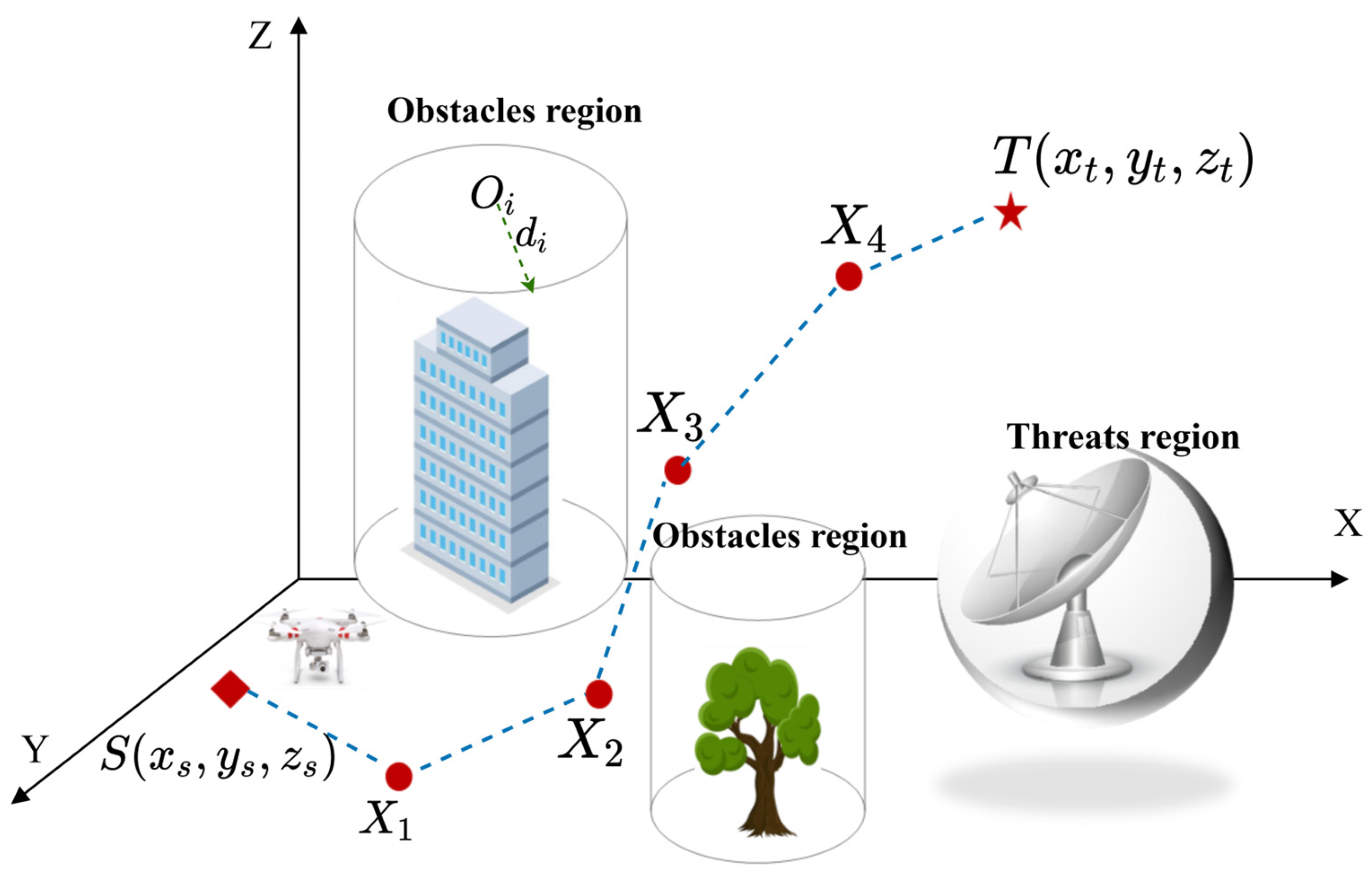
As shown in Figure 1, a UAV is required to plan an optimal flight path from a designated starting point S ( x s , y s , z s ) to a target destination T ( x t , y t , z t ) . The continuous trajectory P is approximated by discrete waypoints X i ( x i , y i , z i ) connected linearly to form the flight path as follows:
P = S ( x s , y s , z s ) , X 1 ( x 1 , y 1 , z 1 ) , X 2 ( x 2 , y 2 , z 2 ) , X n ( x n , y n , z n ) , T ( x t , y t , z t )
This discrete representation reduces computational complexity, enabling efficient solution via metaheuristic algorithms such as MMDBO. With respect to environmental constraints, irregular obstacles (e.g., buildings, trees) are simplified into a cylindrical model [32] defined by center O i and radius d i , while intangible threats (e.g., radar, electromagnetic interference) are modeled as spherical models [33], whose isotropic influence matches omnidirectional threat characteristics.
This paper investigates the UAV path-planning problem under a comprehensive set of constraints (e.g., the aforementioned environmental constraints, movement constraints, flight safety, path length) and optimizes solutions according to objective functions designed to explicitly promote path safety and system reliability.

2.2. Constraints for Path Planning

2.2.1. Flight Altitude Constraints

During UAV flight operations, altitude constraints are typically imposed due to considerations of flight cost, safety regulations, and operational requirements. The upper boundary of permissible altitude is defined as H max . Simultaneously, the UAV must remain above the terrain elevation to ensure a safe clearance from the ground surface, which is characterized by H The overall flight height constraint can be expressed as follows:
H min < h < H max

2.2.2. Flight Attitude Constraints

To guarantee the flight stability and operational safety of the UAV, constraints are imposed on the UAV’s yaw and pitch angles to maintain a proper flight attitude. These angular constraints are formulated based on changes in Euler angles, which reflect the attitude variation between the two consecutive waypoints along the flight path.
Similarly, the constraint for attitudes can be formulated as follows:
φ ( ψ i , ϕ i ) = | ψ i 1 ψ i | ψ max | ϕ i 1 ϕ i | ϕ max
where ψ max , ϕ max represent the upper bounds for UAV’s yaw and pitch angles, respectively.

2.2.3. Safety Distance Constraints

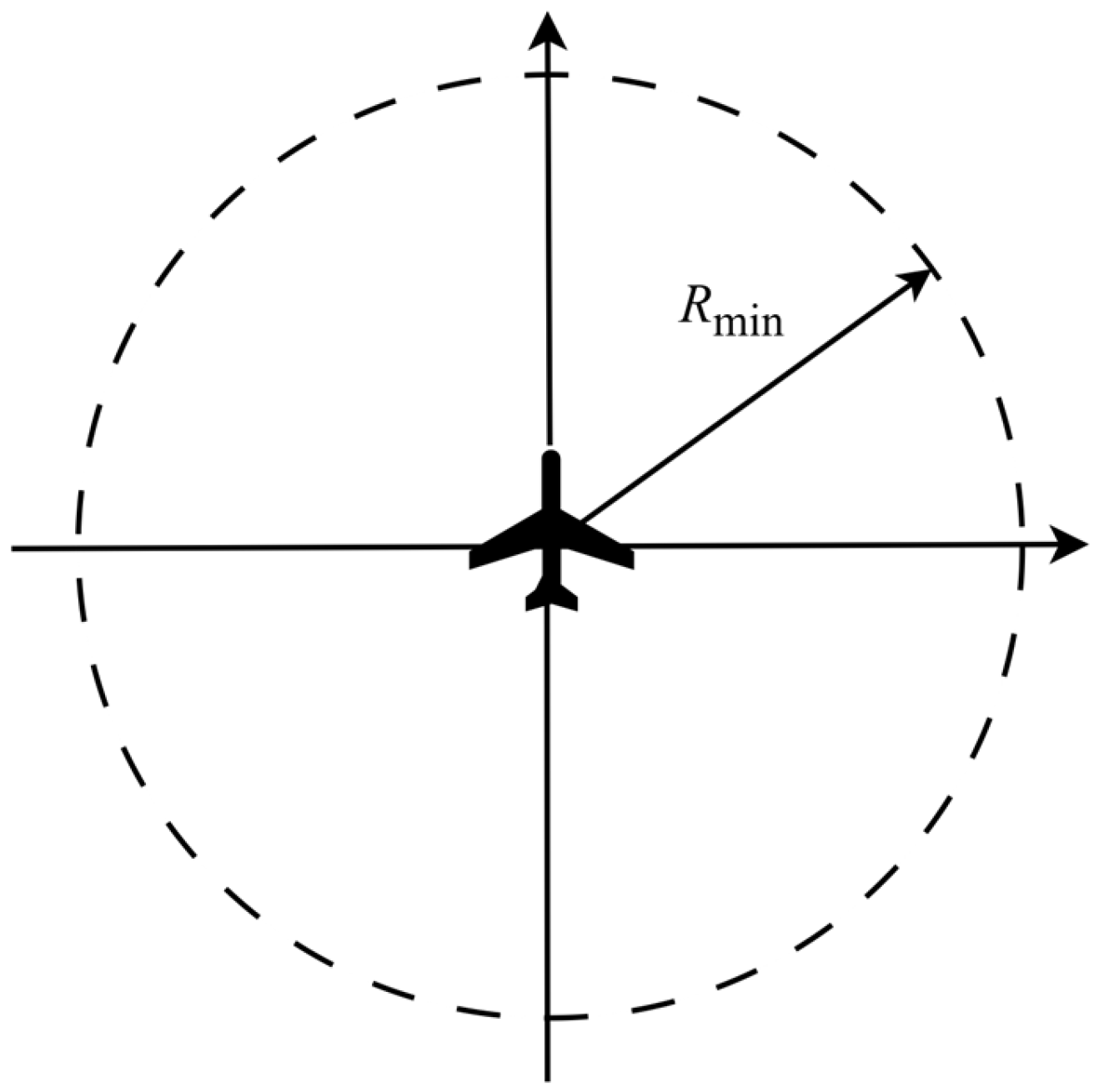
Owing to the inherent maneuverability limitations and flight inertia of UAVs, the aircraft is incapable of executing an instantaneous heading adjustment. A certain spatial margin must be allocated to accommodate the transition from the detection of a heading change requirement to the completion of the actual turning maneuver. As illustrated in Figure 2, a circular safety zone is established, centered at the real-time position of the UAV, with a radius of R min . The subsequent waypoint must not be positioned within this restricted area. The calculation of the minimum safety distance is defined as follows:
R i , i + 1 R min
where R i , i + 1 denotes the distance between i th and ( i + 1 ) th waypoint; R min represents the minimum safety distance required for the UAV.

2.3. Objective Functions for Path Planning

In general, a cost function is employed to assess the fitness of objective functions which plays a pivotal role as both a key metric for assessing path quality and a fundamental criterion for evaluating algorithmic performance.

2.3.1. Path Length

Path length is considered a critical performance metric for assessing path quality. A shorter flight distance directly correlates with reduced time expenditure and lower energy consumption. In this study, it is represented by the Euclidean distance [34] of the unmanned aerial vehicle in 3D space.
The cost related to the path length is subsequently defined as follows:
J path = i = 1 n 1 ( x i x i + 1 ) 2 + ( y i y i + 1 ) 2 + ( z i z i + 1 ) 2
where ( x i , y i , z i ) denotes the coordinates of the i th waypoint in the UAV path, and n represents the total number of waypoints.

2.3.2. Collision Avoidance

To generate a feasible flight path, the UAV must possess the capability of effective obstacle avoidance within the environment model. Typically, the UAV’s path is influenced concurrently by multiple obstacles or threat sources.
The overall obstacle avoidance cost for a UAV is determined by computing the weighted average of the penalty coefficients associated with all obstacles, expressed as follows:
J collision _ A = 1 N b i = 1 N b max 1 d i R min , 0
where N b denotes the total number of obstacles, d i represents the spatial distance between the UAV and the surface of the i th obstacle.
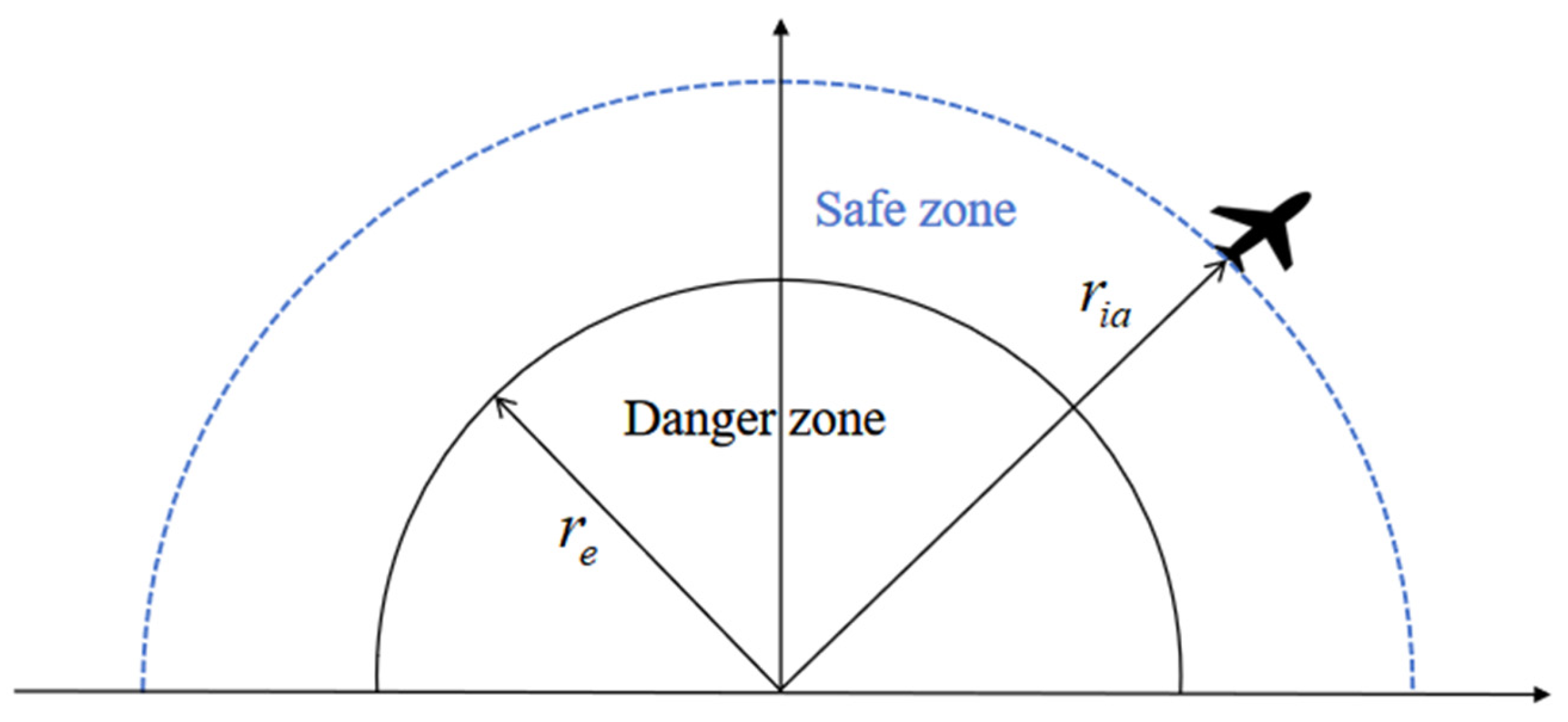
The hemispherical model illustrating the engagement of UAV by ground-based artillery or radar detection systems is presented in Figure 3. When the UAV is located within the operational engagement envelope of the threat system, the system is capable of effectively neutralizing the target. Conversely, if the aircraft operates beyond the maximum firing altitude, the system’s capability to engage the target diminishes to zero. The probability of a ground-based threat system successfully destroying a UAV is expressed as follows:
J collision _ V = i M ( r e 4 / ( r i a 4 + r e 4 ) ) , r i a r e 0 , r i a r e
where r i a denotes the spatial distance between the UAV and the central position of the i th ground-based threat system, r e represents the effective firing radius of the threat system, and M denotes total number of the threat system.
The above analysis shows that obstacle avoidance cost typically depends on three key factors: (i) the distance between the drone and the obstacle, (ii) the obstacle or threat’s geometric dimensions and shape, and (iii) the local feasibility of safe obstacle avoidance. A lower obstacle avoidance cost value signifies reduced influence of the obstacle on path planning, whereas a higher value implies that more intricate maneuvering—such as sharp turns, rapid altitude adjustments, or extended detours—is required to ensure collision-free navigation. Consequently, while elevated obstacle avoidance costs generally correlate with enhanced safety margins, they may also lead to increased path curvature, longer traversal distances, and higher computational load during real-time replanning.

2.3.3. Flight Altitude Cost

Continuous altitude adjustments for UAV are required to ensure real-time terrain and obstacle avoidance, resulting in dynamic variations in flight altitude. To maintain flight safety and system stability, abrupt altitude changes must be prevented. The vertical path distance reflects the average vertical deviation across all waypoints. Accordingly, the fight altitude cost is formulated as follows:
J height = 1 n i = 1 n ( z i z ) 2
where z i denote the height of the i th waypoint in the path, and z denote the average height of all points in the path.

2.3.4. Smoothness

To improve the stability and controllability of the UAV’s flight path and minimize oscillations and jitter during operation, the generated trajectory should be designed to be as smooth as possible.
The turning angle θ i by the i th waypoint and its two neighboring points along the trajectory is expressed as follows:
θ i = arccos P i , i + 1 P i , i 1 | P i , i 1 | | P i , i + 1 |
where P i , i + 1 , P i , i 1 indicate the vectors formed by the i th waypoint and its two consecutive waypoints along the path, respectively.
The spatial variation in path curvature is defined as follows:
J smooth = i = 3 n 3 | θ i 2 θ i 1 | + | θ i θ i + 1 | + | θ i + 2 θ i + 3 |
According to the above discussion, we construct the cost function by integrating the four critical indicators, defined as follows:
J Best   Cost = γ 1 × J path + γ 2 × J height + γ 3 × J smooth + ( J collision _ A + J collision _ V ) × V th
where J Best   Cost denotes the total cost, V th is the penalty coefficient, and γ i denotes the weight coefficients of the cost function, which can be dynamically adjusted according to specific mission requirements.
If the path cost is assigned a relatively high weight in the overall optimization objective, the algorithm prioritizes shorter paths during search. The smoothness cost is typically assigned a moderate weight to enforce curvature continuity without over-constraining or under-constraining the trajectory. The height cost receives a comparatively low weight, permitting controlled altitude variation—particularly in mission-specific scenarios requiring vertical maneuvering. Crucially, flight safety remains the paramount concern for UAV operations; thus, a sufficiently high obstacle avoidance margin must be guaranteed at all times during flight. Consequently, weight selection must strike a principled balance among competing objectives: path length, motion smoothness, height adaptability, and, above all, flight safety. The obstacle avoidance penalty coefficients must be assigned sufficiently high values—strictly prioritized according to safety criticality—to guarantee continuous compliance with obstacle clearance constraints, thereby upholding the fundamental principle that flight safety is paramount. As noted in this study, the value of γ i is set to 100.
For instance, fixed-wing and rotary-wing UAVs have distinct flight characteristics that shape their path optimization requirements. Fixed-wing UAVs generate lift via forward speed, offering high speed, long endurance, and large range for large-area/long-distance missions, but lack vertical takeoff and landing (VTOL) capability, require runways, and cannot hover for precise low-altitude operations. Rotary-wing UAVs (e.g., multi-rotors) generate lift via rotor rotation, enabling VTOL, stable hovering, and flexible low-altitude maneuvering for precision tasks in complex terrain, yet have limited endurance, low load capacity, slow speed, high energy consumption, and wind-sensitive stability. Thus, path optimization prioritizes smoothness and range for fixed-wing UAVs, while focusing on hover adaptability and flexible obstacle avoidance for rotary-wing UAVs.

3. MMDBO for Solving UAV Path Planning

3.1. Population Initialization

The initial population significantly influences algorithm’s search performance, with varying initial populations leading to distinct search outcomes. The DBO algorithm currently employs a random population generation strategy during initialization, which may result in insufficient population diversity and non-uniform distribution. To address these limitations, chaotic mapping is introduced as an alternative initialization approach to improve randomness and enhance population diversity.
The SPM chaotic mapping exhibits a broad chaotic range and pronounced ergodicity, thereby making it particularly effective for improving the randomness and diversity of initial population positions. The specific SPM chaotic mapping utilized in this study is defined as follows:
x ( t + 1 ) = mod x ( t ) η + μ sin ( π x ( t ) ) + r , 1 , 0 x ( t ) < η mod x ( t ) 0.5 η + μ sin ( π x ( t ) ) + r , 1 , η x ( t ) < 0.5   mod 1 x ( t ) η + μ sin π ( 1 x ( t ) ) + r , 1 , 0.5 x ( t ) < 1 η mod 1 x ( t ) η + μ sin π ( 1 x ( t ) ) + r , 1 , 1 η x ( t ) < 1
where r denotes a random number that follows a uniform distribution belonging to 0 , 1 . Setting η = 0.3 and μ = 0.3 results in a more uniformly distributed population.

3.2. Dynamic Global Exploration Mechanism

The DBO algorithm frequently struggles to locate the global optimal solution when updating positions in the ball-rolling dung beetle’s obstacle-free mode, primarily due to its limited global search capability. To address this drawback, the dynamic global exploration mechanism is proposed. This approach enhances the conventional global exploration approach by enabling real-time adjustment of exploration behavior, adaptive control of the search step size, and simultaneous improvement of both algorithmic accuracy and convergence rate.
The positional update for the ball-rolling dung beetle in obstacle-free conditions, which integrates the proposed dynamic global exploration strategy, is given as follows:
x i ( t + 1 ) = x i ( t ) + ω × r × F i ( t ) I × x i ( t )
where t represents iteration count, x i ( t ) represents the location of i th dung beetle at t th iteration, ω denotes the weighting factor, F i ( t ) denotes the fitness of ith dung beetle at t th iteration, and I refers to a randomly selected value belong to 1 , 2 .

3.3. Adaptive T-Distribution-Based Perturbation Mechanism

To overcome the tendency of the DBO algorithm to converge prematurely to local optima, an adaptive perturbation approach based on the T-distribution is integrated. In the later stages of iteration, the mechanism increasingly employs higher degrees of freedom, thereby making the distribution shape more similar to a normal distribution. This adjustment enhances the randomness-induced variation, enabling new solutions to be generated in proximity to the current optimal solution.
The update mechanism of the foraging small dung beetle population in the original algorithm is restructured. Specifically, an adaptive T-distribution-based perturbation is applied to the position updates of a subset of individuals, where the degrees of freedom parameter is adaptively tuned based on the iteration count. This approach introduces controlled randomness into the position perturbation process, thus improving the algorithm’s effectiveness.
The position of the small dung beetle population incorporating the adaptive T-distribution-based perturbation is formulated as follows:
X new i = X b + T ( σ ) × X b
σ = exp   2 t T num 2
where T ( σ ) represents a random variable following a T-distribution with a specified degree of freedom σ , X b denotes the position of the optimal solution prior to perturbation, and T num represents the total number of iterations.

3.4. Dynamic Weight Updating Mechanism

When the DBO algorithm becomes trapped in a local optimum during the position update phase, the thief dung beetle individuals continue to search for alternative solutions in the vicinity of the local optimum. However, this search behavior may limit the algorithm’s ability to locate the global optimum, resulting in premature convergence. To address this limitation, the position update strategy for the thief dung beetle population is reformulated by incorporating the dynamic weight updating mechanism.
In this study, the dynamic weight factor is mathematically formulated as follows:
w 1 = 1 t T num w 2 = t T num
The positional update of the thief dung beetle population incorporating the dynamic weight strategy is mathematically expressed as follows:
x i ( t + 1 ) = w 1 × X b + C × w 2 × e ×   ( | x i ( t ) X b | + | x i ( t ) X | )
where C stands for a fixed value, X indicates the current local optimal position, and e denotes a randomly generated vector that conforms to a normal distribution. w 1 is set to a relatively large value during the early iterations, which enables the thief dung beetle to explore promising regions near the optimal solution. At the same time, w 2 gradually increases, thus improving the algorithm’s capability to break free from local optimal solutions.

3.5. Implementation of the MMDBO in UAV Path Planning

Algorithmic outline of the MMDBO method is introduced in Algorithm 1, with the specific execution flow of the algorithm presented as follows.
Algorithm 1: MMDBO
Input: Population size N , optimization dimension D , total number of iterations T num
Initialize MMDBO ’s population X i by Equation (12);
While ( t T num ) do
For i = 1: Population size of the particle swarm do
Get and update the ball-rolling dung beetle’s positioning by Equation (13);
Determine the brood ball’s position by using standard DBO strategy [31];
Update the small dung beetle’s position by Equation (14);
Update the thief’s position by Equation (17);
Update X ;
Calculate the fitness of each particle by Equation (11);
t = t + 1 ;
End for
End while
Return X and fitness.
Output: Generate paths from best solution in X .

3.6. Time Complexity Analysis

Time complexity is a fundamental metric for assessing the asymptotic computational efficiency of an algorithm. For the path-planning problem addressed in this work, the time complexity of both the DBO and MMDBO algorithms depends not only on the problem-specific parameters population size N , the maximum number of iterations T num , and the problem dimension D but also on the computational cost associated with the position update strategy, which scales with the total number of obstacles and the complexity of the threat model.
The computational time cost of the DBO algorithm is dominated by three components: population initialization O ( N D ) , iterative optimization O ( T n u m N D ) , and fitness evaluation O ( T n u m N ( M + N b ) ) . Therefore, the time complexity of the standard DBO algorithm is as follows:
O ( N D + T n u m N D + T n u m N ( M + N b ) )
Similarly, the time complexity of MMDBO is also composed of the above three parts; the key difference between it and DBO lies in the ball-rolling dung beetle update strategy adopted in the iterative optimization stage—this strategy introduces additional computational overhead O ( T n u m N ( D + N b + M ) ) when calculating the obstacle avoidance loss function. The root cause of this is that in each position update process, the algorithm explicitly models and evaluates the impact of environmental obstacles on the candidate paths, thereby enhancing the safety of the path but also increasing the computational burden of a single iteration. Therefore, the time complexity of MMDBO is as follows:
O ( N D + T n u m N ( D + N b + M ) + T n u m N ( M + N b ) )
which is higher than that of DBO. However, when both N b and M are small, their time complexities become asymptotically equivalent.

4. Results and Discussion

4.1. Performance on Benchmark Functions

To evaluate the performance of the proposed algorithm, this study conducts comparative analyses between MMDBO and several widely adopted path planning optimization algorithms, including PSO, GWO, NGO, WOA, and DBO. To ensure a fair comparison, all algorithms are implemented on the same experimental platform, with the maximum number of iterations set to 500 and the population size fixed at 30. In all convergence curves, t denotes the current iteration index. All algorithms in this experiment were implemented and executed in MATLAB R2021b on a desktop computer equipped with an Intel® Core™ i7-7700 CPU (3.60 GHz) and 16 GB RAM. Additionally, the parameters of each algorithm are configured in accordance with the settings reported in the corresponding original literature.
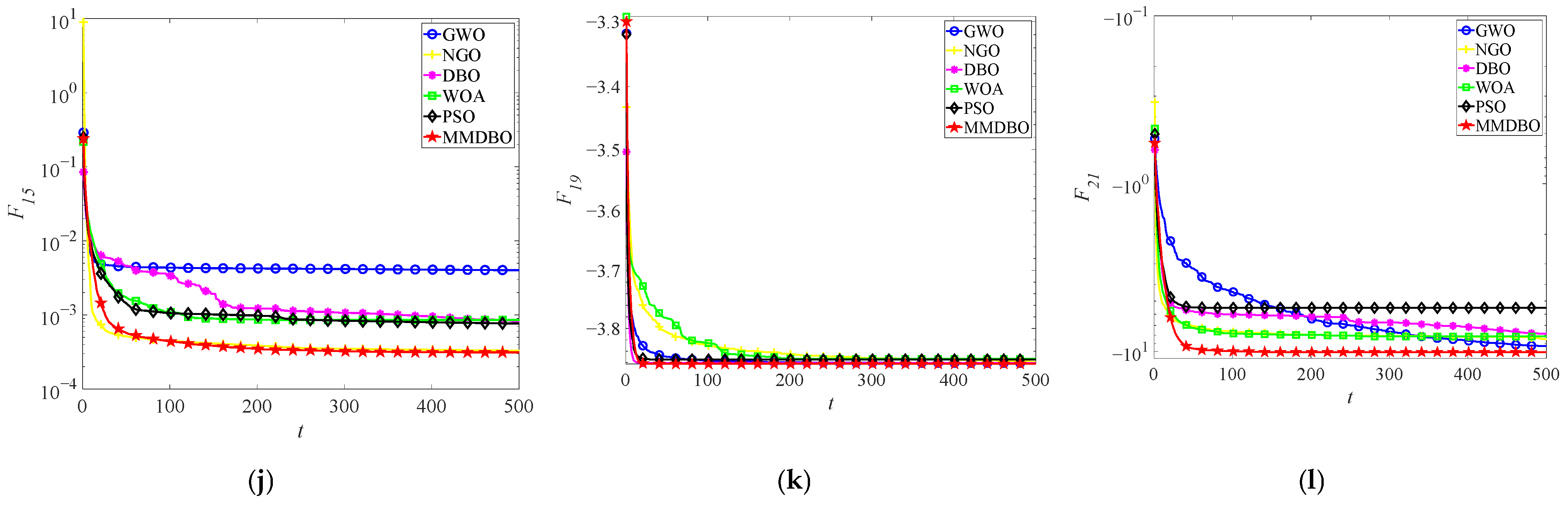
Twelve standard benchmark functions with diverse characteristics from the CEC2017 suite [35] were selected to assess the performance of each algorithm. These functions include typical unimodal functions F 1 , F 2 , F 3 , F 4 ; multimodal functions F 9 , F 10 , F 11 , F 12 ; and fixed-dimensional functions F 14 , F 15 , F 19 , F 21 . For each algorithm, the best optimal value, mean value, and standard deviation were recorded over 100 independent runs. The outcomes of the experiments are presented in Table 1.
As shown in Table 2, unimodal functions F 1 F 4 are primarily utilized to assess the exploitation performance of optimization algorithms. The results in Table 1 indicate that when the MMDBO algorithm is applied to solve these unimodal functions, it achieves better average values, standard deviations, and optimal values compared to the other five algorithms, consistently obtaining the best function values. Overall, the MMDBO algorithm demonstrates superior performance in both convergence accuracy and stability compared to the other five meta-heuristic algorithms.
Unlike unimodal functions, multimodal functions contain numerous local optima, the number of which grows exponentially with the problem dimensionality. This characteristic makes them particularly effective for evaluating an algorithm’s exploration capability. As presented in Table 3, the MMDBO algorithm demonstrates highly competitive performance when solving multimodal functions. For F 9 and F 11 , the performance of MMDBO is comparable to that of NGO, with both algorithms achieving the optimal value. Overall, compared to the other five meta-heuristic algorithms, MMDBO algorithm exhibits a stronger exploration capability.
The fixed-dimension functions F 14 , F 15 , F 19 and F 21 are primarily employed to assess the algorithm’s ability to explore the search space and its efficiency in avoiding local optima. As shown in Table 4, the MMDBO algorithm successfully identifies the optimal solution across all fixed-dimension functions, and its standard deviation is markedly superior to those of the other five optimization algorithms. This demonstrates that the MMDBO algorithm possesses a strong ability to avoid converging to suboptimal solutions.
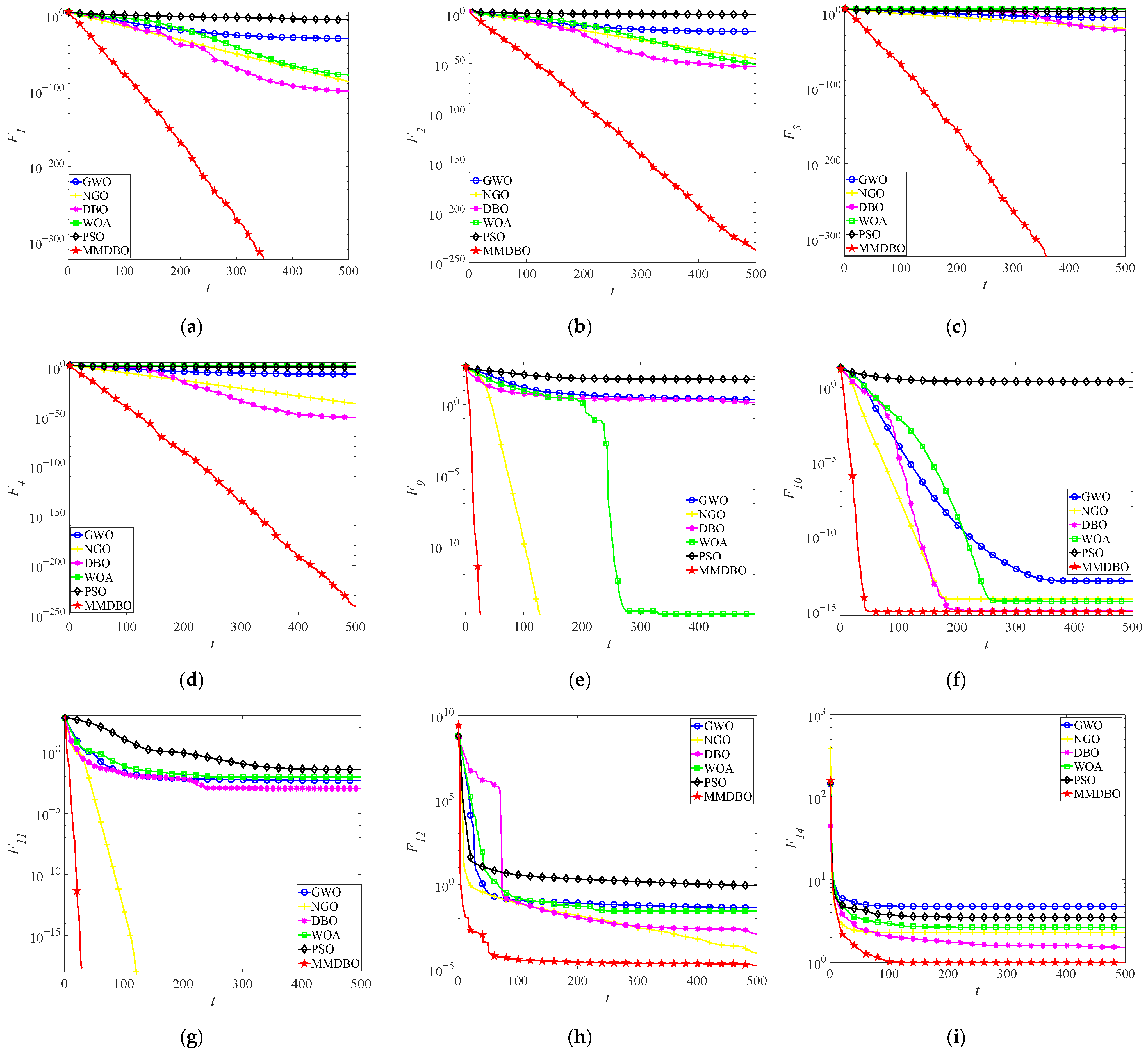
To assess the convergence performance of the algorithms, the convergence results of the six algorithms in solving F 1 , F 2 , F 3 , F 4 , F 9 , F 10 , F 11 , F 12 , F 14 , F 15 , F 19 and F 21 are presented in Figure 4. The results show that in solving F 1 , F 2 , F 3 , F 4 , F 9 , F 10 and F 11 , the MMDBO algorithm exhibits enhanced convergence rate and precision. For F 12 , F 14 , F 15 , F 19 and F 21 , although the convergence rate of MMDBO algorithm is slightly slower than that of NGO and DBO, it still achieves the highest convergence accuracy. Overall, compared with the other five meta-heuristic algorithms, the MMDBO approach shows improved convergence behavior with respect to both velocity and precision.
In conclusion, when solving the functions using the MMDBO algorithm, for the majority of functions, the results obtained are better than those achieved by the other five algorithms. This demonstrates that MMDBO exhibits enhanced optimization capability, convergence accuracy, and convergence speed. However, in terms of computational time consumption, the MMDBO algorithm incurs a slight increase compared to the other algorithms.

4.2. Experimental Validation

In this path-planning experimental phase, all algorithms are configured with a maximum of 200 iterations and independently executed 10 times. All experiments are conducted under identical hardware and software conditions as those used in the benchmark test experiments described in Section 4.1.
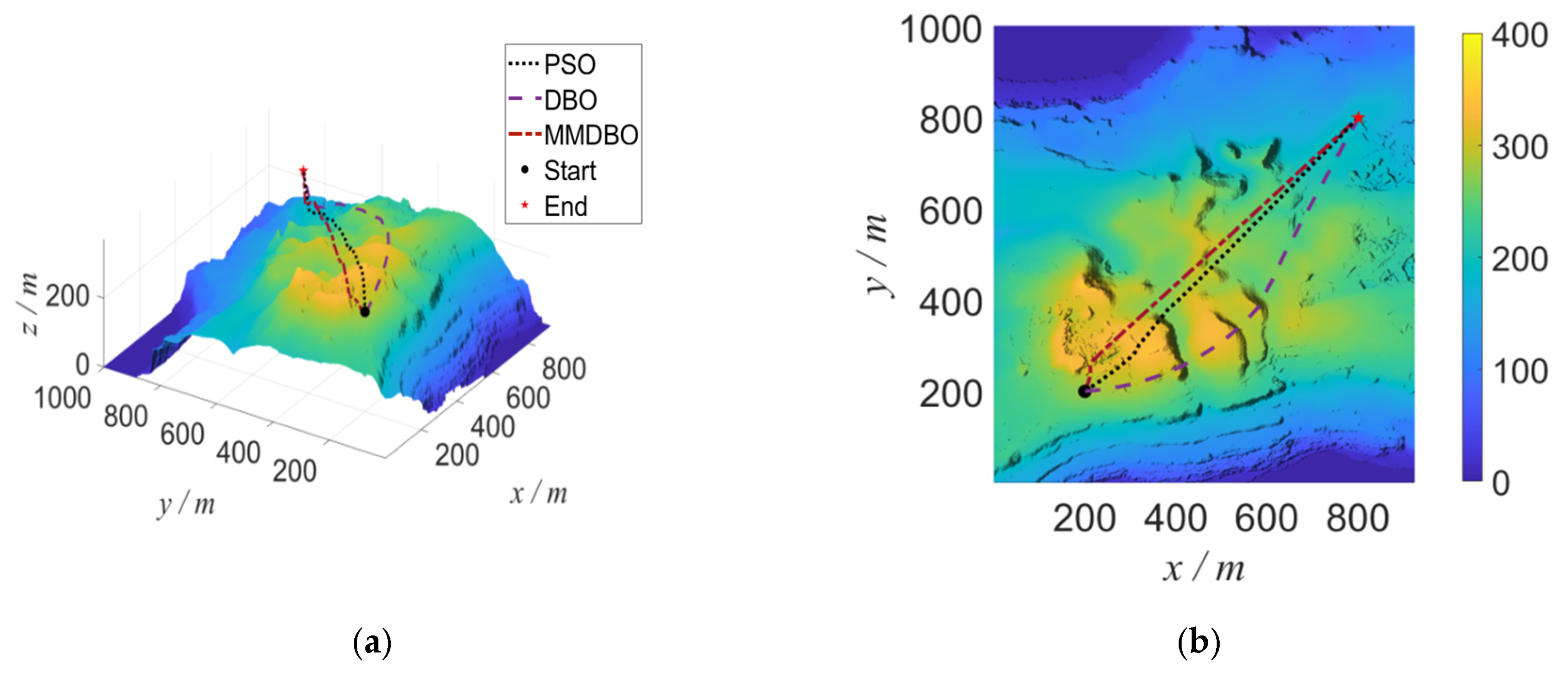
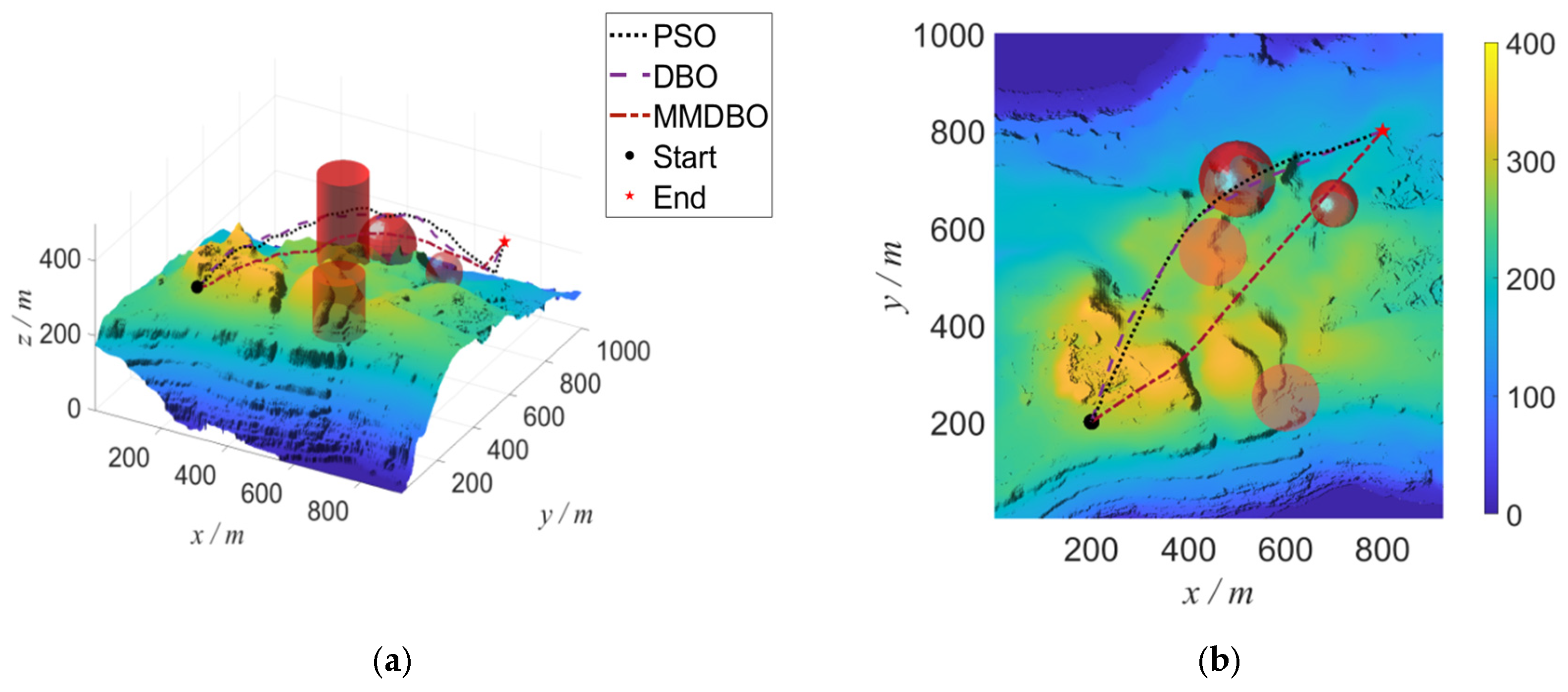
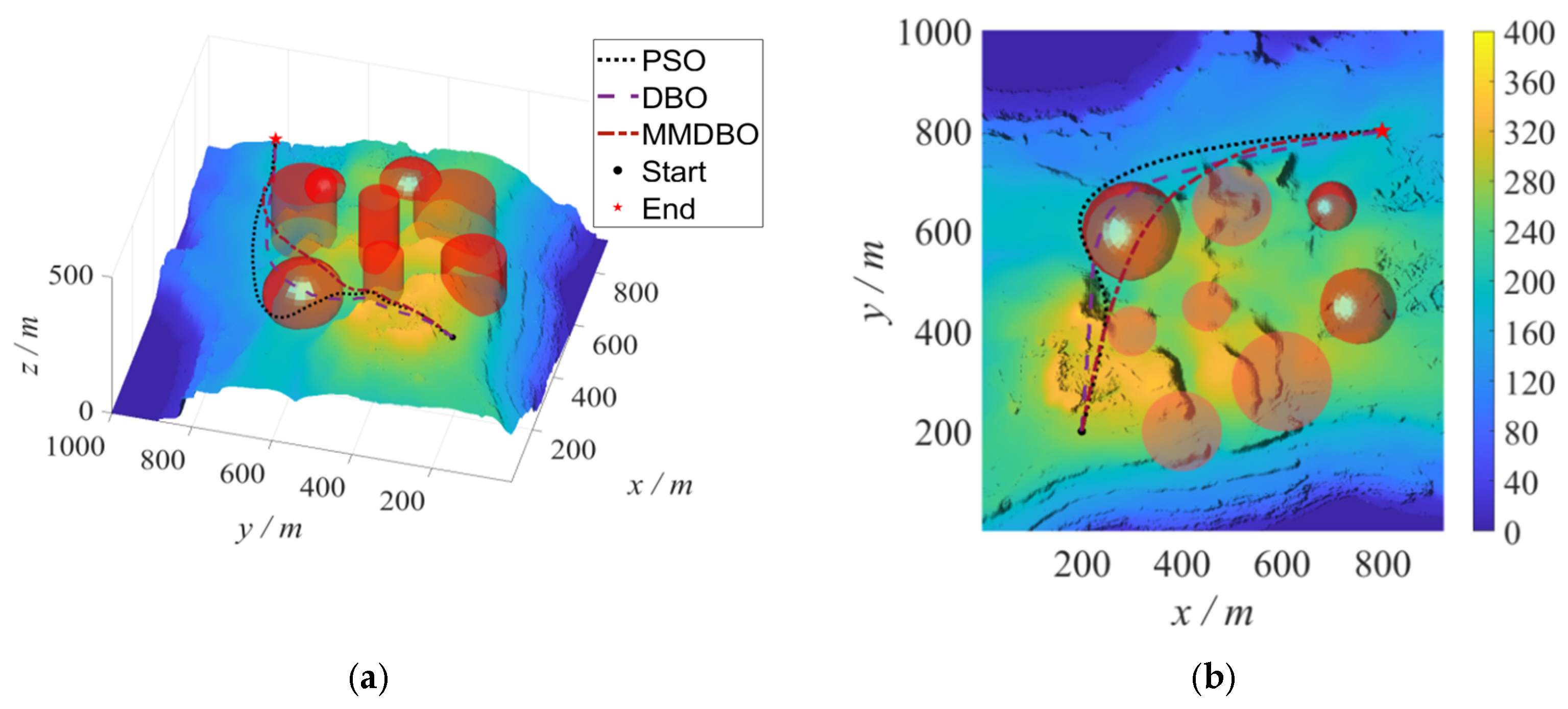
In this study, the map environment for UAV path planning was modeled based on a real Digital Elevation Model (DEM). Three scenarios with varying levels of complexity were created by introducing different obstacle configurations: (Scenario 1) terrain-only environment, (Scenario 2) sparse obstacle environment, and (Scenario 3) dense obstacle environment. The planning space of the map was defined as 1000   m × 1000   m × 400   m . The map model employed the X-Y-Z coordinate system, with the initial and destination positions at (200, 200, 290) and (800, 800, 300), respectively. In this experimental environment, detailed information regarding each obstacle and threat source is summarized in Table 5, where r denotes the radius and h denotes the height.
This experiment first investigates how varying weight allocations in the loss function influence the MMDBO algorithm’s performance across four key metrics: flight path length, flight altitude, trajectory smoothness, and obstacle avoidance success rate. Table 6 presents the loss function weight configurations evaluated in this study, and Table 7 presents the results of each indicator under the different weight combinations. As presented in Table 7, lower values indicate superior performance. Results reveal a consistent weight–performance coupling: increasing the weight assigned to a specific metric leads to measurable improvement in that metric. E.g., Level 1 (dominant path-length weight) achieves the shortest flight path; Level 2 (dominant altitude weight) minimizes flight altitude; Level 3 (dominant smoothness weight) yields the smoothest trajectory; and Level 4—by employing balanced weights—attains a well-balanced trade-off across all four metrics, avoiding severe degradation in any single dimension and thereby delivering enhanced overall robustness.
Next, we balance UAV multiple weighting factors during threat-area crossing and compare the performance of PSO, DBO, and MMDBO under the Level 4 weight configuration.
Figure 5 presents the path-planning results of the MMDBO algorithm and the comparison algorithm in Scenario 1. Since Scenario 1 is a simplified map without obstacles or threats, the search difficulty is relatively low. As corroborated by the quantitative results in Table 8, the MMDBO algorithm did not demonstrate significant advantages in global exploration and local escape in this scenario; its performance indicators were comparable to those of PSO and DBO, and each of the three had their own advantages and disadvantages, with no statistically significant differences.
Figure 6 presents the path-planning outcomes in Scenario 2. All three algorithms are capable of generating safe and collision-free 3D paths. As observed from the side view, the MMDBO algorithm not only adapts well to the terrain but also effectively utilizes vertical space to avoid obstacles, resulting in the shortest overall path. Compared with the other two algorithms, the performance advantage of MMDBO is evident.
Figure 7 presents the path-planning results of the MMDBO algorithm and the comparison algorithms. Even under conditions of increased obstacle density and reduced flight clearance, all three algorithms are able to generate safe and collision-free 3D paths. However, the resulting paths are longer than those obtained in Scenarios 1 and 2. Even when faced with densely distributed obstacles, the MMDBO algorithm continues to demonstrate strong path-planning capabilities, offering a clear performance advantage over the other two algorithms.
As further supported by the mean and standard deviation values reported in Table 8, the MMDBO algorithm consistently outperformed the baseline algorithms (PSO and DBO) across the majority of quantitative performance metrics in all three test scenarios—thereby robustly validating its superior global exploration capability and enhanced ability to escape local optima. Regarding computational efficiency, the algorithm’s runtime increases monotonically with scenario complexity. In obstacle-free Scenario 1, MMDBO achieves runtime performance comparable to that of DBO; in Scenarios 2 and 3—characterized by higher obstacle density and more heterogeneous threat distributions—MMDBO exhibits a marginal increase in runtime relative to both DBO and PSO.
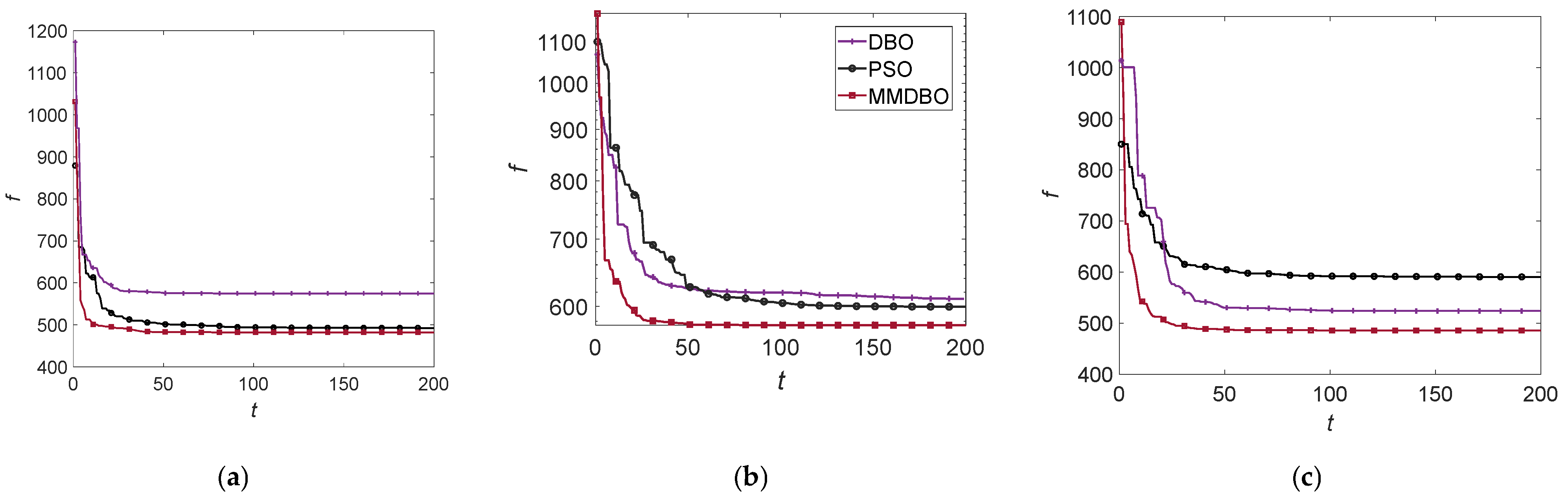
Figure 8 plots the median convergence curves of all compared algorithms across the three experimental scenarios. In Scenario 1, the MMDBO algorithm exhibits marginally faster convergence and slightly higher solution accuracy than PSO; in Scenarios 2 and 3, it consistently outperforms both PSO and DBO in terms of both convergence speed and final solution accuracy.
To further quantify the statistical significance of the performance difference between algorithms, a two-sample t-test was conducted on the final iteration results of 10 independent runs.The test results are presented in Table 9. The null hypothesis was that there is no significant difference in the mean cost function values between the proposed method and comparative algorithms. As shown in Table 9, the t-test between PSO and DBO in Scenario 2 yielded a p-value of 0.056 (p > 0.05), indicating no statistically significant difference between these two algorithms. In contrast, the p-values of the t-test between MMDBO and PSO and between MMDBO and DBO are significant, both of which in all scenarios are less than the significance level of 0.05. This rejects the null hypothesis and confirms that the superiority of the proposed method in optimization performance is statistically significant rather than a random fluctuation in experimental results. The smaller p-values (p < 0.01) further indicate an extremely significant difference, demonstrating the robust and reliable performance of the proposed method.
In conclusion, both the benchmark tests and path-planning experiments demonstrate the algorithm’s capability to thoroughly explore the search space and its effectiveness in escaping local optima. Furthermore, its runtime exhibits only a marginal increase with rising scenario complexity. The experimental results further demonstrate that while effectively avoiding obstacles and threats, the MMDBO algorithm significantly mitigates flight fluctuations—thereby improving both the operational stability and flight safety of UAVs.

5. Conclusions

In this paper, a novel path-planning MMDBO algorithm designed to generate optimal paths in battlefield threat environments has been proposed. To enhance the algorithm’s capability in efficiently exploring the extensive global search space, the SPM chaotic mapping approach, combined with an adaptive global exploration mechanism, has been effectively integrated into its structure. Furthermore, an adaptive T-distribution strategy combined with a dynamic weight adjustment mechanism is introduced to improve the algorithm’s ability to identify the global optimal solution. Comparative experimental results show that the MMDBO algorithm consistently outperforms PSO and DBO across the majority of quantitative performance metrics in all three test scenarios—albeit at a modest computational cost. The results of the statistical analysis also further confirm that MMDBO significantly outperforms the comparison algorithms in terms of stability and overall performance.
Future work will focus on extending the MMDBO framework to dynamic obstacle environments and developing adaptive weight mechanisms to enhance its real-time responsiveness and robustness in practical deployment scenarios.

Author Contributions

L.Z.: Methodology, Software, Validation, Investigation, Data Analysis, Visualization, Supervision, Project Coordination, Writing—Original Draft, Writing—Reviewing and Editing, Funding Acquisition. Y.L.: Formal Analysis, Project Coordination. Y.Y.: Validation, Resources. G.R.: Formal Analysis, Project Coordination. All authors have read and agreed to the published version of the manuscript.

Funding

This research was supported by National Natural Science Foundation of China (Grant No.62341119), Natural Science Foundation of Jiangsu Province for Youth (Grant No. BK20210941), and Changzhou Leading Innovative Talent Introduction and Cultivation Project (Grant No. CQ20210094).

Data Availability Statement

The data presented in this study are available on request from the corresponding author. The data are not publicly available due to some data confidentiality restrictions.

Conflicts of Interest

Author Lin Zhang was employed by the company Sunwave Communications Co., Ltd. The remaining authors Yan Li, Yang Yu and Gunther Retscher declare that the research was conducted in the absence of any commercial or financial relationships that could be construed as a potential conflict of interest.

References

  1. Pan, Z.; Zhang, C.; Xia, Y.; Xiong, H.; Shao, X. An improved artificial potential field method for path planning and formation control of the multi-UAV systems. IEEE Trans. Circuits Syst. II Express Briefs 2022, 69, 1129–1133. [Google Scholar] [CrossRef]
  2. Bapireddygari, H.; Anu, V.M. UAV-based aerial imaging and path optimization to combat mosquito-borne diseases. Pathog. Glob. Health 2025, 119, 198–209. [Google Scholar] [CrossRef] [PubMed]
  3. Si, J.; Xu, Y.; Niu, T.; Wang, L.; Li, B.; Deng, C.; Wang, S.; Wang, J. Dynamic docking algorithm for UGV to UAV based on single planning under disturbed conditions. ISA Trans. 2025, 157, 496–509. [Google Scholar] [CrossRef] [PubMed]
  4. Kanellopoulos, D.; Sharma, V.K.; Panagiotakopoulos, T.; Kameas, A. Networking architectures and protocols for IoT applications in smart cities: Recent developments and perspectives. Electronics 2023, 12, 2490. [Google Scholar] [CrossRef]
  5. Wang, Y.; Chen, Y. Quasi-static path planning for continuum robots by sampling on implicit manifold. IEEE Int. Conf. Robot Autom. 2024, 2024, 8728–8734. [Google Scholar] [CrossRef]
  6. Niu, J.; Shen, C.; Zhang, L.; Li, Q.; Ma, H. A multi-objective path optimization method for plant protection robots based on improved A*-IWOA. PeerJ Comput. Sci. 2024, 10, e2620. [Google Scholar] [CrossRef]
  7. Aggarwal, S.; Kumar, N. Path planning techniques for unmanned aerial vehicles: A review, solutions, and challenges. Comput. Commun. 2020, 149, 270–299. [Google Scholar] [CrossRef]
  8. Du, P.; He, X.; Cao, H.; Garg, S.; Kaddoum, G.; Hassan, M.M. AI-based energy-efficient path planning of multiple logistics UAVs in intelligent transportation systems. Comput. Commun. 2023, 207, 46–55. [Google Scholar] [CrossRef]
  9. Zhang, M.; Liu, S.; Zhou, Q.; Han, X. A novel path planning scheme based on Fast-IBi-RRT* algorithm for industrial robots. Appl. Intell. 2025, 55, 785. [Google Scholar] [CrossRef]
  10. Zhou, K.; Wang, K.; Wang, Y.; Qu, X. A risk-based unmanned aerial vehicle path planning scheme for complex air-ground environments. Risk Anal. 2024. [Google Scholar] [CrossRef]
  11. Zhang, W.; Li, J.; Yu, W.; Ding, P.; Wang, J.; Zhang, X. Algorithm for UAV path planning in high obstacle density environments: RFA-star. Front. Plant. Sci. 2024, 15, 1391628. [Google Scholar] [CrossRef] [PubMed]
  12. Ye, C.; Shao, P.; Zhang, S.; Wang, W. Three-dimensional unmanned aerial vehicle path planning utilizing artificial gorilla troops optimizer incorporating combined mutation and quadratic interpolation operators. ISA Trans. 2024, 149, 196–216. [Google Scholar] [CrossRef] [PubMed]
  13. Zhao, J.; Deng, C.; Yu, H.; Fei, H.; Li, D. Path planning of unmanned vehicles based on adaptive particle swarm optimization algorithm. Comput. Commun. 2024, 216, 112–129. [Google Scholar] [CrossRef]
  14. Zhang, X.; Duan, H. An improved constrained differential evolution algorithm for unmanned aerial vehicle global route planning. Appl. Soft Comput. 2015, 26, 270–284. [Google Scholar] [CrossRef]
  15. Dijkstra, E.W. A note on two problems in connexion with graphs. Numer. Math. 1959, 1, 269–271. [Google Scholar] [CrossRef]
  16. Hart, P.E.; Nilsson, N.J.; Raphael, B. A formal basis for the heuristic determination of minimum cost paths. IEEE Trans. Syst. Sci. Cybern. 1968, 4, 100–107. [Google Scholar] [CrossRef]
  17. Behera, G.C.; Bagal, D.K.; Muduli, P.K.; Maghrabi, L.A.; Mohanta, H.C. Parametric optimization of torsional parameters of ferrocement “U” wrapped beams using recent meta-heuristic optimization algorithms. Materials 2023, 16, 6727. [Google Scholar] [CrossRef]
  18. Li, H.; Li, N.; Guo, Y.; Yuan, H.; Lei, B. Meta-heuristic device-free localization algorithm under multiple path effect. Entropy 2023, 25, 1025. [Google Scholar] [CrossRef]
  19. Fu, B.; Chen, L.; Zhou, Y.; Zheng, D.; Wei, Z.; Dai, J.; Pan, H. An improved A* algorithm for the industrial robot path planning with high success rate and short length. Robot. Auton. Syst. 2018, 106, 26–37. [Google Scholar] [CrossRef]
  20. Liu, L.; Yao, J.; He, D.; Chen, J.; Huang, J.; Xu, H.; Wang, B.; Guo, J. global dynamic path planning fusion algorithm combining jump-A* algorithm and dynamic window approach. IEEE Access 2021, 9, 19632–19638. [Google Scholar] [CrossRef]
  21. Kennedy, J.; Eberhart, R. Particle swarm optimization. In Proceedings of the ICNN’95—International Conference on Neural Networks, Perth, WA, Australia, 27 November–1 December 1995; IEEE: New York, NY, USA, 1995; Volume 1944, pp. 1942–1948. [Google Scholar]
  22. Yu, Z.; Si, Z.; Li, X.; Wang, D.; Song, H. A novel hybrid particle swarm optimization algorithm for path planning of UAVs. IEEE Internet Things J. 2022, 9, 22547–22558. [Google Scholar] [CrossRef]
  23. Mirjalili, S.; Mirjalili, S.M.; Lewis, A. grey wolf optimizer. Adv. Eng. Softw. 2014, 69, 46–61. [Google Scholar] [CrossRef]
  24. Feng, W.-Q.; Yang, Y.; Yang, L.-F.; Fu, Y.-J.; Xu, K.-J. unmanned aerial vehicle logistics distribution path planning based on improved grey wolf optimization algorithm. Symmetry 2025, 17, 2178. [Google Scholar] [CrossRef]
  25. Ibrahim, A.T.; Hassan, I.H.; Abdullahi, M.; Kana, A.F.D.; Abubakar, A.H.; Mohammed, M.T.; Gabralla, L.A.; Rusydi, M.K.; Chiroma, H. hybrid attention-enhanced xception and dynamic chaotic whale optimization for brain tumor diagnosis. Bioengineering 2025, 12, 747. [Google Scholar] [CrossRef] [PubMed]
  26. Dai, Y.; Yu, J.; Zhang, C.; Zhan, B.; Zheng, X. A novel whale optimization algorithm of path planning strategy for mobile robots. Appl. Intell. 2023, 53, 10843–10857. [Google Scholar] [CrossRef]
  27. Zhang, F. Multi-strategy improved northern goshawk optimization algorithm and application. IEEE Access 2024, 12, 34247–34264. [Google Scholar] [CrossRef]
  28. Yang, Y.; Sun, L.; Fu, Y.; Feng, W.; Xu, K. Three-dimensional UAV trajectory planning based on improved sparrow search algorithm. Symmetry 2025, 17, 2071. [Google Scholar] [CrossRef]
  29. Tang, K.; Zhang, L. An enhanced whale optimization algorithm with outpost and multi-population mechanisms for high-dimensional optimization and medical diagnosis. PLoS ONE 2025, 20, e0325272. [Google Scholar] [CrossRef]
  30. Xue, J.; Shen, B. Dung beetle optimizer: A new meta-heuristic algorithm for global optimization. J. Supercomput. 2023, 79, 7305–7336. [Google Scholar] [CrossRef]
  31. Ye, M.; Zhou, H.; Yang, H.; Hu, B.; Wang, X. Multi-strategy improved dung beetle optimization algorithm and its applications. Biomimetics 2024, 9, 291. [Google Scholar] [CrossRef]
  32. Duong, T.T.N.; Bui, D.-N.; Phung, M.D. Navigation variable-based multi-objective particle swarm optimization for UAV path planning with kinematic constraints. Neural Comput. Appl. 2025, 37, 5683–5697. [Google Scholar] [CrossRef]
  33. Guo, C.; Huang, L.; Tian, K. Combinatorial optimization for UAV swarm path planning and task assignment in multi-obstacle battlefield environment. Appl. Soft Comput. 2025, 171, 112773. [Google Scholar] [CrossRef]
  34. Huang, F.; Zhu, Y.; Zhou, Z. Irregular euclidean distance constellation design for quadrature index modulation. IEEE Commun. Lett. 2023, 27, 2928–2932. [Google Scholar] [CrossRef]
  35. Mirjalili, S.; Mirjalili, S.M.; Hatamlou, A. Multi-verse optimizer: A nature-inspired algorithm for global optimization. Neural Comput. Appl. 2016, 27, 495–513. [Google Scholar] [CrossRef]
Figure 1. The environment mode of UAV path planning in complex constrained regions.
Symmetry 18 00383 g001
Figure 2. Safety distance constraint model.
Symmetry 18 00383 g002
Figure 3. The hemispherical model of the threat system.
Symmetry 18 00383 g003
Figure 4. The convergence results from the MMDBO and other algorithms on benchmark functions. (a) F 1 ; (b) F 2 ; (c) F 3 ; (d) F 4 ; (e) F 9 ; (f) F 10 ; (g) F 11 ; (h) F 12 ; (i) F 14 ; (j) F 15 ; (k) F 19 ; (l) F 21 .
Symmetry 18 00383 g004aSymmetry 18 00383 g004b
Figure 5. The paths generated by the MMDBO and other algorithm in Scenarios 1: (a) 90° side view; (b) top view.
Symmetry 18 00383 g005
Figure 6. The paths generated by the MMDBO and other algorithm in Scenarios 2: (a) 45° side view; (b) top view.
Symmetry 18 00383 g006
Figure 7. The paths generated by the MMDBO and other algorithms in Scenarios 3: (a) 90° side view; (b) top view.
Symmetry 18 00383 g007
Figure 8. The convergence curves by the MMDBO and other algorithms in experimental environments. (a) Scenario 1; (b) Scenario 2; (c) Scenario 3.
Symmetry 18 00383 g008
Table 1. Advantages and disadvantages of various classic algorithms.
Algorithm CategoryAlgorithm NameAdvantagesDisadvantages
Classical Traditional AlgorithmsDijkstra’s Algorithm1. Simple to implement and understand; 2. Ensures global optimal solution for single-source shortest path; 3. High stability and reproducibility; 4. Suitable for static networks with non-negative edge weights.1. Inapplicable to dynamic environments; 2. Low efficiency in large-scale networks; 3. Ignores practical constraints; 4. Invalid for negative weight edges.
A*1. Higher search efficiency than Dijkstra; 2. Guarantees optimal path with proper heuristic function; 3. Flexible heuristic function customization.1. Sensitive to heuristic function design; 2. Poor dynamic adaptability; 3. Weak support for high-dimensional/multi-constraint problems.
Meta-Heuristic AlgorithmsPSO1. Simple structure and few parameters; 2. Fast initial convergence; 3. Good for continuous space optimization; 4. Expandable for multi-objective tasks.1. Prone to local optimum in late iteration; 2. Requires manual parameter tuning; 3. Needs discretization for discrete path planning.
GWO1. No gradient information needed; 2. Strong global search ability; 3. Few parameters and high robustness; 4. Good for multi-modal functions.1. Slow late convergence; 2. Reduced efficiency in high-dimensional problems; 3. Needs improvement for dynamic environments.
WOA1. Strong global exploration; 2. Simple implementation with few parameters; 3. Good for non-convex/multi-modal problems.1. Population initialization affects convergence; 2. Weak local development ability; 3. Needs improved coding for discrete tasks.
NGO1. Strong adaptability and high convergence accuracy; 2. Balanced global/local search; 3. Good for high-dimensional optimization.1. Higher complexity than GWO/WOA; 2. Population size impacts performance; 3. Few path-planning applications.
SSA1. Strong dynamic adaptability with early warning mechanism; 2. Balanced search ability and fast convergence; 3. Sensitive to dynamic obstacles.1. Difficult parameter tuning; 2. Prone to premature convergence in large-scale tasks; 3. Poor path smoothness.
DBO1. Strong global search, hard to fall into local optimum; 2. Fast convergence and high accuracy; 3. Good for high-dimensional tasks; 4. Few parameters and high robustness.1. High computational complexity in large-scale tasks; 2. Weak late local development; 3. Needs improvement for discrete path optimization.
MMDBO1. Strong global search; 2. effectiveness in escaping local optima; 3. Fast convergence and high accuracy.1. High computational complexity in obstacle-dense environments; 2. Sensitive to parameter configuration.
Table 2. Results of unimodal benchmark functions.
FunctionsPSOWOANGOGWODBOMMDBO
F 1 Ave0.000152551.096 × 10−862.7666 × 10−871.4579 × 10−279.0801 × 10−1010
Std0.000432092.6134 × 10−718.111 × 10−873.4764 × 10−279.0527 × 10−1000
Opt2.7627 × 10−82.5924 × 10−705.6285 × 10−908.9262 × 10−303.5292 × 10−1620
Runtime/s 0.0160.03150.03690.03980.03760.0471
F 2 Ave0.775971.0468 × 10−491.4973 × 10−459.1928 × 10−175.2207 × 10−491.2891 × 10−243
Std1.4777.3783 × 10−492.018 × 10−458.2948 × 10−175.2138 × 10−480
Opt0.00828355.9447 × 10−591.3175 × 10−461.1304 × 10−172.1774× 10−831.1374 × 10−286
Runtime/s 0.01650.03790.03980.04180.03860.0416
F 3 Ave80.244141,441.5572.7564 × 10−224.4445 × 10−53.7333 × 10−460
Std91.514713,330.5131.6378 × 10−210.000269333.7329 × 10−450
Opt10.32471651.83211.2378 × 10−304.0754 × 10−93.7571 × 10−1440
Runtime/s 0.07360.10190.15310.09790.09800.1042
F 4 Ave2.577949.57372.1667 × 10−377.4506 × 10−79.0233 × 10−503.5996 × 10−239
Std1.224327.97333.5603 × 10−377.8328 × 10−78.0577 × 10−490
Opt0.592450.289116.5366 × 10−393.9133 × 10−86.0399 × 10−822.7626 × 10−283
Runtime/s 0.01640.02890.03750.03930.03710.0401
Bold values represent the best outcomes.
Table 3. Results of multimodal benchmark functions.
FunctionsPSOWOANGOGWODBOMMDBO
F 9 Ave67.02231.7053 × 10−1502.71921.57750
Std18.25751.2659 × 10−1403.65784.58130
Opt26.871300000
Runtime 0.02120.03300.04150.04200.04030.0419
F 10 Ave2.46214.0856 × 10−156.3949 × 10−151.0182 × 10−139.5923 × 10−168.8818 × 10⁻¹⁶
Std0.915792.3414 × 10−151.7764 × 10−151.7273 × 10−144.9989 × 10−160
Opt0.00389248.8818 × 10−164.4409 × 10−157.5495 × 10−148.8818 × 10−168.8818 × 10⁻¹⁶
Runtime 0.02080.03670.04110.04160.04120.0419
F 11 Ave0.0361370.009417600.00465810.00105130
Std0.0427480.04579200.00921410.0105130
Opt4.4406 × 10−700000
Runtime 0.02610.04080.04900.04590.04440.0458
F 12 Ave0.783560.0268499.046 × 10−50.0462870.00205771.9228 × 10−5
Std1.09010.05480.000653840.0301030.0120930.00018773
Opt2.7908 × 10−80.00321696.3764 × 10−80.0120711.2618 × 10−82.2819 × 10⁻¹¹
Runtime 0.11960.15340.24720.14650.14550.1495
Bold values represent the best outcomes.
Table 4. Results of fixed-dimension benchmark functions.
FunctionsPSOWOANGOGWODBOMMDBO
F 14 Ave3.48052.65042.28274.7491.51250.998
Std2.72712.75632.61914.15571.26825.4664 × 10−17
Opt0.9980.9980.9980.9980.9980.998
Runtime 0.17260.20950.37160.17880.20030.2063
F 15 Ave0.000761860.000741660.000329330.00460570.000761830.00031219
Std0.000384320.000786665.0684 × 10−50.00816730.00038074.535 × 10−5
Opt0.000307490.000308190.000307490.00030750.000307490.00030749
Runtime 0.00880.03390.03300.01590.03350.0350
F 19 Ave−3.8551−3.8539−3.8592−3.8616−3.8612−3.8628
Std0.0773020.0171870.0166770.00238650.00316852.2115 × 10−15
Opt−3.8628−3.8628−3.8628−3.8628−3.8628−3.8628
Runtime 0.01090.04100.03840.01670.03630.0397
F 21 Ave−5.4968−8.1475−8.4428−9.3007−7.862−10.1022
Std3.2722.87353.61552.07332.52040.5098
Opt−10.1532−10.1532−10.1532−10.1532−10.1532−10.1532
Runtime 0.01370.0330.04370.02090.03970.0440
Bold values represent the best outcomes.
Table 5. Obstacle and threat parameters.
ScenarioNo.Obstacle/ThreatPosition/(x,y,z) r /m h /m
21Cylinder (450,550,250)70250
2Cylinder(600,250,250)70150
3Sphere(500,700,250)80/
4Sphere(700,650,250)50/
31Cylinder(300,400,250)50200
2Cylinder(400,200,250)80150
3Cylinder(450,450,250)50250
4Cylinder(500,650,250)80200
5Cylinder(600,300,250)100150
6Sphere(300,600,250)100/
7Sphere(700,650,250)50/
8Sphere(750,450,250)80/
Table 6. Weight configurations of MMDBO.
Comb.Level 1Level 2Level 3Level 4
Weight ( γ 1 = 0.7 ,   γ 2 = 0.2 ,   γ 3 = 0.1 ) ( γ 1 = 0.1 ,   γ 2 = 0.7 ,   γ 3 = 0.2 ) ( γ 1 = 0.2 ,   γ 2 = 0.1 ,   γ 3 = 0.7 ) ( γ 1 = 0.5 ,   γ 2 = 0.3 ,   γ 3 = 0.2 )
Table 7. Results of each indicator under the different weight combinations.
ScenarioComb. J path J height J smooth J colision
1Level 1953.9(11.3)30.6(3.8)8.9(1.4)0(0)
Level 2984.0(20.1)18.2(1.5)7.9(1.2)0(0)
Level 3966.9(23.5)31.0(2.9)4.9(0.6)0(0)
Level 4958.9(9.1)26.2(2.9)7.9(0.8)0(0)
2Level 1971.6(32.3)29.0(2.8)8.3(1.9)0.2(0.6)
Level 21024.9(65.6)19.5(3.1)8.2(1.0)9.8 × 10⁻⁴(0.003)
Level 31018.1(54.7)35.2(7.6)5.9(1.1)3.8 × 10⁻³(0.01)
Level 4978.5(25.3)25.5(2.6)8.0(1.4)0(0)
3Level 11050.3(36.6)34.1(4.5)8.0(1.0)0.0102(0.03)
Level 21136.3(58.9)22.4(3.2)8.1(1.4)6.1 × 10⁻⁵(1.9 × 10⁻⁴)
Level 31083.4(40.4)38.9(7.4)5.7(0.6)0(0)
Level 41057.6(28.5)31.6(5.9)7.1(0.9)0(0)
(1) All values in the table are presented as mean (standard deviation). (2) Bold values represent the best outcomes.
Table 8. Results of each cost indicator in experimental environments.
ScenarioAlgorithm J path J height J smooth J colision Runtime(s)
1PSO957.6(12.9)25.2(2.6)8.4(1.6)0(0)113.4
DBO962.1(16.8)27.9(4.6)9.5(1.9)0(0)112.3
MMDBO (Level 4)958.9(9.1)26.2(2.9)7.9(0.8)0(0)112.9
2PSO985.9(27.7)26.5(2.9)8.8(2.0)0(0)116.3
DBO983.4(32.9)28(4.4)8.9(2.4)0.001(0.004)113.5
MMDBO (Level 4)978.5(25.3)25.5(2.6)8.0(1.4)0(0)118.7
3PSO1118.0(137.3)39.5(12.0)8.4(0.4)0(0)117.9
DBO1108.9(41.1)38.6(8)8.4(1.9)0(0)114.2
MMDBO (Level 4)1057.6(28.5)31.6(5.9)7.1(0.9)0(0)120.3
(1) All values in the table are presented as mean (standard deviation). (2) Bold values represent the best outcomes.
Table 9. Statistical significance test results.
Algorithm ComparisonScenario 1Scenario 2Scenario 3
MMDBO vs. PSOp = 0.0041Significant (p < 0.05)p = 0.0022Significant (p < 0.05)p = 0.0015Significant (p < 0.05)
MMDBO vs. DBOp = 0.0024Significant (p < 0.05)p = 0.0034Significant (p < 0.05)p = 0.0027Significant (p < 0.05)
PSO vs. DBOp = 0.0026Significant (p < 0.05)p = 0.056Not significant (p > 0.05)p = 0.0032Significant (p < 0.05)
Disclaimer/Publisher’s Note: The statements, opinions and data contained in all publications are solely those of the individual author(s) and contributor(s) and not of MDPI and/or the editor(s). MDPI and/or the editor(s) disclaim responsibility for any injury to people or property resulting from any ideas, methods, instructions or products referred to in the content.