Article

Mining Managerial Insights from User Reviews: A Mix Contrastive Method to Aspect–Opinion Mining

1
School of Economics and Management, Zhongguancun Campus, University of Chinese Academy of Sciences, Beijing 100190, China
2
School of Computer and Software Engineering, Xihua University, Chengdu 610039, China
3
College of Electronic and Information Engineering, Tongji University, Shanghai 201804, China
4
Department of Computer Science and Operations Research, University of Montreal, Montreal, QC H3C 3J7, Canada
*
Author to whom correspondence should be addressed.
Symmetry 2026, 18(2), 335; https://doi.org/10.3390/sym18020335
Submission received: 22 December 2025 / Revised: 30 January 2026 / Accepted: 3 February 2026 / Published: 12 February 2026

Abstract

For businesses to optimize management decisions in the digital transformation, a process inherently characterized by symmetry between feedback collection and strategic adjustment, it is essential to automatically extract fine-grained opinions from large volumes of unstructured evaluations. However, traditional evaluation management techniques often fail to reflect this symmetrical balance between user perception and organizational response, primarily due to their inefficiency in processing unstructured textual data. Moreover, existing aspect–opinion mining algorithms exhibit limited practical generalization performance due to poor robustness against noise and semantic variations in real-world reviews. To address these gaps, this paper proposes MixContrast, an aspect–opinion mining method based on mix contrastive learning, which integrates mixed sample construction with data augmentation to generate continuous semantic transition samples. By symmetrically aligning positive and negative samples through a contrastive learning mechanism, MixContrast enhances representation learning and improves model generalization. Experiments conducted on cosmetics and multi-domain e-commerce review datasets demonstrate that MixContrast significantly outperforms several strong baseline models in both aspect and opinion extraction tasks. Theoretical analysis shows that MixContrast enhances robustness by ensuring Lipschitz continuity and enabling gradient decomposition in the representation space. Based on MixContrast predictions, we conduct a correlation analysis among aspects, opinions, and sentiment tendencies, delivering real-time quantitative support for marketing strategy formulation, product optimization, and service enhancement. Beyond advancing aspect–opinion mining technology, this work enables data-driven, symmetrical integration of technical insights with managerial decision-making, holding significant theoretical and practical value for digitally transforming enterprises.

1. Introduction

Amid the wave of digital transformation, data-driven decision-making [1,2] has become a crucial competitive advantage for enterprises in responding to market changes and optimizing strategic positioning. User-generated content, such as product reviews on e-commerce platforms, contains rich information about user perceptions, preferences, and complaints regarding product attributes and service quality, serving as a valuable source of unstructured data. Mining insights from such text is key to optimizing assessment management, refining opinion management strategies, and aligning enterprise operations with market demand [3]. Aspect–opinion mining [4,5], a core branch of Natural Language Processing (NLP), bridges unstructured text data with management decisions, offering a technical paradigm for the digital upgrade of business administration by establishing symmetry between data analysis and managerial action.
Evaluation management theory [6] emphasizes that enterprises must continuously collect and analyze feedback from stakeholders such as users, employees, and partners to dynamically adjust organizational processes, product designs, and service standards, maintaining a symmetrical relationship between input and improvement. However, traditional assessment methods rely heavily on structured questionnaires [7], focus group interviews [8], and expert evaluations [9]. These approaches often suffer from limited sample sizes, high time costs, and significant lag, failing to meet the real-time, large-scale analytical needs arising from the explosive growth of online reviews. This inefficiency in processing unstructured data creates a gap between theory and practice, preventing enterprises from achieving true symmetry between customer voice and organizational response [10]. Similarly, opinion management theory [11] highlights that user evaluations of specific product attributes directly impact purchase intention, brand reputation, and market share, implying a symmetrical link between attribute-level sentiment and business outcomes. Yet, without automated, fine-grained analysis, traditional manual methods remain unscalable and lack precision, hindering the realization of this symmetry in practice.
Driven by deep learning [12,13,14], opinion mining has evolved from document-level sentiment classification to finer-grained tasks such as aspect-level opinion mining [15]. Traditional sentiment analysis [16] focuses on overall sentence-level sentiment, offering macro-level value but lacking the granularity needed for multi-attribute evaluation in real business contexts. For example, in the review “The potato chips taste great and have a crisp texture, but the packaging is average”, the customer expresses distinct sentiments across three aspects: “taste”, “texture”, and “packaging”. Sentence-level analysis fails to capture this nuanced, aspect-wise feedback, which reflects an underlying symmetry between each aspect and its corresponding opinion. Fine-grained aspect–opinion mining [4,5] can more accurately identify evaluations of different aspects and their polarities, providing targeted insights for enterprises. This capability shows broad application potential in business administration, enabling companies to automatically extract attribute-specific opinions from massive reviews, understand the drivers of user satisfaction, and provide data support for product optimization, service upgrades, and marketing strategies, thereby strengthening customer relationships and enhancing decision quality through a symmetrical feedback loop.
Despite this potential, significant interdisciplinary and technical challenges remain. First, from a managerial perspective, an integration gap exists: current opinion and evaluation management frameworks lack efficient, automated technical support to process massive unstructured feedback at scale, perpetuating the disconnect between theory and practice [3]. Second, and more critically from a technical standpoint, state-of-the-art aspect–opinion mining methods exhibit notable deficiencies that limit practical deployment. Recent studies highlight that such models often suffer from poor robustness to linguistic noise and semantic variations common in real-world reviews (e.g., typos, colloquialisms, or paraphrasing), which severely degrades generalization across domains or noisy datasets [12,14]. Furthermore, many advanced models rely heavily on large amounts of high-quality labeled data for training [4], a requirement often impractical in fast-paced business environments where labeled data are scarce. This lack of robustness and data efficiency constitutes a core technical bottleneck, preventing reliable application of aspect–opinion mining for robust, symmetrical feedback analysis in enterprises.
In recent years, contrastive learning [17,18] has become a mainstream paradigm for improving model representation by pulling positive samples together and pushing negative samples apart in feature space. Aspect–opinion mining is essentially a fine-grained sequence classification problem [19,20] with context constraints, where representation ability is key to high performance. To address the aforementioned issues, we propose an aspect–opinion mining method based on MixContrast learning. This approach constructs a continuous semantic space by introducing mixed samples, leverages the symmetry between original and augmented data, and employs contrastive learning to enhance model representation under limited labeled data. Specifically, we design embedding generation and contrastive learning frameworks that mix original and augmented samples, with theoretical analysis highlighting the method’s advantages in representation smoothness and generalization. The paper elaborates the design at four levels: data augmentation, feature embedding, mix contrastive learning, and model optimization, validating effectiveness through theory and experiments. Comprehensive experiments on two real-world datasets compare our method with existing baselines, demonstrating superior performance.
Building on identified research gaps and methodological design, this study poses two core research questions: RQ1: How can effective aspect–opinion mining models be constructed to enable automatic and accurate extraction of product aspects and their corresponding user opinions from unstructured reviews? RQ2: What are the managerial implications of the proposed aspect–opinion mining model? Compared with traditional evaluation and opinion management methods, what innovative strategic suggestions can this model provide for enterprises in product optimization, service improvement, and marketing decisions? In the conclusion section, we describe how this paper addresses these two issues.

2. Materials

To verify the effectiveness of the proposed mix contrastive learning model for fine-grained aspect–opinion mining and explore its potential for business management decision-making, we conducted experiments on two distinct datasets. These datasets contain user evaluations of specific product attributes and services, providing a realistic and rich semantic environment for model training and evaluation.

2.1. Description

The data used in this study include:
Cosmetics dataset: This dataset is available from https://github.com/xmxoxo/Text-Opinion-Mining (accessed on 30 October 2025). This data originates from the public evaluation task of the “Jiangbei 2019 Artificial Intelligence Competition—E-commerce Review Opinion Mining”, focusing on user reviews of cosmetic products. The data are anonymized, with brand and product identifiers removed. It provides fine-grained sequence annotations for aspects (ASP) and opinions (OPI), making it high-quality data for evaluating aspect–opinion mining models.
Multi-domain dataset: This dataset is available from https://gitee.com/dianzck/nlp-option (accessed on 30 October 2025). This dataset was collected from multiple e-commerce platforms and social media channels, covering diverse domains such as consumer decision-making, public opinion analysis, and product/store recommendations. It reflects varied user concerns and expressions across different consumption scenarios, useful for testing model robustness in diverse contexts. As its samples are randomly collected from numerous mixed domains, we refer to it as the multi-domain dataset.
The basic statistics of the two datasets are shown in Table 1.

2.2. Characteristic Analysis

To better understand the data characteristics, we analyze the statistical properties and annotation structures of both datasets.
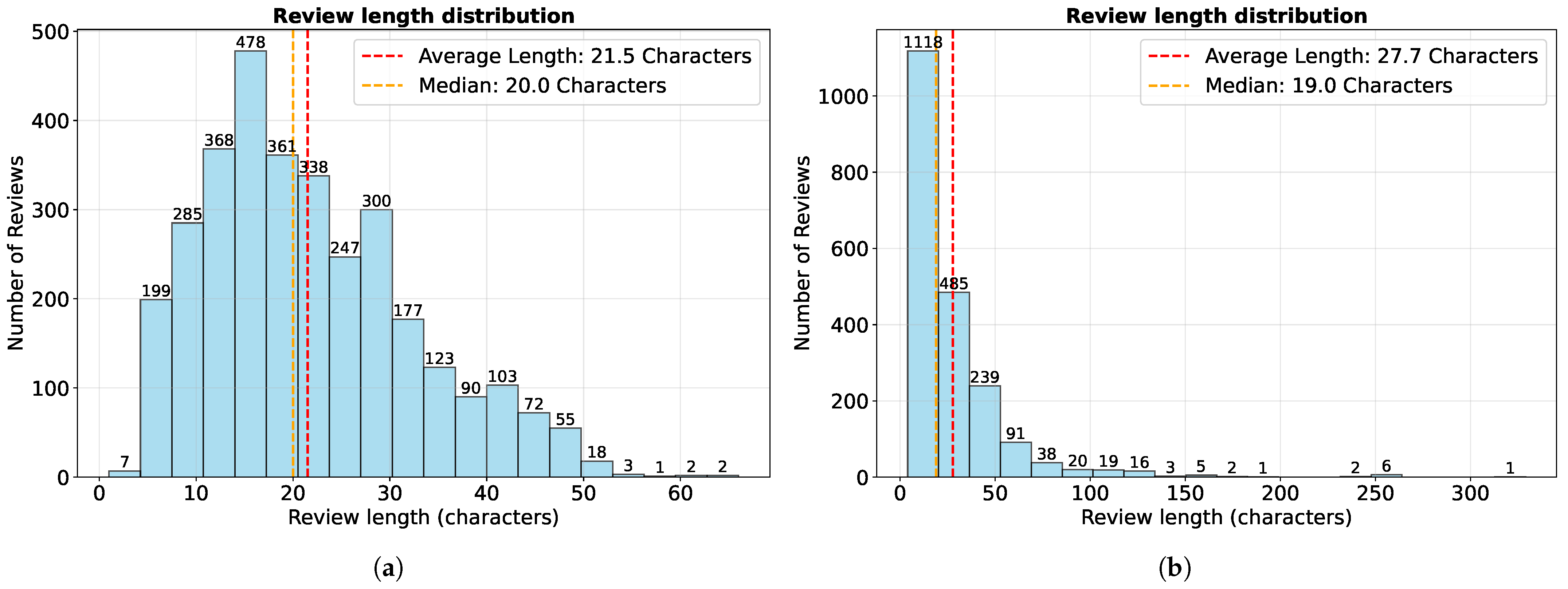
The review length distribution is shown in Figure 1. Both datasets exhibit a distinct left-skewed distribution. The cosmetics dataset has a mean length of 21.5 characters and a median of 20.0, indicating a relatively concentrated distribution. The multi-domain dataset has a higher mean length of 27.7 characters and a median of 19.0, reflecting a prevalence of short reviews alongside a small number of long-tail ones (exceeding 300 characters). This difference highlights distinct user expression habits across domains, requiring models to handle diverse text structures from concise phrases to complex descriptions.
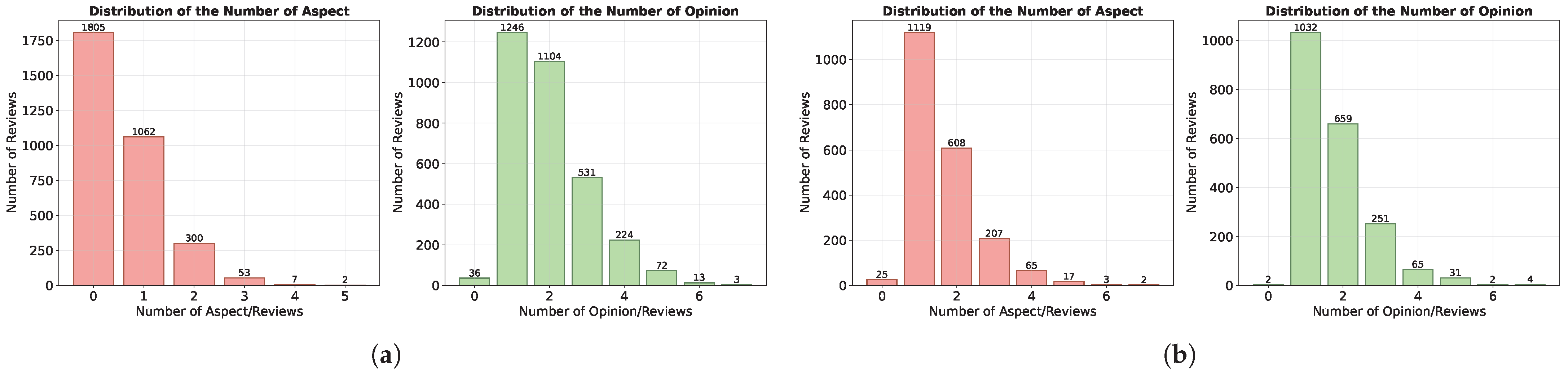
The aspect–opinion density analysis is shown in Figure 2. In the multi-domain dataset, comments containing one or two aspects account for 54.7% and 29.7%, respectively. The distribution of opinions is similar, with comments containing one or two opinions accounting for 50.4% and 29.7%, respectively. Notably, 4.9% of comments in the multi-domain dataset and 9.6% in the cosmetics dataset contain four or more opinions. This strongly validates the necessity of fine-grained aspect-level analysis over overall sentiment analysis, as users often express differentiated sentiments toward multiple product features within a single comment.
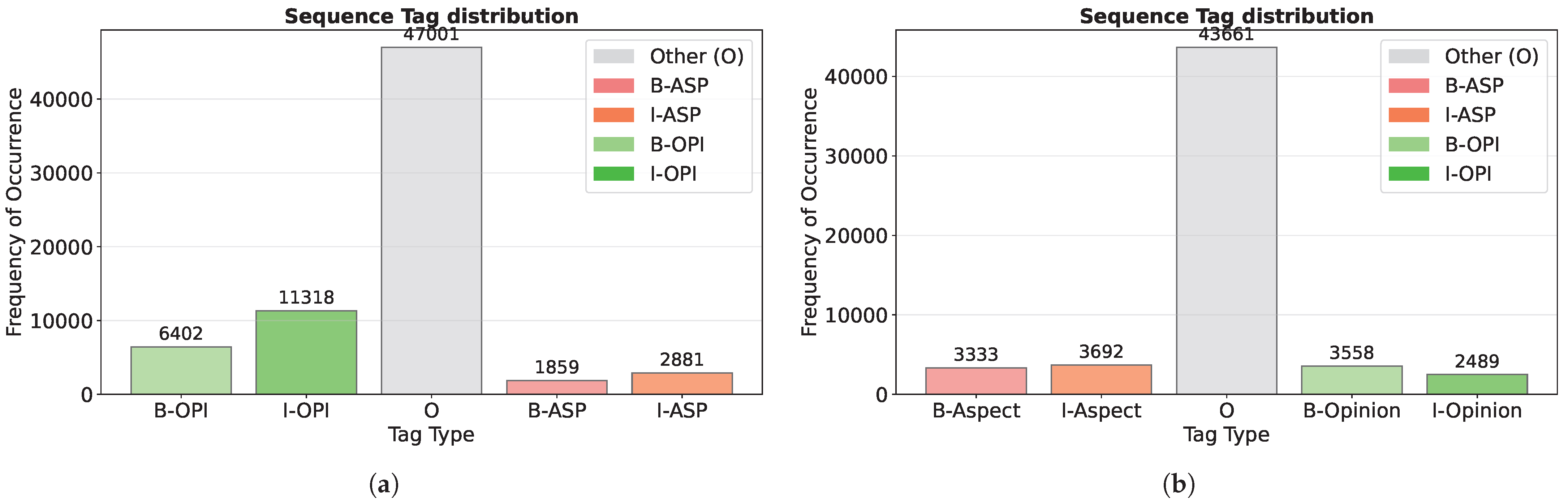
The sequence tag distribution is shown in Figure 3. Both datasets exhibit significant class imbalance. In the cosmetics dataset, the “O” (other) tag accounts for 69.5% (47,001/67,561) of tokens, while the key entity tags “B-ASP”, “I-ASP”, “B-OPI”, and “I-OPI” constitute 2.8%, 4.3%, 9.5%, and 16.7%, respectively. The multi-domain dataset shows a similar extreme distribution, with the “O” tag exceeding 70%. This severe class imbalance represents a core challenge in aspect–opinion mining, demanding that models accurately identify a small number of key entities amidst a large volume of irrelevant tokens.
The datasets used in this study combine domain specificity with scenario diversity. Their inherent variations in length distribution, aspect–opinion density, and pronounced class imbalance collectively form a realistic and challenging testbed, enabling a comprehensive and rigorous evaluation of aspect–opinion mining models.

2.3. Data Equivalence and Validity Justification

In order to ensure the validity and equivalence of the experimental data, we solve the following problems:
Annotation consistency: Both datasets use the same BIO scheme and annotation guidelines for aspects (ASP) and opinions (OPI), ensuring label space consistency across experiments. All comments are initially created by domain experts or by validated crowdsourcing protocols, and they are documented in the respective source code. To further mitigate potential annotation noise, we apply unified text preprocessing (e.g., tokenization, punctuation normalization) and exclude samples with incomplete or contradictory labels.
Statistical representation: As shown in Table 1 and Figure 1, Figure 2 and Figure 3, both datasets exhibit realistic characteristics such as skewed length distributions and variable aspect–opinion densities, which are common challenges in real-world opinion mining. Despite domain differences, these common characteristics ensure that both datasets present a meaningful and comparable challenge to the model.
Fairness of experiments: To prevent data-related artifacts from affecting the comparison, we applied the same experimental protocol to both datasets: same train/validation/test split, same evaluation metrics (e.g., accuracy, f1-score), and same preprocessing (e.g., token mapping with BERT). This ensures that any observed differences in performance can be attributed to the capabilities of the model and not to features of the dataset.

3. Methods

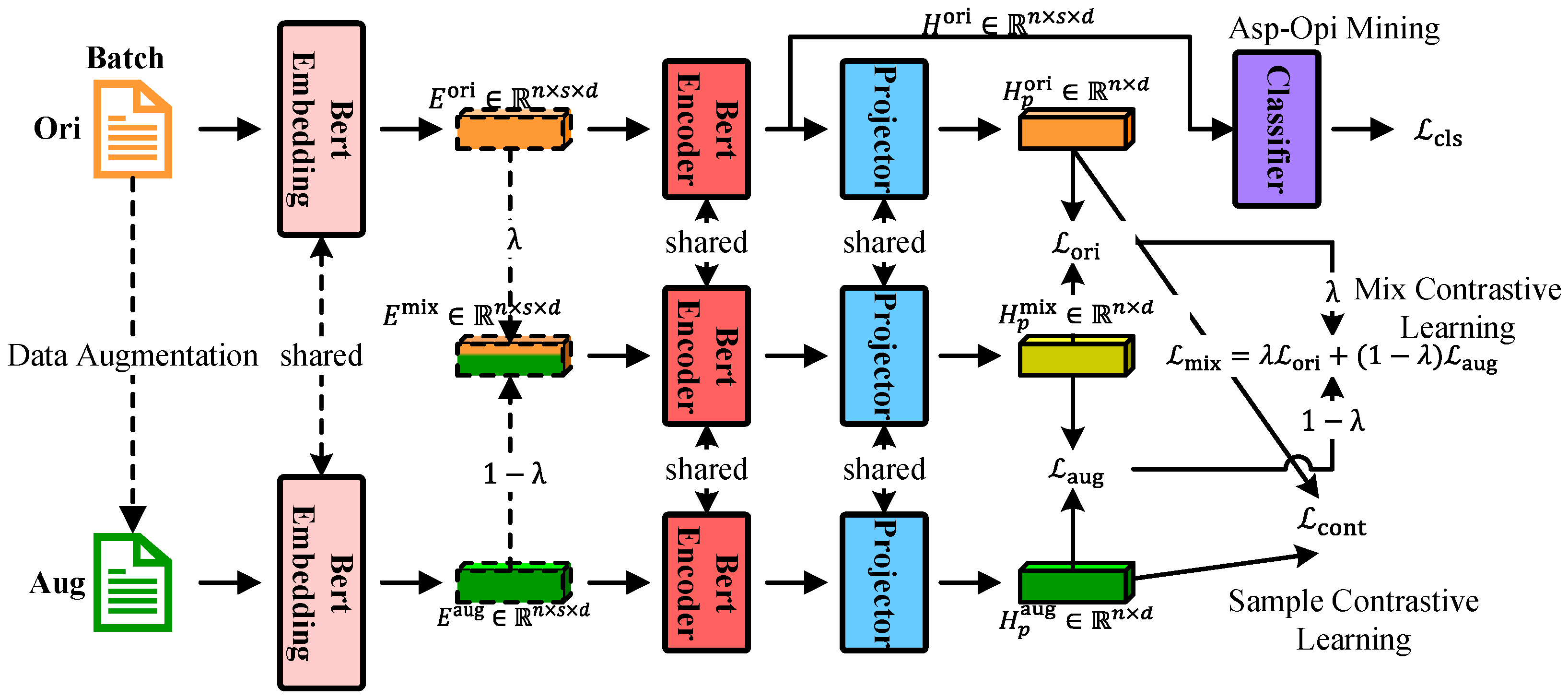
In this study, we enhance aspect–opinion mining by proposing MixContrast, a method that leverages unsupervised contrastive learning and data mixing to improve textual representation learning. The overall architecture, illustrated in Figure 4, is based on a pre-trained Chinese language model. By integrating a mixed contrastive learning and data augmentation mechanism, it achieves superior generalization performance under conditions of limited labeled data. The proposed methodology is detailed as follows.

3.1. Data Augmentation

Data augmentation benefits contrastive learning by increasing data diversity and mitigating overfitting. However, we find traditional strategies such as EDA [21], designed for general sentence embeddings, inefficient for our specific task. We observe that opinions in user reviews are often expressed through a limited set of keywords (e.g., “very good”, “not bad”). While identifying these keywords in unlabeled text is challenging, replacing non-keyword tokens with random substitutes typically does not alter the core semantic meaning significantly. For labeled data, we restrict replacement to non-keywords, thereby preserving opinion expressions and reducing noise introduced by data bias. Different from general text augmentation, our strategy specifically targets the characteristic concentration of opinion words. By preferentially replacing non-keywords, it maintains the salience of opinions, reduces the semantic influence of irrelevant words on aspect and opinion terms, and enhances the semantic fidelity of augmented samples.

3.2. Feature Embedding and Encoding

The purpose of text feature embedding is to project discrete textual tokens into a vector space for facilitating operations and learning within deep learning models. In this paper, we utilize the pre-trained Chinese language model BERT [22]. Specifically, given a mini-batch collection of input texts B a t c h = { B a t c h ori , B a t c h aug } , where ori denotes the original text set and aug denotes the data augmentation set, we first convert them into dense vector representations through BERT’s embedding layer. BERT’s embedding computation is formally expressed in Equation (1):
E b a t c h = BertEmbedding ( B a t c h ) R 2 ( n × s × d )
where E b a t c h = { E ori , E aug } denotes the embedded vector representation, where n is the batch size, s is the sequence length, and d is the hidden dimension size. We first compute a mix embedding as shown in Equation (2):
E mix = λ E ori + ( 1 λ ) shuffle E aug
where E mix denotes the mixed embedding of original samples and shuffled augmented samples, and shuffle refers to the intra-batch randomization of augmented samples. λ represents the mixing coefficient sampled from a Beta distribution. The operation in Equation (2) adopts the Manifold MixUp [23] approach, where E mix serves as a virtual sample in the vector space for mixed contrastive learning. Furthermore, E mix blends diverse semantic information, compelling the model to learn more universal patterns rather than memorizing training data characteristics, thereby serving a regularization effect. After the mixing operation, the new E b a t c h = { E ori , E aug , E mix } is input together into the BERT encoding layer for processing. The computation can be expressed as Equation (3):
H l = BertEnocder ( H l 1 )
where H l denotes the hidden state of the lth layer (the total of 12 layers), and H 0 = E b a t c h .
After obtaining the output from the BERT encoder, we compute two components: one utilizes the last hidden state H l a s t R n × s × d from BERT to calculate the text’s aspect–opinion words. It employs an average pooling strategy to obtain the overall representation of the text, which is used for mix contrastive learning. Specifically, given the encoder output H last = { H ori , H ori , H ori } , the pooling process can be expressed as Equations (4) and (5):
H pool = H last max i = 1 s w i , 1
w i = 1 if j = 1 d H b , i , j last > 10 8 0 else
where H pool = { H p ori , H p aug , H p mix } R 3 ( n × d ) represents the pooled hidden state, and w denotes the effective length of each sequence in the batch (where effective positions are defined as the sum of absolute non-zero feature values, with a minimum length of 1).

3.3. Mix Contrastive Learning

Mix Contrastive Learning, our core innovation, enhances contrastive learning’s representational power via data mixing techniques. The essence of contrastive learning [24,25] lies in pulling positive pairs closer together in feature space while pushing negative pairs farther apart. Traditional contrastive learning typically constructs positive–negative pairs only between original and augmented samples. This paper introduces mixed samples as intermediate transitional states, compelling the model to learn a smoother and more robust representation space. This approach effectively mitigates overfitting on discrete sample pairs and enhances the model’s generalization capabilities in complex semantic scenarios.
Specifically, we first designed a projection network f projector to map the pooled hidden state H pool = { H p ori , H p aug , H p mix } to the contrastive learning space. The projection network consists of two fully connected layers, utilizing the GELU activation function and Dropout regularization in between, as shown in Equation (6):
z = f projector ( H pool ) = W 2 · Dropout ( GELU ( W 1 · H pool + b 1 ) ) + b 2
where z = { z o r i , z a u g , z m i x } , W 1 R d × d , W 2 R d × d are projection weight matrices, and b 1 and b 2 are projection biases. In mix contrastive learning, the mix representation z m i x fuses multi-view semantic information from both original samples and shuffled augmented samples. To this end, we design a multi-view mix contrastive learning. Specifically, for a mix sample representation set of batch size n, the positive P pos i and negative P pos i sample pairs for the i-th mix sample are defined as shown in Equations (7) and (8):
z pos i ( z mix i , z ori i ) ( z mix i , z aug i )
z neg i ( z mix i , z ori j ) , i j i , j { 1 , 2 , . . . , n } ( z mix i , z aug j )
The similarity calculation for positive and negative sample pairs is shown in Equations (9) and (10):
sim o r i + i = z m i x i · ( z o r i i ) T , sim a u g + i = z m i x i · ( z a u g i ) T
sim o r i i , j = z m i x i · ( z o r i j ) T , sim a u g i , j = z m i x i · ( z a u g j ) T , i j
where sim o r i + i and sim a u g + i denote the similarity between the i-th mixed sample and the two positive samples, respectively. sim o r i i , j and sim a u g i , j denote the similarity between the i-th mixed sample and the two negative samples, respectively. Subsequently, we construct the similarity matrix l o g i t s i as shown in Equations (11) and (12):
l o g i t s ori i = [ s i m ori + i , s i m ori i , 1 , s i m ori i , 2 , . . . , s i m ori i , n 1 ] R n
l o g i t s aug i = [ s i m aug + i , s i m aug i , 1 , s i m aug i , 2 , . . . , s i m aug i , n 1 ] R n
Finally, we obtain the mixture contrastive learning loss through the cross-entropy (CE) loss function and the mixture coefficient λ , as shown in Equation (13):
L mix = λ 1 n i = 1 n C E ( l o g i t s ori i τ , y ori i ) + ( 1 λ ) 1 n i = 1 n C E ( l o g i t s aug i τ , y aug i )
where y ori i = 0 and y aug i = 0 denote positive samples located at the first position, with τ = 0.7 serving as the temperature hyperparameter. This approach enhances robustness against noise and perturbations by introducing mixed-sample regularization within a contrastive learning framework, enabling the model to learn discriminative capabilities in a continuous semantic space. Finally, to ensure unsupervised semantic learning on original samples, we maintain a conventional sample-level contrastive learning. For a dataset of batch size n, the positive sample pair is ( z ori i , z aug i ) , and the negative sample pair is ( z ori i , z ori j ) . Similar to Equations (7) and (8), we obtain the similarity scores s i m pos i and sim neg i , j , j for positive and negative samples, respectively, along with the similarity matrix l o g i t s i . Consequently, the sample-level contrastive learning loss is computed as shown in Equation (14):
L sam = 1 n i = 1 n C E ( l o g i t s i τ , y sam i )
where y sam i = 0 denote positive samples located at the first position.

3.4. Aspect–Opinion Mining and Model Optimization

Earlier, we computed the optimization objective L mix for mixed contrastive learning and the sample-level contrastive learning objective L sam . For aspect–opinion mining, we employ a simple fully connected layer classifier to extract opinion words and attributes. This process resembles token-level classification, as shown in Equation (15):
l o g i t s cls = C l a s s i f i e r ( H l last ) R n × s × m
where m denotes the number of categories. Finally, we compute the optimization objective L cls for aspect–opinion mining using cross-entropy loss, as shown in Equation (16):
L cls = 1 n i = 1 n C E ( l o g i t s cls i τ , Y i )
where Y is the true label of the sample. Therefore, the overall optimization objective of the model is
L total = L cls + α L mix + β L sam
In the implementation, α = 0.7 and β = 0.5 . These hyperparameters were determined experimentally to balance the contributions of different loss terms.

4. Theoretical Analysis

The core of the MixContrast method proposed in this paper lies in constructing a continuous and smooth semantic representation space through mixed samples, thereby addressing the issues of noise interference and distribution skew present in real review data. The following two theoretical properties elucidate why this method enhances the model’s robustness and generalization capability.
Theorem 1
(Lipschitz Continuity of Mixed Representations Guarantees Semantic Smoothness). Let the original sample embedding be E ori , the augmented sample embedding be E aug , and the mixed sample embedding be E mix = λ E ori + ( 1 λ ) E aug , where λ is sampled from a Beta distribution. If the feature mapping function f : R d R p is Lipschitz continuous, then there exists a constant L > 0 such that:
f ( E mix ) f ( E ori ) 2 L ( 1 λ ) E aug E ori 2
Proof. 
By the definition of Lipschitz continuous [26], there exists a constant L > 0 such that
f ( E mix ) f ( E ori ) 2 L E mix E ori 2
substituting the mixed representation defined as E mix = λ E ori + ( 1 λ ) E aug into Equation (19) yields
E mix E ori 2 = λ E ori + ( 1 λ ) E aug E ori 2
= ( 1 λ ) E aug E ori 2
Therefore, substituting Equation (21) into Equation (18) holds true. This property ensures that the distance between the mixed sample and the original sample in the feature space is controlled. This implies that the semantic changes induced by the perturbations applied to the input (introduced through data augmentation) are smooth and finite, rather than abrupt. When confronted with review variations in user reviews, such as phrasing variations, noise insertion, or synonym substitutions, this continuity in the semantic space prevents the model from overreacting to minor input changes. This directly enhances the model’s robustness in real-world noisy scenarios. This addresses the issue of existing aspect–opinion mining models being sensitive to data noise, which degrades their generalization performance. □
Proposition 1
(Gradient Decomposition Reveals Adaptive Regularization Mechanisms). The gradient of the mixed contrast loss L mix with respect to the mixed representation z mix can be decomposed into a weighted combination of the original and augmented views:
z mix L mix = λ z mix L ori + ( 1 λ ) z mix L aug
where L ori = 1 n i = 1 n C E l o g i t s ori i τ , y ori i , L aug = 1 n i = 1 n C E l o g i t s aug i τ , y aug i in Equation (22).
Proof. 
The mixed contrastive learning loss is defined as
L mix = λ L ori + ( 1 λ ) L aug
Taking the derivative of Equation (23) with respect to z mix yields
z mix L mix = z mix [ λ L ori + ( 1 λ ) L aug ] = λ z mix L ori + ( 1 λ ) z mix L aug
This gradient decomposition property reveals the core optimization mechanism of MixContrast. The optimization process avoids merely fitting a single data source; instead, it adaptively balances core semantic features from the original data with diverse patterns from augmented data via the mixing coefficient λ . From an optimization perspective, this process functions as an adaptive regularization [27]. It compels the model to account for both the intrinsic data characteristics and their potential variant forms during parameter updates, thereby preventing overfitting to incidental noise or specific training set expressions. In representation learning, this mechanism ensures the learned features are both discriminative for original semantics and invariant to semantic-preserving perturbations [28]. This enhances the model’s generalization capability on unseen data or data with different distributions, thereby improving its domain adaptability. □

5. Experiments

5.1. Baselines

BERT-NER: A robust baseline that fine-tunes BERT for the Named Entity Recognition (NER) task on our datasets. The code of BERT-NER is available from https://github.com/xmxoxo/Text-Opinion-Mining (accessed on 30 October 2025). BERT-BiLSTM-CRF [29]: A classic sequence labeling model that combines BERT, a Bidirectional LSTM (BiLSTM), and a Conditional Random Field (CRF) layer into a powerful architecture for extraction tasks. KNN-NER [30]: A k-nearest neighbor-based NER framework that enhances label distribution by leveraging the k nearest neighbors retrieved from the training set. This strategy improves the model’s ability to handle long-tail cases and boosts few-shot learning performance. W2NER [31]: This model formulates unified NER as a word-to-word relation classification task. It effectively captures the proximity relationships between entity words using neighbor–word and head–tail relations, addressing a core bottleneck in unified named entity recognition. TNCSE-NER [32]: This method optimizes contrastive learning by constraining the modular length features between positive samples, integrating a tensor norm-constrained training objective with ensemble learning techniques. For a fair comparison, all baseline models use BERT as their backbone encoder.

5.2. Details of Experimental Parameters

All models were implemented using the PyTorch framework (version 2.0.1). The download link for the pre-trained weights of the BERT version we use is https://huggingface.co/bert-base-chinese (accessed on 30 October 2025). The BERT encoder was fine-tuned with a learning rate of 1 × 10 5 , while other trainable parameters used a learning rate of 1 × 10 3 . Training was conducted for a maximum of 1000 epochs, with early stopping triggered if performance on the validation set did not improve for 20 consecutive epochs. In MixContrast, the Projector is a multi-layer perceptron consisting of two fully connected layers interleaved with a Dropout layer and a GELU activation function, with both its input and output dimensions set to 768. The final classifier for aspect–opinion mining is a single linear layer. The batch size was set to 50 for training and 100 for validation and testing. We employ a cross-validation strategy where the training, validation, and test sets are strictly disjoint. The validation set is a held-out subset of the test data, and it is not used during the final inference phase. For data partitioning, 100 samples were randomly selected as the training set, with the remaining data constituting the test set. To evaluate performance, we used standard metrics for sequence labeling: Accuracy (Equation (25)), Recall (Equation (26)), Precision (Equation (27)), and the F1-score (Equation (28)) calculated separately for aspect (ASP) and opinion (OPI) extraction. The metrics are defined as follows:
A c c u r a c y = T P + T N T P + T N + F P + F N
R e c a l l = T P T P + F N
P r e c i s i o n = T P T P + F P
F 1 - s c o r e = 2 × ( R e c a l l P r e c i s i o n ) R e c a l l + P r e c i s i o n
where T P denotes true positives (correctly predicted entities), T N denotes true negatives, F P denotes false positives, and F N denotes false negatives. We adopted the BIO tagging scheme and used strict exact match criteria for evaluation: a predicted entity is considered correct only if its span (start and end indices) and its type (ASP or OPI) both match a ground truth entity. To prevent metrics from being inflated by the dominant “O” (non-entity) class, we calculate metrics solely for the aspect and opinion classes. All experiments were performed on a server equipped with an NVIDIA RTX 4090 GPU (24GB VRAM).

5.3. Baseline Comparison Results and Discussion

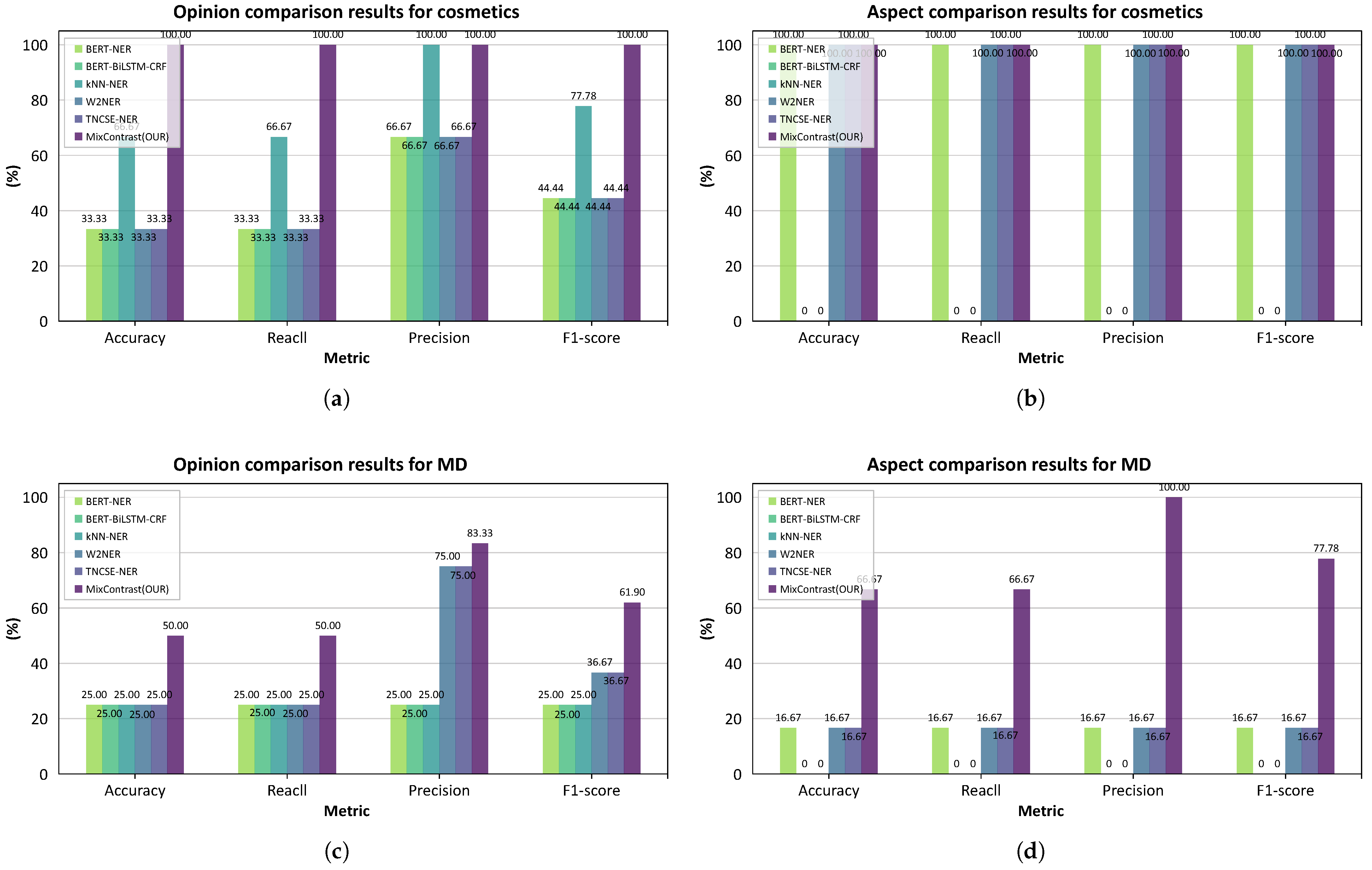
Figure 5 presents the basic metric comparison results, demonstrating that our proposed MixContrast method achieves significant and consistent advantages in both aspect–opinion extraction tasks across the two datasets. This performance superiority originates from fundamental methodological innovations, which we analyze as follows.
On the cosmetics dataset (Figure 5a,b), our method attains perfect scores across all metrics for both tasks. On the more challenging multi-domain dataset (Figure 5c,d), MixContrast achieves leading F1-scores of 61.9% for opinion mining and 77.78% for aspect extraction. Notably, this leading performance is obtained with only 100 labeled training samples, highlighting its exceptional data efficiency in few-shot scenarios. MixContrast’s superiority stems from its unique design that directly addresses core challenges in real-world opinion mining: (1) Poor Robustness to Noise and Variation. Traditional sequence-labeling models such as BERT-BiLSTM-CRF tend to overfit to surface patterns in limited training data and are sensitive to linguistic variations in unseen domains. In contrast, MixContrast’s core mechanism—constructing a continuous semantic space via mixed samples (Section 3.3)—acts as a strong regularizer. By learning to pull a mixed sample and its source samples closer in the representation space, the model captures smoother, more generalizable semantic features rather than memorizing specific expressions. (2) Limited Domain Adaptability. The inconsistent performance of methods like kNN-NER and W2NER across datasets reveals their dependency on domain-specific feature distributions. While TNCSE-NER also employs contrastive learning, it fails under multi-domain conditions because its contrastive objective lacks explicit mechanisms to bridge disparate domains. The outstanding performance of our method on the cosmetics dataset is largely due to the high annotation quality and relatively consistent language within that domain, enabling effective learning from limited data.
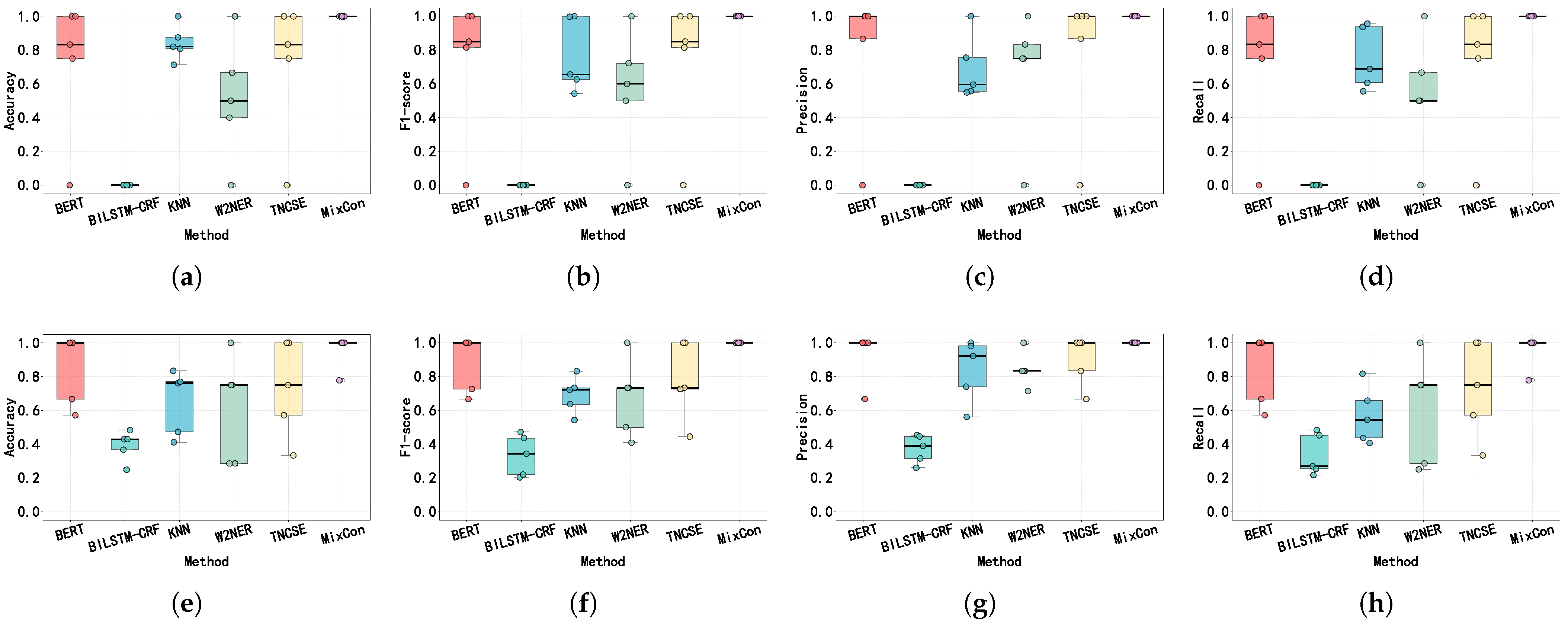
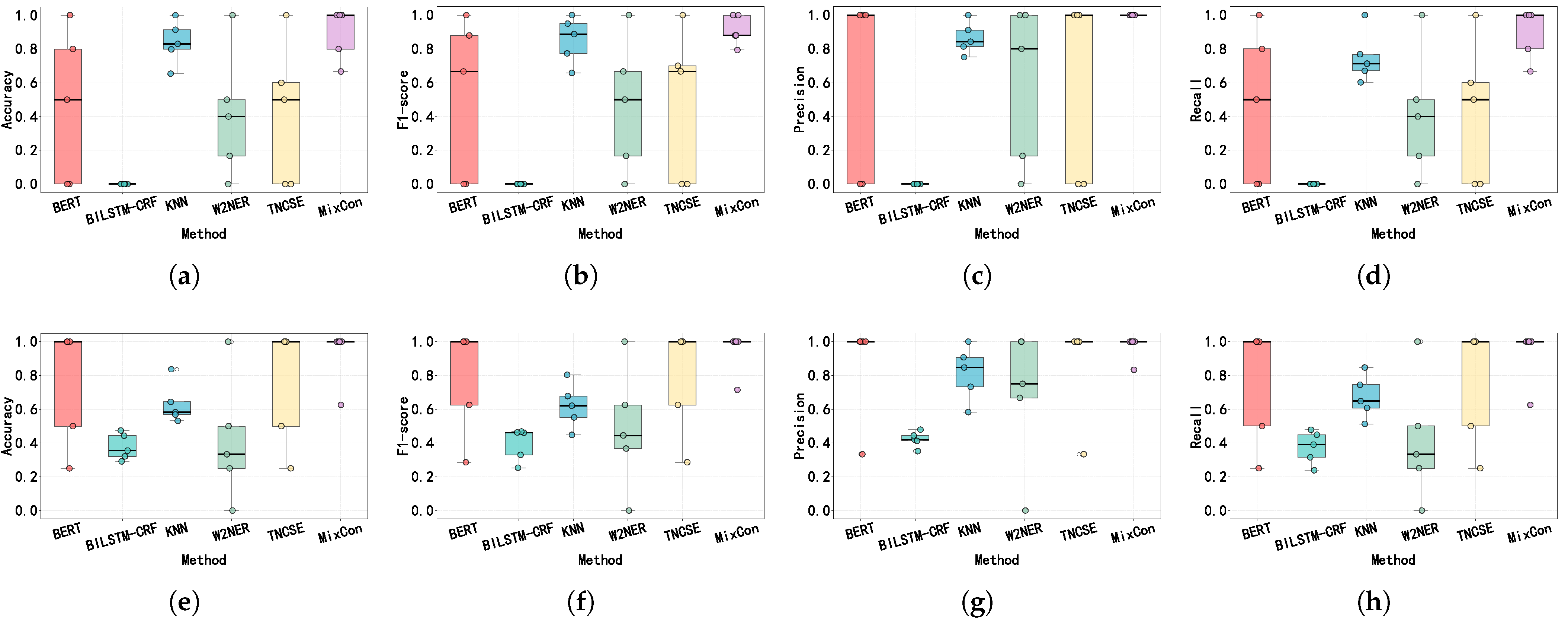
To verify the method’s stability, we run experiments with five random seeds and examine the result variations. The aspect extraction results on the cosmetics (Figure 6) and multi-domain (Figure 7) datasets, along with the fluctuations in Accuracy, F1-score, Precision, and Recall for opinion mining, assess whether the methods yield stable outcomes across different seeds. As shown in Figure 6 and Figure 7, the box-plot dispersion of MixContrast is consistently smaller than that of BERT, BiLSTM-CRF, KNN, and other compared methods across all metrics and both tasks, indicating lower sensitivity to random seeds and better stability. Moreover, MixContrast does not sacrifice performance for stability; it remains competitive on all metrics, proving its reliability and effectiveness in aspect and opinion mining tasks. These results underscore the solid stability of the proposed method.
Thus, MixContrast is not only superior in metrics but also fundamentally more robust and generalizable. This technical advantage translates directly into practical business value: its precision-oriented mining enables deep, actionable insights into specific attributes, while its cross-domain robustness supports reliable deployment in diverse scenarios such as product testing and competitive analysis. Compared to manual approaches, it facilitates real-time, fine-grained analysis of large-scale feedback, allowing businesses to align strategic adjustments symmetrically with customer voice, thereby reducing decision latency and securing a competitive edge.

5.4. Analysis for Aspect-Opinion Mining

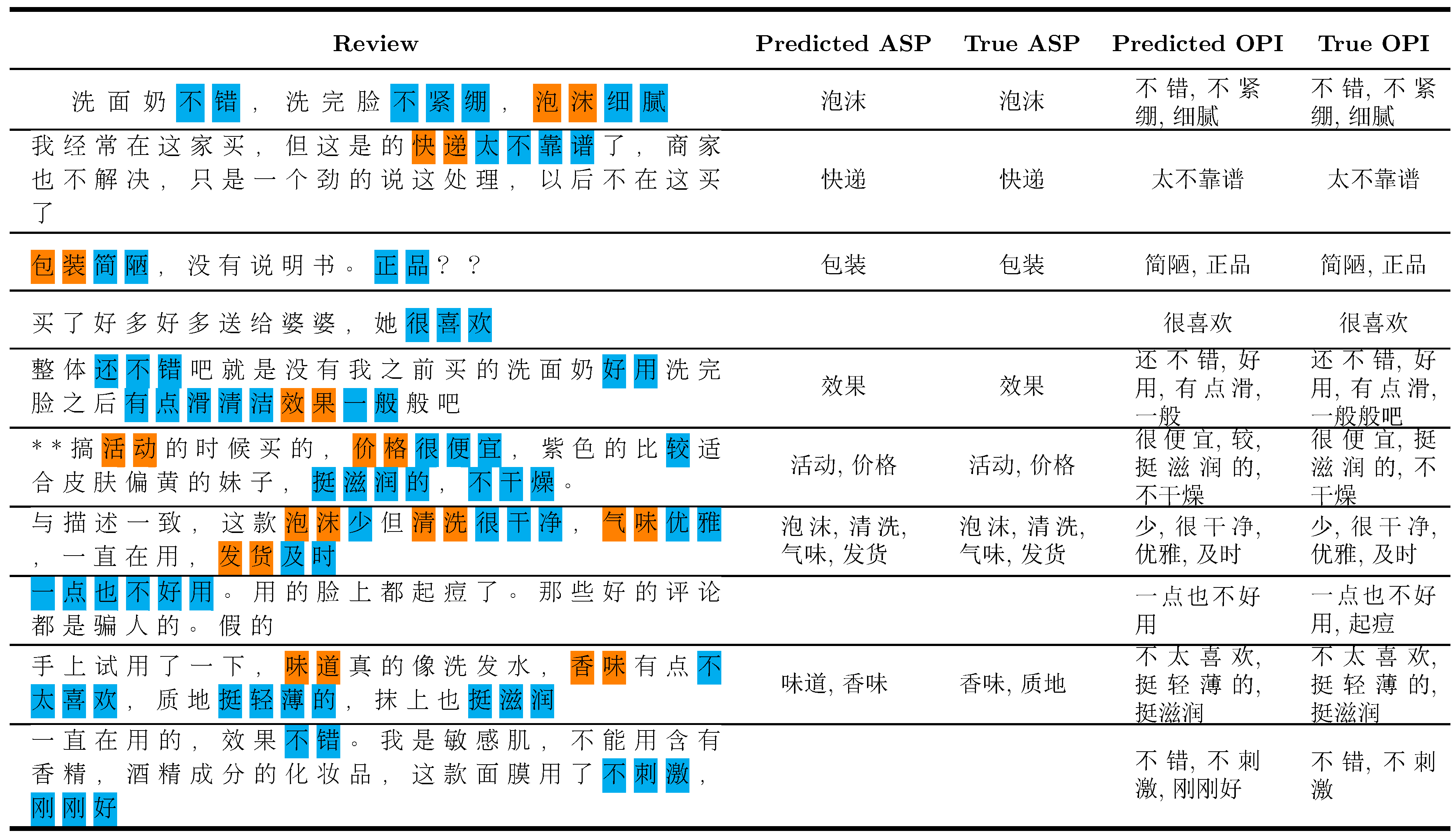
Figure 8 visualizes the proposed method’s predictions on real review data, illustrating its performance in fine-grained opinion mining and practical application value. The prediction results demonstrate that the model accurately identifies product aspects (ASP) and their corresponding opinion expressions (OPI) in most cases. For instance, in reviews related to “洗面奶” (facial cleanser) the model correctly identifies “泡沫” (foam) as the product aspect and accurately associates it with positive evaluations such as “不错” (not bad), “不紧绷” (not tight) and “细腻” (delicate). In complaints about delivery services, the model correctly extracts “快递” (delivery) as an aspect and “太不靠谱” (too unreliable) as a negative opinion. This demonstrates that the proposed mix contrastive learning mechanism effectively enhances the model’s semantic understanding in real-world scenarios, exhibiting strong robustness when processing colloquial, multi-featured user reviews.
This fine-grained, high-accuracy aspect–opinion mining capability revolutionizes insights and product management. Taking “包装简陋” (packaging crude) and “快递问题” (delivery issue) from the example, the model not only identifies negative feedback but precisely pinpoints the specific problem areas. This enables businesses to respond swiftly and implement targeted improvements, rather than remaining at the vague level of “low satisfaction” as traditional methods do. Simultaneously, the model’s precise capture of key attributes like “敏感肌” (sensitive skin) and “不刺激” (non-stinging) provides data support for customer segmentation and targeted marketing, making product positioning and market communication more precise and effective.

5.5. Ablation Studies

The experimental results of the ablation study are shown in Table 2. We can clearly observe the contribution of each component in the mixed contrast learning framework to the model’s performance. In the cosmetics domain, the complete model (MixContrast) achieves 100% performance metrics on both opinion and aspect extraction tasks, demonstrating outstanding extraction capabilities. When the mixed contrast learning component is removed (w/o MixCon), the F1-score for opinion mining drops significantly from 100% to 44.44%. On multi-domain datasets, the F1-score for aspect extraction also declines from 77.78% to 22.22%. This indicates that the mixed contrast learning mechanism plays a crucial role in enhancing the model’s fine-grained semantic understanding capabilities. Further removal of the unsupervised sample-level contrastive learning component (w/o Con) also caused performance degradation, with the F1-score for opinion mining on the cosmetics dataset dropping to 77.78%. This demonstrates that sample-level contrastive learning holds certain value in enhancing the model’s learning aspects. When all contrastive learning components were completely removed (w/o All), the model reverted to the baseline BERT-NER architecture. On multi-domain datasets, its F1-score for opinion extraction remained at only 25.00%, and its aspect extraction performance plummeted to 0%. This fully validates the synergistic effects among the components of our proposed mix contrastive learning framework.

5.6. Aspect-Opinion Mining to Enhance Management Analysis Research

This section demonstrates the potential of artificial intelligence to enhance enterprise management through fine-grained analytics. By analyzing user reviews, we not only derive quantitative evaluations across product dimensions but also establish a data-driven pathway from user feedback to management decision-support—a process that embodies a symmetry between data insight and actionable strategy. The experiments below present a straightforward management-analytics application, with all results generated by the proposed MixContrast model.
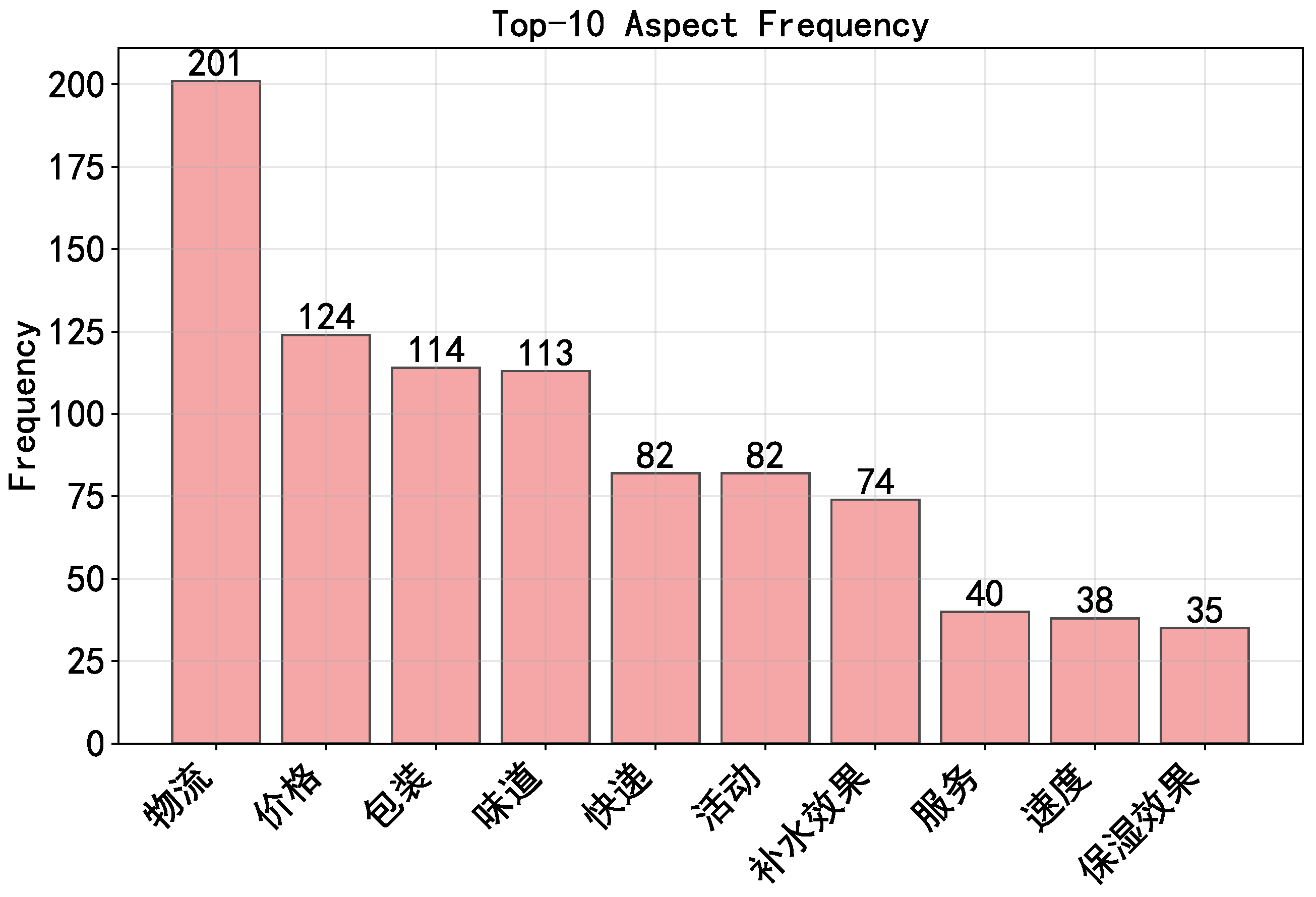
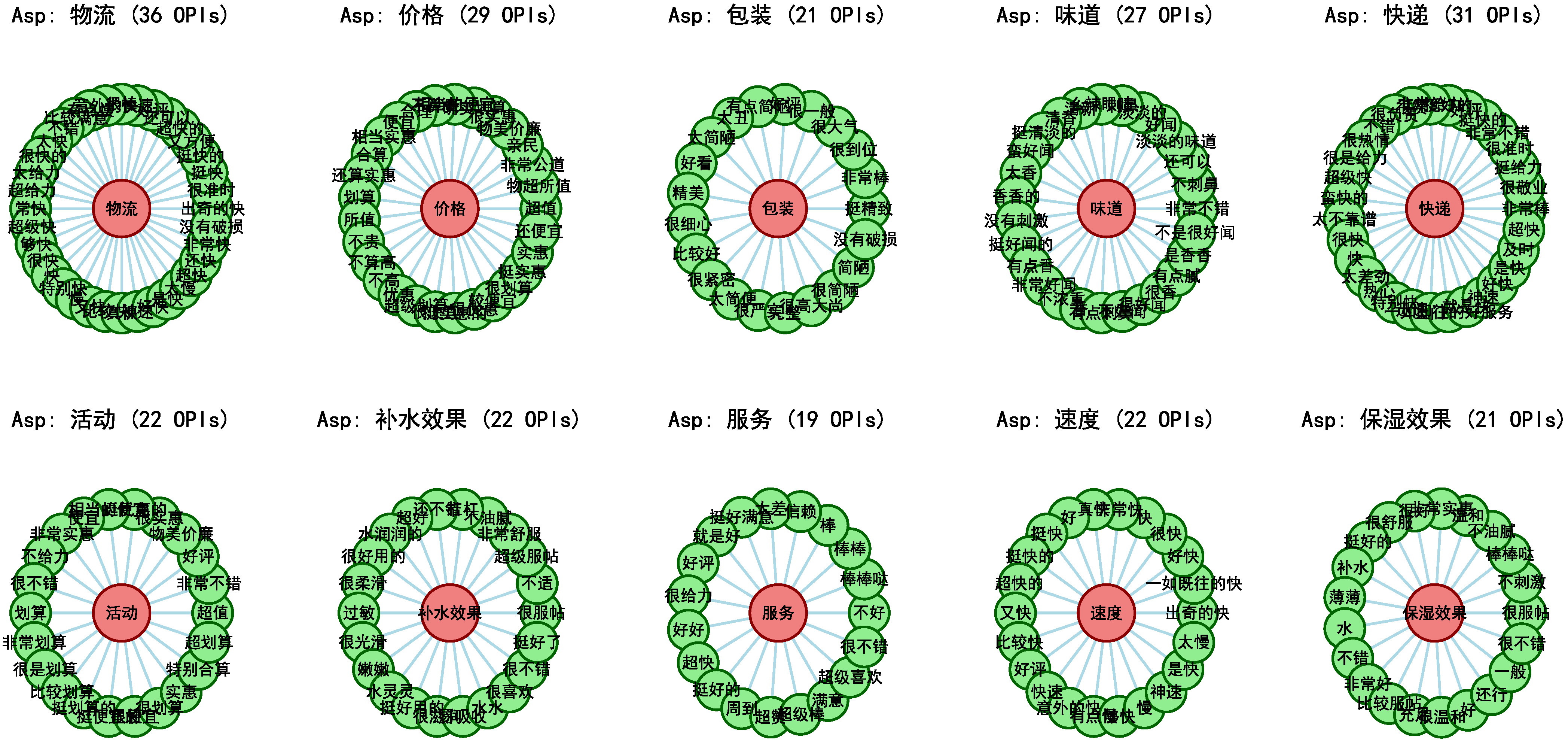
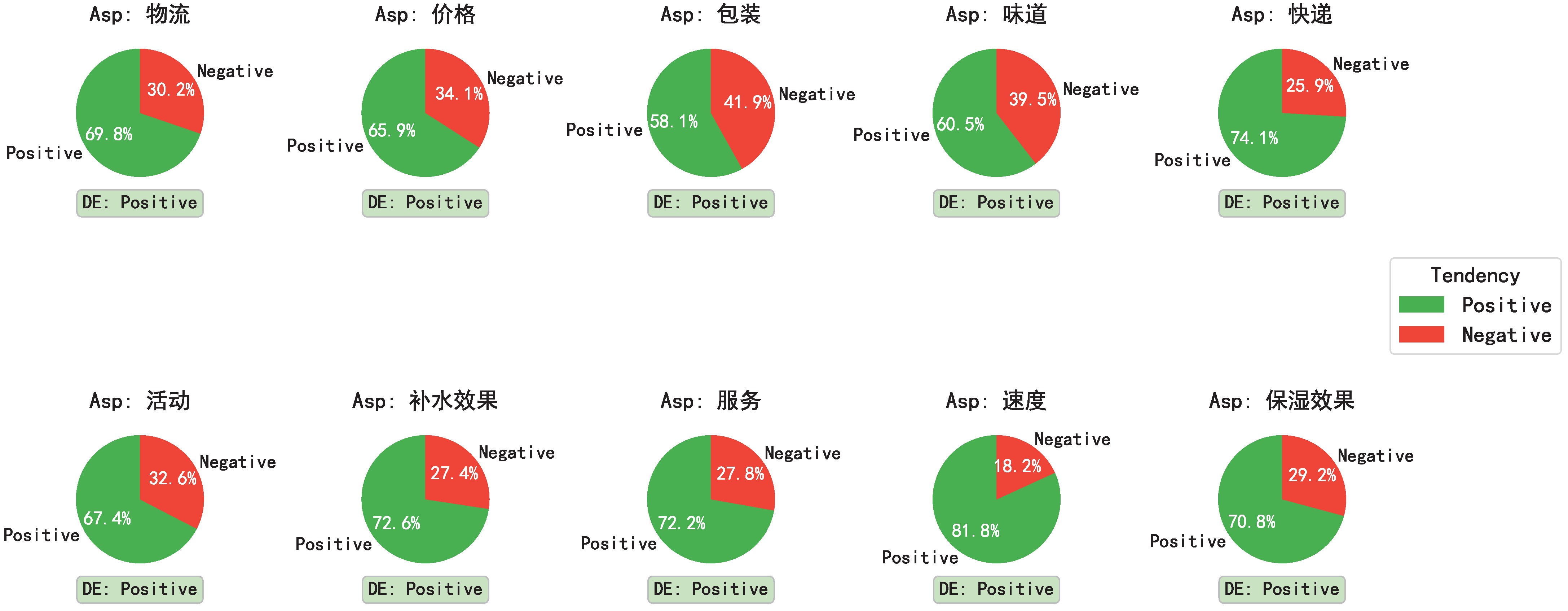
We implement a clear analytical logic (all quantitative results are based on MixContrast predictions) that reflects a symmetrical structure: First, extract aspect--opinion pairs from reviews. Then, rank aspects by the frequency of associated reviews (top 10 shown in Figure 9). Next, for each aspect, present the corresponding user opinions (Figure 10). Final, analyze the sentiment orientation (positive/negative) of opinions for each aspect (Figure 11).
This visualization framework symmetrically maps user voice to managerial insight, giving decision-makers a clear view of specific opinions and sentiment tendencies for every key aspect. The analysis reveals that user attention focuses primarily on core elements such as “物流” (logistics), “价格” (price), “包装” (packaging), “味道” (taste), and “快递” (delivery) (Figure 9). These aspects map directly to critical operational segments, reflecting a symmetry between user concerns and core business processes. Logistics, the most frequently mentioned aspect and the final link between enterprise and consumer, directly influences purchase experience and satisfaction, offering key insights for supply-chain optimization. Furthermore, Figure 11 shows that although logistics receives substantial attention, most associated opinions are positive. This indicates a relative symmetry between user expectations and current service performance, though specific issues in negative feedback still warrant attention. Packaging, closely related to logistics, also ranks high in concern but carries a relatively higher proportion of negative opinions, suggesting an asymmetry between user expectations and the current packaging experience. Correlation analysis between these two aspects gives enterprises a symmetrically clear direction for optimizing the entire logistics-and-delivery process.
The results have meaningful implications for enterprise operations: Supply-chain management: Enterprises can elevate logistics services to a strategic level, using user feedback to monitor and maintain symmetry between service quality and user perception. Customer-relationship management: Real-time sentiment analysis of evaluations enables timely issue identification and resolution, promoting a symmetrical balance between customer experience and operational response.
This research illustrates a paradigm for integrating artificial intelligence with business administration. Its unique value lies in automatically identifying key management dimensions from large-scale user reviews while providing quantifiable metrics for each dimension, a process that ensures symmetry between data extraction and managerial evaluation. Compared with traditional methods, this analysis based on authentic user feedback offers greater timeliness and authenticity, allowing enterprises to build dynamic, data-driven optimization mechanisms grounded in a symmetrical and real-world insight loop.

6. Conclusions

This study proposes the mix contrastive learning framework MixContrast, effectively addressing the core challenge of insufficient generalization capability in fine-grained aspect–opinion mining under noisy data. For RQ1, we constructed an aspect–opinion mining model integrating data augmentation, mixed embedding, and contrastive learning. By introducing mixed samples to build a continuous semantic space, the model’s ability to extract product aspects and corresponding opinions was significantly enhanced. Experimental results demonstrate that this method achieves state-of-the-art performance on both cosmetics and multi-domain datasets, particularly excelling in fine-grained semantic understanding. This validates the model’s effectiveness in automatically and accurately extracting aspect–opinion pairs from unstructured reviews. Regarding RQ2, this study reveals the profound significance of the proposed model in business management practice. Compared to traditional evaluation and opinion management approaches, the MixContrast model offers enterprises innovative strategic recommendations across three dimensions: Product Optimization: Precise aspect–opinion analysis enables enterprises to pinpoint specific improvement directions. Service Enhancement: Analysis of user evaluations on critical aspects like logistics and packaging provides effective support for operational optimization. Marketing Decisions: Fine-grained user preference mining offers new perspectives for precision marketing.
This research bridges aspect–opinion mining technology and business management practice, validating the proposed method’s technical advantages and its potential to advance enterprise precision management and data-driven decision-making via a symmetrically integrated framework. Future work will explore intelligent mechanisms to convert mining results into automated management recommendations, deepening AI’s enabling value in optimizing corporate operations via a closed-loop, symmetrical analysis-action system.

Author Contributions

Conceptualization, T.Z. and K.X.; Methodology, T.Z. and K.X.; Validation, T.Z.; Formal analysis, T.Z.; Investigation, T.Z. and X.C.; Resources, T.Z. and K.X.; Writing—original draft, T.Z.; Writing—review and editing, T.Z. and X.C.; Visualization, T.Z.; Supervision, T.Z., K.X. and X.C.; Project administration, T.Z. All authors have read and agreed to the published version of the manuscript.

Funding

This work was supported by the Research Association of the Third-Line Construction in Sichuan Province (Grant number: SXJS202324).

Data Availability Statement

All used data are available on request from the author.

Conflicts of Interest

The authors declare no conflicts of interest.

References

  1. Munagandla, V.B.; Dandyala, S.S.V.; Vadde, B.C. Improving Educational Outcomes Through Data-Driven Decision-Making. Int. J. Adv. Eng. Technol. Innov. 2024, 3, 698–718. [Google Scholar]
  2. Cristofaro, M.; Giardino, P.L.; Barboni, L. Growth hacking: A scientific approach for data-driven decision making. J. Bus. Res. 2025, 186, 115030. [Google Scholar] [CrossRef]
  3. Thiede, M.; Fuerstenau, D.; Bezerra Barquet, A.P. How is process mining technology used by organizations? A systematic literature review of empirical studies. Bus. Process Manag. J. 2018, 24, 900–922. [Google Scholar] [CrossRef]
  4. Li, M.; Lau, J.H.; Hovy, E.; Lapata, M. Decomposed Opinion Summarization with Verified Aspect-Aware Modules. In Proceedings of the Findings of the Association for Computational Linguistics, Vienna, Austria, 27 July–1 August 2025; pp. 24805–24841. [Google Scholar]
  5. Fan, R.; Li, S.; He, T.; Liu, Y. Aspect-Based Sentiment Analysis with Syntax-Opinion-Sentiment Reasoning Chain. In Proceedings of the 31st International Conference on Computational Linguistics, Abu Dhabi, United Arab Emirates, 19–24 January 2025; pp. 3123–3137. [Google Scholar]
  6. Bacharach, S.B. Organizational theories: Some criteria for evaluation. Acad. Manag. Rev. 1989, 14, 496–515. [Google Scholar] [CrossRef]
  7. De Brandt, K.; Wylleman, P.; Torregrossa, M.; Schipper-Van Veldhoven, N.; Minelli, D.; Defruyt, S.; De Knop, P. Exploring the factor structure of the Dual Career Competency Questionnaire for Athletes in European pupil-and student-athletes. Int. J. Sport Exerc. Psychol. 2025, 23, i–xviii. [Google Scholar] [CrossRef]
  8. Geampana, A.; Perrotta, M. Using interview excerpts to facilitate focus group discussion. Qual. Res. 2025, 25, 130–146. [Google Scholar] [CrossRef] [PubMed]
  9. Ram, S.; Ram, S. Validation of expert systems for innovation management: Issues, methodology, and empirical assessment. J. Prod. Innov. Manag. 1996, 13, 53–68. [Google Scholar] [CrossRef]
  10. Zhao, Y.; Kou, G.; Peng, Y.; Chen, Y. Understanding influence power of opinion leaders in e-commerce networks: An opinion dynamics theory perspective. Inf. Sci. 2018, 426, 131–147. [Google Scholar] [CrossRef]
  11. Perrin, A.J.; McFarland, K. Social theory and public opinion. Annu. Rev. Sociol. 2011, 37, 87–107. [Google Scholar] [CrossRef]
  12. Yang, S.; Du, Y.; Zheng, X.; Li, X.; Chen, X.; Li, Y.; Xie, C. Few-shot intent detection with self-supervised pretraining and prototype-aware attention. Pattern Recognit. 2024, 155, 110641. [Google Scholar] [CrossRef]
  13. Yang, S.; Du, Y.; Liu, J.; Li, X.; Chen, X.; Gao, H.; Xie, C.; Li, Y. Few-shot multi-domain text intent classification with Dynamic Balance Domain Adaptation Meta-learning. Expert Syst. Appl. 2024, 255, 124429. [Google Scholar] [CrossRef]
  14. Almukhalfi, H.; Noor, A.; Noor, T.H. Traffic management approaches using machine learning and deep learning techniques: A survey. Eng. Appl. Artif. Intell. 2024, 133, 108147. [Google Scholar] [CrossRef]
  15. Kong, Y.; Wang, H.; Wang, Z. MTAOS: Aspect-Level Opinion Summarization with Opinion Phrase Masking. In Proceedings of the Advanced Intelligent Computing Technology and Applications—21st International Conference, Ningbo, China, 26–29 July 2025; pp. 89–100. [Google Scholar]
  16. Aquino, J.A.; Liew, D.J.; Chang, Y.C. Graph-aware pre-trained language model for political sentiment analysis in Filipino social media. Eng. Appl. Artif. Intell. 2025, 146, 110317. [Google Scholar] [CrossRef]
  17. Rehman, M.Z.U.; Bhatnagar, A.; Kabde, O.; Bansal, S.; Kumar, D.N. ImpliHateVid: A Benchmark Dataset and Two-stage Contrastive Learning Framework for Implicit Hate Speech Detection in Videos. In Proceedings of the 63rd Annual Meeting of the Association for Computational Linguistics (Volume 1: Long Papers), Vienna, Austria, 27 July–1 August 2025; pp. 17209–17221. [Google Scholar]
  18. Pitawela, D.; Carneiro, G.; Chen, H. CLOC: Contrastive Learning for Ordinal Classification with Multi-Margin N-pair Loss. In Proceedings of the Computer Vision and Pattern Recognition, Seattle, WA, USA, 23–27 June 2025. [Google Scholar]
  19. Li, F.; Hill, E.D.; Shu, J.; Gao, J.; Engelhard, M.M. IRIS: Interpretable Retrieval-Augmented Classification for Long Interspersed Document Sequences. In Proceedings of the 63rd Annual Meeting of the Association for Computational Linguistics, (Volume 1: Long Papers), Vienna, Austria, 27 July–1 August 2025; pp. 30263–30283. [Google Scholar]
  20. Walkowiak, T. Authorship Attribution of Literary Texts Using Named Entity Masking and MaxLogit-Based Sequence Classification for Varying Text Lengths. In Proceedings of the Artificial Intelligence and Soft Computing–22nd International Conference, Zakopane, Poland, 11–15 June 2023; Volume 14125, pp. 296–303. [Google Scholar]
  21. Wei, J.; Zou, K. EDA: Easy Data Augmentation Techniques for Boosting Performance on Text Classification Tasks. In Proceedings of the 2019 Conference on Empirical Methods in Natural Language Processing and the 9th International Joint Conference on Natural Language Processing, Hong Kong, China, 3–7 November 2019; pp. 6382–6388. [Google Scholar]
  22. Devlin, J.; Chang, M.W.; Lee, K.; Toutanova, K. BERT: Pre-training of Deep Bidirectional Transformers for Language Understanding. In Proceedings of the 2019 Conference of the North American Chapter of the Association for Computational Linguistics: Human Language Technologies, Minneapolis, MN, USA, 2–7 June 2019; pp. 4171–4186. [Google Scholar]
  23. Verma, V.; Lamb, A.; Beckham, C.; Najafi, A.; Mitliagkas, I.; Lopez-Paz, D.; Bengio, Y. Manifold Mixup: Better Representations by Interpolating Hidden States. In Proceedings of the 36th International Conference on Machine Learning, ICML 2019, Long Beach, CA, USA, 9–15 June 2019; Volume 97, pp. 6438–6447. [Google Scholar]
  24. Gong, J.; Yang, B.; Shen, W. A Triple-View Framework for Fine-Grained Emotion Classification with Clustering-Guided Contrastive Learning. In Proceedings of the 63rd Annual Meeting of the Association for Computational Linguistics, Vienna, Austria, 27 July–1 August 2025; pp. 4970–4984. [Google Scholar]
  25. Rao, R.; Ganesan, A.V.; Kjell, O.N.E.; Luby, J.; Raghavan, A.; Feltman, S.M.; Ringwald, W.; Boyd, R.L.; Luft, B.J.; Ruggero, C.J.; et al. WhiSPA: Semantically and Psychologically Aligned Whisper with Self-Supervised Contrastive and Student-Teacher Learning. In Proceedings of the 63rd Annual Meeting of the Association for Computational Linguistics, Vienna, Austria, 27 July–1 August 2025; pp. 22529–22544. [Google Scholar]
  26. Valentine, F.A. A Lipschitz condition preserving extension for a vector function. Am. J. Math. 1945, 67, 83–93. [Google Scholar] [CrossRef]
  27. Miyato, T.; Maeda, S.; Koyama, M.; Ishii, S. Virtual Adversarial Training: A Regularization Method for Supervised and Semi-Supervised Learning. IEEE Trans. Pattern Anal. Mach. Intell. 2019, 41, 1979–1993. [Google Scholar] [CrossRef] [PubMed]
  28. Waseda, F.K.; Chang, C.; Echizen, I. Rethinking Invariance Regularization in Adversarial Training to Improve Robustness-Accuracy Trade-off. In Proceedings of the Thirteenth International Conference on Learning Representations, Singapore, 24–28 April 2025. [Google Scholar]
  29. He, W.; Xu, Y.; Yu, Q. BERT-BiLSTM-CRF Chinese Resume Named Entity Recognition Combining Attention Mechanisms. In Proceedings of the 4th International Conference on Artificial Intelligence and Computer Engineering, Dalian, China, 24–26 November 2023; pp. 542–547. [Google Scholar]
  30. Wang, S.; Li, X.; Meng, Y.; Zhang, T.; Ouyang, R.; Li, J.; Wang, G. kNN-NER: Named Entity Recognition with Nearest Neighbor Search. arXiv 2022, arXiv:2203.17103. [Google Scholar]
  31. Li, J.; Fei, H.; Liu, J.; Wu, S.; Zhang, M.; Teng, C.; Ji, D.; Li, F. Unified named entity recognition as word-word relation classification. In Proceedings of the AAAI Conference on Artificial Intelligence, Virtual, 22 February–1 March 2022; Volume 36, pp. 10965–10973. [Google Scholar] [CrossRef]
  32. Zong, T.; Shi, B.; Yi, H.; Xu, J. TNCSE: Tensor Norm Constraints for Unsupervised Contrastive Learning of Sentence Embeddings. In Proceedings of the Association for the Advancement of Artificial Intelligence, Philadelphia, PA, USA, 25 February–4 March 2025; pp. 26192–26201. [Google Scholar]
Figure 1. Review length statistics. This shows the distribution of review lengths in the cosmetics dataset (a) versus the multi-domain dataset (b). Both datasets show a left-skewed distribution, that is, the majority of reviews are short in length and the minority of reviews are long. The length of reviews in the cosmetics dataset is relatively concentrated, while there are some long-tail reviews (more than 300 characters) in the multi-domain dataset, which reflects the differences in the expression habits of users in different domains.
Symmetry 18 00335 g001
Figure 2. Aspect–opinion statistics. (a) for the cosmetics dataset, (b) for the multi-domain dataset. This presents the distribution of the number of aspects contained in each review versus the number of opinions in both datasets. In the multi-domain dataset, about 54.7% of the reviews contained one aspect and 29.7% contained two aspects. The distribution of opinions is similar. This indicates that users often express differentiated sentiment on multiple product attributes in the same review, which verifies the necessity of fine-grained aspect–opinion analysis.
Symmetry 18 00335 g002
Figure 3. Word tag distribution statistics. (a) for the cosmetics dataset, (b) for the multi-domain dataset. This shows the distribution of labels for “B-ASP”, “I-ASP”, “B-OPI”, “I-OPI”, and “O” (other) in both datasets. There is significant class imbalance in both datasets, with “O” labels accounting for more than 69% and key entity labels accounting for a low proportion. This reflects the challenge of accurately identifying a few key entities from a large amount of irrelevant information in aspect–opinion mining tasks.
Symmetry 18 00335 g003
Figure 4. The overall framework of MixContrast, where “shared” indicates that the models share the same parameters. MixContrast constructs a continuous semantic space by mixing original (“Ori”) and augmented (“Aug”) samples, utilizing a contrastive learning mechanism to improve model generalization under limited labeled data. The mixing coefficient λ is sampled from a Beta distribution.
Symmetry 18 00335 g004
Figure 5. Baseline comparison results. Where (a,b) are the aspect and opinion measurement results for the cosmetic dataset, and (c,d) are the aspect and opinion measurement results for the multi-domain dataset, respectively.
Symmetry 18 00335 g005
Figure 6. Five random seed results on the cosmetics dataset, where (ad) are aspect mining results and (eh) are opinion mining results. The longer length of the bins indicates greater fluctuation, which indicates that the model is less stable on different seeds. It can be observed from the results that the proposed MixContrast not only has good stability, but also maintains strong competitiveness.
Symmetry 18 00335 g006
Figure 7. Five random seed results on the multi-domain dataset, where (ad) are aspect mining results and (eh) are opinion mining results. On this dataset, we can still observe the same phenomenon as on the cosmetics data, that is, the proposed method is still able to achieve the most stable performance.
Symmetry 18 00335 g007
Figure 8. Predictions for aspect–opinion mining, where Predicted ASP denotes the aspect predicted by MixContrast, and True ASP denotes the true aspect. Orange represents Predicted ASP, and blue represents Predicted OPI. OPI denotes the opinion expressions. The visualization results show that the model can effectively understand colloquial and multi-feature review text, and realize fine-grained semantic association.
Symmetry 18 00335 g008
Figure 9. Top 10 most frequent aspects in the reviews. This shows the 10 aspects about which users were most concerned in the comments extracted based on MixContrast, such as “物流” (logistics), “价格” (price), “包装” (packaging), “味道” (taste), “快递” (express ), “活动” (activity), “补水效果” (hydrating effect), “服务” (service), “速度” (speed), “保湿效果” (astringent). These aspects directly correspond to the key links of enterprise operation and provide a clear improvement direction for enterprises to optimize products and services.
Symmetry 18 00335 g009
Figure 10. Number of opinions for each aspect, where green represents opinion words. The dark red circles represent aspects, and the green circles represent the corresponding aspect words. This directly reflects the user’s attention and expression frequency of different aspects, and provides data support for enterprise priority management.
Symmetry 18 00335 g010
Figure 11. Each aspect of the opinion sentiment propensity ratio. This shows the ratio of positive to negative sentiment tendencies for each aspect, annotated with the dominant sentiment category (DE). For example, “物流” is dominated by positive evaluations, while “包装” has a high proportion of negative evaluations, suggesting that enterprises need to optimize the packaging experience.
Symmetry 18 00335 g011
Table 1. Basic statistical information of the two datasets. This shows the basic statistical characteristics of the two datasets used in this study, including the number (Num.) of samples, the average length (Avg. Len.) of reviews, the number of aspects, and the number of opinions. The cosmetics dataset contains 3229 reviews with an average length of 21.5 characters; the multi-domain dataset contains 2046 reviews with an average length of 27.7 characters.
DatasetSample Num.Avg. Len. of ReviewAspect Num.Opinion Num.
Cosmetics3229212941594
Multi-domain204627564393
Table 2. Results of ablation studies, where w/o denotes the removal of a certain term. MixCon represents MixContrast, and Con represents sample-level contrastive learning. Removing either the hybrid contrastive learning component (w/o MixCon) or the sample-level contrastive learning component (w/o Con) leads to significant performance degradation, especially on multi-domain datasets. After removing contrastive learning completely (w/o All), the model performance is close to the baseline BERT-NER, which verifies the effectiveness of the synergy of each component. Bold indicates the best performance.
MethodCosmeticsMulti-Domain
OpinionAspectOpinionAspect
AccuracyF1-ScoreAccuracyF1-ScoreAccuracyF1-ScoreAccuracyF1-Score
MixContrast(OUR)100.00100.00100.00100.0050.0061.9066.6777.78
w/o MixCon33.3344.44100.00100.0025.0025.0016.6722.22
w/o Con66.6777.78100.00100.0050.0061.9016.6722.22
w/o All33.3344.44100.00100.0025.0025.000.000.00
Disclaimer/Publisher’s Note: The statements, opinions and data contained in all publications are solely those of the individual author(s) and contributor(s) and not of MDPI and/or the editor(s). MDPI and/or the editor(s) disclaim responsibility for any injury to people or property resulting from any ideas, methods, instructions or products referred to in the content.