CEVPDS: A Cooperative Emergency Vehicle Priority Driving Scheme for Improving Travel Efficiency Through V2X Communications

 ,
,
Abstract
1. Introduction
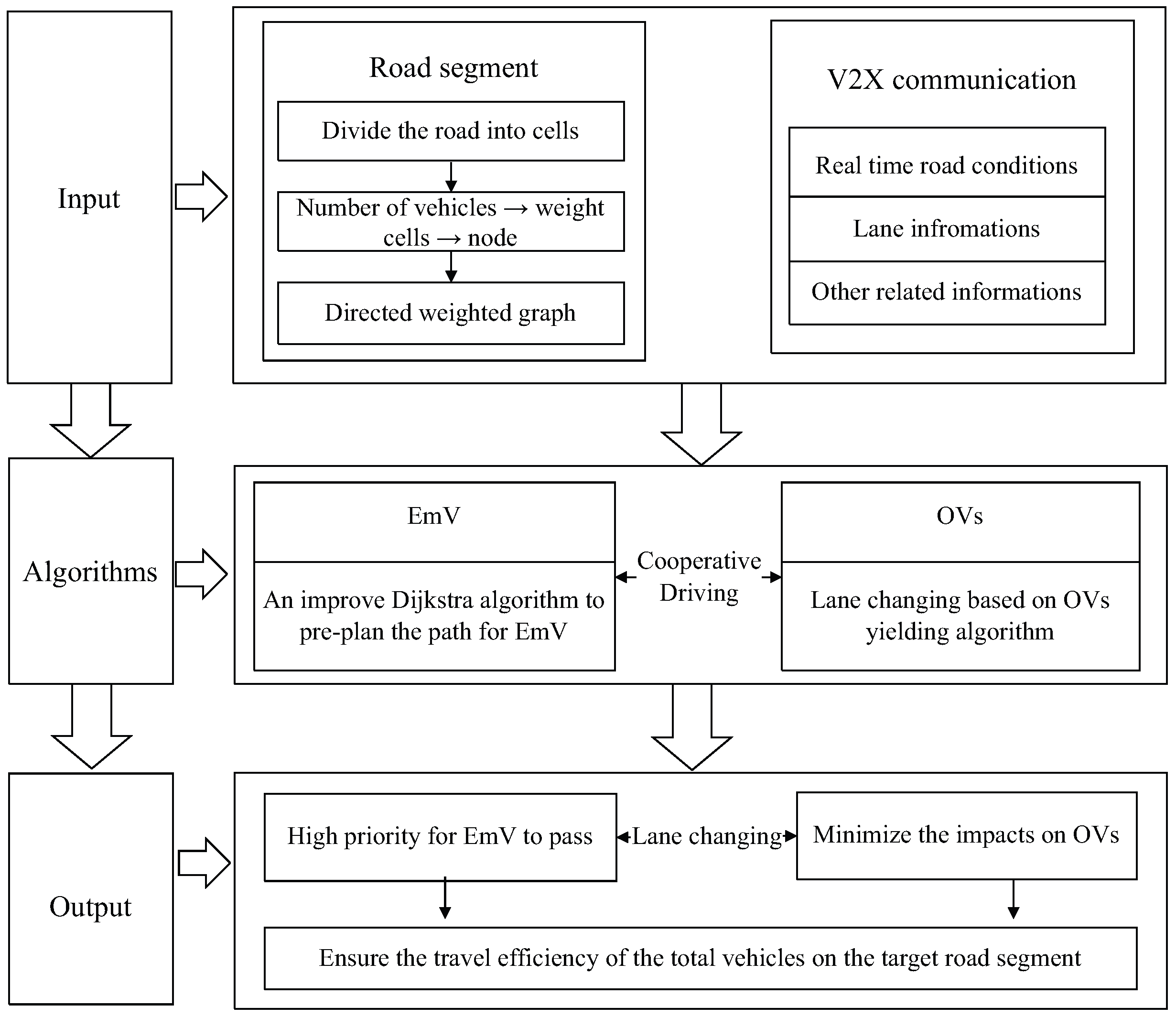
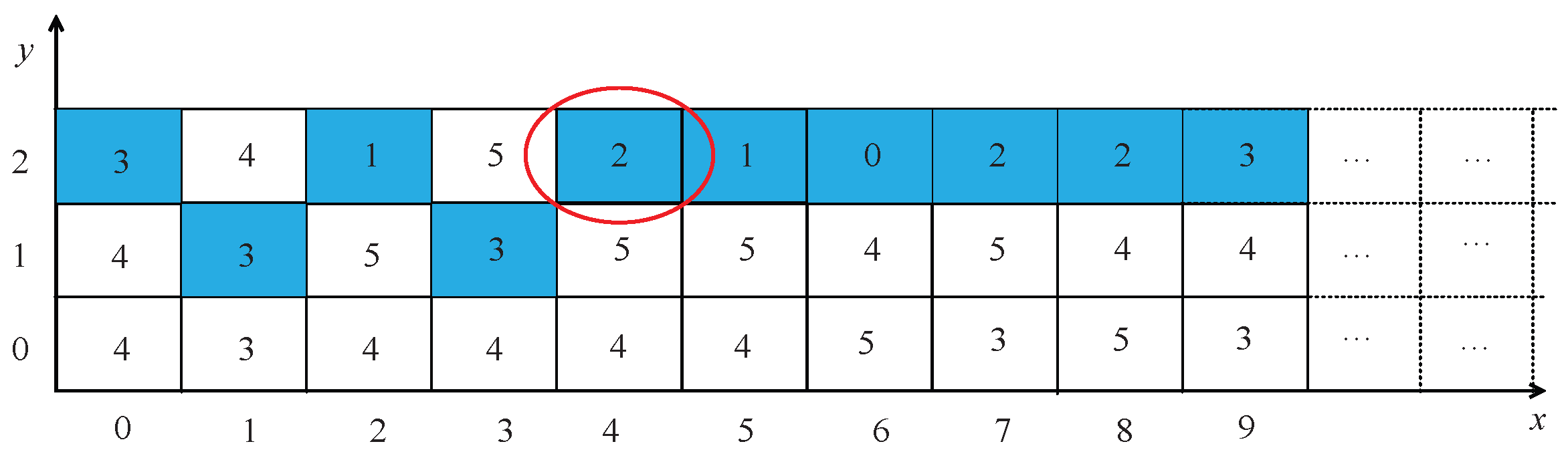
- We divide the road segment from the start to the destination into several cells and set the number of vehicles within a cell as the weight; thus, the road segment becomes a directed graph model. Based on the graph model, path planning for EmVs becomes more feasible.
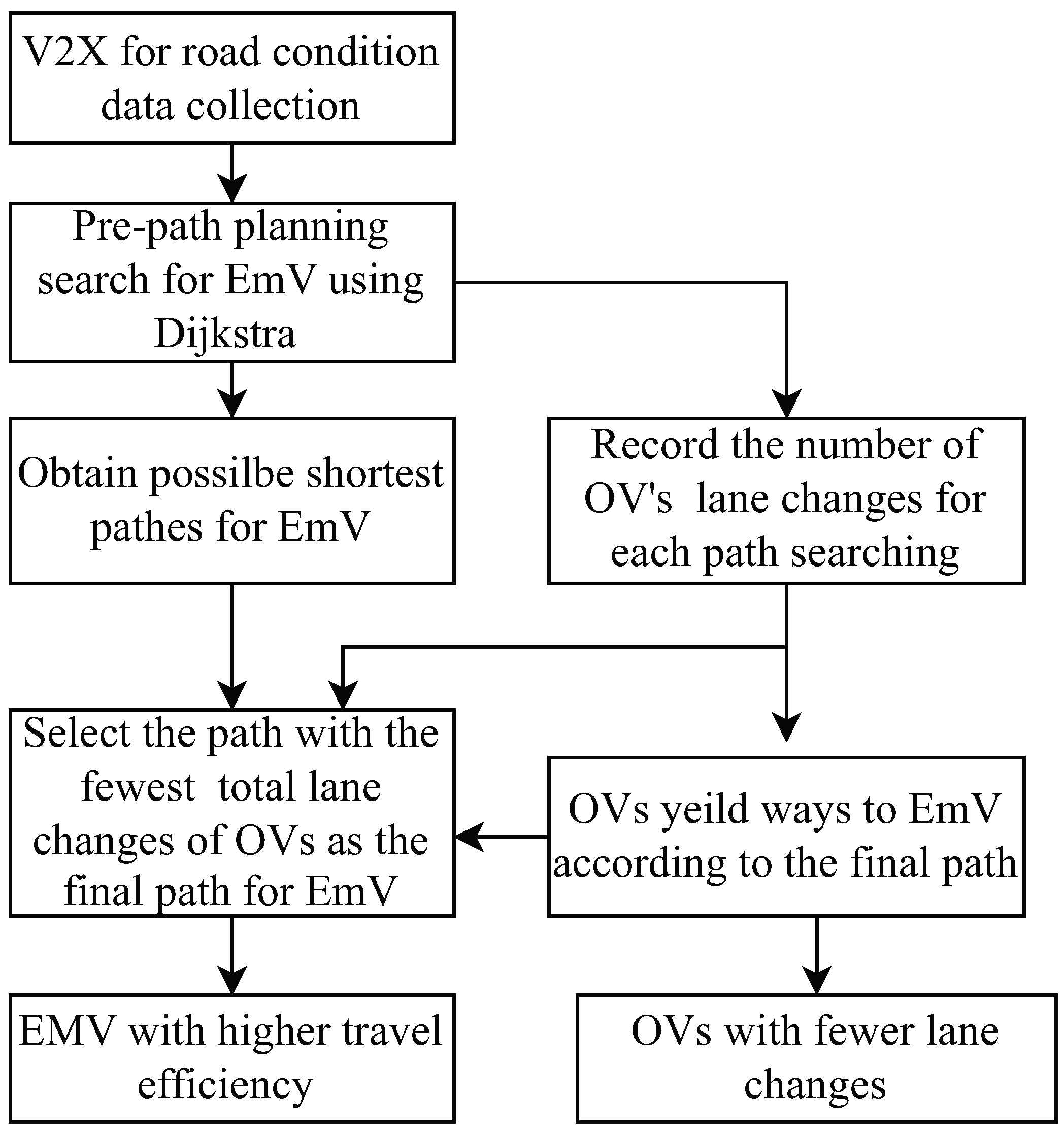
- We propose an improved Dijkstra algorithm for planning paths to ensure the EmV’s priority. It integrates cell weight as the key factor to pre-plan the path for the EmV, then selects the path with the fewest lane changes of OVs, and the path of the EmV is not fixed to a specific lane but is adjusted by lane changing according to the actual cell weight conditions of the road segment, aiming to minimize the impact on OVs.
- A cooperative driving scheme for EmVs and OVs has been proposed. To ensure EmV passage efficiency, OVs need to provide road space for EmVds in a timely manner, and EmVs need to change lanes as required to minimize their impact on OVs, and thus, the overall efficiency of road traffic can be ensured.
2. Problem Statement and Assumptions
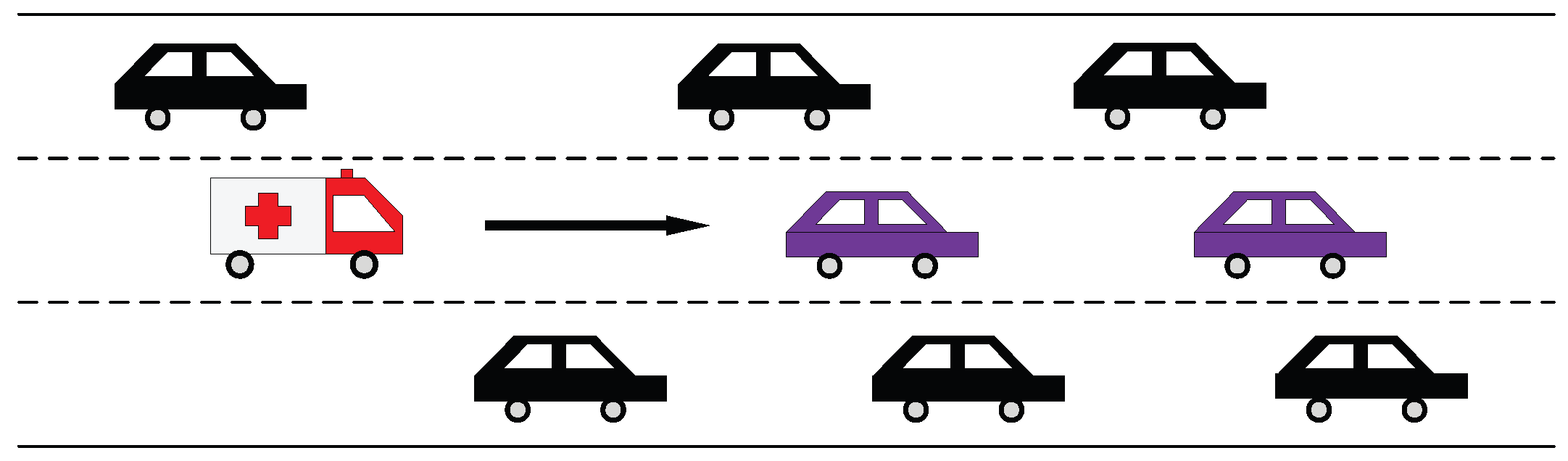
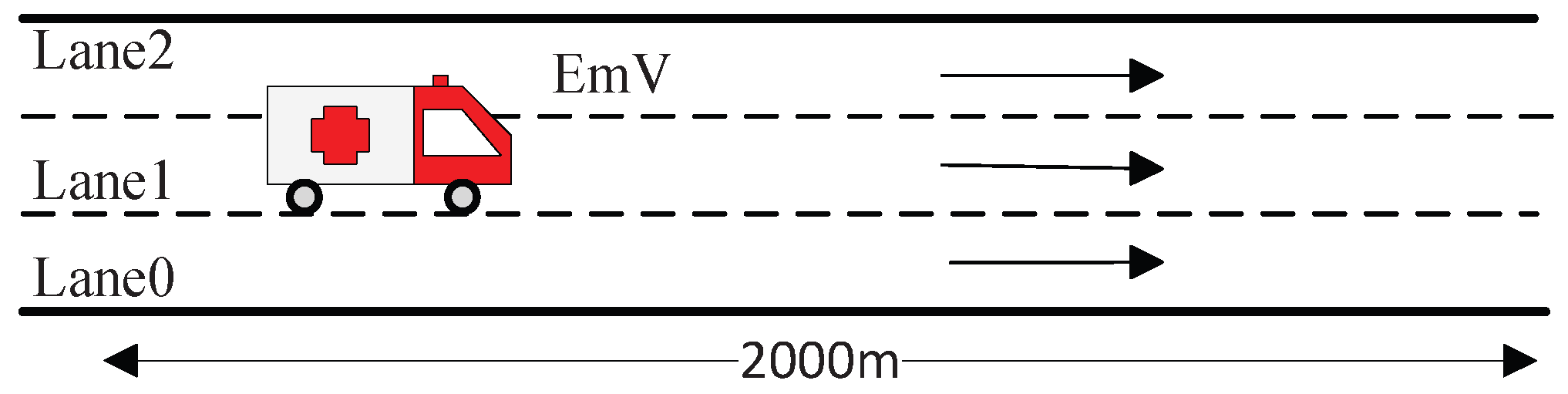
- Suppose that EmVs and OVs travel on urban express roads. To reach the accident site as quickly as possible, it is reasonable for the EmV to choose the urban express roads, as express roads typically have fewer traffic jams than urban ordinary roads. A similar assumption was adopted in [23], where pedestrians and non-motorized vehicles were not considered, as they can be adjusted within the reserved time according to real-time conditions.
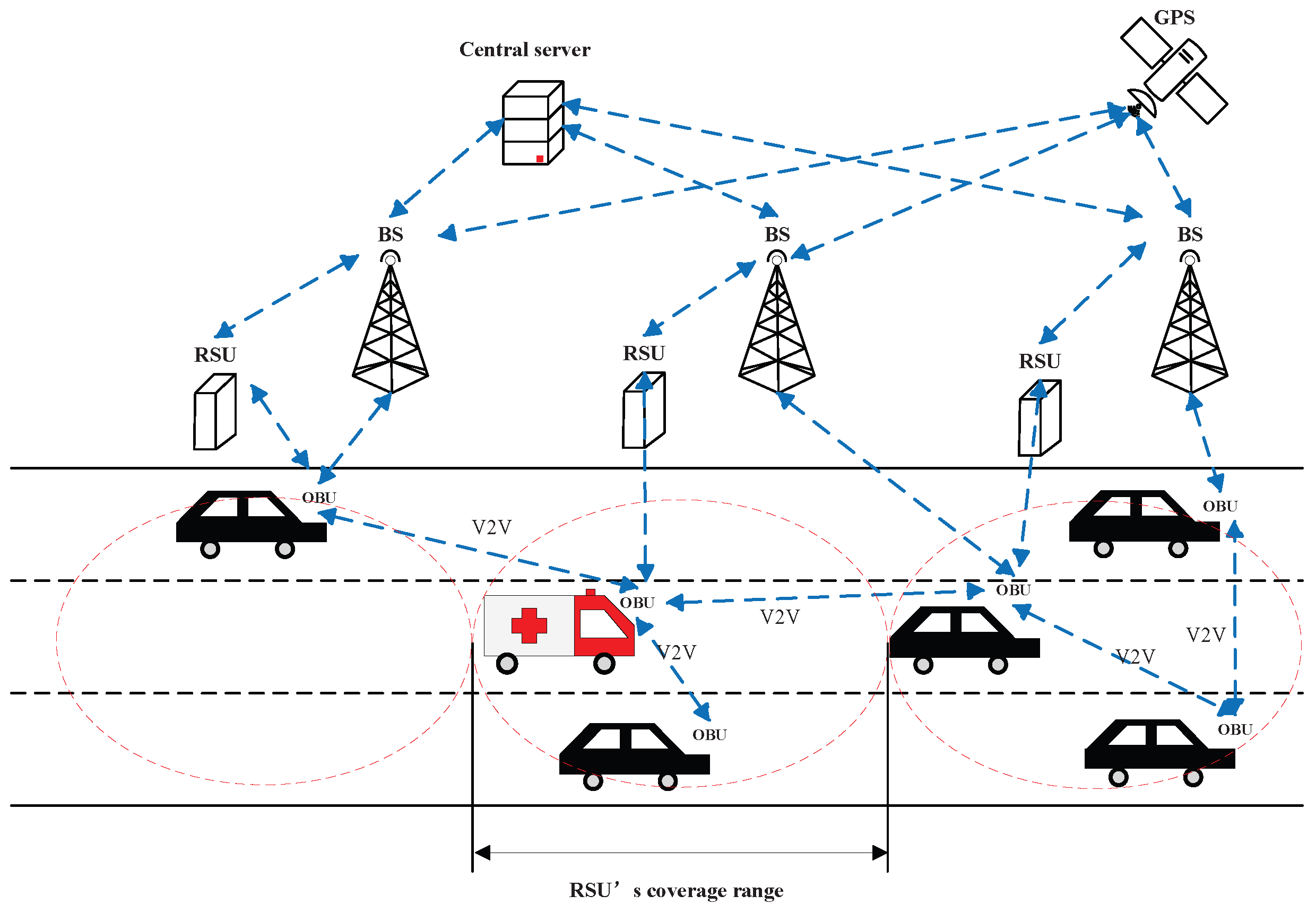
- Suppose all vehicles including EmVs and OVs are equipped with GPS and V2X communication models. Real-time road traffic conditions, such as each vehicle’s current position, speed, destination, acceleration, and directions, can be acquired via GPS [24,25] and shared among neighbor vehicles through V2X communication [26]. This assumption is reasonable because GPS models enable easy acquisition of vehicle speed, location, and destination, and V2X facilitates information sharing and updates between vehicles and traffic control centers, as shown in Figure 2.
- High-quality V2V and V2I communications are available, and the transmission data loss and delay in V2V and V2I connections are not considered [7]. The effects caused by V2X-related communication delay data loss will be considered in future work. As the transmission time for vehicular information to the surrounding vehicles is in milliseconds [27,28], compared to the driver’s reaction time in seconds [29], the transmission delay can be ignored.
3. The Proposed Cooperative Emergency Vehicle Priority Driving Scheme (CEVPDS)
3.1. Cell-Based Trajectory Planning Algorithm for EmVs
3.1.1. Discretizations of Road Network
3.1.2. Directed Weighted Graph
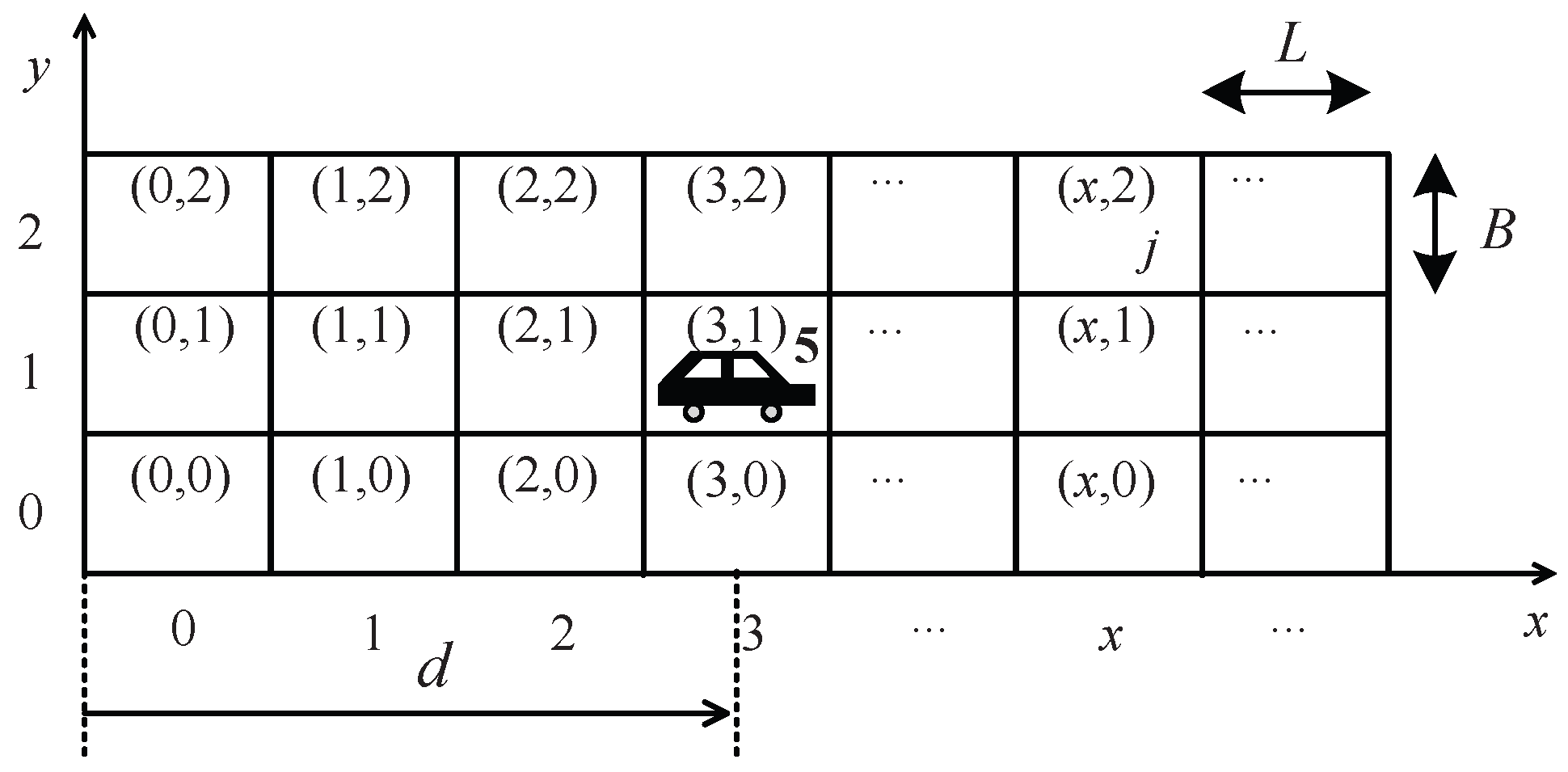
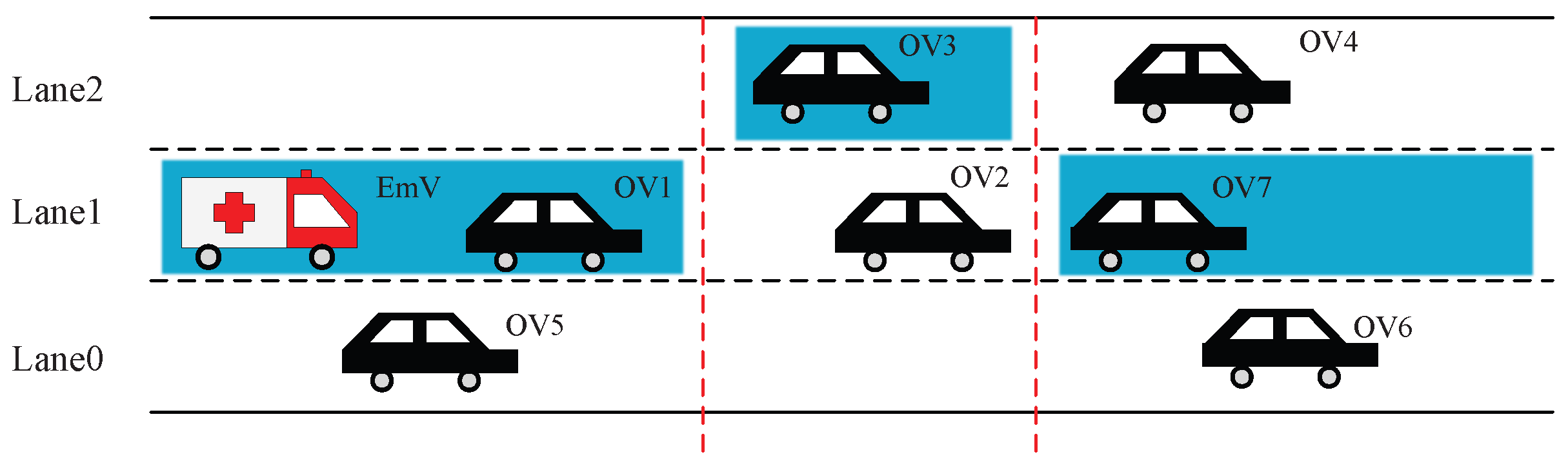
- The number of vehicles in a cell depends on the cell size and road vehicle density. A cell can contain multiple vehicles, but each vehicle belongs to only one cell.
- For cells sharing the same x-coordinate, only one is selected as a candidate for the EmV’s pre-designed trajectory. For example, if cell is included in the EmV’s future trajectory, cell and become inaccessible, because vehicles cannot cross two lanes at once to avoid road accidents.
- Vehicles are prohibited from continuous lane changes. When a vehicle is in cell , it cannot directly access cell (if such cells exist) or , that is, no continuous lane changes cross three consecutive cells. For a three-lane case, this prohibits direct lane changes between the leftmost and rightmost lanes (and vice versa). Continuous lane changes force vehicles to decelerate, leading to rear vehicle accumulation, traffic congestion, and even collisions.
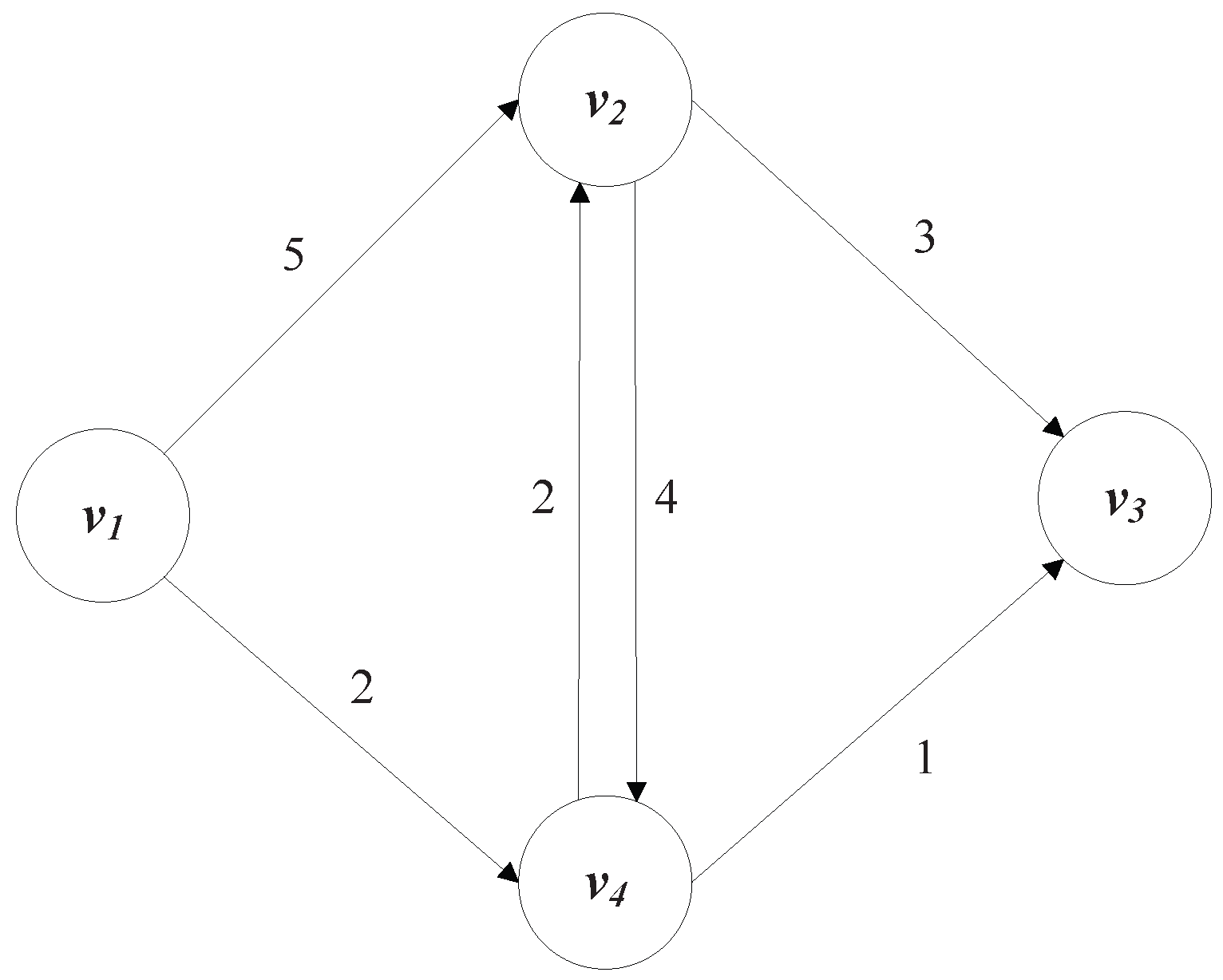
- Vehicles are only allowed to move forward, not backward. So directed edges can only be established between a cell and the cells ahead of it, not those behind.
3.1.3. Path Planning Algorithm for EmVs
- Step 1: Construct cell sets S and U. S stores cells with confirmed shortest paths, and U contains untraversed cells.
- Step 2: Traverse all cells in set U to find all the possible optimal paths from to .
- Step 3: Calculate the number of lane changes both for OVs and EmV for each shortest path , and select the path with the fewest lane changes as the final path for EmVs.
- Step 4: Output the shortest path result for EmVs.
3.2. The Yielding Algorithm for OVs
3.2.1. When OVs Are in Front of the EmV
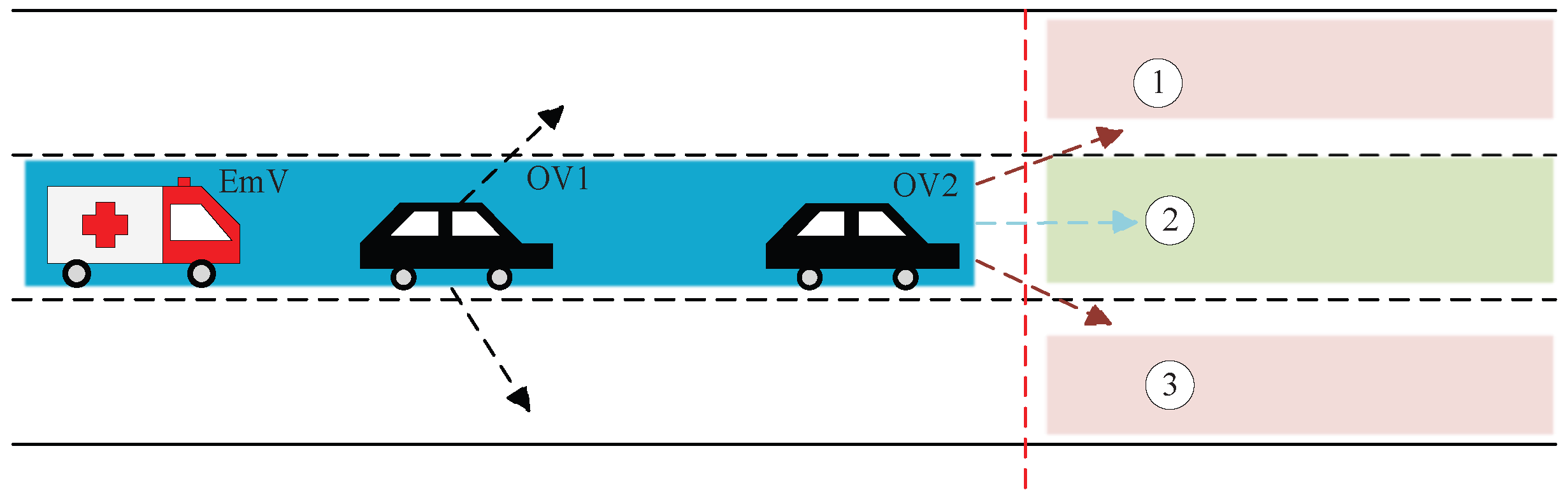
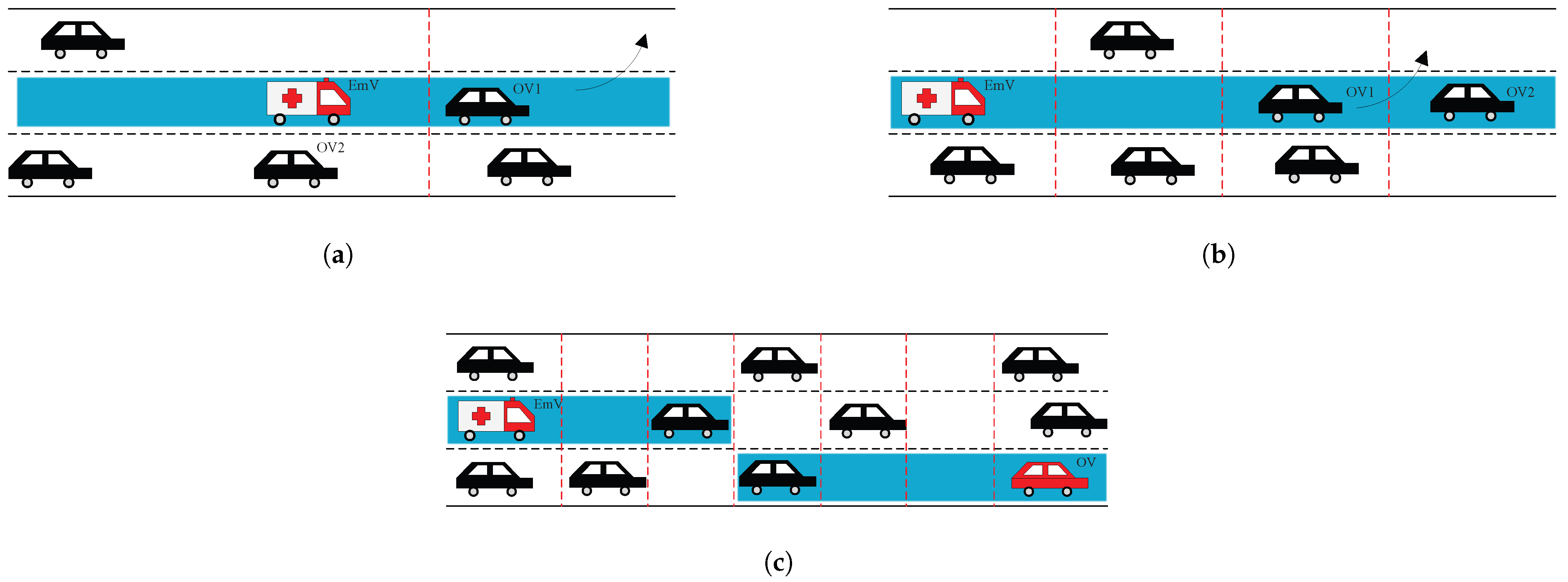
- Case 1: OVs and EmV in the same cell.
- Case 2: OVs on the pre-planned route (different cells from the EmV).
- Case 3: OVs not on the EmV’s pre-planned route (different cells from the EmV).
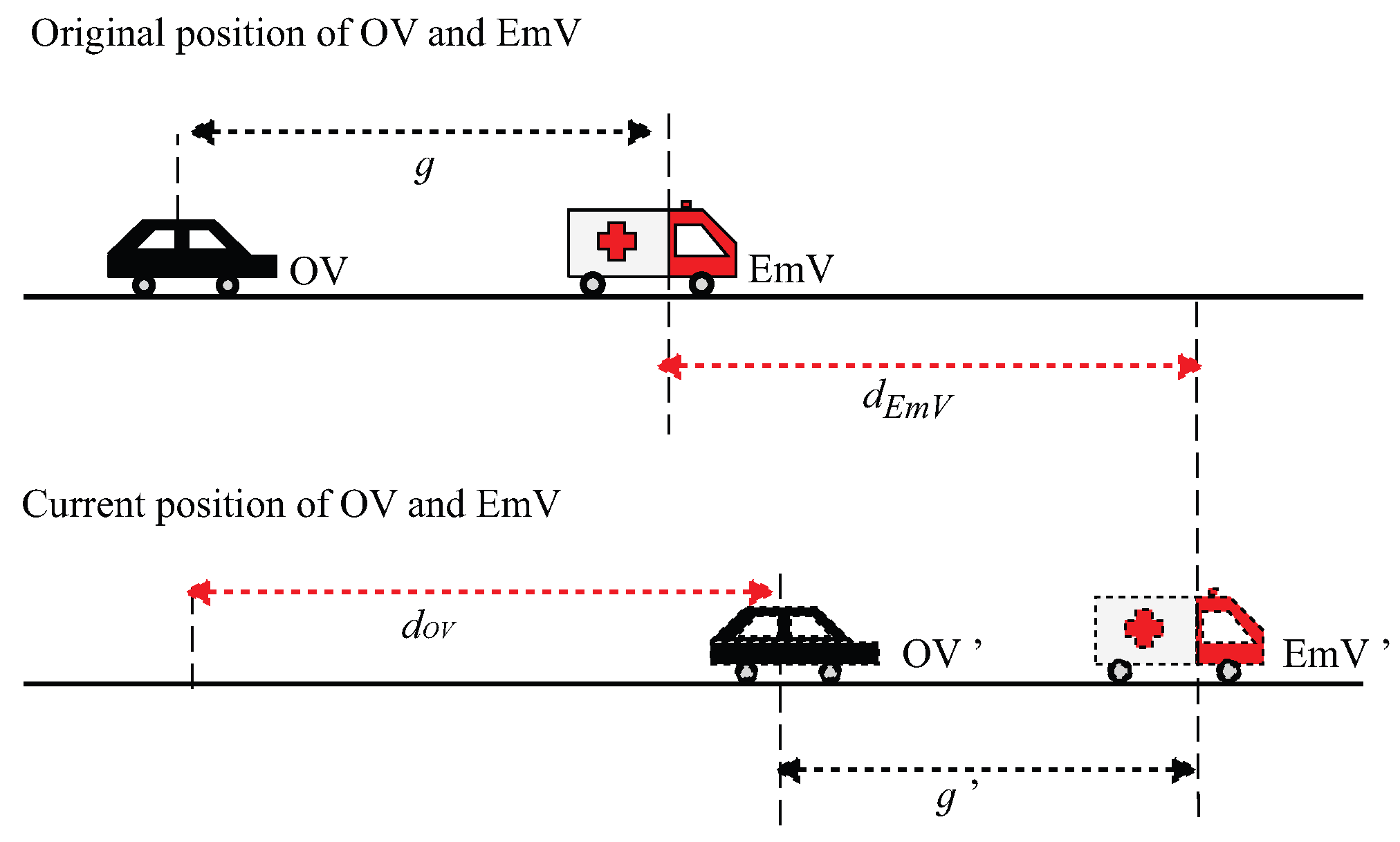
3.2.2. When OVs Are Behind an EmV
4. Simulation and Evaluations
4.1. Path Planning Algorithm Simulation
4.2. Performance Comparison for a Single-EmV Case
- (1)
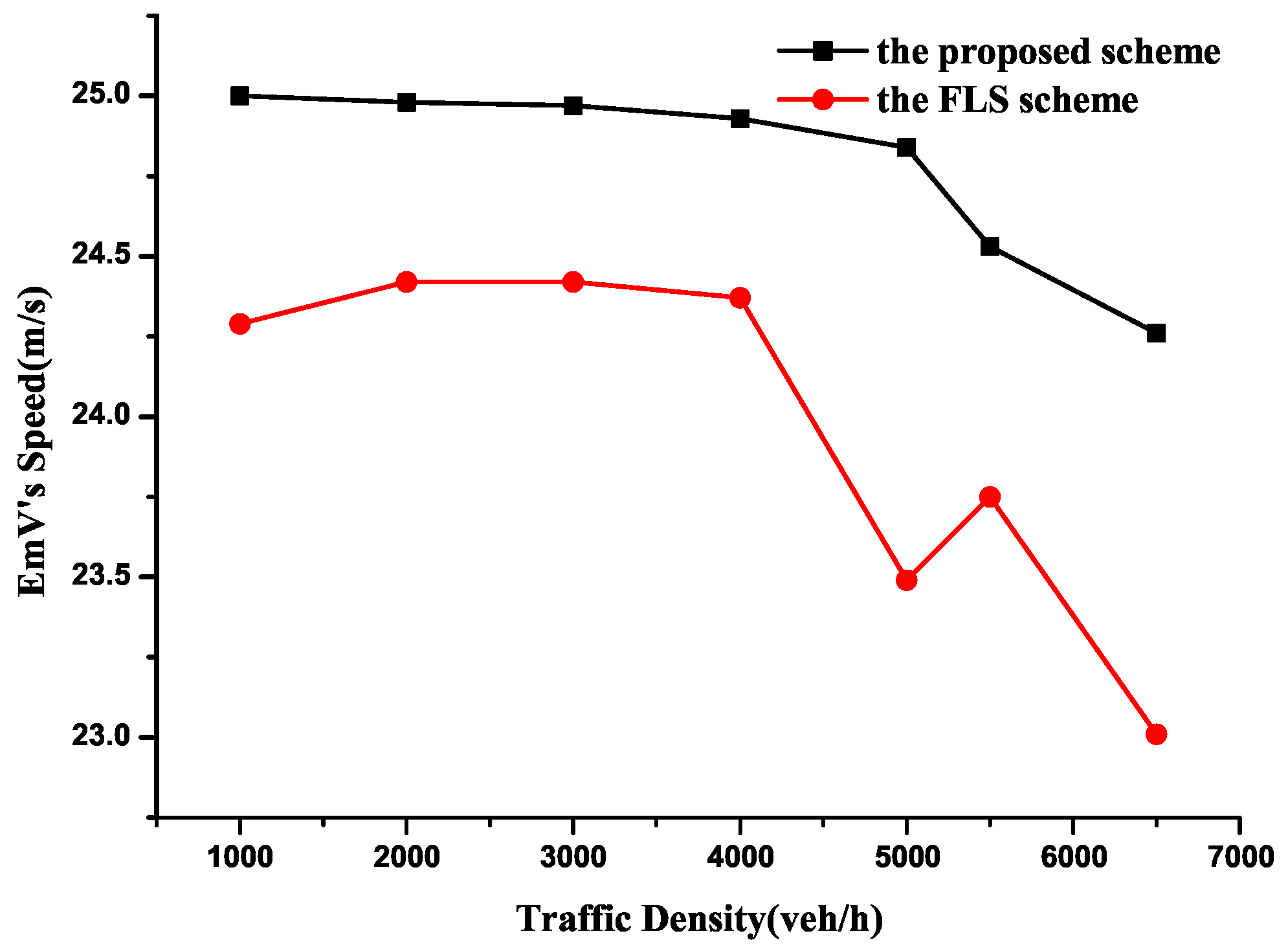
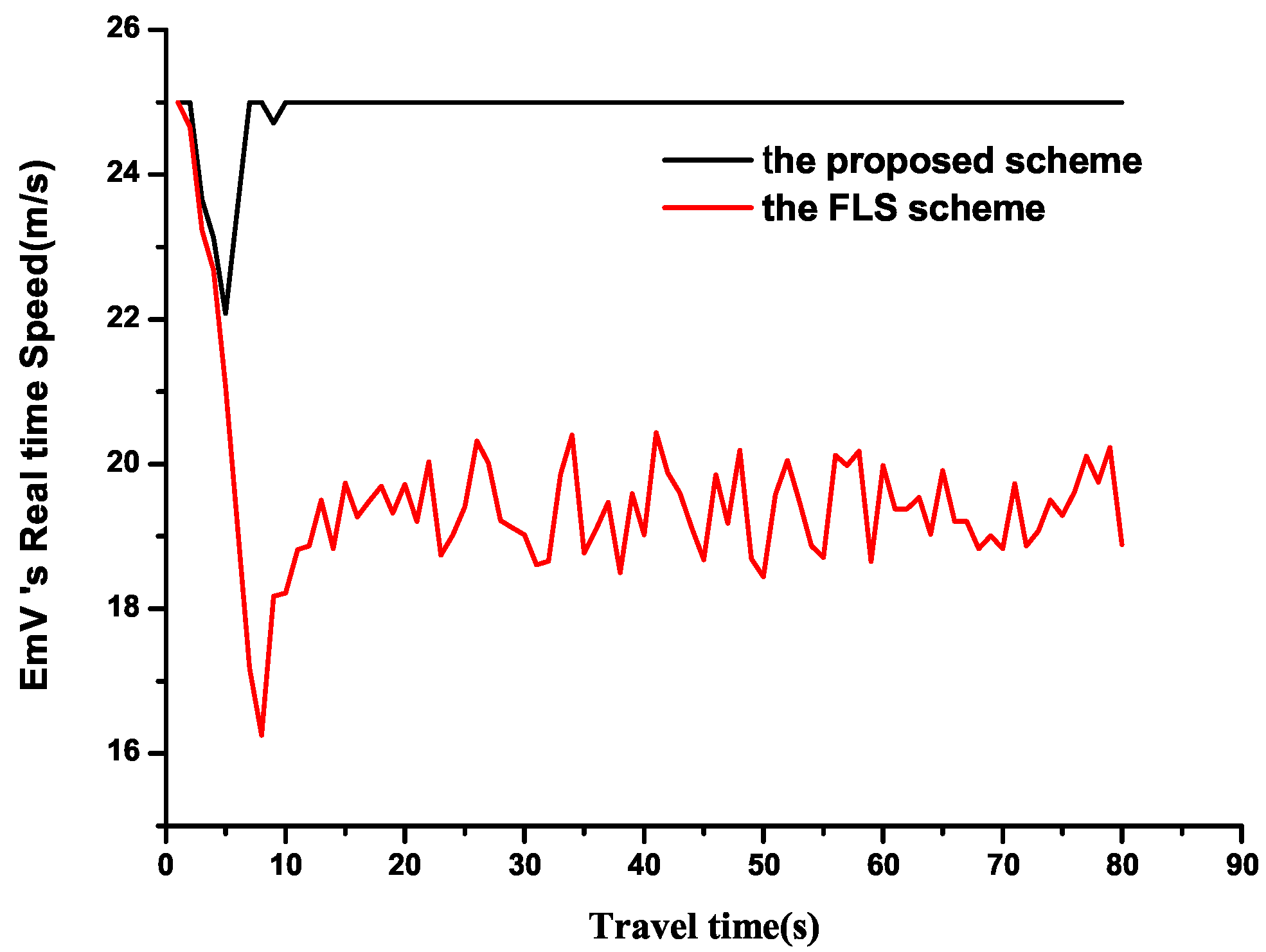
- Average speed of EmV
- (2)
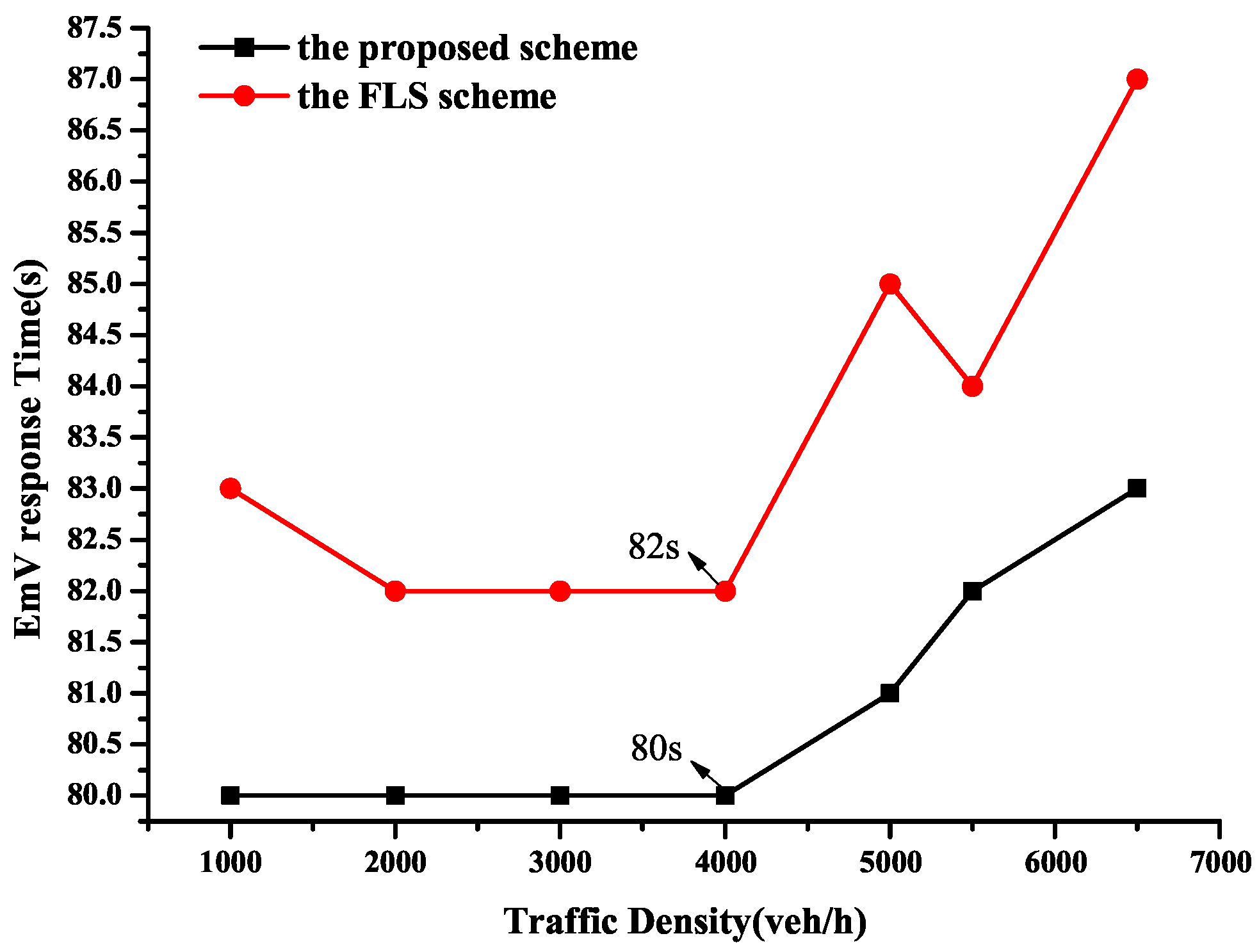
- Response time of EmV
- (3)
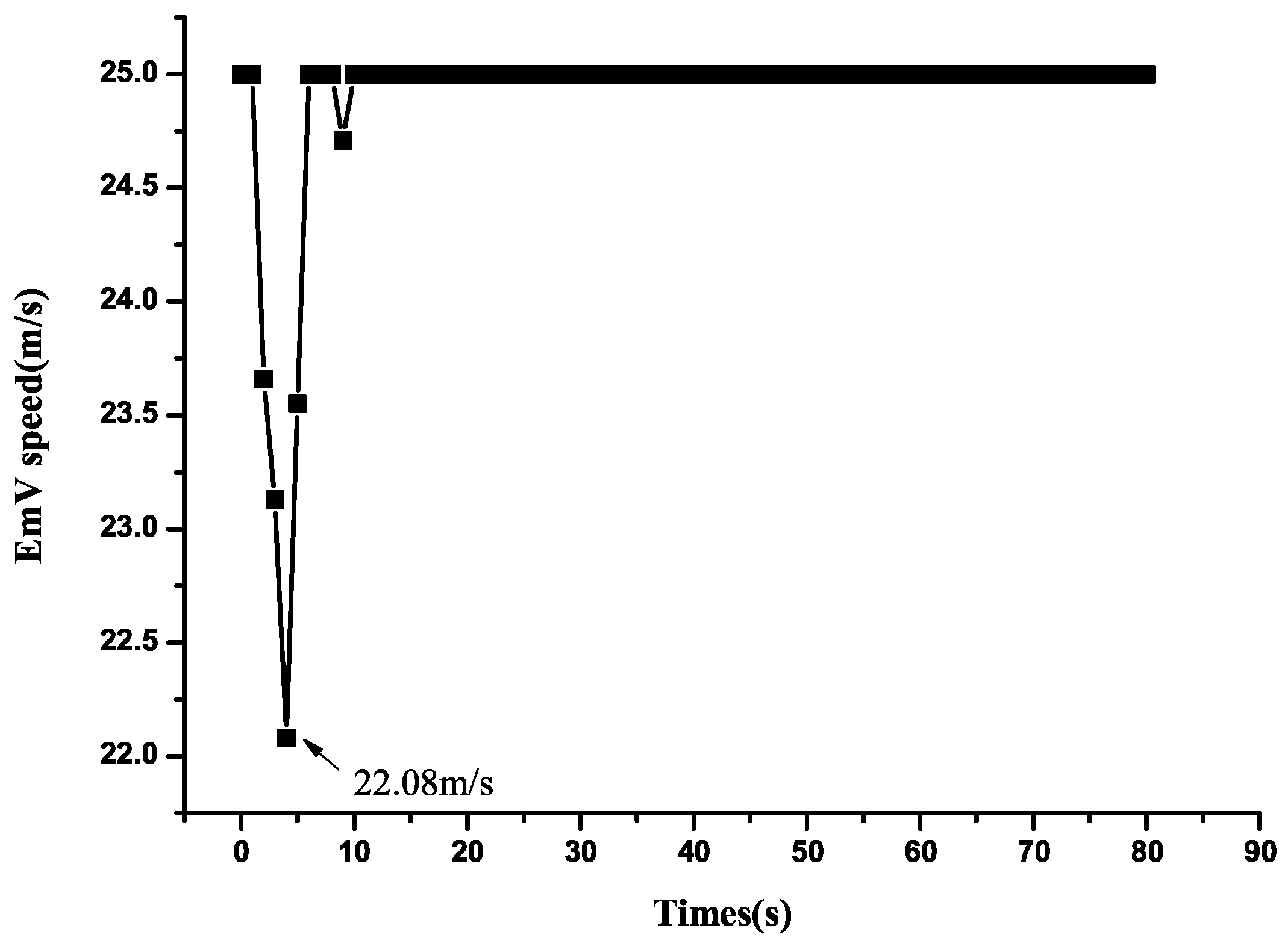
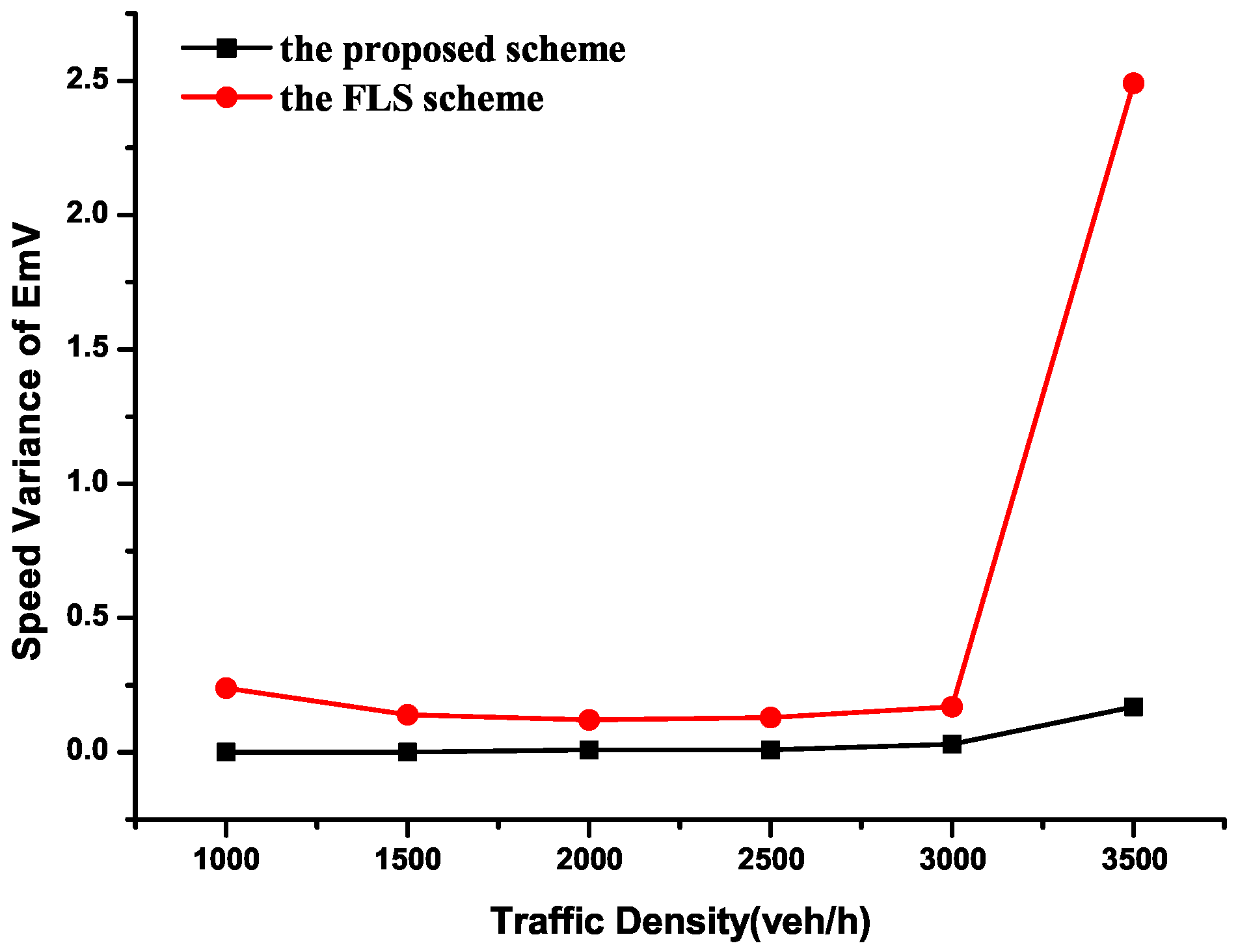
- Speed variance of EmV
- (4)
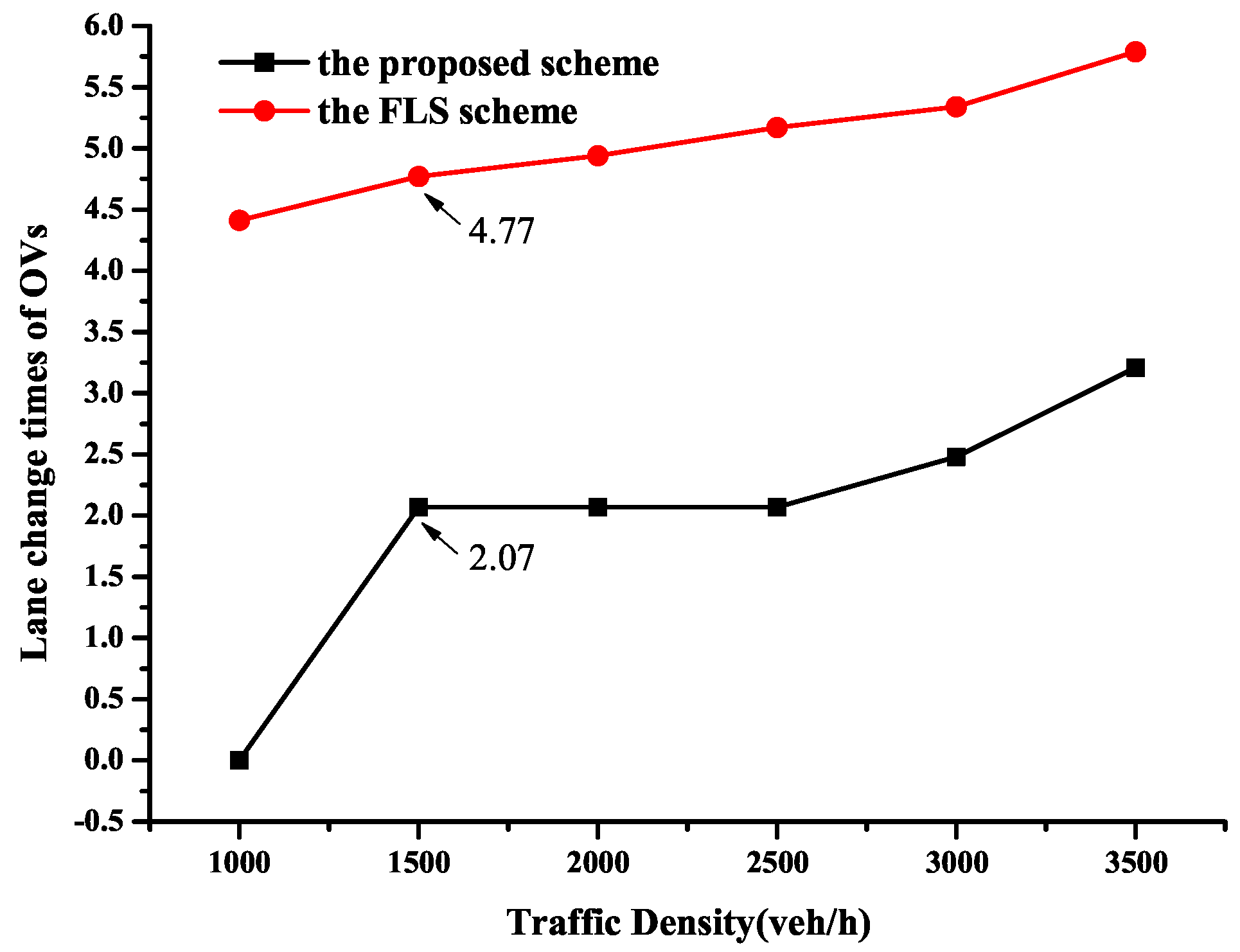
- Lane change frequency of OVs
4.3. Performance Comparison of Two-EmVs Case
5. Conclusions and Future Work
Author Contributions
Funding
Data Availability Statement
Acknowledgments
Conflicts of Interest
Abbreviations
| CEVPDS | Cooperative Emergency Vehicle Priority Driving Scheme |
| EmV | Emergency Vehicle |
| OV | Ordinary Vehicle |
| FLS | Fixed-Lane Strategy |
| V2X | Vehicle-to-everything |
References
- Li, J.; He, Q.; Wang, X.; Hawbani, A.; Yu, K.; Bi, Y.; Zhao, L. UAV-Assisted Microservice Mobile Edge Computing Architecture: Addressing Post-Disaster Emergency Medical Rescue. IEEE Trans. Comput. 2025, 74, 2635–2648. [Google Scholar] [CrossRef]
- Peelam, M.S.; Naren; Gera, M.; Chamola, V.; Zeadally, S. A Review on Emergency Vehicle Management for Intelligent Transportation Systems. IEEE Trans. Intell. Transp. Syst. 2024, 25, 15229–15246. [Google Scholar] [CrossRef]
- Zhao, L.; Li, H.; Wang, J.; Chen, L. Timing and Resource Analysis of Emergency Response Process Using Petri Nets. IEEE Access 2025, 13, 83361–83372. [Google Scholar] [CrossRef]
- Ruan, H.-L.; Ge, W.-H.; Chen, J.-P.; Zhu, Y.-Q.; Huang, W. Prehospital index provides prognosis for hospitalized patients with acute Trauma. Patient Prefer. Adherence 2018, 12, 561–565. [Google Scholar] [CrossRef] [PubMed]
- Coskun, S.; Langari, R. Enhanced vehicle handling performance for an emergency lane changing controller in highway driving. In Proceedings of the 2017 IEEE Intelligent Vehicles Symposium (IV), Los Angeles, CA, USA, 1–14 June 2017; pp. 334–340. [Google Scholar]
- Ding, C.; Ho, I.W.H.; Chung, E.; Fan, T. V2X and Deep Reinforcement Learning-Aided Mobility-Aware Lane Changing for Emergency Vehicle Preemption in Connected Autonomous Transport Systems. IEEE Trans. Intell. Transp. Syst. 2024, 25, 7281–7293. [Google Scholar] [CrossRef]
- Shi, Y.; Yu, H.; Guo, Y.; Yuan, Z. A Collaborative Merging Strategy with Lane Changing in Multilane Freeway On-Ramp Area with V2X Network. Future Internet 2021, 13, 123. [Google Scholar] [CrossRef]
- Wang, P. V2X-Based Autonomous Driving Control at Intersections and Pedestrian Collision Warning. Master’s Thesis, Hefei University of Technology, Hefei, China, 2021. [Google Scholar]
- Figueiredo, A.; Rito, P.; Luís, M.; Sargento, S. Mobility Sensing and V2X Communication for Emergency Services. Mob. Netw. Appl. 2023, 28, 1126–1141. [Google Scholar] [CrossRef]
- Kaja, H.; Stoehr, J.M.; Beard, C. V2X-assisted emergency vehicle transit in VANETs. Simulation 2024, 100, 229–244. [Google Scholar] [CrossRef]
- Oliva, F.; Landolfi, E.; Salzillo, G.; Massa, A.; D’Onghia, S.M.; Troiano, A. Implementation and Testing of V2I Communication Strategies for Emergency Vehicle Priority and Pedestrian Safety in Urban Environments. Sensors 2025, 25, 485. [Google Scholar] [CrossRef]
- Wang, J.; Ma, W.; Yang, X. Development of degree-of-priority based control strategy for emergency vehicle preemption operation. Discret. Dyn. Nat. Soc. 2013, 2013, 283207. [Google Scholar] [CrossRef]
- Rosita, Y.D.; Rosyida, E.E.; Rudiyanto, M.A. Implementation of Dijkstra algorithm and multi-criteria decision-making for optimal route distribution. Procedia Comput. Sci. 2019, 161, 378–385. [Google Scholar] [CrossRef]
- Wu, C.; Zhou, S.; Xiao, L. Dynamic path planning based on improved ant colony algorithm in traffic congestion. IEEE Access 2020, 8, 180773–180783. [Google Scholar] [CrossRef]
- Lin, P.; Chen, Z.; Pei, M.; Ding, Y.; Qu, X.; Zhong, L. Multiple Emergency Vehicle Priority in a Connected Vehicle Environment: A Cooperative Method. IEEE Trans. Intell. Transp. Syst. 2024, 25, 173–188. [Google Scholar] [CrossRef]
- Hannoun, G.J.; Murray, T.P.; Heaslip, K.; Chantem, T. Facilitating emergency response vehicles’ movement through a road segment in a connected vehicle environment. IEEE Trans. Intell. Transp. Syst. 2019, 20, 3546–3557. [Google Scholar] [CrossRef]
- Agarwal, A.; Paruchuri, P. V2V communication for analysis of lane level dynamics for better EV traversal. In Proceedings of the 2016 IEEE Intelligent Vehicles Symposium (IV), Gothenburg, Sweden, 19–22 June 2016; pp. 368–375. [Google Scholar]
- Liu, Z.; Jia, H.; Wu, R.; Tian, J.; Wang, G. IoV-based mathematic model for platoon give way to emergency Vehicles Promptly. IEEE Trans. Intell. Transp. Syst. 2020, 23, 16280–16289. [Google Scholar] [CrossRef]
- Shu, Y.; Zhou, J.; Zhang, F. Agile Decision-Making and Safety-Critical Motion Planning for Emergency Autonomous Vehicles. IEEE Trans. Intell. Transp. Syst. 2025, 26, 13750–13766. [Google Scholar] [CrossRef]
- Arikumar, K.S.; Prathiba, S.B.; Basheer, S.; Moorthy, R.S.; Dumka, A.; Rashid, M. V2X-Based Highly Reliable Warning System for Emergency Vehicles. Appl. Sci. 2023, 13, 1950. [Google Scholar] [CrossRef]
- Yang, M.; Li, C.; Wu, W.; Qi, C. A cooperative lane change strategy for improving road safety through V2V communications. In Proceedings of the 2022 13th International Conference on Information and Communication Technology Convergence (ICTC), Jeju Island, Republic of Korea, 19–21 October 2022; pp. 1415–1418. [Google Scholar]
- Li, C.; Fan, C.; Wang, M.; Shen, J.; Liu, J. A Dynamic Shortest Travel Time Path Planning Algorithm with an Overtaking Function Based on VANET. Symmetry 2025, 17, 345. [Google Scholar] [CrossRef]
- Zhang, Y.; Liu, L.; Lu, Z.; Wang, L.; Wen, X. Robust Autonomous Intersection Control Approach for Connected Autonomous Vehicles. IEEE Access 2020, 8, 124486–124502. [Google Scholar] [CrossRef]
- Li, J.; Fu, H.; Lai, K.K.; Zhang, R.; Iqbal, M.B. Scheduling Optimization of Mobile Emergency Vehicles Considering Dual Uncertainties. Appl. Sci. 2023, 13, 10670. [Google Scholar] [CrossRef]
- Ren, Y.; Jiang, S.; Yan, G.; Shan, H.; Lin, H.; Zhang, Z.; Wang, L.; Zheng, X.; Song, J. Analysis of mixed vehicle traffic flow at signalized intersections based on the mixed traffic agent model of autonomous-manual driving connected vehicles. In Green Connected Automated Transportation and Safety: Lecture Notes in Electrical Engineering; Springer: Berlin/Heidelberg, Germany, 2022; Volume 775. [Google Scholar]
- Li, S.E.; Zheng, Y.; Li, K.; Wang, L.-Y.; Zhang, H. Platoon control of connected vehicles from a networked control perspective: Literature review, component modeling, and controller synthesis. IEEE Trans. Veh. Technol. 2017, 1–16. [Google Scholar] [CrossRef]
- Khayatian, M.; Mehrabian, M.; Shrivastava, A. RIM: Robust Intersection Management for Connected Autonomous Vehicles. In Proceedings of the 2018 IEEE Real-Time Systems Symposium (RTSS), Nashville, TN, USA, 11–14 December 2018; pp. 35–44. [Google Scholar]
- Lyamin, V.N.; Isachenkov, P. Modeling of V2V communications for C-ITS safety applications: A CPS perspective. IEEE Commun. Lett. 2018, 22, 1600–1603. [Google Scholar]
- Droździel, P.; Tarkowski, S.; Rybicka, I.; Wrona, R. Drivers’ reaction time research in the conditions in the real traffic. Open Eng. 2020, 10, 35–47. [Google Scholar] [CrossRef]
- Lidestam, B.; Thorslund, B.; Selander, H.; Näsman, D.; Dahlman, J. In-Car Warnings of Emergency Vehicles Approaching: Effects on Car Drivers’ Propensity to Give Way. Front. Sustain. Cities 2020, 2, 19. [Google Scholar] [CrossRef]
- Chowdhury, A.; Kaisar, S.; Khoda, M.E.; Naha, R.; Khoshkholghi, M.A.; Aiash, M. IoT-Based Emergency Vehicle Services in Intelligent Transportation System. Sensors 2023, 23, 5324. [Google Scholar] [CrossRef]
- Miyombo, M.E.; Liu, Y.K.; Mulenga, C.M.; Siamulonga, A.; Kabanda, M.C.; Shaba, P.; Xi, C.; Ayodeji, A. Optimal path planning in a real-world radioactive environment: A comparative study of A-star and Dijkstra algorithms. Nucl. Eng. Des. 2024, 420, 113039. [Google Scholar] [CrossRef]
- Lopez, P.A.; Behrisch, M.; Bieker-Walz, L.; Erdmann, J.; Flötteröd, Y.P.; Hilbrich, R.; Lücken, L.; Rummel, J.; Wagner, P.; Wießner, E. Microscopic Traffic Simulation using SUMO. In Proceedings of the 2018 21st international conference on intelligent transportation systems (ITSC), Maui, HI, USA, 4–7 November 2018; pp. 2575–2582. [Google Scholar]
- Yu, H.; Jiang, R.; He, Z.; Zheng, Z.; Li, L.; Liu, R.; Chen, X. Automated vehicle-involved traffic flow studies: A survey of assumptions, models, speculations, and perspectives. Transp. Res. Part C Emerging Technol. 2021, 127, 103101. [Google Scholar] [CrossRef]
- Krauß, S. Microscopic Modeling of Traffic Flow: Investigation of Collision Free Vehicle Dynamics; Hauptabteilung Mobilität und Systemtechnik des DLR Köln: Koeln, Germany, 1998. [Google Scholar]
- Kim, K.D. Collision free autonomous ground traffic: A model predictive control approach. In Proceedings of the ACM/IEEE 4th International Conference on Cyber-Physical Systems, Philadelphia, PA, USA, 8–11 April 2013; pp. 51–60. [Google Scholar]
- Liu, J.; Zhao, W.; Xu, C. An Efficient On-Ramp Merging Strategy for Connected and Automated Vehicles in Multi-Lane Traffic. IEEE Trans. Intell. Transp. Syst. 2022, 23, 5056–5067. [Google Scholar] [CrossRef]
- Kuang, Z.; Zhao, X.; Feng, L. Priority of emergency vehicle dynamic right-of-way control method in networked environment. Appl. Sci. 2023, 13, 5883. [Google Scholar] [CrossRef]



| Parameters | EmV | OV |
|---|---|---|
| Length | 8 m | 5 m |
| Width | 2 m | 1.8 m |
| Safe distance | 2.5 m | 2.5 m |
| Acceleration | 2.5 m/s2 | 2.5 m/s2 |
| Deceleration | 4.5 m/s2 | 4.5 m/s2 |
| Maximal velocity | 25 m/s | 20 m/s |
| Car-follow Model | Krauss | Krauss |
| Parameters | Value |
|---|---|
| Road length | 2000 m |
| Road breadth | 3.5 m/lane |
| Number of lanes | 3 |
| Limited speed | 20 m/s |
| Driving direction | right |
| A Lane changing time | 5 s |
| Cell length | 200 m |
| Cell distance threshold | K = 3 |
| Driving rules | Right-handed driving style |
| Total Lane Change Times | EmV’s Average Speed (m/s) | |
|---|---|---|
| Proposed scheme | 30 | 23.7 |
| FLS scheme | 77 | 22.6 |
| Improved percentage | 61.04% | 4.87% |
Disclaimer/Publisher’s Note: The statements, opinions and data contained in all publications are solely those of the individual author(s) and contributor(s) and not of MDPI and/or the editor(s). MDPI and/or the editor(s) disclaim responsibility for any injury to people or property resulting from any ideas, methods, instructions or products referred to in the content. |
© 2026 by the authors. Licensee MDPI, Basel, Switzerland. This article is an open access article distributed under the terms and conditions of the Creative Commons Attribution (CC BY) license.
Share and Cite
Wang, Y.; Wang, M.; Yang, M.; Li, C.; Shen, J.; Wang, H.; Noonpakdee, W. CEVPDS: A Cooperative Emergency Vehicle Priority Driving Scheme for Improving Travel Efficiency Through V2X Communications. Symmetry 2026, 18, 331. https://doi.org/10.3390/sym18020331
Wang Y, Wang M, Yang M, Li C, Shen J, Wang H, Noonpakdee W. CEVPDS: A Cooperative Emergency Vehicle Priority Driving Scheme for Improving Travel Efficiency Through V2X Communications. Symmetry. 2026; 18(2):331. https://doi.org/10.3390/sym18020331
Chicago/Turabian StyleWang, Yanchi, Mu Wang, Mei Yang, Chunxiao Li, Jiajun Shen, Haoyu Wang, and Wasinee Noonpakdee. 2026. "CEVPDS: A Cooperative Emergency Vehicle Priority Driving Scheme for Improving Travel Efficiency Through V2X Communications" Symmetry 18, no. 2: 331. https://doi.org/10.3390/sym18020331
APA StyleWang, Y., Wang, M., Yang, M., Li, C., Shen, J., Wang, H., & Noonpakdee, W. (2026). CEVPDS: A Cooperative Emergency Vehicle Priority Driving Scheme for Improving Travel Efficiency Through V2X Communications. Symmetry, 18(2), 331. https://doi.org/10.3390/sym18020331