Article

Resonant Solutions and Rogue Wave Solutions to the (2+1)-Dimensional Caudrey–Dodd–Gibbon Equation


1
School of Mathematics and Statistics, Weifang University, Weifang 261061, China
2
School of Mathematics, China University of Mining and Technology, Xuzhou 221116, China
*
Author to whom correspondence should be addressed.
Symmetry 2026, 18(2), 332; https://doi.org/10.3390/sym18020332
Submission received: 5 January 2026 / Revised: 3 February 2026 / Accepted: 9 February 2026 / Published: 11 February 2026
(This article belongs to the Special Issue Symmetry in Integrable Systems and Soliton Theories)

Abstract

The (2+1)-dimensional Caudrey–Dodd–Gibbon (CDG) equation, which can frequently be used to be describe the propagations of shallow-water waves and plasma physics, is solved by various methods in this paper, thereby revealing its nonlinear dynamical behavior. First, through the linear superposition principle in conjunction with symmetric Hirota bilinear method, we obtain a bilinear form of the CDG equation, which possesses several symmetry properties, and construct the resonant solutions to exponential waves. Then, the one-rogue wave solutions to the CDG equation are constructed via the ansatz method. Finally, we show three-dimensional diagrams and density graphs of the yielded solutions to better show the dynamic characteristics.

1. Introduction

Nonlinear equations generally come from the research of natural sciences such as physics, astronomy or mechanics. Exact solutions to nonlinear partial differential equations (NLPDEs) play a major role in the field of mathematical physics, such as soliton solutions, complexiton solutions, and rogue wave and lump solutions [1,2,3,4,5]. NLPDEs have many applications, including natural sciences, science and engineering, biotechnology, nerve fibers and architectures, and so on [6,7,8]. In recent years, mathematicians and physicists have established several effective methods to obtain the exact solutions to NLPDEs, such as the Darboux transformation method [9], the inverse scattering transform [10], the Bäcklund transformation method [11], the homogeneous balance method [12], the Lie group method [13], the Hirota bilinear method, [14] and so on [15,16]. Among them, the Hirota bilinear method is very helpful for finding the solutions to NLPDEs [17,18]. The most effective way to construct the Hirota bilinear form of the equation is to use a Bell polynomial [19]. In 2004, Japanese mathematician Hirota introduced bilinear derivatives [14], and since then, many experts and scholars in mathematical physics have begun researching and applying the Hirota bilinear method to construct soliton solutions for high-dimensional nonlinear equations, particularly in two and three dimensions. For example, Ma, et al. [20] has achieved many outstanding results, including Hirota bilinear equations and resonant solutions. Lou S.Y. [21] studied a (3+1)-dimensional KdV equation with the Hirota bilinear method, and proved that the equation has a rich Dromion structure. At the same time, multiple soliton solutions to the extended (3+1)-dimensional Jimbo–Miwa equation [22] and the the Sawada–Kotera–Kadomtsev–Petviashvili equation [23] have been obtained by the bilinear method. In the field of nonlinear integrable equations, high-dimensional (two-dimensional and higher-dimensional) nonlinear equations play a crucial role in describing complex physical phenomena, yet solving them remains a significant challenge. To our knowledge, there are few studies that apply the existing method to obtain exact solutions for (2+1)-dimensional integrable equations, with most research focusing on (1+1)-dimensional equations. To address this issue, we apply the Hirota bilinear method to the (2+1)-dimensional CDG equation to obtain several classes of exact solutions, including the resonant solutions of exponential waves and rogue wave solutions.
Here, we introduce the celebrated high-dimensional equation, namely the (2+1)-dimensional Caudrey–Dodd–Gibbon equation [24]
w t + 1 36 ( w x x x x x + 15 w x w x x + 15 w x w x x x + 45 w 2 w x ) 5 36 ( w x x y + x 1 w y y + 3 w w y + 2 w x x 1 w y ) = 0 ,
which serves as a mathematical model for surface waves in shallow water and has significant applications in plasma and laser physics. This is a generalization of the higher-order KdV-type equations, offering greater precision than the classical KdV equation in describing unidirectional long waves with stronger dispersion effects. This equation is particularly well-suited for simulating physical systems where higher-order dispersion effects cannot be neglected, Where w depends on the time variable t and space variables x , y . At the same time, we need to know that x 1 is an inverse operator of x , x 1 x = x x 1 = 1 . This equation has been investigated by many mathematicians and physicists. For example, Kuo [24] constructed the resonant multi-soliton solutions to Equation (1) via the simplified linear superposition principle. The multiple soliton solutions for the Equation (1) are obtained in Ref. [25], which has an important influence on the natural sciences. In Ref. [26], the authors studied the Bäcklund transformation, Lax pair, solutions and integrability of the CDG equation by using Bell polynomials and symbolic computation. Therefore, studying the physical structure of the CDG equation is interesting and physically meaningful. In this paper, we discuss the resonant solutions and rogue wave solutions to Equation (1) by applying the linear superposition principle in conjunction with the Hirota bilinear method and a new ansatz method. To the best our knowledge, good results for rogue wave and resonant solutions have not appeared in other places. Compared to previous studies, which investigated solutions (lumps, bright-solutions, and so on) to different equations using various methods, this study uses two methods to establish rogue wave solutions with parameters and resonant solutions to the high-dimensional CDG equation. This method is an effective tool for solving high-dimensional equations.
The paper is structured as follows: In Section 2, we describe the linear superposition principle in detail. In Section 3, with the help of the Hirota bilinear method, the resonant solutions to the equation are obtained in both the real and complex domains. In Section 4, the rogue wave solutions to the CDG equation are constructed via a new ansatz method. Moreover, in order to better describe the dynamic behavior of (1), we plot and analyze two-dimensional density images and three-dimensional diagrams.

2. Linear Superposition Principle

Hirota bilinear equations often appear in discussions of the integrability of nonlinear differential equations [27,28,29]. The Hirota bilinear method serves as a powerful tool for studying such equations. The linear superposition principle and the Hirota D-operators [30,31,32] form the core components of this bilinear method, providing an excellent framework for generating exact solutions to nonlinear partial differential equations. First, we introduce the basic definitions and properties of the Hirota D-operators.
Definition 1.
Hirota D-operators:
D t m D x n f · g = D t m D x n ( f , g ) = ( m a m n b n ) f ( t + a , x + b ) g ( t a , x b ) ( a = 0 , b = 0 ) ,
where m , n 0 , f and g are binary differentiable functions of variables x and t.
Definition 2.
Hirota bilinear derivatives:
D x f · g = f x g + f g x , D x 2 f · g = f x x g 2 f x g x + f g x x , D x 3 f · g = f x x x g 3 f x x g x + 3 f g x x f g x x x , D x 4 f · g = f x x x x g 4 f x x x g x + 6 f x x g x x 4 f x g x x x + f g x x x .
Definition 3.
Properties of D-operators:
D x n f · f = 0 , n = 2 k + 1 ( k = 0 , 1 , ) , D t m D x n f · g = ( 1 ) m + n D t m D x n g · f , D t m D x n f · 1 = t m x n f , D x ( D x a · b ) c + D x ( D x b · c ) a + D x ( D x c · a ) b = 0 .
Step 1: Derive the logarithmic transformation of the equation, then introduce a generalized bilinear equation of the following form:
ϕ ( D x , D y , , D t ) f · f = 0 ,
The Hirota bilinear form reveals its symmetry in the bilinear identity, where ϕ is a polynomial and D x , y , , t are Hirota’s differential operators. The N-wave variables have
ω i = η i , 0 + η i , 1 x 1 + + η i , M x M , 1 i N ,
where N N + ; then the exponential wave functions are obtained:
f i = e ω i , 1 i N ,
where η i , j C ( 1 i N , 1 j N ) .
Step 2: The linear combination of f i has form
f = ε 1 f 1 + ε 2 f 2 + + ε N f N , ε i C ,
which satisfies the following identity [33,34]:
ϕ ( D φ , x 1 , D φ , x 2 , , D φ , x M ) f · f = i = 1 N ε i 2 ϕ ( η i , 1 α η i , 1 , , η i , M + α η i , M ) · e 2 ω i + 1 i , k N ε i ε k [ ϕ ( η i , 1 + α η k , 1 , , η i , M + α η k , M ) + ϕ ( η k , 1 + α η i , 1 , , η k , M + α η i , M ) ] · e ω i + ω k .
It is known that Equation (8) is a solution to Equation (1); we obtain
ϕ ( η i , 1 + α η k , 1 , , η i , M + α η k , M ) + ϕ ( η k , 1 + α η i , 1 , , η k , M + α η i , M ) = 0 ,
where r ( x ) = r ( x ) , φ = 2 , r ( 0 ) = 0 ; then the equation takes the following form:
ϕ ( η i , 1 η k , 1 , , η i , M η k , M ) = 0 , 1 i < j N .
Next we give two fundamental theorems of the form.
Theorem 1
([35]). Let ϕ ( x ) be a polynomial in x R P , and the N-wave variables ω i = j = 1 P a j k i α j x j , 1 i N , and a j R . Then any linear combination of the function f i = e ω i , 1 i N solves the linear differential equation ϕ ( D φ ) f · f = 0 if and only if
ϕ ( a 1 ( k j α 1 + α k i α 1 ) + + a M ( k j α M + α k i α M ) ) + ϕ ( a 1 ( k i α 1 + α k j α 1 ) + + a M ( k i α M + α k j α M ) ) = 0 ,
with 1 j i N , k i , k j C .
Theorem 2
([36]). Let ϕ ( x ) be a polynomial in x R P . Suppose that M 1 , M 2 N , N = N 1 + N 2 , a j R , α j Z for j = 1 , 2 , P are all fixed. The N-wave variables ω i = j = 1 P a j k i α j x j , where
k i R , 1 i M 1 , 1 i N k i = β i + I γ i , β i , γ i R , γ i 0 , M 1 + 1 i N , I = 1 .
If Equation (11) is true for any k i , k j R , 1 i , j N , f i satisfies the following form:
f i = e δ i , 1 i N 1 , e Re ( ω i ) cos ( Im ( ω i ) + θ i ) , N 1 + 1 i N ,
where θ i R , M 1 i N solves the equation
ϕ ( D φ ) f · f = 0 .

3. Resonant Solution

In the field of nonlinear science, resonance solutions are widely applied in classical mechanics, circuitry, acoustics, optics, and other fields [33,34]. They represent a significant boundary condition in the theory of nonlinear partial differential equations, revealing phenomena commonly observed in periodic dynamical systems. For example, the resonant solutions of exponential waves for trilinear differential equations are obtained by the superposition principle [37]. In this section, the resonant solutions of N exponential waves for the CDG can be constructed through the linear superposition principle in conjunction with Hirota bilinear method.
Equation (1) can be changed into the form
u x , t + 1 36 ( u x x x x x x + 15 u x x u x x x + 15 u x u x x x x + 45 ( u x ) 2 u x x ) 5 36 ( u x x x y + u y y + 3 u x u x y + 2 u x x u y ) = 0 ,
under the transformation
w ( x , t ) = u x ( x , t ) .
By making a logarithmic transformation
u = 2 ( ln f ) x ,
the Hirota bilinear form of Equation (1) can be obtained:
( D x 6 5 D x 3 D y 5 D y 2 + 36 D x D t ) f · f = 0 .
This bilinear form possesses symmetry under translation, scaling, and exponential gauge transformations:
(a)
Translational symmetry: Let
x x + a , y y + b , t t + c ,
where a, b, c are arbitrary constants. And the bilinear derivative operators D x , D y , and D t remain unchanged under translation,
f ( x , y , t ) f ( x + a , y + b , t + c ) ,
while the CDG equation remains unchanged.
(b)
Scale symmetry: Let
x λ a x , y λ b y , t λ c t , f λ d f ,
where the scale symmetry is
( x , y , t , f ) ( λ x , λ 3 y , λ 5 t , f ) .
(c)
Exponential gauge symmetry: Let
f e a x + b y + c t f ,
which is symmetrical.
Below we consider resonant solutions in the real and complex fields.

3.1. In the Real Field

Taking the N-wave variable of Equation (6) yields
ω i = l i x + m i y + n i t + η i , 1 i N ,
which determines the initial position or phase of each fundamental soliton component, where l i , m i , n i R , η i C .
According to the principle of linear superposition in the second part, Equation (19) becomes
ψ ( a 1 ( l j α 1 + α l i α 1 ) + + a M ( l j α M + α l i α M ) ) + ψ ( a 1 ( l i α 1 + α l j α 1 ) + + a M ( l i α M + α l j α M ) ) = 0 ,
which reads
ψ ( l i l j , m i m j , n i n j ) = ( l i l j ) 6 5 ( l i l j ) 3 ( m i m j ) 5 ( m i m j ) 2 ( l i + 36 l j ) ( n i n j ) = 0 .
Through the linear superposition principle [37], we can get the weight
( w ( x ) , w ( y ) , w ( t ) ) = ( 1 , 3 , 5 ) ,
so we can assume the wave-related numbers to be
l i = l i , l j = l j , m i = a l i 3 , m j = a l j 3 , n i = b l i 5 , n j = b l j 5 ,
where a , b R are determined after. Equations (22) and (23) are the relational expressions between the solutions.
Substituting Equation (23) into Equation (22), equate the coefficients of l i 6 , l i 5 l j 1 , l i 4 l j 2 , l i 3 l j 3 of the above equation and let them take a value of zero, and then the parameters a , b satisfy
5 a 2 + 5 a 1 36 b = 0 , 15 a 36 b 6 = 0 , 15 a 15 = 0 , 10 a 2 + 10 a 20 = 0 .
By solving system (24), a and b are written as
a = 1 , b = 1 4 .
Then Equation (20) becomes
ω i = l i x + l i 3 y + 1 4 l i 5 t + η i ,
where l i and ε i ( 1 < i < N , i N + ) are arbitrary real constants.

3.2. In the Complex Field

In this section, we construct the resonant solution to the CDG equation in the complex field. On the basis of Theorem 2, we assume that l i = α i + I β i and M 1 < i N , and the form of ω i is as follows:
ω i = l i x + a l i 3 y + b l i 5 t + η i = α i x + a ( α i 3 3 α i β i 2 ) y + b ( α i 5 + 4 α i 4 β i 6 α i 3 β i 2 + 4 α i 2 β i 3 + α i β i 4 ) t + η i + I [ β i x + a ( 3 α i 2 β i β i 3 ) y + b ( α i 4 β i + 4 α i 3 β i 2 6 α i 2 β i 3 4 α i β i 4 + β i 5 ) t + θ i ] .
Then, any linear combinations of the exponential and trigonometric waves are constructed:
f = i = 1 M 1 λ i e l i x + a l i 3 y + b l i 5 t + η i + i = M 1 + 1 N δ i e α i x + a ( α i 3 3 α i β i 2 ) y + b ( α i 5 + 4 α i 4 β i 6 α i 3 β i 2 + 4 α i 2 β i 3 + α i β i 4 ) t + η i × cos [ β i x + a ( 3 α i 2 β i β i 3 ) y + b ( α i 4 β i + 4 α i 3 β i 2 6 α i 2 β i 3 4 α i β i 4 + β i 5 ) t + θ i ] . u = 2 ( ln f ) x .
In what follows, according to Equation (28), we consider the following two special cases.
  • Case 1: When θ i = 0, we can get
f = i = 1 M 1 λ i e l i x + a l i 3 y + b l i 5 t + η i + i = M 1 + 1 N δ i e α i x + a ( α i 3 3 α i β i 2 ) y + b ( α i 5 + 4 α i 4 β i 6 α i 3 β i 2 + 4 α i 2 β i 3 + α i β i 4 ) t + η i × cos [ β i x + a ( 3 α i 2 β i β i 3 ) y + b ( α i 4 β i + 4 α i 3 β i 2 6 α i 2 β i 3 4 α i β i 4 + β i 5 ) t ] . u = 2 ( ln f ) x .
Case 2: When θ i = 2 k π + ( π / 2 ) , k = ( 0 , 1 , 2 , ) , we have
f = i = 1 M 1 λ i e l i x + a l i 3 y + b l i 5 t + η i + i = M 1 + 1 N δ i e α i x + a ( α i 3 3 α i β i 2 ) y + b ( α i 5 + 4 α i 4 β i 6 α i 3 β i 2 + 4 α i 2 β i 3 + α i β i 4 ) t + η i × sin [ β i x + a ( 3 α i 2 β i β i 3 ) y + b ( α i 4 β i + 4 α i 3 β i 2 6 α i 2 β i 3 4 α i β i 4 + β i 5 ) t ] . u = 2 ( ln f ) x .
Based on the two cases described above, the mixed-type function solutions can be expressed as
f = i = 1 N 1 λ i e l i x + a l i 3 y + b l i 5 t + η i + i = N 1 + 1 N e α i x + a ( α i 3 3 α i β i 2 ) y + b ( α i 5 + 4 α i 4 β i 6 α i 3 β i 2 + 4 α i 2 β i 3 + α i β i 4 ) t + η i × [ σ 1 j sin ( β i x + a ( 3 α i 2 β i β i 3 ) y + b ( α i 4 β i + 4 α i 3 β i 2 6 α i 2 β i 3 4 α i β i 4 + β i 5 ) t ) + σ 2 i cos ( β i x + a ( 3 α i 2 β i β i 3 ) y + b ( α i 4 β i + 4 α i 3 β i 2 6 α i 2 β i 3 4 α i β i 4 + β i 5 ) t ) ] . u = 2 ( ln f ) x .
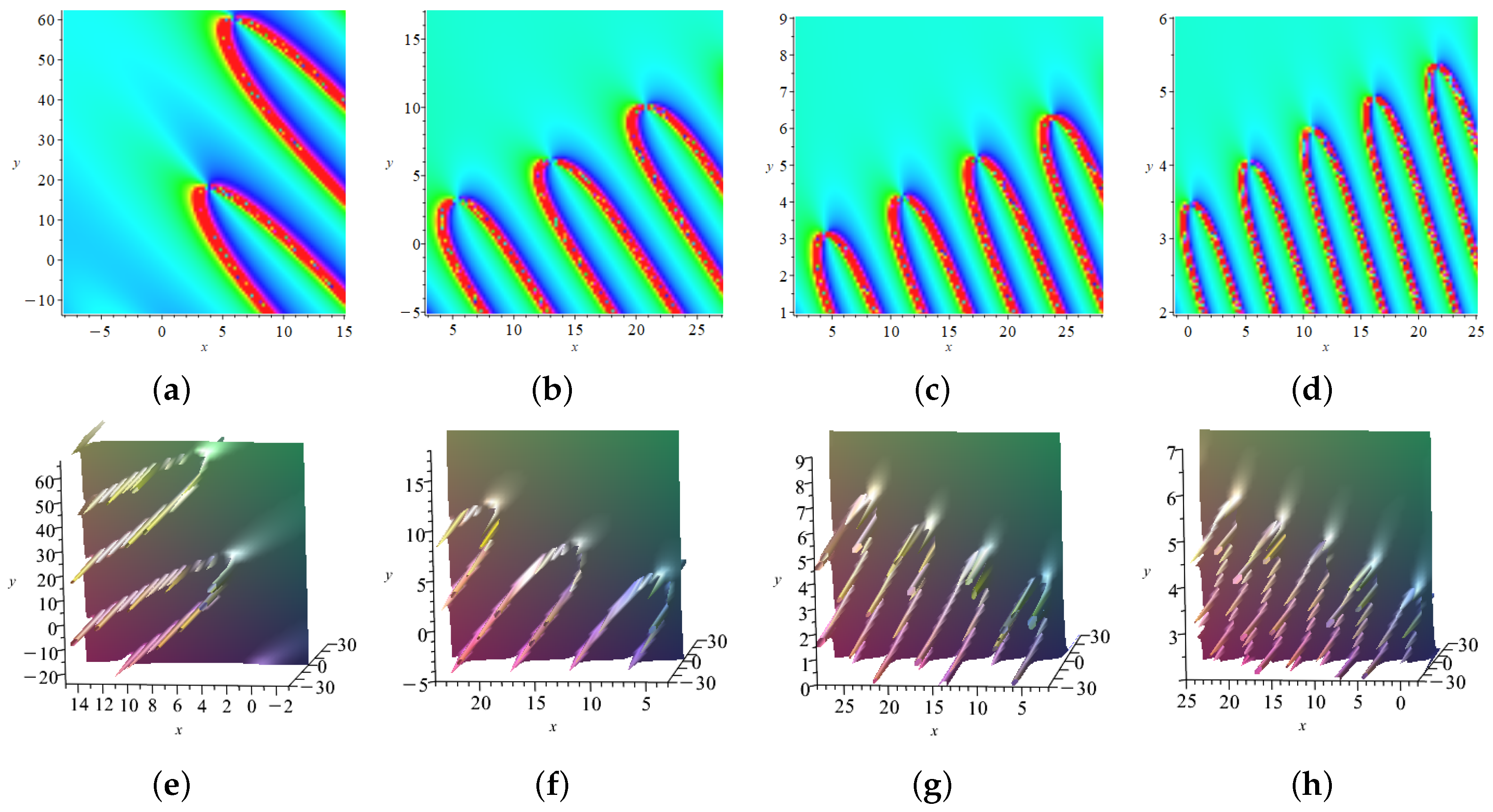
To more clearly describe the dynamic behavior of Equation (1), we performed a visualization analysis of the constructed resonant solution (28). Specifically, we characterized its spatial localization structure by plotting two-dimensional spatial amplitude density maps at specific time points, and depicted its time-dependent dynamical evolution through three-dimensional spatiotemporal evolution diagrams.
From Figure 1, it can be seen that as the number of resonance waves increases with the increase in N, the number of multiple resonance solutions in the complex field increases accordingly.
For resonant solutions, we find the following: (1) We study the relationship between the number of resonant waves and multiple resonant solutions, and find that they are directly proportional. At the same time, resonance waves exhibit periodicity and uniform amplitude. (2) The resonant solutions exhibit deterministic ballistic propagation characteristics, where the energy envelope moves at a constant velocity or undergoes periodic oscillations, and the mean square displacement (MSD) does not increase diffusively over time.

4. Rogue Wave Solution

Rogue waves are nonlinear local waves of different types. They are a key object in nonlinear science systems such as optical field and biophysics plasma. Therefore, finding rogue wave solutions [38,39,40] is of major practical significance to the research of physical appearance. In this section, a new ansatz form is used to construct the rogue wave solutions to the CDG equation. Next, we discuss the construction of the one-rogue wave solution to Equation (1).
We first express the linear form (19) of Equation (16) using a function f:
f 6 x f 6 f 5 x f x + 15 f 4 x f 2 x 10 f 3 x 2 + 5 ( f 3 x , y f + 3 f 2 x , y f x 3 f x y f 2 x f y f 3 x ) + 5 ( f y 2 f 2 y f ) + 36 ( f t x f f t f x ) = 0 .
In the next section, we construct a one-rogue wave solution to Equation (1). The form for f is as follows:
f ( x , y , t ) = q 0 + λ 1 2 + λ 2 2 , λ i = k i x + l i y + ω i t , i = 1 , 2 ,
where k i , l i , ω i C ( i = 1 , 2 ) , and q 0 > 0 .
Substituting (33) into (32), sort out the coefficients of λ 1 and λ 2 and let them take zero, and then the parameters satisfy
h 0 = 3 k 1 ( k 1 2 + k 2 2 ) 2 l 1 k 2 2 , k 1 = k 1 , k 2 = k 2 , l 1 = l 1 , l 2 = 0 , ω 1 = 5 k 1 l 1 2 36 k 1 2 + 36 k 2 2 , ω 2 = 5 k 2 l 1 2 36 k 1 2 + 36 k 2 2 ,
where k 1 , k 2 , l 1 C . According to the transformation
u = 2 ( ln f ) x ,
then substituting Equation (34) into Equation (32), the one rogue wave solution is obtained:
u = 4 M k 1 + 2 N k 2 h 0 + M 2 + N 2 ,
where
M = 5 k 1 l 1 2 36 k 1 2 + 36 k 2 2 + k 1 x + l 1 y , N = 5 k 2 l 1 2 36 k 1 2 + 36 k 2 2 5 k 2 l 1 2 36 k 1 2 + 36 k 2 2 + k 2 x .
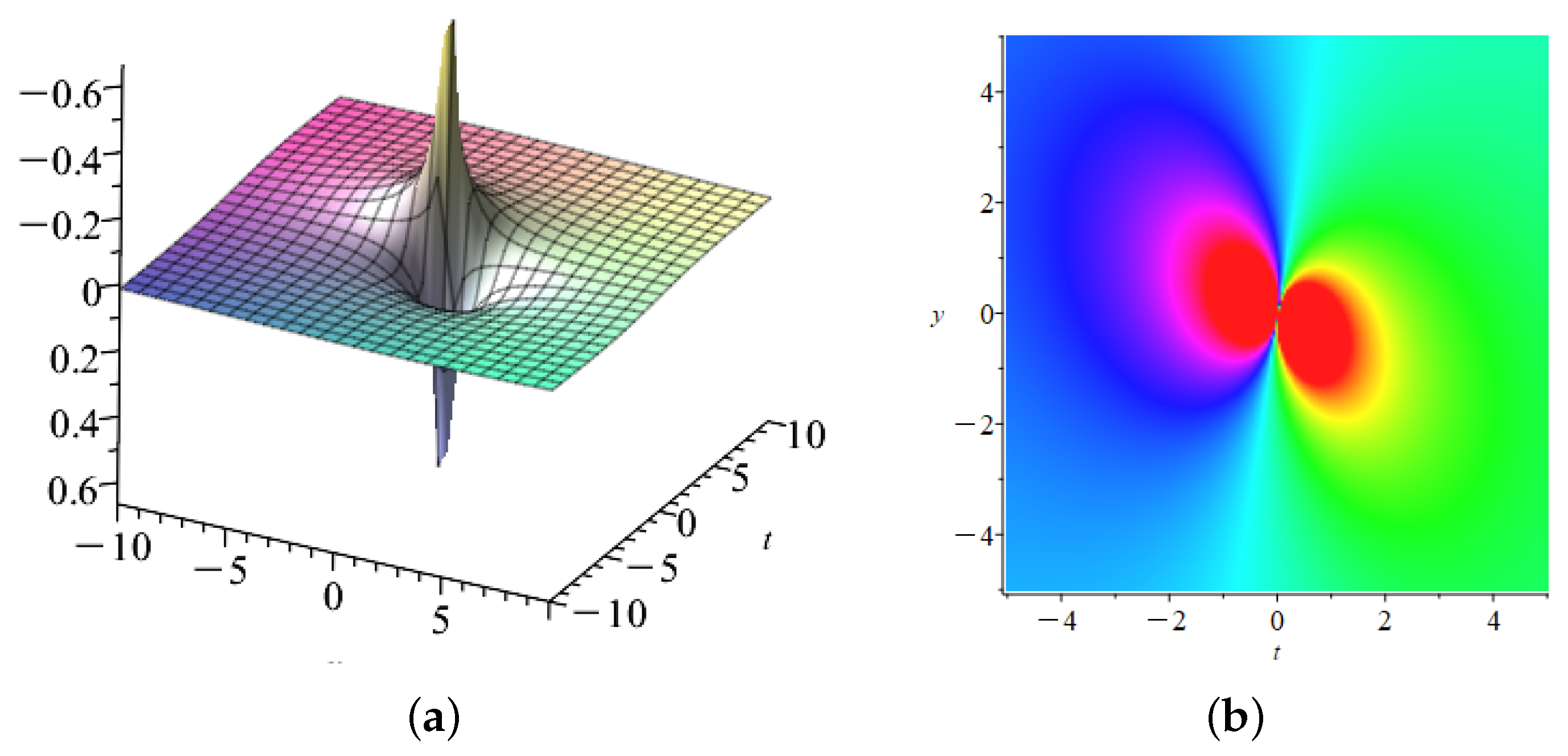
The 3-D diagram and density graph shown in Figure 2 are presented to illustrate the characteristics of the one-rogue wave solution (36).
Upon observing Figure 2, from the spatial image (a), it can be seen that the energy distribution diagram of this rogue wave can be found from the function density diagram (b), where the redder the color, the more concentrated the energy is. The energy distribution of this rogue wave is relatively uniform. The following are true for the rogue wave: (1) We studied its amplitude and energy density distribution. The upward and downward amplitudes are uniformly symmetrical, and the energy distribution of this rogue wave is relatively uniform. (2) The rogue wave solutions represent transient extreme events, where the MSD undergoes drastic changes within an extremely short timeframe, forming the peaks shown in the figure. However, in the long term, they do not exhibit ballistic or diffusive scaling, but instead revert to the calm state of the background wave.
In a similar way, we can also use this ansatz method to get the two-rogue wave solution for Equation (1). Similarly, define f as the expression
f = ( λ 1 x 2 + λ 2 y 2 + λ 3 t 2 ) 3 + λ 4 x 4 + λ 5 x 2 y 2 + λ 6 x 2 t 2 + λ 7 y 2 t 2 + λ 8 y 4 + λ 9 t 4 + λ 10 x 2 + λ 1 y 2 + λ 12 ,
where λ i ( i = 1 , , 12 ) are free constants. In the future, we shall construct multiple rogue wave solutions to the CDG equation by considering the function f as follows:
f ( x 1 , x 2 , , x n , t ) = k = n n ( p k 1 x k 1 + p k t k ) i , i = 1 , , m ,
where p k N , k = n , , n .

5. Discussion

The methods employed and results obtained in this paper differ from those reported in previous studies [19,20,24,25,27]. For example, Ma et al. [19] investigated bilinear equations and resonant solutions using Bell polynomials. Kou constructed multi-soliton solutions to two fifth-order KdV equations via the simplified linear superposition principle. While the results of this paper are associated with high-dimensional ((2+1)-dimensional) integrable PDE, the corresponding rogue wave and resonant solutions were obtained, differing from the results of methods used in previous studies. The results presented in this paper were obtained under related Theorems and specific frameworks (19) and (32).
Based on Refs. [3,4,41,42], the authors applied different time transformations to the corresponding equations, thereby facilitating the construction of various exact solutions. This approach also serves as an effective method for handling high-dimensional equations in future research. There may be numerous alternative approaches to finding exact solutions for the CDG equation beyond those discussed in this paper, including performing certain time transformations or using computational programs, etc. This remains an open and worthwhile area for further research.

6. Conclusions

This paper studies the CDG equation, in which the resonant solutions of N exponential waves and rogue wave are discussed. The resonant solutions to this considered equation are solved using the Hirota bilinear method. At the same time, the one-rogue wave solution is constructed by using different ansatz forms. Finally, by selecting different parameter values, three-dimensional and density figures of these solutions are generated to better investigate the nonlinear dynamical behavior of the equation.
In the future, we will analyze multiple rogue wave solutions to the CDG equation based on the form of the function f (38), and seek the exact solutions to and properties of other types of equations [43,44,45], including solitons, rogue waves, multi-breathers, rational solutions, symmetries, conservation law and so on. The study of the physical background and mathematical properties of these solutions holds significant importance for the advancement of the field of integrable system. The methods and theorems presented in this paper may represent a useful foundation for studying similar equation-solving problems. At the same time, there are many other methods and theories for finding the exact solutions to NLPDEs.

Author Contributions

Y.Z.: Methodology, Formal Analysis, Investigation. Y.S. and L.G.: Writing—original draft, Writing—Review and Editing. All authors have read and agreed to the published version of the manuscript.

Funding

This research was funded by the National Natural Science Foundation of China (grant numbers 12371256 and 11971475).

Data Availability Statement

The data is contained within the article.

Conflicts of Interest

The authors declare no conflicts of interest.

References

  1. Ali, M.R.; Khattab, M.A.; Mabrouk, S.M. Travelling wave solution for the Landau-Ginburg-Higgs model via the inverse scattering transformation method. Nonlinear. Dynam. 2023, 111, 7687–7697. [Google Scholar] [CrossRef]
  2. Deift, P.; Zhou, X. A Steepest Descent Method for Oscillatory Riemann-Hilbert Problems. Asymptotics for the MKdV Equation. Ann. Math. 1993, 137, 295–368. [Google Scholar] [CrossRef]
  3. Zhang, Y.F.; Gui, L.L.; Feng, B.L. Solutions of Cauchy Problems for the Gardner Equation in Three Spatial Dimensions. Symmetry 2025, 17, 102. [Google Scholar] [CrossRef]
  4. Zhang, Y.F.; Gui, L.L. Solutions of Cauchy Problems for the Caudrey-Dodd-Gibbon-Kotera-Sawada equation in three spatial and two temporal dimensions. Axioms 2024, 14, 11. [Google Scholar] [CrossRef]
  5. Udoh, A. Generalized stochastic Korteweg-de Vries equations, their Painlevé integrability, N-soliton and other solutions. Int. J. Geom. Methods. Mod. Phys. 2024, 21, 2450128. [Google Scholar]
  6. Omidi, M.; Arab, B.; Rasanan, A.H.; Rad, J.A.; Parand, K. Learning nonlinear dynamics with behavior ordinary/partial/system of the differential equations: Looking through the lens of orthogonal neural networks. Eng. Comput. 2022, 38, 1635–1654. [Google Scholar] [CrossRef]
  7. Sun, H.G.; Zhang, Y.; Baleanu, D.; Chen, W.; Chen, Y.Q. A new collection of real world applications of fractional calculus in science and engineering. Commun. Nonlinear. Sci. Numer. Simulat. 2018, 64, 213–231. [Google Scholar] [CrossRef]
  8. Zhang, Y.F.; Mei, J.Q.; Zhang, X.Z. Symmetry properties and explicit solutions of some nonlinear differential and fractional equations. Appl. Math. Comput. 2018, 337, 408–418. [Google Scholar] [CrossRef]
  9. Matveev, V.B.; Salle, M.A. Darboux Transformation and Solitons; Springer: Berlin/Heidelberg, Germany, 1991. [Google Scholar] [CrossRef]
  10. Gui, L.L.; Zhang, Y.F.; Han, S.Q. Solutions of initial value problems of two (3+2)-dimensional integrable nonlinear equations via Non-local ¯ -method. Commun. Appl. Math. Comput. 2025. [Google Scholar] [CrossRef]
  11. Tu, G.Z. Bäcklund transformation and conservation laws of the Boussinesq equation. Acta Math. Appl. Sin. 1981, 4, 63–68. [Google Scholar]
  12. Rady, A.S.; Osman, E.S.; Khalfallah, M. The homogeneous balance method and its application to the Benjamin-Bona-Mahoney equation. Appl. Math. Comput. 2010, 217, 1385–1390. [Google Scholar]
  13. Ibragimov, N.K.; Avdonina, E.D. Nonlinear self-adjointness, conservation laws, and the construction of solutions of partial differential equations using conservation laws. Russ. Math. Surv. 2013, 68, 889–921. [Google Scholar] [CrossRef]
  14. Hirota, R. Direct methods in soliton theory. In Solitons; Springer: Berlin/Heidelberg, Germany, 1980; pp. 157–176. [Google Scholar]
  15. Gui, L.L.; Zhang, Y.F. Inverse scattering transform for the (3+1)-dimensional Zakharov-Kuznetsov equation. Math. Method. Appl. Sci. 2025, 48, 13622–13631. [Google Scholar] [CrossRef]
  16. Gui, L.L.; Zhang, Y.F. The large t behaviour of solutions for a new generalized r-th dispersionless Harry Dym equation. Appl. Math. Letts. 2026, 173, 109768. [Google Scholar] [CrossRef]
  17. Ma, W.X.; Zhou, Y. Lump solutions to nonlinear partial differential equations via Hirota bilinear forms. Diff. Equat. 2018, 264, 2633–2659. [Google Scholar] [CrossRef]
  18. Wang, D.S.; Yin, S.J.; Tian, Y.; Liu, Y.F. Integrability and bright soliton solutions to the coupled nonlinear Schrodinger equation with higher-order effects. Appl. Math. Comput. 2014, 229, 296–309. [Google Scholar] [CrossRef]
  19. Ma, W.X. Bilinear equations and resonant solutions characterized by Bell polynomials. Rep. Math. Phys. 2013, 72, 41–56. [Google Scholar] [CrossRef]
  20. Zhou, Y.; Ma, W.X. Applications of linear superposition principle to resonant solitons and complexitons. Comput. Math. Appl. 2017, 73, 1697–1706. [Google Scholar] [CrossRef]
  21. Lou, S.Y.; Ruan, H.Y. Similarity reductions and nonlocal symmetry of the KdV Equation. Commun. Theor. Phys. 1996, 25, 241. [Google Scholar] [CrossRef]
  22. Wazwaz, A.M. Multiple-soliton solutions for extended (3+1)-dimensional Jimbo-Miwa equations. Appl. Math. Lett. 2017, 64, 21–26. [Google Scholar] [CrossRef]
  23. Wazwaz, A.M. The Hirota bilinear method and the tanh-coth method for multiple-soliton solutions of the Sawada-Kotera-Kadomtsev-Petviashvili equation. Appl. Math. Comput. 2008, 200, 160–166. [Google Scholar]
  24. Kuo, C.K. Resonant multi-soliton solutions to two fifth-order KdV equations via the simplified linear superposition principle. Modern. Phys. Lett. B 2019, 33, 1950299. [Google Scholar] [CrossRef]
  25. Wazwaz, A.M. Multiple soliton solutions for (2+1)-dimensional Sawada-Kotera and Caudrey-Dodd-Gibbon equations. Math. Methods Appl. Sci. 2011, 34, 1580–1586. [Google Scholar] [CrossRef]
  26. Qu, Q.-X.; Tian, B.; Sun, K.; Jiang, Y. Bäcklund transformation, Lax pair, and solutions for the Caudrey-Dodd-Gibbon equation. J. Math. Phys. 2011, 52, 013511. [Google Scholar] [CrossRef]
  27. Zhang, Y.F.; Tam, H.W. Discussion on integrable properties for higher-dimensional variable-coefficient nonlinear partial differential equations. J. Math. Phys. 2013, 54, 013516. [Google Scholar] [CrossRef]
  28. Ablowitz, M.J.; Satsuma, J. Solitons and rational solutions of nonlinear evolution equations. J. Math. Phys. 1978, 19, 2180–2186. [Google Scholar] [CrossRef]
  29. Yue, Y.; Huang, L.; Chen, Y. Localized waves and interaction solutions to an extended (3+1)-dimensional Jimbo-Miwa equation. Appl. Math. Lett. 2019, 89, 70–77. [Google Scholar] [CrossRef]
  30. Ünsal, Ö.; Ma, W.X. Linear superposition principle of hyperbolic and trigonometric function solutions to generalized bilinear equations. Comput. Math. Appl. 2016, 71, 1242–1247. [Google Scholar] [CrossRef]
  31. Ma, W.X. Bilinear equations, Bell polynomials and linear superposition principle. J. Phys. Conf. 2013, 411, 012021. [Google Scholar] [CrossRef]
  32. Shen, Y.J.; Gao, Y.T.; Yu, X.; Meng, G.Q.; Qin, Y. Bell-polynomial approach applied to the seventh-order Sawada-Kotera-Ito equation. Appl. Math. Comput. 2014, 227, 502–508. [Google Scholar] [CrossRef]
  33. Liu, J.G.; Yang, X.J.; Feng, Y.Y. Resonant multiple wave solutions to some integrable soliton equations. Chin. Phys. B 2019, 28, 96–102. [Google Scholar] [CrossRef]
  34. Cheng, X.W.; Zhang, Z.G.; Yang, H.W. The (3+1)-dimensional generalized mKdV-ZK equation for ion-acoustic waves in quantum plasmas as well as its non-resonant multiwave solution. Chin. Phys. B 2020, 29, 387–397. [Google Scholar] [CrossRef]
  35. Huang, L.L.; Chen, Y. Lump solutions and interaction phenomenon for (2+1)-dimensional Sawada–Kotera equation. Commun. Theor. Phys. 2017, 67, 473. [Google Scholar] [CrossRef]
  36. Lü, X.; Tian, B.; Sun, K.; Wang, P. Bell-polynomial manipulations on the Bäacklund transformations and Lax pairs for some soliton equations with one Tau-function. J. Math. Phys. 2010, 51, 113506. [Google Scholar] [CrossRef]
  37. Ma, W.X. Trilinear equations, Bell polynomials, and resonant solutions. Front. Math. Chin. 2013, 8, 1139–1156. [Google Scholar] [CrossRef]
  38. Yue, Y.; Huang, L.; Chen, Y. N-solitons, breathers, lumps and rogue wave solutions to a (3+1)-dimensional nonlinear evolution equation. Comput. Math. Appl. 2018, 75, 2538–2548. [Google Scholar] [CrossRef]
  39. Villarroel, J.; Prada, J.; Estévez, P.G. Dynamics of lump solutions in a (2+1)-dimensional NLS equation. Stud. Appl. Math. 2009, 122, 395–410. [Google Scholar] [CrossRef]
  40. Liu, Y.K.; Li, B. Dynamics of rogue waves on multisoliton background in the Benjamin Ono equation. Pramana 2017, 88, 57. [Google Scholar] [CrossRef]
  41. Gui, L.L.; Zhang, Y.F. The inverse spectral method, nonlinear Fourier transforms and integrability of the high-dimensional Date-Jimbo-Kashiwara-Miwa equation. Chaos Solitons Fractals 2025, 199, 116884. [Google Scholar] [CrossRef]
  42. Liang, Y.; Wang, W.; Metzler, R.C.A.G. Anomalous diffusion, nonergodicity, non-Gaussianity, and aging of fractional Brownian motion with nonlinear clocks. Phys. Rev. E 2023, 108, 034113. [Google Scholar] [CrossRef]
  43. Zhang, Y.F.; Gui, L.L. Inverse scattering transform for the two-dimensional B-type Kadomtsev-Petviashvili equation. J. Comput. Appl. Math. 2026, 474, 117011. [Google Scholar] [CrossRef]
  44. Akinyemi, L.L.; Manukure, S.; Houwe, A.; Abbagari, S. A study of (2+1)-dimensional variable coefficients equation: Its oceanic solitons and localized wave solutions. Phys. Fluids. 2024, 36, 18. [Google Scholar] [CrossRef]
  45. Gui, L.L.; Zhang, Y.F.; Han, S.Q. The ¯ -dressing method for the (2+1)-dimensional Harry Dym equation. J. Appl. Anal. Comput. 2025, 15, 3465–3479. [Google Scholar]
Figure 1. (Color online) 3-D and 2-D figures (ah) of the complex solutions in Equation (28) with θ i = 0 , ( 1 i 5 ) , λ i = 1 , δ i = 1 , a = 1 , b = 1 4 , t = 10 , where (a,e) N 1 = 1 , N = 3 , l 1 = 0.2 ; (b,f) N 2 = 2 , N = 5 , l 1 = 0.2 , l 2 = 0.4 ; (c,g) N 3 = 3 , N = 7 , l 1 = 0.2 , l 2 = 0.4 , l 3 = 0.6 ; and (d,h) N 4 = 4 , N = 9 , l 1 = 0.2 , l 2 = 0.4 , l 3 = 0.6 , l 4 = 0.8 .
Symmetry 18 00332 g001
Figure 2. (Color online) 3-D (a) and 2-D (b) figures of one-rogue wave with k 1 = 0.02 , k 2 = 0.1 , l 1 = 1 .
Symmetry 18 00332 g002
Disclaimer/Publisher’s Note: The statements, opinions and data contained in all publications are solely those of the individual author(s) and contributor(s) and not of MDPI and/or the editor(s). MDPI and/or the editor(s) disclaim responsibility for any injury to people or property resulting from any ideas, methods, instructions or products referred to in the content.