Article

Harnessing Symmetry in Recurrence Plots: A Multi-Scale Detail Boosting Approach for Time Series Similarity Measurement

School of Mechanical Engineering, Shandong University of Technology, Zibo 255049, China
*
Author to whom correspondence should be addressed.
Symmetry 2026, 18(2), 290; https://doi.org/10.3390/sym18020290
Submission received: 30 December 2025 / Revised: 26 January 2026 / Accepted: 2 February 2026 / Published: 4 February 2026
(This article belongs to the Section Mathematics)

Abstract

Time series similarity measurement is a fundamental task underpinning clustering, classification, and anomaly detection. Traditional approaches predominantly rely on one-dimensional data representations, which often fail to capture complex structural dependencies. To address this limitation, this paper proposes a novel similarity measurement framework based on two-dimensional image enhancement. The method initially transforms one-dimensional time series into recurrence plots (RPs), converting temporal dynamics into visually symmetric textures, enhancing the temporal information of the one-dimensional time series. To overcome the potential blurring of fine-grained information during transformation, multi-scale detail boosting (MSDB) is introduced to amplify the high-frequency components and textural details of the RP images. Subsequently, a pre-trained ResNet-18 network is utilized to extract deep visual features from the enhanced images, and the similarity is quantified using the Euclidean distance of these feature vectors. Extensive experiments on the UCR Time Series Classification Archive demonstrate that the proposed method effectively leverages image enhancement to reveal latent temporal patterns. This approach leverages the inherent symmetry properties embedded in recurrence plots. By enhancing the texture of these symmetrical structures, the proposed method provides a more robust and informative basis for similarity assessment.

1. Introduction

As the economy advances and the big data era emerges, individuals may readily access vast quantities of data, hence facilitating the advancement of data mining technology [1,2,3]. The assessment of similarity in time series represents a basic barrier within the myriad responsibilities of data mining [4]. The solution to the similarity measurement problem is not only directly related to the similarity search and clustering of time series, but also provides basic tools for outlier detection, pattern recognition, segmentation, and other tasks. Thus, examining the similarity assessment of time series is really important.
In 1993, Agrawal et al. [5] first proposed and solved the time series similarity. The representation of features and evaluation of similarity in time series have increasingly emerged as a prominent topic in the study of time series data mining. The earliest method utilized to evaluate the similarity of series was Euclidean distance (ED) [5]. Although ED was the most commonly used similarity measuring approach [6], the requirement for time series to possess identical lengths restricts their broad applicability. To deal with this issue, Dynamic Time Warping (DTW) [7,8] and longest common subsequence (LCS) [9,10], which are elastic time series similarity assessment methods based on ‘one-to-many’ or ‘one-to-zero’ approaches, were developed. In addition, methods for measuring similarity based on time series symbolization [11], change trend [12], and shape [13] were presented to address the complexities and time-consuming nature of DTW and LCS calculations. Despite the existence of numerous ways for assessing the similarity of time series, these approaches fundamentally relied on the one-dimensional representation of time series for their evaluations.
With the improvement of computing power and algorithms, deep learning methods have been used in time series analysis [14,15]. With the development of computer vision based on the convolutional neural network (CNN), time series began to be transformed into two-dimensional images for classification [16]. For the high-frequency signals such as bearings and gearboxes, the time-frequency spectrogram was used to convert time series into images and used as the input of CNN for the classification of bearings and gearboxes [17,18]. For the low-frequency signals, the time-frequency spectrogram cannot reflect the differences between signals. At this time, the series was usually converted into an image from the perspective of the time-domain waveform. Gramian Angular Fields [16] and recurrence plots (RPs) [19] were the two most used methods. For example, Yang et al. [20,21] employed Gramian Angular Fields to introduce an image aggregation technique aimed at addressing the classification challenge of time series. A fault identification method for gear groups using RP was proposed by Wang et al. [22]. In addition, Souza et al. [23] realized the classification of time series by extracting texture features from RP. Consequently, one-dimensional series have been converted into two-dimensional images, and a computer vision method was employed to address the classification problem of time series. These outcomes were markedly superior to the conventional procedures. Nonetheless, all approaches employed established classifiers for time series classification, and no algorithm existed for assessing similarity between time series.
Additionally, to conform to the visual characteristics of human perception and aid machine recognition, the image enhancement technique was utilized to highlight image details, reduce noise interference, and enhance the difference between the object of information and the backdrop. The image enhancement algorithm is typically categorized into two types: spatial domain improvement and frequency domain improvement [24]. The spatial domain enhancement algorithm was to directly calculate the pixels. Spatial domain filtering and point operation were the two most commonly used methods. For example, Kumar et al. [25] proposed a novel triple clipped histogram-model-based fusion method to improve the visual quality of medical images. Li et al. [26] introduced a novel low-light picture enhancement technique grounded in the degradation model to pre-enhance low-light inputs while preserving visual appeal. In addition, the frequency domain enhancement algorithm needed to transform the original image into the transform domain for processing, and the processed results were transformed into the spatial domain through inverse transformation. For example, Zhao et al. [27] introduced an edge detail enhancement technique for high-dynamic range images to enhance recognition accuracy and efficiency. Zhang et al. [28] proposed a color correction and Bi-interval contrast enhancement method to improve the quality of underwater images. In addition, two methods are sometimes fused to achieve image enhancement. Joseph et al. [29] proposed a hybrid spatial-frequency domain global thresholding filter-based preprocessing for Synthetic Aperture Radar image enhancement. The aforementioned methods can partially restore or augment valuable information in the image using the image enhancement algorithm, hence rendering the processed image more favorable for evaluation by machines or humans.
Consequently, to improve the accuracy of time series similarity evaluation using images, we propose a method based on recurrence plots (RPs) and multi-scale detail boosting (MSDB). RP denotes that the preliminary series is initially transformed into an image with a symmetrical structure. The transformed image undergoes detail texture enhancement through MSDB to convey comprehensive details of the time series. Thereafter, ResNet-18 is utilized to extract features from the image due to its advantageous balance between performance and computational complexity. ResNet-18 provides sufficient depth to capture the structural features of RP while maintaining efficiency, making it an ideal choice for this specific task. The resemblance of a series of times can finally be measured using Euclidean distance. This work’s novel contributions mostly include two areas. (1) The modified series of images was employed to evaluate the similarity of time series, hence augmenting the valuable information in the similarity assessment process. (2) MSDB was utilized to enhance the waveform data of the time series illustrated in the transformed image, hence improving the accuracy of time series similarity evaluation.
The ensuing organization of the paper is outlined as follows: Section 2 presents the fundamental concepts of recurrence plots and multi-scale detail boosting. Section 3 presents a method for measuring time series similarity using image enhancement. Section 4 outlines the validation results and assesses the effectiveness. The conclusion is located in Section 5.

2. Background Theory

2.1. The Theory of Recurrence Plots

Despite the longstanding history of the notion of recurrences, a comprehensive study of recurrence through numerical simulation and empirical measurements was not feasible until the advent of computers [30]. The recurrence plots (RPs) were proposed by Eckmann et al. [19] to illustrate series through the analysis of distance areas, which could effectively represent nearly all data types without bias or limitations on their characteristics. This strategy clarifies the connection between the current point and other points along the route. For a time series X = x 1 , x 2 , x N , the RP without threshold is defined as follows [23]:
R i , j = x i x j ,                   i , j = 1 , 2 , , N
where N is the number of series.

2.2. The Theory of Multi-Scale Detail Boosting

Multi-scale detail boosting (MSDB) was proposed by Kim et al. [31] to improve local visibility by including high-frequency components in the image for enhancement. The core idea of MSDB was similar to Retinex. Initially, varying amounts of detailed information were acquired by removing the three scales of Gaussian blur from the original image. Subsequently, integrate these details into the original image to enhance the original image information. For an image I , a multi-scale approach using differences of Gaussians (DoGs) was adopted to boost details. Three distinct blurred images were generated by applying Gaussian kernels on I as follows.
B 1 = G 1 I B 2 = G 2 I B 3 = G 3 I
where G 1 , G 2 , and G 3 were the Gaussian kernels with the standard deviations σ 1 = 1 , σ 2 = 2 , and σ 3 = 4 , respectively [31]. Then the fine detail D 1 , the middle detail D 2 , and the coarse detail D 3 were extracted as follows.
D 1 = I B 1 D 2 = B 1 B 2 D 3 = B 2 B 3
The overall detailed image D was generated by merging the three layers as follows.
D = 1 ω 1 × sgn D 1 × D 1 + ω 2 × D 2 + ω 3 × D 3
where ω 1 , ω 2 , and ω 3 were fixed to 0.5, 0.5, and 0.25, respectively [31]. Finally, the enhanced image I can be obtained by adding the detailed image to I .

3. The Proposed Method

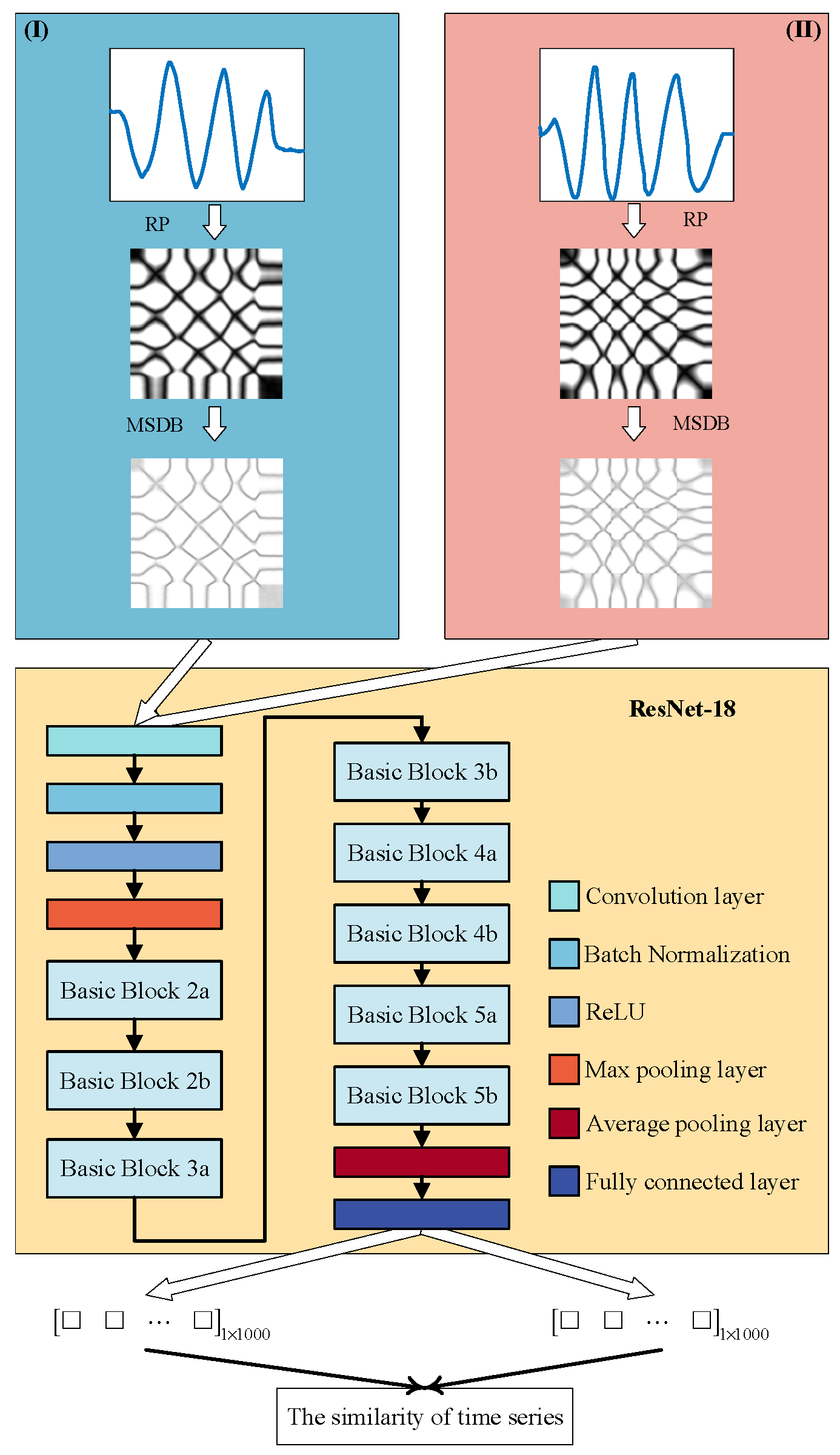
The convolutional neural network (CNN), which was proposed by Kunihiko Fukushima [32], was widely used in image recognition. In addition, some researchers transformed time series into images and realized time series classification and recognition with the help of CNN [16,20,21,22]. However, the above methods were based on the original images transformed from time series to achieve classification and recognition. As a localized detail improvement algorithm, MSDB may proficiently augment the intricate details within the image [31]. Furthermore, the geometric characteristics of time series were primarily represented by the lines in the recurrence plot (RP). Consequently, utilizing images derived from time series and CNN, this work integrated MSDB to facilitate the similarity assessment of time series. For the series X = x 1 , x 2 , , x n and Y = y 1 , y 2 , , y n , the similarity obtained by the proposed method was as follows, and the calculation sketch diagram was shown in Figure 1.
Step 1: The time series X = x 1 , x 2 , , x n and Y = y 1 , y 2 , , y n were transformed to RP as follows:
R X i , j = x i x j ,                   i , j = 1 , 2 , , N
R Y i , j = y i y j ,                   i , j = 1 , 2 , , N
Step 2: The transformed images R X i , j and R Y i , j were further used to calculate the three differently blurred images as follows:
X B 1 = G 1 R X i , j     ,     X B 2 = G 2 R X i , j     ,     X B 3 = G 3 R X i , j  
Y B 1 = G 1 R Y i , j     ,     Y B 2 = G 2 R Y i , j     ,     Y B 3 = G 3 R Y i , j  
where G 1 , G 2 , and G 3 were the Gaussian kernels with the standard deviations σ 1 = 1 , σ 2 = 2 , and σ 3 = 4 , respectively.
Step 3: The fine detail X D 1 and Y D 1 , the middle detail X D 2 and Y D 2 , and the coarse detail X D 3 and Y D 3 were extracted as follows:
X D 1 = R X i , j X B 1     ,     X D 2 = X B 1 X B 2     ,     X D 3 = X B 2 X B 3  
Y D 1 = R Y i , j Y B 1     ,     Y D 2 = Y B 1 Y B 2     ,     Y D 3 = Y B 2 Y B 3  
Step 4: The overall detailed image X D and Y D were generated by merging the three layers as follows:
X D = 1 ω 1 × sgn X D 1 × X D 1 + ω 2 × X D 2 + ω 3 × X D 3
Y D = 1 ω 1 × sgn Y D 1 × Y D 1 + ω 2 × Y D 2 + ω 3 × Y D 3
where ω 1 , ω 2 , and ω 3 were fixed to 0.5, 0.5, and 0.25, respectively.
Step 5: The enhanced image R X and R Y were obtained as follows:
R X = R X i , j + X D
R Y = R Y i , j + Y D
Step 6: Utilize ResNet-18 to extract the features from R X and R Y . Where the outputs O i X i = 1 1000 and O j Y j = 1 1000 of fully connected layer were designated as the features of R X and R Y .
Step 7: The similarity of time series X = x 1 , x 2 , , x n and Y = y 1 , y 2 , , y n was obtained according to the Euclidean distance between O i X i = 1 1000 and O j Y j = 1 1000 .
S i m X Y =       i = 1 1000 O i X O j Y 2
where S i m X Y is the similarity between the time series X = x 1 , x 2 , , x n and Y = y 1 , y 2 , , y n . The smaller S i m X Y , the higher similarity of X and Y .

4. Results and Discussion

4.1. Description of Dataset and Evaluation Methodologies

The dataset on the UCR Time Series Classification/Clustering Homepage [33] comprises several types and has been extensively utilized in the domain of time series mining. Consequently, this experiment utilized the 30 sets of series. The comprehensive details of the utilized dataset are presented in Table 1. The evaluation methodologies refer to Ref. [34].

4.2. Calculation Results

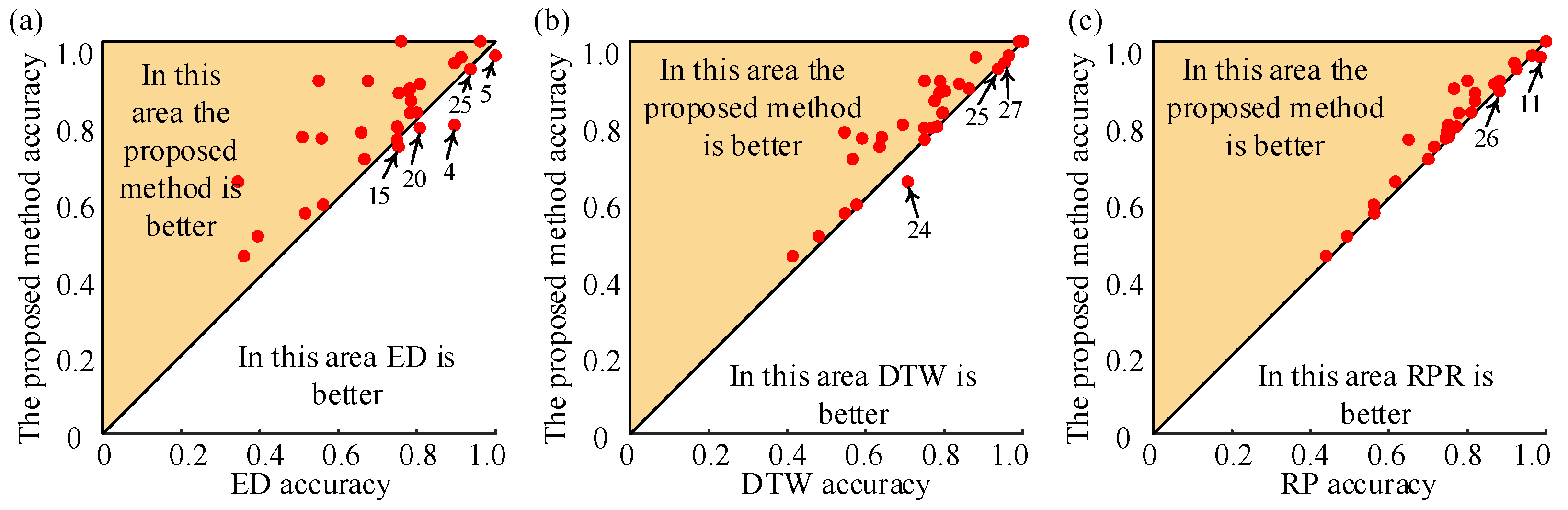
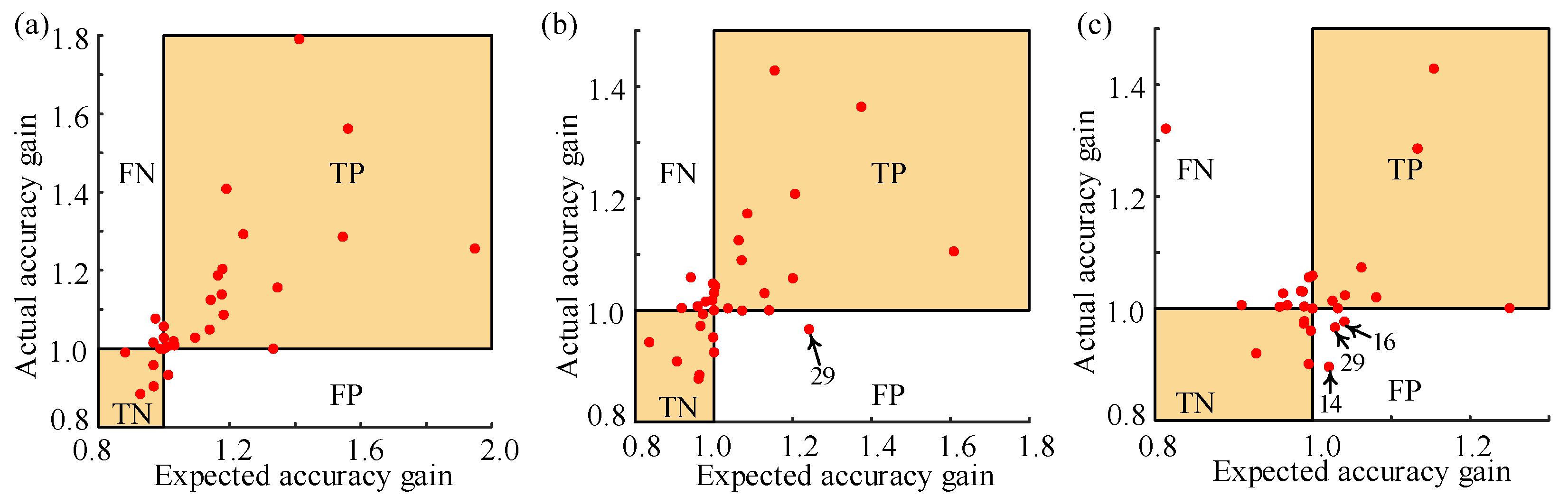
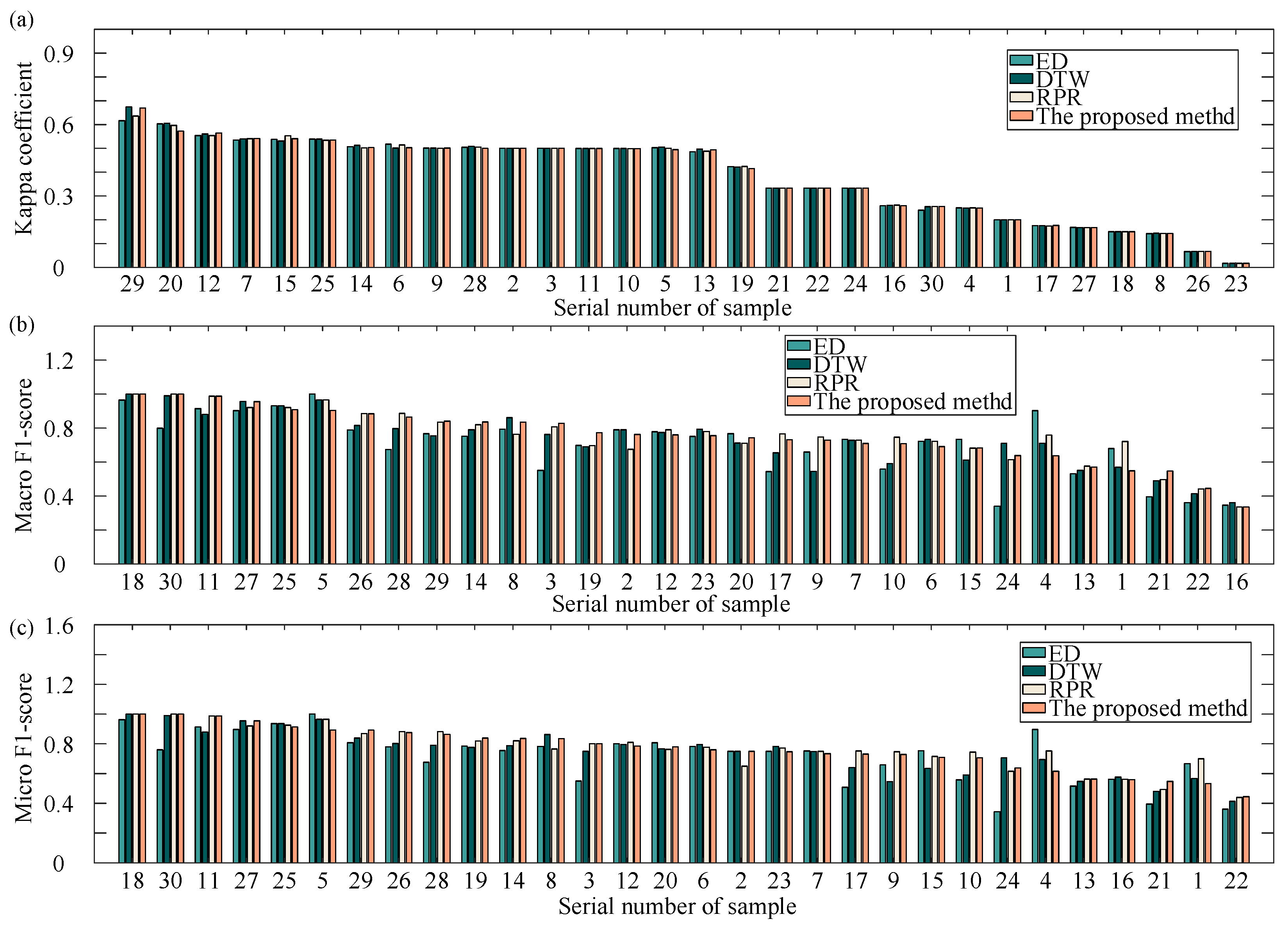
The proposed method is evaluated against established similarity measurement techniques, namely ED and DTW, in addition to the similarity measurement approach employing RP and ResNet-18 (RPR). The results are presented in Figure 2, Figure 3 and Figure 4. Figure 2 illustrates the overall classification accuracy of several approaches, Figure 3 depicts the Texas sharpshooter plot, and Figure 4 displays the evaluation results for each class.
Figure 2 illustrates that the classification accuracy of the proposed method surpassed that of the other three methods. In comparison to the ED, as illustrated in Figure 2a, the classification accuracy of 21 datasets is markedly inferior to that of the proposed method, while 3 datasets exhibit marginally lower accuracy, 1 dataset matches the proposed method, and only the 4th, 5th, 15th, 20th, and 25th datasets surpass the proposed method’s accuracy. Furthermore, Figure 2b illustrates that the proposed method’s classification accuracy across 15 datasets is markedly superior to that of DTW, while 9 datasets exhibit a marginally higher accuracy than DTW, 3 datasets demonstrate equivalent accuracy to the proposed method, and the 24th, 25th, and 27th datasets show lower accuracy than DTW. As illustrated in Figure 2c, while the proposed method’s classification accuracy is not universally superior to that of RPR, it generally exceeds RPR’s performance. Specifically, the proposed method demonstrates significantly higher accuracy on 7 datasets, slightly higher accuracy on 16 datasets, equivalent accuracy on 5 datasets, and lower accuracy on only the 11th and 26th datasets compared to RPR. The current findings indicate that the proposed technique outperformed ED, DTW, and RPR. The evaluation of similarity in two-dimensional image series can be augmented by refining the images generated from the series.
Figure 3 illustrates that the majority of the sites are situated in the TP and TN areas. Although several locations do not reside within the true positive and true negative regions, they are predominantly located around the boundary. As depicted in Figure 3a, there are unequivocally 14 points in the TP area, while 3 points are unmistakably located in the TN area. Figure 3b illustrates that nine locations are definitively situated in the TP zone, whilst four sites are clearly located in the TN area. Furthermore, Figure 3c illustrates the existence of five points in the TP area and one point in the TN area. Thus, an enhanced method may be discerned from the distribution of points in the TP and TN areas utilizing the training set. Moreover, except for the 29th point in Figure 3a and the 14th, 16th, and 29th points in Figure 3c, although several points reside in the FP and FN areas, they are predominantly situated along the boundary. Consequently, the proposed technique outperforms ED, DTW, and RPR for an unidentified dataset.
The comprehensive assessment of the dataset indicates that the proposed technique outperformed ED, DTW, and RPR substantially. The proposed strategy will subsequently be validated from the perspective of each class within the dataset. The proposed approach has a higher Kappa coefficient than ED in 11 datasets, higher than DTW in 9 datasets, and higher than RPR in 11 datasets, as shown in Figure 4a. In addition, the proposed approach has a Kappa coefficient that is the same as ED’s in 7 datasets, the same as DTW’s in 8 datasets, and similar to RPR’s in 10 datasets. Figure 4b illustrates that the M a c r o       F 1 of the proposed technique surpasses that of ED in 19 datasets, exceeds that of DTW in 15 datasets, and outperforms that of RPR in 12 datasets. Moreover, the M a c r o       F 1 of the proposed technique is equivalent to that of DTW in one dataset and matches that of RPR in three datasets. Figure 4c illustrates that the M i c r o       F 1 of the proposed technique is higher than ED in 18 datasets, higher than DTW in 16 datasets, and higher than RPR in 10 datasets. Moreover, the M i c r o       F 1 of the proposed technique is the same as ED’s in one dataset, the same as DTW’s in three datasets, and similar to RPR’s in five datasets. Consequently, in terms of the evaluation methodology for each class, the proposed approach demonstrates a considerable superiority over ED and DTW, and a marginal advantage over RPR.
In summary, these results indicate that the proposed technique outperforms ED, DTW, and RPR. Moreover, the outcome of image-based time series similarity measurement can be further refined by augmenting the picture derived from the time series.

4.3. Analysis of the Proposed Method’s Effectiveness

The results of the above correlational analysis show that the proposed method is better than ED, DTW, and RPR. Then, in this section, the reasons for the performance improvement of the proposed method are analyzed from the perspective of the visualization of ResNet-18 output as follows.

4.3.1. ResNet-18 Output Visualization

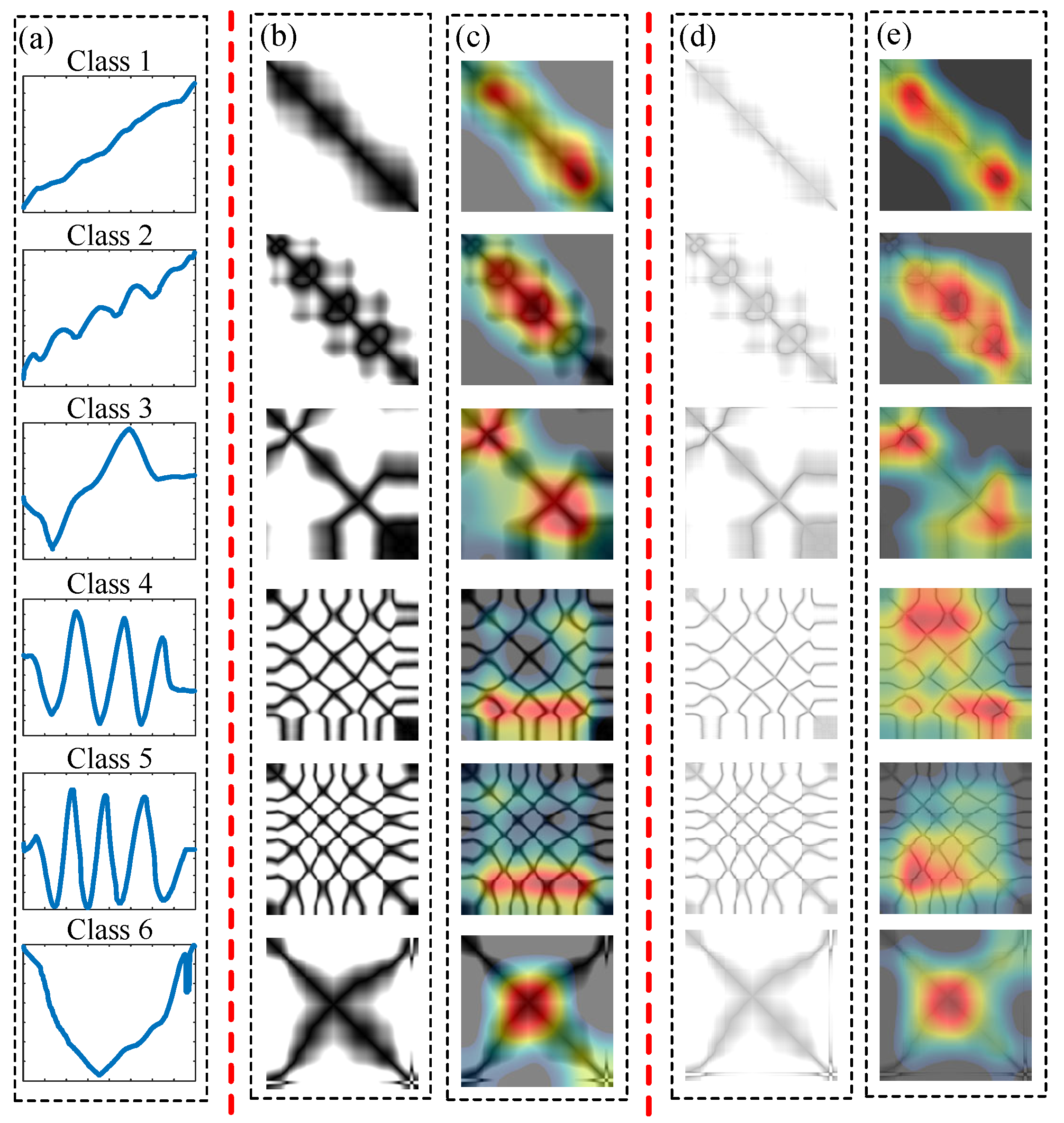
To demonstrate the efficacy of the proposed method, the Symbols datasets from UCR are utilized. The RP, the RP after MSDB, and the related class activation mapping (CAM) [35] of Res5b_relu in ResNet-18 are computed, as depicted in Figure 5.
As demonstrated in Figure 5a,b, the intersections of lines in the recurrence plots (RPs) match the tops and bottoms of the initial time series, which indicates that RPs can successfully encapsulate the shape details of the series. Furthermore, the RP calculation algorithm may also reveal the temporal correlation information among each point. Consequently, RP can maintain the shape characteristics of the initial series while simultaneously augmenting the temporal correlation among each point. Consequently, RP can be utilized to evaluate the similarity of time series. The comparison of Figure 5b,d demonstrates that the boundary information in the image is augmented, highlighting the primary lines of detail after MSDB. The form features of time series in RP can be enhanced. Moreover, as depicted in Figure 5c,e, the focal regions of ResNet-18 predominantly aligned with the textural sections of the image. The focal regions of ResNet-18 in Figure 5e were slightly more extensive than those in Figure 5c. Consequently, the features of the series in RP may be effectively extracted using ResNet-18.
Transforming the series into a two-dimensional image enhances both the temporal information of each data point and the structural aspects of the time series. Furthermore, MSDB can enhance the shape information of the series in RP. The image’s form characteristics can be extracted via ResNet-18. Thus, the proposed method can improve the results of similarity measurement to some extent.

4.3.2. Classification Features Visualization

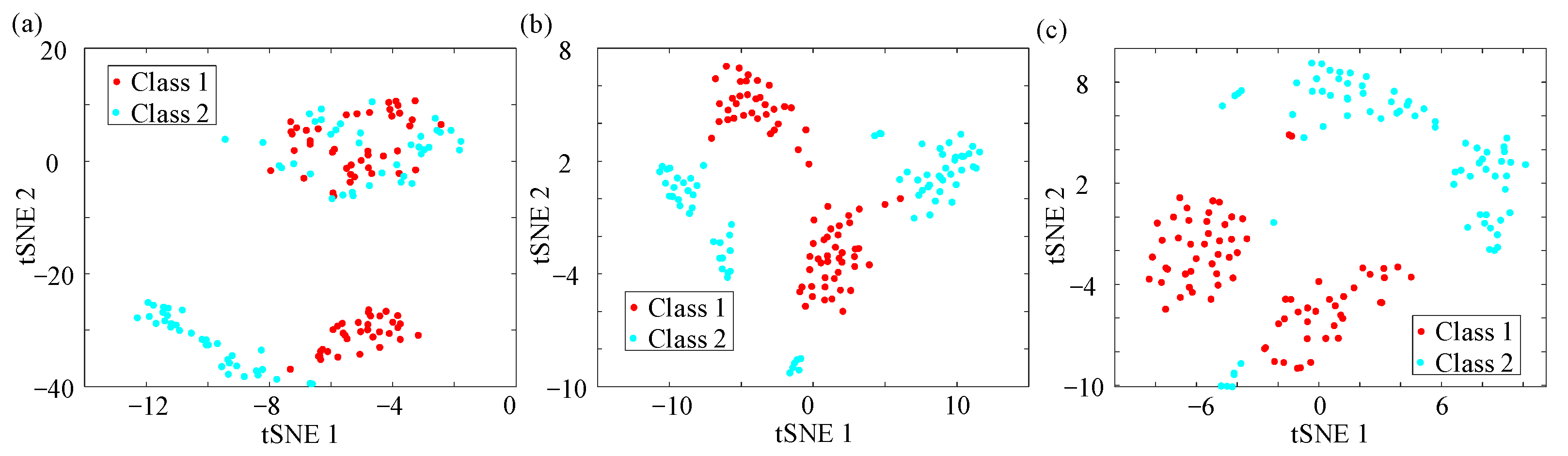
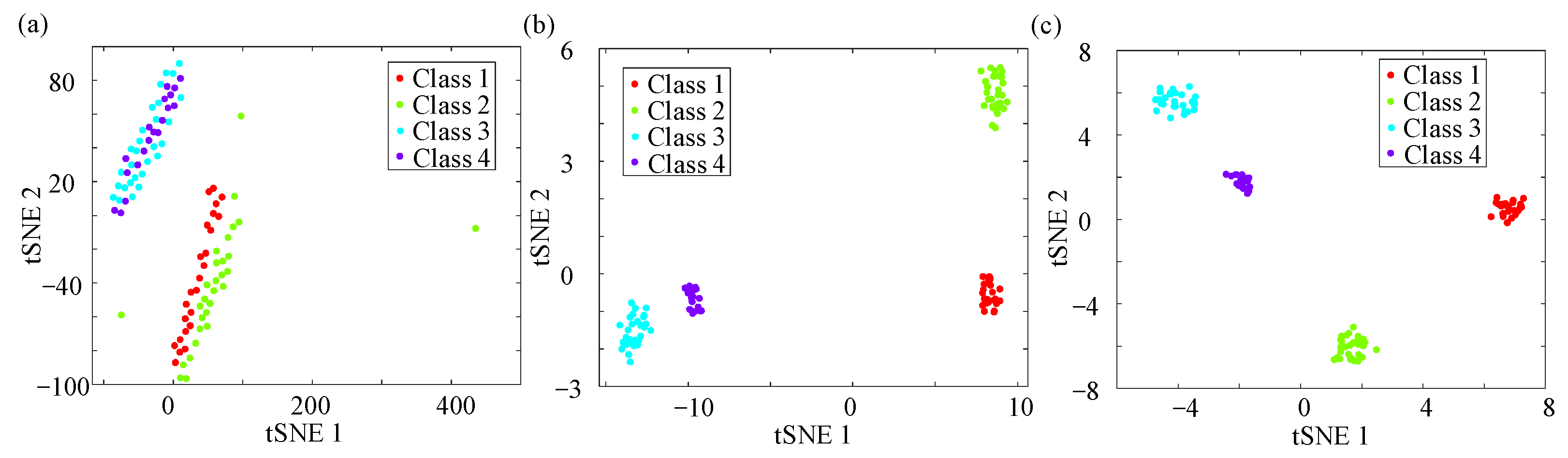
Through the above ResNet-18 output visualization, the reason why the proposed method is effective can be explained. Next, the reason for the improvement of classification accuracy would be explained from the perspective of classification feature visualization, where t-SNE [36] is one of the most prevalent methods for displaying classification features by projecting them onto a two-dimensional space. The t-SNE results for the Gun_Point and Trace datasets from UCR are illustrated in Figure 6 and Figure 7, respectively. The initial time series function as classification characteristics for ED and DTW, whereas the ResNet-18 output is employed as classification features for RPR and the proposed approach.
Figure 6a and Figure 7a illustrate a notable degree of overlap among the classes in the original time series. Despite the absence of apparent overlap across the classes in Figure 6b,c and Figure 7b,c, the classes depicted in Figure 6c and Figure 7c exhibit more clustering compared to those in Figure 6b and Figure 7b. In comparison to Figure 6b and Figure 7b, the identical classes in Figure 6c and Figure 7c exhibit greater clustering, while disparate classes display increased dispersion. Consequently, the proposed method should facilitate the categorization among diverse categories and enhance classification accuracy to some degree.
In summary, the proposed approach enhances the separation of classification features among distinct classes and improves aggregation within identical classes. Furthermore, the classification problem can be resolved with greater ease, and the accuracy of classification can be enhanced to a certain degree.

4.4. Selection of Parameters in MSDB

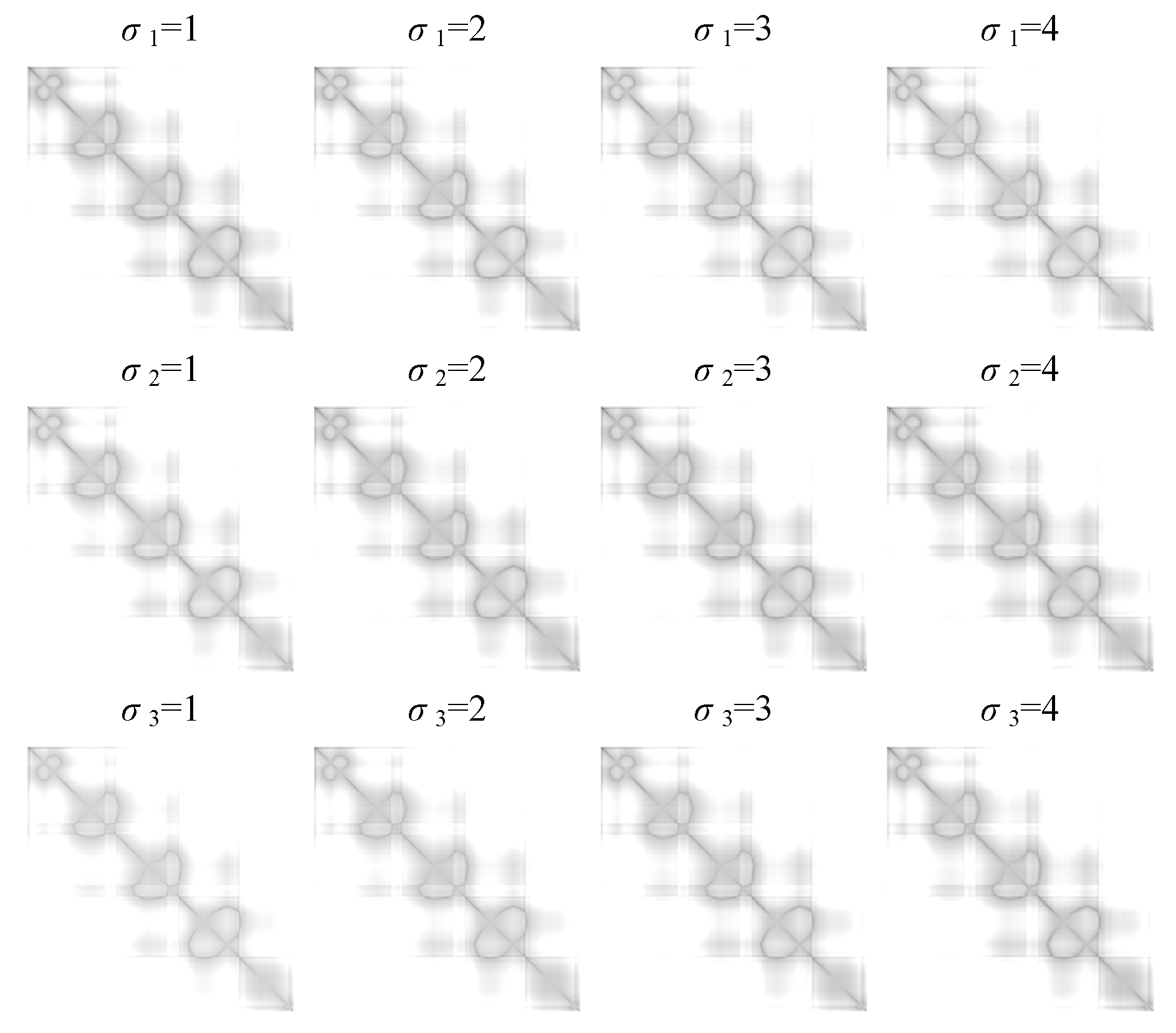
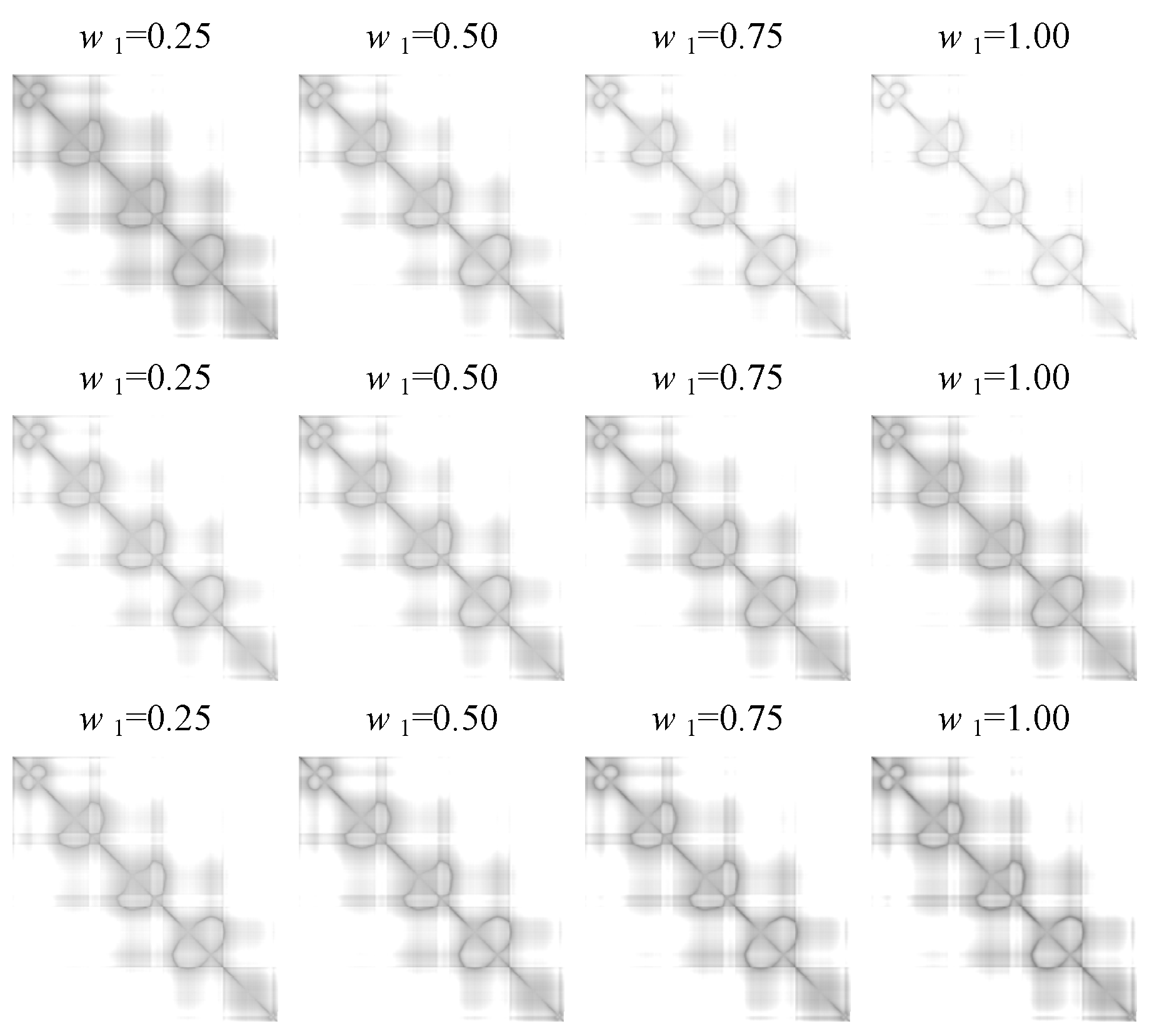
MSDB requires the setting of six parameters during the image detail enhancement, specifically the kernel function standard deviations σ 1 , σ 2 , σ 3 and weights w 1 , w 2 , w 3 . The impact of different parameters on image detail enhancement and similarity measurement results is discussed as follows. The detail enhancement results of MSDB under different standard deviations are shown in Figure 8. The similarity measurement results under different kernel function standard deviations are shown in Table 2. The detail enhancement results of MSDB under different weights are shown in Figure 9. The similarity measurement results under different weights are shown in Table 3.
As shown in Figure 8, the kernel function standard deviation has little difference in enhancing image details, and the MSDB results under different parameters are not significantly different. For σ 1 , σ 2 , σ 3 , it is shown that as the parameters decrease, the main texture becomes more prominent and the blurry details decrease. In addition, the differences in similarity measurement results under different kernel function standard deviations are not significant, with a maximum relative error of only 5.47%. The impact of different weights on MSDB results is greater than that of different kernel function standard deviations. The trend of MSDB results under different w 1 is opposite to that under different w 2 and w 3 . However, the impact of different weights on similarity measurement results is smaller than that of different kernel function standard deviations, with a maximum relative error of only 3.60%. From the above analysis, it can be seen that different kernel function standard deviations and weights have little effect on the results of similarity measurement. Therefore, the parameter settings in Ref. [31] are adopted in this paper. This choice is adopted to ensure the robustness of the image enhancement process and promote fair evaluation of the proposed method, highlighting the contribution of integrating MSDP into similarity measurement.

4.5. The Computational Efficiency Analysis of the Proposed Method

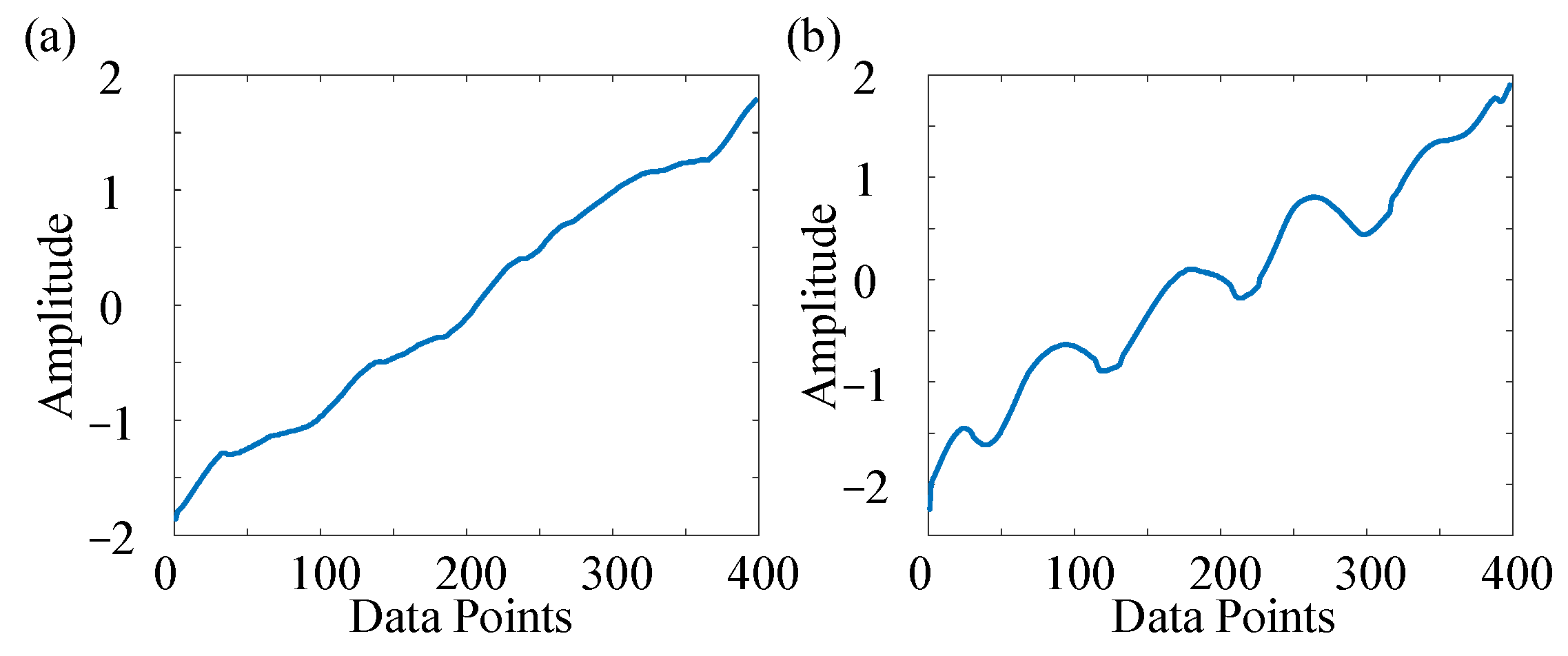
Based on the aforementioned analysis, it can be observed that the proposed method enhances the accuracy of time series similarity measurement by converting one-dimensional time series into two-dimensional images. However, compared to traditional similarity measurement methods, the proposed method exhibits limitations in terms of computational efficiency. Thus, the computational efficiency of the different methods is analyzed by using two time series from Symbols. The time-domain waveform of the two-time series is shown in Figure 10. The computation times for different methods are shown in Table 4.
As can be seen from Table 2, the computation time for time series measurement by converting one-dimensional time series into two-dimensional images is significantly longer than that of traditional ED and DTW. Compared to RPR, the proposed method only increases the computation time by 0.88%.
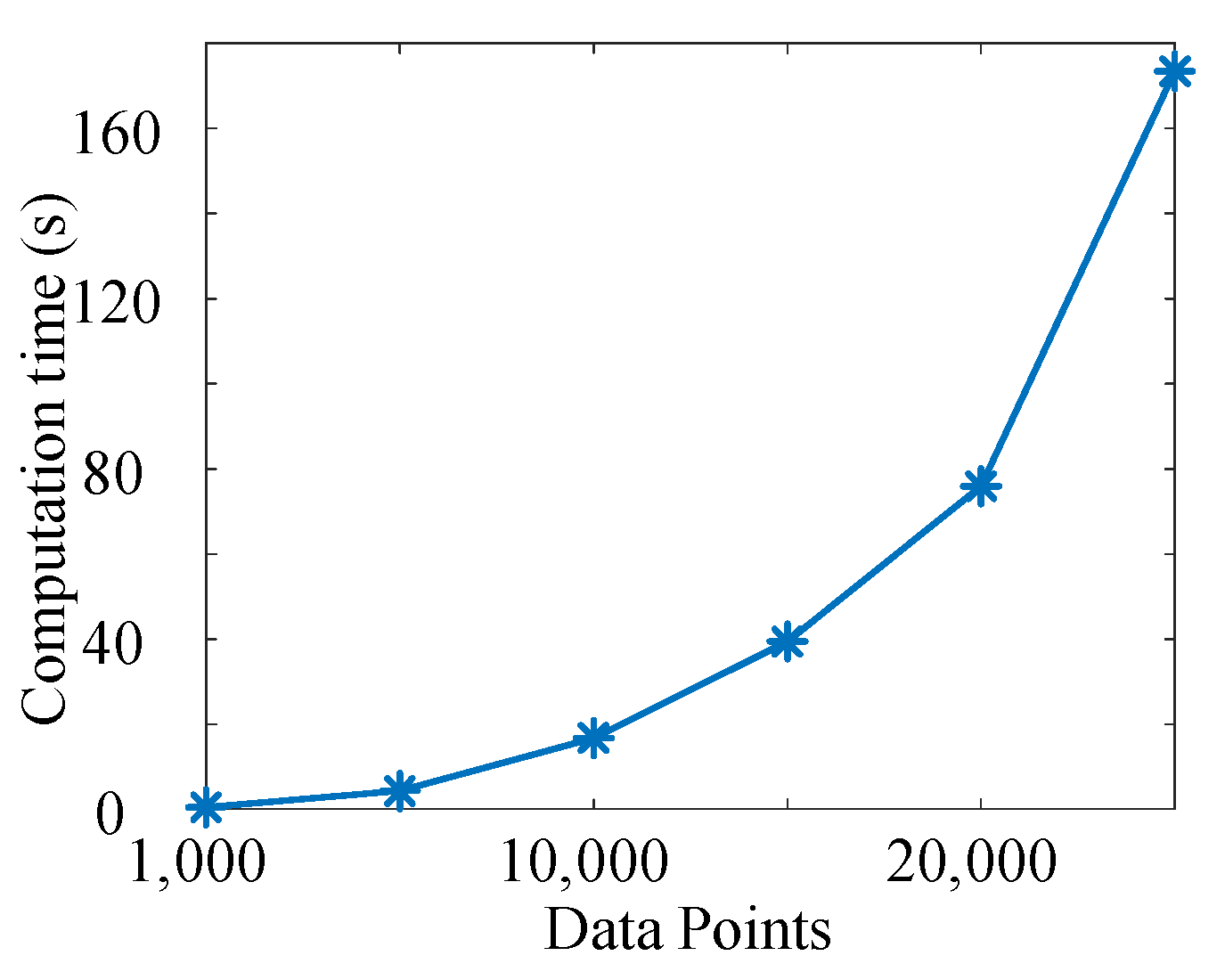
The following random time series with lengths of 1000, 5000, 10,000, 15,000, 20,000, and 25,000 are constructed and the proposed method is used to calculate their similarity. The computation times for different lengths are shown in Figure 11.
As shown in Figure 11, the computation time of the proposed method exhibits exponential growth as the length of the time series increases. Therefore, computational efficiency is a deficiency of the proposed method, which cannot be applied to real-time similarity measurement scenarios involving long time series.

5. Conclusions

In this study, we present a novel approach for measuring time series similarity by integrating recurrence plots (RPs), multi-scale detail boosting (MSDB), and convolutional neural networks (CNNs). Recognizing the limitations of one-dimensional metrics, we transform time series into two-dimensional images to exploit the powerful feature extraction capabilities of computer vision models. A key contribution of this work is the application of MSDB, which successfully accentuates the subtle geometric structures and high-frequency variations within the recurrence plots that are often overlooked by standard imaging methods. By utilizing ResNet-18 for feature embedding and Euclidean distance for metric calculation, we establish a robust pipeline for similarity assessment. Validation using the 1NN classifier on UCR datasets demonstrates that the proposed image enhancement strategy significantly improves classification accuracy. These findings confirm that enhancing the visual details of transformed time series is a critical step in bridging signal processing and computer vision, providing a highly effective tool for data mining tasks.
While this study has examined several significant issues related to the suggested technique, there are a few critical points that merit additional exploration. Currently, numerous image enhancement methods exist, and the specific portions of the image enhanced by various algorithms to increase similarity results need additional investigation. In addition, the computational efficiency of the proposed method is an important limitation, as it cannot achieve real-time similarity measurement of long time series. Therefore, how to improve the computational efficiency of the proposed method is also a problem that needs to be studied.

Author Contributions

Conceptualization, J.Y.; methodology, J.Y. and X.Z.; software, J.Y. and Y.S.; validation, W.S. and Y.S.; formal analysis, J.Y. and W.S.; writing—original draft preparation, J.Y.; writing—review and editing, J.Y., W.S., X.Z. and Y.S.; visualization, X.Z.; project administration, X.Z.; funding acquisition, J.Y. All authors have read and agreed to the published version of the manuscript.

Funding

This research was supported by the National Natural Science Foundation of China, [No. 52502531], the Natural Science Foundation of Shandong Province, China, [Grant No. ZR2023QE214 and No. ZR2025MS765].

Data Availability Statement

The data in the manuscript is a publicly available dataset at “https://www.cs.ucr.edu/~eamonn/time_series_data/ (accessed on 25 June 2021)”.

Conflicts of Interest

The authors declare no conflicts of interest.

References

  1. Han, J.; Kamber, M. Data Mining: Concepts and Technique; Morgan Kaufmann Publishers Inc.: San Francisco, CA, USA, 2006. [Google Scholar]
  2. Cavicchioli, M.; Ghezal, A.; Zemmouri, I. (Bi)spectral analysis of Markov switching bilinear time series. Stat. Methods Appl. 2025, 1–30. [Google Scholar] [CrossRef]
  3. Alraddadi, R. The Markov-switching threshold BLGARCH model. AIMS Math. 2025, 10, 18838–18860. [Google Scholar] [CrossRef]
  4. Yin, J.; Wang, R.; Zheng, H.; Yang, Y.; Li, Y.; Xu, M. A New Time Series Similarity Measurement Method Based on the Morphological Pattern and Symbolic Aggregate Approximation. IEEE Access 2019, 7, 109751–109762. [Google Scholar] [CrossRef]
  5. Agrawal, R.; Faloutsos, C.; Swami, A. Efficient similarity search in sequence databases. In Proceedings of the 4th International Conference on Foundations of Data Organization and Algorithms, Evanston, IL, USA, 13–15 October 1993; Springer: Berlin/Heidelberg, Germany, 1993; pp. 69–84. [Google Scholar]
  6. Isnanto, R.R.; Zahra, A.A.; Widianto, E.D. Palmprint recognition system based on principle-lines feature using Euclidean Distance and neural network. In Proceedings of the 2015 2nd International Conference on Information Technology, Computer, and Electrical Engineering (ICITACEE), Semarang, Indonesia, 16–18 October 2015; IEEE: New York, NY, USA, 2016; pp. 153–158. [Google Scholar]
  7. Folgado, D.; Barandas, M.; Matias, R.; Martins, R.; Carvalho, M.; Gamboa, H. Time Alignment Measurement for Time Series. Pattern Recogn. 2018, 81, 268–279. [Google Scholar] [CrossRef]
  8. Silva, D.F.; Giusti, R.; Keogh, E.; Batista, G.E.A.P. Speeding up similarity search under dynamic time warping by pruning unpromising alignments. Data Min. Knowl. Disc. 2018, 32, 988–1016. [Google Scholar] [CrossRef]
  9. Putpuek, N.; Cooharojananone, N.; Satoh, S. A modification of retake detection using simple signature and LCS algorithm. In Proceedings of the 18th IEEE/ACIS International Conference on Software Engineering, Artificial Intelligence, Networking and Parallel/Distributed Computing, Kanazawa, Japan, 26–28 June 2017; IEEE: New York, NY, USA, 2017; pp. 257–261. [Google Scholar]
  10. Rivault, Y.; Le Meur, N.; Dameron, O. A Similarity Measure Based on Care Trajectories as Sequences of Sets. In Proceedings of the 16th Conference on Artificial Intelligence in Medicine, Vienna, Austria, 21–24 June 2017; Springer: Cham, Switzerland, 2017; pp. 278–282. [Google Scholar] [CrossRef]
  11. Raza, A.; Kramer, S. Accelerating pattern-based time series classification: A linear time and space string mining approach. Knowl. Inf. Syst. 2020, 62, 1113–1141. [Google Scholar] [CrossRef]
  12. Guo, H.; Wang, L.; Liu, X.; Pedrycz, W. Trend-Based Granular Representation of Time Series and Its Application in Clustering. IEEE Trans. Cybern. 2021, 52, 9101–9110. [Google Scholar] [CrossRef]
  13. Sanhudo, L.; Rodrigues, J.; Filho, Ê.V. Multivariate time series clustering and forecasting for building energy analysis: Application to weather data quality control- ScienceDirect. J. Build. Eng. 2020, 35, 101996. [Google Scholar] [CrossRef]
  14. Chen, Z.C.; Yang, J.; Chen, L.F.; Li, F.; Feng, Z.C.; Jia, L.M.; Li, P. RailVoxelDet: A Lightweight 3-D Object Detection Method for Railway Transportation Driven by Onboard LiDAR Data. IEEE Internet Things 2025, 12, 37175–37189. [Google Scholar] [CrossRef]
  15. You, K.S.; Gu, Y.K.; Lin, Y.H.; Wang, Y.J. A novel physical constraint-guided quadratic neural networks for interpretable bearing fault diagnosis under zero-fault sample. Nondestruct. Test. Eval. 2025, 1–31. [Google Scholar] [CrossRef]
  16. Wang, Z.; Oates, T. Imaging Time-Series to Improve Classification and Imputation. In Proceedings of the 24th International Joint Conference on Artificial Intelligence, Buenos Aires, Argentina, 25–31 July 2015; pp. 3939–3945. [Google Scholar]
  17. Shao, S.; McAleer, S.; Yan, R.; Baldi, P. Highly-Accurate Machine Fault Diagnosis Using Deep Transfer Learning. IEEE Trans. Ind. Inform. 2019, 15, 2446–2455. [Google Scholar] [CrossRef]
  18. Li, G.; Deng, C.; Wu, J.; Chen, Z.; Xu, X. Rolling Bearing Fault Diagnosis Based on Wavelet Packet Transform and Convolutional Neural Network. Appl. Sci. 2020, 10, 770. [Google Scholar] [CrossRef]
  19. Eckmann, J.P.; Kamphorst, S.O.; Ruelle, D. Recurrence Plots of Dynamical Systems. EPL Europhys. Lett. 1987, 4, 973–977. [Google Scholar] [CrossRef]
  20. Yang, C.; Yang, C.; Chen, Z.; Lo, N. Multivariate Time Series Data Transformation for Convolutional Neural Network. In Proceedings of the IEEE/SICE International Symposium on System Integration, Paris, France, 14–16 January 2019; IEEE: New York, NY, USA, 2019; pp. 188–192. [Google Scholar] [CrossRef]
  21. Yang, C.; Chen, Z.; Yang, C. Sensor Classification Using Convolutional Neural Network by Encoding Multivariate Time Series as Two-Dimensional Colored Images. Sensors 2020, 20, 168. [Google Scholar] [CrossRef]
  22. Wang, D.; Guo, Y.; Wu, X.; Na, J.; Litak, G. Planetary-Gearbox Fault Classification by Convolutional Neural Network and Recurrence Plot. Appl. Sci. 2020, 10, 932. [Google Scholar] [CrossRef]
  23. Souza, V.M.A.; Silva, D.F.; Batista, G.E.A.P. Extracting Texture Features for Time Series Classification. In Proceedings of the International Conference on Pattern Recognition, Stockholm, Sweden, 24–28 August 2014; IEEE: New York, NY, USA, 2014; pp. 1425–1430. [Google Scholar] [CrossRef]
  24. Wang, Z.; Chen, L.; Qi, B.; Wang, G.; Shi, H. A SAR target recognition method with frequency and spatial domain enhancement. In Proceedings of the 2019 IEEE International Conference on Signal, Information and Data Processing, Chongqing, China, 11–13 December 2019; IEEE: New York, NY, USA, 2019; pp. 1–4. [Google Scholar] [CrossRef]
  25. Kumar, S.; Bhandari, A.K.; Kumar, A.; Swaraj, K. Triple Clipped Histogram Based Medical Image Enhancement Using Spatial Frequency. IEEE Trans. NanoBiosci. 2021, 20, 278–286. [Google Scholar] [CrossRef]
  26. Li, P.; Liang, J.; Zhang, M. A degradation model for simultaneous brightness and sharpness enhancement of low-light image. Signal Process. 2021, 189, 108298. [Google Scholar] [CrossRef]
  27. Zhao, L.; Zhu, Q. Edge detail enhancement algorithm for high-dynamic range images. J. Intell. Syst. 2022, 31, 193–206. [Google Scholar] [CrossRef]
  28. Zhang, W.; Dong, L.; Zhang, T.; Xu, W. Enhancing underwater image via color correction and Bi-interval contrast enhancement. Signal Process. Image 2021, 90, 116030. [Google Scholar] [CrossRef]
  29. Joseph, S.; Sasikala, J.; Juliet, D.; Velliangiri, S. Hybrid spatio-frequency domain global thresholding filter (HSFGTF) model for SAR image enhancement. Pattern Recognit. Lett. 2021, 146, 8–14. [Google Scholar] [CrossRef]
  30. Marwan, N. A historical review of recurrence plots. Eur. Phys. J. 2008, 164, 3–12. [Google Scholar] [CrossRef]
  31. Kim, Y.; Koh, Y.J.; Lee, C.; Kim, S.; Kim, C. Dark image enhancement based onpairwise target contrast and multi-scale detail boosting. In Proceedings of the IEEE International Conference on Image Processing, Quebec City, QC, Canada, 27–30 September 2015; IEEE: New York, NY, USA, 2015. [Google Scholar] [CrossRef]
  32. Fukushima, K.; Miyake, S. Neocognitron: A Self-Organizing Neural Network Model for a Mechanism of Visual Pattern Recognition, Competition and Cooperation in Neural Nets; Springer: Berlin/Heidelberg, Germany, 1982; pp. 267–285. [Google Scholar]
  33. The UCR Time Series Classification Archive. Available online: www.cs.ucr.edu/~eamonn/time_series_data/ (accessed on 25 June 2021).
  34. Yin, J.C.; Zhuang, X.Y.; Sui, W.T.; Sheng, Y.L.; Yang, Y.T. A new similarity measurement method for time series based on image fusion of recurrence plots and wavelet scalogram. Eng. Appl. Artif. Intel. 2024, 129, 107679. [Google Scholar] [CrossRef]
  35. Sharara, E.A.; Tsuji, A.; Karungaru, S.; Terada, K. Prediction of the VDT Worker’s Headache Using Convolutional Neural Network with Class Activation Mapping. IEEJ Trans. Electr. Electron. Eng. 2020, 15, 1691–1698. [Google Scholar] [CrossRef]
  36. Zhang, W.; Li, C.; Peng, G.; Chen, Y.; Zhang, Z. A deep convolutional neural network with new training methods for bearing fault diagnosis under noisy environment and different working load. Mech. Syst. Signal Process. 2017, 100, 439–453. [Google Scholar] [CrossRef]
Figure 1. Computational procedure of the proposed methodology.
Symmetry 18 00290 g001
Figure 2. The classification outcomes of several methodologies. (a) The comparison of the proposed technique with the ED. (b) The comparison between the proposed technique and DTW. (c) The comparison between the proposed technique and RPR. Note: the red dots in the figure represent the calculation results of the samples.
Symmetry 18 00290 g002
Figure 3. The Texas sharpshooter fallacy involves several methodologies. (a) The proposed approach vs. ED. (b) The proposed approach vs. DTW. (c) The proposed approach vs. RPR. Note: the red dots in the figure represent the calculation results of the samples.
Symmetry 18 00290 g003
Figure 4. The different evaluation methods of classification results of the three similarity measurement methods. (a) Kappa coefficient. (b) Macro F1-score. (c) Micro F1-score.
Symmetry 18 00290 g004
Figure 5. Analysis of the proposed method’s effectiveness. (a) Initial time series. (b) RP. (c) Class activation mapping of RP. (d) MSDB. (e) Class activation mapping of the RP after MSDB.
Symmetry 18 00290 g005
Figure 6. Visualization of features using t-SNE for Gun_Point. (a) Initial time series. (b) Feature extraction utilizing RPR. (c) Feature extraction with the RP subsequent to MSDB.
Symmetry 18 00290 g006
Figure 7. Visualization of features using t-SNE for Trace. (a) Original time series. (b) Feature extraction utilizing RPR. (c) Feature extraction with the RP after MSDB.
Symmetry 18 00290 g007
Figure 8. MSDB results under different kernel function standard deviations.
Symmetry 18 00290 g008
Figure 9. MSDB results under different weights.
Symmetry 18 00290 g009
Figure 10. Time-domain waveform of the one-dimensional time series. (a) Class 1. (b) Class 2.
Symmetry 18 00290 g010
Figure 11. Computation time under different lengths.
Symmetry 18 00290 g011
Table 1. Detailed information of the dataset used in the experiment.
No.Dataset NameSeries LengthTraining Set NumberTesting Set NumberClasses
1Beef47030305
2BeetleFly51220202
3BirdChicken51220202
4CinC_ECG_torso16394013804
5Coffee28628282
6DistalPhalanxOutlineAgeGroup801394003
7DistalPhalanxOutlineCorrect802766002
8FISH4631751757
9FordA500132036012
10FordB50081036362
11Gun_Point150501502
12HandOutlines270937010002
13Herring51264642
14Lighting263760612
15MiddlePhalanxOutlineCorrect802916002
16MiddlePhalanxTW801543996
17OSULeaf4272002426
18Plane1441051057
19ProximalPhalanxOutlineAgeGroup804002053
20ProximalPhalanxOutlineCorrect806002912
21RefrigerationDevices7203753753
22ScreenType7203753753
23ShapesAll51260060060
24SmallKitchenAppliances7203753753
25Strawberry2353706132
26SwedishLeaf12850062515
27Symbols398259956
28ToeSegmentation1277402282
29ToeSegmentation2343361302
30Trace2751001004
Table 2. Similarity measurement results under different σ1, σ2, and σ3.
1234
σ150.7950.3449.9949.82
σ250.8650.7949.3650.35
σ353.7352.1851.4450.79
Table 3. Similarity measurement results under different w1, w2, and w3.
0.250.500.751.00
w151.5250.7950.1250.13
w250.5550.7950.0450.25
w350.7948.9649.1950.18
Table 4. The computation times for different methods.
MethodsEDDTWRPRThe Proposed Method
Computation times (s)0.0020.0040.3380.341
Disclaimer/Publisher’s Note: The statements, opinions and data contained in all publications are solely those of the individual author(s) and contributor(s) and not of MDPI and/or the editor(s). MDPI and/or the editor(s) disclaim responsibility for any injury to people or property resulting from any ideas, methods, instructions or products referred to in the content.