Article

Solution Dynamics of the (1 + 1)-Dimensional Fisher’s Equation Using Lie Symmetry Analysis

Department of Mathematics and Applied Mathematics, University of Limpopo, Private Bag X1106, Sovenga 0727, South Africa
*
Author to whom correspondence should be addressed.
Symmetry 2026, 18(2), 279; https://doi.org/10.3390/sym18020279
Submission received: 31 December 2025 / Revised: 29 January 2026 / Accepted: 31 January 2026 / Published: 3 February 2026
(This article belongs to the Special Issue Symmetry in Integrable Systems and Soliton Theories)

Abstract

Reaction–diffusion equations provide a fundamental framework for modelling spatial population dynamics and invasion processes in mathematical biology. Among these, Fisher’s equation combines diffusion with logistic growth to describe the spread of an advantageous gene and the formation of travelling population fronts. In this work, we investigate the one-dimensional Fisher’s equation using Lie symmetry analysis to obtain a deeper analytical understanding of its wave propagation behaviour. The Lie point symmetries of the partial differential equation are derived and used to construct similarity variables that reduce Fisher’s equation to ordinary differential equations. These reduced equations are then solved by a combination of direct integration and the tanh method, yielding explicit invariant and travelling-wave solutions. Symbolic computations in MAPLE are employed to compute the symmetries, verify the reductions, and generate illustrative plots of the resulting wave profiles. The computed solutions capture sigmoidal fronts connecting stable and unstable steady states, providing clear information about wave speed and shape. Overall, this study demonstrates that Lie group methods, combined with hyperbolic-function techniques, offer a powerful and systematic approach for analysing Fisher-type reaction–diffusion models and interpreting their biologically relevant invasion dynamics.

1. Introduction

Reaction–diffusion equations provide a fundamental mathematical framework for modelling spatio-temporal processes across diverse scientific disciplines, including population dynamics [1], chemical kinetics [2], nerve impulse propagation, and biological invasion phenomena [3]. Among this class of equations, Fisher’s equation, which was introduced independently by Fisher [4] to describe gene spread and by Kolmogorov, Petrovsky and Piskunov (KPP) [5] to study diffusion with growth, holds particular significance as a paradigm for studying front propagation in nonlinear systems. This equation elegantly combines linear diffusion with logistic growth to model the spatial spread of advantageous genes through populations and the formation of travelling population fronts that characterise biological invasions [1,6]. Fisher’s equation continues to serve as a benchmark model in mathematical biology due to its rich analytical structure, which balances mathematical tractability with biological relevance, making it an ideal subject for demonstrating systematic analytical methods like Lie symmetry analysis [7,8]. Applying Lie symmetry analysis to investigate closed-form solutions of the Fisher’s equation will provide significant insight into the complex physical phenomena inherent to Fisher-type reaction–diffusion equations.
Lie symmetry analysis provides a systematic, algebraic framework for analysing and solving differential equations by exploiting their invariance under continuous groups of transformations [9,10]. Developed by Sophus Lie in the late 19th century, this method transforms the problem of solving complex nonlinear differential equations into problems of algebra and reduction [11,12]. For PDEs, it can be used to find similarity variables that reduce the PDE to an ODE, construct special solutions called invariant solutions, and identify integrability properties [13,14]. Although there are alternative methods for obtaining exact solutions, including the inverse scattering transform, Hirota’s bilinear method, and various ansatz-based techniques, Lie symmetry analysis has the distinct advantage of being completely systematic and grounded in the geometric structure of the equation. It requires no prior ansatz and reveals all continuous point symmetries inherently possessed by the equation. This approach is therefore particularly powerful for classifying solutions and understanding the fundamental properties of nonlinear models.
In recent years, the exploration of analytical and numerical methods for solving Fisher’s equation has expanded significantly, reflecting its sustained relevance in mathematical biology and nonlinear dynamics. Majeed et al. [15] developed an efficient cubic B-spline collocation scheme for the time-fractional generalised Fisher’s equation, employing Caputo fractional derivatives and L1 discretisation to handle nonlinearities and ensure unconditional stability. Their work demonstrated the scheme’s accuracy through multiple test problems, providing a robust numerical framework for fractional-order reaction–diffusion systems. Subsequently, Eriqat et al. [16] introduced the Laplace residual power series (L-RPS) method for solving the nonlinear fractional Fisher’s equation, correcting earlier errors in the residual power series approach and presenting a reliable analytical technique for fractional logistic models. The scope of solution techniques further broadened with the work of Salih et al. [17], who systematically applied three iterative semi-analytical methods—namely, the Daftardar–Jafari method (DJM), Temimi–Ansari method (TAM), and Banach contraction method (BCM)—to solve one-dimensional, two-dimensional and three-dimensional Fisher’s equations. Their comparative study highlighted the advantages of these derivative-free methods, which circumvent the need for Adomian polynomials or Lagrange multipliers, and provided rigorous convergence analysis alongside solutions for multidimensional cases. Advancing the frontier of hybrid numerical techniques, Bin Jebreen [18] proposed an efficient algorithm, combining the Crank–Nicolson finite difference scheme with a multiwavelets Galerkin method. This approach discretised the temporal domain and then solved the resulting ordinary differential equations at each time step using Alpert’s multiwavelets, with the scheme’s L 2 stability and convergence rigorously proven via the energy method. More recently, Barik and Behera [19] applied the Hirota bilinear method to derive exact one-soliton, two-soliton, and multi-soliton travelling-wave solutions for Fisher’s equation, highlighting the model’s integrable structure and algebraic efficiency in capturing stable propagating fronts.
This study aims to apply a systematic Lie symmetry analysis to the classical one-dimensional Fisher’s equation, providing a rigorous group-theoretic framework to derive its fundamental invariant and travelling-wave solutions. While contemporary research has emphasised fractional, numerical, and specialised integrable-structure approaches, the present work returns to the core analytical power of Lie’s method to obtain a complete set of closed-form solutions that are directly interpretable in biological and physical contexts. The methodology proceeds by first determining the full Lie point symmetry generators of the equation, which are then used to perform systematic similarity reductions. Each reduction yields an ordinary differential equation that is solved analytically, employing direct integration for the simpler cases and the well-established tanh method for the nonlinear travelling-wave equation. Throughout the analysis, symbolic computation in Maple is employed to verify the reductions, solve the resulting algebraic systems, and generate illustrative plots of the obtained wave profiles. The principal outcome of this investigation is the explicit construction of three distinct classes of exact solutions: a steady-state (time-independent) front, a spatially uniform logistic-growth profile, and a non-trivial travelling-wave front with a specific wave speed. These results collectively offer a unified symmetry-based interpretation of the Fisher model’s dynamics, clarifying the connection between its invariant structures and the propagating fronts that describe the invasion of a stable state into an unstable one.
The rest of the manuscript is organised as follows. Section 2 outlines the mathematical framework of the study, providing brief theory on the Fisher’s reaction diffusion equation, the basic definitions in Lie symmetry analysis, including the algorithm of computing Lie symmetries and invariant solutions, and the advantages of the Lie symmetry approach. Section 3 provides a brief overview of the hyperbolic tangent (tanh) method, while, in Section 4, a Lie symmetry analysis of Fisher’s equation is performed, providing the computation of the Lie symmetries, similarity reductions, computation of the invariant solutions, and graphical analysis and interpretation of the solutions. In Section 5, an analysis of the results is provided, focussing on the physical/biological interpretation, comparison with other methods, stability considerations and parameter analysis. Section 6 summarises the findings and their biological implications, discusses the limitations of the study and suggests future work.

2. Mathematical Framework

2.1. The Fisher’s Reaction–Diffusion Equation

Fisher’s reaction–diffusion equation, also called the Fisher–Kolmogorov–Petrovsky–Piskunov (FKPP) equation, is a fundamental partial differential equation (PDE) in mathematical biology, ecology and physics that models how a quantity, such as a population density or a gene frequency, spreads through space while undergoing local growth or reaction [1,20,21]. It is named after R.A. Fisher, who introduced it in 1937 in the context of population genetics, and was independently developed by Kolmogorov, Petrovsky and Piskunov in the same year.
The standard form of the equation in one spatial dimension is
u t = D 2 u x 2 + f ( u ) ,
where u = u ( x , t ) represents the density of the population or concentration at position x and time t, D > 0 is the diffusion coefficient, which measures random motion or dispersal, and the function f ( u ) is the local growth or reaction term, which is often a nonlinear function.
The classical choice of f ( u ) , Fisher’s case, is
f ( u ) = r u ( 1 u ) ,
or
f ( u ) = r u 1 u K ,
with carrying capacity K that is often scaled to K = 1 . In this case, the full equation becomes
u t = D 2 u x 2 + r u ( 1 u ) .
The diffusion D u x x represents spatial spread, like the random movement of organisms or molecules, while the reaction term r u ( 1 u ) represents logistic growth. The growth rate is positive when u is small, zero when u = 1 (carrying capacity), and negative if u > 1 .
Without loss of generality, we set r = 1 and D = 1 , so that we work with the non-dimensional form of Fisher’s equation, i.e.,
u t = 2 u x 2 + u ( 1 u ) .
This equation supports travelling-wave solutions and is widely applied in biological invasion theory, gene propagation, and related fields.
Definition 1. 
Travelling-Wave Solution [22]
A travelling-wave solution of a PDE is a solution of the form
u ( x , t ) = f ( z ) , z = x c t ,
where c is a constant wave speed and f is a function of the single variable z. This substitution transforms the original PDE into an ODE for f ( z ) .

2.2. An Overview of the Lie Symmetry Analysis Method

Definition 2. 
Lie Group [8,23]
A Lie group is essentially a collection of transformations that are defined by continuous variables. What makes these groups special is that their operations, such as composition and inversion, are smooth, which means that they can be differentiated. These transformations interact with independent and dependent variables, ensuring that the structure of a particular PDE remains intact.
Definition 3. 
Infinitesimal Transformation [23,24]
An infinitesimal transformation is the linear (first-order) approximation of a one-parameter Lie group of transformations acting on the variables of a differential equation. Consider a Lie group of point transformations acting on the ( x , t , u ) -space:
t ˜ = f ( t , x , u ; ε ) , x ˜ = g ( t , x , u ; ε ) , u ˜ = h ( t , x , u ; ε ) ,
where ε is a continuous parameter, and  ε = 0 corresponds to the identity transformation. The infinitesimal form of the transformations obtained by expanding the transformations in a Taylor series around ε = 0 is
t ˜ = t + ε τ ( t , x , u ) + O ( ε 2 ) , x ˜ = x + ε ξ ( t , x , u ) + O ( ε 2 ) , u ˜ = u + ε η ( t , x , u ) + O ( ε 2 ) ,
where
ξ ( t , x , u ) = g ε | ε = 0 , τ ( t , x , u ) = f ε | ε = 0 , η ( t , x , u ) = h ε | ε = 0 .
The corresponding infinitesimal generator is given by
X = ξ ( x , t , u ) x + τ ( x , t , u ) t + η ( x , t , u ) u .
Definition 4. 
Lie Symmetry [23,25]
A Lie symmetry of a PDE refers to a transformation derived from a Lie group that takes the solutions of the PDE and transforms them into other valid solutions. These symmetries are typically expressed through infinitesimal generators (7).
Definition 5. 
Infinitesimal Generator [23,24,25,26]
An infinitesimal generator is a vector field that represents a continuous symmetry of a differential equation.
Definition 6. 
Invariant Solution [8,23]
An invariant solution is one that stays the same when a Lie symmetry group acts on it.
Definition 7. 
Prolongation [23,25,26]
Prolongation is the process of extending a symmetry generator so that its action includes the derivatives of the dependent variable. This step is essential when dealing with differential equations that contain higher-order derivatives, ensuring that the symmetry applies to the whole equation. For a generator
X = ξ ( x , t , u ) x + τ ( x , t , u ) t + η ( x , t , u ) u ,
the nth-order prolongation is given by
pr ( n ) X = X + | α | n η α u α ,
where η α are the prolonged coefficients defined using total derivatives.
Definition 8. 
Total Derivative Operators [8,23]
For PDEs with two independent variables x , t and dependent variable u ( x , t ) , the total derivative operators are defined as
D x = x + u x u + u x x u x + u x t u t + ,
D t = t + u t u + u x t u x + u t t u t + ,
where subscripts denote partial derivatives of u.
These operators capture how a function changes with respect to x and t, taking into account both explicit dependence on the independent variables and implicit dependence through derivatives of u. They are essential in computing the prolongation of vector fields in Lie symmetry analysis.
Definition 9. 
Commutator [8]
The commutator of X i and X j , written as [ X i , X j ] , is defined by
[ X i , X j ] = X i ( X j ) X j ( X i ) ,
where the expression represents the Lie bracket of two vector fields X i and X j . This operation plays a central role in the structure of Lie algebras and in the analysis of symmetries of differential equations.
Definition 10. 
Abelian Lie Algebra [8] A Lie algebra is said to be Abelian if all of its generators commute with each other, that is, the Lie bracket of any two elements is zero,
[ X i , X j ] = 0 . for all i , j .
Definition 11. 
Non-Abelian Lie Algebra [8]
A Lie algebra is said to be non-Abelian if not all of its generators commute, i.e., there exists at least one pair ( X i , X j ) such that
[ X i , X j ] 0 .
Theorem 1. 
Lie Symmetry Condition [8,23]
A vector field
X = ξ ( x , t , u ) x + τ ( x , t , u ) t + η ( x , t , u ) u ,
is a symmetry generator of the PDE
F ( x , t , u , u x , u t , u x x , u x t , u t t , ) = 0 ,
if and only if its prolonged action annihilates the equation on its solution manifold
pr ( n ) X ( F ) | F = 0 = 0 ,
where pr ( n ) X denotes the n-th prolongation of X.
Theorem 2. 
Reduction Theorem [8,23,24]
Let
X = ξ ( x , t , u ) x + τ ( x , t , u ) t + η ( x , t , u ) u ,
be a symmetry generator of a partial differential equation
F ( x , t , u , u x , u t , u x x , u x t , u t t , ) = 0 .
Then, there exists a change of variables ( x , t , u ) ( ξ , ζ , U ) , where ξ , ζ are similarity variables and U is the new dependent variable, such that the PDE reduces to an ODE in the new variables,
d U d ζ = G ( U , ζ ) .
Theorem 3. 
Invariant Surface Condition [8,23]
Let
X = ξ ( x , t , u ) x + τ ( x , t , u ) t + η ( x , t , u ) u ,
be a symmetry generator. Then, the associated similarity (invariant) variables
ξ = ϕ ( x , t , u ) , ζ = ψ ( x , t , u ) , U = χ ( x , t , u ) ,
satisfy the invariant surface condition
ξ u x + τ u t = η .
This condition is fundamental in constructing similarity variables and in reducing PDEs, such as reaction–diffusion equations, to ODEs.

2.3. The Algorithm for Finding Lie Symmetries and Invariant Solutions

The steps that make up the process of finding Lie symmetries and invariant solutions of a PDE are as follows:
Step 1. Formulate the Determining Equations
Begin with a given PDE. Consider a one-parameter Lie group of point transformations acting on both the independent and dependent variables. The condition that the PDE remains invariant under this transformation group is expressed using the prolongation of the infinitesimal generator. Applying this invariance condition yields a system of linear, homogeneous PDEs, the determining equations for the infinitesimal functions.
Step 2. Solve for the Infinitesimal Generators
Solve the over-determined system of determining equations. The solution yields the components of the infinitesimal generator, which define the symmetry algebra of the original differential equation. Each independent generator corresponds to a one-parameter symmetry group.
Step 3. Perform Symmetry Reduction
For a chosen symmetry generator (or a linear combination of generators), the method of characteristics is used to find the invariants of the PDE. These invariants define a change of variables, one becomes the new independent variable (the similarity variable), and another is expressed as a function of this variable. Substituting this invariant form into the original PDE reduces it to an ODE of lower order.
Step 4. Solve the Reduced Ordinary Differential Equation
The reduced ODE is solved using appropriate analytical or numerical techniques. Because the ODE results from a symmetry reduction, its solutions are called invariant solutions of the original PDE. Common techniques for solving the resulting nonlinear ODEs include direct integration, the use of special functions, or auxiliary methods like the tanh function, ( G / G ) -expansion methods and others.
Step 5. Construct and Interpret the Final Solution
The solution of the reduced ODE is expressed back in terms of the original variables, yielding an exact, closed-form solution to the original PDE. The physical or biological interpretation of this solution (e.g., as a steady state, a travelling wave, or a scaling solution) is then analysed based on the symmetry used in the reduction.

2.4. Advantages of the Lie Symmetry Method

One of the most powerful and theoretically elegant methods for analysing differential equations, Lie symmetry analysis, provides deep insight into the structure of solutions without relying on guesswork. The method makes complex nonlinear problems more tractable by leveraging the inherent invariance properties of the equations. Its capacity to systematically generate all continuous point symmetries and use them for dimensional reduction is one of the main factors contributing to its enduring value. The solution process becomes algorithmic once the symmetries are known, revealing solution pathways that might not be apparent from standard techniques. The method’s compatibility with symbolic computation tools makes it highly effective for complicated systems.
The main advantages of the Lie symmetry method may be summarised as follows:
  • Systematic and General: It provides a universal, step-by-step procedure applicable to both ODEs and PDEs, revealing all Lie point symmetries without prior assumption of solution form.
  • Reduction of Complexity: It can reduce the number of independent variables in a PDE (e.g., from a PDE to an ODE) or lower the order of an ODE, simplifying the problem substantially.
  • Discovery of New Solutions: The method systematically leads to invariant solutions. These are special solutions that are invariant under a subgroup of the full symmetry group. They include important classes like travelling waves, scaling solutions, and steady states.
  • Foundation for Further Analysis: The identified symmetry algebra is fundamental for studying integrability, constructing conservation laws, and performing group-invariant numerical discretisations.
  • Symbolic Computation Compatibility: The algorithm is perfectly suited for implementation in computer algebra systems (e.g., MAPLE, Mathematica, MATLAB), allowing for the automated calculation of symmetries and reductions.
Because of these characteristics, the Lie symmetry method remains a cornerstone technique in the analytical study of nonlinear differential equations across mathematics, physics, biology, and engineering.

3. The Hyperbolic Tangent (TANH) Method

The hyperbolic tangent (TANH) method is an analytical technique used to solve nonlinear differential equations [27,28,29]. In this study, it is applied to the reduced ODEs obtained from the Fisher’s PDE. The method assumes a solution in the form
u ( ξ ) = i = 0 N a i tanh i ( ξ ) ,
where N is chosen by balancing the highest-order derivative and nonlinear terms in the ODE.
Substituting this expansion into the reduced equation leads to a system of algebraic equations for the unknown coefficients a i . The method yields exact solutions, including travelling waves and kink-type profiles that are relevant to phenomena such as propagation and bistability in reaction–diffusion systems.

4. Lie Symmetry Analysis of Fisher’s Equation

4.1. Computation of Classical Lie Point Symmetries

The Lie symmetry method determines the invariance of partial differential equations under continuous transformation groups, enabling systematic reductions to simpler forms [25]. In this section, we apply Lie symmetry analysis to the non-dimensional Fisher’s equation
u t = 2 u x 2 + u ( 1 u ) .
Consider the infinitesimal transformations
x * = x + ϵ ξ ( x , t , u ) + O ( ϵ 2 ) ,
t * = t + ϵ τ ( x , t , u ) + O ( ϵ 2 ) ,
u * = u + ϵ η ( x , t , u ) + O ( ϵ 2 ) ,
with the associated infinitesimal generator
X = ξ x + τ t + η u .
Using MAPLE 2023 and the PDEtools package, the infinitesimal functions for Fisher’s equation were computed as
ξ ( x , t , u ) = 0 , τ ( x , t , u ) = 1 , η ( x , t , u ) = 0 ,
ξ ( x , t , u ) = 1 , τ ( x , t , u ) = 0 , η ( x , t , u ) = 0 .
The MAPLE code used to compute these infinitesimals is in Appendix A.1. From these infinitesimals, we obtain the corresponding symmetry generators
X 1 = t , X 2 = x .
The symmetry generators in (29) correspond to time translation ( X 1 ) and space translation ( X 2 ). These are the only Lie point symmetries admitted by Fisher’s equation.
The lack of additional symmetries is due to the logistic nonlinearity  u ( 1 u ) . This specific reaction term breaks invariance under scaling, Galilean, or other common transformations that simpler PDEs might allow. Thus, only space and time translations remain, reflecting the fact that Fisher’s equation is homogeneous in space and stationary in time, but not scale-invariant.

4.2. Reduction via Time Translation X 1 = t

An invariant solution under the Lie point symmetry generator
X 1 = t ,
is sought. This symmetry corresponds to invariance under time translations. To find an invariant solution, we use the method of characteristics. The associated characteristic system is
d x 0 = d t 1 = d u 0 .
Two invariants
T 1 = x and T 2 = u ,
are obtained, and the group-invariant solution is given by
T 2 = f ( T 1 ) , i . e . , u = f ( x ) .
Hence, the invariant solution takes the form
u ( x , t ) = f ( x ) .
Now, we substitute the invariant form u ( x , t ) = f ( x ) into Fisher’s equation:
u t = 2 u x 2 + u ( 1 u ) .
Since u depends only on x, the time derivative vanishes:
u t = 0 .
The spatial derivatives become
u x = f ( x ) , 2 u x 2 = f ( x ) .
Substituting these into the Fisher’s PDE gives the ODE
f ( x ) + f ( x ) 1 f ( x ) = 0 .
The reduced equation is a nonlinear second-order ODE and cannot be solved using standard techniques such as separation of variables, integrating factors, or other familiar methods for linear ODEs. Nonlinear equations of this form are difficult to handle analytically and require specialised approaches. In this work, we attempt to obtain an exact solution using the tanh method.
The tanh method [27,28,29] is applied by introducing the transformation
T ( x ) = tanh ( k x ) ,
where k 0 . Since
d T d x = k ( 1 T 2 ) ,
this substitution allows derivatives of f to be rewritten in terms of T. A balance of the highest powers in the ODE shows that the solution should take the form of a quadratic polynomial in T. Thus, we assume
f ( x ) = a 0 + a 1 T + a 2 T 2 ,
where a 0 , a 1 , a 2 , k R are constants to be determined.
Differentiating the ansatz using the chain rule gives
f ( x ) = d f d T d T d x = ( a 1 + 2 a 2 T ) k ( 1 T 2 ) .
Differentiating again, we set
g ( T ) = ( a 1 + 2 a 2 T ) ( 1 T 2 ) ,
so that
f ( x ) = k 2 g ( T ) ( 1 T 2 ) .
Computing g ( T ) gives
g ( T ) = 2 a 2 2 a 1 T 6 a 2 T 2 .
Therefore, the second derivative becomes
f ( x ) = k 2 ( 2 a 2 2 a 1 T 6 a 2 T 2 ) ( 1 T 2 ) ,
and expanding yields
f ( x ) = k 2 6 a 2 T 4 + 2 a 1 T 3 8 a 2 T 2 2 a 1 T + 2 a 2 .
Next, we expand the nonlinear reaction term. Substituting the polynomial ansatz gives
f ( x ) ( 1 f ( x ) ) = ( a 0 a 0 2 ) + ( a 1 2 a 0 a 1 ) T + ( 2 a 0 a 2 a 1 2 + a 2 ) T 2 2 a 1 a 2 T 3 a 2 2 T 4 .
Substituting the expressions for f ( x ) and f ( 1 f ) into the reduced ODE
f ( x ) + f ( x ) ( 1 f ( x ) ) = 0 ,
and simplifying gives
k 2 ( 6 a 2 T 4 + 2 a 1 T 3 8 a 2 T 2 2 a 1 T + 2 a 2 ) + ( a 0 a 0 2 ) + ( a 1 2 a 0 a 1 ) T + ( 2 a 0 a 2 a 1 2 + a 2 ) T 2 2 a 1 a 2 T 3 a 2 2 T 4 = 0 .
Equating coefficients of like powers of T gives the algebraic system
T 4 : 6 a 2 k 2 a 2 2 = 0 ,
T 3 : 2 a 1 k 2 2 a 1 a 2 = 0 ,
T 2 : 8 a 2 k 2 2 a 0 a 2 a 1 2 + a 2 = 0 ,
T 1 : 2 a 1 k 2 + a 1 2 a 0 a 1 = 0 ,
T 0 : 2 a 2 k 2 + a 0 a 0 2 = 0 .
Solving begins with the first condition
a 2 ( 6 k 2 a 2 ) = 0 .
If a 2 = 0 , then
2 a 1 k 2 = 0 a 1 = 0 ,
and the constant-term equation
a 0 a 0 2 = 0
gives the two equilibrium solutions
f = 0 , f = 1 .
To obtain a nonconstant solution, we take a 2 = 6 k 2 . Substituting into
2 a 1 k 2 2 a 1 a 2 = 0
gives
2 a 1 ( k 2 6 k 2 ) = 10 k 2 a 1 = 0 ,
so
a 1 = 0 .
Using a 1 = 0 and a 2 = 6 k 2 in the quadratic condition
8 a 2 k 2 2 a 0 a 2 + a 2 = 0
yields
48 k 4 12 a 0 k 2 + 6 k 2 = 0 .
Dividing by 6 k 2 gives
8 k 2 2 a 0 + 1 = 0 .
Hence,
a 0 = 1 8 k 2 2 .
Substituting into the final condition
2 a 2 k 2 + a 0 a 0 2 = 0 ,
leads to
12 k 4 + 1 8 k 2 2 1 8 k 2 2 2 = 0 .
Multiplying by 4 and simplifying gives
1 + 16 k 4 = 0 ,
so that
k 2 = 1 4 .
Substituting back gives
a 2 = 6 k 2 = 3 2 , a 1 = 0 , a 0 = 1 2 .
Hence, the polynomial becomes
f ( x ) = a 0 + a 2 T 2 = 1 2 + 3 2 T 2 .
With T = tanh ( k x ) and k = 1 2 , we obtain the explicit invariant solution
f ( x ) = 1 2 + 3 2 tanh 2 x 2 .
Since the reduced ODE is autonomous, a translation in x produces the one-parameter family
f ( x ) = 1 2 + 3 2 tanh 2 x x 0 2 ,
where x 0 is a translation constant. Substituting u ( t , x ) = f ( x ) gives the invariant solution
u ( x , t ) = 1 2 + 3 2 tanh 2 x x 0 2 .
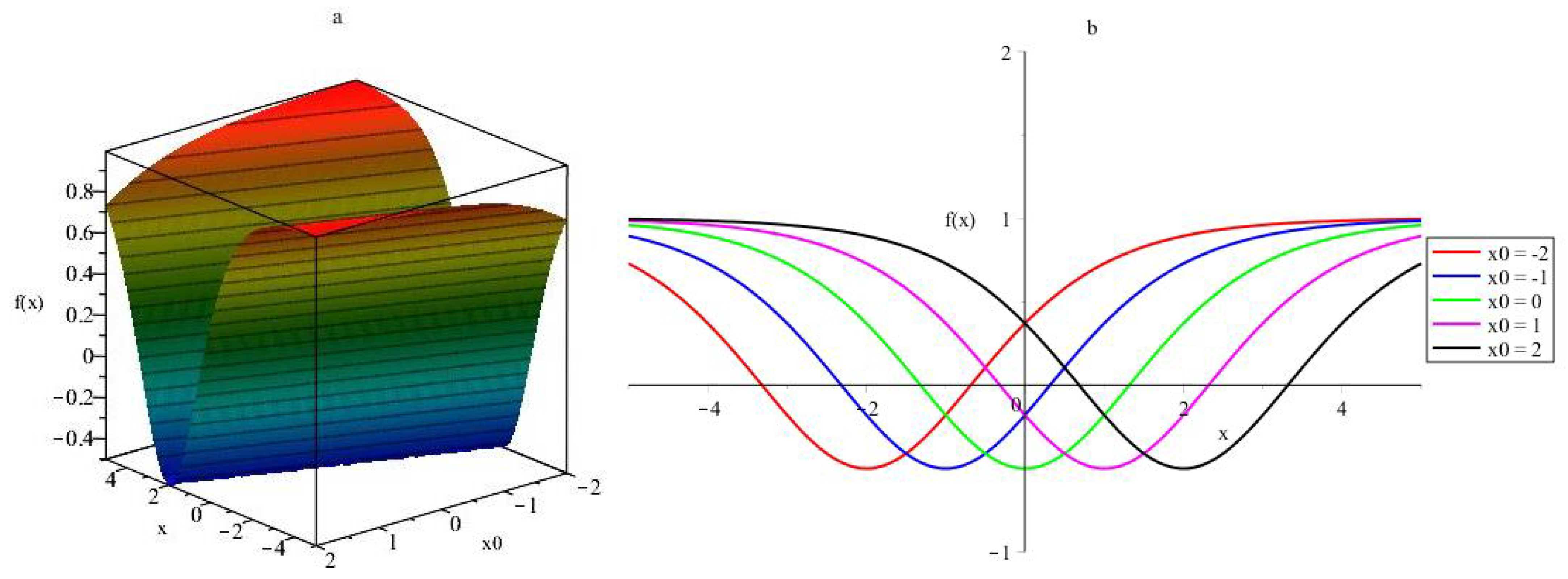
Lie symmetry reduction under X 1 = t yields the steady-state ODE (38). Applying the tanh method produces three solutions, namely, the extinction state u = 0 , the carrying-capacity state u = 1 , and the spatially non-uniform steady front given by Equation (75). This front is symmetric about the translation constant x 0 and asymptotically approaches 1 as | x | . The 3D graph (Figure 1a) displays the solution surface as x 0 varies, illustrating the family of steady-state solutions obtained from the symmetry reduction. The 2D graph (Figure 1b) shows cross-sectional profiles, confirming that the shape of the front is preserved under spatial translation. While u = 0 and u = 1 correspond to the homogeneous equilibria of the Fisher model, the tanh-squared solution represents a nontrivial, diffusion-balanced steady profile.
The MAPLE 2023 code used to plot Figure 1 is in Appendix A.2.

4.3. Reduction via Space Translation X 2 = x

An invariant solution under the Lie point symmetry generator
X 2 = x ,
is sought.
This symmetry corresponds to invariance under spatial translations. To find an invariant solution, we use the method of characteristics. The associated characteristic system is
d x 1 = d t 0 = d u 0 .
Two invariants
T 1 = t and T 2 = u ,
are obtained, and the group-invariant solution is given by
T 2 = f ( T 1 ) , i . e . u = f ( t ) .
Hence, the invariant solution takes the form
u ( x , t ) = f ( t ) .
We substitute the invariant form u ( x , t ) = f ( t ) into Fisher’s equation,
u t = 2 u x 2 + u ( 1 u ) .
Since u depends only on t, all spatial derivatives vanish
u x = 0 , 2 u x 2 = 0 .
Hence, the PDE (3) reduces to the ODE
d f d t = f ( 1 f ) ,
which is the logistic equation. Solving this equation using the separation of variables, we obtain the explicit solution,
f ( t ) = 1 1 + C 1 e t .
where C 1 is an arbitrary constant of integration. The invariant solution under the symmetry X 2 is thus
u ( x , t ) = 1 1 + C 1 e t ,
where C 1 is an arbitrary constant of integration.
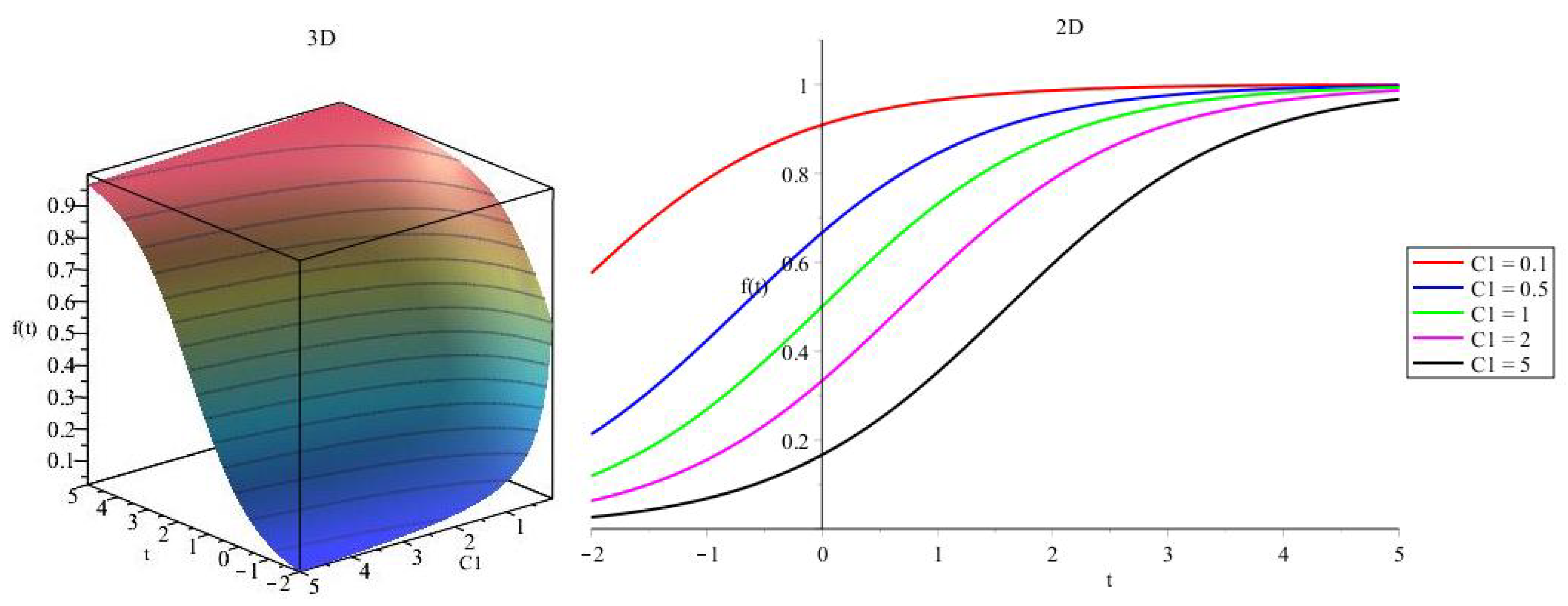
Lie symmetry reduction under X 2 = x yields the spatially homogeneous solution u = f ( t ) , which reduces the Fisher equation to the logistic ODE (82). The exact solution is given by (84), where C 1 is an integration constant determined by the initial population density. The 3D graph (Figure 2 (3D)) displays the solution surface f ( t , C 1 ) , illustrating how the temporal evolution depends on C 1 . The 2D graph (Figure 2 (2D)) shows cross-sectional profiles for selected C 1 values, all exhibiting the characteristic logistic growth from 0 to the carrying capacity 1. This family of solutions represents homogeneous population growth in the absence of spatial diffusion, a purely time-dependent saturation process governed by the reaction term u ( 1 u ) .
The MAPLE 2023 code used to plot Figure 2 is in Appendix A.3.

4.4. Reduction via the Travelling-Wave Symmetry ( X = t + c x )

We seek an invariant solution under the Lie point symmetry generator
X = t + c x ,
where c is a constant representing the speed of the travelling-wave.
This symmetry corresponds to invariance under a travelling-wave transformation. To find an invariant solution, we use the method of characteristics. The associated characteristic system is
d t 1 = d x c = d u 0 .
Two invariants
T 1 = z = x c t and T 2 = u ,
are obtained, and the group-invariant solution is given by
T 2 = f ( T 1 ) , i . e . u ( x , t ) = f ( x c t ) .
Hence, the invariant variable is
z = x c t ,
and the solution can be written as
u ( x , t ) = f ( z ) .
Substituting the invariant form u ( x , t ) = f ( z ) , with  z = x c t , into Fisher’s equation results in
u t = 2 u x 2 + u ( 1 u ) .
Using the chain rule
u t = d f d z z t = c f ( z ) ,
2 u x 2 = d 2 f d z 2 .
Substituting these into the PDE (3) yields the ODE
f ( z ) + c f ( z ) + f ( z ) ( 1 f ( z ) ) = 0 .
To obtain an exact solution of this nonlinear ODE we apply the tanh method [27,28,29]. The idea is to express the solution in terms of a polynomial in the hyperbolic tangent function. Introduce the transformation
T ( z ) = tanh ( k z ) ,
where k 0 is a constant real number. Since
d T d z = k ( 1 T 2 ) ,
this substitution allows the derivatives of f to be rewritten in terms of T. A balance of the highest powers in the ODE shows that the solution should take the form of a quadratic polynomial in T, so we assume
f ( z ) = a 0 + a 1 T + a 2 T 2 ,
where a 0 , a 1 , a 2 , k R are constants to be determined.
Differentiating the ansatz using the chain rule gives
f ( z ) = d f d T d T d z = ( a 1 + 2 a 2 T ) k ( 1 T 2 ) .
Differentiating again, we set
g ( T ) = ( a 1 + 2 a 2 T ) ( 1 T 2 ) ,
so that
f ( z ) = k 2 g ( T ) ( 1 T 2 ) .
Computing g ( T ) gives
g ( T ) = 2 a 2 2 a 1 T 6 a 2 T 2 .
Therefore, the second derivative becomes
f ( z ) = k 2 ( 2 a 2 2 a 1 T 6 a 2 T 2 ) ( 1 T 2 ) ,
and expanding yields
f ( z ) = k 2 ( 6 a 2 T 4 + 2 a 1 T 3 8 a 2 T 2 2 a 1 T + 2 a 2 ) .
Next, the nonlinear reaction term is expanded. Substituting the polynomial ansatz gives
f ( 1 f ) = ( a 0 a 0 2 ) + ( a 1 2 a 0 a 1 ) T + ( 2 a 0 a 2 a 1 2 + a 2 ) T 2 2 a 1 a 2 T 3 a 2 2 T 4 .
For later use, write f ( z ) in expanded form as
f ( z ) = k ( a 1 + 2 a 2 T ) ( 1 T 2 ) = k ( 2 a 2 T 3 a 1 T 2 + 2 a 2 T + a 1 ) .
Substituting the expressions for f ( z ) , c f ( z ) , and  f ( 1 f ) into the ODE
f + c f + f ( 1 f ) = 0 ,
gives
k 2 ( 6 a 2 T 4 + 2 a 1 T 3 8 a 2 T 2 2 a 1 T + 2 a 2 ) +   c k ( 2 a 2 T 3 a 1 T 2 + 2 a 2 T + a 1 ) + ( a 0 a 0 2 ) + ( a 1 2 a 0 a 1 ) T + ( 2 a 0 a 2 a 1 2 + a 2 ) T 2 2 a 1 a 2 T 3 a 2 2 T 4 = 0 .
Collecting like powers of T yields a polynomial identity
A 4 T 4 + A 3 T 3 + A 2 T 2 + A 1 T + A 0 = 0 ,
where
A 4 = 6 a 2 k 2 a 2 2 ,
A 3 = 2 a 1 k 2 2 a 1 a 2 2 a 2 c k ,
A 2 = 8 a 2 k 2 2 a 0 a 2 a 1 2 a 1 c k + a 2 ,
A 1 = 2 a 1 k 2 2 a 0 a 1 + a 1 + 2 a 2 c k ,
A 0 = 2 a 2 k 2 a 0 2 + a 0 + a 1 c k .
Since this identity must hold for every value of T, the coefficients must vanish:
T 4 : 6 a 2 k 2 a 2 2 = 0 ,
T 3 : 2 a 1 k 2 2 a 1 a 2 2 a 2 c k = 0 ,
T 2 : 8 a 2 k 2 2 a 0 a 2 a 1 2 a 1 c k + a 2 = 0 ,
T 1 : 2 a 1 k 2 2 a 0 a 1 + a 1 + 2 a 2 c k = 0 ,
T 0 : 2 a 2 k 2 a 0 2 + a 0 + a 1 c k = 0 .
Solving these equations begins with the first condition,
a 2 ( 6 k 2 a 2 ) = 0 ,
which gives either a 2 = 0 or a 2 = 6 k 2 .
  • Case 1: a 2 = 0
The second equation reduces to
2 a 1 k 2 = 0 a 1 = 0 ,
and the last equation becomes
a 0 2 + a 0 = 0 ,
so a 0 = 0 or a 0 = 1 . These yield the constant solutions
f ( z ) = 0 , f ( z ) = 1 ,
which are not travelling waves.
  • Case 2: a 2 = 6 k 2
Substitute into the third-power condition
2 a 1 k 2 2 a 1 a 2 2 a 2 c k = 0 ,
10 a 1 k 2 12 c k 3 = 0 .
Dividing gives
5 a 1 + 6 c k = 0 ,
and hence
a 1 = 6 5 c k .
Using these in the linear equation yields
6 5 c k ( 2 a 0 + 12 k 2 1 ) = 0 .
Assuming c 0 , k 0 , we set
2 a 0 + 12 k 2 1 = 0 ,
so that
a 0 = 1 12 k 2 2 .
Substituting a 0 , a 1 , a 2 into the quadratic condition reduces to
100 k 2 c 2 = 0 ,
so that
c 2 = 100 k 2 .
Finally, the constant term equation becomes
( 24 k 2 1 ) ( 24 k 2 + 1 ) = 0 .
Thus,
k 2 = 1 24 ,
and
k = 1 2 6 , c 2 = 100 k 2 = 25 6 .
Taking c > 0 for a right-moving wave gives
c = 5 6 .
The coefficients are then given by
a 2 = 6 k 2 = 1 4 , a 0 = 1 12 k 2 2 = 1 4 , a 1 = 1 2 .
Hence, the polynomial becomes
f ( z ) = a 0 + a 1 T + a 2 T 2 = 1 4 1 2 T + 1 4 T 2 = 1 4 ( 1 T ) 2 ,
with
T = tanh z 2 6 .
Therefore, the explicit nonconstant travelling-wave solution of the ODE is
f ( z ) = 1 4 1 tanh z 2 6 2 .
Since the reduced ODE is autonomous, a translation in z also produces a solution. Thus,
f ( z ) = 1 4 1 tanh z z 0 2 6 2 , z = x c t
where z 0 is a translation constant. Substituting u ( t , x ) = f ( z ) results in the group-invariant solution
u ( x , t ) = 1 4 1 tanh x c t x 0 2 6 2 ,
where x 0 is a translation constant.
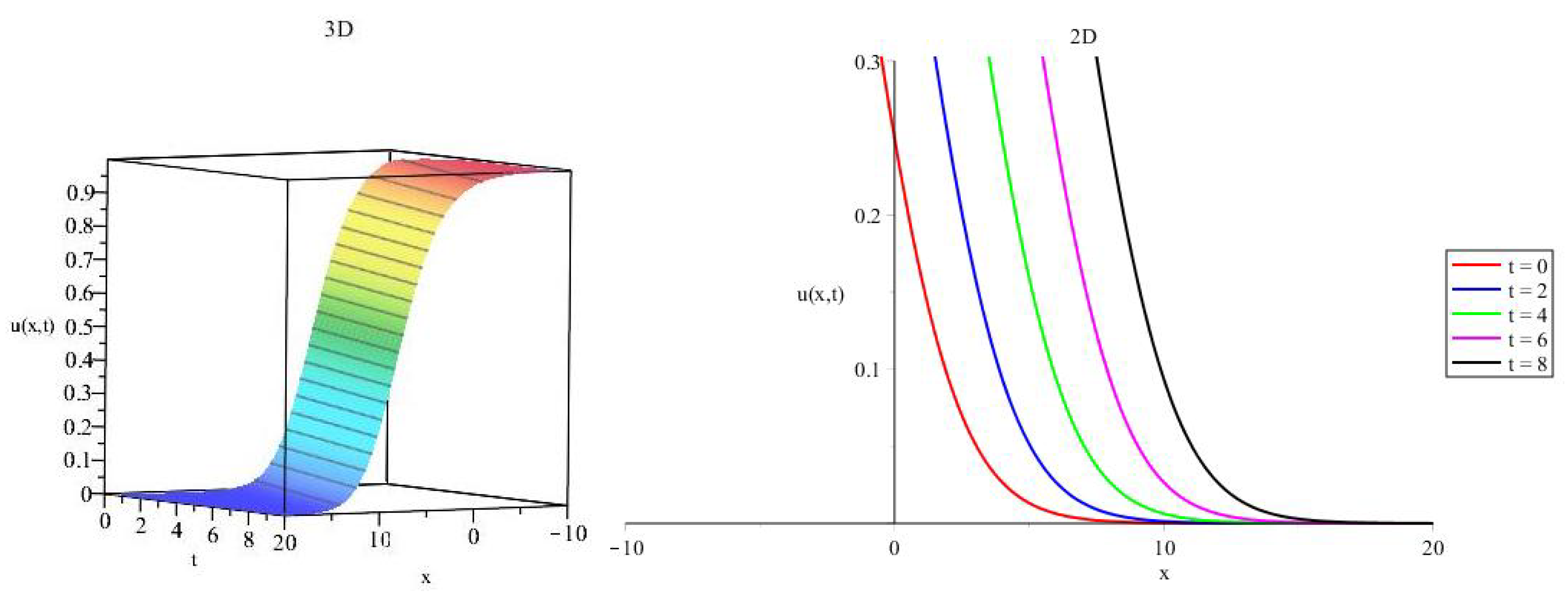
Lie symmetry reduction under the travelling-wave generator X = t + c x leads to the wave-front solution (141). This solution describes a smooth transition front that propagates with constant speed c while maintaining its shape. Biologically, it represents an invasion wave where the population density changes from the carrying-capacity state ( u 1 ) ahead of the front to the extinction state ( u 0 ) behind it or vice-versa, depending on the sign of c. The 3D graph (Figure 3 (3D)) displays the solution surface u ( x , t ) , illustrating the front’s uniform motion in the xt plane. The 2D graph (Figure 3 (2D)) shows snapshots of the profile at successive times, confirming the front’s translational invariance and its stable waveform. This exact travelling-wave solution is a hallmark of Fisher’s equation and models the spreading of a saturated population into an unoccupied habitat.
The MAPLE 2023 code used to compute Figure 3 is in Appendix A.4.

5. Analysis of Results

5.1. Physical/Biological Interpretation

Lie symmetry analysis yielded two independent translation symmetries, X 1 = t and X 2 = x , from which we derived two families of invariant solutions. By considering the linear combination X = X 1 + c X 2 = t + c x , which corresponds to a travelling-wave ansatz, we obtain a third class of solutions that represents front propagation. Together, these three solution types capture distinct dynamical regimes of Fisher’s equation.
  • Steady-state front from X 1
    The solution
    u ( x ) = 1 2 + 3 2 tanh 2 x x 0 2 ,
    corresponds to a time-independent equilibrium that balances diffusion and reaction. Although it approaches the carrying capacity u 1 as | x | , its minimum value of 0.5 lies outside the biologically admissible range u 0 . This indicates that such stationary fronts are mathematical solutions that may require modified nonlinearities to be physically meaningful.
  • Homogeneous logistic growth from X 2
    The solution
    u ( t ) = 1 1 + C 1 e t ,
    describes purely temporal saturation in the absence of spatial gradients. The constant C 1 encodes the initial population density relative to the carrying capacity. This solution models logistic growth in a well-mixed environment, where spatial diffusion is negligible.
  • Travelling-wave front from X = t + c x
    The solution
    u ( z ) = 1 4 1 tanh z z 0 2 6 2 , z = x c t ,
    with wave speed c = 5 / 6 , is the classic invasion front of the Fisher–KPP equation. It describes the transition from extinction ( u 0 ) ahead of the front to saturation ( u 1 ) behind it. This front models the spatial spread of a population or gene into unoccupied territory, with the speed c determined by the linearised growth rate at the unstable state u = 0 .

5.2. Comparison with Other Methods

The tanh method was selected for this analysis due to its capacity to furnish closed-form, explicit expressions for travelling front profiles. These analytical solutions offer distinct advantages for both visualisation and parameter interpretation, as they can be directly plotted and systematically examined without recourse to numerical approximation at this stage. Unlike phase–plane analysis, which yields qualitative dynamical insight but often leaves solutions in implicit form, the tanh approach translates the problem into a tractable algebraic system solvable via symbolic computation. This contrasts with quadrature or first-integral methods, which typically produce solutions expressed as integrals, thereby requiring additional evaluation steps for concrete interpretation. While mathematically equivalent to solutions derived from more geometric techniques, the explicit representations obtained here serve a specific methodological purpose: they bridge directly to biological intuition, allowing clear mapping between parameter values and waveform features, and they enable straightforward numerical validation through immediate simulation.

5.3. Stability Considerations

The stability of the obtained solutions can be inferred from established Fisher–KPP theory. The travelling-wave front with speed c = 5 / 6 is linearly stable and represents the minimal speed front selected by compact initial data. The constant solutions u = 0 (extinction) and u = 1 (carrying capacity) are, respectively, unstable and stable homogeneous equilibria. The steady-state tanh-squared front, although an exact solution of the time-independent ODE, is expected to be unstable under the full time-dependent Fisher dynamics because it violates the positivity condition u 0 over part of its domain. This highlights that not every invariant solution obtained from symmetry reduction is dynamically realisable in the original biological setting; stability and positivity constraints must be considered when interpreting the results.

5.4. Parameter Analysis

The figures presented quantify the dependence of solutions on key symmetry-generated parameters. Figure 1 shows how the steady-state front translates without shape change as x 0 varies, a direct manifestation of the spatial-translation symmetry X 2 . Figure 2 displays logistic growth profiles for different initial conditions C 1 , illustrating how the transient approach to saturation depends on the initial population size. Figure 3 visualises the travelling-wave front at successive times, confirming its constant shape and speed. These plots demonstrate that the free parameters arising from the symmetry reductions ( x 0 , C 1 , z 0 ) correspond to physically meaningful translations in space, shifts in initial density, and phase shifts of the invasion front. Moreover, the wave speed c = 5 / 6 emerges directly from the algebraic consistency of the tanh ansatz, showing how the method determines the characteristic propagation velocity without additional asymptotic matching.
Figure 1. Steady-state solution presentation of Equation (75).
Symmetry 18 00279 g001
Figure 2. Logistic solution presentation of Equation (84).
Symmetry 18 00279 g002
Figure 3. Travelling–wave solution presentation of Equation (141).
Symmetry 18 00279 g003

6. Discussion and Conclusions

6.1. Summary of the Findings

In this work, Lie symmetry analysis was applied to the classical Fisher’s equation, revealing its two elementary point symmetries, time translation X 1 = t and space translation X 2 = x . Using these symmetries, the PDE was systematically reduced to ODEs, whose solutions were obtained via direct integration and the tanh method. The analysis produced three families of exact solutions:
(i).
A time-independent (steady-state) front arising from X 1 ;
(ii).
A spatially homogeneous logistic-growth solution arising from X 2 ;
(iii).
A propagating travelling-wave front obtained from the linear combination X = t + c x .
Each solution class corresponds to a distinct dynamical regime of the Fisher model, from static balances between diffusion and reaction to uniform temporal saturation and invasive front propagation. The explicit wave speed c = 5 / 6 emerged naturally from the algebraic conditions of the tanh ansatz, confirming the well-known minimal speed selection in the Fisher–KPP framework. Throughout the study, symbolic computation in MAPLE was employed to verify the reductions, solve the algebraic systems, and generate illustrative visualisations of the wave profiles.

6.2. Biological Implications

Fisher’s equation originated as a model for the spread of an advantageous gene in a population. The solutions obtained here translate directly into interpretable biological scenarios. The travelling-wave front describes an invasion process, where a genetically favourable trait (or a colonising population) propagates spatially at a constant speed c, transforming an unstable extinction state into a stable saturated state. The logistic solution describes local, well-mixed population growth in the absence of spatial structure. The steady-state front, although not globally positive, illustrates how diffusion and reaction can balance to produce a non-uniform stationary profile, a situation that could arise in spatially heterogeneous environments or under additional ecological constraints. In all cases, the free parameters arising from the symmetry reductions ( x 0 , C 1 , z 0 ) correspond to measurable biological quantities: the initial location of a front, the initial population density, and the phase of an invasion wave. Thus, while the analysis is mathematical, each result carries a clear biological interpretation that reinforces the utility of symmetry methods in theoretical ecology and population dynamics.

6.3. Limitations of the Study

The symmetry analysis performed here is restricted to classical Lie point symmetries. As a consequence, only the two translation symmetries were found, a result that is already well-known for Fisher’s equation. Nonclassical, potential, or generalised symmetries were not explored, which might have revealed a richer algebraic structure and possibly new classes of solutions. Moreover, the tanh method, while effective for obtaining closed-form expressions, is a standard technique and does not offer qualitative insight beyond the explicit solutions it delivers. Finally, the study considered only the canonical Fisher’s equation with unit diffusion and reaction coefficients; a more general form containing free parameters could have broadened the applicability of the results.

6.4. Future Work

Several directions naturally extend the present investigation. First, a systematic search for nonclassical symmetries of Fisher’s equation could uncover additional reductions and exact solutions beyond those obtained here. Second, the stability and attractor properties of the derived solutions, particularly the steady-state tanh-squared front, could be analysed rigorously via linear stability analysis or numerical simulation. Third, the method could be applied to generalised Fisher-type equations with spatially dependent coefficients, fractional derivatives, or alternative reaction terms, where symmetries may be less trivial. Finally, incorporating recent numerical techniques (e.g., multiwavelet Galerkin schemes or hybrid finite-difference–spectral methods) could provide a quantitative comparison between the analytical solutions and high-accuracy numerical approximations, validating the solutions in regimes where explicit formulas are unavailable.

Author Contributions

Conceptualisation, L.R. and P.M.; methodology, L.R. and P.M.; software, P.M.; validation, L.R. and P.M.; resources, L.R. and P.M.; writing—original draft preparation, P.M.; writing—review and editing, P.M. and L.R.; supervision, L.R.; funding acquisition, L.R. All authors have read and agreed to the published version of the manuscript.

Funding

This work is based on research supported in part by the National Research Foundation (NRF) of South Africa (Reference/Grant Number: CSUR240425215973). The authors acknowledge that opinions, findings, and conclusions or recommendations expressed in this work are those of the authors alone, and that the NRF accepts no liability whatsoever in this regard. The authors are grateful for the funding.

Data Availability Statement

The original contributions presented in this study are included in the article. Further inguiries can be directed to the corresponding author.

Acknowledgments

The authors gratefully acknowledge the administrative and infrastructural support provided by the University of Limpopo, including computing resources, which facilitated the completion of this research.

Conflicts of Interest

The authors declare no conflicts of interest.

Appendix A

Appendix A.1. Symmetry Computation

restart;
with(PDEtools):
PDE := diff(u(x,t), t) = diff(u(x,t), x, x) + u(x,t)∗(1 - u(x,t));
Infinitesimals(PDE);
		  

Appendix A.2. Steady-State Solution (Figure 1)

restart;
with(plots):


f := (x, x0) -> -1/2 + (3/2)∗tanh((x - x0)/2)^2;


x_min := -5; x_max := 5;
x0_min := -2; x0_max := 2;


# 3D surface
plot3d_f := plot3d(f(x, x0), x = x_min..x_max, x0 = x0_min..x0_max,
    axes = boxed, labels = ["x", "x0", "f(x)"],
    colorscheme = ["zgradient", ["Blue","Cyan","Green","Yellow","Red"]],
    style = surfacecontour, shading = zgrayscale,
    orientation = [140,70,0]):


# 2D profiles
x0_vals := [-2, -1, 0, 1, 2];
colors := [red, blue, green, magenta, black];
profiles := seq(plot(f(x, x0_vals[i]), x = x_min..x_max,
    color = colors[i], thickness = 2,
    legend = sprintf("x0 = %a", x0_vals[i])), i = 1..5):


plot2d_f := display(profiles,
    labels = ["x", "f(x)"], legendstyle = [location=right],
    view = [DEFAULT, -1..2]):


display(Array([plot3d_f, plot2d_f]));
		  

Appendix A.3. Logistic Solution (Figure 2)

restart;
with(plots):


g := (t, C1) -> 1/(1 + C1 ∗ exp(-t));
t_min := -2; t_max := 5;
C1_min := 0.1; C1_max := 5;


# 3D surface
plot3d_g := plot3d(g(t, C1), t = t_min..t_max, C1 = C1_min..C1_max,
    axes = boxed, labels = ["t", "C1", "f(t)"],
    colorscheme = ["zgradient", ["Blue","Cyan","Green","Yellow","Red"]],
    style = surfacecontour, shading = zgrayscale,
    orientation = [140,70,0]):


# 2D profiles
C1_vals := [0.1, 0.5, 1, 2, 5];
colors := [red, blue, green, magenta, black];
profiles := seq(plot(g(t, C1_vals[i]), t = t_min..t_max,
    color = colors[i], thickness = 2,
    legend = sprintf("C1 = %a", C1_vals[i])), i = 1..5):


plot2d_g := display(profiles,
    labels = ["t", "f(t)"], legendstyle = [location=right],
    view = [DEFAULT, 0..1.1]):


display(Array([plot3d_g, plot2d_g]));
		  

Appendix A.4. Travelling-Wave Solution (Figure 3)

restart;
with(plots):


c := 5/sqrt(6);
u := (x, t) -> (1/4)∗(1 - tanh((x - c∗t)/(2∗sqrt(6))))^2;


x_min := -10; x_max := 20;
t_min := 0; t_max := 10;


# 3D surface
plot3d_u := plot3d(u(x, t), x = x_min..x_max, t = t_min..t_max,
    axes = boxed, labels = ["x", "t", "u(x,t)"],
    colorscheme = ["zgradient", ["Blue","Cyan","Green","Yellow","Red"]],
    style = surfacecontour, shading = zgrayscale,
    orientation = [130,60,0]):


# 2D profiles
t_vals := [0, 2, 4, 6, 8];
colors := [red, blue, green, magenta, black];
profiles := seq(plot(u(x, t_vals[i]), x = x_min..x_max,
    color = colors[i], thickness = 2,
    legend = sprintf("t = %a", t_vals[i])), i = 1..5):


plot2d_u := display(profiles,
    labels = ["x", "u(x,t)"], legendstyle = [location=right],
    view = [DEFAULT, 0..0.3]):


display(Array([plot3d_u, plot2d_u]));
		  

References

  1. Murray, J.D. Mathematical Biology I: An Introduction, 3rd ed.; Springer: New York, NY, USA, 2007. [Google Scholar]
  2. Turing, A.M. The chemical basis of morphogenesis. Philos. Trans. R. Soc. Lond. B 1952, 237, 37–72. [Google Scholar] [CrossRef]
  3. Cosner, C. Reaction–diffusion equations and ecological modeling. In Tutorials in Mathematical Biosciences IV: Evolution and Ecology; Springer: Berlin/Heidelberg, Germany, 2008; pp. 77–115. [Google Scholar]
  4. Fisher, R.A. The wave of advance of advantageous genes. Ann. Eugen. 1937, 7, 355–369. [Google Scholar] [CrossRef]
  5. Kolmogorov, A.; Petrovsky, I.; Piskunov, N. Étude de l’équation de la diffusion avec croissance de la quantité de matière et son application à un problème biologique. Moscou Univ. Math. Bull. 1937, 1, 1–12. [Google Scholar]
  6. Ablowitz, M.J.; Zeppetella, A. Explicit solutions of Fisher’s equation for a special wave speed. Bull. Math. Biol. 1979, 41, 835–840. [Google Scholar] [CrossRef]
  7. Bluman, G.W.; Kumei, S. Symmetries and Differential Equations; Springer Science & Business Media: New York, NY, USA, 2013; Volume 81. [Google Scholar]
  8. Hydon, P.E. Symmetry Methods for Differential Equations: A Beginner’s Guide; Cambridge University Press: Cambridge, UK, 2000. [Google Scholar]
  9. Oliveri, F. ReLie: A reduce program for Lie group analysis of differential equations. Symmetry 2021, 13, 1826. [Google Scholar] [CrossRef]
  10. Ganghoffer, J.-F.; Rahouadj, R.; Cheviakov, A. Symmetry analysis and equivalence transformations for the construction and reduction of constitutive models. Adv. Model. Simul. Eng. Sci. 2021, 8, 1. [Google Scholar] [CrossRef]
  11. Adeyemo, O.D. Lie Subalgebras, Solutions and Conserved Vectors of a Nonlinear Geophysical Korteweg de Vries Equation in Ocean Physics and Nonlinear Mechanics with Power Law. Qual. Theory Dyn. Syst. 2025, 24, 62. [Google Scholar] [CrossRef]
  12. Amangeldi, M. Lie Groups and Euler-Bernoulli Beam Equation. Master’s Thesis, Illinois State University, Normal, IL, USA, 2021. [Google Scholar]
  13. Liu, P.; Lou, S. Applications of Symmetries to Nonlinear Partial Differential Equations. Symmetry 2024, 16, 1591. [Google Scholar] [CrossRef]
  14. Pailas, T.; Terzis, P.A.; Christodoulakis, T. On solvable Lie algebras and integration method of ordinary differential equations. arXiv 2020, arXiv:2002.01195. [Google Scholar] [CrossRef]
  15. Majeed, A.; Kamran, M.; Abbas, M.; Singh, J. An Efficient Numerical Technique for Solving Time-Fractional Generalized Fisher’s Equation. Front. Phys. 2020, 8, 293. [Google Scholar] [CrossRef]
  16. Eriqat, T.; Oqielat, M.N.; Al-Zhour, Z.; El-Ajou, A.; Bataineh, A.S. Revisited Fisher’s equation and logistic system model: A new fractional approach and some modifications. Int. J. Dyn. Control 2023, 11, 555–563. [Google Scholar] [CrossRef]
  17. Salih, O.M.; Al-Jawary, M. Reliable iterative methods for solving 1D, 2D and 3D Fisher’s equation. IIUM Eng. J. 2020, 22, 138–166. [Google Scholar] [CrossRef]
  18. Bin Jebreen, H. On the numerical solution of Fisher’s equation by an efficient algorithm based on multiwavelets. AIMS Math. 2021, 6, 2369–2384. [Google Scholar] [CrossRef]
  19. Barik, S.; Behera, S. Soliton Dynamics of the Phi-Four Equation and Fisher Equation by Hirota Bilinear Method. Int. J. Appl. Comput. Math. 2025, 11, 243. [Google Scholar] [CrossRef]
  20. Loyinmi, A.C.; Akinfe, T.K. Exact solutions to the family of Fisher’s reaction-diffusion equation using Elzaki homotopy transformation perturbation method. Eng. Rep. 2020, 2, e12084. [Google Scholar] [CrossRef]
  21. Mittal, R.C.; Jain, R.K. Numerical solutions of nonlinear Fisher’s reaction–diffusion equation with modified cubic B-spline collocation method. Math. Sci. 2013, 7, 12. [Google Scholar] [CrossRef]
  22. Cheng-Shi, L. Representations and classification of traveling wave solutions to sinh-Gordon equation. Commun. Theor. Phys. 2008, 49, 153. [Google Scholar] [CrossRef]
  23. Bluman, G.; Anco, S. Symmetry and Integration Methods for Differential Equations; Springer Science & Business Media: New York, NY, USA, 2008; Volume 154. [Google Scholar]
  24. Arrigo, D.J. Symmetry Analysis of Differential Equations: An Introduction; John Wiley & Sons: Hoboken, NJ, USA, 2015. [Google Scholar]
  25. Olver, P.J. Applications of Lie Groups to Differential Equations, 2nd ed.; Graduate Texts in Mathematics; Springer: New York, NY, USA, 1993; Volume 107, ISBN 0-387-94007-3. [Google Scholar]
  26. Ibragimov, N.H. (Ed.) CRC Handbook of Lie Group Analysis of Differential Equations, Volume 1: Symmetries, Exact Solutions, and Conservation Laws; CRC Press: Boca Raton, FL, USA, 1996; ISBN 0-8493-4488-3. [Google Scholar] [CrossRef]
  27. Hendi, A. The extended tanh method and its applications for solving nonlinear physical models. IJRRAS 2010, 3, 83–91. [Google Scholar]
  28. Hereman, W.; Malfliet, W. The tanh method: A tool to solve nonlinear partial differential equations with symbolic software. In Proceedings of the 9th World Multi-Conference on Systems, Cybernetics and Informatics, Orlando, FL, USA, 10–13 July 2005; pp. 165–168. [Google Scholar]
  29. Yang, Z.; Pan, H. New solitary wave solutions of the Fisher equation. J. Appl. Math. Phys. 2022, 10, 3356–3368. [Google Scholar] [CrossRef]
Disclaimer/Publisher’s Note: The statements, opinions and data contained in all publications are solely those of the individual author(s) and contributor(s) and not of MDPI and/or the editor(s). MDPI and/or the editor(s) disclaim responsibility for any injury to people or property resulting from any ideas, methods, instructions or products referred to in the content.