Conjugation of Colored Compositions


School of Mathematics, University of the Witwatersrand, Johannesburg 2050, South Africa
Symmetry 2026, 18(2), 257; https://doi.org/10.3390/sym18020257
Submission received: 20 December 2025
/
Revised: 19 January 2026
/
Accepted: 23 January 2026
/
Published: 30 January 2026
Abstract
An n-color composition is a colored composition in which a part of size m may come in m colors. This paper gives a new set of n-color-type compositions that admits exhaustive conjugation of its members. Previous attempts at conjugation of n-color compositions have yielded partial results at best. Instead of importing the coloring scheme previously used for partitions, we apply colors directly to the parts of compositions while treating any maximal string of ones as a single part under color assignment. This leads to the definition of n-color compositions of the second kind. As with ordinary compositions, a conjugate may be found using equivalent techniques: symbolic algebra, zig-zag graphs, and line graphs. We conclude with a derivation of the relevant enumeration formulas.
MSC:
11P81; 05A17; 05A151. Introduction
A composition of a positive integer n is an ordered partition of n or a sequence of positive integers that sum to n. The summands are also called parts, and n is the weight of the composition. For example, has four compositions: , and . It is well-known that there are compositions of n (see, for example, [1,2]).
Colored compositions are generalized compositions in which a part’s size may come in a prescribed number of types or colors, usually denoted by subscripts . In particular, an n-color composition is a colored composition in which a part of size m may come in m colors: [3]. For example, there are eight n-color compositions of three, namely,
The n-color notion originated from the paper of Agarwal and Andrews [4], who investigated combinatorial identities for “partitions with n copies of n”, that is, n-color partitions. Subsequently Agarwal [3] defined n-color compositions and explored their enumeration and combinatorial properties. For instance, he proved that the number of n-color compositions of a positive integer is given by , where the Fibonacci numbers are defined by .
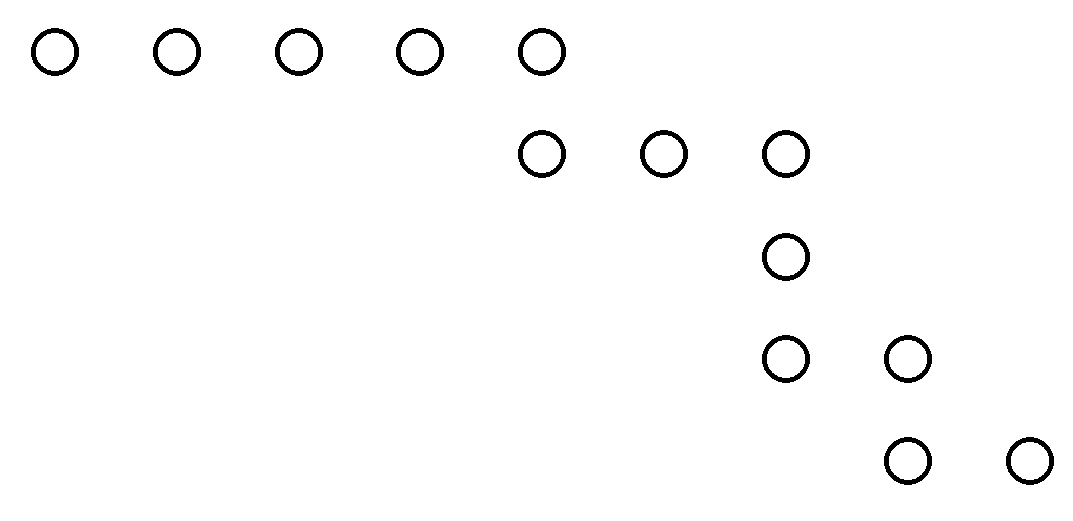
The conjugate of a composition is given by the composition corresponding to the columns of its zig-zag graph, read from left to right. For example, the zig-zag graph of is shown in Figure 1.
Thus the conjugate from Figure 1 is . Two further methods of obtaining are mentioned below.
It appears that the n-color compositions cannot all be conjugated like ordinary compositions. Brian Hopkins [5] made a limited attempt by means of zig-zag graphs and concluded that only certain compositions with odd weights and parts not exceeding three may be conjugated. A year later, Collins et al. [6] discussed the topic briefly using tilings of 1-by-n boards with ternary sequences and gave a few instances. However, their technique was rather elusive, and no counting formula was provided. Alanazi et al. [7] undertook a systematic investigation of the topic using n-multicolor compositions with tilings of 1-by-n boards and ternary sequences. They modeled their technique after an extension of MacMahon’s line graph conjugation method and discovered a remarkably large set of conjugable n-color compositions.
Theorem 1
(Alanazi et al. [7]). The number of conjugable n-color compositions of an integer is given by .
However, even in the latter model, a substantial number of objects still escaped conjugation. Note that for all .
Lastly, we refer to a significant 1997 paper by Agarwal and Balasubrananian [8], where the conjugate of an n-color partition is defined as the n-color partition obtained by replacing each colored part by . The authors used this definition to establish an identity between “n-color partitions, where the weighted difference of each pair of parts is ” and “n-color partitions such that, in each pair of parts, () b is the arithmetic mean of the subscripts i and j”, among other results.
One may apply this definition to n-color compositions and obtain the conjugate of every object. We will refer to this conjugation as color-complement or simply c-complement. For example, if , then the c-complement conjugate is given by .
Proposition 1.
The number of c-complement self-conjugate n-color compositions of ν is given by .
Since maps to and , self-conjugate parts are odd parts (), with each part subscripted by its unique numerical index among increasing odd positive integers. The result then follows from the fact that compositions of into odd parts are enumerated by (see [2]). For example, is a c-complement self-conjugate.
Note that Proposition 1 implies that every n-color composition C counted by has a unique conjugate with . It follows that (mod 2) for all .
Even though c-complement conjugation admits conjugation of every n-color composition C, the parts of C and remain rigidly the same, and it is not clear how can be found graphically. Nonetheless, the method is independently interesting and may be gainfully applied to any set of subscripted integer sequences.
This paper introduces a modified set of n-color compositions in which every object has a conjugate in the classical tradition of Percy Alexander MacMahon (1854–1929) who pioneered the topic for ordinary compositions [9]. Whereas standard n-color compositions originated by extending the coloring scheme used for partitions to compositions (see [3,4]), our objects arise from coloring compositions directly. Such colored compositions share the essential property of n-color compositions by requiring a subscript associated with a part to not exceed the part.
The conjugation techniques discussed in this work have potential applications in certain graph-based and algebraic constructions used in cryptography [10]. The graphical techniques may be harnessed to strengthen the confusion in RGB (red, green, blue) image encryption using SPN (Substitution–Permutation Network) with a novel block cipher over simple graph adjacency matrices [11].
In Section 2 we profile the new set of conjugable colored compositions with some immediate examples. Then in Section 3 we give further details of three conjugation techniques gleaned from the conjugation of ordinary compositions. Section 4 is devoted to the statement and proof of relevant enumeration formulas. Finally, Section 5 contains additional enumeration results for objects with part sizes bounded from below.
2. The n-Color Compositions of the Second Kind
It would be convenient to write compositions symbolically by representing a maximal string of 1s of length x by , where two adjacent big parts (i.e., parts ) are assumed to be separated by . A general composition then has one of the following two forms:
where it is understood in each case that C either ends in or for some with and .
The first or last part of composition C is also referred to as a boundary part. Any other part of C is an interior part.
In defining our new set of colored compositions, we are guided by the conjugation model of P. A. MacMahon for ordinary compositions; that is, every composition C has a unique conjugate that satisfies the following conditions:
- (i)
- is obtainable from C via symbolic algebra;
- (ii)
- is obtainable from the line graph of ; and
- (iii)
- is obtainable from the zig-zag graph of C.
For example, in addition to the zig-zag graph technique shown earlier, one may use symbolic algebra and a line graph to obtain as follows:
Firstly, the symbolic algebra conjugation of is given by
Thus an interior part , conjugates to . We also refer to as the number of interior units of m. Note that 2 conjugates to and thus has 0 interior units.
For example, has the conjugate
For the line graph we use circular nodes separated by bars (instead of line segments separated by dots). Thus we obtain
We now propose an n-color-type scheme that satisfies the three conjugation conditions. Our most significant departure from standard n-color compositions is a negation of the assignment of the color 1 to each part 1 in every maximal string . It is known that an ordinary composition generates as many n-color compositions as the product of its parts (see, for example, [13]). For example, generates the following 6 objects:
Indeed any composition of the form generates exactly 6 n-color compositions.
The coloring scheme proposed here accounts for the fact that the number of colors of a part-size m is dominated by m. But we treat a string of m ones, , , as the single part m with respect to color assignment. This is informed by the conjugation of standard compositions in which strings of 1s translate into big parts.
This makes sense because a boundary string conjugates into the boundary part (which is entitled to colors) while an interior string conjugates into the interior part (which is entitled to colors). We see that an assignment of just the single color 1 to , independent of the size of x, is not symmetrical.
This color assignment is also supported by the natural fact that the parts of a composition occur as an ordered sequence. Thus in the proposed model, a colored part occurs in a composition if and only if a corresponding string , occurs in the ordinary support composition if and only if a string of x colored parts , actually occur in . Thus, for instance, if is colored 2 in a composition, these will appear as or in the symbolic form .
Another seemingly unusual assignment is that, when 2 occurs as an interior part, it has no color (or empty color) denoted by . This is justified by the naturally derived conjugation principle:
“a big part bears a positive color if and only if it can be obtained via a symbolic transformation of a string of 1s with a positive color by conjugation”.
It is clear that 2 does not fulfill this condition because it is obtained by transforming a zero string of ones under conjugation (see the paragraph immediately following (3)).
Suppose C is a composition of . Let and denote the respective sets of possible colors of a boundary and interior big part , and let and denote the sets of possible colors of a boundary and interior string of ones .
Definition 1.
Let C be an ordinary composition of ν. A conjugable n-color composition is any colored composition of ν obtained by applying the following color assignments to the parts of C. If C is a trivial composition, that is, , then each symbolic part admits ν colors:
- ;
Otherwise,
- (i)
- ;
- (ii)
- ;
- (iii)
- ;
- (iv)
- .
As with ordinary compositions, the LG nodes of a boundary part (or boundary string of 1s) are read from left to right on the left boundary and from right to left on the right boundary.
Remark 1.
Note that when standard n-color compositions are defined with respect to sets of colors assigned to the parts of an ordinary composition, we have
For example, the following are some conjugable n-color compositions obtained from one ordinary composition: and . However, is not a conjugable composition because and violate the definition.
Using the line graph, colors are assigned to interior units of interior big parts. Thus an interior part represented by b nodes in a line graph is assigned a color only at one of the interior nodes, that is, at one of the 2nd to the th nodes:
Secondly, a left boundary part is assigned a color only at one of the first nodes (similar for a right boundary part):
On the other hand, it is clear that 2 with the representation has no interior unit. So an interior part 2 bears the color 0. However, a boundary part 2, with a representation of the form or , clearly has one colorable node, on the left or on the right, respectively. Consequently, in a nontrivial conjugable n-color composition, 2 always takes the boundary form and the interior form .
Finally, we remark that a string of 1s, already being units, may be assigned a color at any of its nodes in a line graph.
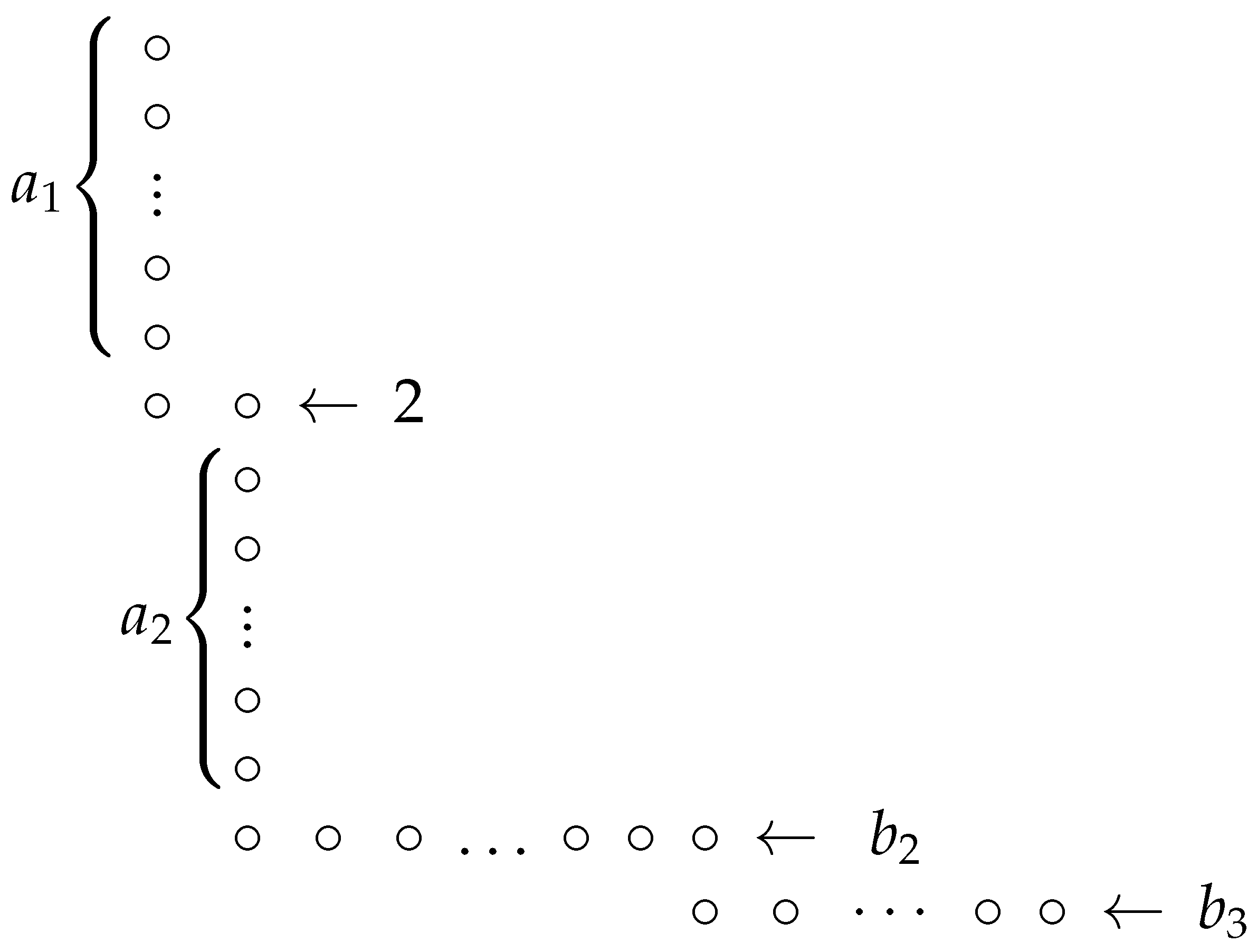
These facts may also be depicted using a zig-zag graph. For example, consider the composition . From the zig-zag graph in Figure 2, it is intuitively clear why any of the (or ) nodes is colorable, why neither of the 2 interior nodes can be colored, why only the second to the th nodes are colorable, and why only the last nodes are colorable.
With these coloring rules observed, the conjugate of the resulting colored composition may be obtained by reading the diagram by columns from left to right.
For example, the conjugable n-color composition
has the following zigzag graph representation:
The conjugate is now obtained by reading the zig-zag graph by columns to give . The corresponding line graph of is
The line graph of is obtained by swapping gaps and bars as with ordinary compositions:
Finally, the symbolic algebra technique matches that of ordinary compositions, as one may verify by ignoring the colors. Precise details are provided in the next section.
| ○ | |||||||
| ● | |||||||
| ○ | |||||||
| ○ | |||||||
| ○ | ○ | ||||||
| ○ | |||||||
| ○ | |||||||
| ● | |||||||
| ○ | ○ | ● | ○ | ○ | |||
| ○ | ○ | ● |
These new colored compositions should be known as n-color compositions of the second kind or simply M-color compositions.
We recap the properties satisfied by an M-color composition based on an ordinary support composition C as follows: the number of parts of C is denoted by .
- (1)
- A maximal string of ones of length u always comes in u colors.
- (2)
- If C consists of a single part b, then b comes in b colors.
- (3)
- If , the part comes in one color (namely, 1 or 0).
- (4)
- If and is the first or last part of C, then b comes in colors.
- (5)
- If is an interior part of C, it comes in colors.
The number of M-color compositions of is denoted by .
3. The Conjugation Involution
We now give a full explanation of the symbolic algebra technique. The trivial compositions conjugate is as follows for any :
We next convert the ordinary composition C in (1) into a conjugable n-color composition by assigning colors to the parts in accordance with the following definition:
Since the conjugate of C is given by (see (3)), we analogously obtain
Alternatively, showing the occurrence of 2, let
where the color sizes are subject to the restrictions in (5). Then the conjugate is
Note that the colors in both and satisfy the stipulations in the definition since they immediately agree with (5). For example, in we have for all i, and , which gives for , and so forth. Secondly, the conjugation of an interior 2 to and vice versa are given by convention. Hence the conjugates in (6) and (7) are well-defined.
It is clear that one may similarly assign colors to the parts of the support composition (2) and obtain analogous symbolic conjugates.
We remark that an M-color composition of cannot be a self-conjugate, a fact inherited from ordinary (support) compositions (see [12]).
Example 1.
Consider . Then
Alternatively, we may use the line graph and obtain
which, by placing division bars only in gaps which previously had none, leads to
from which the conjugate is again seen to be .
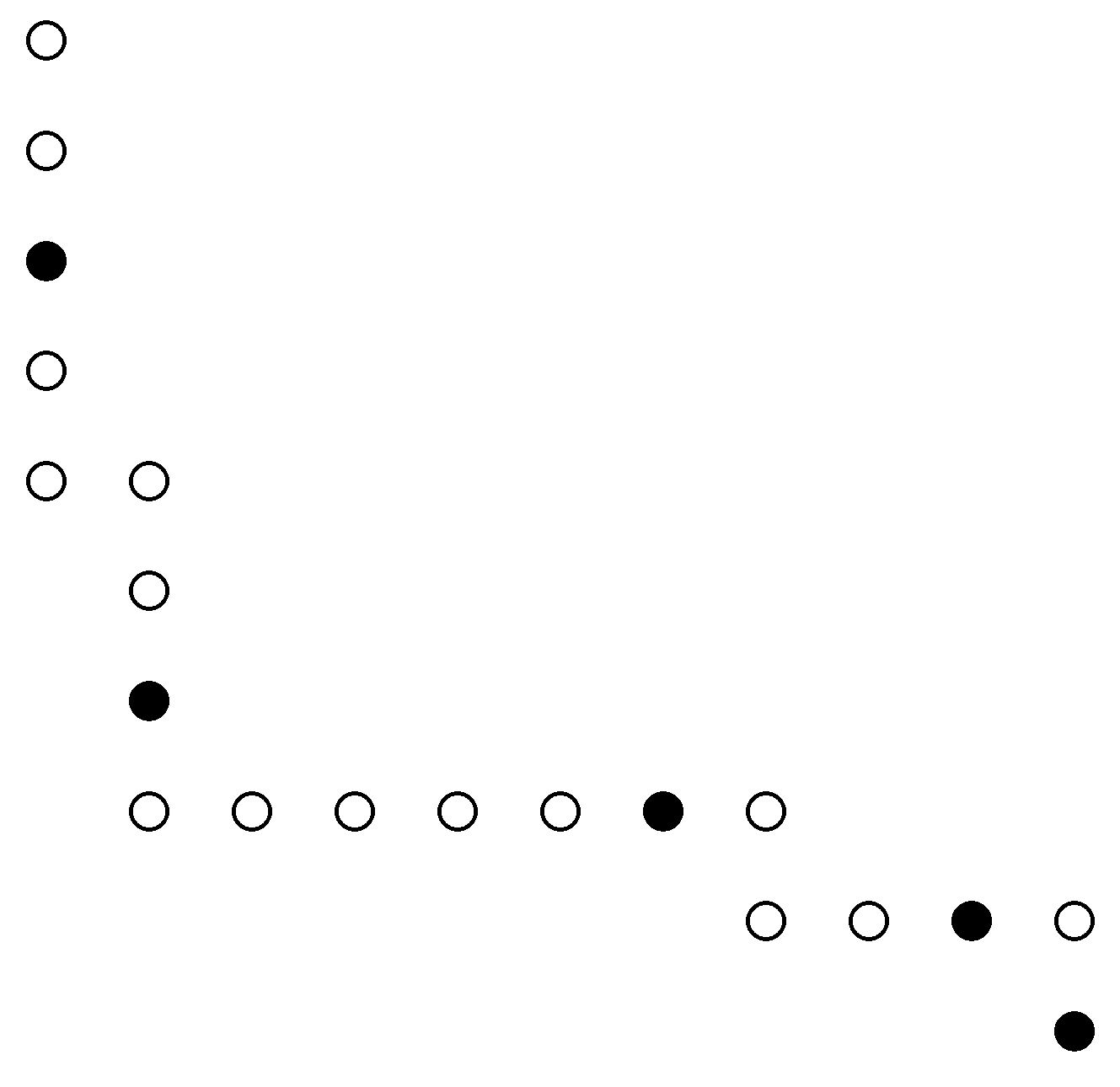
The final approach is to use the zig-zag graph of where is obtained by reading the graph by columns (see Figure 3).
Example 2.
If , then , which enumerates the following objects (arranged in conjugate pairs):
4. Enumeration of M-Color Compositions
We state the main enumeration result.
Theorem 2.
We have
Proof.
We refer to the list of properties satisfied by the parts of an M-color composition C given at the end of Section 2.
Let and be the generating functions for the numbers of M-color compositions with first part 1 and first part , respectively.
We first consider the following attributes:
- (i)
- Any maximal string of ones comes in u colors.
- (ii)
- There is exactly one color for 2 (for now).
- (iii)
- A part comes in colors (for now).
Then is given by an initial block of u ones, for which there are u colors, followed by a composition that does not start with 1, that is,
Secondly, is given by either the empty composition of 0 or 2 or an initial part , for which there are colors, followed by an arbitrary composition:
Next we account for additional attributes:
- (iv)
- The integer 2 has a second color if it is the only part.
- (v)
- There is an additional color for each first or last part .
Thus, altogether, (i) to (v) are equivalent to the original conditions (1) to (5) in Section 2.
If we combine the generating functions for (iv) and (v) with Equation (11), we obtain the full generating function:
This simplifies to
Hence the proof follows. □
The following recurrence is a routine consequence of the generating function (8), and it may be verified that the explicit formula (13) satisfies the recurrence.
Corollary 1.
We have
5. M-Color Compositions with Parts Bounded Below
Let denote the number of M-color compositions of that satisfy property P, and let be the number of those objects with k parts. We first obtain the generating function for the number of objects without 1s.
Theorem 3.
We have
Proof.
Note that , that is,
When , each boundary part b has possible colors, and each interior part b has colors, while 2 has precisely one color either way. Thus the decomposition is
- Therefore,
□
The Case of Objects with Parts
We prove the following assertion:
Theorem 4.
Let be an integer. Then
Proof.
First note that , that is,
When , each boundary part has possible colors, and each interior part has colors. Thus the decomposition is
(Note that implies ).
Therefore,
□
6. Discussion
This research introduces a new set of colored compositions endowed with the classical conjugation property of ordinary compositions. Furthermore, there is an enumerative generating function and an explicit computational formula. The results are based directly on the inherent symmetry of compositions. It is worth noting that these M-color compositions also form an interesting class of combinatorial objects in their own right, even without recourse to conjugation. They are expected to become rich objects of research in the future. For example, it might be rewarding to examine pattern avoidance questions in the set of M-color compositions. Also, the discussed techniques might have applications to certain graph-based cryptographic constructions such as RGB image encryption using SPN with a novel block cipher over simple graph adjacency matrices and Galois fields. The results of this work will probably be regarded as a significant contribution to the number theory and combinatorics literature.
Funding
This research received no external funding.
Data Availability Statement
The colored compositions studied in this paper were computed mostly using the computer algebra system Maple [14]. The original contributions presented in the study are included in the article, further inquiries can be directed to the corresponding author.
Acknowledgments
The author thanks Stephan Wagner for generously providing the proof of Theorem 2.
Conflicts of Interest
The author declares no conflicts of interest.
References
- Andrews, G.E. The Theory of Partitions; Cambridge University Press: Cambridge, UK, 1998. [Google Scholar]
- Heubach, S.; Mansour, T. Combinatorics of Compositions and Words; Discrete Mathematics and its Applications (Boca Raton); CRC Press: Boca Raton, FL, USA, 2010. [Google Scholar]
- Agarwal, A.K. n-color compositions. Indian J. Pure Appl. Math. 2000, 31, 1421–1427. [Google Scholar]
- Agarwal, A.K.; Andrews, G.E. Rogers-Ramanujan identities for partitions with “N copies of N”. J. Combin. Theory Ser. A 1987, 45, 40–49. [Google Scholar] [CrossRef] [Scilit]
- Hopkins, B. Spotted tilings and n-color compositions. Integers 2012, 12B, A6. [Google Scholar]
- Collins, A.; Dedrickson, C.; Wang, H. Binary words, n-color compositions and bisection of the Fibonacci numbers. Fibonacci Quart. 2013, 51, 130–136. [Google Scholar] [CrossRef] [Scilit]
- Alanazi, A.M.; Archibald, M.; Munagi, A.O. Multicolor Compositions and Conjugation of N-Color Compositions. Contrib. Discrete Math 2024, 19, 68–85. [Google Scholar] [CrossRef] [Scilit]
- Agarwal, A.K.; Balasubramanian, R. n-color partitions with weighted differences equal to minus two. Internat. J. Math. Math. Sci. 1997, 20, 759–768. [Google Scholar] [CrossRef] [Scilit]
- MacMahon, P.A. Combinatory Analysis; Cambridge University Press: Cambridge, UK, 1915; Volume 1. [Google Scholar]
- Kong, J.H.; Ang, L.-M.; Seng, K.P. A comprehensive survey of modern symmetric cryptographic solutions for resource constrained environments. J. Netw. Comput. Appl. 2015, 49, 15–50. [Google Scholar] [CrossRef] [Scilit]
- Sajjad, M.; Alqwaifly, N.A. RGB image encryption using SPN with a novel block cipher over simple graph adjacency matrices and Galois fields. Sci. Rep. 2025, 15, 37488. [Google Scholar] [CrossRef] [Scilit] [PubMed]
- Munagi, A.O. Primary classes of compositions of numbers. Ann. Math. Inform. 2013, 41, 193–204. [Google Scholar]
- Shapcott, C. C-color compositions and palindromes. Fibonacci Quart. 2012, 50, 297–303. [Google Scholar] [CrossRef] [Scilit]
- Maple 2020.2; Maplesoft, a Division of Waterloo Maple Inc. Waterloo Maple Inc.: Waterloo, ON, Canada, 2020.
Figure 1.
Zig-zag graph of .

Figure 2.
Zig-zag graph of .

Figure 3.
Zig-zag graph of .

Disclaimer/Publisher’s Note: The statements, opinions and data contained in all publications are solely those of the individual author(s) and contributor(s) and not of MDPI and/or the editor(s). MDPI and/or the editor(s) disclaim responsibility for any injury to people or property resulting from any ideas, methods, instructions or products referred to in the content. |
© 2026 by the author. Licensee MDPI, Basel, Switzerland. This article is an open access article distributed under the terms and conditions of the Creative Commons Attribution (CC BY) license.
Share and Cite
MDPI and ACS Style
Munagi, A.O. Conjugation of Colored Compositions. Symmetry 2026, 18, 257. https://doi.org/10.3390/sym18020257
AMA Style
Munagi AO. Conjugation of Colored Compositions. Symmetry. 2026; 18(2):257. https://doi.org/10.3390/sym18020257
Chicago/Turabian StyleMunagi, Augustine O. 2026. "Conjugation of Colored Compositions" Symmetry 18, no. 2: 257. https://doi.org/10.3390/sym18020257
APA StyleMunagi, A. O. (2026). Conjugation of Colored Compositions. Symmetry, 18(2), 257. https://doi.org/10.3390/sym18020257
Note that from the first issue of 2016, this journal uses article numbers instead of page numbers. See further details here.