
Article

Design of a Microwave-Assisted Pyrolysis Device for Polypropylene Plastic Based on Symmetrical Circular Waveguide Slot Antenna
College of Electronics and Information Engineering, Taiyuan University of Science and Technology, Taiyuan 030024, China
*
Author to whom correspondence should be addressed.
Symmetry 2026, 18(2), 230; https://doi.org/10.3390/sym18020230
Submission received: 20 October 2025 / Revised: 21 January 2026 / Accepted: 22 January 2026 / Published: 28 January 2026
(This article belongs to the Section Engineering and Materials)

Abstract

Plastic pyrolysis can not only effectively solve the environmental pollution caused by the large use of plastics products but also can produce valuable chemical products to alleviate the energy shortage problem. Firstly, this study designs a microwave pyrolysis device for polypropylene plastic based on a symmetrical circular waveguide slot radiation structure. The microwave energy is fed in through the bottom symmetrical circular waveguide port, transmitted to the slot array unit after passing through the horn amplification structure, and then uniformly radiated into the polypropylene plastic. Secondly, the finite element method is employed to conduct multi-physics field coupling calculations for the electromagnetic field, temperature field, chemical reaction field, mass transfer field of concentrated substances, and fluid field involved in the microwave pyrolysis process. Finally, to improve the efficiency of microwave pyrolysis, the wave-absorbing material SiC is introduced to investigate the effects of different doping methods and doping mass ratios mSiC:mPP on pyrolysis temperature distribution uniformity, pyrolysis gas yield (YG), energy consumption (Q), gas composition, and higher heating value (HHV). The results indicate that optimal pyrolysis performance is achieved when the microwave power is 1000 W, the pyrolysis time is 9.2 min, SiC is uniformly doped and the mass ratio is mSiC:mPP = 3:1. The COV of temperature is a mere 0.0004, the YG reaches 75.15 wt.%, and Q is 0.15 kWh, the HHV is up to 85.32 MJ/Nm3, and the percentages of C3H6 and CH4 are relatively high at 72% and 11.4%. These findings confirm the designed microwave pyrolysis device can achieve uniform and high-efficiency pyrolysis capability for polypropylene plastic.

1. Introduction

Global plastic consumption in electronics, healthcare, automotive, agriculture, and packaging industries is projected to exceed 25 billion metric tons by 2040, posing severe threats to ecosystems and human health [1,2,3,4,5,6,7,8,9]. As one of the five major plastics, polypropylene waste has become a critical challenge in environmental governance. Currently, the primary methods for treating waste plastics include landfilling, incineration, mechanical recycling, and pyrolysis, among others. Among these, pyrolysis technology, which cracks plastics at high temperatures to produce high-value-added products such as pyrolysis oil and gas, is recognized as an effective solution with both environmental benefits and economic feasibility [10,11].
Direct pyrolysis is a commonly used method in traditional plastic pyrolysis. For instance, Elordi et al. investigated the direct pyrolysis of high-density polyethylene in a conical spouted bed reactor, achieving a YG of 39.4% at a temperature of 700 °C and a reaction time of 54.33 min [12]. Jung et al. studied the direct pyrolysis of polypropylene in a fluidized bed, with a YG of 65.9% obtained at 746 °C and 74.6 min [13]. Hernandez et al. further explored the direct pyrolysis of high-density polyethylene in a fluidized bed, reporting a YG of 66.3% under the conditions of 800 °C and 53.33 min [14]. Miandad et al. investigated the pyrolysis of polystyrene, polypropylene, and polyethylene using electric heating, and the YG were 13%, 54.5%, and 62%, respectively, at the condition of 450 °C for 120 min [15]. Although these studies indicate that direct pyrolysis achieves relatively high YG at high temperatures, it still suffers from drawbacks such as long pyrolysis duration and high energy consumption.
Microwave heating technology, featuring advantages such as selective heating, penetrating heating, fast heating rate, and environmental friendliness, has been widely applied in various fields including energy and chemical engineering, food processing, medical ablation, and material preparation [16,17]. As a weak microwave-absorbing material, polypropylene plastic has poor microwave-absorbing ability. In contrast, SiC exhibits high-temperature resistance, excellent dielectric properties and remarkable thermal stability, and is frequently used as a microwave absorbent material to enhance the overall microwave absorption and pyrolysis efficiency of polypropylene plastic [18]. At present, many scholars have conducted extensive theoretical and experimental research on microwave-assisted plastic pyrolysis. For example, Fan et al. investigated the incorporation of SiC into low-density polyethylene using a microwave oven and found that the YG reached 52.8 wt.% at a pyrolysis temperature of 350 °C and a reaction time of 20 min [19]. Dadi V et al. studied the incorporation of SiC into polypropylene using a microwave oven, reporting a YG of 66.52 wt.% at 600 °C with a pyrolysis time of 30 min [20]. Meanwhile, Shi et al. explored the incorporation of SiC into polypropylene via a microwave oven and observed a YG of 70.7 wt.% at 900 °C after 30 min of pyrolysis [21]. Compared with traditional pyrolysis methods, microwave-assisted plastic pyrolysis can significantly reduce pyrolysis time. However, the majority of experimental setups are either based on home microwave ovens or modified versions, which suffer from issues such as poor heating uniformity and low energy efficiency. Furthermore, Ma et al. performed simulation calculations on the electromagnetic, thermal, and chemical fields during the microwave co-pyrolysis of polystyrene and corn stover, achieving a bio-oil yield of 52.3 wt.% at 450 °C with a mass ratio of 1:2 [22]. Khaghanikavkani et al. conducted multi-physics field coupling calculations on the electromagnetic field, heat conduction, and chemical reaction kinetics in microwave-assisted pyrolysis of high-density polyethylene, attaining a liquid oil recovery of 73 wt.% employing SiC as a wave absorber [23,24]. In the process of microwave plastic pyrolysis, reactants and products exhibit real-time dynamic changes in terms of composition and concentration as the reaction progresses, thus the mass-transfer field must be taken into account. Meanwhile, gaseous products exhibit dynamic changes in their movement trajectories with the continuous progress of the reaction, thus the fluid field also needs to be taken into account. Therefore, the mass-transfer field and fluid field should be incorporated into the multi-physics field coupling calculations for microwave plastic pyrolysis, so as to achieve more accurate design of microwave pyrolysis devices.
To address the above issues, a microwave pyrolysis device for polypropylene plastic is specifically designed in this study. Microwave energy is fed through the bottom port of a 2.45 GHz symmetrical circular waveguide, amplified by a horn structure, and then transmitted to the slot array antenna unit, which in turn radiates uniformly into the polypropylene plastic. Subsequently, multi-physics field coupling calculations were conducted for the electromagnetic field, temperature field, chemical reaction field, mass concentration transfer field and fluid field involved in the microwave-assisted pyrolysis process of polypropylene plastic. Finally, the effects of different doping methods and doping mass ratios of SiC on the temperature distribution uniformity, YG, Q, gas composition and HHV of polypropylene plastic were studied, providing a theoretical basis for the efficient pyrolysis of polypropylene plastic.

2. Model and Methodology

2.1. Geometric Modeling

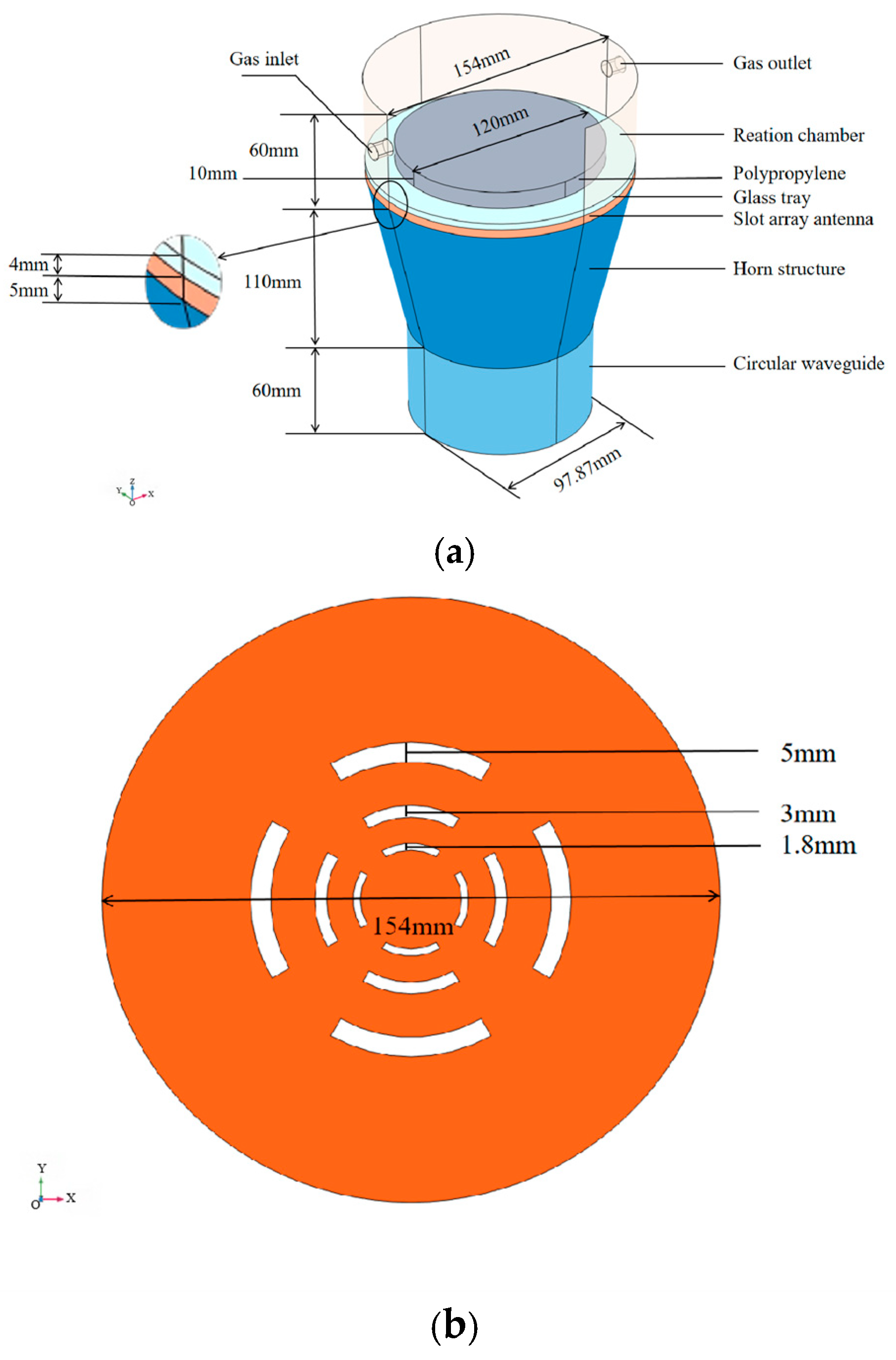
The multi-physics coupling calculation geometric model of microwave-assisted polypropylene plastic pyrolysis is given in Figure 1. The three-dimensional (3D) structure is shown in Figure 1a. Firstly, microwave power of 1000 W with a frequency of 2.45 GHz is fed into a symmetrical circular waveguide with a bottom diameter of 97.87 mm and a height of 60 mm, and the excitation mode is TM01. Second, the microwave energy is amplified using a horn structure that is 110 mm high and has a magnification of 1.5735. Then it is uniformly radiated to the reaction cavity, which has a diameter of 154 mm and a height of 60 mm above it, using a slot array antenna composed of metal copper material with a diameter of 154 mm and a thickness of 5 mm. Figure 1b displays the locations and widths of the slot antenna. To store polypropylene plastic, a glass tray of 154 mm in diameter and 4 mm in thickness is placed inside the reaction chamber. A sample of polypropylene plastic with 120 mm in diameter and 10 mm in height is placed at the center of the tray. Two cylindrical gas ports are disposed on the side wall of the reaction chamber, which function as the gas inlet and gas outlet, respectively.

2.2. Multiphysics Governing Equations

2.2.1. Electromagnetic Field Equations

In the microwave-assisted pyrolysis of polypropylene plastic, the electromagnetic field is represented by the frequency domain Helmholtz equation, which are expressed as [25,26]:
× μ 1 ( × E ) k 0 2 ( ε r j σ ω ε 0 ) E = 0
where μ stands for relative permeability, E for electric field strength (V/m), k 0 for wave number in free space, ε r for relative dielectric constant, ε 0 for dielectric constant in vacuum (8.85 × 10⁻¹² F/m), and σ for conductivity (S/m).
The electromagnetic power loss Qe which can be derived from the computed electric field, is expressed as [27]
Q e = 1 2 ω ε 0 ε | E | 2
where Qe represents the electromagnetic energy loss, ω is the angular frequency, ε 0 is the permittivity of free space, and ε is the imaginary part of the dielectric permittivity.

2.2.2. Temperature Field Equation

The temperature field equation is calculated using the heat conduction formula, which is expressed as [28]
ρ C P T t = q ρ C P u T + Q q = k T
where ρ denotes the material density, C P is the specific heat capacity, q represents the heat flux density, u is the velocity, Q is the internal heat source, and k is the thermal conductivity.

2.2.3. Chemical Reaction Field Equation

Polypropylene plastic experiences a number of chemical reactions while it is heated. For solid materials, the Arrhenius equation can be used to characterize non-isothermal pyrolysis [29]. The following is the expression for determining the reaction rate and the kinetics of the reactions:
d a d t = β d a d t = k ( T ) f ( α ) k ( T ) = A   e x p E f R T
where α represents the solid reaction conversion rate, t is the reaction time, is the activation energy, A is the pre-exponential factor, f ( α ) is the reaction mechanism function, β is the constant pyrolysis rate in K/min, R is the universal gas constant, 8.314 J/(mol·K). The values of E and A used in the model are provided in reference [30].

2.2.4. Mass Transfer Field Equation

The mass transfer field equation is calculated using the convection-diffusion equation, which is expressed as [31]
c i t + J i + u c i = R i J i = D i c i
where J i represents the flux of the substance, c i is the concentration of the substance, u is the velocity vector of the fluid field, R i is the reaction source term, and D i is the diffusion coefficient.

2.2.5. Fluid Field Equation

The fluid field equation is described by the continuity equation and the Navier–Stokes equation, which are expressed as [32]
ρ t + ( ρ u ) = 0 ρ u t + ρ ( u ) = p I + μ ( u + ( u ) T ) 2 3 μ ( u ) + F
where u represents the fluid velocity, F is the body force and I is the identity tensor.
The Reynolds number (Re) is defined as the ratio of inertial forces to viscous forces and is calculated by the following formula [33]:
R e = ρ d v μ
where ρ denotes the fluid density, v represents the flow velocity, d is the inlet diameter and μ stands for the dynamic viscosity.

2.3. Initial Conditions and Boundary Conditions

In the calculation of the electromagnetic field, the frequency is established at 2.45 GHz. The waveguide and chamber walls are modeled as perfect electric conductors. An impedance boundary condition is applied, which is expressed as [34]
n × E = 0
where n represents the unit normal vector of the surface.
Both the starting temperature and the ambient temperature of polypropylene plastic are 20 °C in the temperature field calculation. Solid and fluid heat transmission are the modes of heat transfer. The nitrogen that fills the space is fluid, while polypropylene plastic is solid. There is no heat exchange with the external environment; all of the system’s heat is transmitted within. The thermal insulation condition is the boundary of the microwave cavity [35],
n × q = 0
where q represents the heat flux.
When calculating the concentrated mass transfer field, the polypropylene plastic mass fraction starts at 1 and there is no flux condition at the boundary [35]. Other than the fact that the polypropylene’s upper surface comes into contact with nitrogen, mass transfer does not occur, which can be expressed as
n J i = 0
where J i represents the flux of the substance on the surface.
Nitrogen gas is introduced at the chamber’s inlet at a speed of 0.02 m/s in order to calculate the fluid field. When the boundary conditions are set to no-slip conditions [36], the fluid’s velocity at the solid surface equals the solid surface’s velocity, which can be written as follows:
n u = 0
where u represents the velocity vector of the wall.

2.4. Material Properties

The pyrolysis of polypropylene plastic is studied in this paper using SiC as the material that absorbs microwave energy. Copper is used to construct the waveguide and chamber boundaries, and glass is used for the tray. The chamber is filled with nitrogen, with air filling the remaining space. The specific properties of the materials used are detailed in Table 1.

3. Results and Discussion (J/kg·K)

This study investigates the effects of different SiC doping methods and mass ratios on the uniformity of internal temperature distribution in polypropylene plastic, as well as on gas yield (YG), energy consumption (Q), gas composition, and higher heating value (HHV) during microwave-assisted polypropylene plastic pyrolysis. The gas products of pyrolysis are C3H8, C3H6, C2H6, C2H4, CH4, and H2.
The uniformity of the temperature distribution of polypropylene plastic is calculated using the COV of temperature, which is expressed as [39]
C O V = 1 n i = 1 n ( T i T ¯ ) 2 T ¯
where T i represents the temperature of the i-th element within the solution domain, T ¯ indicating the average temperature of the polypropylene plastic.
The formula of volumetric average temperature for polypropylene plastic is the following [40]:
T v ¯ = 1 V V T d V
where V represents the total volume of the region, and T is the temperature at a specific point within the region.
The formula for calculating the pyrolysis YG is the following [41]:
Y G = m P P m L m P P × 100 % m L = m P P × w t L
where m P P is the mass of polypropylene plastic, m L is the mass of the liquid, and w t L is the mass fraction of the liquid.
The formula for calculating the Q is the following [42]:
Q = P t
where P represents the microwave power, and t represents the pyrolysis time.
The pyrolysis gas components are described by the gas volume fraction. According to the ideal gas state equation P V = n R T , under the same temperature and pressure, the volume fraction is numerically equal to the mole fraction for each gas. The gas volume fraction of a given volume is computed via the following [43]:
Y i = V i V t o t a l = n i n t o t a l
where V i represents the partial volume of the i-th gas in the mixture, V total represents the total volume of the gas mixture, n i represents the amount of substance of the i-th gas, and n total represents the total amount of substance in the gas mixture.
The formula for calculating HHV is the following [41]:
H H V = i H H V i Y i
where H H V i represents HHV of the i-th gas component.

3.1. The Influence of Pyrolysis Temperature on Pyrolysis Effect of Polypropylene Plastic Without SiC Doping

Table 2 provides the results of an analysis of the COV of temperature, pyrolysis time, YG, and Q of polypropylene plastic at 700 °C, 800 °C, 900 °C, and 1000 °C when the microwave power is 1000 W and without SiC doping.
Table 2 shows that the COV of the temperature of polypropylene plastic drops from 0.2137 to 0.1616 as the pyrolysis temperature rises from 700 °C to 1000 °C. This suggests that the temperature distribution uniformity of polypropylene plastic in the pyrolysis reactor is subpar. Moreover, as the temperature rises, the pyrolysis time of polypropylene plastic increases from 57 min to 82 min, suggesting that the pyrolysis efficiency is low when the SiC is not doped. As the temperature increases, the YG initially increases and then decreases, peaking at 75.61 wt.% at 900 °C. The YG drops to 72.62 wt.% when the temperature is raised to 1000 °C, and this trend aligns with previous research [40]. This suggests that high temperatures can cause secondary cracking side reactions, which would eliminate gas product recombination. As a result, the YG peaks at 900 °C. The Q increases from 0.95 kWh to 1.367 kWh as the temperature rises, and it is high overall. Although a lower COV of temperature and a higher gas yield (YG) are achieved at 900 °C, the pyrolysis time and energy consumption Q remain considerably high, thereby necessitating further optimization. Given that SiC serves as an effective microwave absorber, this study proceeds to investigate the effects of different SiC doping methods on the uniformity of temperature distribution, YG, Q, gas composition, and HHV of polypropylene plastic.

3.2. The Influence of SiC Doping Method on Pyrolysis Effect of Polypropylene Plastic

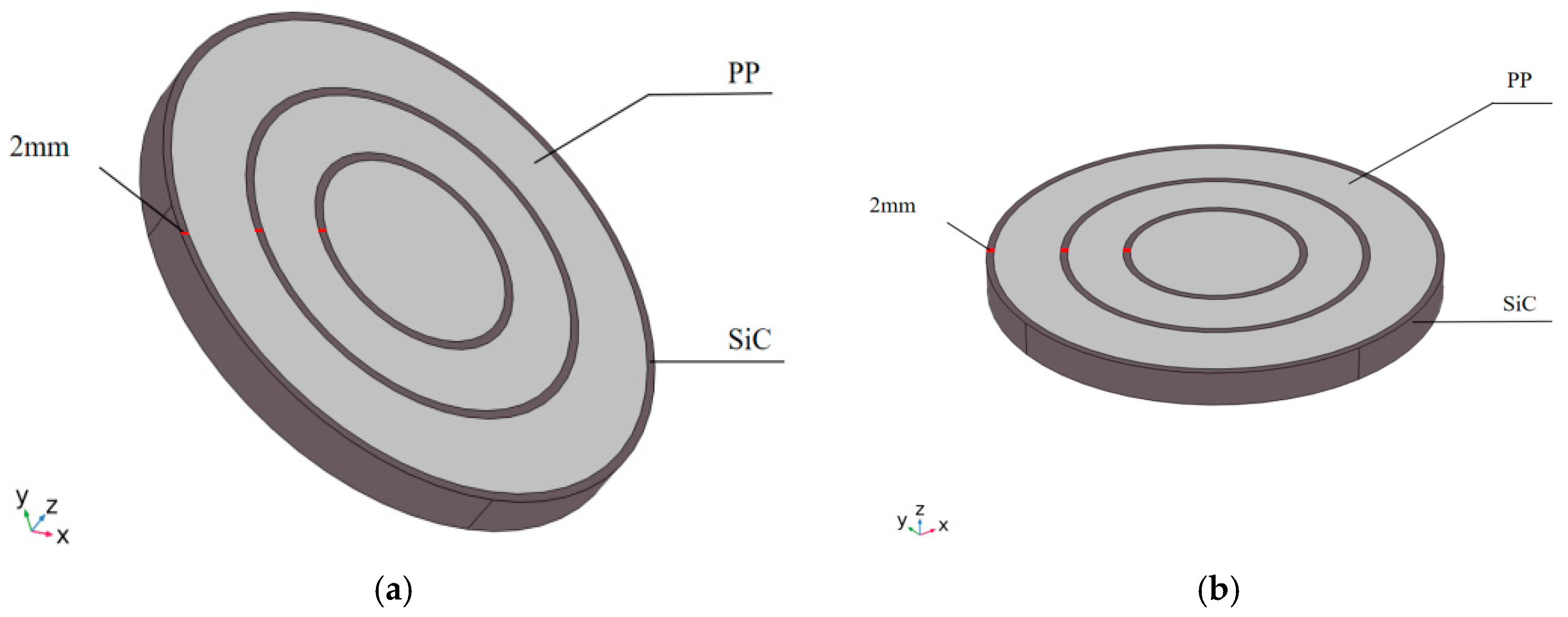
The pyrolysis performance of polypropylene plastics via various SiC doping approaches is investigated at a microwave power of 1000 W and pyrolysis temperature of 900 °C. Figure 2a,b display the three-dimensional structural diagram of the non-uniform layered doped SiC with a thickness of 2 mm positioned vertically along the Z axis and horizontally along the X-O-Y plane.
The formula for the mass ratio of SiC to polypropylene plastic is expressed as mSiC:mPP. Table 3 displays the COV of temperature, the pyrolysis time and the volume averaged temperature of polypropylene plastic under different SiC doping methods.
Table 3 shows that the COV of temperature is 0.2709, the pyrolysis time is 73 min, and the volume averaged temperature is 894 °C in the absence of SiC doping (mSiC:mPP = 0:1). This indicates a non-uniform temperature distribution and prolonged pyrolysis time due to the poor microwave absorption and thermal conductivity of polypropylene plastic when the SiC is not doped. For non-uniform layered SiC doping, vertical doping along the Z-axis required a substantially shorter pyrolysis time (21.5 min) compared to horizontal doping along the X-O-Y plane (37 min). And the volume-averaged temperature of the vertical doping method was slightly lower at 893 °C than that of the horizontal doping approach (897 °C). However, the COV of temperature for vertical Z-axis doping was 0.2659, much higher than that of 0.0149 for horizontal X-O-Y plane doping. This indicates that the temperature distribution uniformity effect of the horizontal doping along the X-O-Y plane is better than that of the vertical doping along the Z axis. Even though the non-uniform layered doping method shortens the pyrolysis duration as compared to the undoped method, the overall pyrolysis effect is subpar. When SiC is uniformly doped, the COV of temperature of polypropylene plastic under three different SiC doping mass ratios is less than 0.001, indicating that the uniform doping method can effectively improve the pyrolysis temperature uniformity of polypropylene plastic. However, for a uniform SiC doping mass ratio of 3:1, the pyrolysis time attains a minimum of 9.2 min. Therefore, it is proved that the pyrolysis effect of polypropylene plastic is the best when the uniform doping mass ratio is 3:1.
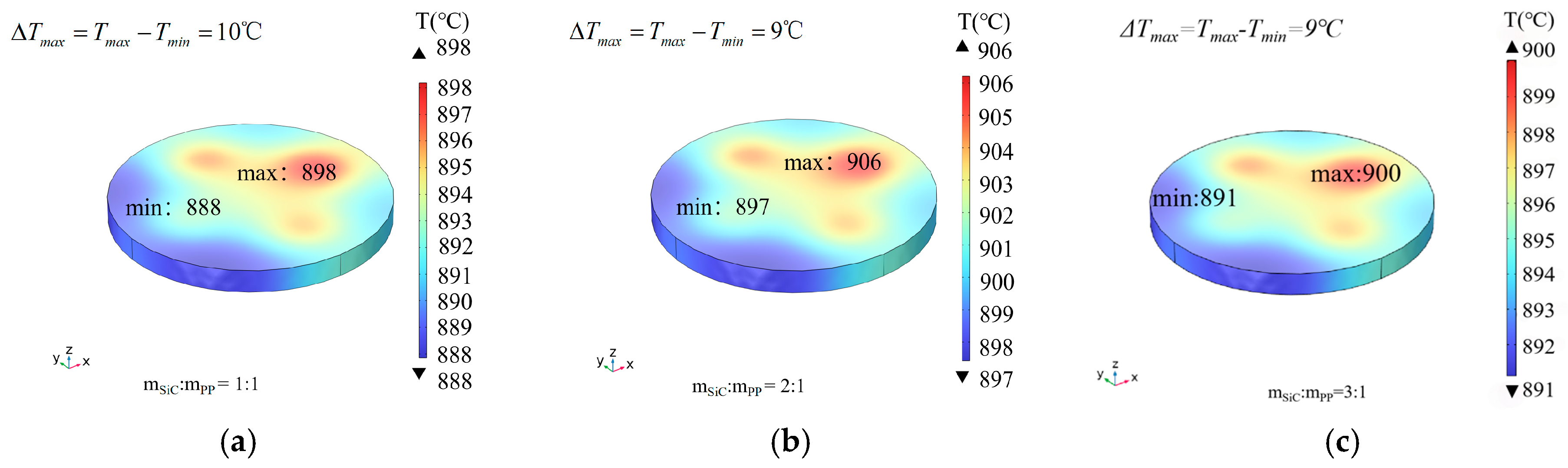
To further study the temperature uniformity of polypropylene plastic, the impact of different SiC doping methods and different doping mass ratios on temperature distribution is analyzed as shown in Figure 3, Figure 4 and Figure 5.
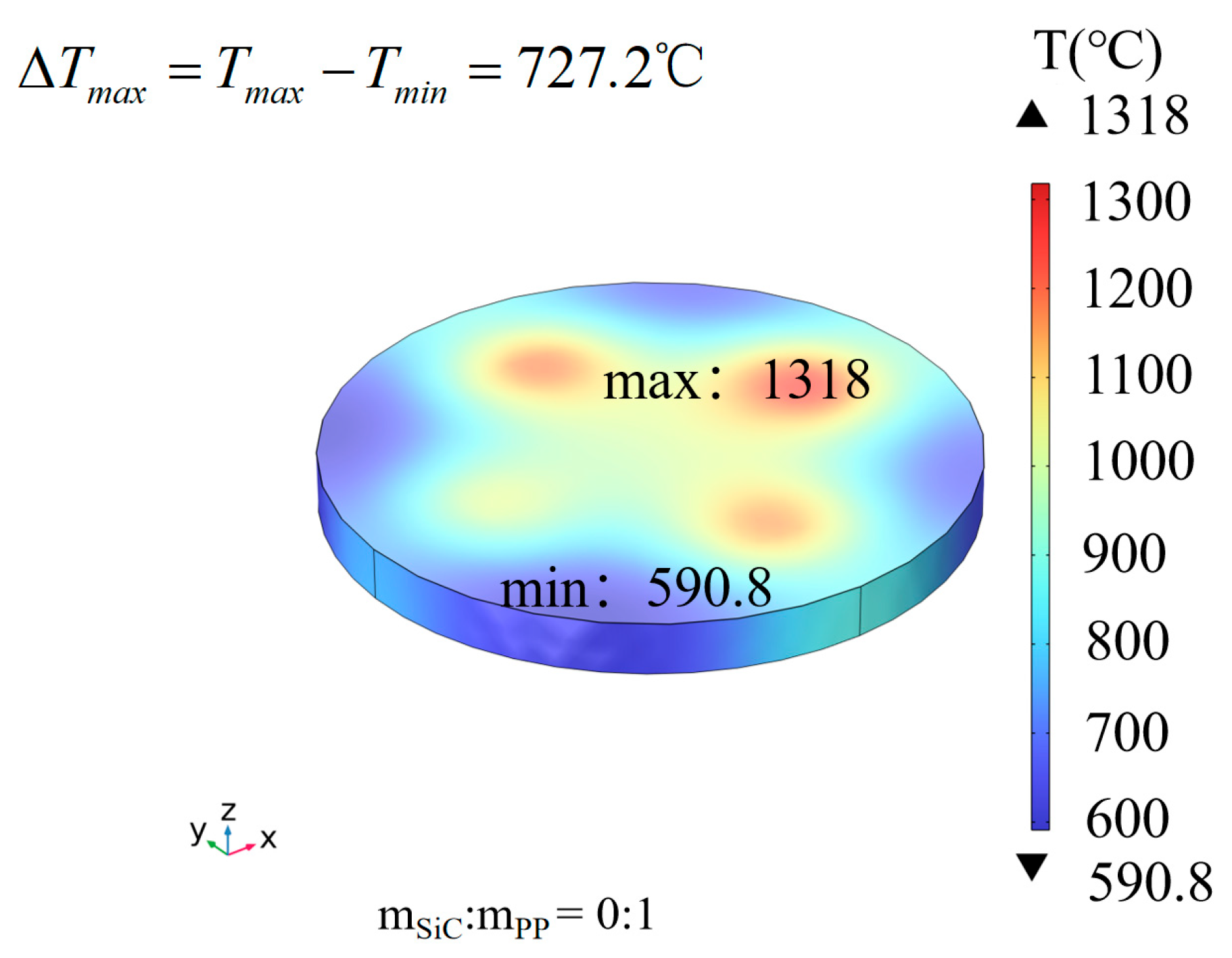
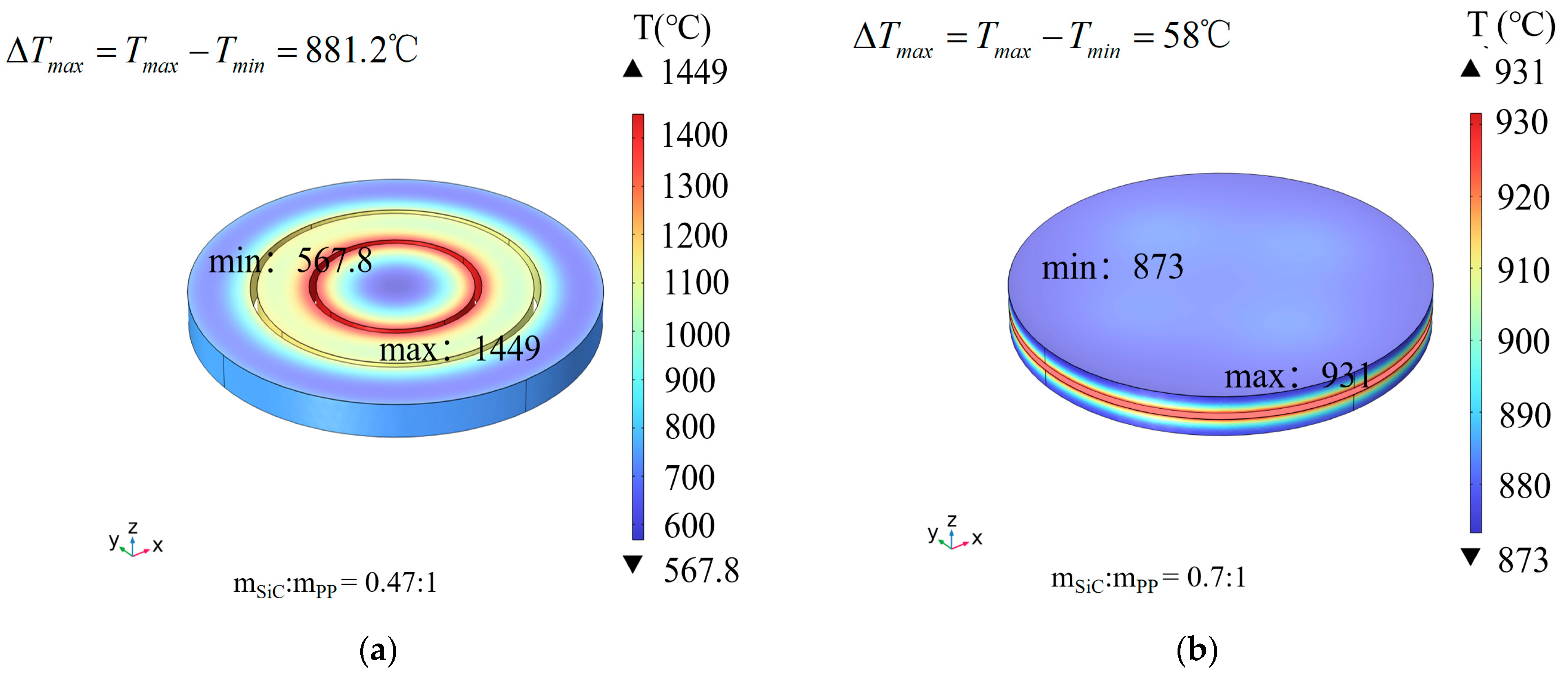
As shown in Figure 3, polypropylene plastic has a maximum temperature of 1318 °C and a minimum temperature of 590.8 °C, with a maximum temperature differential of 727.2 °C when SiC is non-doped (mSiC:mPP = 0:1). This further suggests that the uniformity of the interior temperature distribution within the polypropylene plastic is poor when the SiC is not doped. It can be seen from Figure 4a,b that when non-uniform layered SiC doping is adopted, the maximum temperature difference of 881.2 °C for vertical doping of SiC along the Z-axis is significantly higher than that of 58 °C for horizontal doping along the X-O-Y plane. Moreover, the maximum temperature difference occurs around the SiC. This is mainly because SiC, as a microwave-absorbing material, exhibits a high pyrolysis rate. Combined with its excellent thermal conductivity, it leads to a high temperature of the surrounding polypropylene plastic, thereby resulting in a large temperature difference in the polypropylene plastic. As shown in Figure 5a–c, when SiC is uniformly doped, the maximum temperature difference in the polypropylene plastic significantly decreases. With the doping mass of SiC increasing, the maximum temperature difference decreases from 10 °C to 9 °C, suggesting that uniform doping of SiC greatly enhances the thermal conductivity of polypropylene plastic, ensuring a relatively uniform heat generation location and rate.
In summary, under uniform doping at a mass ratio of mSiC:mPP = 3:1, the temperature distribution exhibits good uniformity, characterized by a COV of temperature of merely 0.0004. Moreover, the pyrolysis time is minimized at 9.2 min, while the maximum temperature difference is only 9 °C.

3.3. The Effect of SiC Doping Method on YG and Q

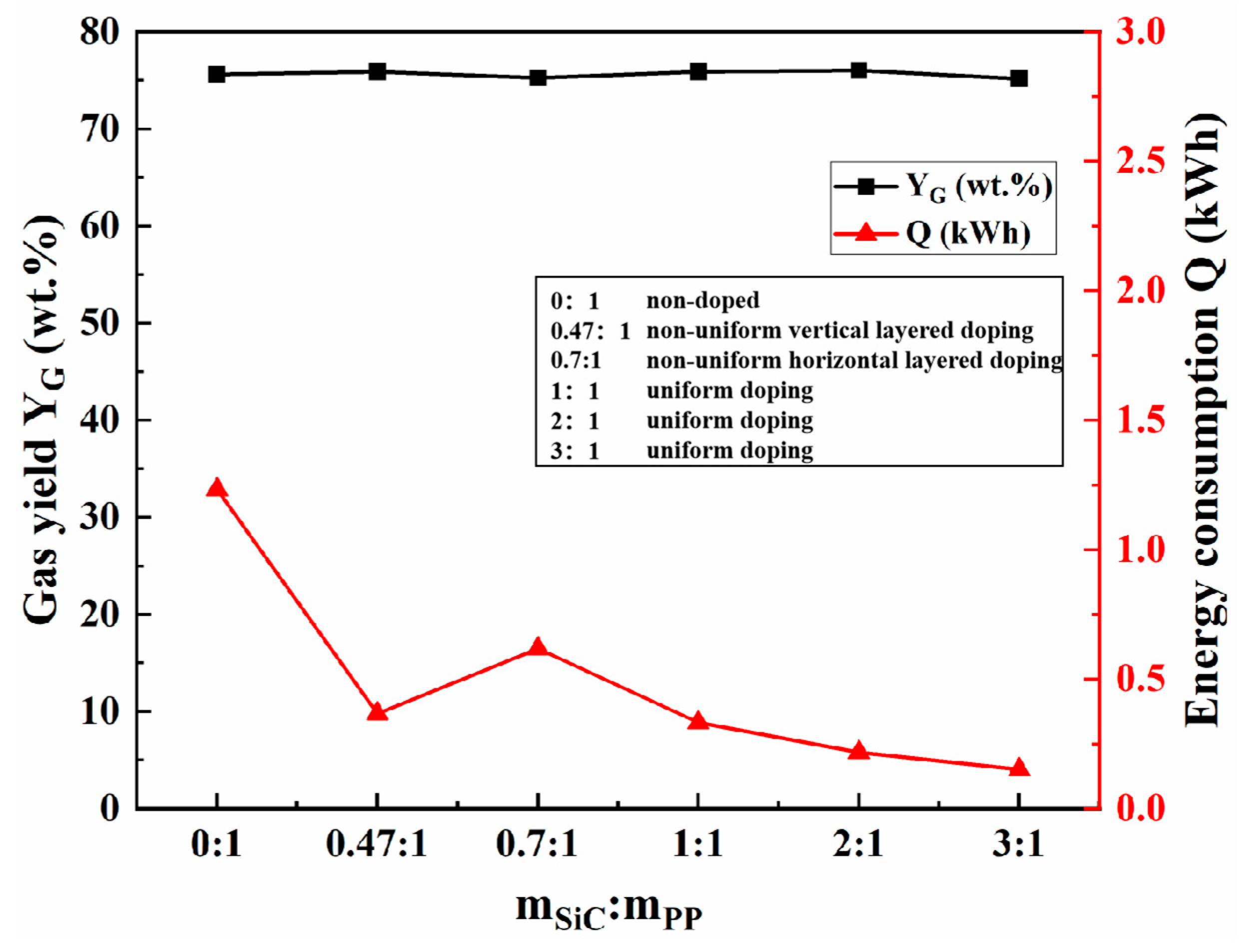
Under a microwave power of 1000 W and a pyrolysis temperature of 900 °C, the effects of different SiC doping methods on the YG and Q of pyrolysis are illustrated in Figure 6.
As illustrated in Figure 6, the YG and Q of polypropylene plastic are 75.61 wt.% and 1.233 kWh, respectively, when the SiC is not doped (mSiC:mPP = 0:1). This indicates that the microwave device achieves a relatively high gas yield (YG) under the undoped condition, while its energy consumption Q is also relatively high. For non-uniform layered doping, the pyrolysis YG of SiC via vertical doping along the Z-axis and lateral doping along the X-O-Y plane are 75.85 wt.% and 75.24 wt.%, respectively, with corresponding Q of 0.367 kWh and 0.617 kWh. This indicates that vertical doping along the Z-axis exhibits superior performance over horizontal doping along the X-O-Y plane in terms of both YG and Q. For uniform SiC doping, Q decreases steadily as the SiC doping mass ratio increases, decreasing from 0.333 kWh to 0.15 kWh. Concurrently, the pyrolysis YG of polypropylene plastic exhibits a trend of first increasing and then decreasing as the mass ratio of SiC increases from 1:1 to 3:1, specifically increasing from 75.86 wt.% to 76.01 wt.% and then decreasing to 75.15 wt.%. Compared with uniform SiC doping at the 2:1 mass ratio, the YG at the mSiC:mPP = 3:1 mass ratio decreased by a mere 1.131% ((76.01–75.15)/76.01 × 100%), whereas the Q dropped by 30.876% ((0.217–0.15)/0.217 × 100%). Therefore, when considering both YG and Q comprehensively, uniform SiC doping at the 3:1 mass ratio yields the optimal pyrolysis performance for polypropylene plastic.

3.4. The Effect of SiC Doping Methods on Polypropylene Plastic Pyrolysis Gas Composition and HHV

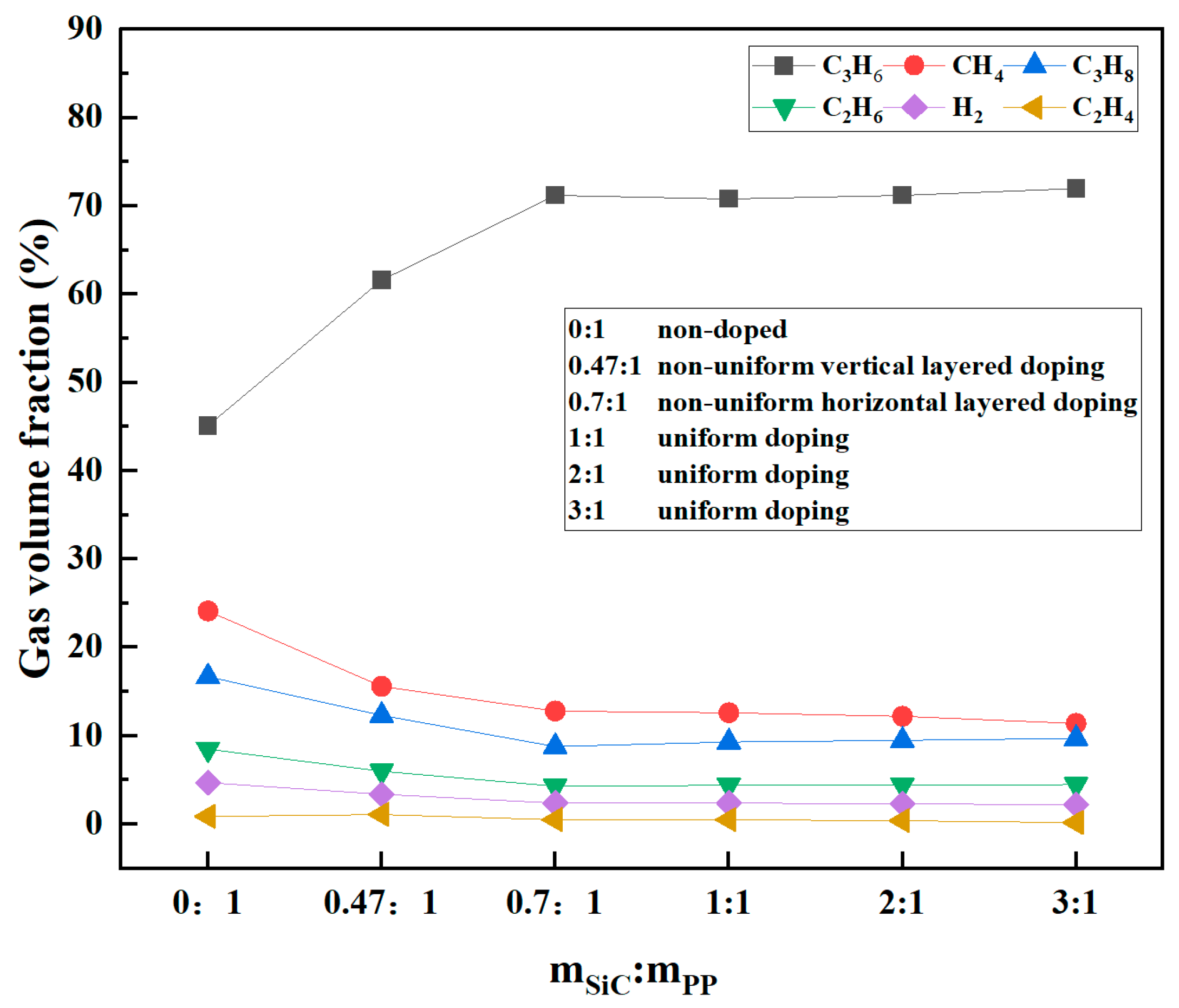
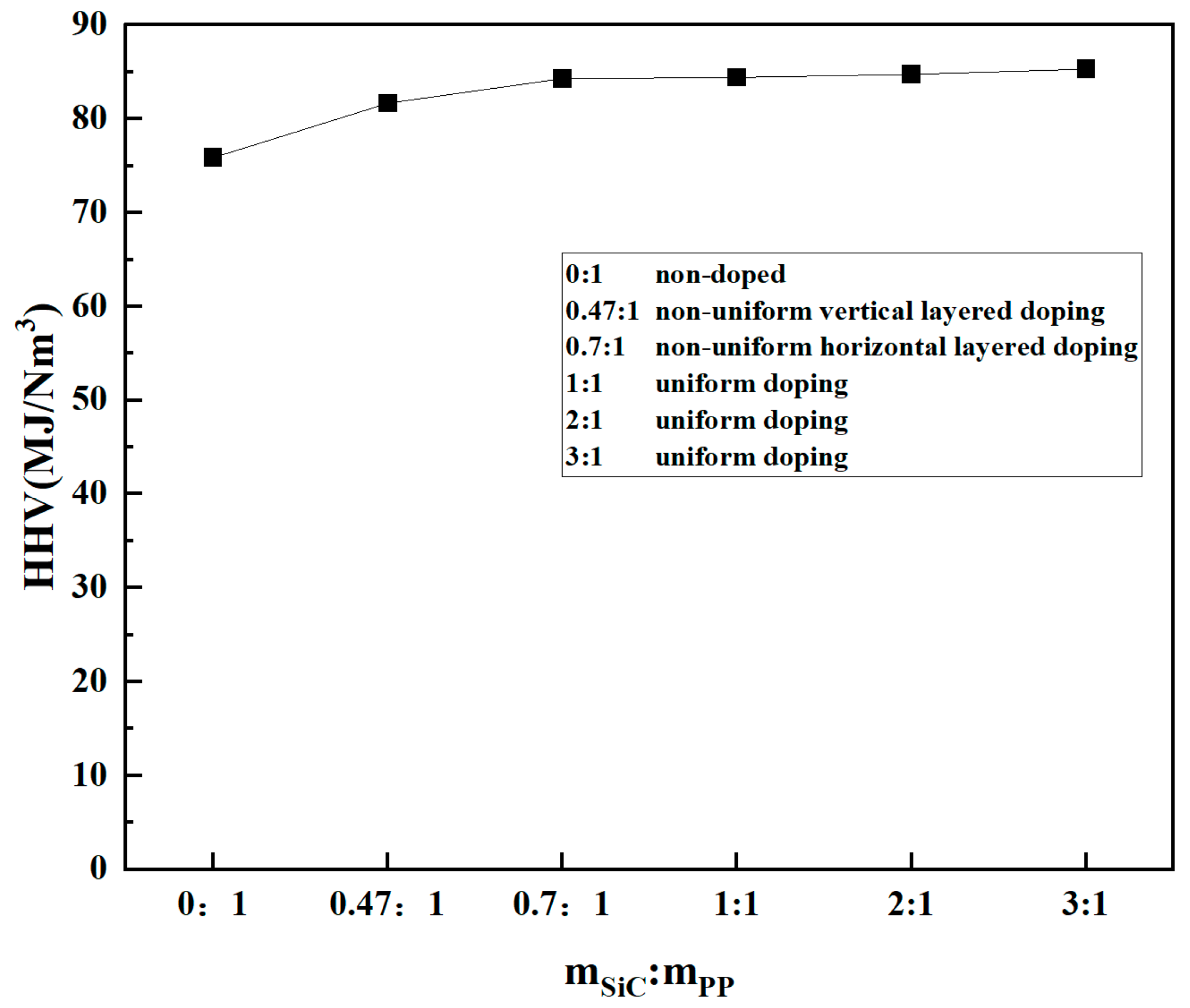
Under a microwave power of 1000 W and a pyrolysis temperature of 900 °C, the effects of different SiC doping methods on gas volume fractions and HHV variations are presented in Figure 7 and Figure 8, respectively.
It can be seen from Figure 7 that for non-doped SiC (mSiC:mPP = 0:1), C3H6 and CH4 account for a relatively high proportion of the polypropylene plastic pyrolysis gases, at 45.1% and 24.1%, respectively. In contrast, the proportions of the other gases (C3H8, C2H6, H2, and C2H4) are relatively low, at 16.7%, 8.5%, 4.7%, and 0.9%, respectively. This indicates that the gases generated during the pyrolysis process are dominated by C3H6 and CH4. Under non-uniform layered SiC doping, the volume fraction of C3H6 increases, while the volume fractions of the remaining five gases decrease to some extent. This may be attributed to the fact that SiC doping enhances pyrolysis efficiency and reduces the occurrence of C3H6 decomposition or recombination reactions. Compared with non-uniform layered SiC doping, as the SiC uniform doping and the mass ratio increases, the volume fraction of C3H6 increases slightly and that of CH4 decreases slightly, respectively, while the volume fractions of the other four gases remain essentially unchanged.
As shown in Figure 8, the HHV of pyrolysis gas calculated by formula (16) is generally higher after SiC doping than the 75.86 MJ/Nm3 observed under the non-doped SiC condition. Moreover, the HHV under uniform SiC doping is consistently higher than that under non-uniform layered SiC doping. Additionally, it is found that under uniform doping, the gas HHV increases as the SiC doping mass ratio rises. Thus, with uniform SiC doping at a mass ratio of mSiC:mPP = 3:1, the pyrolysis gas exhibits the highest HHV of 85.32 MJ/Nm3, and the polypropylene plastic achieves the optimal pyrolysis performance.

4. Conclusions

In order to achieve uniform and efficient pyrolysis of polypropylene plastic, a microwave pyrolysis device based on a 2.45 GHz symmetrical circular waveguide with slot radiation was specifically designed in this study. Through the calculation of multi-physics field coupling, the following key results were obtained:
(1)
Microwave energy with a frequency of 2.45 GHz was fed into the bottom of a standard symmetrical circular waveguide. The horn and slot radiating antenna structure were continuously optimized, such that the microwave energy was amplified through the horn structure and then uniformly radiated into the polypropylene plastic in the reaction chamber via the slot array antenna. Meanwhile, two cylindrical through-holes were arranged on the side of the reaction chamber, serving as dedicated gas inlets and outlets.
(2)
In the microwave pyrolysis of polypropylene plastic, the electromagnetic field, temperature field, fluid field, concentrated matter transfer field, and chemical reaction field are all involved in the multi-physical field coupling calculations based on the finite element method. The study investigated the effects of microwave pyrolysis temperature and time on the temperature distribution uniformity, pyrolysis YG, Q, gas composition and HHV of polypropylene plastic under different SiC doping methods and different doping mass ratios. According to the calculation results, the best effect of microwave pyrolysis was obtained when the microwave power was 1000 W, the pyrolysis time was 9.2 min, the SiC was uniformly doped and the doping mass ratio was mSiC:mPP = 3:1. Based on the aforementioned conditions, the COV of temperature was only 0.0004 and the temperature field distribution of polypropylene plastic was uniform, which ensures efficient and stable pyrolysis reaction. The YG increased to 75.15 wt.%, the Q is 0.15 kWh, the HHV reached 85.32 MJ/Nm3, and the proportion of C3H6 and CH4 in the gas components were relatively high at 72% and 11.4%, showing high energy efficiency and economy.
In summary, this study obtains a high-efficiency microwave pyrolysis device and optimal pyrolysis conditions through the special design of a microwave pyrolysis device for polypropylene plastic and multi-physics field coupling calculations, which provides a solid theoretical basis and technical support for realizing rapid, low-energy consumption resource treatment of plastic waste.

Author Contributions

W.T. developed the model, analyzed the data; W.T., J.S., X.F., L.G. and Y.W., wrote the initial draft of the manuscript; W.T., J.S., Y.L. and S.W. reviewed and contributed to the final manuscript. All authors have read and agreed to the published version of the manuscript.

Funding

This research was funded by Science and Technology Cooperation and Exchange Special Project of Shanxi Province (202204041101030) and Scientific and Technological Achievements Transformation and Guidance Project of Shanxi Province (202304021301044).

Data Availability Statement

The original contributions presented in the study are included in the article, further inquiries can be directed to the corresponding author.

Conflicts of Interest

The authors declare no conflicts of interest.

References

  1. Zhang, F.; Zhao, Y.; Wang, D.; Yan, M.; Zhang, J.; Zhang, P.; Ding, T.; Chen, L.; Chen, C. Current technologies for plastic waste treatment: A review. J. Clean. Prod. 2021, 282, 124523. [Google Scholar] [CrossRef]
  2. Kim, H.; Kim, H. Development of KF-Rated Face Mask Using Biodegradable and Functional Materials. Sustainability 2025, 17, 4161. [Google Scholar] [CrossRef]
  3. Papuga, S.; Djurdjevic, M.; Ciccioli, A.; Ciprioti, S.V. Catalytic Pyrolysis of Plastic Waste and Molecular Symmetry Effects: A Review. Symmetry 2023, 15, 38. [Google Scholar] [CrossRef]
  4. Varga, J.; Brezinová, J.; Brezina, J. Quality analysis of bonded joints in the renovation of plastic automotive parts. Appl. Sci. 2023, 14, 271. [Google Scholar] [CrossRef]
  5. Bal, S.; Tamus, Z.A. Investigation of the Structural Dependence of the Cyclical Thermal Aging of Low-Voltage PVC-Insulated Cables. Symmetry 2023, 15, 1186. [Google Scholar] [CrossRef]
  6. Wright, A.C.M.; Boots, B.; Ings, T.C. Above-and below-ground field study on the impacts of conventional and alternative mesoplastics on Hordeum vulgare growth and soil invertebrate communities. Chemosphere 2024, 365, 143393. [Google Scholar] [CrossRef]
  7. Kremer, I.; Tomić, T.; Katančić, Z.; Hrnjak-Murgić, Z.; Erceg, M.; Vecchio Ciprioti, S.; Schneider, D.R. Effect of Zeolite Catalyst on the Pyrolysis Kinetics of Multi-Layered Plastic Food Packaging. Symmetry 2022, 14, 1362. [Google Scholar] [CrossRef]
  8. Tiseo, I. Plastic Production Forecast Worldwide 2025–2050. Statista. 2021. Available online: https://www.statista.com/statistics/1199324/global-plastic-production-forecast/ (accessed on 26 January 2025).
  9. Vuppaladadiyam, S.S.V.; Vuppaladadiyam, A.K.; Sahoo, A. Waste to energy: Trending key challenges and current technologies in waste plastic management. Sci. Total Environ. 2024, 913, 169436. [Google Scholar] [CrossRef]
  10. Bach, Q.V.; Chen, W.H.; Eng, C.F.; Wang, C.W.; Liang, K.C.; Kuo, J.Y. Pyrolysis characteristics and non-isothermal torrefaction kinetics of industrial solid wastes. Fuel 2019, 251, 118–125. [Google Scholar] [CrossRef]
  11. Bai, B.; Wang, W.Z.; Jin, H. Experimental study on gasification performance of polypropylene (PP) plastics in supercritical water. Energy 2020, 191, 116527. [Google Scholar] [CrossRef]
  12. Elordi, G.; Olazar, M.; Lopez, G. Product yields and compositions in the continuous pyrolysis of high-density polyethylene in a conical spouted bed reactor. Ind. Eng. Chem. Res. 2011, 50, 6650–6659. [Google Scholar] [CrossRef]
  13. Jung, S.H.; Cho, M.H.; Kang, B.S. Pyrolysis of a fraction of waste polypropylene and polyethylene for the recovery of BTX aromatics using a fluidized bed reactor. Fuel Process. Technol. 2010, 91, 277–284. [Google Scholar] [CrossRef]
  14. del Remedio Hernández, M.; García, Á.N.; Marcilla, A. Catalytic flash pyrolysis of HDPE in a fluidized bed reactor for recovery of fuel-like hydrocarbons. J. Anal. Appl. Pyrolysis 2007, 78, 272–281. [Google Scholar] [CrossRef]
  15. Miandad, R.; Barakat, M.A.; Aburiazaiza, A.S. Effect of plastic waste types on pyrolysis liquid oil. Int. Biodeterior. Biodegrad. 2017, 119, 239–252. [Google Scholar] [CrossRef]
  16. Zhang, W.; Qiu, X.; Wang, C.; Zhong, L.; Fu, F.; Zhu, J. Lignin derived carbon materials: Current status and future trends. Carbon Res. 2022, 1, 14. [Google Scholar] [CrossRef]
  17. Tian, W.; Feng, X.; Gao, L.; Chen, K.; Chen, Y.; Shi, J.; Lao, H. Improvement of Microwave Heating Uniformity Using Symmetrical Stirring. Symmetry 2025, 17, 659. [Google Scholar] [CrossRef]
  18. Liu, C.; Yu, D.; Kirk, D.W.; Xu, Y. Electromagnetic wave absorption of silicon carbide based materials. RSC Adv. 2017, 7, 595–605. [Google Scholar] [CrossRef]
  19. Fan, L.; Zhang, Y.; Liu, S. Ex-situ catalytic upgrading of vapors from microwave-assisted pyrolysis of low-density polyethylene with MgO. Energy Convers. Manag. 2017, 149, 432–441. [Google Scholar] [CrossRef]
  20. Suriapparao, D.V.; Vinu, R. Resource recovery from synthetic polymers via microwave pyrolysis using different susceptor. J. Anal. Appl. Pyrolysis 2015, 113, 701–712. [Google Scholar] [CrossRef]
  21. Shi, H.; Cui, Y.; Zhang, Y. Gases production from microwave-assisted pyrolysis of polypropylene plastic. J. Environ. Chem. Eng. 2023, 11, 110851. [Google Scholar] [CrossRef]
  22. Ma, Y.; Wang, W.; Miao, H. Physicochemical synergistic effect of microwave-assisted Co-pyrolysis of biomass and waste plastics by thermal degradation, thermodynamics, numerical simulation, kinetics, and products analysis. Renew. Energy 2024, 223, 120026. [Google Scholar] [CrossRef]
  23. Khaghanikavkani, E.; Farid, M.M. Mathematical modelling of microwave pyrolysis. Int. J. Chem. React. Eng. 2013, 11, 543–559. [Google Scholar] [CrossRef]
  24. Khaghanikavkani, E.; Farid, M.M.; Holdem, J. Microwave pyrolysis of plastic. J. Chem. Eng. Process Technol. 2013, 4, 2157–7048. [Google Scholar] [CrossRef]
  25. Huang, K.-M.; Liao, Y. Transient power loss density of electromagnetic pulse in debye media. IEEE Trans. Microw. Theory Tech. 2015, 63, 135–140. [Google Scholar] [CrossRef]
  26. Kirsch, A.; Hettlich, F.J. The Mathematical Theory of Time-Harmonic Maxwell’s Equations; Springer: Berlin/Heidelberg, Germany, 2015; Volume 190, p. 20. [Google Scholar]
  27. Yang, H.; Yan, B.; Meng, L. Mathematical modeling of continuous microwave heating of surimi paste. J. Food Eng. 2022, 315, 110797. [Google Scholar] [CrossRef]
  28. Wang, H.; Li, X.; Zhu, J. Numerical simulation of oil shale pyrolysis under microwave irradiation based on a three-dimensional porous medium multiphysics field model. Energies 2022, 15, 3256. [Google Scholar] [CrossRef]
  29. Kissinger, H.E. Variation of peak temperature with heating rate in differential thermal analysis. J. Res. Nat. Bur. Stand. 1956, 57, 217–221. [Google Scholar] [CrossRef]
  30. Xuan, W.; Yan, S.; Dong, Y. Exploration of Pyrolysis Behaviors of Waste Plastics (Polypropylene Plastic/Polyethylene Plastic/Polystyrene Plastic): Macro-Thermal Kinetics and Micro-Pyrolysis Mechanism. Processes 2023, 11, 2764. [Google Scholar] [CrossRef]
  31. Bird, R.B. Transport phenomena. Appl. Mech. Rev. 2002, 55, R1–R4. [Google Scholar] [CrossRef]
  32. Kubo, M.T.K.; Curet, S.; Augusto, P.E.D. Multiphysics modeling of microwave processing for enzyme inactivation in fruit juices. J. Food Eng. 2019, 263, 366–379. [Google Scholar] [CrossRef]
  33. Reynolds, O. An experimental investigation of the circumstances which determine whether the motion of water shall be direct or sinuous, and of the law of resistance in parallel channels. Philos. Trans. R. Soc. 1883, 174, 935–982. [Google Scholar] [CrossRef]
  34. Gao, T.; Sun, D.W.; Tian, Y. Multiphysics modelling of constant power microwave heating of model juice. Int. J. Therm. Sci. 2024, 198, 108888. [Google Scholar] [CrossRef]
  35. Singh, B.; Zafar, S. Understanding temperature characteristics during microwave cladding through process modeling and experimental investigation. CIRP J. Manuf. Sci. Technol. 2022, 37, 401–413. [Google Scholar] [CrossRef]
  36. Plawsky, J.L. Transport Phenomena Fundamentals; CRC Press: Boca Raton, FL, USA, 2020. [Google Scholar]
  37. Zhang, Y.; Chen, P.; Liu, S.; Peng, P.; Min, M.; Cheng, Y.; Anderson, E.; Zhou, N.; Fan, L.; Liu, C.; et al. Effects of feedstock characteristics on microwave-assisted pyrolysis—A review. Bioresour. Technol. 2017, 230, 143–151. [Google Scholar] [CrossRef] [PubMed]
  38. Von Hippel, A.R.; Morgan, S.O. Dielectric materials and applications. J. Electrochem. Soc. 1955, 102, 68C. [Google Scholar] [CrossRef]
  39. Lou, B.; Sha, A.; Barbieri, D.M. Microwave heating properties of steel slag asphalt mixture using a coupled electromagnetic and heat transfer model. Constr. Build. Mater. 2021, 291, 123248. [Google Scholar] [CrossRef]
  40. Bejan, A. Convection Heat Transfer; John Wiley & Sons: Hoboken, NJ, USA, 2013. [Google Scholar]
  41. Cui, Y.; Zhang, Y.; Cui, L. Microwave-assisted fluidized bed reactor pyrolysis of polypropylene plastic for pyrolysis gas production towards a sustainable development. Appl. Energy 2023, 342, 121099. [Google Scholar] [CrossRef]
  42. Cai, Q.; Li, B.; He, W. Energy consumption calculation of civil buildings in regional integrated energy systems: A review of characteristics, methods and application prospects. Sustainability 2024, 16, 5692. [Google Scholar] [CrossRef]
  43. Shao, X.; Wang, W.; Zhou, Y. Problems and thoughts on the state equation of ideal gas. Astron. Astrophys. 2017, 5, 15–20. [Google Scholar] [CrossRef]
Figure 1. Geometric model of microwave-assisted polypropylene plastic pyrolysis. (a) three-dimensional structure; (b) planar slot structure.
Symmetry 18 00230 g001
Figure 2. Three-dimensional structural of non-uniform layers doping SiC (a) Along the vertical Z-axis; (b) Along the horizontal X-O-Y plane.
Symmetry 18 00230 g002
Figure 3. Pyrolysis temperature distribution of polypropylene plastic without SiC doping (mSiC:mPP = 0:1).
Symmetry 18 00230 g003
Figure 4. Pyrolysis temperature distribution of polypropylene plastic with non-uniform layered doping of SiC. (a) mSiC:mPP = 0.47:1; (b) mSiC:mPP = 0.7:1.
Symmetry 18 00230 g004
Figure 5. Pyrolysis temperature distribution of polypropylene plastic with uniform doping of SiC (a) mSiC:mPP = 1:1; (b) mSiC:mPP = 2:1; (c) mSiC:mPP = 3:1.
Symmetry 18 00230 g005
Figure 6. The YG and Q of polypropylene plastic pyrolysis with different SiC doping methods.
Symmetry 18 00230 g006
Figure 7. The gas volume fractions of polypropylene plastic pyrolysis with different SiC doping methods.
Symmetry 18 00230 g007
Figure 8. The HHV of polypropylene plastic pyrolysis with different SiC doping methods.
Symmetry 18 00230 g008
Table 1. Material properties.
PropertiesNitrogenAirCopperGlassPolypropylene [37,38]SiC [23]
Relative permittivity1114.22.3−0.0025 × j8.4−0.924 × j
Relative permeability111111
Conductivity (S/m)005.98 × 1071 × 10−1400
Density (kg/m3)1.251.29896022109103200
Heat capacity (J/kg·K)103810033857301790750
Heat conductivity coefficient (W/m·K)0.02590.02334001.40.17250
Table 2. The pyrolysis effect of polypropylene plastic at different pyrolysis temperatures when the SiC is not doped.
T (°C)COVt (min)YG (wt.%)Q (kWh)
7000.21375769.640.95
8000.19386572.631.083
9000.17537475.611.233
10000.16168272.621.367
Table 3. The pyrolysis effect of polypropylene plastic with different SiC doping methods.
SiC Doping MethodsmSiC:mPPCOVt (min) T V ¯ (°C)
Non-doped0:10.270973894
Non-uniform layered dopingAlong the vertical Z-axis0.47:10.265921.5893
Along the horizontal X-O-Y plane0.7:10.014937897
Uniform doping1:10.000620893
2:10.000413902
3:10.00049.2896
Disclaimer/Publisher’s Note: The statements, opinions and data contained in all publications are solely those of the individual author(s) and contributor(s) and not of MDPI and/or the editor(s). MDPI and/or the editor(s) disclaim responsibility for any injury to people or property resulting from any ideas, methods, instructions or products referred to in the content.