Review

Symmetry and Asymmetry in Biogenic Carbonaceous Materials: A Framework for Sustainable Waste Valorization


by
Pablo Gutiérrez-Sánchez
1,*,
Gemma Vicente
1,2 and
Luis Fernando Bautista
1,2
1
Chemical and Environmental Engineering Group, ESCET, Universidad Rey Juan Carlos, C/Tulipán s/n, 28933 Móstoles, Madrid, Spain
2
Instituto de Investigación de Tecnologías para la Sostenibilidad (ITPS), Universidad Rey Juan Carlos, C/Tulipán s/n, 28933 Móstoles, Madrid, Spain
*
Author to whom correspondence should be addressed.
Symmetry 2026, 18(1), 42; https://doi.org/10.3390/sym18010042
Submission received: 1 November 2025 / Revised: 12 December 2025 / Accepted: 22 December 2025 / Published: 25 December 2025

Abstract

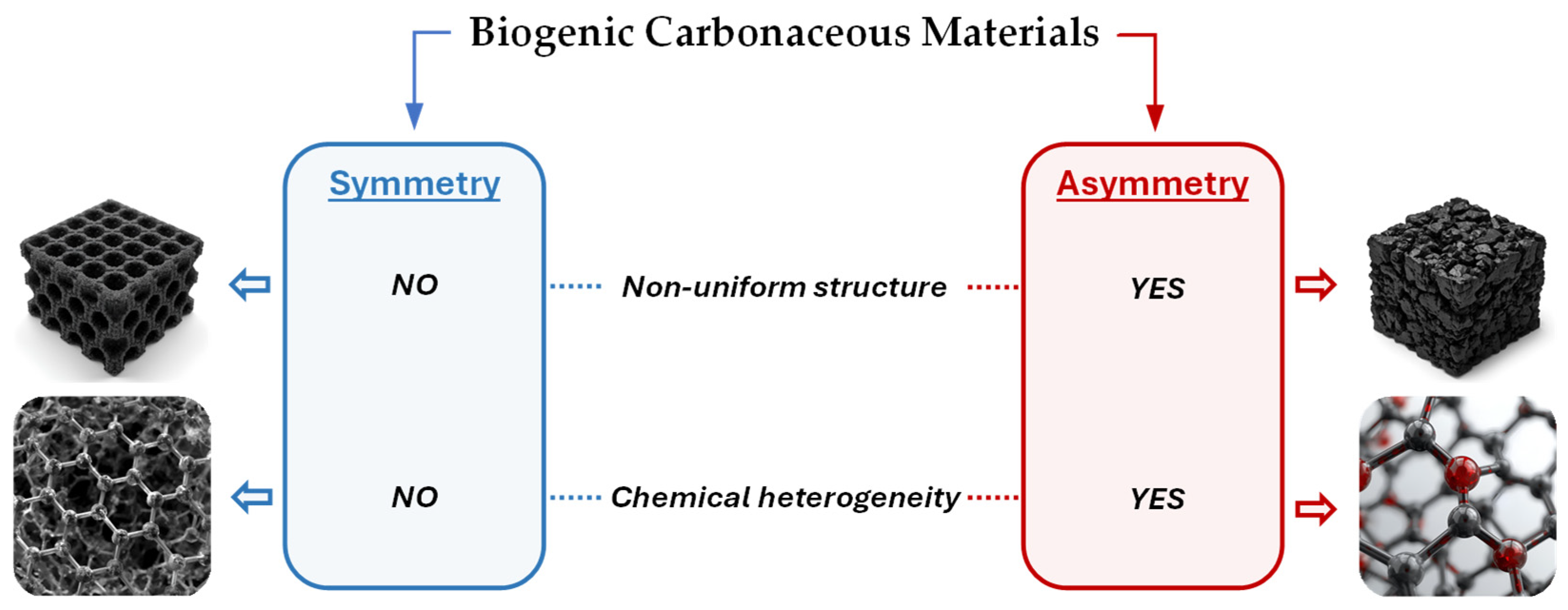
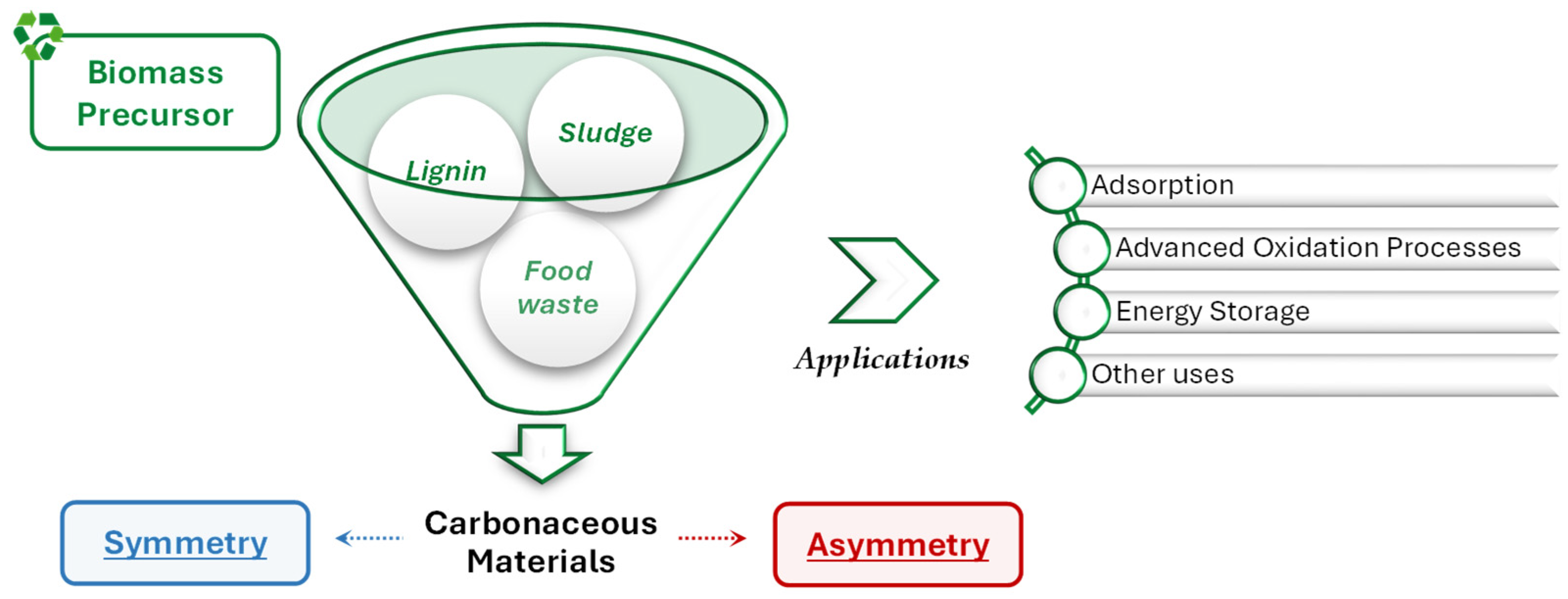
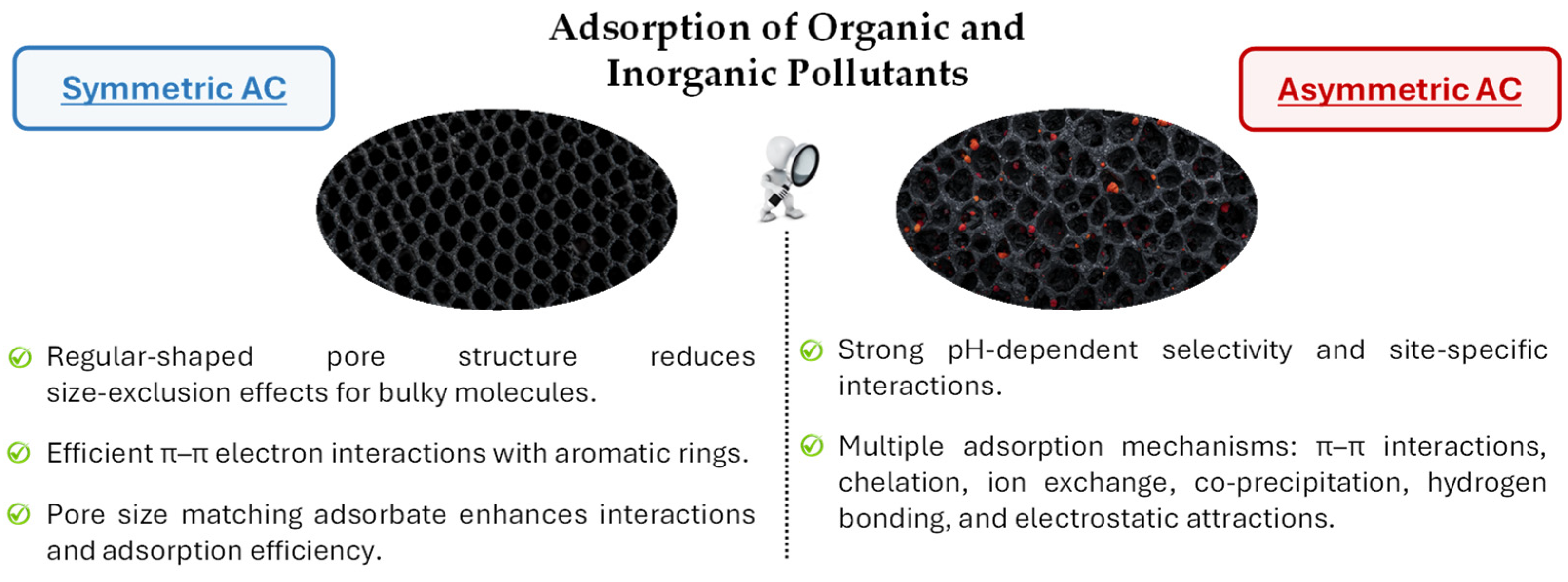
The increasing generation of biomass-derived waste has accelerated the development of sustainable strategies for its valorization into functional materials. Activated carbon (AC), due to its high surface area, tunable porosity, and chemical versatility, has emerged as a key product for applications in adsorption, catalysis, energy storage, and biosensing, among others. Recent studies have highlighted the importance of symmetry and asymmetry in determining the structural and functional performance of AC. Symmetric architectures, typically generated via templating methods, yield ordered pore networks, whereas asymmetric structures, commonly produced through direct chemical activation or heteroatom doping, exhibit hierarchical porosity and heterogeneous surface functionalities. This work critically examines the fundamentals of symmetry and asymmetry in AC materials, as well as their influence on design and use. It discusses synthesis strategies, characterization techniques, and recent approaches that enable the rational engineering of carbon structures. Application-specific case studies are presented, along with current challenges related to feedstock variability, scalability, and regulatory integration. By highlighting the interplay between structural order and functional diversity, this work provides a conceptual framework for guiding future research in the development on symmetrical and asymmetrical carbonaceous materials for sustainable waste valorization.
Keywords: biogenic carbonaceous materials; symmetry; asymmetry; biomass valorization; circular economy biogenic carbonaceous materials; symmetry; asymmetry; biomass valorization; circular economy