Review

Symmetry and Asymmetry in Biogenic Carbonaceous Materials: A Framework for Sustainable Waste Valorization


by
Pablo Gutiérrez-Sánchez
1,*,
Gemma Vicente
1,2 and
Luis Fernando Bautista
1,2
1
Chemical and Environmental Engineering Group, ESCET, Universidad Rey Juan Carlos, C/Tulipán s/n, 28933 Móstoles, Madrid, Spain
2
Instituto de Investigación de Tecnologías para la Sostenibilidad (ITPS), Universidad Rey Juan Carlos, C/Tulipán s/n, 28933 Móstoles, Madrid, Spain
*
Author to whom correspondence should be addressed.
Symmetry 2026, 18(1), 42; https://doi.org/10.3390/sym18010042
Submission received: 1 November 2025 / Revised: 12 December 2025 / Accepted: 22 December 2025 / Published: 25 December 2025

Abstract

The increasing generation of biomass-derived waste has accelerated the development of sustainable strategies for its valorization into functional materials. Activated carbon (AC), due to its high surface area, tunable porosity, and chemical versatility, has emerged as a key product for applications in adsorption, catalysis, energy storage, and biosensing, among others. Recent studies have highlighted the importance of symmetry and asymmetry in determining the structural and functional performance of AC. Symmetric architectures, typically generated via templating methods, yield ordered pore networks, whereas asymmetric structures, commonly produced through direct chemical activation or heteroatom doping, exhibit hierarchical porosity and heterogeneous surface functionalities. This work critically examines the fundamentals of symmetry and asymmetry in AC materials, as well as their influence on design and use. It discusses synthesis strategies, characterization techniques, and recent approaches that enable the rational engineering of carbon structures. Application-specific case studies are presented, along with current challenges related to feedstock variability, scalability, and regulatory integration. By highlighting the interplay between structural order and functional diversity, this work provides a conceptual framework for guiding future research in the development on symmetrical and asymmetrical carbonaceous materials for sustainable waste valorization.

1. Introduction

The increasing global emphasis on sustainability and circular economy principles has driven the development of advanced materials for waste valorization. Among the most pressing environmental challenges is the growing accumulation of biomass-derived residues, including agricultural by-products, forestry waste, sewage sludge, and industrial effluents, which are often underutilized or poorly managed. These waste streams represent not only a disposal burden but also valuable sources of carbon-rich precursors for value-added products [1].
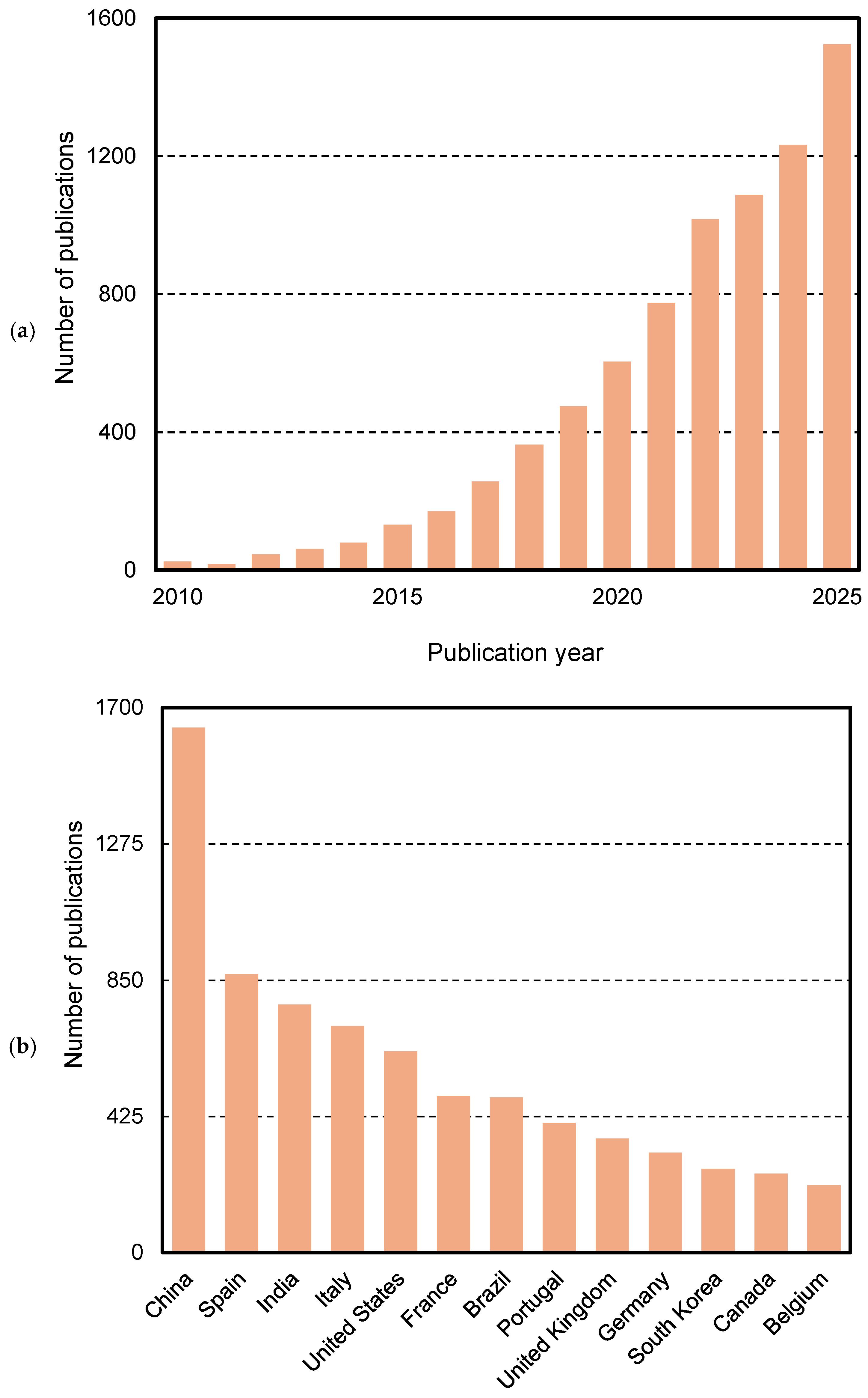
Figure 1 provides a bibliometric overview of research trends in biomass valorization over the past 15 years, illustrating a marked increase in the number of publications from 2010 to 2025, with a particularly sharp rise beginning around 2015. This exponential growth reflects escalating global interest in sustainable technologies and circular economy strategies in which biomass valorization plays a central role. The surge in publications also coincides with the expansion of funding programs and policy frameworks to promote renewable resources and waste-to-value approaches. Notable examples include the Horizon Europe program, which supports research in circular economy and green technologies across the EU [2], and the Renewable Energy Directive (RED II), which sets binding targets for renewable energy adoption [3]. National initiatives such as Germany’s Energiewende [4] and the U.S. Inflation Reduction Act [5] have also played a key role in accelerating innovation through financial incentives and regulatory support. Additionally, platforms like Database of State Incentives for Renewables & Efficiency (DSIRE) in the United States provide targeted incentives that encourage the development of sustainable technologies and valorization of waste streams [6].
Figure 1b highlights the geographical distribution of research output, identifying countries with more than 200 publications on biomass valorization. China leads by a wide margin, followed by Spain and India, indicating strong national research agendas and sustained institutional investment in this field. The prominence of European countries such as Spain, Italy, France, Portugal, and Germany underscores the alignment of biomass valorization with EU sustainability goals. Meanwhile, contributions from the United States, Brazil, and South Korea underscore the global relevance of the topic across diverse economic and environmental contexts. Together, these data underscore the dynamic and international nature of biomass valorization research, reinforcing its importance as a multidisciplinary domain that integrates materials science, environmental engineering, and energy technologies.
In recent years, the conversion of biomass residues into carbonaceous materials has gained recognition as a viable valorization pathway, offering a dual benefit: mitigating environmental pollution and enabling resource recovery through the production of high-performance products. In this context, activated carbon (AC) stands out for its high surface area, tunable porosity, and chemical versatility, making it suitable for applications in adsorption, catalysis, energy storage, and biosensing, among others [7,8].
Recent advances in material science have highlighted the importance of symmetry and asymmetry in determining the performance of porous materials. In AC, symmetry refers to the regularity in pore structure and surface chemistry, while asymmetry arises from hierarchical porosity, heterogeneous surface chemistry, or irregular morphology [9]. Despite extensive empirical advancements, the specific roles of symmetry and asymmetry in shaping the microstructure and surface properties of AC are often overlooked in design strategies. In this context, synthesis methods play a crucial role in modulating symmetry.
The inherent variability of feedstocks often leads to unique carbon structures. Rather than being a limitation, this fact can be strategically harnessed to tailor AC properties for specific purposes, such as selective adsorption, pollutant degradation, or energy storage [10]. The interplay between symmetry and asymmetry thus becomes a powerful design principle in optimizing AC for environmental and energy-related functions.
Recent pioneering studies have demonstrated the transformative potential of symmetric and asymmetric carbonaceous materials in waste management and energy storage. For instance, 3D-printed sewage sludge-derived ACs have been successfully employed as catalysts for advanced oxidation processes, achieving almost complete removal of pharmaceuticals under mild conditions while promoting circular economy principles [11]. In parallel, ordered mesoporous carbons synthesized via hard templating have shown efficient removal of bulky molecules such as 1,2,4,5-tetrachlorobenzene due to their highly ordered pore networks that minimize size-exclusion effects [12]. Conversely, asymmetric architectures with defect sites have enabled high store capacity and enhanced electron transport in batteries [13]. These advances illustrate how symmetry and asymmetry serve as complementary design paradigms for tailoring carbon materials to specific environmental and energy applications.
Despite the growing body of literature on biogenic carbonaceous materials, there is a notable gap in comprehensive reviews that explicitly address the fundamentals of symmetry and asymmetry, as well as their influence on the design and use. This review aims to fill that gap by providing a brief overview of these structural paradigms, exploring the fundamental principles, synthesis methodologies, and some of the most relevant applications, highlighting both the opportunities and challenges associated with exploiting symmetry and asymmetry in the design of carbonaceous materials.

2. Fundamentals of Symmetry and Asymmetry in Porous Carbon Materials

The structure–function relationship in porous carbon materials is deeply influenced by symmetry and asymmetry at multiple scales: atomic, molecular, and morphological. These structural paradigms are not merely geometric descriptors but are directly linked to the adsorptive, catalytic, and electrochemical performance of AC in sustainable waste valorization applications.

2.1. Structural and Chemical Symmetry: Order and Predictability

Symmetry in porous carbon materials is not limited to geometry; it can manifest in two complementary dimensions:
  • Structural symmetry, defined by periodic arrangements of pores, resulting in uniform pore-size distribution and well-defined diffusion pathways.
  • Chemical symmetry, characterized by a homogeneous elemental composition, typically dominated by carbon with only a minimal presence of heteroatoms distributed in an orderly manner throughout the material.
Symmetry is most evident in ordered mesoporous carbons (OMCs) such as CMK-3 and CMK-5, synthesized via hard templating using silica or zeolite frameworks. These materials exhibit hexagonally arranged mesopores, which facilitate rapid mass transport and uniform adsorption kinetics [14,15]. The long-range order in these materials enhances their performance in gas separation, supercapacitors, and electrocatalysis by minimizing diffusion resistance and enabling predictable ion transport [16,17]. Furthermore, graphitic symmetry at the atomic level contributes to electrical conductivity, which is essential for electrochemical applications [18].
Symmetry also contributes to mechanical stability. Uniform pore structures distribute stress evenly, reducing the likelihood of collapse under pressure or during cycling in energy storage devices [19]. In catalysis, symmetric arrangements of active sites can lead to more uniform reaction environments, improving selectivity and turnover frequency [20,21].

2.2. Morphological and Functional Asymmetry: Complexity and Reactivity

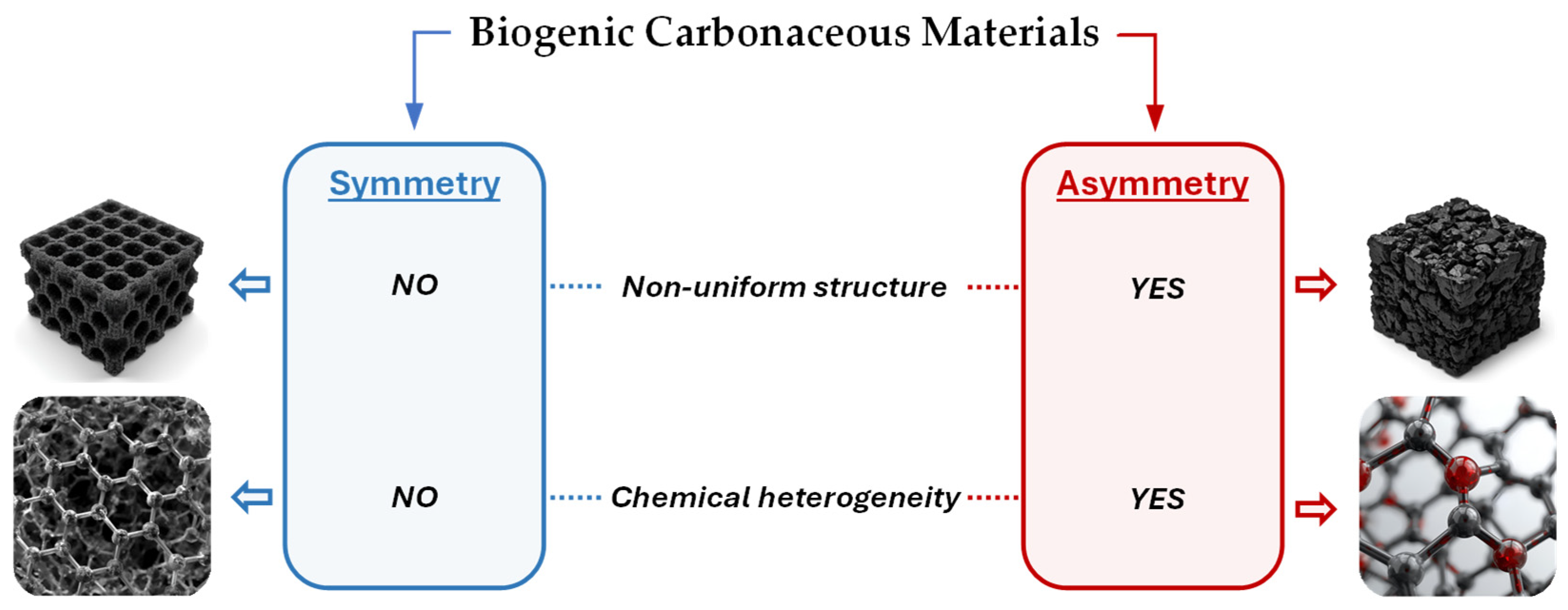
In contrast, asymmetry may arise from structural (irregular pore size, hierarchical porosity) or chemical (uneven distribution of heteroatoms and functional groups) heterogeneity. Figure 2 compares symmetric and asymmetric biogenic carbonaceous materials in terms of structural and chemical features. Chemical/physical activation (e.g., ZnCl2, FeCl3, H3PO4, or NiCl2) and biomass-derived routes often generate both forms of asymmetry, producing materials with diverse surface moieties and disordered architectures. While less predictable, such materials can outperform their symmetric counterparts in adsorption and catalysis due to their diverse active sites and enhanced accessibility [1,7,22,23].
Hierarchical porosity, combining micro-, meso-, and macropores, is a hallmark of asymmetric carbon architecture. This multiscale design improves mass transfer (especially in liquid-phase applications) and increases the effective surface area available for interaction with target molecules [24,25].
Asymmetric features are particularly advantageous in waste valorization, where pollutant complexity (e.g., heavy metals, dyes, pharmaceuticals) demands multifunctional surfaces capable of diverse interactions. For instance, multifunctional mixed metal-biochar composites produced from two abundant industrial wastes, lignin and red mud, exhibit complementary functionalities (adsorption, chemical reduction and catalytic reaction) [26,27].
Moreover, chemical asymmetry introduced via heteroatom doping (e.g., O, N, S, P) creates localized electronic imbalances that enhance catalytic activity and adsorption affinity [28,29,30]. These groups play a critical role through hydrogen bonding, π–π interactions, and electrostatic attractions between the adsorbate and the carbonaceous matrix [31]. Nitrogen doping, for example, enhances basicity and electron-donating capacity, improving performance in CO2 capture and oxygen reduction reactions [32,33,34,35]. Sulfur and phosphorus dopants introduce active sites, beneficial for energy storage and electrocatalysis [36,37].
These architectures are also advantageous in Fenton-like reactions, where surface defects and heterogeneity promote the Fe3+/Fe2+ conversion, thereby improving the oxidation process [38]. Moreover, defect sites in asymmetric carbon can act as nucleation centers for metal nanoparticles, enabling the fabrication of carbon-metal hybrid catalysts [39,40].

2.3. Experimental and Theoretical Characterization of Symmetry and Asymmetry

Understanding the symmetry and asymmetry in biogenic carbonaceous materials requires a comprehensive approach that integrates advanced experimental techniques with theoretical modeling.
Experimentally, X-ray diffraction (XRD) is employed to probe crystalline ordering [41,42] by analyzing the 002 peak strength, where the crystalline phase appears as a sharp peak and the amorphous phase contributes mainly to the background. The relative fractions of crystalline and amorphous carbon can be calculated from the peak intensities using standard quantitative methods described in the literature [43,44]. Raman spectroscopy further contributes by assessing graphitic order and defect density, parameters closely linked to both symmetry and reactivity. This is achieved through the calculation of the intensity ratio of the D and G bands (ID/IG) [45,46,47].
Nitrogen physisorption, combined with Barrett–Joyner–Halenda (BJH) analysis, is widely used to quantitatively determine pore-size distribution from adsorption–desorption isotherms. In this way, the method allows the distinction between uniform pore-size distributions typical of symmetric architectures and heterogeneous porosity characteristic of asymmetric structures [23,48]. Scanning and transmission electron microscopy (SEM/TEM) provide direct nanoscale visualization of pore-size and morphology, structural regularity, and symmetry [49,50].
The chemical composition of carbonaceous materials can be determined through elemental analysis and X-ray fluorescence (XRF), enabling the evaluation of chemical heterogeneity and the calculation of C/Heteroatom ratios to assess chemical diversity [1]. Surface functional groups and heteroatom distribution, key indicators of chemical asymmetry, are elucidated using X-ray photoelectron spectroscopy (XPS) and Fourier-transform infrared spectroscopy (FTIR) [51].
Complementing these experimental insights, computational modeling offers predictive and mechanistic understanding. Density functional theory (DFT) simulations allow for the prediction of adsorption energies, pore-size distribution, charge distribution, and reaction pathways on symmetric versus asymmetric surfaces [52,53]. Molecular dynamics (MD) simulations visualize diffusion in ordered versus disordered pore networks, providing a dynamic perspective of structure–function relationships [54,55].
These theoretical tools are increasingly used integrated with experimental data to guide the rational design of AC materials [56]. For instance, DFT studies have shown that S-doped graphite pores with high S/N ratios interact more strongly with CO2 than with other gases, making S-doping more effective than S/N co-doping for selective CO2 capture [57]. Similarly, the increased CO2 affinity of P-C3N monolayers has been attributed to their non-uniform charge distribution, as revealed by DFT calculations [58].
Beyond the symmetry/asymmetry paradigm, activated carbons can also be classified using complementary approaches widely adopted in the literature. Textural classification based on IUPAC standards distinguishes microporous (<2 nm), mesoporous (2–50 nm), and macroporous (>50 nm) structures, which strongly influence adsorption and diffusion behavior [59]. Another common framework relies on chemical functionality, grouping carbons according to surface heteroatom content (e.g., oxygenated, nitrogen-doped or sulfur-doped ACs), as these functionalities govern catalytic activity and adsorption selectivity [60,61]. Morphology-driven classification considers particle shape and structural arrangement (e.g., powdered, fibrous, granular and monolithic ACs), which are relevant for mechanical stability and reactor design [62,63]. Application-oriented classification organizes materials by their primary use, such as adsorbents, catalysts, or electrode materials [64]. Finally, precursor-based classification differentiates carbons according to their origin (e.g., biomass and fossil source), since feedstock composition strongly determines the final properties [65].

3. Design and Synthesis of Symmetric and Asymmetric AC

The synthesis of AC with tailored symmetry or asymmetry is a cornerstone in the development of high-performance materials for sustainable waste valorization. The pore structure distribution and surface chemistry allow researchers to fine-tune AC for specific purposes such as adsorption, catalysis, and energy storage. This section explores strategies for engineering symmetrically ordered and asymmetrically heterogeneous carbon materials, highlighting their structural features, functional implications, and scalability.

3.1. Symmetric Architectures: Templated and Controlled Assembly

Symmetric porous carbons are typically synthesized using templating techniques that impose order at the meso- and nanoscale. Hard templating involves the infiltration of carbon precursors into rigid matrices such as SBA-15, KIT-6, or zeolites, followed by carbonization and template removal [66,67]. This method yields ordered mesoporous biocarbons with uniform pore diameters, high surface areas, and hexagonal or cubic symmetry [68,69]. The resulting materials exhibit predictable mass transport, uniform adsorption sites, and enhanced electrochemical performance, making them ideal for gas separation, capacitive deionization, and electrocatalysis [70,71,72].
Soft templating, by contrast, uses surfactants or block copolymers that self-assemble with carbon precursors. Upon carbonization, the organic templates decompose, leaving behind symmetrically arranged mesopores. This method offers greater flexibility in tuning pore size and wall thickness, and is compatible with greener precursors such as phenolic resins, lignin, and biomass-derived sugars [67,73,74]. Materials obtained through soft templating generally exhibit less pronounced pore ordering and reduced structural robustness compared to those synthesized via hard-template approaches, which typically deliver highly uniform architectures and superior mechanical integrity [75].
Emerging techniques such as microwave-assisted synthesis and hydrothermal route have also been employed to promote the formation of graphitic domains and layered structures with high crystallinity and symmetry, thereby improving selectivity and electrical conductivity [76,77,78,79,80].
Symmetric architectures are particularly advantageous in applications that require uniform ion diffusion, such as in supercapacitors and Li-ion batteries, where ordered pore channels reduce resistance and enhance cycling stability. Moreover, the reproducibility of templated synthesis makes it suitable for scalable production, although the use of sacrificial templates can increase cost and environmental impact [67].

3.2. Asymmetric Architectures: Hierarchical and Heterogeneous Design

In contrast, asymmetric AC structures are characterized by irregular pore distributions, non-uniform surface chemistry, and heterogeneous morphology. These features are often introduced through chemical/physical activation, wherein agents such as KOH, H3PO4, FeCl3, or ZnCl2 react with carbon precursors to generate hierarchical porosity alongside diverse surface functional groups [81]. The resulting materials combine micropores (<2 nm), which provide the high surface area and adsorption sites, with mesopores (2–50 nm) and macropores (>50 nm), which act as transport pathways to the micropores and reduce diffusion limitations. This hierarchical architecture enhances performance in wastewater treatment as an adsorbent and in heterogeneous catalysis as a support or carbocatalyst [1,82,83,84].
Biomass-derived carbons usually exhibit asymmetry due to the structural and chemical complexity of natural precursors. Agricultural residues, sewage sludge, lignocellulosic biomass, and food waste may yield AC with irregular pore networks, defect-rich surfaces, and diverse functional groups. These features enhance chemical reactivity, hydrophilicity, and selectivity toward polar contaminants such as heavy metals and pharmaceuticals [81,85,86].
Heteroatom doping introduces electronic asymmetry by altering the charge distribution and creating localized active sites [87]. Nitrogen incorporation significantly increases the basic character and electron-donating ability of carbon materials, which translates into superior efficiency for CO2 adsorption and oxygen reduction processes [32,33,34,35]. In addition, the introduction of sulfur and phosphorus atoms creates highly active sites that boost functionalities required for advanced energy storage systems and electrocatalytic applications [36,37].
As has been discussed so far, the division between symmetry and asymmetry in carbon-based materials is driven by their structural and chemical characteristics. Symmetric architectures, defined by ordered pore networks and homogeneous composition, enable predictable ion diffusion, uniform adsorption kinetics, and mechanical stability, making them ideal for applications requiring reproducibility and controlled transport. In contrast, asymmetric architectures, characterized by hierarchical porosity and heterogeneous surface chemistry, provide multifunctionality and adaptability. These features enhance mass transfer, introduce diverse active sites, and create localized electronic imbalances, which are particularly advantageous for complex processes like wastewater treatment, where versatility and high reactivity are essential.

3.3. Hybrid and Tunable Strategies

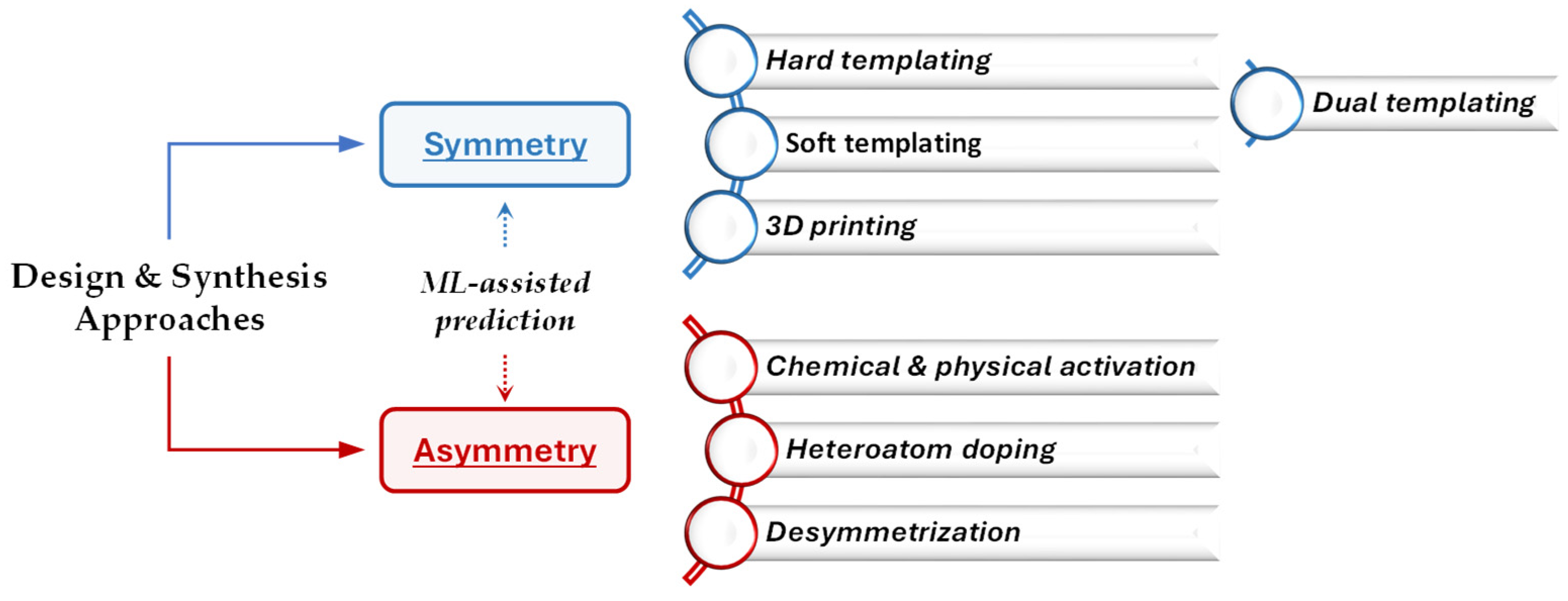
Recent advances have focused on hybrid synthesis strategies to achieve multifunctional performance. Dual-templating methods, for instance, use both hard and soft templates to create ordered frameworks with hierarchical porosity, offering the benefits of both structural regularity and transport efficiency. These materials are particularly effective as electrodes, adsorbents, or multiphase catalysts [88,89,90,91,92].
Desymmetrization, a concept adapted from organic synthesis, has been applied to carbon materials to break symmetry and selectively expose reactive edge sites. This approach enables the design of anisotropic surfaces with enhanced catalytic activity and molecular recognition [93,94,95].
Machine learning (ML) and computational modeling are increasingly used to guide the synthesis of AC with targeted symmetry/asymmetry profiles. ML algorithms can predict optimal synthesis parameters based on precursor composition, activation conditions, and desired use, accelerating the discovery of application-specific carbon materials [96,97,98,99].
Furthermore, 3D printing is emerging as a tool to fabricate macroscopically defined carbon structures with controlled porosity and geometry, opening new avenues for the design and optimization of catalysts, sodium-ion batteries, energy storage and conductive materials [100,101,102].
Figure 3 illustrates the main design and synthesis approaches for symmetric and asymmetric biogenic carbonaceous materials described previously, highlighting the integration of ML-assisted prediction for guiding material design.

4. Applications of Symmetric and Asymmetric AC for Waste Valorization

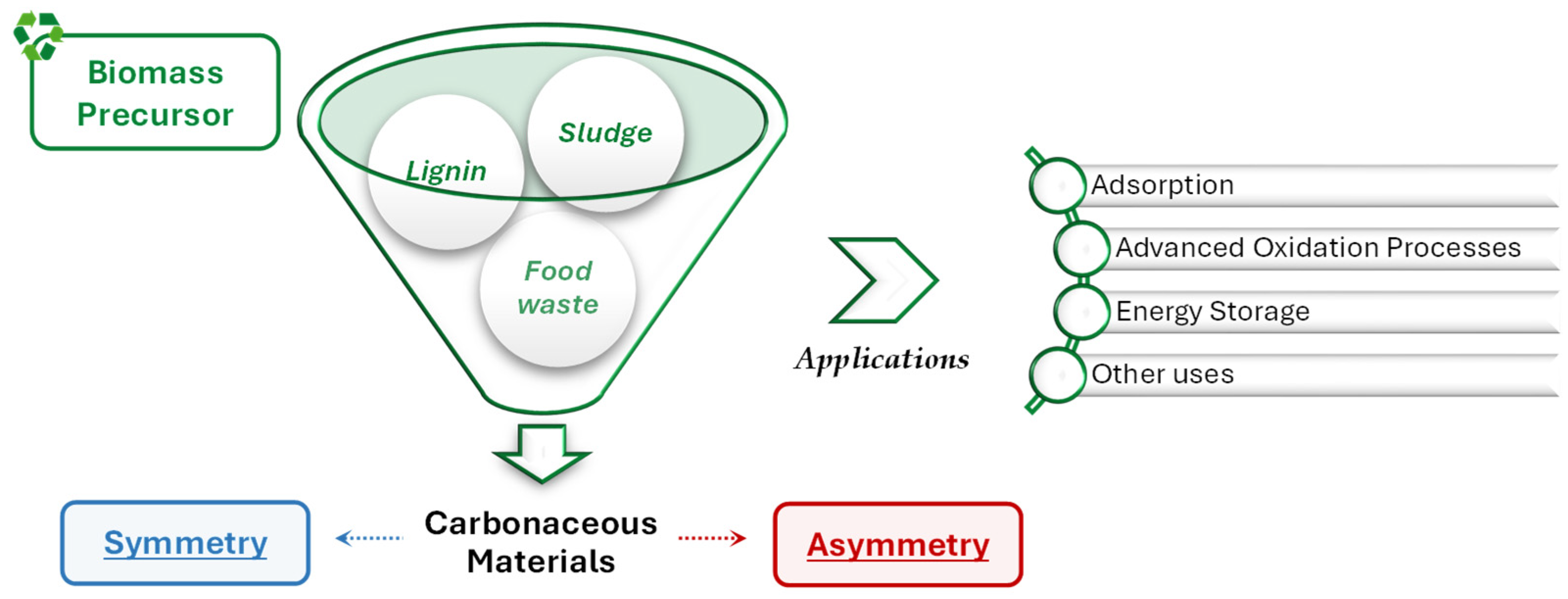
AC plays a pivotal role in sustainable waste valorization due to its high surface area, tunable porosity, and chemical versatility. The symmetry or asymmetry of its structure and functionality significantly influences its performance across a range of uses, including adsorption, catalysis, and energy storage, among others. This section integrates both structural and functional perspectives to critically examine how symmetry and asymmetry affect the selectivity, efficiency, and versatility of ACs in waste valorization. Figure 4 illustrates the main applications of carbonaceous materials derived from biomass precursors.

4.1. Adsorption of Organic and Inorganic Pollutants

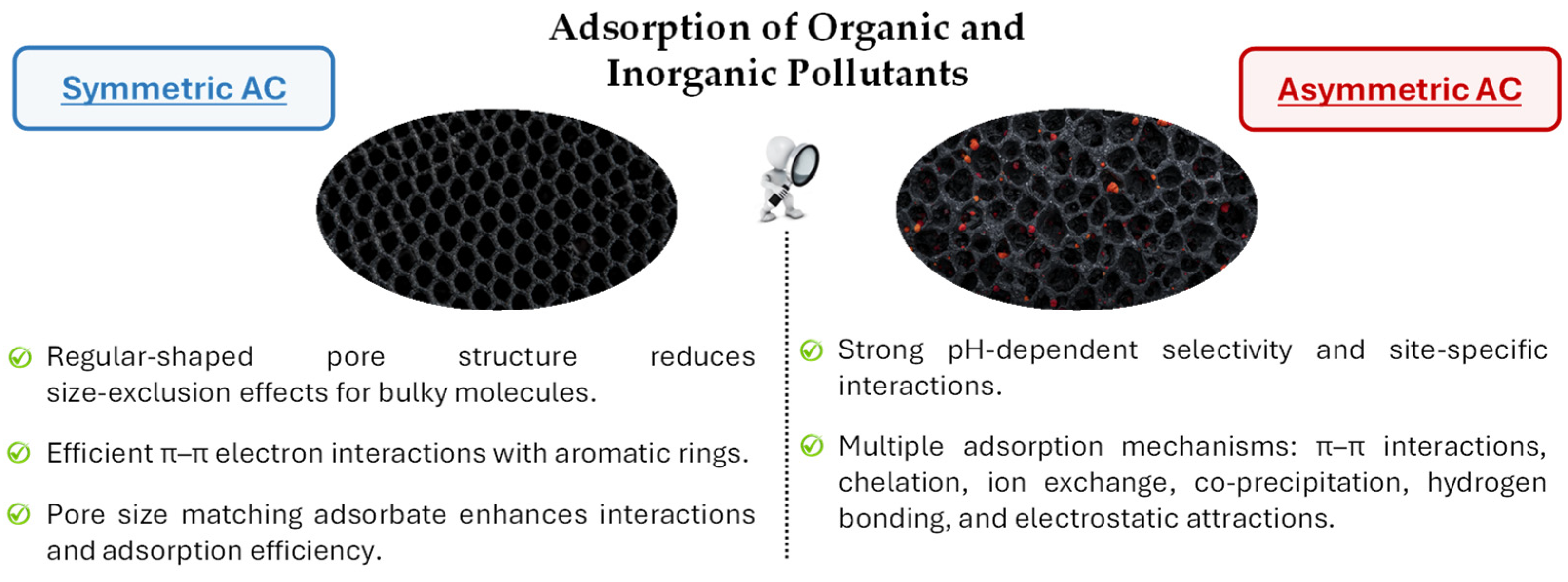
Symmetric ACs, particularly those with ordered mesoporous structures and uniform surface chemistry, offer predictable diffusion pathways and adsorption behavior. These materials are especially effective where size exclusion dominates. In addition, when the pore diameter is adapted to the size of the adsorbate, stronger interactions can occur, leading to a more efficient adsorption process [103]. This principle is further supported by recent studies on light hydrocarbon adsorption. For example, bamboo fiber-based porous carbons (BPCs) with tunable pore-size distributions have shown that adsorption efficiency and selectivity strongly depend on matching the pore diameter to the molecular size of the adsorbate. Grand Canonical Monte Carlo (GCMC) simulations revealed that CH4 exhibits an optimal pore-size range of 0.7–0.8 nm. Experimental results confirmed that BPCs designed within these ranges achieved high adsorption capacities (2.07 mmol/g) and selective separation. These findings demonstrate that tailoring pore size to the adsorbate dimensions is a rational strategy for optimizing adsorption and separation performance in porous carbon materials [104].
Moreover, recent research on zeolite-templated microporous carbons has highlighted the advantages of highly ordered carbon structures in adsorption processes. These materials exhibit regular and interconnected pore architectures, which alleviate size-exclusion effects for bulky molecules such as 1,2,4,5-tetrachlorobenzene (TCB). Ji et al. demonstrated that zeolite-templated carbons achieved superior adsorption performance for TCB due to their regular-shaped pore structure. Their open framework enables efficient π–π electron interactions with aromatic rings while maintaining full accessibility of the surface area. This structural advantage also facilitates nearly complete desorption, supporting the sustainable use of recycled adsorbents [12].
In contrast, asymmetric ACs, often derived from biomass and/or obtained through chemical modification, exhibit heterogeneous surface chemistry and hierarchical porosity. These features enhance their capacity to adsorb complex pollutants like heavy metals, dyes, pesticides, and pharmaceuticals [7,105,106,107]. Functional asymmetry, including the uneven distribution of oxygen-, nitrogen-, sulfur-, or metal-containing functional groups, enables pH-dependent selectivity and site-specific interactions, making these materials particularly suitable for real-world wastewater treatment [108]. For example, Cao et al. demonstrated that sulfide-iron-doped biochar exhibited adsorption capacities of 124.62 mg/g for Pb(II) and 57.71 mg/g for Cd(II) [109]. The presence of sulfur-containing groups promoted the adsorption via chelation and ion exchange, while Fe sites contributed to physical adsorption and co-precipitation mechanisms [109,110].
Recent advances in heteroatom doping (e.g., N, S) have led to asymmetric ACs with high-affinity behavior and enhanced performance in removing persistent organic pollutants [110,111]. Xu et al. demonstrated that Fe/N co-doped biochar exhibited a maximum adsorption capacity of 94.96 mg/g for bisphenol A, far exceeding commercial activated carbon (6 mg/g) and graphene (19 mg/g). This improvement is attributed to the introduction of graphitic N and Fe–Nx sites, which enhance π–π electron donor–acceptor interactions. Similar enhancements were observed for other micropollutants such as phenol, sulfamethoxazole, and carbamazepine, confirming that heteroatom doping creates functional asymmetry and promotes adsorption [112]. Figure 5 compares symmetric and asymmetric activated carbon materials and highlights their roles in adsorption processes for organic and inorganic pollutants.
Table 1 offers a comprehensive overview of biomass-derived carbonaceous materials applied to the adsorption of a wide range of organic and inorganic pollutants, including CO2, dyes, pharmaceuticals, pesticides, heavy metals, and nanoplastics. The data reveals that both the nature of the biomass precursor and the synthesis method play a decisive role in determining the textural properties and adsorption performance of the resulting materials. Hard-templated carbons from sucrose and bioglycerol [68] exhibit high surface areas (up to 1086 m2/g) and moderate CO2 adsorption capacities (42–79 mg/g), while creosote-derived carbon achieves an exceptional uptake of 579.6 mg/g for methylene blue [113]. Similarly, pig manure-based carbon shows high affinity for tetracycline hydrochloride (122 mg/g) [114]. Soft-templated materials derived from bayberry kernel [115] and mimosa tannin [116] demonstrate efficient adsorption of heavy metals and pharmaceuticals. These findings underscore the crucial role of pore architecture in facilitating specific interactions with target pollutants.
Chemically and/or physically ACs derived from sewage sludge [22], lignin [117], walnut shells [31], and sawdust [118] show promising performance for emerging contaminants such as pharmaceuticals and nanoplastics, with adsorption capacities ranging from 41 to 153 mg/g. Comparable adsorption capacities have also been reported for other ordered porous materials such as Metal–Organic Frameworks (MOFs) [119]. However, the materials evaluated in this review also offer the additional advantage of enabling waste valorization, aligning with circular economy principles and promoting sustainable material development.
Overall, Table 1 highlights the versatility of biomass sources and the adaptability of synthesis techniques in tailoring carbon materials for specific environmental applications. The combination of high surface area, hierarchical porosity, and functional surface groups enables these materials to effectively target a wide spectrum of pollutants, positioning them as sustainable and efficient alternatives for adsorption-based remediation technologies.
Table 1. Features of several biomass-derived carbonaceous materials reported in the literature for the adsorption of organic and inorganic pollutants.
Target
Pollutant
Biomass PrecursorSynthesis
Method
SBET (m2/g)Qm (mg/g)Reference
CO2SucroseHard-templating108679.2[68]
CO2BioglycerolHard-templating378–56242–46[68]
Methylene blue CreosoteHard-templating1017579.6[113]
Tetracycline hydrochloride Pig manureHard-templating276122.0[114]
Pb (II) and
Cr (III)
Bayberry kernelSoft-templating1012123 (Pb); 46 (Cr)[115]
CO2Chestnut tanninSoft-templating747151[120]
TetracyclineMimosa tanninSoft-templating592300[116]
U (VI)Corn cobsChemical activation139551.66[107]
ImidaclopridSewage sludgeChemical and physical activation750153.1[22]
Diclofenac
sodium
Walnut shellsChemical activation122948.41[31]
NanoplasticsLigninChemical activation106349.53[117]
NanoplasticsSawdustChemical activation103740.84[118]
CO2Pine conesPhysical activation1322141[121]

4.2. Advanced Oxidation Processes

In catalytic applications, symmetric ACs provide uniform active sites and stable support for metal nanoparticles, improving selectivity and catalyst longevity. Their ordered pore networks facilitate reactant diffusion and product desorption, which is particularly advantageous in reactions requiring consistent kinetics [122,123]. Huber-Benito et al. developed a novel approach using 3D-printed sewage sludge-derived carbon catalysts for catalytic wet air oxidation (CWAO) of cytostatic drugs in hospital wastewater. The study highlights how structured carbon monoliths with interconnected channels improve process efficiency by enhancing mass transfer, reducing pressure drop, and increasing catalyst loading per unit volume. These geometries also provide high mechanical stability and durability under continuous operation, enabling complete degradation of methotrexate and mycophenolic acid under mild conditions. The work demonstrates that geometry and textural optimization are key to achieving superior catalytic performance in continuous systems, positioning 3D-printed carbon structures as a sustainable alternative for advanced water treatment [11].
However, asymmetric ACs, rich in structural defects and doped with heteroatoms, offer superior performance in advanced oxidation processes (AOPs) such as Fenton-like reactions and photocatalysis. These materials promote radical formation and electron transfer due to their localized charge density and non-uniform active sites [38,87]. Li et al. showed that heteroatom-doped activated carbons coupled with Fenton systems form dynamic single-atom sites that enhance Fe3+/Fe2+ conversion and inhibit Fe3+ hydrolysis. These sites create a carbon → ligand → Fe ↔ H2O2 electron-flux pathway, whose bidirectional nature enhances the generation of hydroxyl radicals. As a result, degradation rates improved over 90-fold compared to conventional Fenton, with >88% removal maintained across five cycles and long-term stability (480 h) with minimal Fe leaching [38].
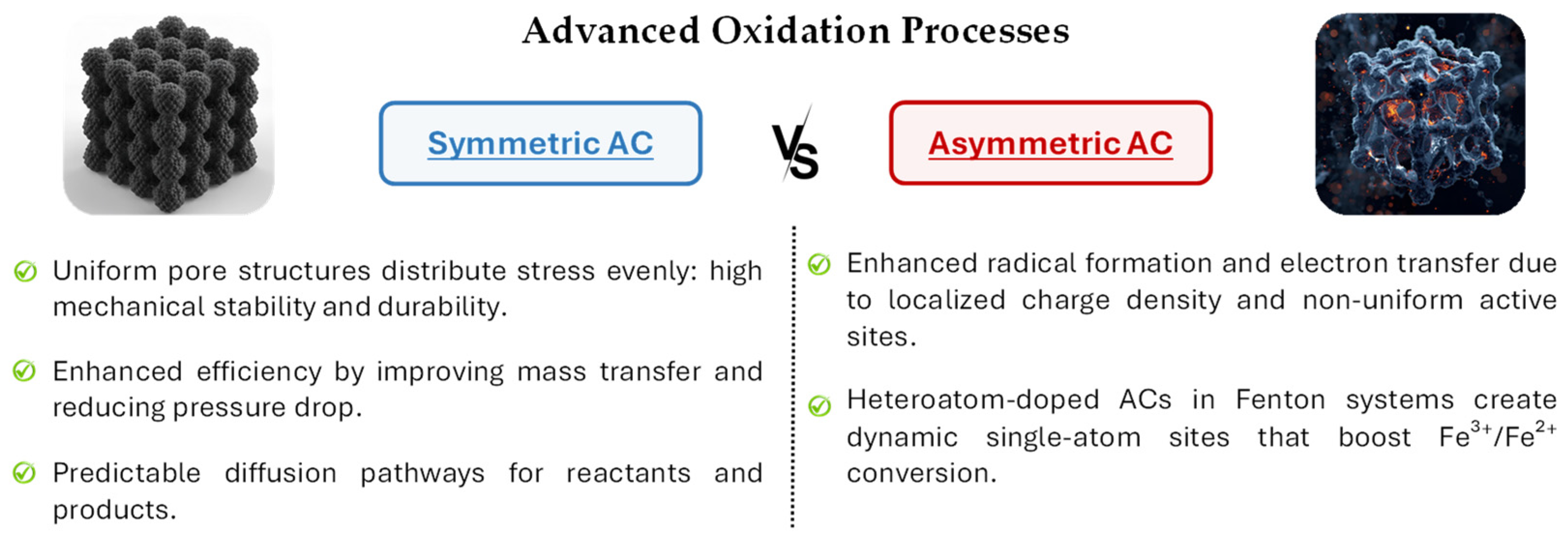
Systems combining asymmetric ACs with transition metals, such as iron, have shown enhanced catalytic activity and stability, offering sustainable alternatives to homogeneous catalysts. In this regard, Gutiérrez-Sánchez et al. reported that sewage sludge-derived carbon catalysts activated with iron chloride exhibited outstanding catalytic performance in CWPO processes, achieving up to 99.7% ciprofloxacin removal within 30 min and maintaining low iron leaching levels (0.48–0.61 mg/L). The degradation mechanism involves the generation of surface-bound hydroxyl radicals through electron transfer between H2O2 and iron sites on the catalyst, assisted by oxygen-containing functional groups. Additionally, the carbon matrix facilitates electron transfer from ciprofloxacin to H2O2 [1]. Figure 6 compares symmetric and asymmetric biogenic activated carbon materials and their roles in advanced oxidation processes.
Table 2 highlights the performance of various biomass-derived carbonaceous catalysts used in AOPs for water treatment. Sewage sludge frequently appears as a precursor, employed through chemical, physical, and even 3D printing methods, achieving high removal yields (up to 100%) for pollutants such as trimethoprim [7], ciprofloxacin [23], prednisone [124], and methotrexate [11]. Other precursors like yeast extract [125] also show excellent results, with surface areas up to 1480 m2/g. Hard-templated carbons from egg yolk [126] and pig manure [114] demonstrate high efficiency against 4-nitrophenol and tetracycline, respectively. Taken together, Table 2 underscores the potential of biomass waste as a sustainable source for effective catalysts in water purification technologies.

4.3. Energy Storage

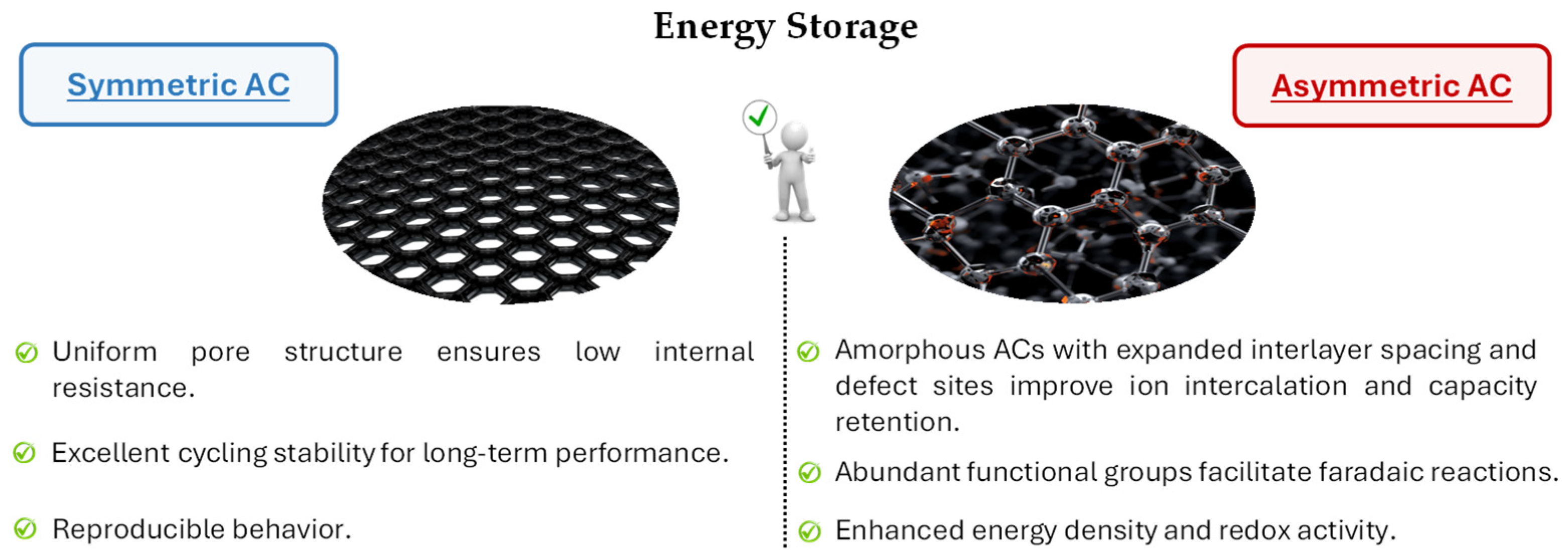
Symmetric ACs are widely used in electric double-layer capacitors due to their uniform pore structure, low internal resistance, and excellent cycling stability. Their functional symmetry ensures reproducible performance and high-power density [19,67].
Asymmetric ACs, particularly those doped with heteroatoms or integrated with pseudocapacitive materials, exhibit enhanced energy density and redox activity. Their hierarchical porosity and abundant surface functionalities facilitate faradaic reactions, making them suitable for hybrid supercapacitors and battery-type electrodes [36,131,132].
In lithium-ion and sodium-ion batteries, asymmetric and amorphous ACs with expanded interlayer spacing and defect sites have been found to improve ion intercalation and capacity retention. Yang et al. demonstrated that hierarchical carbon nanostructures derived from glucose precursors, consisting of interconnected expanded graphitic ribbons embedded in amorphous carbon, not only enable reversible Li+/Na+ insertion but also provide abundant active sites and fast electron/ion transport through hierarchical porous structures, achieving high capacity and long cycle life [13]. Figure 7 compares symmetric and asymmetric biogenic carbonaceous materials and their roles in energy storage.
Table 3 summarizes several recent studies on biomass-derived carbon materials used in energy storage applications, including those obtained from bread and Ganoderma spores, quinoa straw, luffa sponge, Strychnos potatorum, hybrid willow, flour, lignin and other sources [133,134,135,136,137,138,139,140,141,142]. Table 3 highlights the diversity of biomass precursors, synthesis methods, and the resulting BET surface areas and specific capacitances. Notably, materials derived from luffa sponge [135] and quinoa straw [134] exhibit excellent specific capacitance performance, underscoring the effectiveness of chemical activation in producing asymmetric, heteroatom-doped ACs for use in supercapacitor and battery technologies.

4.4. Other Uses

Beyond individual applications, ACs with tailored symmetry/asymmetry are increasingly being integrated into multifunctional systems that enable simultaneous waste treatment and resource recovery. Biomass-derived ACs have been employed as electrodes in microbial fuel cells, where their physicochemical properties promote biocompatibility for microbial adhesion [143].
The functional arrangement of surface groups also enhances sensitivity and selectivity in molecular recognition [144]. ACs functionalized with chiral moieties can selectively bind enantiomers or biomolecules, supporting applications in pharmaceutical purification [145]. Moreover, several studies have reported the selective immobilization of proteins and enzymes on carbonaceous surfaces, further expanding the role of these materials in biosensing systems [146,147,148].
Biomass-derived activated carbons have also been successfully employed as heterogeneous catalysts for biodiesel production through esterification and transesterification processes. Sulfonated carbons obtained from precursors such as lignin, starch, and sugarcane bagasse exhibit high acidity and catalytic efficiency, achieving fatty acid methyl ester (FAME) yields above 95%, even with feedstocks rich in free fatty acids. Similarly, base-functionalized carbons derived from banana peels, coconut husks, and coffee grounds have demonstrated excellent performance, enabling biodiesel synthesis under mild conditions with yields exceeding 90%. These examples highlight the versatility of biogenic carbons in promoting sustainable fuel production while valorizing agricultural and food waste [149].
ACs derived from biomass precursors have also attracted attention for their use in the synthesis of high value-added compounds such as furfuryl alcohol [150], propylene [151], ethylene [152], and γ-butyrolactone [153], among others.

5. Future Perspectives and Challenges

Despite the remarkable progress achieved in the development and use of symmetric and asymmetric AC materials, several scientific, technological, and practical challenges remain. Addressing these issues is essential to fully realize the potential of AC in sustainable waste valorization and to advance toward scalable, circular, and economically viable systems.

5.1. Feedstock Variability

One of the most pressing challenges lies in the variability of biomass feedstocks, which directly affects the reproducibility and performance of biogenic ACs. These precursors differ in chemical composition, ash content and structure characteristics, resulting in wide variations in porosity, surface chemistry, and yield [10]. Future research should focus on the standardizing pretreatment protocols, the developing predictive models, and the classification of feedstocks based on their carbonization behavior and activation potential.
In recent years, machine learning tools have been applied to predict key properties of biomass-derived carbon materials, such as yield, surface area, pore volume, and even elemental distribution, based on precursor composition and process parameters [97,98,99]. Recent studies using ensemble algorithms (e.g., Gradient Boosting regression, XGBoost) combined with interpretability techniques like Shapley Additive Explanation (SHAP) have demonstrated that intrinsic biomass features (C/H/N/O ratios, lignin content, ash composition) strongly influence porosity and heteroatom doping patterns, which are decisive for asymmetry/asymmetry [97,99]. These advances confirm that ML can capture complex, non-linear relationships between feedstock structure and final performance, reducing experimental costs and accelerating optimization [98]. However, the integration of symmetry-related descriptors—such as pore-size distribution, the relative fractions of crystalline and amorphous carbon, ID/IG ratio or charge distribution—into predictive frameworks remains largely unexplored. Linking these quantitative indicators with ML-driven models would enable rational design strategies, allowing researchers to tune structural symmetry and functional asymmetry for targeted applications systematically.
Moreover, competition between waste valorization and other biomass utilization routes raises questions about resource allocation and life cycle optimization. Integrating techno-economic analysis and Life Cycle Assessment (LCA) into AC development pipelines will be crucial for identifying the most sustainable pathways.

5.2. Process Optimization and Scalability

Beyond feedstock variability, the choice of synthesis pathway strongly influences both environmental and economic performance. Both physical and chemical activation show their greatest environmental impact in the global warming category, mainly due to the high energy requirements during drying (physical activation), impregnation (chemical activation), and pyrolysis/carbonization steps (physical and chemical activation). Compared to physical activation, chemical activation introduces additional burdens associated with the production, use and disposal of activating agents such as H3PO4, ZnCl2, or KOH, which dominate impact categories related to environmental impact, ecotoxicity and human toxicity. According to published LCA studies, H3PO4 is associated with higher acidification and eutrophication effects, while ZnCl2 leads to greater ecotoxicity and toxicity burdens. From an economic perspective, physical activation generally exhibits smaller costs (0.68–4.48 USD/kg) but lower yields, whereas chemical activation offers higher yields but highly variable costs (0.26–70.67 USD/kg) depending on the activating agent and scale. Life cycle assessments and economic analyses underscore the need for integrated strategies that minimize energy use and chemical consumption, while leveraging large-scale production and by-product valorization; improvements can be achieved through energy savings by integrating renewable sources, recovering heat from process by-products, and enhancing carbonization efficiency with more efficient ovens [154].
In addition to physical and chemical activation, templating methods present distinct challenges regarding environmental impact, energy consumption, and cost-effectiveness. Hard-template techniques, which often employ mesoporous silica or metal carbides, require multiple processing steps such as infiltration, carbonization, and template removal using corrosive chemicals like hydrofluoric acid or concentrated NaOH. These procedures not only increase environmental risks but also raise operational costs and complicate scalability [155,156]. Soft-template methods, which rely on surfactant micelles or block copolymers, are generally simpler because they eliminate the need for post-carbonization template removal. However, they still require high-temperature treatments for carbonization and surfactant decomposition, leading to significant energy consumption [75,155,156]. Furthermore, the use of expensive and low-biodegradable block copolymers in soft-templating adds economic and environmental burdens [156]. Templating methods face critical challenges that must be addressed through greener template systems, simplified removal processes, and energy-efficient carbonization technologies to ensure industrial viability. Unlike physical and chemical activation processes, the literature still lacks comprehensive techno-economic analyses and life cycle assessments for template-based synthesis routes derived from biomass precursors, highlighting the need for future studies to explore these aspects in depth.
Although laboratory-scale synthesis of ACs has been extensively studied, scaling up remains a major bottleneck. Some methods often involve toxic reagents, high energy input, or complex post-processing steps, which limit their industrial feasibility. Therefore, the development of greener activation methods compatible with large-scale production is urgently needed.
Continuous-flow reactors are also emerging as promising technologies for scalable AC synthesis [157], but their integration into existing waste management infrastructure and their economic viability still require further validation. These frontiers will require novel synthesis strategies, advanced characterization tools, and cross-sector innovation to translate laboratory breakthroughs into practical, real-world solutions.

5.3. Functional Design, Application-Specific Tailoring and Policy Frameworks

The next generation of AC materials must be designed for specific purposes, with precisely engineered symmetry or asymmetry to match the demands of adsorption, catalysis, biosensing, or energy storage. This level of control requires a deeper understanding of structure–function relationships, which can be achieved through multiscale modeling, machine learning, and high-throughput experimentation. These advances will depend on close interdisciplinary collaboration between chemists, engineers, data scientists, and environmental analysts. Achieving such precision in material design calls for innovative strategies, including desymmetrization, machine learning, and 3D printing, which offer transformative potential. Desymmetrization enables selective disruption of symmetry to expose reactive edge sites, creating anisotropic surfaces with enhanced catalytic activity and adsorption selectivity. ML-driven models could predict optimal synthesis parameters by correlating precursor composition, activation conditions, and symmetry-related descriptors (e.g., pore-size distribution, ID/IG ratio, charge density), accelerating the rational design of hybrid architectures. Meanwhile, 3D printing provides control over macroscopic geometry and porosity, enabling the integration of ordered transport channels. The synergy of these approaches can deliver multifunctional carbons that combine structural regularity for efficient mass transfer with localized chemical heterogeneity for high reactivity, paving the way for next-generation materials tailored to complex environmental and energy applications.
In the literature, quantitative formal oxidation state assignments for carbon atoms in activated carbons are rarely addressed. Garten et al. initially classified activated carbons into oxidized “H” carbon (quinonoid structure) and reduced “L” carbon (hydroquinone structure), with intermediate semiquinone forms [158]. Since then, the practical characterization of activated carbon oxidation has relied on operational indicators such as chemical composition and identification of functional groups, which inherently influence local carbon oxidation states in the solid matrix. On this basis, future breakthroughs may lie in systematically mapping how local oxidation states in carbon atoms affect and are affected in different applications, such as catalysis, using DFT analysis. Designing carbon materials that exploit specific oxidation states, through heteroatom doping and defect engineering, offers a promising route to tune electronic asymmetry and catalytic performance. This perspective links atomic-scale valence control to macroscopic functionality, reinforcing the conceptual depth of symmetry/asymmetry in biogenic carbons.
To maximize impact, AC technologies must be embedded within circular economy models that prioritize waste minimization, resource recovery, and closed-loop processes. This includes coupling AC production with biomass waste management, biochar generation, or waste-to-energy platforms to create synergistic valorization chains.
Policy support is also essential. Regulatory frameworks should incentivize the use of waste-derived materials, support green procurement practices, and establish quality standards for AC used in environmental uses. Public–private partnerships and international cooperation will play a pivotal role in accelerating deployment, particularly in regions with abundant biomass resources and pressing pollution challenges.

6. Conclusions

The exploration of symmetry and asymmetry in activated carbon provides a strong conceptual and practical framework for advancing sustainable waste valorization. Over the past decade, significant progress has been made in understanding how structural order, chemical uniformity, and functional heterogeneity influence AC performance in adsorption, catalysis, energy storage, and related applications.
The distinction between symmetry and asymmetry arises from structural and chemical features. Symmetric architectures, with ordered pore networks and homogeneous composition, ensure predictable ion diffusion, uniform adsorption kinetics, and mechanical stability, making them ideal for controlled transport applications. Conversely, asymmetric architectures, characterized by hierarchical porosity and heterogeneous surface chemistry, offer multifunctionality and adaptability, enhancing mass transfer and creating localized electronic imbalances for complex processes such as wastewater treatment. Neither symmetry nor asymmetry is inherently superior; the greatest potential lies in application-specific design. Advances in characterization and modeling enable rational engineering, while hybrid strategies—dual-templating, heteroatom doping, desymmetrization, and 3D printing—expand functionality across environmental and energy domains.
Despite notable progress, challenges remain in feedstock variability, process scalability, and regulatory integration. Future research should focus on standardized protocols, predictive synthesis models, and greener activation methods compatible with industrial deployment. Embedding AC technologies within circular economy frameworks and fostering interdisciplinary collaboration will be essential to unlock their full potential in real-world waste valorization systems.

Funding

This research was funded by the Ministry of Science and Innovation and the European Regional Development Fund (PID2024-161364OB-I00).

Data Availability Statement

No new data were created or analyzed in this study. Data sharing is not applicable to this article.

Conflicts of Interest

The authors declare no conflicts of interest.

References

  1. Gutiérrez-Sánchez, P.; Álvarez-Torrellas, S.; Larriba, M.; Gil, M.V.; Garrido-Zoido, J.M.; García, J. Influence of transition metal-based activating agent on the properties and catalytic activity of sewage sludge-derived catalysts. Insights on mechanism, DFT calculation and degradation pathways. J. Mol. Liq. 2023, 381, 121840. [Google Scholar] [CrossRef]
  2. Peñalosa, P.; Castaldi, C. Horizon Europe: A green window of opportunity for european peripheral regions? Rev. Reg. Res. 2024, 44, 251–285. [Google Scholar] [CrossRef]
  3. Mai-Moulin, T.; Hoefnagels, R.; Grundmann, P.; Junginger, M. Effective sustainability criteria for bioenergy: Towards the implementation of the european renewable directive II. Renew. Sustain. Energy Rev. 2021, 138, 110645. [Google Scholar] [CrossRef]
  4. Chen, C.-C. Comparative impacts of energy sources on environmental quality: A five-decade analysis of Germany’s Energiewende. Energy Rep. 2024, 11, 3550–3561. [Google Scholar] [CrossRef]
  5. Bang, G. The U.S. Inflation Reduction Act: Climate policy as economic crisis response. Environ. Politics 2024, 34, 1216–1237. [Google Scholar] [CrossRef]
  6. Lamontagne, L. Determining If a State Will Adopt a Renewable Portfolio Standard. In Empirical Applications of the Median Voter Model; Hall, J., Starr, K., Eds.; Springer Nature: Cham, Switzerland, 2025; pp. 137–150. [Google Scholar] [CrossRef]
  7. Álvarez-Torrellas, S.; Segura, Y.; de Mora, A.; Gutiérrez-Sánchez, P.; Sanz-Santos, E.; Corrochano, N.; Larriba, M.; Pariente, M.I.; Martínez, F.; García, J. Evaluation of the adsorptive and catalytic properties of sludge-based carbon materials for the efficient removal of antibiotics listed in the European Decision 2020/1161/EU. J. Environ. Chem. Eng. 2023, 11, 110743. [Google Scholar] [CrossRef]
  8. Gutiérrez-Sánchez, P.; Garrido-Zoido, J.M.; Martín-Martínez, M.; Álvarez-Torrellas, S.; Gil, M.V.; García, J. Sustainable removal of acetamiprid by a sludge-derived catalyst through catalytic wet peroxide oxidation: Performance, mechanism and toxicity assessment. J. Environ. Manag. 2026, 397, 128231. [Google Scholar] [CrossRef]
  9. Li, H.; Chen, L.; Li, X.; Sun, D.; Zhang, H. Recent progress on asymmetric carbon- and silica-based nanomaterials: From synthetic strategies to their applications. Nano-Micro Lett. 2022, 14, 45. [Google Scholar] [CrossRef]
  10. Fan, M.; Li, C.; Shao, Y.; Jiang, Y.; Zhang, L.; Zhang, S.; Hu, X. Characteristics of activated carbon from carbonaceous feedstocks of varied origin. J. Environ. Chem. Eng. 2025, 13, 117845. [Google Scholar] [CrossRef]
  11. Huber-Benito, D.; Martin-Martinez, M.; Larriba, M.; Carbajo, J.; Agueda, I.; García, J. 3D printing optimisation of a novel structured catalyst for oxidation of cytostatic compounds from hospital wastewater by CWAO. Chem. Eng. J. 2025, 516, 163977. [Google Scholar] [CrossRef]
  12. Ji, L.; Liu, F.; Xu, Z.; Zheng, S.; Zhu, D. Zeolite-templated microporous carbon as a superior adsorbent for removal of monoaromatic compounds from aqueous solution. Environ. Sci. Technol. 2009, 43, 7870–7876. [Google Scholar] [CrossRef]
  13. Yang, W.; Yang, W.; Zhang, F.; Wang, G.; Shao, G. Hierarchical interconnected expanded graphitic ribbons embedded with amorphous carbon: An advanced carbon nanostructure for superior lithium and sodium storage. Small 2018, 14, e1802221. [Google Scholar] [CrossRef]
  14. Wang, X.; Liang, C.; Dai, S. Nano/Microporous Materials: Mesoporous and Surface-Functionalized Mesoporous Carbon. In Encyclopedia of Inorganic and Bioinorganic Chemistry; John Wiley & Sons: Hoboken, NJ, USA, 2011. [Google Scholar]
  15. Jain, S.K.; Pellenq, R.J.-M.; Gubbins, K.E.; Peng, X. molecular modeling and adsorption properties of ordered silica-templated CMK mesoporous carbons. Langmuir 2017, 33, 2109–2121. [Google Scholar] [CrossRef] [PubMed]
  16. Du, G.; Wang, H.; Liu, J.; Sun, P.; Chen, T. Hierarchically porous and orderly mesostructured carbon nanorods with excellent supercapacitive performance. ACS Appl. Nano Mater. 2022, 5, 13384–13394. [Google Scholar] [CrossRef]
  17. Jin, Z.; Xu, Y.; Sun, Q.; Lu, A. Evidence of microporous carbon nanosheets showing fast kinetics in both Gas phase and liquid phase environments. Small 2015, 11, 5151–5156. [Google Scholar] [CrossRef] [PubMed]
  18. Ren, H. Graphene and Its Derivatives for Electrochemical Sensing. Sensors 2025, 25. [Google Scholar] [CrossRef]
  19. Baek, J.; Suh, S.; Kim, H.; Park, H.; Kumar, S.; Tamulevičius, T.; Tamulevičius, S.; Kim, H.-J. Improving electrochemical performances of lithium-ion capacitors employing 3D structured Si anodes. J. Ind. Eng. Chem. 2023, 126, 204–213. [Google Scholar] [CrossRef]
  20. Hannagan, R.T.; Wang, Y.; Réocreux, R.; Schumann, J.; Stamatakis, M.; Sykes, E.C.H. Tuning the Product Selectivity of Sin-gle-Atom Alloys by Active Site Modification. Surf. Sci. 2022, 717, 121990. [Google Scholar] [CrossRef]
  21. Liu, L.; Zhou, T.-Y.; Telfer, S.G. Modulating the performance of an asymmetric organocatalyst by tuning its spatial environment in a metal–organic framework. J. Am. Chem. Soc. 2017, 139, 13936–13943. [Google Scholar] [CrossRef]
  22. Sanz-Santos, E.; Gutiérrez-Sánchez, P. Multicomponent and continuous adsorption of neonicotinoid pesticides identified in the EU Watch Lists onto mesoporous and biogenic activated carbon. Sep. Purif. Technol. 2024, 346, 127514. [Google Scholar] [CrossRef]
  23. Gutiérrez-Sánchez, P.; Álvarez-Torrellas, S.; Larriba, M.; Gil, M.V.; Garrido-Zoido, J.M.; García, J. Efficient removal of antibiotic ciprofloxacin by catalytic wet air oxidation using sewage sludge-based catalysts: Degradation mechanism by DFT studies. J. Environ. Chem. Eng. 2023, 11, 109344. [Google Scholar] [CrossRef]
  24. Bari, G.A.K.M.R.; Jeong, J.-H. Potential of carbon aerogels in energy: Design, characteristics, and applications. Gels 2024, 10, 389. [Google Scholar] [CrossRef]
  25. Yuan, Z.-Y.; Su, B.-L. Insights into hierarchically meso–macroporous structured materials. J. Mater. Chem. 2006, 16, 663–677. [Google Scholar] [CrossRef]
  26. Rasheed, T.; Adeel, M.; Nabeel, F.; Bilal, M.; Iqbal, H.M. TiO2/SiO2 decorated carbon nanostructured materials as a multifunctional platform for emerging pollutants removal. Sci. Total. Environ. 2019, 688, 299–311. [Google Scholar] [CrossRef]
  27. Cho, D.-W.; Yoon, K.; Ahn, Y.; Sun, Y.; Tsang, D.C.; Hou, D.; Ok, Y.S.; Song, H. Fabrication and environmental applications of multifunctional mixed metal-biochar composites (MMBC) from red mud and lignin wastes. J. Hazard. Mater. 2019, 374, 412–419. [Google Scholar] [CrossRef]
  28. Herold, F.; Imhof, T.; Roumeliotis, P.; Schühle, P.; Ledendecker, M.; Rønning, M. Controlled doping of carbon catalyst supports by atomic replacement via gasification-assisted heteroatom doping. Carbon 2023, 207, 207–218. [Google Scholar] [CrossRef]
  29. Yang, N.; Zheng, X.; Li, L.; Li, J.; Wei, Z. Influence of phosphorus configuration on electronic structure and oxygen reduction reactions of phosphorus-doped graphene. J. Phys. Chem. C 2017, 121, 19321–19328. [Google Scholar] [CrossRef]
  30. Tian, W.; Zhang, H.; Duan, X.; Sun, H.; Shao, G.; Wang, S. Porous carbons: Structure-oriented design and versatile applications. Adv. Funct. Mater. 2020, 30, 1909265. [Google Scholar] [CrossRef]
  31. Seymen, S.T.; Eroğlu, H.A.; Kadıoğlu, E.N.; Umar, M.; Hamid, A.; Khan, H.; Hussain, S.; Akbal, F. Comprehensive study on efficient diclofenac sodium removal using walnut and pistachio shell activated carbon: ANN, kinetics, isotherms, thermodynamics and DFT calculations. Biomass Bioenergy 2025, 202, 108216. [Google Scholar] [CrossRef]
  32. Li, L.; Wang, M.; Huang, L.; Liu, X.; Zhang, X.; Sun, H.; Yu, Q.; Yang, F.; Guo, Q.; Shen, B. Electron-donating-accepting behavior between nitrogen-doped carbon materials and Fe species and its promotion for DBT hydrodesulfurization. Appl. Catal. B Environ. 2019, 254, 360–370. [Google Scholar] [CrossRef]
  33. Villalgordo-Hernández, D.; Grau-Atienza, A.; García-Marín, A.A.; Ramos-Fernández, E.V.; Narciso, J. Manufacture of carbon materials with high nitrogen content. Materials 2022, 15, 2415. [Google Scholar] [CrossRef] [PubMed]
  34. Rajasekaran, N.; Vinoba, M.; Al-Sheeha, H.; Rana, M.S. The Synergistic Character of Highly N-Doped Coconut–Shell Activated Carbon for Efficient CO2 Capture. ChemistrySelect 2021, 6, 9149–9156. [Google Scholar] [CrossRef]
  35. Balou, S.; Babak, S.E.; Priye, A. Synergistic effect of nitrogen doping and ultra-microporosity on the performance of biomass and microalgae-derived activated carbons for CO2 capture. ACS Appl. Mater. Interfaces 2020, 12, 42711–42722. [Google Scholar] [CrossRef]
  36. Wang, X.; Yang, C.; Li, J.; Chen, X.; Yang, K.; Yu, X.; Lin, D.; Zhang, Q.; Wang, S.; Wang, J.; et al. Insights of heteroatoms doping-enhanced bifunctionalities on carbon based energy storage and conversion. Adv. Funct. Mater. 2021, 31, 2009109. [Google Scholar] [CrossRef]
  37. Paraknowitsch, J.P.; Thomas, A. Doping carbons beyond nitrogen: An overview of advanced heteroatom doped carbons with boron, sulphur and phosphorus for energy applications. Energy Environ. Sci. 2013, 6, 2839–2855. [Google Scholar] [CrossRef]
  38. Li, X.; Liu, M.; Wen, L.; Li, R.; Liu, Y.; Yang, S.; Ding, D.; Chen, Y.; Chen, R.; Xu, S. Synergism between Activated Carbon and Fenton Reaction for Organic Pollutant Degradation: The Hitherto Overlooked Role of Dynamic Single-Atom Sites. Environ. Sci. Technol. 2025, 59, 13458–13469. [Google Scholar] [CrossRef]
  39. Durante, C. Metal–carbon interaction in metal nanoparticles and implication in the electrocatalysis of oxygen reduction. Curr. Opin. Electrochem. 2022, 36, 101119. [Google Scholar] [CrossRef]
  40. Dong, Y.; Wang, Y.; Tian, Z.; Jiang, K.; Li, Y.; Lin, Y.; Oloman, C.W.; Gyenge, E.L.; Su, J.; Chen, L. Enhanced catalytic performance of Pt by coupling with carbon defects. Innov. 2021, 2, 100161. [Google Scholar] [CrossRef]
  41. Parmentier, J.; Gaslain, F.O.M.; Ersen, O.; Centeno, T.A.; Solovyov, L.A. Structure and sorption properties of a zeolite-templated carbon with the emt structure type. Langmuir 2014, 30, 297–307. [Google Scholar] [CrossRef]
  42. Schwind, B.; Smått, J.-H.; Tiemann, M.; Weinberger, C. Modeling of gyroidal mesoporous CMK-8 and CMK-9 carbon nanostructures and their X-Ray diffraction patterns. Microporous Mesoporous Mater. 2021, 310, 110330. [Google Scholar] [CrossRef]
  43. Lee, S.-M.; Lee, S.-H.; Roh, J.-S. Analysis of activation process of carbon black based on structural parameters obtained by XRD analysis. Crystals 2021, 11, 153. [Google Scholar] [CrossRef]
  44. Kang, D.-S.; Lee, S.-M.; Lee, S.-H.; Roh, J.-S. X-ray diffraction analysis of the crystallinity of phenolic resin-derived carbon as a function of the heating rate during the carbonization process. Carbon Lett. 2018, 27, 108–111. [Google Scholar]
  45. Misra, P.; Casimir, D.; Garcia-Sanchez, R. Temperature-Dependent Raman Spectroscopy of Graphitic Nanomaterials. In International Conference on Computational & Experimental Engineering and Sciences; Springer: Cham, Switzerland, 2019; pp. 793–800. [Google Scholar]
  46. Ortega, E.O.; Hosseinian, H.; López, M.J.R.; Vera, A.R.; Hosseini, S. Characterization techniques for chemical and structural analyses. In Material Characterization Techniques and Applications; Springer: Cham, Switzerland, 2022; pp. 93–152. [Google Scholar]
  47. Santos, A.C.; Badenhorst, C.; Białecka, B.; Cameán, I.; Guedes, A.; Moreira, K.; Predeanu, G.; Suárez-Ruiz, I.; Wagner, N.; Valentim, B. Graphitization: Microstructural and microtextural transformations of residual char from international coal combustion ash. Int. J. Coal. Geol. 2024, 285, 104470. [Google Scholar] [CrossRef]
  48. Dey, A.; Varagnolo, S.; Power, N.P.; Vangapally, N.; Elias, Y.; Damptey, L.; Jaato, B.N.; Gopalan, S.; Golrokhi, Z.; Sonar, P.; et al. Doped MXenes—A new paradigm in 2D systems: Synthesis, properties and applications. Prog. Mater. Sci. 2023, 139, 101166. [Google Scholar] [CrossRef]
  49. Simon, A.; Zhang, Z.; Abetz, C.; Abetz, V.; Segal-Peretz, T. Atomic layer deposition enables multi-modal three-dimensional electron microscopy of isoporous membranes. Nanoscale 2023, 15, 3219–3229. [Google Scholar] [CrossRef]
  50. Alvarez, J.; Saudino, G.; Musteata, V.; Madhavan, P.; Genovese, A.; Behzad, A.R.; Sougrat, R.; Boi, C.; Peinemann, K.-V.; Nunes, S.P. 3D Analysis of ordered porous polymeric particles using complementary electron microscopy methods. Sci. Rep. 2019, 9, 13987. [Google Scholar] [CrossRef]
  51. Dwivedi, A.; Dwivedi, A.; Kumar, A. Qualitative surface characterization of Indian Permian coal using XPS and FTIR. Inter-Natl. J. Coal Prep. Util. 2023, 43, 1152–1163. [Google Scholar] [CrossRef]
  52. Iyemperumal, S.K.; Deskins, N.A. Evaluating solvent effects at the aqueous/Pt (111) interface. Chemphyschem 2017, 18, 2171–2190. [Google Scholar] [CrossRef] [PubMed]
  53. Stuart, N.M.; Sohlberg, K. A method of calculating surface energies for asymmetric slab models. Phys. Chem. Chem. Phys. 2023, 25, 13351–13358. [Google Scholar] [CrossRef] [PubMed]
  54. Hefner, S.; Horstmann, R.; Kloth, S.; Vogel, M. Quantitative Understanding of Liquid Dynamics at Interfaces from a Free-Energy Landscape Perspective. Phys. Rev. Lett. 2024, 133, 106201. [Google Scholar] [CrossRef]
  55. Zhao, K.; Liu, Z.; Wu, H. Effects of temperature and pore size on water diffusion inside carbon nanotubes. In Proceedings of the ASME 2015 13th International Conference on Nanochannels, Microchannels, and Minichannels collocated with the ASME 2015 International Technical Conference and Exhibition on Packaging and Integration of Electronic and Photonic Microsystems, San Francisco, CA, USA, 6–9 July 2015. [Google Scholar]
  56. González-Rodríguez, L.; Yáñez, O.; Mena-Ulecia, K.; Hidalgo-Rosa, Y.; García-Carmona, X.; Ulloa-Tesser, C. Exploring the ad-sorption of five emerging pollutants on activated carbon: A theoretical approach. J. Env. Chem. Eng. 2024, 12, 112911. [Google Scholar] [CrossRef]
  57. Li, X.; Xue, Q.; He, D.; Zhu, L.; Du, Y.; Xing, W.; Zhang, T. Sulfur–nitrogen codoped graphite slit-pore for enhancing selective carbon dioxide adsorption: Insights from molecular simulations. ACS Sustain. Chem. Eng. 2017, 5, 8815–8823. [Google Scholar] [CrossRef]
  58. Li, X.; Yin, Y.; Chang, X.; Xiong, Y.; Zhu, L.; Xing, W.; Xue, Q. Doping-induced enhancement of CO2 adsorption on negatively charged C3N nanosheet: Insights from DFT calculations. Chem. Eng. J. 2020, 387, 123403. [Google Scholar] [CrossRef]
  59. Thommes, M.; Kaneko, K.; Neimark, A.V.; Olivier, J.P.; Rodriguez-Reinoso, F.; Rouquerol, J.; Sing, K.S.W. Physisorption of gases, with special reference to the evaluation of surface area and pore size distribution (IUPAC Technical Report). Pure Appl. Chem. 2015, 87, 1051–1069. [Google Scholar] [CrossRef]
  60. Huo, Y.; Zheng, H.; Jiang, Y.; Chen, H.; Cao, W.; Mameda, N.; Nghiem, L.D.; Zhang, X.; Liu, Q. Comparison and Characterization of Nitrogen/Sulfur-Doped Activated Carbon for Activating Peroxydisulfate to Degrade Acid Orange 7: An Experimental and Theoretical Study. Ind. Eng. Chem. Res. 2023, 62, 11894–11904. [Google Scholar] [CrossRef]
  61. Morales-Torres, S.; Pérez-Cadenas, A.F.; Carrasco-Marín, F. Element-doped functional carbon-based materials. Materials 2020, 13, 333. [Google Scholar] [CrossRef]
  62. Ganjoo, R.; Sharma, S.; Kumar, A.; Daouda, M.M.A. Activated Carbon: Fundamentals, Classification, and Properties. In Activated Carbon: Progress and Applications; Verma, C., Quraishi, M.A., Eds.; The Royal Society of Chemistry: Cambridge, UK, 2023; pp. 1–2. [Google Scholar] [CrossRef]
  63. Ahmad, A.; Azam, T. 4—Water Purification Technologies. In Bottled and Packaged Water; Grumezescu, A.M., Holban, A.M., Eds.; Woodhead Publishing: Cambridge, UK, 2019; pp. 83–120. [Google Scholar] [CrossRef]
  64. Kalyani, P.; Banuprabha, T.R.; Sudharsana, C.; Anvarsha, N. Phytomass-Derived Multifunctional Activated Carbon as a “Wonder-Material”: A Paradigm Shift of Filth-to-Wealth. In Waste Material Recycling in the Circular Economy-Challenges and Developments; IntechOpen: London, UK, 2021. [Google Scholar]
  65. Neme, I.; Gonfa, G.; Masi, C. Activated carbon from biomass precursors using phosphoric acid: A review. Heliyon 2022, 8, e11940. [Google Scholar] [CrossRef]
  66. Koyuncu, D.D.E.; Okur, M. Removal of AV 90 dye using ordered mesoporous carbon materials prepared via nanocasting of KIT-6: Adsorption isotherms, kinetics and thermodynamic analysis. Sep. Purif. Technol. 2021, 257, 117657. [Google Scholar] [CrossRef]
  67. Pavlenko, V.; Khosravi, S.H.; Żółtowska, S.; Haruna, A.; Zahid, M.; Mansurov, Z.; Supiyeva, Z.; Galal, A.; Ozoemena, K.; Abbas, Q.; et al. A comprehensive review of template-assisted porous carbons: Modern preparation methods and advanced applications. Mater. Sci. Eng. R Rep. 2022, 149, 100682. [Google Scholar] [CrossRef]
  68. Azhagapillai, P.; Reddy, K.S.K.; Pena, G.D.J.G.; Bojesomo, R.S.; Raj, A.; Anjum, D.H.; Elkadi, M.; Karanikolos, G.N.; Ali, M.I. Synthesis of mesoporous carbon adsorbents using biowaste crude glycerol as a carbon source via a hard template method for efficient CO2 capture. ACS Omega 2023, 8, 21664–21676. [Google Scholar] [CrossRef]
  69. Chang, Z.; Dai, J.; Xie, A.; He, J.; Zhang, R.; Tian, S.; Yan, Y.; Li, C.; Xu, W.; Shao, R. From lignin to three-dimensional interconnected hierarchically porous carbon with high surface area for fast and superhigh-efficiency adsorption of sulfamethazine. Ind. Eng. Chem. Res. 2017, 56, 9367–9375. [Google Scholar] [CrossRef]
  70. Lan, K.; Zhao, D. Functional ordered mesoporous materials: Present and future. Nano Lett. 2022, 22, 3177–3179. [Google Scholar] [CrossRef] [PubMed]
  71. Eftekhari, A.; Fan, Z. Ordered mesoporous carbon and its applications for electrochemical energy storage and conversion. Mater. Chem. Front. 2017, 1, 1001–1027, Correction in Mater. Chem. Front. 2020, 4, 676. https://doi.org/10.1039/c9qm90060h. [Google Scholar] [CrossRef]
  72. Peng, Z.; Zhang, D.; Shi, L.; Yan, T. High performance ordered mesoporous carbon/carbon nanotube composite electrodes for capacitive deionization. J. Mater. Chem. 2012, 22, 6603–6612. [Google Scholar] [CrossRef]
  73. Poolakkandy, R.R.; Menamparambath, M.M. Soft-template-assisted synthesis: A promising approach for the fabrication of transition metal oxides. Nanoscale Adv. 2020, 2, 5015–5045. [Google Scholar] [CrossRef]
  74. Huber, M.; Sonnenberg, P.; Naumann, S. Polymer-templated films of ordered mesoporous carbon: Preparation, characterization and applications. Polym. Chem. 2025, 16, 1627–1646. [Google Scholar] [CrossRef]
  75. Wei, Z.; Yanfei, Z.; Jiao, W. Mesoporous carbon materials: Synthesis methods, properties, and advanced applications. Front. Mater. 2025, 12, 1548671. [Google Scholar] [CrossRef]
  76. Yu, J.; So, J. Synthesis and characterization of nitrogen-containing hydrothermal carbon with ordered mesostructure. Chem. Phys. Lett. 2019, 716, 237–246. [Google Scholar] [CrossRef]
  77. Feng, S.; Li, W.; Wang, J.; Song, Y.; Elzatahry, A.A.; Xia, Y.; Zhao, D. Hydrothermal synthesis of ordered mesoporous carbons from a biomass-derived precursor for electrochemical capacitors. Nanoscale 2014, 6, 14657–14661. [Google Scholar] [CrossRef]
  78. Ma, X.; Huang, Z.; Yuan, H.; Ke, Y. Preparation of a sulfonic-acid-type ordered Mesoporous carbon solid acid via hydrothermal synthesis for the Transesterification of waste frying oil. ChemistrySelect 2020, 5, 11721–11729. [Google Scholar] [CrossRef]
  79. Pawelski, D.; Plonska-Brzezinska, M.E. Microwave-assisted synthesis as a promising tool for the preparation of materials containing defective carbon nanostructures: Implications on properties and applications. Materials 2023, 16, 6549. [Google Scholar] [CrossRef]
  80. Yan, K.; Sun, X.; Ying, S.; Cheng, W.; Deng, Y.; Ma, Z.; Zhao, Y.; Wang, X.; Pan, L.; Shi, Y. Ultrafast microwave synthesis of rambutan-like CMK-3/carbon nanotubes nanocomposites for high-performance supercapacitor electrode materials. Sci. Rep. 2020, 10, 6227. [Google Scholar] [CrossRef]
  81. Bedia, J.; Peñas-Garzón, M.; Gómez-Avilés, A.; Rodriguez, J.J.; Belver, C. Review on Activated Carbons by Chemical Activation with FeCl3. C 2020, 6, 21. [Google Scholar] [CrossRef]
  82. Hesse, S.A.; Fritz, K.E.; Beaucage, P.A.; Susca, E.M.; Suntivich, J.; Wiesner, U. Oxides and Nitrides with Asymmetric Pore Structure from Block Copolymer Co-Assembly and Non-Solvent Induced Phase Separation. Macromol. Chem. Phys. 2023, 224, 2200304. [Google Scholar] [CrossRef]
  83. Peng, L.; Peng, H.; Xu, L.; Wang, B.; Lan, K.; Zhao, T.; Che, R.; Li, W.; Zhao, D. Anisotropic self-assembly of asymmetric mesoporous hemispheres with tunable pore structures at liquid–liquid interfaces. J. Am. Chem. Soc. 2022, 144, 15754–15763. [Google Scholar] [CrossRef]
  84. Ghorbali, R.; Sellaoui, L.; Gutiérrez-Sánchez, P.; Ghalla, H.; Erto, A. Molecular-level insights into naproxen sodium adsorption on activated carbons using advanced multilayer modeling. J. Mol. Liq. 2025, 439, 128846. [Google Scholar] [CrossRef]
  85. Gaspard, S.; Passé-Coutrin, N.; Durimel, A.; Cesaire, T.; Jeanne-Rose, V. Activated Carbon from Biomass for Water Treatment; Royal Society of chemistry: Cambridge, UK, 2013. [Google Scholar]
  86. Hoang, T.; Van Anh, N.; Yusuf, M.; Muhammed, A.A.S.; Subramanian, Y.; Nam, N.H.; Ky, N.M.; Le, V.; Huyen, N.T.T.; Bianasari, A.A.; et al. Valorization of Agriculture Residues into Value-Added Products: A Comprehensive Review of Recent Studies. Chem. Rec. 2024, 24, e202300333. [Google Scholar] [CrossRef]
  87. Qiu, H.; Wen, S.; Fu, Q.; Zhao, X. Oxygen Reduction Reactions of Catalysts with Asymmetric Atomic Structures: Mechanisms, Applications, and Challenges. Catalysts 2025, 15, 615. [Google Scholar] [CrossRef]
  88. Qiao, L.; Zhao, L.; Du, K. Construction of hierarchically porous chitin microspheres via a novel Dual-template strategy for rapid and High-capacity removal of heavy metal ions. Chem. Eng. J. 2020, 393, 124818. [Google Scholar] [CrossRef]
  89. Liu, L.; He, Y.; Yin, S.; Chang, X.; Zhang, J.; Peng, L.; Li, J.; Ma, Y.; Wei, Q.; Lan, K. Bimodal ordered porous hierarchies from co-operative soft-hard template pairs. Matter 2023, 6, 3099–3111. [Google Scholar] [CrossRef]
  90. Haynes, T.; Bougnouch, O.; Dubois, V.; Hermans, S. Preparation of mesoporous silica nanocapsules with a high specific surface area by hard and soft dual templating approach: Application to biomass valorization catalysis. Microporous Mesoporous Mater. 2020, 306, 110400. [Google Scholar] [CrossRef]
  91. Brun, N.; Prabaharan, S.R.S.; Surcin, C.; Morcrette, M.; Deleuze, H.; Birot, M.; Babot, O.; Achard, M.-F.; Backov, R. Design of hierarchical porous carbonaceous foams from a dual-template approach and their use as electrochemical capacitor and Li ion battery negative electrodes. J. Phys. Chem. C 2012, 116, 1408–1421. [Google Scholar] [CrossRef]
  92. Bruno, M.M.; Corti, H.R.; Balach, J.; Cotella, N.G.; Barbero, C.A. Hierarchical porous materials: Capillaries in nanoporous carbon. Funct. Mater. Lett. 2009, 2, 135–138. [Google Scholar] [CrossRef]
  93. Qu, L.; Dai, L. Polymer-masking for controlled functionalization of carbon nanotubes. Chem. Commun. 2007, 37, 3859–3861. [Google Scholar] [CrossRef]
  94. Loget, G.; Lapeyre, V.; Garrigue, P.; Warakulwit, C.; Limtrakul, J.; Delville, M.-H.; Kuhn, A. Versatile procedure for synthesis of janus-type carbon tubes. Chem. Mater. 2011, 23, 2595–2599. [Google Scholar] [CrossRef]
  95. Zhang, C.; Formalik, F.; Lv, D.; Sha, F.; Kirlikovali, K.O.; Wang, X.; Tang, X.; Su, S.; Xie, H.; Chen, Y.; et al. Lowering linker symmetry to access zirconium metal–organic frameworks for inverse alkane/alkene separations. Angew. Chem. 2025, 137, e202424260. [Google Scholar] [CrossRef]
  96. He, J.; Shen, Z.; Hu, S.; Zhao, Y.; Yuan, Q.; Wu, Y.; Sun, K.; Wang, S.; Jiang, J.; Fan, M. Rationally Designing Efficient Biomass Carbon Electrocatalysts for H2O2 Synthesis and Near-Neutral Zn–Air Batteries with Preliminary Machine Learning Guidance. ACS Appl. Mater. Interfaces 2025, 17, 23937–23947. [Google Scholar] [CrossRef] [PubMed]
  97. Song, Y.; Huang, Z.; Jin, M.; Liu, Z.; Wang, X.; Hou, C.; Zhang, X.; Shen, Z.; Zhang, Y. Machine learning prediction of biochar physicochemical properties based on biomass characteristics and pyrolysis conditions. J. Anal. Appl. Pyrolysis 2024, 181, 106596. [Google Scholar] [CrossRef]
  98. Hai, A.; Patah, M.F.A.; Bharath, G.; AlMohamdi, H.; Shah, M.U.H.; Daud, M.; Banat, F.; Islam, S.; Daud, W.M.A.W. Single-Step Synthesis of Porous Activated Carbon by CO2 Activation: Process Optimization with Response Surface Methodology and Machine Learning Techniques. Int. J. Energy Res. 2025, 2025, 1659655. [Google Scholar] [CrossRef]
  99. Zou, R.; Yang, Z.; Zhang, J.; Lei, R.; Zhang, W.; Fnu, F.; Tsang, D.C.; Heyne, J.; Zhang, X.; Ruan, R.; et al. Machine learning application for predicting key properties of activated carbon produced from lignocellulosic biomass waste with chemical activation. Bioresour. Technol. 2024, 399, 130624. [Google Scholar] [CrossRef]
  100. Steldinger, H.; Esposito, A.; Brunnengräber, K.; Gläsel, J.; Etzold, B.J.M. Activated carbon in the third dimension—3D printing of a tuned porous carbon. Adv. Sci. 2019, 6, 1901340. [Google Scholar] [CrossRef]
  101. Bobrin, V.A.; Hackbarth, H.G.; Yao, Y.; Kundu, D.; Bedford, N.M.; Kuchel, R.P.; Zhang, J.; Corrigan, N.; Boyer, C. Design and 3D Printing of Polyacrylonitrile-Derived Nanostructured Carbon Architectures. Small Sci. 2024, 4, 2300275. [Google Scholar] [CrossRef]
  102. Blyweert, P.; Nicolas, V.; Fierro, V.; Celzard, A. 3D-printed carbons with improved properties and oxidation resistance. ACS Sustain. Chem. Eng. 2023, 11, 8055–8064. [Google Scholar] [CrossRef]
  103. Maceiras, R.; Feijoo, J.; Perez-Rial, L.; Alvarez-Feijoo, M.A.; Eslami, N. Influence of Activated Carbon Granulometry on H2 Purification in Glycerol Reforming Syngas: Adsorption and Kinetic Analysis. Energies 2024, 17, 6011. [Google Scholar] [CrossRef]
  104. Wang, J.; Guo, Y.; Luo, C.; Chen, H.; Pi, W.; Liu, B.; Yao, N.; Qiu, J.; Zeng, Z.; Li, L. Theory-guided preparation of pore size tunable porous carbon for efficient adsorption and separation of the light hydrocarbons. Appl. Surf. Sci. 2023, 623, 156941. [Google Scholar] [CrossRef]
  105. Awadallah-F, A.; Al-Muhtaseb, S.A. Influence of carbon uniformity on its characteristics and adsorption capacities of CO2 and CH4 gases. Appl. Sci. 2020, 11, 265. [Google Scholar] [CrossRef]
  106. Zhu, X.; Zeng, Y.; Zhao, X.; Liu, D.; Lei, W.; Lu, S. Biomass-Derived Carbon and Their Composites for Supercapacitor Applications: Sources, Functions, and Mechanisms. EcoEnergy 2025, 3, e70000. [Google Scholar] [CrossRef]
  107. Giraldo, L.; Serafin, J.; Dziejarski, B.; Moreno-Piraján, J.C. Activated carbon from biomass waste as potential materials for ura-nium removal. Chem. Eng. Sci. 2025, 306, 121222. [Google Scholar] [CrossRef]
  108. Machida, M.; Amano, Y. Preparation and Modification of Activated Carbon Surface and Functions for Environments. In Design of Materials and Technologies for Environmental Remediation; Springer: Cham, Switzerland, 2020; pp. 335–366. [Google Scholar]
  109. Cao, B.; Qu, J.; Yuan, Y.; Zhang, W.; Miao, X.; Zhang, X.; Xu, Y.; Han, T.; Song, H.; Ma, S.; et al. Efficient scavenging of aqueous Pb(II)/Cd(II) by sulfide-iron decorated biochar: Performance, mechanisms and reusability exploration. J. Environ. Chem. Eng. 2022, 10, 107531. [Google Scholar] [CrossRef]
  110. Yang, M.; Luo, S.; Zeng, P.; Wu, Y. Fabrications and Properties of Heteroatom-Based Co-Doped Biochar for Environmental Application: A Review. Separations 2025, 12, 20. [Google Scholar] [CrossRef]
  111. Zhang, Y.; Liang, S.; He, R.; Zhao, J.; Lv, J.; Kang, W.; Zhang, J. Enhanced adsorption and degradation of antibiotics by doping corncob biochar/PMS with heteroatoms at different preparation temperatures: Mechanism, pathway, and relative contribution of reactive oxygen species. J. Water Process. Eng. 2022, 46, 102626. [Google Scholar] [CrossRef]
  112. Xu, L.; Wu, C.; Chai, C.; Cao, S.; Bai, X.; Ma, K.; Jin, X.; Shi, X.; Jin, P. Adsorption of micropollutants from wastewater using iron and nitrogen co-doped biochar: Performance, kinetics and mechanism studies. J. Hazard. Mater. 2022, 424, 127606. [Google Scholar] [CrossRef] [PubMed]
  113. Castro-Muñiz, A.; Lorenzo-Fierro, S.; Martínez-Alonso, A.; Tascón, J.M.; Fierro, V.; Suárez-García, F.; Paredes, J.I. Ordered mesoporous carbons obtained from low-value coal tar products for electrochemical energy storage and water remediation. Fuel Process. Technol. 2019, 196, 106152. [Google Scholar] [CrossRef]
  114. Feng, L.; Li, X.; Chen, X.; Huang, Y.; Peng, K.; Huang, Y.; Yan, Y.; Chen, Y. Pig manure-derived nitrogen-doped mesoporous carbon for adsorption and catalytic oxidation of tetracycline. Sci. Total. Environ. 2020, 708, 135071. [Google Scholar] [CrossRef]
  115. Li, K.; Zhou, Y.; Li, J.; Liu, J. Soft-templating synthesis of partially graphitic Fe-embedded ordered mesoporous carbon with rich micropores from bayberry kernel and its adsorption for Pb(II) and Cr(III). J. Taiwan Inst. Chem. Eng. 2018, 82, 312–321. [Google Scholar] [CrossRef]
  116. Canevesi, R.; Sanchez-Sanchez, A.; Gadonneix, P.; Celzard, A.; Fierro, V. Hierarchical tannin-derived carbons as efficient tetracycline adsorbents. Appl. Surf. Sci. 2020, 533, 147428. [Google Scholar] [CrossRef]
  117. Álvarez-Montero, M.; Sanz-Santos, E.; Gómez-Avilés, A.; Belver, C.; Bedia, J. Lignin-based activated carbon as an effective adsorbent for the removal of polystyrene nanoplastics: Insights from adsorption kinetics and equilibrium studies. Sep. Purif. Technol. 2025, 361, 131380. [Google Scholar] [CrossRef]
  118. Sanz-Santos, E.; Alvarez-Montero, A.; Gomez-Aviles, A.; Belver, C.; Bedia, J. Adsorption of polystyrene nanoplastics on saw-dust-based activated carbons. J. Water Process Eng. 2025, 69, 106891. [Google Scholar] [CrossRef]
  119. Liu, Z.; Marquina, C.; Han, W.; Kwan, J.K.; Ibarra, M.R.; Yeung, K.L. Insight into the molecular mechanism of organic pollutants’ adsorption on magnetic ZIF-8 synthesized via a transformational route. Sep. Purif. Technol. 2025, 356, 130006. [Google Scholar] [CrossRef]
  120. Nelson, K.M.; Mahurin, S.M.; Mayes, R.T.; Williamson, B.; Teague, C.M.; Binder, A.J.; Baggetto, L.; Veith, G.M.; Dai, S. Preparation and CO2 adsorption properties of soft-templated mesoporous carbons derived from chestnut tannin precursors. Microporous Mesoporous Mater. 2016, 222, 94–103. [Google Scholar] [CrossRef]
  121. Li, G.; Yu, H.; Ji, D.; Zhu, C.; Thu, K.; Miyazaki, T. Pine cone-based activated carbon via dual physical activation for efficient carbon dioxide capture: Experimental and molecular simulation studies. Energy 2025, 328, 136506. [Google Scholar] [CrossRef]
  122. Yang, C.; Zhou, M.; Xu, Q. Confining Pt nanoparticles in porous carbon structures for achieving durable electrochemical performance. Nanoscale 2014, 6, 11863–11870. [Google Scholar] [CrossRef]
  123. Shi, Y.; Zhou, Y.; Lou, Y.; Chen, Z.; Xiong, H.; Zhu, Y. Homogeneity of supported single-atom active sites boosting the selective catalytic transformations. Adv. Sci. 2022, 9, e2201520. [Google Scholar] [CrossRef]
  124. Huber-Benito, D.; Martin-Martinez, M.; Larriba, M.; Agueda, I.; García, J. Enhanced prednisone removal by catalytic wet air oxidation using sewage sludge derived catalyst. Process. Saf. Environ. Prot. 2024, 190, 475–485. [Google Scholar] [CrossRef]
  125. Tian, W.; Lin, J.; Zhang, H.; Duan, X.; Wang, H.; Sun, H.; Wang, S. Kinetics and mechanism of synergistic adsorption and persulfate activation by N-doped porous carbon for antibiotics removals in single and binary solutions. J. Hazard. Mater. 2022, 423, 127083. [Google Scholar] [CrossRef] [PubMed]
  126. Zirak, M.; Jalalat, M.; Vahdati-Khajeh, S.; Gargari, M.S.; Rad, S.L.; Eftekhari-Sis, B. Biomass-derived N-doped ordered mesoporous carbon-supported gold nanoparticles: An efficient catalyst for the reduction of nitroaromatic pollutants. J. Inorg. Organomet. Polym. Mater. 2025, 35, 527–537. [Google Scholar] [CrossRef]
  127. Liang, F.; Liu, Z.; Jiang, X.; Li, J.; Xiao, K.; Xu, W.; Chen, X.; Liang, J.; Lin, Z.; Li, M.; et al. NaOH-modified biochar supported Fe/Mn bimetallic composites as efficient peroxymonosulfate activator for enhance tetracycline removal. Chem. Eng. J. 2023, 454, 139949. [Google Scholar] [CrossRef]
  128. Tian, W.; Lin, J.; Tian, Z.; Ncube, S.; Zhang, H.; Cortés, E.; Sun, H.; Wang, S. Biomass Native Structure into Functional Carbon-Based Catalysts for Fenton-Like Reactions. Adv. Funct. Mater. 2025, 34, 2508759. [Google Scholar] [CrossRef]
  129. Tian, Z.; Chen, Q.; Ren, S.; Zhang, H.; Tian, W.; Sun, H.; Wang, S. Effects of cobalt salts on biomass conversion to functional carbon-based catalysts for peroxymonosulfate activation. Chem. Eng. J. 2023, 469, 143856. [Google Scholar] [CrossRef]
  130. Esteves, B.M.; Morales-Torres, S.; Maldonado-Hódar, F.J.; Madeira, L.M. Fitting biochars and activated carbons from residues of the olive oil industry as supports of Fe- catalysts for the heterogeneous fenton-like treatment of simulated olive mill wastewater. Nanomaterials 2020, 10, 876. [Google Scholar] [CrossRef]
  131. Cherusseri, J.; Pandey, D.; Thomas, J. Symmetric, asymmetric, and battery-type supercapacitors using two-dimensional nanomaterials and composites. Batter. Supercaps 2020, 3, 860–875. [Google Scholar] [CrossRef]
  132. Mandal, S.; Mendhe, A.B.; Rakhade, H.M.; Barse, N.S.; Roy, M.; Rosaiah, P.; Park, T.; Lee, H.-S.; Mendhe, A.C.; Kim, D. Recent advancement and design in supercapacitor hybrid electrode materials: Bridging the gap between energy and power density. Chem. Eng. J. Adv. 2025, 21, 100690. [Google Scholar] [CrossRef]
  133. Yi, E.; Shen, X.; Chen, X.; Jiang, M.; Yan, W.; Liu, Y.; Jiang, W.; Abdullah, M. Preparation of biomass composite activated carbon based supercapacitor materials and their application in energy storage devices. Chem. Eng. Sci. 2023, 282, 119193. [Google Scholar] [CrossRef]
  134. Ma, T.; Xu, S.; Zhu, M. Hierarchical Porous Carbon Based on Waste Quinoa Straw for High-Performance Supercapacitors. ACS Omega 2024, 9, 13592–13602. [Google Scholar] [CrossRef] [PubMed]
  135. Chidambaram, B.; Sengodan, P.; Jeon, S.; Srituravanich, W. Utilizing luffa sponge-derived porous activated carbon as a sustainable environmental bio-mass for renewable energy storage applications. Biomass Bioenergy 2025, 194, 107667. [Google Scholar] [CrossRef]
  136. Vinayagam, M.; Babu, R.S.; Sivasamy, A.; de Barros, A. Improved capacitive performance of conducting polymer with incorporation of biomass derived activated carbon for supercapacitors. Diam. Relat. Mater. 2025, 154, 112165. [Google Scholar] [CrossRef]
  137. Jiang, C.; Yakaboylu, G.A.; Yumak, T.; Zondlo, J.W.; Sabolsky, E.M.; Wang, J. Activated carbons prepared by indirect and direct CO2 activation of lignocellulosic biomass for supercapacitor electrodes. Renew. Energy 2020, 155, 38–52. [Google Scholar] [CrossRef]
  138. Lin, G.; Ma, R.; Zhou, Y.; Hu, C.; Yang, M.; Liu, Q.; Kaskel, S.; Wang, J. Three-dimensional interconnected nitrogen-doped mesoporous carbons as active electrode materials for application in electrocatalytic oxygen reduction and supercapacitors. J. Colloid Interface Sci. 2018, 527, 230–240. [Google Scholar] [CrossRef]
  139. Salinas-Torres, D.; Ruiz-Rosas, R.; Valero-Romero, M.J.; Mirasol, J.R.; Cordero, T.; Morallón, E.; Cazorla-Amorós, D. Asymmetric capacitors using lignin-based hierarchical porous carbons. J. Power Sources 2016, 326, 641–651. [Google Scholar] [CrossRef]
  140. Herou, S.; Ribadeneyra, M.C.; Madhu, R.; Araullo-Peters, V.; Jensen, A.; Schlee, P.; Titirici, M. Ordered mesoporous carbons from lignin: A new class of biobased electrodes for supercapacitors. Green Chem. 2019, 21, 550–559. [Google Scholar] [CrossRef]
  141. Chen, C.; Ren, T.; Wu, S.; Xin, X.; Ge, B.; Hao, S.; Ma, M.; Pang, J.; Zhang, J. Soft-templating of biomass derivatives into edge-N doped 3D-interconnected hierarchical porous carbon for multi-scenario supercapacitive energy storage. J. Energy Storage 2024, 102, 114192. [Google Scholar] [CrossRef]
  142. Song, Y.; Liu, J.; Sun, K.; Xu, W. Synthesis of sustainable lignin-derived mesoporous carbon for supercapacitors using a nano-sized MgO template coupled with Pluronic F127. RSC Adv. 2017, 7, 48324–48332. [Google Scholar] [CrossRef]
  143. Zhou, Y.; Zhou, G.; Yin, L.; Guo, J.; Wan, X.; Shi, H. High-performance carbon anode derived from sugarcane for packed microbial fuel cells. ChemElectroChem 2017, 4, 168–174. [Google Scholar] [CrossRef]
  144. Benzigar, M.R.; Talapaneni, S.N.; Joseph, S.; Ramadass, K.; Singh, G.; Scaranto, J.; Ravon, U.; Al-Bahily, K.; Vinu, A. Recent ad-vances in functionalized micro and mesoporous carbon materials: Synthesis and applications. Chem. Soc. Rev. 2018, 47, 2680–2721. [Google Scholar] [CrossRef]
  145. Zhao, Z.; Liao, M.; Hu, G.; Zeng, S.; Ge, L.; Yang, K. Enantioselective adsorption of ibuprofen enantiomers using chiral-active carbon nanoparticles induced S-α-methylbenzylamine. Chirality 2024, 36, e23628. [Google Scholar] [CrossRef]
  146. Williams, E.H.; Davydov, A.V.; Motayed, A.; Sundaresan, S.G.; Bocchini, P.; Richter, L.J.; Stan, G.; Steffens, K.; Zangmeister, R.; Schreifels, J.A.; et al. Immobilization of streptavidin on 4H–SiC for biosensor development. Appl. Surf. Sci. 2012, 258, 6056–6063. [Google Scholar] [CrossRef]
  147. Fatoni, A.; Hutama, D.; Hermawan, D.; Samanman, S.; Anggraeni, M.D. A Sustainable Approach to Glucose Biosensors: Utilizing Coconut Shell Activated Carbon and NiCaFe2O4 Nanoparticles. In E3S Web of Conferences; EDP Sciences: Les Ulis, France, 2025; p. 02002. [Google Scholar]
  148. Madhu, R.; Veeramani, V.; Chen, S.-M.; Veerakumar, P.; Liu, S.-B.; Miyamoto, N. Functional porous carbon–ZnO nanocomposites for high-performance biosensors and energy storage applications. Phys. Chem. Chem. Phys. 2016, 18, 16466–16475. [Google Scholar] [CrossRef]
  149. Stepacheva, A.A.; Markova, M.E.; Lugovoy, Y.V.; Kosivtsov, Y.Y.; Matveeva, V.G.; Sulman, M.G. Plant-biomass-derived carbon materials as catalyst support, A brief review. Catalysts 2023, 13, 655. [Google Scholar] [CrossRef]
  150. Wang, X.; Qiu, M.; Smith, R.L.; Yang, J.; Shen, F.; Qi, X. Ferromagnetic lignin-derived ordered mesoporous carbon for catalytic hydrogenation of furfural to furfuryl alcohol. ACS Sustain. Chem. Eng. 2020, 8, 18157–18166. [Google Scholar] [CrossRef]
  151. Hu, Z.; Zhang, L.; Wang, Z.; Yuan, Z. Bean dregs-derived hierarchical porous carbons as metal-free catalysts for efficient dehydrogenation of propane to propylene. J. Chem. Technol. Biotechnol. 2018, 93, 3410–3417. [Google Scholar] [CrossRef]
  152. Wang, Q.; Zhao, J.; Xu, L.; Yu, L.; Yao, Z.; Lan, G.; Guo, L.; Zhao, J.; Lu, C.; Pan, Z.; et al. Tuning electronic structure of palladium from wheat flour-derived N-doped mesoporous carbon for efficient selective hydrogenation of acetylene. Appl. Surf. Sci. 2021, 562, 150141. [Google Scholar] [CrossRef]
  153. Luque, R.; Clark, J.H. Water-tolerant Ru-Starbon® materials for the hydrogenation of organic acids in aqueous ethanol. Catal. Commun. 2010, 11, 928–931. [Google Scholar] [CrossRef]
  154. Jaria, G.; Calisto, V.; Esteves, V.I.; Otero, M. Overview of relevant economic and environmental aspects of waste-based activated carbons aimed at adsorptive water treatments. J. Clean. Prod. 2022, 344, 130984. [Google Scholar] [CrossRef]
  155. Díez, N.; Sevilla, M.; Fuertes, A.B. Synthesis strategies of templated porous carbons beyond the silica nanocasting technique. Carbon 2021, 178, 451–476. [Google Scholar] [CrossRef]
  156. Lee, D.-W.; Jin, M.-H.; Park, J.C.; Lee, C.-B.; Oh, D.; Lee, S.-W.; Park, J.-S. Waste-Glycerol-Directed Synthesis of Mesoporous Silica and Carbon with Superior Performance in Room-Temperature Hydrogen Production from Formic Acid. Sci. Rep. 2015, 5, 15931. [Google Scholar] [CrossRef]
  157. Chataigner, V.; Tarlet, D.; Ricoul, F.; Bellettre, J. Experimental and theoretical study of heat and mass transfer in a continuous, vertical and coaxial pyrolysis reactor for high porosity biochar production. Fuel 2023, 351, 128848. [Google Scholar] [CrossRef]
  158. Garten, V.; Weiss, D. The Quinone-Hydroquinone character of activated carbon and carbon black. Aust. J. Chem. 1955, 8, 68–95. [Google Scholar] [CrossRef]
Figure 1. (a) Number of research articles on biomass valorization from 2010 to 2025; and (b) main countries with more than 200 research articles on biomass valorization from 2010 to 2025. Search date on Scopus: September 2025. Keyword: “biomass valorization”.
Symmetry 18 00042 g001
Figure 2. Structural and chemical features of symmetric and asymmetric biogenic carbonaceous materials.
Symmetry 18 00042 g002
Figure 3. Design and synthesis strategies for symmetric and asymmetric biogenic carbonaceous materials.
Symmetry 18 00042 g003
Figure 4. Main applications of carbonaceous materials derived from biomass precursors.
Symmetry 18 00042 g004
Figure 5. Comparison of symmetric and asymmetric biogenic ACs in adsorption.
Symmetry 18 00042 g005
Figure 6. Comparison of symmetric and asymmetric biogenic ACs in Advanced Oxidation Processes.
Symmetry 18 00042 g006
Figure 7. Comparison of symmetric and asymmetric biogenic carbonaceous materials in energy storage.
Symmetry 18 00042 g007
Table 2. Performance of several biomass-derived carbonaceous catalysts used in advanced oxidation processes for water treatment reported in the literature.
Target
Pollutant
Biomass PrecursorSynthesis
Method
SBET (m2/g)Removal Yield (%)Reference
TrimethoprimSewage sludgeChemical activation603100[7]
CiprofloxacinSewage sludgeChemical activation58299[23]
SulfamethoxazoleYeast extractChemical activation148098.4[125]
TetracyclinePlatanus orientalisChemical activation17697.9[127]
PhenolFlower petalsChemical activation177.7100[128]
Bisphenol AWhite roseChemical activation190.6100[129]
PrednisoneSewage sludgePhysical activation372100[124]
Gallic acidSlive stonesPhysical activation54678[130]
Caffeic acidSawdustPhysical activation17680[130]
4-nitrophenolEgg yolkHard-templating419100[126]
Tetracycline hydrochloride Pig manureHard-templating27694.8[114]
MethotrexateSewage sludge3D printing122100[11]
Mycophenolic acidSewage sludge3D printing122100[11]
Table 3. Performance of several biomass-derived carbonaceous materials used in energy storage reported in the literature.
Biomass PrecursorSynthesis
Method
SBET (m2/g)Specific Capacitance (F/g)Reference
Bread and Ganoderma sporesChemical activation1813290 at 1.0 A/g[133]
Quinoa StrawChemical activation1802469 at 0.5 A/g[134]
Luffa spongeChemical activation240412 at 1.0 A/g[135]
Strychnos potatorumPhysical activation49214 at 1.0 A/g[136]
Hybrid willowPhysical activation66193 at 0.1 A/g[137]
FlourHard-templating995178 at 0.5 A/g[138]
LigninHard-templating700–900140 at 1.0 A/g[139]
LigninSoft-templating667100 at 0.1 A/g [140]
LignosulfonateSoft-templating1416234 at 0.1 A/g[141]
LigninDual Hard/Soft-templating642112 at 1.0 A/g[142]
Disclaimer/Publisher’s Note: The statements, opinions and data contained in all publications are solely those of the individual author(s) and contributor(s) and not of MDPI and/or the editor(s). MDPI and/or the editor(s) disclaim responsibility for any injury to people or property resulting from any ideas, methods, instructions or products referred to in the content.