Triply Heavy Ω Baryons with Jethad: A High-Energy Viewpoint


Abstract
1. Overview
2. Heavy-Flavor Fragmentation and the Rare Sector
2.1. Unveiling the Dynamics of Heavy-Flavor Fragmentation
2.2. Rare-Baryon Fragmentation in a Diquark Picture
2.3. Initial-Scale Partonic Channels
2.4. The OMG3Q1.0 Functions from HF-NRevo
3. NLL/NLO+ Hybrid Factorization at Work
3.1. Phenomenology of the Semi-Hard QCD: A Brief Overview with Open Directions
3.2. High-Energy Resummation at
4. Rare Baryons from HL-LHC to FCC with Jethad
4.1. The Jethad v0.5.4 Technology
 (DYnamis) [371] was added in v0.4.5, while integration with the LExA code in v0.4.6 [359] enabled low-x studies using small-x TMD densities.
4.2. Uncertainty Quantification
4.3. Observables and Kinematics
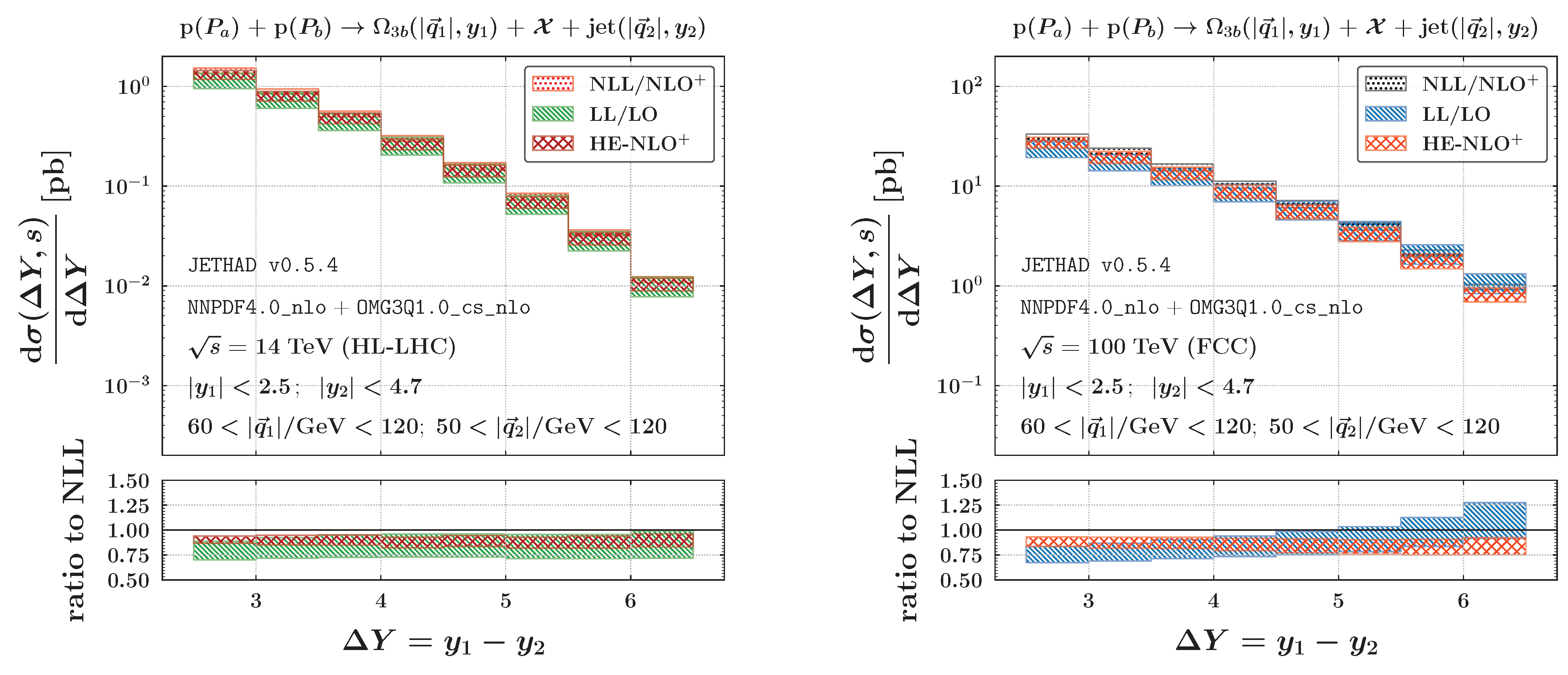
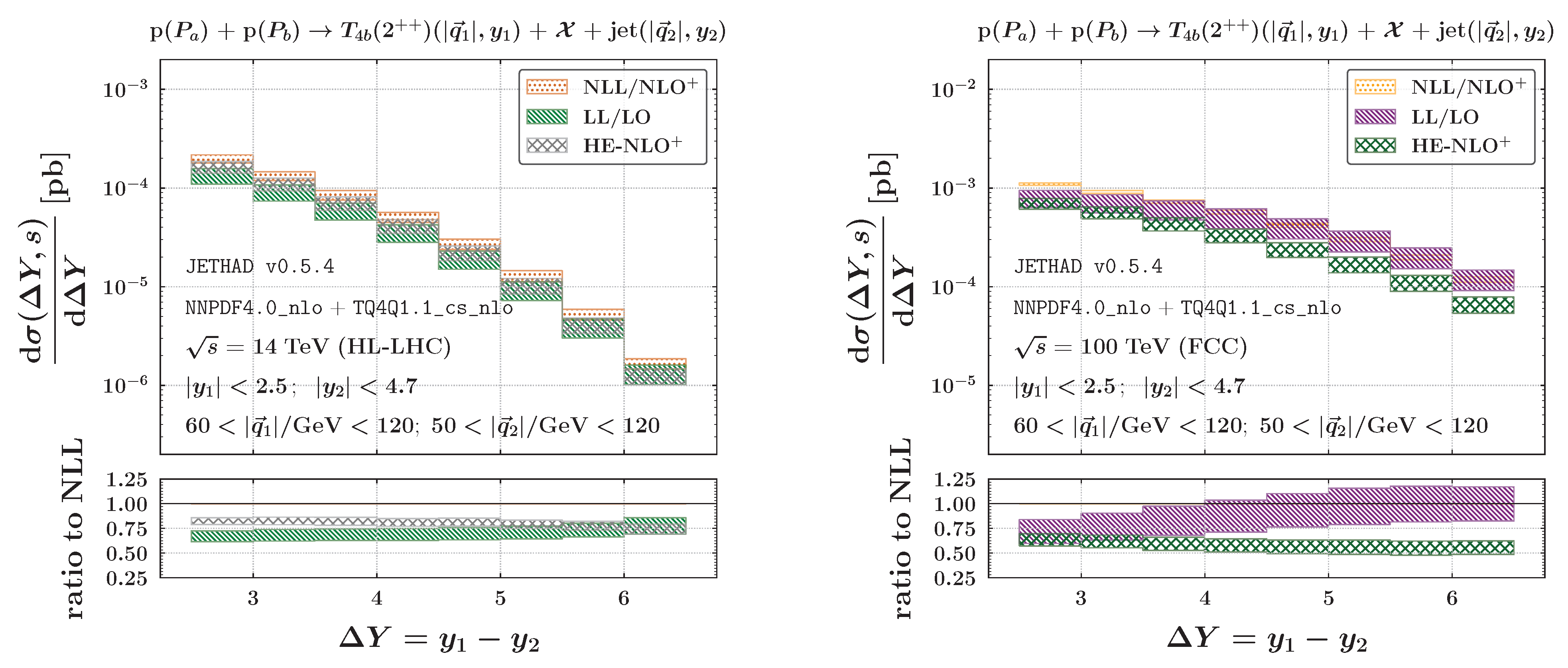
4.4. Rapidity-Differential Distributions
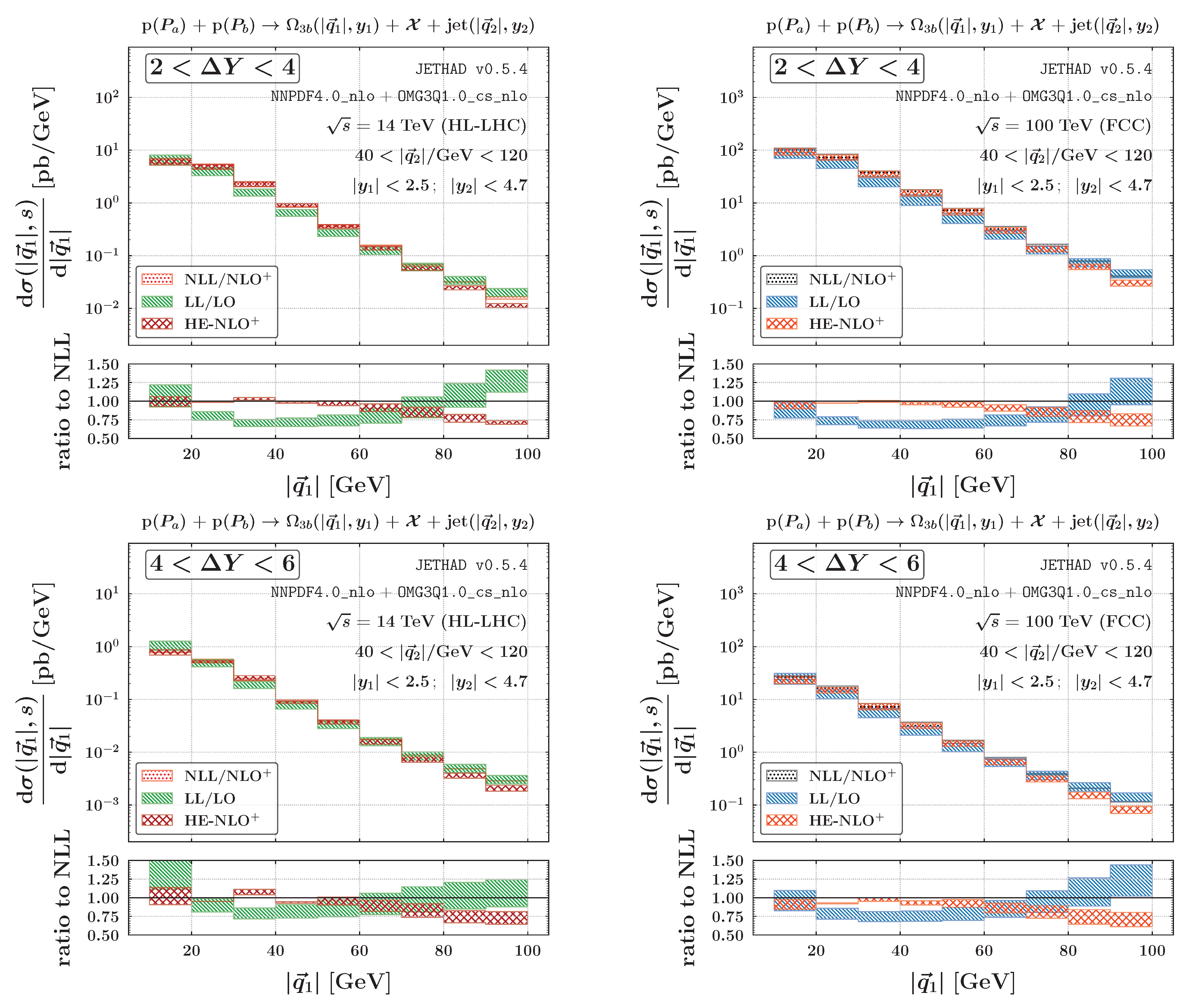
4.5. Transverse-Momentum-Differential Distributions
5. Future Perspectives
Funding
Data Availability Statement
Conflicts of Interest
Acronyms
| ABF | Altarelli–Ball–Forte; |
| BFKL | Balitsky–Fadin–Kuraev–Lipatov; |
| BLM | Brodsky–Lepage–Mackenzie; |
| BSM | Beyond the Standard Model; |
| DGLAP | Dokshitzer–Gribov–Lipatov–Altarelli–Parisi; |
| EIC | Electron-Ion Collider; |
| FCC | Future Circular Collider; |
| FFNS | Fixed-Flavor Number Scheme; |
| FFs | Fragmentation Functions; |
| HF-NRevo | Heavy-Flavor Non-Relativistic Evolution; |
| HL-LHC | High-Luminosity Large Hadron Collider; |
| LL | Leading Logarithmic; |
| MHOUs | Missing Higher-Order Uncertainties; |
| NLL | Next-to-Leading Logarithmic; |
| PDFs | Parton Distribution Functions; |
| PSSZ | Peterson–Schlatter–Schmitt–Zerwas; |
| QCD | Quantum Chromodynamics; |
| SCA | Small-Cone Algorithm; |
| SDC | Short-Distance Coefficient; |
| UGD | Unintegrated Gluon Distribution; |
| VFNS | Variable-Flavor Number Scheme. |
Appendix A. NLO Correction for the Heavy-Hadron Singly Off-Shell Emission Function
Appendix B. NLO Correction for the Light-Jet Singly Off-Shell Emission Function
References
- Apollinari, G.; Brüning, O.; Nakamoto, T.; Rossi, L. High Luminosity Large Hadron Collider HL-LHC. CERN Yellow Rep. 2015, 1–19. [Google Scholar] [CrossRef]
- Apollinari, G.; Bejar Alonso, I.; Bruning, O.; Lamont, M.; Rossi, L. (Eds.) High-Luminosity Large Hadron Collider (HL-LHC): Preliminary Design Report; CERN: Geneva, Switzerland, 2015. [Google Scholar] [CrossRef]
- Apollinari, G.; Bejar Alonso, I.; Bruning, O.; Fessia, P.; Lamont, M.; Rossi, L.; Tavian, L. (Eds.) High-Luminosity Large Hadron Collider (HL-LHC): Technical Design Report V. 0.1; CERN: Geneva, Switzerland, 2017. [Google Scholar] [CrossRef]
- Chapon, E.; d’Enterria, D.; Ducloué, B.; Echevarria, M.G.; Gossiaux, P.-B.; Kartvelishvili, V.; Kasemets, T.; Lansberg, J.-P.; McNulty, R.; Price, D.D.; et al. Prospects for quarkonium studies at the high-luminosity LHC. Prog. Part. Nucl. Phys. 2022, 122, 103906. [Google Scholar] [CrossRef] [Scilit]
- Abdul Khalek, R.; Accardi, A.; Adam, J.; Adamiak, D.; Akers, W.; Albaladejo, M.; Al-bataineh, A.; Alexeev, M.G.; Ameli, F.; Antonioli, P.; et al. Science Requirements and Detector Concepts for the Electron-Ion Collider: EIC Yellow Report. Nucl. Phys. A 2022, 1026, 122447. [Google Scholar] [CrossRef] [Scilit]
- Abdul Khalek, R.; D’Alesio, U.; Arratia, M.; Bacchetta, A.; Battaglieri, M.; Begel, M.; Boglione, M.; Boughezal, R.; Boussarie, R.; Bozzi, G.; et al. Snowmass 2021 White Paper: Electron Ion Collider for High Energy Physics. In Proceedings of the 2022 Snowmass Summer Study, Seattle, WA, USA, 17–26 July 2022. [Google Scholar] [CrossRef] [Scilit]
- Hentschinski, M.; Royon, C.; Peredo, M.A.; Baldenegro, C.; Bellora, A.; Boussarie, R.; Celiberto, F.G.; Cerci, S.; Chachamis, G.; Contreras, J.G.; et al. White Paper on Forward Physics, BFKL, Saturation Physics and Diffraction. Acta Phys. Polon. B 2023, 54, 2. [Google Scholar] [CrossRef] [Scilit]
- Amoroso, S.; Apyan, A.; Armesto, N.; Ball, R.D.; Bertone, V.; Bissolotti, C.; Bluemlein, J.; Boughezal, R.; Bozzi, G.; Britzger, D.; et al. Snowmass 2021 whitepaper: Proton structure at the precision frontier. Acta Phys. Polon. B 2022, 53, A1. [Google Scholar] [CrossRef] [Scilit]
- Abir, R.; Akushevich, I.; Altinoluk, T.; Anderle, D.P.; Aslan, F.P.; Bacchetta, A.; Balantekin, B.; Barata, J.; Battaglieri, M.; Bertulani, C.A.; et al. The case for an EIC Theory Alliance: Theoretical Challenges of the EIC. arXiv 2023, arXiv:2305.14572. [Google Scholar] [CrossRef] [Scilit]
- Allaire, C.; Ammendola, R.; Aschenauer, E.-C.; Balandat, M.; Battaglieri, M.; Bernauer, J.; Bondì, M.; Branson, N.; Britton, T.; Butter, A.; et al. Artificial Intelligence for the Electron Ion Collider (AI4EIC). Comput. Softw. Big Sci. 2024, 8, 5. [Google Scholar] [CrossRef] [Scilit]
- Abada, A.; Abbrescia, M.; AbdusSalam, S.S.; Abdyukhanov, I.; Abelleira Fernandez, J.; Abramov, A.; Aburaia, M.; Acar, A.O.; Adzic, P.R.; Agrawal, P.; et al. FCC Physics Opportunities: Future Circular Collider Conceptual Design Report Volume 1. Eur. Phys. J. C 2019, 79, 474. [Google Scholar] [CrossRef] [Scilit]
- Abada, A.; Abbrescia, M.; AbdusSalam, S.S.; Abdyukhanov, I.; Abelleira Fernandez, J.; Abramov, A.; Aburaia, M.; Acar, A.O.; Adzic, P.R.; Agrawal, P.; et al. FCC-ee: The Lepton Collider: Future Circular Collider Conceptual Design Report Volume 2. Eur. Phys. J. ST 2019, 228, 261–623. [Google Scholar] [CrossRef] [Scilit]
- Abada, A.; Abbrescia, M.; AbdusSalam, S.S.; Abdyukhanov, I.; Abelleira Fernandez, J.; Abramov, A.; Aburaia, M.; Acar, A.O.; Adzic, P.R.; Agrawal, P.; et al. FCC-hh: The Hadron Collider: Future Circular Collider Conceptual Design Report Volume 3. Eur. Phys. J. ST 2019, 228, 755–1107. [Google Scholar] [CrossRef] [Scilit]
- Abada, A.; Abbrescia, M.; AbdusSalam, S.S.; Abdyukhanov, I.; Abelleira Fernandez, J.; Abramov, A.; Aburaia, M.; Acar, A.O.; Adzic, P.R.; Agrawal, P.; et al. HE-LHC: The High-Energy Large Hadron Collider: Future Circular Collider Conceptual Design Report Volume 4. Eur. Phys. J. ST 2019, 228, 1109–1382. [Google Scholar] [CrossRef] [Scilit]
- Benedikt, M.; Zimmermann, F.; Auchmann, B.; Bartmann, W.; Burnet, J.P.; Carli, C.; Chancé, A.; Craievich, P.; Giovannozzi, M.; Grojean, C.; et al. Future Circular Collider Feasibility Study Report: Volume 1, Physics, Experiments, Detectors; CERN Document Server: Geneva, Switzerland, 2025. [Google Scholar] [CrossRef]
- Benedikt, M.; Zimmermann, F.; Auchmann, B.; Bartmann, W.; Burnet, J.P.; Carli, C.; Chancé, A.; Craievich, P.; Giovannozzi, M.; Grojean, C.; et al. Future Circular Collider Feasibility Study Report: Volume 2, Accelerators, Technical Infrastructure and Safety. Eur. Phys. J. Spec. Top. 2025. [Google Scholar] [CrossRef] [Scilit]
- Benedikt, M.; Zimmermann, F.; Auchmann, B.; Bartmann, W.; Burnet, J.P.; Carli, C.; Chancé, A.; Craievich, P.; Giovannozzi, M.; Grojean, C.; et al. Future Circular Collider Feasibility Study Report: Volume 3, Civil Engineering, Implementation and Sustainability. Eur. Phys. J. Spec. Top. 2025, 234, 5113–5383. [Google Scholar] [CrossRef] [Scilit]
- Gell-Mann, M. Symmetries of baryons and mesons. Phys. Rev. 1962, 125, 1067–1084. [Google Scholar] [CrossRef] [Scilit]
- Gell-Mann, M. A Schematic Model of Baryons and Mesons. Phys. Lett. 1964, 8, 214–215. [Google Scholar] [CrossRef] [Scilit]
- Zweig, G. An SU(3) model for strong interaction symmetry and its breaking. Version 2. In Developments in the Quark Theory of Hadrons. VOL. 1. 1964–1978; Lichtenberg, D.B., Rosen, S.P., Eds.; 1964; pp. 22–101. Available online: https://inspirehep.net/literature/4674 (accessed on 17 November 2025).
- Fritzsch, H.; Gell-Mann, M.; Leutwyler, H. Advantages of the Color Octet Gluon Picture. Phys. Lett. B 1973, 47, 365–368. [Google Scholar] [CrossRef] [Scilit]
- Peccei, R.D.; Quinn, H.R. CP Conservation in the Presence of Instantons. Phys. Rev. Lett. 1977, 38, 1440–1443. [Google Scholar] [CrossRef] [Scilit]
- Peccei, R.D.; Quinn, H.R. Constraints Imposed by CP Conservation in the Presence of Instantons. Phys. Rev. D 1977, 16, 1791–1797. [Google Scholar] [CrossRef] [Scilit]
- Peccei, R.D. The Strong CP problem and axions. Lect. Notes Phys. 2008, 741, 3–17. [Google Scholar] [CrossRef] [Scilit]
- Duffy, L.D.; van Bibber, K. Axions as Dark Matter Particles. New J. Phys. 2009, 11, 105008. [Google Scholar] [CrossRef] [Scilit]
- Forestell, L.; Morrissey, D.E.; Sigurdson, K. Cosmological Bounds on Non-Abelian Dark Forces. Phys. Rev. D 2018, 97, 75029. [Google Scholar] [CrossRef] [Scilit]
- Huang, W.C.; Reichert, M.; Sannino, F.; Wang, Z.W. Testing the dark SU(N) Yang-Mills theory confined landscape: From the lattice to gravitational waves. Phys. Rev. D 2021, 104, 35005. [Google Scholar] [CrossRef] [Scilit]
- McLerran, L.; Pisarski, R.D. Phases of cold, dense quarks at large N(c). Nucl. Phys. A 2007, 796, 83–100. [Google Scholar] [CrossRef] [Scilit]
- Hidaka, Y.; McLerran, L.D.; Pisarski, R.D. Baryons and the phase diagram for a large number of colors and flavors. Nucl. Phys. A 2008, 808, 117–123. [Google Scholar] [CrossRef] [Scilit]
- McLerran, L.; Reddy, S. Quarkyonic Matter and Neutron Stars. Phys. Rev. Lett. 2019, 122, 122701. [Google Scholar] [CrossRef] [Scilit]
- Buchmuller, W.; Wyler, D. Effective Lagrangian Analysis of New Interactions and Flavor Conservation. Nucl. Phys. B 1986, 268, 621–653. [Google Scholar] [CrossRef] [Scilit]
- Witten, E. Baryons in the 1/n Expansion. Nucl. Phys. B 1979, 160, 57–115. [Google Scholar] [CrossRef] [Scilit]
- Dudek, J.J.; Edwards, R.G.; Peardon, M.J.; Richards, D.G.; Thomas, C.E. Toward the excited meson spectrum of dynamical QCD. Phys. Rev. D 2010, 82, 34508. [Google Scholar] [CrossRef] [Scilit]
- Afonin, S.S. The effect of higher dimensional QCD operators on the spectroscopy of bottom-up holographic models. Universe 2021, 7, 102. [Google Scholar] [CrossRef] [Scilit]
- Augustin, J.-E.; Boyarski, A.M.; Breidenbach, M.; Bulos, F.; Dakin, J.T.; Feldman, G.J.; Fischer, G.E.; Fryberger, D.; Hanson, G.; Jean-Marie, B.; et al. Discovery of a Narrow Resonance in e+e− Annihilation. Phys. Rev. Lett. 1974, 33, 1406–1408. [Google Scholar] [CrossRef] [Scilit]
- Aubert, J.J.; Becker, U.; Biggs, P.J.; Burger, J.; Chen, M.; Everhart, G.; Goldhagen, P.; Leong, J.; McCorriston, T.; Rohde, M.; et al. Experimental Observation of a Heavy Particle J. Phys. Rev. Lett. 1974, 33, 1404–1406. [Google Scholar] [CrossRef] [Scilit]
- Bacci, C.; Balbini Celio, R.; Berna-Rodini, M.; Caton, G.; del Fabbro, R.; Grilli, M.; Iarocci, E.; Locci, M.; Mencuccini, C.; Murtas, G.P.; et al. Preliminary Result of Frascati (ADONE) on the Nature of a New 3.1-GeV Particle Produced in e+ e- Annihilation. Phys. Rev. Lett. 1974, 33, 1408, Erratum in Phys. Rev. Lett. 1974, 33, 1649.. [Google Scholar] [CrossRef] [Scilit]
- Close, F. Glueballs and exotic matter. Nature 1991, 349, 368–369. [Google Scholar] [CrossRef] [Scilit]
- Close, F.E. Glueballs and hybrids: New states of matter. Contemp. Phys. 1997, 38, 1–12. [Google Scholar] [CrossRef] [Scilit]
- Close, F.E. Glueballs and the pomeron: A central mystery. In Proceedings of the 33rd Rencontres de Moriond: QCD and High-Energy Hadronic Interactions, Les Arcs, France, 21–28 March 1998; pp. 589–602. [Google Scholar]
- Minkowski, P.; Ochs, W. Identification of the glueballs and the scalar meson nonet of lowest mass. Eur. Phys. J. C 1999, 9, 283–312. [Google Scholar] [CrossRef]
- Close, F.E. Glueballs: A Central mystery. Acta Phys. Polon. B 2000, 31, 2557–2565. [Google Scholar] [CrossRef] [Scilit]
- Mathieu, V.; Kochelev, N.; Vento, V. The Physics of Glueballs. Int. J. Mod. Phys. E 2009, 18, 1–49. [Google Scholar] [CrossRef] [Scilit]
- Hsiao, Y.K.; Geng, C.Q. Identifying Glueball at 3.02 GeV in Baryonic B Decays. Phys. Lett. B 2013, 727, 168–171. [Google Scholar] [CrossRef] [Scilit]
- Abazov, V.M.; Abbott, B.; Acharya, B.S.; Adams, M.; Adams, T.; Agnew, J.P.; Alexeev, G.D.; Alkhazov, G.; Alton, A.; Alves, G.A.; et al. Odderon Exchange from Elastic Scattering Differences between pp and Data at 1.96 TeV and from pp Forward Scattering Measurements. Phys. Rev. Lett. 2021, 127, 62003. [Google Scholar] [CrossRef] [Scilit]
- Csörgő, T.; Novak, T.; Pasechnik, R.; Ster, A.; Szanyi, I. Evidence of Odderon-exchange from scaling properties of elastic scattering at TeV energies. Eur. Phys. J. C 2021, 81, 180. [Google Scholar] [CrossRef] [Scilit]
- Jaffe, R.L. Multi-Quark Hadrons. 1. The Phenomenology of (2 Quark 2 anti-Quark) Mesons. Phys. Rev. D 1977, 15, 267. [Google Scholar] [CrossRef] [Scilit]
- Jaffe, R.L. Multi-Quark Hadrons. 2. Methods. Phys. Rev. D 1977, 15, 281. [Google Scholar] [CrossRef] [Scilit]
- Ader, J.P.; Richard, J.M.; Taxil, P. Do Narrow Heavy Multi—Quark States Exist? Phys. Rev. D 1982, 25, 2370. [Google Scholar] [CrossRef] [Scilit]
- Choi, S.-K.; Olsen, S.L.; Abe, K.; Abe, T.; Adachi, I.; Ahn, B.S.; Aihara, H.; Akai, K.; Akatsu, M.; Akemoto, M.; et al. Observation of a narrow charmonium-like state in exclusive B± → K±π+π−J/ψ decays. Phys. Rev. Lett. 2003, 91, 262001. [Google Scholar] [CrossRef] [Scilit] [PubMed]
- Aaij, R.; Abellán Beteta, C.; Ackernley, T.; Adeva, B.; Adinolfi, M.; Afsharnia, H.; Aidala, C.A.; Aiola, S.; Ajaltouni, Z.; Akar, S.; et al. A model-independent study of resonant structure in B+ → D+D−K+ decays. Phys. Rev. Lett. 2020, 125, 242001. [Google Scholar] [CrossRef] [Scilit] [PubMed]
- Bjorken, J.D. Is the ccc a new deal for baryon spectroscopy? AIP Conf. Proc. 1985, 132, 390–403. [Google Scholar] [CrossRef] [Scilit]
- Fleck, S.; Richard, J.M. Baryons with double charm. Prog. Theor. Phys. 1989, 82, 760–774. [Google Scholar] [CrossRef] [Scilit]
- Martynenko, A.P. Ground-state triply and doubly heavy baryons in a relativistic three-quark model. Phys. Lett. B 2008, 663, 317–321. [Google Scholar] [CrossRef] [Scilit]
- Martynenko, A.P.; Trunin, A.M. Relativistic corrections to the pair double heavy diquark production in e+e− annihilation. Phys. Rev. D 2014, 89, 14004. [Google Scholar] [CrossRef] [Scilit]
- Karliner, M.; Rosner, J.L. Baryons with two heavy quarks: Masses, production, decays, and detection. Phys. Rev. D 2014, 90, 94007. [Google Scholar] [CrossRef] [Scilit]
- Yoshida, T.; Hiyama, E.; Hosaka, A.; Oka, M.; Sadato, K. Spectrum of heavy baryons in the quark model. Phys. Rev. D 2015, 92, 114029. [Google Scholar] [CrossRef] [Scilit]
- Ebert, D.; Faustov, R.N.; Galkin, V.O.; Martynenko, A.P. Mass spectra of doubly heavy baryons in the relativistic quark model. Phys. Rev. D 2002, 66, 14008. [Google Scholar] [CrossRef] [Scilit]
- Roberts, W.; Pervin, M. Heavy baryons in a quark model. Int. J. Mod. Phys. A 2008, 23, 2817–2860. [Google Scholar] [CrossRef] [Scilit]
- Chen, Y.Q.; Wu, S.Z. Production of Triply Heavy Baryons at LHC. JHEP 2011, 2011, 144, Erratum in JHEP 2011, 9, 89.. [Google Scholar] [CrossRef] [Scilit]
- Padmanath, M.; Edwards, R.G.; Mathur, N.; Peardon, M. Spectroscopy of triply-charmed baryons from lattice QCD. Phys. Rev. D 2014, 90, 74504. [Google Scholar] [CrossRef] [Scilit]
- Brown, Z.S.; Detmold, W.; Meinel, S.; Orginos, K. Charmed bottom baryon spectroscopy from lattice QCD. Phys. Rev. D 2014, 90, 94507. [Google Scholar] [CrossRef] [Scilit]
- Meinel, S. Excited-state spectroscopy of triply-bottom baryons from lattice QCD. Phys. Rev. D 2012, 85, 114510. [Google Scholar] [CrossRef] [Scilit]
- Flynn, J.M.; Mescia, F.; Tariq, A.S.B. Spectroscopy of doubly charmed baryons in lattice QCD. JHEP 2003, 7, 66. [Google Scholar] [CrossRef] [Scilit]
- Shah, Z.; Thakkar, K.; Rai, A.K. Excited State Mass spectra of doubly heavy baryons Ωcc, Ωbb and Ωbc. Eur. Phys. J. C 2016, 76, 530. [Google Scholar] [CrossRef] [Scilit]
- Shah, Z.; Rai, A.K. Masses and Regge trajectories of triply heavy Ωccc and Ωbbb baryons. Eur. Phys. J. A 2017, 53, 195. [Google Scholar] [CrossRef] [Scilit]
- Bagan, E.; Dosch, H.G.; Gosdzinsky, P.; Narison, S.; Richard, J.M. Hadrons with charm and beauty. Z. Phys. C 1994, 64, 57–72. [Google Scholar] [CrossRef] [Scilit]
- Chang, C.H.; Qiao, C.F.; Wang, J.X.; Wu, X.G. Estimate of the hadronic production of the doubly charmed baryon Xi(cc) under GM-VFN scheme. Phys. Rev. D 2006, 73, 94022. [Google Scholar] [CrossRef] [Scilit]
- Gomshi Nobary, M.A.; Sepahvand, R. An Ivestigation of triply heavy baryon production at hadron colliders. Nucl. Phys. B 2006, 741, 34–41. [Google Scholar] [CrossRef] [Scilit]
- Gershtein, S.S.; Kiselev, V.V.; Likhoded, A.K.; Onishchenko, A.I. Spectroscopy of doubly heavy baryons. Phys. Rev. D 2000, 62, 54021. [Google Scholar] [CrossRef] [Scilit]
- Aaij, R.; Adeva, B.; Adinolfi, M.; Affolder, A.; Ajaltouni, Z.; Akar, S.; Albrecht, J.; Alessio, F.; Alexander, M.; Ali, S.; et al. Observation of J/ψp Resonances Consistent with Pentaquark States in → J/ψK−p Decays. Phys. Rev. Lett. 2015, 115, 72001. [Google Scholar] [CrossRef] [Scilit] [PubMed]
- Aaij, R.; Abellán Beteta, C.; Adeva, B.; Adinolfi, M.; Aidala, C.A.; Ajaltouni, Z.; Akar, S.; Albicocco, P.; Albrecht, J.; Alessio, F.; et al. Observation of a narrow pentaquark state, Pc(4312)+, and of two-peak structure of the Pc(4450)+. Phys. Rev. Lett. 2019, 122, 222001. [Google Scholar] [CrossRef] [Scilit]
- LHCb Collaboration. Evidence of a J/ψΛ structure and observation of excited Ξ− states in the → J/ψΛK− decay. Sci. Bull. 2021, 66, 1278–1287. [Google Scholar] [CrossRef] [Scilit]
- Brambilla, N.; Eidelman, S.; Hanhart, C.; Nefediev, A.; Shen, C.P.; Thomas, C.E.; Vairo, A.; Yuan, C.Z. The XYZ states: Experimental and theoretical status and perspectives. Phys. Rept. 2020, 873, 1–154. [Google Scholar] [CrossRef] [Scilit]
- Esposito, A.; Pilloni, A.; Polosa, A.D. Multiquark Resonances. Phys. Rept. 2017, 668, 1–97. [Google Scholar] [CrossRef] [Scilit]
- Lebed, R.F.; Mitchell, R.E.; Swanson, E.S. Heavy-Quark QCD Exotica. Prog. Part. Nucl. Phys. 2017, 93, 143–194. [Google Scholar] [CrossRef] [Scilit]
- Faustov, R.N.; Galkin, V.O. Triply heavy baryon spectroscopy in the relativistic quark model. Phys. Rev. D 2022, 105, 14013. [Google Scholar] [CrossRef] [Scilit]
- Mathur, N.; Padmanath, M. Lattice QCD study of doubly-charmed strange baryons. Phys. Rev. D 2019, 99, 31501. [Google Scholar] [CrossRef] [Scilit]
- Francis, A.; Hudspith, R.J.; Lewis, R.; Maltman, K. Evidence for charm-bottom tetraquarks and the mass dependence of heavy-light tetraquark states from lattice QCD. Phys. Rev. D 2019, 99, 54505. [Google Scholar] [CrossRef] [Scilit]
- Eichten, E.J.; Quigg, C. Mesons with beauty and charm: Spectroscopy. Phys. Rev. D 1994, 49, 5845–5856. [Google Scholar] [CrossRef] [Scilit]
- Godfrey, S.; Isgur, N. Mesons in a Relativized Quark Model with Chromodynamics. Phys. Rev. D 1985, 32, 189–231. [Google Scholar] [CrossRef] [Scilit]
- Ali, A.; Lange, J.S.; Stone, S. Exotics: Heavy Pentaquarks and Tetraquarks. Prog. Part. Nucl. Phys. 2017, 97, 123–198. [Google Scholar] [CrossRef] [Scilit]
- Aaij, R.; Beteta, C.A.; Ackernley, T.; Adeva, B.; Adinolfi, M.; Afsharnia, H.; Aidala, C.A.; Aiola, S.; Ajaltouni, Z.; Akar, S.; et al. Observation of structure in the J/ψ -pair mass spectrum. Sci. Bull. 2020, 65, 1983–1993. [Google Scholar] [CrossRef] [Scilit]
- Karliner, M.; Rosner, J.L. First exotic hadron with open heavy flavor: tetraquark. Phys. Rev. D 2020, 102, 94016. [Google Scholar] [CrossRef] [Scilit]
- Pineda, A. Review of Heavy Quarkonium at weak coupling. Prog. Part. Nucl. Phys. 2012, 67, 735–785. [Google Scholar] [CrossRef] [Scilit]
- Celiberto, F.G.; Gatto, G.; Papa, A. Fully charmed tetraquarks from LHC to FCC: Natural stability from fragmentation. Eur. Phys. J. C 2024, 84, 1071. [Google Scholar] [CrossRef] [Scilit]
- Celiberto, F.G.; Gatto, G. Bottomoniumlike states in proton collisions: Fragmentation and resummation. Phys. Rev. D 2025, 111, 34037. [Google Scholar] [CrossRef] [Scilit]
- Celiberto, F.G. Fragmentation functions for axial-vector heavy tetraquarks: A TQ4Q1.1 update. Phys. Rev. D 2025, 111, L111501. [Google Scholar] [CrossRef] [Scilit]
- Celiberto, F.G. Fragmentation of fully heavy tetraquarks: The TQ4Q1.1 functions as a case study. Phys. Rev. D 2025, 112, 74041. [Google Scholar] [CrossRef] [Scilit]
- Celiberto, F.G.; Giannini, A.V.; Gonçalves, V.P.; Lima, Y.N. Fully charmed tetraquark production in forward rapidity pp collisions at LHC and FCC energies. arXiv 2025, arXiv:2511.18984. [Google Scholar] [CrossRef] [Scilit]
- Llanes-Estrada, F.J.; Pavlova, O.I.; Williams, R. A First Estimate of Triply Heavy Baryon Masses from the pNRQCD Perturbative Static Potential. Eur. Phys. J. C 2012, 72, 2019. [Google Scholar] [CrossRef] [Scilit]
- Wei, K.W.; Chen, B.; Liu, N.; Wang, Q.Q.; Guo, X.H. Spectroscopy of singly, doubly, and triply bottom baryons. Phys. Rev. D 2017, 95, 116005. [Google Scholar] [CrossRef] [Scilit]
- Yang, G.; Ping, J.; Ortega, P.G.; Segovia, J. Triply heavy baryons in the constituent quark model. Chin. Phys. C 2020, 44, 23102. [Google Scholar] [CrossRef] [Scilit]
- Gómez-Rocha, M.; More, J.; Serafin, K. Baryon Masses Estimate in Heavy Flavor QCD: An Effective Particle Approach to Hadron Spectra. Few Body Syst. 2023, 64, 44. [Google Scholar] [CrossRef] [Scilit]
- Najjar, Z.R.; Azizi, K.; Moshfegh, H.R. Properties of the ground and excited states of triply heavy spin-1/2 baryons. Eur. Phys. J. C 2024, 84, 612. [Google Scholar] [CrossRef] [Scilit]
- de Arenaza, N.M.; Gálvez-Viruet, J.J.; Llanes-Estrada, F.J. Triply-heavy/strange baryons with Cornell potential on a quantum computer. arXiv 2024, arXiv:2407.07232. [Google Scholar] [CrossRef] [Scilit]
- Abe, T.; Adachi, I.; Adamczyk, K.; Ahn, S.; Aihara, H.; Akai, K.; Aloi, M.; Andricek, L.; Aoki, K.; Arai, Y.; et al. Belle II Technical Design Report. arXiv 2010, arXiv:1011.0352. [Google Scholar] [CrossRef] [Scilit]
- Aaboud, M.; Aad, G.; Abbott, B.; Abdallah, J.; Abdinov, O.; Abeloos, B.; Aben, R.; AbouZeid, O.S.; Abraham, N.L.; Abramowicz, H.; et al. Search for new phenomena in final states with an energetic jet and large missing transverse momentum in pp collisions at = 13 TeV using the ATLAS detector. Phys. Rev. D 2016, 94, 32005. [Google Scholar] [CrossRef] [Scilit]
- Hayrapetyan, A.; Tumasyan, A.; Adam, W.; Andrejkovic, J.W.; Benato, L.; Bergauer, T.; Chatterjee, S.; Damanakis, K.; Dragicevic, M.; Hussain, P.S.; et al. Performance of the CMS high-level trigger during LHC Run 2. JINST 2024, 19, P11021. [Google Scholar] [CrossRef] [Scilit]
- The LHCb Collaboration; Aaij, R.; Beteta, C.A.; Ackernley, T.; Adeva, B.; Adinolfi, M.; Afsharnia, H.; Aidala, C.A.; Aiola, S.; Ajaltouni, Z.; et al. Measurement of differential - and -dijet cross-sections in the forward region of pp collisions at = 13 TeV. JHEP 2021, 2, 23. [Google Scholar] [CrossRef] [Scilit]
- Braaten, E.; Cheung, K.; Fleming, S.; Yuan, T.C. Perturbative QCD fragmentation functions as a model for heavy quark fragmentation. Phys. Rev. D 1995, 51, 4819–4829. [Google Scholar] [CrossRef] [Scilit]
- Braaten, E.; Yuan, T.C. Gluon fragmentation into heavy quarkonium. Phys. Rev. Lett. 1993, 71, 1673–1676. [Google Scholar] [CrossRef] [Scilit]
- Braaten, E.; Cheung, K.; Yuan, T.C. Z0 decay into charmonium via charm quark fragmentation. Phys. Rev. D 1993, 48, 4230–4235. [Google Scholar] [CrossRef] [Scilit]
- Braaten, E.; Doncheski, M.A.; Fleming, S.; Mangano, M.L. Fragmentation production of J/ψ and ψ′ at the Tevatron. Phys. Lett. B 1994, 333, 548–554. [Google Scholar] [CrossRef] [Scilit]
- Braaten, E.; Cheung, K.; Yuan, T.C. Perturbative QCD fragmentation functions for Bc and Bc * production. Phys. Rev. D 1993, 48, R5049. [Google Scholar] [CrossRef] [Scilit]
- Kiselev, V.V.; Likhoded, A.K.; Shevlyagin, M.V. Double charmed baryon production at B factory. Phys. Lett. B 1994, 332, 411–414. [Google Scholar] [CrossRef] [Scilit]
- Anselmino, M.; Predazzi, E.; Ekelin, S.; Fredriksson, S.; Lichtenberg, D.B. Diquarks. Rev. Mod. Phys. 1993, 65, 1199–1234. [Google Scholar] [CrossRef] [Scilit]
- Ebert, D.; Feldmann, T.; Kettner, C.; Reinhardt, H. A Diquark model for baryons containing one heavy quark. Z. Phys. C 1996, 71, 329–336. [Google Scholar] [CrossRef] [Scilit]
- Moosavi Nejad, S.M.; Sartipi Yarahmadi, P. Heavy quark fragmentation functions at next-to-leading perturbative QCD. Eur. Phys. J. A 2016, 52, 315. [Google Scholar] [CrossRef] [Scilit]
- Caswell, W.E.; Lepage, G.P. Effective Lagrangians for Bound State Problems in QED, QCD, and Other Field Theories. Phys. Lett. B 1986, 167, 437–442. [Google Scholar] [CrossRef] [Scilit]
- Bodwin, G.T.; Braaten, E.; Lepage, G.P. Rigorous QCD analysis of inclusive annihilation and production of heavy quarkonium. Phys. Rev. D 1995, 51, 1125–1171. [Google Scholar] [CrossRef] [Scilit]
- Cho, P.L.; Leibovich, A.K. Color octet quarkonia production. Phys. Rev. D 1996, 53, 150–162. [Google Scholar] [CrossRef] [Scilit]
- Cho, P.L.; Leibovich, A.K. Color octet quarkonia production. II Phys. Rev. D 1996, 53, 6203–6217. [Google Scholar] [CrossRef] [Scilit]
- Bodwin, G.T.; Braaten, E.; Lee, J. Comparison of the color-evaporation model and the NRQCD factorization approach in charmonium production. Phys. Rev. D 2005, 72, 14004. [Google Scholar] [CrossRef] [Scilit]
- Adamov, A.D.; Goldstein, G.R. Fragmentation functions for baryons in a quark–diquark model. Phys. Rev. D 1997, 56, 7381–7391. [Google Scholar] [CrossRef] [Scilit]
- Yang, J.J. Flavor and spin structure of quark fragmentation functions in a diquark model for octet baryons. Phys. Rev. D 2002, 65, 94035. [Google Scholar] [CrossRef] [Scilit]
- Gomshi Nobary, M.A.; Sepahvand, R. Fragmentation of triply heavy baryons. Phys. Rev. D 2005, 71, 34024. [Google Scholar] [CrossRef] [Scilit]
- Moosavi Nejad, S.M.; Delpasand, M. Polarized heavy baryon production in quark-diquark model considering two different scenarios. Eur. Phys. J. A 2017, 53, 174. [Google Scholar] [CrossRef] [Scilit]
- Moosavi Nejad, S.M. NLO QCD corrections to triply heavy baryon fragmentation function considering the effect of nonperturbative dynamics of baryon bound states. Phys. Rev. D 2017, 96, 114021. [Google Scholar] [CrossRef] [Scilit]
- Delpasand, M.; Moosavi Nejad, S.M. Gluon fragmentation into triply heavy baryons considering two various scenarios. Phys. Rev. D 2019, 99, 114028. [Google Scholar] [CrossRef] [Scilit]
- Cacciari, M.; Greco, M. Large pT hadroproduction of heavy quarks. Nucl. Phys. B 1994, 421, 530–544. [Google Scholar] [CrossRef] [Scilit]
- Buza, M.; Matiounine, Y.; Smith, J.; van Neerven, W.L. Charm electroproduction viewed in the variable flavor number scheme versus fixed order perturbation theory. Eur. Phys. J. C 1998, 1, 301–320. [Google Scholar] [CrossRef]
- Cacciari, M.; Catani, S. Soft gluon resummation for the fragmentation of light and heavy quarks at large x. Nucl. Phys. B 2001, 617, 253–290. [Google Scholar] [CrossRef] [Scilit]
- Mitov, A.; Moch, S.O. QCD Corrections to Semi-Inclusive Hadron Production in Electron-Positron Annihilation at Two Loops. Nucl. Phys. B 2006, 751, 18–52. [Google Scholar] [CrossRef] [Scilit]
- An, H.T.; Zhou, Q.S.; Liu, Z.W.; Liu, Y.R.; Liu, X. Exotic pentaquark states with the configuration. Phys. Rev. D 2019, 100, 56004. [Google Scholar] [CrossRef] [Scilit]
- Ortiz-Pacheco, E.; Bijker, R. Masses and radiative decay widths of S- and P-wave singly, doubly, and triply heavy charm and bottom baryons. Phys. Rev. D 2023, 108, 54014. [Google Scholar] [CrossRef] [Scilit]
- Liu, C.L.; Zhang, W.X.; Jia, D. Masses and decays of triply-heavy pentaquarks*. Chin. Phys. C 2024, 48, 103110. [Google Scholar] [CrossRef] [Scilit]
- Chen, H.X.; Chen, W.; Liu, X.; Zhu, S.L. The hidden-charm pentaquark and tetraquark states. Phys. Rept. 2016, 639, 1–121. [Google Scholar] [CrossRef] [Scilit]
- Wang, W.; Xu, J. Weak Decays of Triply Heavy Baryons. Phys. Rev. D 2018, 97, 93007. [Google Scholar] [CrossRef] [Scilit]
- Celiberto, F.G. Unwinding the rare Ω sector: Fragmentation of fully charmed baryons from HL-LHC to FCC. Phys. Rev. D 2025, 112, 74023. [Google Scholar] [CrossRef] [Scilit]
- Celiberto, F.G. OMG3Q1.0: OMeGa baryons with 3 heavy Quarks VFNS FFs. Available online: https://github.com/FGCeliberto/Collinear_FFs/ (accessed on 17 November 2025).
- Celiberto, F.G. Heavy-flavor multimodal fragmentation to S-wave pentacharms at next-generation hadron colliders. Eur. Phys. J. C 2025, 85, 1395. [Google Scholar] [CrossRef] [Scilit]
- Mele, B.; Nason, P. The Fragmentation function for heavy quarks in QCD. Nucl. Phys. B 1991, 361, 626–644, Erratum in Nucl. Phys. B 2017, 921, 841–842. [Google Scholar] [CrossRef] [Scilit]
- Celiberto, F.G.; Lonigro, F. Pseudoscalar heavy-quarkonium hadroproduction from nonrelativistic fragmentation at NLL/NLO+. arXiv 2025, arXiv:2510.10593. [Google Scholar] [CrossRef] [Scilit]
- Celiberto, F.G. Towards Quarkonium Fragmentation from NRQCD in a Variable-Flavor Number Scheme. arXiv 2024, arXiv:2405.08221. [Google Scholar] [CrossRef] [Scilit]
- Celiberto, F.G. Quarkonium fragmentation in a variable-flavor number scheme: Towards NRFF1.0. In Proceedings of the 31st International Workshop on Deep Inelastic Scattering—PoS(DIS2024), Grenoble, France, 8–12 April 2024; p. 168. [Google Scholar] [CrossRef] [Scilit]
- Celiberto, F.G. On the Quarkonium-in-jet Collinear Fragmentation at Moderate-to-large Transverse Momentum. Acta Phys. Polon. Supp. 2025, 18, 1–A22. [Google Scholar] [CrossRef] [Scilit]
- Celiberto, F.G.; Lonigro, F. Heavy-Flavor Fragmentation and Jet Structure from HF-NRevo: Bridging to Heavy-Ion Collisions. In Proceedings of the 2025 European Physical Society Conference on High Energy Physics, Marseille, France, 7–11 July 2025. [Google Scholar] [CrossRef] [Scilit]
- Buckley, A.; Ferrando, J.; Lloyd, S.; Nordström, K.; Page, B.; Rüfenacht, M.; Schönherr, M.; Watt, G. LHAPDF6: Parton density access in the LHC precision era. Eur. Phys. J. C 2015, 75, 132. [Google Scholar] [CrossRef] [Scilit]
- Celiberto, F.G.; Papa, A. Mueller-Navelet jets at the LHC: Hunting data with azimuthal distributions. Phys. Rev. D 2022, 106, 114004. [Google Scholar] [CrossRef] [Scilit]
- Bolognino, A.D.; Celiberto, F.G.; Fucilla, M.; Ivanov, D.Y.; Papa, A. Inclusive production of a heavy-light dijet system in hybrid high-energy and collinear factorization. Phys. Rev. D 2021, 103, 94004. [Google Scholar] [CrossRef] [Scilit]
- Celiberto, F.G.; Fucilla, M. Diffractive semi-hard production of a J/ψ or a Υ from single-parton fragmentation plus a jet in hybrid factorization. Eur. Phys. J. C 2022, 82, 929. [Google Scholar] [CrossRef] [Scilit]
- Wolfram Research, Inc. Mathematica, Version 14.2; Wolfram Research, Inc.: Champaign, IL, USA, 2024.
- Celiberto, F.G. Hunting BFKL in semi-hard reactions at the LHC. Eur. Phys. J. C 2021, 81, 691. [Google Scholar] [CrossRef] [Scilit]
- Celiberto, F.G. High-energy emissions of light mesons plus heavy flavor at the LHC and the Forward Physics Facility. Phys. Rev. D 2022, 105, 114008. [Google Scholar] [CrossRef] [Scilit]
- Celiberto, F.G. Vector Quarkonia at the LHC with JETHAD: A High-Energy Viewpoint. Universe, 2023; 9, 324. [CrossRef] [Scilit]
- Celiberto, F.G. Exotic Tetraquarks at the HL-LHC with JETHAD: A High-Energy Viewpoint. Symmetry 2024, 16, 550. [Google Scholar] [CrossRef] [Scilit]
- Celiberto, F.G. Forward & Far-Forward Heavy Hadrons with JETHAD: A High-Energy Viewpoint. Particles 2024, 7, 502–542. [Google Scholar] [CrossRef] [Scilit]
- Celiberto, F.G. Fully Heavy Pentaquarks with JETHAD: A High-Energy Viewpoint. Symmetry 2025, in press. [Google Scholar]
- Cacciari, M.; Greco, M.; Rolli, S.; Tanzini, A. Charmed mesons fragmentation functions. Phys. Rev. D 1997, 55, 2736–2740. [Google Scholar] [CrossRef] [Scilit]
- Jaffe, R.L.; Randall, L. Heavy quark fragmentation into heavy mesons. Nucl. Phys. B 1994, 412, 79–105. [Google Scholar] [CrossRef] [Scilit]
- Kniehl, B.A.; Kramer, G.; Schienbein, I.; Spiesberger, H. Collinear subtractions in hadroproduction of heavy quarks. Eur. Phys. J. C 2005, 41, 199–212. [Google Scholar] [CrossRef] [Scilit]
- Helenius, I.; Paukkunen, H. Revisiting the D-meson hadroproduction in general-mass variable flavour number scheme. JHEP 2018, 5, 196. [Google Scholar] [CrossRef] [Scilit]
- Helenius, I.; Paukkunen, H. B-meson hadroproduction in the SACOT-mT scheme. JHEP 2023, 7, 54. [Google Scholar] [CrossRef] [Scilit]
- Generet, T. B-Hadron Production at Higher Orders in QCD. Ph.D. Thesis, RWTH Aachen University, Aachen, Germany, 2023. [Google Scholar]
- Mele, B.; Nason, P. Next-to-leading QCD calculation of the heavy quark fragmentation function. Phys. Lett. B 1990, 245, 635–639. [Google Scholar] [CrossRef] [Scilit]
- Rijken, P.J.; van Neerven, W.L. Oαs2 contributions to the longitudinal fragmentation function in e+ e- annihilation. Phys. Lett. B 1996, 386, 422–428. [Google Scholar] [CrossRef] [Scilit]
- Blumlein, J.; Ravindran, V. O Timelike Wilson Coefficients for Parton-Fragmentation Functions in Mellin Space. Nucl. Phys. B 2006, 749, 1–24. [Google Scholar] [CrossRef] [Scilit]
- Melnikov, K.; Mitov, A. Perturbative heavy quark fragmentation function through O(). Phys. Rev. D 2004, 70, 34027. [Google Scholar] [CrossRef] [Scilit]
- Mitov, A. Perturbative heavy quark fragmentation function through O(): Gluon initiated contribution. Phys. Rev. D 2005, 71, 54021. [Google Scholar] [CrossRef] [Scilit]
- Biello, C.; Bonino, L. Time-Like heavy-flavour thresholds for fragmentation functions: The light-quark matching condition at NNLO. Eur. Phys. J. C 2024, 84, 1192. [Google Scholar] [CrossRef] [Scilit]
- Kartvelishvili, V.; Likhoded, A.; Petrov, V. On the Fragmentation Functions of Heavy Quarks Into Hadrons. Phys. Lett. B 1978, 78, 615–617. [Google Scholar] [CrossRef] [Scilit]
- Bowler, M.G. e+e− Production of Heavy Quarks in the String Model. Z. Phys. C 1981, 11, 169. [Google Scholar] [CrossRef] [Scilit]
- Peterson, C.; Schlatter, D.; Schmitt, I.; Zerwas, P.M. Scaling Violations in Inclusive e+ e− Annihilation Spectra. Phys. Rev. D 1983, 27, 105. [Google Scholar] [CrossRef] [Scilit]
- Andersson, B.; Gustafson, G.; Soderberg, B. A General Model for Jet Fragmentation. Z. Phys. C 1983, 20, 317. [Google Scholar] [CrossRef] [Scilit]
- Collins, P.D.B.; Spiller, T.P. The Fragmentation of Heavy Quarks. J. Phys. G 1985, 11, 1289. [Google Scholar] [CrossRef] [Scilit]
- Colangelo, G.; Nason, P. A Theoretical study of the c and b fragmentation function from e+ e- annihilation. Phys. Lett. B 1992, 285, 167–171. [Google Scholar] [CrossRef] [Scilit]
- Georgi, H. An Effective Field Theory for Heavy Quarks at Low-energies. Phys. Lett. B 1990, 240, 447–450. [Google Scholar] [CrossRef] [Scilit]
- Eichten, E.; Hill, B.R. An Effective Field Theory for the Calculation of Matrix Elements Involving Heavy Quarks. Phys. Lett. B 1990, 234, 511–516. [Google Scholar] [CrossRef] [Scilit]
- Grinstein, B. Light quark, heavy quark systems. Ann. Rev. Nucl. Part. Sci. 1992, 42, 101–145. [Google Scholar] [CrossRef]
- Neubert, M. Heavy quark symmetry. Phys. Rept. 1994, 245, 259–396. [Google Scholar] [CrossRef] [Scilit]
- Cacciari, M.; Greco, M. D* production from e+ e− to e p collisions in NLO QCD. Phys. Rev. D 1997, 55, 7134–7143. [Google Scholar] [CrossRef] [Scilit]
- Thacker, B.A.; Lepage, G.P. Heavy quark bound states in lattice QCD. Phys. Rev. D 1991, 43, 196–208. [Google Scholar] [CrossRef] [Scilit] [PubMed]
- Leibovich, A.K. Psi-prime polarization due to color octet quarkonia production. Phys. Rev. D 1997, 56, 4412–4415. [Google Scholar] [CrossRef] [Scilit]
- Grinstein, B. A Modern introduction to quarkonium theory. Int. J. Mod. Phys. A 2000, 15, 461–496. [Google Scholar] [CrossRef] [Scilit]
- Krämer, M. Quarkonium production at high-energy colliders. Prog. Part. Nucl. Phys. 2001, 47, 141–201. [Google Scholar] [CrossRef] [Scilit]
- Brambilla, N. Quarkonium Working Group. Heavy Quarkonium Physics; CERN: Geneva, Switzerland, 2004. [Google Scholar] [CrossRef]
- Lansberg, J.P. Quarkonium Production at High-Energy Hadron Colliders: A Systematic Gauge-Invariant Approach to Relativistic Effects of J/ψ, ψ′ and υ Production. Ph.D. Thesis, Liege University, Liège, Belgium, 2005. [Google Scholar] [CrossRef] [Scilit]
- Lansberg, J.P. New Observables in Inclusive Production of Quarkonia. Phys. Rept. 2020, 889, 1–106. [Google Scholar] [CrossRef] [Scilit]
- Alekhin, S.; Blumlein, J.; Klein, S.; Moch, S. The 3, 4, and 5-flavor NNLO Parton from Deep-Inelastic-Scattering Data and at Hadron Colliders. Phys. Rev. D 2010, 81, 14032. [Google Scholar] [CrossRef] [Scilit]
- Fleming, S.; Leibovich, A.K.; Mehen, T.; Rothstein, I.Z. The Systematics of Quarkonium Production at the LHC and Double Parton Fragmentation. Phys. Rev. D 2012, 86, 94012. [Google Scholar] [CrossRef] [Scilit]
- Kang, Z.B.; Ma, Y.Q.; Qiu, J.W.; Sterman, G. Heavy Quarkonium Production at Collider Energies: Factorization and Evolution. Phys. Rev. D 2014, 90, 34006. [Google Scholar] [CrossRef] [Scilit]
- Echevarria, M.G. Proper TMD factorization for quarkonia production: pp → ηc,b as a study case. JHEP 2019, 10, 144. [Google Scholar] [CrossRef] [Scilit]
- Boer, D.; Bor, J.; Maxia, L.; Pisano, C.; Yuan, F. Transverse momentum dependent shape function for J/ψ production in SIDIS. JHEP 2023, 8, 105. [Google Scholar] [CrossRef] [Scilit]
- Zheng, X.C.; Chang, C.H.; Feng, T.F.; Wu, X.G. QCD NLO fragmentation functions for c or quark to Bc or meson and their application. Phys. Rev. D 2019, 100, 34004. [Google Scholar] [CrossRef] [Scilit]
- Zheng, X.C.; Chang, C.H.; Wu, X.G. Fragmentation functions for gluon into Bc or meson. JHEP 2022, 5, 36. [Google Scholar] [CrossRef] [Scilit]
- Celiberto, F.G. The high-energy spectrum of QCD from inclusive emissions of charmed B-mesons. Phys. Lett. B 2022, 835, 137554. [Google Scholar] [CrossRef] [Scilit]
- Celiberto, F.G. High-energy QCD dynamics from bottom flavor fragmentation at the Hi-Lumi LHC. Eur. Phys. J. C 2024, 84, 384. [Google Scholar] [CrossRef] [Scilit]
- Aaij, R.; Adeva, B.; Adinolfi, M.; Affolder, A.; Ajaltouni, Z.; Akar, S.; Albrecht, J.; Alessio, F.; Alexander, M.; Ali, S.; et al. Precision measurement of CP violation in → J/ψK+K− decays. Phys. Rev. Lett. 2015, 114, 41801. [Google Scholar] [CrossRef] [Scilit]
- Aaij, R.; Adeva, B.; Adinolfi, M.; Ajaltouni, Z.; Akar, S.; Albrecht, J.; Alessio, F.; Alexander, M.; Ali, S.; Alkhazov, G.; et al. Measurement of the b-quark production cross-section in 7 and 13 TeV pp collisions. Phys. Rev. Lett. 2017, 118, 52002, Erratum in Phys. Rev. Lett. 2017, 119, 169901.. [Google Scholar] [CrossRef] [Scilit]
- Aad, G.; Abbott, B.; Abeling, K.; Abicht, N.J.; Abidi, S.H.; Aboulhorma, A.; Abramowicz, H.; Abreu, H.; Abulaiti, Y.; Hoffman, A.C.A. Observation of an Excess of Dicharmonium Events in the Four-Muon Final State with the ATLAS Detector. Phys. Rev. Lett. 2023, 131, 151902. [Google Scholar] [CrossRef] [Scilit]
- Hayrapetyan, A.; Tumasyan, A.; Adam, W.; Andrejkovic, J.W.; Bergauer, T.; Chatterjee, S.; Damanakis, K.; Dragicevic, M.; Valle, A.E.D.; Hussain, P.S.; et al. New Structures in the J/ψJ/ψ Mass Spectrum in Proton-Proton Collisions at s=13 TeV. Phys. Rev. Lett. 2024, 132, 111901. [Google Scholar] [CrossRef] [Scilit]
- Zhang, H.F.; Ma, Y.Q. Exploring the di-J/ψ resonances based on \itab initio perturbative QCD. arXiv 2020, arXiv:2009.08376. [Google Scholar] [CrossRef] [Scilit]
- Zhu, R. Fully-heavy tetraquark spectra and production at hadron colliders. Nucl. Phys. B 2021, 966, 115393. [Google Scholar] [CrossRef] [Scilit]
- Feng, F.; Huang, Y.; Jia, Y.; Sang, W.L.; Xiong, X.; Zhang, J.Y. Fragmentation production of fully-charmed tetraquarks at the LHC. Phys. Rev. D 2022, 106, 114029. [Google Scholar] [CrossRef] [Scilit]
- Suzuki, M. Fragmentation of Hadrons from Heavy Quark Partons. Phys. Lett. B 1977, 71, 139–141. [Google Scholar] [CrossRef] [Scilit]
- Suzuki, M. Spin Property of Heavy Hadron in Heavy Quark Fragmentation: A Simple Model. Phys. Rev. D 1986, 33, 676. [Google Scholar] [CrossRef] [Scilit] [PubMed]
- Amiri, F.; Ji, C.R. Perturbative Quantum Chromodynamic Prediction for the Heavy Quark Fragmentation Function. Phys. Lett. B 1987, 195, 593–598. [Google Scholar] [CrossRef] [Scilit]
- Moosavi Nejad, S.M.; Amiri, N. Ground state heavy tetraquark production in heavy quark fragmentation. Phys. Rev. D 2022, 105, 34001. [Google Scholar] [CrossRef] [Scilit]
- Celiberto, F.G.; Papa, A. A high-energy QCD portal to exotic matter: Heavy-light tetraquarks at the HL-LHC. Phys. Lett. B 2024, 848, 138406. [Google Scholar] [CrossRef] [Scilit]
- Bai, X.W.; Feng, F.; Gan, C.M.; Huang, Y.; Sang, W.L.; Zhang, H.F. Producing fully-charmed tetraquarks via charm quark fragmentation in colliders. JHEP 2024, 9, 2. [Google Scholar] [CrossRef] [Scilit]
- Ma, H.H.; Tao, Z.K.; Niu, J.J. Application of fragmentation function to the indirect production of fully charmed tetraquark. Eur. Phys. J. C 2025, 85, 397. [Google Scholar] [CrossRef] [Scilit]
- Nakhaei, H.S.; Boroun, G.R. Analysis of the fragmentation function of gluon at next-to-leading order approximation. Phys. Rev. D 2025, 112, 54039. [Google Scholar] [CrossRef] [Scilit]
- Farashaeian, R.; Moosavi Nejad, S.M. Ground state fully heavy pentaquark production in the pair annihilation process. Eur. Phys. J. A 2024, 60, 65. [Google Scholar] [CrossRef] [Scilit]
- Farashaeian, R.; Moosavi Nejad, S.M. Fragmentation production of S-wave heavy pentaquark in diquark model. Eur. Phys. J. A 2024, 60, 143. [Google Scholar] [CrossRef] [Scilit]
- Maiani, L.; Piccinini, F.; Polosa, A.D.; Riquer, V. Diquark-antidiquarks with hidden or open charm and the nature of X(3872). Phys. Rev. D 2005, 71, 14028. [Google Scholar] [CrossRef] [Scilit]
- Jaffe, R.L.; Wilczek, F. Diquarks and exotic spectroscopy. Phys. Rev. Lett. 2003, 91, 232003. [Google Scholar] [CrossRef] [Scilit]
- Guo, F.K.; Hidalgo-Duque, C.; Nieves, J.; Valderrama, M.P. Heavy-antiquark–diquark symmetry and heavy hadron molecules: Are there triply heavy pentaquarks? Phys. Rev. D 2013, 88, 54014. [Google Scholar] [CrossRef] [Scilit]
- De Sanctis, M.; Ferretti, J.; Magaña Vsevolodovna, R.; Saracco, P.; Santopinto, E. An interacting quark-diquark model. Strange and nonstrange baryon spectroscopy and other observables. Few Body Syst. 2016, 57, 1177–1184. [Google Scholar] [CrossRef] [Scilit]
- Bacchetta, A.; Conti, F.; Radici, M. Transverse-momentum distributions in a diquark spectator model. Phys. Rev. 2008, D78, 74010. [Google Scholar] [CrossRef] [Scilit]
- Bacchetta, A.; Radici, M.; Conti, F.; Guagnelli, M. Weighted azimuthal asymmetries in a diquark spectator model. Eur. Phys. J. 2010, A45, 373–388. [Google Scholar] [CrossRef] [Scilit]
- Bacchetta, A.; Celiberto, F.G.; Radici, M.; Taels, P. Transverse-momentum-dependent gluon distribution functions in a spectator model. Eur. Phys. J. C 2020, 80, 733. [Google Scholar] [CrossRef] [Scilit]
- Bacchetta, A.; Celiberto, F.G.; Radici, M. T-odd gluon distribution functions in a spectator model. Eur. Phys. J. C 2024, 84, 576. [Google Scholar] [CrossRef] [Scilit]
- Chakrabarti, D.; Choudhary, P.; Gurjar, B.; Kishore, R.; Maji, T.; Mondal, C.; Mukherjee, A. Gluon distributions in the proton in a light-front spectator model. Phys. Rev. D 2023, 108, 14009. [Google Scholar] [CrossRef] [Scilit]
- Banu, K.; Mukherjee, A.; Pawar, A.; Rajesh, S. Unraveling gluon TMDs in J/ψ and pion production at the EIC. Phys. Rev. D 2024, 110, 54009. [Google Scholar] [CrossRef] [Scilit]
- Nzar, M.; Hoodbhoy, P. Quark fragmentation functions in a diquark model for proton and Lambda hyperon production. Phys. Rev. D 1995, 51, 32–36. [Google Scholar] [CrossRef] [Scilit]
- Ma, B.Q.; Schmidt, I.; Soffer, J.; Yang, J.J. Quark distributions of octet baryons from SU(3) symmetry. Phys. Rev. D 2002, 65, 34004. [Google Scholar] [CrossRef] [Scilit]
- Falk, A.F.; Luke, M.E.; Savage, M.J.; Wise, M.B. Heavy quark fragmentation to baryons containing two heavy quarks. Phys. Rev. D 1994, 49, 555–558. [Google Scholar] [CrossRef] [Scilit] [PubMed]
- Maiani, L.; Polosa, A.D.; Riquer, V. The New Pentaquarks in the Diquark Model. Phys. Lett. B 2015, 749, 289–291. [Google Scholar] [CrossRef] [Scilit]
- Faustov, R.N.; Galkin, V.O.; Savchenko, E.M. Masses of the tetraquarks in the relativistic diquark–antidiquark picture. Phys. Rev. D 2020, 102, 114030. [Google Scholar] [CrossRef] [Scilit]
- Faustov, R.N.; Galkin, V.O.; Savchenko, E.M. Heavy tetraquarks in the relativistic quark model. Universe 2021, 7, 94. [Google Scholar] [CrossRef] [Scilit]
- Faustov, R.N.; Galkin, V.O.; Savchenko, E.M. Fully Heavy Tetraquark Spectroscopy in the Relativistic Quark Model. Symmetry 2022, 14, 2504. [Google Scholar] [CrossRef] [Scilit]
- Martynenko, A.P.; Saleev, V.A. Heavy quark fragmentation into baryons in a quark–diquark model. Phys. Lett. B 1996, 385, 297–303. [Google Scholar] [CrossRef] [Scilit]
- Gomshi Nobary, M.A.; Sepahvand, R. Ground state heavy baryon production in a relativistic quark-diquark model. Phys. Rev. D 2007, 76, 114006. [Google Scholar] [CrossRef] [Scilit]
- Delpasand, M.; Moosavi Nejad, S.M. Ωccc baryon production from gluon in vector diquark fragmentation. Eur. Phys. J. A 2020, 56, 56. [Google Scholar] [CrossRef] [Scilit]
- Lepage, G.P.; Brodsky, S.J. Exclusive Processes in Perturbative Quantum Chromodynamics. Phys. Rev. D 1980, 22, 2157. [Google Scholar] [CrossRef] [Scilit]
- Bjorken, J.D. Properties of Hadron Distributions in Reactions Containing Very Heavy Quarks. Phys. Rev. D 1978, 17, 171–173. [Google Scholar] [CrossRef] [Scilit]
- Kinoshita, K. A Covariant Parton Model for Heavy Quark Fragmentation. Prog. Theor. Phys. 1986, 75, 84. [Google Scholar] [CrossRef] [Scilit]
- Binosi, D.; Collins, J.; Kaufhold, C.; Theussl, L. JaxoDraw: A Graphical user interface for drawing Feynman diagrams. Version 2.0 release notes. Comput. Phys. Commun. 2009, 180, 1709–1715. [Google Scholar] [CrossRef] [Scilit]
- Mertig, R.; Bohm, M.; Denner, A. FEYN CALC: Computer algebraic calculation of Feynman amplitudes. Comput. Phys. Commun. 1991, 64, 345–359. [Google Scholar] [CrossRef] [Scilit]
- Shtabovenko, V.; Mertig, R.; Orellana, F. New Developments in FeynCalc 9.0. Comput. Phys. Commun. 2016, 207, 432–444. [Google Scholar] [CrossRef] [Scilit]
- Shtabovenko, V.; Mertig, R.; Orellana, F. FeynCalc 9.3: New features and improvements. Comput. Phys. Commun. 2020, 256, 107478. [Google Scholar] [CrossRef] [Scilit]
- Zyla, P.A.; Barnett, R.M.; Beringer, J.; Dahl, O.; Dwyer, D.A.; Groom, D.E.; Lin, C.-J.; Lugovsky, K.S.; Pianori, E.; Robinson, D.J.; et al. Review of Particle Physics. PTEP 2020, 2020, 83C01. [Google Scholar] [CrossRef] [Scilit]
- Gomshi Nobary, M.A. Heavy quark fragmentation functions. J. Phys. G 1994, 20, 65–72. [Google Scholar] [CrossRef] [Scilit]
- Celiberto, F.G.; Ivanov, D.Y.; Murdaca, B.; Papa, A. High energy resummation in dihadron production at the LHC. Phys. Rev. D 2016, 94, 34013. [Google Scholar] [CrossRef] [Scilit]
- Celiberto, F.G.; Ivanov, D.Y.; Murdaca, B.; Papa, A. Dihadron production at the LHC: Full next-to-leading BFKL calculation. Eur. Phys. J. C 2017, 77, 382. [Google Scholar] [CrossRef] [Scilit]
- Bolognino, A.D.; Celiberto, F.G.; Ivanov, D.Y.; Mohammed, M.M.A.; Papa, A. Hadron-jet correlations in high-energy hadronic collisions at the LHC. Eur. Phys. J. C 2018, 78, 772. [Google Scholar] [CrossRef] [Scilit]
- Celiberto, F.G.; Fucilla, M.; Ivanov, D.Y.; Papa, A. High-energy resummation in Λc baryon production. Eur. Phys. J. C 2021, 81, 780. [Google Scholar] [CrossRef] [Scilit]
- Celiberto, F.G.; Fucilla, M.; Ivanov, D.Y.; Mohammed, M.M.A.; Papa, A. Bottom-flavored inclusive emissions in the variable-flavor number scheme: A high-energy analysis. Phys. Rev. D 2021, 104, 114007. [Google Scholar] [CrossRef] [Scilit]
- Bertone, V.; Carrazza, S.; Rojo, J. APFEL: A PDF Evolution Library with QED corrections. Comput. Phys. Commun. 2014, 185, 1647–1668. [Google Scholar] [CrossRef] [Scilit]
- Carrazza, S.; Ferrara, A.; Palazzo, D.; Rojo, J. APFEL Web: A web-based application for the graphical visualization of parton distribution functions. J. Phys. G 2015, 42, 57001. [Google Scholar] [CrossRef] [Scilit]
- Bertone, V. APFEL++: A new PDF evolution library in C++. In Proceedings of the XXV International Workshop on Deep-Inelastic Scattering and Related Subjects—PoS(DIS2017), Birmingham, UK, 3–7 April 2017; p. 201. [Google Scholar] [CrossRef] [Scilit]
- Candido, A.; Hekhorn, F.; Magni, G. EKO: Evolution kernel operators. Eur. Phys. J. C 2022, 82, 976. [Google Scholar] [CrossRef] [Scilit]
- Hekhorn, F.; Magni, G. DGLAP evolution of parton distributions at approximate N3LO. arXiv 2023, arXiv:2306.15294. [Google Scholar] [CrossRef] [Scilit]
- Artoisenet, P.; Braaten, E. Gluon fragmentation into quarkonium at next-to-leading order. JHEP 2015, 4, 121. [Google Scholar] [CrossRef] [Scilit]
- Zhang, P.; Wang, C.Y.; Liu, X.; Ma, Y.Q.; Meng, C.; Chao, K.T. Semi-analytical calculation of gluon fragmentation into1 quarkonia at next-to-leading order. JHEP 2019, 4, 116. [Google Scholar] [CrossRef] [Scilit]
- Zheng, X.C.; Zhang, Z.Y.; Wu, X.G. Fragmentation functions for a quark into a spin-singlet quarkonium: Different flavor case. Phys. Rev. D 2021, 103, 74004. [Google Scholar] [CrossRef] [Scilit]
- Zheng, X.C.; Wu, X.G.; Huang, X.D. NLO fragmentation functions for a quark into a spin-singlet quarkonium: Same flavor case. JHEP 2021, 7, 14. [Google Scholar] [CrossRef] [Scilit]
- Zheng, X.C.; Chang, C.H.; Wu, X.G. NLO fragmentation functions of heavy quarks into heavy quarkonia. Phys. Rev. D 2019, 100, 14005. [Google Scholar] [CrossRef] [Scilit]
- Celiberto, F.G. Emergence of high-energy dynamics from cascade-baryon detections at the LHC. Eur. Phys. J. C 2023, 83, 332. [Google Scholar] [CrossRef] [Scilit]
- Celiberto, F.G. Stabilizing BFKL via Heavy-flavor and NRQCD Fragmentation. Acta Phys. Polon. Supp. 2023, 16, 41. [Google Scholar] [CrossRef] [Scilit]
- Collins, J.C.; Soper, D.E.; Sterman, G.F. Factorization of Hard Processes in QCD. Adv. Ser. Direct. High Energy Phys. 1989, 5, 1–91. [Google Scholar] [CrossRef] [Scilit]
- Sterman, G.F. Partons, factorization and resummation, TASI 95. In Proceedings of the Theoretical Advanced Study Institute in Elementary Particle Physics (TASI 95): QCD and Beyond, Boulder, CO, USA, 4–30 June 1995; pp. 327–408. [Google Scholar] [CrossRef] [Scilit]
- Gribov, L.V.; Levin, E.M.; Ryskin, M.G. Semihard Processes in QCD. Phys. Rept. 1983, 100, 1–150. [Google Scholar] [CrossRef] [Scilit]
- Celiberto, F.G. High-Energy Resummation in Semi-Hard Processes at the LHC. Ph.D. Thesis, Università della Calabria and INFN-Cosenza, Cosenza, Italy, 2017. [Google Scholar] [CrossRef] [Scilit]
- Bolognino, A.D. From Semi-Hard Processes to the Unintegrated Gluon Distribution: A Phenomenological Path in the High-Energy Framework. Ph.D. Thesis, Università della Calabria and INFN-Cosenza, Cosenza, Italy, 2021. [Google Scholar] [CrossRef] [Scilit]
- Mohammed, M.M.A. Hunting Stabilization Effects of the High-Energy Resummation at the LHC. Ph.D. Thesis, Università della Calabria and INFN-Cosenza, Cosenza, Italy, 2022. [Google Scholar] [CrossRef] [Scilit]
- Gatto, G. High-Energy Dynamics of QCD: Theoretical and Phenomenological Results. Ph.D. Thesis, Università della Calabria and INFN-Cosenza, Cosenza, Italy, 2022. [Google Scholar] [CrossRef] [Scilit]
- Fadin, V.S.; Kuraev, E.; Lipatov, L. On the Pomeranchuk Singularity in Asymptotically Free Theories. Phys. Lett. B 1975, 60, 50–52. [Google Scholar] [CrossRef] [Scilit]
- Kuraev, E.A.; Lipatov, L.N.; Fadin, V.S. Multi-Reggeon Processes in the Yang-Mills Theory. Sov. Phys. JETP 1976, 44, 443–450. [Google Scholar]
- Kuraev, E.; Lipatov, L.; Fadin, V.S. The Pomeranchuk Singularity in Nonabelian Gauge Theories. Sov. Phys. JETP 1977, 45, 199–204. [Google Scholar]
- Balitsky, I.; Lipatov, L. The Pomeranchuk Singularity in Quantum Chromodynamics. Sov. J. Nucl. Phys. 1978, 28, 822–829. [Google Scholar]
- Fadin, V.S.; Lipatov, L.N. BFKL pomeron in the next-to-leading approximation. Phys. Lett. B 1998, 429, 127–134. [Google Scholar] [CrossRef] [Scilit]
- Ciafaloni, M.; Camici, G. Energy scale(s) and next-to-leading BFKL equation. Phys. Lett. B 1998, 430, 349–354. [Google Scholar] [CrossRef] [Scilit]
- Fadin, V.S.; Fiore, R.; Papa, A. The Quark part of the nonforward BFKL kernel and the ‘bootstrap’ for the gluon Reggeization. Phys. Rev. D 1999, 60, 74025. [Google Scholar] [CrossRef] [Scilit]
- Fadin, V.S.; Gorbachev, D.A. Nonforward color octet BFKL kernel. JETP Lett. 2000, 71, 222–226. [Google Scholar] [CrossRef] [Scilit]
- Fadin, V.S.; Gorbachev, D.A. Nonforward color-octet kernel of the Balitsky-Fadin-Kuraev-Lipatov equation. Phys. Atom. Nucl. 2000, 63, 2157–2172. [Google Scholar] [CrossRef] [Scilit]
- Fadin, V.S.; Fiore, R. Non-forward BFKL pomeron at next-to-leading order. Phys. Lett. B 2005, 610, 61–66, Erratum in Phys. Lett. B 2005, 621, 320.. [Google Scholar] [CrossRef] [Scilit]
- Fadin, V.S.; Fiore, R. Non-forward NLO BFKL kernel. Phys. Rev. D 2005, 72, 14018. [Google Scholar] [CrossRef] [Scilit]
- Caola, F.; Chakraborty, A.; Gambuti, G.; von Manteuffel, A.; Tancredi, L. Three-Loop Gluon Scattering in QCD and the Gluon Regge Trajectory. Phys. Rev. Lett. 2022, 128, 212001. [Google Scholar] [CrossRef] [Scilit]
- Falcioni, G.; Gardi, E.; Maher, N.; Milloy, C.; Vernazza, L. Disentangling the Regge Cut and Regge Pole in Perturbative QCD. Phys. Rev. Lett. 2022, 128, 132001. [Google Scholar] [CrossRef] [Scilit] [PubMed]
- Del Duca, V.; Marzucca, R.; Verbeek, B. The gluon Regge trajectory at three loops from planar Yang-Mills theory. JHEP 2022, 1, 149. [Google Scholar] [CrossRef] [Scilit]
- Byrne, E.P.; Del Duca, V.; Dixon, L.J.; Gardi, E.; Smillie, J.M. One-loop central-emission vertex for two gluons in N = 4 super Yang-Mills theory. JHEP 2022, 8, 271. [Google Scholar] [CrossRef] [Scilit]
- Fadin, V.S.; Fucilla, M.; Papa, A. One-loop Lipatov vertex in QCD with higher ϵ-accuracy. JHEP 2023, 4, 137. [Google Scholar] [CrossRef] [Scilit]
- Byrne, E.P. One-loop five-parton amplitudes in the NMRK limit. arXiv 2023, arXiv:2312.15051. [Google Scholar] [CrossRef] [Scilit]
- Fadin, V.S.; Fiore, R.; Kotsky, M.I.; Papa, A. The Gluon impact factors. Phys. Rev. D 2000, 61, 94005. [Google Scholar] [CrossRef] [Scilit]
- Fadin, V.S.; Fiore, R.; Kotsky, M.I.; Papa, A. The Quark impact factors. Phys. Rev. D 2000, 61, 94006. [Google Scholar] [CrossRef] [Scilit]
- Bartels, J.; Colferai, D.; Vacca, G.P. The NLO jet vertex for Mueller-Navelet and forward jets: The Quark part. Eur. Phys. J. C 2002, 24, 83–99. [Google Scholar] [CrossRef] [Scilit]
- Bartels, J.; Colferai, D.; Vacca, G.P. The NLO jet vertex for Mueller-Navelet and forward jets: The Gluon part. Eur. Phys. J. C 2003, 29, 235–249. [Google Scholar] [CrossRef] [Scilit]
- Caporale, F.; Ivanov, D.Y.; Murdaca, B.; Papa, A.; Perri, A. The next-to-leading order jet vertex for Mueller-Navelet and forward jets revisited. JHEP 2012, 2, 101. [Google Scholar] [CrossRef] [Scilit]
- Ivanov, D.Y.; Papa, A. The next-to-leading order forward jet vertex in the small-cone approximation. JHEP 2012, 5, 86. [Google Scholar] [CrossRef] [Scilit]
- Colferai, D.; Niccoli, A. The NLO jet vertex in the small-cone approximation for kt and cone algorithms. JHEP 2015, 4, 71. [Google Scholar] [CrossRef] [Scilit]
- Ivanov, D.Y.; Papa, A. Inclusive production of a pair of hadrons separated by a large interval of rapidity in proton collisions. JHEP 2012, 7, 45. [Google Scholar] [CrossRef] [Scilit]
- Ivanov, D.Y.; Kotsky, M.I.; Papa, A. The Impact factor for the virtual photon to light vector meson transition. Eur. Phys. J. C 2004, 38, 195–213. [Google Scholar] [CrossRef] [Scilit]
- Bartels, J.; Gieseke, S.; Qiao, C.F. The γ* → Reggeon vertex in next-to-leading order QCD. Phys. Rev. D Erratum in Phys. Rev. D 2002, 65, 79902.. 2001, 63, 56014. [Google Scholar] [CrossRef] [Scilit]
- Bartels, J.; Gieseke, S.; Kyrieleis, A. The Process + q → (g) + q: Real corrections to the virtual photon impact factor. Phys. Rev. D 2002, 65, 14006. [Google Scholar] [CrossRef] [Scilit]
- Bartels, J.; Colferai, D.; Gieseke, S.; Kyrieleis, A. NLO corrections to the photon impact factor: Combining real and virtual corrections. Phys. Rev. D 2002, 66, 94017. [Google Scholar] [CrossRef] [Scilit]
- Bartels, J.; Kyrieleis, A. NLO corrections to the γ* impact factor: First numerical results for the real corrections to . Phys. Rev. D 2004, 70, 114003. [Google Scholar] [CrossRef] [Scilit]
- Fadin, V.S.; Ivanov, D.Y.; Kotsky, M.I. Photon Reggeon interaction vertices in the NLA. Phys. Atom. Nucl. 2002, 65, 1513–1527. [Google Scholar] [CrossRef] [Scilit]
- Balitsky, I.; Chirilli, G.A. Photon impact factor and kT-factorization for DIS in the next-to-leading order. Phys. Rev. D 2013, 87, 14013. [Google Scholar] [CrossRef] [Scilit]
- Hentschinski, M.; Kutak, K.; van Hameren, A. Forward Higgs production within high energy factorization in the heavy quark limit at next-to-leading order accuracy. Eur. Phys. J. C 2021, 81, 112, Erratum in Eur. Phys. J. C 2021, 81, 262.. [Google Scholar] [CrossRef] [Scilit]
- Celiberto, F.G.; Fucilla, M.; Ivanov, D.Y.; Mohammed, M.M.A.; Papa, A. The next-to-leading order Higgs impact factor in the infinite top-mass limit. JHEP 2022, 8, 92. [Google Scholar] [CrossRef] [Scilit]
- Hentschinski, M. Forward Higgs production at NLO using Lipatov’s high energy effective action. SciPost Phys. Proc. 2022, 8, 136. [Google Scholar] [CrossRef] [Scilit]
- Celiberto, F.G.; Delle Rose, L.; Fucilla, M.; Gatto, G.; Papa, A. The next-to-leading order Higgs impact factor at physical top mass: The real corrections. JHEP 2024, 12, 61. [Google Scholar] [CrossRef] [Scilit]
- Celiberto, F.G.; Delle Rose, L.; Gatto, G.; Papa, A.; Fucilla, M. The Real Corrections to the Higgs Impact Factor at Next-to-leading Order with Finite Top Mass. Acta Phys. Polon. Supp. 2025, 18, 1–A37. [Google Scholar] [CrossRef] [Scilit]
- Del Duca, V.; Falcioni, G. The two-loop Higgs impact factor. JHEP 2025, 7, 18. [Google Scholar] [CrossRef] [Scilit]
- Hentschinski, M.; Salas, C. Forward Drell-Yan plus backward jet as a test of BFKL evolution. In Proceedings of the 20th International Workshop on Deep-Inelastic Scattering and Related Subjects, Bonn, Germany, 26–30 March 2012. [Google Scholar] [CrossRef] [Scilit]
- Motyka, L.; Sadzikowski, M.; Stebel, T. Twist expansion of Drell-Yan structure functions in color dipole approach. JHEP 2015, 5, 87. [Google Scholar] [CrossRef] [Scilit]
- Celiberto, F.G.; Ivanov, D.Y.; Murdaca, B.; Papa, A. High-energy resummation in heavy-quark pair photoproduction. Phys. Lett. B 2018, 777, 141–150. [Google Scholar] [CrossRef] [Scilit]
- Bolognino, A.D.; Celiberto, F.G.; Fucilla, M.; Ivanov, D.Y.; Murdaca, B.; Papa, A. Inclusive production of two rapidity-separated heavy quarks as a probe of BFKL dynamics. In Proceedings of the XXVII International Workshop on Deep-Inelastic Scattering and Related Subjects—PoS(DIS2019), Torino, Italy, 8–12 April 2019; p. 67. [Google Scholar] [CrossRef] [Scilit]
- Bolognino, A.D.; Celiberto, F.G.; Fucilla, M.; Ivanov, D.Y.; Papa, A. High-energy resummation in heavy-quark pair hadroproduction. Eur. Phys. J. C 2019, 79, 939. [Google Scholar] [CrossRef] [Scilit]
- Boussarie, R.; Ducloué, B.; Szymanowski, L.; Wallon, S. Forward J/ψ and very backward jet inclusive production at the LHC. Phys. Rev. D 2018, 97, 14008. [Google Scholar] [CrossRef] [Scilit]
- Boussarie, R.; Ducloué, B.; Szymanowski, L.; Wallon, S. Production of a forward J/psi and a backward jet at the LHC. In Proceedings of the International Conference on the Structure and Interactions of the Photon and 21st International Workshop on Photon-Photon Collisions and International Workshop on High Energy Photon Linear Colliders, Novosibirsk, Russia, 15–19 June 2015. [Google Scholar] [CrossRef] [Scilit]
- Boussarie, R.; Ducloue, B.; Szymanowski, L.; Wallon, S. Production of a forward J/ψ and a backward jet at the LHC. In Proceedings of the XXIV International Workshop on Deep-Inelastic Scattering and Related Subjects—PoS(DIS2016), Hamburg, Germany, 11–15 April 2016; p. 204. [Google Scholar] [CrossRef] [Scilit]
- Boussarie, R.; Ducloué, B.; Szymanowski, L.; Wallon, S. QCD resummation effects in forward J/ψ and very backward jet inclusive production at the LHC. In Proceedings of the XXV International Workshop on Deep-Inelastic Scattering and Related Subjects—PoS(DIS2017), Birmingham, UK, 3–7 April 2017; p. 63. [Google Scholar] [CrossRef] [Scilit]
- Mueller, A.H.; Navelet, H. An Inclusive Minijet Cross-Section and the Bare Pomeron in QCD. Nucl. Phys. B 1987, 282, 727–744. [Google Scholar] [CrossRef] [Scilit]
- Colferai, D.; Schwennsen, F.; Szymanowski, L.; Wallon, S. Mueller Navelet jets at LHC—Complete NLL BFKL calculation. JHEP 2010, 12, 26. [Google Scholar] [CrossRef] [Scilit]
- Ducloué, B.; Szymanowski, L.; Wallon, S. Confronting Mueller-Navelet jets in NLL BFKL with LHC experiments at 7 TeV. JHEP 2013, 5, 96. [Google Scholar] [CrossRef] [Scilit]
- Caporale, F.; Murdaca, B.; Sabio Vera, A.; Salas, C. Scale choice and collinear contributions to Mueller-Navelet jets at LHC energies. Nucl. Phys. B 2013, 875, 134–151. [Google Scholar] [CrossRef] [Scilit]
- Caporale, F.; Ivanov, D.Y.; Murdaca, B.; Papa, A. Brodsky-Lepage-Mackenzie optimal renormalization scale setting for semihard processes. Phys. Rev. D 2015, 91, 114009. [Google Scholar] [CrossRef] [Scilit]
- Ducloué, B.; Szymanowski, L.; Wallon, S. Evaluating the double parton scattering contribution to Mueller-Navelet jets production at the LHC. Phys. Rev. D 2015, 92, 76002. [Google Scholar] [CrossRef] [Scilit]
- Celiberto, F.G.; Ivanov, D.Y.; Murdaca, B.; Papa, A. Mueller–Navelet Jets at LHC: BFKL Versus High-Energy DGLAP. Eur. Phys. J. C 2015, 75, 292. [Google Scholar] [CrossRef] [Scilit]
- Celiberto, F.G.; Ivanov, D.Y.; Murdaca, B.; Papa, A. Mueller–Navelet Jets at the LHC: Discriminating BFKL from DGLAP by Asymmetric Cuts. Acta Phys. Polon. Supp. 2015, 8, 935. [Google Scholar] [CrossRef] [Scilit]
- Celiberto, F.G.; Ivanov, D.Y.; Murdaca, B.; Papa, A. Mueller–Navelet jets at 13 TeV LHC: Dependence on dynamic constraints in the central rapidity region. Eur. Phys. J. C 2016, 76, 224. [Google Scholar] [CrossRef] [Scilit]
- Celiberto, F.G.; Ivanov, D.Y.; Murdaca, B.; Papa, A. BFKL effects and central rapidity dependence in Mueller-Navelet jet production at 13 TeV LHC. In Proceedings of the XXIV International Workshop on Deep-Inelastic Scattering and Related Subjects—PoS(DIS2016), Hamburg, Germany, 11–15 April 2016; p. 176. [Google Scholar] [CrossRef] [Scilit]
- Caporale, F.; Celiberto, F.G.; Chachamis, G.; Gordo Gómez, D.; Sabio Vera, A. Inclusive dijet hadroproduction with a rapidity veto constraint. Nucl. Phys. B 2018, 935, 412–434. [Google Scholar] [CrossRef] [Scilit]
- de León, N.B.; Chachamis, G.; Sabio Vera, A. Multiperipheral final states in crowded twin-jet events at the LHC. Nucl. Phys. B 2021, 971, 115518. [Google Scholar] [CrossRef] [Scilit]
- de León, N.B.; Chachamis, G.; Sabio Vera, A. Average minijet rapidity ratios in Mueller–Navelet jets. Eur. Phys. J. C 2021, 81, 1019. [Google Scholar] [CrossRef] [Scilit]
- Baldenegro, C.; Chachamis, G.; Kampshoff, M.; Klasen, M.; Milhano, G.J.; Royon, C.; Sabio Vera, A. Multijet event shape variables for Mueller-Navelet jet topologies. Phys. Rev. D 2024, 110, 114027. [Google Scholar] [CrossRef] [Scilit]
- Celiberto, F.G.; Ivanov, D.Y.; Murdaca, B.; Papa, A. Dihadron Production at LHC: BFKL Predictions for Cross Sections and Azimuthal Correlations. AIP Conf. Proc. 2017, 1819, 60005. [Google Scholar] [CrossRef] [Scilit]
- Celiberto, F.G.; Ivanov, D.Y.; Murdaca, B.; Papa, A. Inclusive charged light di-hadron production at 7 and 13 TeV LHC in the full NLA BFKL approach. In Proceedings of the 25th Low-x Meeting, Bisceglie, Italy, 12–18 June 2017. [Google Scholar] [CrossRef] [Scilit]
- Celiberto, F.G.; Ivanov, D.Y.; Murdaca, B.; Papa, A. Inclusive dihadron production at the LHC in NLA BFKL. In Proceedings of the 17th Conference on Elastic and Diffractive Scattering, Prague, Czech Republic, 26–30 June 2017. [Google Scholar] [CrossRef] [Scilit]
- Caporale, F.; Chachamis, G.; Murdaca, B.; Sabio Vera, A. Balitsky-Fadin-Kuraev-Lipatov Predictions for Inclusive Three Jet Production at the LHC. Phys. Rev. Lett. 2016, 116, 12001. [Google Scholar] [CrossRef] [Scilit]
- Caporale, F.; Celiberto, F.G.; Chachamis, G.; Sabio Vera, A. Multi-Regge kinematics and azimuthal angle observables for inclusive four-jet production. Eur. Phys. J. C 2016, 76, 165. [Google Scholar] [CrossRef] [Scilit]
- Caporale, F.; Celiberto, F.G.; Chachamis, G.; Gordo Gómez, D.; Sabio Vera, A. BFKL azimuthal imprints in inclusive three-jet production at 7 and 13 TeV. Nucl. Phys. B 2016, 910, 374–386. [Google Scholar] [CrossRef] [Scilit]
- Caporale, F.; Celiberto, F.G.; Chachamis, G.; Sabio Vera, A. Inclusive four-jet production: A study of Multi-Regge kinematics and BFKL observables. In Proceedings of the XXIV International Workshop on Deep-Inelastic Scattering and Related Subjects—PoS(DIS2016), Hamburg, Germany, 11–15 April 2016; p. 177. [Google Scholar] [CrossRef] [Scilit]
- Caporale, F.; Celiberto, F.G.; Chachamis, G.; Gordo Gómez, D.; Sabio Vera, A. Inclusive Four-jet Production at 7 and 13 TeV: Azimuthal Profile in Multi-Regge Kinematics. Eur. Phys. J. C 2017, 77, 5. [Google Scholar] [CrossRef] [Scilit]
- Celiberto, F.G. BFKL phenomenology: Resummation of high-energy logs in semi-hard processes at LHC. Frascati Phys. Ser. 2016, 63, 43–48. [Google Scholar] [CrossRef] [Scilit]
- Caporale, F.; Celiberto, F.G.; Chachamis, G.; Gordo Gómez, D.; Sabio Vera, A. Inclusive three- and four-jet production in multi-Regge kinematics at the LHC. AIP Conf. Proc. 2017, 1819, 60009. [Google Scholar] [CrossRef] [Scilit]
- Caporale, F.; Celiberto, F.G.; Chachamis, G.; Gordo Gomez, D.; Murdaca, B.; Sabio Vera, A. High energy effects in multi-jet production at LHC. In Proceedings of the 24th Low-x Meeting, Gyöngÿos, Hungary, 6–11 June 2017; Volume 5, p. 47. [Google Scholar] [CrossRef] [Scilit]
- Chachamis, G.; Caporale, F.; Celiberto, F.; Gomez Gordo, D.; Sabio Vera, A. Inclusive three jet production at the LHC for 7 and 13 TeV collision energies. In Proceedings of the XXIV International Workshop on Deep-Inelastic Scattering and Related Subjects—PoS(DIS2016), Hamburg, Germany, 11–15 April 2016; p. 178. [Google Scholar] [CrossRef] [Scilit]
- Caporale, F.; Celiberto, F.G.; Chachamis, G.; Gordo Gómez, D.; Sabio Vera, A. Probing the BFKL dynamics in inclusive three jet production at the LHC. EPJ Web Conf. 2017, 164, 7027. [Google Scholar] [CrossRef] [Scilit]
- Caporale, F.; Celiberto, F.G.; Chachamis, G.; Gordo Gómez, D.; Sabio Vera, A. Stability of Azimuthal-angle Observables under Higher Order Corrections in Inclusive Three-jet Production. Phys. Rev. D 2017, 95, 74007. [Google Scholar] [CrossRef] [Scilit]
- Caporale, F.; Celiberto, F.G.; Gordo Gomez, D.; Sabio Vera, A.; Chachamis, G. Multi-jet production in the high energy limit at LHC. In Proceedings of the 25th Low-x Meeting, Bisceglie, Italy, 12–18 June 2017. [Google Scholar] [CrossRef] [Scilit]
- Chachamis, G.; Caporale, F.; Celiberto, F.G.; Gordo Gomez, D.; Sabio Vera, A. Azimuthal-angle Observables in Inclusive Three-jet Production. In Proceedings of the 25th International Workshop on Deep Inelastic Scattering and Related Topics, Birmingham, UK, 3–7 April 2017; p. 67. [Google Scholar] [CrossRef] [Scilit]
- Bolognino, A.D.; Celiberto, F.G.; Ivanov, D.Y.; Mohammed, M.M.A.; Papa, A. High-energy effects in forward inclusive dijet and hadron-jet production. In Proceedings of the XXVII International Workshop on Deep Inelastic Scattering and Related Subjects (DIS2019), Torino, Italy, 8–12 April 2019; p. 49. [Google Scholar] [CrossRef] [Scilit]
- Bolognino, A.D.; Celiberto, F.G.; Ivanov, D.Y.; Mohammed, M.M.A.; Papa, A. Inclusive hadron-jet production at the LHC. Acta Phys. Polon. Supp. 2019, 12, 773. [Google Scholar] [CrossRef] [Scilit]
- Celiberto, F.G.; Ivanov, D.Y.; Papa, A. Diffractive production of Λ hyperons in the high-energy limit of strong interactions. Phys. Rev. D 2020, 102, 94019. [Google Scholar] [CrossRef] [Scilit]
- Celiberto, F.G.; Ivanov, D.Y.; Mohammed, M.M.A.; Papa, A. High-energy resummed distributions for the inclusive Higgs-plus-jet production at the LHC. Eur. Phys. J. C 2021, 81, 293. [Google Scholar] [CrossRef] [Scilit]
- Celiberto, F.G.; Ivanov, D.Y.; Mohammed, M.M.A.; Papa, A. High-energy resummation in inclusive hadroproduction of Higgs plus jet. SciPost Phys. Proc. 2022, 8, 39. [Google Scholar] [CrossRef] [Scilit]
- Celiberto, F.G.; Fucilla, M.; Papa, A.; Ivanov, D.Y.; Mohammed, M.M.A. Higgs-plus-jet inclusive production as stabilizer of the high-energy resummation. In Proceedings of the European Physical Society Conference on High Energy Physics (EPS-HEP2021), Hamburg, Germany, 26–30 July 2021; p. 589. [Google Scholar] [CrossRef] [Scilit]
- Celiberto, F.G.; Fucilla, M.; Ivanov, D.Y.; Mohammed, M.M.A.; Papa, A. Higgs boson production in the high-energy limit of pQCD. In Proceedings of the Particles and Nuclei International Conference (PANIC 2021), Lisbon, Portugal, 5–10 September 2021; p. 352. [Google Scholar] [CrossRef] [Scilit]
- Celiberto, F.G.; Fucilla, M.; Ivanov, D.Y.; Mohammed, M.M.A.; Papa, A. BFKL phenomenology: Resummation of high-energy logs in inclusive processes. SciPost Phys. Proc. 2022, 10, 2. [Google Scholar] [CrossRef] [Scilit]
- Bolognino, A.D.; Celiberto, F.G.; Fucilla, M.; Ivanov, D.Y.; Papa, A. Hybrid high-energy/collinear factorization in a heavy-light dijets system reaction. SciPost Phys. Proc. 2022, 8, 68. [Google Scholar] [CrossRef] [Scilit]
- Bolognino, A.D.; Celiberto, F.G.; Fucilla, M.; Ivanov, D.Y.; Papa, A. Heavy flavored emissions in hybrid collinear/high energy factorization. In Proceedings of the European Physical Society Conference on High Energy Physics (EPS-HEP2021), Hamburg, Germany, 26–30 July 2021; p. 389. [Google Scholar] [CrossRef] [Scilit]
- Bolognino, A.D.; Celiberto, F.G.; Fucilla, M.; Ivanov, D.Y.; Mohammed, M.M.A.; Papa, A. High-energy Signals from Heavy-flavor Physics. Acta Phys. Polon. Supp. 2023, 16, 17. [Google Scholar] [CrossRef] [Scilit]
- Celiberto, F.G.; Fucilla, M.; Papa, A. The high-energy limit of perturbative QCD: Theory and phenomenology. EPJ Web Conf. 2022, 270, 1. [Google Scholar] [CrossRef] [Scilit]
- Celiberto, F.G.; Fucilla, M.; Mohammed, M.M.A.; Papa, A. Ultraforward production of a charmed hadron plus a Higgs boson in unpolarized proton collisions. Phys. Rev. D 2022, 105, 114056. [Google Scholar] [CrossRef] [Scilit]
- Celiberto, F.G.; Fucilla, M. Inclusive J/ψ and Υ emissions from single-parton fragmentation in hybrid high-energy and collinear factorization. In Proceedings of the 29th International Workshop on Deep-Inelastic Scattering and Related Subjects, Santiago de Compostela, Spain, 2–6 May 2022. [Google Scholar] [CrossRef]
- Anikin, I.; Ivanov, D.Y.; Pire, B.; Szymanowski, L.; Wallon, S. QCD factorization of exclusive processes beyond leading twist: → ρT impact factor with twist three accuracy. Nucl. Phys. B 2010, 828, 1–68. [Google Scholar] [CrossRef] [Scilit]
- Anikin, I.; Besse, A.; Ivanov, D.Y.; Pire, B.; Szymanowski, L.; Wallon, S. A phenomenological study of helicity amplitudes of high energy exclusive leptoproduction of the rho meson. Phys. Rev. D 2011, 84, 54004. [Google Scholar] [CrossRef] [Scilit]
- Besse, A.; Szymanowski, L.; Wallon, S. Saturation effects in exclusive rhoT, rhoL meson electroproduction. JHEP 2013, 11, 62. [Google Scholar] [CrossRef] [Scilit]
- Bolognino, A.D.; Celiberto, F.G.; Ivanov, D.Y.; Papa, A. Unintegrated gluon distribution from forward polarized ρ-electroproduction. Eur. Phys. J. 2018, C78, 1023. [Google Scholar] [CrossRef] [Scilit]
- Bolognino, A.D.; Celiberto, F.G.; Ivanov, D.Y.; Papa, A. ρ-meson leptoproduction as testfield for the unintegrated gluon distribution in the proton. Frascati Phys. Ser. 2018, 67, 76–82. [Google Scholar]
- Bolognino, A.D.; Celiberto, F.G.; Ivanov, D.Y.; Papa, A. Leptoproduction of ρ-mesons as discriminator for the unintegrated gluon distribution in the proton. Acta Phys. Polon. Supp. 2019, 12, 891. [Google Scholar] [CrossRef] [Scilit]
- Bolognino, A.D.; Szczurek, A.; Schaefer, W. Exclusive production of ϕ meson in the γ* p → ϕ p reaction at large photon virtualities within kT-factorization approach. Phys. Rev. D 2020, 101, 54041. [Google Scholar] [CrossRef] [Scilit]
- Celiberto, F.G. Unraveling the Unintegrated Gluon Distribution in the Proton via ρ-Meson Leptoproduction. Nuovo Cim. 2019, C42, 220. [Google Scholar] [CrossRef] [Scilit]
- Łuszczak, A.; Łuszczak, M.; Schäfer, W. Unintegrated gluon distributions from the color dipole cross section in the BGK saturation model. Phys. Lett. B 2022, 835, 137582. [Google Scholar] [CrossRef] [Scilit]
- Bolognino, A.D.; Celiberto, F.G.; Ivanov, D.Y.; Papa, A.; Schäfer, W.; Szczurek, A. Exclusive production of ρ-mesons in high-energy factorization at HERA and EIC. Eur. Phys. J. C 2021, 81, 846. [Google Scholar] [CrossRef] [Scilit]
- Bolognino, A.D.; Celiberto, F.G.; Ivanov, D.Y.; Papa, A. Exclusive emissions of rho-mesons and the unintegrated gluon distribution. SciPost Phys. Proc. 2022, 8, 89. [Google Scholar] [CrossRef] [Scilit]
- Bolognino, A.D.; Celiberto, F.G.; Fucilla, M.; Ivanov, D.Y.; Papa, A.; Schäfer, W.; Szczurek, A. Hadron structure at small-x via unintegrated gluon densities. Rev. Mex. Fis. Suppl. 2022, 3, 308109. [Google Scholar] [CrossRef] [Scilit]
- Celiberto, F.G. Phenomenology of the hadronic structure at small-x. arXiv 2022, arXiv:2202.04207. [Google Scholar] [CrossRef] [Scilit]
- Bolognino, A.D.; Celiberto, F.G.; Ivanov, D.Y.; Papa, A.; Schäfer, W.; Szczurek, A. Exclusive emissions of polarized ρ mesons at the EIC and the proton content at low x. In Proceedings of the 29th International Workshop on Deep-Inelastic Scattering and Related Subjects, Santiago de Compostela, Spain, 2–6 May 2022. [Google Scholar] [CrossRef]
- Bautista, I.; Fernandez Tellez, A.; Hentschinski, M. BFKL evolution and the growth with energy of exclusive J/ψ and Υ photoproduction cross sections. Phys. Rev. D 2016, 94, 54002. [Google Scholar] [CrossRef] [Scilit]
- Arroyo Garcia, A.; Hentschinski, M.; Kutak, K. QCD evolution based evidence for the onset of gluon saturation in exclusive photo-production of vector mesons. Phys. Lett. B 2019, 795, 569–575. [Google Scholar] [CrossRef] [Scilit]
- Hentschinski, M.; Padrón Molina, E. Exclusive J/Ψ and Ψ(2s) photo-production as a probe of QCD low x evolution equations. Phys. Rev. D 2021, 103, 74008. [Google Scholar] [CrossRef] [Scilit]
- Peredo, M.A.; Hentschinski, M. Ratio of J/Ψ and Ψ(2s) exclusive photoproduction cross-sections as an indicator for the presence of non-linear QCD evolution. Phys. Rev. D 2024, 109, 14032. [Google Scholar] [CrossRef] [Scilit]
- Hentschinski, M.; Ramírez, R.R. The energy dependence of exclusive heavy vector meson photoproduction cross-sections and NLO BFKL evolution. arXiv 2025, arXiv:2508.11545. [Google Scholar] [CrossRef] [Scilit]
- Brzeminski, D.; Motyka, L.; Sadzikowski, M.; Stebel, T. Twist decomposition of Drell-Yan structure functions: Phenomenological implications. JHEP 2017, 1, 5. [Google Scholar] [CrossRef] [Scilit]
- Motyka, L.; Sadzikowski, M.; Stebel, T. Lam-Tung relation breaking in Z0 hadroproduction as a probe of parton transverse momentum. Phys. Rev. 2017, D95, 114025. [Google Scholar] [CrossRef] [Scilit]
- Celiberto, F.G.; Gordo Gómez, D.; Sabio Vera, A. Forward Drell-Yan production at the LHC in the BFKL formalism with collinear corrections. Phys. Lett. 2018, B786, 201–206. [Google Scholar] [CrossRef] [Scilit]
- Chachamis, G.; Deak, M.; Hentschinski, M.; Rodrigo, G.; Sabio Vera, A. Single bottom quark production in k⊥-factorisation. JHEP 2015, 9, 123. [Google Scholar] [CrossRef] [Scilit]
- Chachamis, G.; Deak, M.; Rodrigo, G. Heavy quark impact factor in kT-factorization. JHEP 2013, 12, 66. [Google Scholar] [CrossRef] [Scilit]
- Chachamis, G.; Hentschinski, M.; Sabio Vera, A.; Salas, C. Exclusive central production of heavy quarks at the LHC. arXiv 2009, arXiv:0911.2662. [Google Scholar] [CrossRef] [Scilit]
- Ball, R.D.; Bertone, V.; Bonvini, M.; Marzani, S.; Rojo, J.; Rottoli, L. Parton distributions with small-x resummation: Evidence for BFKL dynamics in HERA data. Eur. Phys. J. 2018, C78, 321. [Google Scholar] [CrossRef] [Scilit]
- Abdolmaleki, H.; Bertone, V.; Britzger, D.; Camarda, S.; Cooper-Sarkar, A.; Giuli, F.; Glazov, A.; Kusina, A.; Luszczak, A.; Olness, F.; et al. Impact of low-x resummation on QCD analysis of HERA data. Eur. Phys. J. C 2018, 78, 621. [Google Scholar] [CrossRef] [Scilit]
- Bonvini, M.; Giuli, F. A new simple PDF parametrization: Improved description of the HERA data. Eur. Phys. J. Plus 2019, 134, 531. [Google Scholar] [CrossRef] [Scilit]
- Silvetti, F.; Bonvini, M. Differential heavy quark pair production at small x. Eur. Phys. J. C 2023, 83, 267. [Google Scholar] [CrossRef] [Scilit]
- Silvetti, F. Resummation Phenomenology and PDF Determination for Precision QCD at the LHC. Ph.D. Thesis, University of Rome, Rome, Italy, 2023. [Google Scholar] [CrossRef] [Scilit]
- Rinaudo, A. Towards the Resummation of High-Energy Next-to-Leading Logarithms in QCD. Ph.D. Thesis, University of Genoa, Genova, Italy, 2024. [Google Scholar] [CrossRef]
- Celiberto, F.G.; Bonvini, M. Towards Precision Gluon Densities at Small x: From Resummation to Collider Observables. In Proceedings of the 2025 European Physical Society Conference on High Energy Physics, Marseille, France, 7–11 July 2025. [Google Scholar] [CrossRef] [Scilit]
- Celiberto, F.G. 3D tomography of the nucleon: Transverse-momentum-dependent gluon distributions. Nuovo Cim. 2021, C44, 36. [Google Scholar] [CrossRef]
- Bacchetta, A.; Celiberto, F.G.; Radici, M.; Taels, P. A spectator-model way to transverse-momentum-dependent gluon distribution functions. SciPost Phys. Proc. 2022, 8, 40. [Google Scholar] [CrossRef] [Scilit]
- Bacchetta, A.; Celiberto, F.G.; Radici, M. Toward twist-2 T-odd transverse-momentum-dependent gluon distributions: The f -type Sivers function. In Proceedings of the European Physical Society Conference on High Energy Physics (EPS-HEP2021), Hamburg, Germany, 26–30 July 2021; p. 376. [Google Scholar] [CrossRef] [Scilit]
- Bacchetta, A.; Celiberto, F.G.; Radici, M. Toward twist-2 T-odd transverse-momentum-dependent gluon distributions: The f -type linearity function. In Proceedings of the 22nd Particles and Nuclei International Conference (PANIC2021), Lisbon, Portugal, 5–10 September 2021; p. 378. [Google Scholar] [CrossRef] [Scilit]
- Bacchetta, A.; Celiberto, F.G.; Radici, M. Towards Leading-twist T-odd TMD Gluon Distributions. JPS Conf. Proc. 2022, 37, 20124. [Google Scholar] [CrossRef] [Scilit]
- Bacchetta, A.; Celiberto, F.G.; Radici, M. Unveiling the proton structure via transverse-momentum-dependent gluon distributions. Rev. Mex. Fis. Suppl. 2022, 3, 308108. [Google Scholar] [CrossRef] [Scilit]
- Bacchetta, A.; Celiberto, F.G.; Radici, M.; Signori, A. Phenomenology of gluon TMDs from ηb,c production. In Proceedings of the 29th International Workshop on Deep-Inelastic Scattering and Related Subjects, Santiago de Compostela, Spain, 2–6 May 2022. [Google Scholar] [CrossRef]
- Celiberto, F.G. A Journey into the Proton Structure: Progresses and Challenges. Universe 2022, 8, 661. [Google Scholar] [CrossRef] [Scilit]
- Bacchetta, A.; Celiberto, F.G.; Radici, M. Spectator-model studies for spin-dependent gluon TMD PDFs at the LHC and EIC. In Proceedings of the European Physical Society Conference on High Energy Physics (EPS-HEP) 2023, Hamburg, Germany, 20–25 August 2023; p. 247. [Google Scholar] [CrossRef] [Scilit]
- Bacchetta, A.; Celiberto, F.G.; Radici, M. Proton 3D reconstruction with T-odd TMD gluon densities. In Proceedings of the 25th International Spin Physics Symposium (SPIN 2023), Durham, NC, USA, 24–29 September 2023; p. 49. [Google Scholar] [CrossRef] [Scilit]
- Hentschinski, M. Transverse momentum dependent gluon distribution within high energy factorization at next-to-leading order. Phys. Rev. D 2021, 104, 54014. [Google Scholar] [CrossRef] [Scilit]
- Mukherjee, S.; Skokov, V.V.; Tarasov, A.; Tiwari, S. Unified description of DGLAP, CSS, and BFKL evolution: TMD factorization bridging large and small x. Phys. Rev. D 2024, 109, 34035. [Google Scholar] [CrossRef] [Scilit]
- Boroun, G.R. Dipole cross section from the unintegrated gluon distribution at small x. Phys. Rev. D 2023, 108, 34025. [Google Scholar] [CrossRef] [Scilit]
- Boroun, G.R. The unintegrated gluon distribution from the GBW and BGK models. Eur. Phys. J. A 2024, 60, 48. [Google Scholar] [CrossRef] [Scilit]
- Bonvini, M.; Marzani, S. Double resummation for Higgs production. Phys. Rev. Lett. 2018, 120, 202003. [Google Scholar] [CrossRef] [Scilit]
- Ball, R.D.; Forte, S. Summation of leading logarithms at small x. Phys. Lett. B 1995, 351, 313–324. [Google Scholar] [CrossRef] [Scilit]
- Ball, R.D.; Forte, S. Asymptotically free partons at high-energy. Phys. Lett. B 1997, 405, 317–326. [Google Scholar] [CrossRef] [Scilit]
- Altarelli, G.; Ball, R.D.; Forte, S. Factorization and resummation of small x scaling violations with running coupling. Nucl. Phys. B 2002, 621, 359–387. [Google Scholar] [CrossRef] [Scilit]
- Altarelli, G.; Ball, R.D.; Forte, S. An Anomalous dimension for small x evolution. Nucl. Phys. B 2003, 674, 459–483. [Google Scholar] [CrossRef] [Scilit]
- Altarelli, G.; Ball, R.D.; Forte, S. Perturbatively stable resummed small x evolution kernels. Nucl. Phys. B 2006, 742, 1–40. [Google Scholar] [CrossRef] [Scilit]
- Altarelli, G.; Ball, R.D.; Forte, S. Small x Resummation with Quarks: Deep-Inelastic Scattering. Nucl. Phys. B 2008, 799, 199–240. [Google Scholar] [CrossRef] [Scilit]
- White, C.; Thorne, R. A Global Fit to Scattering Data with NLL BFKL Resummations. Phys. Rev. D 2007, 75, 34005. [Google Scholar] [CrossRef] [Scilit]
- Catani, S.; Ciafaloni, M.; Hautmann, F. Gluon Contributions to Small x Heavy Flavor Production. Phys. Lett. B 1990, 242, 97–102. [Google Scholar] [CrossRef] [Scilit]
- Catani, S.; Ciafaloni, M.; Hautmann, F. High-energy factorization and small x heavy flavor production. Nucl. Phys. B 1991, 366, 135–188. [Google Scholar] [CrossRef] [Scilit]
- Collins, J.C.; Ellis, R. Heavy quark production in very high-energy hadron collisions. Nucl. Phys. B 1991, 360, 3–30. [Google Scholar] [CrossRef] [Scilit]
- Catani, S.; Ciafaloni, M.; Hautmann, F. High-energy factorization in QCD and minimal subtraction scheme. Phys. Lett. B 1993, 307, 147–153. [Google Scholar] [CrossRef] [Scilit]
- Catani, S.; Hautmann, F. Quark anomalous dimensions at small x. Phys. Lett. B 1993, 315, 157–163. [Google Scholar] [CrossRef] [Scilit]
- Catani, S.; Hautmann, F. High-energy factorization and small x deep inelastic scattering beyond leading order. Nucl. Phys. B 1994, 427, 475–524. [Google Scholar] [CrossRef] [Scilit]
- Ball, R.D. Resummation of Hadroproduction Cross-sections at High Energy. Nucl. Phys. B 2008, 796, 137–183. [Google Scholar] [CrossRef] [Scilit]
- Caola, F.; Forte, S.; Marzani, S. Small x resummation of rapidity distributions: The Case of Higgs production. Nucl. Phys. B 2011, 846, 167–211. [Google Scholar] [CrossRef] [Scilit]
- Brodsky, S.J.; Hautmann, F.; Soper, D.E. Probing the QCD pomeron in e+ e- collisions. Phys. Rev. Lett. 1997, 78, 803–806, Erratum in Phys. Rev. Lett. 1997, 79, 3544.. [Google Scholar] [CrossRef] [Scilit]
- Brodsky, S.J.; Hautmann, F.; Soper, D.E. Virtual photon scattering at high-energies as a probe of the short distance pomeron. Phys. Rev. D 1997, 56, 6957–6979. [Google Scholar] [CrossRef] [Scilit]
- Brodsky, S.J.; Fadin, V.S.; Kim, V.T.; Lipatov, L.N.; Pivovarov, G.B. The QCD pomeron with optimal renormalization. JETP Lett. 1999, 70, 155–160. [Google Scholar] [CrossRef] [Scilit]
- Brodsky, S.J.; Fadin, V.S.; Kim, V.T.; Lipatov, L.N.; Pivovarov, G.B. High-energy QCD asymptotics of photon-photon collisions. JETP Lett. 2002, 76, 249–252. [Google Scholar] [CrossRef] [Scilit]
- Celiberto, F.G.; Papa, A. The high-energy QCD dynamics from Higgs-plus-jet correlations at the FCC. arXiv 2023, arXiv:2305.00962. [Google Scholar] [CrossRef] [Scilit]
- Celiberto, F.G.; Delle Rose, L.; Fucilla, M.; Gatto, G.; Papa, A. High-energy resummed Higgs-plus-jet distributions at NLL/NLO* with Powheg+Jethad. In Proceedings of the 57th Rencontres de Moriond on QCD and High Energy Interactions, La Thuile, Italy, 18–25 March 2023. [Google Scholar] [CrossRef] [Scilit]
- Celiberto, F.G.; Delle Rose, L.; Fucilla, M.; Gatto, G.; Papa, A. NLL/NLO− studies on Higgs-plus-jet production with POWHEG+JETHAD. In Proceedings of the 16th International Symposium on Radiative Corrections: Applications of Quantum Field Theory to Phenomenology (RADCOR 2023), Crieff, UK, 28 May–2 June 2023; p. 69. [Google Scholar] [CrossRef] [Scilit]
- Celiberto, F.G.; Delle Rose, L.; Fucilla, M.; Gatto, G.; Papa, A. Towards high-energy Higgs+jet distributions at NLL matched to NLO. In Proceedings of the European Physical Society Conference on High Energy Physics (EPS-HEP) 2023, Hamburg, Germany, 20–25 August 2023; p. 390. [Google Scholar] [CrossRef] [Scilit]
- Celiberto, F.G.; Fucilla, M.; Ivanov, D.Y.; Mohammed, M.M.A.; Papa, A. Higgs boson production at next-to-leading logarithmic accuracy. In Proceedings of the 57th Rencontres de Moriond on QCD and High Energy Interactions, La Thuile, Italy, 25 March–1 April 2023. [Google Scholar] [CrossRef] [Scilit]
- Celiberto, F.G.; Fucilla, M.; Mohammed, M.M.A.; Ivanov, D.Y.; Papa, A. High-energy resummation in Higgs production at the next-to-leading order. In Proceedings of the 16th International Symposium on Radiative Corrections: Applications of Quantum Field Theory to Phenomenology (RADCOR 2023), Crieff, UK, 28 May–2 June 2023; p. 91. [Google Scholar] [CrossRef] [Scilit]
- Celiberto, F.G.; Delle Rose, L.; Fucilla, M.; Gatto, G.; Papa, A. Towards Higgs and Z boson plus jet distributions at NLL/NLO+. In Proceedings of the 31st International Workshop on Deep Inelastic Scattering (DIS2024), Grenoble, France, 8–12 April 2024; p. 126. [Google Scholar] [CrossRef] [Scilit]
- Celiberto, F.G.; Delle Rose, L.; Fucilla, M.; Gatto, G.; Ivanov, D.Y.; Mohammed, M.M.A.; Papa, A. Higgs production at NLL accuracy in the BFKL approach. In Proceedings of the 31st International Workshop on Deep Inelastic Scattering (DIS2024), Grenoble, France, 8–12 April 2024; p. 101. [Google Scholar] [CrossRef] [Scilit]
- Celiberto, F.G.; Delle Rose, L.; Papa, A. Matching NLL to NLO in Higgs and Z plus jet at the LHC and FCC. In Proceedings of the 2025 European Physical Society Conference on High Energy Physics, Marseille, France, 7–11 July 2025. [Google Scholar] [CrossRef] [Scilit]
- Bardeen, W.A.; Buras, A.J.; Duke, D.W.; Muta, T. Deep-inelastic scattering beyond the leading order in asymptotically free gauge theories. Phys. Rev. D 1978, 18, 3998–4017. [Google Scholar] [CrossRef] [Scilit]
- Yang, Y.; Ping, J.; Deng, C.; Zong, H.S. Possible interpretation of the Zb(10610) and Zb(10650) in a chiral quark model. J. Phys. G 2012, 39, 105001. [Google Scholar] [CrossRef] [Scilit]
- Zhou, H.; Luo, S.Q.; Liu, X. Triply heavy baryon spectroscopy revisited. Phys. Rev. D 2025, 112, 74007. [Google Scholar] [CrossRef] [Scilit]
- Kotikov, A.V.; Lipatov, L.N. NLO corrections to the BFKL equation in QCD and in supersymmetric gauge theories. Nucl. Phys. B 2000, 582, 19–43. [Google Scholar] [CrossRef] [Scilit]
- Kotikov, A.V.; Lipatov, L.N. DGLAP and BFKL equations in the N = 4 supersymmetric gauge theory. Nucl. Phys. B 2003, 661, 19–61, Erratum in Nucl. Phys. B 2004, 685, 405–407.. [Google Scholar] [CrossRef] [Scilit]
- Chekanov, S.V. Jet algorithms: A Minireview. In Proceedings of the 14th Topical Conference on Hadron Collider Physics (HCP 2002), Karlsruhe, Germany, 28 September–4 October 2002; pp. 478–486. [Google Scholar] [CrossRef] [Scilit]
- Salam, G.P. Towards Jetography. Eur. Phys. J. C 2010, 67, 637–686. [Google Scholar] [CrossRef] [Scilit]
- Catani, S.; Dokshitzer, Y.L.; Seymour, M.H.; Webber, B.R. Longitudinally invariant Kt clustering algorithms for hadron hadron collisions. Nucl. Phys. B 1993, 406, 187–224. [Google Scholar] [CrossRef] [Scilit]
- Cacciari, M.; Salam, G.P.; Soyez, G. The anti-kt jet clustering algorithm. JHEP 2008, 4, 63. [Google Scholar] [CrossRef] [Scilit]
- Furman, M. Study of a Nonleading {QCD} Correction to Hadron Calorimeter Reactions. Nucl. Phys. B 1982, 197, 413–445. [Google Scholar] [CrossRef] [Scilit]
- Aversa, F.; Chiappetta, P.; Greco, M.; Guillet, J.P. QCD Corrections to Parton-Parton Scattering Processes. Nucl. Phys. B 1989, 327, 105. [Google Scholar] [CrossRef] [Scilit]
- NNPDF Collaboration; Ball, R.D.; Carrazza, S.; Cruz-Martinez, J.; Debbio, L.D.; Forte, S.; Giani, T.; Iranipour, S.; Kassabov, Z.; Latorre, J.I.; et al. An open-source machine learning framework for global analyses of parton distributions. Eur. Phys. J. C 2021, 81, 958. [Google Scholar] [CrossRef] [Scilit]
- Ball, R.D.; Carrazza, S.; Cruz-Martinez, J.; Debbio, L.D.; Forte, S.; Giani, T.; Iranipour, S.; Kassabov, Z.; Latorre, J.I.; Nocera, E.R.; et al. The path to proton structure at 1% accuracy. Eur. Phys. J. C 2022, 82, 428. [Google Scholar] [CrossRef] [Scilit]
- Forte, S.; Garrido, L.; Latorre, J.I.; Piccione, A. Neural network parametrization of deep inelastic structure functions. JHEP 2002, 5, 62. [Google Scholar] [CrossRef] [Scilit]
- Bacchetta, A.; Delcarro, F.; Pisano, C.; Radici, M.; Signori, A. Extraction of partonic transverse momentum distributions from semi-inclusive deep-inelastic scattering, Drell-Yan and Z-boson production. JHEP 2017, 6, 81, Erratum in JHEP 2019, 6, 51.. [Google Scholar] [CrossRef] [Scilit]
- Scimemi, I.; Vladimirov, A. Non-perturbative structure of semi-inclusive deep-inelastic and Drell-Yan scattering at small transverse momentum. JHEP 2020, 6, 137. [Google Scholar] [CrossRef] [Scilit]
- Bacchetta, A.; Bertone, V.; Bissolotti, C.; Bozzi, G.; Delcarro, F.; Piacenza, F.; Radici, M. Transverse-momentum-dependent parton distributions up to N3LL from Drell-Yan data. JHEP 2020, 7, 117. [Google Scholar] [CrossRef] [Scilit]
- Bacchetta, A.; Bertone, V.; Bissolotti, C.; Bozzi, G.; Cerutti, M.; Piacenza, F.; Radici, M.; Signori, A. Unpolarized transverse momentum distributions from a global fit of Drell-Yan and semi-inclusive deep-inelastic scattering data. JHEP 2022, 10, 127. [Google Scholar] [CrossRef] [Scilit]
- Bury, M.; Hautmann, F.; Leal-Gomez, S.; Scimemi, I.; Vladimirov, A.; Zurita, P. PDF bias and flavor dependence in TMD distributions. JHEP 2022, 10, 118. [Google Scholar] [CrossRef] [Scilit]
- Moos, V.; Scimemi, I.; Vladimirov, A.; Zurita, P. Extraction of unpolarized transverse momentum distributions from the fit of Drell-Yan data at N4LL. JHEP 2024, 5, 36. [Google Scholar] [CrossRef] [Scilit]
- Ball, R.D.; Forte, S.; Stegeman, R. Correlation and combination of sets of parton distributions. Eur. Phys. J. C 2021, 81, 1046. [Google Scholar] [CrossRef] [Scilit]
- Salam, G.P. A Resummation of large subleading corrections at small x. JHEP 1998, 7, 19. [Google Scholar] [CrossRef] [Scilit]
- Ciafaloni, M.; Colferai, D.; Salam, G.P.; Stasto, A.M. Renormalization group improved small x Green’s function. Phys. Rev. D 2003, 68, 114003. [Google Scholar] [CrossRef] [Scilit]
- Ciafaloni, M.; Colferai, D.; Colferai, D.; Salam, G.P.; Stasto, A.M. Extending QCD perturbation theory to higher energies. Phys. Lett. B 2003, 576, 143–151. [Google Scholar] [CrossRef] [Scilit]
- Ciafaloni, M.; Colferai, D.; Salam, G.P. On factorization at small x. JHEP 2000, 7, 54. [Google Scholar] [CrossRef] [Scilit]
- Ciafaloni, M.; Colferai, D.; Salam, G.P. Renormalization group improved small x equation. Phys. Rev. D 1999, 60, 114036. [Google Scholar] [CrossRef] [Scilit]
- Ciafaloni, M.; Colferai, D. The BFKL equation at next-to-leading level and beyond. Phys. Lett. B 1999, 452, 372–378. [Google Scholar] [CrossRef] [Scilit]
- Sabio Vera, A. An ‘All-poles’ approximation to collinear resummations in the Regge limit of perturbative QCD. Nucl. Phys. B 2005, 722, 65–80. [Google Scholar] [CrossRef] [Scilit]
- Barbieri, R.; d’Emilio, E.; Curci, G.; Remiddi, E. Strong Radiative Corrections to Annihilations of Quarkonia in QCD. Nucl. Phys. B 1979, 154, 535–546. [Google Scholar] [CrossRef] [Scilit]
- Celmaster, W.; Gonsalves, R.J. Quantum-Chromodynamics Perturbation Expansions in a Coupling Constant Renormalized by Momentum-Space Subtraction. Phys. Rev. Lett. 1979, 42, 1435–1438. [Google Scholar] [CrossRef] [Scilit]
- Khachatryan, V.; Sirunyan, A.M.; Tumasyan, A.; Adam, W.; Asilar, E.; Bergauer, T.; Brandstetter, J.; Brondolin, E.; Dragicevic, M.; Erö, J.; et al. Azimuthal decorrelation of jets widely separated in rapidity in pp collisions at = 7 TeV. JHEP 2016, 8, 139. [Google Scholar] [CrossRef] [Scilit]
- Mueller, A.; Xiao, B.W.; Yuan, F. Sudakov double logarithms resummation in hard processes in the small-x saturation formalism. Phys. Rev. D 2013, 88, 114010. [Google Scholar] [CrossRef] [Scilit]
- Marzani, S. Combining QT and small-x resummations. Phys. Rev. D 2016, 93, 54047. [Google Scholar] [CrossRef] [Scilit]
- Mueller, A.; Szymanowski, L.; Wallon, S.; Xiao, B.W.; Yuan, F. Sudakov Resummations in Mueller-Navelet Dijet Production. JHEP 2016, 3, 96. [Google Scholar] [CrossRef] [Scilit]
- Xiao, B.W.; Yuan, F. BFKL and Sudakov Resummation in Higgs Boson Plus Jet Production with Large Rapidity Separation. Phys. Lett. B 2018, 782, 28–33. [Google Scholar] [CrossRef] [Scilit]
- Hatta, Y.; Xiao, B.W.; Yuan, F.; Zhou, J. Anisotropy in Dijet Production in Exclusive and Inclusive Processes. Phys. Rev. Lett. 2021, 126, 142001. [Google Scholar] [CrossRef] [Scilit] [PubMed]
- Hatta, Y.; Xiao, B.W.; Yuan, F.; Zhou, J. Azimuthal angular asymmetry of soft gluon radiation in jet production. Phys. Rev. D 2021, 104, 54037. [Google Scholar] [CrossRef] [Scilit]
- Andersen, J.R.; Del Duca, V.; Frixione, S.; Schmidt, C.R.; Stirling, W.J. Mueller-Navelet jets at hadron colliders. JHEP 2001, 2, 7. [Google Scholar] [CrossRef] [Scilit]
- Fontannaz, M.; Guillet, J.P.; Heinrich, G. Is a large intrinsic k(T) needed to describe photon + jet photoproduction at HERA? Eur. Phys. J. C 2001, 22, 303–315. [Google Scholar] [CrossRef] [Scilit]
- Ducloué, B.; Szymanowski, L.; Wallon, S. Violation of energy–momentum conservation in Mueller–Navelet jets production. Phys. Lett. B 2014, 738, 311–316. [Google Scholar] [CrossRef] [Scilit]
- CMS Collaboration; Chatrchyan, S.; Khachatryan, V.; Sirunyan, A.M.; Tumasyan, A.; Adam, W.; Bergauer, T.; Dragicevic, M.; Erö, J.; Fabjan, C.; et al. Measurement of the Λb cross section and the b to Λb ratio with J/ΨΛ decays in pp collisions at = 7 TeV. Phys. Lett. B 2012, 714, 136–157. [Google Scholar] [CrossRef] [Scilit]
- Brodsky, S.J.; Hoyer, P.; Peterson, C.; Sakai, N. The Intrinsic Charm of the Proton. Phys. Lett. B 1980, 93, 451–455. [Google Scholar] [CrossRef] [Scilit]
- Brodsky, S.J.; Kusina, A.; Lyonnet, F.; Schienbein, I.; Spiesberger, H.; Vogt, R. A review of the intrinsic heavy quark content of the nucleon. Adv. High Energy Phys. 2015, 2015, 231547. [Google Scholar] [CrossRef] [Scilit]
- Ball, R.D.; Candido, A.; Cruz-Martinez, J.; Forte, S.; Giani, T.; Hekhorn, F.; Kudashkin, K.; Magni, G.; Rojo, J. Evidence for intrinsic charm quarks in the proton. Nature 2022, 608, 483–487. [Google Scholar] [CrossRef] [Scilit]
- Guzzi, M.; Hobbs, T.J.; Xie, K.; Huston, J.; Nadolsky, P.; Yuan, C.P. The persistent nonperturbative charm enigma. Phys. Lett. B 2023, 843, 137975. [Google Scholar] [CrossRef] [Scilit]
- Ball, R.D.; Candido, A.; Cruz-Martinez, J.; Forte, S.; Giani, T.; Hekhorn, F.; Magni, G.; Nocera, E.R.; Rojo, J.; Stegeman, R. Intrinsic charm quark valence distribution of the proton. Phys. Rev. D 2024, 109, L091501. [Google Scholar] [CrossRef] [Scilit]
- Nocera, E.R. Towards a Neural Network Determination of Charged Pion Fragmentation Functions. In Proceedings of the 22nd International Symposium on Spin Physics, Urbana, IL, USA, 25–30 September 2017. [Google Scholar] [CrossRef] [Scilit]
- Bertone, V.; Carrazza, S.; Nocera, E.R.; Hartland, N.P.; Rojo, J. Towards a Neural Network determination of Pion Fragmentation Functions. In Proceedings of the Parton radiation and fragmentation from LHC to FCC-ee, Geneva, Switzerland, 22–23 November 2016; pp. 19–25. [Google Scholar]
- Bertone, V.; Carrazza, S.; Hartland, N.P.; Nocera, E.R.; Rojo, J. A determination of the fragmentation functions of pions, kaons, and protons with faithful uncertainties. Eur. Phys. J. C 2017, 77, 516. [Google Scholar] [CrossRef] [Scilit] [PubMed]
- Bertone, V.; Hartland, N.P.; Nocera, E.R.; Rojo, J.; Rottoli, L. Charged hadron fragmentation functions from collider data. Eur. Phys. J. C 2018, 78, 651, Erratum in Eur. Phys. J. C 2024, 84, 155.. [Google Scholar] [CrossRef] [Scilit] [PubMed]
- Abdul Khalek, R.; Bertone, V.; Nocera, E.R. Determination of unpolarized pion fragmentation functions using semi-inclusive deep-inelastic-scattering data. Phys. Rev. D 2021, 104, 34007. [Google Scholar] [CrossRef] [Scilit]
- Abdul Khalek, R.; Bertone, V.; Khoudli, A.; Nocera, E.R. Pion and kaon fragmentation functions at next-to-next-to-leading order. Phys. Lett. B 2022, 834, 137456. [Google Scholar] [CrossRef] [Scilit]
- Soleymaninia, M.; Hashamipour, H.; Khanpour, H.; Spiesberger, H. Fragmentation Functions for Ξ−/+ Using Neural Networks. Nucl. Phys. A 2022, 2023, 1. [Google Scholar] [CrossRef] [Scilit]
- Soleymaninia, M.; Hashamipour, H.; Khanpour, H. Neural network QCD analysis of charged hadron fragmentation functions in the presence of SIDIS data. Phys. Rev. D 2022, 105, 114018. [Google Scholar] [CrossRef] [Scilit]
- Caucal, P.; Salazar, F.; Schenke, B.; Venugopalan, R. Back-to-back inclusive dijets in DIS at small x: Sudakov suppression and gluon saturation at NLO. JHEP 2022, 11, 169. [Google Scholar] [CrossRef] [Scilit]
- Taels, P.; Altinoluk, T.; Beuf, G.; Marquet, C. Dijet photoproduction at low x at next-to-leading order and its back-to-back limit. JHEP 2022, 10, 184. [Google Scholar] [CrossRef] [Scilit]
- Dasgupta, M.; Dreyer, F.; Salam, G.P.; Soyez, G. Small-radius jets to all orders in QCD. JHEP 2015, 4, 39. [Google Scholar] [CrossRef] [Scilit]
- Dasgupta, M.; Dreyer, F.A.; Salam, G.P.; Soyez, G. Inclusive jet spectrum for small-radius jets. JHEP 2016, 6, 57. [Google Scholar] [CrossRef] [Scilit]
- Banfi, A.; Monni, P.F.; Salam, G.P.; Zanderighi, G. Higgs and Z-boson production with a jet veto. Phys. Rev. Lett. 2012, 109, 202001. [Google Scholar] [CrossRef] [Scilit]
- Banfi, A.; Caola, F.; Dreyer, F.A.; Monni, P.F.; Salam, G.P.; Zanderighi, G.; Dulat, F. Jet-vetoed Higgs cross section in gluon fusion at N3LO+NNLL with small-R resummation. JHEP 2016, 4, 49. [Google Scholar] [CrossRef] [Scilit]
- Liu, X.; Moch, S.O.; Ringer, F. Threshold and jet radius joint resummation for single-inclusive jet production. Phys. Rev. Lett. 2017, 119, 212001. [Google Scholar] [CrossRef] [Scilit]
- Luisoni, G.; Marzani, S. QCD resummation for hadronic final states. J. Phys. G 2015, 42, 103101. [Google Scholar] [CrossRef] [Scilit]
- Caletti, S.; Fedkevych, O.; Marzani, S.; Reichelt, D.; Schumann, S.; Soyez, G.; Theeuwes, V. Jet angularities in Z+jet production at the LHC. JHEP 2021, 7, 76. [Google Scholar] [CrossRef] [Scilit]
- Reichelt, D.; Caletti, S.; Fedkevych, O.; Marzani, S.; Schumann, S.; Soyez, G. Phenomenology of jet angularities at the LHC. JHEP 2022, 3, 131. [Google Scholar] [CrossRef] [Scilit]
- Gelis, F.; Iancu, E.; Jalilian-Marian, J.; Venugopalan, R. The Color Glass Condensate. Ann. Rev. Nucl. Part. Sci. 2010, 60, 463–489. [Google Scholar] [CrossRef] [Scilit]
- Kovchegov, Y.V.; Levin, E. Quantum Chromodynamics at High Energy; Cambridge University Press: Cambridge, UK, 2012; Volume 33. [Google Scholar] [CrossRef] [Scilit]
- Chirilli, G.A.; Xiao, B.W.; Yuan, F. Inclusive Hadron Productions in pA Collisions. Phys. Rev. D 2012, 86, 54005. [Google Scholar] [CrossRef] [Scilit]
- Boussarie, R.; Grabovsky, A.V.; Szymanowski, L.; Wallon, S. Impact factor for high-energy two and three jets diffractive production. JHEP 2014, 9, 26. [Google Scholar] [CrossRef] [Scilit]
- Benic, S.; Fukushima, K.; Garcia-Montero, O.; Venugopalan, R. Probing gluon saturation with next-to-leading order photon production at central rapidities in proton-nucleus collisions. JHEP 2017, 1, 115. [Google Scholar] [CrossRef] [Scilit]
- Benić, S.; Fukushima, K.; Garcia-Montero, O.; Venugopalan, R. Constraining unintegrated gluon distributions from inclusive photon production in proton–proton collisions at the LHC. Phys. Lett. B 2019, 791, 11–16. [Google Scholar] [CrossRef] [Scilit]
- Roy, K.; Venugopalan, R. NLO impact factor for inclusive photon+dijet production in e + A DIS at small x. Phys. Rev. D 2020, 101, 34028. [Google Scholar] [CrossRef] [Scilit]
- Roy, K.; Venugopalan, R. Extracting many-body correlators of saturated gluons with precision from inclusive photon+dijet final states in deeply inelastic scattering. Phys. Rev. D 2020, 101, 71505. [Google Scholar] [CrossRef] [Scilit]
- Beuf, G.; Hänninen, H.; Lappi, T.; Mäntysaari, H. Color Glass Condensate at next-to-leading order meets HERA data. Phys. Rev. D 2020, 102, 74028. [Google Scholar] [CrossRef] [Scilit]
- Iancu, E.; Mueller, A.H.; Triantafyllopoulos, D.N. Probing Parton Saturation and the Gluon Dipole via Diffractive Jet Production at the Electron-Ion Collider. Phys. Rev. Lett. 2022, 128, 202001. [Google Scholar] [CrossRef] [Scilit]
- Iancu, E.; Mueller, A.H.; Triantafyllopoulos, D.N.; Wei, S.Y. Probing gluon saturation via diffractive jets in ultra-peripheral nucleus-nucleus collisions. Eur. Phys. J. C 2023, 83, 1078. [Google Scholar] [CrossRef] [Scilit]
- van Hameren, A.; Kakkad, H.; Kotko, P.; Kutak, K.; Sapeta, S. Searching for saturation in forward dijet production at the LHC. Eur. Phys. J. C 2023, 83, 947. [Google Scholar] [CrossRef] [Scilit]
- Wallon, S. The QCD Shockwave Approach at NLO: Towards Precision Physics in Gluonic Saturation. Acta Phys. Polon. Supp. 2023, 16, 26. [Google Scholar] [CrossRef] [Scilit]
- Agostini, P.; Altinoluk, T.; Armesto, N. Next-to-eikonal corrections to dijet production in Deep Inelastic Scattering in the dilute limit of the Color Glass Condensate. JHEP 2024, 7, 137. [Google Scholar] [CrossRef] [Scilit]
- Altinoluk, T.; Beuf, G.; Czajka, A.; Marquet, C. Back-to-back dijet production in DIS at next-to-eikonal accuracy and twist-3 gluon TMDs. Phys. Rev. D 2025, 111, 14010. [Google Scholar] [CrossRef] [Scilit]
- Altinoluk, T.; Bergabo, F.; Jalilian-Marian, J.; Marquet, C.; Shi, Y. SIDIS at small x at next-to-leading order: Transverse photon. Phys. Rev. D 2025, 112, 54020. [Google Scholar] [CrossRef] [Scilit]
- Altinoluk, T.; Beuf, G.; Penttala, J. Exploring rapidity regularization schemes at low x with the DIS longitudinal structure function. arXiv 2025, arXiv:2510.08550. [Google Scholar] [CrossRef] [Scilit]
- Caucal, P.; Salazar, F.; Venugopalan, R. Dijet impact factor in DIS at next-to-leading order in the Color Glass Condensate. JHEP 2021, 11, 222. [Google Scholar] [CrossRef] [Scilit]
- Kotko, P.; Kutak, K.; Marquet, C.; Petreska, E.; Sapeta, S.; van Hameren, A. Improved TMD factorization for forward dijet production in dilute-dense hadronic collisions. JHEP 2015, 9, 106. [Google Scholar] [CrossRef] [Scilit]
- van Hameren, A.; Kotko, P.; Kutak, K.; Marquet, C.; Petreska, E.; Sapeta, S. Forward di-jet production in p+Pb collisions in the small-x improved TMD factorization framework. JHEP 2016, 12, 34, Erratum in JHEP 2019, 2, 158.. [Google Scholar] [CrossRef] [Scilit]
- Altinoluk, T.; Boussarie, R.; Marquet, C.; Taels, P. Photoproduction of three jets in the CGC: Gluon TMDs and dilute limit. JHEP 2020, 7, 143. [Google Scholar] [CrossRef] [Scilit]
- Altinoluk, T.; Marquet, C.; Taels, P. Low-x improved TMD approach to the lepto- and hadroproduction of a heavy-quark pair. JHEP 2021, 6, 85. [Google Scholar] [CrossRef] [Scilit]
- Boussarie, R.; Mäntysaari, H.; Salazar, F.; Schenke, B. The importance of kinematic twists and genuine saturation effects in dijet production at the Electron-Ion Collider. JHEP 2021, 9, 178. [Google Scholar] [CrossRef] [Scilit]
- Caucal, P.; Salazar, F.; Schenke, B.; Stebel, T.; Venugopalan, R. Back-to-back inclusive dijets in DIS at small x: Gluon Weizsäcker-Williams distribution at NLO. JHEP 2023, 8, 62. [Google Scholar] [CrossRef] [Scilit]
- Cheung, V.; Kang, Z.B.; Salazar, F.; Vogt, R. Direct quarkonium production in DIS from a joint CGC and NRQCD framework. Phys. Rev. D 2024, 110, 94039. [Google Scholar] [CrossRef] [Scilit]
- Caucal, P.; Iancu, E.; Salazar, F.; Yuan, F. Gluon splitting at small x: A unified derivation for the JIMWLK, DGLAP and CSS equations. arXiv 2025, arXiv:2510.08454. [Google Scholar] [CrossRef] [Scilit]
- Kang, Z.B.; Ma, Y.Q.; Venugopalan, R. Quarkonium production in high energy proton-nucleus collisions: CGC meets NRQCD. JHEP 2014, 1, 56. [Google Scholar] [CrossRef] [Scilit]
- Ma, Y.Q.; Venugopalan, R. Comprehensive Description of J/ψ Production in Proton-Proton Collisions at Collider Energies. Phys. Rev. Lett. 2014, 113, 192301. [Google Scholar] [CrossRef] [Scilit]
- Ma, Y.Q.; Venugopalan, R.; Zhang, H.F. J/ψ production and suppression in high energy proton-nucleus collisions. Phys. Rev. D 2015, 92, 71901. [Google Scholar] [CrossRef] [Scilit]
- Ma, Y.Q.; Stebel, T.; Venugopalan, R. J/ψ polarization in the CGC+NRQCD approach. JHEP 2018, 12, 57. [Google Scholar] [CrossRef] [Scilit]
- Stebel, T.; Watanabe, K. Jψ polarization in high multiplicity pp and pA collisions: CGC + NRQCD approach. Phys. Rev. D 2021, 104, 34004. [Google Scholar] [CrossRef] [Scilit]
- Mäntysaari, H.; Penttala, J. Exclusive heavy vector meson production at next-to-leading order in the dipole picture. Phys. Lett. B 2021, 823, 136723. [Google Scholar] [CrossRef] [Scilit]
- Mäntysaari, H.; Penttala, J. Complete calculation of exclusive heavy vector meson production at next-to-leading order in the dipole picture. JHEP 2022, 8, 247. [Google Scholar] [CrossRef] [Scilit]
- Flore, C.; Lansberg, J.P.; Shao, H.S.; Yedelkina, Y. Large-PT inclusive photoproduction of J/ψ in electron-proton collisions at HERA and the EIC. Phys. Lett. B 2020, 811, 135926. [Google Scholar] [CrossRef] [Scilit]
- Accardi, A.; Bacchetta, A.; Barion, L.; Bedeschi, G.; Benesova, V.; Bertelli, S.; Bertone, V.; Bissolotti, C.; Boglione, M.; Bozzi, G.; et al. LHCspin: A Polarized Gas Target for LHC. arXiv 2025, arXiv:2504.16034. [Google Scholar] [CrossRef] [Scilit]
- Anchordoqui, L.A.; Ariga, A.; Ariga, T.; Bai, W.; Balazs, K.; Batell, B.; Boyd, J.; Bramante, J.; Campanelli, M.; Carmona, A.; et al. The Forward Physics Facility: Sites, experiments, and physics potential. Phys. Rept. 2022, 968, 1–50. [Google Scholar] [CrossRef] [Scilit]
- Feng, J.L.; Kling, F.; Reno, M.H.; Rojo, J.; Soldin, D.; Anchordoqui, L.A.; Boyd, J.; Ismail, A.; Harland-Lang, L.; Kelly, K.J.; et al. The Forward Physics Facility at the High-Luminosity LHC. J. Phys. G 2023, 50, 30501. [Google Scholar] [CrossRef] [Scilit]
- Accardi, A.; Albacete, J.L.; Anselmino, M.; Armesto, N.; Aschenauer, E.C.; Bacchetta, A.; Boer, D.; Brooks, W.K.; Burton, T.; Chang, N.-B.; et al. Electron Ion Collider: The Next QCD Frontier: Understanding the glue that binds us all. Eur. Phys. J. A 2016, 52, 268. [Google Scholar] [CrossRef] [Scilit]
- Acosta, D.; Barberis, E.; Hurley, N.; Li, W.; Colin, O.M.; Wood, D.; Zuo, X. The Potential of a TeV-Scale Muon-Ion Collider. In Proceedings of the 2022 Snowmass Summer Study, Seattle, WA, USA, 17–26 July 2022. [Google Scholar] [CrossRef] [Scilit]
- Aryshev, A.; Behnke, T.; Berggren, M.; Brau, J.; Craig, N.; Freitas, A.; Gaede, F.; Gessner, S.; Gori, S.; Grojean, C.; et al. The International Linear Collider: Report to Snowmass 2021. arXiv 2022, arXiv:2203.07622. [Google Scholar] [CrossRef] [Scilit]
- Abramowicz, H.; Adli, E.; Alharthi, F.; Almanza-Soto, M.; Altakach, M.M.; Castelazo, S.A.; Angal-Kalinin, D.; Anguiano, J.A.; Appleby, R.B.; Apsimon, O.; et al. The Linear Collider Facility (LCF) at CERN. arXiv 2025, arXiv:2503.24049. [Google Scholar] [CrossRef] [Scilit]
- Attié, D.; Krüger, K.; Abramowicz, H.; Adli, E.; Alharthi, F.; Almanza-Soto, M.; Altakach, M.M.; du Pree, T.A.; Bilki, B.; Castelazo, S.A.; et al. A Linear Collider Vision for the Future of Particle Physics. arXiv 2025, arXiv:2503.19983. [Google Scholar] [CrossRef] [Scilit]
- Brunner, O.; Burrows, P.N.; Calatroni, S.; Lasheras, N.C.; Corsini, R.; D’Auria, G.; Doebert, S.; Faus-Golfe, A.; Grudiev, A.; Latina, A.; et al. The CLIC project. arXiv 2022, arXiv:2203.09186. [Google Scholar] [CrossRef] [Scilit]
- Arbuzov, A.; Bacchetta, A.; Butenschoen, M.; Celiberto, F.G.; D’Alesio, U.; Deka, M.; Denisenko, I.; Echevarria, M.G.; Efremov, A.; Ivanov, N.Y.; et al. On the physics potential to study the gluon content of proton and deuteron at NICA SPD. Prog. Part. Nucl. Phys. 2021, 119, 103858. [Google Scholar] [CrossRef] [Scilit]
- Abazov, V.M.; Abramov, V.; Afanasyev, L.G.; Akhunzyanov, R.R.; Akindinov, A.V.; Akopov, N.; Alekseev, I.G.; Aleshko, A.M.; Alexakhin, V.Y.; Alexeev, G.D.; et al. Conceptual design of the Spin Physics Detector. arXiv 2021, arXiv:2102.00442. [Google Scholar] [CrossRef] [Scilit]
- Bernardi, G.; Brost, E.; Denisov, D.; Landsberg, G.; Aleksa, M.; d’Enterria, D.; Janot, P.; Mangano, M.L.; Selvaggi, M.; Zimmermann, F.; et al. The Future Circular Collider: A Summary for the US 2021 Snowmass Process. arXiv 2022, arXiv:2203.06520. [Google Scholar] [CrossRef] [Scilit]
- Celiberto, F.G.; Fucilla, M.; Ivanov, D.Y.; Mohammed, M.M.A.; Papa, A. High-energy QCD at colliders: Semi-hard reactions and unintegrated gluon densities: Letter of Interest for SnowMass 2021. In Proceedings of the 2022 Snowmass Summer Study, Seattle, WA, USA, 17–26 July 2022; Available online: https://inspirehep.net/literature/1841481 (accessed on 17 November 2025).
- Adam, J.; Aidala, C.; Angerami, A.; Audurier, B.; Bertulani, C.; Bierlich, C.; Blok, B.; Brandenburg, J.D.; Brodsky, S.; Bylinkin, A.; et al. New opportunities at the photon energy frontier. arXiv 2020, arXiv:2009.03838. [Google Scholar] [CrossRef] [Scilit]
- Canepa, A.; D’Onofrio, M. Future Accelerator Projects: New Physics at the Energy Frontier. arXiv 2022, arXiv:2306.12897. [Google Scholar] [CrossRef] [Scilit]
- De Blas, J.; Buttazzo, D.; Capdevilla, R.; Curtin, D.; Franceschini, R.; Maltoni, F.; Meade, P.; Meloni, F.; Su, S.; Vryonidou, E.; et al. The physics case of a 3 TeV muon collider stage. arXiv 2022, arXiv:2203.07261. [Google Scholar] [CrossRef] [Scilit]
- Aimè, C.; Apyan, A.; Mahmoud, M.A.; Bartosik, N.; Bertolin, A.; Bonesini, M.; Bottaro, S.; Buttazzo, D.; Capdevilla, R.; Casarsa, M.; et al. Muon Collider Physics Summary. arXiv 2022, arXiv:2203.07256. [Google Scholar] [CrossRef] [Scilit]
- Bartosik, N.; Krizka, K.; Griso, S.P.; Aimè, C.; Apyan, A.; Mahmoud, M.A.; Bertolin, A.; Braghieri, A.; Buonincontri, L.; Calzaferri, S.; et al. Simulated Detector Performance at the Muon Collider. In Proceedings of the 2022 Snowmass Summer Study, Seattle, WA, USA, 17–26 July 2022. [Google Scholar] [CrossRef] [Scilit]
- Black, K.M.; Jindariani, S.; Li, D.; Maltoni, F.; Meade, P.; Stratakis, D.; Acosta, D.; Agarwal, R.; Agashe, K.; Aimè, C.; et al. Muon Collider Forum report. JINST 2024, 19, T02015. [Google Scholar] [CrossRef] [Scilit]
- Accettura, C.; Adams, D.; Agarwal, R.; Ahdida, C.; Aimè, C.; Amapane, N.; Amorim, D.; Andreetto, P.; Anulli, F.; Appleby, R.; et al. Towards a muon collider. Eur. Phys. J. C 2023, 83, 864, Erratum in Eur. Phys. J. C 2024, 84, 36.. [Google Scholar] [CrossRef] [Scilit]
- Accettura, C.; Adrian, S.; Agarwal, R.; Ahdida, C.; Aimè, C.; Aksoy, A.; Alberghi, G.L.; Alden, S.; Alfonso, L.; Amapane, N.; et al. Interim report for the International Muon Collider Collaboration (IMCC). CERN Yellow Rep. Monogr. 2024. [Google Scholar] [CrossRef]
- Accettura, C.; Adrian, S.; Agarwal, R.; Ahdida, C.; Aimè, C.; Aksoy, A.; Alberghi, G.L.; Alden, S.; Alfonso, L.; Amapane, N.; et al. MuCol Milestone Report No. 5: Preliminary Parameters. arXiv 2024, arXiv:2411.02966. [Google Scholar] [CrossRef] [Scilit]
- Accettura, C.; Adrian, S.; Agarwal, R.; Ahdida, C.; Aimè, C.; Aksoy, A.; Alberghi, G.L.; Albright, S.; Alden, S.; Alfonso, L.; et al. MuCol Milestone Report No. 7: Consolidated Parameters. arXiv 2025, arXiv:2510.27437. [Google Scholar] [CrossRef] [Scilit]
- Accettura, C.; Adrian, S.; Agarwal, R.; Ahdida, C.; Aimè, C.; Aksoy, A.; Alberghi, G.L.; Alden, S.; Alfonso, L.; Ali, M.; et al. The Muon Collider. arXiv 2025, arXiv:2504.21417. [Google Scholar] [CrossRef] [Scilit]
- Vignaroli, N. Charged resonances and MDM bound states at a multi-TeV muon collider. arXiv 2023, arXiv:2304.12362. [Google Scholar] [CrossRef] [Scilit]
- Dawson, S.; Meade, P.; Ojalvo, I.; Vernieri, C.; Adhikari, S.; Abu-Ajamieh, F.; Albert, A.; Bahl, H.; Barman, R.; Basso, M.; et al. Report of the Topical Group on Higgs Physics for Snowmass 2021: The Case for Precision Higgs Physics. In Proceedings of the 2022 Snowmass Summer Study, Seattle, WA, USA, 17–26 July 2022. [Google Scholar] [CrossRef] [Scilit]
- Bose, T.; Boveia, A.; Doglioni, C.; Griso, S.P.; Hirschauer, J.; Lipeles, E.; Liu, Z.; Shah, N.R.; Wang, L.-T.; Agashe, K.; et al. Report of the Topical Group on Physics Beyond the Standard Model at Energy Frontier for Snowmass 2021. In Proceedings of the 2022 Snowmass Summer Study, Seattle, WA, USA, 17–26 July 2022. [Google Scholar] [CrossRef] [Scilit]
- Begel, M.; Hoeche, S.; Schmitt, M.; Lin, H.-W.; Nadolsky, P.M.; Royon, C.; Lee, Y.-J.; Mukherjee, S.; Baldenegro, C.; Campbell, J.; et al. Precision QCD, Hadronic Structure & Forward QCD, Heavy Ions: Report of Energy Frontier Topical Groups 5, 6, 7 submitted to Snowmass 2021. arXiv 2022, arXiv:2209.14872. [Google Scholar] [CrossRef] [Scilit]
- Accardi, A.; Achenbach, P.; Adhikari, D.; Afanasev, A.; Akondi, C.S.; Akopov, N.; Albaladejo, M.; Albataineh, H.; Albrecht, M.; Almeida-Zamora, B.; et al. Strong interaction physics at the luminosity frontier with 22 GeV electrons at Jefferson Lab. Eur. Phys. J. A 2024, 60, 173. [Google Scholar] [CrossRef] [Scilit]
- Gessner, S.; Barklow, T.; Hogan, M.; Knetsch, A.; Majernik, N.; O’Shea, B.; Peskin, M.; Schwartzman, A.; Storey, D.; Vernieri, C.; et al. Design Initiative for a 10 TeV pCM Wakefield Collider. arXiv 2025, arXiv:2503.20214. [Google Scholar] [CrossRef] [Scilit]
- Altmann, J.; Skands, P.; Desai, A.; Mitaroff, W.; Plätzer, S.; Dobur, D.; Skovpen, K.; Drewes, M.; Durieux, G.; Georis, Y.; et al. ECFA Higgs, Electroweak, and Top Factory Study; CERN: Geneva, Switzerland, 2025; Volume 5. [Google Scholar] [CrossRef]


Disclaimer/Publisher’s Note: The statements, opinions and data contained in all publications are solely those of the individual author(s) and contributor(s) and not of MDPI and/or the editor(s). MDPI and/or the editor(s) disclaim responsibility for any injury to people or property resulting from any ideas, methods, instructions or products referred to in the content. |
© 2025 by the author. Licensee MDPI, Basel, Switzerland. This article is an open access article distributed under the terms and conditions of the Creative Commons Attribution (CC BY) license.
Share and Cite
Celiberto, F.G. Triply Heavy Ω Baryons with Jethad: A High-Energy Viewpoint. Symmetry 2026, 18, 29. https://doi.org/10.3390/sym18010029
Celiberto FG. Triply Heavy Ω Baryons with Jethad: A High-Energy Viewpoint. Symmetry. 2026; 18(1):29. https://doi.org/10.3390/sym18010029
Chicago/Turabian StyleCeliberto, Francesco Giovanni. 2026. "Triply Heavy Ω Baryons with Jethad: A High-Energy Viewpoint" Symmetry 18, no. 1: 29. https://doi.org/10.3390/sym18010029
APA StyleCeliberto, F. G. (2026). Triply Heavy Ω Baryons with Jethad: A High-Energy Viewpoint. Symmetry, 18(1), 29. https://doi.org/10.3390/sym18010029