Article

Global Phase Portraits of Homogeneous Polynomial Planar Hamiltonian Systems with Finitely Many Isotropic Points

1
Institute of Engineering Mechanics, School of Infrastructure Engineering, Qianhu Campus, Nanchang University, Nanchang 330031, China
2
Institute of Photovoltaics, Qianhu Campus, Nanchang University, Nanchang 330031, China
3
Jiangxi Provincial Key Laboratory of Solar Photovoltaics, Qianhu Campus, Nanchang University, Nanchang 330031, China
*
Author to whom correspondence should be addressed.
Symmetry 2026, 18(1), 151; https://doi.org/10.3390/sym18010151
Submission received: 18 December 2025 / Revised: 10 January 2026 / Accepted: 12 January 2026 / Published: 14 January 2026
(This article belongs to the Section Mathematics)

Abstract

The global phase portrait (GPP) classification of polynomial planar Hamiltonian systems with finitely many isotropic points is a challenging problem. Only homogeneous Hamiltonian systems of degrees up to five have been dealt with in existing literature. In this paper, through a polar coordinate compactification, we prove that the GPP of a homogeneous planar Hamiltonian system is uniquely determined by the phase portrait around its isotropic point, referred to as the local phase portrait (LPP). Thus, the global classification can be reduced to the local classification. Secondly, two distinct approaches, topological index analysis and algebraic factorization, are proposed to establish both the local classification and the global one. And finally, the corresponding physical flows are discussed, and the consistency of results from the two approaches is validated through four examples.

1. Introduction

A central problem in the qualitative theory of differential systems is to study the global phase portraits (GPPs) of polynomial planar systems. Beyond this foundational pursuit, qualitative theory applies to diverse fields, such as analyzing the stability of fractional-order stochastic neural networks [1] and studying oscillatory dynamics in stochastic population models with delays [2]. Returning to polynomial planar systems, the GPPs of polynomial planar differential systems have been extensively investigated [3,4,5]. Among them, significant results have been made in the study of quadratic polynomial systems [6,7]. Despite all these, a comprehensive understanding of quadratic systems still remains open [8]. For polynomial differential systems of degree higher than 2, the studies are mainly limited to planar Hamiltonian systems [9,10,11].
A polynomial planar Hamiltonian system is defined by
x ˙ 1 , x ˙ 2 x 1 t ,   x 2 t = P x 1 , x 2 ,   Q x 1 , x 2 ,
where two polynomials P x 1 , x 2 and Q x 1 , x 2 satisfy P x 1 , x 2 x 1 + Q x 1 , x 2 x 2 = 0 . In practice, the cases of P x 1 , x 2 and Q x 1 , x 2 having the same function factor could be excluded (If the function factor is a sign invariant in the flow domain, it can be incorporated into the time variable without altering the streamline; if the function factor vanishes at a curve, such a zero curve will divide the flow domain into separate domains). Such a system has motivated interdisciplinary studies across mathematics and physics, especially in fluid dynamics [12], celestial mechanics [13], and control engineering [14]. In particular, mathematical researchers focused on Hamiltonian systems confined to the real plane. Key contributions to GPP classification include the foundational analysis of general quadratic planar Hamiltonian systems given by Artés and Llibre [15], and the subsequent extension to homogeneous planar Hamiltonian systems of degrees 1–5 presented by Benterki and Llibre [11], which represents an excellent advancement. But the existing analytical approach is not concise enough for higher-degree systems, and the GPP classification for homogeneous planar Hamiltonian systems with degrees above 5 remains to be clarified. These motivate the current work.
In this paper, we use the term isotropic point to replace the more common critical point. Points in velocity field are classified into regular points, where the velocity is nonzero, and critical points, where the velocity vanishes. A critical point is called isolated if no other critical points lie in any sufficiently small neighborhood, and removable if the velocity directions of nearby regular points converge to a limit as the point is approached. Throughout this work, we consider polynomial velocity fields in which expansions around an isolated critical point contain no common polynomial factor (i.e., the components are coprime). We define an isotropic point specifically as an isolated critical point that is not removable. Obviously, at the isotropic point P and Q must vanish simultaneously; but it is not necessarily the case on the contrary. The investigation of the results obtained by Benterki and Llibre [11] for degrees 1–5 shows a unique correspondence between the GPPs and the local phase portraits (LPPs). Whether this relationship holds for arbitrary degrees in such systems is addressed in Section 2, where the following theorem is established.
Theorem 1.
For a homogeneous polynomial planar Hamiltonian system with finitely many isotropic points, the LPP uniquely determines the GPP.
In virtue of this, the GPP analysis reduces to its LPP analysis, for which there are abundant literature available for reference. Cima et al. [9] pointed out that the critical point in a Hamiltonian system is either a center or a finite union of hyperbolic sectors. Brøns and Hartnack [16] obtained the LPP classification of Hamiltonian systems with the lowest order being first-order. Subsequently, Deliceoğlu and Gürcan [17] expanded this classification to Hamiltonian systems with the lowest-degree terms of degree 2 under symmetry constraints. These classifications rely on two critical procedures: (i) simplifying non-lowest-order terms in the Hamiltonian function through normal form transformations, and (ii) determining the type and quantity of factors in the simplified Hamiltonian function. Notably, for the LPP of the origin in a homogeneous Hamiltonian system, normal form transformations become unnecessary. The classification can be directly determined by analyzing the factorization structure of the homogeneous polynomial Hamiltonian function, particularly the number of real linear factors in its decomposition.
Due to the correspondence between the streamline pattern and the phase portrait, many people borrowed the concepts and methods developed in the dynamical system to study the complex structures in fluid dynamics [18,19,20], where Hamiltonian systems exactly correspond to incompressible flows. Deliceoğlu and Gürcan [17] presented a bifurcation analysis of nonlinear and symmetric incompressible flows by using normal transformation. It should be noticed that most research on flow structure (say vortex) focused on the linear part of the velocity field [21,22,23]. Recently, Gao et al. [24] reported the LPPs of velocity fields with nonzero linear parts, and found four extra patterns that cannot be characterized only by linear terms. Two of four were reported by Brøns and Hartnack [16] and Li et al. [25], respectively. For Hamiltonian systems, Brøns and Hartnack [16] reported that two fundamental flow structures exist, namely center (vortex) and saddle. But Benterki and Llibre [11] provided the flow structures more than these two types. That implies the significant effect of nonlinear terms in complicated flows [24].
To achieve a complete, degree-independent classification, this work makes three key contributions: (i) A proof that the GPP of a homogeneous planar Hamiltonian system is uniquely determined by the LPP at the origin (Theorem 1), achieved via a newly introduced polar coordinate compactification. (ii) The development of two independent and consistent classification methods: topological index analysis based on a complex-tensorial representation, and algebraic factorization via real linear factor counting. (iii) The establishment of a correspondence between all classified LPPs and physical incompressible flows, demonstrating that nonlinear terms generate flow structures beyond the reach of linearized analysis.
Following the above contributions, the paper is structured as follows. Section 2 proves Theorem 1 via polar coordinate compactification. Section 3 classifies LPPs using two methods (topological index analysis and algebraic factorization) and validates their consistency through examples. Section 4 discusses the results and concludes the paper.

2. Proof of Theorem 1

Two m -th degree polynomials P x 1 , x 2 and Q x 1 , x 2 in the planar Hamiltonian vector field (1) can be formulated by a Hamiltonian function
H x 1 , x 2 = i = 0 m + 1 h i x 1 i x 2 m + 1 i
as
P x 1 , x 2 = H x 1 , x 2 x 2 , Q x 1 , x 2 = H x 1 , x 2 x 1 .
Obviously, the Hamiltonian function H x 1 , x 2 as a homogeneous polynomial of degree   m + 1 , contains no repeated irreducible factor(s) according to the discussion mentioned before.
In order to prove Theorem 1, we first introduce a new method, called the polar coordinate compactification, to express the polynomial planar Hamiltonian system in polar coordinates, and reformulate the classification of polynomial planar systems with non-degenerate linear parts in polar coordinate. Then, we analyze the infinite isotropic points in system (3) by comparison.

2.1. Preliminary

The GPP of a planar vector field must involve the whole real plane R 2 , which is impossible in visualization. Poincaré compactification is an effective method to draw the GPP in a unit disk D 2 , called the Poincaré disk, where the interior of D 2 corresponds to a finite region of R 2 , and the boundary circle S 1 of the disk corresponds to the infinity of R 2 . After compactification, the isotropic points inside the disk are named the finite isotropic points, while the isotropic points on S 1 the infinite isotropic points. Besides isotropic points, the main subject of two-dimensional differential system is the limit cycles, i.e., periodic orbits that are isolated in the set of all periodic orbits of a differential system [26]. For the homogeneous planar Hamiltonian system (3) with finitely many isotropic points, the only finite isotropic point is the origin, denoted by O in the following, and Dumortier et al. [26] proved that the limit cycle must be absent.

2.1.1. Polar Coordinate Compactification

We define R 2 as the plane in R 3 defined by y 1 ,   y 2 ,   y 3 = x 1 ,   x 2 ,   1 . A unit sphere S 2   : = { Y = ( y 1 ,   y 2 ,   y 3 )   R 3   :   y 1 2 + y 2 2 + y 3 2 = 1 } , referred to as the Poincaré sphere, can be divided into three parts: the northern hemisphere ( H + = { Y S 2   : y 3 > 0 } ), the southern hemisphere ( H = { Y S 2 : y 3 < 0 } ), and the equator ( S 1 = { Y S 2   :   y 3 = 0 } ). The polar coordinate compactification means that a straight line passing through Y   ¯ R 2 = ( x 1 = ρ 1 c o s θ , x 2 =   ρ 1 s i n θ ,   1 ) and the origin of R 3 is used to map each point ( x 1 = ρ 1 c o s θ ,   x 2 = ρ 1 s i n θ ) to the point(s) on H + S 1 , and then the phase portrait is drawn on the Poincaré disk D 2 { ( r c o s θ , r s i n θ ,   1 ) R 2   : 0 r 1 } , which is obtained by projecting H + S 1 onto the Poincaré disk D 2 with the projection π y 1 ,   y 2 ,   y 3 = ( r c o s θ , r s i n θ ) . To derive the compactified vector field on D 2 , the specific operation is shown as follows.
We will proceed three coordinate transformations to rewrite the system (3) in polar coordinate in the Poincaré disk. Firstly, we represent the points ( x 1 ,   x 2 ) on R 2 in polar coordinates
x 1 = ρ 1 cos θ , x 2 = ρ 1 sin θ ,
this transformation facilitates our study of the infinite isotropic points, when ( x 1 , x 2 ) + , it means that ρ 0 . Substituting into system (3), we obtain
d ρ d t = ρ m + 2 P c o s θ , s i n θ c o s θ + Q c o s θ , s i n θ s i n θ , d θ d t = ρ m + 1 Q c o s θ , s i n θ c o s θ P c o s θ , s i n θ s i n θ .
Secondly, applying the time scaling
ρ m + 1 d t = d τ ,
we have
d ρ d τ = ρ P c o s θ , s i n θ c o s θ + Q c o s θ , s i n θ s i n θ , d θ d τ = Q c o s θ , s i n θ c o s θ P c o s θ , s i n θ s i n θ .
Finally, to map the point ( ρ 1 c o s θ ,   ρ 1 s i n θ ) R 2 onto the Poincaré disk D 2 , the transformation
ρ 1 r 2 r   or   r 1 ρ 2 + 1 ,
is performed, which leads to the compactified system
d r d τ = r 1 r 2 P c o s θ , s i n θ c o s θ + Q c o s θ , s i n θ s i n θ , d θ d τ = Q c o s θ , s i n θ c o s θ P c o s θ , s i n θ s i n θ = m + 1 H cos θ , sin θ ,
on D 2 .
Compared to the classical Poincaré compactification method [26] that requires analysis through four local charts to examine isotropic points at infinity, the polar coordinate compactification approach enables complete analysis on a single Poincaré disk D 2 .

2.1.2. Classification Description of LPPs in Polar Coordinate

From Jiang and Llibre [27], for any polynomial planar system with the origin as a finite isotropic point
x ˙ 1 x ˙ 2 = D x 1 x 2 + p 1 x 1 , x 2 p 2 x 1 , x 2 ,   D = d 11 d 12 d 21 d 22 ,
where p 1 x 1 , x 2 and p 2 x 1 , x 2 are two polynomials with degrees higher than 1 , there are six types of LPPs when det D 0 . Assume that two real eigenvalues λ 1 , λ 2 or a pair of complex eigenvalues ϑ ± ι μ with ι = 1 are the eigenvalues of D . Under an affine transformation x 1 x 2 A x 1 x 2   w i t h   d e t A > 0 , we obtain the system in the Jordan form
x ˙ 1 x ˙ 2 = J D x 1 x 2 + p 1 x 1 , x 2 p 2 x 1 , x 2 ,
where the Jordan matrix J D takes one of the following three expressions:
J D = ϑ μ μ ϑ ,   λ 1 0 λ   or   λ 1 0 0 λ 2 ,
which is convenient to build up the classification. Further substituting the polar coordinate transformation
x 1 , x 2 r cos θ ,   r sin θ ,
into (11), we can derive the polar coordinate expressions of the velocity fields in the form
r ˙ = k r θ r + o r , θ ˙ = k θ θ + o 1 .
We can use k r , k θ to analyze the type of the isotropic point as follows.
  • If k r is constantly positive or negative, and k θ is constantly positive or negative, the isotropic point is a focus.
  • If k r 0 and k θ is constantly positive or negative, the isotropic point is a center or a weak focus.
  • If k r is constantly positive or negative and k θ can take both positive and negative values, the isotropic point is a node. Furthermore, from Zhang et al. [28], we know when λ i < λ j i , all orbits passing through the isotropic point are tangent to the x i -axis, except those along the x 1 -axis or x 2 -axis. This implies that in the polar coordinate velocity field, the sign of the product
    K = λ 1 cos 2 θ + λ 2 sin 2 θ λ 2 λ 1 ,
    determines how the non-axis-aligned orbits approach the isotropic point: when K > 0 , they approach the isotropic point along the direction θ = 0 or π , i.e., tangent to the x 1 -axis; when K < 0 , they approach along the direction θ = π / 2 or 3 π / 2 , i.e., tangent to the x 2 -axis.
  • If k r is consistently positive or negative and k θ 0 , the isotropic point is a proper node.
  • If k θ is consistently non-positive, θ increases monotonically toward 0 or π ; thus, r ˙ | θ 0   o r   π = λ r with k r = λ is always positive or negative, and the isotropic point is an improper node.
  • If both k r and k θ can take both positive and negative values, i.e., their signs are not restricted to be the same, the isotropic point is a saddle.
This comprehensive classification of LPP types based on the polar coordinate parameters is summarized in Table 1.

2.2. Analysis of Infinite Isotropic Points in System (3)

We factorize H cos θ , sin θ in (3) into real factors
H cos θ , sin θ = r m + 1 h p = 1 m 1 F p cos θ , sin θ q = 1 m 2 S q cos θ , sin θ ,
where m 1 + 2 m 2 = m + 1 , the parity of m 1 is the same as that of m + 1 , and a constant factor h to normalize F p and S q in the form
F p cos θ , sin θ = cos ( θ + θ p ) ,     S q cos θ , sin θ = sin 2 θ + s q , 1 cos θ sin θ + s q ,   2 cos 2 θ ,
with
θ p π 2 , π 2 ,   s q , 1 2 4 s q , 2 < 0 .
Since H cos θ , sin θ have no repeated irreducible factor(s), this implies all elements in the set θ p ,   p = 1 , , m 1 are distinct.
From (16), the condition H cos θ , sin θ = 0 immediately yields p sets of solutions θ p , 1 = π 2 θ p 0 , π and θ p , 2 = π + θ p , 1 from F p cos θ , sin θ = 0 . That means the infinite isotropic points appear in pairs, lying at two endpoints of a diameter. When m is even, there is at least one pair of infinite isotropic points, while m is odd, there may be no infinite isotropic point or their number is 4 n 1   ( n 1 N + ) .
No loss of generality, rotating the coordinate system
θ θ θ m 1 ,
to rewrite (16) as
H cos θ , sin θ = h cos θ p = 1 m 1 1 F p cos θ , sin θ q = 1 m 2 S q cos θ , sin θ .  
Thus, a pair of points A ( r = 1 , θ = π / 2 ) and A ( r = 1 , θ = π / 2 ) are set to be infinite isotropic points. And the above rotation does not change the types of any infinite isotropic point. In this case, the general expression (3) of Hamiltonian function has property h 0 = 0 , and obviously h 1 0 , else x 1 2 becomes a cofactor.
Next, we will expand the velocity field in the local coordinate system of point A . For the convenience of coordinate translation, we first write back (9) to the Cartesian coordinates. Substituting
u 1 = r cos θ ,   u 2 = r sin θ ,
into (9) yields
d u 1 d τ = 1 r m 1 1 u 1 2 P u 1 , u 2 u 1 u 2 Q u 1 , u 2 , d u 2 d τ = 1 r m 1 1 u 2 2 Q u 1 , u 2 u 1 u 2 P u 1 , u 2 .
By applying the time scaling transformation
d τ = 1 r m 1 d τ ,
(22) can be simplified to be
d u 1 d τ = 1 u 1 2 P u 1 , u 2 u 1 u 2 Q u 1 , u 2 ,         d u 2 d τ = 1 u 2 2 Q u 1 , u 2 u 1 u 2 P u 1 , u 2 .
Now, we translate the coordinate system from the isotropic point to A and adopt the local polar coordinates ϱ , φ . The transformation
u 1 , u 2 ϱ cos φ , 1 + ϱ sin φ ,
yields the system for a small ϱ as
d ϱ d τ = cos φ d u 1 d τ + sin φ d u 2 d τ = 2 sin 2 φ + m + 1 cos 2 φ h 1 ϱ + o ϱ , d φ d τ = ϱ 1 cos φ d u 2 d τ sin φ d u 1 d τ = 1 m h 1 sin φ cos φ + o 1 .
In comparison with Table 1, the infinite isotropic point A is a node when m 2 , and all orbits near A in D 2 are approach to A and tangent to the u 2 -axis. This tangential behavior arises because the condition K = 2 sin 2 φ + m + 1 cos 2 φ h 1 1 m h 1 < 0 in (15) is satisfied. When m = 1 , A is a proper node, in which all nearby orbits approach along distinct straight-line directions; that is different from the node classification reported by Benterki and Llibre [11]. The reason is that, in polar coordinate compactification, the distance from the origin to all points at infinity is identical, whereas the Poincaré compactification does not maintain uniform distances for points at infinity.
In order to clarify the GPP of (3) in D 2 , according to Neumann [29], the GPP of a planar differential system in D 2 is determined by its separatrix configuration [4]. It should be pointed out that these separatrices are all the orbits of the circle at infinity, isotropic points, the limit cycles, and the orbits that lie in the boundary of hyperbolic sectors [11,30]. We denote the set formed by all separatrices as Σ , and Σ is a closed set as proved by Neumann [29]. An open connected component of D 2 \ Σ is called a canonical region of the differential system. Then the separatrix configuration of the planar differential system is the union of the set Σ with an orbit for each canonical region.
Thus, to determine the GPP of system (3) requires analyzing not only the previously discussed limit cycles and infinite isotropic points, but also the finite isotropic point, namely the origin. In planar Hamiltonian systems, the LPP of an isotropic point is either a center or consists of several hyperbolic sectors; for homogeneous cases, the boundaries of these hyperbolic sectors are straight lines [31]. Therefore, we can conclude that if the origin is a center in (3), there are no separatrices in D 2 , and all orbits are periodic orbits. If the origin is not a center, the boundary lines near the origin extends to S 1 and serve as the separatrices of D 2 , with each canonical region containing an orbit that is a line connecting two adjacent infinite isotropic points. Thus, the LPP of the origin determines the separatrix configuration of system (3), i.e., the LPP of the origin can determine the GPP of system (3), thereby proving Theorem 1.
It is worth noting the methodological advantage of the presented polar coordinate compactification over the classical Poincaré compactification. The advantages can be summarized in the following two key aspects.
(i).
Compact representation without local charts. Unlike the Poincaré compactification, which requires constructing one or multiple local charts to analyze dynamics at infinity, our approach maps infinity directly onto the unit circle through the radial variable ρ = r 1 . This yields a single, simple expression (Equation (9)) that describes all infinite isotropic points uniformly, eliminating the need for case-specific charts.
(ii).
Simplified local analysis via rotation. Exploiting the homogeneity of the Hamiltonian, the coordinate system can be rotated (Equation (19)) so that any chosen infinite isotropic point aligns with a standard direction (e.g., θ = π / 2 ). This rotation simplifies the local analysis substantially without loss of generality and avoids the need to inspect the entire boundary through separate charts. Consequently, the method scales naturally with the degree m and remains computationally tractable even for higher-order systems.

3. Classification of System (3)

Based on the analysis in Section 2, the key to obtain the GPP of system (3) is to determine its LPP. In this section, two distinct methods, the topological index analysis and the algebraic factorization, are employed for the LPP classification of (3), and the detailed classifications derived for systems of degree m 3 or Hamiltonian functions of degree 4 are derived using algebraic factorization. For more higher-degree cases, we validated both methods by determining the LPPs of the origin for four randomly selected examples with m > 3 .

3.1. Classification Based on the Index

The origin O of system (3) is surrounded either by hyperbolic sectors with straight boundaries or by periodic orbits without sectors. Let h denote the number of hyperbolic sectors; the LPP is thus fully determined by h . According to the Bendixson formula [26,28], the relationship between the index J O ( V ) and h in system (3) is
J O V = 1 h 2 ,
where V = V ( x 1 , x 2 ) represents system (3). The topological index, indicated by an integer called the rotation number of the velocity field, can serve as a fundamental invariant in LPP topology analysis. For the planar vector field V ( x 1 , x 2 ) defined on an open subset of R 2 , let Ω be a neighborhood of the origin containing no other critical points. As a point ( x 1 , x 2 ) moves counterclockwise along a simply closed curve L Ω , the vector V ( x 1 , x 2 ) rotates by an angle 2 π J O ( V ) [31]. Equation (27) establishes that the LPP is completely determined by J O ( V ) , and the index J O ( V ) can be calculated as follows.
It is convenient to introduce a complex base [32]
ω = e 1 + ι e 2 ,
with ι = 1 being the unit imaginary, and e 1 ,   e 2 the bases vector of the Cartesian coordinate system. The following properties hold
ω ω ¯ = 1 ι ϵ ;   ω · ω ¯ = 2 ,   ω · ω = 0 ,
where 1 = e 1 e 1 + e 2 e 2 and ϵ = e 1 e 2 e 2 e 1 are 2D identity tensor and permutation tensor, respectively. Using z = x 1 + ι x 2 to indicate the complex variable and ‘ R e ’ to take the real part, we have the expression of position vector as
x = Re z ¯ ω = 1 2 z ¯ ω + z ω ¯ ,
and the tensor power
ω n = P n + ι Q n ,   n N + ,
yields the bases of two-dimensional n -th order deviator space (symmetric and traceless tensor) P n and Q n . The power of complex variable z gives the harmonic polynomials X n ,   Y n of degree n
z n = X n + ι Y n ,   X 1 = x 1 , Y 1 = x 2 .
Thus, the tensor power of position vector has formula
x n = 1 2 n z ¯ ω + z ω ¯ n = 1 2 n k = 0 n z ¯ k z n k ω k ω ¯ n k   = 1 2 n k = 0 n r 2 k z n 2 k ω k ω ¯ n k   = 1 2 n 1 k = 0 n 2 r 2 k X n 2 k 1 k P n 2 k + Y n 2 k 1 k Q n 2 k ,  
where r = x = z , and the operator 〈 〉 indicates the symmetrisation, such as ω ω ¯ = ω ω ¯ + ω ¯ ω .
In virtue of the above notation, the 2D n -th order completely symmetric tensor S n can be expressed by
S n = 1 2 k = 0 n 2 n k 1 h n 2 k ω k ω ¯ n k + h ¯ n 2 k ω ¯ k ω n k ,
where h n 2 k = 1 2 n 1 S n ω ¯ k ω n k are complex coefficients except h 0 being real, since ω k ω ¯ n k has n ! k ! n k ! = n k = C n k terms. Then the tensor S n can be decomposed into n 2 deviators of orders n ,   n 2 ,   n 4 ,   [33].
Based on the above analysis, the n = m + 1 -th degree Hamiltonian function can be expressed in the tensor form
H ( x 1 , x 2 ) = m 2 x m + 1 S m + 1 = 1 2 k = 0 m + 1 2 r 2 k h m + 1 2 k z ¯ m + 1 2 k + h ¯ m + 1 2 k z m + 1 2 k .
For specific cases when m = 1 , 2 , and 3 , the complex coefficients are given by
(i)
when m = 1 ,
h 0 = h 2 + h 0 2 ,   h 2 = h 2 h 0 2 + ι h 1 2 ;
(ii)
when m = 2 ,
h 1 = 3 h 3 + h 1 4 + ι 3 h 0 + h 2 4 ,   h 3 = h 3 h 1 4 + ι h 0 + h 2 4 ;
(iii)
when m = 3 ,
h 0 = 3 h 4 + h 2 + 3 h 0 8 ,   h 2 = h 4 h 0 2 + ι h 3 + h 1 2 ,   h 4 = h 4 h 2 + h 0 8 + ι h 3 h 1 8 .
Then, the complex representation of the velocity field
v = P x 1 , x 2 + ι Q x 1 , x 2 ,
has property
P x 1 , x 2 d Q x 1 , x 2 Q x 1 , x 2 d P x 1 , x 2 = Im v ¯ d v ,
where ‘ I m ’ indicates taking the imaginary part, and the index of the origin can be calculated by
J O ( V ) = 1 2 π L P x 1 , x 2 d Q x 1 , x 2 Q x 1 , x 2 d P x 1 , x 2 v 2 = 1 2 π L I m v ¯ d v v v ¯ = 1 2 π Im C d l n v .
From (35), we have
v = 2 ι H z ¯ = ι k = 0 m + 1 2 m + 1 k r 2 k h m + 1 2 k z ¯ m 2 k + k r 2 k 2 h ¯ m + 1 2 k z m + 2 2 k ,
and by setting z = r η with η = 1
ln v = ln ι k = 0 m + 1 2 r m m + 1 k h m + 1 2 k η m 2 k + k h ¯ m + 1 2 k η m + 2 2 k   = ln ι + m ln r + ln k = 0 m + 1 2 m + 1 k h m + 1 2 k η m 2 k + k = 1 m + 1 2 k h ¯ m + 1 2 k η m + 2 2 k   = l n ι + m l n r + ln m + 1 h m + 1 + k = 1 m l n η 1 + e k η ,   i f   h m + 1 0 ; l n ι + m l n r + ln m h m 1 + ln η + k = 1 m 1 l n η 1 + e k η ,   i f   h m + 1 = 0 ,
where h m 1 0 when h m + 1 = 0 , otherwise (35) has a repeated factor r 4 = x 1 2 + x 2 2 2 . Substituting (43) into (41) yields
J O V = 1 2 π Im L d l n v   = k = 1 m 1 2 π I m η = 1 d l n e k η + η 1 = k = 1 m s i g n e k 1 ,   i f   h m + 1 0 ; 1 + k = 1 m 1 1 2 π I m η = 1 d l n e k η + η 1 = 1 + k = 1 m 1 s i g n e k 1 ,   i f   h m + 1 = 0 .
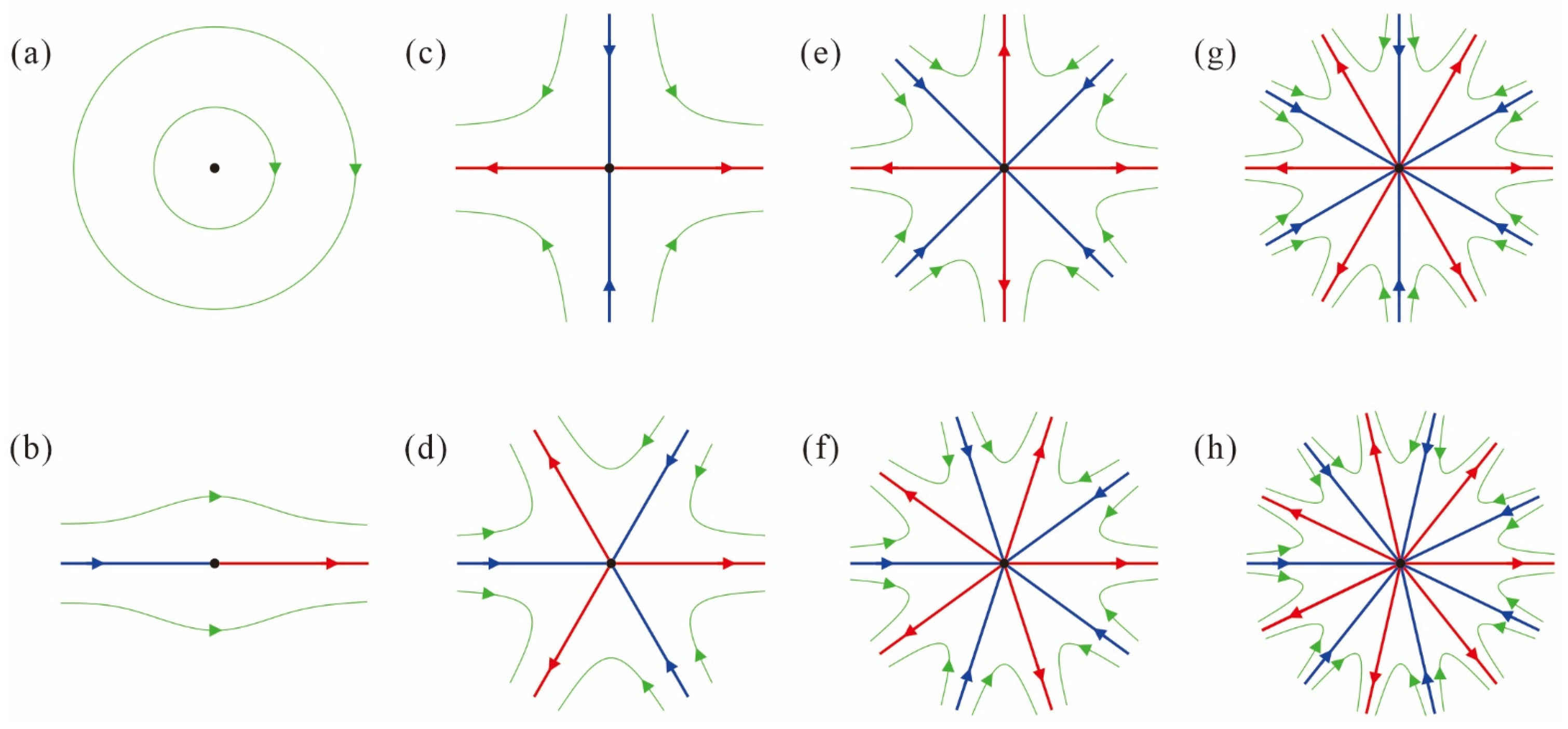
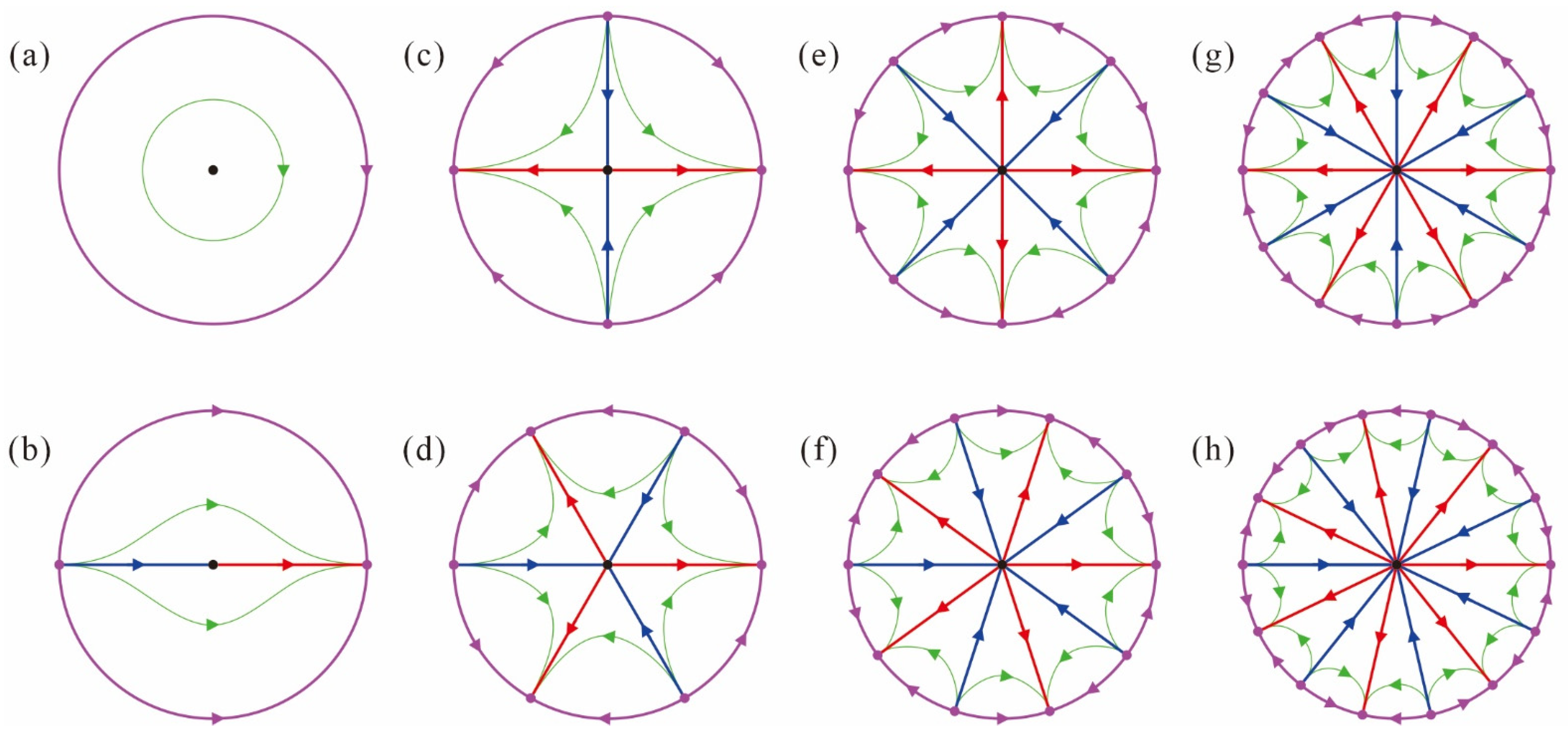
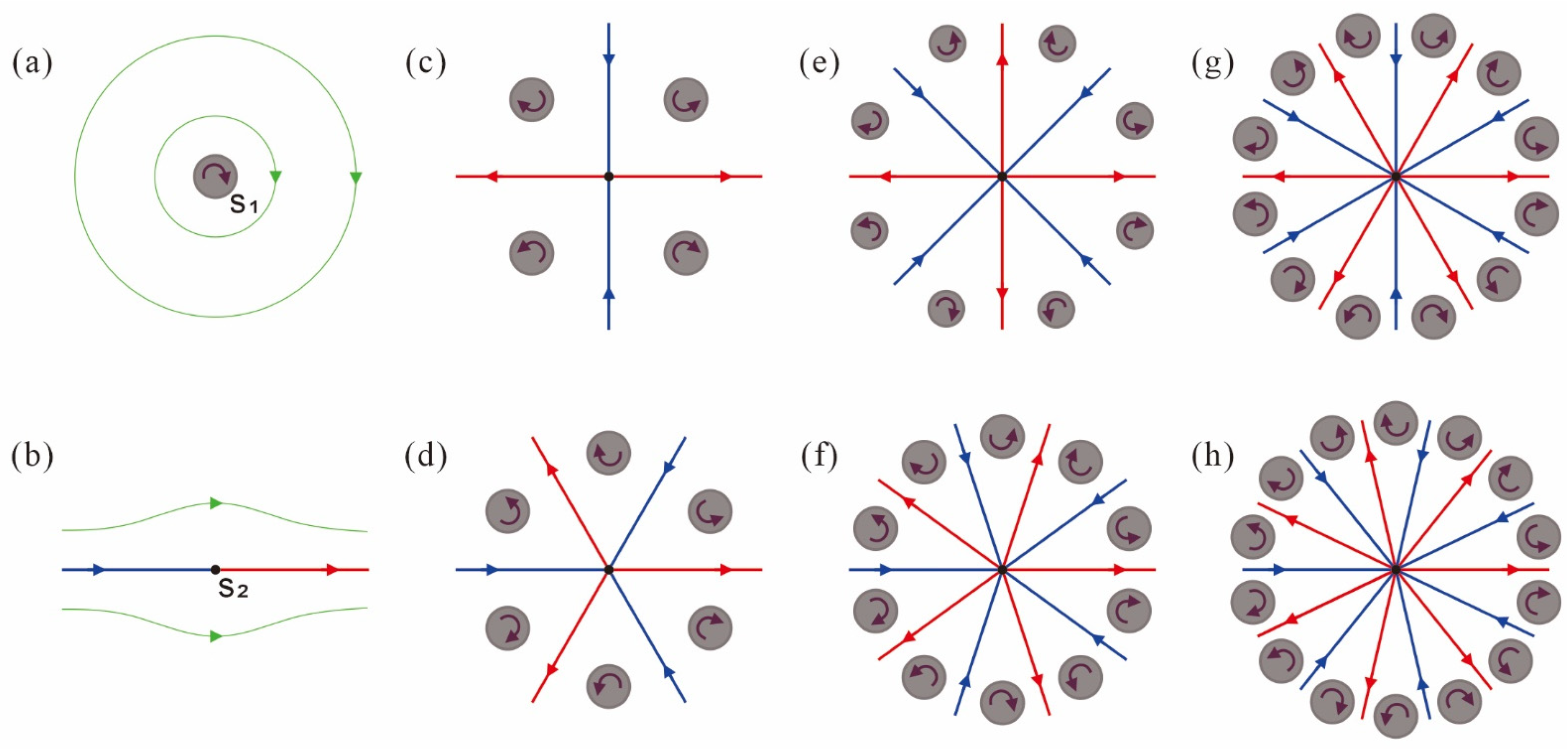
Therefore, the index of the origin could be + 1 , 1 , 3 , , m when m is odd, while J O ( V ) could be 0 , 2 , , m when m is even. It should be noted that the origin is an isotropic point except when its index J O V = 0 . Combining (27), the possible values of J O ( V ) and the corresponding LPPs and GPPs, physical flows are summarized in Table 2. Furthermore, the LPPs, GPPs, and their corresponding physical flows [34] associated with the LPPs are visually illustrated in Figure 1, Figure 2 and Figure 3, respectively.

3.2. Classification Based on Algebraic Factorization

In order to obtain the classification of LPPs of the origin O in system (3), calculating the number of hyperbolic sectors h is crucial, which can be achieved by counting the number of straight boundaries (or two rays) n s near the origin.
It is well-established that each distinct real linear factor of H ( x 1 , x 2 ) produces a straight orbit consisting of two rays in/out the origin. Consequently, the number of boundaries n s is twice the number of the real linear factors n f . This means that n s can be obtained by determining n f , where n f is related to the degree m + 1 of H ( x 1 , x 2 ) : If m = 2 N + 1 , then n f { 0 , 2 , ,   2 N + 2 } ; If m = 2 N , then n f { 1 , 3 , , 2 N + 1 } . Based on these relationships, the straight boundaries
n s = 2 n f = h ,
can be determined. It is evident that the two classification methods, topological index analysis and algebraic factorization, will yield consistent results of (3).
However, existing classifications, including that in Benterki and Llibre [11], remain incomplete as they fail to establish the relationship between the coefficients of H ( x 1 , x 2 ) in (3) and their corresponding phase portraits of both LPPs and GPPs. In the following, we provide detailed analysis to address this key limitation.
The homogeneous polynomial H x 1 , x 2 in (3) can be expressed as
H x 1 , x 2 = x 2 m + 1 H k ,
where
k x 1 x 2 ,   H k = i = 0 m + 1 h i k i .
For any real root k = k of H k = 0 , there exists a corresponding real linear factor ( x 1 k x 2 ) in H x 1 , x 2 . Thus, determining the number of real linear factors n f in H x 1 , x 2 reduces to finding the number of real roots n f of H k = 0 . A special case occurs when h m + 1 = 0 , where x 2 becomes an additional real linear factor of H x 1 , x 2 not reflected in H k = 0 . Consequently, the relationship between n f and n f is given by
n f = n f + 1 , i f   h m + 1 = 0 ; n f                 ,   i f   h m + 1 0 .
While algebraic solutions exist for H k = 0 when m 3 , other cases require numerical methods [35]. The complete classification for cases m = 1 , 2 , 3 is presented as follows.
Case 1 ( m = 1 ):
(i)
When h 2 = 0 , n f = n f + 1 = 2 .
(ii)
When h 2 0 ,
H k = h 2 k 2 + h 1 k + h 0 .
The number of real roots is determined by the discriminant 1 = h 1 2 4 h 0 h 2 , yielding
n f = n f = 2     , i f   1 > 0 ; 0     , i f   1 < 0 .
Case 2 ( m = 2 ) :
(i)
When h 3 = 0 , following the results from (50), we obtain
n f = n f + 1 = 3     , i f   1 > 0 ; 1     , i f   1 < 0 .
(ii)
When h 3 0 , the polynomial transforms to
H k = h 3 k 3 + h 2 k 2 + h 1 k + h 0 k 3 + h ~ 1 k + h ~ 0 ,
through the coordinate shift
k h 3 1 3 k h 2 3 h 3 ,
where h ~ 1 and h ~ 0 represent the transformed coefficients. The discriminant 2 = 4 h ~ 1 3 + 27 h ~ 0 2 determines the number of real roots n f of (52) [35], we have
n f = n f = 1     , i f   2 > 0 ; 3     , i f   2 < 0 .
Case 3 ( m = 3 ) :
(i)
When h 4 = 0 , building upon the results from (54), we obtain
n f = n f + 1 = 2     , i f   2 > 0 ; 4     , i f   2 < 0 .
(ii)
When h 4 0 , the quartic polynomial can be normalized as
H k = h 4 k 4 + h 3 k 3 + h 2 k 2 + h 1 k + h 0 k 4 + h ~ 2 k 2 + h ~ 1 k + h ~ 0 ,
through the following transformation steps: (1) Normalizing the coefficients through division by h 4 ; (2) Coordinate shift k k h 3 4 h 4 .
The number of real roots is determined by two discriminants [35]
Δ 3 = 256 h ~ 0 3 128 h ~ 2 2 h ~ 0 2 + 144 h ~ 2 h ~ 1 2 h ~ 0 + 16 h ~ 2 4 h ~ 0 27 h ~ 1 4 4 h ~ 2 3 h ~ 1 2 ,
and
Δ 4 = 8 h ~ 2 h ~ 0 9 h ~ 1 2 2 h ~ 2 3 .
The complete classification based on these discriminants is systematically presented in Table 3.
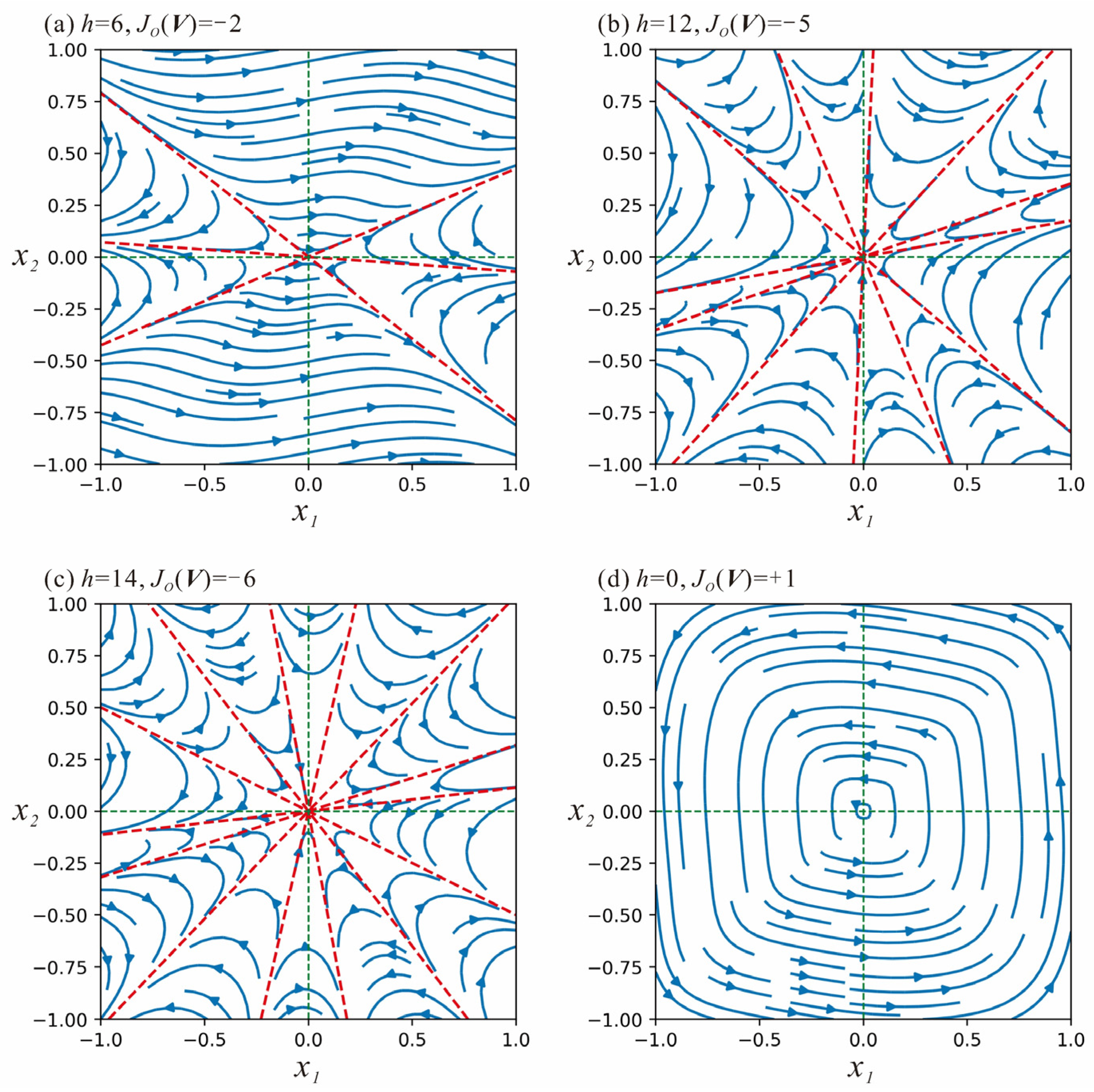
For higher-degree systems with m > 3 , we adopt numerical approaches to analyze n f . Table 4 presents our analysis of four examples ( m = 4 , 5 , 6 ,   a n d   7 ), where m + 2 coefficients of H x 1 , x 2 are randomly filtered with four significant digits and all lie in ( 1,1 ) . In each example, H x 1 , x 2 has no repeated real linear factor, which is achieved by ensuring that the greatest common divisor
f k = gcd H k ,   H k k ,
is a constant. The number n f of real linear factor and index J O ( V ) are validated through LPPs, as shown in Table 4 and Figure 4.
We remark that in Table 4, the index J O ( V ) is obtained through (44). For these randomized examples, the numerical results of n f , J O ( V ) and h satisfy (27) and (45), which also indicates that their LPP diagrams intuitively verify the equivalence between the two methods: topological index analysis and algebraic factorization.

4. Discussions and Conclusions

4.1. Discussions

The present work establishes a complete classification of GPPs for homogeneous polynomial planar Hamiltonian systems of arbitrary degree, under the condition of finitely many isotropic points. Our discussion proceeds along three main lines.
First, we introduced and applied the polar coordinate compactification method to rigorously link the GPP of the system to the LPP at the origin (Theorem 1). This approach provides a clear geometric and analytic framework for treating infinite isotropic points in a unified manner. This represents a significant extension beyond previous classifications limited to degrees up to five, such as that by Benterki and Llibre [11]. Prior studies typically relied on Poincaré compactification, which requires constructing local charts to analyze the infinite isotropic points for each individual degree—a process that becomes increasingly cumbersome for higher-order systems. In contrast, our method offers a unified and scalable analytical procedure valid for any homogeneous degree, thereby addressing a gap in the theoretical treatment of higher-order Hamiltonian systems.
Second, within the framework of system (3), we developed and compared two independent methodologies for determining the LPP of the origin: topological index analysis and algebraic factorization. The first method is grounded in topological index theory. Its core lies in a novel mathematical representation introduced in this work: the velocity field is expressed via a complex variable, while the Hamiltonian function is represented using deviatoric tensors. This formulation enables the direct computation of the index of the origin, which in turn determines the number of hyperbolic sectors. The second technique relies on algebraic factorization, where the count of distinct real linear factors in the homogeneous Hamiltonian polynomial directly determines the number of separatrix rays emanating from the origin. The consistency of these two approaches is validated through the derived results and four randomized examples.
Third, we related the obtained LPPs to corresponding physical flow patterns. Figure 3 illustrates that beyond the well-known structures such as centers (vortices) and saddles, higher-order systems generate multi-roller flow patterns that cannot be captured by the linear part of the velocity field alone. This underscores a limitation in much of the existing fluid dynamics literature, which often focuses on linearized or low-order approximations [21,22,23]. Our classification thus provides a systematic catalog of possible streamline topologies arising from nonlinear Hamiltonian velocity fields, suggesting that higher-order terms play an essential role in organizing complex flow structures, such as those involving multiple alternating rotors.

4.2. Conclusions

This study achieves a complete classification of the GPPs for homogeneous planar Hamiltonian systems with finitely many isotropic points, thereby extending the known classification to an arbitrary degree. The main conclusions are as follows:
(i)
The GPP is uniquely determined by the LPP at the origin in homogeneous planar Hamiltonian systems. This fundamental principle (Theorem 1) is proven via a newly introduced polar coordinate compactification. It simplifies the classification problem by systematically reducing the global analysis to a local one.
(ii)
Two consistent classification methods are established. The topological index analysis, based on a complex-tensorial representation, and the algebraic factorization approach provide independent and equivalent ways to determine the LPP. Their consistency is validated both theoretically and through examples, forming a robust analytical framework for any degree.
(iii)
A direct correspondence with physical flow patterns is provided. The classification explicitly links each local phase portrait to a specific incompressible flow structure. This demonstrates that nonlinear terms in the Hamiltonian generate complex flow topologies, such as multi-roller patterns, which lie beyond the scope of linearized velocity field analysis.
Looking forward, this study suggests several promising research directions. Mathematically, the polar coordinate compactification method presented here admits a natural extension to analyze the GPPs of general homogeneous planar systems, including non-Hamiltonian ones. Physically, further investigation into the role of nonlinear terms in shaping flow structures is warranted. A deeper understanding of streamline patterns, especially those generated by nonlinear velocity fields, could contribute to the development of new flow models, such as advanced slip-viscosity formulations [20]. The study of such nonlinear flow patterns, which provides new insights into fundamental flow mechanisms, remains a challenging yet fruitful endeavor in fields like fluid dynamics and dynamical systems, with potential implications for turbulence research.

Author Contributions

Conceptualization, W.Z. and J.G.; methodology, W.Z.; software, J.G.; validation, J.G., C.T. and R.W.; formal analysis, W.Z. and J.G.; investigation, J.G. and R.W.; resources, W.Z.; data curation, J.G.; writing—original draft preparation, J.G.; writing—review and editing, W.Z.; visualization, C.T.; supervision, W.Z.; project administration, W.Z.; funding acquisition, W.Z. All authors have read and agreed to the published version of the manuscript.

Funding

This research received no external funding.

Data Availability Statement

The original contributions presented in this study are included in the article. Further inquiries can be directed to the corresponding author.

Conflicts of Interest

The authors declare no conflicts of interest.

References

  1. Xiang, J.; Tang, T.; Huang, X. Investigating Uniform Stability of Fractional-Order Complex-Valued Stochastic Neural Networks with Impulses via a Direct Method. Axioms 2025, 15, 17. [Google Scholar] [CrossRef]
  2. Zhao, K. A generalized stochastic Nicholson blowfly model with mixed time-varying lags and harvest control: Almost periodic oscillation and global stable behavior. Adv. Contin. Discret. Models 2025, 2025, 171. [Google Scholar] [CrossRef]
  3. Llibre, J.; Oliveira, R.D. Phase portraits of quadratic polynomial vector fields having a rational first integral of degree 3. Nonlinear Anal. Theory Methods Appl. 2009, 70, 3549–3560, Erratum in Nonlinear Anal. Theory Methods Appl. 2009, 71, 6378–6379. [Google Scholar] [CrossRef]
  4. Tian, Y.; Zhao, Y. Global phase portraits and bifurcation diagrams for Hamiltonian systems of linear plus quartic homogeneous polynomials symmetric with respect to the y-axis. Nonlinear Anal. Theory Methods Appl. 2020, 192, 111658. [Google Scholar] [CrossRef]
  5. Li, T.; Llibre, J. Phase portraits of separable quadratic systems and a bibliographical survey on quadratic systems. Expo. Math. 2021, 39, 540–565. [Google Scholar] [CrossRef]
  6. Ye, Y.Q. Theory of Limit Cycles; Translations of Mathematical Monographs; American Mathematical Society: Providence, RI, USA, 1986; Volume 66. [Google Scholar]
  7. Reyn, J. Phase Portraits of Planar Quadratic Systems; Springer: Boston, MA, USA, 2007; Volume 583. [Google Scholar]
  8. Artés, J.C.; Llibre, J.; Schlomiuk, D.; Vulpe, N. Geometric Configurations of Singularities of Planar Polynomial Differential Systems: A Global Classification in the Quadratic Case; Springer: London, UK, 2021. [Google Scholar]
  9. Cima, A.; Gasull, A.; Manosas, F. On polynomial Hamiltonian planar vector fields. J. Differ. Equ. 1993, 106, 367–383. [Google Scholar] [CrossRef]
  10. Gasull, A.; Guillamon, A.; Mañosa, V. Phase portrait of Hamiltonian systems with homogeneous nonlinearities. Nonlinear Anal. Theory Methods Appl. 2000, 42, 679–707. [Google Scholar] [CrossRef]
  11. Benterki, R.; Llibre, J. Symmetric phase portraits of homogeneous polynomial Hamiltonian systems of degree 1, 2, 3, 4, and 5 with finitely many equilibria. Symmetry 2023, 15, 1476. [Google Scholar] [CrossRef]
  12. Bakker, P.G. Bifurcations in Flow Patterns; Volume 2 of Nonlinear Topics in the Mathematical Sciences; Springer: Dordrecht, NL, USA, 1991. [Google Scholar]
  13. Goldstein, H. Classical Mechanics; Addison-Wesley: Boston, MA, USA, 1951. [Google Scholar]
  14. Andronov, A.A.; Vitt, A.A.F.; Khaikin, S.E. Theory of Oscillators: Adiwes International Series in Physics; Elsevier: Kidlington, UK, 2013; Volume 4. [Google Scholar]
  15. Artés, J.C.; Llibre, J. Quadratic Hamiltonian vector fields. J. Differ. Equ. 1994, 107, 80–95, Erratum in J. Differ. Equ. 1996, 129, 559–560. [Google Scholar] [CrossRef]
  16. Brøns, M.; Hartnack, J.N. Streamline topologies near simple degenerate critical points in two-dimensional flow away from boundaries. Phys. Fluids 1999, 11, 314–324. [Google Scholar] [CrossRef]
  17. Deliceoğlu, A.; Gürcan, F. Streamline topology near non-simple degenerate critical points in two-dimensional flow with symmetry about an axis. J. Fluid Mech. 2008, 606, 417–432. [Google Scholar] [CrossRef]
  18. Moffatt, H.K. Some topological aspects of fluid dynamics. J. Fluid Mech. 2021, 914, P1. [Google Scholar] [CrossRef]
  19. Zou, W.N.; Xu, X.Y.; Tang, C.X. Spiral streamline pattern around a critical point: Its dual directivity and effective characterization by right eigen representation. Phys. Fluids 2021, 33, 067102. [Google Scholar] [CrossRef]
  20. Zou, W.N.; He, J. Slip topology of steady flows around a critical point: Taking the linear velocity field as an example. Phys. Fluids 2024, 36, 043611. [Google Scholar] [CrossRef]
  21. Jeong, J.; Hussain, F. On the identification of a vortex. J. Fluid Mech. 1995, 285, 69–94. [Google Scholar] [CrossRef]
  22. Chakraborty, P.; Balachandar, S.; Adrian, R.J. On the relationships between local vortex identification schemes. J. Fluid Mech. 2005, 535, 189–214. [Google Scholar] [CrossRef]
  23. Tian, S.L.; Gao, Y.S.; Dong, X.R.; Liu, C.Q. Definitions of vortex vector and vortex. J. Fluid Mech. 2018, 849, 312–339. [Google Scholar] [CrossRef]
  24. Gao, J.; Wang, R.; Ma, H.P.; Zou, W.N. Local streamline pattern and topological index of an isotropic point in a 2D velocity field. Mathematics 2025, 13, 2320. [Google Scholar] [CrossRef]
  25. Li, X.; Zheng, Q.; Chi, Z.; Jiang, B. Research on separation loss of compressor cascade profile based on large eddy simulation. J. Appl. Fluid Mech. 2024, 17, 1514–1523. [Google Scholar] [CrossRef]
  26. Dumortier, F.; Llibre, J.; Artés, J.C. Qualitative Theory of Planar Differential Systems; Universitext; Springer: Berlin/Heidelberg, Germany, 2006. [Google Scholar]
  27. Jiang, Q.B.; Llibre, J. Qualitative classification of singular points. Qual. Theory Dyn. Syst. 2005, 6, 87–167. [Google Scholar] [CrossRef]
  28. Zhang, Z.F.; Ding, T.R.; Huang, W.Z.; Dong, Z.X. Qualitative Theory of Differential Equations; Translations of Mathematical Monographs; American Mathematical Society: Providence, RI, USA, 1992; Volume 101. [Google Scholar]
  29. Neumann, D.A. Classification of continuous flows on 2–manifolds. Proc. Am. Math. Soc. 1975, 48, 73–81. [Google Scholar]
  30. Markus, L. Global structure of ordinary differential equations in the plane. Trans. Am. Math. Soc. 1954, 76, 127–148. [Google Scholar] [CrossRef]
  31. Cronin, J. Ordinary Differential Equations: Introduction and Qualitative Theory, 3rd ed.; CRC Press: Boca Raton, FL, USA, 2007. [Google Scholar]
  32. Zheng, Q.S. Two-dimensional tensor function representation for all kinds of material symmetry. Proc. R. Soc. A-Math. Phys. Sci. 1993, 443, 127–138. [Google Scholar]
  33. Zou, W.N. Theoretical Studies on High-Order Tensors in Mechanics and Turbulence. Ph. D. Thesis, Tsinghua University, Beijing, China, 2000. [Google Scholar]
  34. Brøns, M. Streamline topology: Patterns in fluid flows and their bifurcations. Adv. Appl. Mech. 2007, 41, 1–42. [Google Scholar]
  35. Arnon, D.S. Geometric reasoning with logic and algebra. Artif. Intell. 1988, 37, 37–60. [Google Scholar] [CrossRef]
Figure 1. The eight LPPs of the origin in system (3) as listed in Table 2. The descriptions of each subfigure are as follows: (a) center; (b) trivial flow in fluid dynamics; (ch) LPPs of the origin with 4, 6, 8, 10, 12 and 14 hyperbolic sectors, respectively. In (ch), every boundary line between sectors is a straight line.
Symmetry 18 00151 g001
Figure 2. The eight GPPs of the system (3) as listed in Table 2. Each separatrix is a ray from the origin. Subfigure details: (a) global center; (b) two separatrices; (ch) 4, 6, 8, 10, 12, and 14 separatrices, respectively. All infinite isotropic points are nodes when m 2 ; for m   =   1 , the GPPs are shown in (a,c), where the infinite isotropic points in (c) are proper nodes.
Symmetry 18 00151 g002
Figure 3. Physical flow fields corresponding to the LPPs in Figure 1. Each subfigure depicts a distinct flow structure in a viscous fluid: (a) A vortex structure, where S 1 denotes an infinitesimal rotating point at the center; (b) A trivial flow along a horizontal axis, with S 2 representing a fixed point; (ch) Symmetric flows driven by 2 k ( = 4 , 6 , 8 , 10 , 12 , 14 ) identical rollers positioned at the vertices of a regular 2 k -gon. The arrows within each roller indicate its rolling direction; consecutive rollers rotate in opposite directions with the same angular velocity, generating the surrounding viscous flow patterns shown.
Symmetry 18 00151 g003
Figure 4. LPPs of (a) example 1; (b) example 2; (c) example 3; (d) example 4. In each subplot, the blue solid lines represent the system orbits; the red dashed lines mark the boundaries of regions of distinct flow behavior; and the green dashed lines indicate the coordinate axes (horizontal: x1-axis, vertical: x2-axis).
Symmetry 18 00151 g004
Table 1. LPP types of system (11). The parameters ϑ , μ , and λ are not 0, and λ 1 λ 2 .
CaseDeterminant J D in (11) k r , k θ Type
i det D > 0 ϑ μ μ ϑ ϑ ,   μ focus
ii 0 μ μ 0 ( 0 ,   μ ) center or weak focus
iii λ 1 λ 2 ,
λ 1 λ 2 > 0
λ 1 cos 2 θ + λ 2 sin 2 θ , λ 2 λ 1 sin θ cos θ   node
iv λ 0 0 λ ( λ , 0 ) proper node
v λ 1 0 λ λ + sin θ cos θ , sin 2 θ improper node
vi det D < 0 λ 1 λ 2 < 0 λ 1 cos 2 θ + λ 2 sin 2 θ , λ 2 λ 1 sin θ cos θ   saddle
Table 2. Classification of J O ( V ) , phase portraits (LPPs and GPPs), and their corresponding physical flows for LPP of the origin in system (3). Here, “⋮” indicates the continuation of the sequence; the origin is not an isotropic point when J O V = 0 , N N + , and “ ” means not displaying the image.
m J O ( V ) The Number of hLPPsGPPsPhysical Flows
2 N + 1 + 1 0 Figure 1aFigure 2aFigure 3a
1 4 Figure 1cFigure 2cFigure 3c
−38Figure 1eFigure 2eFigure 3e
−512Figure 1gFigure 2gFigure 3g
2 N 1 4 N + 4
2 N 0 2 Figure 1bFigure 2bFigure 3b
2 6 Figure 1dFigure 2dFigure 3d
−410Figure 1fFigure 2fFigure 3f
−614Figure 1hFigure 2hFigure 3h
2 N 4 N + 2
Table 3. The number of real linear factors n f when h 4 0 .
Conditions n f = n f
Δ 3 > 0   a n d   Δ 4 > 0   a n d   h ~ 2 < 0 4
Δ 3 < 0 2
Δ 3 > 0   a n d   ( Δ 4 0   o r   h ~ 2 > 0 ) 0
Table 4. Comparison of n f , J O ( V ) and LPPs for four randomized examples.
Example H x 1 , x 2 n f e k J O ( V ) LPPs h
1
( m = 4 )
0.9237 x 2 5 0.8834 x 1 x 2 4 + 0.4536 x 1 2 x 2 3 + 0.9416 x 1 3 x 2 2 0.3731 x 1 4 x 2 0.03100 x 1 5 3 2.369 ,   0.694 ,   0.522 ,   0.691 2 Figure 4a6
2
( m = 5 )
0.01860 x 2 6 + 0.3580 x 1 x 2 5 + 0.6760 x 1 2 x 2 4 0.9762 x 1 3 x 2 3 0.5136 x 1 4 x 2 2 + 0.4170 x 1 5 x 2 0.05260 x 1 6 6 0.224 ,   0.637 ,   0.644 ,   0.711 ,   0.958 5 Figure 4b12
3
( m = 6 )
0.02331 x 2 7 + 0.03123 x 1 x 2 6 0.5769 x 1 2 x 2 5 0.2202 x 1 3 x 2 4 + 0.8350 x 1 4 x 2 3 + 0.07228 x 1 5 x 2 2 0.1370 x 1 6 x 2 + 0.01342 x 1 7 7 0.402 ,   0.580 ,   0.509 ,   0.651 ,   0.930 ,   0.560   6 Figure 4c14
4
( m = 7 )
0.5218 x 2 8 0.3788 x 1 x 2 7 0.9843 x 1 2 x 2 6 0.1758 x 1 3 x 2 5 + 0.2400 x 1 4 x 2 4 + 0.6880 x 1 5 x 2 3 0.7048 x 1 6 x 2 2 0.3312 x 1 7 x 2 0.6918 x 1 8 0 0.108 , 4.643 , 0.366 , 1.567 , 1.357 , 0.400 , 4.332 + 1 Figure 4d0
Disclaimer/Publisher’s Note: The statements, opinions and data contained in all publications are solely those of the individual author(s) and contributor(s) and not of MDPI and/or the editor(s). MDPI and/or the editor(s) disclaim responsibility for any injury to people or property resulting from any ideas, methods, instructions or products referred to in the content.