Abstract
This paper considers the problem of approximating some Appell’s hypergeometric functions by their branched continued fraction expansions. Using the formula for the difference of two approximants of a branched continued fraction, we established the truncation error bounds for such expansions. In addition, we provided another proof of the convergence of branched continued fraction expansions to the ratio of Appell’s hypergeometric functions . Finally, we also provide examples to demonstrate the effectiveness of branched continued fractions as a tool for approximating special functions.
Keywords:
Appell’s hypergeometric function; branched continued fraction; analytic continuation; convergence; approximation by rational functions MSC:
33C65; 32A17; 32D99; 40A99; 41A20
1. Introduction
The Gaussian or ordinary hypergeometric function and its various generalizations, including Appell’s hypergeometric functions, appear in various fields of mathematics and its applications [1,2].
This paper considers the Appell’s hypergeometric function which is defined as follows (see [3,4]):
where
Currently, there are several papers that deal with this function (see, for example, [5,6]), primarily because of its diverse applications [7,8].
Among the variety of problems related to , one of the most intriguing is constructing its representation in terms of a branched continued fraction, which would be analogous to constructing a Gaussian continued fraction for an ordinary hypergeometric function [9]. Such representations are used to compute special functions (see, for example, [10,11]).
In [12], D. Bodnar obtained a formal expansion of the ratio of the functions
into a branched continued fraction
where … are the coefficients expressed in terms of the parameters of Appell’s hypergeometric function However, there are still no convergence criteria for this branched continued fraction. The problem of convergence of branched continued fractions can be found in [13,14]. The structures of branched continued fraction expansions are considered in [15].
In [16], the authors considered the case when from which it follows that the ratio
has a formal branched continued fraction expansion of the following form:
where
Provided that and are the real constants such that
where is a positive number, it is proven that (3) converges uniformly on every compact subset of the domain
to a function that is holomorphic in ; furthermore, is an analytic continuation of the function (2) in In [17] in (2) and (3), the variable is replaced by , and a similar result is shown in some domain of , provided that and are complex constants from some parabolic region. Here, the region refers to a domain (an open connected set) which may include all, part, or none of its boundary.
Mainly motivated by the aforementioned recent developments, we establish truncation errors bounds for branched continued fractions (3) in the case of non-negative elements. Such bounds are of great importance for the computation of special functions using branched continued fraction representations [18,19]. In addition, we also provide another proof of the convergence of (3) to function (2).
2. Truncation Error Bounds
Let be the kth approximant of the branched continued fraction
where are functions of defined in the region E.
If for each , the branched continued fraction (5) converges to the finite value , then is called the truncation error of the kth approximant. The estimate of the form
where and as for all , is called the a priori bound (or truncation error bound) (see [20,21,22]).
Theorem 1.
Suppose that and are real constants that satisfy the inequalities in (4). Then, the following apply:
Proof.
First we will prove (i). Let
and
where Then it is easy to see that
Additionally, we can write the following:
In the following, we will estimate where and .
Let be an arbitrary fixed point in (6). Then, by condition (4), it is easy to see that the elements of the branched continued fraction (3) are non-negative, and thus, from (8) for arbitraries k and p such that and , we obtain
Since for all indexes and , the following formula holds (see [21]):
Indeed, using (9), for and , we have that
By (8) for and , we obtain the following:
Then, taking (7) into account, we have that
Now, due to the above, it is easy to obtain Formula (11). For convenience, we write this formula in the following form:
where and if and and if
Now, due to the above, for and , we obtain the following:
Obviously, for an arbitrary fixed ,
Then, due to the arbitrariness of p, we obtain (i).
In what follows, we will prove (iii). Let K be an arbitrary compact subset of ; then there exists a constant such that
Furthermore, if m and n are arbitrary natural numbers such that and then
Due to
we get (ii).
It is clear that (iii) follows from (12) when we pass to the limit as .
Finally, we will prove (iv) by the PF method (based on the so-called ‘fork property’ for a branched continued fraction with positive elements). It is obvious that
Then, there exists such that function (2) is analytic in domain
and where P is defined by (1). In particular,
In what follows, we will show that function (2) and the elements of the branched continued fraction (3) are positive-valued functions in .
Let be an arbitrary fixed point in Then, by condition (4), it is easy to see that the elements of the branched continued fraction (3) are positive, which means that the approximants of (3) satisfy the following inequalities:
i.e., the ‘fork property’ holds (see [21]). This, together with (i), for each ensures the convergence of the sequences of even and odd approximants of (3) to a finite value
Next, we will consider
where
and
It is obvious that and and . Taking (11) into account for , we obtain the following:
Thus,
Now, due to the above, including (i), we have that
and, therefore,
i.e., the branched continued fraction (3) converges to function (2) in the domain
Finally, applying Theorem 5 from [17], we complete the proof of (iv). □
In what follows, setting and replacing with in Theorem 1, we obtain the truncation error bound for a branched continued fraction of the form
where
Corollary 1.
Suppose that and are real constants that satisfy the following inequality:
where are defined by (14), and ϱ is a positive number. Then, the following apply:
3. Numerical Experiments
From [23,24], Corollary 1, and Corollary 2.3 from [16], it follows that the function
has representations in the series
and a branched continued fraction
which converges and represents a single-valued branch of the function (16) in the domain
Note that the case is trivial.
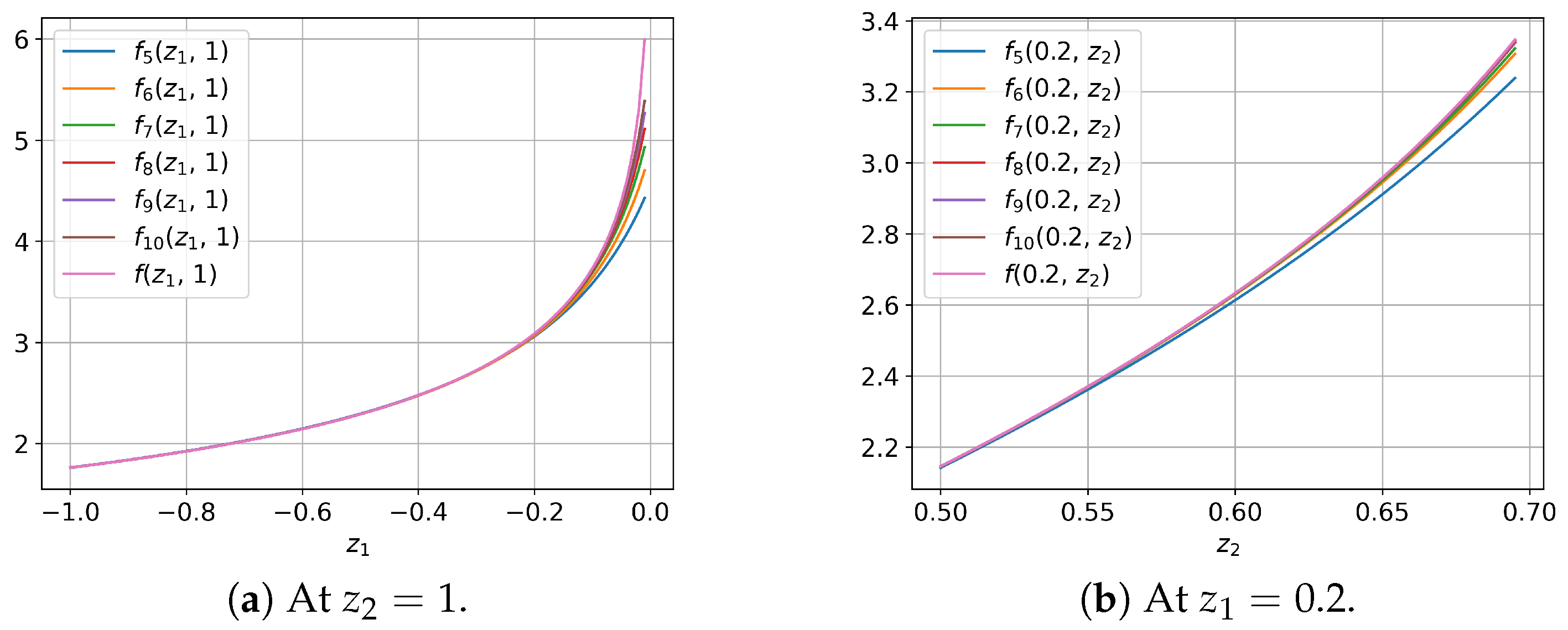
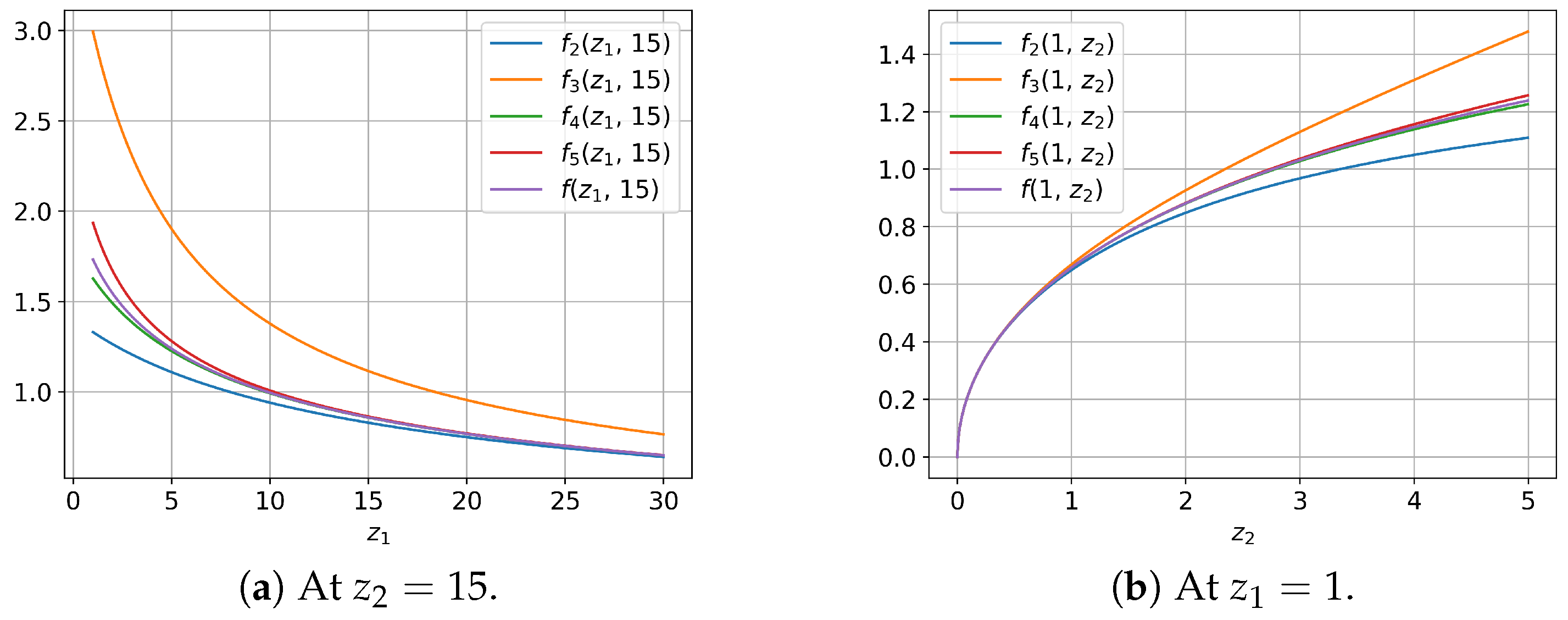
Plots of the values of the nth approximants of branched continued fraction expansion (18) are shown in Figure 1a,b. On the sets given in color there, all the elements of (18) are positive, so we see the ‘fork property’ for a branched continued fraction with positive elements (see [21]). That is, the plots of the values of even (odd) approximations of expansion (18) approaches from below (above) to the plot of function (16) at a fixed value of (Figure 1a). The plots at fixed values of are similar (see Figure 1b).
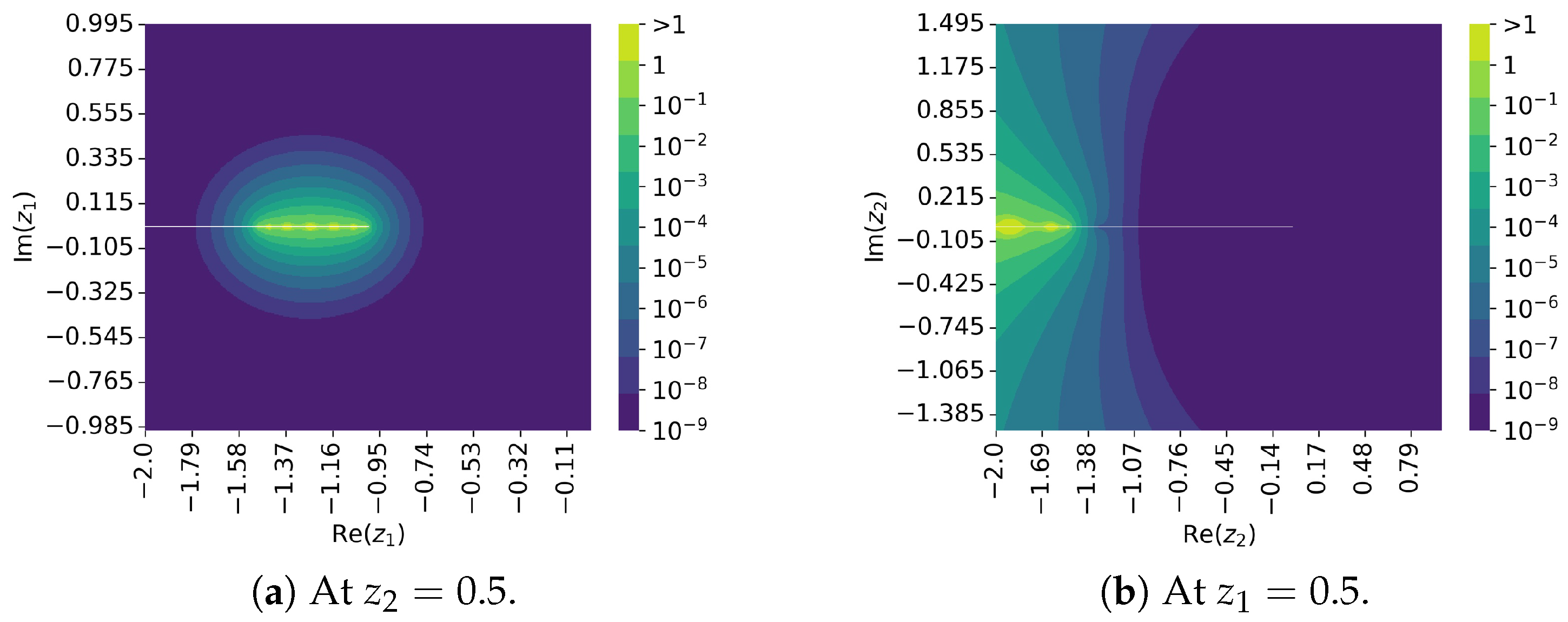
Figure 2a,b show 2D plots where the 15th approximant of the branched continued fraction expansion (18) guarantees certain truncation error bounds for (16). Here we see the symmetrical regions, with a cut along the real axis from to (Figure 2a) and a cut along the real axis from to 0 (Figure 2b).
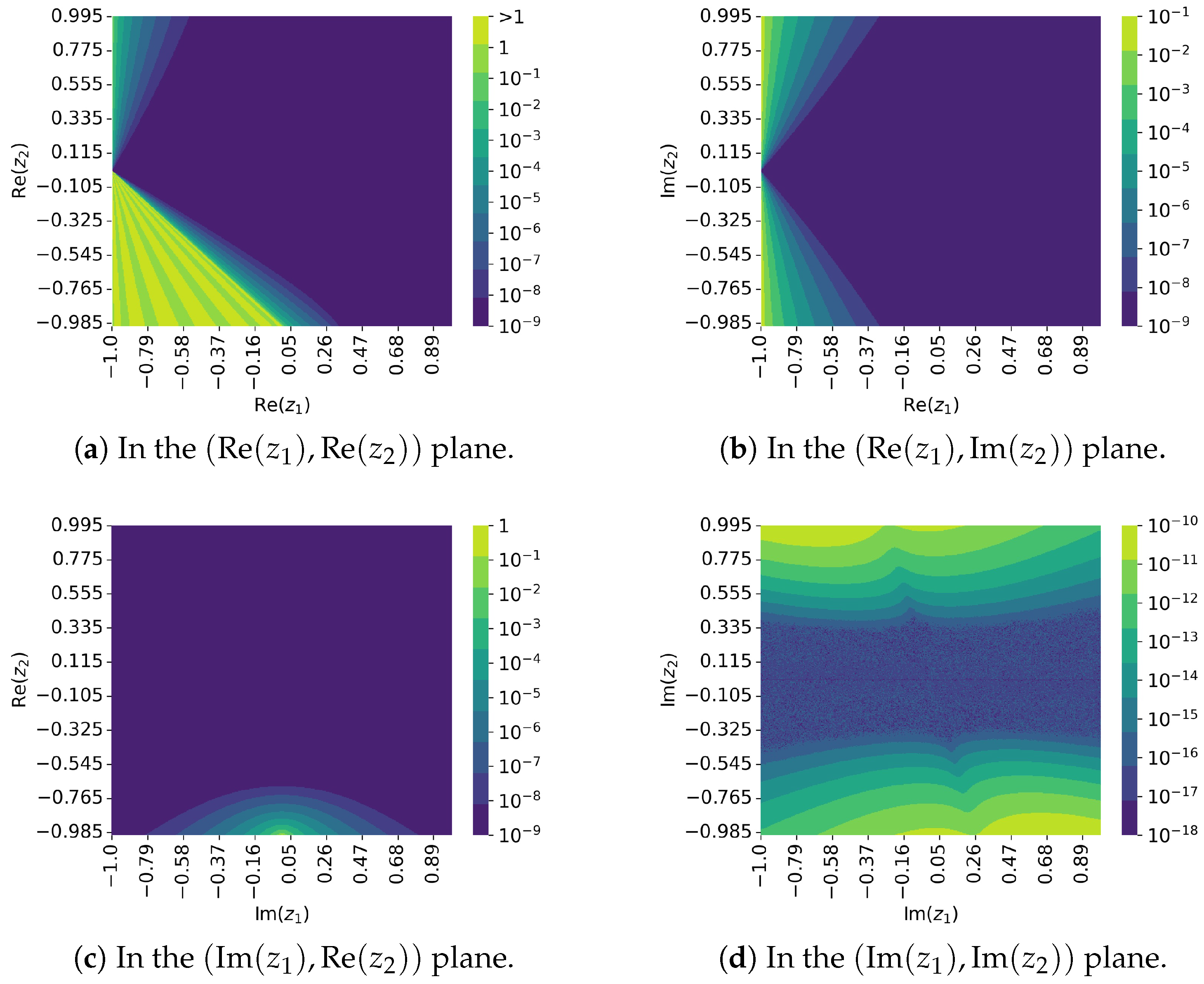
Figure 3a–d show 2D plots in different planes in where the 15th approximant of (18) guarantees certain truncation error bounds for function (16). Here we observe symmetrical regions in all cases except Figure 3a.
The results of evaluations (17) and (18) are displayed in Table 1. The analysis of these computation results shows that the approximation of function (16) is better using the 20th approximant of (18) and then the 20th partial sum of (17). We also see numerical stability of the 20th approximant of the branched continued fraction (18) at extreme inputs (e.g., , ). Note that this computational property is inherent to continued and branched continued fractions [10,11,22].
Table 1.
Relative error of 20th partial sum and 20th approximants for (16).
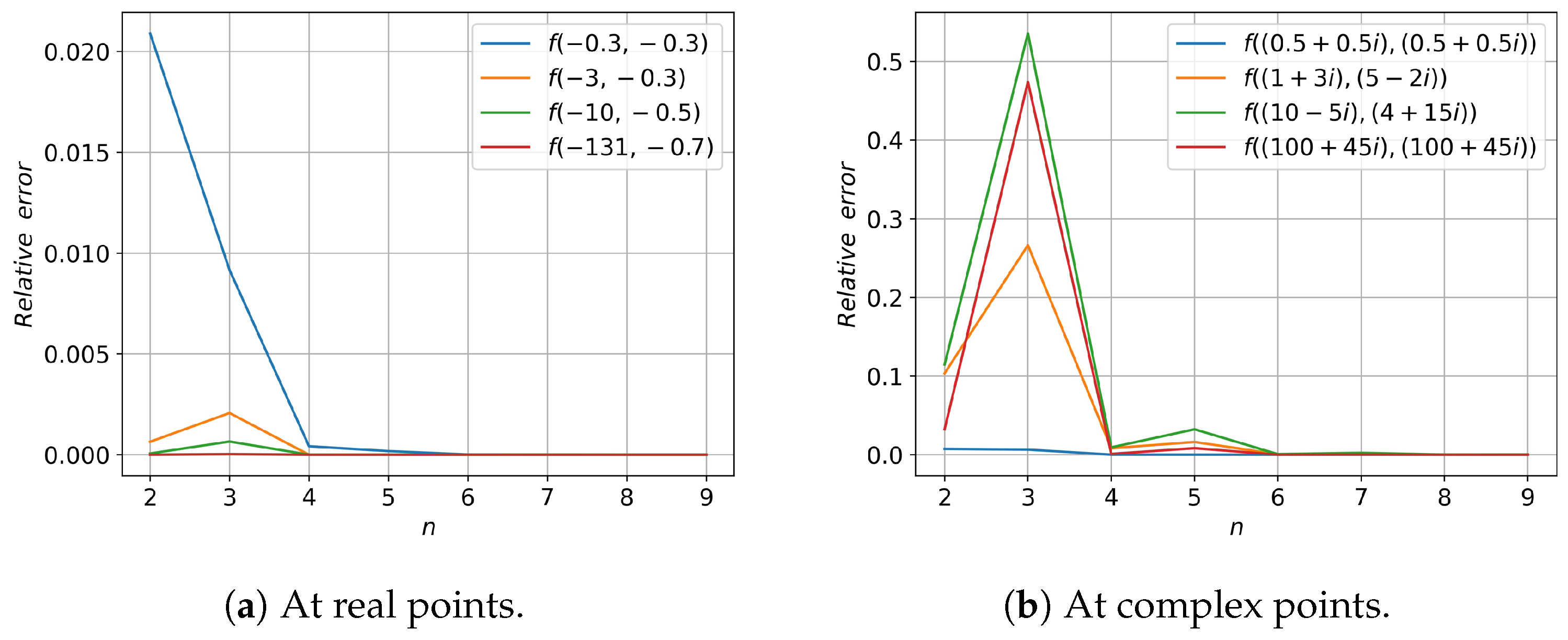
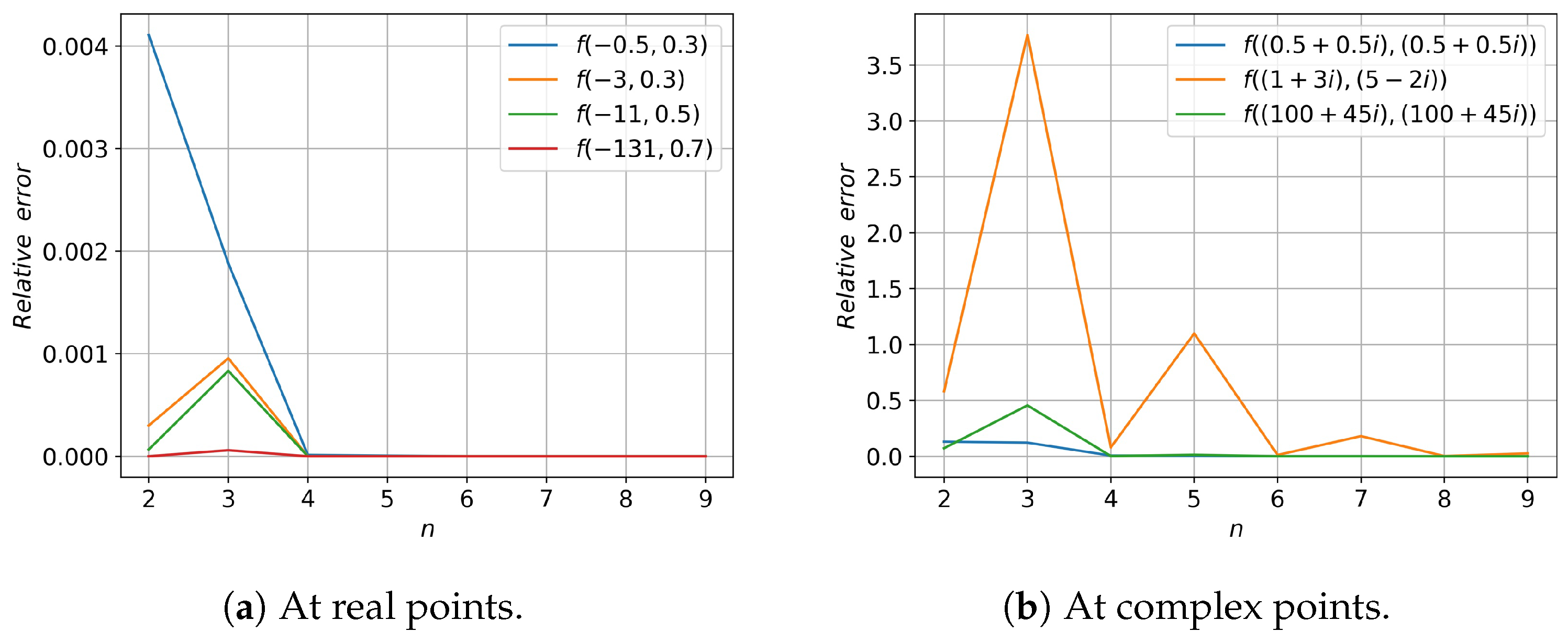
Plots of the values of the relative errors of the nth approximants of expansion (18) for function (16) are shown in Figure 4a,b. Here we observe that the relative error values tend to 0 as
In another example, from [23,24], Corollary 1, and Corollary 2.3 from [16], it follows that the function
has representations in the series
and a branched continued fraction
which converges and represents a single-valued branch of function (19) in the domain
We note that the case is trivial.
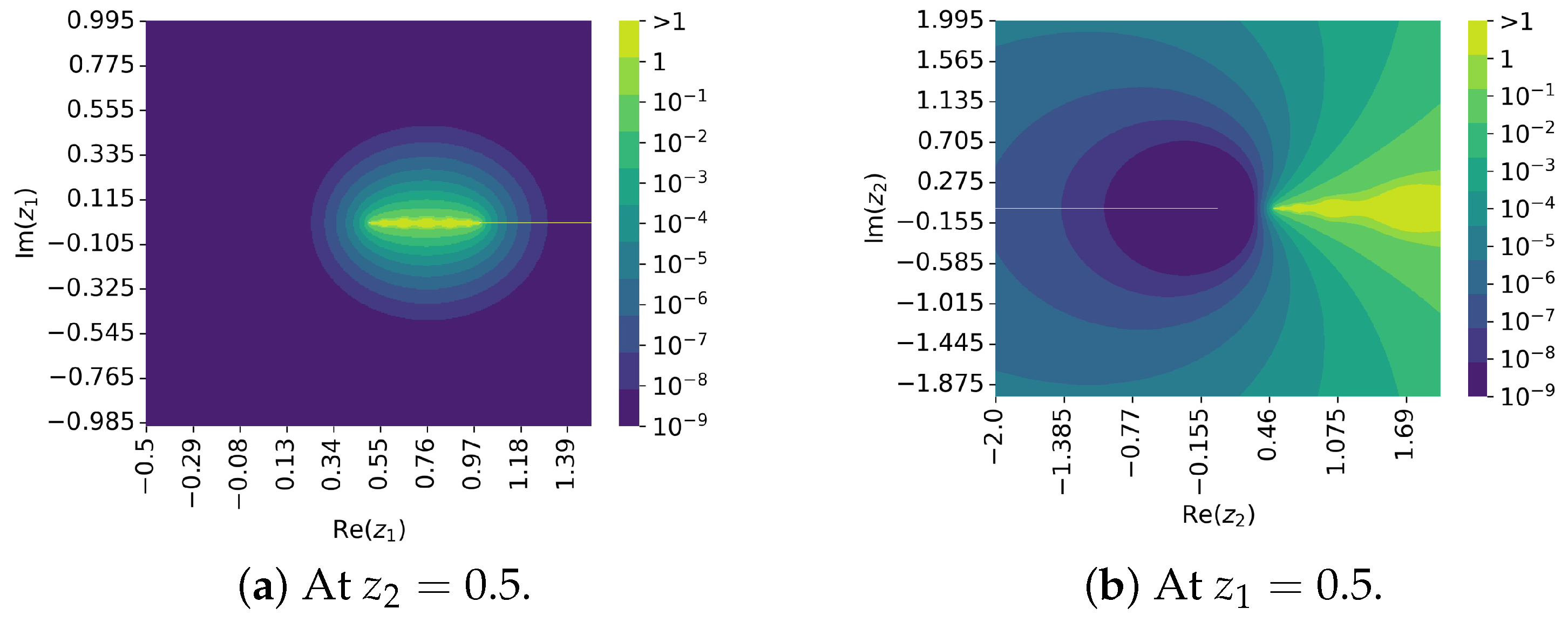
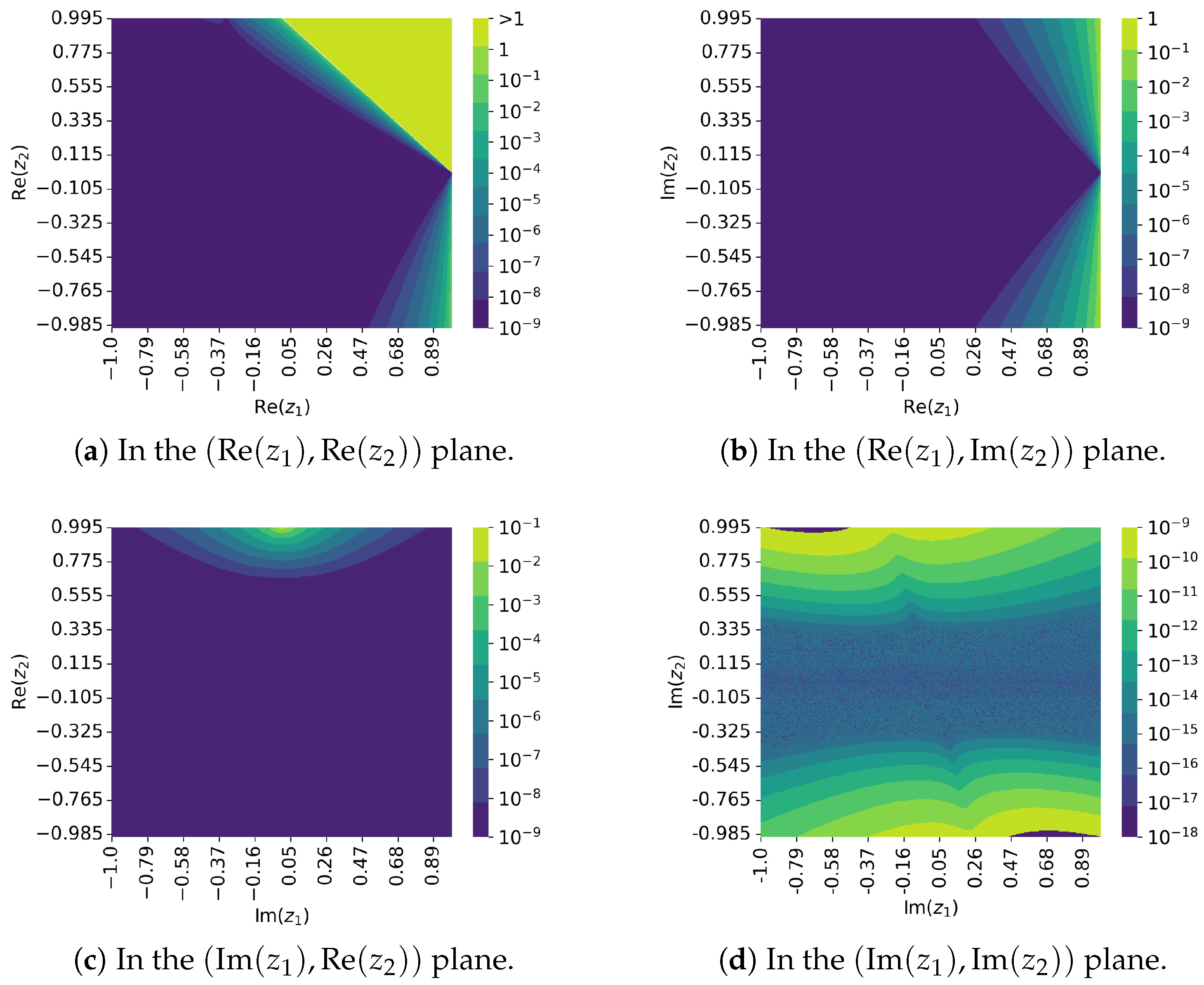
In Figure 5a,b, the sets where the elements of (18) are not positive are shown, so we cannot see the ‘fork property’ as in the previous example.
Table 2.
Relative errors of 20th partial sum and 20th approximants for (19).
Finally, plots of the values of the relative errors of the nth approximants of (21) for function (19) are shown in Figure 8a,b.
Here we have similar results to those in the previous example.
4. Conclusions
Compared to previous works (see [16,17,21]), the novelty of this paper is that under the conditions of (4) and for each where is defined by (6), we have established that the branched continued fraction (3) converges to the function at least as fast as geometric series with the following ratio:
Thus,
where is the kth approximant of (3). Using the PF method (based on the ‘fork property’ of a branched continued fraction with positive elements), it is also established that is an analytic extension of function (2) in (6). Numerical experiments on new examples demonstrate the effectiveness and feasibility of using branched continued fractions as a tool for approximating special functions in comparison with the corresponding series.
Funding
This research was supported by the National Research Foundation of Ukraine, 2023.03/0198 “Analysis of the spectra of countably generated algebras of symmetric polynomials and possible applications in quantum mechanics and computer science”.
Data Availability Statement
Data are contained within the article.
Conflicts of Interest
The authors declare no conflicts of interest.
References
- Exton, H. Multiple Hypergeometric Functions and Applications; Horwood, E., Ed.; Halsted Press: Chichester, UK, 1976. [Google Scholar]
- Seaborn, J.B. Hypergeometric Functions and Their Applications; Springer: New York, NY, USA, 1991. [Google Scholar]
- Appell, P. Sur les séries hyper géométriques de deux variables et sur des équations différentielles lineaires aux dérivées partielles. C. R. Acad. Sci. 1880, 90, 296–298+731–734. [Google Scholar]
- Appell, P. Sur les fonctions hyper géométriques de deux variables. J. Math. Pures Appl. 1982, 8, 173–216. [Google Scholar]
- Hang, P.-C.; Luo, M.-J. Asymptotics of Saran’s hypergeometric function FK. J. Math. Anal. Appl. 2025, 541, 128707. [Google Scholar] [CrossRef]
- Muneera, A.Q.; Sarah, A.Q. Solution of fractional kinetic equations involving new extended incomplete second Appell hypergeometric matrix functions. J. Funct. Spaces 2025, 2025, 9578749. [Google Scholar] [CrossRef]
- Bentalha, Z. A new formula for Coulomb matrix elements in the lowest Landau level in disk geometry. Phys. Scr. 2025, 100, 051501. [Google Scholar] [CrossRef]
- Caamaño-Carrillo, C.; Bevilacqua, M.; Zamudio-Monserratt, M.; Contreras-Reyes, J.E. Bivariate Pareto-Feller distribution based on Appell hypergeometric function. Axioms 2024, 13, 701. [Google Scholar] [CrossRef]
- Gauss, C.F. Disquisitiones generales circa seriem infinitam In Commentationes Societatis Regiae Scientiarum Gottingensis Recentiores; Classis Mathematicae, 1812; H. Dieterich: Gottingae, Germany, 1813; Volume 2, pp. 3–46. [Google Scholar]
- Dmytryshyn, R.; Cesarano, C.; Lutsiv, I.-A.; Dmytryshyn, M. Numerical stability of the branched continued fraction expansion of Horn’s hypergeometric function H4. Mat. Stud. 2024, 61, 51–60. [Google Scholar] [CrossRef]
- Hladun, V.; Rusyn, R.; Dmytryshyn, M. On the analytic extension of three ratios of Horn’s confluent hypergeometric function H7. Res. Math. 2024, 32, 60–70. [Google Scholar] [CrossRef] [PubMed]
- Bodnar, D.I. Expansion of a ratio of hypergeometric functions of two variables in branching continued fractions. J. Math. Sci. 1993, 64, 1155–1158. [Google Scholar] [CrossRef]
- Bilanyk, I.B.; Bodnar, D.I.; Vozniak, O.G. Convergence criteria of branched continued fractions. Res. Math. 2024, 32, 53–69. [Google Scholar] [CrossRef] [PubMed]
- Bodnar, D.I.; Bodnar, O.S.; Dmytryshyn, M.V.; Popov, M.M.; Martsinkiv, M.V.; Salamakha, O.B. Research on the convergence of some types of functional branched continued fractions. Carpathian Math. Publ. 2024, 16, 448–460. [Google Scholar] [CrossRef]
- Antonova, T. On structure of branched continued fractions. Carpathian Math. Publ. 2024, 16, 391–400. [Google Scholar] [CrossRef]
- Antonova, T.; Cesarano, C.; Dmytryshyn, R.; Sharyn, S. An approximation to Appell’s hypergeometric function F2 by branched continued fraction. Dolomites Res. Notes Approx. 2024, 17, 22–31. [Google Scholar] [CrossRef]
- Dmytryshyn, R. On the analytic continuation of Appell’s hypergeometric function F2 to some symmetric domains in the space . Symmetry 2024, 16, 1480. [Google Scholar] [CrossRef]
- Antonova, T.; Dmytryshyn, R.; Sharyn, S. Branched continued fraction representations of ratios of Horn’s confluent function H6. Constr. Math. Anal. 2023, 6, 22–37. [Google Scholar] [CrossRef]
- Hladun, V.R.; Dmytryshyn, M.V.; Kravtsiv, V.V.; Rusyn, R.S. Numerical stability of the branched continued fraction expansions of the ratios of Horn’s confluent hypergeometric functions H6. Math. Model. Comput. 2024, 11, 1152–1166. [Google Scholar] [CrossRef]
- Antonova, T.M.; Dmytryshyn, R.I. Truncation error bounds for branched continued fraction whose partial denominators are equal to unity. Mat. Stud. 2020, 54, 3–14. [Google Scholar] [CrossRef]
- Bodnar, D.I. Branched Continued Fractions; Naukova Dumka: Kyiv, Ukraine, 1986. [Google Scholar]
- Jones, W.B.; Thron, W.J. Continued Fractions: Analytic Theory and Applications; Addison-Wesley Pub. Co.: Reading, MA, USA, 1980. [Google Scholar]
- Abramowitz, M.; Stegun, I.A. Handbook of Mathematical Functions with Formulas, Graphs and Mathematical Tables; U.S. Government Printing Office, NBS: Washington, DC, USA, 1964.
- Schlosser, M.J. Multiple Hypergeometric Series: Appell Series and Beyond. In Computer Algebra in Quantum Field Theory: Integration, Summation and Special Functions; Schneider, C., Blümlein, J., Eds.; Springer: Vienna, Austria, 2013; pp. 305–324. [Google Scholar] [CrossRef]
- Hladun, V.R.; Bodnar, D.I.; Rusyn, R.S. Convergence sets and relative stability to perturbations of a branched continued fraction with positive elements. Carpathian Math. Publ. 2024, 16, 16–31. [Google Scholar] [CrossRef]
- Hladun, V.R. Some sets of relative stability under perturbations of branched continued fractions with complex elements and a variable number of branches. J. Math. Sci. 2016, 215, 11–25. [Google Scholar] [CrossRef]
Disclaimer/Publisher’s Note: The statements, opinions and data contained in all publications are solely those of the individual author(s) and contributor(s) and not of MDPI and/or the editor(s). MDPI and/or the editor(s) disclaim responsibility for any injury to people or property resulting from any ideas, methods, instructions or products referred to in the content. |
© 2025 by the author. Licensee MDPI, Basel, Switzerland. This article is an open access article distributed under the terms and conditions of the Creative Commons Attribution (CC BY) license (https://creativecommons.org/licenses/by/4.0/).