1. Introduction and Preliminaries
The study of fixed points in metric spaces has advanced significantly, leading to the development of various contraction principles. Among these, the Banach contraction principle [
1] remains a foundational result, ensuring the existence and uniqueness of a fixed point under certain contractive conditions. However, one limitation of the Banach contraction principle is that it requires the mapping to be continuous throughout its domain. In 1968, Kannan [
2] introduced a new condition that also guarantees the existence of a unique fixed point, similar to the Banach contraction principle. Unlike the Banach condition, Kannan demonstrated that there are mappings that have a discontinuity point in their domain but still have a fixed point, although such mappings are continuous at their fixed point. In 1973, motivated by the work of Kannan, Hardy and Rogers [
3] proposed new contractive conditions for ensuring the existence and uniqueness of fixed points. Subsequently, in 2012, Samet et al. [
4] introduced the concept of
-
contraction mapping, which generalizes several earlier contraction mappings. In 2012, Wardowski [
5] enhanced the concept of
F-contraction mapping. This contraction mapping introduces a more generalized framework that can address a wider variety of nonlinear mappings, thus broadening the applicability of fixed point results. In 2018, Karapinar [
6] proposed the concept of an interpolative-type contraction mapping by merging the frameworks of metric fixed point theory and interpolation theory. Further, Karapinar et al. [
7] proposed the notion of interpolative Hardy–Rogers-type contraction by combining the concepts of interpolative contraction and Hardy–Rogers-type contraction mapping.
Investigating various abstract spaces with a more general structure than a metric space is another possible way to improve the Banach contraction principle. In 1989, Bakhtin [
8] introduced a new axiom that is weaker than the classical triangular inequality, leading to the definition of a
b-metric space. Matthews [
9] explored the concept of a partial metric space to provide a better framework for certain computer science applications where a classical metric is not sufficient. Later, in 2000, Hitzler and Seda [
10] introduced the notion of a dislocated metric space in which the self-distance of a point need not be equal to zero. Mustafa and Sims [
11] enhanced the concept of classical metric spaces by introducing a more generalized form of distance measurement known as a
G-metric space. Furthermore, in 2019, Jain and Kaur [
12] introduced the concept of a
-metric space by combining the concepts of a
b-metric space and
G-metric space. Recently, Jleli and Samet [
13] introduced the notion of a perturbed metric space to address real-world problems where slight deviations in measurements are unavoidable.
In 1970, Takahashi [
14] proposed the concept of convex structure in a metric space, known as a convex metric space. This concept of convexity has been used as a fundamental tool for proving various fixed point results. In 1988, Ding [
15] studied the convergence of the Ishikawa iterative scheme for quasi-contractive and quasi-nonexpansive mappings in a convex metric space. Beg [
16] explored the convergence of asymptotically nonexpansive mappings using the Mann-type iterative scheme in a uniformly convex metric space. Later, in 2016, Fukhar-ud-din and Berinde [
17] introduced the modified Noor iterative method in a convex metric space for the class of quasi-contractive-type operators. Chen et al. [
18], in 2020, established the notion of the convex
b-metric space and generalized Mann iterative scheme for this newly defined space. Further, in 2022, Li et al. [
19] explored the concept of the rectangular
b-metric space and generalize Mann iterative algorithm and proved fixed point results in this space.
Many authors have studied applications of fixed point results for solving differential equations, integral equations, systems of linear equations, etc., by making use of various mappings. In 1996, Burton [
20] developed the idea of large contraction mappings to solve integral equations. These mappings are weaker than Banach contraction mappings; that is, every Banach contraction mapping is a large contraction, but the converse is not true. We now present some definitions from the literature.
In 1970, Takahashi defined the convex metric space as follows.
Definition 1 ([
14]).
Let be a metric space. A continuous function is said to have a convex structure if there exist and such thatfor any A metric space endowed with a convex structure W is called a convex metric space and is denoted by
In 1996, Burton developed the idea of large contraction mapping as follows.
Definition 2 ([
20]).
Let be a metric space. A mapping is said to be a large contraction if for with , we have and for all there exists such that Remark 1 ([
20]).
Every Banach contraction is a large contraction, but the converse need not to be true. Example 1. Let be a function defined as for all Assume that Then, the mapping R is a large contraction, but not a Banach contraction. Using the inequality , we have If then we have Thus, R is a large contraction mapping. Assume and Then, Hence, R is not a Banach contraction.
Recently, Berinde and Păcurar [
21] introduced the notion of enriched contraction in the framework of a convex metric space.
Definition 3 ([
21]).
Let be a convex metric space. A mapping is called an enriched contraction if there exist such thatfor all distinct Remark 2. Large contraction mappings and enriched contraction mappings are independent mappings.
Example 2. Let be a mapping defined as for all Assume that Then, the mapping R is a large contraction but not an enriched contraction. Thus, R is a large contraction but not an enriched contraction. If we take , and then Example 3. Let be a mapping defined as where a and b are constants such that and Assume that and where Then, the mapping H is an enriched contraction but not a Banach contraction. It is clear that if , then But if then we cannot have We need which is satisfied whenever In order to generalize the concept of large contractions, Özyurt [
22] defined the concept of extended large contraction mapping as follows.
Definition 4 ([
22]).
Let be a metric space. A mapping is said to be an extended large contraction if for with we have and for all , there exists such thatwhere Ψ
is the family of functions satisfying the following conditions:- (i)
ψ is nondecreasing;
- (ii)
, for all where oψo…o
Clearly, conditions (i) and (ii) of Definition 4 imply for every
In 2006, Mustafa and Sims [
13] defined the
G-metric space as follows.
Definition 5 ([
13]).
Let H be a nonempty set. Assume that is a mapping satisfying the following conditions:- (i)
, if
- (ii)
, for all with
- (iii)
for all with
- (iv)
(symmetry in all three variables);
- (v)
, for all
Then, G is called G-metric on H and is called a G-metric space.
Ji et al. [
23] introduced the notion of a convex
G-metric space as follows.
Definition 6 ([
23]).
Let be a G-metric space. A mapping is said to be a convex structure on H if for each and is satisfied. Then, the triplet is called a convex G-metric space. Lemma 1 ([
23]).
Let be a convex G-metric space. If , then the convex G-metric space is symmetric. In recent years, researchers have explored various generalizations and extensions of classical fixed point results by considering enriched contractions in larger settings, such as convex metric spaces. In order to generalize the enriched contraction, Berinde and Păcurar [
24] introduced the notion of enriched Ćirić–Reich–Rus contractions in Banach spaces as well as in convex metric spaces. In 2022, Panicker and Shukla [
25] obtained stability results of fixed point sets associated with a sequence of enriched contraction mappings in the setting of convex metric spaces. Further, Rawat et al. [
26] defined and studied interpolative enriched contractions of the Kannan type, Hardy–Rogers type, and Matkowski type within the setting of convex metric spaces. Anjali et al. [
27] introduced enriched Ćirić-type and enriched Hardy–Rogers contractions for which they established fixed point theorems in the Banach space and convex metric space. They showed that Ćirić-type and Hardy–Rogers contractions are unsaturated classes of mappings. Recently, in 2024, Rani et al. [
28] proposed the theory of enriched contraction mapping by introducing a new type of contraction mappings known as hybrid enriched contractions in convex metric spaces.
The aim of this paper is to generalize the notions of large contraction, extended large contraction, and enriched contraction and to study the existence and uniqueness of fixed points in the framework of convex metric spaces as well as in convex
G-metric spaces. This paper is divided into four sections.
Section 1 is introductory,
Section 2 introduces the concept of large enriched contractions in the framework of convex metric spaces,
Section 3 extends the idea of large enriched contractions in convex
G-metric spaces, and an application is studied in
Section 4 to explore the existence of solutions of nonlinear equations.
2. Large Contractions in Convex Metric Space
In this section, we define the concept of large enriched contraction in the framework of a convex metric space.
Definition 7. Let be a convex metric space. A mapping is said to be a large enriched contraction if for with and we haveand for all there exists such that Definition 8. Let be a convex metric space. A mapping is said to be an extended large enriched contraction if for with and we haveand for all there exists such that Remark 3. Every enriched contraction is a large enriched contraction, but the converse need not to be true.
Example 4. Let be a mapping defined as for all Assume that and . Then, the mapping R is a large enriched contraction but not an enriched contraction. Using the inequalities and , we have Thus, R is a large enriched contraction, but R is not an enriched contraction. If we take and is very small, then Example 5. Let be a mapping defined as , for all . Assume that and Then, the mapping R is a large enriched contraction, but not a large contraction. Thus, R is a large enriched contraction.
For and , we have Thus, R is not a large contraction.
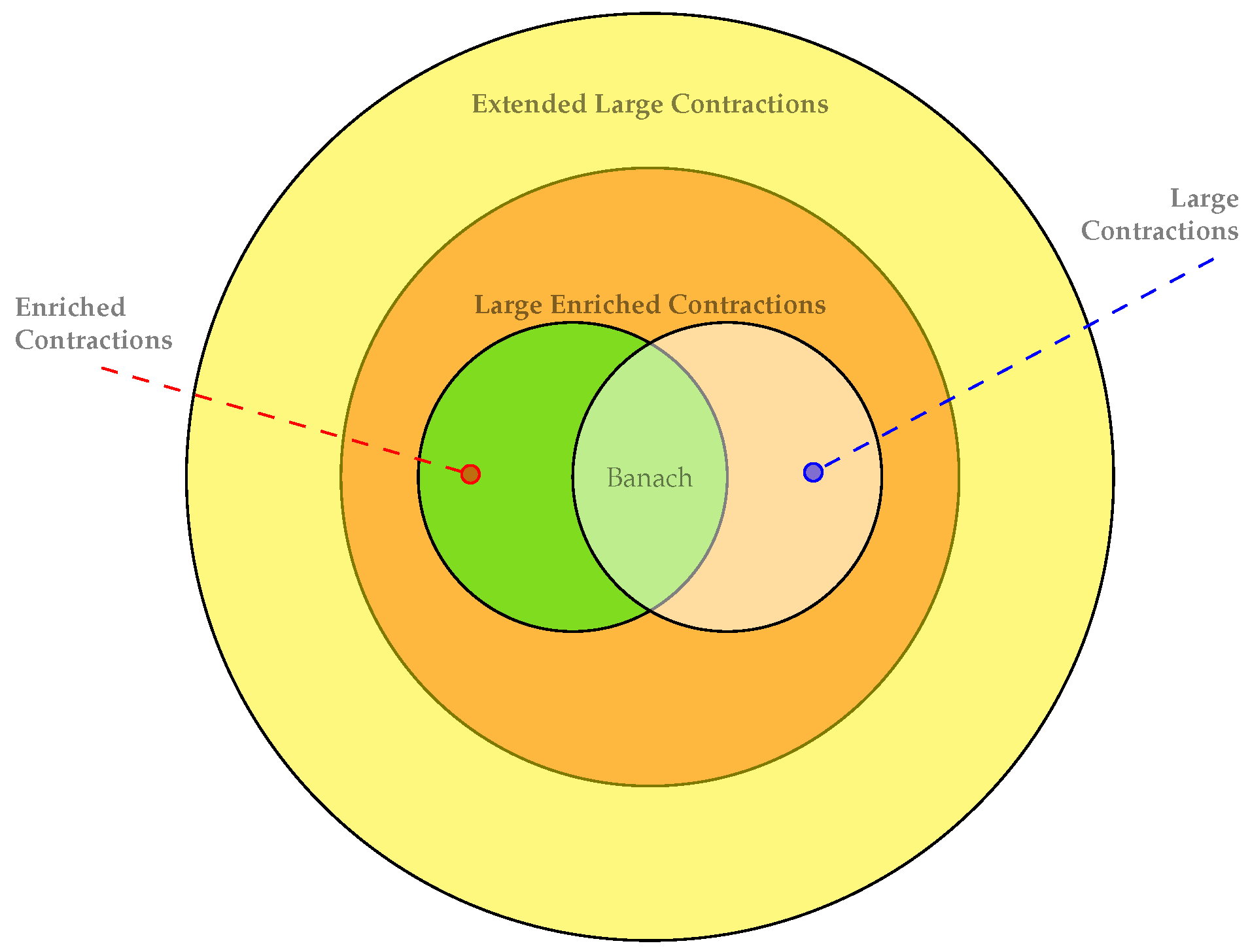
Figure 1 represents the relationship between various contraction mappings.
We now present the results concerning the existence and uniqueness of a fixed point associated with these two categories of large enriched contractions in the framework of a convex metric space.
Theorem 1. Let be a complete convex metric space and be a large enriched contraction map. Assume that there exist a and a constant such that for all . Then, R has a unique fixed point in H.
Proof.
The proof of this theorem is mainly divided into four steps:
Step 1. Initially, we shall prove that the sequence is a decreasing sequence.
Using the definition of a large enriched contraction, we have
Setting
and
in (6), we obtain
Step 2. In the second step, our aim is to prove that
Since the sequence is strictly decreasing,
If possible, let
. Then, for all
, we have
As a result, there exists
such that
Using (9), we have , which is a contradiction. Hence,
Step 3. The objective of the next step is to prove that the sequence given by is a Cauchy sequence.
By contradiction, assume that
is not a Cauchy sequence. Therefore, there exist an
and subsequences of integers
,
, and
such that
As
R is a large enriched contraction, there exists a
such that
By taking in the above equation, we obtain , which is not possible. Hence, is a Cauchy sequence in
Step 4. In the last phase, we shall prove the existence and uniqueness of a fixed point.
Because is a complete metric space, there exists a such that . The continuity of implies that
Let
be another fixed point of
such that
as a consequence, there exists an
such that
Using the contractive condition, we have
which contradicts
. Hence,
has a unique fixed point. Using Lemma 4 of [
21], we obtain
□
Theorem 2. Let be a complete convex metric space, and be an extended large enriched contraction map. Assume that there exists such that the sequence is bounded. Then, R has a unique fixed point in H.
Proof.
Define . Using assumptions of the theorem and following Step 1 of Theorem 1, we obtain that the sequence is strictly decreasing; therefore,
Now, let
. Then, for all
, we have
Hence, there exists
such that
Using (11), we have , which is a contradiction. Thus,
Now, assume that
is not a Cauchy sequence. So, there exist an
and subsequences of integers
,
, and
such that
Further, as
R is an extended large enriched contraction,
By considering in the above equation, we find that , which is not possible. Thus, is a Cauchy sequence in Because is a complete metric space, there exists a such that . Moreover, the continuity of implies that
Let
be another fixed point of
. Therefore, there exists an
such that
. Using the contractive condition, we obtain
which is a contradiction. Hence,
has a unique fixed point. By making use of Lemma 4 of [
21], we obtain
. □
Now, we present the consequences of Theorems 1 and 2.
Corollary 1. Let be a complete metric space. Let be a large contraction mapping. Assume that there exist a and a constant such that for all . Then, R has a unique fixed point.
Proof.
By substituting in Theorem 1, we obtain the desired result. □
Corollary 2. Let be a complete metric space. Let be an extended large contraction mapping. Assume that there exist a and a constant such that for all . Then, R has a unique fixed point.
Proof.
Put in Theorem 2, we obtain the result. □
3. Large Contractions in Convex G-Metric Space
Lemma 2. Let be a convex G-metric space. For all and the following equality holds: Proof.
Using the rectangular inequality and Lemma 1,
□
Lemma 3. Let be a convex G-metric space. For all , and , we have Proof.
Using the rectangular inequality and Lemma 1,
If
, then by Lemma 2,
which is a contradiction. Similarly,
. □
Lemma 4. Let be a convex G-metric space and be a mapping. Define as , . Then, for , .
Proof.
For
,
. Let
and
. Therefore,
Thus, .
Conversely, let . So, .
Hence, □
Definition 9. Let be a convex G-metric space. A function is said to be a large enriched contraction if for distinct ,and for all there exists such that Definition 10. Let be a convex G-metric space. A function is said to be an extended large enriched contraction if for distinct ,and for all there exists such that Theorem 3. Let be a complete convex G-metric space and be a large enriched contraction map. Assume that there exist a and a constant such that for all Then, R has a unique fixed point in
Proof.
The proof of this theorem is mainly divided into three steps:
Step 1. Firstly, we shall prove that the sequence is a decreasing sequence and
Using the assumptions of the theorem,
Put
,
and
in (14) to obtain
Since the sequence is strictly decreasing,
If possible, let
. Then, for all
, we obtain
As a result, there exists a
such that
We obtain a contradiction from Equation (
17). Hence,
Step 2: In this step, we will show that the sequence is a Cauchy sequence.
Define for and
Assume that
is not a Cauchy sequence. Thus, there exist an
and subsequences of integers
,
, and
such that
Since
R is a large enriched contraction, there exists a
such that
We observe that our assumption is wrong. Thus, is a Cauchy sequence.
Step 3. Next, we will prove the existence and uniqueness of the fixed point.
By the completeness of and continuity of we obtain
Let
be another fixed point of
such that
Therefore, there exists an
such that
Using the contractive conditions, we have
which is not possible. Hence,
has a unique fixed point. Further, we obtain
through the use of Lemma 4. □
Theorem 4. Let be a complete convex G-metric space, and be an extended large enriched contraction map. Assume that there exists a and a constant such that for all Then, R has a unique fixed point in
Proof.
The proof of Theorem 4 follows a similar approach to that of Theorems 2 and 3, using the same key steps and logical structure.
We now present the following corollaries, which are direct consequences of Theorems 3 and 4. □
Corollary 3. Let be a complete G-metric space. Let be a mapping such that the following hold:
- (i)
- (ii)
For , there exists a such that - (iii)
There exist and a constant such that
Then, R has a unique fixed point.
Corollary 4. Let be a complete G-metric space. Let be a mapping such that the following hold:
- (i)
- (ii)
For , there exists a such that - (iii)
There exist and a constant such that
Then, R has a unique fixed point.
4. Application
The aim of this section is to check the existence of a solution to nonlinear equations using large enriched contractions.
Example 6. Suppose we want to solve nonlinear equation . The solution of this nonlinear equation will be the fixed point of mapping where
First, we will show that R satisfies all the assumptions of Theorem 1. Take and .
Therefore, by Theorem 1, , where is the unique fixed point of mapping
Further, we can also find the fixed point of mapping R using the convergence of iterative sequence (as taken in the proof of Theorem 1).
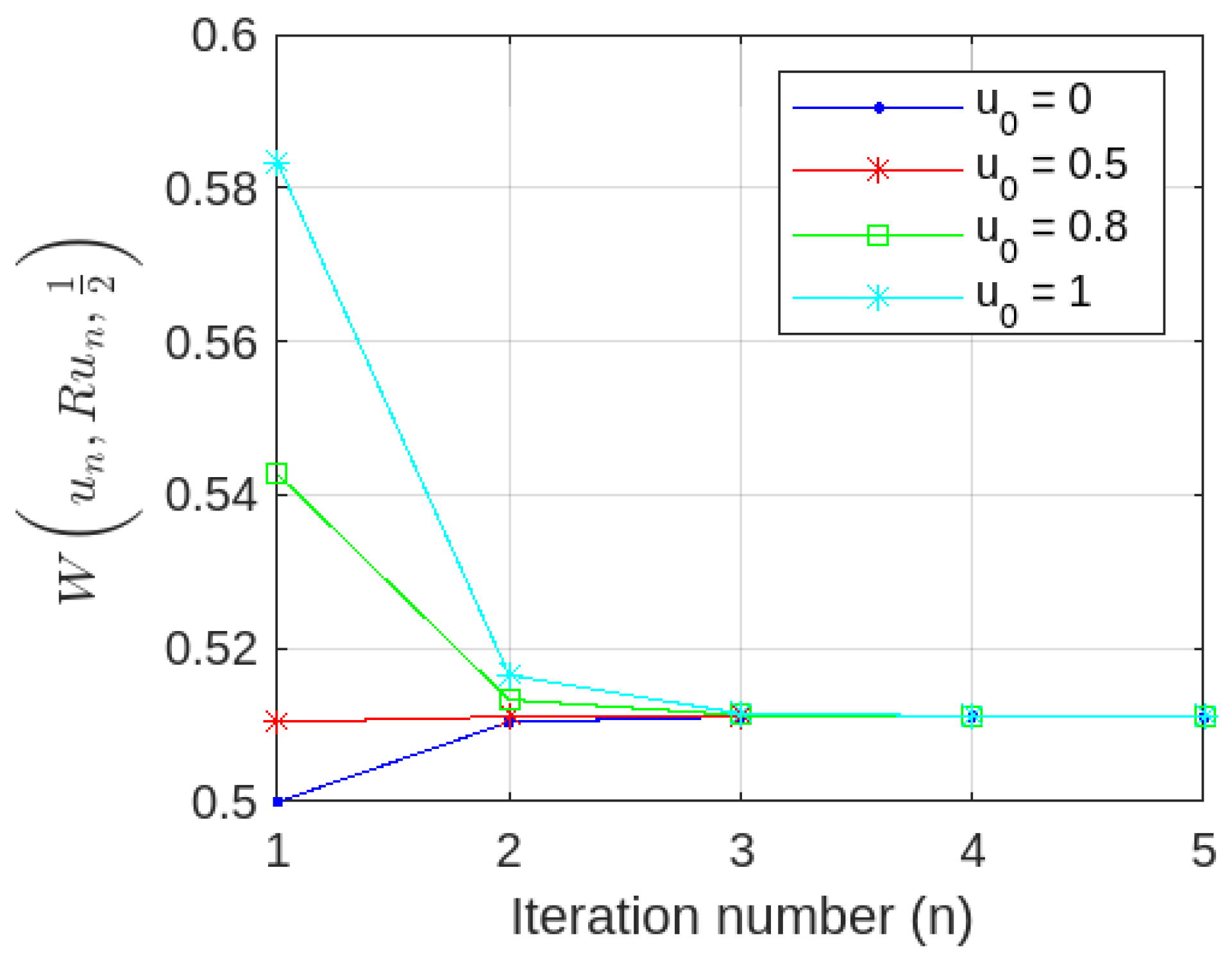
The Figure 2 represents the convergence of with different starting points. It is clear from the
Table 1 that
converges to the point 0.5111 irrespective of the initial guess. Thus, 0.5111 is the fixed point of mapping
R up to four decimal places (the solution of the nonlinear equation) in [0,1].
Example 7. Consider the nonlinear equation . The solution of this nonlinear equation corresponds to the fixed points of mapping where
First, we will demonstrate that R satisfies all the requirements of Theorem 1. Take and . Therefore, by Theorem 1, , where is the unique fixed point of mapping Since for all , the existence of a solution for cannot be checked using Bolzano’s theorem.
Moreover, the fixed point of mapping R can also be found through the convergence of the iterative sequence , as outlined in the proof of Theorem 1.
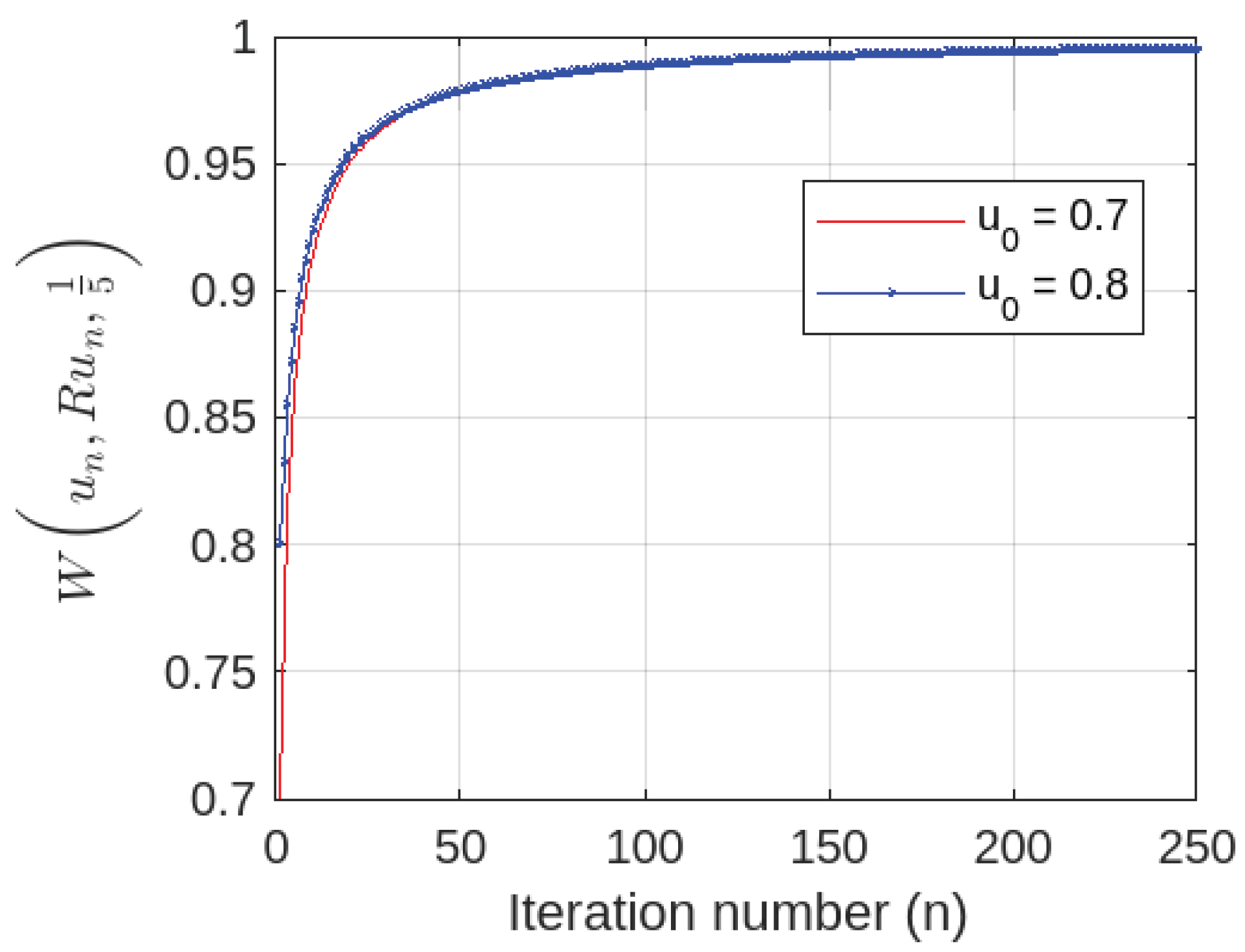
The Figure 3 shows the convergence of with different starting points. The
Table 2 clearly indicates that the sequence
converges to the point 0.9996, regardless of the initial guess. Consequently, 0.9996 serves as the fixed point of mapping
R (the solution of the nonlinear equation) up to four decimal places within the interval [0,1].