Article

Optimizing Legal Text Summarization Through Dynamic Retrieval-Augmented Generation and Domain-Specific Adaptation


by
S Ajay Mukund
*,† and
K. S. Easwarakumar
Department of Computer Science and Engineering, College of Engineering Guindy, Anna University, Chennai 600025, India
*
Author to whom correspondence should be addressed.
These authors contributed equally to this work.
Symmetry 2025, 17(5), 633; https://doi.org/10.3390/sym17050633
Submission received: 12 March 2025 / Revised: 15 April 2025 / Accepted: 17 April 2025 / Published: 23 April 2025

Abstract

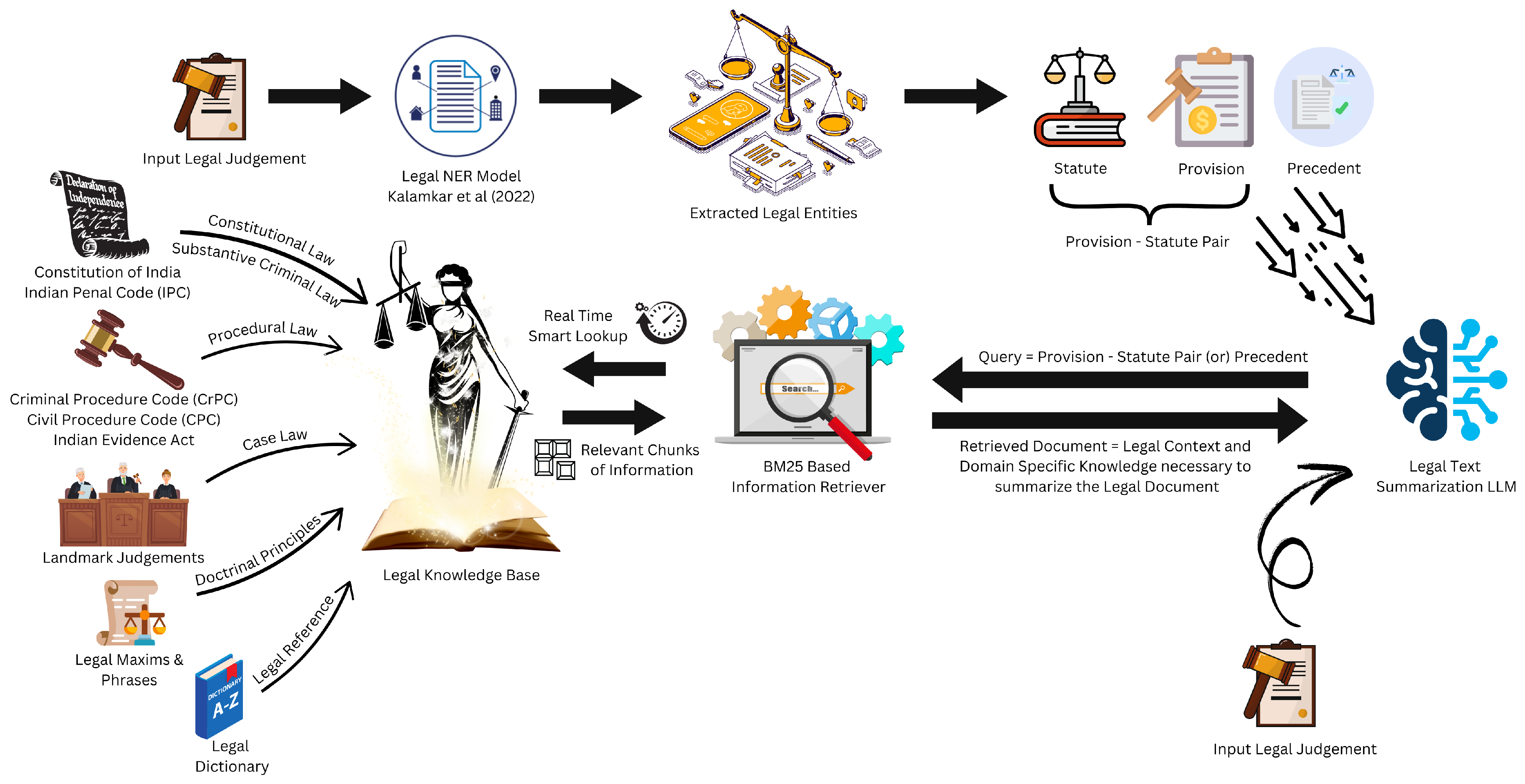
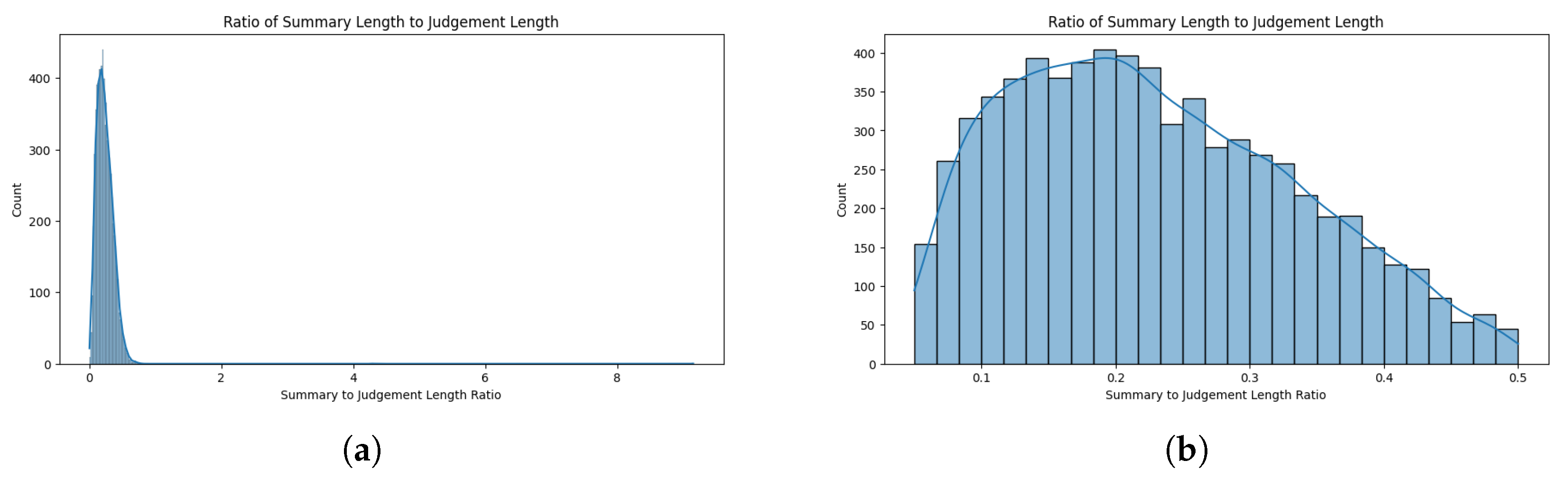
Legal text summarization presents distinct challenges due to the intricate and domain-specific nature of legal language. This paper introduces a novel framework integrating dynamic Retrieval-Augmented Generation (RAG) with domain-specific adaptation to enhance the accuracy and contextual relevance of legal document summaries. The proposed Dynamic Legal RAG system achieves a vital form of symmetry between information retrieval and content generation, ensuring that retrieved legal knowledge is both comprehensive and precise. Using the BM25 retriever with top-3 chunk selection, the system optimizes relevance and efficiency, minimizing redundancy while maximizing legally pertinent content. with top-3 chunk selection, the system optimizes relevance and efficiency, minimizing redundancy while maximizing legally pertinent content. A key design feature is the compression ratio constraint (0.05 to 0.5), maintaining structural symmetry between the original judgment and its summary by balancing representation and information density. Extensive evaluations establish BM25 as the most effective retriever, striking an optimal balance between precision and recall. A comparative analysis of transformer-based (Decoder-only) models—DeepSeek-7B, LLaMA 2-7B, and LLaMA 3.1-8B—demonstrates that LLaMA 3.1-8B, enriched with Legal Named Entity Recognition (NER) and the Dynamic RAG system, achieves superior performance with a BERTScore of 0.89. This study lays a strong foundation for future research in hybrid retrieval models, adaptive chunking strategies, and legal-specific evaluation metrics, with practical implications for case law analysis and automated legal drafting.
Keywords: legal text summarization; domain-specific adaptation; Retrieval-Augmented Generation; BM25 retriever; Decoder-only language models legal text summarization; domain-specific adaptation; Retrieval-Augmented Generation; BM25 retriever; Decoder-only language models