Article

Nonlocal Effects and Chaotic Wave Propagation in the Cubic–Quintic Nonlinear Schrödinger Model for Optical Beams


by
Zoalnoon Ahmed Abeid Allah Saad
1,
Muhammad Amin S. Murad
2,
Faraj M. Omar
3,
A. H. Tedjani
4 and
Khizar Farooq
5,*
1
Department of Physics, Faculty of Sciences, King Khalid University, Abha 61421, Saudi Arabia
2
Department of Mathematics, College of Science, University of Duhok, Duhok 42001, Iraq
3
Department of Mathematics, College of Education, Akre University for Applied Sciences, Duhok 42004, Iraq
4
Department of Mathematics and Statistics, College of Science, Imam Mohammad Ibn Saud Islamic University (IMSIU), Riyadh 13318, Saudi Arabia
5
Centre for High Energy Physics, University of the Punjab, Quaid-e-Azam Campus, Lahore 54590, Pakistan
*
Author to whom correspondence should be addressed.
Symmetry 2025, 17(12), 2129; https://doi.org/10.3390/sym17122129
Submission received: 5 November 2025 / Revised: 2 December 2025 / Accepted: 8 December 2025 / Published: 10 December 2025

Abstract

In this study, we investigate a nonlinear Schrödinger equation relevant to the evolution of optical beams in weakly nonlocal media. Utilizing the modified F-expansion method, we construct a variety of novel soliton solutions, including dark, bright, and wave solitons. These solutions are illustrated through comprehensive graphical simulations, including 2D contour plots and 3D surface profiles, to highlight their structural dynamics and propagation behavior. The effects of the temporal parameter on soliton formation and evolution are thoroughly analyzed, demonstrating its role in modulating soliton shape and stability. To further explore the system’s dynamics, chaos and sensitivity theories are employed, revealing the presence of complex chaotic behavior under perturbations. The outcomes underscore the versatility and richness of the present model in describing nonlinear wave phenomena. This work contributes to the theoretical understanding of soliton dynamics in weakly nonlocal nonlinear optical systems and supports advancements in photonic technologies. This study reports a novel soliton structure for the weak nonlocal cubic–quantic NLSE and also details the comprehensive chaotic and sensitivity analysis that represents the unexplored dynamical behavior of the model. This study further demonstrates how the underlying nonlinear structures, along with the novel solitons and chaotic dynamics, reflect key symmetry properties of the weakly nonlocal cubic–quintic Schrödinger model. These results enhanced the theoretical framework of the nonlocal nonlinear optics and offer potential implications in photonic waveguides, pulse shape, and optical communication systems.

1. Introduction

Researchers across multiple scientific fields, especially in nonlinear optical fibers, fluid dynamics, and plasma physics, have shown strong interest in the nonlinear Schrödinger equation (NLSE), which is a fundamental nonlinear partial differential equation (NLPDE) [1,2,3]. This widely recognized model is crucial for accurately representing the propagation of wave packets in media where both nonlinearity and dispersion are present. Soliton solutions have attracted significant attention in applied sciences and engineering studies because of their efficacy in examining phenomena like traveling and solitary waves in nonlinear partial differential equations [4,5,6]. Solitons, distinguished by their stability, efficiency, self-limitation, and long-lasting solitary wave characteristics, preserve their integrity while traversing a medium. We attribute their creation to nonlinearity and dispersion phenomena. The telecommunications sector extensively studies and uses optical solitons, which function similarly to particles as they propagate via optical waveguides such as fibers, laser optics, and magnetic couplers [7,8].
Optical fiber technology is the foundation of modern information systems, playing a vital role in internet infrastructure and global communication networks. This work focuses on the conformable nonlinear Schrödinger equation with cubic–quintic–septimal nonlinearities in weakly nonlocal media [9], analyzed through a new Kudryashov approach. Such higher-order nonlinear models provide a more accurate description of pulse propagation in optical fibers, especially under the influence of complex media effects. Conventional optical fibers are designed for specific functionalities such as light transmission, switching, routing, and buffering, which are typically fixed after fabrication. To overcome these limitations and enhance system performance, researchers have explored advanced nonlinear models that allow for better control over wave behavior, paving the way for improved signal processing, noise reduction, and soliton management in optical communication technologies [10,11,12].
To investigate nonlinear partial differential equations, various analytical methods have been developed and refined over time. These techniques, such as the Sardar sub-equation method [13,14], the modified auxiliary equation method [15,16], the improved modified extended tanh technique [17,18], the generalized projective Riccati equation method [19], the sine-Gordon expansion method [20], the generalized exponential rational function method [21], the extended modified auxiliary equation mapping method [19], and MGERIF method [22], have proven highly effective in constructing exact solutions and providing deeper insights into the dynamics of complex physical systems modeled by such equations.

1.1. Formulation of the Problem

The one-dimensional propagation of optical beams in nonlinear media can be accurately represented by the paraxial wave equation, which delineates the envelope evolution of the electromagnetic field as follows:
i ρ t + 1 2 2 ρ x 2 + K ( I ) ρ = 0 ,
where ρ ( x , t ) signifies the gradually fluctuating envelope of the optical field, with t representing the longitudinal propagation coordinate and x the transverse spatial variable. In this context, the function Δ K ( I ) represents the variation in the refractive index, whereas the optical intensity is defined as I ( x , t ) = | ρ ( x , t ) | 2 . In nonlocal nonlinear systems, the refractive index modulation ( K ( I ) ) is typically represented in integral form:
Δ K ( I ) = + F ( I ( x , t ) ) A ( x x ) d x ,
where F ( I ) delineates the nonlinear response to intensity, and A ( x ) represents the response kernel of the nonlocal medium, which is generally considered to be real, symmetric, and rapidly decaying to encapsulate the localized characteristics of nonlocal interactions. In weakly nonlocal media exhibiting cubic–quintic nonlinearities, it has been demonstrated that this nonlocal contribution can be approximated as follows:
K ( I ) = c 1 I + c 2 I 2 + μ 2 I x 2 ,
where c 1 and c 2 denote the magnitudes of the cubic and quintic nonlinear effects, respectively, and μ measures the extent of nonlocality. The parameter μ is defined as follows:
μ = 1 2 + x 2 F ( x ) d x ,
where F ( x ) is the normalized response function of the medium. This function delineates the influence of surrounding light intensities on the refractive index at position x, which often demonstrates a decline with distance. The second moment of R ( x ) serves as a key metric for the spatial extent of nonlocal interactions, substantially affecting beam dynamics. Inserting the aforementioned approximation into the paraxial equation yields the subsequent generalized nonlinear Schrödinger equation (NLSE) characterized by weak nonlocality:
i ρ t α 2 2 ρ x 2 + c 1 | ρ | 2 ρ + c 2 | ρ | 4 ρ + μ 2 | ρ | 2 x 2 ρ = 0 ,
where α regulates dispersion, c 1 and c 2 denote the nonlinear effects of third and fifth order, respectively. c 1 represents the Kerr-type third-order nonlinear response, which produces the intensity-dependent refractive index and indicates whether the system exhibits focusing or defocusing behavior. c 2 describes the quantic-order nonlinear effect, which is relevant when high intensity excitation or in the presence of multi-photon or saturation-type interactions. At the same time, μ encompasses the weakly nonlocal contribution and characterizes the spatial extent over which a medium responds to optical intensity variation. Large μ corresponds to the enhanced nonlocality, meaning the refractive index at a point depends not only on the local intensity but also on intensities in its neighborhood. These factors collectively dictate the behavior and stability of propagating waveforms in nonlinear optical systems. Particular instances of this equation are of significant importance. When c 2 = 0 , the model simplifies to a nonlocal Kerr-type nonlinear Schrödinger equation, which embodies third-order nonlinearities with spatial nonlocality. If μ = 0 , the equation simplifies to the conventional cubic–quintic nonlinear Schrödinger equation, devoid of nonlocal interactions, which is frequently employed to model materials demonstrating both Kerr and higher-order nonlinear effects.
The cubic term arises from the well-known Kerr effect, which indicates the intensity-dependent refractive index in nonlinear optical fibers. It serves as the leading order nonlinear contribution in optical media and also emerges in Bose–Einstein condensate under the Gross–Pitaevskii formulation. The quintic term characterizes the higher-order effects that become relevant under high-intensity optical fields, multi-photon interactions, or non-paraxial propagation. In optical fibers, this term captures the refractive index saturation and higher-order susceptibility effects, while in Bose–Einstein condensates it corresponds to the three-body interaction mechanism or density-dependent corrections under extended mean-field models. Consequently, these nonlinear terms arise naturally in realistic physical settings and accurately describe nonlocal effects, pulse broadening, self-compression, and amplitude-dependent phase modulation.

1.2. Literature Review

Mustafa et al. [23] investigated the time-fractional (3+1)-dimensional nonlinear Schrödinger equation with cubic–quintic nonlinearity, deriving exact soliton solutions and analyzing their propagation dynamics, highlighting the influence of fractional-order derivatives on soliton stability and localization. The Schrödinger equation with cubic–quintic nonlinearity was studied by Schurmann in [24]. The present model incorporates both the beta derivative and the M-derivative, analyzed using two analytical methods [25]. Soliman et al. [26] employed the improved modified extended tanh-function method to study a higher-order NLS equation with cubic–quintic nonlinearity and β -fractional dispersion, obtaining bright, elliptic, periodic, and exponential fractional wave structures. The extended Wang’s direct mapping method and the auxiliary equation approach were used to analyze the model in [27]. Celik et al. [28] numerically investigated how self-steepening and quintic nonlinearity reshape the bifurcation topology and stability of solitary waves in the cubic–quintic NLS, reporting pitchfork and saddle–node bifurcations and self-steepening-induced suppression of multistability. Recently, researchers have focused on the nonlinear Schrödinger equation (NLSE) augmented with higher-order nonlinear terms, namely, cubic, quintic, and septimal nonlinearities, which significantly enrich the equation’s dynamics and allow for the modeling of more complex physical phenomena [29]. Arshad et al. [30] derived rational-function, multipeak soliton, breather-type and periodic wave solutions of a higher-order dispersive cubic–quintic nonlinear Schrödinger model relevant for fiber optics, showing how higher-order dispersion and quintic nonlinearity produce a wide variety of waveforms under realistic physical settings. Lou demonstrated that for the coupled cubic–quintic NLSE in a nonlinear-optics context, a breather and a rogue-wave can interact on a non-zero periodic background, uncovering hybrid dynamical structures induced by quintic nonlinearity and coupling effects [31].
In this study, we introduce a wave transformation of the following form to facilitate the construction of exact soliton solutions:
ρ ( x , t ) = H ( σ ) e i ( κ x + β t + ε ) ,
where H ( σ ) is a real-valued function of the traveling coordinate σ = x + 2 p κ t , with κ as the wave number, β as the frequency shift, ε as a constant phase, and p as the transverse velocity of the traveling wave.

1.3. Contribution and Originality

One of the main purposes and motivations of the present paper is to study the bifurcation, chaotic, and sensitivity analysis of the present nonlinear Schrödinger equation. The study of the bifurcation and chaotic analysis of the nonlinear Schrödinger equations, particularly in nonlinear systems, is are critical area of research due to its profound applications for understanding complex wave dynamics. Bifurcation refers to the phenomenon where small changes in system parameters lead to sudden qualitative changes in behavior, which can signal the onset of chaos. Regarding the bifurcation in nonlinear Schrödinger equations, bifurcation can occur when solitons, wave packets, or other solutions experience transitions between stable and unstable states. These transitions can result in chaotic dynamics, where the system becomes highly sensitive to initial conditions, exhibiting unpredictable and seemingly random behavior. Chaotic regimes in NLSEs are often associated with intricate interactions between nonlinearity and dispersion, and their study is crucial for a wide range of applications, including optical fibers, fluid dynamics, and plasma physics. Understanding bifurcation and chaos within these equations not only provides insights into the stability of solitons but also helps in developing methods to control or mitigate chaotic behavior in practical systems. Solitons, which are unimodal wave solutions, can propagate through a system without dispersing or losing energy due to dispersion or dissipation. Sensitivity analysis investigates the dynamical behavior of a system in response to variations in its initial conditions or parameters. Sensitivity analysis to nonlinear Schrödinger equations is crucial for understanding the intricate dynamics of the system, particularly in chaotic regimes. Such systems are highly sensitive to even minor perturbations, with minor changes in initial conditions potentially leading to significantly different outcomes over time. This analysis highlights the system’s predictability and stability by identifying parameters or conditions that induce dramatic shifts in behavior. In real applications, such as fluid dynamics, plasma physics, and optical fibers, sensitivity analysis is important for optimizing system performance, mitigating instability, and designing robust solutions to maintain desired behavior under varying conditions.

1.4. Aims and Objectives

This paper aims to investigate the nonlinear cubic–quintic nonlinear Schrödinger equation (NLSE), which describes the propagation dynamics of light beams in a weakly nonlocal medium. This high-order model accounts for the combined effects of third-, fifth-, and seventh-order nonlinearities, which are essential in accurately capturing complex wave behaviors in advanced optical systems. Such nonlinearities often arise in media with higher-order susceptibility or in the presence of intense optical fields. The weak nonlocality further introduces spatial correlations that influence the beam evolution, making the study of this model crucial for understanding and controlling nonlinear wave propagation in modern photonic structures and fiber systems. By employing the modified F-expansion method, various optical soliton solutions to the proposed model are derived. The present investigation aligns with the scope of Symmetry by exploring the inherent geometric and dynamical symmetries of the weakly nonlocal cubic–quintic NLSE, particularly through its soliton structures and chaotic evolution.
The article is summarized as follows: Section 2 outlines the mathematics of the modified F-expansion method. Section 3 examines the applications of the F-expansion method, with graphical representations. Section 4 highlights the chaotic behavior of our model. In Section 5, we discuss the sensitivity analysis of the model. In Section 6, we discuss the results of our research. Section 7 concludes our study.

2. Description of the Modified F-Expansion Method

This section delineates the structure of the revised F-expansion approach. We shall examine a general nonlinear partial differential equation represented as follows:
P ( ρ , ρ x , ρ t , ρ x x , ρ t t , ) = 0 ,
where x and t are the independent variables, and ρ = u ( x , t ) is the dependent variable. The function P is formulated as a polynomial that incorporates ρ and its partial derivatives. We outline the essential procedural steps for implementing the modified F-expansion approach, as detailed in [32].
Step 1:
Initiate the wave transformation process:
ρ ( x , t ) = H ( σ ) e i ( κ x + β t + ε ) , σ = x + 2 p κ t ,
where κ as the wave number, β as the frequency shift, ε as a constant phase, and p as the transverse velocity of the traveling wave. Incorporating this transformation into Equation (5) transforms the partial differential equation into a nonlinear ordinary differential equation (NODE) concerning H ( σ ) .
Q ( H , H , H , . . . ) = 0 ,
Step 2:
Assume that the solution H ( σ ) may be expressed as a finite series expansion that incorporates a function G ( σ ) :
H ( σ ) = λ 0 + i = 1 n λ i G i ( σ ) + λ i + 1 G i ( σ ) ,
where ( λ 0 , λ i , λ i + 1 ) for ( i = 1 , 2 , , N ) are constants to be ascertained. The function G ( σ ) satisfies the subsequent auxiliary ordinary differential equation:
G ( σ ) = A + B G ( σ ) + C G 2 ( σ ) ,
with G ( σ ) = d G ( σ ) d σ , where A, B, and C are constants.
Step 3:
The value of the positive integer N is ascertained by employing the homogeneous balance principle between the highest order derivative and the predominant nonlinear term in Equation (9).
Step 4:
Subsequently, insert the series expression Equation (8) into the modified Equation (9). Utilizing the structure of the auxiliary Equation (10), aggregate terms that correspond to identical powers of G ( σ ) . This results in a polynomial equation in G ( σ ) . Equating each coefficient of the polynomial to zero yields a system of algebraic equations that incorporates the constants λ 0 , λ i , λ i + 1

3. Application of the Method

This section employs the modified F-expansion approach and symbolic computation to derive the exact solutions of the present equation. Consider the following wave transformation:
ρ ( x , t ) = H ( σ ) e i ( κ x + β t + ε ) , σ = x + 2 p κ t ,
Inserting Equation (12) into the governing Equation (5) results in a separation into real and imaginary components, yielding a system of two interdependent ordinary differential equations (ODEs) as follows:
( 4 H 2 μ α ) H + 4 μ H ( H ) 2 + ( α κ 2 2 β ) H + 2 c 1 H 3 + 2 c 2 H 5 = 0 ,
The dispersion parameter α plays a central physical role in determining whether the medium exhibits normal or anomalous dispersion. In the present model, substitution of the traveling-wave transformation (12) into Equation (5) yields the imaginary part (Equation (14)):
4 p + α 2 κ H = 0 .
from which we obtain the constraint
α = 2 p .
This relation specifies the admissible dispersion regime for all soliton solutions constructed in this work. Physically, the sign of α determines the dispersive behavior of the optical medium:
  • α > 0 corresponds to normal dispersion;
  • α < 0 corresponds to anomalous dispersion
which are both well-established regimes in weakly nonlocal optical fibers. Because α is directly linked to the transverse wave velocity p, the choice of p automatically selects the appropriate dispersion regime. Integrating this constraint into Equation (13) produces the subsequent reduced form of the governing equation:
( 1 η 1 H 2 ) H η 1 H ( H ) 2 + η 2 H η 3 H 3 η 4 H 5 = 0 ,
where η 1 = 2 μ p , η 2 = p κ 2 + β p , η 3 = c 1 p , and η 4 = c 2 p .
  • By applying the homogeneous balance, the highest order derivative term H 2 H combined with the nonlinear component H 5 yields N = 1 . Therefore, for N = 1 , the solution of the ODE in Equation (15) can be articulated using Equation (10) as follows:
    H ( σ ) = λ 0 + λ 1 G ( σ ) + λ 2 G ( σ ) ,
    where λ 0 governs the background (asymptotic) amplitude of the wave profile, λ 1 and λ 2 control the shape, steepness, and localization of the soliton or periodic wave. These are constants that can be calculated later.
We substitute the system of Equation (16) into Equation (15). An algebraic system is obtained by equating the coefficients of different powers of G ( σ ) .
By employing Maple to solve this algebraic system, we obtain result as follows:
  • Result
    μ = 6 c 2 4 A C B 2 2 κ 2 p 2 c 2 β 12 A C 3 B 2 , c 1 = 12 A C p 3 B 2 p 8 p κ 2 8 β c 2 6 c 2 4 A C B 2 2 κ 2 p 2 c 2 β , λ 0 = 2 c 2 6 c 2 4 A C B 2 2 κ 2 p 2 c 2 β A C 1 / 4 B 2 B 4 c 2 A C 1 / 4 B 2 , λ 2 = 0 . λ 1 = 2 c 2 6 c 2 4 A C p B 2 p 2 p κ 2 2 β 4 A C B 2 C c 2 4 A C B 2 ,
    Solution case-1: A = 0 , B = 1 , C = 1 , refer to Table 1.
    ρ 1 ( x , t ) = ( 6 c 2 2 κ 2 1 p 2 c 2 β 2 c 2 + 6 c 2 2 p κ 2 2 β p 2 c 2 + 6 c 2 2 p κ 2 2 β p tanh κ p t + x 2 + σ 0 2 2 c 2 ) e i β t κ x + ε .
    Constraint 1: The radicand F 1 a = 6 c 2 ( 2 κ 2 1 ) p 2 c 2 β must satisfy F 1 a 0 , with 2 c 2 0 .
    If c 2 > 0 , then 3 ( 2 κ 2 1 ) p β 0 .
    Constraint 2: The quantity F 1 b = 6 c 2 ( 2 p κ 2 2 β p ) must satisfy F 1 b 0 . If c 2 > 0 , then 3 ( 2 p κ 2 2 β p ) 0 .
    Solution case-2: A = 0 , B = 1 , C = 1 , refer to Table 1.
    ρ 2 ( x , t ) = ( 6 c 2 2 κ 2 1 p 2 c 2 β 2 c 2 6 c 2 2 p κ 2 2 β p 2 c 2 6 c 2 2 p κ 2 2 β p coth κ p t + x 2 + σ 0 2 2 c 2 ) e i β t κ x + ε .
Table 1. Relations between A, B, C, and the corresponding G ( σ ) in Equation (10).
Values of A, B, C G ( σ )
A = 0 , B = 1 , C = 1 1 2 + 1 2 tanh 1 2 ( σ + σ 0 )
A = 0 , B = 1 , C = 1 1 2 1 2 coth 1 2 ( σ + σ 0 )
A = 1 2 , B = 0 , C = 1 2 coth ( σ + σ 0 ) ± csch ( σ + σ 0 ) , tanh ( σ + σ 0 ) ± i sech ( σ + σ 0 )
A = 1 , B = 0 , C = 1 tanh ( σ + σ 0 ) , coth ( σ + σ 0 )
A = 1 2 , B = 0 , C = 1 2 sec ( σ + σ 0 ) + tan ( σ + σ 0 ) , csc ( σ + σ 0 ) cot ( σ + σ 0 )
A = 1 2 , B = 0 , C = 1 2 sec ( σ + σ 0 ) tan ( σ + σ 0 ) , csc ( σ + σ 0 ) + cot ( σ + σ 0 )
A = 1 ( 1 ) , B = 0 , C = 1 ( 1 ) tan ( σ + σ 0 ) , cot ( σ + σ 0 )
A 0 , B 0 , C = 0 A + e B ( σ + σ 0 ) B
  • Constraint 1: F 2 a = 6 c 2 ( 2 κ 2 1 ) p 2 c 2 β 0 ,       2 c 2 0 .
    Constraint 2: F 2 b = 6 c 2 ( 2 p κ 2 2 β p ) 0 .
    Solution case-3: A = 1 2 , B = 0 , C = 1 2 , refer to Table 1.
    ρ 3 ( x , t ) = 6 c 2 2 p κ 2 2 β p coth 2 κ p t + x + σ 0 ± csch 2 κ p t + x + σ 0 e L 2 c 2 .
    ρ 4 ( x , t ) = 6 c 2 2 p κ 2 2 β p tanh 2 κ p t + x + σ 0 ± i sech 2 κ p t + x + σ 0 e L 2 c 2 .
    Here L= i β t κ x + ε .
    Constraint: The radicand F 3 = 6 c 2 ( 2 p κ 2 2 β p ) requires F 3 0 , with 2 c 2 0 .
    Solution case-4: A = 1 , B = 0 , C = 1 , refer to Table 1.
    ρ 5 ( x , t ) = 6 c 2 2 p κ 2 2 β 4 p tanh 2 κ p t + x + σ 0 e L 2 c 2 .
    ρ 6 ( x , t ) = 6 c 2 2 p κ 2 2 β 4 p coth 2 κ p t + x + σ 0 e L 2 c 2 .
    Constraint: F 4 = 6 c 2 ( 2 p κ 2 2 β 4 p ) 0 ,       2 c 2 0 .
    Solution case-5: A = 1 2 , B = 0 , C = 1 2 , refer to Table 1.
    ρ 7 ( x , t ) = 6 c 2 2 p κ 2 2 β + p tan 2 p κ t + x + σ 0 + sec 2 p κ t + x + σ 0 e L 2 c 2 .
    ρ 8 ( x , t ) = 6 c 2 2 p κ 2 2 β + p csc 2 p κ t + x + σ 0 cot 2 p κ t + x + σ 0 e L 2 c 2 .
    Constraint: F 5 = 6 c 2 ( 2 p κ 2 2 β + p ) 0 ,       2 c 2 0 .
    Solution case-6: A = 1 2 , B = 0 , C = 1 2 , refer to Table 1.
    ρ 9 ( x , t ) = 6 c 2 2 p κ 2 2 β + p cot 2 κ p t + x + σ 0 + csc 2 κ p t + x + σ 0 e L 2 c 2 .
    ρ 10 ( x , t ) = 6 c 2 2 p κ 2 2 β + p sec 2 κ p t + x + σ 0 tan 2 κ p t + x + σ 0 e L 2 c 2 .
    Constraint: F 6 = 6 c 2 ( 2 p κ 2 2 β + p ) 0 ,       2 c 2 0 .
    Solution case-7: A = 1 ( 1 ) , B = 0 , C = 1 ( 1 ) , refer to Table 1.
    ρ 11 ( x , t ) = 6 c 2 2 p κ 2 2 β + 4 p tan 2 κ p t + x + σ 0 e L 2 c 2 .
    ρ 12 ( x , t ) = 6 c 2 2 p κ 2 2 β + 4 p cot 2 κ p t + x + σ 0 e L 2 c 2 .
    Constraint: F 7 = 6 c 2 ( 2 p κ 2 2 β + 4 p ) 0 ,       2 c 2 0 .
    Solution case-8: A 0 , B 0 , C = 0 , refer to Table 1.
    ρ 13 ( x , t ) = 6 c 2 B 2 2 κ 2 p 2 c 2 β B 2 e L B 2 c 2 .
    Constraint: The radicand F 13 = 6 c 2 ( B 2 2 κ 2 ) p 2 c 2 β B 2 must satisfy F 13 0 , with B 0 and 2 c 2 0 . If c 2 > 0 , then 3 ( B 2 2 κ 2 ) p β B 2 0 .
    Coefficient Constraints. The auxiliary coefficient μ contains the radicand R μ = 6 c 2 ( 4 A C B 2 2 κ 2 ) p 2 c 2 β , which requires R μ 0 , with 12 A C 3 B 2 0 . The expressions for λ 0 and λ 1 contain the same root-argument as μ , and therefore must satisfy 6 c 2 ( 4 A C B 2 2 κ 2 ) p 2 c 2 β 0 , with the additional denominator condition A C 1 4 B 2 0 .
    In above all solutions L= i β t κ x + ε .

4. Chaotic Analysis

Disrupted periodic patterns are observable in the quasi-periodic activity of a dynamical system. A wave exhibiting quasi-periodic characteristics is generated by a dynamic system having two incompatible frequencies, where the ratio of these frequencies is irrational. One can investigate the quasi-periodic characteristic by applying an external force, θ cos ( δ t ) , to the unperturbed system.
By assuming H = V , the dynamical system represented by Equation (15) can be reformulated as follows:
H = V , V = η 1 H V 2 η 2 H + η 3 H 3 + η 4 H 5 1 η 1 H 2 ,
In the ( H , V ) -plane, the system Equation (31) demonstrates singular behavior along the linear trajectory H = ± ( 1 η 1 ) . This categorizes the system as a unique traveling wave system. To resolve this singularity, we propose a transformation that replaces the independent variable σ with an alternative variable ζ .
d σ = 1 η 1 H 2 d ζ ,
Applying the transformation specified in Equation (32) to the system in Equation (31) yields the following results:
H = 1 η 1 H 2 V , V = η 1 H V 2 η 2 H + η 3 H 3 + η 4 H 5 ,
The dot signifies the derivative concerning σ . The system (33) is designated as a regular system, which is linked to the single system (31). Dynamical system (33), where θ c o s ( δ t ) denotes the external periodic force, with θ and δ representing the frequency and strength of the periodic term, respectively. This section will present an illustration of the altered dynamical structure [33]:
H = 1 η 1 H 2 V , V = η 1 H V 2 η 2 H + η 3 H 3 + η 4 H 5 + θ c o s ( δ t ) .
System (34) is distinguished from system (33) by the incorporation of an external periodic forcing term. System (34) specifically includes the perturbation term θ cos ( δ t ) , which is not included in system (33). This analysis investigates the periodic and quasi-periodic dynamics of the system under the specified perturbation, emphasizing the impact of the unknown parameters η 1 , η 2 , η 3 , and η 4 .
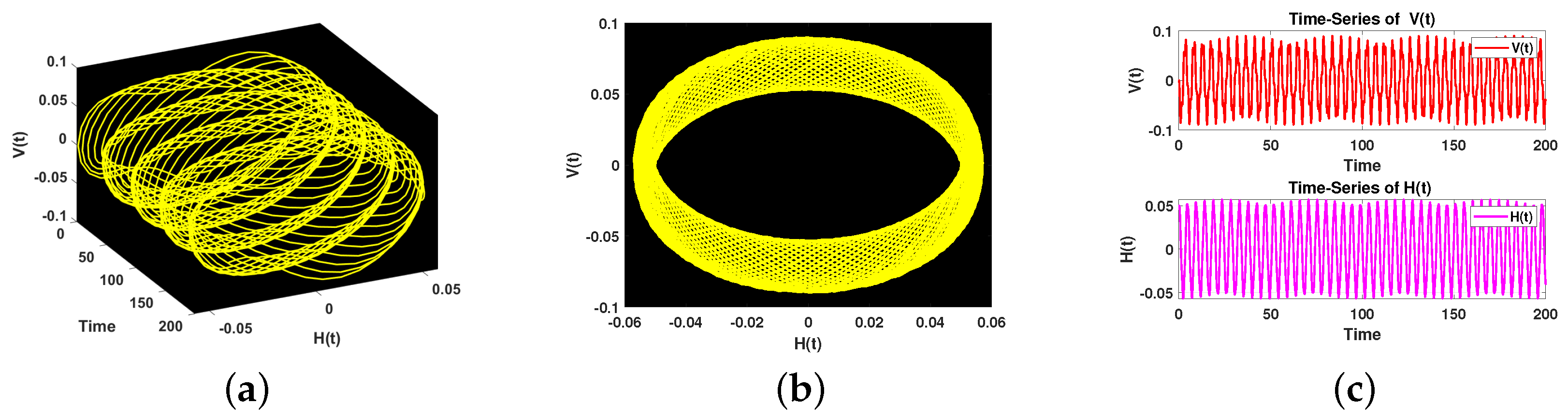
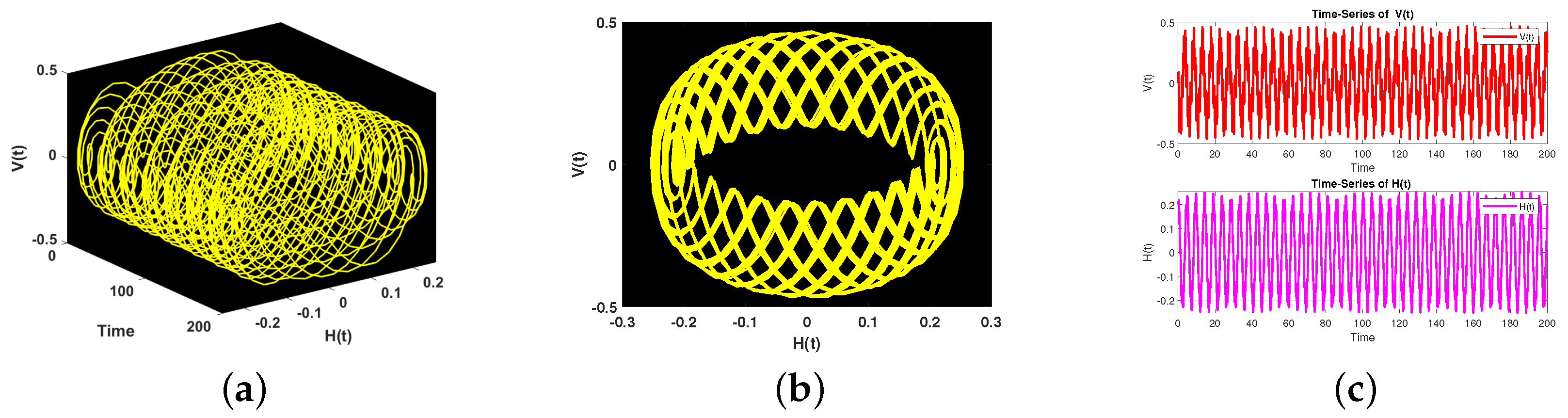
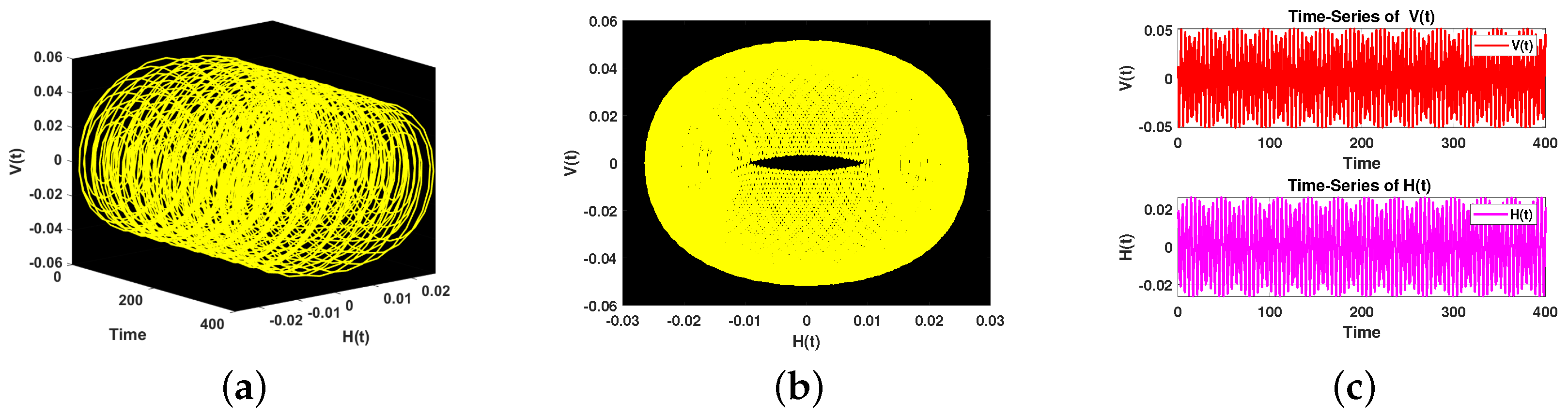
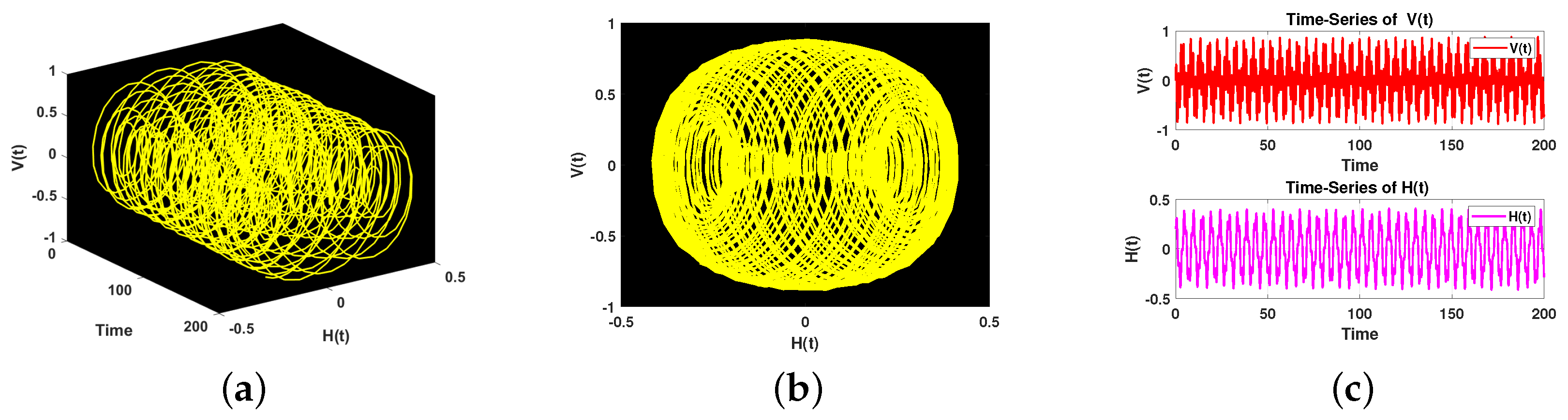
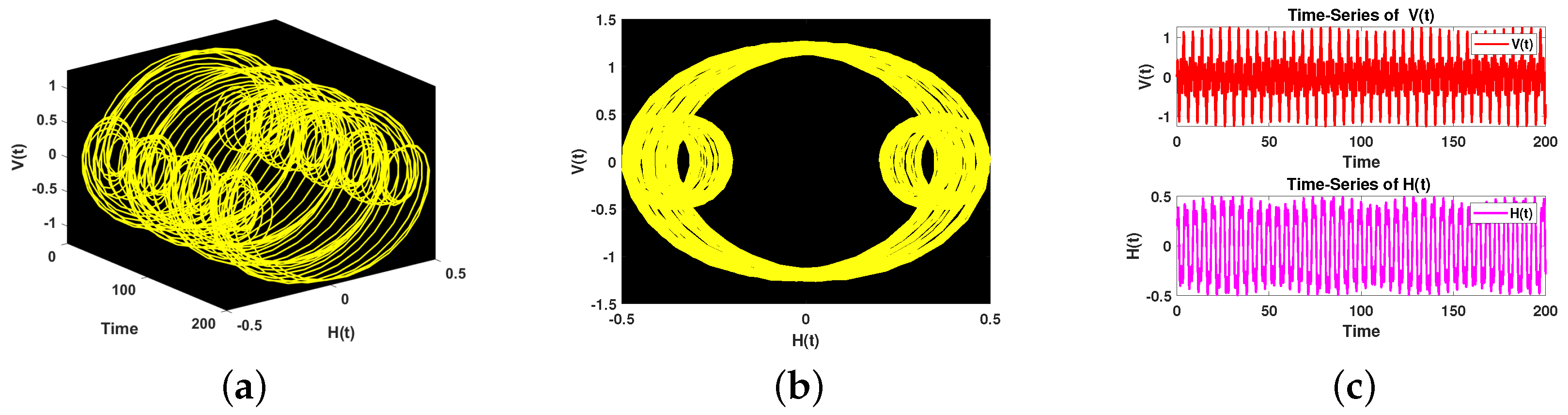
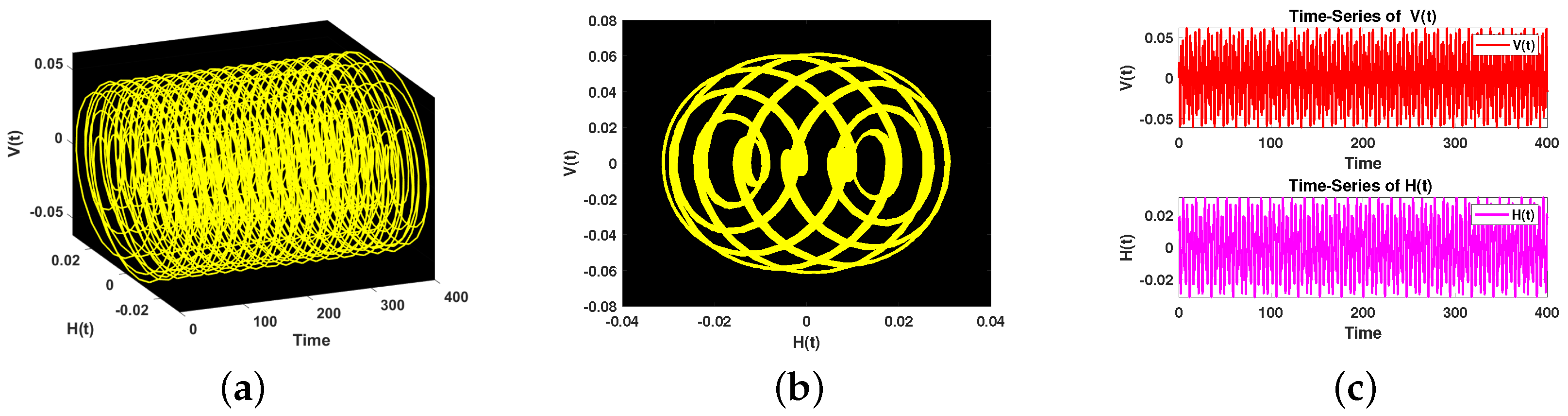
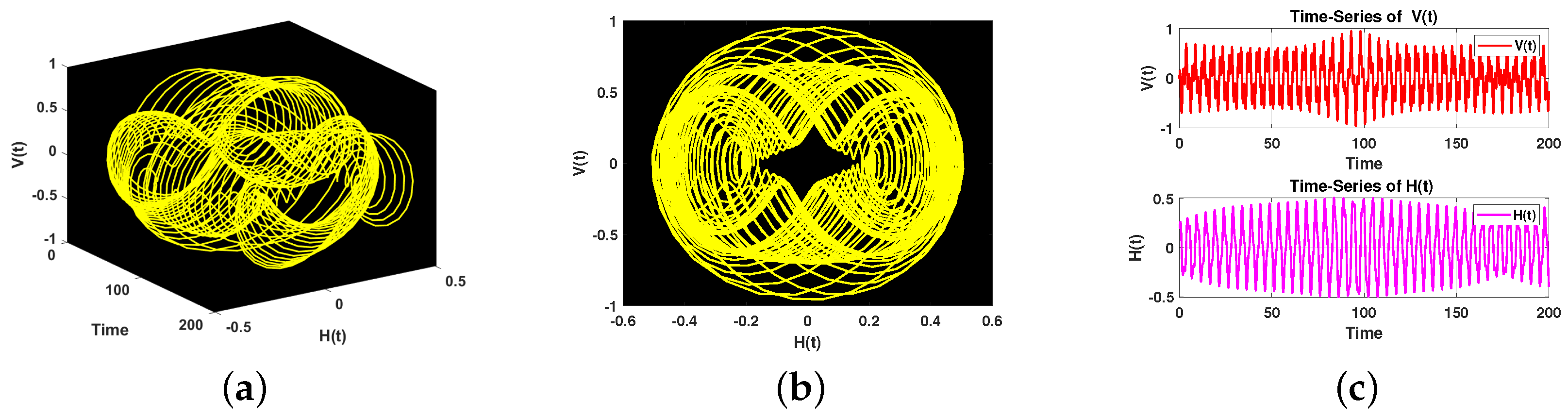
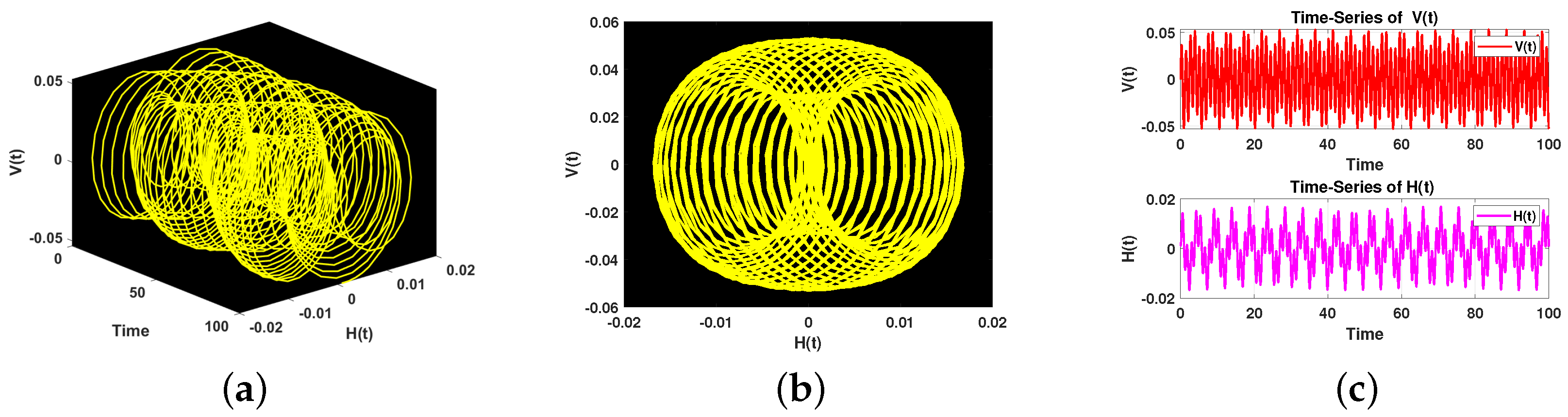
Figure 1, Figure 2, Figure 3, Figure 4, Figure 5, Figure 6, Figure 7 and Figure 8 present a thorough analysis of turbulent behavior in a nonlinear dynamical system. The system parameters are specified as c 1 = 2 ,   c 2 = 0.5 ,   μ = 0.2 ,   κ = 0.17 ,   p = 1.2 , and β = 2.17 , all of which influence the sensitivity and intricate response of the system. Nonetheless, θ and δ dictate the frequency and amplitude of the periodic component. Each image comprises three visual elements: (a) three-dimensional phase-space trajectories, (b) two-dimensional projections of the attractor, and (c) time-series graphs of state-related variables. Collectively, these elements offer a comprehensive and intricate view of the system’s dynamic evolution.
The 3D phase pictures exhibit significant variation in the structure and topology of the attractors, illustrating the intensification, relaxation, or bifurcation of chaotic activity as parameters are adjusted. Figure 1 commences with a rather smooth, quasi-toroidal configuration, wherein the route tightly coils without self-intersection, indicating a mild chaotic regime. In Figure 2, the attractor exhibits a markedly increased degree of folding and density, characterized by intersecting lobes and a more compact geometry, signifying an intensification of chaotic complexity. This alteration is primarily attributable to the increase in the forcing amplitude θ , which introduces greater nonlinearity into the system. Figure 3 displays a more flattened attractor with distinct rotational symmetry, suggesting a partial reversion to quasi-periodicity, indicative of a transient suppression of chaos. According to Figure 4, the attractor becomes increasingly complex, featuring layered layers and loop-like formations that signify a revival in chaotic modulation. Figure 5 and Figure 6 present more symmetrical, frequently dual-lobed geometries that indicate an underlying periodicity disrupted by irregular transitions—implying occasional chaos or a boundary state between order and disorder. Figure 7 and Figure 8 illustrate the attractors becoming progressively intertwined and volumetrically complex, indicative of profound chaotic dynamics characterized by multi-directional stretching and folding, which are characteristic of odd attractors in high-dimensional systems.
The 2D projections in subfigures (b) over all Figure 1, Figure 2, Figure 3, Figure 4, Figure 5, Figure 6, Figure 7 and Figure 8 are an effective means of seeing the underlying phase-space mechanics from a condensed perspective. In previous illustrations, including Figure 1 and Figure 3, the two-dimensional representations exhibit nested loops with very uniform spacing, thus confirming the perception of weak chaos or near-periodic activity. Figure 2 and Figure 4 exhibit increasingly intricate projections, characterized by overlapping trajectories and denser fill patterns—indicative of chaotic stretching and folding. Figure 5, Figure 6 and Figure 7 prominently display attractors manifesting as double-lobed or toroidal structures, perhaps indicative of period-doubling bifurcations or torus breakdowns, phenomena frequently associated with the emergence of chaos. These projections elucidate transitions that are less discernible in 3D, facilitating the identification of structural changes generated by bifurcation.
The time-series graphs in Figure 1, Figure 2, Figure 3, Figure 4, Figure 5, Figure 6, Figure 7 and Figure 8c provide additional insight into the system’s temporal dynamics. Figure 1 illustrates a time series exhibiting a constrained yet erratic oscillation pattern with moderate amplitude modulation, characteristic of nascent chaotic systems. In Figure 2 and Figure 4, the amplitude of oscillations escalates, resulting in a more erratic and non-periodic signal, indicative of heightened chaos and increased energy dispersion within the system. In Figure 3, although the system remains chaotic, the time series exhibits increased rhythmically, reflecting the visually simpler attractor in the phase plots. Figure 5 and Figure 6 demonstrate abrupt alterations in waveform symmetry and periodic bursts intermingled with irregular intervals, indicative of intermittent chaos. Figure 7’s time series exhibits sporadic, erratic activity characterized by sudden amplitude fluctuations, but Figure 8, with external forcing θ = 0 , displays a fully realized chaotic signal only governed by internal nonlinear interactions, devoid of external modulation.
In summary, the data offer a clear and multifaceted depiction of a nonlinear system’s progression through many chaotic regimes. The 3D attractors encapsulate the geometric structure and intricacy of chaos, while the 2D projections facilitate the identification of symmetry and bifurcation-induced transitions, and the time-series plots reveal the erratic temporal behavior typical of chaotic systems. The transition from Figure 1, Figure 2, Figure 3, Figure 4, Figure 5, Figure 6, Figure 7 and Figure 8 illustrates the system’s significant sensitivity to parameter fluctuations, particularly θ and δ , and embodies fundamental concepts of nonlinear dynamics and chaos theory, including sensitivity to initial conditions, bifurcations, and weird attractors. Each visual representation enhances the others, creating a comprehensive depiction of the system’s complex and unpredictable dynamic landscape.

5. Sensitivity Analysis

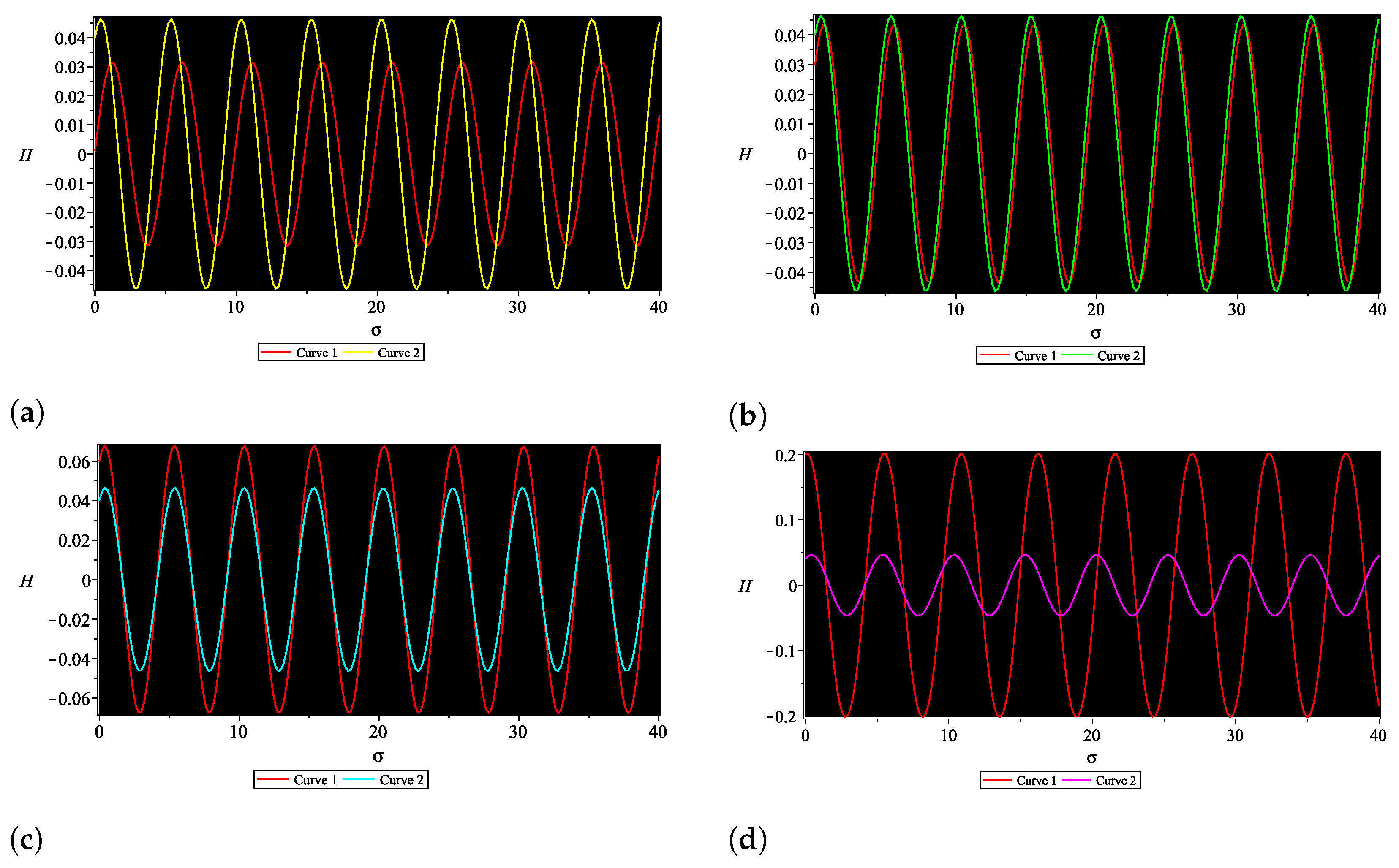
This section will analyze quasi-periodic and periodic responses using sensitivity analysis of the dynamical structure’s results, employing a range of initial conditions in system (33). Figure 9 presents a comprehensive sensitivity analysis of a nonlinear dynamical system under several initial circumstances, demonstrating the significant influence of small perturbations on the system’s temporal history. Each Figure 9a–d illustrates two solution trajectories (Curve 1 and Curve 2) of the system variable H.
  • The function H ( σ ) as a function of the time-like parameter σ , given various pairs of beginning values. Notwithstanding the minor discrepancies in initial conditions, the resultant trajectories demonstrate significantly divergent behaviors, particularly in panels (Figure 9c,d), highlighting the system’s sensitive dependency on initial states, an intrinsic characteristic of nonlinear and potentially chaotic systems. The sensitivity is determined by a parameterized model with c 1 = 0.2 ,   c 2 = 0.5 ,   μ = 1.3 ,   κ = 0.6 , p = 0.4 , and β = 0.5 , which presumably delineate the intensity of nonlinearity, damping, and external forcing within the system. As the initial perturbation amplitude escalates, the divergence between curves becomes increasingly evident, especially in amplitude and phase, indicating a shift from near-linear to markedly nonlinear dynamics. This approach is essential for comprehending the robustness, predictability, and long-term behavior of physical systems represented by differential equations in several domains, including mechanical oscillations and wave propagation in nonlinear media.
Figure 9. Sensitivity analysis of the system (33) for c 1 = 0.2 , c 2 = 0.5 , μ = 1.3 , κ = 0.6 , p = 0.4 , and β = 0.5 . Each subfigure compares the time evolution of two trajectories with slightly perturbed initial conditions, demonstrating divergence due to chaotic sensitivity. (a) Trajectories generated from the starting points H ( 0 ) = 0.01 , V ( 0 ) = 0 and H ( 0 ) = 0.015 , V ( 0 ) = 0 . (b) Time evolution corresponding to the initial pairs H ( 0 ) = 0.03 , V ( 0 ) = 0.04 and H ( 0 ) = 0.04 , V ( 0 ) = 0.03 . (c) Results of sensitivity analysis for curve 1 and curve 2 at values of ( 0.06 , 0.04 ) and ( 0.04 , 0.03 ) , respectively. (d) Comparative curves obtained from the initial conditions H ( 0 ) = 0.20 , V ( 0 ) = 0.04 and H ( 0 ) = 0.04 , V ( 0 ) = 0.03 .
Symmetry 17 02129 g009

6. Results and Discussion

Several analytical solutions derived in this study contain the terms under square roots. To ensure real-valued and physically meaningful insight, the arguments of all such radicals must remain strictly positive. For each term of the form F ( x , t ) , the condition F ( x , t ) > 0 must hold.
Some solutions involve the hyperbolic and trigonometric functions such as c o t h ( ξ ) , c s c h ( ξ ) , c s c ( ξ ) , and related expressions. Since these functions possess singularities at specific arguments and therefore the solutions are valid only when the associated arguments lie outside those singular points. c o t h ( ξ ) , c s c h ( ξ ) , c s c ( ξ ) . c s c h ( ξ ) diverges at ξ = 0 ; hence the solution is defined only for ξ 0 , or equivalently ( κ x ω t + δ ) 0 . The function c s c ( ξ ) is singular when s i n ( ξ ) = 0 . Therefore, the solution is valid only when ξ n π , n Z . Since s e c ( ξ ) diverges when c o s ( ξ ) = 0 , the solution is valid only when ξ n + 1 2 π , n Z . All singular points of the special functions must be excluded from the argument ξ = κ x ω t + δ .
To determine the significance of the current nonlinear Schrödinger model, appropriate values of the physical parameters are selected. Distinct graphs are utilized to illustrate the characteristics of the novel optical solutions and to enhance the understanding of their physical implications. The effects of varying the temporal parameter on the different types of exact solutions are also demonstrated.
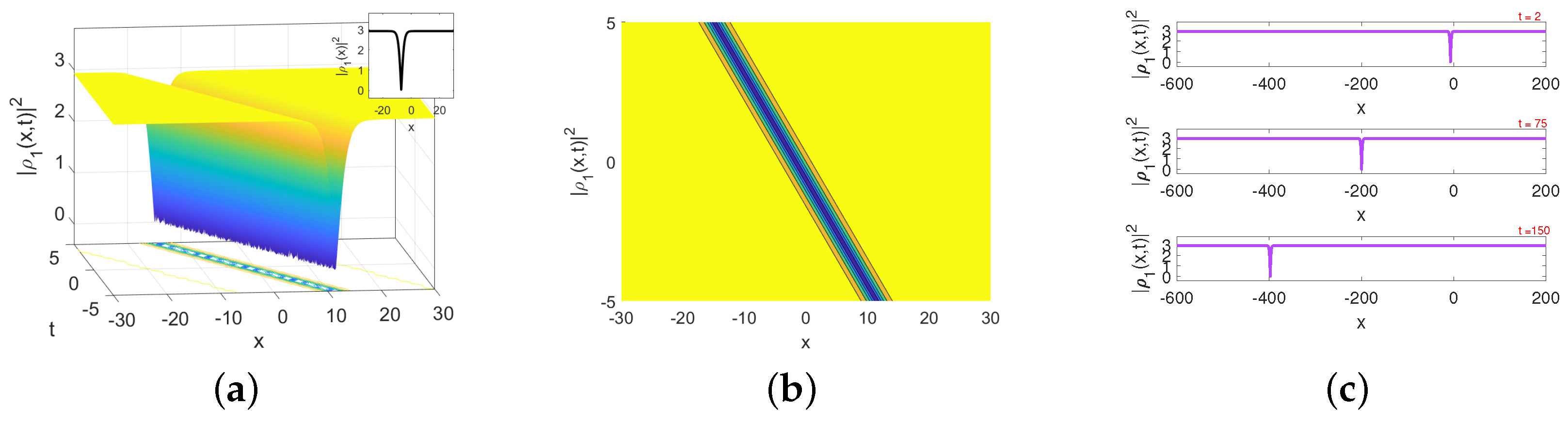
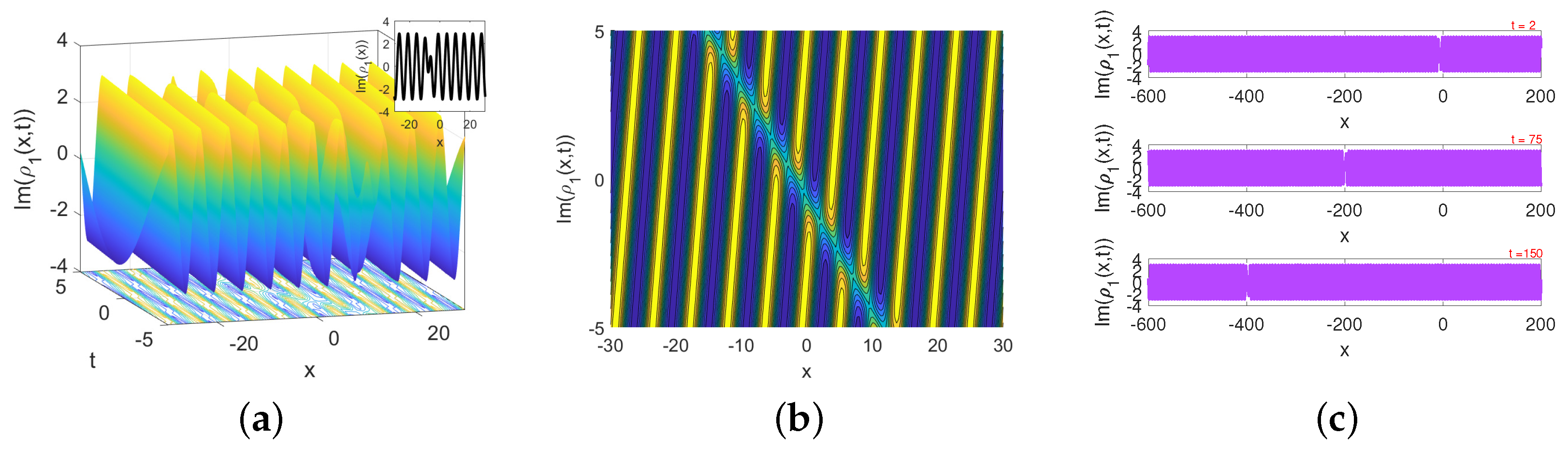
Figure 10 and Figure 11 present the soliton dynamics of the squared modulus | ρ 1 ( x , t ) | 2 and the imaginary part I m ( ρ 1 ( x , t ) , respectively, for a specific solution to the cubic–quintic NLSE in a weakly nonlocal medium. These visualizations are generated under the parameter settings p 0 = 1.2 ,   κ 1 = 1.1 ,   β = 0.4 ,   c 2 = 0.1 ,   ε = 1.2 , and σ 0 = 1.7 , highlighting different physical aspects of the wave solution.
Figure 10a displays the 3D profile of the dark soliton | ρ 1 ( x , t ) | 2 , demonstrating a localized intensity dip that remains spatially confined and temporally stable, a hallmark of dark soliton behavior in defocusing media. Figure 10b presents the corresponding 2D contour plot, reinforcing the soliton’s steady propagation along a linear trajectory in the x t plane. Figure 10c depicts cross-sectional intensity profiles at fixed times, confirming the soliton’s consistent amplitude and shape over time, indicative of robust soliton stability under the chosen conditions.
Figure 11a illustrates the 3D wave profile of the imaginary part, revealing periodic solitary waves that represent internal phase dynamics of the optical field. These oscillations are further accentuated in Figure 11b, a 2D contour plot that shows alternating wave-fronts propagating along the spatial axis, reflecting the wave-like nature of the imaginary component. Figure 11c capture temporal slices of I m ( ρ 1 ( x , t ) , highlighting its coherent yet oscillatory structure over time and space.
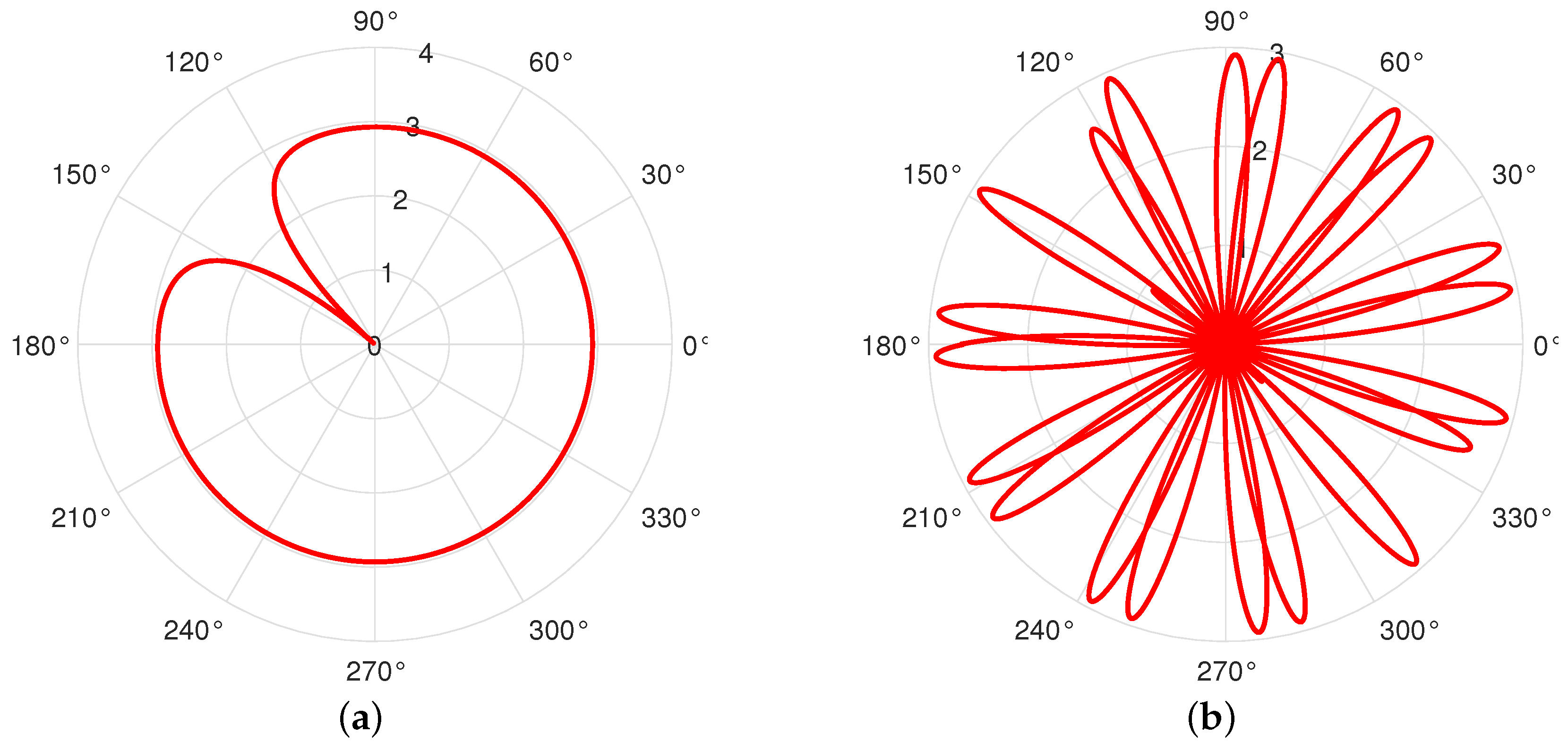
Together, these figures demonstrate the interplay between the soliton’s intensity (Figure 10) and its phase or complex dynamics (Figure 11). While | ρ 1 ( x , t ) | 2 governs the energy localization and transport, I m ( ρ 1 ( x , t ) offers insights into wave interference and phase modulation. These complementary visualizations confirm the analytical results and provide a deeper understanding of soliton propagation in higher-order nonlinear optical systems with weak nonlocality. The graphical representations in Figure 10 and Figure 11 serve as crucial tools for understanding the behavior of optical solitons in weakly nonlocal nonlinear media. These figures illustrate how light beams, governed by high-order nonlinear Schrödinger equations, evolve under various conditions, offering practical insights into real-world optical systems. In particular, the intensity profile | ρ 1 ( x , t ) | 2 reveals the spatial localization and stability of soliton structures, which is essential for controlling beam propagation in nonlinear waveguides and optical fibers. Meanwhile, the imaginary part I m ( ρ 1 ( x , t ) captures the internal phase dynamics, shedding light on interference patterns, phase shifts, and modulation effects. Figure 12 presents the polar plots of | ρ 1 ( x ) | 2 and I m ( ρ 1 ( x ) , offering a circular representation of the spatial characteristics of the optical soliton solution under the parameters p 0 = 1.2 ,   κ 1 = 1.1 ,   β = 0.4 ,   c 2 = 0.1 ,   ε = 1.2 , and σ 0 = 1.7 .  Figure 12a displays the polar profile of the intensity | ρ 1 ( x ) | 2 , revealing a smooth, symmetric pattern. The shape indicates that the soliton maintains a consistent amplitude distribution over the spatial domain, supporting the interpretation of a stable dark soliton. The lack of rapid oscillations or irregularities suggests minimal distortion or modulation, which is desirable in applications requiring robust signal transmission or beam propagation. Figure 12b shows the polar plot of the imaginary part I m ( ρ 1 ( x ) , exhibiting a denser, petal-like structure. The multiple lobes and sharp transitions in the plot indicate a rich internal phase structure and stronger wave oscillations compared to the intensity profile. This pattern is a direct reflection of the wave’s complex behavior in phase space, revealing modulation and interference effects inherent in the imaginary component of the wave function.

7. Conclusions

In this work, we employed the modified F-expansion method to construct a range of novel optical soliton solutions for a nonlinear Schrödinger equation formulated in weakly nonlocal media. Through detailed analysis of 2D and 3D graphical simulations, we examined the dynamic behavior of these solutions under various temporal conditions by selecting appropriate physical parameter values. The study yielded multiple classes of exact solutions, including singular solitons, dark solitons, bright solitons, and periodic wave solitons. Additionally, to gain deeper insights into the system’s qualitative behavior, we employed chaos and sensitivity theories, which revealed the emergence of complex chaotic dynamics under perturbations. These findings highlight the flexibility and depth of the proposed model in capturing nonlinear wave behavior. The novelty of this work resides in establishing new analytical soliton families and elucidating the system’s chaotic and bifurcation behavior through a comprehensive dynamical investigation. Overall, this work advances the theoretical framework of soliton dynamics in weakly nonlocal optical systems and provides a foundation for potential applications in nonlinear photonics and optical communication technologies, including soliton control, optical switching, and the stabilization of beam propagation in weakly nonlocal media.

Author Contributions

Z.A.A.A.S.: Validation, Funding, Project administration; M.A.S.M.: Formal analysis, Methodology, and Writing—review; F.M.O.: Methodology, and review; A.H.T.: Methodology, Methodology and review; K.F.: Investigation, Supervision, Formal analysis, and editing. All authors have read and agreed to the published version of the manuscript.

Funding

This research received no external funding.

Data Availability Statement

All data supporting the findings of this study are included within the article. The original results presented here are fully contained in this publication, and any further inquiries may be directed to the corresponding author.

Acknowledgments

The authors extend their appreciation to the Deanship of Research and Graduate Studies at King Khalid University, KSA, for supporting this work through the General Research Project under grant number (GRP/19/46).

Conflicts of Interest

The authors declare that they have no conflicts of interest.

Nomenclature

xTransverse spatial coordinate
tLongitudinal propagation coordinate
I ( x , t ) = | ρ ( x , t ) | 2 Optical intensity distribution
ρ ( x , t ) Slowly varying complex envelope of the optical field
K ( I ) Nonlinear refractive index modulation
Δ K ( I ) Variation in nonlinear refractive index
F ( I ) Nonlinear response function of the medium
A ( x ) Nonlocal response kernel
c 1 Coefficient of cubic nonlinearity
c 2 Coefficient of quintic nonlinearity
μ Degree of nonlocality parameter
pTransverse velocity of the traveling wave
κ Wave number
β Frequency shift
ε Constant phase term
σ = x + 2 p κ t Traveling-wave coordinate
H ( σ ) Real amplitude function of the traveling wave
G ( σ ) Auxiliary function in the F-expansion method
A ,   B ,   C Constants in the auxiliary differential equation for G ( σ )
λ 0 ,   λ 1 ,   λ 2 Expansion coefficients in the F-expansion series
η 1 ,   η 2 ,   η 3 ,   η 4 System parameters derived from c 1 , c 2 , p , β , κ , μ
θ Amplitude of external periodic forcing
δ Frequency of external periodic forcing
VAuxiliary variable, V = H
ζ Transformed variable to remove singularity in
dynamical system
L = i ( β t κ x + ε ) Complex phase term
G ( σ ) = A + B G ( σ ) + C G 2 ( σ ) Auxiliary differential equation for G ( σ )
σ 0 Phase shift constant
| ρ 1 ( x , t ) | 2 Intensity profile of soliton solution
I m ( ρ 1 ( x , t ) ) Imaginary (phase) part of soliton solution
R e ,   I m ,   A b s Real, Imaginary, and Absolute components of
wave structures
CQNLSCubic–Quintic Nonlinear Schrödinger Equation
NLMNonlocal Medium
ODEOrdinary Differential Equation
NLPDENonlinear Partial Differential Equation
FEMF-Expansion Method
SMMSardar Sub-Equation Method
BAMBifurcation Analysis Method
SASensitivity Analysis
LBLocalized Beam/Optical Soliton Structure

References

  1. Rahioui, M.; El Kinani, E.H.; Ouhadan, A. Bäcklund Transformations, Consistent Tanh Expansion Solvability, Interaction Solutions, and Some Exact Solitary Waves of a (3+1)-Dimensional P-Type Evolution Equation. Int. J. Theor. Phys. 2025, 64, 187. [Google Scholar] [CrossRef]
  2. Li, Z.; Hussain, E. Qualitative analysis and traveling wave solutions of a (3+1)-Dimensional Generalized Nonlinear Konopelchenko-Dubrovsky-Kaup-Kupershmidt System. Fractal Fract. 2025, 9, 285. [Google Scholar] [CrossRef]
  3. Zhao, F.; Zhang, L. Chaotic Phenomenon, Variational Principle, Hamiltonian, Phase Portraits, Bifurcation Analysis and Diverse Soliton Solutions of the Unstable Schrödinger Equation Involving Kerr Law in Optical Fibers. Int. J. Theor. Phys. 2025, 64, 184. [Google Scholar] [CrossRef]
  4. Iqbal, M.A.; Gepreel, K.A.; Akbar, M.A.; Osman, M.S. The Compatibility and Dynamics of Optical Soliton Solutions for Higher-Order Nonlinear Schrödinger Model. Mod. Phys. Lett. B 2025, 39, 2550086. [Google Scholar] [CrossRef]
  5. Alam, N.; Ullah, M.S.; Manafian, J.; Mahmoud, K.H.; Alsubaie, A.S.A.; Ahmed, H.M.; Ahmed, K.K.; Al Khatib, S. Bifurcation Analysis, Chaotic Behaviors, and Explicit Solutions for a Fractional Two-Mode Nizhnik-Novikov-Veselov Equation. AIMS Math. 2025, 10, 4558–4578. [Google Scholar] [CrossRef]
  6. Islam, S.M.R.; Arafat, S.M.Y.; Inc, M. Exploring Novel Optical Soliton Solutions for the Stochastic Chiral Nonlinear Schrödinger Equation. J. Nonlinear Opt. Phys. Mater. 2025, 34, 2450009. [Google Scholar] [CrossRef]
  7. Polyanin, A.D.; Kudryashov, N.A. Closed-Form Solutions of the Nonlinear Schrödinger Equation with Arbitrary Dispersion and Potential. Chaos Solitons Fractals 2025, 191, 115822. [Google Scholar] [CrossRef]
  8. Hossain, M.D.; Boulaaras, S.M.; Saeed, A.M.; Gissy, H.; Hossain, M.N.; Miah, M.M. New Investigation on Soliton Solutions of Two Nonlinear PDEs with Dynamical Property. Open Phys. 2025, 23, 20250155. [Google Scholar] [CrossRef]
  9. Hussain, E.; Aljethi, R.A.; Farooq, K.; Younas, U. Optical multi-peakon dynamics in the fractional cubic–quintic nonlinear pulse propagation model using a novel integral approach. Fract. Fract. 2025, 9, 631. [Google Scholar] [CrossRef]
  10. Hontinfinde, R.D.; Ayela, M.A.; Edah, G. Dynamics of Optical Soliton Solutions Parameters for Hirota Equation by Variational Principle. Opt. Fiber Technol. 2024, 88, 104026. [Google Scholar] [CrossRef]
  11. AlQahtani, S.A.; Alngar, M.E.M.; Shohib, R.M.A.; Alawwad, A.M. Enhancing the Performance and Efficiency of Optical Communications through Soliton Solutions. J. Opt. 2024, 53, 3581–3591. [Google Scholar] [CrossRef]
  12. Iqbal, M.; Lu, D.; Seadawy, A.R.; Zhang, Z. Nonlinear Behavior of Dust Acoustic Periodic Soliton Structures. Results Phys. 2024, 59, 107533. [Google Scholar] [CrossRef]
  13. Asghar, U.; Asjad, M.I.; Hamed, Y.S.; Akgul, A.; Hassani, M.K. New Exact Soliton Wave Solutions in Optical Fibers via Sardar Sub-Equation and New Auxiliary Equation Techniques. Sci. Rep. 2025, 15, 4396. [Google Scholar] [CrossRef] [PubMed]
  14. Ahmad, J.; Hameed, M.; Mustafa, Z.; Rehman, S.U. Soliton Patterns in the Truncated M-Fractional Resonant Nonlinear Schrödinger Equation via Modified Sardar Sub-Equation Method. J. Opt. 2024, 54, 1118–1139. [Google Scholar] [CrossRef]
  15. Shahid, N.; Baber, M.Z.; Shaikh, T.S.; Iqbal, G.; Ahmed, N.; Akgül, A.; De la Sen, M. Dynamical Study of Groundwater Systems Using the New Auxiliary Equation Method. Results Phys. 2024, 58, 107444. [Google Scholar] [CrossRef]
  16. Hashemi, M.S.; Bayram, M.; Riaz, M.B.; Baleanu, D. Bifurcation Analysis and Exact Solutions of the Two-Mode Cahn–Allen Equation. Results Phys. 2024, 64, 107882. [Google Scholar] [CrossRef]
  17. Ali, M.H.; El-Owaidy, H.M.; Ahmed, H.M.; El-Deeb, A.A.; Samir, I. Optical Solitons for Fourth Order Nonlinear Schrödinger’s Equation. Ain Shams Eng. J. 2024, 15, 102413. [Google Scholar] [CrossRef]
  18. Khalil, T.A.; Ahmed, H.M.; Ahmed, K.K.; Emadifar, H.; Rabie, W.B. Innovative Optical Solitons and Other Exact Wave Solutions for Coupled Systems of new Nonlocal LPDE Using Improved Modified Extended tanh Technique. Results Opt. 2025, 21, 100853. [Google Scholar] [CrossRef]
  19. Miah, S.S.; Akbar, M.A.; Khan, K. Solitary wave solutions and stability analysis of the fractional Sawada-Kotera equation using the extended modified auxiliary equation mapping method. J. Umm Al-Qura Univ. Appl. Sci. 2025, 2025, 1–14. [Google Scholar] [CrossRef]
  20. Kundu, P.R.; Fahim, M.R.A.; Islam, M.E.; Akbar, M.A. The Sine-Gordon Expansion Method for Higher-Dimensional NLEEs and Parametric Analysis. Heliyon 2021, 7, e06459. [Google Scholar] [CrossRef]
  21. Ghanbari, B.; Inc, M. A New Generalized Exponential Rational Function Method for the Resonance Nonlinear Schrödinger Equation. Eur. Phys. J. Plus 2018, 133, 142. [Google Scholar] [CrossRef]
  22. Hussain, E.; Aljethi, R.A.; Farooq, K.; Shah, S.A.A. Lie symmetry analysis, rogue waves, and lump waves of nonlinear integral Jimbo–Miwa equation. Symmetry 2025, 17, 1717. [Google Scholar] [CrossRef]
  23. Mustafa, M.A. Soliton solutions for time-fractional (3+1)-dimensional nonlinear Schrödinger equation with cubic-quintic nonlinearity terms. Int. J. Comput. Math. 2025, 102, 1428–1442. [Google Scholar] [CrossRef]
  24. Schürmann, H.W. Traveling-Wave Solutions of the Cubic-Quintic Nonlinear Schrödinger Equation. Phys. Rev. E 1996, 54, 4312. [Google Scholar] [CrossRef]
  25. Butt, A.R.; Fatima, T.; Chahlaoui, Y.; Baleanu, D.; Bekir, A. Dynamics of Fractional Optical Solitons in Cubic–Quintic–Septimal Nonlinear Schrödinger Equations. Appl. Phys. B 2025, 131, 101. [Google Scholar] [CrossRef]
  26. Soliman, M.; Ahmed, H.M.; Badra, N.M.; Samir, I.; Radwan, T.; Ahmed, K.K. Fractional Wave Structures in a Higher-Order Nonlinear Schrödinger Equation with Cubic–Quintic Nonlinearity and β-Fractional Dispersion. Fractal Fract. 2025, 9, 522. [Google Scholar] [CrossRef]
  27. Mustafa, M.A.; Murad, M.A.S. Optical Solutions of the Nonlinear Conformable Schrödinger Equation in Weakly Non-Local Media Using Two Distinct Analytic Methods. Nonlinear Dyn. 2025, 113, 20105–20119. [Google Scholar] [CrossRef]
  28. Celik, E.G.; Antar, N. Bifurcation structure and stability of solitary waves in the cubic–quintic nonlinear Schrödinger equation with self-steepening. Eur. Phys. J. Plus 2025, 140, 1104. [Google Scholar] [CrossRef]
  29. Mahmood, A.; Rehman, H.U.; Razzaq, S.; Rashid, J.; Rezazadeh, H.; Karaca, Y.; Hosseinzadeh, M.A. Exact Solutions of Cubic-Quintic-Septimal Nonlinear Schrödinger Wave Equation. Opt. Quantum Electron. 2024, 56, 1096. [Google Scholar] [CrossRef]
  30. Arshad, M.; Yasin, F.; Aldosary, S.F.; Rezazadeh, H.; Farman, M.; Hosseinzadeh, M.A. Rational function solutions of higher order dispersive cubic quintic nonlinear Schrödinger dynamical model and its applications in fiber optics. Math. Methods Appl. Sci. 2025, 48, 5300–5314. [Google Scholar] [CrossRef]
  31. Lou, Y. Interactions of breather and rogue wave on the periodic background for the coupled cubic quintic nonlinear Schrödinger equations in nonlinear optics. Nonlinear Dynamics 2025, 113, 15347–15362. [Google Scholar] [CrossRef]
  32. Jazaa, Y.; Iqbal, M.; Seadawy, A.R.; Alqahtani, S.; Rajhi, A.A.; Boulaaras, S.M.; Az-Zo’bi, E.A. Exploration of Solitary Wave Structures to the Nonlinear Landau–Ginsberg–Higgs Equation. Opt. Quantum Electron. 2024, 56, 1181. [Google Scholar] [CrossRef]
  33. Farooq, K.; Abdullah, A.R.; Hussain, E.; Murad, M.A.S. Chaos, Lyapunov Exponent, and Sensitivity Demonstration of the Coupled Nonlinear Integrable Model with Soliton Solutions. AIMS Math. 2025, 10, 22929–22957. [Google Scholar] [CrossRef]
Figure 1. Chaotic behavior of the system (34) for c 1 = 2 , c 2 = 0.5 , μ = 0.2 , κ = 0.17 , p = 1.2 , β = 2.17 , θ = 0.09 , and δ = 5.2 . (a) 3D chaotic attractor, (b) corresponding 2D projection, and (c) temporal evolution showing sensitivity to initial conditions.
Symmetry 17 02129 g001
Figure 2. Chaotic behavior of the system (34) for c 1 = 2 , c 2 = 0.5 , μ = 0.2 , κ = 0.17 , p = 1.2 , β = 2.17 , θ = 1.09 , and δ = 6.8 . (a) 3D chaotic attractor, (b) 2D phase projection, and (c) time series showing the system’s sensitive dependence on initial conditions.
Symmetry 17 02129 g002
Figure 3. Chaotic behavior of the system (34) for c 1 = 2 , c 2 = 0.5 , μ = 0.2 , κ = 0.17 , p = 1.2 , β = 2.17 , θ = 0.09 , and δ = 4.2 . (a) 3D chaotic attractor, (b) 2D phase projection, and (c) temporal evolution indicating irregular oscillations due to parameter variation.
Symmetry 17 02129 g003
Figure 4. Chaotic behavior of the system (34) for c 1 = 2 , c 2 = 0.5 , μ = 0.2 , κ = 0.17 , p = 1.2 , β = 2.17 , θ = 2.09 , and δ = 4.8 . (a) 3D chaotic attractor, (b) 2D phase portrait, and (c) time series illustrating irregular oscillations and sensitivity to parameter θ .
Symmetry 17 02129 g004
Figure 5. Chaotic behavior of the system (34) for c 1 = 2 , c 2 = 0.5 , μ = 0.2 , κ = 0.17 , p = 1.2 , β = 2.17 , θ = 2.2 , and δ = 3.8 . (a) 3D chaotic attractor, (b) 2D phase trajectory, and (c) time evolution exhibiting irregular oscillations with strong parameter sensitivity.
Symmetry 17 02129 g005
Figure 6. Chaotic behavior of the system (34) for c 1 = 2 , c 2 = 0.5 , μ = 0.2 , κ = 0.17 , p = 1.2 , β = 2.17 , θ = 0.09 , and δ = 3.2 . (a) 3D chaotic attractor, (b) 2D phase projection, and (c) temporal evolution showing high sensitivity and irregular oscillations.
Symmetry 17 02129 g006
Figure 7. Chaotic behavior of the system (34) for c 1 = 2 , c 2 = 0.5 , μ = 0.2 , κ = 0.17 , p = 1.2 , β = 2.17 , θ = 1.09 , and δ = 3.8 . (a) 3D chaotic attractor, (b) 2D projection in the phase space, and (c) time series illustrating the irregular and sensitive evolution of the state variable.
Symmetry 17 02129 g007
Figure 8. Chaotic behavior of the system (34) for c 1 = 2 , c 2 = 0.5 , μ = 0.2 , κ = 0.17 , p = 1.2 , β = 2.17 , θ = 0.2 , and δ = 5.2 . (a) 3D chaotic attractor, (b) 2D phase portrait, and (c) time series illustrating irregular oscillations indicating sensitivity to initial conditions.
Symmetry 17 02129 g008
Figure 10. The Dark soliton intensity profile | ρ 1 ( x , t ) | 2 for the weakly nonlocal cubic–quintic NLSE. The 3D surface plot (a), contour map (b), and time-evolution slices (c) illustrate the formation, propagation, and stability of the dark soliton under the parameter set p = 1.2 , κ = 1.1 , β = 0.4 , c 2 = 0.1 , ε = 1.2 , and σ 0 = 1.7 .
Symmetry 17 02129 g010
Figure 11. Periodic soliton intensity profile | ρ 2 ( x , t ) | 2 for the weakly nonlocal cubic–quintic NLSE. The 3D surface plot (a), contour map (b), and time-evolution slices (c) illustrate the formation, propagation, and stability of the bright soliton under the parameter set p = 1.2 , κ = 1.1 , β = 0.4 , c 2 = 0.1 , ε = 1.2 , and σ 0 = 1.7 .
Symmetry 17 02129 g011
Figure 12. Polar plots of (a) | ρ 1 ( x ) | 2 and (b) Im ( ρ 1 ( x ) ) with parameters p 0 = 1.2 , κ 1 = 1.1 , β = 0.4 , c 2 = 0.1 , ε = 1.2 , and σ 0 = 1.7 . These plots illustrate the angular variation in amplitude and imaginary components in weakly nonlocal media.
Symmetry 17 02129 g012
Disclaimer/Publisher’s Note: The statements, opinions and data contained in all publications are solely those of the individual author(s) and contributor(s) and not of MDPI and/or the editor(s). MDPI and/or the editor(s) disclaim responsibility for any injury to people or property resulting from any ideas, methods, instructions or products referred to in the content.