Abstract
Computational modeling offers a cost-effective approach to exploring complex geotechnical behavior. This study uses PLAXIS 2D finite element software to simulate nailed soil slopes under plane strain conditions, with models calibrated against laboratory-scale experiments involving a sand-filled Perspex box, steel nail reinforcements, and a rigid foundation. The soil mass, structural elements, and reinforcements are modeled using fifteen-node triangular elements, five-node plate elements, and two-node elastic spring elements, respectively. In this paper, parametric studies evaluate the influence of slope angles, mesh density, domain dimensions, constitutive models, and reinforcement configurations. Both prototype-scale and 3D-approximated models are included to assess scale effects and spatial behavior. The results highlight the significant impact of model size and material behavior, particularly when using the Hardening Soil model and its small-strain extension. Reinforcement optimization, including nail length reduction strategies, demonstrates the potential for maintaining slope stability while improving material efficiency. Validation against experimental data confirms that the numerical models accurately capture deformation patterns and internal stress development across different construction and loading phases. This study observed that the Hardening Soil (small-strain) material model significantly improved slope performance by reducing settlements and better capturing stress behavior, especially for steep slopes. Optimized redistribution of nail lengths across the slope depth enhanced stability while reducing reinforcement usage, demonstrating a cost-effective alternative to uniform configurations. The findings offer practical guidance for optimizing nailed slope stabilization in sandy soils, supporting safer and more economical geotechnical design for real-world applications.
1. Introduction
Reinforced soil systems offer a reliable method for stabilizing slopes and improving ground performance in civil engineering projects. Traditional analytical and physical modeling approaches often fall short in capturing the complex soil-reinforcement interaction. Finite element methods have become essential tools for analyzing geotechnical problems due to their ability to model complex material behavior and soil structure interaction. Numerous studies have explored different aspects of soil nailing through FEM. Panigrahi and Dhiman [1] examined the intricacies of soil reinforcement mechanisms and provided foundational design insights into soil nailing systems. Jeyaseelan and Madhavan [2] combined FEM with artificial intelligence, achieving high accuracy in predicting the bearing capacity of 3D-reinforced soils. Sundaravel and Dodagoudar [3] compared ABAQUS and PLAXIS for modeling reinforced retaining structures, highlighting the adequacy of the Mohr–Coulomb (MC) material model. Similarly, Zhou et al. [4] emphasized the importance of the nail layout and surface structures in slope stability through three-dimensional FEM. Lanzieri and Avesani [5] analyzed a soil-nailed vertical excavation in fine-grained soils within an urban area using finite element analysis. The study emphasized the importance of soil properties and nail configurations in ensuring excavation stability. Zhang et al. [6] proposed a system reliability analysis method for soil-nailed slopes, considering uncertainties in soil and nail properties, and introduced a response surface method to identify critical failure modes. Their approach enhances the assessment of slope stability under varying conditions. Mathew et al. [7] compared screw and smooth soil nails using finite element analysis, finding that screw nails enhance slope stability, especially under seismic loads, with optimal nail inclinations between 15 and 25°. This study provides insights into the design of more effective soil nail systems. Jaiswal et al. [8] utilized the Drucker–Prager model in finite element software Optum G2, to study nail length and inclination effects, recommending 4–6 m nails at 10–20° for optimal stability. Their findings contribute to the optimization of soil nail design parameters. Stauffer [9] has proposed finite element models for two- and three-dimensional slopes. The two-dimensional models employ quadratic quadrilateral elements to discretize the slope field and utilize the Drucker–Prager material model for slope soil. The three-dimensional models utilize continuum solid elements alongside Mohr–Coulomb failure criteria. The stability analysis of nailed soil slopes was examined by Singh et al. [10] using a limit equilibrium and finite difference coupled methods. Deng et al. [11] provide a simplified limit equilibrium approach to evaluate reinforced slopes’ stability, considering a nonlinear Mohr–Coulomb model for slip surface shear failure. Oliaei et al. [12] applied the mesh-free method to investigate the interaction between reinforcement and soil and found that the friction and adhesion at the interface reduce the soil mass strain and increase the stability of the nailed soil slope. Sharma and Ramkrishnan [13] used multiple regression analysis and finite element analysis to optimize soil nailing parameters. Kalehsar et al. [14] utilized FLAC3D for numerical modeling to investigate the behavior of nailed soil slopes under different loading conditions.
Numerous experimental studies that examine the behavior of soil-nailed slopes are available in literature. Sahoo et al. [15] investigated the dynamic behavior of reinforced soil slopes by shaking table experiments. From the study, they conclude that a smaller reinforcement inclination offers better results as compared to horizontal nails or nails with significant inclination in stabilizing soil slopes. Ye et al. [16] examined the effects of reinforcing and soil characteristics, such as nail size, length, and angle, as well as the friction coefficient at the nail and soil interfaces (grouting), on the pull-out force for nails in sandy soil. Mohamed et al. [17] constructed experimental models to investigate the impact of loading and nail characteristics on the behavior of nailed soil slopes. Various researchers highlight the effectiveness of PLAXIS in modeling soil-nailed slopes. Afitikhar and Aartati [18] have used PLAXIS 2D for analyzing soil nailing to restore the stability of the Cibeureum slope following the Cianjur effect produced by an earthquake. The original slope had a safety factor of 1.62 without seismic activity. Soil nails installed at 10°, 15°, and 20° angles slightly improved stability, but due to the distance from the slip surface, 50 m long nails were needed. The optimal design used a 19° slope angle with 50 m nails at a 20° angle, achieving safety factors of 2.55 without and 1.102 with an earthquake. Phan and Le [19] used PLAXIS 3D for a highway project, finding 25–27% higher safety factors than 2D models. Mohamed et al. [20] developed a finite element model to simulate various phases of the soil nailing process, including construction and loading phases, using PLAXIS software. The model was validated against laboratory tests, demonstrating its effectiveness in predicting slope displacements and stress conditions. A study by Pauzi et al. [21] compared PLAXIS 2D results with Limit Equilibrium Method (LEM) results, showing that FEM gives a more detailed stress–strain analysis, while LEM provides higher safety factors. Elahi et al. [22] have identified optimal nail inclinations (0–25°) and diminishing returns for lengths beyond L/H > 0.9. Gui and Rajak [23] have analyzed the footing loads on nailed excavations, showing greater deflections and lower safety with an increased load. Bahramipour et al. [24] have studied the stability of vertical excavation for various soil types, both cohesive and non-cohesive. They concluded that both the soil type and nail inclination strongly influence stability. Coarse-grained soils with higher internal friction angles outperformed fine-grained soils, and a 10° nail angle provided the best structural performance because it offered an effective balance between tensile and shear forces. Maleki et al. [25] have investigated the location and its dynamic effect on the nailed walls in non-cohesive soil. They concluded that by increasing the underground water table, the wall’s flexural rigidity, and the face batter angle, augment stability and reduce the wall’s tendency to show more nonlinear behavior through higher deformations under dynamic loading.
Despite extensive research on soil nailing, critical gaps remain in understanding the stage-wise construction response of nailed slopes, especially in non-cohesive soils during sequential construction and loading phases. Most existing studies focus on cohesive soils and seldom consider the interplay between reinforcement configurations, slope geometry, and numerical modeling choices in a stage-wise simulation framework. Furthermore, the implications of mesh resolution, model dimensionality, and material model selection are often overlooked, particularly in parametric investigations using advanced platforms like PLAXIS. Addressing these gaps, the present study conducts a comprehensive parametric analysis using PLAXIS-based FEMs calibrated against laboratory experiments, with an emphasis on realistic material behavior and construction sequences. It evaluates the impact of mesh density, model dimensions (2D and 3D domains), slope angles, constitutive soil models (HS and HS-Small), and nail length distribution strategies. A key innovation of this work lies in its exploration of nail length redistribution and the use of the Hardening Soil model with small-strain stiffness to capture critical deformation mechanisms and stress redistribution under realistic boundary conditions. This study contributes novel insights into the optimization of nailed slope design by integrating scale effects, constitutive modeling, and reinforcement layout, offering practical guidance for more reliable, efficient, and economical geotechnical applications.
2. Materials and Methods
2.1. Material Models and Numerical Methods
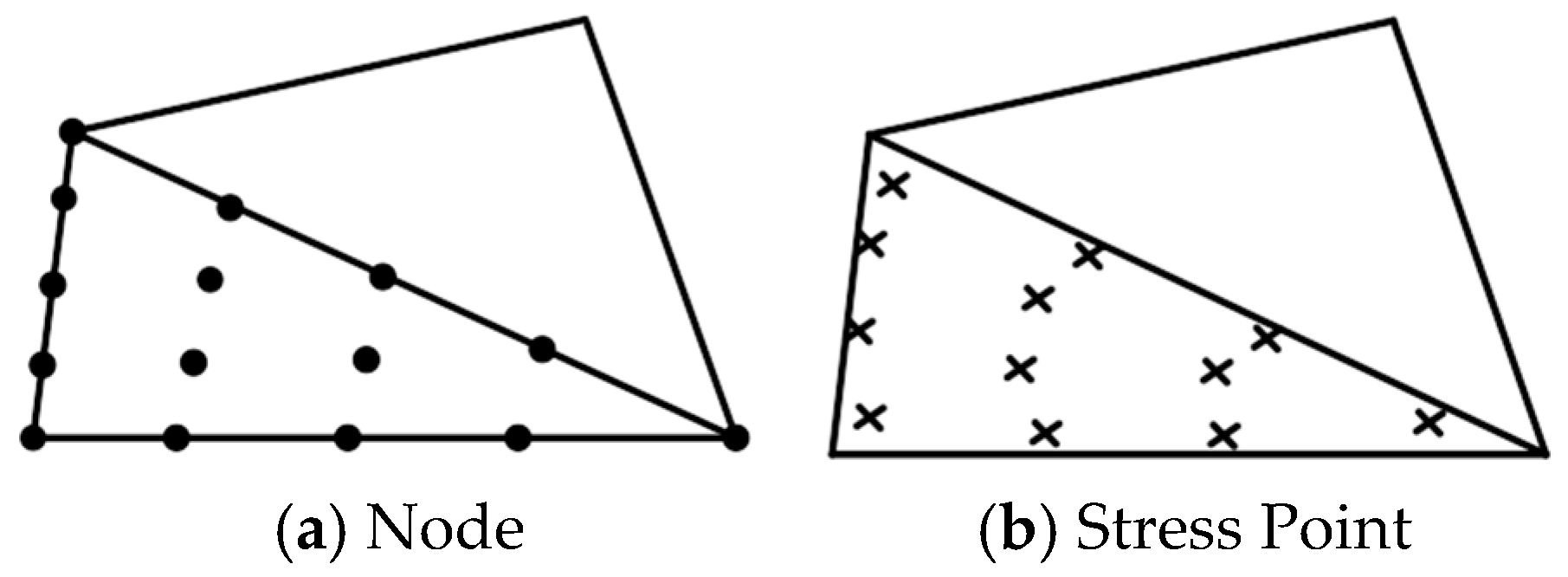
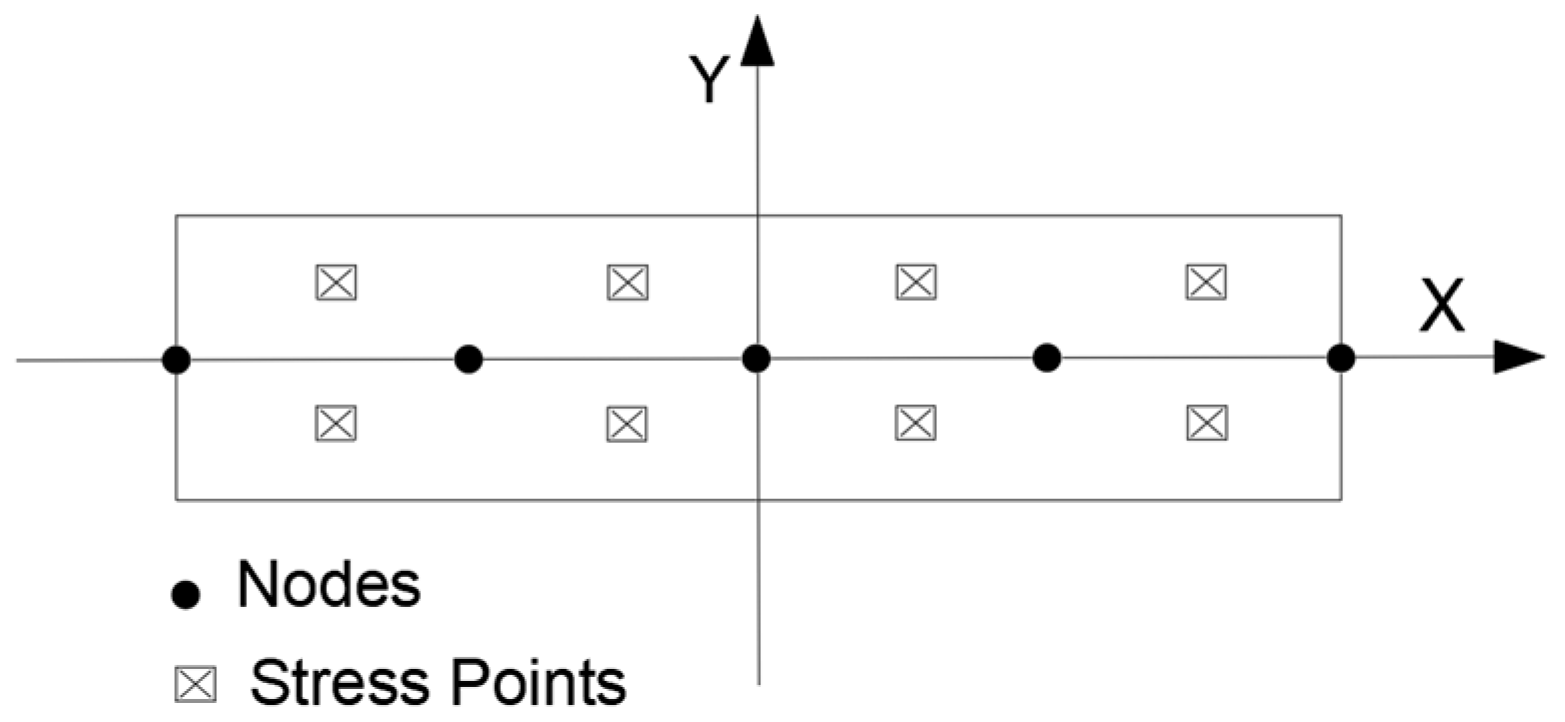
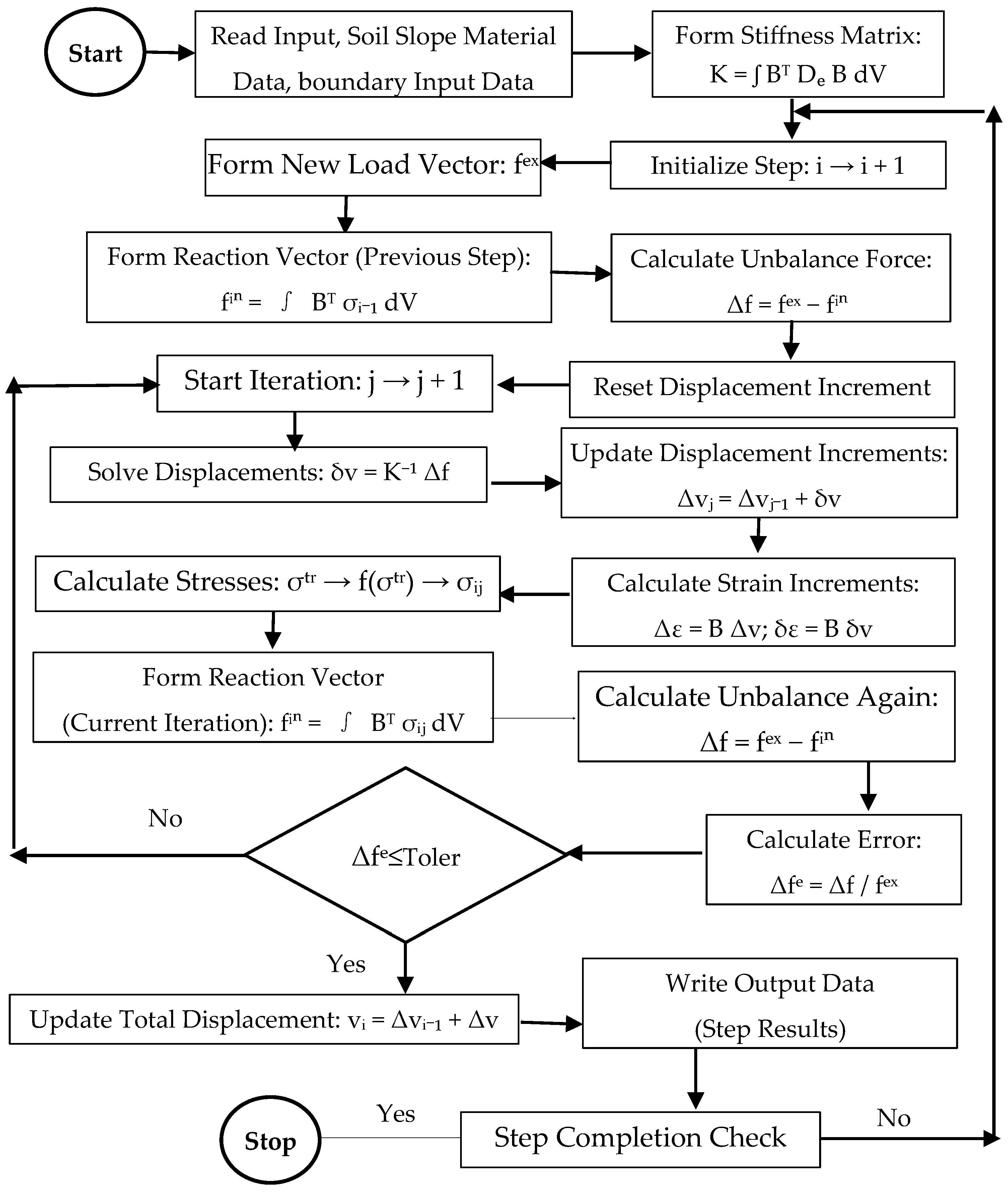
This study utilizes the finite element code PLAXIS Version 2024.2.0.1144, which is created specifically for geotechnical applications, including a variety of advanced material models. The flow chart for the finite element calculation process of the soil slope implemented in PLAXIS code is given in Figure 1. The finite element model accurately replicates the materials and construction sequence used in a simulated laboratory setup and full-scale slope. The models are idealized three-dimensional, in which one dimension is very large as compared to the other two dimensions and assuming no strain in that direction. The simulated laboratory system consists of a Perspex wall box containing sand material, reinforced with steel nails [17]. The simulation and dimensional analysis of the laboratory setup is explained in [17]. The reinforcement length and spacing, the foundation’s distance from the crest of the slope, the model’s applied foundation loads, and the resulting displacement are all proportionate to the prototype in the same ratio as the overall excavation height ratio, taking into account the model and prototype soil’s similar unit weight and shearing resistance. Four different element types are utilized to represent the materials involved: sand, steel, and Perspex. The slope domain is modeled using triangular elements of fifteen nodes. These elements offer fourth-order displacement interpolation and are integrated using twelve Gauss points, providing high accuracy in stress analysis, especially for curve boundaries and complex geotechnical problems. The high node count of the 15-node element ensures accurate modeling of soil domains with complex stress paths, making it well-suited for modeling the nailed soil slope. Figure 2 displays the 15-node triangular element with nodes, node arrangement, and stress points for soil mass. The 5-node plate elements are used to model semi-two-dimensional structural components such as the slope facing and footing plates, which possess both flexural rigidity and normal stiffness. Figure 3 represents the 5-node element for the facing and footing plate. The characteristics of plate elements for the facing and footing are given in Table 1. Nail reinforcements are modeled using the two-node elastic spring elements. The properties of the reinforcement (steel nails) element are given in Table 2.
Figure 1.
Finite element analysis workflow for soil slope.
Figure 2.
Fifteen-node triangle element with nodes (dots) and stress points (crossed) for soil mass.
Figure 3.
Five-node beam element with nodes and stress points (facing and foundation plate).
Table 1.
Characteristics of the facing and foundation constituent.
Table 2.
Characteristics of reinforcement element (steel nails).
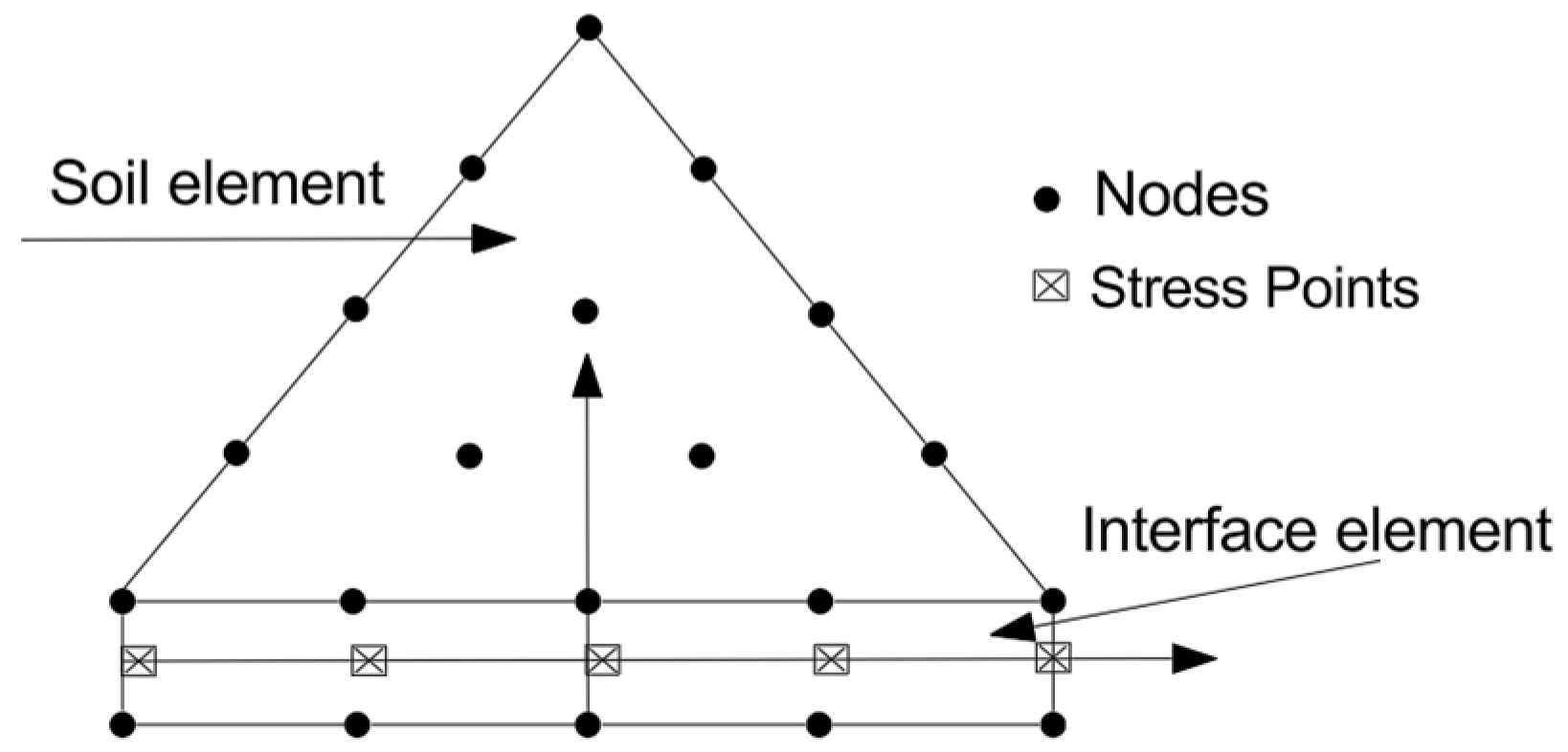
The interaction between the nailed soil slope components is modeled using the interface elements. Different from the plate elements, interface elements have dual nodes in place of single nodes. The distance between the two nodes is zero. Each node has three degrees of translational freedom. Consequently, differential displacements between the dual nodes (slipping and gapping) are made possible by interface elements. The interface elements are numerically integrated using a six-point Gauss quadrature. When using 15-node soil elements, each interface element is defined by five pairs of nodes. The interaction roughness between the soil and structural elements is modeled by assigning a strength reduction factor at the interface (Rinter) with a value of 0.7. This factor defines the interface strength specifically, and the friction and adhesion as a proportion of the soil’s shear strength, which includes its internal friction angle and cohesion. The selected value reflects established modeling practices in similar soil reinforcement studies, where reduction factors in the range of 0.65 to 0.75 have commonly been adopted [26]. Additionally, recent FEM studies have employed values around 0.73 for soil–grout interfaces [25], all falling within the broader recommended range of 0.5 to 0.9 for soil–structure interfaces [27]. Since the soil–nail interface typically exhibits reduced shear strength compared to intact soil, applying such a reduction factor in numerical modeling is justified to realistically simulate the interface behavior [24]. The interface elements’ nodes and stress points with linkage to soil mass elements are shown in Figure 4.
Figure 4.
Interface elements: Nodes and stress points with linkage to soil mass elements.
The sand material is modeled using nonlinear elastic hyperbolic constitutive models, specifically the Hardening-Soil (HS) model and the HS (small-strain) model. These models are based on the hyperbolic stress–strain relationship framework originally established by Duncan and Chang [28], where the confining pressure and shear stress level both affect the soil modulus. The model characterizes soil deformation through three distinct stiffness parameters, the triaxial loading stiffness (E50), the triaxial unloading stiffness (Eur), and the oedometer loading stiffness (Eoed), with (Eur)ref ≈ 3(E50)ref and (Eoed)ref ≈ (E50)ref. The stiffness module’s stress dependency is taken into consideration by the HS model. The reference stress for all three stiffnesses is 100 kN/m2.
The Hardening Soil (HS-small) model is specifically designed to capture the increased stiffness that soils exhibit at very small strain levels. Unlike the stiffness at typical engineering strain levels, small-strain stiffness is significantly higher and decreases nonlinearly with increasing strain. The HS-small model incorporates this behavior by introducing an additional strain history component along with two extra material parameters: G0,ref, the reference shear modulus at small strains, and γ0.7, the strain level at which the shear modulus is reduced to approximately 70% of G0,ref. These enhancements make the model particularly effective under working load conditions, providing more accurate displacement predictions than the original HS model. Table 3 tabulates the material properties for soil mass.
Table 3.
Soil mass material model parameters.
Two boundary conditions were employed in the finite element model, the first at the model’s bottom, and the second at its left and right. At the bottom, the nodes were treated as fixed, i.e., with no horizontal or vertical movement or rotation. The nodes at the sides were free to move in the vertical direction and rotate but were re-strained in the horizontal direction. The rest of the nodes were allowed to move in the horizontal and vertical directions and rotate.
2.2. Model Dimensions and Development
The model geometry is defined as a height of 85 cm and a length of 176 cm, corresponding to the internal dimensions of the sand material bed employed in the laboratory setup. Table 4 lists other geometric parameters of the reinforced sand material slope employed in the model. The model is discretized to accommodate the slope development and loading phases effectively. The slope development order is simulated in 8 phases, consistent with the laboratory procedure described below, using a nail spacing of 280 mm (Sh/Sv = 0.4H where H is the height of slope) in both horizontal and vertical directions.
Table 4.
Reinforced soil slope model dimensions [17].
- Phases 1–5: The first excavation phase was to a depth of 140 mm, followed by the second excavation phase at 280 mm, the third at 420 mm, the fourth at 560 mm, and the fifth at 700 mm below the ground surface. Install the first, second, and third nail layers at depths of 70 mm, 350 mm, and 630 mm from the top ground surface.
- Phases 6–8: Foundation is positioned at the required location, applying foundation loads, self-weight included, to achieve footing loads (q) equal to 5 kN/m2 (phase 6), 10 kN/m2 (phase 7), and 20 kN/m2 (phase 8).
3. Reinforced Soil Slope Models: Parametric Study Results
The finite element models of the reinforced soil slope with various parameters were developed using the geotechnical software PLAXIS following the above-described dimensions and material properties. The considered finite element model parameters are the mesh density, model dimensions with variations in vertical, horizontal, and perpendicular dimensions, prototype model, constitutive models, slope angle, and nail length distribution in layers. The developed finite element models are utilized to obtain deformed shapes, deformations, and stresses at different places on the reinforced soil slope, as well as slope system factors of safety under various construction and loading phases. The results of laboratory-scale FEM are validated by comparing them with experimentally observed values at different phases of the sand slope’s response. The subsequent section presents the findings for each parameter of the reinforced sand slope models.
3.1. Domain Discretization and Mesh Sensitivity
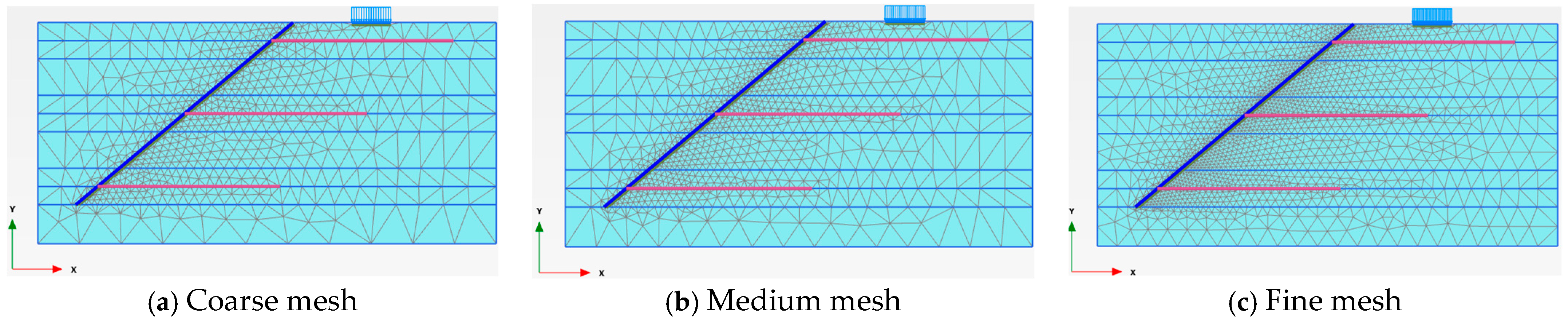
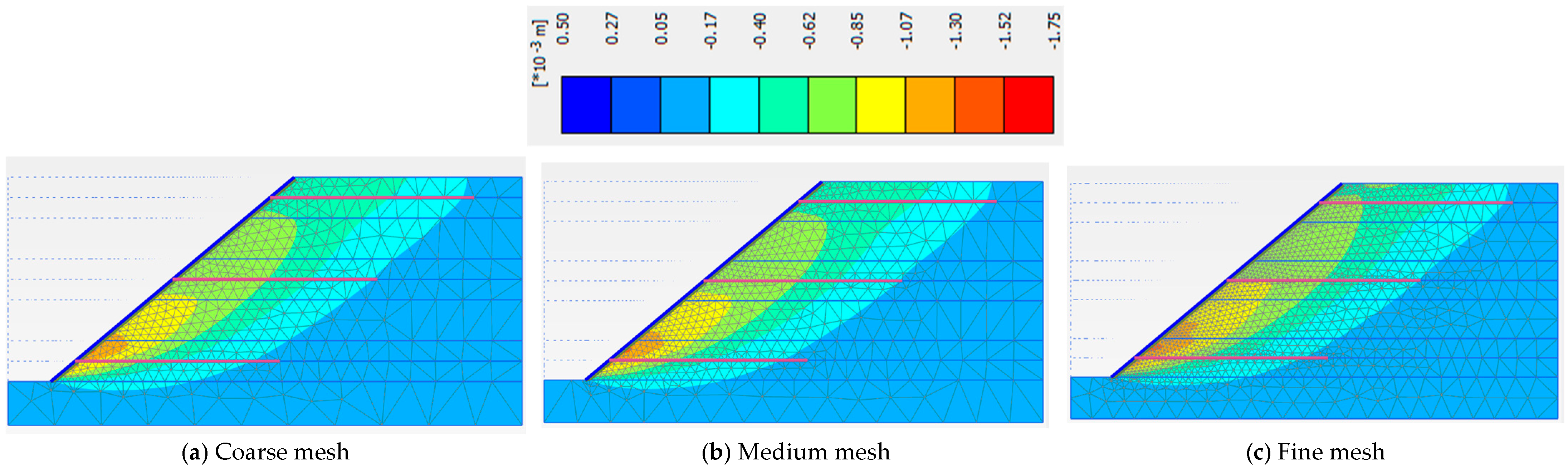
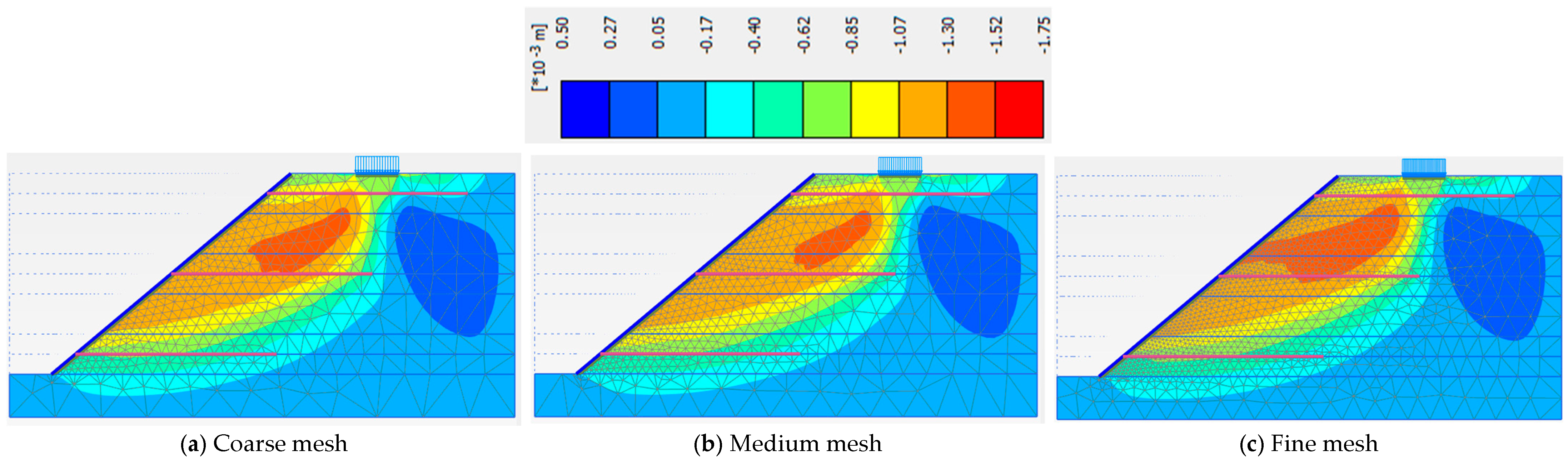
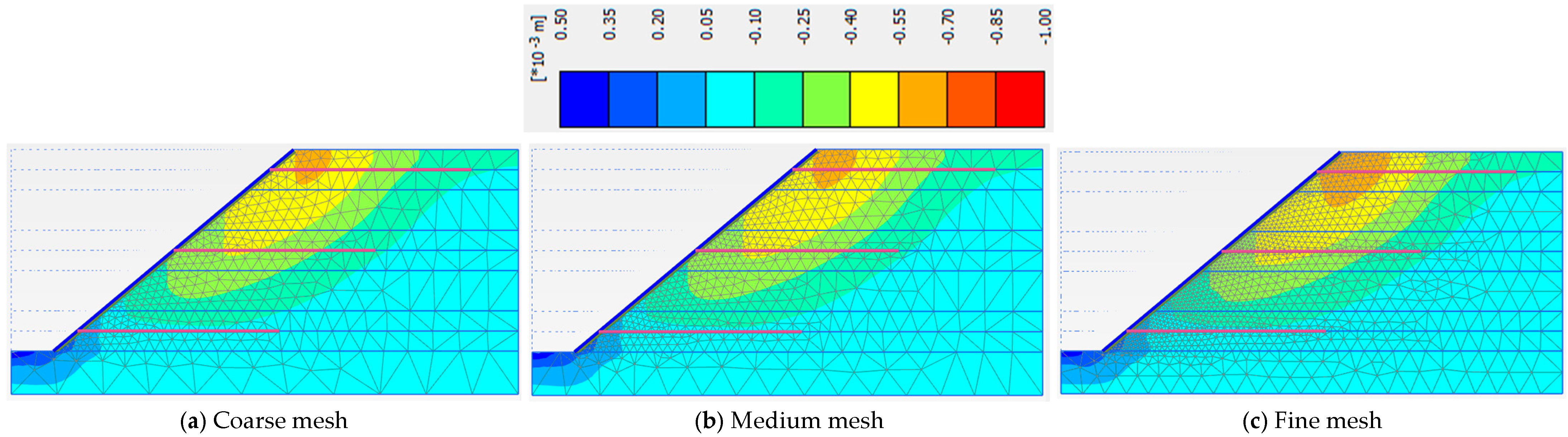
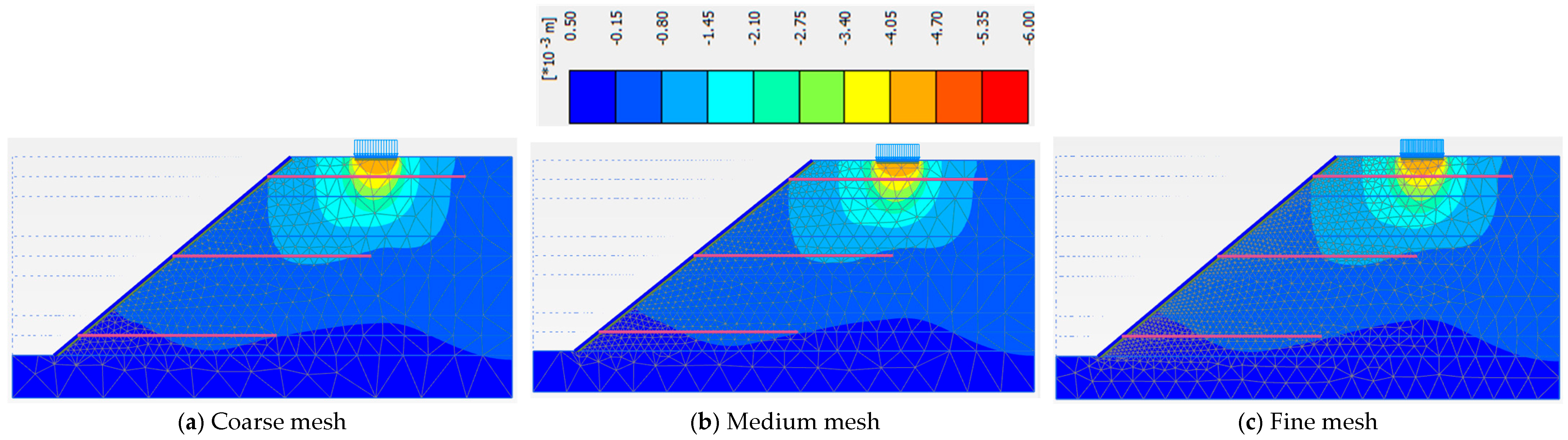
Mesh density is significantly important for the accuracy and computational efficiency of finite element models (FEMs). The current parametric study investigates the impact of mesh coarseness, categorized as coarse, medium, and fine, on various aspects of a nailed soil slope, including horizontal displacements, footing settlement, displacement contours, and the factor of safety (FOS). Figure 5 visually presents the discretization of the soil slope model using coarse, medium, and fine meshes. Figure 1 visually presents the discretization of the soil slope model using coarse (1359 elements), medium (1975 elements), and fine meshes (4085 elements). Table 5 and Figure 6 and Figure 7 show the horizontal displacements at different construction and loading phases. Table 6 and Figure 8 and Figure 9 detail the vertical displacements or footing settlements. The factor of safety (FOS) values for various mesh fineness levels are provided in Table 7.
Figure 5.
Soil slope finite element models of discretization with different mesh densities, measured using PLAXIS software.
Table 5.
Facing center horizontal displacement with different levels of domain discretization coarseness.
Figure 6.
Horizontal displacement distribution at phase 5 of soil slope with various mesh densities.
Figure 7.
Horizontal displacement distribution at phase 6 of soil slope with various mesh densities.
Table 6.
Footing settlement with different levels of coarseness of slope domain discretization.
Figure 8.
Vertical displacement distribution at phase 5 of soil slope with different mesh densities.
Figure 9.
Vertical displacement distribution at phase 6 of soil slope with different mesh densities.
Table 7.
Factor of safety (FOS) at different mesh densities.
3.2. Model Dimensions
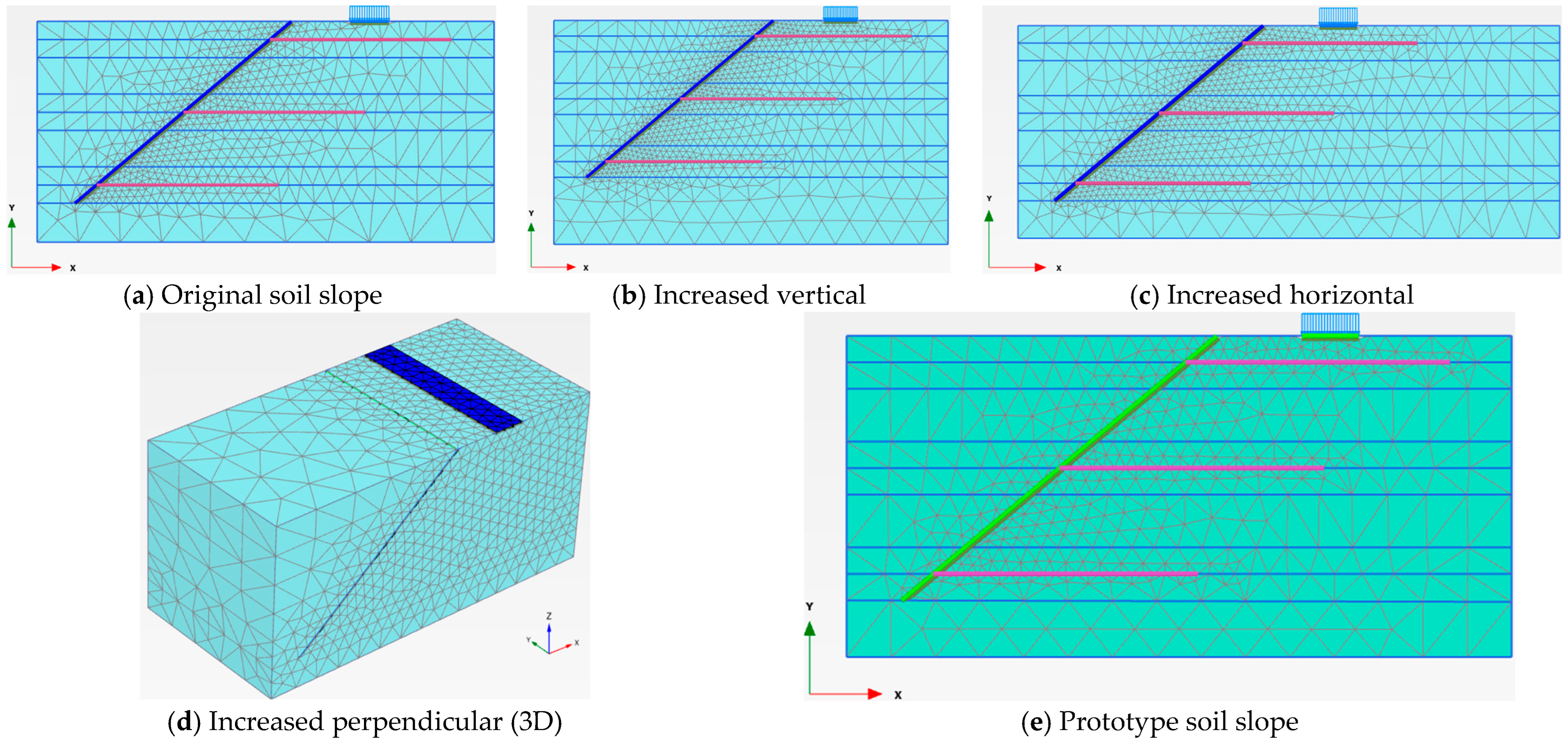
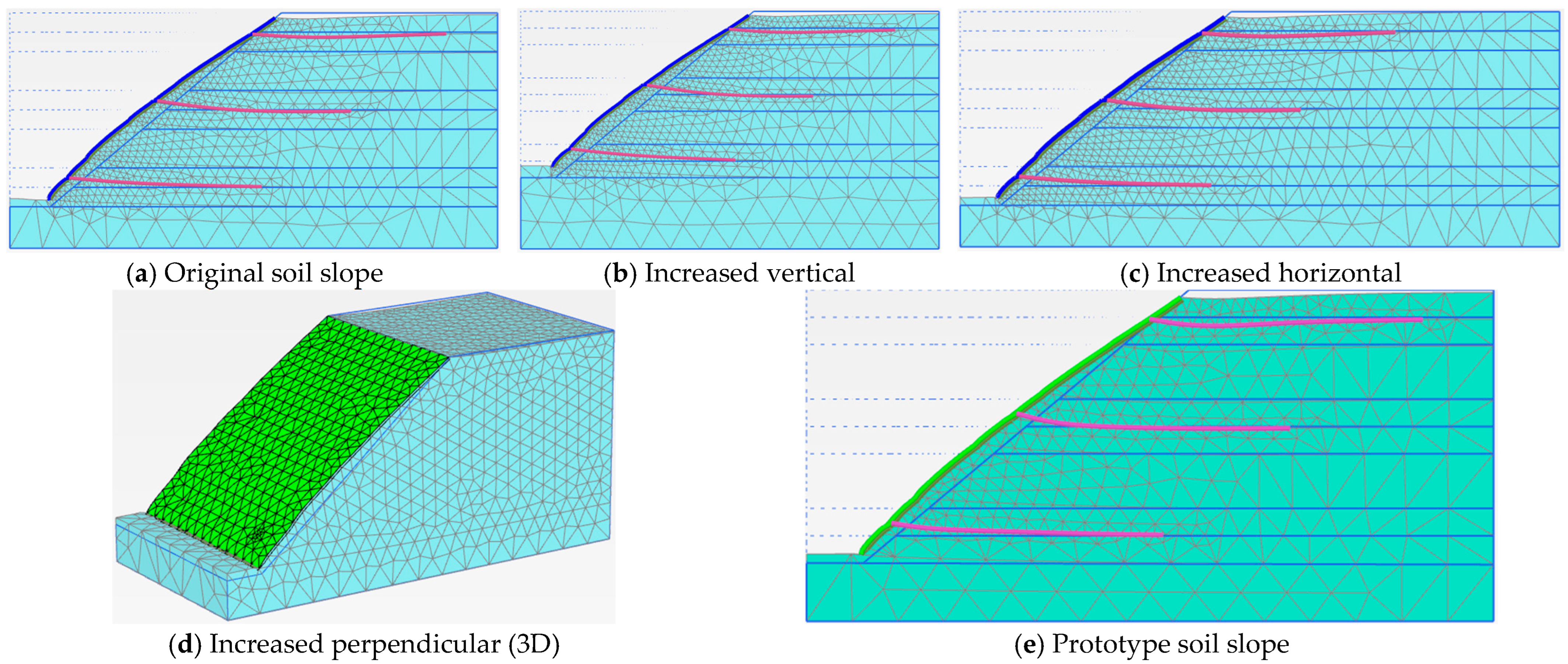
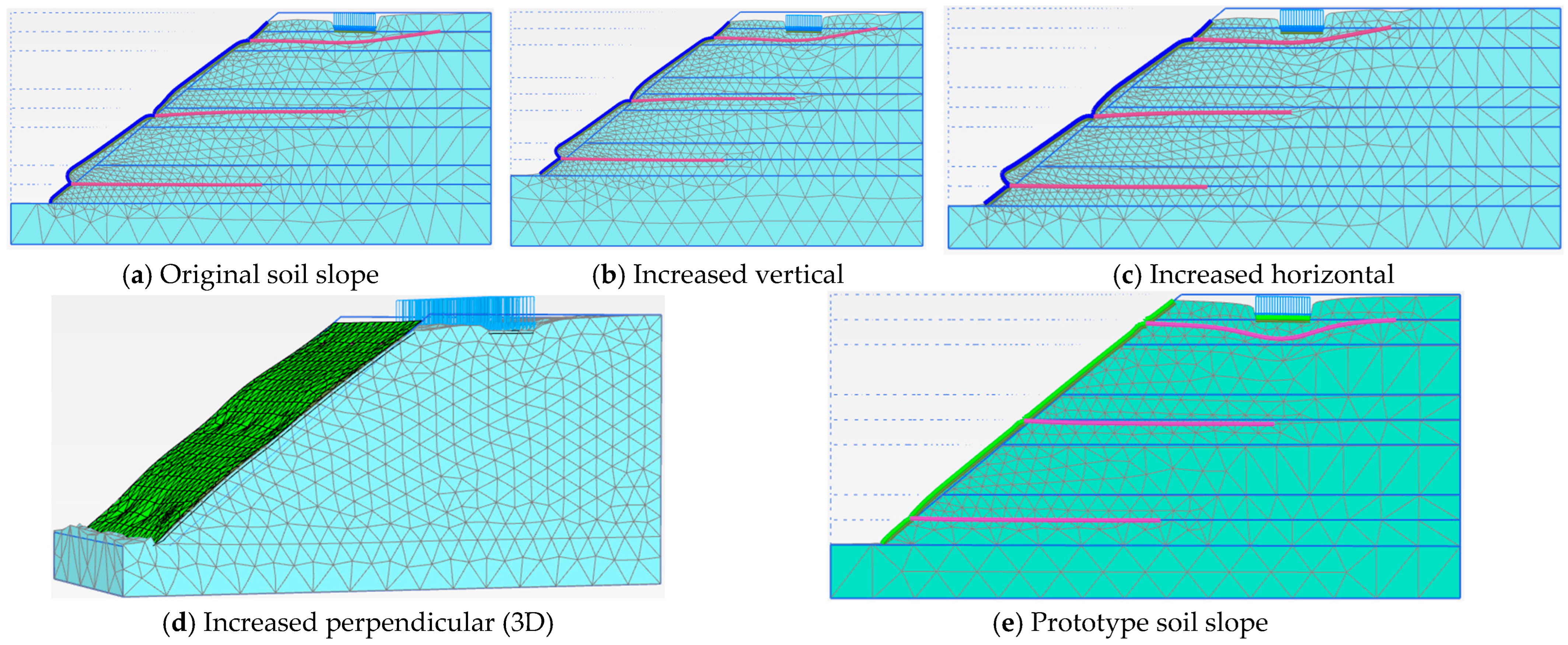
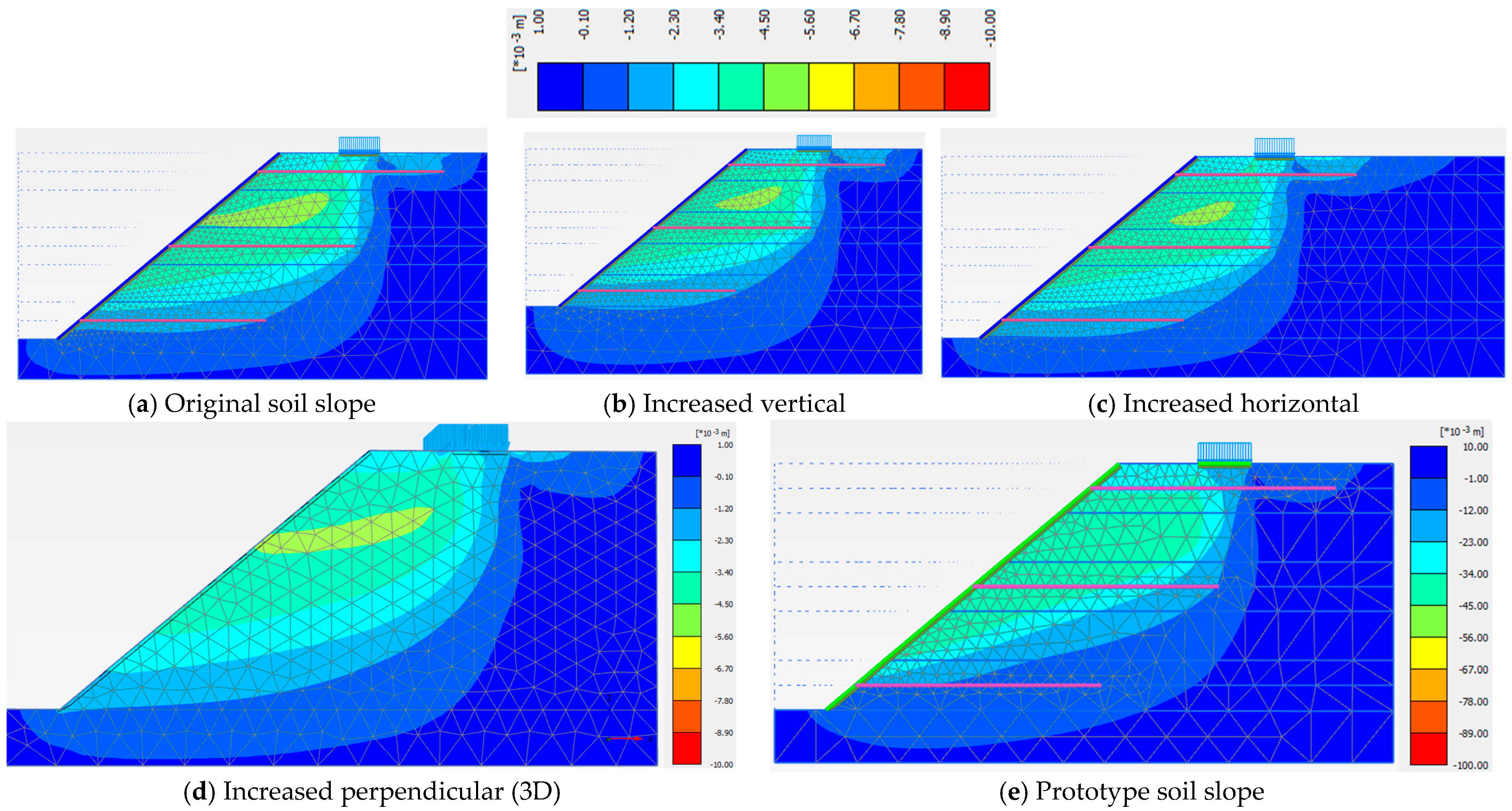
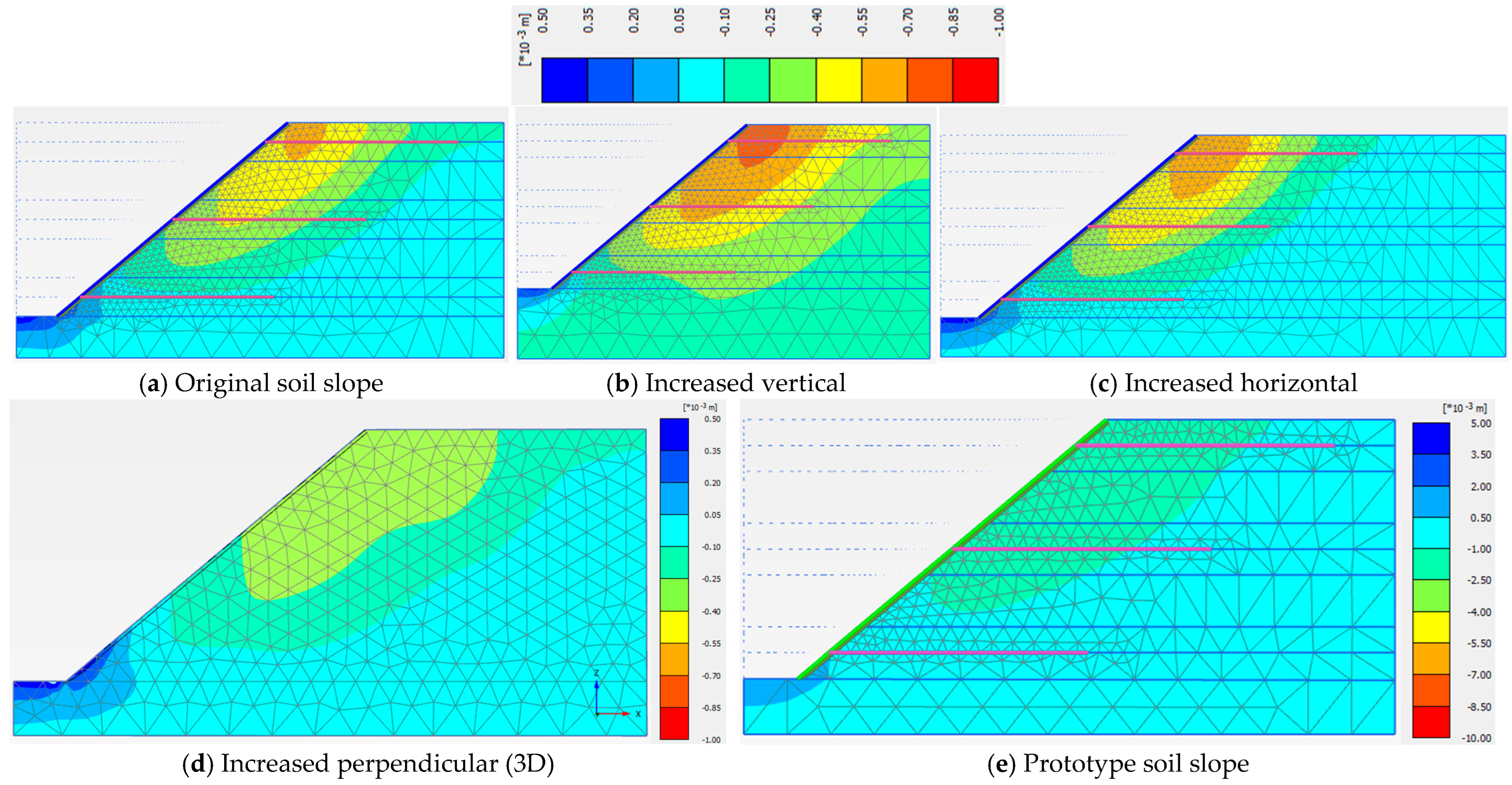
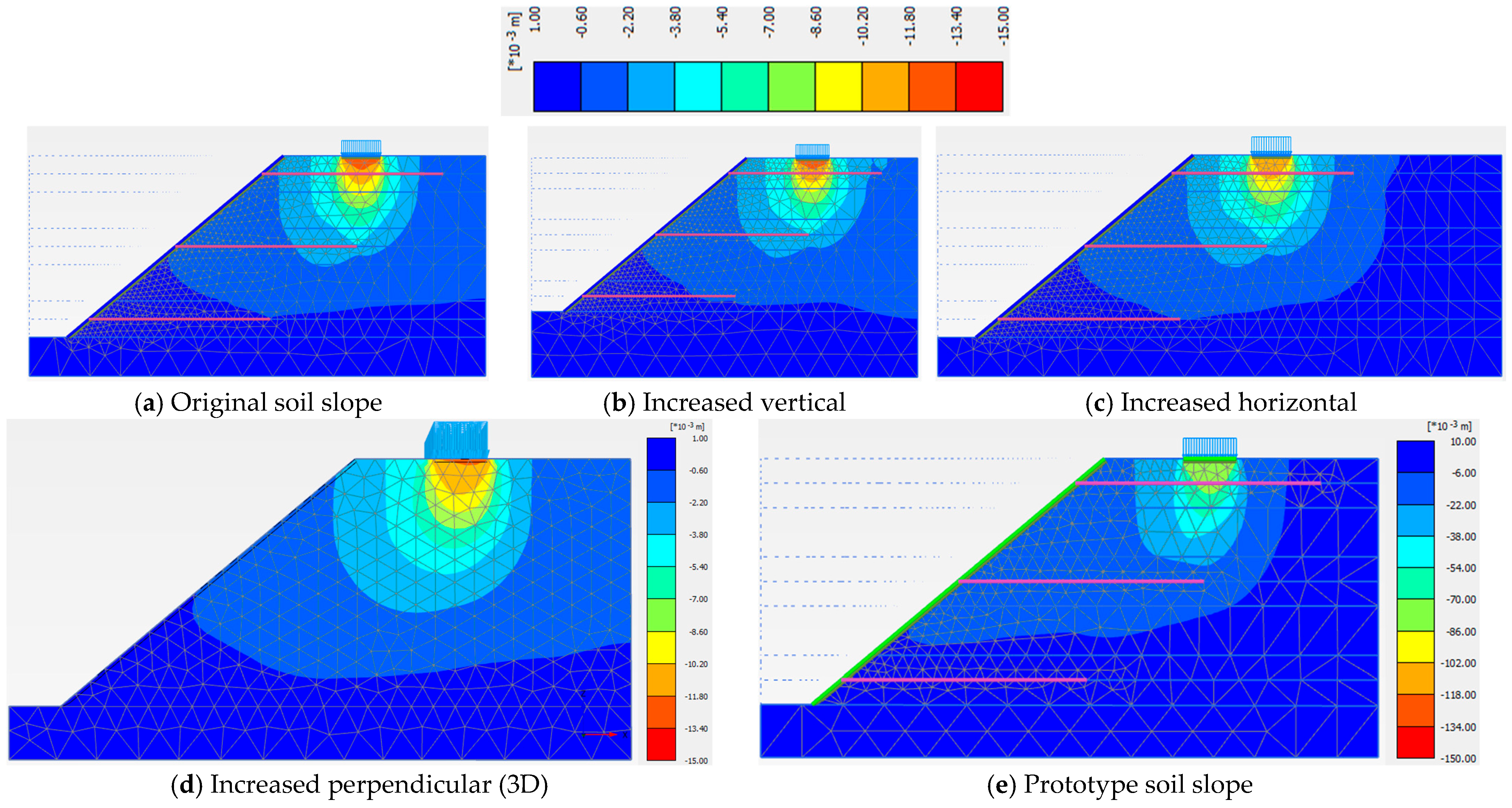
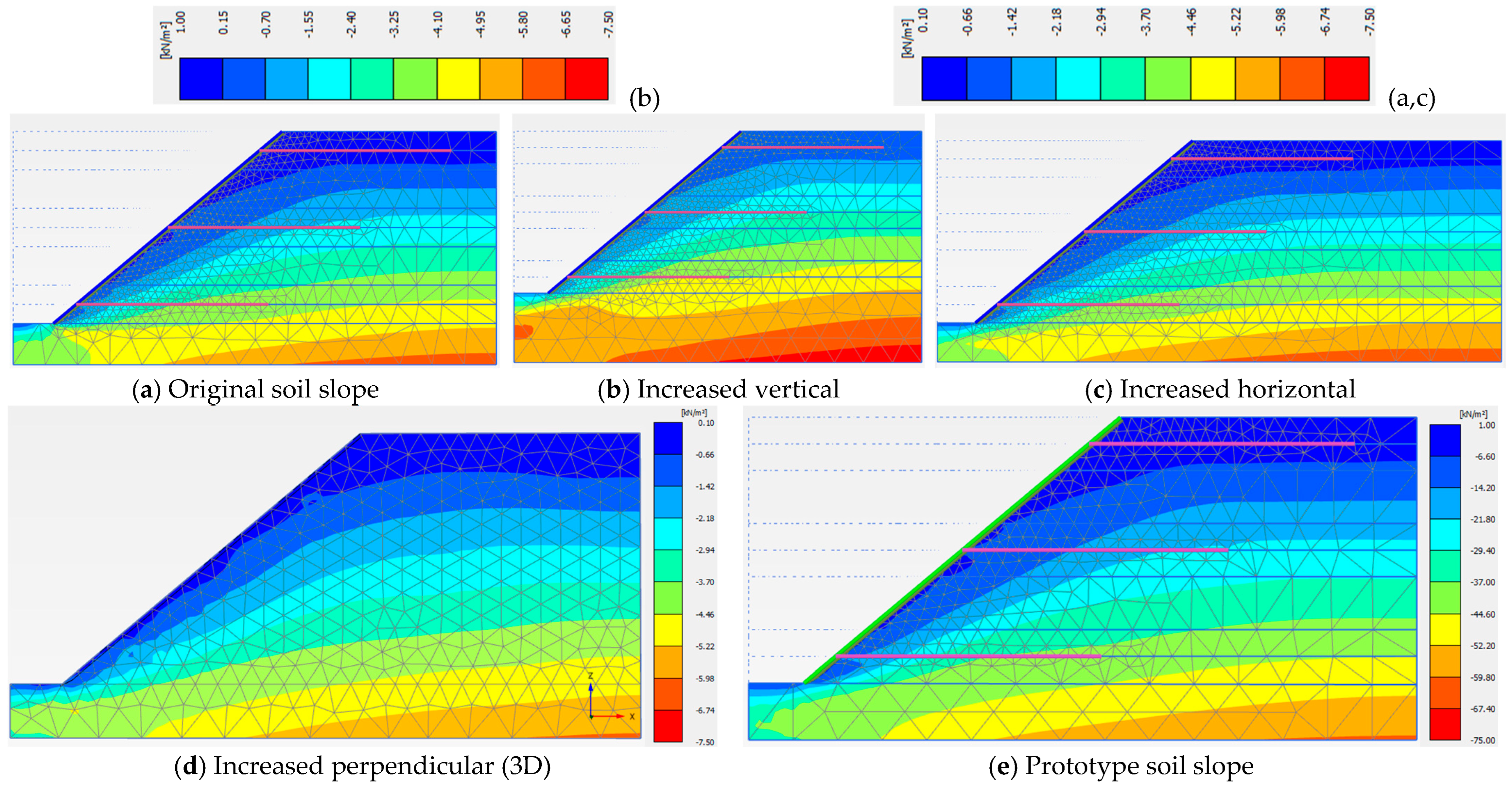
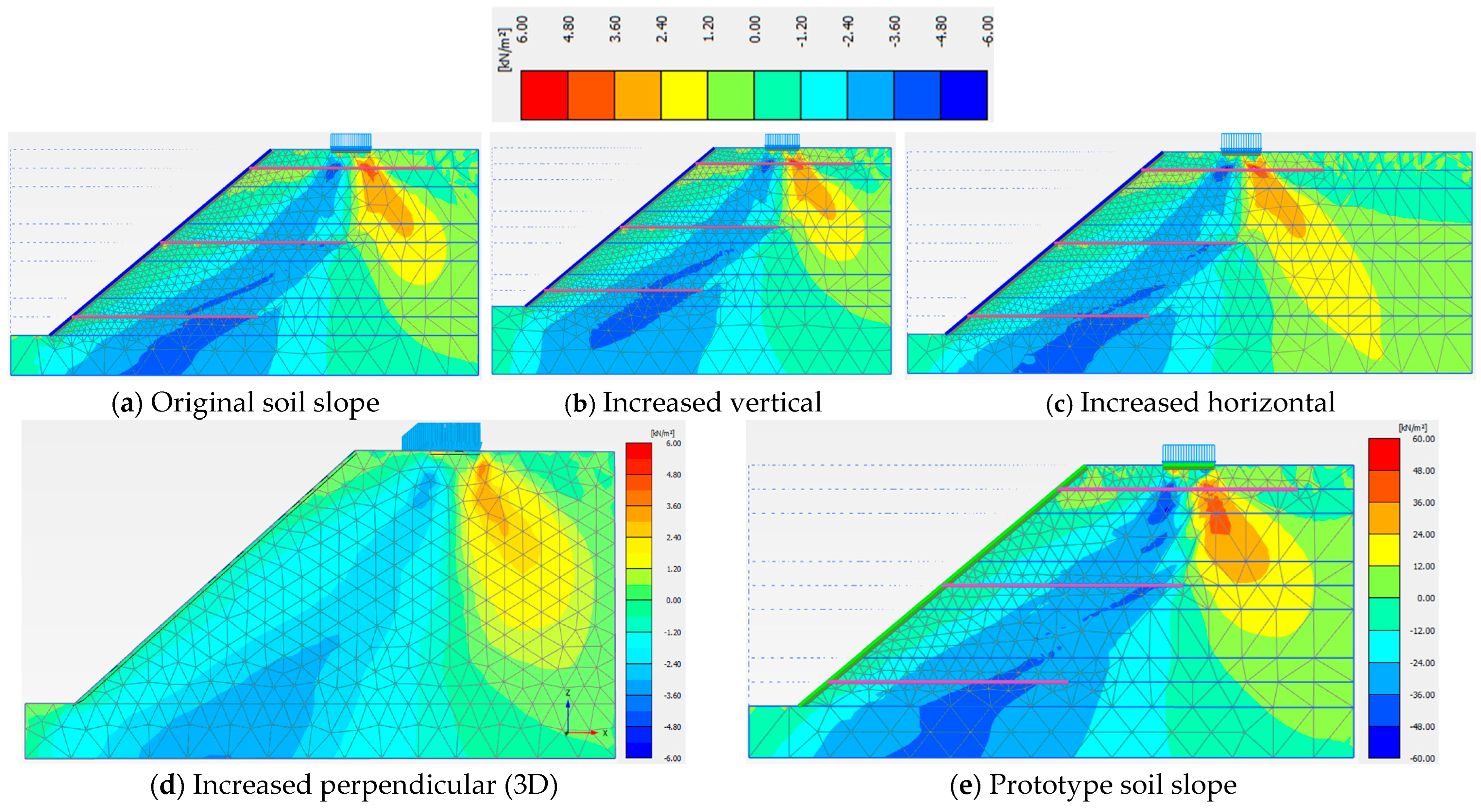
A Perspex box of 176 cm × 85 cm × 100 cm was selected as the experimental setup for the reinforced soil slope, based on simulation criteria for material properties and geometric dimensions, and the same dimensions are adopted for the development of the finite element models to investigate the model dimension sensitivity. The prototype soil slope was simulated using a scale factor of ten [17]. The facing materials should be adaptable to accommodate ground movement during excavation. Therefore, a Perspex plate with a thickness of 0.5 cm is selected to simulate the Shotcrete in the prototype reinforcing system of thickness 14 cm. The nails used in this study are circular cross-section steel rods 70 cm in length. The diameter of the model nails is 0.5 cm to simulate the actual nail of diameter 5 cm. A rigid steel plate of dimensions 84 cm × 15 cm × 2.2 cm thick is used to act as a building footing to exert a distributed load on the soil mass. The effect on the predicted performance of nailed soil slopes, assessed using finite element modeling by varying the model dimensions, specifically vertical, horizontal, and perpendicular (3D) scaling, is investigated. Comparisons are drawn between the original laboratory-scale model, dimensionally adjusted versions, and a full-scale prototype model. Figure 10 shows the initial mesh configurations for the five models, namely the original soil slope (reference laboratory dimensions), increased vertical and increased horizontal dimensions to test aspect ratio effects, increased perpendicular (3D) to approximate out-of-plane influence, and a prototype model, representing the full-scale geometry. The soil mass in the 3D model is modeled using 10-node tetrahedral elements, and 6-node triangular elements are used to model plate (facing and footing) elements. All models maintain a consistent mesh quality and reinforcement layout to isolate the effect of geometric scaling (Figure 10). The deformed mesh at construction phase 5 and loading phase 8 of nailed soil slope development is depicted in Figure 11 and Figure 12.
Figure 10.
Initial discretization of soil slope finite element models and for variations in model dimensions.
Figure 11.
Deformed meshes of laboratory-scale models of nailed soil slope and for variations in model dimensions at construction phase 5.
Figure 12.
Deformed meshes of laboratory-scale models of nailed soil slope and for variations in model dimensions at loading phase 8.
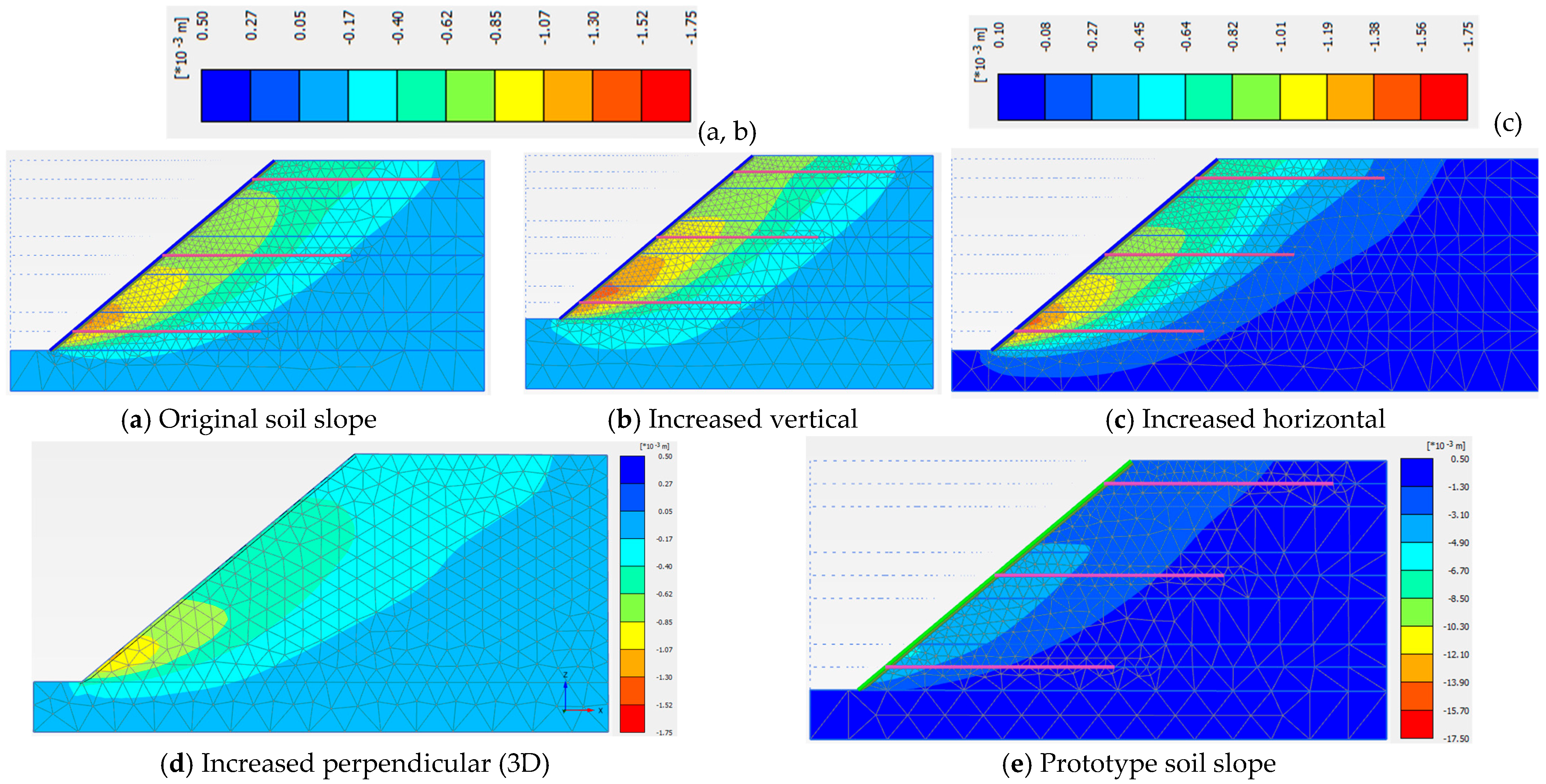
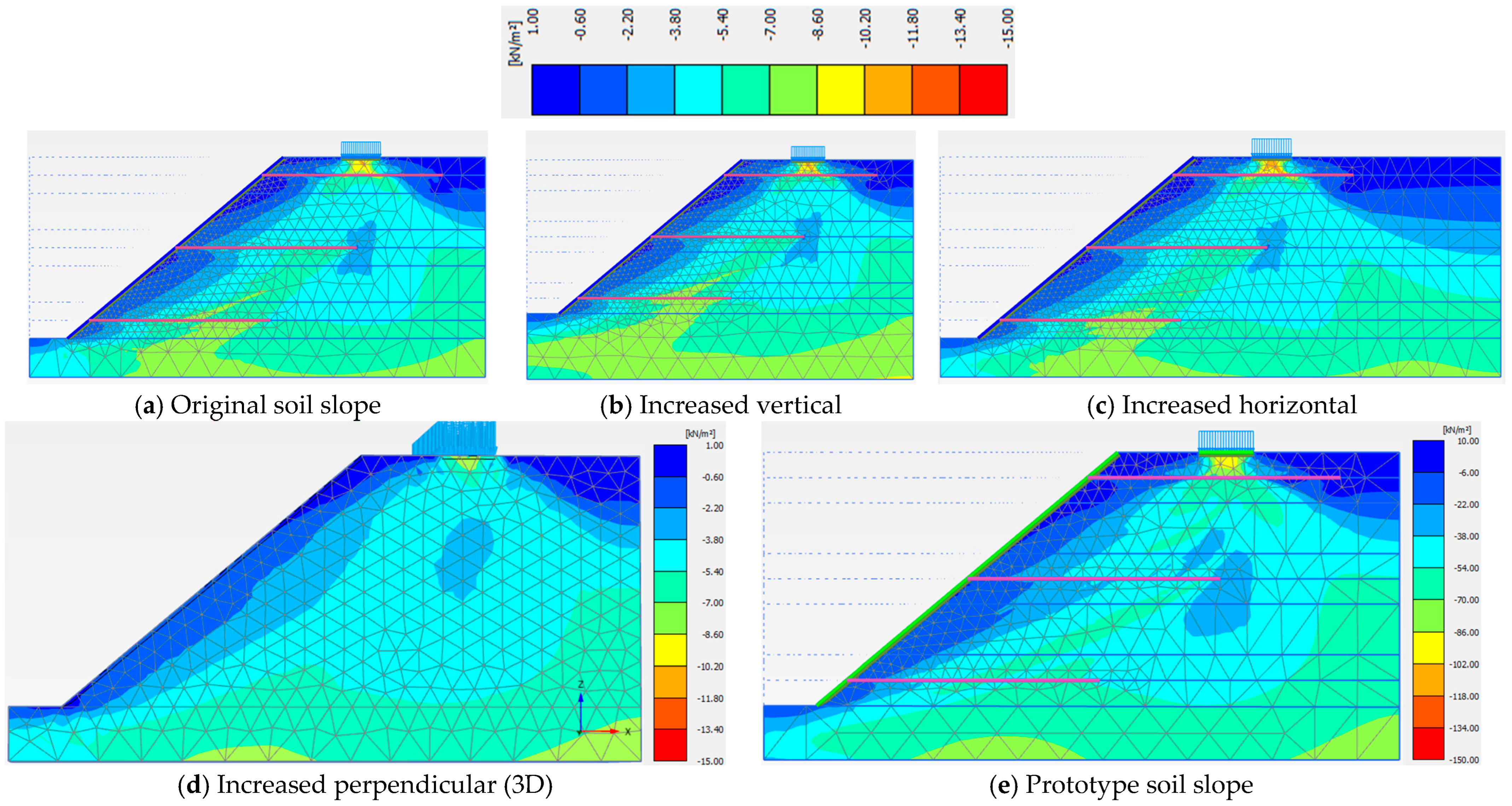
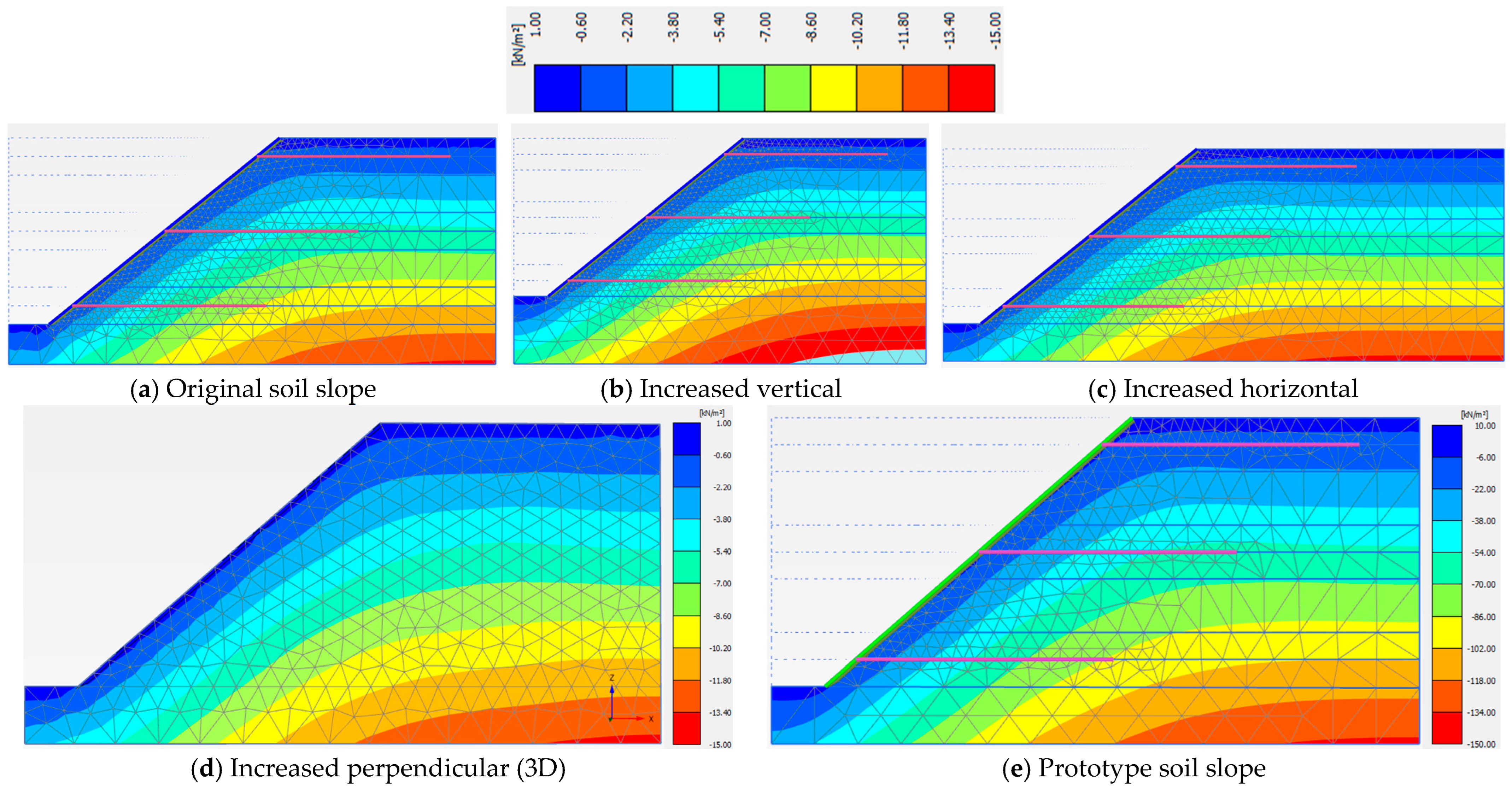
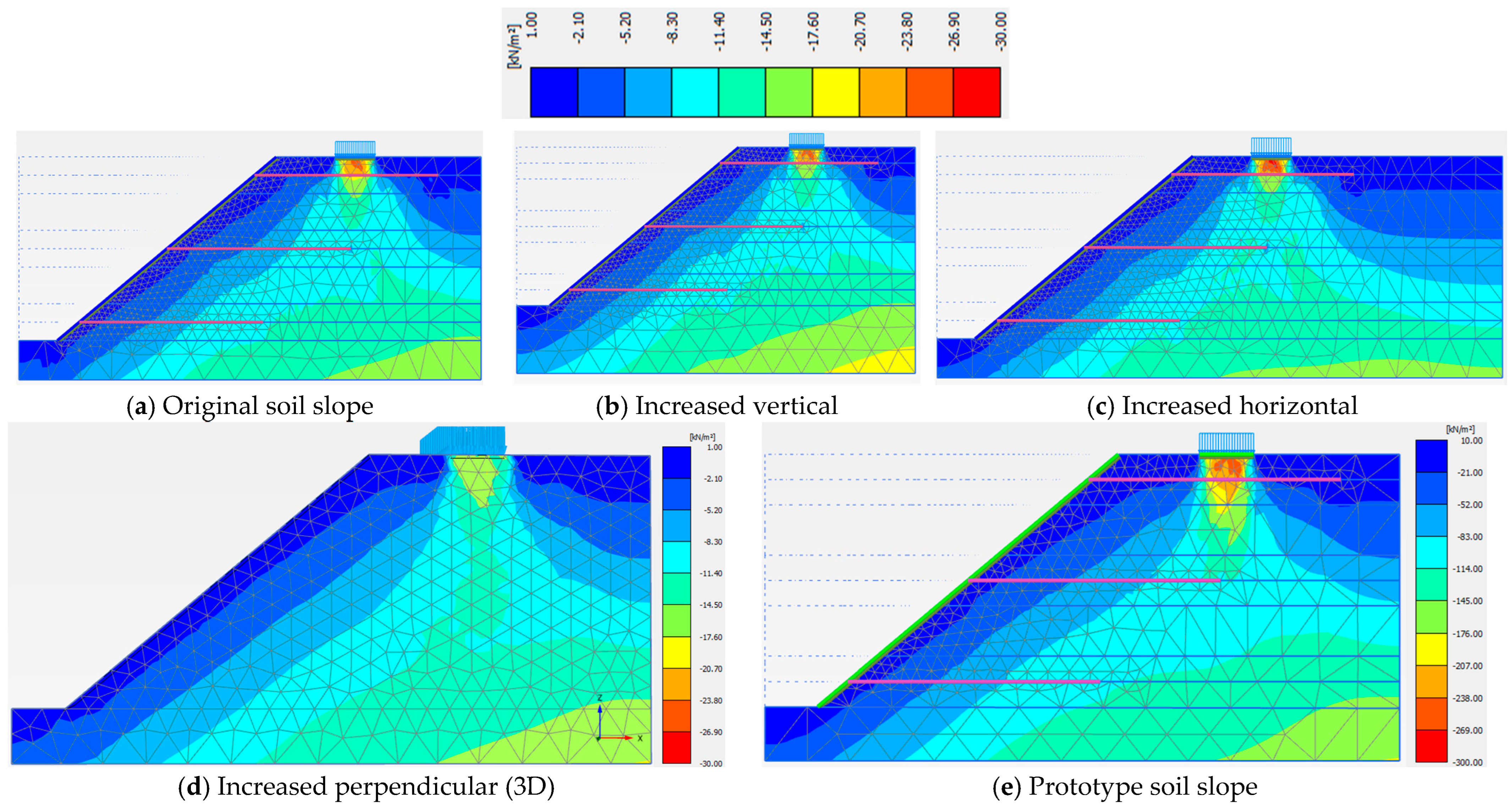
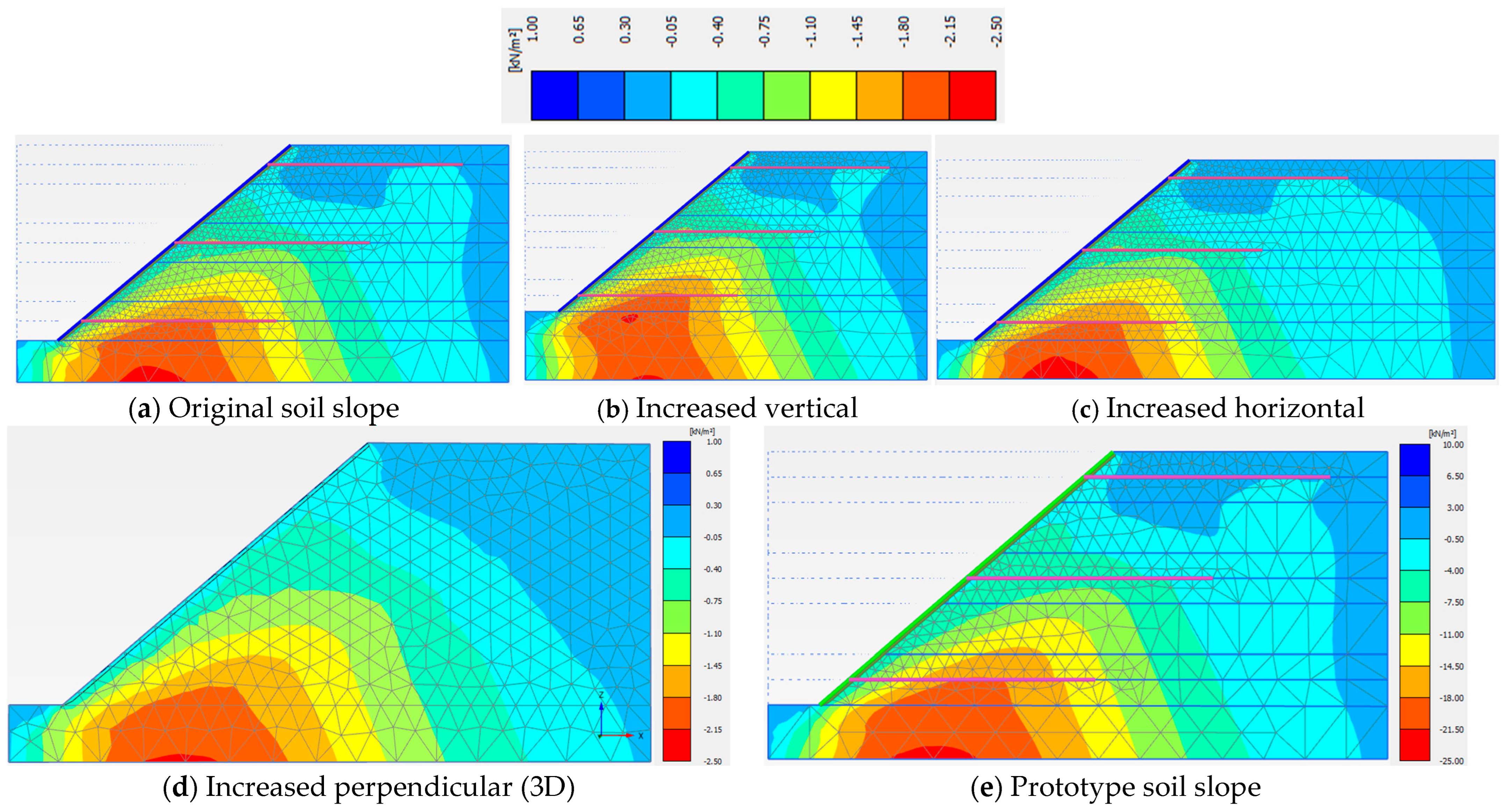
Horizontal displacement distributions with varying model dimensions at phases 5 and 8 are depicted in Figure 13 and Figure 14, respectively, while perpendicular displacement distributions are given in Figure 15 and Figure 16. Horizontal stress distributions for variations in model dimensions are given in Figure 17 and Figure 18, and the vertical stress distributions are depicted in Figure 19 and Figure 20. Shear stress distributions are portrayed in Figure 21 and Figure 22. Table 8 provides the factor of safety (FOS) for both the laboratory-scale model of the nailed soil slope and for the variation in model dimensions throughout the development of the soil slope system.
Figure 13.
Horizontal displacement distribution of laboratory-scale model of nailed soil slope and for variations in model dimensions at phase 5.
Figure 14.
Horizontal displacement distribution of laboratory-scale model of nailed soil slope and for variations in model dimensions at phase 8.
Figure 15.
Vertical displacement distribution of laboratory-scale model of nailed soil slope and for variations in model dimensions at phase 5.
Figure 16.
Vertical displacement distribution of laboratory-scale model of nailed soil slope and for variations in model dimensions at phase 8.
Figure 17.
Horizontal stress distribution of laboratory-scale model of nailed soil slope and for variations in model dimensions at phase 5.
Figure 18.
Horizontal stress distribution of laboratory-scale model of nailed soil slope and for variations in model dimensions at phase 8.
Figure 19.
Vertical stress distribution of laboratory-scale model of nailed soil slope and for variations in model dimensions at phase 5.
Figure 20.
Vertical stress distribution of laboratory-scale model of nailed soil slope and for variations in model dimensions at phase 8.
Figure 21.
Shear stress distribution of laboratory-scale model of nailed soil slope and for variations in model dimensions at phase 5.
Figure 22.
Shear stress distribution of laboratory-scale model of nailed soil slope and for variations in model dimensions at phase 8.
Table 8.
Factor of safety (FOS) of laboratory-scale model of nailed soil slope and for variations in model dimensions.
3.3. Slope Angles and Material Models
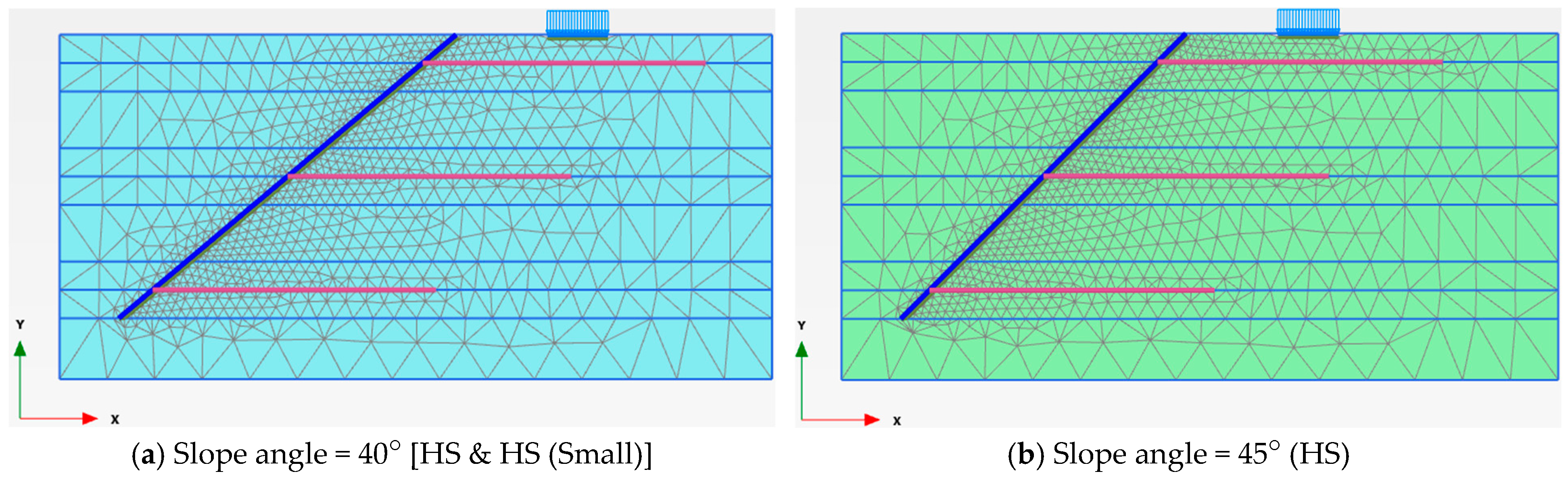
The influence of varying slope angles (40° and 45°) and constitutive soil models [Hardening Soil (HS) and Hardening Soil Small-Strain (HS Small)] on the performance of nailed soil slopes is studied through detailed finite element modeling and compared across construction phases of nailed soil slope development, based on the mesh deformations, displacements, stress distributions, and factors of safety. Figure 23 displays initial meshing for models with 40° and 45° slopes using both HS and HS-small models. All models maintain a consistent nail geometry and boundary conditions. The deformed meshes at construction phase 5 and loading phase 8 are shown Figure 24 and Figure 25.
Figure 23.
Initial discretization of soil slope finite element models with different slope angles and material models.
Figure 24.
Deformed mesh of finite element model of nailed soil slope with different slope angles and material models at construction phase 5.
Figure 25.
Deformed mesh of finite element model of nailed soil slope with different slope angles and material models at loading phase 8.
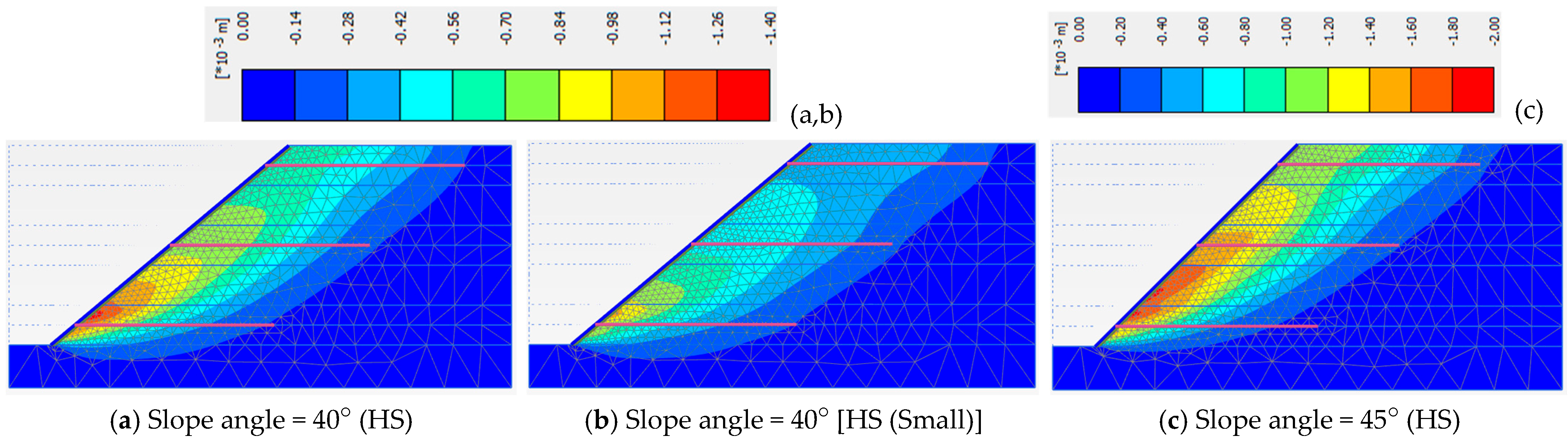
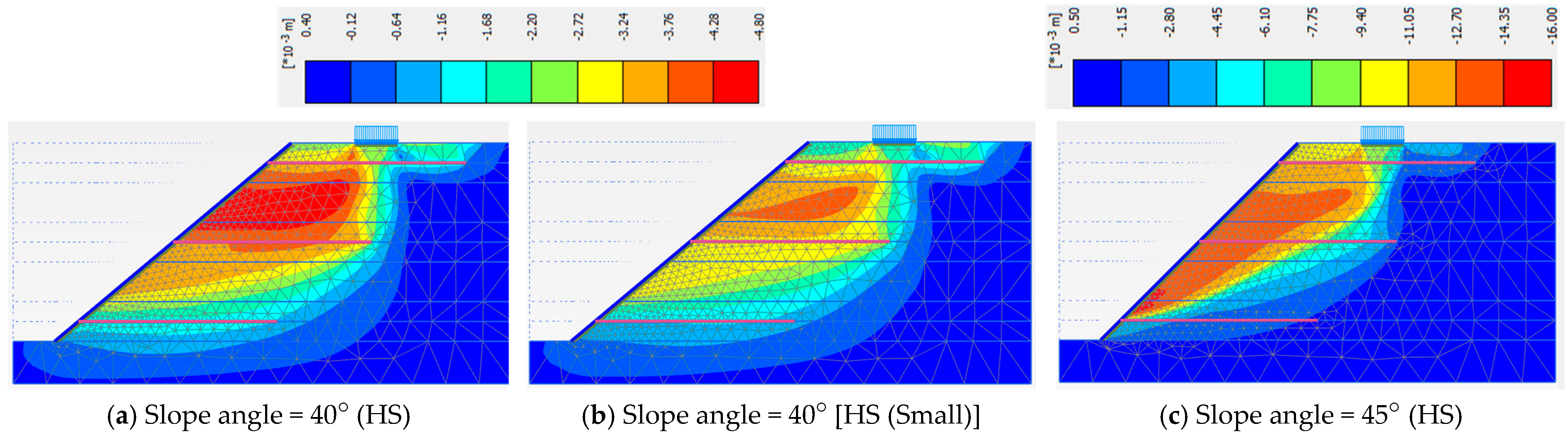
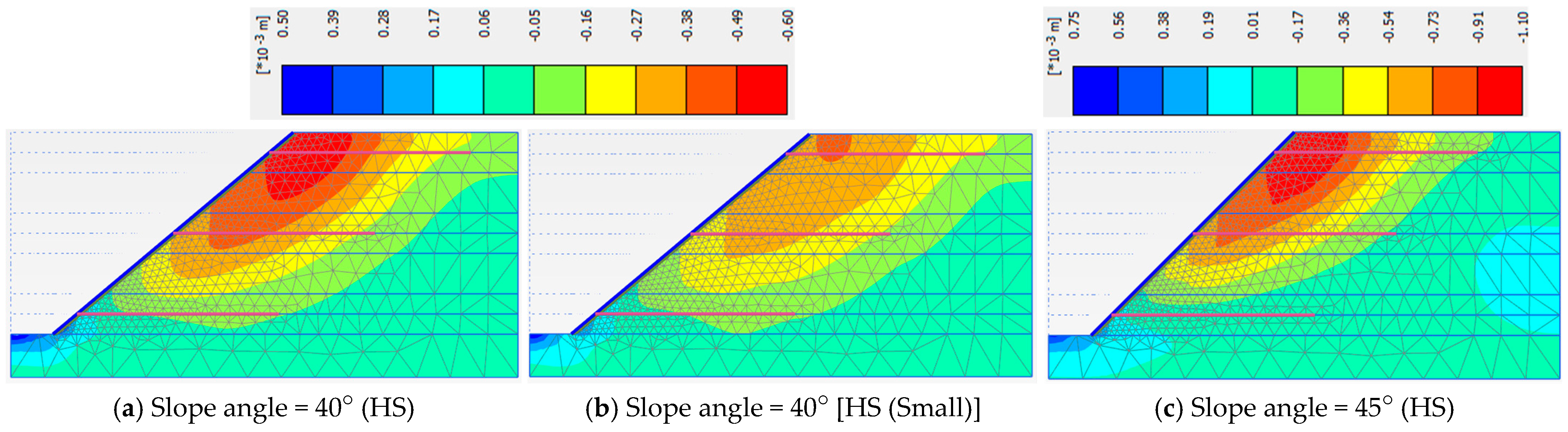
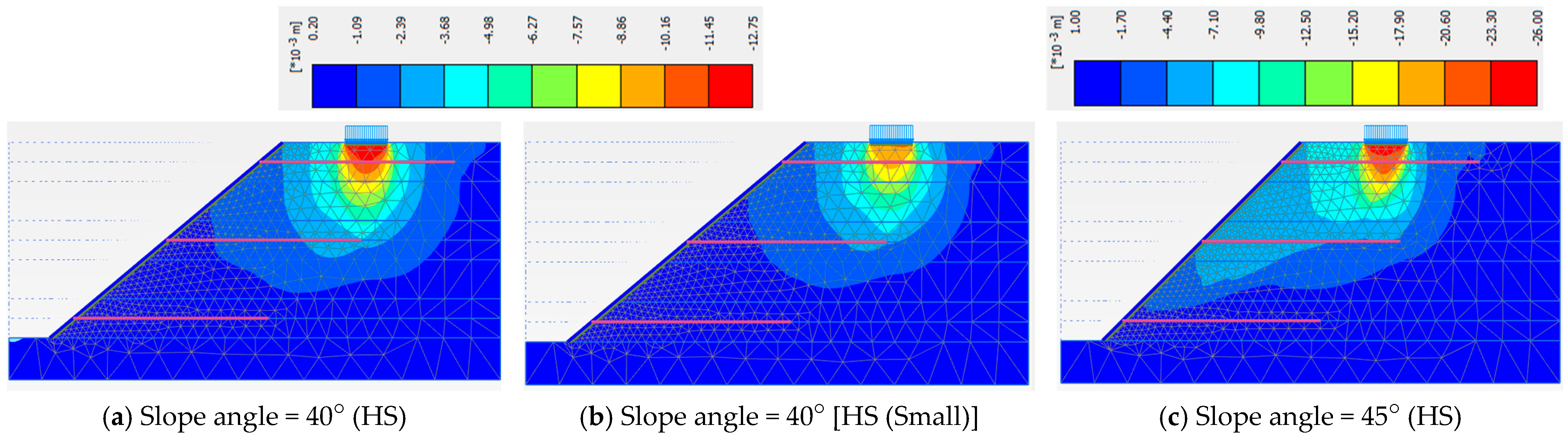
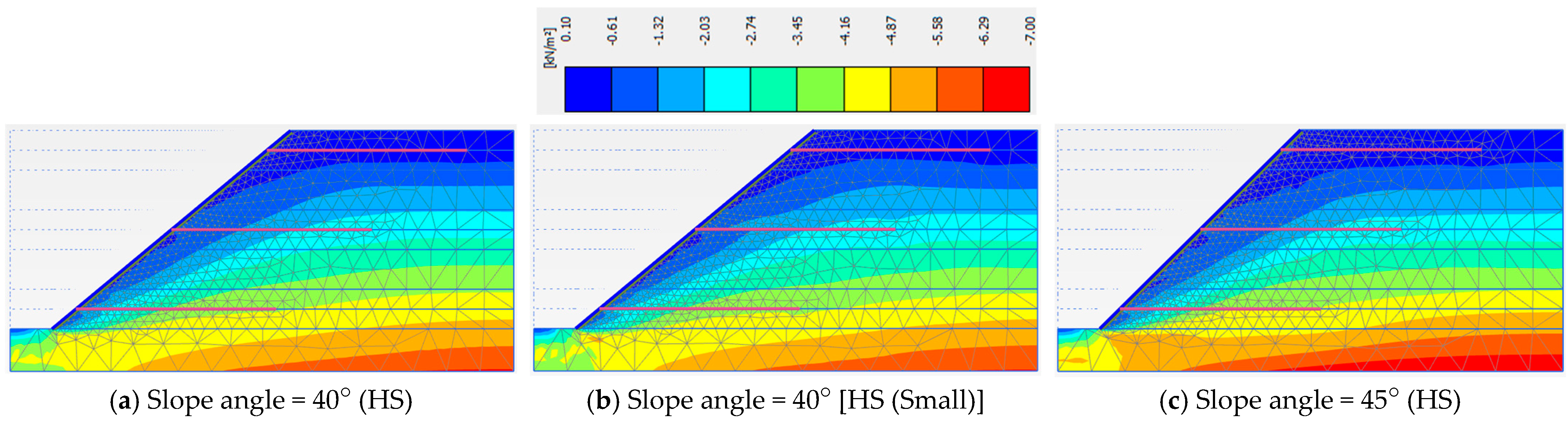
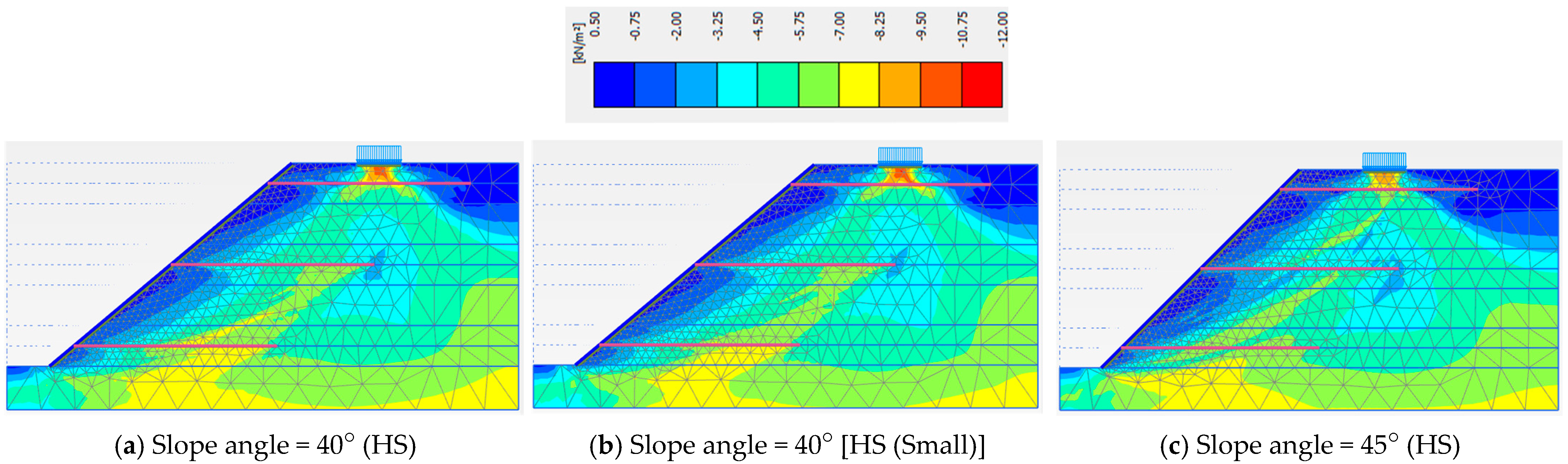
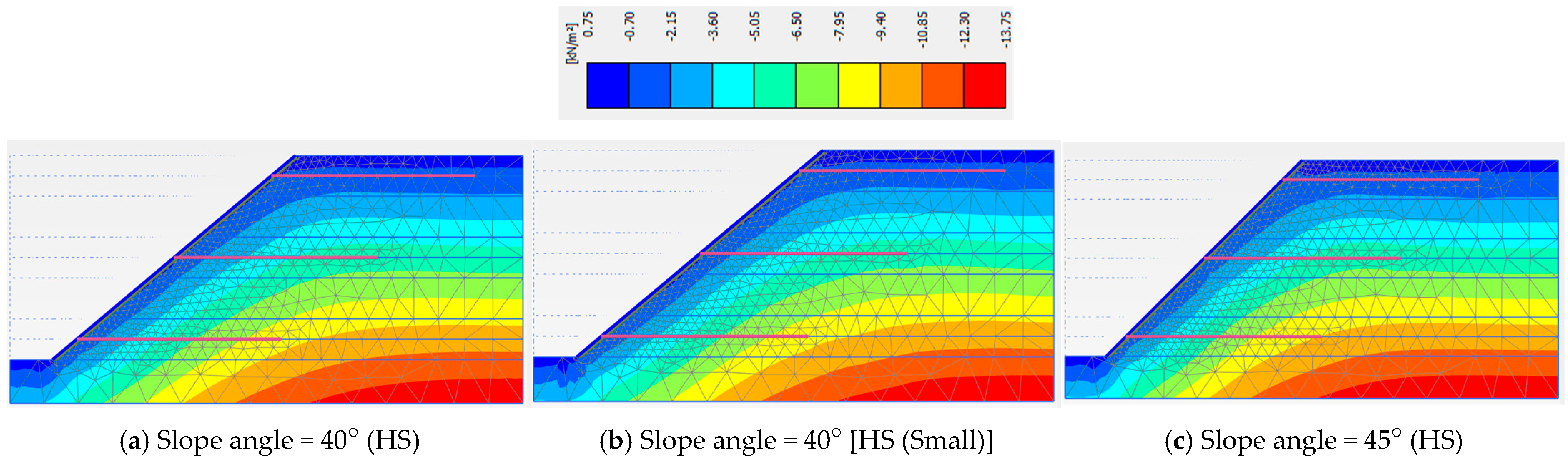
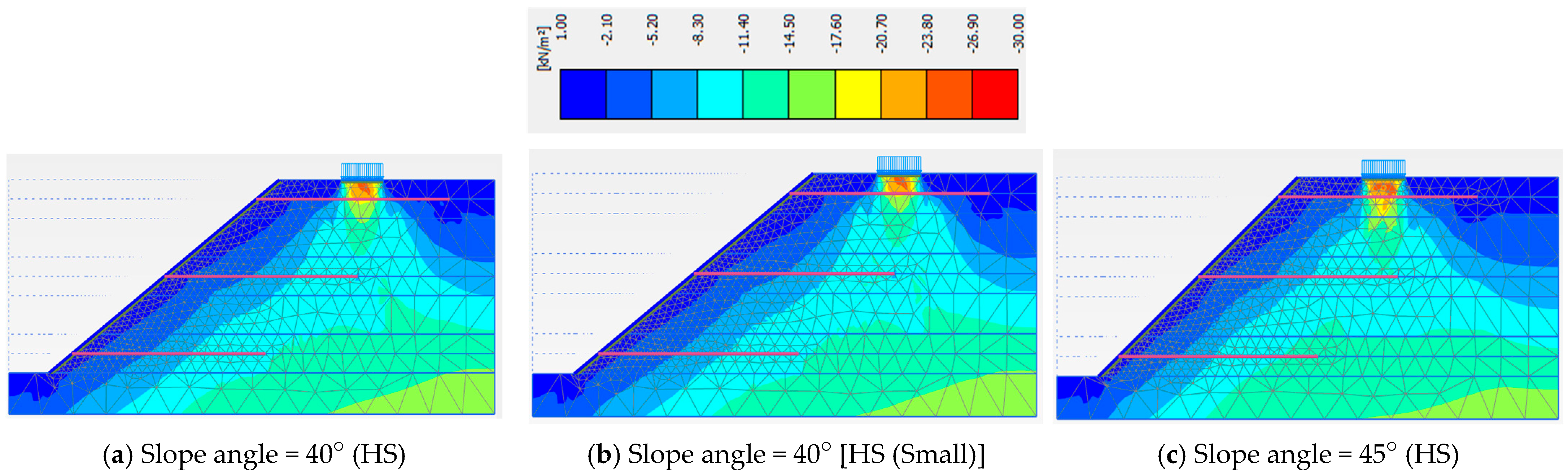
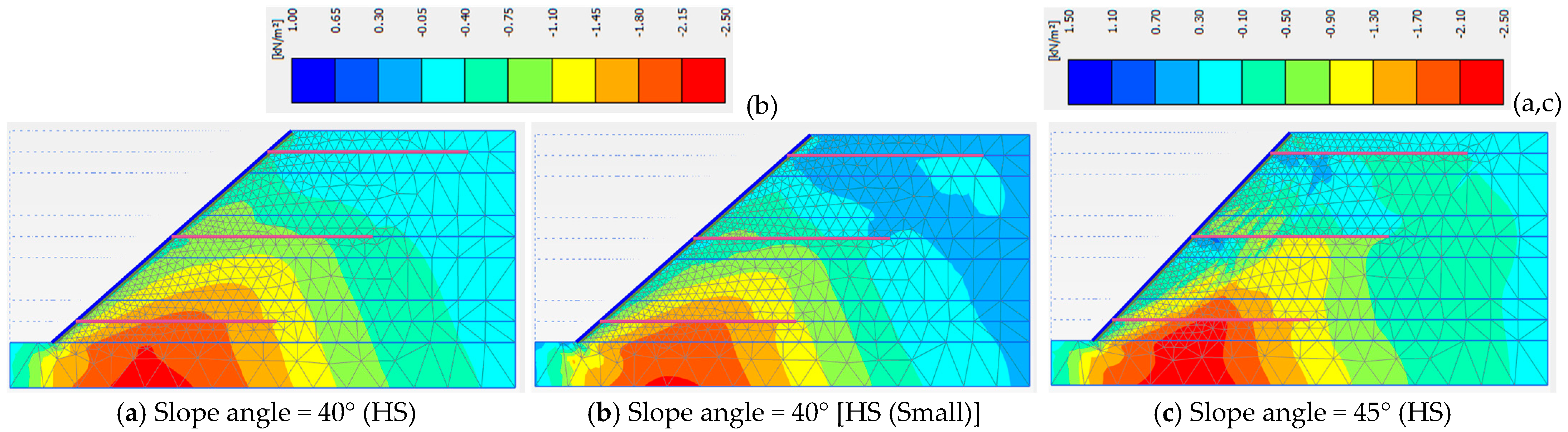
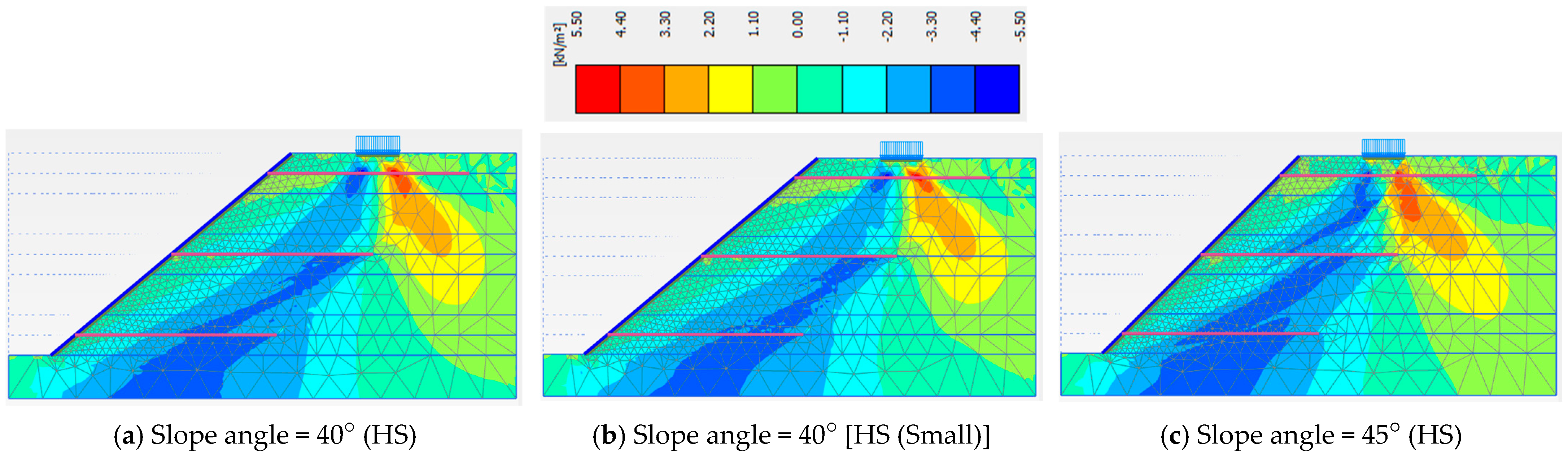
The horizontal displacement distributions at construction phase 5 and loading phase 8 for different slope angles and material models are shown in Figure 26 and Figure 27. Figure 28 and Figure 29 display the vertical displacement distribution at construction phase 5 and loading phase 8. The horizontal stress distribution at phase 5 and phase 8 are given in Figure 30 and Figure 31 for different slope angles and material models. The vertical stress distributions for different angles and material models at phases 5 and 8 are depicted in Figure 32 and Figure 33. Figure 34 and Figure 35 shows the shear stress distributions at phases 5 and 8 for different slope angles and material models. Table 9 provides the factors of safety (FOSs) of FEM models of nailed soil slopes with different slope angles and material models.
Figure 26.
Horizontal displacement distribution for different slope angles and material models at construction phase 5.
Figure 27.
Horizontal displacement distribution for different slope angles and material models at loading phase 8.
Figure 28.
Vertical displacement distribution for different slope angles and material models at construction phase 5.
Figure 29.
Vertical displacement distribution for different slope angles and material models at loading phase 8.
Figure 30.
Horizontal stress distribution for different slope angles and material models at construction phase 5.
Figure 31.
Horizontal stress distribution for different slope angles and material models at loading phase 8.
Figure 32.
Vertical stress distribution for different slope angles and material models at construction phase 5.
Figure 33.
Vertical stress distribution for different slope angles and material models at loading phase 8.
Figure 34.
Shear stress distribution for different slope angles and material models at construction phase 5.
Figure 35.
Shear stress distribution for different slope angles and material models at loading phase 8.
Table 9.
Factor of safety (FOS) of finite element model of nailed soil slope and for variation in slope angles and material models.
3.4. Nail Length Distribution Strategies in Slope Layers
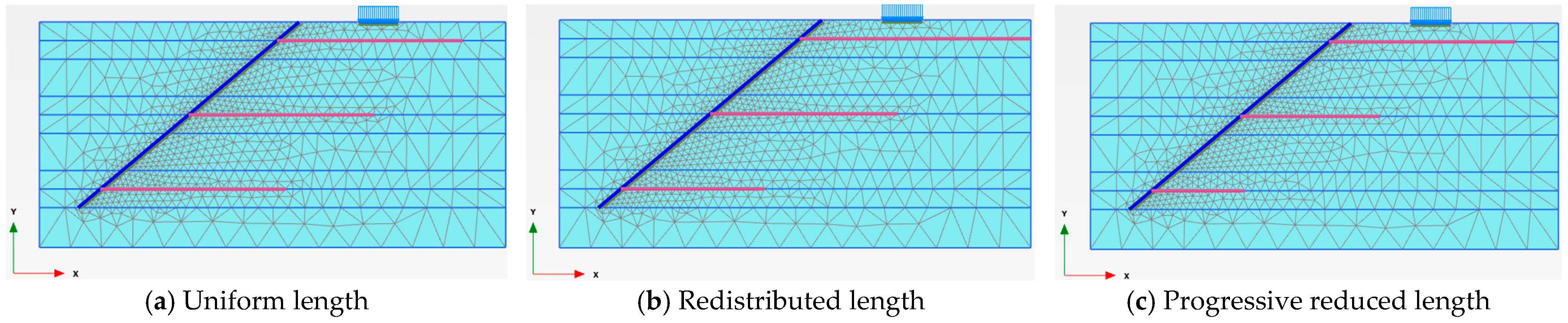
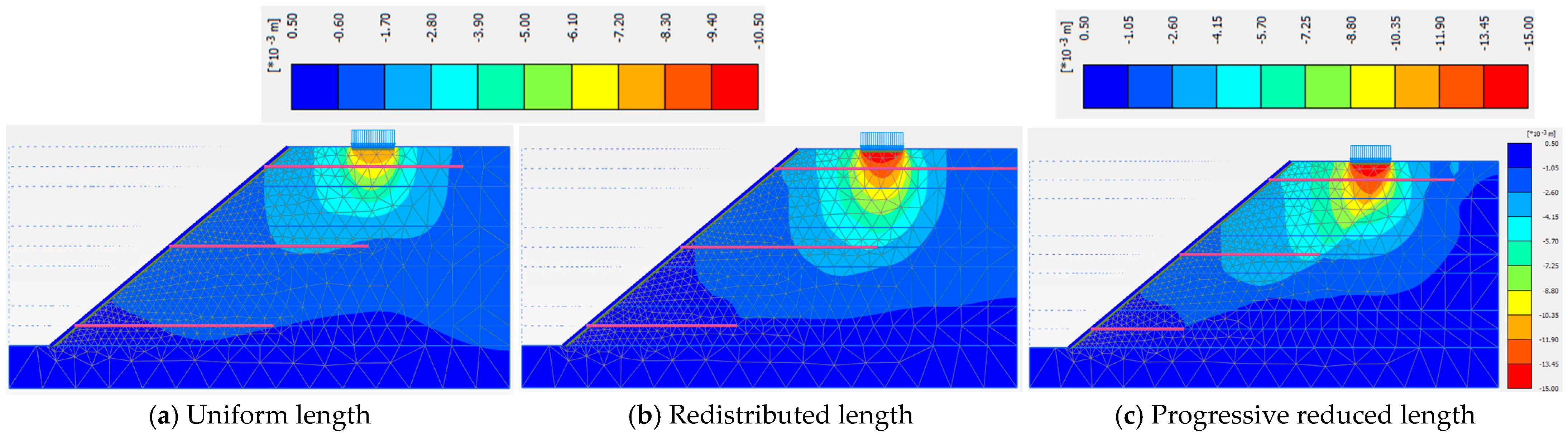
As noted by Saran [29], effective nail design requires extension beyond the anticipated rupture surface to mobilize reinforcement and resist tensile forces within the failure wedge, and according to Bahramipour et al. [24], increasing the nail length greatly increases stability, but the benefits reduce beyond a threshold length. The impact of three nail length configurations—equal length (all nails have a uniform length across the slope height), redistributed length (lengths vary but are optimized per layer to maximize efficiency, e.g., longer nails at critical depth, at top), and progressively reduced length (lengths decrease progressively from bottom to top, same length in top layer with three-quarters, and half in middle and bottom layers)—are evaluated for a soil-nailed slope based on slope stability, displacement, and stress behavior. The performance is assessed at different construction and loading phases. Soil slope finite element models’ discretization for various nail length distribution strategies in slope layers is portrayed in Figure 36. Figure 37 and Figure 38 illustrate deformed meshes at phase 5 (construction) and phase 8 (loading) for various nail length distribution strategies.
Figure 36.
Soil slope finite element models’ discretization for nail length distribution strategy in slope layers.
Figure 37.
Deformed mesh of finite element models of nailed soil slope at phase 5 for nail length distribution strategy in slope layers.
Figure 38.
Deformed mesh of finite element models of reinforced soil slope at phase 8 for nail length distribution strategy in slope layers.
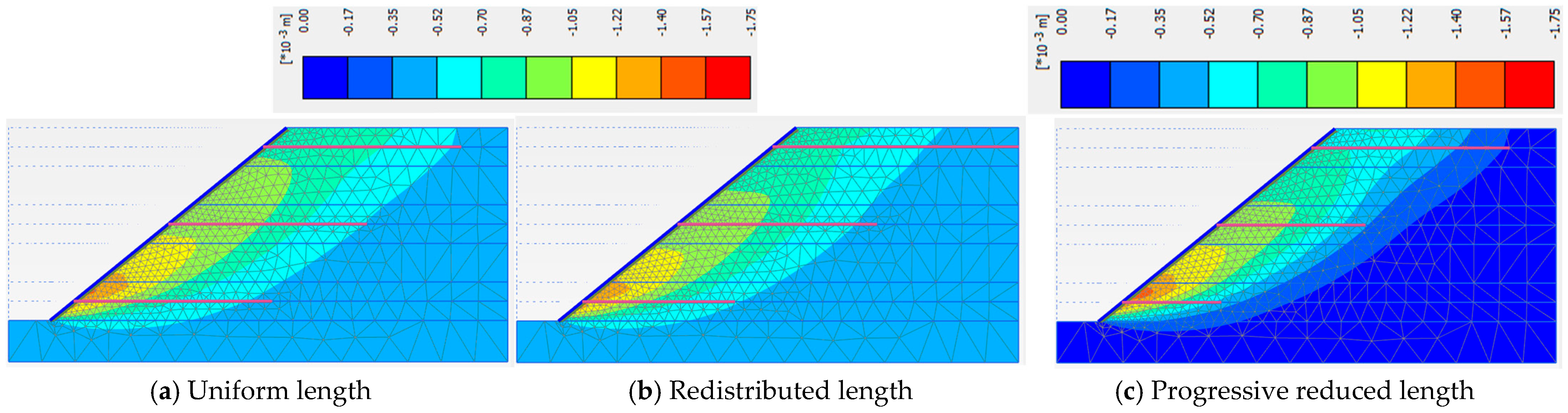
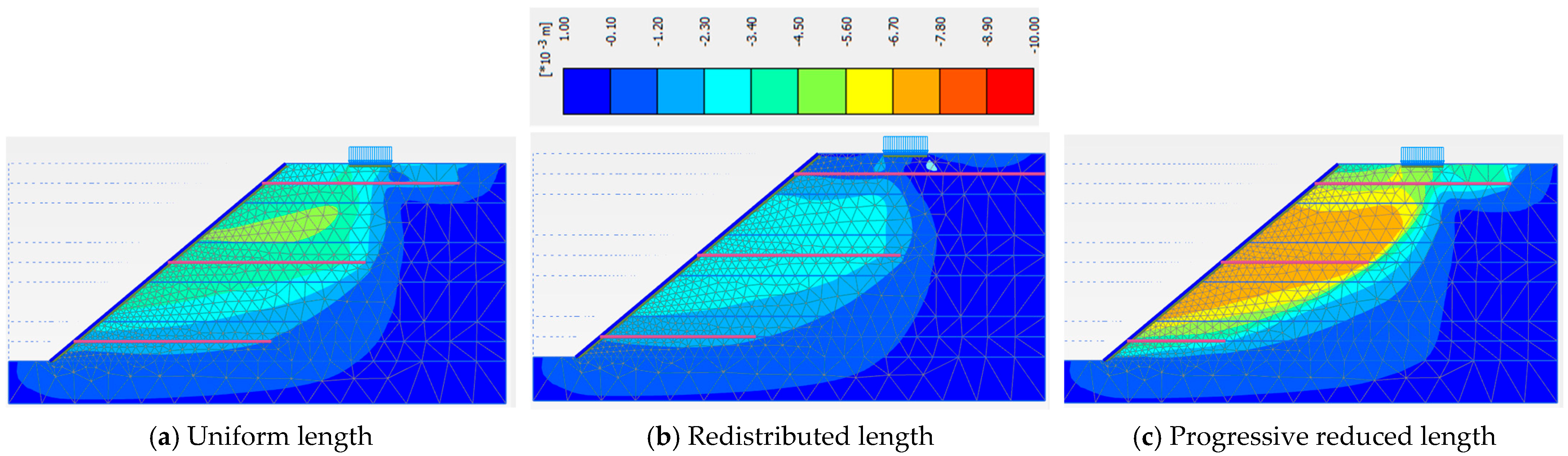
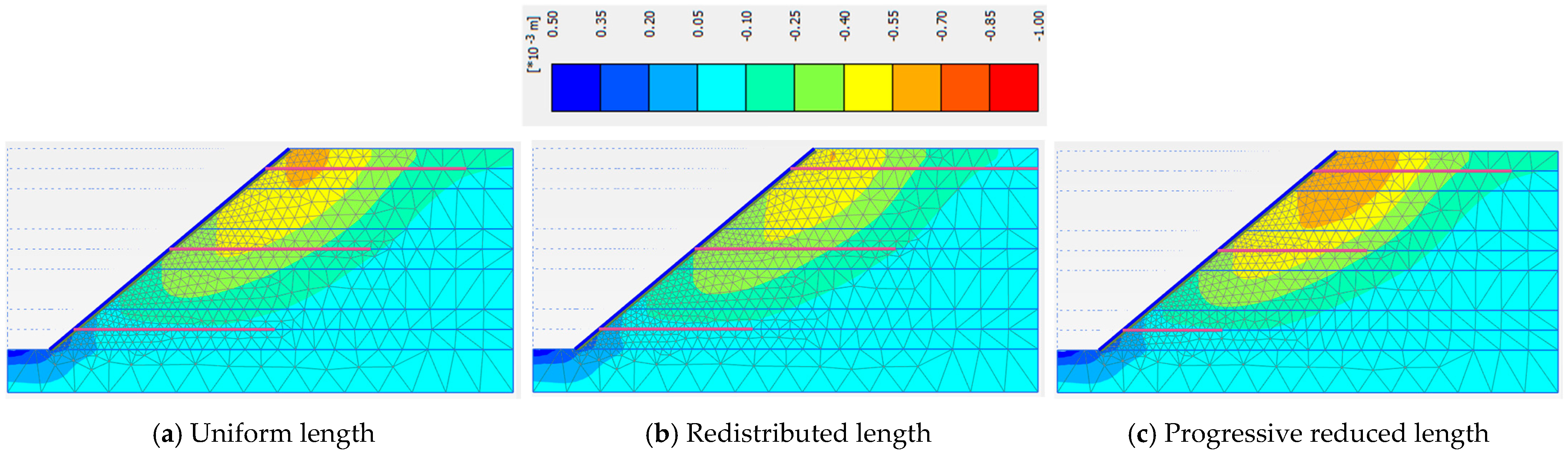
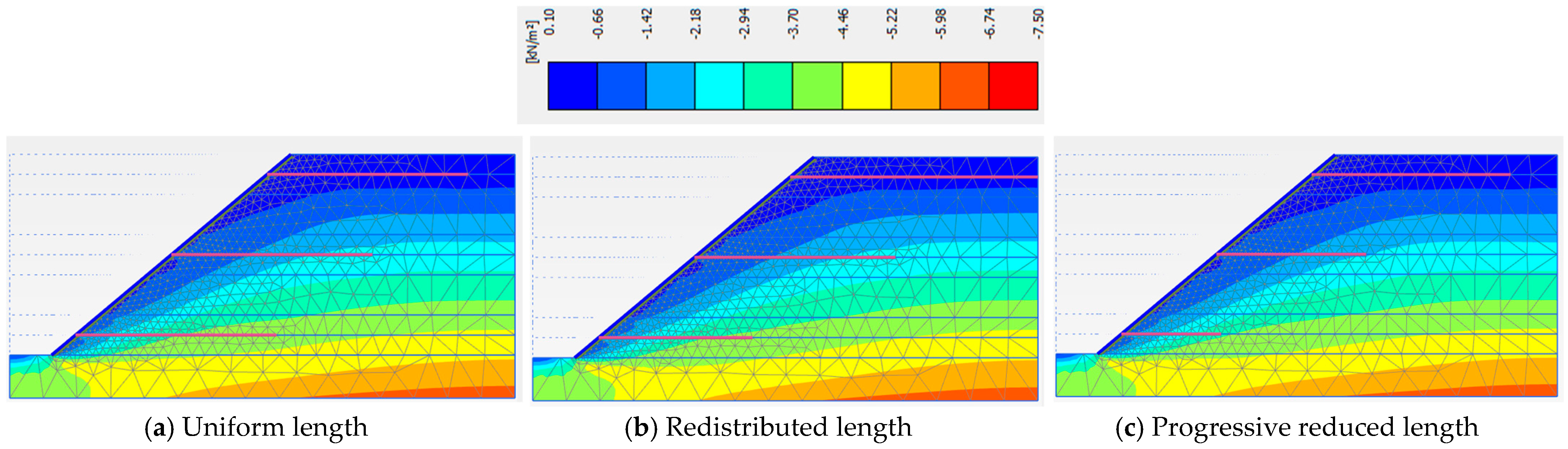
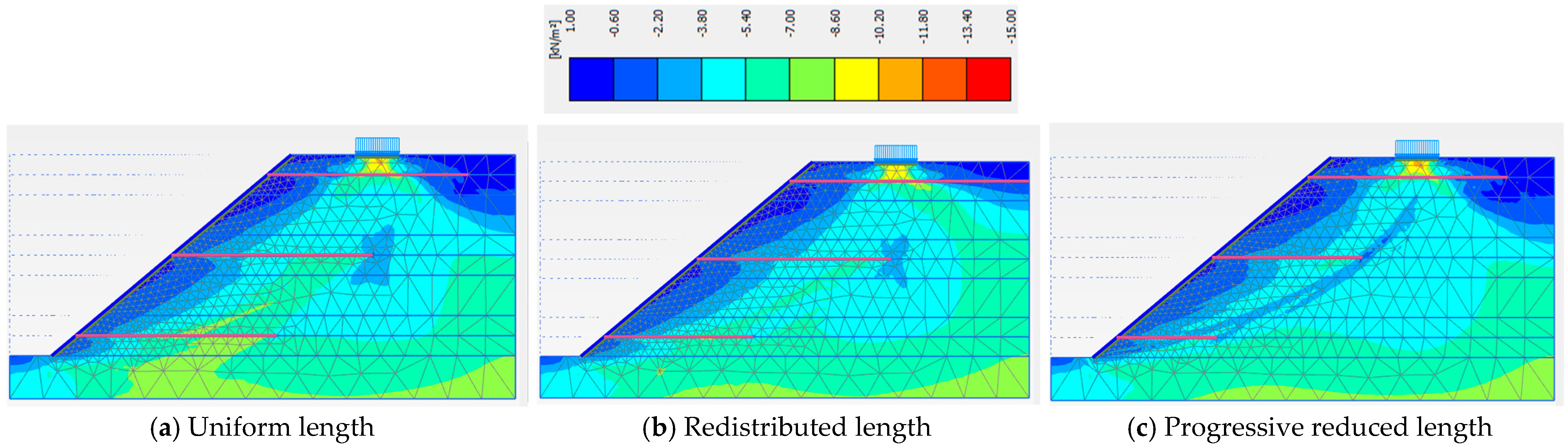
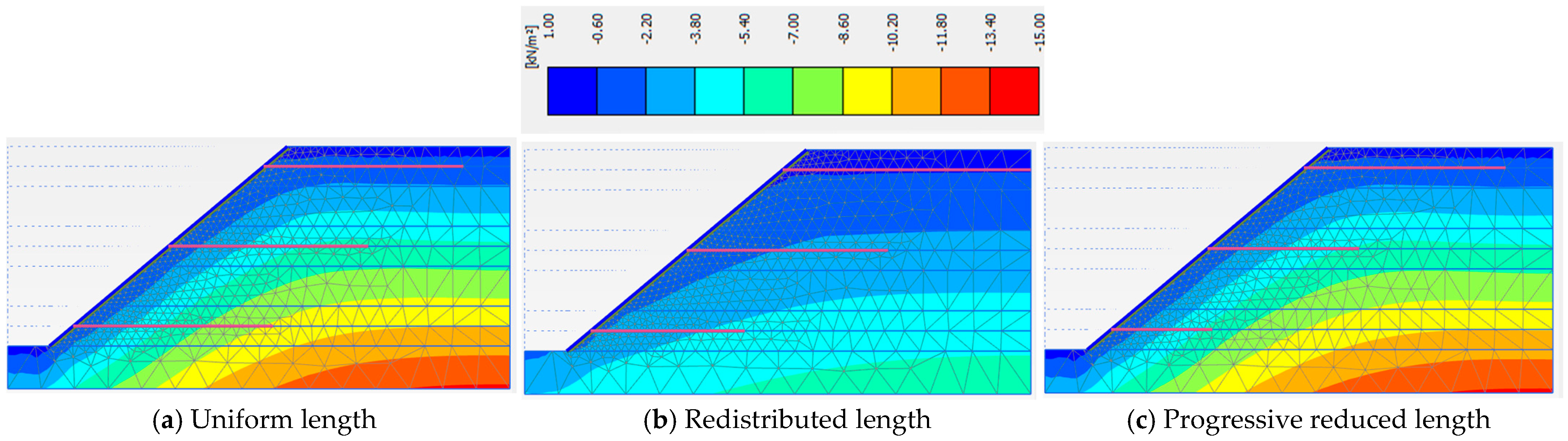
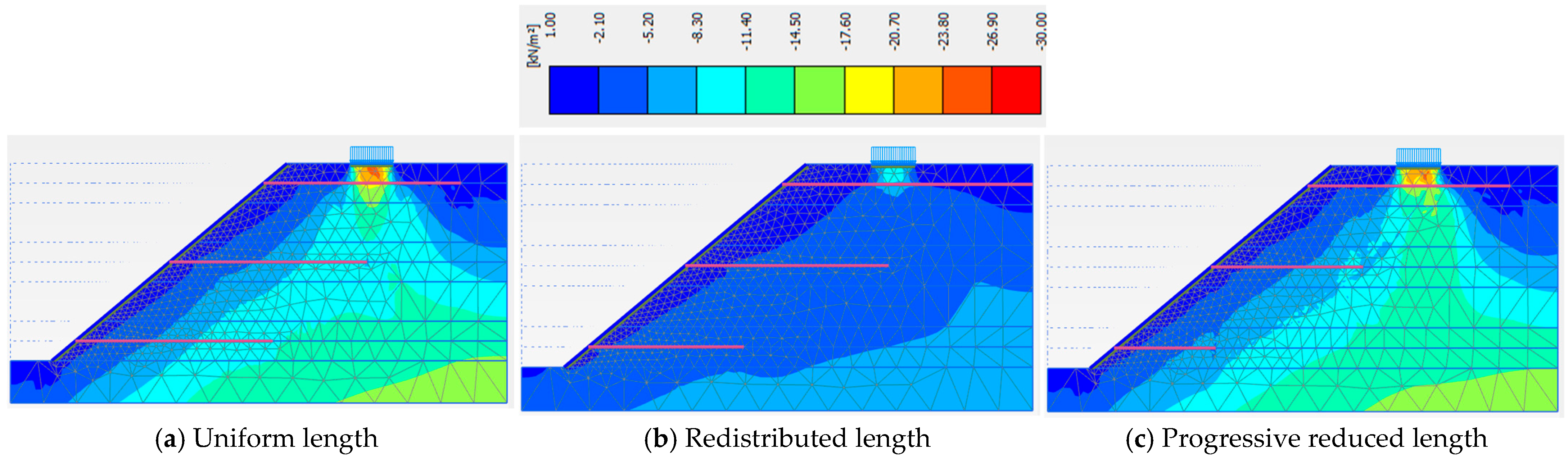
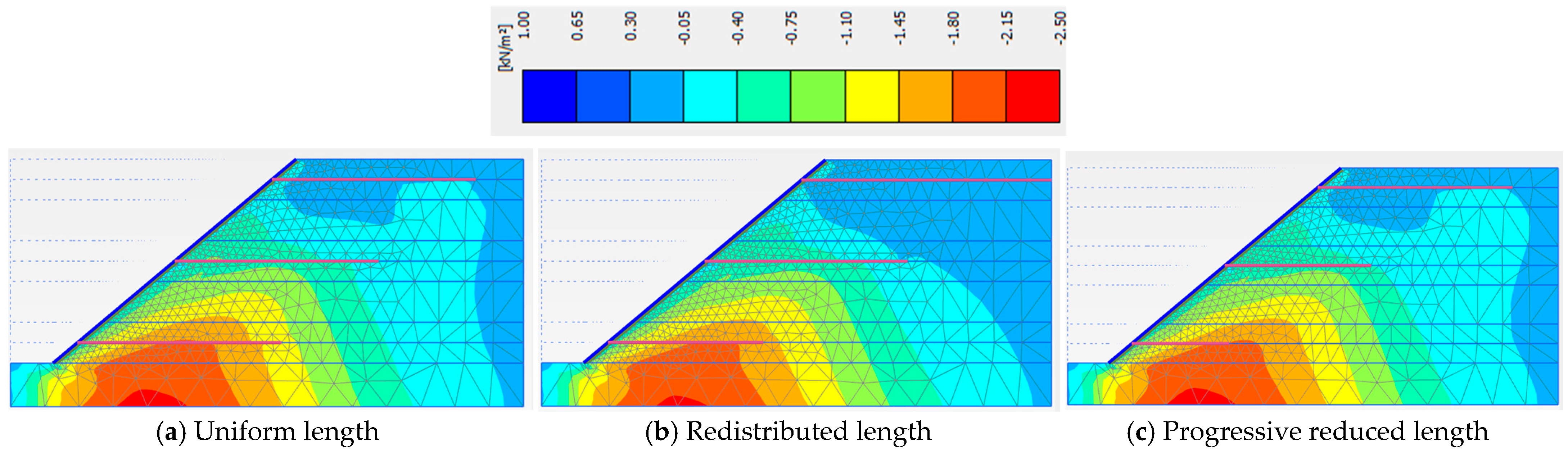
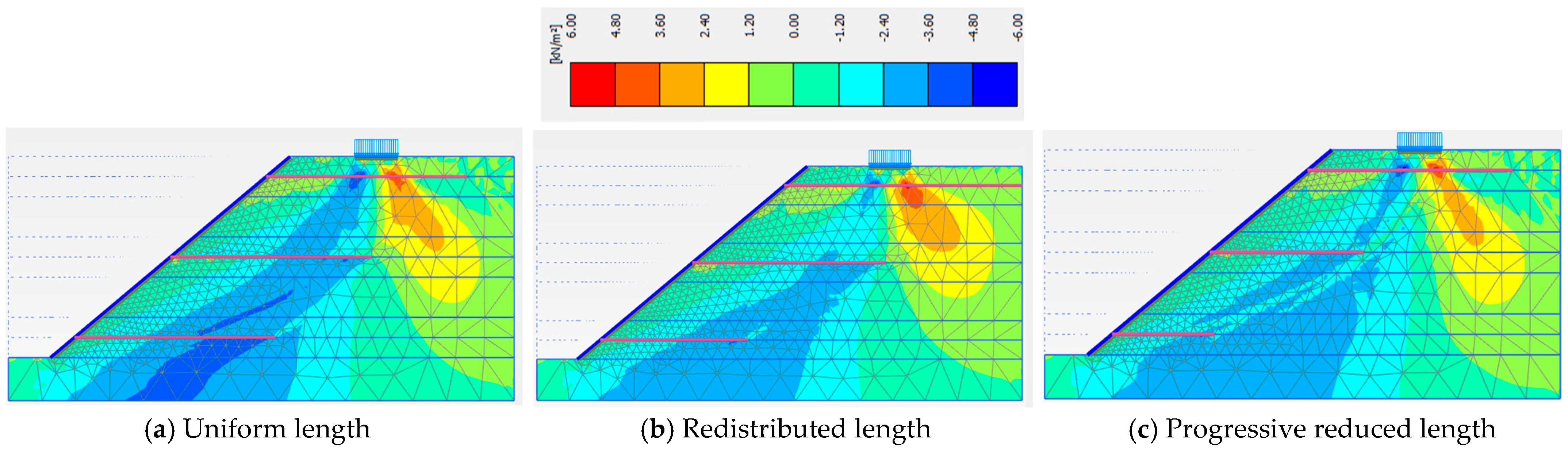
The horizontal displacement distributions in the nailed soil slope for various nail lengths are portrayed in Figure 39 and Figure 40 at construction phase 5 and loading phase 8. The vertical displacement distributions in the nailed soil slope for different reinforcement strategies are depicted in Figure 41 and Figure 42 at phases 5 and 8, respectively. The horizontal stress distributions for various nail lengths are shown in Figure 43 and Figure 44 for two phases, phases 5 and 8. The vertical stress distributions for various nail lengths are portrayed in Figure 45 and Figure 46 for phase 5 and phase 8. Figure 47 and Figure 48 depict the shear stress distributions for various nail lengths. The factor of safety of FEM of the nailed soil slope for the nail length distribution strategy in slope layers is given in Table 10.
Figure 39.
Horizontal displacement distribution for nail length distribution strategy in slope layers at construction phase 5.
Figure 40.
Horizontal displacement distribution for nail length distribution strategy in slope layers at loading phase 8.
Figure 41.
Vertical displacement distribution for nail length distribution strategy in slope layers at construction phase 5.
Figure 42.
Vertical displacement distribution for nail length distribution strategy in slope layers at loading phase 8.
Figure 43.
Horizontal stress distribution for nail length distribution strategy in slope layers at construction phase 5.
Figure 44.
Horizontal stress distribution for nail length distribution strategy in slope layers at loading phase 8.
Figure 45.
Vertical stress distribution for nail length distribution strategy in slope layers at construction phase 5.
Figure 46.
Vertical stress distribution for nail length distribution strategy in slope layers at loading phase 8.
Figure 47.
Shear stress distribution for nail length distribution strategy in slope layers at construction phase 5.
Figure 48.
Shear stress distribution for nail length distribution strategy in slope layers at loading phase 8.
Table 10.
Factor of safety (FOS) of finite element model of nailed soil slope for nail length distribution strategy in slope layers.
4. Discussion
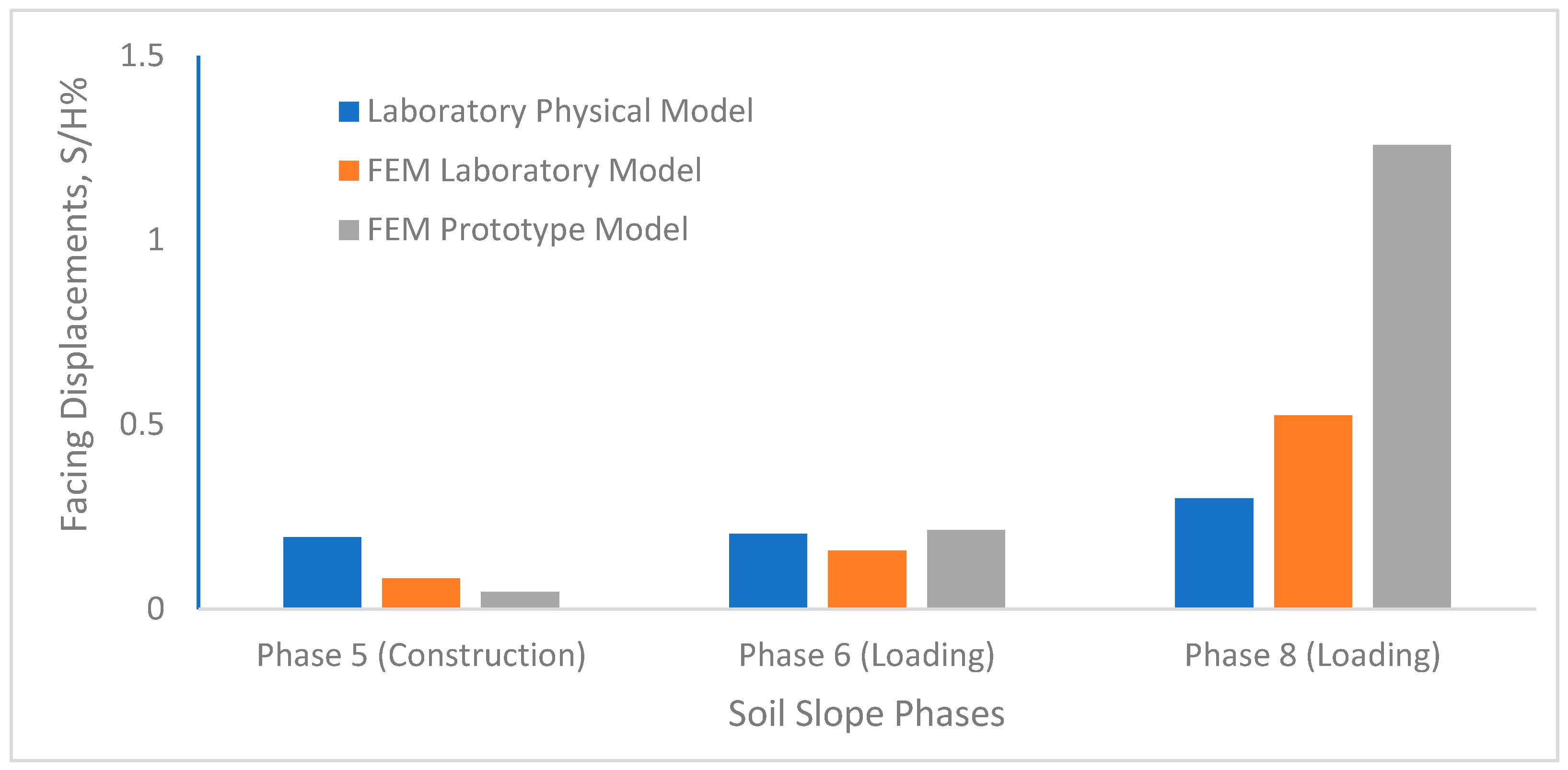
The developed PLAXIS code-based simulation models of the nailed soil slope with various model parameters, including mesh density, model dimensions, slope and reinforcement geometry, and constitutive models, are used to obtain deformed shapes, displacement, stresses at different positions, and factors of safety of the nailed soil system under the construction and loading phases. The resulting deformed shapes, displacements, stresses within the nailed soil slope, and factors of safety of nailed soil system outcomes for various nailed soil slope model parameters are presented in Table 4, Table 5, Table 6, Table 7, Table 8, Table 9 and Table 10 and in Figure 5, Figure 6, Figure 7, Figure 8, Figure 9, Figure 10, Figure 11, Figure 12, Figure 13, Figure 14, Figure 15, Figure 16, Figure 17, Figure 18, Figure 19, Figure 20, Figure 21, Figure 22, Figure 23, Figure 24, Figure 25, Figure 26, Figure 27, Figure 28, Figure 29, Figure 30, Figure 31, Figure 32, Figure 33, Figure 34, Figure 35, Figure 36, Figure 37, Figure 38, Figure 39, Figure 40, Figure 41, Figure 42, Figure 43, Figure 44, Figure 45, Figure 46, Figure 47 and Figure 48. Validation of the laboratory-scale model’s computed values against experimentally observed values is provided in Figure 49, Figure 50, Figure 51 and Figure 52.
Figure 49.
Laboratory model and finite element model: Horizontal slope face displacement at different phases.
Figure 50.
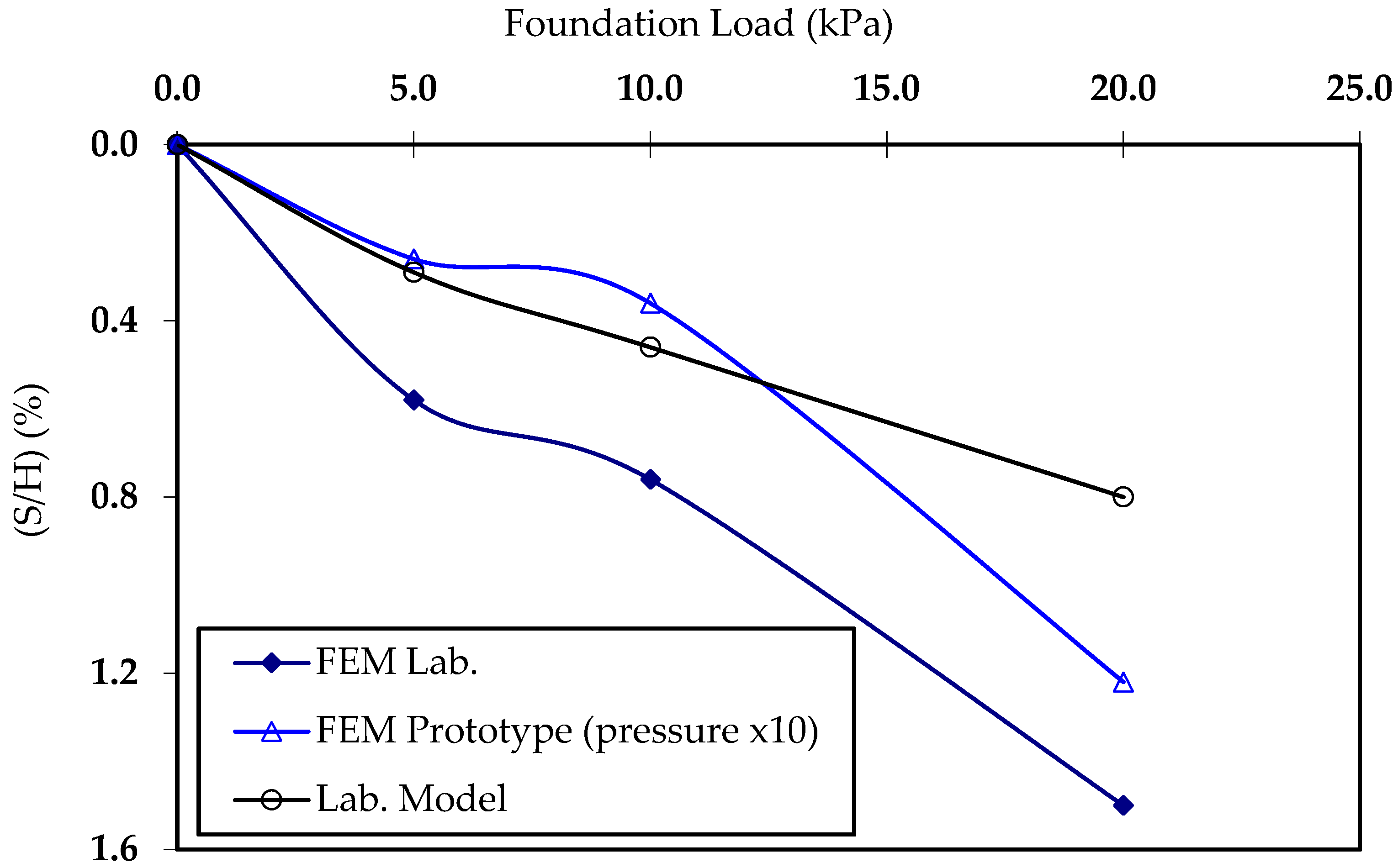
Footing settlements at different footing pressures in laboratory physical model and finite element model of nailed soil slope.
Figure 51.
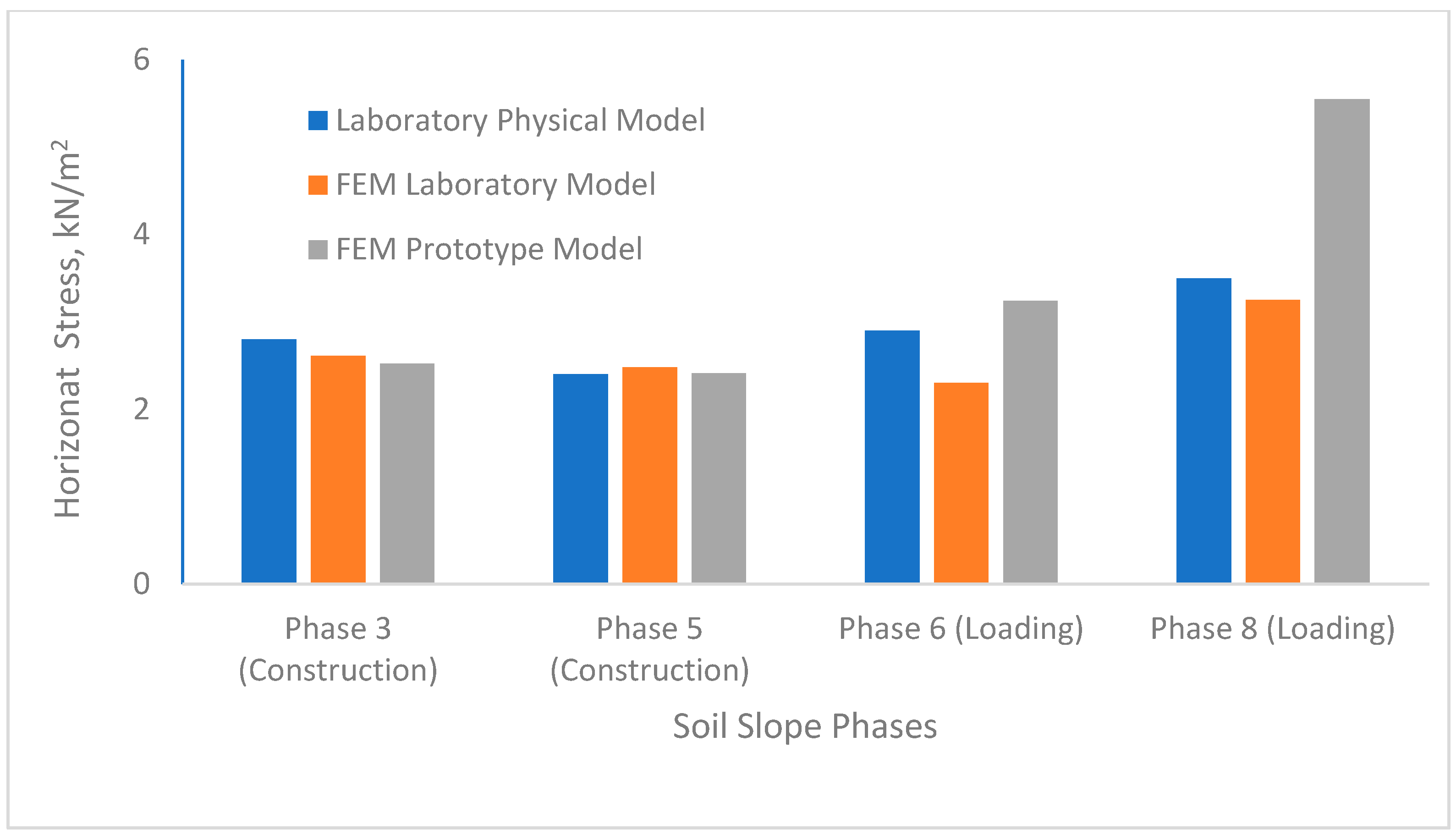
Laboratory physical model and finite element model for horizontal stress behind the reinforcement at different phases.
Figure 52.
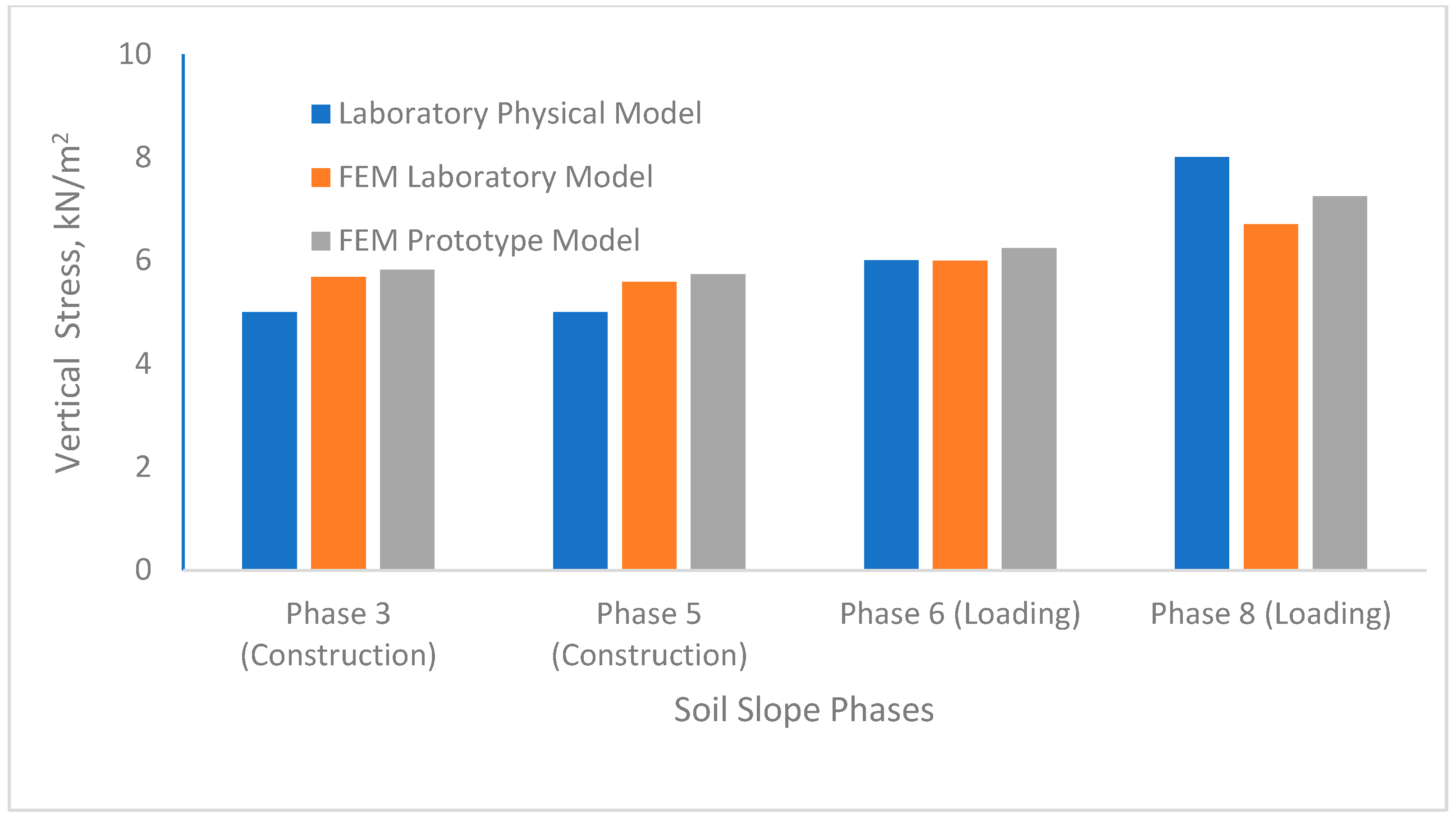
Laboratory physical model and finite element model for vertical stresses behind the reinforcement at different phases.
Analysis of Table 5, Table 6 and Table 7 and Figure 5, Figure 6, Figure 7, Figure 8 and Figure 9 indicates that mesh density is important for the accuracy and computational efficiency of finite element models (FEMs). Figure 5 illustrates the discretization of the soil slope model using coarse, medium, and fine meshes. The finer mesh, with its significantly higher number of elements and nodes, provides a greater spatial resolution for stress–strain calculations. In early phases (e.g., Phase 3), all three meshes yield nearly identical horizontal displacements (0.05 S/H%), indicating low sensitivity. However, discrepancies become more pronounced in later phases. Notably, in phase 8, the coarse mesh underestimates horizontal displacement (0.466%) compared to fine mesh (0.528%). Figure 6 and Figure 8 demonstrate that the fine mesh produces smoother and more continuous horizontal displacement fields, highlighting its better capacity to capture deformation patterns, especially near the slope toe and top facing. Similarly, the vertical displacement or footing settlement predictions are relatively close in early phases (e.g., phase 6), though the medium mesh shows a slightly lower value (0.58%) than the coarse and fine meshes (0.68%). These differences become more pronounced in latter phases, with the fine mesh predicting a higher settlement (1.83%) than both the medium (1.51%) and coarse (1.63%) meshes. This suggests that the coarse mesh may suppress localized settlement zones due to its lower resolution. Figure 8 and Figure 10 further reveal that the fine mesh provides a more refined view of vertical displacement gradients, particularly under the footing and crest of the slope. Factor of safety (FOS) values across different mesh densities show a consistent trend (Table 7), with FOS decreasing as the mesh becomes finer. This trend indicates that coarser meshes may artificially inflate safety margins due to numerical stiffness and stress averaging effects. The fine mesh likely yields a more realistic, though conservative, estimate of slope stability. Fine meshes offer more accurate representation of the stress/strain distribution and displacements but at higher computational costs. The conservative FOS from fine meshes may be more reliable for design purposes, particularly in critical infrastructure. Medium mesh results are generally close to fine mesh results, suggesting it may be a practical compromise for engineering analysis when resources are limited.
Figure 11, Figure 12, Figure 13, Figure 14, Figure 15, Figure 16, Figure 17, Figure 18, Figure 19, Figure 20, Figure 21 and Figure 22 and Table 8 present the predicted performance of nailed soil slopes from finite element models with varying dimensions. The deformed mesh at construction phase 5 and loading phase 8 is shown in Figure 11 and Figure 12. Figure 13 and Figure 14 for the original dimensions, increased vertical and increased horizontal models, and increased perpendicular (3D) model show similar horizontal displacement patterns at both phases 5 and 8, though slightly higher displacements occur in the vertically expanded model, suggesting that an increased height influences overall deformation due to larger soil mass mobilization, and the slightly lower displacement in the increased perpendicular (3D) model highlights some 3D effects on stiffness and stress redistribution. The prototype model displays the lowest deformation, likely due to scale-induced stiffness reductions. Similarly, Figure 15 and Figure 16 showing the vertical displacement distribution show similar patterns for horizontal displacement. The vertical expanded models, perpendicular expansion, and the prototype model have a greater influence on the load distribution. The vertical expansions result in somewhat increased stress zones compared to the base model. Shear stress is most prominent near the toe of the slope in construction stages and near the foundation in loading stages. The prototype model and increased perpendicular (3D) model show the spatial spread of shear stress, suggesting a reduced peak intensity impact. The prototype model consistently shows the lowest FOS, indicating a more realistic and conservative safety assessment at the field scale. The increased vertical dimension yields the highest FOS at phase 6, likely due to improved confinement, but may also represent boundary effect artifacts. The increased horizontal dimension has a negligible effect on the FOS, aligning with earlier displacement and stress findings. The original model remains a reasonable approximation but slightly overestimates stability compared to prototype conditions. The three-dimensional model consistently shows the higher FOS compared to other variations in dimensions over the base model, giving a more realistic stability of slope.
The performance of the finite element models for nailed soil slopes when varying slope angles and constitutive soil models is presented in Figure 24, Figure 25, Figure 26, Figure 27, Figure 28, Figure 29, Figure 30, Figure 31, Figure 32, Figure 33, Figure 34 and Figure 35 and in Table 9, detailing mesh deformations, displacements and stress distributions, and factors of safety. From the figures of the construction and loading phases of nailed soil slope development, it can be seen that there is lower deformation in the 40° slope models compared to the 45° slope, indicating improved stability at flatter angles. The HS (small) model results in slightly reduced deformation compared to HS material model, confirming the impact of capturing small-strain stiffness for a realistic short-term response. The 45° slope exhibits more pronounced lateral bulging and toe movement in both the HS and HS (small) models, consistent with expected instability trends for steeper slopes. The horizontal displacement distribution shown in the figure confirms that displacement magnitudes increase with slope steepness. The soil slope with angle 40° with the HS (small) material model yields the least deformation, followed by angle 40° with the HS material model, and then the soil slope with angle 45°. At the latter loading phases, the horizontal displacements become significantly more extensive, suggesting that the construction sequence critically influences the slope behavior. The figures for vertical displacement reveal a similar trend, confirming that this progression equally affects vertical displacements. Settlements are most prominent under the footing and along the slope crest. The HS (small) material model provides improved resistance to vertical deformation compared to HS at the same slope angle. The 45° slopes demonstrate larger settlements, aligning with theoretical expectations of lower stability on steeper slopes. The stress distribution during the construction and loading phase for different slope angles and material models indicates that HS (small) material models exhibit lower horizontal stress magnitudes. This suggests better soil confinement and reduced active earth pressure. On the 45° slopes, horizontal stresses concentrate near the nail head, indicating potential development of slip surfaces. Vertical stress patterns show stress arching around reinforcements and localized zones of compression behind the nails. HS (small) distributes vertical stresses more uniformly, especially under shallow overburden. The shear stress distribution is critical for the slope failure potential. Higher shear stress concentrations appear at the toe in the 45° models. HS (small) shows less intense peak shear zones, possibly delaying the onset of plastic failure. Shear zones deepen and broaden during loading phases, demonstrating the accumulation of stress from sequential excavation and loading. Stability studies clearly show the influence of the slope development, slope angle, and material model effect on factors of safety (FOSs). The 45° slope consistently yields the lowest FOS, indicating higher susceptibility to failure. The HS (small) material model shows marginal FOS improvements over the standard HS material model, particularly during loading phases, which is attributed to more realistic simulation of soil stiffness at small strains. FOS values peak at an intermediate development phase before they decline, reflecting the maximum stability mid-construction followed by a reduction due to a subsequent loading increment or deeper excavation.
Figure 37, Figure 38, Figure 39, Figure 40, Figure 41, Figure 42, Figure 43, Figure 44, Figure 45, Figure 46, Figure 47 and Figure 48 and Table 10 present the predicted performance of the nailed soil slope finite element model for various nail length configurations, i.e., slope stability, deformed shapes, displacement/stress behavior. The equal nail length and redistributed nail length models show relatively controlled deformation, especially mid-slope and at the toe. A progressive reduced nail length results in noticeably greater deformations, particularly near the slope face and crest, suggesting weaker confinement due to shorter nails in upper layers. The redistributed configuration offers deformation control nearly comparable to equal-length nails while potentially using less material. The displacement distributions for various nail length distribution strategies in the slope layers indicate that the equal nail length and redistributed nail length perform similarly in limiting lateral movements during construction and loading phases. A progressively reduced nail length allows for increased displacements, especially at the upper face and crest area, indicating a trade-off between efficiency and lateral stability. During the loading phase, the redistribution strategy controls displacements more effectively than the equal nail length approach, likely due to a strategic placement of reinforcement, deeper in the upper layers for effective stabilization. Settlements are observed to be lowest in the redistributed nail length model, particularly near the slope crest and mid-depth of slope. The configuration with a progressively reduced nail length again shows the highest settlements, confirming that there is insufficient resistance in upper slope layers. The equal nail length setup demonstrates a moderate performance but is less optimized than the redistributed approach. The redistributed nail length provides a more uniform stress field, which helps reduce local overstress. The vertical stress distributions for various nail length configurations indicate that equal nail lengths and redistributed nail lengths demonstrate a consistent vertical stress distribution with better arching effects behind reinforcements. Shear stress builds up most prominently near the toe and along potential failure planes. Redistributed nail lengths effectively distribute shear stress, reducing peak intensity zones. The factor of safety for different nail length distribution strategies across various development phases shows that the redistributed nail length configuration consistently yields the highest or comparable FOS values. This strategy slightly outperforms the equal nail length approach, specifically during phases 5, 6, 7, and 8. Progressively reduced nail lengths show the lowest FOS values, highlighting the potential compromise in safety when nail lengths are reduced excessively, especially near the toe. The trend suggests that while uniform nail lengths provide safety, redistributed nail lengths offer a better efficiency-to-safety ratio.
The simulation models (FEMs) of nailed soil slopes are validated by comparing the computed displacement, footing settlement, and stresses with laboratory observed values at different phases of slope development. These comparisons are presented in Figure 49, Figure 50, Figure 51 and Figure 52. As illustrated in Figure 49, the horizontal displacement at different construction and loading phases shows good agreement between the FEM and laboratory results. The FEM effectively captures the progressive deformation patterns of the slope face, validating its capacity to simulate stress redistribution as soil nailing progresses. The deviations observed in later stages may be attributed to simplifications in constitutive soil behavior in the FEMs or may be due to potential scale effects in the laboratory model. Figure 50 highlights the settlement response of a footing under varying load intensities. Both experimental and numerical results indicate a nonlinear settlement pattern with increasing pressure. FEM closely matches the experimental trend, though it slightly underestimates settlements at higher pressure levels. This may reflect limitations in modeling localized failure mechanisms or interaction between the footing and reinforced soil zone. Horizontal stress data behind the reinforcement, presented in Figure 51, align well between the FEM and physical tests across different construction phases. The FEM adequately reproduces stress build-up due to excavation and nail installation. Differences observed in early phases may result from initial stress distribution approximations in the model. Figure 52 shows vertical stress distributions behind the nails at various phases, portraying that the finite element models (FEMs) replicate the general trend and magnitude of stress variations, demonstrating their robustness in modeling vertical load paths. The FEM shows a reliable prediction of the slope behavior when reinforced with soil nails. Key geotechnical responses such as deformation, stress distribution, and settlement are well captured. The close agreement with laboratory results suggests that the FEM can serve as a predictive tool for design optimization and performance assessment of nailed soil slopes.
5. Conclusions
The present study uses PLAXIS code to simulate the behavior of nailed soil slopes under plane strain conditions, using models calibrated against laboratory-scale experiments involving a sand-filled Perspex box, steel nail reinforcements, and a rigid foundation. The research work examines the effects of varying slope angles, mesh discretization, the domain size, constitutive modeling, and reinforcement distribution across different layers, including both prototype-scale and three-dimensional models. The analysis evaluates slope displacements, internal stress distributions, and factors of safety during construction and loading under various parametric conditions.
The results confirm that key design parameters, including the mesh density, model dimensions, slope angle, reinforcement layout, and constitutive material models, significantly influence the slope deformation, stress distribution, and global safety. Medium-density meshes provided a practical balance between computational efficiency and result accuracy, while fine meshes offered detailed deformation capture but at increased computational costs. Dimensionality effects were notable, with 3D and prototype-scale models showing more realistic deformation and stress redistribution, highlighting the limitations of simplified 2D models. The slope angle and constitutive model choice were found to be critical, as shallower slopes and the Hardening Soil model with small-strain stiffness (HS-small) yielded better performances, reduced settlements, and improved stress confinement, especially under sequential loading.
The redistribution of nail lengths across slope depth enhanced the performance compared to both uniform and progressively reduced nail lengths, offering material savings without compromising safety. Vertical model expansions had a greater impact on performance than horizontal expansions, likely due to increased overburden effects, while boundary conditions influenced localized stress zones and displacements. The finite element model predictions aligned closely with laboratory test results for deformation, settlement, and stress, validating the reliability of the model for engineering applications. The findings support the adoption of optimized nail layouts, realistic material modeling, and careful dimensional calibration in designing safe and cost-effective nailed soil slope systems. This study delivers valuable understanding on the development of design guidelines and further refinement of FEM-based slope stability tools.
6. Recommendations for Future Research
We recommend that future researchers should use prototype-scale numerical analysis alongside laboratory testing for a more accurate assessment of slope behavior, especially when designing soil-nailed systems for large-scale projects. This ensures that complex stress interactions and failure mechanisms are properly accounted for in design and stability evaluations. There is a need to perform an in-depth comparative analysis of three-dimensional finite element simulation of reinforced-soil system development (construction and loading) with two-dimensional simulation. There is also a need for two- and three-dimensional parametric investigation by varying the slope structure parameters, soil parameters, nailing parameters, loading parameters, and finite element model parameters. Other analysis methods could also be adopted to analyze the reinforced-soil system and compare the findings with the finite element model analysis.
Author Contributions
Conceptualization, S.A.T. and M.A.; methodology, S.A.T. and MA.; resources, J.M. and M.H.M.; writing—original draft preparation, M.H.M. and M.Q.A.; writing—review and editing, J.M. and M.H.M.; project administration, M.Q.A.; funding acquisition, M.A. All authors have read and agreed to the published version of the manuscript.
Funding
Funding for this research was given under the Large Group Research Project, award numbers R.G.P2/105/46 by the Deanship of Scientific Research; King Khalid University, Ministry of Education, Kingdom of Saudi Arabia.
Data Availability Statement
The data and models developed or employed in this study can be obtained from the corresponding author by written request.
Acknowledgments
The authors extend their appreciation to the Deanship of Research and Graduate Studies at King Khalid University for funding this work through Large Research Project under grant number RGP2/105/46. The authors acknowledge to the Dean, Faculty of Engineering for his valuable support and help.
Conflicts of Interest
The authors declare no conflicts of interest.
Abbreviations
The following abbreviations are used in this manuscript:
| FEM | Finite Element Method |
| FOS | Factor of Safety |
| FEA | Finite Element Analysis |
| HS | Hardening Soil |
References
- Panigrahi, R.K.; Dhiman, G. Design and Analysis of Soil Nailing Technique for Remediation of Landslides. Highw. Res. J. 2019, 10, 24–32. [Google Scholar]
- Jeyaseelan, P.A.; Madhavan, M. Application of FEM and Artificial Intelligence Techniques (LRM, RFM, ANN) for Predicting the ultimate Bearing Capacity of Reinforced Soil foundation. Buildings 2024, 14, 2273. [Google Scholar] [CrossRef]
- Sundaravel, V.; Dodagoudar, G.R. Finite Element Analysis of Reinforced Earth Retaining Structures: Material Models and Performance Assessment. Indian Geotech. J. 2024, 54, 2076–2095. [Google Scholar] [CrossRef]
- Zhou, Y.D.; Xu, K.; Tang, X.; Tham, L.G. Three-Dimensional Modeling of Spatial Reinforcement of Soil Nails in a Field Slope under Surcharge Loads. J. Appl. Math. 2013, 3, 926097. [Google Scholar] [CrossRef]
- Lanzieri, D.R.; Avesani Neto, J.O. Finite Element Analysis of Soil-Nailed Vertical Excavation in Fine-Grained Soils in an Urban Area. Soils Rocks 2025, 48, e2024010523. [Google Scholar] [CrossRef]
- Zhang, J.; Luo, C.; Wu, C.; Lu, M.; Wu, D. System Reliability Analysis of Soil-Nailed Slopes. Eng. Fail. Anal. 2025, 176, 109613. [Google Scholar] [CrossRef]
- Mathew, E.; Varma, M.; Sanoop, G.; Viji, A.J. Parametric Study of Different Soil Nails on Slope Stability Based on Finite Element Method. In Analyses for Retaining Walls, Slope Stability and Landslides, Proceedings of the ICRAGEE 2024, Guwahati, India, 11–14 December 2024; Lecture Notes in Civil Engineering; Sarkar, R., Maheshwari, B., Kumar, A., Eds.; Springer: Singapore, 2025; Volume 568. [Google Scholar] [CrossRef]
- Jaiswal, S.; Srivastava, A.; Chauhan, V.B. Numerical Modeling of Soil-Nailed Slope Using Drucker–Prager Model. In Advances in Geo-Science and Geo-Structures; Springer: Singapore, 2021; Volume 154, pp. 97–105. [Google Scholar] [CrossRef]
- Stauffer, K.D. Three-Dimensional Stability Analyses of Soil-Nailed Slopes by Finite Element Method. Ph.D. Thesis, West Virginia University, Morgantown, WV, USA, 2015. [Google Scholar]
- Singh, S.K.; Negi, M.S.; Singh, J. Strengthening of Slope by Soil Nailing Using Finite Difference and Limit Equilibrium Methods. Int. J. Geosynth. Ground Eng. 2021, 7, 64. [Google Scholar] [CrossRef]
- Deng, D.-G.; Li, L.; Zhao, L.-H. Stability analysis of slopes reinforced with anchor cables and optimal design of anchor cable parameters. Eur. J. Environ. Civ. Eng. 2021, 25, 2425–2440. [Google Scholar] [CrossRef]
- Oliaei, M.; Norouzi, B.; Binesh, S.M. Evaluation of Soil-Nail Pullout Resistance Using Mesh-Free Method. Comput. Geotech. 2019, 116, 103179. [Google Scholar] [CrossRef]
- Sharma, A.; Ramkrishnan, R. Parametric Optimization and Multi-regression Analysis for Soil Nailing Using Numerical Approaches. Geotech. Geol. Eng. 2020, 38, 3505–3523. [Google Scholar] [CrossRef]
- Kalehsar, R.I.; Khodaei, M.; Dehghan, A.N.; Najafi, N. Numerical modeling of effect of surcharge load on the stability of nailed soil slopes. Model. Earth Syst. Environ. 2022, 8, 499–510. [Google Scholar] [CrossRef]
- Sahoo, S.; Manna, B.; Sharma, K. Shaking Table Tests to Evaluate the Seismic Performance of Soil Nailing Stabilized Embankments. Int. J. Geomech. 2021, 21, 04021036. [Google Scholar] [CrossRef]
- Ye, X.; Wang, S.; Zhang, S.; Xiao, X.; Xu, F. Numerical and experimental studies of the mechanical behaviour for compaction grouted soil nails in sandy soil. Comput. Geotech. 2017, 90, 202–214. [Google Scholar] [CrossRef]
- Mohamed, M.H.; Ahmed, M.; Mallick, J.; Hoa, P.V. An Experimental Study of a Nailed Soil Slope: Effects of Surcharge Loading and Nails Characteristics. Appl. Sci. 2021, 11, 4842. [Google Scholar] [CrossRef]
- Afitikhar, A.A.; Aartati, H.K. Finite Element Modelling of Soil Nailing Inclination Effect on Slope Stability: Cibeureum Slope Case Study. Teknisia 2024, 29, 14–23. [Google Scholar] [CrossRef]
- Rajan, K.C.; Aryal, M.; Sharma, K.; Bhandary, N.P.; Pokhrel, R.; Acharya, I.P. Development of a framework for the prediction of slope stability using machine learning paradigms. Nat. Hazards 2025, 121, 83–107. [Google Scholar] [CrossRef]
- Mohamed, M.H.; Ahmed, M.; Mallick, J.; AlQadhi, S. Finite Element Modeling of the Soil-Nailing Process in Nailed-Soil Slopes. Appl. Sci. 2023, 13, 2139. [Google Scholar] [CrossRef]
- Pauzi, N.I.M.; Radhi, M.S.M.; Win, T.K. Analysis of a Nailed Soil Slope Using Limit Equilibrium and Finite Element Methods—A Review. MATEC Web Conf. 2024, 400, 02003. [Google Scholar] [CrossRef]
- Elahi, T.E.; Islam, M.A.; Islam, M.S. Parametric Assessment of Soil Nailing on the Stability of Slopes Using Numerical Approach. Geotechnics 2022, 2, 615–634. [Google Scholar] [CrossRef]
- Gui, M.-W.; Rajak, R.P. A Numerical Study of a Soil-Nail-Supported Excavation Pit Subjected to a Vertically Loaded Strip Footing at the Crest. Buildings 2024, 14, 927. [Google Scholar] [CrossRef]
- Bahramipour, O.; Moezzi, R.; Jalali, F.M.; Khaksar, R.Y.; Gheibi, M. Parametric Evaluation of Soil Nail Configurations for Sustainable Excavation Stability Using Finite Element Analysis. Inventions 2025, 10, 45. [Google Scholar] [CrossRef]
- Maleki, M.; Nezhad, H.M.; Hosseini, S.M.M.M. A numerical study of site effect and dynamic response of staged excavation supported by soil nail walls. Sci. Rep. 2025, 15, 20521. [Google Scholar] [CrossRef]
- Cheung, W.M.; Chang, G.W.K. Study of Nail soil Interaction by Numerical Shear Box Test Simulations; GEO Report No. 265; Civil Engineering and Development Department: Hong Kong, 2012; 42p. [Google Scholar]
- Yu, Y.; Bathurst, R. Influence of Selection of Soil and Interface Properties on Numerical Results of Two Soil–Geosynthetic Interaction Problems. Int. J. Geomech. 2017, 17, 04016136. [Google Scholar] [CrossRef]
- Duncan, J.M.; Chang, C.Y. Nonlinear Analysis of stress and strain in soil. J. Soil Mech. Found. 1970, 96, 1629–1653. [Google Scholar] [CrossRef]
- Saran, S. Reinforced Soil and Its Engineering Applications, 2nd ed.; PHI Learning Private Limited: New Delhi, India, 2010. [Google Scholar]
Disclaimer/Publisher’s Note: The statements, opinions and data contained in all publications are solely those of the individual author(s) and contributor(s) and not of MDPI and/or the editor(s). MDPI and/or the editor(s) disclaim responsibility for any injury to people or property resulting from any ideas, methods, instructions or products referred to in the content. |
© 2025 by the authors. Licensee MDPI, Basel, Switzerland. This article is an open access article distributed under the terms and conditions of the Creative Commons Attribution (CC BY) license (https://creativecommons.org/licenses/by/4.0/).