Article

Equivalent Elastic Modulus Study of a Novel Quadrangular Star-Shaped Zero Poisson’s Ratio Honeycomb Structure


1
School of Mechanical and Electronic Engineering, Wuhan University of Technology, Luoshi Road 122, Wuhan 430070, China
2
Hubei Digital Manufacturing Key Laboratory, Wuhan University of Technology, Luoshi Road 122, Wuhan 430070, China
*
Author to whom correspondence should be addressed.
Symmetry 2026, 18(1), 127; https://doi.org/10.3390/sym18010127
Submission received: 25 November 2025 / Revised: 20 December 2025 / Accepted: 1 January 2026 / Published: 9 January 2026

Abstract

This study proposes a novel four-pointed-star-shaped honeycomb structure having zero Poisson’s ratio, designed to overcome the stress concentration inherent in traditional point-to-point connected star-shaped honeycombs.By introducing a horizontal connecting wall at cell junctions, the new configuration achieves a more uniform stress distribution and enhanced structural stability. An analytical model for the in-plane equivalent elastic modulus was derived using homogenization theory and the energy method. The model, along with the structure’s zero Poisson’s ratio characteristic, was validated through finite element simulations and experimental compression tests. The simulations predicted an equivalent elastic modulus of 51.71 MPa (Y-direction) and 74.67 MPa (X-direction), which aligned closely with the experimental measurements of 56.61 MPa and 60.50 MPa, respectively. The experimental Poisson’s ratio was maintained near zero (v = 0.02). Parametric analysis further revealed that the in-plane equivalent elastic modulus decreases with increases in the wall angle, horizontal wall length, and wall thickness. This work demonstrates a successful structural optimization strategy that improves both mechanical performance and manufacturability for zero Poisson’s ratio honeycomb applications.

1. Introduction

Honeycomb structures originated from nature and are widely used due to their special topology and excellent geometrical and mechanical properties, as in the common honeycomb and honeycomb coal. With the human attention on honeycomb structures, honeycomb structures having different cellular units and topologies prepared by different materials have been designed successively [1,2,3]. Honeycomb structures are typically periodic, lightweight, and porous structures that exhibit numerous excellent properties, such as high specific stiffness, high specific strength, impact resistance, vibration damping, and noise reduction capabilities [4,5,6,7,8,9,10,11,12]. According to the material classification, they include metal honeycomb [13,14], paper honeycomb [15,16], ceramic honeycomb [17,18], and composite honeycomb structures [19,20,21]; according to the shape, there are hexagonal honeycomb [22,23], octagonal honeycomb [24], star-shaped honeycomb [25,26,27], arrowhead-shaped honeycomb [28], and so on. Within the material characterization parameters, Poisson’s ratio is a particularly critical mechanical property parameter, defined as the negative ratio of deformation in the perpendicular stress direction to deformation along the stress direction in the loaded state of the material [29]. Many materials in nature exhibit positive Poisson’s ratio characteristics, with the ratio ranging from 0 to 0.5, but the cellular structure can be controlled by controlling the shape of its cell elements and topology, so the cellular structure can be designed according to the actual engineering Poisson’s ratio requirements. According to the different Poisson’s ratios of the structures, they can be categorized into three main types: positive Poisson’s ratio [30,31,32], zero Poisson’s ratio [33,34,35], and negative Poisson’s ratio cellular structures [36,37,38]. Positive Poisson’s ratio honeycomb structures and negative Poisson’s ratio honeycomb structures undergo transverse deformation within the elastic range when subjected to longitudinal tension or compression, with the latter exhibiting transverse expansion behavior [39], while zero Poisson’s ratio honeycomb structures do not undergo transverse deformation under in-plane longitudinal loading [40], and therefore, zero Poisson’s ratio honeycomb structures are widely used in aircraft wing skins [25,41,42], biological tissues [6,43], etc.
The design ideas of the zero Poisson’s ratio honeycomb structure are mainly divided into two kinds: one is to realize zero Poisson’s ratio by combining a positive Poisson’s ratio honeycomb structure and a negative Poisson’s ratio honeycomb structure; the other is to directly design a new zero Poisson’s ratio honeycomb structure. Gao et al. [31] proposed a quadrangular star-shaped zero Poisson’s ratio honeycomb structure and applied it in the support structure of an airplane wing.Guo Yang and Ma [44] designed a zero Poisson’s ratio honeycomb structure having better energy absorption characteristics under quasi-static and dynamic compression by combining a hexagonal honeycomb and a bow-tie-shaped negative Poisson’s ratio honeycomb; single zero-Poisson’s-ratio honeycomb structures are mainly quadrangular, hexagonal, and accordion-shaped [45]. Zhang, Liu, and Cai [42] investigated a systematic approach that combines parametric modeling with advanced algorithms. Their study analyzed the mechanical properties of the star-shaped closed honeycomb (SRH) structure through parametric modeling and used Latin hypercube sampling for parameter adjustment, successfully achieving targeted redesign from positive Poisson’s ratio effect to zero Poisson’s ratio effect. Ashutosh et al. [46] proposed a novel fish-like zero Poisson’s ratio honeycomb structure and investigated the large strain-deformation capability of metamaterials based on this structure. A multi-objective genetic algorithm was used to optimize the parameters of the structure to improve the zero Poisson’s ratio performance of the structure. Nian et al. [47] proposed an innovative design of an integrated thin-walled skin-type gradient-variable Poisson’s ratio metamaterial. This structure achieves the integration of anti-collapse and controllable expansion mechanical properties through spatial gradient changes. Scholars further focus on research into structures having variable Poisson’s ratio.
Most of the studies on zero Poisson’s ratio honeycomb structures have focused on the realization of zero Poisson’s ratio for combined honeycombs, and the zero Poisson’s ratio performance can only be realized in a single direction. Unlike other zero Poisson’s ratio honeycomb structures, the quadrangular star-shaped zero Poisson’s ratio honeycomb structure has axial symmetry and central symmetry, and thus it can achieve zero Poisson’s ratio performance in both orthogonal directions. While existing quadrangular star-shaped honeycomb designs achieve zero Poisson’s ratio, they typically rely on sharp, point-to-point connections between adjacent cells. This configuration leads to significant stress concentration, which may trigger premature failure, limit structural durability, and impose challenges in manufacturing—particularly in additive manufacturing where overhangs and fine geometric features are difficult to reproduce reliably [48]. To address these limitations, this paper proposes a novel quadrangular star-shaped honeycomb structure in which a horizontal connecting wall replaces the conventional pointed joint. This redesign transforms the connection into a small-area surface contact, thereby alleviating stress concentration, improving load distribution, and enhancing geometric stability during fabrication. The resulting structure retains the desired zero Poisson’s ratio in both orthogonal directions while offering better manufacturability and mechanical robustness. Beyond its fundamental mechanical characterization, this optimized design holds potential for applications requiring stable in-plane deformation and damage tolerance, such as morphing wing skins in aerospace, biomedical scaffolds, and lightweight protective structures. In the following sections, we establish an analytical model for the equivalent elastic modulus, validate it through finite element simulations and experiments, and analyze the effects of key geometric parameters on the structural performance.

2. The Zero Poisson’s Ratio Honeycomb Design

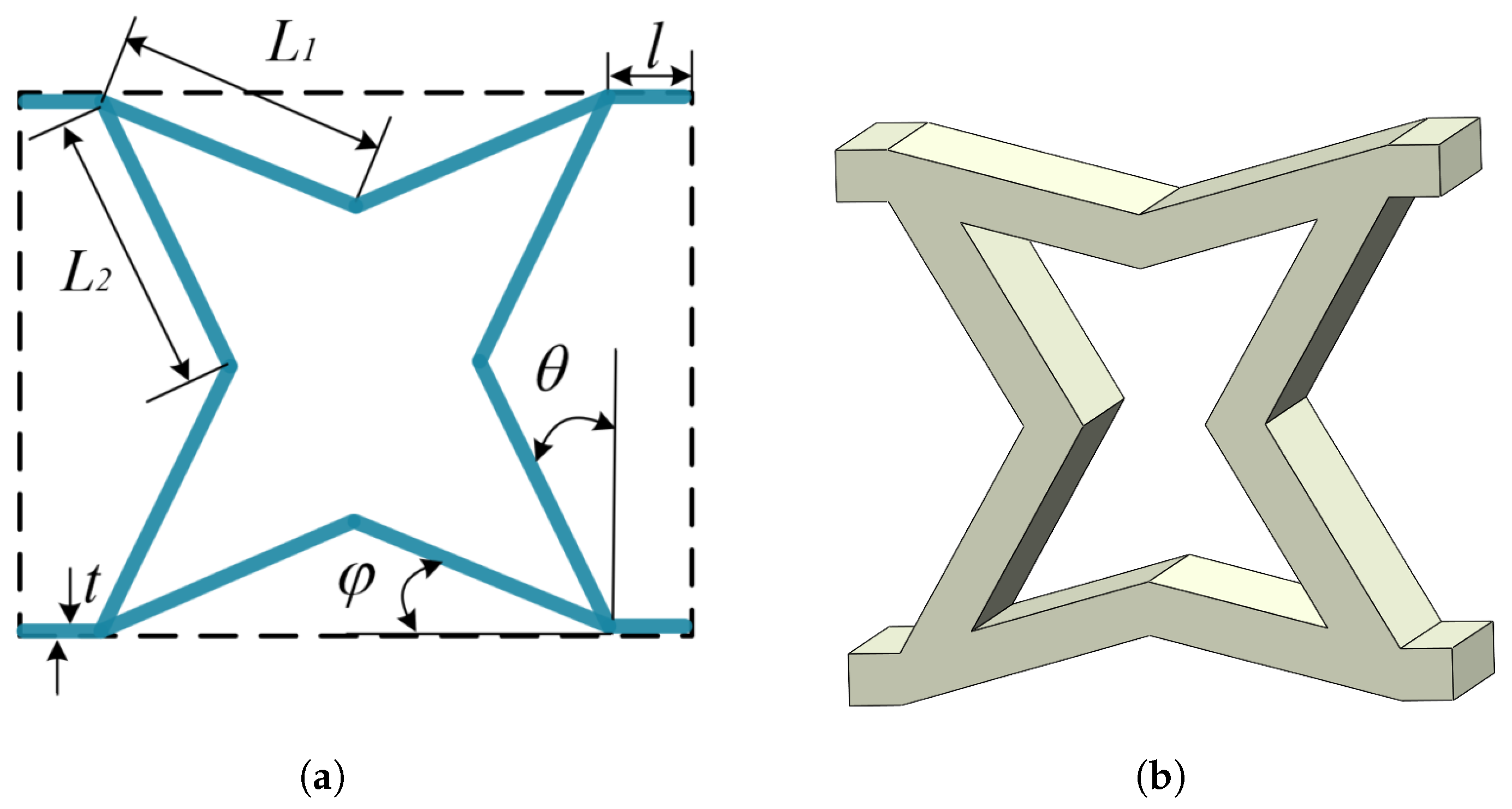
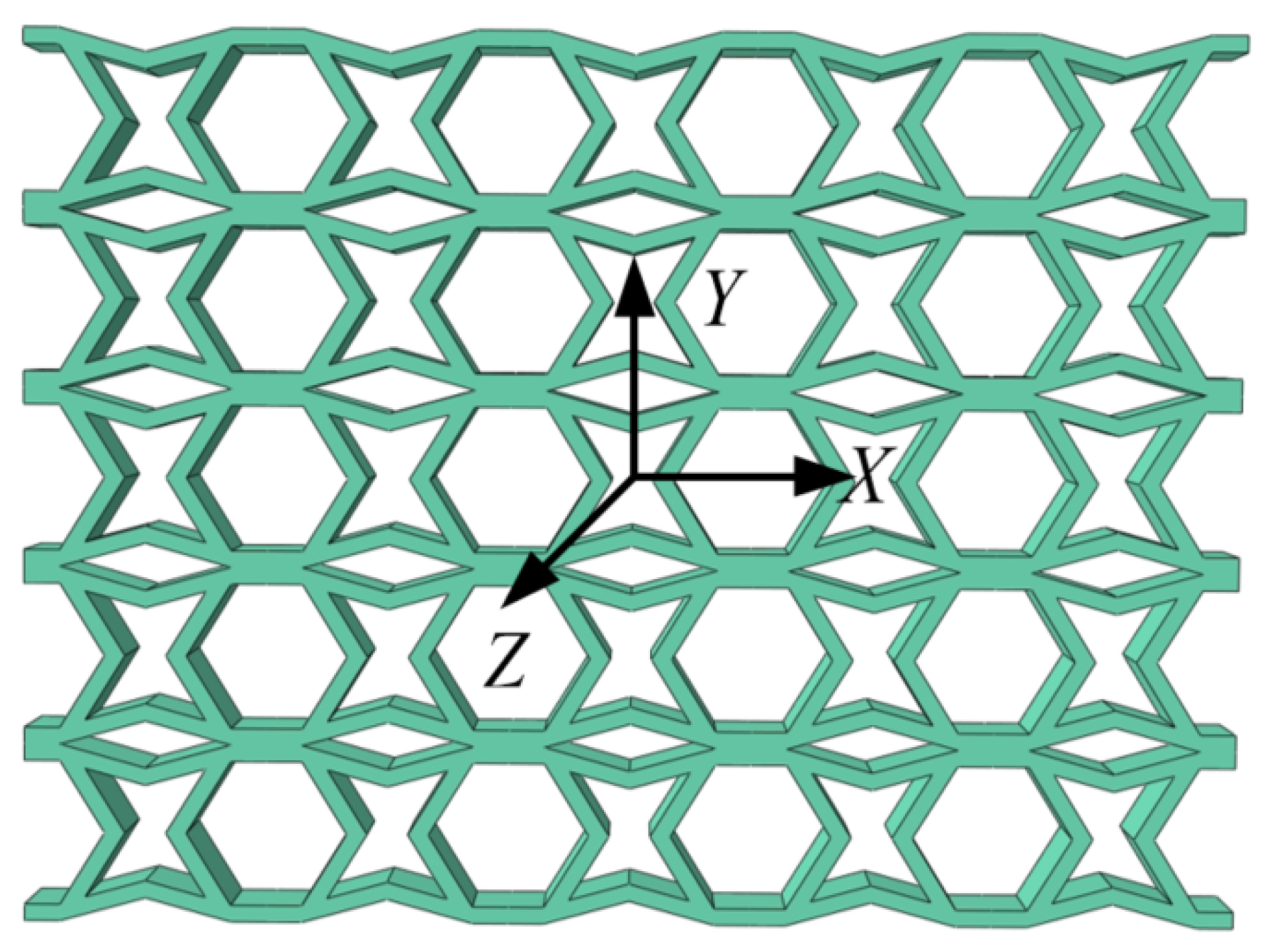
The quadrangular star-shaped honeycomb structure is one of the typical zero Poisson’s ratio honeycomb structures [31], and different cells are connected by a point-to-point method at sharp corners. Therefore, it is not easy to achieve bending deformation in the structural plane of the four-pointed-star-shaped honeycomb board, and the structure is prone to failure if the stress at the sharp corners is too large. By designing horizontal honeycomb walls at the sharp corners, a new four-pointed-star-shaped zero Poisson’s ratio honeycomb structure is constructed instead of the original connection between cells. In order to better describe the novel quadrangular star-shaped zero Poisson’s ratio honeycomb structure, it is shown in Figure 1. Figure 1a presents the geometric parameters of the two-dimensional structure of the new design, while Figure 1b shows the three-dimensional schematic model of the honeycomb structure. Define the single-cell honeycomb slant wall lengths as L 1 and L 2 , the single-cell honeycomb wall thickness as t, the cross arm length as l, the angles between the slant wall and the cross wall as θ and φ , and the thickness of the single cell of the honeycomb as b. For the purpose of the subsequent analyses, the dimensionless parameters α , β , and η are defined, where α = L 1 / L 2 , β = l / L 2 , and η = t / L 2 .
Define 0 ° < θ < 45 ° , 0 ° < φ < 45 ° , and φ + θ < 90 ° .
In the study of the mechanical properties of honeycomb structures, relative density is one of the important parameters to measure the mechanical properties, and it is defined as the ratio of the density of honeycomb structure ρ to the density of the matrix material constituting the honeycomb structure ρ S [4]:
ρ ¯ = ρ ρ S = m V S m V = V V S
In Equation (1), ρ ¯ represents the relative density of the honeycomb structure. V represents the volume of the honeycomb structure. V S represents the overall volume in the direction of the honeycomb thickness, that is, the volume of the rectangular region. Through the dimensionless parameter transformation, the relative density of the novel quadrangular star-shaped zero Poisson’s ratio honeycomb cell can be obtained as follows:
ρ ¯ = ρ ρ S = η [ 2 ( α cos φ + β ) cos ( θ + φ ) cos θ + η sin φ ] 2 ( α cos φ + β ) ( η + cos θ ) cos ( θ + φ ) cos θ

3. Analytical Model

3.1. Theoretical Analysis of In-Plane Mechanical Properties

The modulus of elasticity is an important parameter to measure the in-plane mechanical properties of the zero Poisson’s ratio honeycomb structure, and Figure 1 shows the geometrical model of the novel quadrangular star-shaped zero Poisson’s ratio honeycomb structure. Figure 1a shows that the structure is in a centrosymmetric form, and the structure is consistent in the X-direction and Y-direction, so when considering the uniaxial force of a single cell, only the quarter structure of the single cell can be considered for the force. Homogenization theory is one of the important methods to study the performance of honeycomb structures. By analyzing the performance and properties of one of the representative cells, we can then evaluate the various global properties of the whole structure. The basic assumption of homogenization theory is that all microscopic units are evenly and periodically distributed, that is, the entire macroscopic structure is evenly distributed, with each microscopic unit cell being adjacent to another. The microscopic unit cell is the most basic representative unit of the structure, and composite material mechanics calls it RVE (Representative Volume Element), so that the original problem is transformed into a microscopic problem and a macro homogenization problem.
The theoretical model of the compressive elastic modulus in the Y-direction of the novel quadrangular star-shaped zero Poisson’s ratio honeycomb structure is derived based on Karr’s second theorem. In the theoretical calculations it is assumed that the honeycomb cell walls are subjected to both bending and axial deformations, thus avoiding the tendency towards infinity of the compressive elastic modulus of the honeycomb structure when the internal angle of the cell element is 0. Castigliano’s second theorem states that for a linear elastomer whose stress–strain relationship satisfies Hooke’s law, the partial derivative of the strain energy U with respect to an external force F i is equal to the displacement δ i corresponding to this force F i :
U F i = δ i
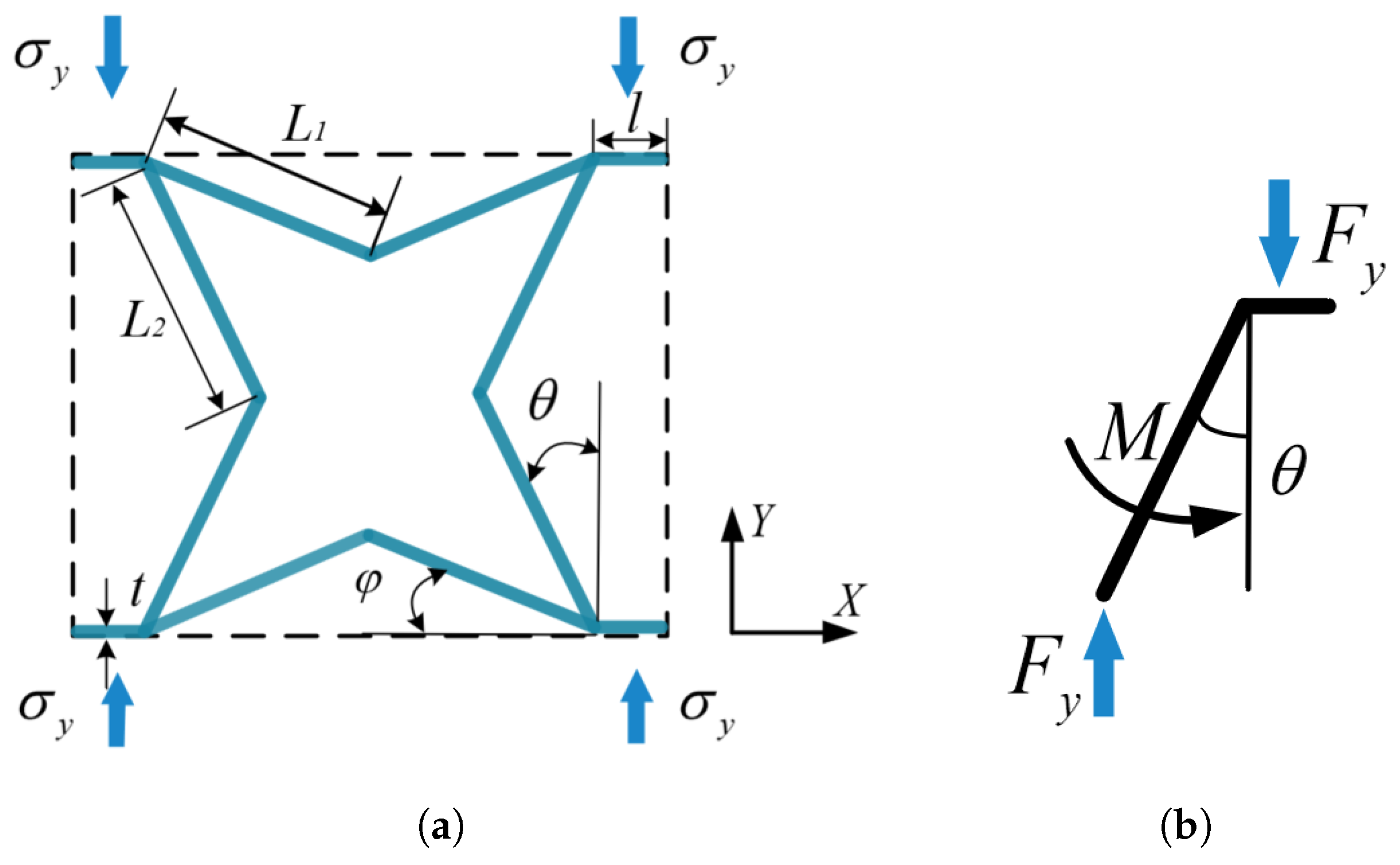
Figure 2a shows the stress diagram of the new quadrangular star-shaped zero Poisson’s ratio honeycomb cell in the Y-direction, and the honeycomb cell deformation is mainly through the inclined wall L 2 , so the inclined wall L 2 is taken as the research object. When the single cell is subjected to a uniform pressure σ v in the Y-direction, the deformation of the horizontal honeycomb wall is not considered, because the honeycomb wall is thin and the deformation of the honeycomb wall thickness is small and negligible. In order to eliminate the boundary effect and retain the maximum degree of structural symmetry, the honeycomb cell is assumed to be an infinitely extended structure. The structural strain does not affect the honeycomb configuration, the joints are rigidly connected, and the torsional deformation of the beams is not considered. Simplifying its stresses as shown in Figure 2b, its cellular inclined-wall strain energy is expressed as follows:
U = 0 L 2 M 2 ( x ) 2 E s I d x + 0 L 2 F N 2 ( x ) 2 E s A d x
where M ( x ) is the bending load on the honeycomb inclined wall; F N is the axial force of the honeycomb inclined wall; I is the moment of inertia of the honeycomb inclined-wall section; A is the cross-sectional area of the inclined wall; E S is the Young’s modulus of the material.
Taking the 1/4 honeycomb structure as the object of study, the honeycomb sloping wall can be regarded as a cantilever beam. For the cantilever beam, the bending moment can be expressed as
M = 1 2 F l sin θ
Therefore, the bending load and axial load distribution of the honeycomb inclined-wall cantilever beam can be expressed as
M ( x ) = 1 2 L 2 x F y sin θ
F N ( x ) = F y cos θ
Substituting Equations (6) and (7) into Equation (4) yields the honeycomb inclined-wall cantilever beam strain energy:
U = F y 2 L 2 3 sin 2 θ 24 E s I + F y 2 L 2 cos 2 θ 2 E s A
For a rectangular section cantilever beam, the moment of inertia and the cross-sectional area can be expressed as
I = b t 3 12 = b η 3 L 2 3 12
A = t b = η L 2 b
Substituting Equation (8) into Castigliano’s second theorem expression, Equation (3), the Y-direction displacement of the honeycomb inclined-wall cantilever beam is obtained as
δ y = F y L 2 3 sin 2 θ 12 E s I + F y L 2 cos 2 θ E s A
From homogenization theory, the homogenized stress and homogenized strain of the quadrangular star-shaped zero Poisson’s ratio honeycomb structure in the Y-direction are:
σ y = F y 2 b L 2 ( β + sin θ )
ε y = δ y L 2 cos θ
In summary, according to the stress-strain relation E = σ / ε of linear elastic materials, the dimensionless equivalent elastic modulus of the novel quadrangular star-shaped zero Poisson’s ratio honeycomb structure in the Y-direction can be obtained as follows:
E y E s = η 3 cos θ 2 ( β + sin θ ) ( sin 2 θ + η 2 cos 2 θ )
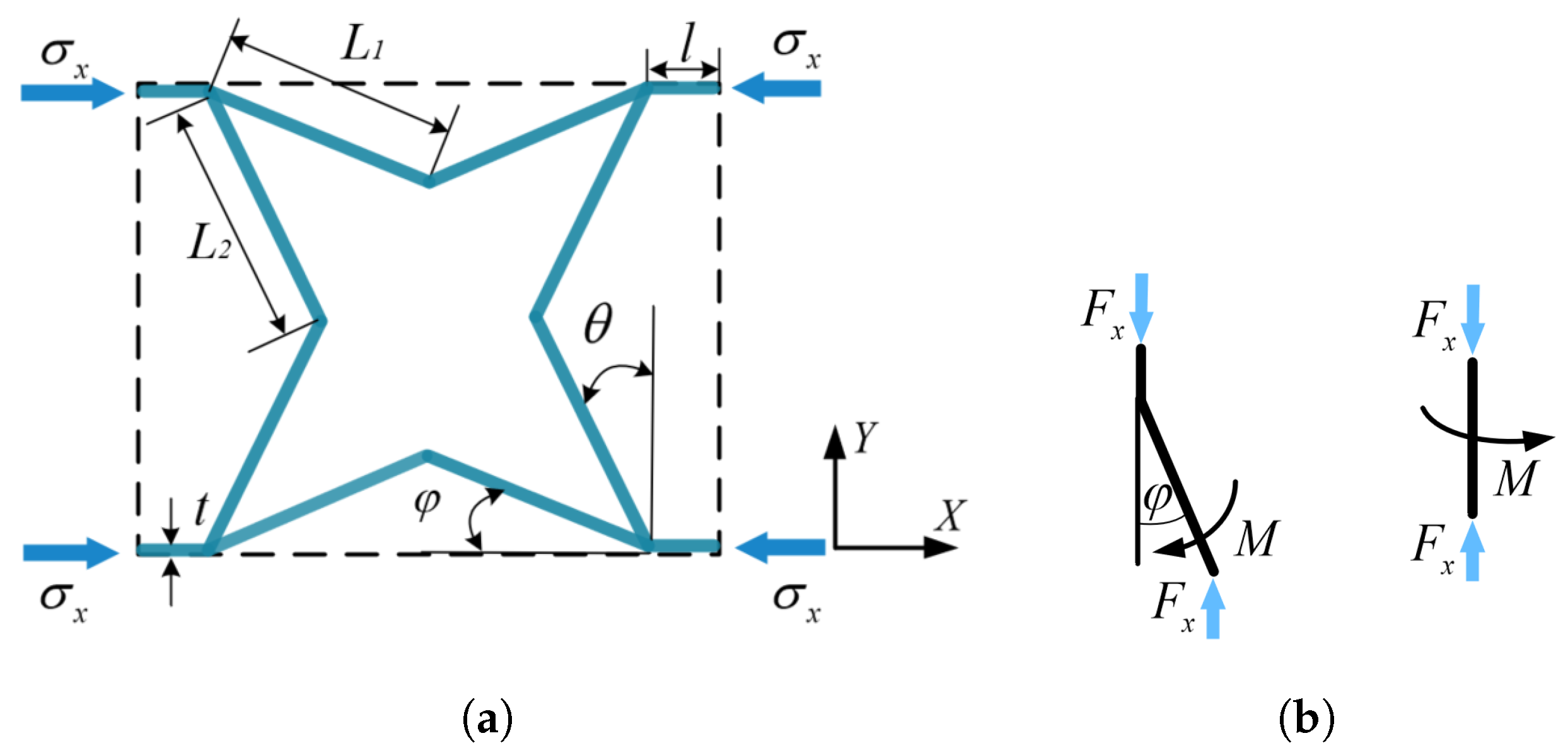
In the same step as above, when the quadrangular star-shaped single cell receives a uniform stress in the X-direction, its force is shown in Figure 3, and the deformation of its single cell is the sum of the displacements of the honeycomb sloping wall L 1 and the horizontal cross arm l.
Its honeycomb sloping wall strain can be derived as above, so the displacement δ 1 of the honeycomb sloping wall L 1 in the X-direction is:
δ 1 = F x L 1 3 sin 2 φ 12 E s I + F x L 1 cos 2 φ E s A
For a horizontal honeycomb wall, the bending and axial loads can be expressed as:
M ( x ) = 1 2 F x l sin φ
F N ( x ) = F x
Substituting into Equation (4) yields the horizontal honeycomb wall strain energy U :
U = F x 2 l 3 sin 2 φ 8 E s I + F x 2 l 2 E s A
Thus, the displacement of the horizontal honeycomb wall in the X-direction is:
δ 2 = F x l 3 sin 2 φ 4 E s I + F x l E s A
The total displacement of a quadrangular star-shaped zero Poisson’s ratio cell in the X-direction is the superposition of horizontal honeycomb wall and honeycomb oblique wall L 1 displacement:
δ x = δ 1 + δ 2 = F x sin 2 φ ( L 1 3 + l 3 ) 12 E s I + F x ( L 1 cos 2 φ + l ) E s A
From homogenization theory, the homogenized stress and homogenized strain of the quadrangular star-shaped zero Poisson’s ratio honeycomb structure in the X-direction are as follows:
σ x = F x 2 b ( L 1 sin φ + η L 2 )
ε x = δ x b L 2 ( α cos φ + β )
In the same way, the dimensionless equivalent elastic modulus of a quadrangular star-shaped zero Poisson’s ratio honeycomb structure in the X-direction can be obtained as
E x E s = η 3 ( α cos φ + β ) 2 ( α sin φ + η ) [ sin 2 φ ( α 3 + β 3 ) + η 2 ( α cos 2 φ + β ) ]
The new four-pointed-star-shaped honeycomb structure is different from other honeycomb structures in that it has complete center symmetry. Its stress situation is basically the same when the force is applied in the X-direction and Y-direction, so it can be calculated by interchanging the length and angle when calculating the stress and strain in the orthogonal directions. Moreover, in the case of unidirectional force, the X-direction and Y-direction strains of the star-shaped honeycomb corner cancel each other, and the contact end of the corner can be regarded as a fixed end. It can be seen that the honeycomb inclined wall in the X-direction and the honeycomb inclined wall in the Y-direction are not affected by each other when deformed. When stress is applied to the honeycomb in either direction, the oblique walls of the honeycomb in the orthogonal direction do not participate in the deformation, and the strain is always 0. As a result, the Poisson’s ratio of the new quadrangular star-shaped honeycomb is 0, and it theoretically has a zero Poisson’s ratio property.
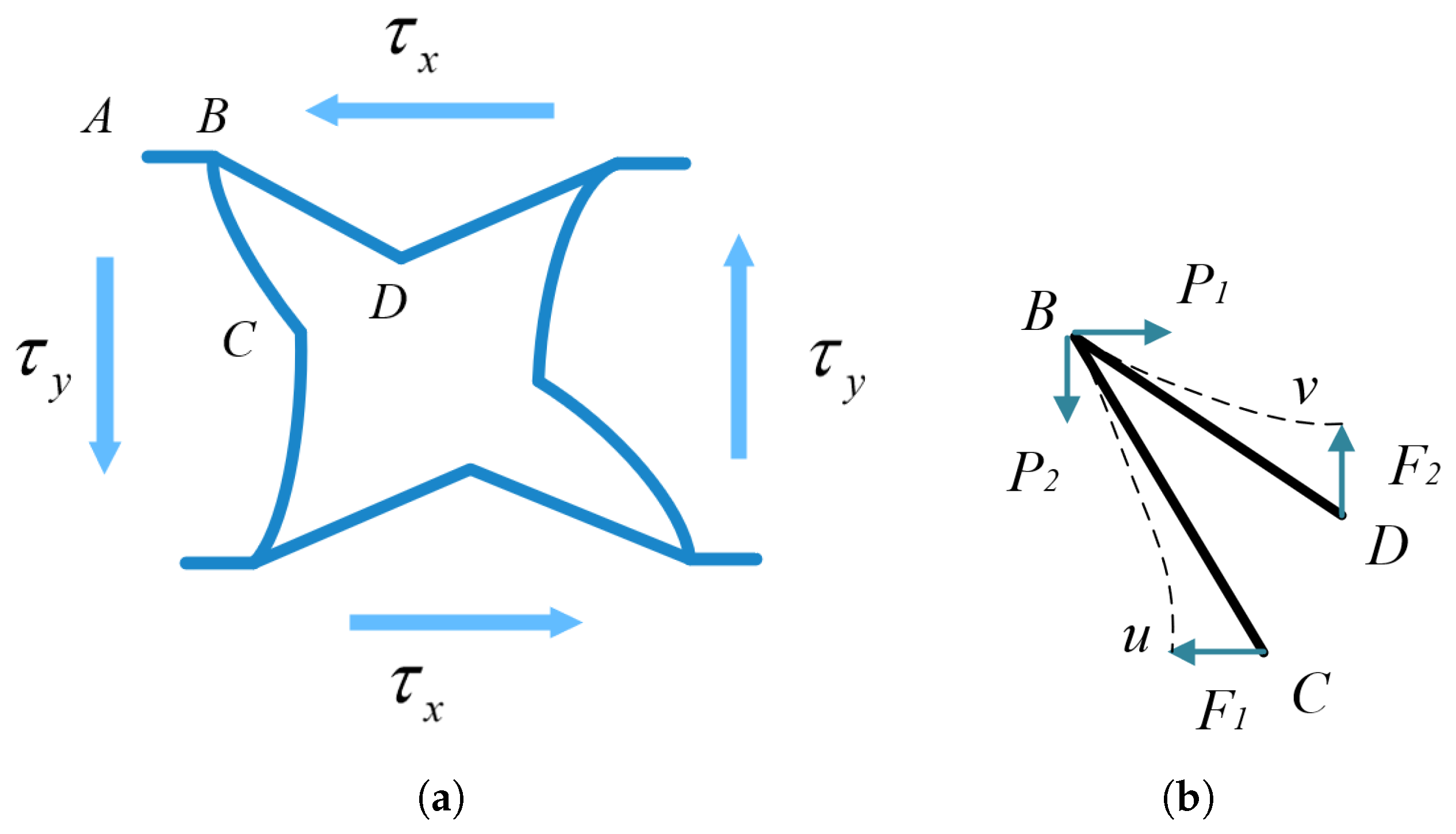
In order to calculate the uniform shear modulus of elasticity, uniform shear stresses are applied on the honeycomb structural cell as shown in Figure 4a. The honeycomb is subjected to pure shear in an asymmetric system due to the symmetry of the new quadrangular honeycomb structure and the asymmetric loading present in this structure. It can be found that the deformation is mainly due to bending and rotation of the cell wall of the unit cell subjected to a horizontal shear force τ . The extent of deformation of the cell wall AB is small and negligible when considering antisymmetry. By cutting along the horizontal and vertical planes of symmetry, the quarter cell can be isolated, and the loads and displacements of the quarter cell due to shear stresses are shown in Figure 4b. The antisymmetric system has only antisymmetric internal forces in the plane of symmetry and therefore only antisymmetric shear loads in the symmetric sections ( F 1 and F 2 ).
The load can be determined by balancing the quarter cells ( F 1 = P 1 ; F 2 = P 2 ), where
P 1 = τ L 1 cos φ
P 2 = τ L 2 cos θ
Using the standard beam theory for cantilever beams, the deflection can be calculated as ω = ( F l 3 ) / 3 E I . The corresponding shear deflections u and v in the horizontal and vertical directions are, respectively,
u = F 1 cos θ L 2 3 cos θ 3 E s I
v = F 2 cos φ L 1 3 cos φ 3 E s I
Thus, the shear strain γ is obtained as
γ = v L 1 cos φ + u L 2 cos θ
The shear modulus is G = τ / γ and its dimensionless in-plane shear modulus is finally expressed as
G E s = b η 3 4 cos θ cos φ ( α 2 + α )

3.2. Finite Element Analysis

In order to better analyze the equivalent in-plane mechanical properties of the quadrangular star-shaped zero Poisson’s ratio honeycomb structure, the finite element analysis software ABAQUS2023/Standard is used to simulate and analyze the honeycomb panel. In order to ensure the consistency of the finite element analysis and experiment, the finite element model of the honeycomb panel adopts “Future 8200” photosensitive resin, whose material properties are obtained according to the GB T1040.1-2018 test standard [49], Young’s modulus E s = 2600 MPa, and Poisson’s ratio v = 0.42 . A 5 × 5 finite element model of the honycomb structure (Figure 5) was established via the discretization of individual unit cells, with the geometric parameters defined as follows: L 1 = L 2 = 10 mm, l = t = 2 mm, θ = 30 ° , φ = 28 ° , b = 10 mm. Given that the thickness t of the unit cell walls is considerably smaller than the in-plane characteristic dimensions L 1 and L 2 , and the primary structural response investigated herein corresponds to in-plane deformation, the adoption of shell elements is sufficient to enable accurate evaluation of the structure’s equivalent in-plane elastic properties.Using solid elements would significantly increase the computational cost, and it would not bring meaningful improvements in predicting the overall equivalent elastic properties. Therefore, for the cases of unidirectional compression along the X-axis and Y-axis, we calculated the in-plane elastic modulus and Poisson’s ratio of the honeycomb structure. This simulation analysis set the element properties to S4R and the grid size to 0.5 t .
In the unidirectional compression simulation, the displacement limit is imposed on the two boundary planes in the displacement direction, while the other boundaries are free boundaries, the displacement is controlled by setting the upper, lower, left, and right boundary reference points for motion coupling, and the boundary conditions are set as shown in Table 1. Due to the Saint-Venant effect of the boundary honeycomb structure, only the average stress–strain value of the central cell element is required for calculating the in-plane equivalent elastic modulus; the Poisson’s ratio of the honeycomb structure can be calculated using the equation v = ε x / ε y .
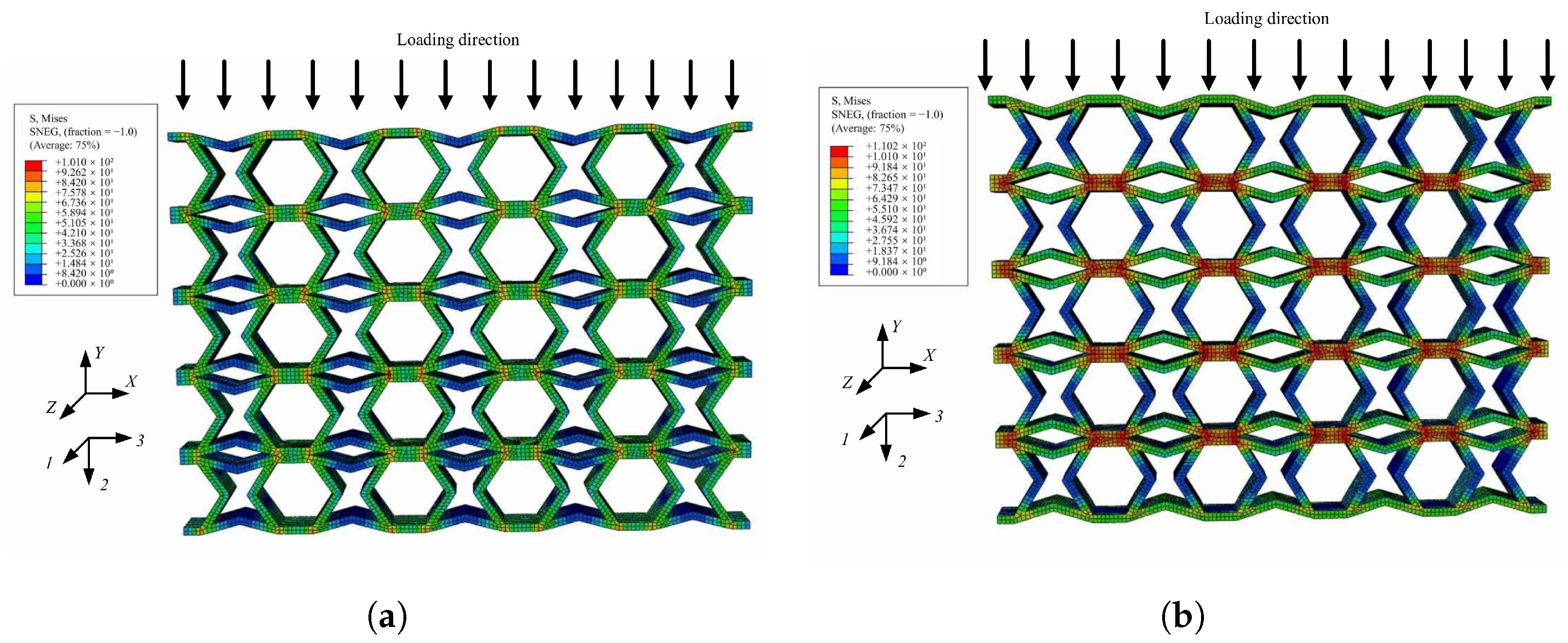
The simulation results are shown in Figure 6a,b. When the Y-direction is subjected to uniform compressive stress, the deformation of the honeycomb structure is characterized by the displacement change of the honeycomb inclined wall, and the honeycomb inclined wall in the X-direction has almost no stress and strain. Therefore, the strain in the X-direction is about 0, which verifies the correctness of the theoretical model, and the new four-pointed-star-shaped honeycomb structure is a zero Poisson’s ratio structure. The equivalent elastic modulus and Poisson’s ratio can be calculated by extracting the average stress and strain of the intermediate cell. Its average tensile stress is
σ ¯ x x = 1 V V σ i i ( 1 , 2 , 3 )   d V
Since the resin is actually an orthorhombic anisotropic material, for the sake of abbreviated calculations, the in-plane tensile mechanical properties of the new four-pointed-star-shaped honeycomb structure can be expressed as follows:
E 1 = 1 / S 11 , E 1 = 1 / S 22

3.3. Experiment

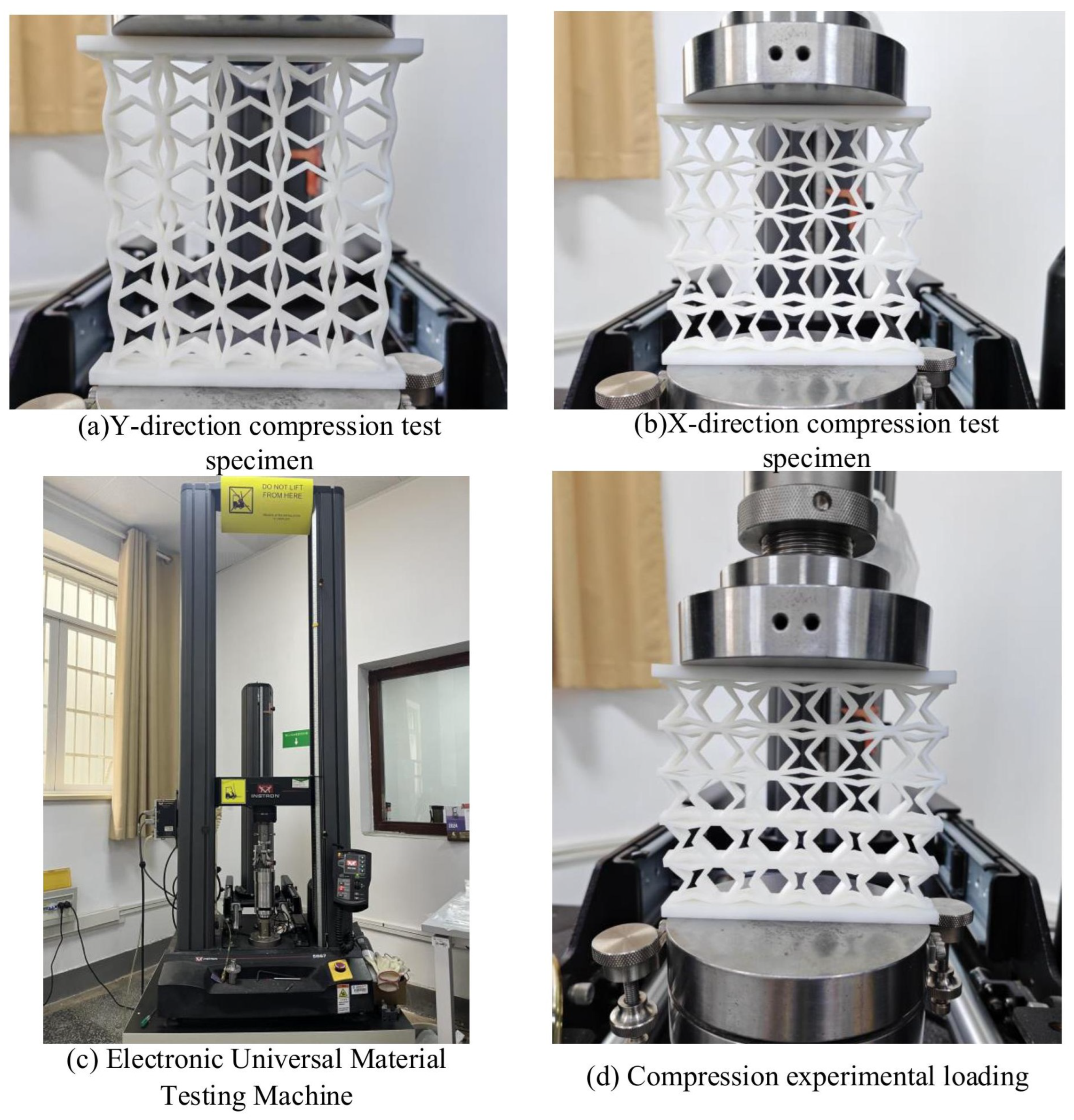
In order to verify the correctness of the in-plane equivalent modulus of elasticity theory as well as the actual structural Poisson’s ratio of the quadrangular star-shaped zero Poisson’s ratio honeycomb structure, the honeycomb structure is analyzed by axial compression experiments and the finite element method. The honeycomb panels are fabricated by stereolithography 3D printing technology. The honeycomb size is set according to the finite element analysis size, as shown in Figure 7. The experimental sample is tested using an electronic universal material testing machine.The dimensions of the Y-direction compression test specimen are L = 120 mm, H = 116.603 mm, and B = 20 mm, and the X-direction compression test specimen dimensions differ only in height, which is H = 118.603 mm.The mechanical properties of the base resin, namely Young’s modulus E S and Poisson’s ratio ν , were determined via uniaxial tensile tests conducted in accordance with the Chinese National Standard GB/T 1040.1-2066. The tests were performed on an Instron 1341 electro-mechanical universal testing system fitted with a 25 kN load cell, at a constant crosshead displacement rate of 1 mm/min.
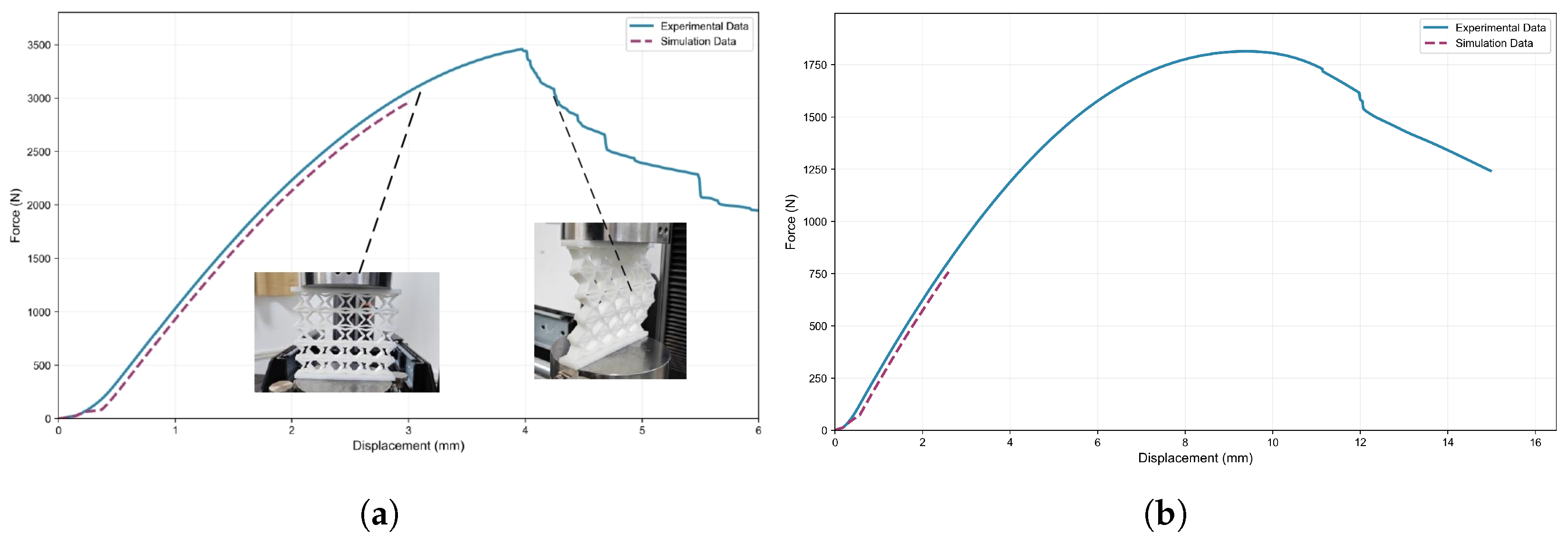
By using sensors to collect the displacement–load information of the honeycomb structure during the compression process, as shown in Figure 8, the load–displacement curves of the honeycomb structure in the X-direction and the Y-direction under the compression of the pressing plate are presented. From Figure 8a, it can be seen that as the pressing plate is pressed down, the load borne by the honeycomb structure in the Y-direction gradually increases. In the initial stage, the structure undergoes elastic deformation, and at this time, the load–displacement curve almost shows a linear pattern. When the pressing is reduced to about 4 mm, the sample structure of the Y-direction honeycomb structure shown in the figure exhibits a buckling state. At this point, the load–displacement curve becomes non-linear, and the structure continues to bend until it fails.
Substituting each dimensionless parameter, the theoretical in-plane mechanical property parameters can be obtained. Table 2 shows the theoretical analysis model of the in-plane equivalent elastic modulus of the new quadrangular star-shaped honeycomb structure and a comparison between the results of the finite element simulation and compression experiments. Table 2 shows the results of the finite element analysis of Poisson’s ratio of the honeycomb structure and compression experiment.
The analysis results show that the error between the theoretical analysis results and the finite element analysis results of the in-plane equivalent elastic modulus in the Y-direction is 12.56%, and the error with the results of the compression experiments is 23.23%; the structural flexibility embodied by the compression experiments in the in-plane equivalent elastic modulus in the X-direction is better than that in the theoretical analysis results, being lower by 6.16%, and the results of the finite element analysis are the poorest, being 15.82% different from the theoretical results; the in-plane equivalent modulus of elasticity in the X-direction is higher than the in-plane equivalent modulus of elasticity in the Y-direction, with a difference of 28.74%. From the above results, it can be seen that the honeycomb structure has better in-plane mechanical properties under the Y-direction force; the Poisson’s ratio is stabilized at about 0.02, which is close to 0. This error is within the acceptable range, so the new quadrangular star-shaped honeycomb structure is a zero Poisson’s ratio structure. The possible reasons for the errors in the above three results are as follows: (1) The honeycomb structure in the X-direction of the horizontal honeycomb wall stress generates strain, which increases the X-direction of the honeycomb structure of the equivalent elastic modulus of the surface. (2) The experimental samples are manufactured by 3D printers, and the manufacturing process results in the generation of voids within the samples, which does not comply with the assumptions of isotropic materials, and there is a certain error in the connection of the horizontal honeycomb wall. (3) In the finite element analysis, there are differences between the setting of the honeycomb structure and the actual experimental results of the honeycomb samples. The honeycomb slanted walls all generate strains and participate in the calculation of elastic modulus, while the theoretical analysis neglects the strains of adjacent honeycomb slanted walls. Therefore, the results of the theoretical analysis are all smaller than those of the finite element analysis. Furthermore, this study also indicates that by optimizing the manufacturing process, it is possible to further enhance the structural performance. If more precise additive manufacturing techniques are adopted, such as micro-resolution photopolymerization printing, or if the printing direction and process parameters are specifically optimized, it is expected that the geometric accuracy and material density in the node area will be significantly improved. This will fully utilize the theoretical mechanical advantages of this design, making the experimental equivalent modulus of the structure closer to the theoretical prediction value and improving the consistency of its performance.

4. Results and Discussions

4.1. Influence of Geometrical Parameters of Honeycomb Single Cells on the Equivalent Modulus of Elasticity Inside the Face

The accuracy and Poisson’s ratio of the in-plane equivalent modulus of elasticity theory of honeycomb structures were verified in the previous section, but the effect of the geometric dimensions of the honeycomb structure on the in-plane equivalent modulus of elasticity is not known. Therefore, finite element analysis was carried out by varying the geometric parameters of the honeycomb, so as to investigate the effect of the geometric parameters on the in-plane mechanical properties. Since the honeycomb structure is geometrically centrosymmetric, only the mechanical properties under the unidirectional force condition need to be investigated, so only the Y-direction compression simulation experiments are carried out, and the compression amount is consistently U 2 = 2 mm. From Equation (14), β , ε , and θ are the main factors affecting the in-face equivalent elastic modulus, so the simulation investigates the in-face equivalent mechanical properties of the honeycomb structure by varying the horizontal honeycomb wall length l and honeycomb pinch angle θ , as well as the honeycomb wall thickness t.
The honeycomb single-cell dimensions L 1 = L 2 = 5 mm, l = 2 mm, t = 1 mm, b = 5 mm, and θ = 30 ° , with material properties as above, are used to build a 5 × 5 finite element model of the honeycomb structure. Since the width of the single cell is much smaller than the overall size, it can be regarded as a shell, so the grid cell attribute is S4R and the grid size is 0.5 t . The boundary conditions are the same as above.
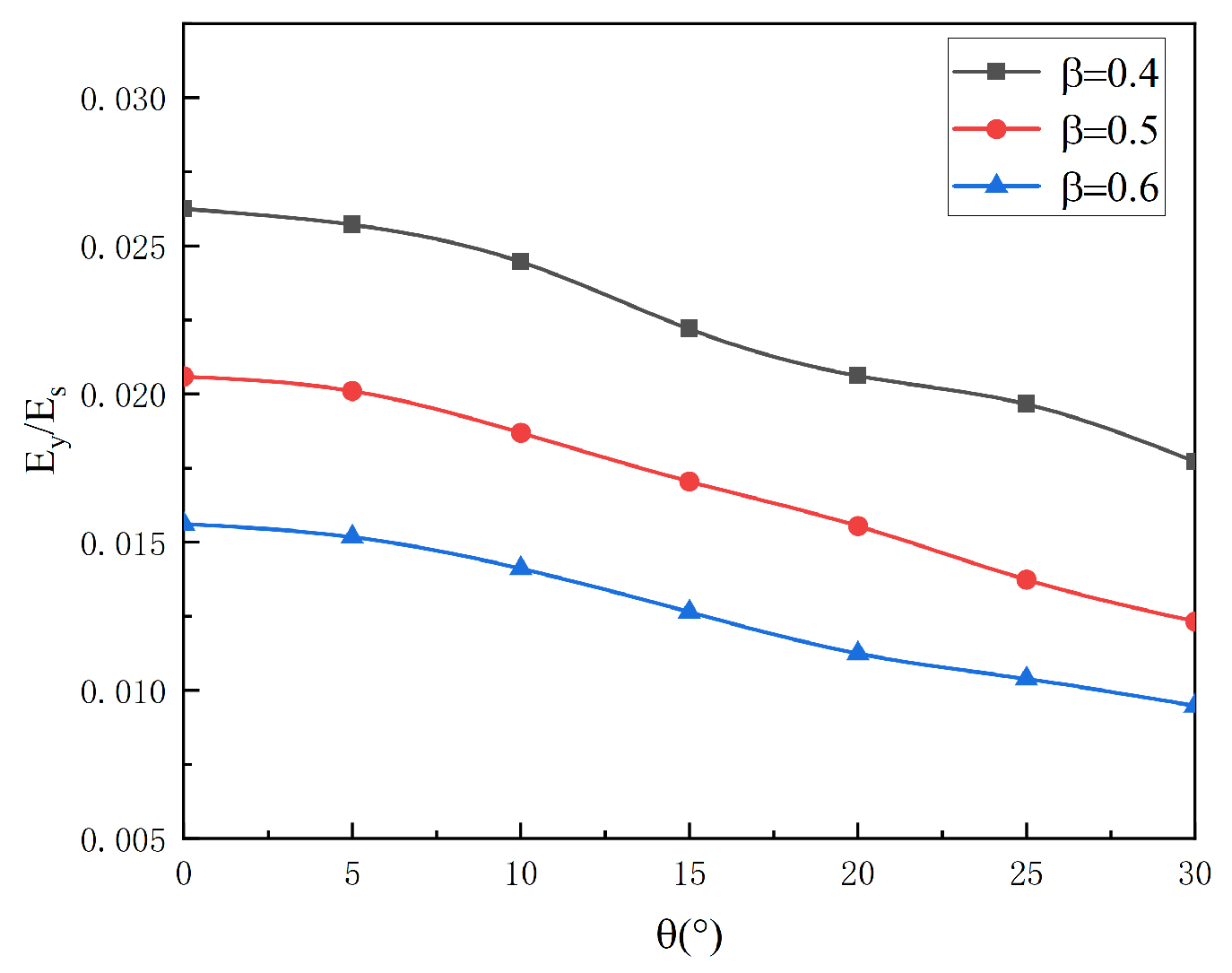
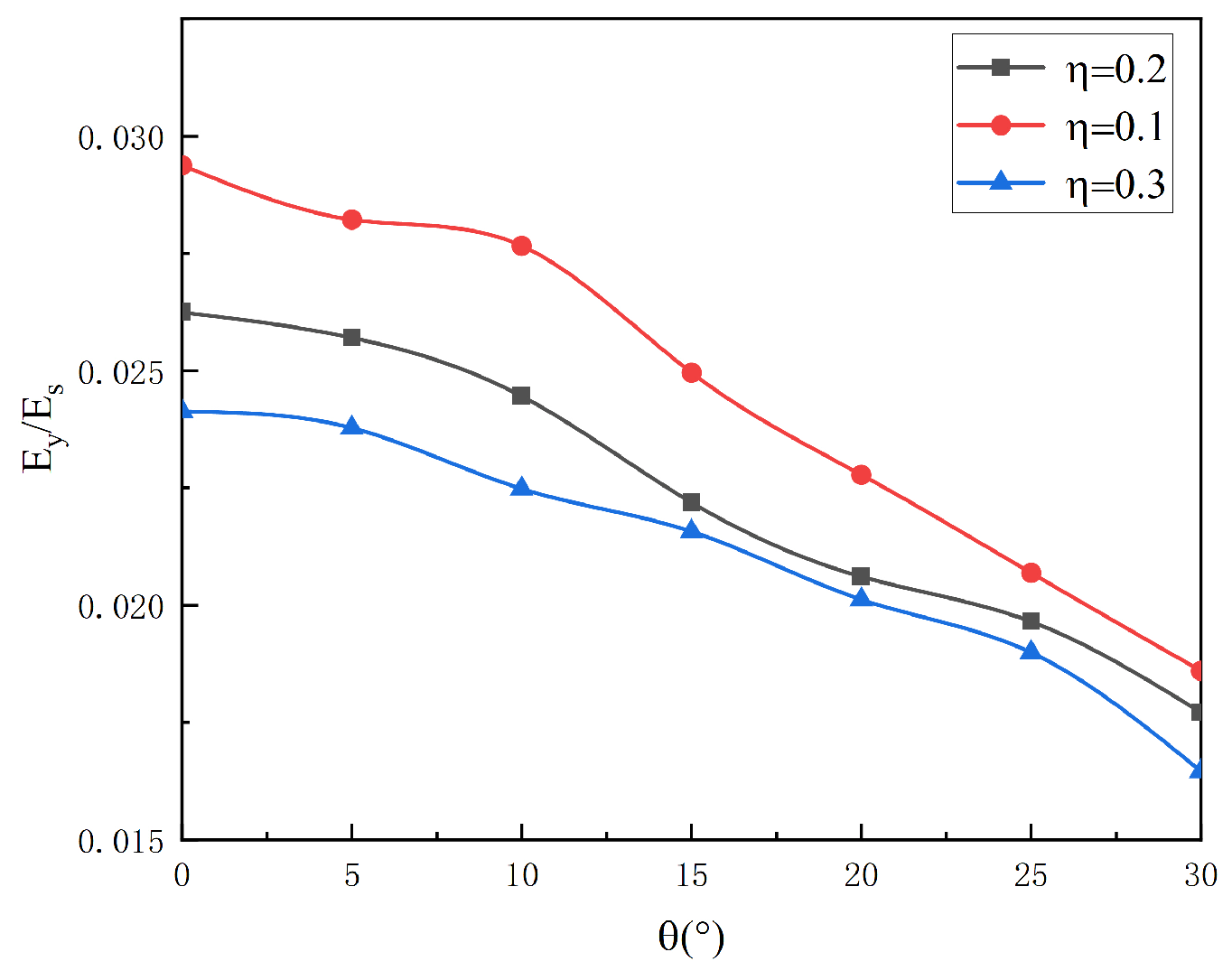
The honeycomb single-cell geometry θ is gradually reduced from 30° to 0°, with a special cell element at 0° and no honeycomb sloping walls in the Y-direction; β parameters are chosen as 0.4, 0.5, and 0.6; and η is chosen as 0.1, 0.2, and 0.3. Figure 9 and Figure 10, respectively, show the changes of the equivalent elastic modulus in the honeycomb structure plane under different parameters. According to the theoretical formula of elastic modulus, it can be seen that α has no effect on the equivalent elastic modulus under the Y-direction, so α is always 1.
From Figure 9 and Figure 10, it can be seen that the in-plane equivalent modulus of elasticity of the novel quadrangular star-shaped honeycomb structure decreases with the increase in the angle φ , when other parameters remain certain. When the angle is constant, the larger β is, the longer the horizontal honeycomb wall length is, and the smaller the in-plane equivalent elastic modulus of the structure is. The thicker the honeycomb wall is, that is, the larger η is, the smaller the in-plane equivalent elastic modulus of the structure is. Moreover, it can be seen from the numerical difference in the figure that the effect of dimensionless parameter β on the equivalent elastic modulus of the structure is stronger than that of dimensionless parameter η . However, when the angle is too large, interference will occur at the inner sharp corners of the quadrangular star-shaped honeycomb structure; when the wall thickness is too large, the same interference phenomenon occurs when the two honeycomb walls are stressed. Therefore, when reducing the in-plane equivalent modulus of elasticity of the novel quadrangular star-shaped honeycomb structure, the coupling effects of the angle and the honeycomb wall thickness should be fully considered.

4.2. Influence of Geometrical Parameters of Honeycomb Cells on Poisson’s Ratio

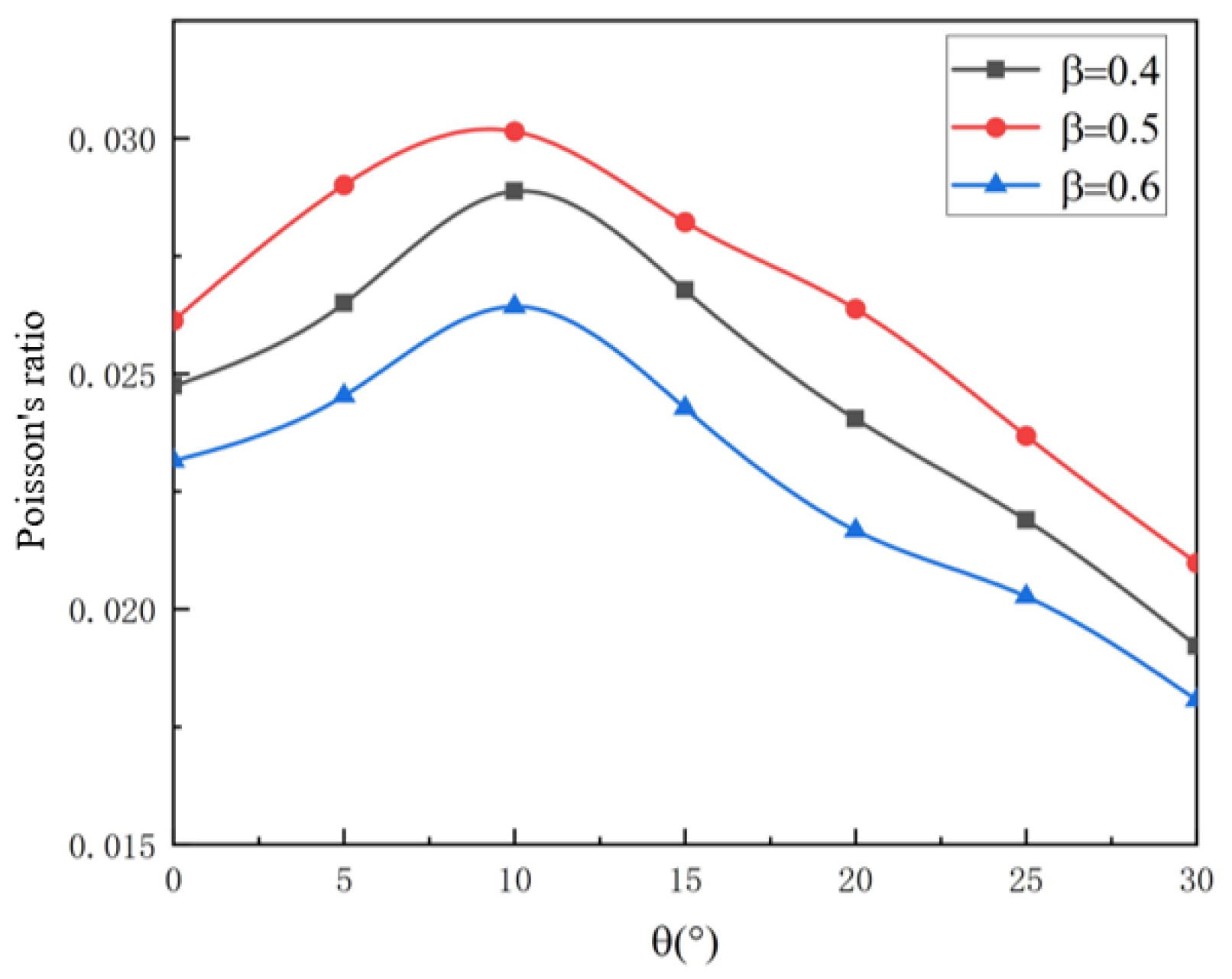
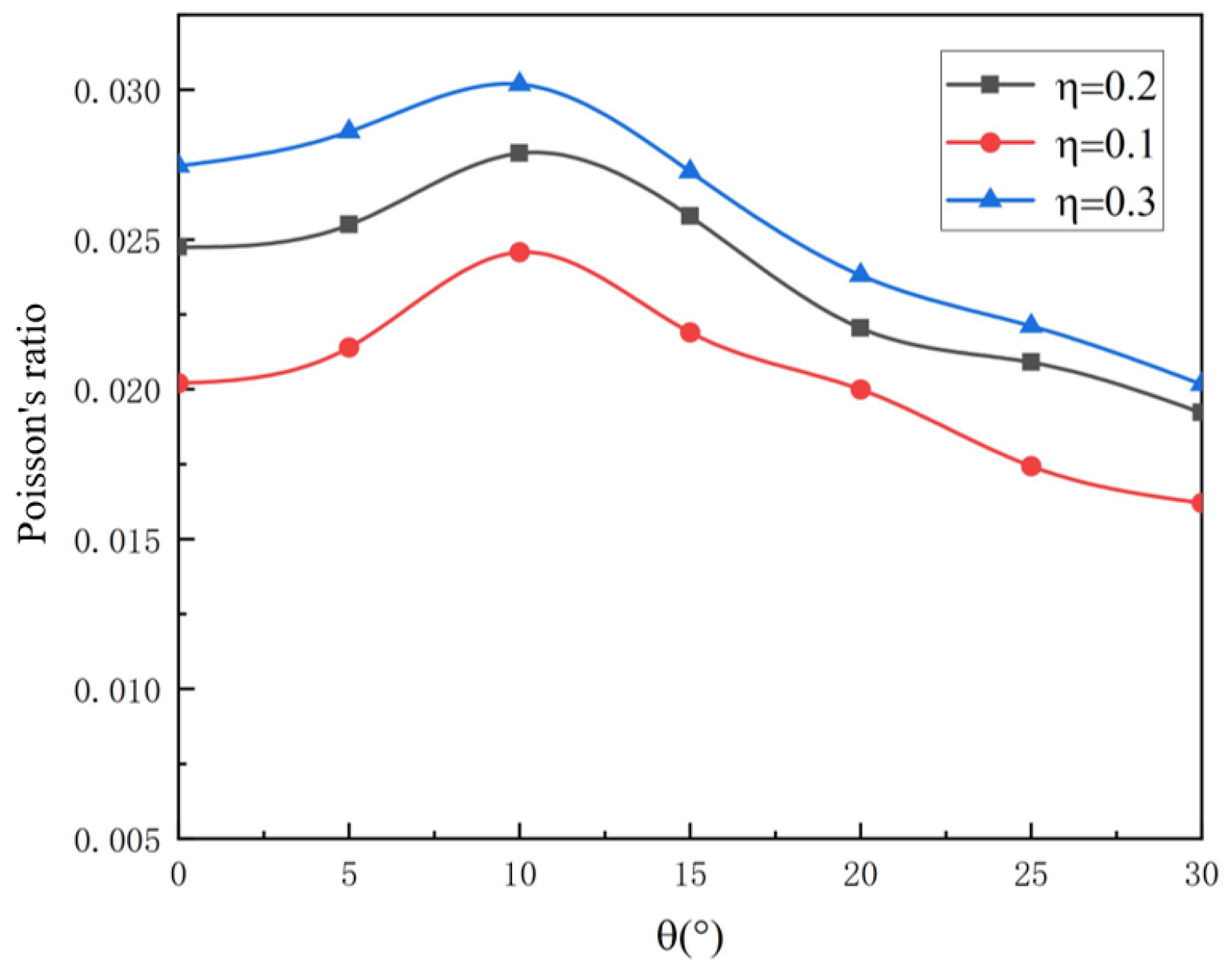
Figure 11 and Figure 12 show the graphs of the law of influence of the inclined wall clamp angle θ on the Poisson’s ratio of the honeycomb structure under different dimensionless parameters β and η , respectively.
As can be seen from the figures, the Poisson’s ratio in the honeycomb structure shows a tendency to increase and then decrease with the increase in the angle of the inclined wall and finally stabilizes at 0.02. This is because, with the increase in the honeycomb wall angle θ , the deformation of the quadrangular star-shaped honeycomb structure in the Y-direction mainly consists of the deformation of the oblique wall in that direction, and the deformation of the honeycomb wall in the direction orthogonal to the direction of the wall is a small lateral deformation through the intersection area of the two directions; then, due to the positive Poisson’s ratio property of the honeycomb wall itself in the perpendicular direction of the stress direction, the honeycomb structure exhibits a small non-zero value.

5. Conclusions

This study presented a novel quadrangular star-shaped honeycomb structure designed to achieve zero Poisson’s ratio. The key innovation lies in replacing the traditional point-to-point connections at cell junctions with a horizontal connecting wall, which significantly alleviates stress concentration and enhances structural integrity and manufacturability. Based on homogenization theory, an analytical model was developed to predict its in-plane equivalent elastic modulus, and its accuracy along with the zero Poisson’s ratio characteristic were successfully validated through finite element simulations and experimental compression tests. The close agreement between the experimental and simulated load–displacement curves further confirmed the fidelity of the numerical model and the structure’s predictable linear-elastic response. Furthermore, a parametric finite element analysis revealed that the in-plane equivalent elastic modulus decreases with increases in the wall angle θ , horizontal wall length, and wall thickness. This work provides a new, more robust structural design strategy for zero Poisson’s ratio honeycomb applications.

Author Contributions

H.L. (He Ling): investigation, software, visualization, data curation, formal analysis, writing—original draft. A.L.: investigation, validation, formal analysis, writing—review and editing. Z.W.: investigation, visualization, data curation, writing—review and editing. D.Y.: investigation, visualization, data curation, writing—review and editing. H.L. (Hong Lu): validation, formal analysis, funding acquisition, resources, writing—review and editing. All authors have read and agreed to the published version of the manuscript.

Funding

This work was supported by National Natural Science Foundation of China [Grant number 52275505] and [Grant number 52505573]; this work was supported by the Key Research and Development project of Hubei Science and Technology Plan [Grant number 2024BAB055]; this work was supported by the Key Research and Development project of Hubei Science and Technology Plan [Grant number 2023BEB013].

Data Availability Statement

The original contributions presented in this study are included in the article. Further inquiries can be directed to the corresponding author.

Conflicts of Interest

The authors declare no conflicts of interest.

References

  1. Qi, W.; Zhang, Y.; Zhang, Y.; Yan, H.; Liu, Y.; Zhang, Z. Advanced honeycomb structures for aerospace: Multiscale mechanics, bio-inspired hierarchical design, and multi-physics coupling responses. Thin-Walled Struct. 2026, 218, 114132. [Google Scholar] [CrossRef]
  2. Qi, C.; Jiang, F.; Yang, S. Advanced honeycomb designs for improving mechanical properties: A review. Compos. Part B Eng. 2021, 227, 109393. [Google Scholar] [CrossRef]
  3. Guo, X.; Zhao, J.; Hu, B.; Li, J.; Tao, J.; Chen, Y. Flexible Pressure Sensor With High Sensitivity and Fast Response Based on Bionic Honeycomb-Structured Polydimethylsiloxane/Aluminum Oxide Composites Dielectric via 3-D Printing. IEEE Trans. Electron Devices 2024, 2024, 71. [Google Scholar] [CrossRef]
  4. Chen, D.; Gao, K.; Yang, J.; Zhang, L. Functionally graded porous structures: Analyses, performances, and applications—A Review. Thin-Walled Struct. 2023, 191, 111046. [Google Scholar] [CrossRef]
  5. Rajeev, A.; Grishin, A.; Agrawal, V.; Santhanam, B.; Goss, D. Parametric optimization of corner radius in hexagonal honeycombs under in-plane compression. J. Manuf. Process. 2022, 79, 35–46. [Google Scholar] [CrossRef]
  6. Wang, Y.; Zheng, J.; Jin, Y.; Pang, Z.; Zhang, D. Zero Poisson’s ratio biomimetic jellyfish honeycomb structure for large deformation wing. Aerosp. Sci. Technol. 2026, 168, 111137. [Google Scholar] [CrossRef]
  7. Fan, Z.; Wang, L.; Hu, Y.; Li, S. Design, fabrication and compressive performance of reinforced wood gradient hierarchical square honeycomb structures. Structures 2025, 82, 110527. [Google Scholar] [CrossRef]
  8. Wang, G.; Deng, X. In-plane mechanical behavior design of novel re-entrant and hexagonal combined honeycombs. Mater. Today Commun. 2024, 40, 109729. [Google Scholar] [CrossRef]
  9. Wang, S.; Pei, W.; Jin, S.; Yu, H. Numerical and theoretical analysis of the out-of-plane crushing behavior of a sinusoidal-shaped honeycomb structure with tunable mechanical properties. Structures 2024, 61, 106147. [Google Scholar] [CrossRef]
  10. Zhang, Q.; Li, F.; Zhu, D.; Zhang, T.; Chen, L. Quasi-static and impact performance study of a three-dimensional negative Poisson’s ratio structure with adjustable mechanical properties. Int. J. Impact Eng. 2024, 193, 105057. [Google Scholar] [CrossRef]
  11. Yin, Z.; Liang, K. A dual reduced-order modeling method for nonlinear thermoelastic analysis of 3D honeycomb structure. Comput. Math. Appl. 2026, 202, 130–154. [Google Scholar] [CrossRef]
  12. Fan, D.; Sun, S.; Li, M.; Jiang, Z.; Tang, T. In-situ engineered reentrant-honeycomb symbiosis structure for preparing zero Poisson’s ratio composite foam. Polymer 2026, 343, 129488. [Google Scholar] [CrossRef]
  13. Afkhami, S.; Amraei, M.; Gardner, L.; Piili, H.; Wadee, M.A.; Salminen, A.; Björk, T. Mechanical performance and design optimisation of metal honeycombs fabricated by laser powder bed fusion. Thin-Walled Struct. 2022, 180, 109864. [Google Scholar] [CrossRef]
  14. Lei, Z.; Liu, J.; Guo, Z.; Ye, J.; Gao, F. Metal honeycomb skeleton reinforced foam concrete: Mechanical properties, reinforcement mechanism and optimal design. Eng. Struct. 2025, 341, 120827. [Google Scholar] [CrossRef]
  15. Xu, Z.; Wang, J.; Pan, L.; Qiu, X. Experimental, numerical and theoretical study on heat transfer in paper honeycomb structure. Int. J. Therm. Sci. 2023, 186, 108108. [Google Scholar] [CrossRef]
  16. Imrag, B.T.; Taşdemirci, A.; Gurler, Y. On the quasi-static and dynamic compressive behavior of paper honeycomb: Experimental and numerical study. Int. J. Impact Eng. 2025, 206, 105469. [Google Scholar] [CrossRef]
  17. Ma, H.; Meng, T.; Yin, J.; Yin, S.; Fang, X.; Li, T.; Yang, D.; Liu, Q.; Zuo, R. Mechanical properties and fracture mechanism of 3D-printed honeycomb mullite ceramics fabricated by stereolithography. Ceram. Int. 2024, 50, 41499–41508. [Google Scholar] [CrossRef]
  18. Huang, X.; Ma, C.; Sun, T.; Yu, Y.; Wu, Y. A novel honeycomb ceramic for gas treatment prepared by microarc oxidation. Ceram. Int. 2025, 51, 12525–12533. [Google Scholar] [CrossRef]
  19. Liu, H.T.; Wang, P.H.; Wu, W.J.; Li, J.Q. 3D piezoelectric composite honeycombs with alternating bi-material beam: An active control method for elastic properties. Mater. Today Commun. 2024, 38, 108191. [Google Scholar] [CrossRef]
  20. Liu, A.; Wang, A.; Jiang, Q.; Jiao, Y.; Wu, L. Structure Design and Performance Evaluation of Fibre Reinforced Composite Honeycombs: A Review. Appl. Compos. Mater. 2024, 31, 2019–2045. [Google Scholar] [CrossRef]
  21. Vellaisamy, S.; Munusamy, R. Mechanical Property Characterization of 3D-Printed Carbon Fiber Honeycomb Core Composite Sandwich Structures. J. Mater. Eng. Perform. 2025, 34, 15083–15094. [Google Scholar] [CrossRef]
  22. He, Y.; Bi, Z.; Wang, T.; Wang, L.; Lu, G.; Cui, Y.; Tse, K.M. Design and mechanical properties analysis of hexagonal perforated honeycomb metamaterial. Int. J. Mech. Sci. 2024, 270, 109091. [Google Scholar] [CrossRef]
  23. Berber, A.; Yılmaz, C.A.; Gürdal, M. Experimental and ANN-based optimization of thermal and hydraulic performance in a hexagonal honeycomb structure. Int. J. Therm. Sci. 2026, 220, 110374. [Google Scholar] [CrossRef]
  24. Zhang, S.; Ma, Y.; Deng, Z. Analytical solution and experimental verification for the buckling failure of additively manufactured octagonal honeycombs. Compos. Struct. 2023, 303, 116306. [Google Scholar] [CrossRef]
  25. Chang, Z.-Y.; Liu, H.-T.; Cai, G.-B. Mechanical properties and prescribed design of a star-shaped re-entrant honeycomb based on multi-objective optimization. Mater. Today Commun. 2024, 40, 110091. [Google Scholar] [CrossRef]
  26. Ma, L.; Liu, Z.; Cui, Y.; Wang, B. A leaf venation-inspired star-shaped hybrid honeycomb with ultra-high load-bearing and energy absorption. Compos. Struct. 2026, 377, 119862. [Google Scholar] [CrossRef]
  27. Chen, Y.; Huang, H.; Deng, X. In-plane compression characteristics of star-shaped honeycomb with asymmetric cells. Eur. J. Mech.-A/Solids 2024, 105, 105224. [Google Scholar] [CrossRef]
  28. Sun, X.; Zhang, X.; Yan, H.; Zhang, L.; Dong, Y. Penetration resistance of ceramic composite structures with a double arrowhead honeycombs interlayer against projectile impact. Ceram. Int. 2025, 51, 11649–11664. [Google Scholar] [CrossRef]
  29. Olympio, K.R.; Gandhi, F. Flexible Skins for Morphing Aircraft Using Cellular Honeycomb Cores. J. Intell. Mater. Syst. Struct. 2009, 21, 1719–1735. [Google Scholar] [CrossRef]
  30. Chen, M.; Fu, M.; Hu, L. Poisson’s ratio sign-switching metamaterial with stiffness matrix asymmetry and different elastic moduli under tension and compression. Compos. Struct. 2021, 275, 114442. [Google Scholar] [CrossRef]
  31. Gao, W.T.; Yang, C.; Tan, Y.T.; Ren, J. Reversible topological non-reciprocity by positive–negative Poisson’s ratio switch in chiral metamaterials. Appl. Phys. Lett. 2022, 121, 071702. [Google Scholar] [CrossRef]
  32. Yang, N.; Deng, Y.; Zhao, S.; Song, Y.; Huang, J. Mechanical Metamaterials with Discontinuous and Tension/Compression-Dependent Positive/Negative Poisson’s Ratio. Adv. Eng. Mater. 2021, 24, 2100787. [Google Scholar] [CrossRef]
  33. Liu, Y.; Lu, H.; Lau, D. Fractal design of 3D-printing mechanical metamaterial undergoing tailorable zero Poisson’s ratio. Smart Mater. Struct. 2023, 33, 015015. [Google Scholar] [CrossRef]
  34. Wu, H.; Zhang, X.; Liu, Y. In-plane crushing behavior of density graded cross-circular honeycombs with zero Poisson’s ratio. Thin-Walled Struct. 2020, 151, 106767. [Google Scholar] [CrossRef]
  35. Tang, A.; Yang, Q.; Liu, J. Buckling-induced metamaterials with one-way zero Poisson’s ratio. Acta Mech. Sin. 2026, 42, 424833. [Google Scholar] [CrossRef]
  36. Harinarayana, V.; Shin, Y.C. Design and evaluation of three–dimensional axisymmetric mechanical metamaterial exhibiting negative Poisson’s ratio. J. Mater. Res. Technol. 2022, 19, 1390–1406. [Google Scholar] [CrossRef]
  37. Zhao, G.; Fan, Y.; Tang, C.; Wei, Y.; Hao, W. Preparation and compressive properties of cementitious composites reinforced by 3D printed cellular structures with a negative Poisson’s ratio. Dev. Built Environ. 2024, 17, 100362. [Google Scholar] [CrossRef]
  38. Jin, Y.-T.; Qie, Y.-H.; Li, N.-N.; Li, N.-W. Study on elastic mechanical properties of novel 2D negative Poisson’s ratio structure: Re-entrant hexagon nested with star-shaped structure. Compos. Struct. 2022, 301, 116065. [Google Scholar] [CrossRef]
  39. Liu, W.; Zhang, Y.; Guo, Z.; Li, D.; Zhao, S.; Xie, W. Analyzing in-plane mechanics of a novel honeycomb structure with zero Poisson’s ratio. Thin-Walled Struct. 2023, 192, 111134. [Google Scholar] [CrossRef]
  40. Qin, Q.; Dayyani, I. Large strain zero Poisson’s ratio spring cell metamaterial with critical defect analysis and variable stiffness distributions. Compos. Struct. 2023, 318, 117102. [Google Scholar] [CrossRef]
  41. Li, T.; Sun, J.; Leng, J.; Liu, Y. In-plane mechanical properties of a novel cellular structure for morphing applications. Compos. Struct. 2023, 305, 116482. [Google Scholar] [CrossRef]
  42. Guo, Y.; Ai, S.; Song, C.; Nie, X.; Chang, L. Comprehensive Optimization Technology for Composite Flexible Skin Structures with Zero Poisson’s Ratio Honeycomb. In Asia-Pacific International Symposium on Aerospace Technology; Springer: Singapore, 2024. [Google Scholar] [CrossRef]
  43. John-Banach, M.; John, A.; Száva, I.; Vlase, S. Three-Dimensional Printing Component Used in Rehabilitation Exoskeleton. Symmetry 2022, 14, 1834. [Google Scholar] [CrossRef]
  44. Guo, M.-F.; Yang, H.; Ma, L. Design and characterization of 3D AuxHex lattice structures. Int. J. Mech. Sci. 2020, 181, 105700. [Google Scholar] [CrossRef]
  45. Rong, L.; Yifeng, Z.; Yilin, Z.; Haiwen, C.; Minfang, C. Three-dimensional orthogonal accordion cellular structures with multi-directional zero Poisson’s ratio effects. Thin-Walled Struct. 2024, 202, 112148. [Google Scholar] [CrossRef]
  46. Jha, A.; Dayyani, I. Shape optimisation and buckling analysis of large strain zero Poisson’s ratio fish-cells metamaterial for morphing structures. Compos. Struct. 2021, 268, 113995. [Google Scholar] [CrossRef]
  47. Nian, Y.; Ni, Y.Q.; Avcar, M.; Yue, R.; Zhou, K. Novel negative-zero-positive Poisson’s ratio graded mechanical metamaterials for enhanced energy absorption: Performance investigation and design optimization. Eng. Struct. 2025, 343, 121092. [Google Scholar] [CrossRef]
  48. Chynybekova, K.; Choi, S.-M. Flexible Patterns for Soft 3D Printed Fabrications. Symmetry 2019, 11, 1398. [Google Scholar] [CrossRef]
  49. GB/T 1040.1-2018; Plastics—Determination of Tensile Properties—Part 1: General Principles. State Administration for Market Regulation, Standardization Administration of the People’s Republic of China: Beijing, China, 2018.
Figure 1. The shape and geometric parameters of a novel quadrangular star-shaped honeycomb structure. (a) The geometric parameters of the two-dimensional structure of the new design. (b) The three-dimensional schematic model of the honeycomb structure.
Symmetry 18 00127 g001
Figure 2. Force diagram in Y-direction of a quadrangular star-shaped zero Poisson’s ratio cellular cell. (a) Diagram of force on a single cell. (b) Diagram of force on a quarter of a single cell.
Symmetry 18 00127 g002
Figure 3. Force diagram in X-direction of a quadrangular star-shaped zero Poisson’s ratio cellular cell. (a) Diagram of force on a single cell. (b) Diagram of force on a quarter of a single cell.
Symmetry 18 00127 g003
Figure 4. Analysis of equivalent shear elastic modulus. (a) The honeycomb in pure shear: unit cell subjected to pure shear stress. (b) The loads and displacements of the quarter unit cell caused by a shear stress.
Symmetry 18 00127 g004
Figure 5. Finite element analysis model of honeycomb structure.
Symmetry 18 00127 g005
Figure 6. Finite element analysis results. (a) Simulation results of Y-direction compression. (b) Simulation results of X-direction compression.
Symmetry 18 00127 g006
Figure 7. Compression test sample and equipment.
Symmetry 18 00127 g007
Figure 8. Load–displacement curves. (a) Load–displacement curve in the Y-direction. (b) Load–displacement curve in the X-direction.
Symmetry 18 00127 g008
Figure 9. Variation of in-plane equivalent modulus of elasticity with β = l / L 2 .
Symmetry 18 00127 g009
Figure 10. Variation of in-plane equivalent modulus of elasticity with η = t / L 2 .
Symmetry 18 00127 g010
Figure 11. Variation of Poisson’s ratio with β = l / L 2 for the novel quadrangular star-shaped honeycomb structure.
Symmetry 18 00127 g011
Figure 12. Variation of Poisson’s ratio with η = t / L 2 for the novel quadrangular star-shaped honeycomb structure.
Symmetry 18 00127 g012
Table 1. Boundary conditions for finite element simulation of honeycomb structure.
BoundaryY-Direction Compression DeformationX-Direction Compression Deformation
UpU2 = −2 mm; U1 = U3 = UR1 = UR2 = UR3 = 0Free
DownU1 = U2 = U3 = UR1 = UR2 = UR3 = 0Free
LeftFreeU2 = −2 mm; U1 = U3 = UR1 = UR2 = UR3 = 0
RightFreeU1 = U2 = U3 = UR1 = UR2 = UR3 = 0
Table 2. Comparison of the analytical, FEM, and experimental results ( n = 5 for each test).
IndexTheoretical AnalysisFEMExperimental
E Y (MPa)45.9451.71 56.61 ± 2.84
E X (MPa)64.4774.67 60.50 ± 3.02
ν Y 0.021 0.027 ± 0.004
ν X 0.025 0.032 ± 0.005
Note: Experimental values are presented as mean ± standard deviation based on n = 5 repeated tests for each loading direction.
Disclaimer/Publisher’s Note: The statements, opinions and data contained in all publications are solely those of the individual author(s) and contributor(s) and not of MDPI and/or the editor(s). MDPI and/or the editor(s) disclaim responsibility for any injury to people or property resulting from any ideas, methods, instructions or products referred to in the content.