1. Introduction
In the article titled “New Technological Approach to Cable Car Boarding” [
1], the authors Težak and Lep presented a cable car system with attaching platforms in a central position. The concept of this system is the use of a cable car for urban environments, where large masses of passengers need to be transported. Existing circulating gondola systems can provide capacities of up to 5500 passengers per hour (theoretically even higher). However, the problem is that their capacity is still lower compared to other urban public transport systems such as metro, tram, or trolleybus lines.
Circulating gondolas have already been successfully used in public transport in cities such as La Paz, Medellín, and Caracas, as they can transport people to hilly areas regardless of the terrain relief. An additional advantage is that they operate aerially and do not occupy already congested urban surface space. Existing circulating gondola systems operate in such a way that the cabin detaches from the rope at the station and then is decelerated by a conveyor system to a speed of 0.5 m/s or less, allowing it to slowly pass through the station while passengers enter and exit the cabin. For this reason, these types of cable cars are very expensive—approximately twice as costly as cable cars with vehicles fixed to the rope (e.g., chairlifts with fixed grips).
In existing circulating gondolas, cabins move slowly through the station, so the time available for boarding and alighting is limited. Consequently, cabins are smaller, usually accommodating up to 10 passengers (or in some cases up to 30). Another disadvantage is that the movement of cabins through the station makes boarding difficult for elderly and disabled passengers.
The operation of a cable car system with attaching platforms in a central position was conceived so that passengers enter and exit on stationary platforms, which detach from the cabin. This approach replicates the advantages of aerial tramways, where the cabin comes to a complete stop at the station. Passengers thus have sufficient time to board and alight, allowing these platforms to accommodate a larger number of passengers (e.g., up to 100 or even 120). Boarding and alighting for disabled and elderly passengers would also be facilitated. Since loading and unloading of the platform is independent of the cable car’s operation, such a system can achieve very high capacities, up to 12,000 passengers per hour [
1]. Therefore, the primary purpose of this cable car is its use in urban environments, where aerial transport could significantly relieve surface traffic on main city streets.
The operating concept of the cable car with attaching platforms in a central position is derived from the cable car with central entry and exit, which was also patented [
1]. When a platform is fully loaded with passengers, it is moved to the central position, where the cabin attaches to it and departs from the station. Deceleration and acceleration of the cabin with the platform is enabled by a special “rope flow” curve, along which the rope moves while the cabin is fixed via the suspension, which can be positioned horizontally or vertically. This innovative interaction between rope and cabin allows deceleration of the cabin at the central position without the use of special braking systems. Everything depends solely on the correct geometric shape of the rope curve.
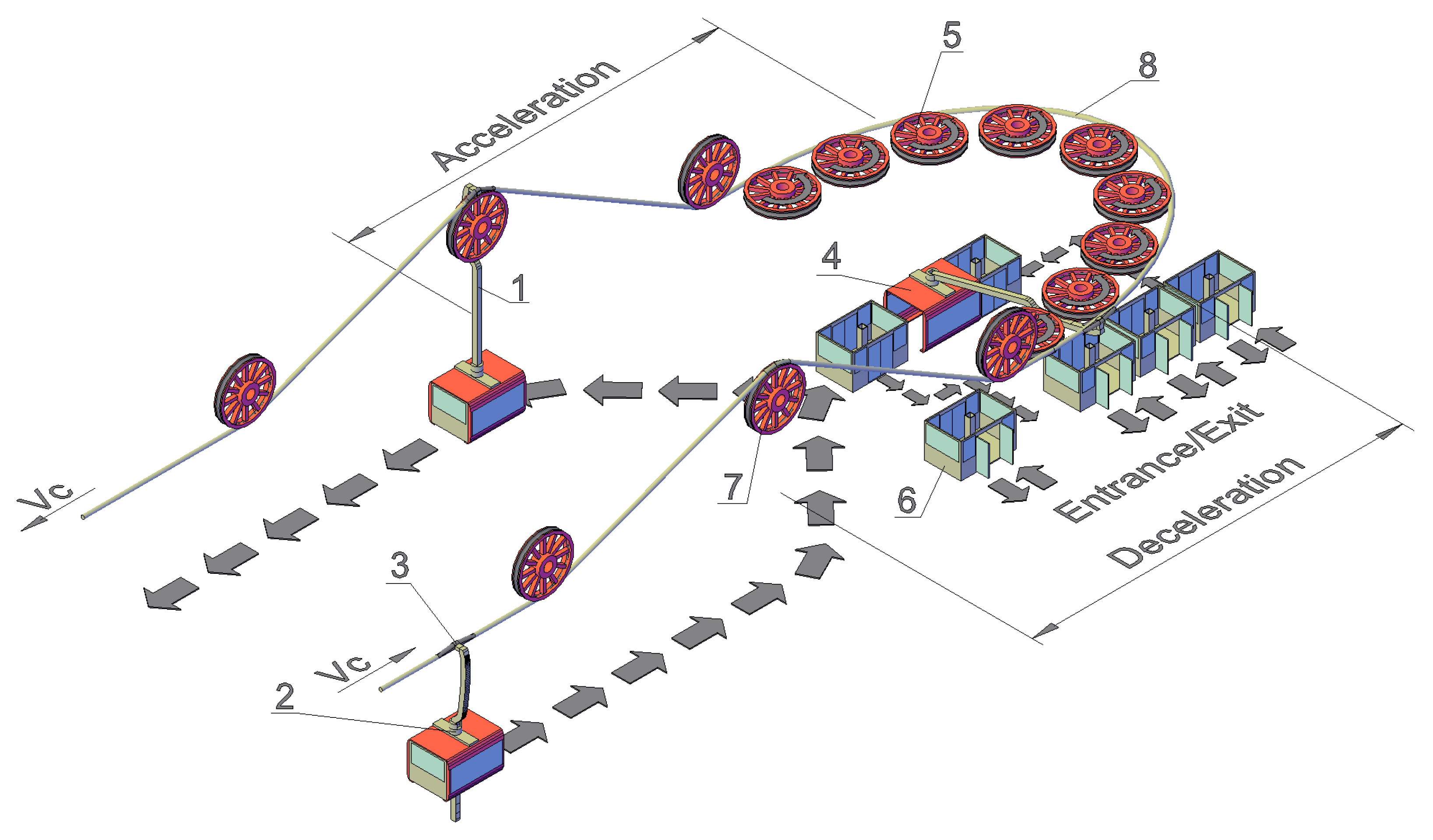
Figure 1 illustrates this system.
1.1. Description of the Operation of the Cable Car with Attaching Platforms in the Central Position [1]
Figure 1 illustrates a model of a cable car system in which the cabin attaches to a platform while in the central position. When the cabin enters the station, it moves to the middle of the line simultaneously as the rope is guided downward, allowing the suspension to assume a horizontal position. This configuration is more comfortable for passengers, as the cabin remains at a consistent level.
When the suspension is in the horizontal position, the fixed grip with the rope rotates along the curve (which is not circular but elliptical). This curve allows the cabin in the middle of the station to decelerate. First, the platform that has entered the station detaches from the cabin. Once detached, the platform moves via a conveyor to the position where passengers can smoothly alight and board. When the cabin is stopped at the central position, it can attach to the next fully loaded platform. After attaching, the cabin accelerates and leaves the station.
The special “rope flow” curve provides both deceleration and acceleration for the cabin within the station. This type of cable car uses fixed grips. If the suspension length is 8 m, the station width must be at least 16 m. When the cabin with attached platforms departs the station, the suspension aligns with the platform. This ensures a secure connection between the cabin and the platform along the line.
The article New Technological Approach to Cable Car Boarding also describes the geometric procedure for designing the rope trajectory curve through the station. As an example, a cable car with a rope speed of 5 m/s, a suspension length of 8 m, and a maximum cabin deceleration (or acceleration) of 0.5 m/s2 is presented.
1.2. Methodology—Geometric Method of the Design of the “Rope Flow” Curve [1]
This type of cable car achieves cabin deceleration and acceleration solely through the geometric configuration of the carrying/hauling rope, to which the cabins are attached using fixed grips. Consequently, the rope must follow a specific path, guided by drive wheels. Determining this rope path within the station requires a geometric design procedure based on descriptive geometry, which ensures that the cabin comes to a precise stop at the central position.
The shape of this curve allows a cabin, located at the midpoint of the station, to decelerate while the rope and fixed grip continue to move along the curve at a constant speed. The maximum allowable acceleration or deceleration for the cabins is 0.5 m/s
2. For instance, if the cable car travels at 5 m/s and the suspension length is 8 m, the geometric procedure for designing the curve proceeds as follows:
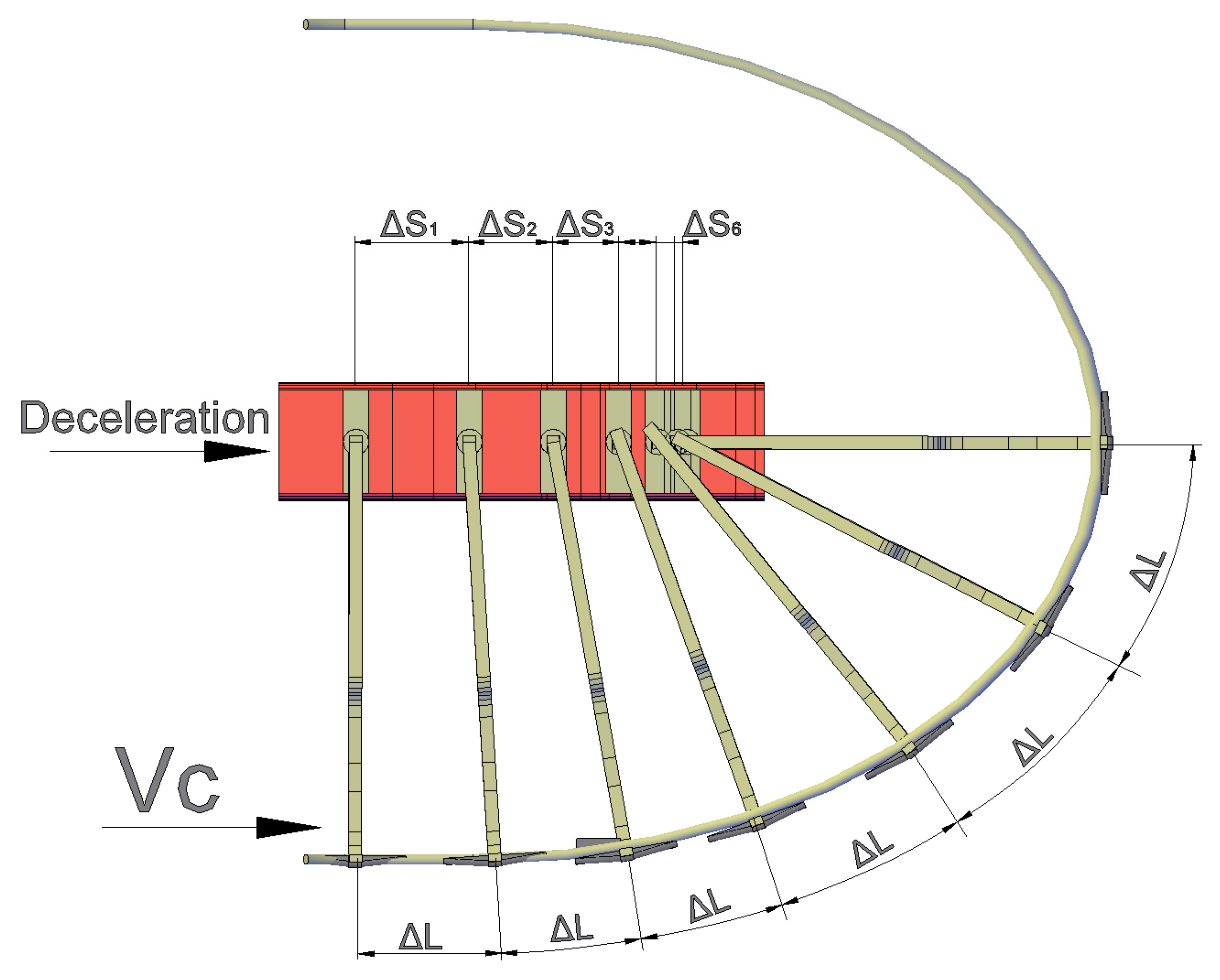
The cabin, positioned at the station’s center axes, requires 10 s to decelerate from an initial speed of V
C = 5 m/s (see
Figure 2). During the first second, the cabin slows from 5 m/s to 4.5 m/s, covering a distance of:
In the same first second, the rope advances 5 m, maintaining a speed of 5 m/s.
During the second second, the cabin reduces its speed from 4.5 m/s to 4 m/s, traveling a distance of:
Simultaneously, the rope moves 5 m along its path at 5 m/s.
n the third second, the cabin decelerates from 4 m/s to 3.5 m/s, covering a distance of:
During this third second, the rope again travels 5 m at 5 m/s.
Figure 2.
Cabin deceleration and rope movement along a longitudinally symmetric curve [
1].
Figure 2.
Cabin deceleration and rope movement along a longitudinally symmetric curve [
1].
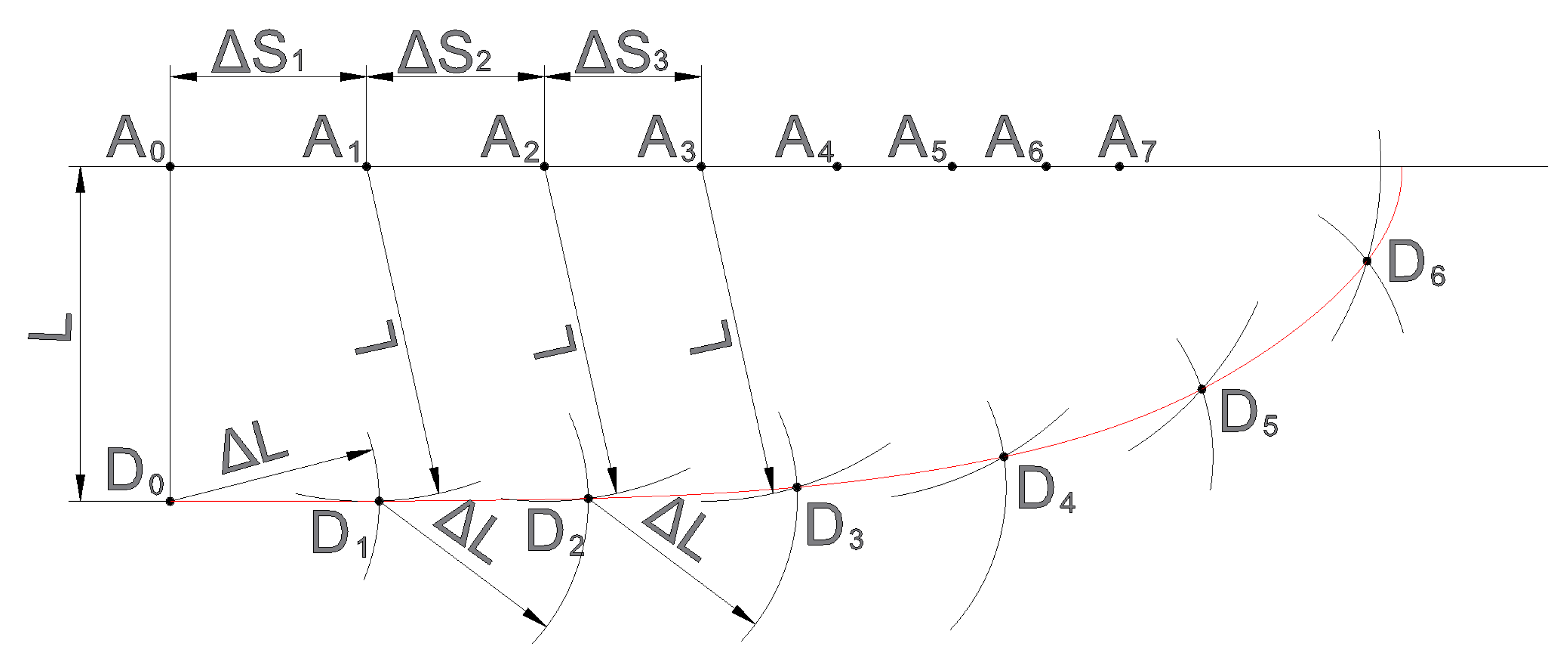
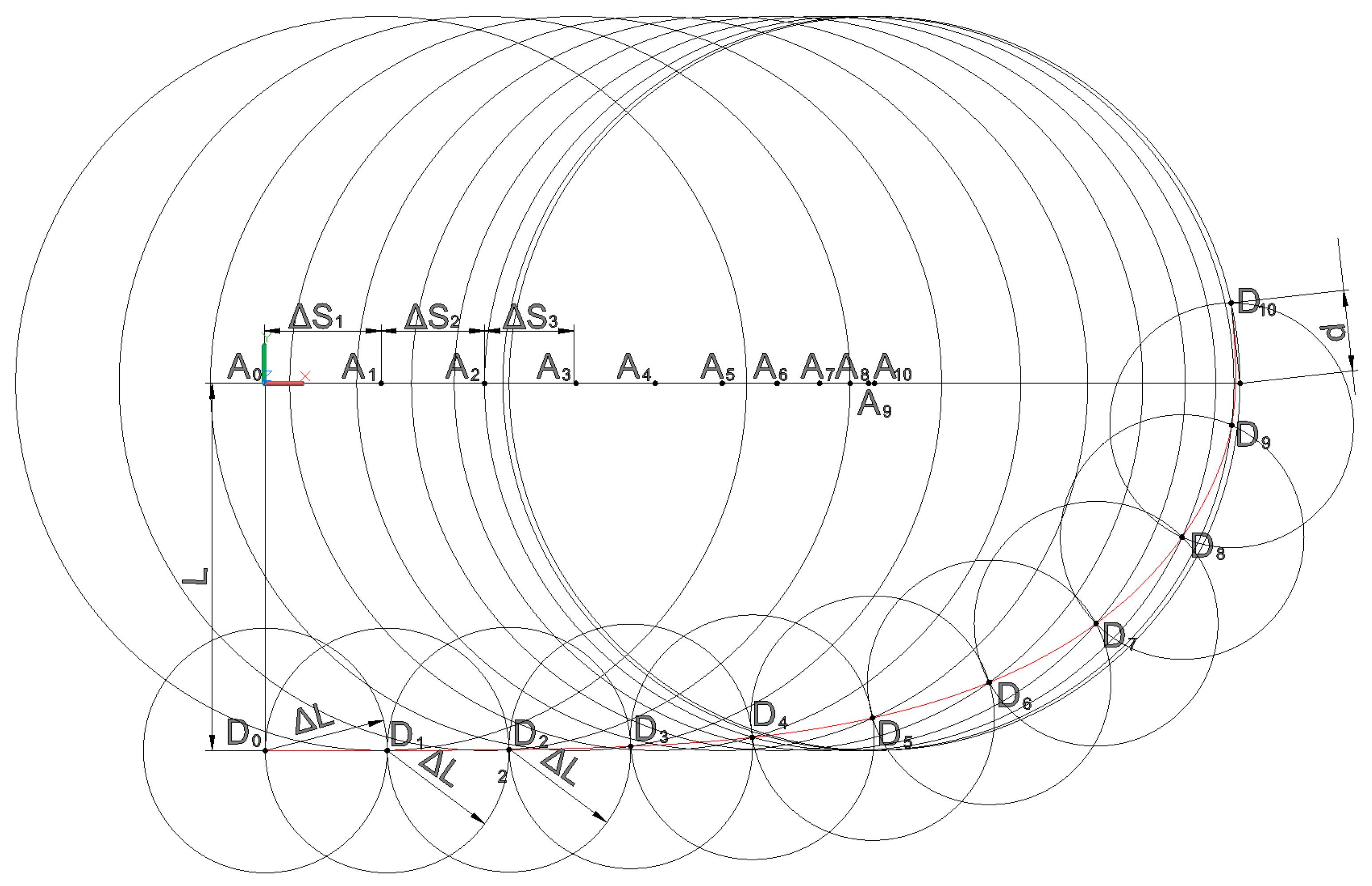
Similar calculations can be performed for the subsequent seconds of the cabin’s deceleration at the midpoint of the line. The curve construction (
Figure 3) starts at time t = 0, when the cabin begins to decelerate with an initial speed of 5 m/s. At this moment, the cabin is located at point A
0 and the fixed grip on the rope is at point D
0, with the distance between them being L = 8 m, corresponding to the suspension length.
During the first second, from t = 0 to t = 1, the cabin travels a distance of ΔS1 = 4.75 m, moving from A0 to A1. Meanwhile, the rope advances ΔL = 5 m, from D0 to D1. The point D1 is determined as the intersection of an arc of radius L = 8 m centered at A1 with an arc of radius ΔL = 5 m.
In the second second, the rope moves another ΔL = 5 m from D1 to D2, while the cabin travels ΔS2 = 4.25 m from A1 to A2. The point D2 is found as the intersection of an arc with radius L = 8 m centered at A2 and an arc of radius 5 m. Similarly, the point D3 is obtained from the intersection of an arc of radius L = 8 m centered at A3 with an arc of radius ΔL = 5 m.
This procedure can be continued for the remaining seconds. By connecting the points D with straight lines, a polyline representation of the rope path is obtained. Alternatively, these points can be connected using a spline, which is supported by modern geometric modeling software such as AutoCAD 2023.
1.3. Detected Problem in the Design of the Curve
In the article New Technological Approach to Cable Car Boarding [
1], from which the method of designing the rope flow curve—enabling the cabin to stop—is summarized, some issues were already present at the time of writing. Specifically, if the cabin decelerates from an initial speed of 5 m/s to a complete stop with a deceleration of 0.5 m/s
2, it requires 10 s to come to a full stop. Using a time interval of 1 s, there should be 10 points representing the cabin’s position at each second (points A
1, A
2, A
3, …). However, in
Figure 3 of the referenced article, only 7 points are shown (from A
1 to A
7). Likewise, the intersection points of the circles required for constructing the curve are only 6 (from D
1 to D
6). This means that for the last approximately 3.5 s, the curve is drawn merely as an extension, leaving the actual path of the curve unknown.
At the time when the article New Technological Approach to Cable Car Boarding was written, the authors were not aware of this problem, or (one of the authors of that article is also a co-author of this one) they assumed that a 1 s time interval for constructing the curve was too large and that a shorter time interval would probably produce a more accurate curve. The reasons for this issue and how it can be resolved will be clarified in the following sections of this paper.
2. Review of Previous Research
Recently, a large number of studies have addressed cable transport in urban environments as part of public passenger transport. Historically, for public transport purposes, funiculars were the most commonly used cable systems, first installed at the turn of the 19th to 20th century [
2,
3]. These cable systems operated on the ground and occupied valuable urban space [
4].
For mass passenger transport in the air, enabled primarily by circulating gondola cable cars, such systems began to be implemented mainly in South America only in the 21st century. The first widely known example is the Metrocable in Medellin, Colombia, where six lines were installed, connecting predominantly hilly parts of the city. The objective was to link people from remote and otherwise inaccessible areas to the Medellin metro system [
5,
6,
7,
8], thereby improving accessibility and the social conditions of populations in the city’s poorest districts.
Other cities that successfully introduced circulating gondola systems in urban transport are Bogotá and Caracas, where social conditions in underprivileged areas were also improved [
9,
10,
11,
12]. In 2014, the largest urban cable car system in the world, Mi Teleférico, began operating in La Paz, Bolivia, where 11 cable lines were installed across the city by 2018 [
13,
14]. In these South American cities, circulating gondola systems are predominantly used, with capacities in La Paz reaching up to 4000 passengers per hour.
In addition to South America, urban cable systems have been successfully implemented in New York, Portland (USA), Hong Kong, Lagos (Nigeria), Constantine (Algeria), Rio de Janeiro (Brazil), Koblenz (Germany), and Maokong (Taiwan) [
14]. In Europe and the USA, cable systems are not yet as widespread in urban transport as in South America. Many studies have examined the use of cable systems in urban environments, including public perception and willingness to adopt cable-based transport. These studies were conducted in Germany [
15,
16], Austria [
17], Serbia [
18], Slovakia [
19], the USA [
20], and China [
21]. The main focus of these studies was the integration of cable systems into urban areas [
22] and assessing public opinion on implementing such transport, with surveys generally indicating a positive reception.
In recent decades, new technologies in cable systems have been introduced, primarily in areas such as Dual-Haul Aerial Tramways, Tricable Detachable Gondola (TDG) systems, long spans, track and haul ropes, drive and evacuation equipment, advancements in safety considerations, flexible gondola deployment, sliding platforms, and flexible station location and design [
23]. Furthermore, research has focused on vibration damping and passenger comfort [
24,
25,
26,
27,
28], optimization of design and construction [
29], increasing cable system speeds [
30], more effective ways of rescuing people from a cable cars [
31] and electrical energy consumption, which shows favorable efficiency compared to conventional urban transport systems [
32].
In urban applications, a key question is whether cable systems can provide sufficient capacity to meet passenger demand. Findings from Medellin indicated that the cable system had insufficient capacity, resulting in queues at metro stations [
5]. Therefore, increasing cable system capacities is essential to make them competitive with other urban public transport modes [
23].
Currently, the best-performing technologies are tricable detachable gondolas, or 3S systems, such as the one implemented in Koblenz, Germany. These systems can achieve capacities of up to 5500 passengers per hour at speeds of 8.5 m/s [
33]. However, even these capacities may still be insufficient, and several concepts have been proposed to further increase throughput. One approach is to densify cabins on the line with multiple platforms at stations, achieving capacities of up to 8000 passengers per hour [
34]. Another concept is the cable car system with attaching platforms, capable of reaching capacities of up to 12,000 passengers per hour [
1].
Since this article addresses the geometry of the rope path within a station for stopping a cabin in the central position, it is important to note that most previous cable system research focused on rope paths with respect to terrain. In such systems, the rope curve along the longitudinal profile depends mainly on the rope tension and the weight of the rope, cabins, and payload. These curves form a catenary, and calculations of these curves determine the maximum rope sag and whether cabins maintain sufficient clearance from the ground [
2,
3]. The shape of the rope sheaves for the carrying rope is also critical in determining the rope path [
35].
Most importantly, cable systems must comply with regulations specifying allowable speeds, minimum and maximum cabin-to-ground distances, and the temporal sequence of cabin movement in stations [
36]. Determining rope curves within a single-line station has not been a primary focus, as the rope, guided over the drive sheave, typically forms a semicircular path. Only in stations where increased transmission of driving force is desired does the rope pass over multiple drive wheels, forming larger angles and contact areas, and in these cases, the rope curves are also circular arcs [
2,
3].
3. Geometric Analysis of the Identified Problem
The example described in the article New Technological Approach to Cable Car Boarding [
1], which contains the identified error, will be revisited using a geometric approach to determine the cause of the problem. The rope moves at a speed of 5 m/s, the cabin stops at the central position with a deceleration of 0.5 m/s
2, and the suspension length is 8 m. These parameters correspond roughly to standard single-line circulating gondola cable cars [
36]. The time interval is 1 s, and during each second, the cabin’s speed decreases by 0.5 m/s. As the cabin slows down, it covers a shorter distance during each subsequent time interval.
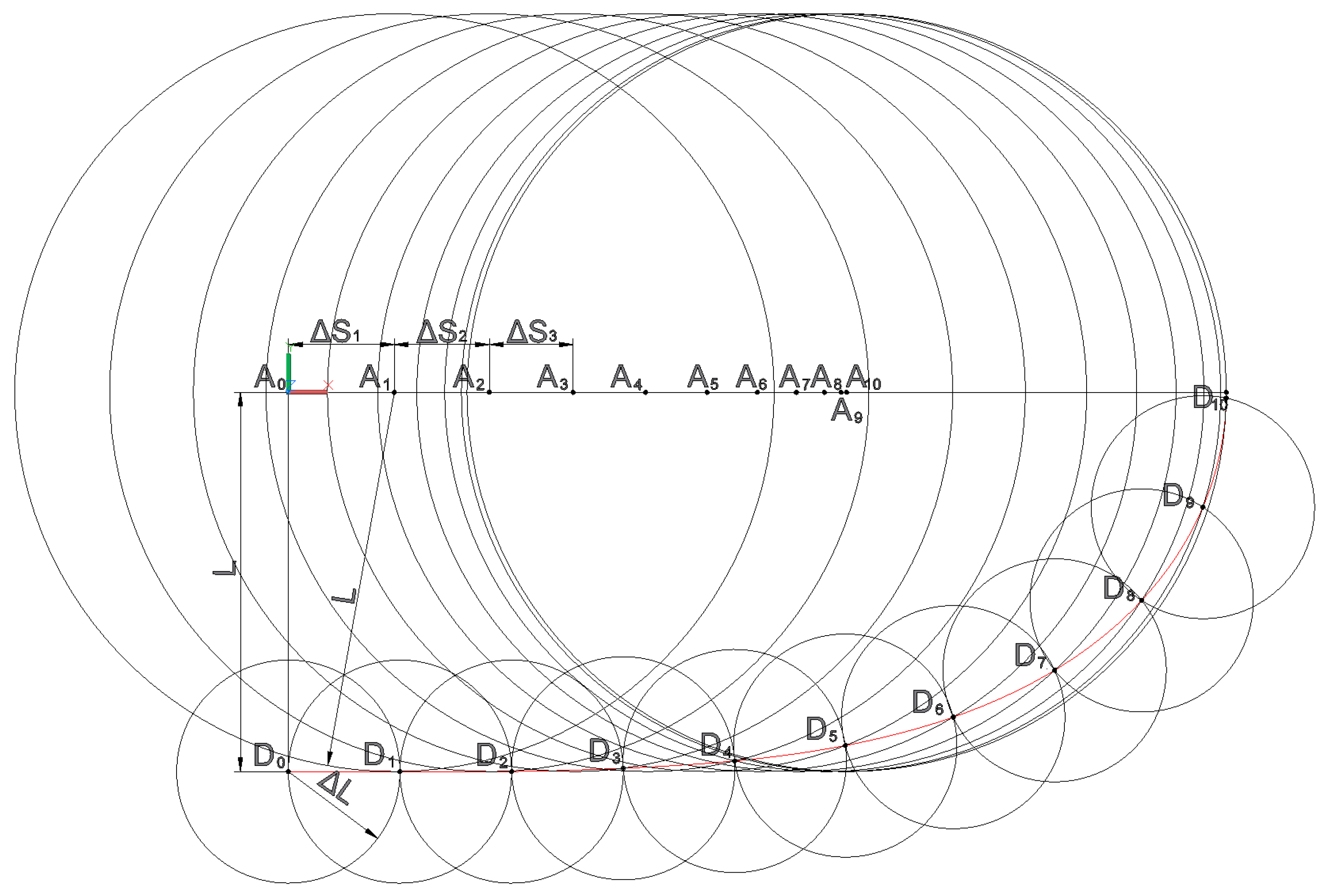
Table 1 provides the cabin travel distances during each time interval and the cumulative distance from the start of deceleration (coordinate x), which are used to determine the points A
1 to A
10.
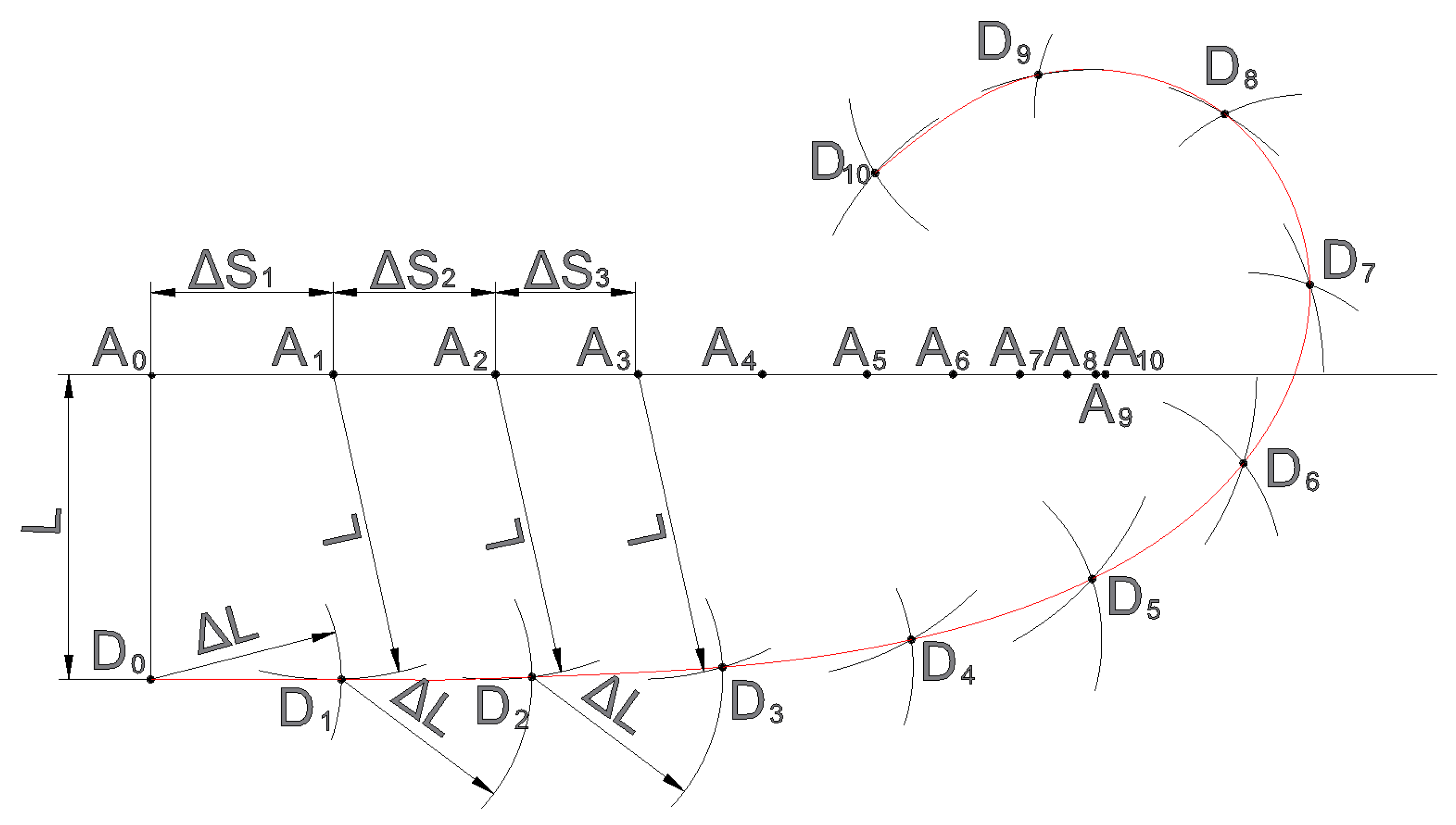
Using the same procedure described in
Section 1.2, the resulting rope flow curve for all ten construction points is shown in
Figure 4.
In
Figure 4, the rope flow curve is shown for all ten construction points. The curve is constructed according to the same principle described in
Section 1.2. It can be seen that the last three points lie on a curve that already crosses the horizontal line, which, according to
Figure 1 and
Figure 2, was not intended. Up to point D
7, the curve follows the same pattern as in
Figure 3. It is also noticeable that the curve in
Figure 4 is longer, with a total length of exactly 50 m, which corresponds to the required rope travel distance at a speed of 5 m/s over 10 s (the time required to stop the cabin).
This means that in
Figure 3, the curve length is shorter than 50 m. Consequently, during the last three seconds, the cabin would begin to move backward instead of following the planned deceleration of 0.5 m/s
2, which would be very uncomfortable for passengers.
What is the problem? It appears that the procedure described does not apply to all combinations of acceleration (a), rope speed (V), and suspension length (L). Clearly, the suspension length is not suitable for certain combinations of speed and deceleration and does not produce a correct curve. Specifically, for the combination of a rope speed of 5 m/s and cabin deceleration of 0.5 m/s2, a suspension length of 8 m is not appropriate. Therefore, in the next section, we will discuss the limitations of suspension length in relation to rope speed and acceleration.
4. Restrictions on the Rope Path Curve
The shape of the rope path curve depends on the combination of suspension length (L), cabin deceleration/acceleration (a), and rope speed (V). As discussed in
Section 2, an incorrect combination of these three parameters makes it impossible to construct the rope path correctly. In such cases, the curve already extends beyond the horizontal line where the cabin is supposed to stop, which is inconsistent with the concept of the system shown in
Figure 1 and
Figure 2. Therefore, it is necessary to determine the interdependence between these three parameters that define the rope travel curve through the station:
To find the correct suspension length, it is necessary to define the limits within which the rope path curve can be constructed. These limits are illustrated in
Figure 5:
In
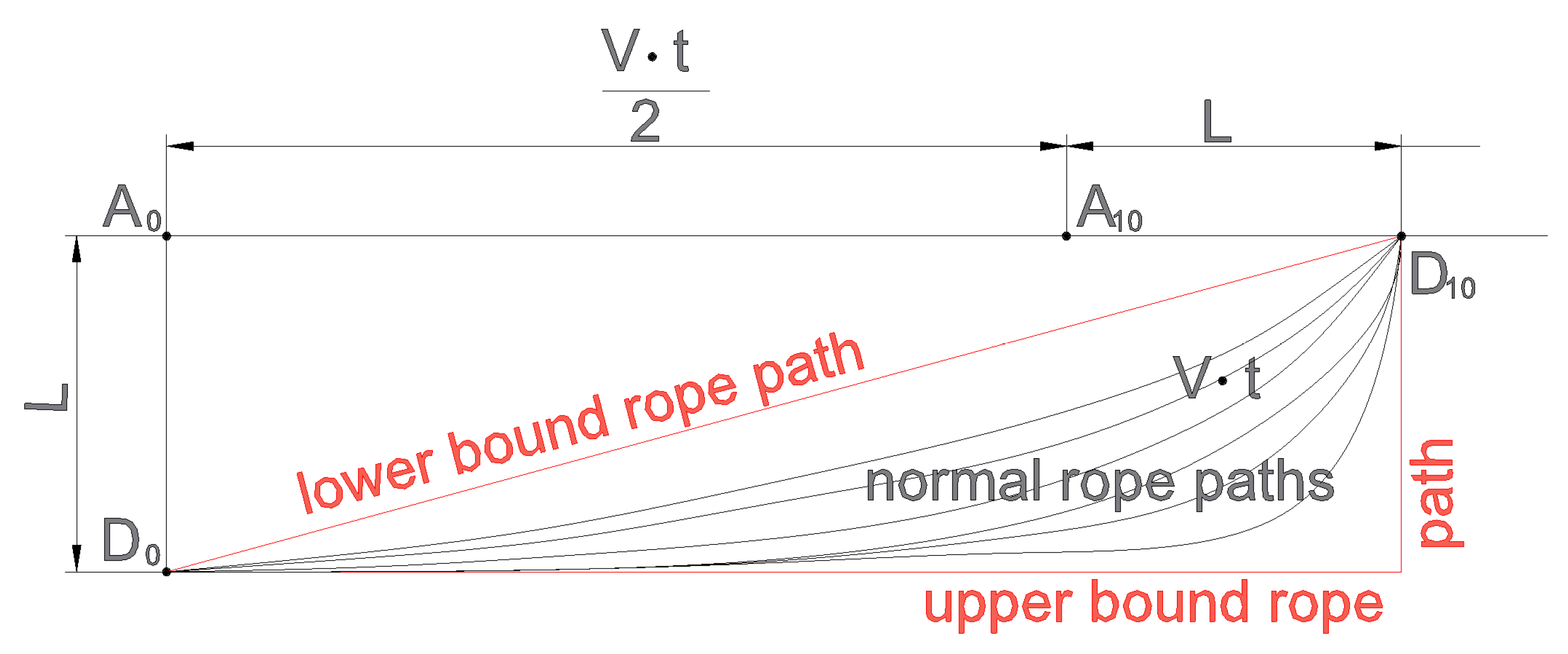
Figure 5, the geometric limits of the rope path through the station are shown with red lines. The rope path curve is formed based on different combinations of rope speed (V), cabin deceleration during stopping (a), and suspension length (L). These curves are drawn in black within a triangle outlined in red. The rope path curve must remain inside this triangle (unlike the example in
Figure 4).
The length of the horizontal side of the triangle consists of the distance traveled by the cabin during stopping (V·t/2) plus the suspension length L. Here, t is the cabin stopping time. The vertical side of the triangle corresponds to the suspension length L. The rope path curves must have a length equal to the distance the rope travels during the cabin’s stopping time, i.e., V·t.
Thus, the rope path curves must lie between two limits. The first limit, the “lower bound rope path,” represents a straight line from point D0 to D10, which corresponds to the shortest possible rope path. In practice, such a design is not feasible, as it would create excessive lateral accelerations at points D0 to D10 due to abrupt changes in the rope direction. The second limit, the “upper bound rope path,” represents the rope following the triangle’s legs, moving horizontally and vertically. This path is also impractical, as it would create a sudden 90° change in rope direction at the right-angle corner.
The idea is as follows: by calculating the mathematical relationships between V, a, and L for both extreme cases, equations can be derived for the maximum and minimum suspension length. A suspension length within these limits ensures a normal and correct rope path curve for a given rope speed (V) and cabin deceleration (a).
4.1. Upper Bound Rope Path
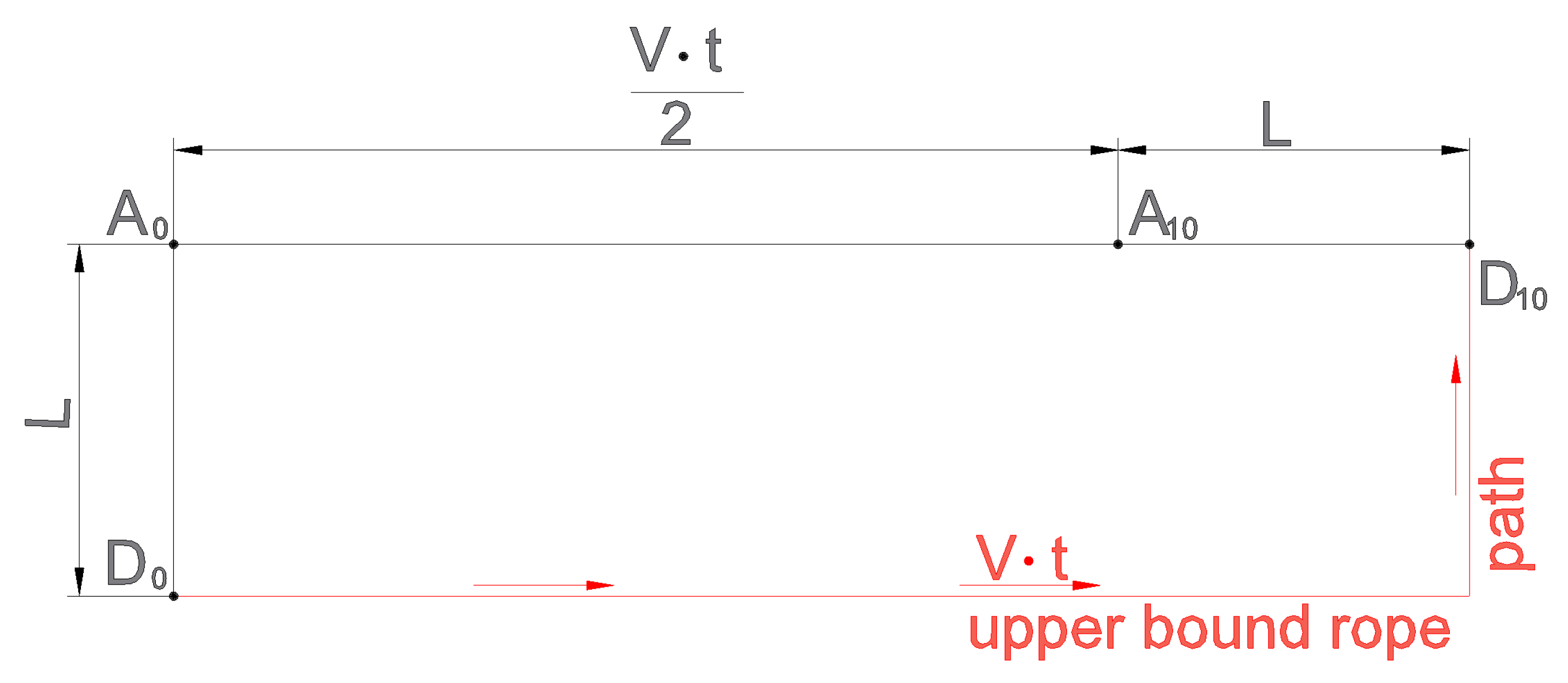
The upper bound rope path represents the first limiting case of the rope path through the station. In this case, the rope path runs perpendicularly from point D
0 to point D
10, representing the longest possible rope travel. In
Figure 6, this path is marked with red lines.
The length of this rope path consists of the horizontal distance traveled by the cabin during deceleration (V·t/2) plus the suspension length (L). In the vertical direction, the rope path length equals the suspension length L. During this time, the rope travels from D
0 to D
10 a total distance equal to the rope speed multiplied by the stopping time (V·t), where t is the time for the cabin to decelerate from A
0 to A
10:
To include deceleration (a) in the equation, we replace t using the relationship between speed, deceleration, and time:
From the above equation, we obtain the expression for L:
In the above equation, we obtained the dependency of the suspension length L on the rope speed and cabin deceleration (a) for the first limiting case.
4.2. Lower Bound Rope Path
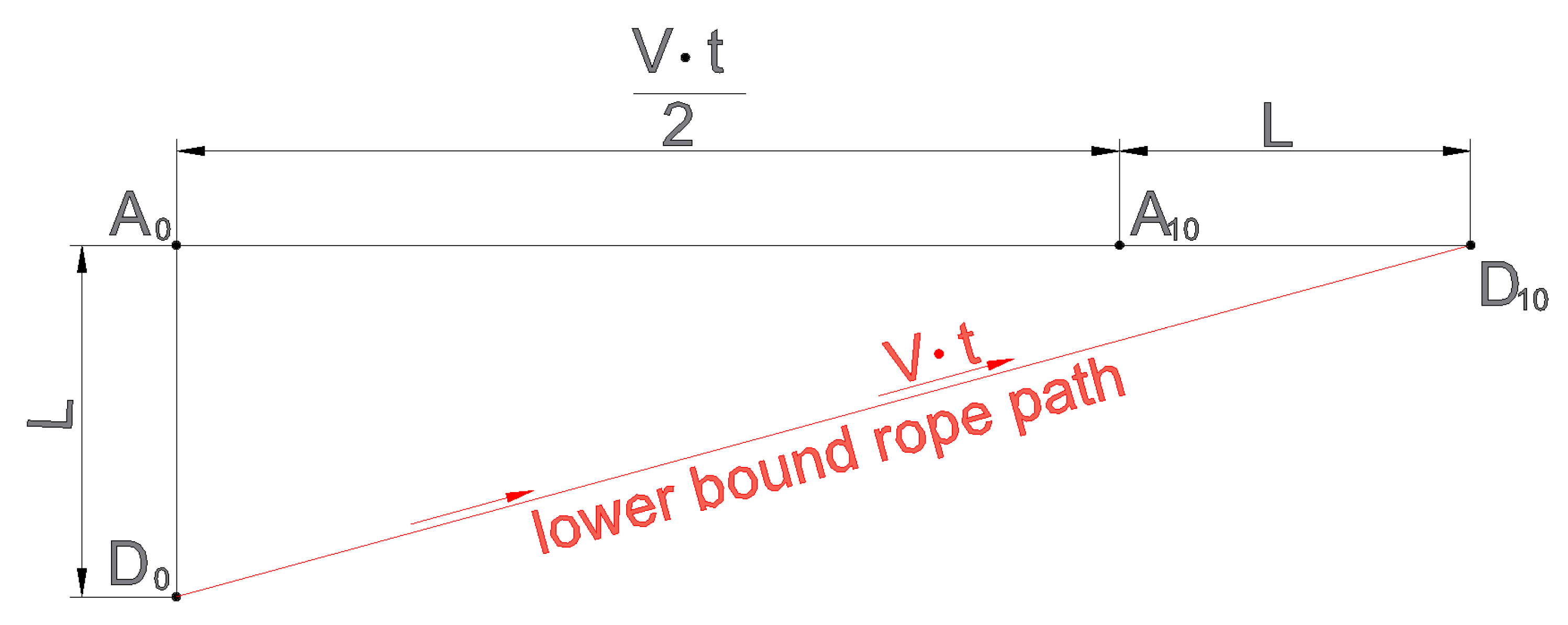
Lower bound rope path is the second limiting case of the rope path through the station. In this case, the path goes directly in a straight line from point D
0 to point D
10, which represents the shortest possible rope path. In
Figure 7, this path is marked with a red line.
During this time, the rope travels from point D0 to point D10 a distance equal to (V·t). However, the length of this line can be obtained using the Pythagorean theorem, where one leg of the triangle has the length of the path traveled by the cabin decelerating in horizontal direction (V·t/2) plus the suspension length (L). The other leg of the triangle has the length of the suspension (L).
To have acceleration (a) in the equation, we put instead of t:
The above expression can be written in the form of a quadratic equation:
This is a quadratic equation in the form:
For which the quadratic formula applies:
If we substitute this into the quadratic formula, we get:
With further simplification, we obtain the final expression for L:
Since there are two solutions for L, the second solution is not applicable because it gives a negative number. Therefore, we can use the equation for L:
In the above equation, we obtain the dependency of the suspension length L on the rope speed and cabin deceleration (a) for the second limiting case.
4.3. Normal Rope Path Within the Limits
From
Figure 5, we can see that normal rope paths follow curves that lie between the two limiting cases. Therefore, for the lower bound rope path, the normal rope path, which has a length of (V·t), must be shorter than the lower bound rope path. Thus, Equation (7) changes into an inequality:
Or in this case, the suspension length must be greater than the expression in Equation (11):
For the lower bound rope path, the normal rope path, which has a length of (V·t), must be longer than the lower bound rope path. Therefore, Equation (12) changes into an inequality:
Or in this case, the suspension length must be shorter than the expression in Equation (22):
Now let us look at the real example given at the beginning of the article, or in
Figure 4, to determine within which limits the suspension length should lie. In the initial example, the rope speed is 5 m/s and the cabin deceleration/acceleration is 0.5 m/s
2. Based on Equations (24) and (26), which represent the limits for minimal and maximal suspension length, the correct suspension length can be calculated:
We can now conclude that the permissible suspension lengths for a rope speed of 5 m/s and cabin acceleration/deceleration of 0.5 m/s2 lie between 12.5 m and 20.57 m. The originally chosen suspension length of 8 m is clearly not suitable.
5. Example of Constructing the Rope Path Curve with an Appropriate Suspension Length
For the construction of the rope path curve, the same data for cabin speed and deceleration during braking in the station will be used as in the case discussed in
Section 2. The speed of 5 m/s is approximately the normal speed of existing single-rope circulating gondolas with detachable grips, and the deceleration of 0.5 m/s
2 is the maximum constant deceleration allowed during cabin stopping. The suspension length will be 16.5 m, which is close to the average value between the given limits presented in
Section 4.3 and in Equations (27) and (28) (maximum suspension length 20.57 m and minimum suspension length 12.5 m).
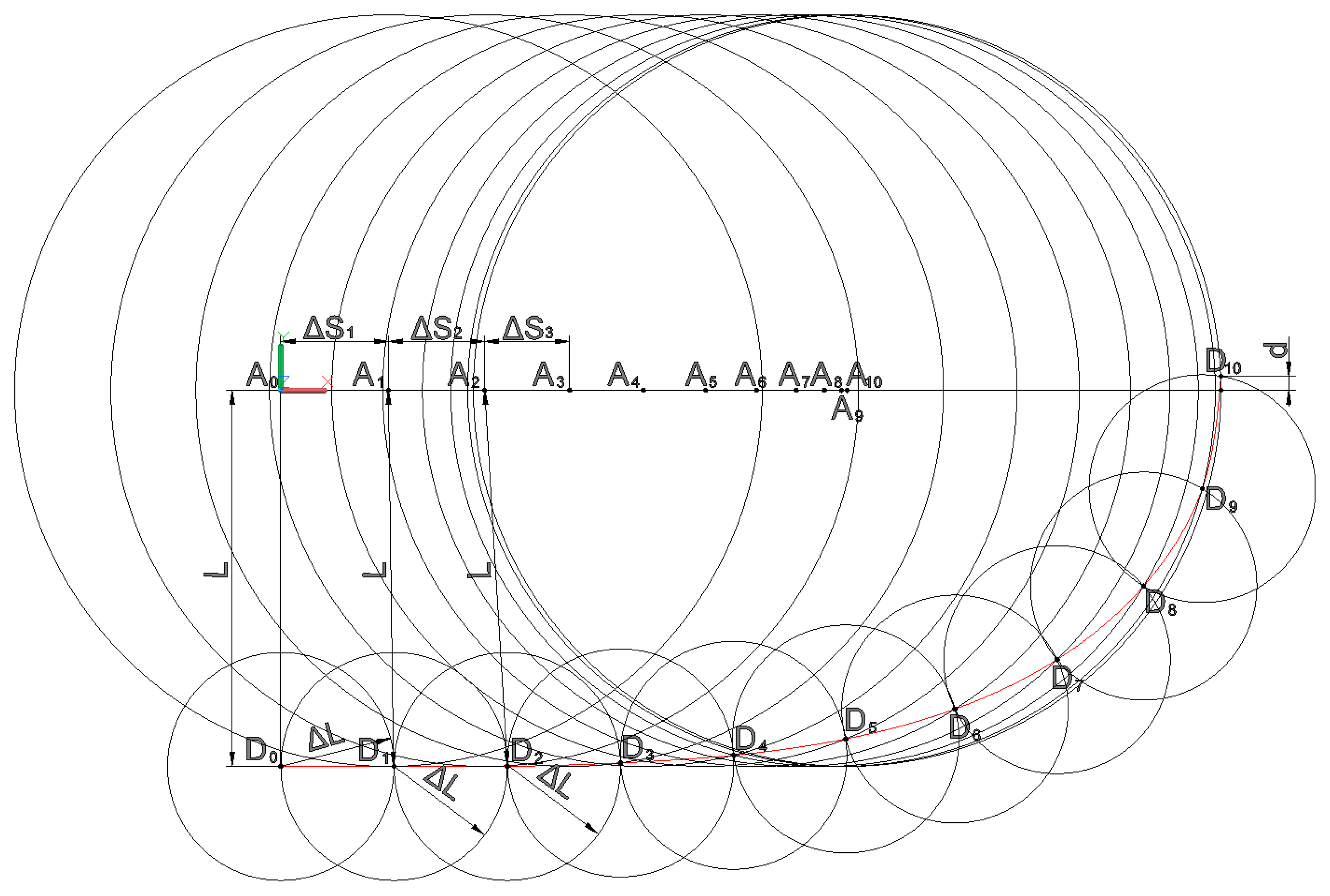
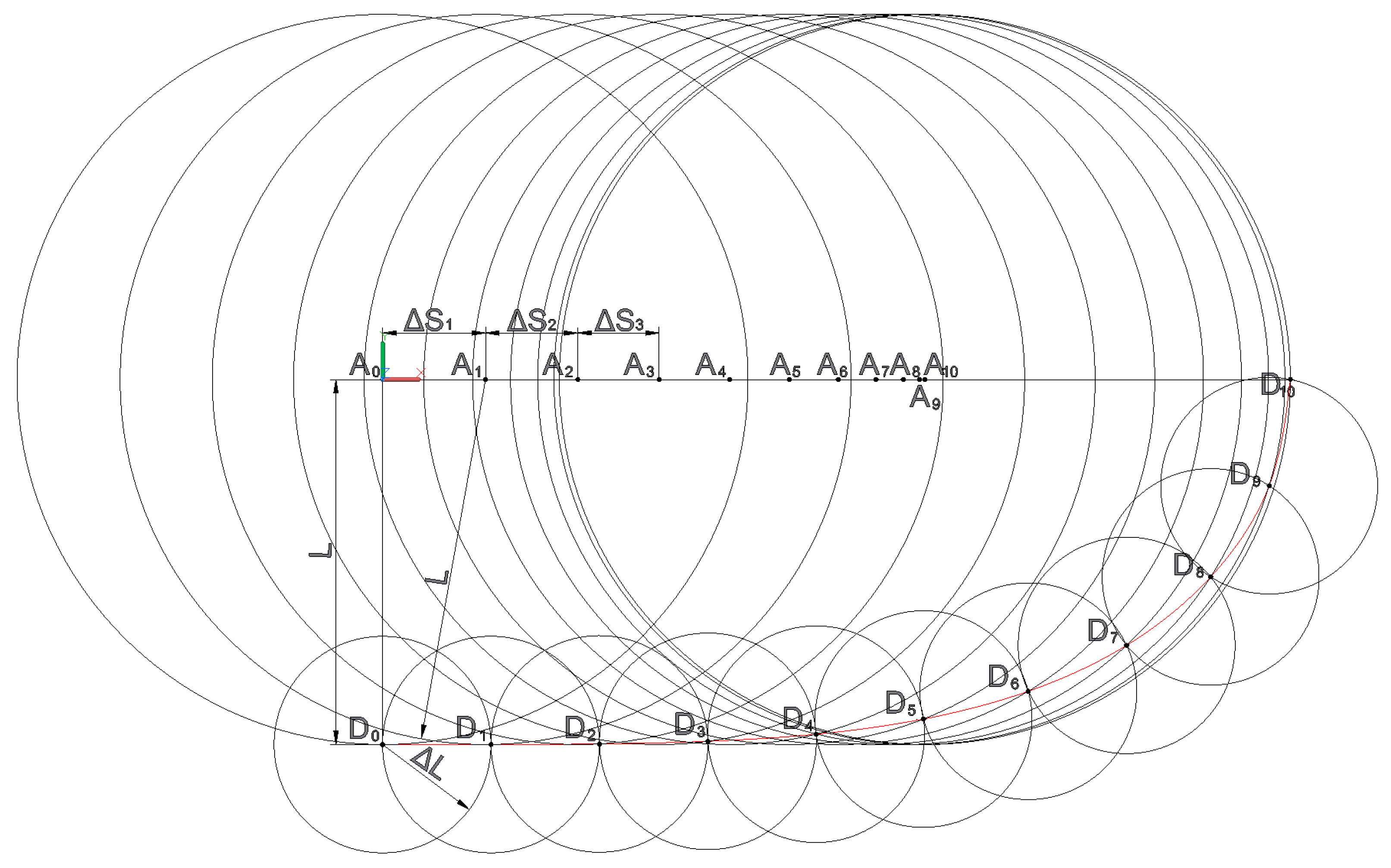
The geometric method of constructing the curve is shown in
Figure 8 and is carried out according to the geometric procedure described in
Section 1.2. The time interval is 1 s. Here, the error at the last point of the curve D
10 is quite small and amounts to d = 0.6172 m. This error represents the distance between the ideal position of the last point on the curve D
10, which is located on the horizontal line where the cabin stops (extension of the line on which points A
0 to A
10 lie).
In
Figure 8, the large circles represent the suspension length with radius L = 16.5 m, and the small circles, with a radius of 5 m, represent the rope path for each second at a rope speed of 5 m/s. The time interval is 1 s. Points A indicate the cabin positions during stopping at 10 s intervals. This figure is constructed according to
Table 1, where the distance s for each point A is given. Points D represent the rope displacement along the curve for each second at constant speed.
Comparing
Figure 4, where the suspension length was L = 8 m, with
Figure 8, where the suspension length is 16.5 m, it is clear that the rope path curve is much more correct. All points D lie below the horizontal, and the last point D
10 misses the final horizontal point by only d = 0.617 m.
In the next attempt to construct the rope path curve, the suspension length is reduced to L = 15 m. The time interval is 1 s. The result is shown in
Figure 9. Here, the error at the last point on the curve, D
10, is even larger and amounts to d = 3.3129 m. This means that the correct solution must be sought for suspension lengths greater than 16.5 m. Therefore, the next attempt will be made with a suspension length of L = 17 m, as shown in
Figure 10.
With a suspension length of 17 m and a time interval of 1 s, the last point on the curve, D
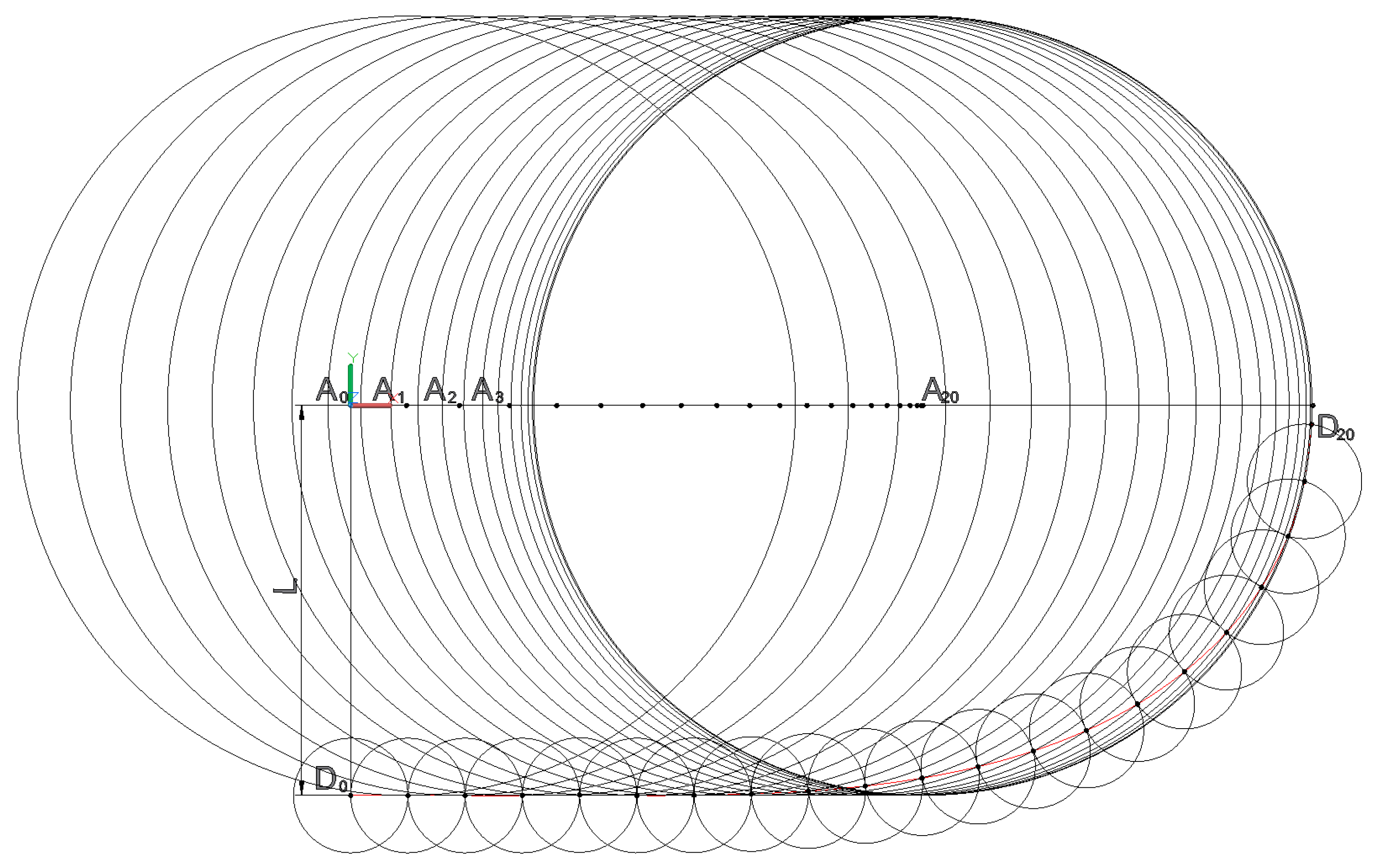
10, is almost in the correct position (on the horizontal) and misses the correct position by only d = 0.2597 m. This solution is already nearly ideal. If the time interval is reduced to 0.5 s, the rope path curve is designed more precisely, since during the braking time, a half-second interval results in 20 points used to construct the rope path curve. This example is shown in
Figure 11.
In
Figure 11, it is clearly visible that the small circles are smaller and have a radius of 2.5 m, since the rope travels a distance of s = 2.5 m in half a second at a speed of 5 m/s. The result is 20 points from D
1 to D
20, which are used to construct the rope path curve. Comparing
Figure 10 and
Figure 11, we can see that reducing the time interval for constructing the curve positions the last point on the curve lower, in this case with an error of 0.813 m. This means that reducing the time interval positions the curve “lower,” making it more curved or more concave.
From the previous examples, it can be seen that the correct solution will be somewhere between 17 m and 16.5 m. The error for a suspension length of L = 16.5 m is d = 0.617 m above the horizontal, and for L = 17 m, it is d = 0.259 m below the horizontal.
Since the solution for the last point’s position at L = 17 m is closer to the ideal line, with a smaller error, the precise suspension length should be slightly greater than L = 16.75 m, which is the midpoint between 16.5 m and 17 m. Using linear interpolation based on the errors, the most accurate suspension length should be L = 16.85 m.
Figure 12 shows the solution for a suspension length of L = 16.85 m, where the last point on the curve, D
10, is exactly on the horizontal and in the correct position. This solution applies for a time interval of one second. If the time interval were 0.5 s, the suspension would likely need to be slightly longer.
6. Discussion
Based on the geometric construction in
Figure 12, we can see that if we want to correctly implement a cable car system with attaching platforms in the central position with a suspension length of 16.85 m, the horizontal rope path curve is 41.85 m long and 16.85 m high (wide). Since an identical curve is required on the other side for cabin acceleration, the width doubles to 33.7 m. This means that the station required for such a cable car must be at least 42 × 34 m. This station is significantly larger than in the case shown in
Figure 3, where the station was 31 m long and 16 m wide. However, such a system would have a very high capacity. One platform could accommodate up to 120 passengers, and if the time interval between cabins were half a minute (two cabins leaving the station every minute), the cable car could transport 120 cabins per hour, giving a total capacity of 14,400 passengers per hour. For such large capacities, the station would need to be correspondingly large.
However, using the geometric method, it is only possible to approximately determine the exact curve length, which in the case of
Figure 12 should be 50 m. This length comes from the 10 s stopping time of the cabin and the rope speed of 5 m/s. In
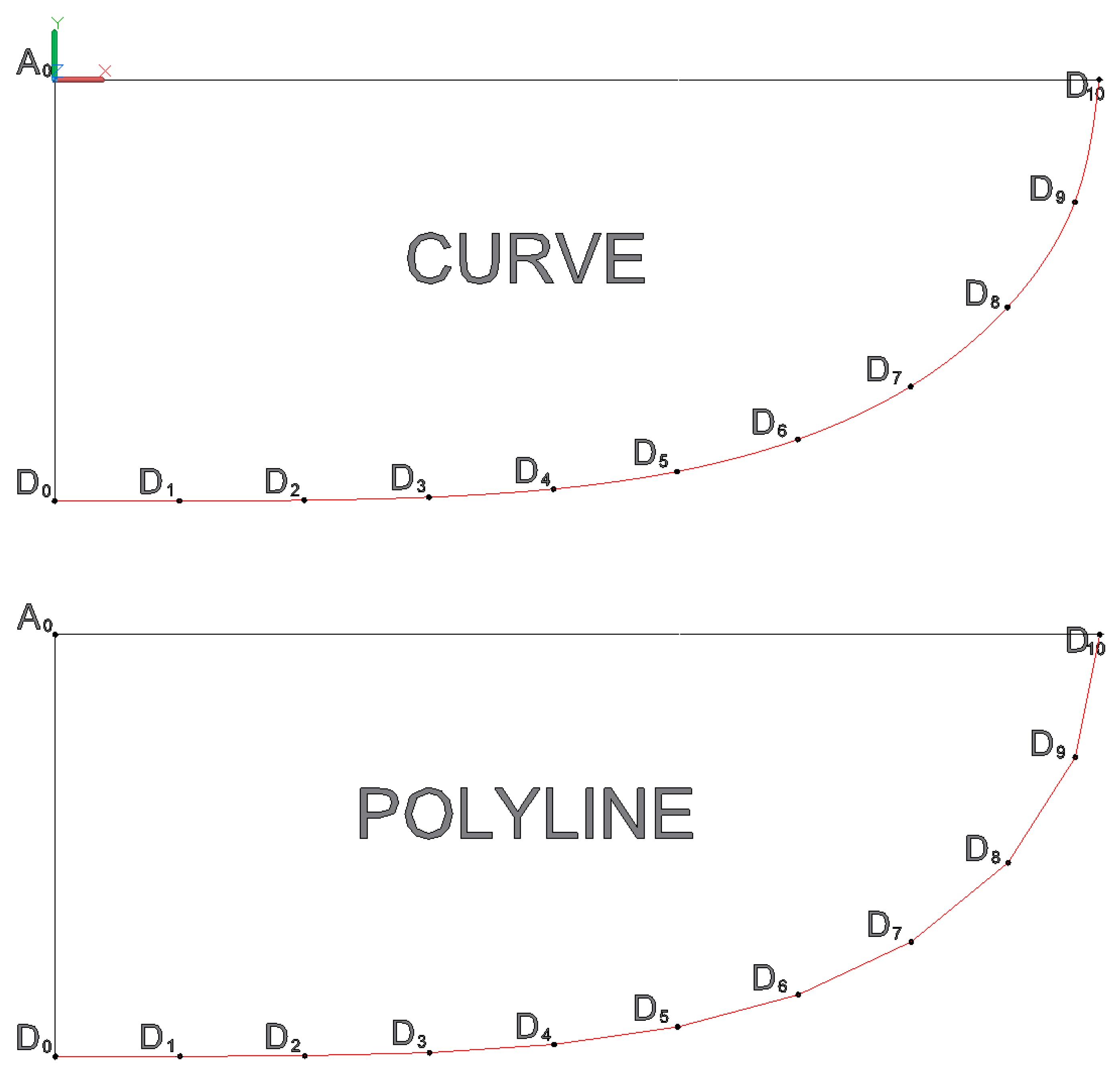
Figure 12, the curve length is 50.076 m. The difference arises because the curve was constructed using splines, whereas the geometrically obtained curve is actually a polyline composed of 10 straight segments, which has an exact length of 50 m (
Figure 13).
The curve shape is also influenced by the time interval. A shorter time interval (0.5 s) means that the last point of the curve construction is positioned lower, making the curve more concave. The result is equivalent to slightly increasing the suspension length while keeping the same time interval (1 s). In this case as well, the last point of the curve is positioned lower.
To determine an exact solution, it would be necessary to develop analytical methods for the equation of the rope path through the station. In practice, the curve is not exactly as determined by the geometric method but is only an approximation. In
Figure 1, it can be seen that the rope path curve is formed by horizontally positioned wheels that guide the rope through the station. This means that between two wheels, the rope runs in a straight line (tangent to two circles), then partially along the circular arc of the wheel rim, and then again along a straight line to the next horizontal wheel. Such a non-uniform rope path through the station, which does not precisely follow the constructed curve, would result in vibrations in the cabin during stopping. Therefore, a vibration damper should be installed on the suspension or on the attachment of the suspension to the cabin. A possible solution is that, in the horizontal position, the suspension could have a free movement (or clearance) at the point where it is attached to the cabin. The vibrations can also be reduced geometrically by using a larger number of smaller guide wheels instead of a smaller number of large ones. In this way, the rope can be guided through the station as close as possible to the designed curve.
7. Conclusions
The cable car system with attaching platforms in the central position, which was presented in the previous article [
1] and in
Figure 1, could not function correctly. The suspension length L = 8 m is too short for a rope speed V = 5 m/s and cabin deceleration a = 0.5 m/s
2. Through a precise analysis of this case, it was determined that during a 10 s stop, the cabin would move backward during the last approximately 3.5 s, which is not even remotely similar to the desired uniform stopping.
Therefore, the limits within which the rope can travel (upper bound and lower bound rope path) were analyzed, as well as the maximum and minimum possible suspension lengths L for proper operation. It was calculated that for the same combination of rope speed (5 m/s) and cabin deceleration (0.5 m/s2), the minimum suspension length would be L_min = 12.5 m and the maximum suspension length L_max = 20.57 m. Thus, the originally intended suspension length L = 8 m was clearly not within these calculated limits.
Using the geometric method to find the correct solution, the first attempt used a suspension length of L = 16.5 m, which is the arithmetic mean between the maximum and minimum suspension lengths. However, the solution was not adequate because the last point on the curve missed the correct position (located on the extension of the cabin stopping line) by a distance of 0.617 m (and the horizontal line). The next attempt used a suspension length L = 15 m, and the result was even worse, as the last point on the curve missed the correct position by 3.313 m (above the horizontal line). In the third attempt, a longer suspension length was tried, L = 17 m, where the error was only 0.259 m (below the horizontal line). All three attempts at constructing the rope path curve were based on a 1 s time interval. This means that for each second, a point on the rope path curve was constructed. During the 10 s cabin stopping time, 10 points on the rope path curve were constructed.
If the time interval is shortened to 0.5 s, a point on the rope path curve is constructed every half second, which means 20 points on the curve are constructed in 10 s. The procedure is longer, but the result was that the final point (the twentieth point) on the curve was positioned even lower than the correct location, and in this case, with a suspension length of 17 m, the error was 0.813 m, which is greater than for the 1 s interval. Comparing the two curves, it can be observed that the curve constructed with a 0.5 s interval is more curved, i.e., more concave, than the curve constructed with a 1 s interval.
Finally, using linear interpolation between the two most accurate solutions (L = 16.5 m and L = 17 m), the correct suspension length was determined to be L = 16.85 m. In this case, the last point constructed on the curve is exactly in the correct position.
In this way, it was determined that for a given cable car system, arbitrary combinations of cabin deceleration, rope speed, and suspension length cannot be used. In other words, for a given combination of rope speed and deceleration, only one suspension length is suitable. For the given example, with a cable car speed V = 5 m/s and cabin deceleration a = 0.5 m/s2, the suitable suspension length is only L = 16.85 m. For the originally intended suspension length of 8 m, a lower rope speed would have been required.
It follows that stations for cable car systems with attaching platforms in a central position would require a large footprint at normal cabin speeds, which would only be justified for high capacities (up to 14,400 passengers/hour) that these cable cars could provide.
The geometric procedure for determining the correct rope path curve through the station, presented in this article, is rather time-consuming, as the curve had to be constructed multiple times to arrive at the correct solution. Therefore, in the future, analytical methods for constructing the rope path curve should be developed to shorten this process.