Abstract
We studied traveling-wave solutions of the Dullin–Gottwald–Holm (DGH) equation via a sub-ODE construction. Under explicit algebraic constraints, the approach yielded closed-form families—bell-shaped, hyperbolic (), Jacobi-elliptic function (JEF), Weierstrass-elliptic function (WEF), periodic, and rational—and classified their symmetry properties. Optical solitons (bright and dark) arose as limiting cases of the elliptic solutions. We specified the parameter regimes that produced each profile and illustrated representative solutions with 2D/3D plots to highlight symmetry. The results provide a unified, reproducible procedure for generating solitary and periodic DGH waves and expand the catalog of exact solutions for this model.
1. Introduction
The study of nonlinear evolution equations (NLEEs) is considered a foundation in the framework of mathematical physics when it comes to the examination of the diverse and intricate processes of physics. These equations, which are used in fluid dynamics, nonlinear optics, plasma physics, and many other fields, are challenging to solve and at the same time promising. Among the numerous solutions that NLEEs offer, solitons, which are stable and non-dispersive, are perhaps among the most outstanding and interesting formations. The authors of this paper aim to introduce the reader to the topic of nonlinear evolution equations and the main types of such equations, as well as their practical applications and importance in analyzing complicated physical processes [1,2]. Thus, our interest was in understanding the soliton solutions of NLEEs, how they form, how they move, and how they interact [3,4,5,6,7]. The consideration of nonlinear evolution equations as the main object of study was at the core of our investigation due to the ability of these equations to accurately describe the complex interactions between nonlinearity, dispersion, and dissipation. By avoiding the constraints that linear systems impose, NLEEs provide a more complex view of the interactions of physical processes, and uncover interesting processes such as wave-breaking, shock formation, and the formation of coherent structures [8,9]. At the center of our discussion are solitons, which are essentially solitary waves that travel through nonlinear media with so much stability. These self-sustaining structures emerge as solutions to a host of NLEEs, such as the famous KdV equation, the nonlinear Schrödinger equation, and the sine-Gordon equation. These result in solitons having unique characteristics such as shape preservation and a constant velocity during their propagation, despite the dispersion and dissipation forces. Consequently, NLEE methods are crucial to understanding the qualitative characteristics of these occurrences. NLEEs have a soliton solution, and these solutions address the dynamics of the propagation of waves for transcontinental and transoceanic distances using optical fibers [10,11,12]. Thus, in nonlinear science, the traveling wave solution is becoming an attractive area of research. Various types of soliton solutions—such as multi-solitons, kink waves, bell-shaped waves, compactons, peakons, and cuspons-can be derived from NLEEs [13,14,15].Recently, several kinds with advantageous approaches have been figured out and evolved to create accurate solutions for NLEEs [16,17,18,19,20,21].
The present study examined the DGH model in relation to wave propagation in shallow water [22,23,24].
where is the fluid velocity; the constants and are the squares of the length scales; and is the linear wave speed for undisturbed water at rest at spatial infinity. Equation (1) is related to two classical integrable models. When and , it reduces to the Korteweg–de Vries (KdV) equation:
For and , it becomes the Camassa–Holm (CH) equation:
The KdV equation describes unidirectional surface waves in shallow water under gravity; its solitary waves are smooth. The CH equation also models shallow water waves, where denotes the free-surface elevation above a flat bed; its solitary waves are smooth for and peakons for , with the latter being orbitally stable. Global well-posedness for KdV holds for initial data and wave breaking is excluded. For CH, local well-posedness is known for with , and there exist unique global conservative solutions in ; both global smooth solutions and finite-time wave breaking may occur. Moreover, both KdV and CH arise as geodesic flows of right-invariant metrics on the diffeomorphism group of the circle (or its central extension, the Virasoro group). A detailed comparison between the previous and current studies can be seen in Table 1.
Table 1.
Comparison of existing literature and the present study for the DGH equation.
This paper is organized as follows. Section 2 develops the sub-ODE framework used throughout the study; we introduce the traveling-wave reduction, define the auxiliary function and its subsidiary ODE, carry out the homogeneous balance (yielding ), and present the resulting algebraic system together with theorems that generate closed-form families (bell/hyperbolic, Jacobi-elliptic, Weierstrass-elliptic, periodic, and rational). Section 3 applies this scheme to the DGH equation, specifies the admissibility/real-valuedness constraints on the parameters, and records the explicit solution forms. We also reports and interprets the wave geometries with figures (3D surfaces, 2D sections, and contour maps) and symmetry remarks for each family, including the limiting cases that connect elliptic waves to bright/dark solitons. Section 4 concludes with a summary of the contributions and outlines future work, including a linearized spectral/modulational stability study for the elliptic and solitary waves. For completeness, Appendix A provides the intermediate steps leading from the substituted ansatz to the algebraic relations used to construct the solutions.
2. Mathematical Analysis and Symmetry
To transform Equation (1) into an ordinary differential equation, we applied the following traveling wave transformation:
where c is a constant. Consequently, we obtained the following ODE:
Integrating Equation (3) yields
A is an integrating constant. The main objective was to solve Equation (4). We assumed the following ansatz for the sub-ODE technique [33]:
satisfying
The parameters , and are included in this equation. By using the derivative with the highest ordering to balance the nonlinear term, we are able to determine n.
By the homogenous balance in Equation (4), we get . Now, putting Equations (5) and (6) into Equation (4) and equating the coefficient of and yields a system of algebraic equations.
Consequently, Equation (6) provides the following solutions.
Theorem 1.
If , then Equation (6) provides bell-shaped solutions:
and periodic soliton solutions:
and a rational solution:
Proof.
Upon solving Equation (8), we obtained the subsequent outcomes if we substituted :
By putting Equation (12) into Equation (9), we have the bell-shaped solutions of Equation (1) in the following form:
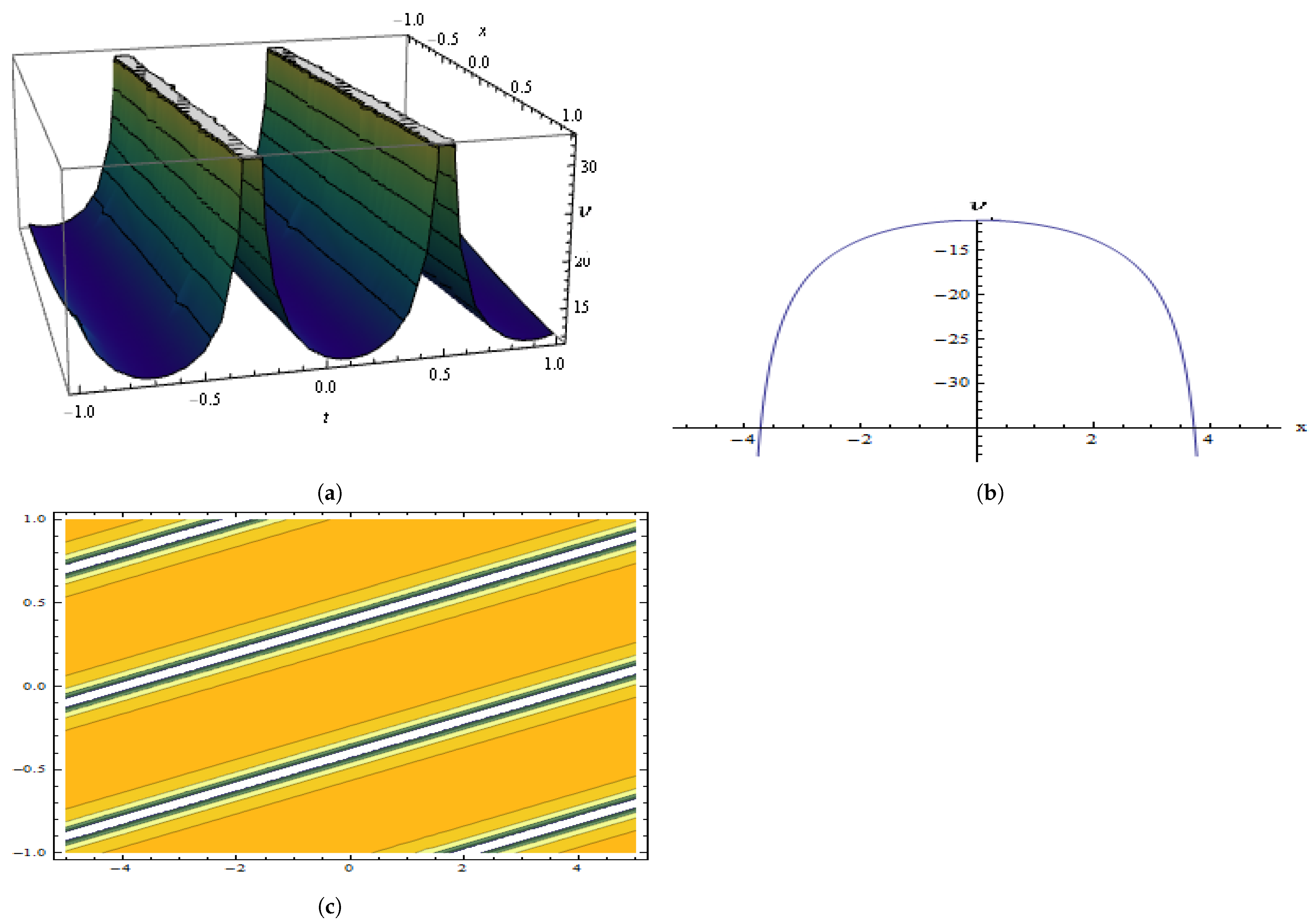
provided and can be visualised in Figure 1.
Figure 1.
The parameters , , , , and yield a graphic illustration of in Equation (13), where (a) displays a 3D graph, (b) displays a 2D plot, and (c) displays a contour illustration.
By putting Equation (12) into Equation (10), we have the periodic function solutions of Equation (1) in the following form:
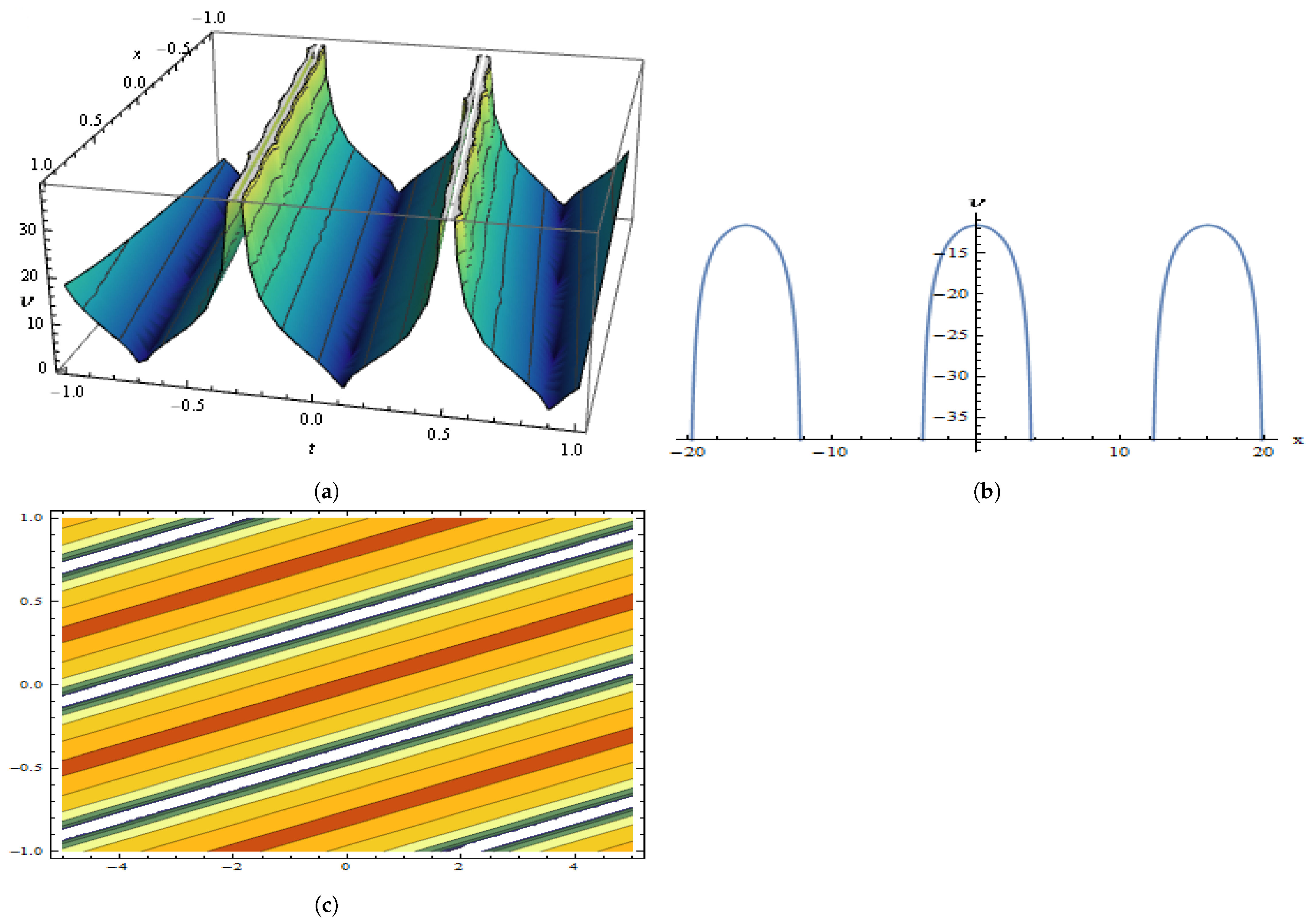
provided and can be seen in Figure 2.
Figure 2.
The parameters , , , , and yield a graphic illustration of in Equation (15), where (a) displays a 3D graph, (b) displays a 2D plot, and (c) displays a contour illustration.
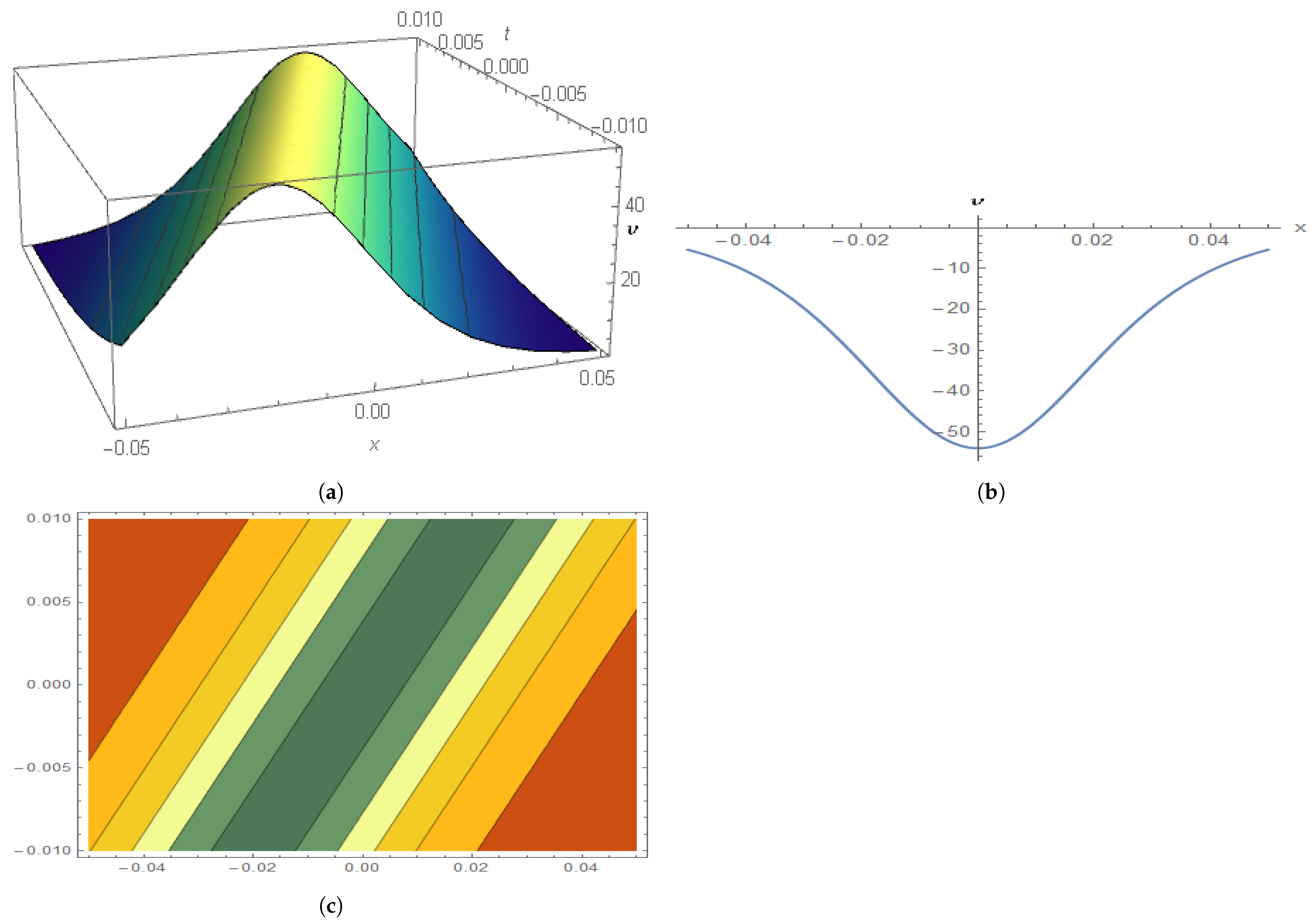
The symmetry of the rational function’s solution to Equation (1) has the following form when we insert Equation (12) into Equation (11) and can be visualised in Figure 3:
□
Figure 3.
The parameters , , , , , , and yield a graphic illustration of in Equation (17), where (a) displays a 3D graph, (b) displays a 2D plot, and (c) shows a contour chart.
Theorem 2.
- (a)
- where and .
- (b)
- where and .
Proof.
When in Equation (8), the results that follow can be obtained by solving Equation (8):
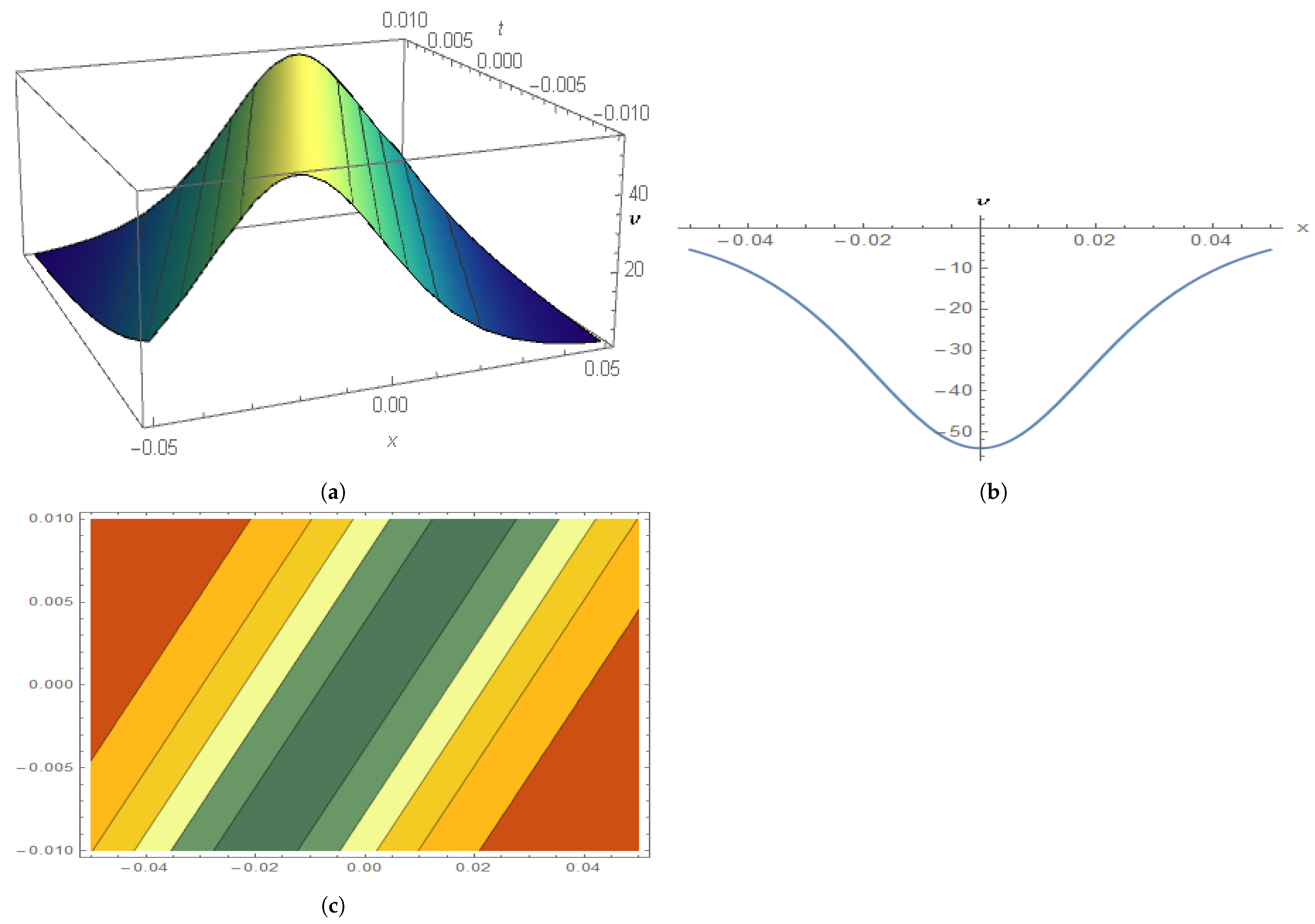
We obtain the Weierstrass-elliptic function solutions of Equation (1) in the following way by inserting Equation (20) into Equation (18) and can be visualised in Figure 4:
where , .
Figure 4.
The parameters , , , , and yield a graphic illustration of in Equation (21), where (a) displays a 3D graph, (b) presents a 2D plot, and (c) displays a contour chart.
Theorem 3.
Proof.
Upon solving Equation (8), if , the following outcomes arise:
We obtained the positive solutions of Equation (1) in the following way by inserting Equation (25) into Equation (23) and can be visualised in Figure 5:
Figure 5.
The parameters , , , , and yield a graphic illustration of in Equation (26), where (a) displays a 3D graph, (b) displays a 2D plot, and (c) displays a contour illustration.
Upon solving Equation (24), if , the following outcomes arise:
We obtained the positive solutions of Equation (1) in the following way by inserting Equation (25) into Equation (24) and can be visualised in Figure 6:
□
Figure 6.
The parameters , , , , , , and yield a graphic illustration of in Equation (28), where (a) displays a 3D graph, (b) displays a 2D plot, and (c) displays a contour chart.
Theorem 4.
Proof.
If the value of in Equation (8), then the problem of the Jacobi-elliptic function can be solved by simply solving Equation (8):
The Jacobi-elliptic function methods of Equation (1) have the following form when we insert Equation (32) into Equation (29):
By putting Equation (32) into Equation (30), we obtain the following:
By putting Equation (32) into Equation (31), we obtain the following:
The hyperbolic equation is the degenerated form of the Jacobi-elliptic function. Equation (33) yields the following result when and can be visualised in Figure 7:
Figure 7.
The parameters , , , , , , and yield a graphic illustration of in Equation (36), where (a) displays a 3D graph, (b) displays a 2D plot, and (c) displays a contour chart.
Figure 8.
The parameters , , , , , , and yield a graphic illustration of in Equation (37), where (a) displays a 3D graph, (b) displays a 2D plot, and (c) presents a contour chart.
When , then the result for Equation (34) is
When , then the result for Equation (35) is given by along with Figure 9.
□
Figure 9.
The parameters , , , , , , and yield a graphic illustration of in Equation (39), where (a) displays a 3D graph, (b) displays a 2D plot, and (c) displays a contour chart.
Theorem 5.
Proof.
Solving Equation (8), if , yields the bell soliton solution:
The dark solutions of Equation (1) take the following form when we insert Equation (41) into Equation (40) along with Figure 10:
□
Figure 10.
The parameters , , , , , , and yield a graphic illustration of in Equation (42), where (a) displays a 3D graph, (b) displays a 2D plot, and (c) displays a contour graph.
Theorem 6.
Proof.
Applying Equation (8), if and , yields the subsequent result for the hyperbolic function:
The hyperbolic function solutions of Equation (1) have the following form when we insert Equation (45) into Equation (43) and can be visualised in Figure 11:
Figure 11.
The parameters , , , , , 1, and yield a graphic illustration of in Equation (46), where (a) displays a 3D graph, (b) displays a 2D plot, and (c) displays a contour chart.
Figure 12.
The parameters , , , , , , , and yield a graphic illustration of in Equation (47), where (a) displays a 3D graph, (b) displays a 2D plot, and (c) displays a contour chart.
Theorem 7.
Proof.
If and , then Equation (8) provides the following periodic-function solutions, with the associated parameters specified below:
The symmetry of the periodic function solutions of Equation (1) take the following form when we plug Equation (50) into Equation (48) and can be visualised in Figure 13:
Figure 13.
The parameters , , , , , 1, , and yield a graphic illustration of in Equation (51), where (a) displays a 3D graph, (b) displays a 2D plot, and (c) displays a contour chart.
Putting Equation (50) into Equation (49) yields the following and can be visualised in Figure 14:
where , . □
Figure 14.
The parameters , , , , , 1, , and yield a graphic illustration of in Equation (52), where (a) displays a 3D graph, (b) displays a 2D plot, and (c) displays a contour chart.
3. Results and Discussion
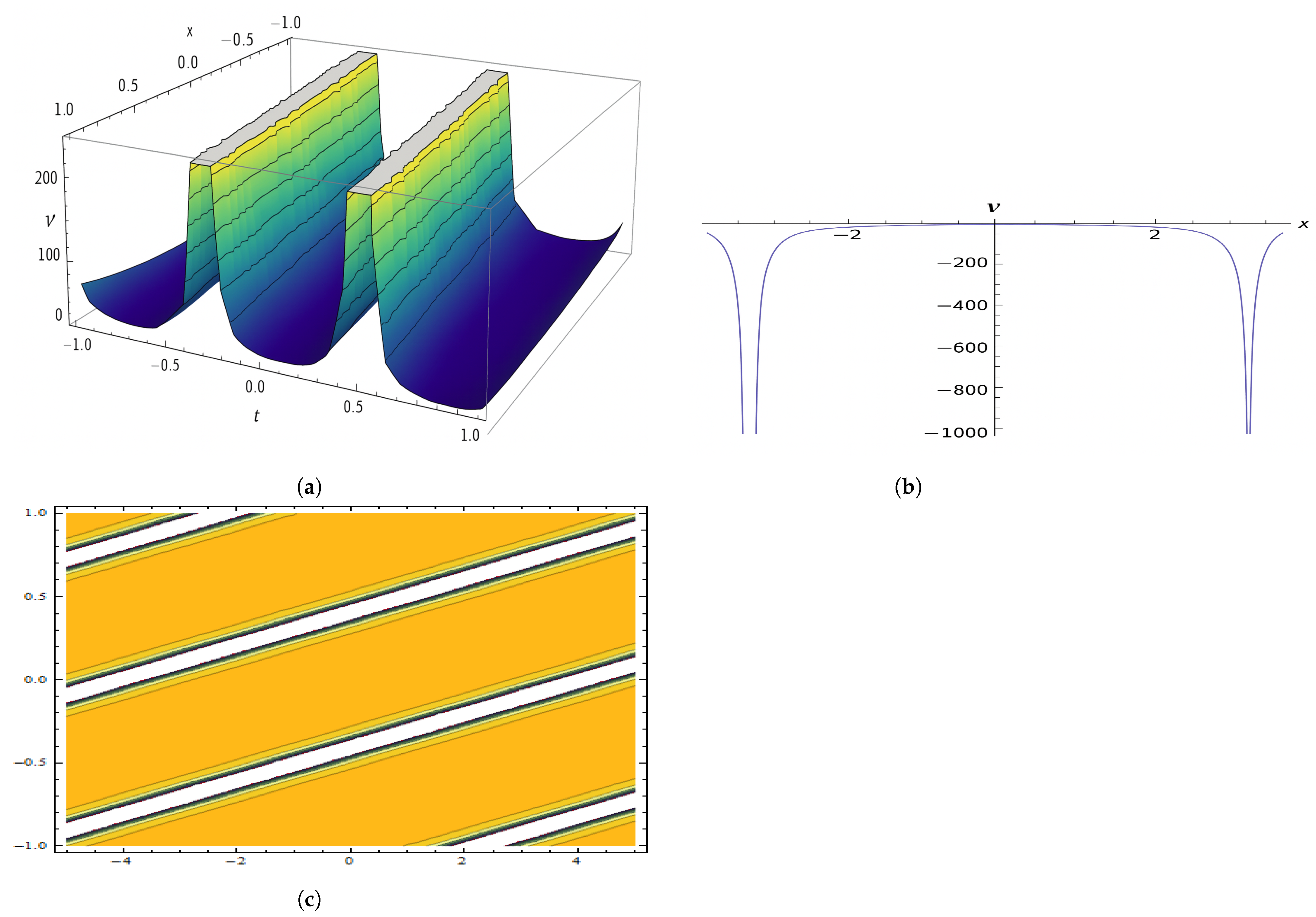
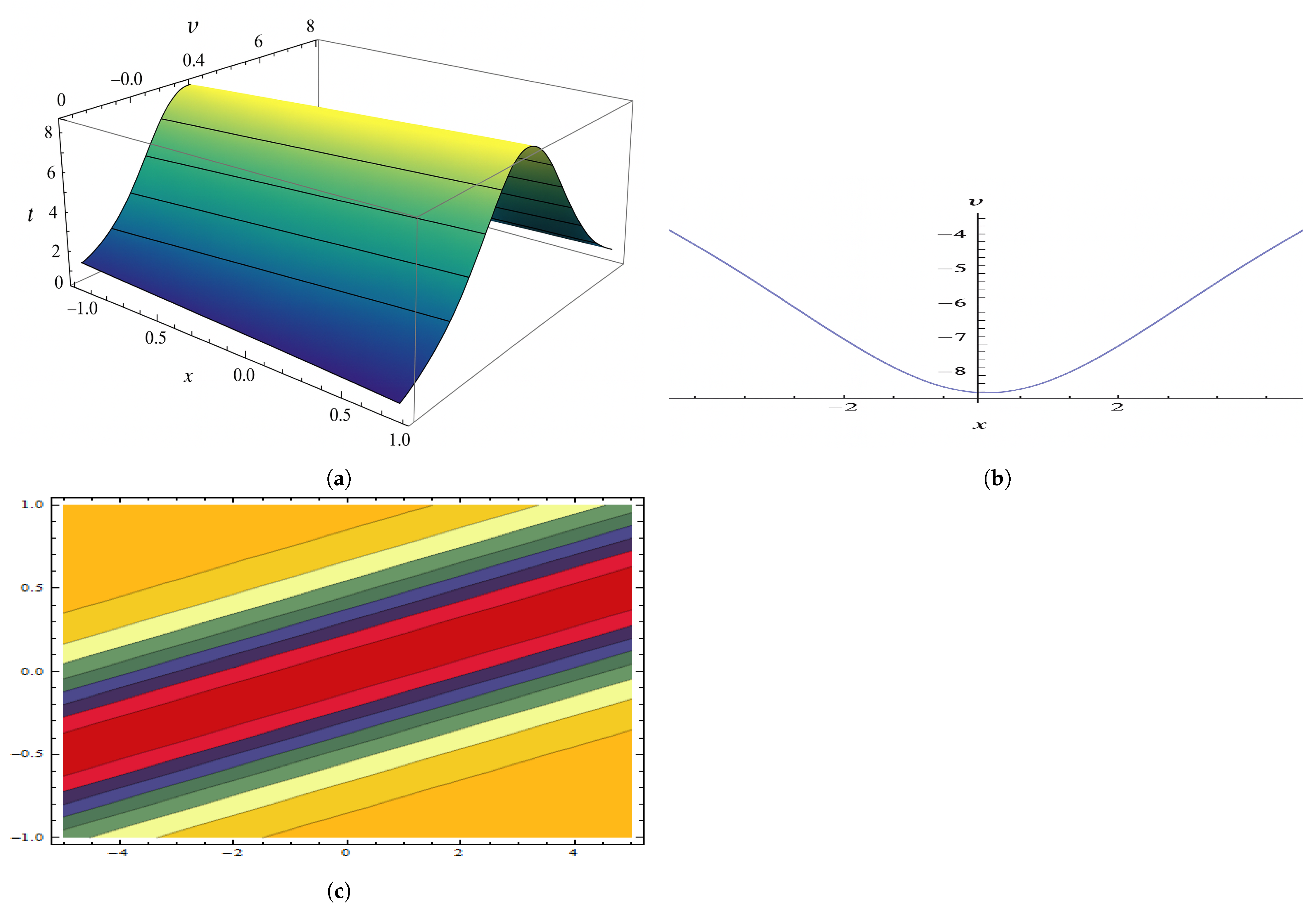
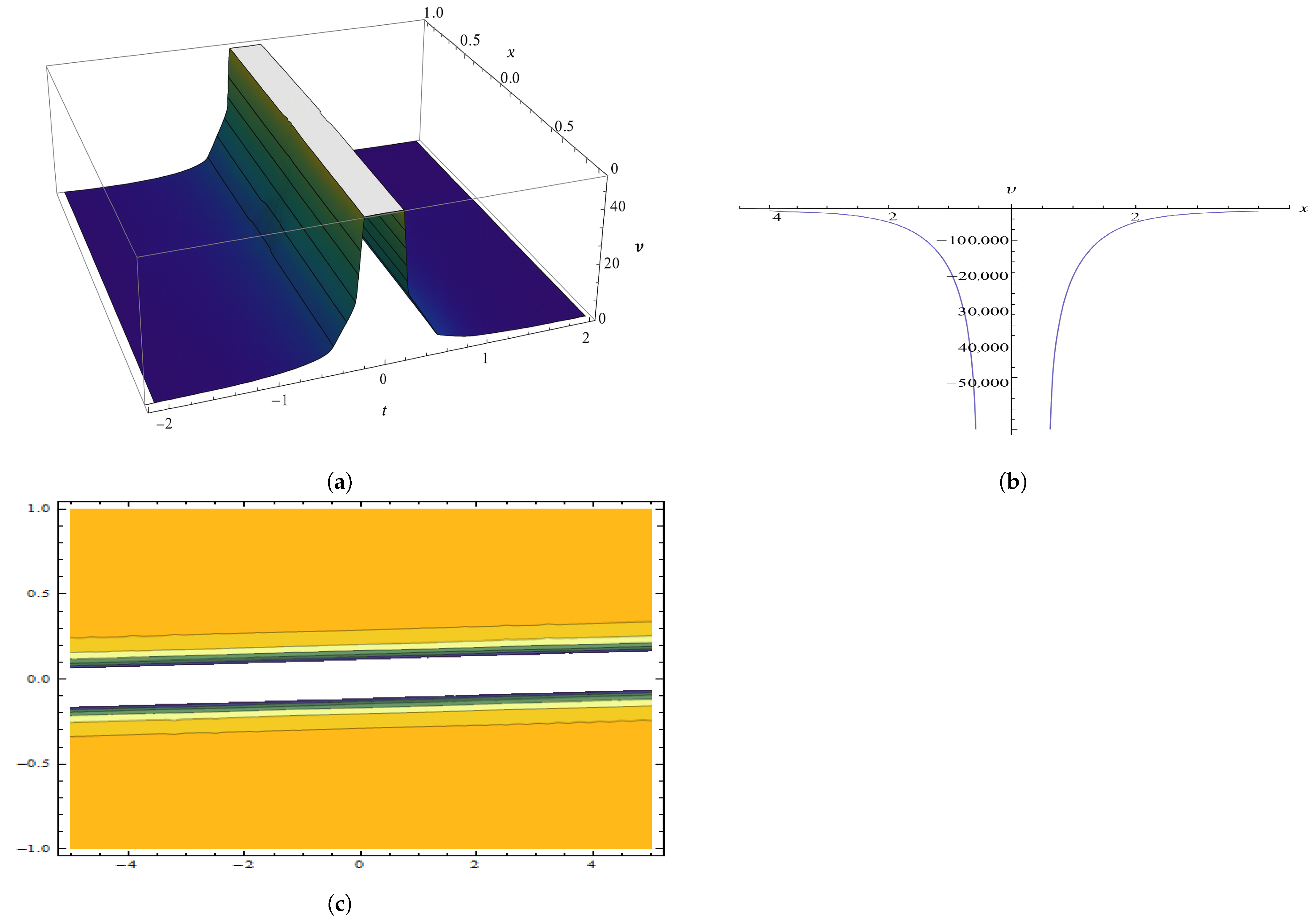
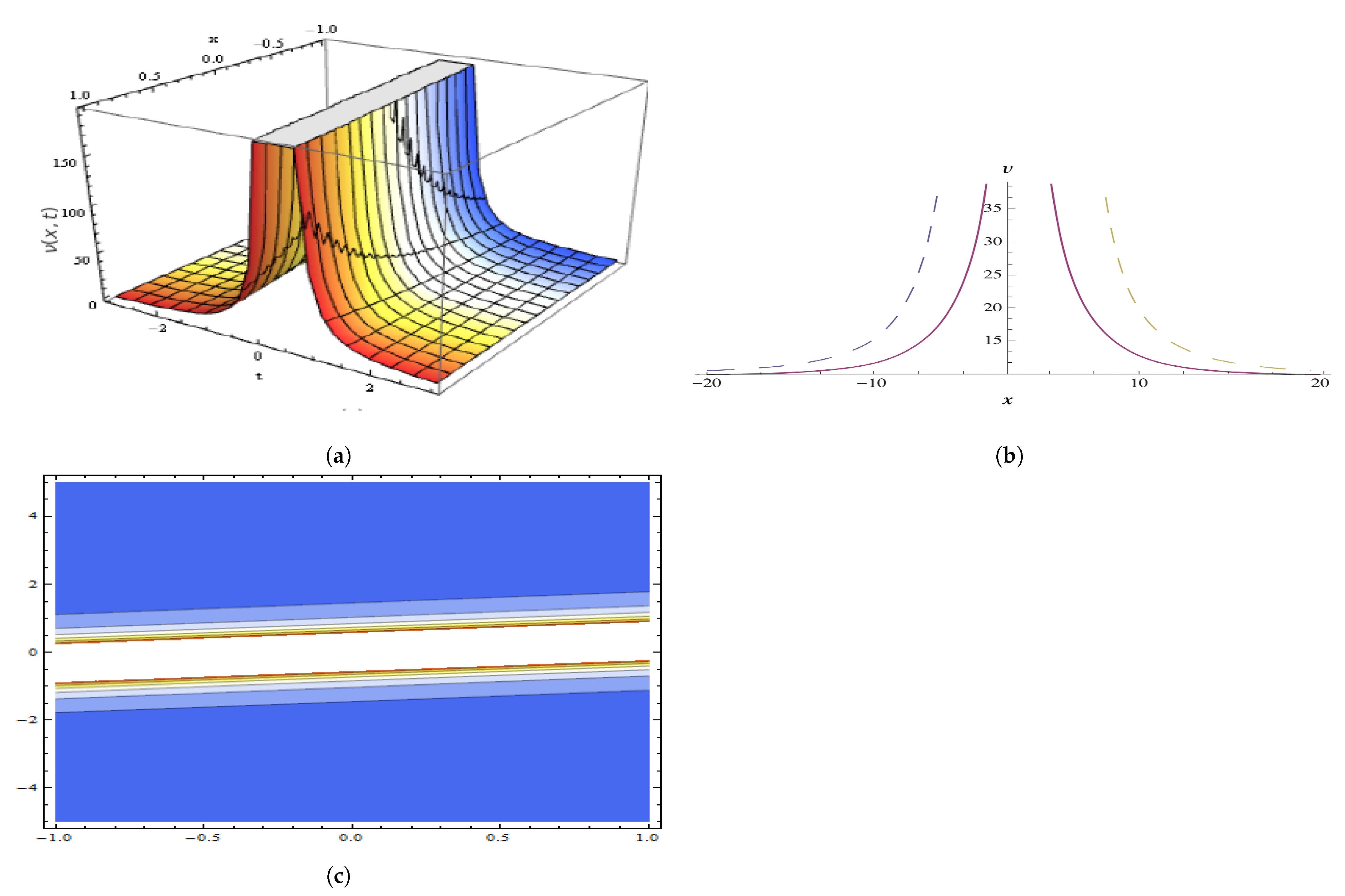
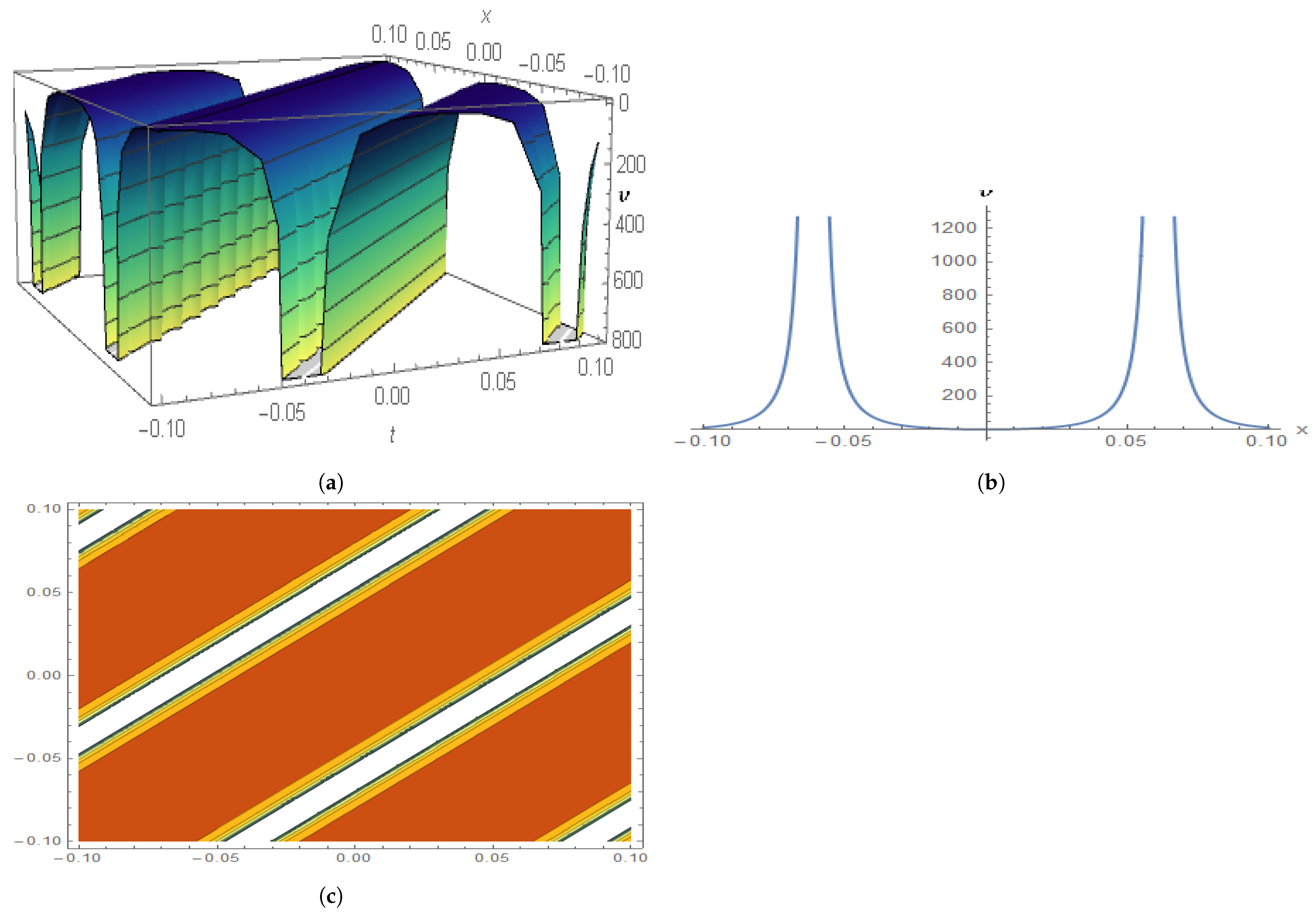
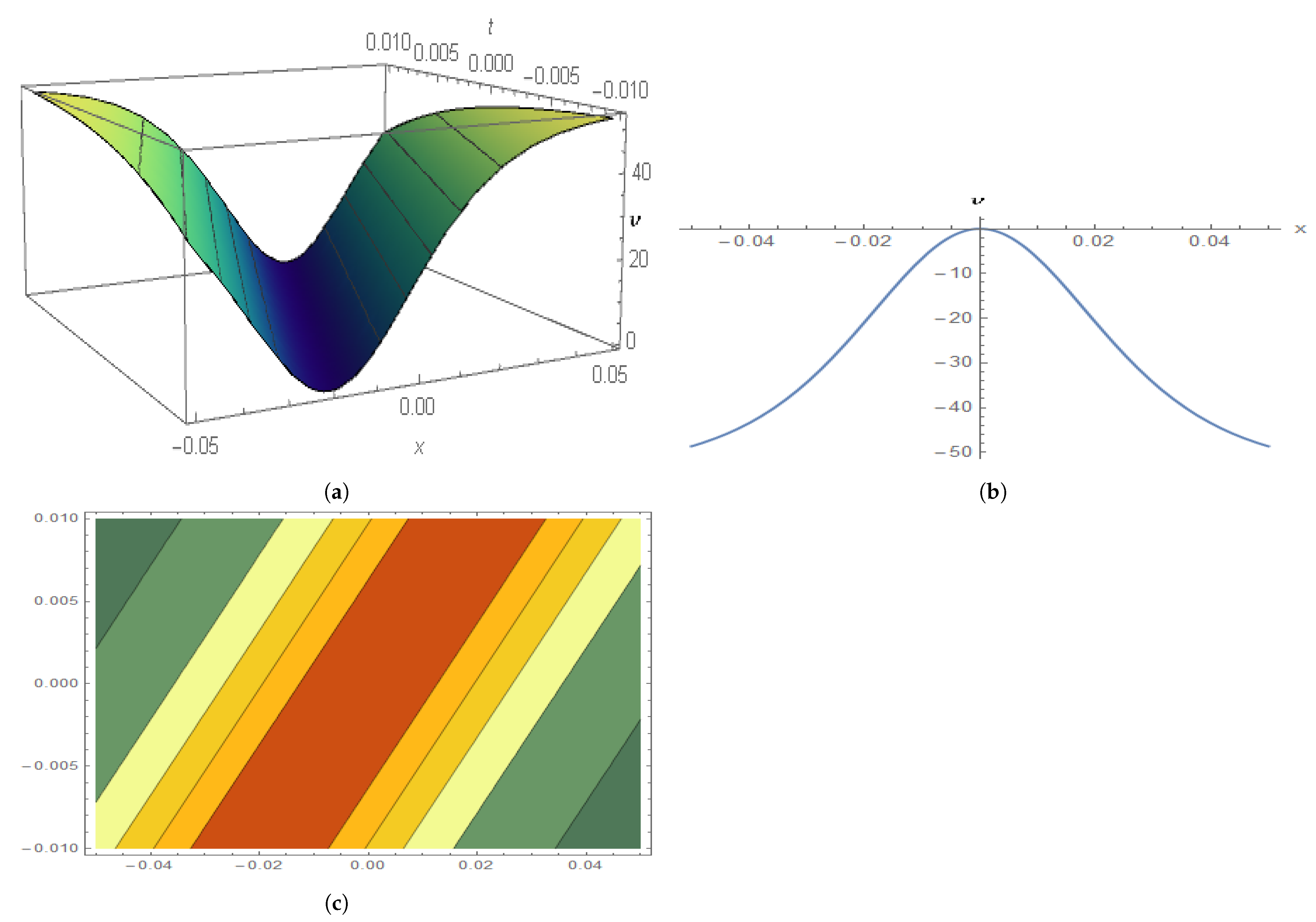
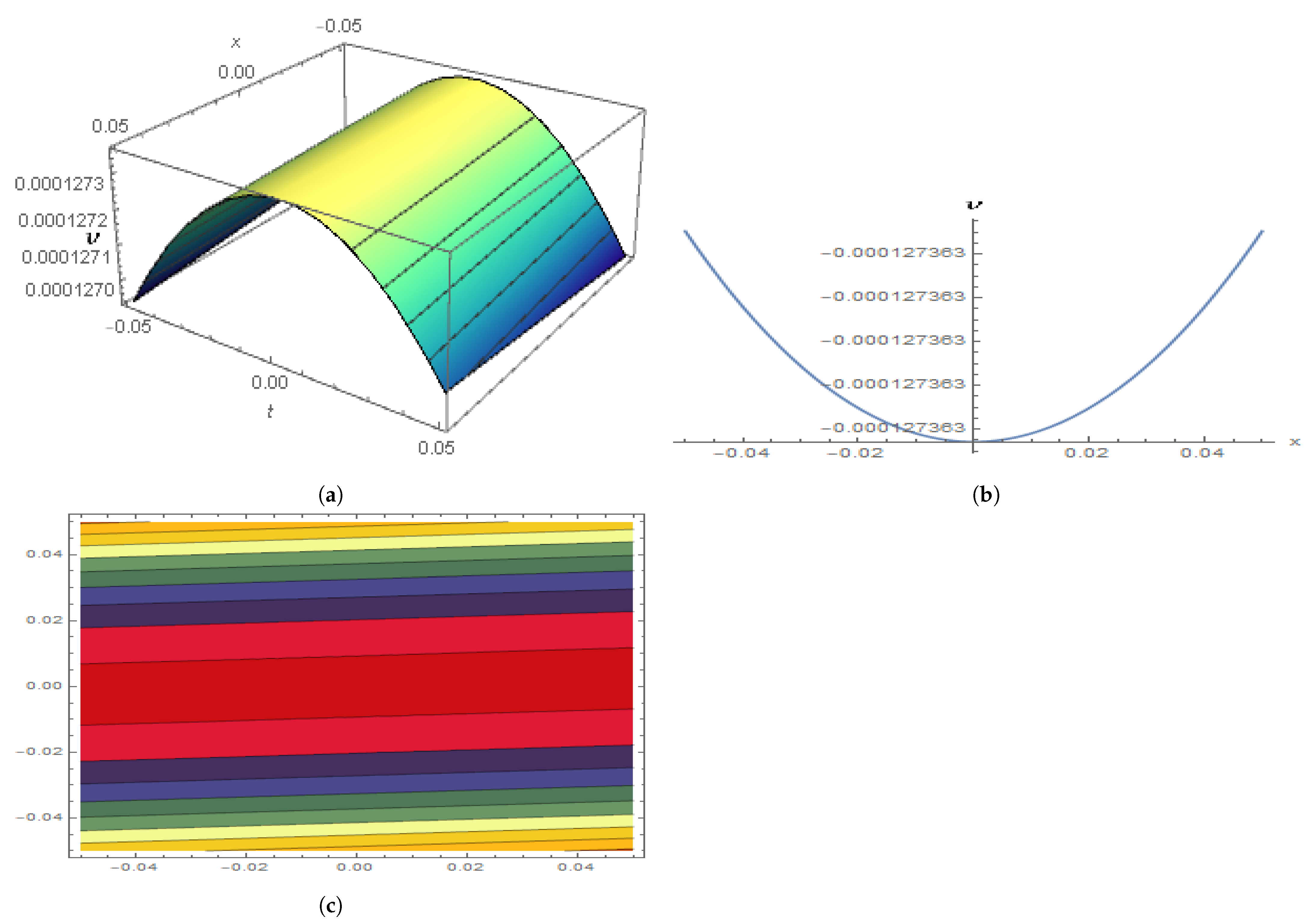
Figure 1 illustrates the geometry of a localized bell-shaped soliton. In Figure 1a, a three-dimensional surface is shown with smooth, symmetric humps that propagate along the spatial axis without changing shape, indicating a stable traveling solitary wave. The 2D profile in Figure 1b displays a sharp, single peak with rapid decay on both sides, representing a compact localized structure. The contour map in Figure 1c depicts parallel diagonal bands corresponding to constant-amplitude regions, confirming the steady translation of the bell soliton through the medium. Physically, this solution describes a localized pulse that maintains its shape and speed, characteristic of a stable solitary wave. In contrast, Figure 2 represents a periodic wave pattern. The 3D plot in Figure 2a exhibits repeating wave ridges that form a regular train of oscillations, while the 2D curve in Figure 2b shows evenly spaced crests and troughs, indicating smooth periodic motion. The contour map in Figure 2c highlights alternating colored bands that extend diagonally, confirming the periodic propagation of the wave. Physically, this pattern represents a continuous train of oscillations, where the wave energy is periodically distributed and travels uniformly through the medium. Figure 3 illustrates the geometry of a rational-type solution. Figure 3a shows a 3D surface characterized by a sharp, localized spike that rapidly decays in all directions, indicating a singular structure with steep gradients near its center. The ridge line remains fixed along a narrow path, representing a rational solitary profile with intense amplitude concentration. Figure 3b depicts a 2D curve that diverges sharply around the origin, confirming the singular nature of the solution with rapid amplitude variation. Figure 3c displays a contour plot where narrow, closely packed bands highlight regions of high intensity surrounded by broad low-amplitude zones. Physically, this solution represents a rational solitary wave exhibiting strong localization and steep decay, often associated with sharply peaked disturbances or singular pulses in nonlinear dispersive media. Figure 4 illustrates the geometry of the Weierstrass-elliptic function solution. Figure 4a shows a 3D surface with steep, wall-like ridges and smooth descending slopes on both sides, representing a localized periodic structure that exhibits sharp variations near its peak. The surface profile indicates the coexistence of localized and periodic features typical of elliptic solutions. Figure 4b presents a 2D view of the solution with symmetric peaks and troughs around the center, confirming the strong amplitude modulation and localized oscillations. Figure 4c displays a contour map characterized by alternating color bands arranged diagonally, depicting a quasi-periodic propagation pattern along the spatial axis. Physically, this Weierstrass-elliptic solution represents a periodic–localized wave that bridges solitary and periodic behaviors, showing both confinement and regular modulation in nonlinear dispersive media.
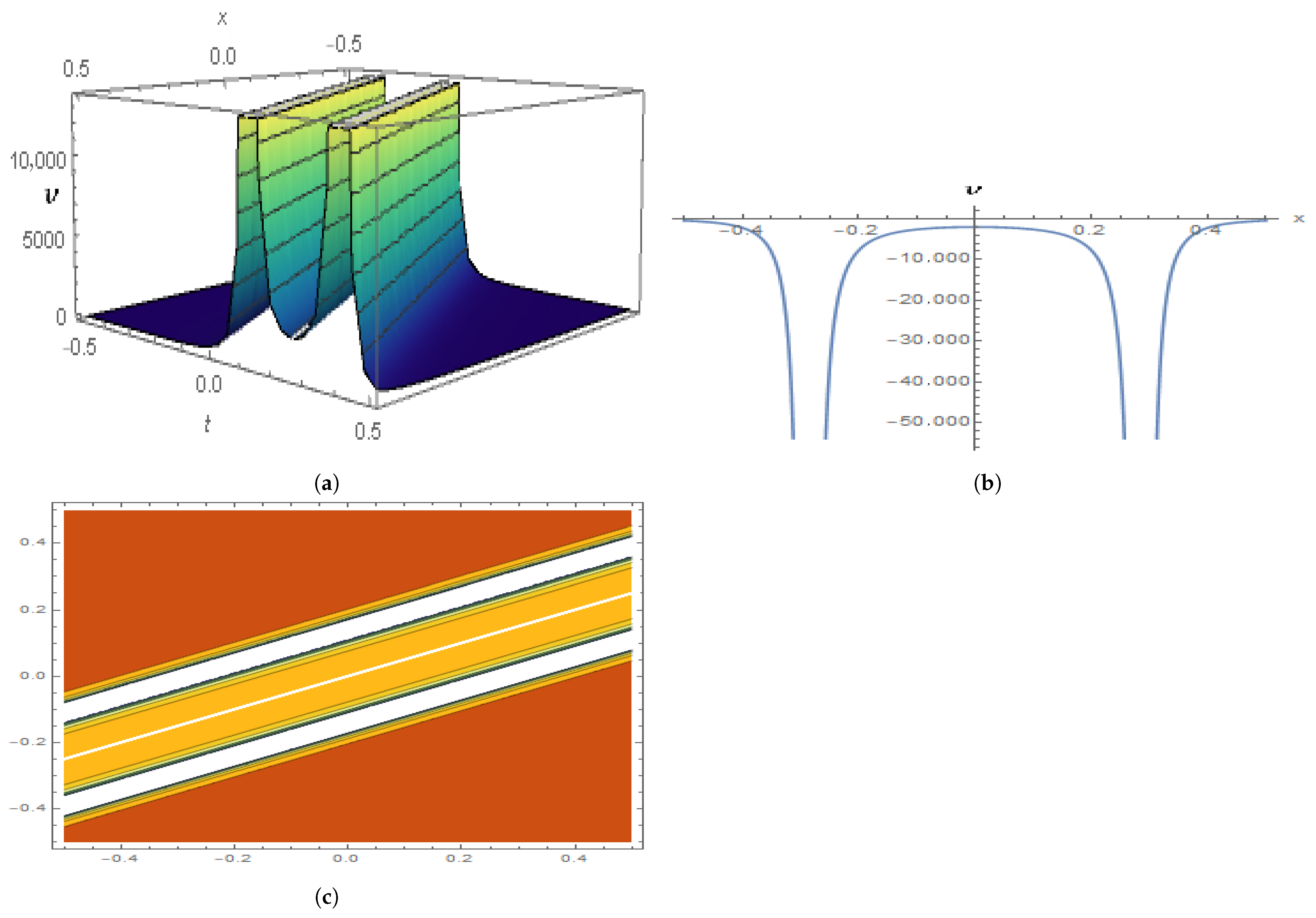
Figure 5 illustrates the geometry of the positive solitary wave solution. Figure 5a shows a 3D surface with smoothly elevated wave peaks that move along the spatial axis, representing a localized traveling pulse that maintains its shape over time. The ridges are uniform and evenly spaced, reflecting the stable propagation of the solitary structure. Figure 5b presents a 2D profile exhibiting a symmetric, bell-like curve with a single maximum, showing smooth decay on both sides. Figure 5c displays a contour map with diagonal, regularly spaced bands that indicate uniform propagation of the wave fronts. Physically, this solution corresponds to a positive solitary wave, where the amplitude remains constant during motion, signifying a self-sustaining traveling pulse typical in nonlinear dispersive systems. Figure 6 illustrates the geometry of the positive hyperbolic solution. Figure 6a presents a 3D surface displaying two pronounced humps that propagate steadily along the spatial axis, depicting a pair of localized solitary waves with smooth and symmetric peaks. The regular spacing between these waves indicates stable and coherent propagation. Figure 6b shows a 2D plot with two identical bell-shaped profiles separated by a fixed distance, confirming the periodic recurrence of the localized structures. Figure 6c displays a contour map with alternating diagonal color bands, representing the uniform and directional movement of the wave fronts. Physically, this solution corresponds to a pair of bright-type solitons exhibiting elastic propagation and a stable amplitude, typical of hyperbolic soliton interactions in nonlinear media. Figure 7 illustrates the geometry of the Jacobi-elliptic function solution. Figure 7 corresponds to the Jacobi–elliptic solution in the limit , yielding a trigonometric–periodic wave. The 3D view in Figure 7a shows a regular wavetrain of gentle, equally spaced ripples that propagate without distortion, forming a smooth, corrugated surface. The 2D slice in Figure 7b appears as a near-sinusoidal curve with uniform crests and troughs and no localization, indicating purely periodic behavior. The contour map in Figure 7c consists of parallel, evenly spaced diagonal bands that trace constant-phase lines and confirm the steady, uniform translation of the pattern. Physically, this regime represents the small-modulation limit of the elliptic family, where the solution behaves like a classical periodic wave with energy distributed evenly across repeating cycles. Figure 8 depicts the Jacobi-elliptic solution in the limiting case , which reduces to a hyperbolic-type solitary wave. The 3D view in Figure 8a shows a single, smooth ridge that translates without distortion, indicating a shape-preserving localized pulse. The 2D slice in Figure 8b exhibits a symmetric, narrowly confined profile with rapid decay away from the center, highlighting strong localization. The contour plot in Figure 8c presents evenly spaced diagonal bands that track constant-phase lines, confirming steady, uniform propagation. Physically, this limit connects the periodic elliptic family to an isolated solitary waveform, expressing coherent energy transport with a stable amplitude and geometry. Figure 9 represents the Jacobi-elliptic function solution in the limiting case , which transitions into a kink-type hyperbolic structure. The 3D view in Figure 9a shows alternating high and low ridges forming steep wave fronts, highlighting a strong nonlinear transition zone typical of kink or anti-kink waves. The 2D plot in Figure 9b displays sharp symmetric peaks, emphasizing the steep gradient and localized energy concentration of the solution. The contour map in Figure 9c presents narrow, slanted stripes representing regions of abrupt change, confirming the directional propagation of intense wave fronts. Physically, this limit describes a nonlinear kink soliton that connects two asymptotic states, maintaining sharp transitions and robust stability during propagation in nonlinear dispersive media.
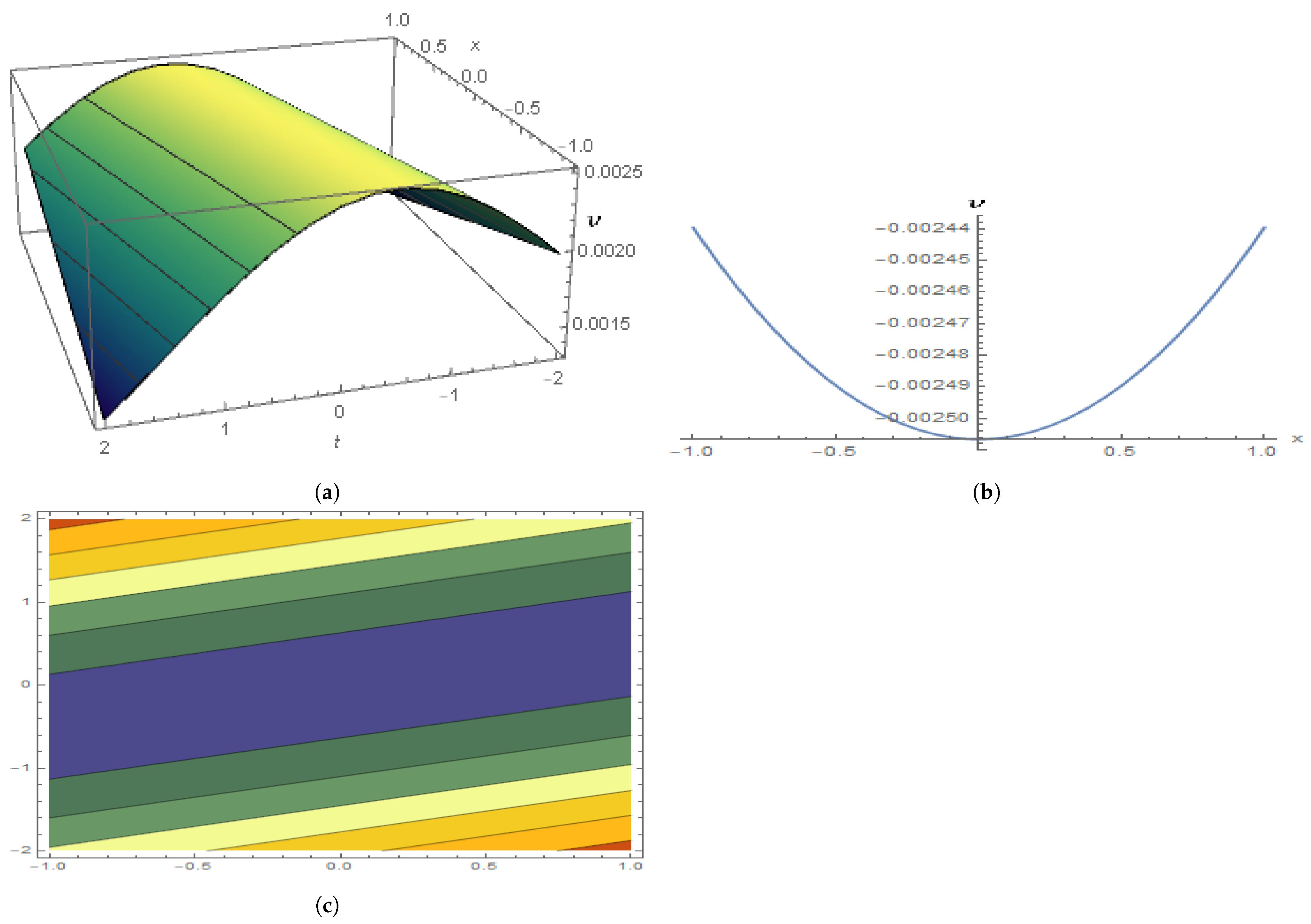
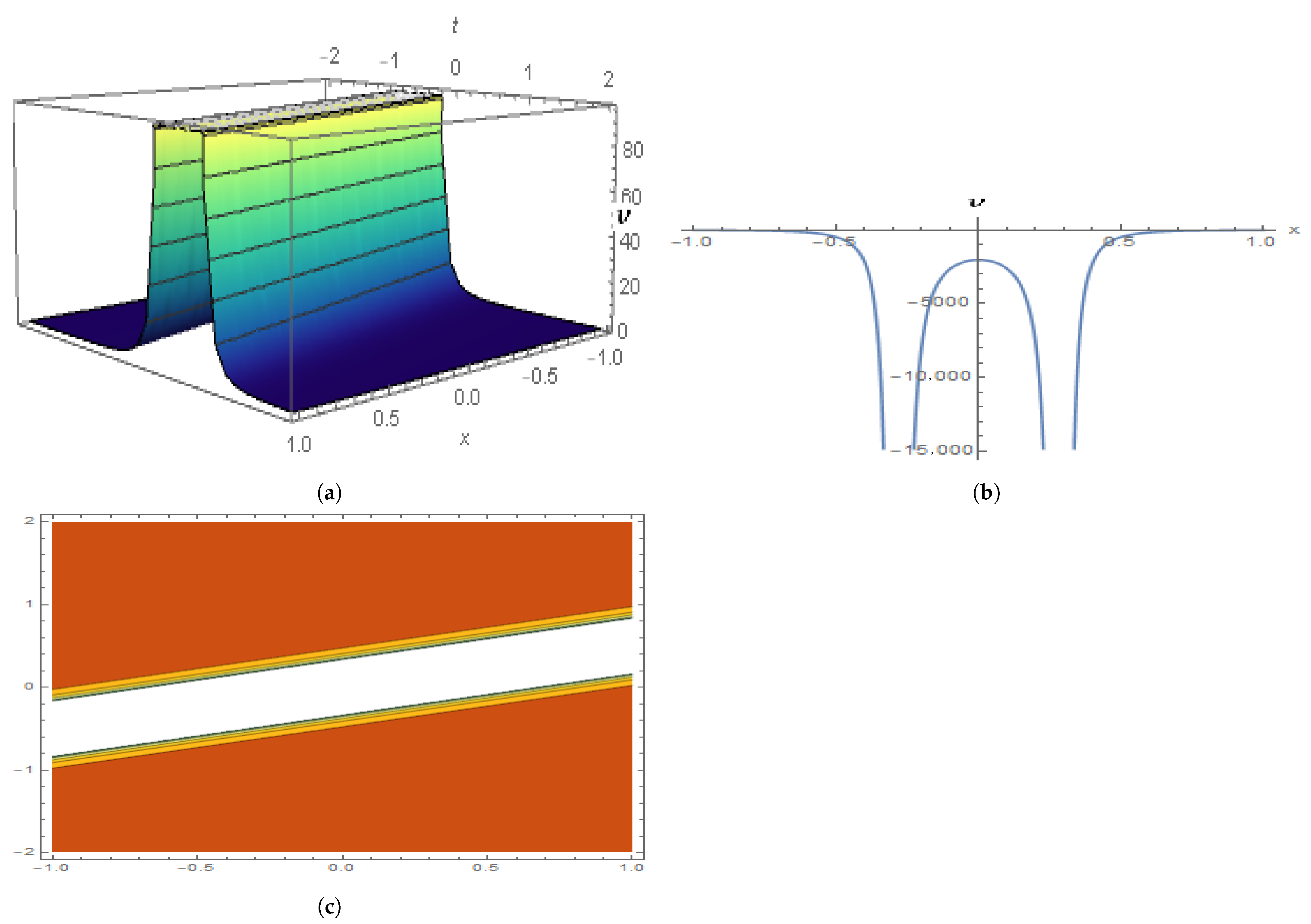
Figure 10 depicts a dark-soliton geometry. In Figure 10a, a valley-shaped depression travels steadily without changing form. The 2D slice in Figure 10b shows a smooth central dip with symmetric recovery on both sides. The contour map in Figure 10c displays parallel diagonal bands with a darker moving stripe, indicating a stable intensity drop propagating through the medium. Figure 11 illustrates the geometry of the hyperbolic function solution. Figure 11a shows a 3D surface with a single broad elevation that gently curves across the plane, representing a smooth, non-localized hyperbolic wave pattern. Figure 11b displays a 2D plot with a shallow symmetric curve, indicating mild amplitude variation and stability across space. Figure 11c presents a contour plot of parallel, color-shaded bands that depict uniform wave propagation along the spatial–temporal direction. Physically, this solution corresponds to a weakly nonlinear hyperbolic wave exhibiting gradual transitions and smooth propagation without steep gradients. Figure 12 illustrates the geometry of the hyperbolic csch-type solution. Figure 12a shows a 3D surface with sharp vertical ridges and steep transitions, representing a highly localized structure with rapid amplitude variation. Figure 12b presents a 2D profile exhibiting narrow, symmetric dips, indicating strong localization around the wave center. Figure 12c displays a contour map with distinct diagonal layers and a bright central region corresponding to the peak intensity. Physically, this solution represents a singular-type hyperbolic wave exhibiting steep gradients and strong confinement, characteristic of sharply localized nonlinear excitations. Figure 13 illustrates the geometry of the periodic sec-type solution. Figure 13a shows a smooth 3D surface with a gentle, repetitive curvature, reflecting the periodic oscillations of the wave along both the space and time directions. Figure 13b presents a 2D view depicting a symmetric and continuous curve, representing a periodic modulation with minimal amplitude variation. Figure 13c displays a contour map of evenly spaced horizontal color bands, signifying a uniform periodicity and a consistent phase distribution. Physically, this solution corresponds to a periodic wave pattern with a small amplitude and stable propagation, characterizing harmonic oscillations in a weakly nonlinear medium. Figure 14 illustrates the geometry of the periodic csc-type solution. Figure 14a shows a 3D surface characterized by steep vertical peaks and deep troughs, representing a periodic singular wave pattern with strong amplitude fluctuations. Figure 14b presents a 2D view with sharply localized dips, highlighting the singular nature of the oscillations. Figure 14c displays a contour plot composed of alternating diagonal color bands, indicating repeating high- and low-intensity regions along the propagation direction. Physically, this solution corresponds to a periodic singular wave that exhibits strong localization and discontinuous transitions typical of nonlinear periodic structures.
4. Conclusions
Solitons are stable, non-dispersive waveforms that preserve their shape and speed, making them valuable across physics, mathematics, and engineering (e.g., fluid dynamics, optical fibers, and telecommunications). In this work, we applied a sub-ODE construction to the DGH equation and derived a broad catalog of exact traveling-wave solutions, including bright and dark solitary waves, Jacobi- and Weierstrass-elliptic waves, and periodic, rational, and hyperbolic profiles. These families provide a more detailed mathematical picture of nonlinear dispersive dynamics, including regimes influenced by higher-order dispersion. To aid interpretation, we illustrated representative solutions with 3D surfaces, 2D profiles, and contour maps (generated in Mathematica). The results expand the set of closed-form DGH waveforms and offer a unified route for reproducing them. Future work: A linearized spectral and modulational stability study of the elliptic and solitary wave solutions will be pursued as future work. This future investigation will help clarify the parameter regimes under which these analytical solutions remain dynamically stable and physically realizable.
Author Contributions
N.: writing—original draft, visualization, and investigation; A.R.S.: software, methodology, and validation; S.T.R.R.: resources, project administration, and writing—review and editing; I.A.: conceptualization and data curation. All authors have read and agreed to the published version of the manuscript.
Funding
This work was supported and funded by the Deanship of Scientific Research at Imam Mohammad Ibn Saud Islamic University (IMSIU) (grant number IMSIU-DDRSP2502).
Data Availability Statement
The original contributions presented in this study are included in the article. Further inquiries can be directed to the corresponding author.
Conflicts of Interest
The authors declare no conflicts of interest.
Appendix A. Derivation of Equation (8)
References
- Helal, M.A.; Seadawy, A.R. Benjamin-Feir-instability in nonlinear dispersive waves. Comput. Math. Appl. 2012, 64, 3557–3568. [Google Scholar] [CrossRef]
- Seadawy, A.R. Exact Solutions of a two-dimensional nonlinear Schrödinger equation. Appl. Math. Lett. 2012, 25, 687–691. [Google Scholar] [CrossRef]
- Inc, M.; Aliyu, A.I.; Yusuf, A. Dark-bright optical solitary waves and modulation instability analysis with (2 + 1)-dimensional cubic-quintic nonlinear Schrödinger equation. Waves Random Complex Media 2019, 29, 393–402. [Google Scholar] [CrossRef]
- Inc, M.; Aliyu, A.I.; Yusuf, A.; Bayram, M.; Baleanu, D. Optical solitons to the (n + 1)-dimensional nonlinear Schrödinger equation with Kerr law and power law nonlinearities using two integration schemes. Mod. Phys. Lett. B 2019, 33, 1950224. [Google Scholar] [CrossRef]
- Abdelwahed, H.G.; Abdelrahman, M.A.; Inc, M.; Sabry, R. New soliton applications in Earth’s magnetotail plasma at critical densities. Front. Phys. 2020, 8, 181. [Google Scholar] [CrossRef]
- Korpinar, Z.; Inc, M.; Bayram, M. Some new exact solutions for derivative nonlinear Schrodinger equation with the quintic non-Kerr nonlinearity. Mod. Phys. Lett. B 2020, 34, 2050079. [Google Scholar] [CrossRef]
- Aliyu, A.I.; Inc, M.; Yusuf, A.; Baleanu, D.; Bayram, M. Dark-bright optical soliton and conserved vectors to the Biswas-Arshed equation with third-order dispersions in the absence of self-phase modulation. Front. Phys. 2019, 7, 28. [Google Scholar] [CrossRef]
- Naqvi, S.K.; Aldawish, I.; Rizvi, S.T.R.; Seadawy, A.R. Bilinear neural network solutions for nonlinear waves in the Sawada–Kotera model studied in heat transfer. Eur. Phys. J. Plus 2025, 140, 835. [Google Scholar] [CrossRef]
- Iqbal, M.; Seadawy, A.R.; Lu, D. Dispersive solitary wave solutions of nonlinear further modified Kortewege-de Vries dynamical equation in a unmagnetized dusty plasma via mathematical methods. Mod. Phys. Lett. A 2018, 33, 1850217. [Google Scholar] [CrossRef]
- Lu, D.; Seadawy, A.R.; Iqbal, M. Construction of new solitary wave solutions of generalized Zakharov-Kuznetsov-Benjamin-Bona-Mahony and simplified modified form of Camassa-Holm equations. Open Phys. 2018, 16, 896–909. [Google Scholar] [CrossRef]
- Seadawy, A.R.; Iqbal, M.; Lu, D. Construction of soliton solutions of the modify unstable nonlinear Schrodinger dynamical equation in fiber optics. Indian J. Phys. 2020, 94, 823–832. [Google Scholar] [CrossRef]
- Wazwaz, A.M. A two mode burgers equation of weak shock waves in a fluid multiple kink solutions and other exact solutions. Int. J. Appl. Comput. Math. 2017, 3, 3977–3985. [Google Scholar] [CrossRef]
- Hahne, F.M.; Thibes, R. Compact kinks in a modified Christ–Lee model. J. High Energy Phys. 2025, 2025, 58. [Google Scholar] [CrossRef]
- Bazeia, D.; Lobão, A.S.; Simas, F.C. Kinks in generalized scalar field models and their scattering properties. Phys. Lett. A 2025, 551, 130619. [Google Scholar] [CrossRef]
- Qiao, C.; Long, X.; Yang, L.; Zhu, Y.; Cai, W. Calculation of a dynamical substitute for the real Earth–Moon system based on Hamiltonian analysis. Astrophys. J. 2025, 991, 46. [Google Scholar] [CrossRef]
- Shi, J.; Liu, C.; Liu, J. Hypergraph-based model for modeling multi-agent Q-learning dynamics in public goods games. IEEE Trans. Netw. Sci. Eng. 2024, 11, 6169–6179. [Google Scholar] [CrossRef]
- Wang, A.; Cheng, C.; Wang, L. On r-invertible matrices over antirings. Publ. Math. Debr. 2025, 106, 445–459. [Google Scholar] [CrossRef]
- Hu, B.; Liao, Y. Convergence conditions for extreme solutions of an impulsive differential system. AIMS Math. 2025, 10, 10591–10604. [Google Scholar] [CrossRef]
- Tran, M.Q. Ion acoustic solitons in a plasma: A review of their experimental properties and related theories. Phys. Scr. 1979, 20, 317–327. [Google Scholar] [CrossRef]
- Lonngren, K.E. Ion acoustic soliton experiments in a plasma. Opt. Quantum Electron. 1998, 30, 615–630. [Google Scholar] [CrossRef]
- Demiray, A. Travelling wave solutions to the Korteweg-De-Vrie-Burger equation. Appl. Math. Commput. 2004, 154, 665–670. [Google Scholar]
- Christov, O.; Hakkaev, S. On the inverse scattering approach and action-angle variables for the Dullin-Gottwald-Holm equation. Mod. Phys. D Nonlinear Phenom. 2009, 238, 9–19. [Google Scholar] [CrossRef]
- Naz, R.; Naeem, I.; Abelman, S. Conservation laws for Camassa-Holm equation, Dullin-Gottwald-Holm equation and generalized Dullin-Gottward-Holm equation. Nonlinear Anal. Real World Appl. 2009, 10, 3466–3471. [Google Scholar] [CrossRef]
- Can, X.G.; Quang, X.D.; Qiang, L.X. Application of exp-function to Dullin-Gottwald-Holm equation. Appl. Math.Comput. 2009, 210, 536–541. [Google Scholar]
- Cheng, W.; Xu, T. Blow-up of solutions to a modified two-component Dullin–Gottwald–Holm system. Appl. Math. Lett. 2020, 105, 106307. [Google Scholar] [CrossRef]
- Tian, L.; Gui, G.; Liu, Y. On the Well-posedness problem and the scattering problem for Dullin-Gottwald-Holm equation. Commun. Math. Phy. 2005, 257, 667–701. [Google Scholar] [CrossRef]
- Biswas, A.; Kara, A.H. 1-Soliton solution and conservation laws of generalized Dullin-Gottwald-Holm equation. Appl. Math. Commput. 2010, 217, 929–932. [Google Scholar]
- Zhou, J.; Tian, L.; Zhang, W.; Kumar, S. Peakon-antipeakon interaction in the Dullin-Gottwald-Holm equation. Phys. Lett. A 2013, 377, 1233–1238. [Google Scholar] [CrossRef]
- Liu, X.X.; Yin, Z.Y. Orbital Stability of the sum of N peakons for the Dullin-Gottwald-Holm equation. Nonlinear Anal. Real World Appl. 2012, 13, 2414–2422. [Google Scholar] [CrossRef]
- Cheng, W.; Li, B. Local-in-space blow-up of a weakly dissipative generalized Dullin–Gottwald–Holm equation. Appl. Math. Lett. 2025, 163, 109445. [Google Scholar] [CrossRef]
- Mustafa, O.G. Existence and uniqueness of low regularity solutions for the Dullin–Gottwald–Holm equation. Commun. Math. Phys. 2006, 265, 189–200. [Google Scholar] [CrossRef]
- Zhang, S.; Yin, Z. Global weak solutions for the Dullin–Gottwald–Holm equation. Nonlinear Anal. 2010, 72, 1690–1700. [Google Scholar] [CrossRef]
- Zayed, E.M.E.; Alngar, M.E.M.; Biswas, A.; Triki, H.; Yidlrim, Y.; Alshomrani, A.S. Chirped and Chirp free optical solitons in fiber Bragg gratings with dispersive reflectivity having quadratic cubic nonlinearity by sub-ODE approach. Optik 2020, 203, 163993. [Google Scholar] [CrossRef]
Disclaimer/Publisher’s Note: The statements, opinions and data contained in all publications are solely those of the individual author(s) and contributor(s) and not of MDPI and/or the editor(s). MDPI and/or the editor(s) disclaim responsibility for any injury to people or property resulting from any ideas, methods, instructions or products referred to in the content. |
© 2025 by the authors. Licensee MDPI, Basel, Switzerland. This article is an open access article distributed under the terms and conditions of the Creative Commons Attribution (CC BY) license (https://creativecommons.org/licenses/by/4.0/).