1. Introduction
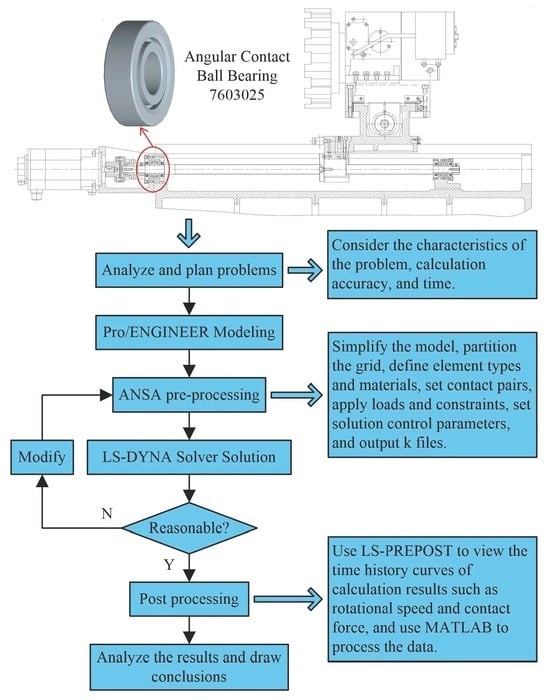
Angular contact ball bearings are crucial mechanical components supporting the lead screw in the feed system of CNC machine tools. The dynamic characteristics of internal components during the operation of the bearings have a significant impact on the accuracy and reliability of the entire machine. Especially under harsh working conditions, it is easy to cause faults such as cage breakage and bearing ring wear, thereby reducing the service life and operational performance of the bearings. Therefore, by analyzing the dynamic characteristics of bearing components to accurately understand the generation and variation mechanisms of unstable motions of the inner ring and cage of the bearing, it is of great engineering practical significance for improving the operational performance of the angular contact ball bearings.
Harris [
1] proposed the calculation method of quasi-dynamics after quasi-statics and established a pseudo-dynamics model of cylindrical roller bearings based on the theory of elastohydrodynamic lubrication, predicting the slipping of the bearings under the action of radial loads. Polanski et al. [
2] established a more comprehensive quasi-dynamic model of bearings considering the internal friction between rolling bearing elements. Kleckner et al. [
3] developed a quasi-dynamic analysis software for cylindrical roller bearings that can be used to analyze the deformation of rings, load variations, and the inclination and skewing of rollers, etc. Creju et al. [
4,
5] established a quasi-dynamic model of tapered roller bearings that can be used to analyze load distribution, cage slipping, and the sliding speed between rollers and rings, etc. Nelias et al. [
6] established a quasi-dynamic model of angular contact ball bearings considering the force between the cage and the rolling elements, analyzed its motion characteristics and operational performance under the combined radial and axial loads, and verified the correctness of the calculation results through experiments. Hagiu et al. [
7] established a quasi-dynamic vibration model under lubrication conditions considering internal elastic deformation and oil film squeezing effects. However, the quasi-dynamic analysis is limited to the dynamic characteristics of bearings under absolute steady-state conditions, and cannot clearly reveal the time-varying dynamic characteristics of the internal components of the rolling bearings.
In order to obtain more accurate dynamic characteristics of bearings, Walers [
8] first proposed the dynamic analysis method in early 1970 and established a dynamic model of rolling bearings based on the motion equations of the six-degree-of-freedom cage and the four-degree-of-freedom rolling elements. Kannel et al. [
9] developed an angular contact ball bearing analysis model based on elastohydrodynamic lubrication theory and analyzed the smoothness of cage plane motion under different lubrication conditions. Boesiger et al. [
10] simplified the degrees of freedom of bearing components and established a two-dimensional dynamic model for deep groove ball bearings, and studied the relationship between friction and the stability of the cage through simulation and experiments. Neglia et al. [
11] investigated the relationship between inertia force, impact force and the trajectory of the cage centroid. However, the above research has not yet deeply analyzed the effects of geometric parameters and operating conditions. Additionally, the above-mentioned model simplifies the contact behavior among the various components. Meeks [
12,
13] established the dynamic friction model of the bearing considering the six degrees of freedom of the cage, and wrote the calculation programs for the ball rollers, cage, and inner and outer rings under different load conditions. Moreover, a nonlinear contact bearing dynamic model was established, and the relationships between the inner ring speed, cage structure parameters, lubrication parameters and cage stability were analyzed. Choe et al. [
14,
15] analyzed the influence of pocket clearance and guiding clearance on the motion smoothness of the cage through experiments. In addition, some scholars have conducted relevant research on other factors that affect the motion stability of the cage. Ghaisas et al. [
16] studied the effects of cage asymmetry, raceway misalignment and roller size on the stability of the cage. Pederson et al. [
17] established a dynamic model of deep groove ball bearings based on the ANSYS flexible cage and analyzed the influences of circumferential stiffness, torsional stiffness and cage clearance on the motion stability of the cage. Cheng et al. [
18,
19,
20] proposed a candidate fault frequencies-based blind deconvolution, which can enhance the fault characteristics of rolling bearings. The motion stability of the inner ring and the cage has become the focus of the performance analysis of the rolling bearings.
With the development of electromechanical equipment such as CNC machine tools towards high speed and high precision, higher requirements have been put forward for the operational stability of angular contact ball bearings. The research on the dynamic characteristics of the inner ring and cage of angular contact ball bearings under typical complex variable working conditions such as variable speed and variable load has become a research hotspot. Lu [
21] established a vibration model of roll-slip bearings under cyclic load impact and studied the relationship between its amplitude and the rotational position of the inner ring, the transverse stiffness of the rollers, and the number of rollers. Jia et al. [
22] and Li et al. [
23], respectively, established dynamic models for cylindrical roller bearings during start-up and stoppage stages, and analyzed the influence of working condition parameters and structural parameters on their slip characteristics, and conducted experimental verification. Zhang et al. [
24] established a multi-rigid body dynamic model of the main shaft bearing of wind turbine units using ADAMS, and analyzed the internal contact forces under three working conditions: the start-up process, the sudden change in rotational speed, and the emergency stop process. Li et al. [
25] established a dynamic model of cylindrical roller bearings during the emergency stop process and used the angular velocity and collision force between the rollers and cage as boundary conditions of their finite element model to study the effects of inner ring angular acceleration, radial force, oil temperature, and radial clearance on cage stress. Ye [
26] established a dynamic model of high-speed rolling bearings in aircraft engines and investigated the stability variation laws of the cage under three working conditions: starting, acceleration and loading, but did not study its influencing factors. Yao et al. [
27] established a dynamic model of angular contact ball bearings considering the three-dimensional dynamic contact relationship inside the bearing, and studied the influence of clearance, friction and lubrication resistance on the stability of the cage under variable-speed, variable-load and preload conditions. Lioulios et al. [
28] considered the effect of radial clearance, contact force between the balls and rings, and flexible contact stiffness, and analyzed the dynamic characteristics of the periodic, unstable periodic, and chaotic response of rotor bearings using frequency spectrum method, phase space method, high-order Poincare diagram method, and Lyapunov exponent method.
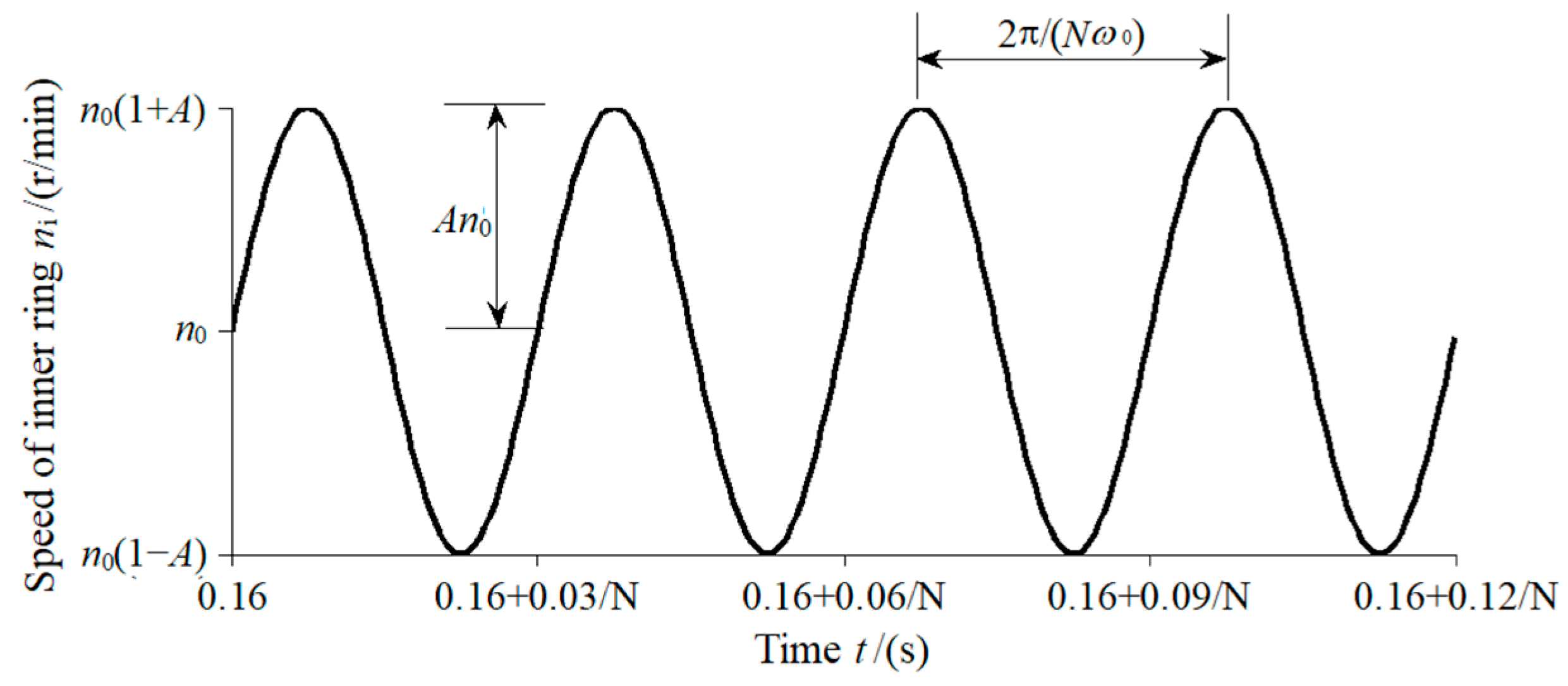
Currently, researchers have studied the dynamic characteristics of rolling bearings from various perspectives, particularly focusing on the motion stability of the inner ring and cage under different operating conditions. However, much of the existing research primarily focuses on steady-state operating conditions, and most analytical models overlook the nonlinear interactions among the components of rolling bearings. In reality, the dynamic interactions between the moving parts significantly influence the movement and performance of the inner ring and cage, especially under non-stationary working conditions. While some scholars have made notable advancements regarding the motion characteristics of rolling bearings under variable operating conditions—such as acceleration, deceleration, and impact loads—there is a lack of research on the impact of periodic variable speed working parameters on the motion stability of the inner ring and cage. Therefore, in this paper, a nonlinear dynamic model for a fully flexible angular contact ball bearing was established, comprehensively taking into account nonlinear factors such as elastic contact relationships, collisions between rolling elements and the cage, friction, and clearance. Based on this model, the dynamic characteristics of the inner ring and cage under sinusoidal rotational speed fluctuations were investigated. A comparative analysis was conducted regarding the rotational speed, centroid trajectory of the inner ring and cage, and the contact forces between single rolling element and the inner ring and cage under varying amplitudes and frequencies of rotational speed fluctuations. The aim is to uncover the intrinsic relationship between the instability of the inner ring and cage and the working conditions associated with rotational speed variations, thus providing theoretical references for the design optimization and failure analysis of angular contact ball bearings.
3. Model Validation
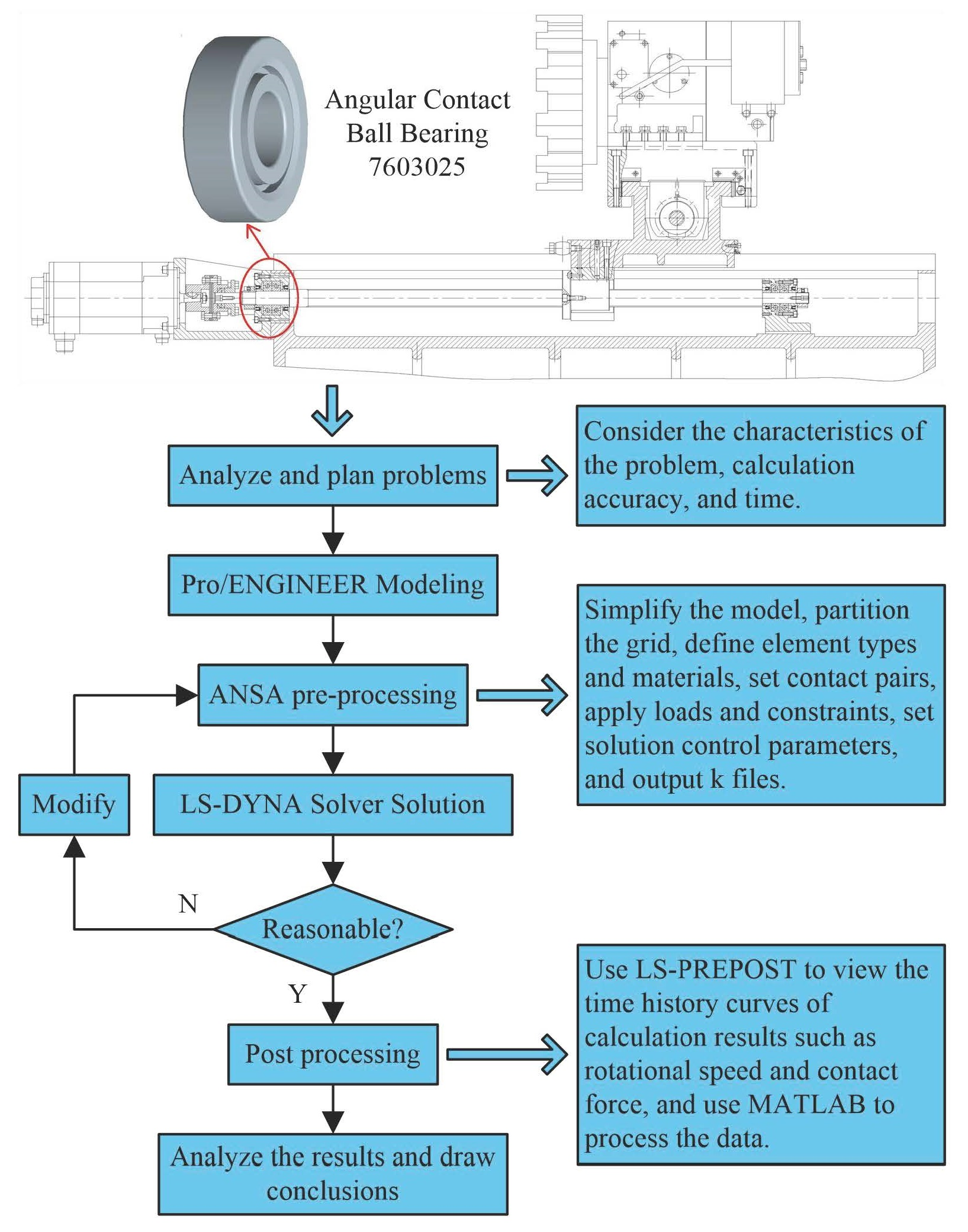
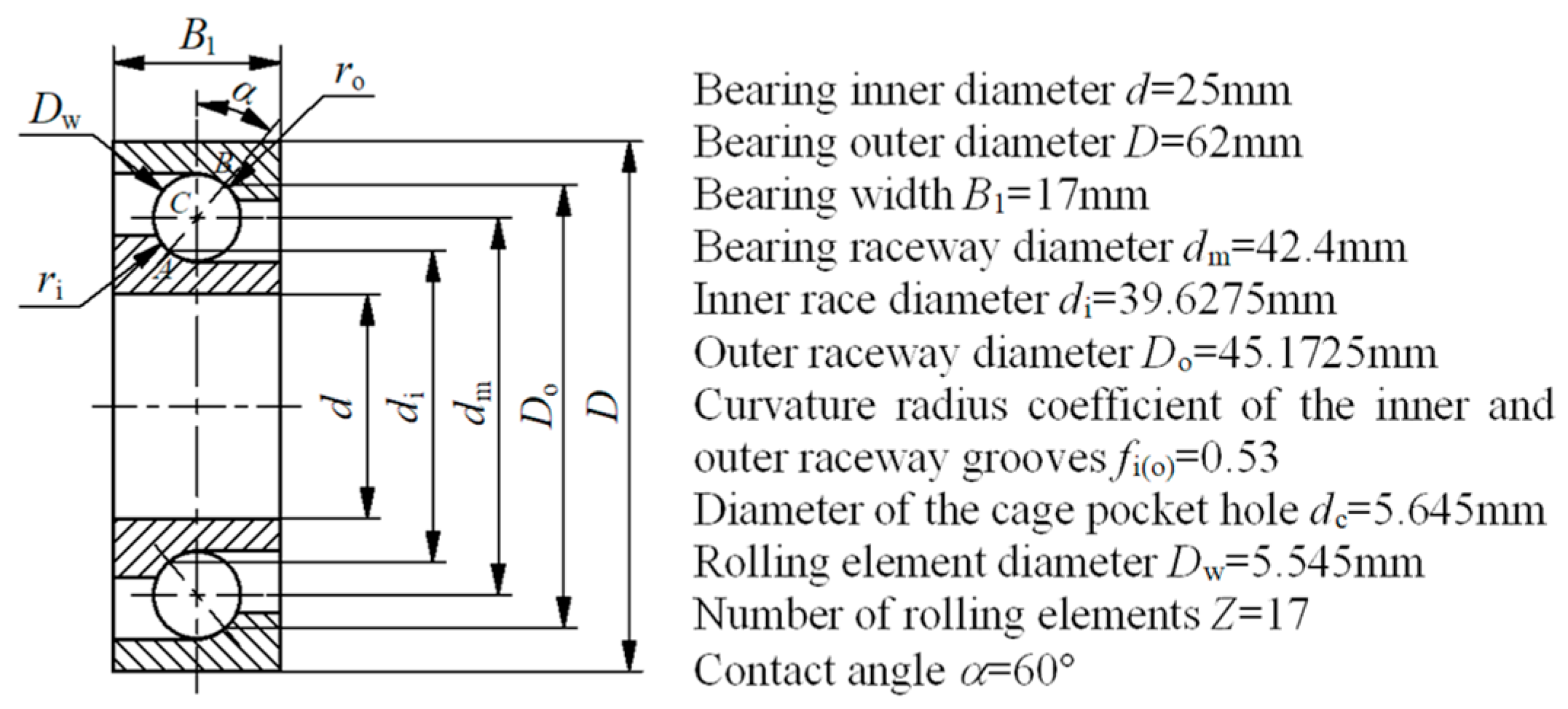
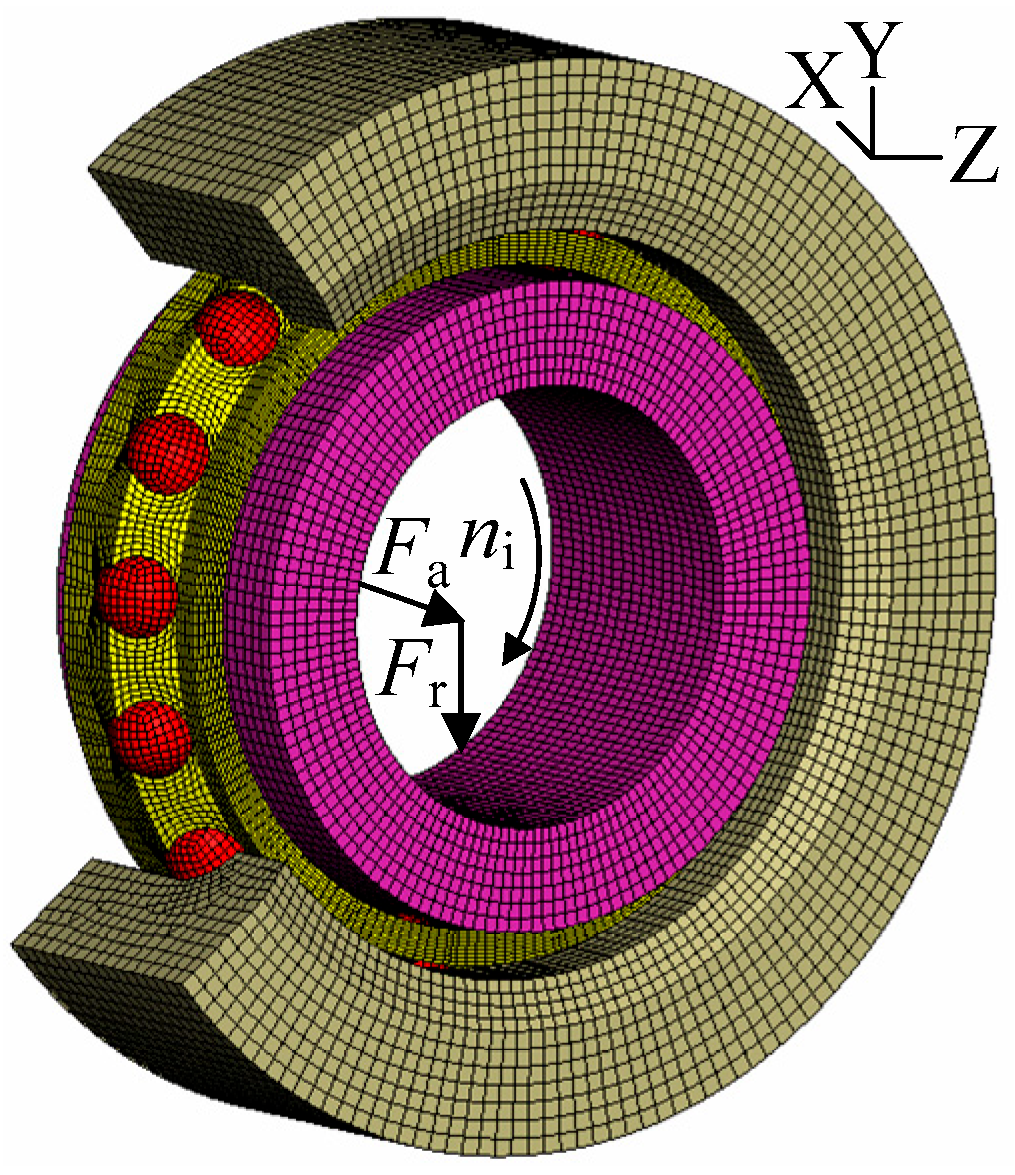
Rolling bearings typically operate with the outer ring stationary and the inner ring rotating. Consequently, an axial force of 3500 N, a radial force of 1200 N, and a constant rotational speed of 2000 r/min are applied to the inner ring. The analytical solutions for the kinematic parameters of the angular contact ball bearing 7603025 were derived from Equations (6)–(10). The full flexible body dynamic model analyzed the same operational conditions, extracting corresponding parameters from the calculation results for comparison with the analytical solutions.
The rotational speed of the cage is given by:
where
is the rotational speed of the inner ring.
The linear velocity at the contact point between the inner ring and the rolling elements is calculated as:
The linear velocity at the center of the rolling element is expressed as:
During one rotation of the inner ring, the number of rolling elements passing a specific point on the inner and outer rings can be calculated using:
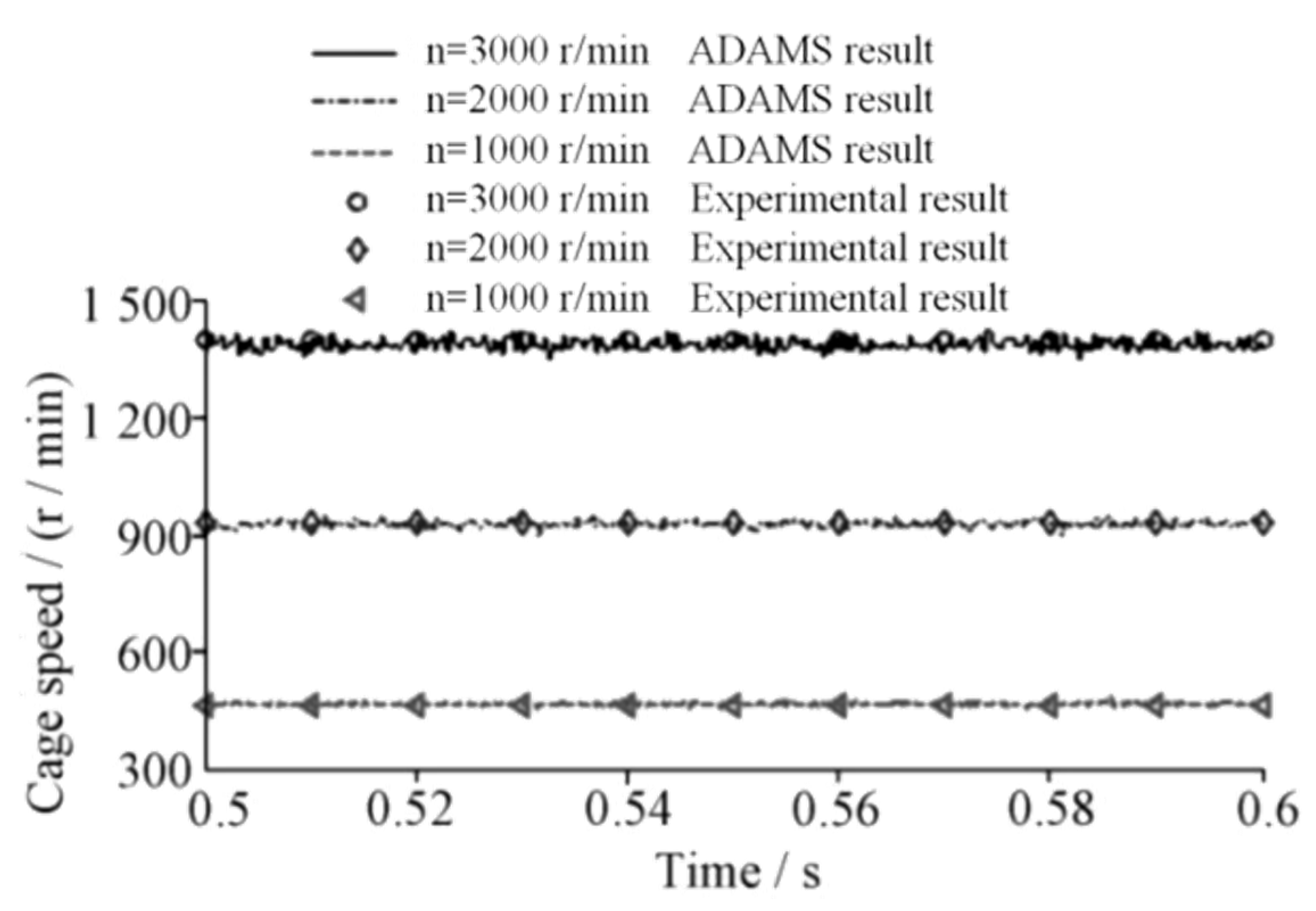
The ADAMS simulation results and experimental results for cage rotational speed are illustrated in
Figure 4.
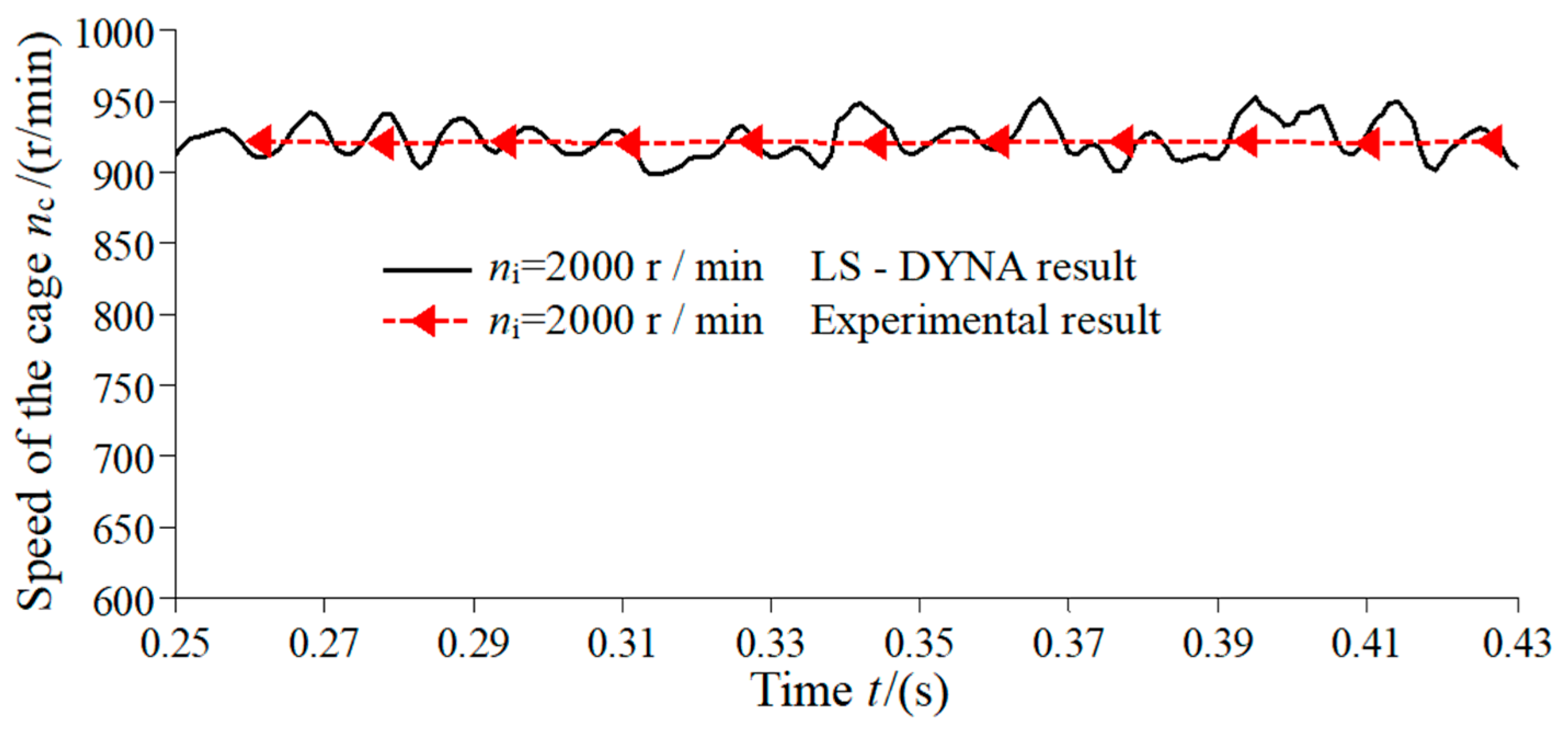
Figure 5 presents the LS-DYNA results compared to experimental results for the cage rotational speed, and
Table 5 provides a comparison of the LS-DYNA solutions with the analytical solutions.
As can be seen from
Figure 4 and
Figure 5, and
Table 5, relative errors between LS-DYNA solutions and analytical solutions of the kinematic parameters remain within 3%. The LS-DYNA results for the cage rotational speed are consistent with both the ADAMS result (928 r/min) and the experimental finding (927 r/min) [
29,
30]. This strong agreement confirms the accuracy of the full flexible body dynamic model of the angular contact ball bearing developed in this paper.