


Content and Enantiomeric Composition of 1-Octen-3-yl Acetate in Lavender Essential Oils

Abstract
1. Introduction
2. Materials and Methods
2.1. Chemicals and Standards
2.2. GC-MS Analysis of EOs
2.3. Chiral GC-MS Analysis of Selected EOs
3. Results
4. Discussion
4.1. GC-MS Qualitative Analysis
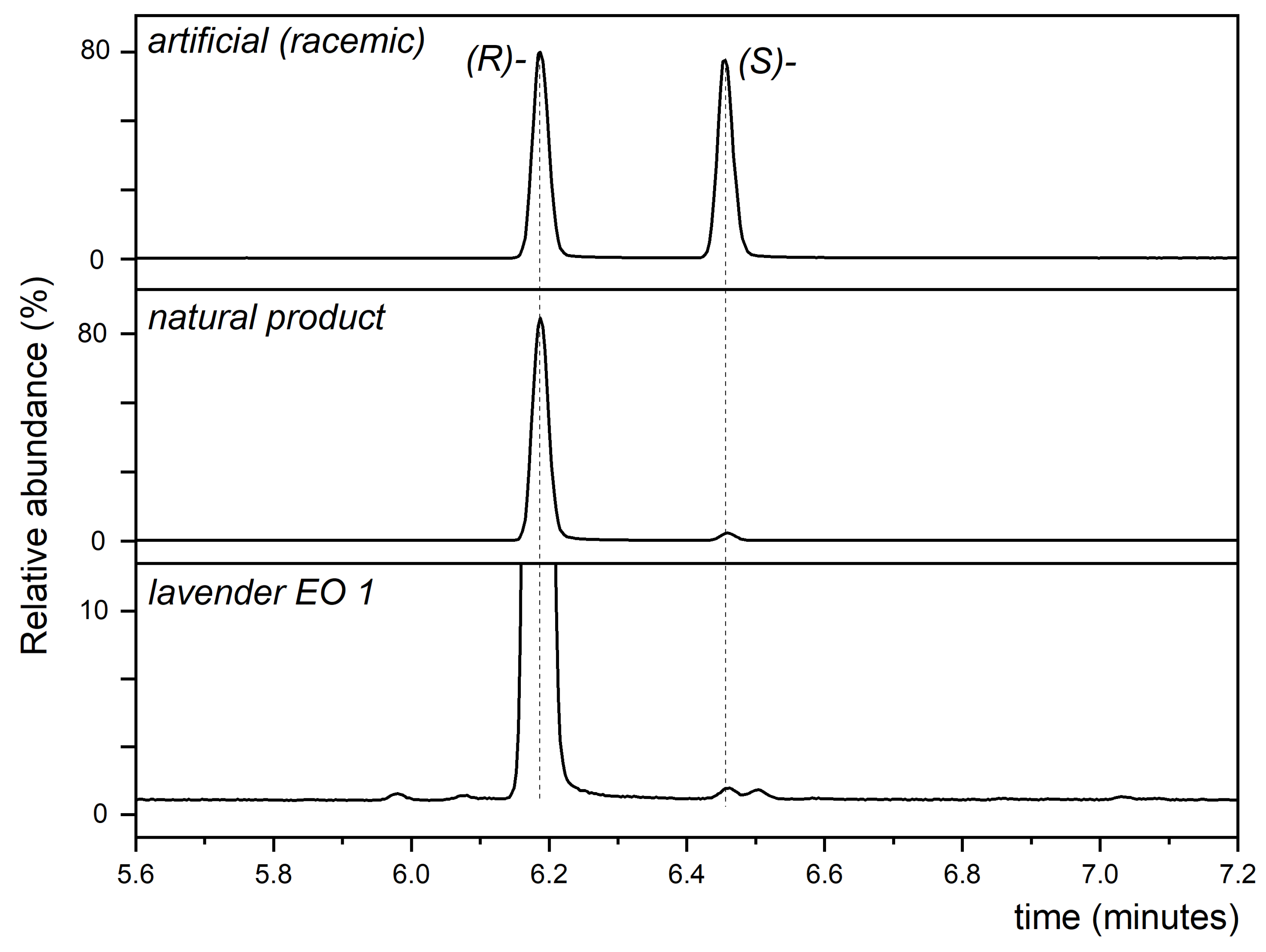
4.2. GC-MS Chiral Analysis
5. Conclusions
Author Contributions
Funding
Data Availability Statement
Conflicts of Interest
References
- Meenu, M. Antibacterial activity of essential oils from different parts of plants against. Food Chem. 2023, 404, 142–149. [Google Scholar] [CrossRef]
- Atanasova, T.; Gochev, V.; Nenov, N.; Djurkov, T.; Girova, T.; Merdzhanov, P.; Stoyanov, A. Lavender extract with tetraflouroethane—Chemical composition, antimicrobial activity and application in cosmetics. World Sci. 2016, 1, 10–15. [Google Scholar]
- Tomicic, Z.; Cabarkapa, I.; Saric, L.; Dzomba, M.; Tomicic, R. Germicidal efficancy of disinfectant based on sodium hypochlorite and essential oils. J. Food Nutr. Res. 2023, 62, 346–353. [Google Scholar]
- Capetti, F.; Marengo, A.; Cagliero, C.; Liberto, E.; Bicchi, C.; Rubiolo, P.; Sgorbini, B. Adulteration of Essential Oils: A Multitask Issue for Quality Control. Three Case Studies: Lavandula angustifolia Mill., Citrus limon (L.) Osbeck and Melaleuca alternifolia (Maiden & Betche) Cheel. Molecules 2021, 26, 5610. [Google Scholar] [CrossRef] [PubMed]
- Wilson, T.M.; Poulson, A.; Murphy, B.J.; Nebeker, B.; Cuchet, A.; Schiets, F.; Casabianca, H.; Carlson, R.E. Authentication of Lavandula angustifolia Mill. (Lamiaceae) essential oil using physical property, gas chromatography, enantiomeric selectivity, and stable isotope analyses. J. Essent. Oil Res. 2022, 35, 529–541. [Google Scholar] [CrossRef]
- Koulivand, P.H.; Khaleghi Ghadiri, M.; Gorji, A. Lavender and the nervous system. Evid.-Based Complement. Altern. Med. 2013, 2013, 681304. [Google Scholar] [CrossRef] [PubMed]
- Karimi, A.; Torsten, M. Antifungal activity of Zataria multiflora Boiss. essential oils and changes in volatile compound composition under abiotic stress conditions. Ind. Crop. Prod. 2021, 171, 113888. [Google Scholar] [CrossRef]
- Catella, C.; Camero, M.; Lucente, M.S.; Fracchiolla, G.; Sblano, S.; Tempesta, M.; Martella, V.; Buonavoglia, C.; Lanave, G. Virucidal and antiviral effects of Thymus vulgaris essential oil on feline coronavirus. Res. Vet. Sci. 2021, 137, 44–47. [Google Scholar] [CrossRef] [PubMed]
- Cavanagh, H.M.A.; Wilkinson, J.M. Biological activities of lavender essential oil. Phytother. Res. 2002, 16, 301–308. [Google Scholar] [CrossRef]
- Boelens, M.H.; Jimenez, R. Chemical composition of the essential oils from lavender and other linalool-rich plants. J. Chromatogr. A 2003, 1000, 325–356. [Google Scholar]
- Schipilliti, L.; Dugo, P.; Bonaccorsi, I.; Mondello, L. Authenticity control on lemon essential oils employing Gas Chromatography– Combustion-Isotope Ratio Mass Spectrometry (GC–C-IRMS). Food Chem. 2012, 131, 1523–1530. [Google Scholar] [CrossRef]
- Do, K.T.; Hadji-Minaglou, F.; Antoniotti, S.; Fernandez, X. Authenticity of essential oils. TrAC 2015, 66, 146–157. [Google Scholar] [CrossRef]
- Brenna, E.; Fuganti, C.; Serra, S. Enantioselective perception of chiral odorants. Tetrahedron Asymmetry 2003, 14, 1–42. [Google Scholar] [CrossRef]
- Aimila, A.; Aisa, H.A.; Maiwulanjiang, M. Study on Lavender Essential Oil Chemical Compositions by GC-MS and Improved pGC. Molecules 2020, 25, 3166. [Google Scholar] [CrossRef] [PubMed]
- Api, A.M.; Belmonte, F.; Belsito, D.; Biserta, S.; Botelho, D.; Bruze, M.; Burton, G.A., Jr.; Buschmann, J.; Cancellieri, M.A.; Dagli, M.L.; et al. RIFM fragrance ingredient safety assessment, 1-octen-3-yl acetate, CAS Registry Number 2442-10-6. Food Chem. Toxicol. 2019, 134, 110638. [Google Scholar] [CrossRef] [PubMed]
- Burdock, G.A. 1-octen-3-yl acetate. In Fenaroli’s Handbook of Flavor Ingredients; Burdock, G. Press: Boca Raton, FL, USA, 2005; p. 752. [Google Scholar]
- Beale, D.J.; Morrison, P.D.; Karpe, A.V.; Dunn, M.S. Chemometric Analysis of Lavender Essential Oils Using Targeted and Untargeted GC-MS Acquired Data for the Rapid Identification and Characterization of Oil Quality. Molecules 2017, 22, 1339. [Google Scholar] [CrossRef] [PubMed]
- Shellie, R.; Mondello, L.; Marriott, P.; Dugo, G. Characterisation of lavender essential oils by using gas chromatography–mass spectrometry with correlation of linear retention indices and comparison with comprehensive two-dimensional gas chromatography. J. Chromatogr. A 2002, 970, 225–234. [Google Scholar] [CrossRef] [PubMed]

| EO Sample | Variety | Location |
|---|---|---|
| 1 | Lavandula angustifolia | southeastern France |
| 2 | Lavandula angustifolia | southeastern France |
| 3 | Lavandula angustifolia | southeastern France |
| 4 | Lavandula angustifolia | northeastern Bulgaria |
| 5 | Lavandula angustifolia | western Slovakia |
| EO Sample | 1 | 2 | 3 | 4 | 5 |
|---|---|---|---|---|---|
| Compound | |||||
| -pinene | 0.20 | 0.20 | - | 0.17 | - |
| camphene | 0.16 | 0.12 | 0.31 | 0.22 | - |
| 1-octen-3-ol | 0.21 | 0.19 | 0.31 | 0.18 | 0.20 |
| 3-octanone | 0.60 | 0.39 | 0.88 | 1.04 | 0.66 |
| -myrcene | 0.58 | 0.43 | 0.34 | 1.89 | 0.23 |
| 3-octanol | - | - | 0.27 | 1.04 | 0.23 |
| butyl butanoate | 0.21 | 0.18 | - | 0.52 | - |
| nerol | - | - | - | 0.21 | 0.13 |
| 3-carene | 0.27 | - | - | 0.16 | - |
| hexyl acetate | 0.41 | 0.39 | 0.33 | 0.97 | 0.32 |
| p-cymene | 0.31 | 0.24 | 0.16 | 0.16 | 0.31 |
| D-limonene | - | 0.34 | 0.16 | 0.86 | 0.12 |
| eucalyptol | 0.82 | 0.78 | 0.10 | 1.42 | 0.70 |
| lavender lactone | - | - | - | - | 0.26 |
| trans--ocimene | 3.29 | 2.84 | 0.69 | 3.15 | 0.16 |
| -ocimene | 1.54 | 3.00 | 0.51 | 3.55 | - |
| ethyl,2-(5-methyl-5-vinyltetrahydro-furan-2-yl) propan-2-yl carbonate | 0.27 | 0.18 | 0.59 | - | 2.85 |
| -terpinene | - | 0.11 | - | 0.21 | - |
| linalool oxide | 0.25 | 0.18 | 0.48 | 0.66 | 2.61 |
| -terpinolen | - | - | - | 0.63 | - |
| linalool | 28.8 | 24.5 | 38.9 | 35.6 | 18.8 |
| 1-octen-3-yl acetate | 1.18 | 1.12 | 0.53 | 1.19 | 1.26 |
| 3-octanol acetate | - | - | - | 0.22 | 0.14 |
| alloocimene | 0.34 | 0.38 | - | 0.41 | - |
| camphor | 0.28 | 0.31 | 0.77 | 0.56 | 0.42 |
| endo-borneol | 0.74 | 0.70 | 1.99 | 1.81 | 1.01 |
| lavandulol | 1.23 | 1.03 | 0.23 | 1.21 | 0.83 |
| trans-linalool 3,7-oxide | - | - | - | - | 0.29 |
| terpinen-4-ol | 3.87 | 4.43 | 0.21 | 4.37 | 2.09 |
| benzenemethanol, ,,3-trimethyl- | - | - | - | - | 0.26 |
| 2,6-dimethyl-3,7-octadiene-2,6-diol | - | - | - | - | 2.51 |
| cryptone | 0.25 | 0.17 | - | 0.38 | - |
| -terpineol | 1.33 | 0.59 | 0.64 | 5.75 | - |
| nerol | 0.16 | - | - | 0.97 | - |
| cumic aldehyde | - | - | - | 0.27 | - |
| hexyl butanoate | 0.46 | 0.44 | 0.73 | - | - |
| linalyl acetate | 32.8 | 39.3 | 37.5 | 17.1 | 30.8 |
| bornyl formate | - | - | - | - | 0.32 |
| bornyl acetate | 0.18 | 0.16 | - | 0.25 | 0.22 |
| 2,6-dimethyl-1,7-octadien-3,6-diol | - | - | - | - | 0.50 |
| lavandulol acetate | 5.50 | 0.27 | 0.50 | 3.41 | 3.88 |
| geranyl acetate (Z) | 0.52 | - | - | 1.41 | 0.22 |
| geranyl acetate (E) | 1.07 | 0.59 | 0.62 | 2.63 | 0.39 |
| hexyl hexanoate | - | - | - | - | 0.27 |
| caryophyllene | 4.22 | 5.19 | 4.04 | 2.11 | - |
| santalene | - | - | - | - | 0.61 |
| cis--bergamotene | 0.17 | 0.17 | 0.26 | - | 0.13 |
| humulene | 0.11 | 0.15 | - | - | - |
| germacrene D | 0.38 | 0.44 | - | 0.21 | - |
| -muurolene | 0.20 | 0.17 | - | - | - |
| -farnesene | 2.94 | 2.24 | 1.97 | - | - |
| caryophyllene oxide | 1.10 | 0.63 | 0.98 | 0.31 | - |
| -bisabolol | - | - | 0.17 | - | 0.41 |
| Sample | (R)-OcAc | (S)-OcAc |
|---|---|---|
| Natural OcAc * | 97.0 | 3.0 |
| EO 1 | 99.5 | 0.5 |
| EO 2 | 99.8 | 0.2 |
| EO 3 | 99.9 | 0.1 |
| EO 4 | 99.7 | 0.3 |
| EO 5 | 99.8 | 0.2 |
Disclaimer/Publisher’s Note: The statements, opinions and data contained in all publications are solely those of the individual author(s) and contributor(s) and not of MDPI and/or the editor(s). MDPI and/or the editor(s) disclaim responsibility for any injury to people or property resulting from any ideas, methods, instructions or products referred to in the content. |
© 2024 by the authors. Licensee MDPI, Basel, Switzerland. This article is an open access article distributed under the terms and conditions of the Creative Commons Attribution (CC BY) license (https://creativecommons.org/licenses/by/4.0/).
Share and Cite
Čuchorová, J.; Blaško, J.; Farkaš, P.; Peterková, J. Content and Enantiomeric Composition of 1-Octen-3-yl Acetate in Lavender Essential Oils. Symmetry 2024, 16, 973. https://doi.org/10.3390/sym16080973
Čuchorová J, Blaško J, Farkaš P, Peterková J. Content and Enantiomeric Composition of 1-Octen-3-yl Acetate in Lavender Essential Oils. Symmetry. 2024; 16(8):973. https://doi.org/10.3390/sym16080973
Chicago/Turabian StyleČuchorová, Justína, Jaroslav Blaško, Pavel Farkaš, and Júlia Peterková. 2024. "Content and Enantiomeric Composition of 1-Octen-3-yl Acetate in Lavender Essential Oils" Symmetry 16, no. 8: 973. https://doi.org/10.3390/sym16080973
APA StyleČuchorová, J., Blaško, J., Farkaš, P., & Peterková, J. (2024). Content and Enantiomeric Composition of 1-Octen-3-yl Acetate in Lavender Essential Oils. Symmetry, 16(8), 973. https://doi.org/10.3390/sym16080973

