Abstract
Until now, little investigation has been done to examine the existence and uniqueness of solutions for fractional differential equations on star graphs. In the published articles on the subject, the authors used a star graph with one junction node that has edges with the other nodes, although there are no edges between them. These graph structures do not cover more generic non-star graph structures; they are specific examples. The purpose of this study is to prove the existence and uniqueness of solutions to a new family of fractional boundary value problems on the tetramethylbutane graph that have more than one junction node after presenting a labeling mechanism for graph vertices. The chemical compound tetramethylbutane has a highly symmetrical structure, due to which it has a very high melting point and a short liquid range; in fact, it is the smallest saturated acyclic hydrocarbon that appears as a solid at a room temperature of 25 °C. With vertices designated by 0 or 1, we propose a fractional-order differential equation on each edge of tetramethylbutane graph. Employing the fixed-point theorems of Schaefer and Banach, we demonstrate the existence and uniqueness of solutions for the suggested fractional differential equation satisfying the integral boundary conditions. In addition, we examine the stability of the system. Lastly, we present examples that illustrate our findings.
1. Introduction
Initial and boundary value problems have been extensively used to study natural phenomena in many real-world problems, attracting researchers who employ mathematical techniques and computer simulations to study natural phenomena. It has recently been demonstrated that a wide range of applications in the applied sciences can be described through fractional differential equations (FDEs) [1]. In [2], the authors studied the multiple positive solutions of the boundary value problem for nonlinear FDEs by constructing the Green function using fixed-point theory. Sanjay Bhatter et al. [3] studied a fractional extension of the modified Kawahara equation using the Atangana–Baleanu fractional operator in the Caputo sense to describe plasma waves and capillary–gravity water waves. The inverse problem for a family of multi-term time FDEs with nonlocal boundary conditions is discussed in [4]. The authors of [5] discussed the existence of a multiplicity of solutions to the generalized Bagley–Torvik FDE with the Neumann boundary conditions. Fatma Al-Musalhi et al. [6] considered direct and inverse source problems of a fractional diffusion equation with a regularized Caputo-like hyper-Bessel differential operator, constructing solutions via eigenfunction expansions and establishing their existence and uniqueness. In [7], the authors established Lyapunov-type inequalities for fractional boundary value problems with the Hilfer fractional derivative under multi-point boundary conditions. In [8,9], utilizing the fixed-point theorems and properties of the Mittag–Leffler function, the authors established the existence/uniqueness and stability results for fractional Langevin equations and nonlinear fractional hybrid differential equations, respectively. In [10], the authors presented analytical solutions for some fractional diffusion boundary value problems. Komal Bansal et al. proposed a model dealing with the dynamics of crime transmission using fractional-order differential equations in [11]. An analysis of a human liver model using the Caputo–Fabrizio fractional derivative is discussed in [12]. There are several methods for solving mathematical models based on FDEs, obtaining the solution functions, and then applying certain techniques to analyze the qualitative behavior of solutions under particular boundary conditions. The work in [13] dealt with a class of Hilfer–Hadamard differential equations. The existence and stability of solutions are presented via fixed-point theorems. In [14], the authors investigated the solution of multi-term time–space fractional partial delay differential–algebraic equations with Dirichlet boundary conditions defined on a finite domain using the Laplace transform method. The authors of [15,16,17] discussed the initial/boundary value problem for FDEs in the sense of different fractional derivative operators.
Our goal in this paper is to improve our capacity to predict certain chemical reaction processes by expanding the theoretical features of specific applied concepts in chemistry. If we are able to do so, software developers will be able to create tools that will enable anyone to perform chemical experiments without the need for actual ingredients, and this might be helpful for the environment.
Nowadays, graph theory is an area of interest in which lines interconnect a network of points. Numerous real constructions in our surroundings contain this structure. Stated differently, new descriptive models for studying related processes created by experts in these fields have emerged due to the development and expansion of some dynamic and industrial systems, such as water pipelines, gas transmission lines, computer networks, and the structure of molecules in biology and medicine. The study of mathematical models described by ordinary or fractional differential equations on graphs was considered due to the graph structure of these networks. A boundary value problem on a graph structure is a system of differential equations assigned to each edge with some boundary conditions on each vertex.
With Lumer’s work [18] in the 1980s, the theory of differential equations on graphs came into the picture. He used local operators constructed on ramification spaces to study general evolution equations in those spaces. Nicaise [19] discussed how nerve impulses propagate. This led to many papers on linear eigenvalue problems for metric graphs and Sturm–Liouville-type problems, especially in Von Below’s work [20]. Pokornyi [21] studied the eigenfunctions of a particular problem on graphs with Dirichlet conditions at border nodes, as well as the spectrum and the impact of eigenvalue multiplicity. Using the double-sweep method, Gordeziani et al. [22] provided a numerical way to solve ordinary differential equations on graphs, as well as an investigation of the existence and uniqueness results of these kinds of problems. Currie and Watson [23] provided asymptotic approximations for eigenvalues and examined the spectral structure of second-order boundary value problems on graphs.
Most of the publications listed above involve differential equations on a graph, and computational and numerical techniques are employed to determine their solutions. However, there are only a few studies available in the literature on fractional boundary value problems on graphs where the existence of solutions is demonstrated using certain methods from fixed-point theory. Graef et al. [24] were the first authors to use the concept of fixed-point theory to obtain results on the existence of solutions. The authors assumed a star graph with three vertices and two edges , respectively, where is the junction point and is the edge length from to with the length . Graef et al. studied the following fractional boundary value problem on this star graph:
with the boundary conditions
where the functions , are continuous with . and are the fractional derivative operators in the Riemann–Liouville sense. They proved the existence of solutions by using the Banach contraction principle and Schaefer’s fixed-point theorem. In Mehandiratta et al. [25] generalized the work of Graef et al. [24]. They extended the graph from three vertices and two edges to vertices and n edges. They considered the generalized star graph with vertices and n edges , respectively, where is the junction point and is the edge length from to with the length . The authors discussed the following nonlinear fractional boundary value problem on this generalized star graph:
with the conditions
where the functions are continuous. and are the fractional derivative operators in the Caputo sense. By using the appropriate transformation, they converted the given FDE on the generalized star graph to the FDE on the interval and proved the existence and uniqueness results. Recently, Wajahat Ali et al. [26] discussed the novel existence result for an FDE on a graph of cyclohexane. For more studies on graphs, one can refer to [27,28,29,30,31,32,33,34,35].
We were motivated to extend these boundary value problems to a new problem on the tetramethylbutane graph. Tetramethylbutane is a hydrocarbon; it is the most heavily branched and most compact of the many octane isomers and has a highly symmetrical structure. The presence of a symmetric bond is related to the number of atoms and bond orbits [36]. The molecule’s symmetrical arrangement leads to significant steric hindrance, influencing its chemical reactivity and resulting in fewer distinct hydrogen environments in spectroscopy. Its compact symmetrical structure allows for efficient packing in the solid state, affecting its melting and boiling points. In graph-theoretical terms, tetramethylbutane can be compared to a generalized graph with multiple junction nodes, distinguishing it from simpler star graphs. Compared to star graphs, it is actually a symmetrical generalized graph with more than one junction node. In this paper, we discuss the following system of nonlinear Caputo fractional-order differential equations on each edge of the tetramethylbutane graph:
which satisfies the integral boundary conditions
where are continuous, and and . and are the fractional derivative operators in the Caputo sense. is the number of edges of the tetramethylbutane graph with an edge length of unit 1.
It is noteworthy that there are several practical interpretations of organic chemistry for the fractional boundary value problem’s solutions that are found. The existence and uniqueness of solutions to FDEs in the chemical context ensure that the mathematical models used to describe chemical processes are well defined and reliable [37]. The existence of a solution at any edge of the chemical graph may represent the bond polarity, strength, bond energy, etc. Uniqueness ensures consistent and unambiguous predictions about chemical interactions, such as the distribution of electron density and the stability of bonds. This might have important implications for the theory of chemical processes. Thus, young researchers may find this abstract idea helpful in their future work.
This paper is arranged in the following manner: Section 2 presents some basic preliminary ideas for the graph and some fundamentals of fractional calculus. In Section 3, the main results are proved with well-known fixed-point theorems. The Hyers–Ulam stability of the system is discussed in Section 4. At the end of this manuscript, some illustrative examples are discussed to validate the obtained results.
2. Preliminaries
This section introduces the graph in relation to the tetramethylbutane compound in order to define a new class of fractional boundary value problems on it. First, let us bring readers’ attention to two essential approaches used in [24,25].
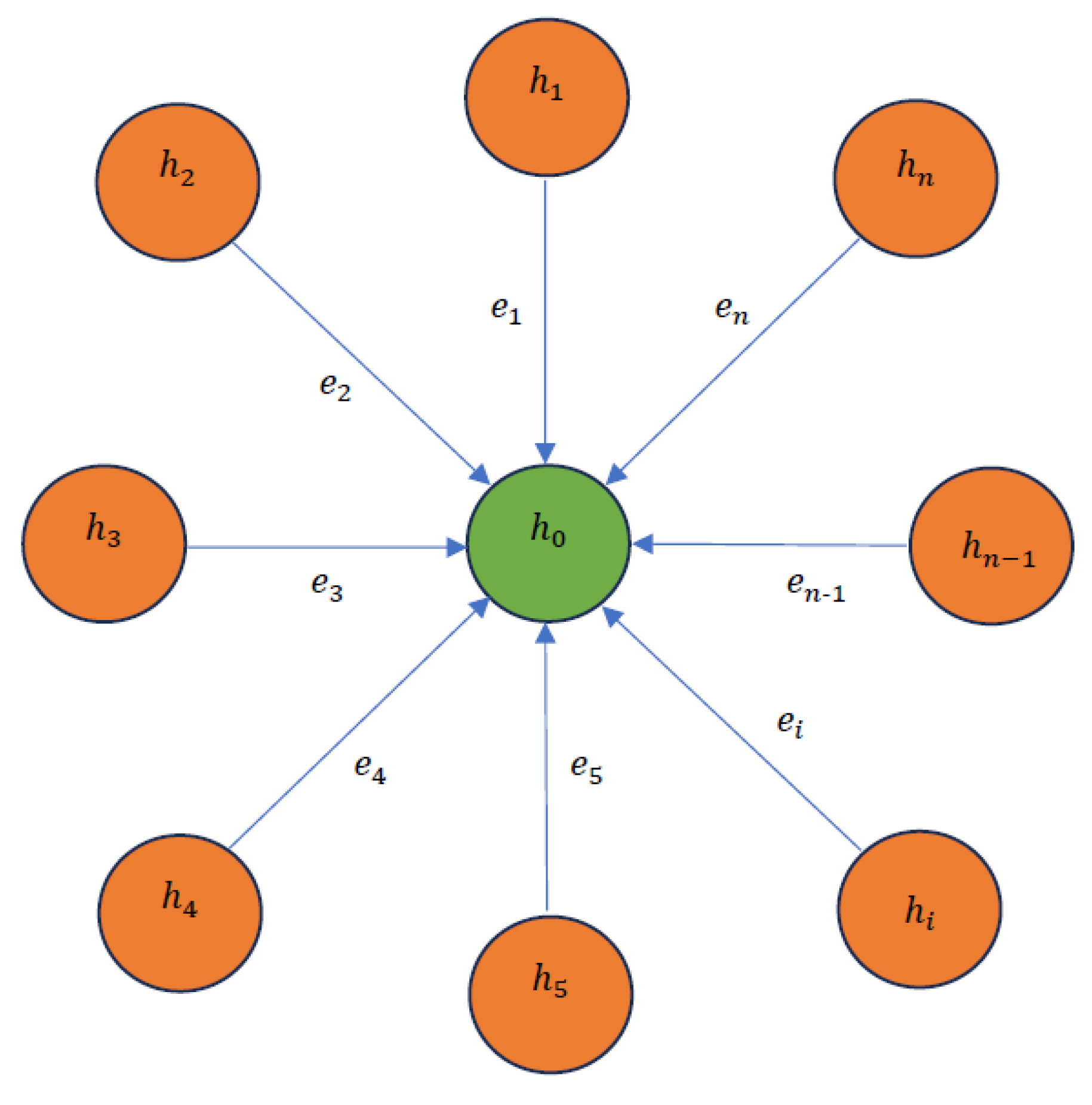
(I) The authors of both papers assumed that the graph G is a star graph with one junction node , as illustrated in Figure 1 and Figure 2.
Figure 1.
A star graph with three vertices and two edges.
Figure 2.
A general star graph with (n + 1) vertices and n edges.
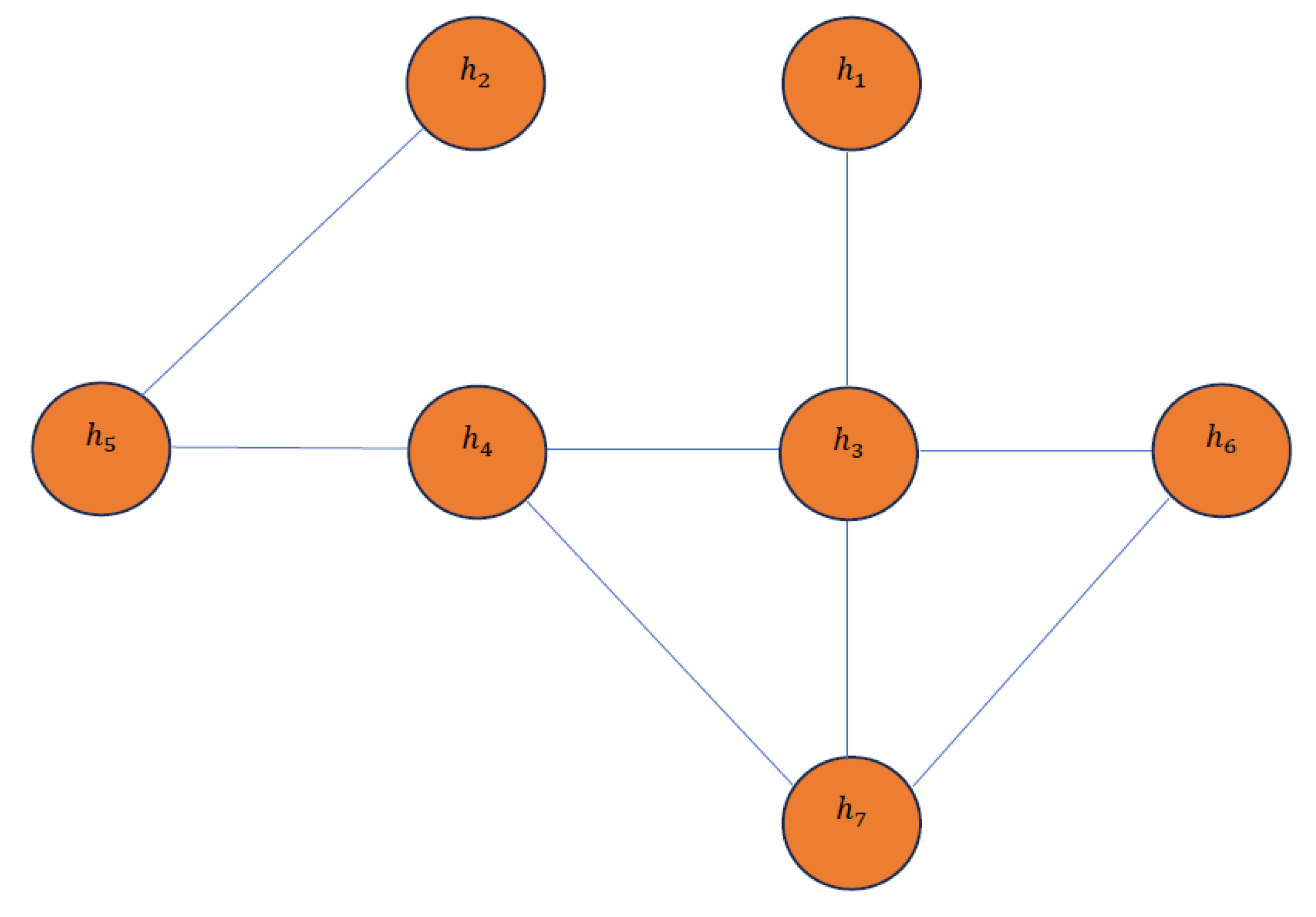
However, the graph G might not be a star network and might have more than one junction node. As an illustration, Figure 3 depicts five junction nodes.
Figure 3.
A non-star graph with more than one junction node.
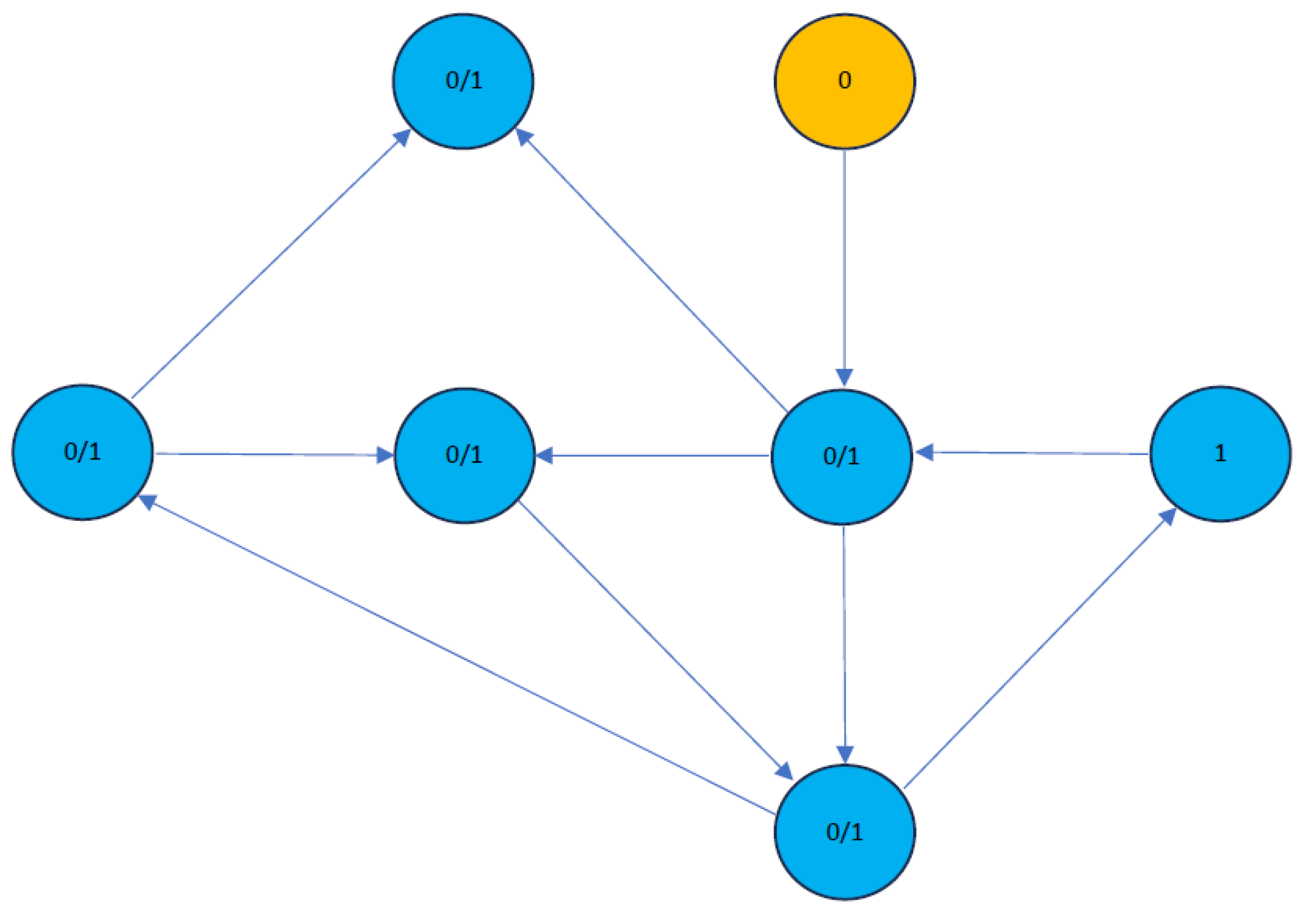
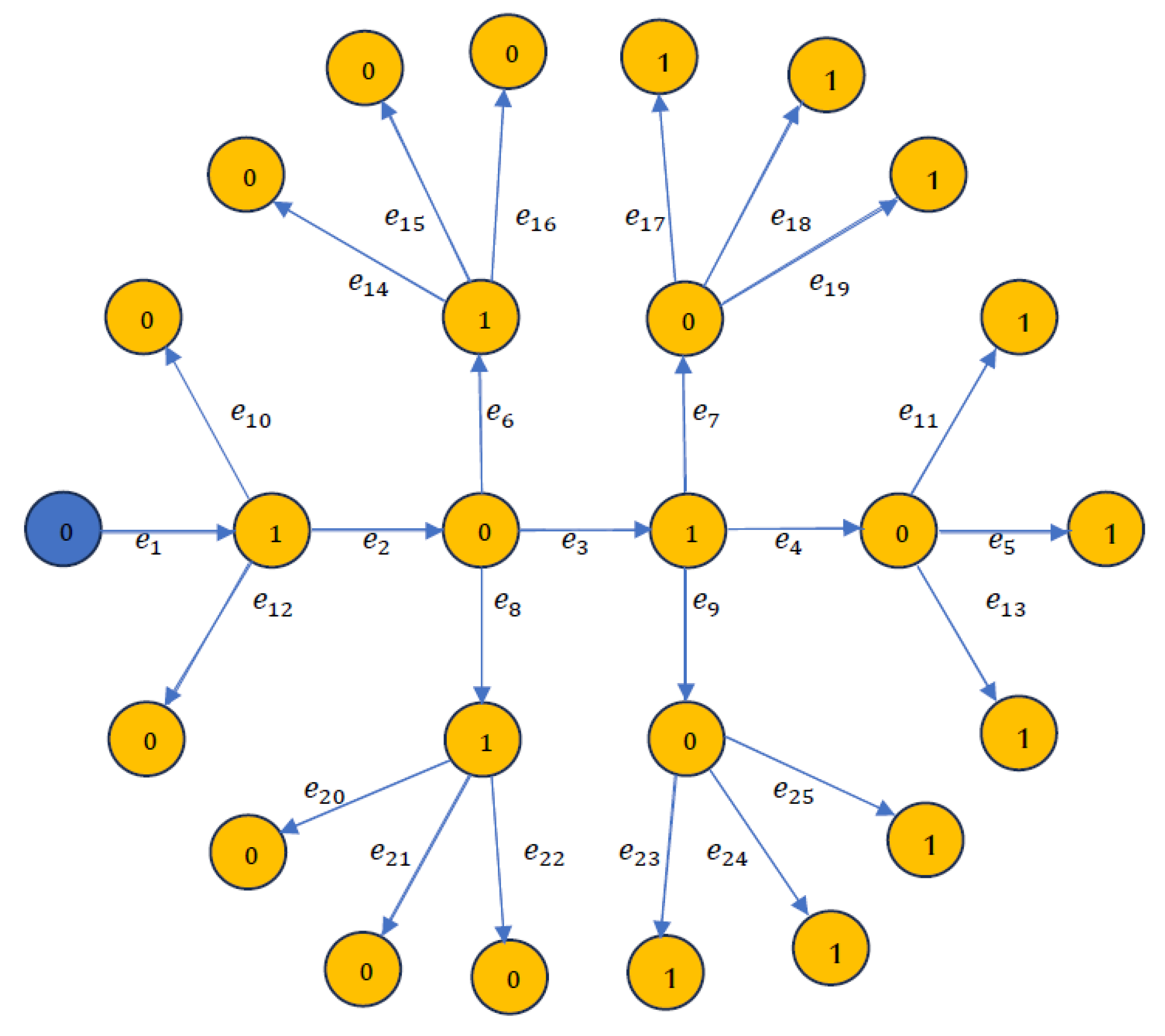
(II) The authors of both articles mentioned above treat the length of each edge as the variable value for , where n is the edge count of the graph G. The length of all edges is then normalized by using a change of variable, and finally, they transform into a unit interval . From the start, the length of all edges can be considered a fixed value without identifying the boundary vertices of every edge as the origin. For this reason, we suggest another method for labeling vertices. In this scenario, each vertex in a graph can be assigned one of two labels: 0 or 1. In other words, each vertex’s label is determined by the orientation of its related edge. When we go along an arbitrary edge, the starting and ending vertex labels are assigned values of 0 and 1, respectively, and vice versa. As a result, several vertices may have both the labels 0 and 1 at the same time. Additionally, every edge’s origin is not fixed; rather, it changes any time the edge’s movement direction changes. We are allowed to choose the origin of each edge to be any one of its two vertices, as there is no need to normalize the length of every edge using the aforementioned transforms. A possible application of labeling in this scenario is illustrated in Figure 4. We start at the yellow vertex and then move along the graph’s edges for labeling (see Figure 4).
Figure 4.
Labeling of a non-star graph with 0 or 1.
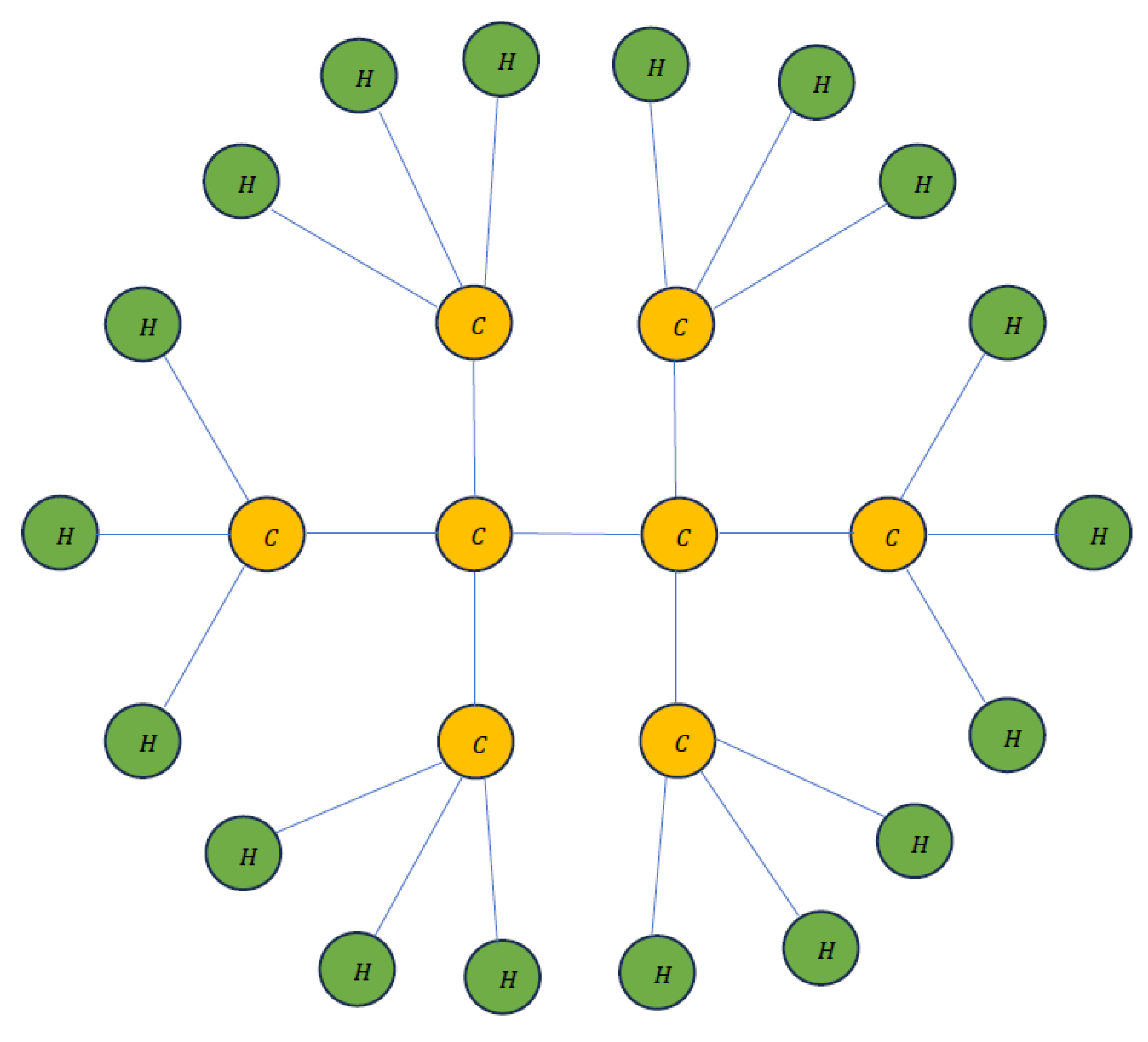
In this article, we study a system of FDEs defined on each edge of the tetramethylbutane graph (Figure 5).
Figure 5.
A graph of the chemical compound tetramethylbutane.
The molecular formula for tetramethylbutane is , where C and H represent carbon and hydrogen atoms, respectively. The petrochemical industry uses tetramethylbutane as a precursor molecule. Eight carbon–carbon bonds and six subbranches make up this molecule. Atoms of hydrogen and carbon are viewed as the graph’s vertices because of this structure. The edges of the graph represent the chemical bonds that exist between atoms. Since there are several junction nodes on this molecular graph, the method used in [24,25] to assign the origin at boundary nodes other than the junction node will not apply here because the molecular graph is not a star graph. As a result, we must adopt a new strategy. In this graph, vertices can be labeled with 0 or 1, and the length of each edge is represented by the unit value (see Figure 6).
Figure 6.
Labeling of the tetramethylbutane graph with vertices with 0 or 1.
As a result, using the tetramethylbutane graph with vertices labeled 0 or 1, as shown above, we can reach our goals of the existence and uniqueness of solutions for the considered nonlinear FDE defined on it.
We now review some fundamental terms of fractional calculus.
Definition 1.
([38,39]). The Riemann–Liouville fractional integral of order of an integrable function is defined by
where Γ denotes the Gamma function.
Definition 2.
([38,39]). The Caputo fractional derivative of order ρ of a function (an m-times differentiable absolutely continuous function) is defined as
where , where denotes the greatest integer less than or equal to ρ.
The general solution of the homogeneous FDE is of the form , where . Then, we have (see [40]).
Lemma 1.
Assume that function has a fractional derivative and let , be continuous functions; then, the solution of the FDE
satisfies the integral boundary conditions
if and only if it satisfies the following integral equation:
by setting
Proof.
Assume to be the solution of the following differential equation:
Applying the integral on both sides, we get
using boundary conditions
On solving and , we obtain
and
On substituting the values of into , we get the required solution
For the converse part, let be the solution of the integral equation. Obviously, satisfies the boundary conditions. By applying the Caputo derivative on both sides, we get
Hence, these functions having fractional derivatives on is the desired solution of the differential equation. □
Theorem 1.
(Schaefer Fixed-Point Theorem [41]) Assume that X is a Banach space and let be a continuous and compact map. Then, either one of the following holds:
(i) The set is not bounded.
(ii) T has at least one fixed point.
Theorem 2.
(Banach Contraction Principle [41]) Let X be a Banach space and let be a contraction map. Then, T has a unique fixed point in X.
3. Algorithm
- Vertex Labeling: Label the vertices of the tetramethylbutane graph as 0 or 1 by fixing the edge length to a unit of 1.
- FDEs on Each Edge: On each edge of the graph, define following the FDEs:
- Boundary Conditions: Apply the following integral boundary conditions to the problem:
- Solution Method: Solve the system of FDEs defined on each edge using fixed-point theory by constructing an operator.
4. Main Results
Consider the space with the norm defined by
where
The above-defined space is a Banach space with norm ([42]). Hence, the product space is also a Banach space ([25]) with the norm
Using Lemma 1, we define an operator corresponding with the boundary condition (2) by
where the ith component of is defined by
where are defined in Lemma 1.
Theorem 3.
Proof.
We will show the existence result via Schaefer’s fixed-point Theorem 1. The boundary value problem has a solution if has a fixed point in space . In the beginning, it will be shown that the operator is completely continuous.
Clearly, is continuous map due to the continuity of the functions . We have to show only the completeness.
Let U be a bounded subset of . Now, for any , we have
where
Similarly,
where
Using , we obtain
Hence,
So, is uniformly bounded.
Now, the equicontinuity of the operator will be shown. For any , we have
We also have
Next,
So,
From and ,
So,
Therefore, the operator is equicontinous on . Applying the Arzela Ascoli theorem, we conclude that is complete.
Furthermore, we have to prove that the set is bounded.
Assume that ; then, . So,
Therefore,
Using , we obtain
Hence,
This proves that set P is bounded. Hence, according to Schaefer’s fixed-point theorem, has a fixed point in , which ensures at least one solution of the nonlinear FDEs (1) on . □
Theorem 4.
Let the functions be continuous. Assume that are non-negative continuous functions on satisfying the condition
and
where are constants given in Theorem 3;
Proof.
We will apply the Banach contraction principle 2 to prove the uniqueness of the solution. We will show that is a contraction mapping.
Assume that .
Then, we have
Similarly,
So,
Hence, is a contraction mapping. Hence, according to the Banach contraction principle, the nonlinear FDEs has a unique solution on □
5. Ulam–Hyers Stability
Because the concept of stability is so essential in defining the solutions to many dynamic systems, we present the Ulam–Hyers stability in connection to the FDE on the tetramethylbutane graph. Readers should refer to [43,44,45] for more information. Consistently with [45], we have the following definitions.
Definition 3.
A system of FDEs defined on each edge of the tetramethylbutane graph is Ulam–Hyers stable if there exists such that for every and the solutions of the inequalities
there exists a unique solution of the system satisfying .
Definition 4.
The function is a solution of the inequality if there exists a function such that and
Theorem 5.
Under the assumptions of Theorem 4, the system of FDEs defined on the tetramethylbutane graph is Ulam–Hyers stable.
Proof.
Assume to be the solution satisfying the inequalities in , and let be the unique solution of problem (1). Now,
Similarly,
So,
This completes the proof. □
6. Examples
Example 1.
Consider the system of FDEs
with the integral boundary conditions
where . and are the fractional derivative operators of order and , respectively, in the Caputo sense.
Now, we define the continuous functions using
Then, we have
So,
,
and we get
.
After manipulation, we obtain
and
Hence, according to Theorem 4, the problem satisfying the conditions has unique solution on . Moreover, this problem is Ulam–Hyers stable.
Example 2.
We solve the following FDEs analytically in this example:
satisfying the integral boundary conditions with
where are continuous and bounded functions. Hence, by applying Theorem 3, this problem has a solution on .
With the above operator defined in Lemma 1, we get
7. Conclusions
Since the methodology used in [24,25] can only be used for star graphs, it will not work here. The chemical structure of the tetramethylbutane compound can be viewed as a graph that is a generalization of a star graph. The tetramethylbutane graph is actually a non-star graph comprising eight junction nodes. So, we chose another method for labeling the vertices with 0 or 1 to fix the edge length to a unit of 1. We examined FDEs in the sense of a Caputo operator on each edge of the tetramethylbutane graph with the boundary conditions on each vertex of the graph. Employing the Schaefer and Banach fixed-point theorems, we attained the conditions for proving the existence and uniqueness of solutions for the FDEs system (1) satisfying the integral boundary conditions (2). Additionally, we conducted a stability analysis of the system with the Hyers–Ulam method and provided two illustrative examples to support our findings. Due to the significance of differential equations in chemical graph theory, we discussed the system of FDEs (1) on the molecular graph representation of tetramethylbutane, which is an illustration of a non-star graph. This study can be important in the fractional mathematical modeling of various chemical compounds of molecules within complex non-star graph frameworks. Our approach is simple to use and can be used for many different types of graphs, such as chordal bipartite graphs, which are widely utilized in biology and computer networking.
Author Contributions
Conceptualization, A.Y., T.M. and S.A.; methodology, J.J.N., A.Y., T.M. and S.A.; validation, J.J.N. and T.M.; formal analysis, J.J.N., T.M. and S.A.; writing—original draft preparation, A.Y. and T.M.; writing—review and editing, J.J.N., A.Y. and T.M.; visualization, T.M. and S.A.; supervision, J.J.N., T.M. and S.A. All authors have read and agreed to the published version of the manuscript.
Funding
The research of J.J. Nieto was supported by Grant PID2020-113275GB-I00 funded by MCIN/AEI/10.13039/501100011033, Spain, by “ERDF—A way of making Europe” of the European Union, and by Xunta de Galicia, Spain, project ED431C 2023/12.
Data Availability Statement
No data were used for this research.
Acknowledgments
Ashish Yadav expresses his sincere gratitude to the Birla Institute of Technology and Science Pilani, Pilani Campus, Rajasthan, India, for providing financial support.
Conflicts of Interest
There are no conflicts of interest according to the authors.
References
- Abbas, S.; Benchohra, M.; Lazreg, J.E.; Nieto, J.J.; Zhou, Y. Fractional Differential Equations and Inclusions: Classical and Advanced Topics; World Scientific: Singapore, 2023. [Google Scholar]
- Xu, X.; Jiang, D.; Yuan, C. Multiple positive solutions for the boundary value problem of a nonlinear fractional differential equation. Nonlinear Anal. Theory Methods Appl. 2009, 71, 4676–4688. [Google Scholar] [CrossRef]
- Bhatter, S.; Mathur, A.; Kumar, D.; Nisar, K.S.; Singh, J. Fractional modified Kawahara equation with Mittag–Leffler law. Chaos Solitons Fractals 2020, 131, 109508. [Google Scholar] [CrossRef]
- Ali, M.; Aziz, S.; Malik, S.A. Inverse problem for a multi-term fractional differential equation. Fract. Calc. Appl. Anal. 2020, 23, 799–821. [Google Scholar] [CrossRef]
- Staněk, S. The Neumann problem for the generalized Bagley-Torvik fractional differential equation. Fract. Calc. Appl. Anal. 2016, 19, 907–920. [Google Scholar] [CrossRef]
- Al-Musalhi, F.; Al-Salti, N.; Karimov, E. Initial boundary value problems for a fractional differential equation with hyper-Bessel operator. Fract. Calc. Appl. Anal. 2018, 21, 200–219. [Google Scholar] [CrossRef]
- Wang, Y.; Wang, Q. Lyapunov-type inequalities for nonlinear fractional differential equation with Hilfer fractional derivative under multi-point boundary conditions. Fract. Calc. Appl. Anal. 2018, 21, 833–843. [Google Scholar] [CrossRef]
- Baghani, H.; Nieto, J.J. Some new properties of the Mittag-Leffler functions and their applications to solvability and stability of a class of fractional Langevin differential equations. Qual. Theory Dyn. Syst. 2024, 23, 18. [Google Scholar] [CrossRef]
- Slimane, I.; Dahmani, Z.; Nieto, J.J.; Abdeljawad, T. Existence and stability for a nonlinear hybrid differential equation of fractional order via regular Mittag–Leffler kernel. Math. Methods Appl. Sci. 2023, 46, 8043–8053. [Google Scholar] [CrossRef]
- Mathur, T.; Agarwal, S.; Goyal, S.; Pritam, K.S. Analytical solutions of some fractional diffusion boundary value problems. In Fractional Order Systems and Applications in Engineering; Elsevier: Amsterdam, The Netherlands, 2023; pp. 37–50. [Google Scholar]
- Bansal, K.; Arora, S.; Pritam, K.S.; Mathur, T.; Agarwal, S. Dynamics of crime transmission using fractional-order differential equations. Fractals 2022, 30, 2250012. [Google Scholar] [CrossRef]
- Baleanu, D.; Jajarmi, A.; Mohammadi, H.; Rezapour, S. Analysis of the human liver model with Caputo–Fabrizio fractional derivative. Chaos Solitons Fractals 2020, 134, 7. [Google Scholar] [CrossRef]
- Bachir, F.S.; Abbas, S.; Benbachir, M.; Benchohra, M. Hilfer-Hadamard fractional differential equations; Existence and attractivity. Adv. Theory Nonlinear Anal. Appl. 2021, 5, 49–57. [Google Scholar] [CrossRef]
- Ding, X.L.; Nieto, J.J.; Wang, X. Analytical solutions for fractional partial delay differential-algebraic equations with Dirichlet boundary conditions defined on a finite domain. Fract. Calc. Appl. Anal. 2022, 25, 408–438. [Google Scholar] [CrossRef]
- Shah, K.; Khan, R.A. Iterative scheme for a coupled system of fractional-order differential equations with three-point boundary conditions. Math. Methods Appl. Sci. 2018, 41, 1047–1053. [Google Scholar] [CrossRef]
- Liang, J.; Mu, Y.; Xiao, T.J. Initial-value/Nonlocal Cauchy problems for fractional differential equations involving ψ-Hilfer multivariable operators. Fract. Calc. Appl. Anal. 2020, 23, 1090–1124. [Google Scholar] [CrossRef]
- Yadav, A.; Mathur, T.; Agarwal, S.; Yadav, B. Fractional boundary value problem in complex domain. J. Math. Anal. Appl. 2023, 526, 127178. [Google Scholar] [CrossRef]
- Lumer, G. Connecting of local operators and evolution equations on networks. In Proceedings of the Potential Theory Copenhagen 1979: Proceedings of a Colloquium Held in Copenhagen, Copenhagen, Denmark, 14–18 May 1979; Springer: Berlin/Heidelberg, Germany, 1980; pp. 219–234. [Google Scholar]
- Nicaise, S. Some results on spectral theory over networks, applied to nerve impulse transmission. In Proceedings of the Polynômes Orthogonaux et Applications: Proceedings of the Laguerre Symposium held at Bar-le-Duc, Bar-le-Duc, France, 15–18 October 1984; Springer: Berlin/Heidelberg, Germany, 1985; pp. 532–541. [Google Scholar]
- Von Below, J. Sturm-Liouville eigenvalue problems on networks. Math. Methods Appl. Sci. 1988, 10, 383–395. [Google Scholar] [CrossRef]
- Pokornyi, Y.V. On the spectrum of certain problems on graphs. Uspekhi Mat. Nauk 1987, 42, 128–129. [Google Scholar]
- Gordeziani, D.; Kupreishvli, M.; Meladze, H.; Davitashvili, T. On the solution of boundary value problem for differential equations given in graphs. Appl. Math. Lett. 2008, 13, 80–91. [Google Scholar]
- Currie, S.; Watson, B.A. Indefinite boundary value problems on graphs. Oper. Matrices 2011, 5, 565–584. [Google Scholar] [CrossRef]
- Graef, J.R.; Kong, L.; Wang, M. Existence and uniqueness of solutions for a fractional boundary value problem on a graph. Fract. Calc. Appl. Anal. 2014, 17, 499–510. [Google Scholar] [CrossRef]
- Mehandiratta, V.; Mehra, M.; Leugering, G. Existence and uniqueness results for a nonlinear Caputo fractional boundary value problem on a star graph. J. Math. Anal. Appl. 2019, 477, 1243–1264. [Google Scholar] [CrossRef]
- Ali, W.; Turab, A.; Nieto, J.J. On the novel existence results of solutions for a class of fractional boundary value problems on the cyclohexane graph. J. Inequal. Appl. 2022, 2022, 5. [Google Scholar] [CrossRef]
- Baleanu, D.; Etemad, S.; Mohammadi, H.; Rezapour, S. A novel modeling of boundary value problems on the glucose graph. Commun. Nonlinear Sci. Numer. Simul. 2021, 100, 105844. [Google Scholar] [CrossRef]
- Etemad, S.; Rezapour, S. On the existence of solutions for fractional boundary value problems on the ethane graph. Adv. Difference Equ. 2020, 2020, 276. [Google Scholar] [CrossRef]
- Turab, A.; Sintunavarat, W. The novel existence results of solutions for a nonlinear fractional boundary value problem on the ethane graph. Alex. Eng. J. 2021, 60, 5365–5374. [Google Scholar] [CrossRef]
- Mehandiratta, V.; Mehra, M. A difference scheme for the time-fractional diffusion equation on a metric star graph. Appl. Numer. Math. 2020, 158, 152–163. [Google Scholar] [CrossRef]
- Turab, A.; Rosli, N. Study of fractional differential equations emerging in the theory of chemical graphs: A robust approach. Mathematics 2022, 10, 4222. [Google Scholar] [CrossRef]
- Sintunavarat, W.; Turab, A. A unified fixed point approach to study the existence of solutions for a class of fractional boundary value problems arising in a chemical graph theory. PLoS ONE 2022, 17, e0270148. [Google Scholar] [CrossRef]
- Zhang, W.; Liu, W. Existence and Ulam’s type stability results for a class of fractional boundary value problems on a star graph. Math. Methods Appl. Sci. 2020, 43, 8568–8594. [Google Scholar] [CrossRef]
- Rezapour, S.; Deressa, C.T.; Hussain, A.; Etemad, S.; George, R.; Ahmad, B. A theoretical analysis of a fractional multi-dimensional system of boundary value problems on the methylpropane graph via fixed point technique. Mathematics 2022, 10, 568. [Google Scholar] [CrossRef]
- Faheem, M.; Khan, A. A collocation method for time-fractional diffusion equation on a metric star graph with η edges. Math. Methods Appl. Sci. 2023, 46, 8895–8914. [Google Scholar] [CrossRef]
- Varmuza, K.; Dehmer, M.; Emmert-Streib, F.; Filzmoser, P. Automorphism groups of alkane graphs. Croat. Chem. Acta 2021, 94, 47–58. [Google Scholar] [CrossRef]
- Balaban, A.T. Applications of graph theory in chemistry. J. Chem. Inf. Comput. 2021, 25, 334–343. [Google Scholar] [CrossRef]
- Podlubny, I. Fractional Differential Equations: An Introduction to Fractional Derivatives, Fractional Differential Equations, to Methods of Their Solution and Some of Their Applications; Elsevier: Amsterdam, The Netherlands, 1998. [Google Scholar]
- Samko, S.G.; Kilbas, A.A.; Marichev, O.I. Fractional Integrals and Derivatives:Theory and Applications; Gordon and Breach Science Publishers: Yverdon, Switzerland, 1993; pp. xxxvi+976. [Google Scholar]
- Miller, K.S.; Ross, B. An Introduction to the Fractional Calculus and Fractional Differential Equations; John Wiley & Sons, Inc.: New York, NY, USA, 1993; pp. xvi+366. [Google Scholar]
- Granas, A.; Dugundji, J. Fixed Point Theory; Springer: Berlin/Heidelberg, Germany, 2003; Volume 14. [Google Scholar]
- Su, X. Boundary value problem for a coupled system of nonlinear fractional differential equations. Appl. Math. Lett. 2009, 22, 64–69. [Google Scholar] [CrossRef]
- Wang, J.; Fec, M.; Zhou, Y. Ulam’s type stability of impulsive ordinary differential equations. J. Math. Anal. Appl. 2012, 395, 258–264. [Google Scholar] [CrossRef]
- Wang, J.; Li, X. A uniform method to Ulam–Hyers stability for some linear fractional equations. Mediterr. J. Math. 2016, 13, 625–635. [Google Scholar] [CrossRef]
- Ben Chikh, S.; Amara, A.; Etemad, S.; Rezapour, S. On Hyers–Ulam stability of a multi-order boundary value problems via Riemann–Liouville derivatives and integrals. Adv. Differ. Equ. 2020, 2020, 547. [Google Scholar] [CrossRef]
Disclaimer/Publisher’s Note: The statements, opinions and data contained in all publications are solely those of the individual author(s) and contributor(s) and not of MDPI and/or the editor(s). MDPI and/or the editor(s) disclaim responsibility for any injury to people or property resulting from any ideas, methods, instructions or products referred to in the content. |
© 2024 by the authors. Licensee MDPI, Basel, Switzerland. This article is an open access article distributed under the terms and conditions of the Creative Commons Attribution (CC BY) license (https://creativecommons.org/licenses/by/4.0/).