Abstract
The paper considers the problem of representation and extension of Appell’s hypergeometric functions by a special family of functions—branched continued fractions. Here, we establish new symmetric domains of the analytical continuation of Appell’s hypergeometric function with real and complex parameters, using their branched continued fraction expansions whose elements are polynomials in the space . To do this, we used a technique that extends the domain of convergence of the branched continued fraction, which is already known for a small domain, to a larger domain, as well as the PC method to prove that it is also the domain of analytical continuation. A few examples are provided at the end to illustrate this.
Keywords:
Appell’s hypergeometric function; branched continued fraction; analytic continuation; convergence; approximation by rational functions MSC:
33C65; 32A17; 32D99; 40A99; 41A20
1. Introduction
This paper considers the Appell’s hypergeometric function defined as (see, [1,2])
where is the Pochhammer symbol,
Appell’s hypergeometric function surprisingly appears in various applications, in particular, in materials science for the compute of the canonical partition function of the model of heteropolymer in the form of a freely jointed chain [3], in probability theory and statistics for the study of the compound gamma bivariate distribution [4], in the theory of the quantum Hall effect for the explicit evaluation of the matrix elements of the Coulomb interaction of two-body [5], in the quantum field theory for the evaluation of Feynman integrals [6] and a two-loop diagram of the propagator-type (the so-called propagator seagull) [7], in the spectral theory of atom, molecule and plasma for the compute of multipole matrix elements [8].
Many works are devoted to the study of the Appell’s hypergeometric function itself, in particular, to the establishment of recurrence relations [9,10], reduction and transformation formulas [11], to the construction of analytic continuations [12,13,14], integral representations [15,16] and asymptotic expansions [16,17,18,19,20]. We also note the work [21], which presents the Mathematica package AppellF2.wl, dedicated to the evaluation of the Appell’s hypergeometric function
This paper discusses the representation and analytical extension of the Appell’s hypergeometric function due a special family of functions—branched continued fractions. Domains of analytical continuation will be symmetric domains of convergence of co-called confluent branched continued fractions.
Research in the direction mentioned above was started in [22], where a formal branched continued fraction expansion was constructed for the following ratio
In [23], the following formal branched continued fraction expansion
where
was considered, and it was shown that
is the domain of the analytical continuation of the function on the left side of (1) provided that for all
The following theorem holds:
Theorem 1.
Suppose that and are complex constants such that
where are given in (2) herewith ,
Then, the following statements hold:
- (A)
- The branched continued fractionconverges uniformly on every compact subset of the domainwhereandwhereto the function holomorphic in the domain
- (B)
This paper is organized as follows. In Section 2, we give the necessary definitions and statements and prove Theorem 2, the result of which is a certain contribution to the theory of branched continued fractions. In the next section, we prove Theorem 1 and several important consequences from it. In Section 4, we give some examples. Finally, we collect our conclusions in Section 5.
2. Definitions and Auxiliary Results
Let us recall the necessary concepts of convergence in the theory of branched continued fractions (see, [24,25]).
We set and
By Bodnar ([25], p. 15) for each the symbol denotes a vector in with components for each and for each multiindex the symbol is a vector in with components with the following order of components:
- (i)
- if
- (ii)
- if or there exists index such that and
Let the ordered pair of sequences
of complex numbers such that:
- (*)
- for all
- (**)
- if for there exists a multiindex such that then for and
gives rise to sequence herewith and of two-dimensional linear fractional transformations
and
and to a sequence given by
where is a vector in
Definition 1.
The ordered pair
is the branched continued fraction denoted by symbols
The numbers and are called elements of the branched continued fraction. The value
is called the kth approximant of the branched continued fraction.
Note that a new and more general so-called sets approach to the concept of a branched continued fraction was proposed by Antonova in [26].
Next, considering the branched continued fractions, we admit confluent case where there are no constraints (*). Without reducing the generality, we will give the following definitions with approximant sequences
Definition 2.
A branched continued fraction
converges if, at most, a finite number of its approximants don’t make sense and if the limit of its sequence of approximants
exists and is finite.
Definition 3.
A branched continued fraction (11) converges absolutely if its sequence of approximants such that
Definition 4.
A branched continued fraction
is a majorant of a branched continued fraction (11) if there exist a natural number and a positive constant M such that for and the following relation holds
Again, without reducing the generality, let us put
Definition 5.
A convergence set Ω is a set and such that: if for all then a branched continued fraction
converges.
Definition 6.
A uniform convergence set Ω is a convergence set to which there corresponds a sequence of positive numbers depending only on Ω and converging to 0 such that
for every branched continued fraction (12) with all
Reasoning similarly as in the proof of Theorem 2 [24], we will prove the following result:
Theorem 2.
Suppose that are constants such that
Then, the following statements hold:
- (A)
- The branched continued fractionconverges absolutely and uniformly for
- (B)
- The values of the branched continued fraction (14) and of its approximants are in the closed disk
Proof.
Let us show that the majorant of branched continued fraction (14) is
We set
and
where, and, for
Then
where
For inequalities (22) are obvious (see, (13) and (18)). By induction hypothesis that (22) hold for where we prove (22) for Indeed, use of inequalities (15) and (19)–(21) lead to
It is easy to see that
By virtue of estimates (22), Therefore, replacing by inequalities (22) are obtained for
From (13) and (22) it follows that and for all and Applying the method suggested in ([25], p. 28) and the relations (18) and (20) we find the formula for the difference of two approximants of the branched continued fraction (14). For and on the first step we obtain
Let r be arbitrary integer number, moreover Then for and we have
Using (19) and (22), we get the following
where and Thus,
It follows that the sequence is monotonically decreasing and due to inequalities (22) is bounded from below. Indeed, for we have
Therefore, there exists a limit
Now, using the relation (24), we obtain for
If it follows that the branched continued fraction (14) converges absolutely and uniformly for and which satisfies the inequalities (15). This proves (A).
Finally, by (22) for any we obtain
which proves (B). □
Note that Theorem 2 is an analogue to Theorem 11.1 in [27]. Moreover, it can be proved in another way, using a generalization of the Sleshinsky-Pringsheim criterion ([28], Proposition 1).
We will also need the convergence continuation theorem, which follows from Theorem 2.17 [25] (see also ([27], Theorem 24.2)).
Theorem 3
(Convergence Continuation Theorem). Suppose that is a sequence of functions holomorphic in the domain uniformly bounded on every compact subset of Suppose that this sequence converges at each point of the set which is the real neighborhood of the point in Then the sequence converges uniformly on every compact subset of the domain Ω to a function holomorphic in this domain.
Next, we recall the necessary concepts of the PC method in the theory of branched continued fractions, which will be used to establish the analytical continuation of the function (see, [29,30]).
Let
where be a formal double power series at Let be function holomorphic in a neighbourhood of the origin Let the mapping associate with its Taylor expansion in a neighbourhood of the origin.
Definition 7.
A sequence of functions holomorphic at the origin corresponds to a formal double power series at if
where λ is the function defined as follows: ; if then if then where n is the smallest degree of homogeneous terms for which that is
If corresponds at to a formal double power series then the order of correspondence of is defined to be
By the definition of the series and agree for all homogeneous terms up to and including degree
Definition 8.
A branched continued fraction whose elements are polynomials in the space corresponds to a formal double power series at if its sequence of approximants corresponds to
Finally, we present the well-known Weierstrass’ theorem ([31], p. 23) and the principle of analytic continuation ([32], p. 39).
Theorem 4
(Weierstrass’ Theorem). Suppose that is a sequence of holomorphic functions in a domain converges to a function uniformly on each compact subset in the domain Then is a holomorphic in and for any
on each compact subset in the domain
Theorem 5
(Principle of Analytic Continuation). Suppose that and are functions holomorphic in the domains and respectively, and suppose that is a domain. Next, suppose that in the real neighborhood of the point the functions and coincide. Then these functions are an analytic continuation of one another, i.e., there is a unique function that is holomorphic in and coincides with in and with in .
3. Convergence and Analytical Continuation
Proof of Theorem 1.
We prove (A). Let
and
where Then the following relations hold
and
where and, thus, for each we write the nth approximants of (5) as
Let n be an arbitrary natural number, and be an arbitrary fixed point from (7). By induction on we show the following
and
By virtue of an arbitrary fixed point it follows that for its arbitrary neighborhood, there exists such that and, thus,
Let us prove the inequalities (29). From (26) we have
where and
where Using (3), (7), (25), (31), and Corollary 2 in [29], for we obtain
Let the inequalities (29) hold for such that Then, by (3), (7), Corollary 2 in [29], and the induction hypothesis, from (31) and (32) for we have
and
respectively.
Similarly, we obtain the inequalities (30).
Let be an arbitrary compact subset of (7). Then there exists an open bi-disk
of radius such that Moreover, for any and from (25), (29), and (30) we have
where h is defined in (9), i.e., the sequence is uniformly bounded on every compact subset of
It is obvious that for every l such that
where p and q are defined in (4), h and d are defined in (9), the domain
contained in (7), in particular Using (9) and (33), for any we obtain that
and for any
i.e., the elements of (5) satisfy the Theorem 1, with It means that branched continued fraction (5) converges for all Therefore, according to the Theorem 3, the convergence of (5) is uniform on compact subsets of the domain (7).
From (A) of Theorem 1, with it follows that the branched continued fraction (5) converges for all , where is defined by (8), and from (B) of the same theorem it follows that all approximants of (5) lie in the closed disk (16) if . Hence, by Theorem 3, the branched continued fraction (5) converges uniformly on compact subsets of the domain (8). This is a complete proof of (A).
Now, we prove (B). Let
and
where and Then
and
where
It follows (see also [22]) that for each
and
Since and for any then the and have formal Taylor expansions in a neighborhood of the origin. It is clear that and for all and Applying the method suggested in ([25], p. 28) and (25)–(27), (34), and (35), for each we have
and
Hence, in a neighborhood of origin for any , we have
where are some coefficients. It follows that
tends monotonically to as
Thus, the branched continued fraction (5) corresponds at to a formal double power series
Let be a neighborhood of the origin contained (6), and in which
From (A), it follows that the sequence of approximants of (5) converges uniformly on each compact subset of to function holomorphic in the domain Then, by Theorem 3, for arbitrary we have
on each compact subset of And now, due to the above proven, the expansion of each approximant of (5) into formal double power series and series (36) agree for all homogeneous terms up to and including degree Then, for any we have
Hence,
for all
Finally, (B) follows from Theorem 4. □
Note that in the same way the domains of the analytical continuation of the ratios of Horn’s hypergeometric functions and were obtained in the works [33,34,35], respectively. Another approach using the PF Method (see, [29]) is applied in [36].
Corollary 1.
Suppose that and are complex constants such that satisfy inequality (3), where
herewith , and where and Then the branched continued fraction
converges uniformly on every compact subset of the domain (6) to the function holomorphic in this domain, in addition, the function is an analytic continuation of the function in the domain .
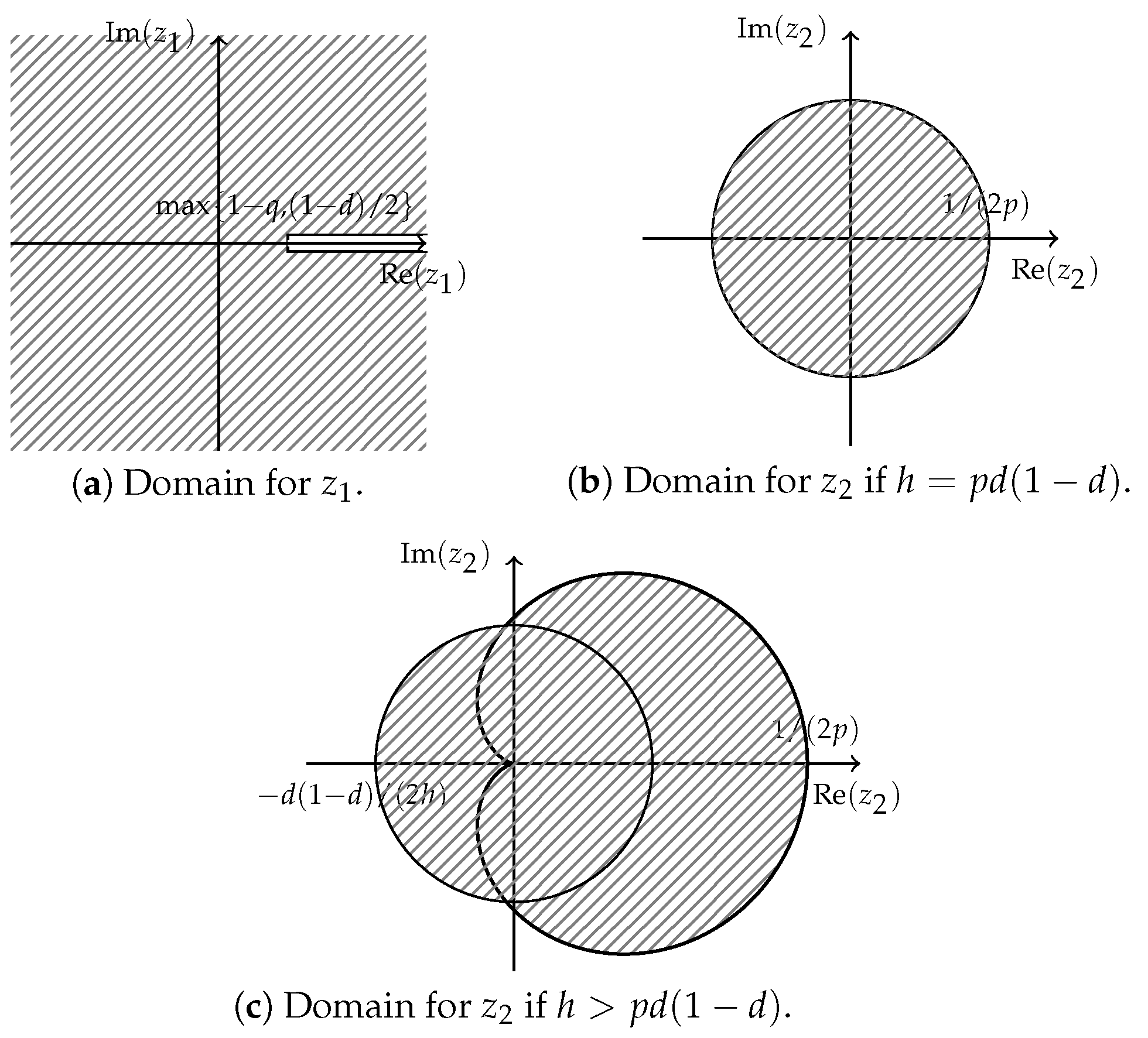
Figure 1.
Domains for variables and in (6).
By using Theorem 1, we obtain the following result:
Theorem 6.
Suppose that and are real constants such that
where are given in (2) herewith , h is a positive number. Then the branched continued fraction (5) converges uniformly on every compact subset of the domain
to the function holomorphic in this domain, in addition, the function is an analytic continuation of the function (10) in the domain
Proof.
Corollary 2.
Suppose that and are real constants such that satisfy inequality (39), where are given in (37) herewith , h is a positive number. Then the branched continued fraction (38) converges uniformly on every compact subset of the domain (40) to the function holomorphic in this domain, in addition, the function is an analytic continuation of the function in the domain .
Note that (40) is the Cartesian product of the plane cut along the real axis from 1 to and the plane cut along the real axis from to where h is a positive number satisfying (39).
By using Theorem 5, we directly obtain the following result from Theorem 2.2 in [23] and Theorem 6:
Theorem 7.
Suppose that and are real constants such that satisfy inequality (39), where are given in (2) herewith , h is a positive number. Then the branched continued fraction (1) converges uniformly on every compact subset of the domain
to the function holomorphic in the this domain, in addition, the function is an analytic continuation of the function on the left side of (1) in the domain
Corollary 3.
Suppose that and are real constants such that satisfy inequality (39), where are given in (37) herewith , h is a positive number. Then the branched continued fraction
converges uniformly on every compact subset of the domain (41) to the function holomorphic in the this domain, in addition, the function is an analytic continuation of the function in the domain
4. Examples
As an example, by Corollary 3 we get
where the branched continued fraction converges and represents a single-valued branch of the analytic function on the left side of (42) in the domain
One more example, by Corollary 3 we obtain
where the branched continued fraction converges and represents a single-valued branch of the analytic function on the left side of (43) in the domain
5. Conclusions
In this paper, we discussed the representation and extension of the analytic functions due branched continued fractions as a special family of functions. Our results are new symmetric domains of analytical extension of the Appell’s hypergeometric function with certain conditions on its real and complex parameters. In particular, we obtained the domain of analytical continuation, which is the Cartesian product of the plane cut along the real axis from 1 to and the plane cut along the real axis from to where and h is a positive number satisfying (39). However, the problem of establishing the domains of the analytical extension of the Appell’s hypergeometric functions with arbitrary parameters remains open.
The results of the study of branched continued fraction expansions of the Appel’s hypergeometric functions and can be found in [37,38,39,40].
Further studies of branched continued fraction expansions consist in the use of new parabolic [41,42,43] and angular [44,45] domains of convergence of branched continued fractions. Other directions of research are truncation errors analysis [46,47,48,49,50] and computational stability [51,52,53]. Finally, taking into account the efficiency of approximation of functions by branched continued fractions [23,34,36] and the breadth of application of hypergeometric function, the applied direction of research is natural and intriguing.
Funding
This research received no external funding.
Data Availability Statement
Data are contained within the article.
Acknowledgments
The authors were partially supported by the Ministry of Education and Science of Ukraine, project registration number 0123U101791.
Conflicts of Interest
The author declare no conflicts of interest.
References
- Appell, P. Sur les séries hyper géométriques de deux variables et sur des équations différentielles lineaires aux dérivées partielles. CR Acad. Sci. Paris 1880, 90, 296–298, 731–734. [Google Scholar]
- Appell, P. Sur les fonctions hyper géométriques de deux variables. J. Math. Pures Appl. 1982, 8, 173–216. [Google Scholar]
- Mazars, M. Canonical partition functions of freely jointed chains. J. Phys. A Math. Gen. 1998, 31, 1949–1964. [Google Scholar] [CrossRef]
- Hutchinson, T.P. Compound gamma bivariate distributions. Metrika 1981, 28, 263–271. [Google Scholar] [CrossRef]
- Bentalha, Z.E.A. Representation of the Coulomb matrix elements by means of Appell hypergeometric function F2. Math. Phys. Anal. Geom. 2018, 21, 10. [Google Scholar] [CrossRef]
- Shpot, M.A. A massive Feynman integral and some reduction relations for Appell functions. J. Math. Phys. 2007, 48, 123512. [Google Scholar] [CrossRef]
- Kol, B.; Shir, R. The propagator seagull: General evaluation of a two loop diagram. J. High Energy Phys. 2019, 2019, 83. [Google Scholar] [CrossRef]
- Tarasov, V.F. Multipole matrix elements for DH-systems and their asymptotics. Int. J. Mod. Phys. B 1995, 9, 2699–2718. [Google Scholar] [CrossRef]
- Brychkov, Y.A.; Saad, N. On some formulas for the Appell function F2(a, b, b′; c, c′; w; z). Integral Transforms Spec. Funct. 2013, 25, 111–123. [Google Scholar] [CrossRef]
- Wang, X. Recursion formulas for Appell functions. Integral Transforms Spec. Funct. 2012, 23, 421–433. [Google Scholar] [CrossRef]
- Opps, S.B.; Saad, N.; Srivastava, H.M. Some reduction and transformation formulas for the Appell hypergeometric function F2. J. Math. Anal. Appl. 2005, 302, 180–195. [Google Scholar] [CrossRef]
- Hahne, G.E. Analytic continuation of Appell’s hypergeometric series F2 to the vicinity of the singular point x = 1, y = 1. J. Math. Phys. 1969, 10, 524–531. [Google Scholar] [CrossRef]
- Jaeger, J.C. A continuation formula for Appell’s function F2. J. Lond. Math. Soc. 1938, 13, 254. [Google Scholar] [CrossRef]
- Sud, K.; Wright, L.E. A new analytic continuation of Appell’s hypergeometric series F2. J. Math. Phys. 1976, 17, 1719–1721. [Google Scholar] [CrossRef]
- Mimachi, K. Integral representations of Appell’s F2, F3, Horn’s H2 and Olsson’s Fp functions. Kyushu J. Math. 2020, 74, 1–13. [Google Scholar] [CrossRef]
- Slater, L.J. The integration of hypergeometric functions. Math. Proc. Camb. Philos. Soc. 1955, 51, 288–296. [Google Scholar] [CrossRef]
- Chelo, F.; López, J.L. The Appell’s function F2 for large values of its variables. Q. Appl. Math. 2010, 68, 701–712. [Google Scholar] [CrossRef]
- Hang, P.-C.; Luo, M.-J. Asymptotics of Saran’s hypergeometric function FK. J. Math. Anal. Appl. 2025, 541, 128707. [Google Scholar] [CrossRef]
- Minton, B.M. A note on the asymptotic expansion of the second Appell function. Math. Proc. Camb. Philos. Soc. 1968, 64, 1055. [Google Scholar] [CrossRef]
- Luo, M.-J.; Raina, R.K. On certain results related to the hypergeometric function FK. J. Math. Anal. Appl. 2021, 504, 125439. [Google Scholar] [CrossRef]
- Ananthanarayan, B.; Bera, S.; Friot, S.; Marichev, O.; Pathak, T. On the evaluation of the Appell F2 double hypergeometric function. Comput. Phys. Commun. 2023, 284, 108589. [Google Scholar] [CrossRef]
- Bodnar, D.I. Expansion of a ratio of hypergeometric functions of two variables in branching continued fractions. J. Math. Sci. 1993, 64, 1155–1158. [Google Scholar] [CrossRef]
- Antonova, T.; Cesarano, C.; Dmytryshyn, R.; Sharyn, S. An approximation to Appell’s hypergeometric function F2 by branched continued fraction. Dolomites Res. Notes Approx. 2024, 17, 22–31. [Google Scholar] [CrossRef]
- Dmytryshyn, R.I. Convergence of multidimensional A- and J-fractions with independent variables. Comput. Methods Funct. Theory 2022, 22, 229–242. [Google Scholar] [CrossRef]
- Bodnar, D.I. Branched Continued Fractions; Naukova Dumka: Kyiv, Ukraine, 1986. (In Russian) [Google Scholar]
- Antonova, T. On structure of branched continued fractions. Carpathian Math. Publ. 2024, 16, 391–400. [Google Scholar] [CrossRef]
- Wall, H.S. Analytic Theory of Continued Fractions; D. Van Nostrand Co.: New York, NY, USA, 1948. [Google Scholar]
- Antonova, T.M. On convergence of branched continued fraction expansions of Horn’s hypergeometric function H3 ratios. Carpathian Math. Publ. 2021, 13, 642–650. [Google Scholar] [CrossRef]
- Antonova, T.; Dmytryshyn, R.; Goran, V. On the analytic continuation of Lauricella-Saran hypergeometric function FK(a1, a2, b1, b2; a1, b2, c3; z). Mathematics 2023, 11, 4487. [Google Scholar] [CrossRef]
- Cuyt, A.A.M.; Petersen, V.; Verdonk, B.; Waadeland, H.; Jones, W.B. Handbook of Continued Fractions for Special Functions; Springer: Dordrecht, The Netherlands, 2008. [Google Scholar]
- Shabat, B.V. Introduce to Complex Analysis. Part II. Functions of Several Variables; American Mathematical Society: Providence, RI, USA, 1992. [Google Scholar]
- Vladimirov, V.S. Methods of the Theory of Functions of Many Complex Variables; The MIT Press: Cambridge, MA, USA, 1966. [Google Scholar]
- Dmytryshyn, R.; Lutsiv, I.-A.; Dmytryshyn, M. On the analytic extension of the Horn’s hypergeometric function H4. Carpathian Math. Publ. 2024, 16, 32–39. [Google Scholar] [CrossRef]
- Antonova, T.; Dmytryshyn, R.; Sharyn, S. Branched continued fraction representations of ratios of Horn’s confluent function H6. Constr. Math. Anal. 2023, 6, 22–37. [Google Scholar] [CrossRef]
- Hladun, V.; Rusyn, R.; Dmytryshyn, M. On the analytic extension of three ratios of Horn’s confluent hypergeometric function H7. Res. Math. 2024, 32, 60–70. [Google Scholar] [CrossRef]
- Antonova, T.; Dmytryshyn, R.; Sharyn, S. Generalized hypergeometric function 3F2 ratios and branched continued fraction expansions. Axioms 2021, 10, 310. [Google Scholar] [CrossRef]
- Bodnar, D.I.; Manzii, O.S. Expansion of the ratio of Appel hypergeometric functions F3 into a branching continued fraction and its limit behavior. J. Math. Sci. 2001, 107, 3550–3554. [Google Scholar] [CrossRef]
- Bodnar, D.I. Multidimensional C-fractions. J. Math. Sci. 1998, 90, 2352–2359. [Google Scholar] [CrossRef]
- Hladun, V.R.; Hoyenko, N.P.; Manzij, O.S.; Ventyk, L. On convergence of function F4(1, 2; 2, 2; z1, z2) expansion into a branched continued fraction. Math. Model. Comput. 2022, 9, 767–778. [Google Scholar] [CrossRef]
- Manzii, O.S. On the approximation of an Appell hypergeometric function by a branched continued fraction. J. Math. Sci. 1998, 90, 2376–2380. [Google Scholar] [CrossRef]
- Dmytryshyn, R.; Antonova, T.; Dmytryshyn, M. On the analytic extension of the Horn’s confluent function H6 on domain in the space C2. Constr. Math. Anal. 2024; accept. [Google Scholar]
- Bodnar, D.I.; Bilanyk, I.B. Parabolic convergence regions of branched continued fractions of the special form. Carpathian Math. Publ. 2021, 13, 619–630. [Google Scholar] [CrossRef]
- Bodnar, D.I.; Bilanyk, I.B. Two-dimensional generalization of the Thron-Jones theorem on the parabolic domains of convergence of continued fractions. Ukr. Math. J. 2023, 74, 1317–1333. [Google Scholar] [CrossRef]
- Bodnar, D.I.; Bilanyk, I.B. Estimation of the rates of pointwise and uniform convergence of branched continued fractions with inequivalent variables. J. Math. Sci. 2022, 265, 423–437. [Google Scholar] [CrossRef]
- Bodnar, D.I.; Bilanyk, I.B. On the convergence of branched continued fractions of a special form in angular domains. J. Math. Sci. 2020, 246, 188–200. [Google Scholar] [CrossRef]
- Antonova, T.M.; Dmytryshyn, M.V.; Vozna, S.M. Some properties of approximants for branched continued fractions of the special form with positive and alternating-sign partial numerators. Carpathian Math. Publ. 2018, 10, 3–13. [Google Scholar] [CrossRef]
- Antonova, T.M.; Sus’, O.M. Sufficient conditions for the equivalent convergence of sequences of different approximants for two-dimensional continued fractions. J. Math. Sci. 2018, 228, 1–10. [Google Scholar] [CrossRef]
- Antonova, T.M.; Sus’, O.M.; Vozna, S.M. Convergence and estimation of the truncation error for the corresponding two-dimensional continued fractions. Ukr. Math. J. 2022, 74, 501–518. [Google Scholar] [CrossRef]
- Bodnar, D.I.; Bodnar, O.S.; Bilanyk, I.B. A truncation error bound for branched continued fractions of the special form on subsets of angular domains. Carpathian Math. Publ. 2023, 15, 437–448. [Google Scholar] [CrossRef]
- Bodnar, O.S.; Dmytryshyn, R.I.; Sharyn, S.V. On the convergence of multidimensional S-fractions with independent variables. Carpathian Math. Publ. 2020, 12, 353–359. [Google Scholar] [CrossRef]
- Dmytryshyn, R.; Cesarano, C.; Lutsiv, I.-A.; Dmytryshyn, M. Numerical stability of the branched continued fraction expansion of Horn’s hypergeometric function H4. Mat. Stud. 2024, 61, 51–60. [Google Scholar] [CrossRef]
- Hladun, V.R.; Bodnar, D.I.; Rusyn, R.S. Convergence sets and relative stability to perturbations of a branched continued fraction with positive elements. Carpathian Math. Publ. 2024, 16, 16–31. [Google Scholar] [CrossRef]
- Hladun, V.R. Some sets of relative stability under perturbations of branched continued fractions with complex elements and a variable number of branches. J. Math. Sci. 2016, 215, 11–25. [Google Scholar] [CrossRef]
Disclaimer/Publisher’s Note: The statements, opinions and data contained in all publications are solely those of the individual author(s) and contributor(s) and not of MDPI and/or the editor(s). MDPI and/or the editor(s) disclaim responsibility for any injury to people or property resulting from any ideas, methods, instructions or products referred to in the content. |
© 2024 by the author. Licensee MDPI, Basel, Switzerland. This article is an open access article distributed under the terms and conditions of the Creative Commons Attribution (CC BY) license (https://creativecommons.org/licenses/by/4.0/).