Article

Improved Generalized-Pinball-Loss-Based Laplacian Twin Support Vector Machine for Data Classification


by
Vipavee Damminsed
1,† and
Rabian Wangkeeree
1,2,*,†
1
Department of Mathematics, Faculty of Science, Naresuan University, Phitsanulok 65000, Thailand
2
Research Center for Academic Excellence in Mathematics, Naresuan University, Phitsanulok 65000, Thailand
*
Author to whom correspondence should be addressed.
These authors contributed equally to this work.
Symmetry 2024, 16(10), 1373; https://doi.org/10.3390/sym16101373
Submission received: 9 September 2024 / Revised: 9 October 2024 / Accepted: 12 October 2024 / Published: 15 October 2024
(This article belongs to the Section B: Mathematics)

Abstract

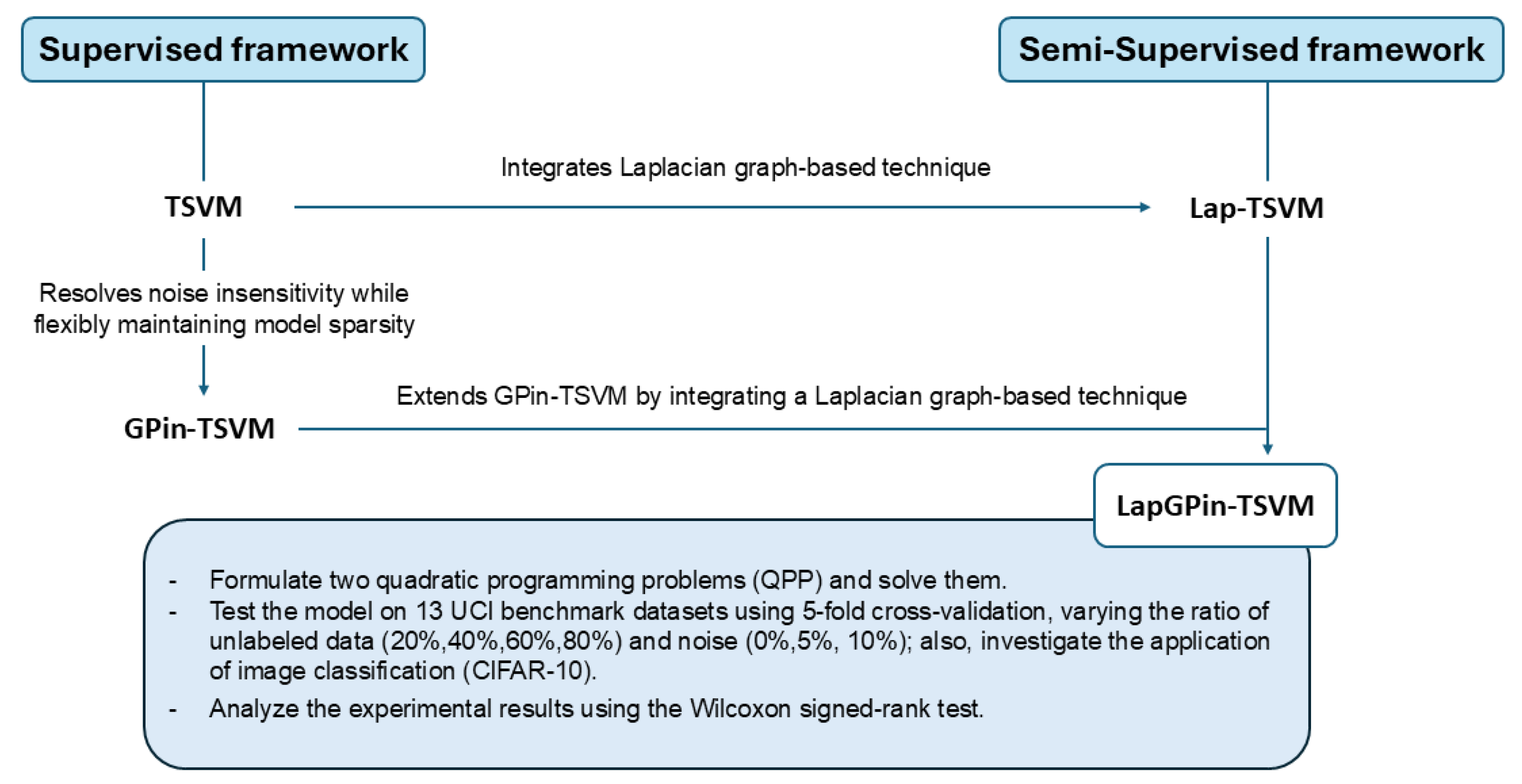
Nowadays, unlabeled data are abundant, while supervised learning struggles with this challenge as it relies solely on labeled data, which are costly and time-consuming to acquire. Additionally, real-world data often suffer from label noise, which degrades the performance of supervised models. Semi-supervised learning addresses these issues by using both labeled and unlabeled data. This study extends the twin support vector machine with the generalized pinball loss function (GPin-TSVM) into a semi-supervised framework by incorporating graph-based methods. The assumption is that connected data points should share similar labels, with mechanisms to handle noisy labels. Laplacian regularization ensures uniform information spread across the graph, promoting a balanced label assignment. By leveraging the Laplacian term, two quadratic programming problems are formulated, resulting in LapGPin-TSVM. Our proposed model reduces the impact of noise and improves classification accuracy. Experimental results on UCI benchmarks and image classification demonstrate its effectiveness. Furthermore, in addition to accuracy, performance is also measured using the Matthews Correlation Coefficient (MCC) score, and the experiments are analyzed through statistical methods.
Keywords: twin support vector machine (TSVM); semi-supervised learning (SSL); Laplacian matrix; generalized pinball loss twin support vector machine (TSVM); semi-supervised learning (SSL); Laplacian matrix; generalized pinball loss