1. Introduction
Vector integrable nonlinear equations still continue to attract active attention (see, for example, [
1,
2,
3,
4,
5,
6,
7,
8,
9,
10]). Mainly, the vector nonlinear Schrödinger equation is considered. Much less work is devoted to the derivative form of the vector equation (see, for example, [
11,
12,
13,
14,
15,
16,
17,
18,
19]). Scalar forms of the derivative nonlinear Schrödinger equation are given much more attention (see, for example, [
20,
21,
22,
23,
24,
25]). Note that for each derivative nonlinear Schrödinger equation, its vector form is obtained, and multi-soliton solutions of these vector forms are investigated. Attention to two-component variants of the nonlinear Schrodinger equation is due to the fact that with the help of double-polarized waves, twice as much information can be transmitted over an optical fiber [
26,
27,
28,
29]. In practice, it turns out that it is much more difficult to recover encoded information from a two-component signal. Apparently, this is due to the results obtained in our work. When transmitting information, it is assumed that each component is independent and carries its own part of the information. As we proved earlier [
30], the spectral curve is invariant with respect to the orthogonal transformation of the solution. I.e., it does not depend on the individual components of the solution, but on their symmetric functions. This statement is also true for the equations from our current work. This is one of the possible reasons for the difficulty of recovering information from the transmitted signal. The second possible reason most likely follows from the fact that the spectral curve corresponding to a solution with linearly dependent components is greatly reduced. The correctness of this statement can be seen in the examples from this work. Therefore, when transmitting signals that differ slightly from each other, some information about the spectral characteristics of the signals may be lost. In addition, as our examples show, the genus of the spectral curve far exceeds the number of phases of the solution. Thus, part of the spectral data is redundant. Also, as we show, in the case of the vector equations, first of all, we get the law of transformation of the length of the solution vector, and then the rule of direction transformation. When replacing the components of a vector by its length and vice versa, information loss may occur. Thus, based on the results of this work, we can advise transmitting information not in Cartesian coordinates, but in polar ones.
In this paper, we use the monodromy matrix method (see, for example, [
1,
20,
30]) to construct a hierarchy of the Gerdjikov–Ivanov vector equation and investigate the simplest solutions of equations from this hierarchy. As a rule, in the works devoted to the study of vector nonlinear equations, the individual components of the vector are analyzed. At the same time, sometimes there are works (see, for example, [
7]) in which the behavior of the length and tangent of the angle of inclination of the vector is investigated. Our studies of the simplest solutions have shown that in the case of a vector nonlinear equation, the evolution of a vector can naturally be divided into two components: the evolution of the length of the vector and the evolution of its direction. Note that this statement is also true for the Manakov system, which can be seen by looking at the calculations in [
1]. For example, assuming
and
, where
, we have
and
If the reduction has the form
then the angle
becomes purely imaginary
, where
. In this case, the “direction” of the vector
is defined by the function
. Thus, if
, then it is possible to construct solutions that satisfy the reduction
. If
, then the solutions will satisfy the reduction (
3). When
, the second component of the vector
is missing (
). The reduction sign
is determined by the sign of the function
u:
Note that the functions
u,
v, and
naturally appear during calculations. Also, note that from Equation (
1) it follows that
. Therefore, to plot the amplitudes of the individual components
of the vector
, it is enough to find
. The analysis of the examples showed that when the direction of the vector
is independent of the coordinate and time (
), the spectral curve splits into two separate components, and the dynamics of the solution is determined by a spectral curve of a smaller kind than in the case when the direction of the vector
changes depending on the coordinate and time.
The presented article consists of an introduction, four sections, and concluding remarks. In the first section, we define the Lax operator, define the monodromy matrix, find recurrent relations between its elements, and derive the equation of spectral curves associated with multiphase solutions. In
Section 2, we define the second Lax pair operators and obtain vector integrable nonlinear differential equations from the hierarchy of the Gerdjikov–Ivanov vector equation. The first equations from this hierarchy have the form
and
If we replace vectors with scalars in these equations, we obtain the Gerdjikov–Ivanov equation and one of the forms of the mKdV equation.
In
Section 3, we consider solutions in the form of plane waves. We show that there are two types of plane waves that differ in the properties of their spectral curves. If
, where
is a constant vector, then the equation of the spectral curve does not depend on the direction of the vector
, in another case, the equation of the spectral curve depends on the direction of the vector
. In the case when the direction of the vector
is fixed, the corresponding spectral curve splits into separate components.
In the fourth section, the simplest nontrivial solutions of the Gerdjikov–Ivanov vector equation are investigated. In this case, the function
u is an elliptic function or its degeneracy, and the function
depends on the function
u according to the following formula:
where
. Note that the simplest nontrivial solutions are also divided into two types. If
, then the direction of the vector
is fixed, only its length changes. The spectral curve of such a solution also splits into two components. If
, then the vector makes small fluctuations near the direction given by the equality
. The amplitude of these oscillations satisfies the condition
. Therefore, if
, then
, and from
follows the inequality
.
2. The Monodromy Matrix
Let the Lax operator have the form
where
,
.
Let us consider Equations (
4) and (
5) with matrices (
6). The monodromy matrix
M is a polynomial of the spectral parameter
, and satisfies the equation (see, for example, [
1,
31])
From Equation (
7), the following structure of the matrix
M follows:
where
,
,
,
The elements of the matrix
satisfy the following recurrence relations
From Equation (
7), in addition to the recurrent relations (
9), stationary equations also follow. Any
m-phase solution for
and for all values of
t and
z satisfies these stationary equations. As in the case of scalar derivative nonlinear Schrödinger equations [
20], stationary vector equations form two groups. For
, stationary vector equations have the form
and
Note that since the structure of matrices depends on parity, the scalar stationary equations for even and odd n have a different form. The compatibility of this overridden system of equations imposes restrictions on the constants .
Other stationary equations, which are satisfied by multiphase solutions, can be obtained from the equations of the spectral curve. Recall that the equation of the spectral curve of the multiphase solution is the characteristic equation of the monodromy matrix [
31]:
From Formula (
8), it follows that the equation of the spectral curve
has the form
where
3. Integrable Nonlinear Equations
Let us define the second equation of the Lax pair by the equation
Then, the following integrable nonlinear evolutionary equations:
follow from the Lax pair compatibility condition.
Thus, the first equations from this hierarchy have the forms
and
For
and
, where
,
, Equations (
13) and (
14) transform to coupled Gerdjikov–Ivanov equations
and to coupled complex mKdV equations
Since any solutions of the equations from the Gerdjikov–Ivanov hierarchy, after multiplying them by a constant vector
, will satisfy Equations (
13) and (
14), then these equations can be considered as vector forms of the Gerdjikov–Ivanov and mKdV equations. These equations, as well as the Manakov [
1], Kundu–Eckhaus [
30], and Kulish–Sklyanin equations, are invariant with respect to the orthogonal transformation
T of solutions. The proof can be found in [
30]. Since the transformation
T is simultaneously a transformation of the similarity of the monodromy matrix
M, we can assume that the matrix
is diagonal. Solutions with a non-diagonal matrix
can be obtained by orthogonal transformation of solutions corresponding to the diagonal matrix
. Note that the equations of spectral curves of multiphase solutions of equations from this hierarchy are also invariant with respect to this transformation.
4. Solutions in the Form of Plane Waves
Let
. Then,
, where
,
. The first set of stationary equations has the form
Solving these equations, we have
It follows from Equations (
1) and (
15) that the functions
do not depend on
x:
Substituting (
15) into the second set of stationary equations, we obtain the following equalities:
Therefore, the system of stationary equations is compatible only if one of the two conditions is met. Or , or and .
From Equation (
13), the equalities
and
follow. Hence (see (
2)),
,
, and
It is not difficult to see that the solutions (
16) satisfy the reduction
Thus, for
, the solution of Equation (
13) is plane waves of constant amplitude
and constant direction. But there can be two types of plane waves.
For
,
and
, the coefficients of the equation of the spectral curve (
10) are equal
Since the discriminant of the polynomial
with coefficients (
17) is a polynomial of
of degree 8
then the curve (
10), (
17) has eight branching points. Using the Riemann–Hurvitz formula, we obtain that the genus of the spectral curve
is equal to 2. Therefore, in this case, the coefficients
are functions of the constants determined by the parameters of the curve
of genus
, invariant under the involution.
So, apparently, the solution is determined by the parameters of the curve .
Note that in this case the complex phases of the components depend on v, i.e., on the direction of the vector .
For
,
, and
,
, the equation of the spectral curve (
10) takes the form
Therefore, in this case, the spectral curve decomposes into two components. These components are described by the solutions of Equation (
18):
Hence, in this case, the genus of both components is zero.
Note that in this situation, the complex phases of the components coincide and do not depend on the direction of the vector . That is, when , the solution to the vector equation of Gerdjikov–Ivanov is a product of the solution to the scalar Gerdjikov–Ivanov equation and a constant vector.
Also, these two types of plane waves differ in the dependence of the spectral curve equation on the direction of the vector . When , the equation of the spectral curve depends on the direction of the vector , while when , the equation of the spectral curve does not depend on the direction of the vector .
5. Solutions for
Let . Then, , where , .
The first set of stationary equations has the form
Solving these equations for
, we obtain
where
.
Substituting (
19) into the second set of stationary equations, we obtain the conditions:
and
(
). Since this case is analogous to the second case from the previous paragraph, we will omit it.
For
, the first set of stationary equations is satisfied when
, and the second set takes the form
or
Let us make the substitution into Equation (
20):
where
,
.
After simplification, we obtain
and
where
are constants of integration.
The transformation of (
23) using relations (
2) gives us the following equalities:
To obtain additional relations for the functions
u and
v, let us consider the coefficients of the spectral curve Equation (
10), which in this case are equal to
where
It is easy to see that the spectral curve (
10), (
25) possesses a holomorphic involution:
That is, this spectral curve has symmetry.
Usage the additional integrals (
26) allows us to proceed from Equation (
24) to the following equations:
and
Integrating (
27), we obtain
where
is a constant of integration.
Therefore, the function
is an elliptic function or its degeneration. From Equations (
24), (
26), and (
29), it follows that
Let us replace the function
v with
in Equation (
28). From relations (
24), (
27)–(
29), it follows that the function
satisfies the equation
From this equation, it follows that the function
has the form
where
,
.
It is easy to see that if
or
, the direction of the vector
is fixed (
). In other cases, it depends on its length
according to the formula (
30).
It is obvious that the coefficients in Equation (
30) are real in one of the two cases.
Then, , which implies that for continuous real .
In the second case:
and
. Therefore, in this case, for continuous real
, the inequality
holds.
From Equation (
13), it follows that for
, the dynamics of the functions
and
is described by the following relations:
Therefore,
where
, and the function
satisfies Equation (
29). Substituting (
30) into (
31), we obtain
Therefore,
where
is a solution to the equation
. Thus, if
, then the dynamics of the vector direction differ from the dynamics of its length.
5.1. Case of Elliptic Function
Let
where
, and
is the Jacobi elliptic function [
32,
33], satisfying the equation
Then,
where
,
,
, and Equation (
29) takes the form
In this case,
where
, and
satisfies the equation
Since
, for the reality of the solution, it is necessary to set
or
. In this case, the solution will satisfy the reductions (
3).
From Equation (
34), the following equalities follow:
The calculation of the integral
yields the following result:
To calculate the integral
, we will use the following identity:
where
is the Weierstrass elliptic function satisfying the equation
Continuing the calculations in terms of Weierstrass elliptic functions, we have
Since
, then Re
. Consequently,
,
,
and
where
, Re
.
Since
then
and
where
.
Since this solution is given by quite intricate expressions, we will not explicitly write out the formulas for the components and .
The spectral curve of this solution is determined by Equation (
10), where
The discriminant of the polynomial is a polynomial of degree 14 in the spectral parameter with a double root at . Therefore, the spectral curve is a degeneration of an algebraic curve of the genus 5.
5.2. Case of a Rational Function
Let
where
. Then,
where
,
,
. With these values of constants, Equation (
29) takes the form
Since
then, for
and
the condition
is satisfied. If
and
, then
.
In this case,
where
Simplifying Equation (
36), we obtain
In the case of
or
the function
is constant. If
, then
and
The relations (
21), (
22), and (
2) imply the following equalities:
where
. The dependence of the solution (
38) on
was found from Equation (
13).
It is easy to see that when
the solution (
38) satisfies the reductions
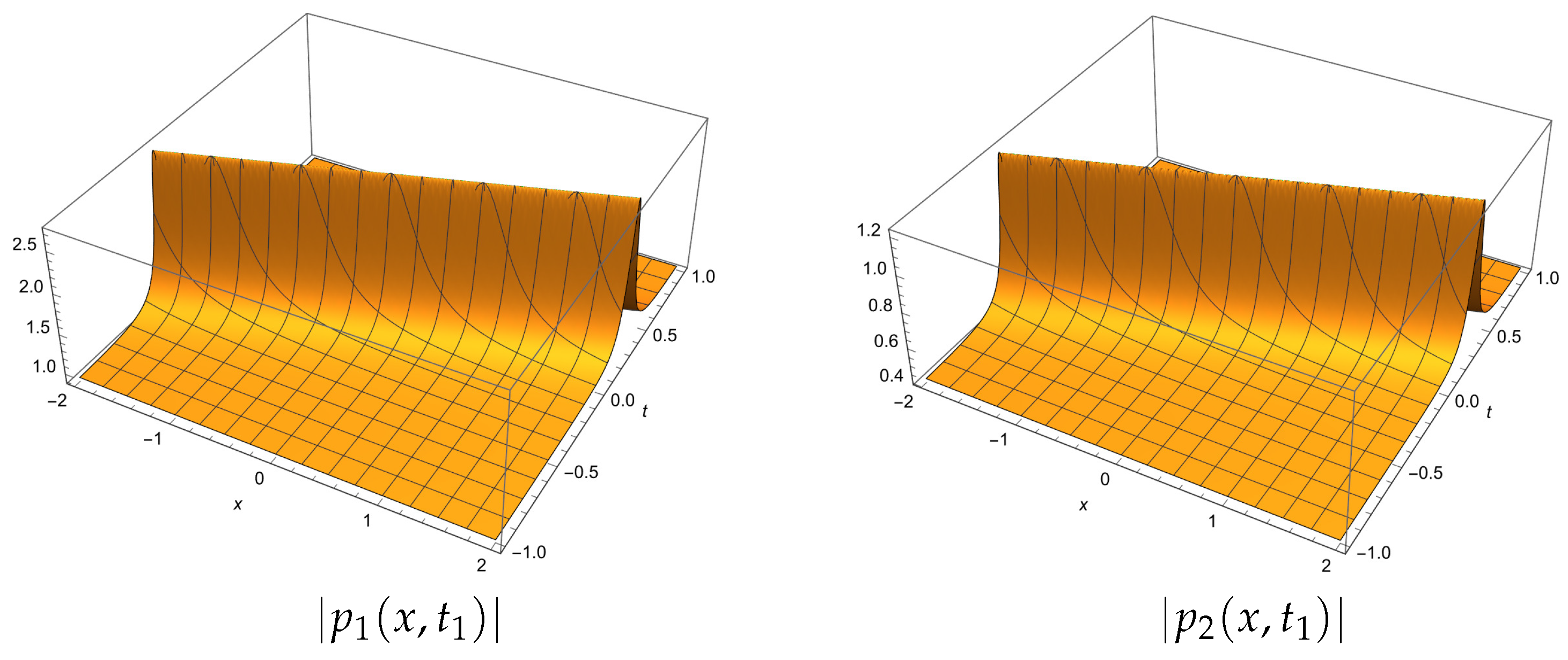
. The amplitudes of the solution components are depicted in
Figure 1.
The equation of the spectral curve for solution (
38) takes the form
Note that since the solution components
and
are linearly dependent, the spectral curve splits into two. The first one is rational and is defined by the equation
The equation for the second component of the curve is given by
In other words, the second component of the curve (
39) represents a degenerate hyperelliptic curve of genus
. The presence of branch points of the third order on the spectral curve corresponds to the existence of solutions in terms of rational functions.
If the function
is defined by Equation (
37) and
, then
where
Here, and are initial phases.
Equation (
13) is two-phased and represents a nonlinear superposition of rational and trigonometric functions. In other words, the solution is a traveling rational wave on a trigonometric background. Expressions for the components
and
can be obtained from Equations (
21) and (
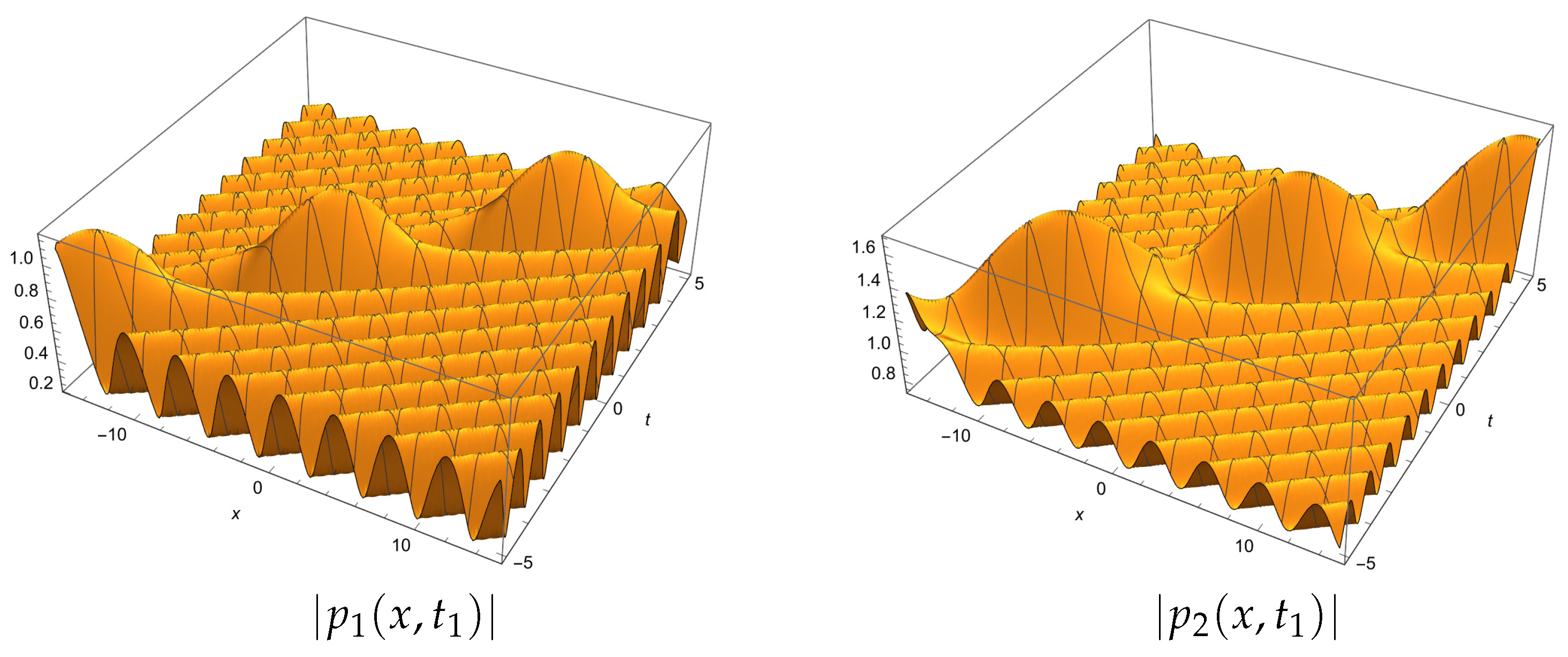
22). The amplitudes of the components of this solution are shown in
Figure 2.
In this case, the equation of the spectral curve has the form given in (
10), where
The discriminant of the polynomial
with coefficients given by (
40) is equal to
Therefore, the spectral curve (
10), (
40) is degenerate. It has two branch points of the third order and four branch points of the first order. The presence of branch points of the third order indicates a dependence of the solution on rational functions.
5.3. Case of the Function in the Form of a Soliton
Let
where
. Then,
where
,
,
.
With these values of constants, Equation (
29) takes the form
Then, the solution will be real when
. In other words, Function (
41) corresponds to the inequality
.
In this case, Equation (
30) can be written in the following form:
Both integrals in this equality depend on the relationship between a and .
Let
and
. Then the solution of Equation (
30) has the form
From Equations (
2) and (
42), it follows that
where
,
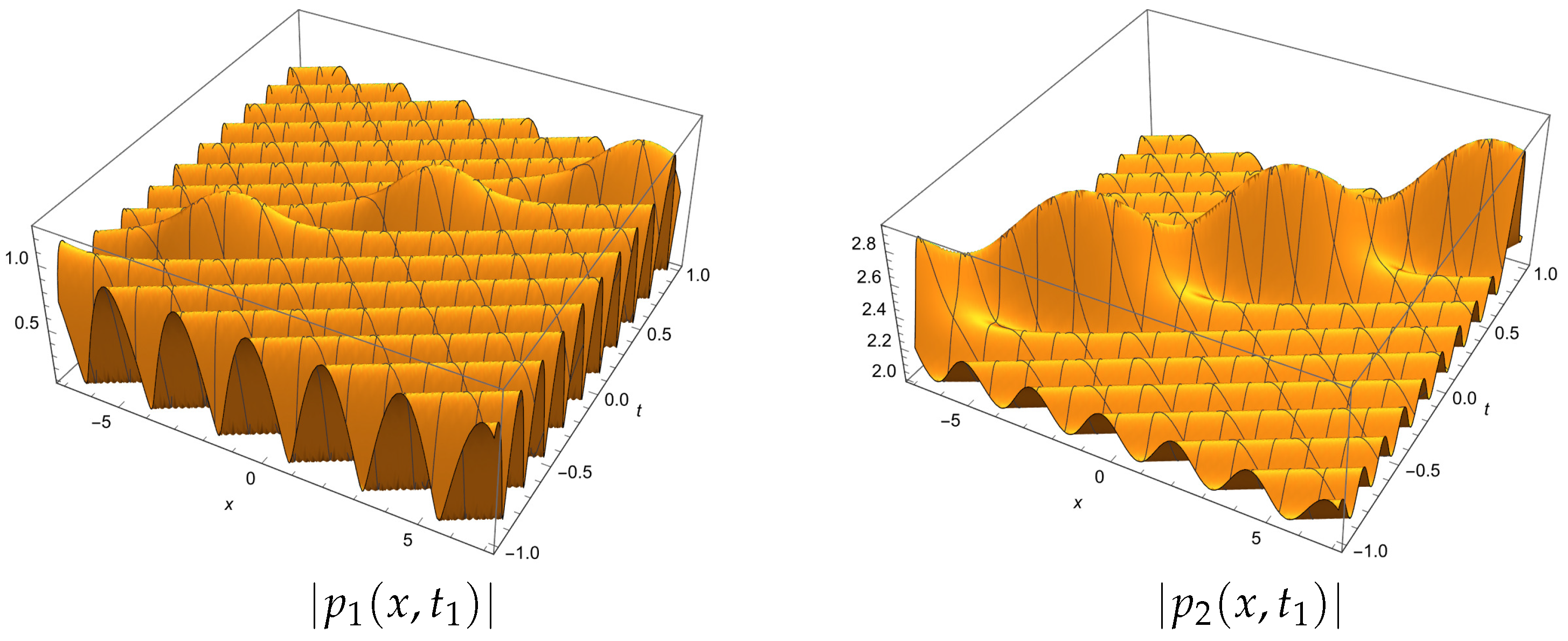
. The amplitudes of the components of this solution are shown in
Figure 3.
In this case, the equation of the spectral curve has the form (
10), where
The discriminant of the polynomial
with coefficients (
43) is equal to
Therefore, the spectral curve (
10), (
43) is degenerate. It has three branch points of the second order and four branch points of the first order.
5.4. Case of the Function in the Form of a Dark Soliton
Let
where
. Then,
where
,
,
,
. With these values of constants, Equation (
29) takes the form
Since
Therefore, the inequality
is true under the following conditions:
With these parameter values, Equality (
30) takes the form
where
Using trigonometric identities, we obtain the following relation:
where
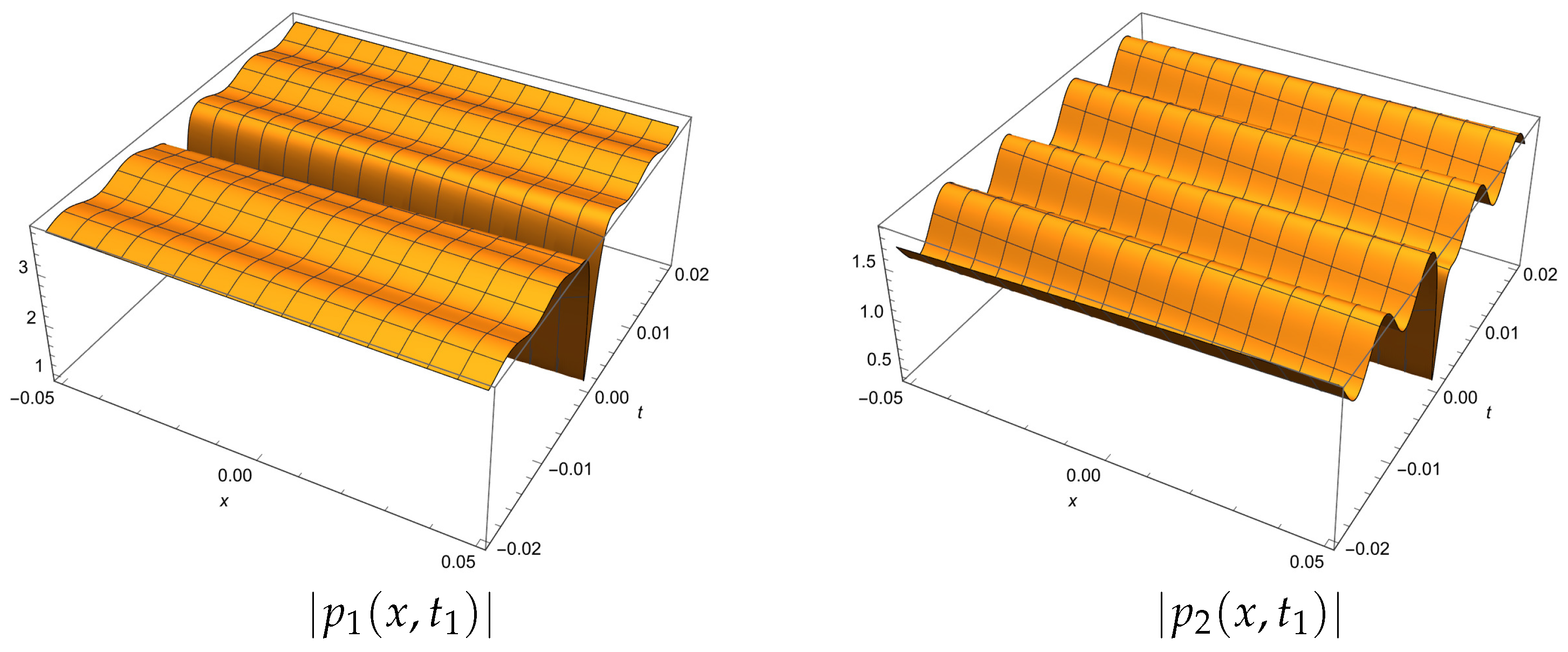
In
Figure 4, the amplitudes of the solution components are depicted, where the length of the solution is equal to
, and
u is determined by Equation (
44).
The coefficients of the equation of the spectral curve (
10) in this case are
The discriminant of the polynomial
with these coefficients is
Therefore, in this case, the spectral curve is also degenerate. It has two complex conjugate branch points of the second order and three pairs of complex conjugate branch points of the first order.