Abstract
The use of information–theoretical methodologies to assess graph-based systems has received a significant amount of attention. Evaluating a graph’s structural information content is a classic issue in fields such as cybernetics, pattern recognition, mathematical chemistry, and computational physics. Therefore, conventional methods for determining a graph’s structural information content rely heavily on determining a specific partitioning of the vertex set to obtain a probability distribution. A network’s entropy based on such a probability distribution is obtained from vertex partitioning. These entropies produce the numeric information about complexity and information processing which, as a consequence, increases the understanding of the network. In this paper, we study the Benes network and its novel-derived classes via different entropy measures, which are based on information functionals. We construct different partitions of vertices of the Benes network and its novel-derived classes to compute information functional dependent entropies. Further, we present the numerical applications of our findings in understanding network complexity. We also classify information functionals which describe the networks more appropriately and may be applied to other networks.
Keywords:
butterfly network; Benes network; network complexity; eccentricity; information functionals; entropy via information functionals MSC:
05C09; 05C10; 05C12; 90C35; 94C15
1. Introduction
As a comprehensive model for reflecting many real-world phenomena, networks are becoming more and more significant in modern information science. Network science is able to describe, analyse, simulate, and forecast the behaviours and states of such complex systems due to the amount of data on interactions within them. Thus, it is crucial to classify networks according to their complexity levels to adapt analytical techniques to specific networks. For many applications, network complexity measurement is crucial. For instance, the complexity of the network might influence the progress of many network processes including information diffusion, failure propagation, control-related actions, or resilience preservation. Network complexity has been successfully applied to study software library structure [1], compute chemical structural properties [2], evaluate the effectiveness of business operations [3,4,5], and offer general network characterisations [6,7]. In particular, the interconnection networks (ICNs) may be characterised in several ways based on different parameters. The main performance features are network bandwidth, switch radix, latency, and network topology [8]. The amount of data that may be transferred in a specific amount of the time is known as bandwidth. A packet’s latency is the length of time it takes to move from a source node to a destination node. The number of switch ports used to connect it to other nodes is known as the switch radix. Performance of the node and connecting technology greatly impact on the ICN topology decision. A fat-tree design works well with a limited number of nodes, but with more nodes, the fat tree would have more levels and a greater hop count, increasing latency [8]. Several networks including ICNs have been studied in view of their topology, (see [9,10,11,12,13]). For more on other important aspects of significance networks, see [14] and references therein. The corresponding graphs of fast Fourier transform (FFT) networks, which are capable of performing the FFT very effectively, are known as butterfly graphs. The butterfly network enables the linking of “multiple” inputs to corresponding outputs through a sequence of switch stages and connectivity patterns. Butterflies are paired back-to-back to construct the Benes network. Benes is known for permutation routing while butterfly is known for FFT [15]. Important multistage ICNs with appealing topologies for communication networks are the butterfly and Benes network [16]. They have been employed in optical coupler internal constructions as well as parallel computer systems IBM, SP1/SP2, MIT Transit Project, NEC Cenju-3, and others [17]. The class of multistage interconnection networks, or MIN’s, have long been suggested and studied as the communication network for parallel computers [18]. The topological study of the Benes network is given in [19]. Moreover, through identifications of Benes networks, some other ICNs have been introduced in [20] and studied in terms of the topology of these ICNs in [21,22]. Benes networks constitute a significant part of interconnection networks and have been used in numerous domains, such as on-chip networks [23,24], data centers, and multiprocessor systems [25]. They have also attracted great appeal in optical communications due to the increasing popularity of optical switches based on these architectures [26]. Due to their non-blocking property and the relatively smaller number of cross points, Benes networks have received much attention in industry and academia.
The study of graphs and networks has been a multidisciplinary research area. It has been extensively utilised in diverse fields, where graph-based approaches have been proposed for well-communicating with numerous challenging tasks. Structures of complex networks have been found in many areas, and considerable efforts to learn their properties, such as dynamics, topology, symmetry, and so forth, have been concentrated on these vast and appealing research topics. The relatively significant number of network studies leads to numerous ways to analyse, sample, and interpret them. Graph theory provides a relatively concise way to describe the complexity of networks. Topological indices such as degree distribution, connectance, or network topology perform as fundamental measures to express their structures. Such indices enable comparison between various systems and show variations and commonalities. For instance, see the references [27,28,29,30,31,32,33,34]. More precisely, a fundamental and effective technique in the field of graph theory is to associate graphs to objects that may be an algebraic structure or a chemical structure of medicine or an ICN. These objects are further studied by assigning them a numeric value, which remains invariant under isomorphism, known as a topological index (TI). Several hundred topological indices (TIs) have been introduced and have assisted in exploring many objects, including the above-mentioned ones. These graph invariants are classified in terms of degree, distance, and (or sometimes) eccentricity as well. Among the families of these TIs, a significant class of TIs is eccentricity-dependent TIs. Several eccentricity dependent TIs (EDIs), along with their applications, are introduced and assisted in solving/understanding different problems/objects. Lesniak [35] did important work on the eccentricity distribution in 1975 by introducing the notion “eccentric sequence”, which represents the sequence that is used to count the number of occurrences of each possible value of eccentricity. For instance, the facility location problem tells us about the effectiveness of eccentricity in the measurement of centrality. In case, when we consider the organisation of emergency facilities such as a fire station or a hospital, the map is represented as a graph; the least eccentric value vertex may be suitable for such a structure. In other circumstances—for instance, for establishing a shopping centre—a corresponding measurement named “closeness centrality”, described as average distance of a vertex to each vertex, is more appropriate. Thus, eccentricity is an applicable criterion when some strict standard has to be met [36]. The network routing graph is a larger-scale use of eccentricity as a measure, where the eccentricity of a vertex conveys information about the worst-case reaction time between one device and all other devices. For more on EDIs, we refer [37,38,39,40,41]. Here, we also use EDIs as a fundamental tool applied in two steps: in the first step, directly; and in the second step, indirectly. Additionally, as previously mentioned, there has been a lot of interest lately in using information–theoretical approaches to evaluate graph-based systems. As a result, multiple graph entropies have been proposed and explored in order to understand graph-based systems. Shannon’s entropy is well-known and the most original one; for more information, see [42]. The introduction of new entropies also made a substantial contribution in many ways. See [43,44] for more information on Dehmer’s excellent work in using entropy to understand networks. A comprehensive framework for defining the entropy of a graph is introduced in [44]. This definition is based on a local information graph and information functionals that are generated from a specific graph’s topological structure. More specifically, a graph’s structural information is quantified by an information functional using a probability distribution. The entropy of a graph can be obtained simply via such a probability distribution. The obtained graph entropy is utilised to interpret and define the structural information content of a graph.

2. Objectives and Hypothesis
This paper studies Benes networks and their novel-derived classes via different entropy measures based on information functionals. We use some information functionals which are dependent on EDIs. We construct different partitions of vertices of the Benes network and its novel-derived classes to compute information functional dependent entropies. In the first step, through these partitions, we derive formulae for EDIs. Then, via different EDIs, we generate information functionals. By using the general framework defined in [44], we apply these information functionals to construct formulae of entropies and derive formulae for the Benes network and its novel-derived classes. Further, we present the numerical applications of our findings in understanding network complexity. We also classify information functionals which describe the studied networks more appropriately and may be applied to other networks. In the next section, we include technical details of EDIs, information functionals, information functional-based entropies, and the construction of the networks. We also describe the methodology of proofs in this section. After this, we prove formulae for EDIs and information functional-based entropies for the Benes networks and its novel-derived classes. Finally, we present the numerical applications of our findings in understanding network complexity using numeric tables and graphs, and give concluding remarks. We also promote such information functionals which describe complexity more appropriately and thus can be effectively used to study other network complexities.
3. Materials and Methods
The current section is devoted to recalling necessary fundamental notions about graphs, the TIs, and the information functional-based entropy measures which assist in studying the complexity of the networks. Moreover, the mathematical representations of the Benes network, its novel-derived classes, and the methodology applied to establish formulae are also described. By , we denote a graph with vertex set V and an edge set E; for , its degree, eccentricity, and neighbourhood are represented by , , and , respectively, (see [45]). Similarly, for , we denote by (and ) the product (and sum) of all degrees of the vertices in its neighbourhood; that is, (and ). The formulae of several distance (and degree) dependent TIs, including eccentric connectivity index (ECI ), total eccentricity index (TEI ), first Zagreb eccentric index (FZEI ), augmented eccentric connectivity index (AECI , and modified eccentric connectivity index (MECI based on , , and , are listed in Table 1.
Table 1.
Eccentricity dependent TIs.
The following framework for defining information functional -based entropy measures for a graph G is given in [44].
Here is considered with base e. With the help of Equation (1), and particular informational functions, several informational functional-based entropy measures were introduced in [51]. The explicit formulae of these entropies are given in Table 2.
Table 2.
Eccentricity dependent entropies.
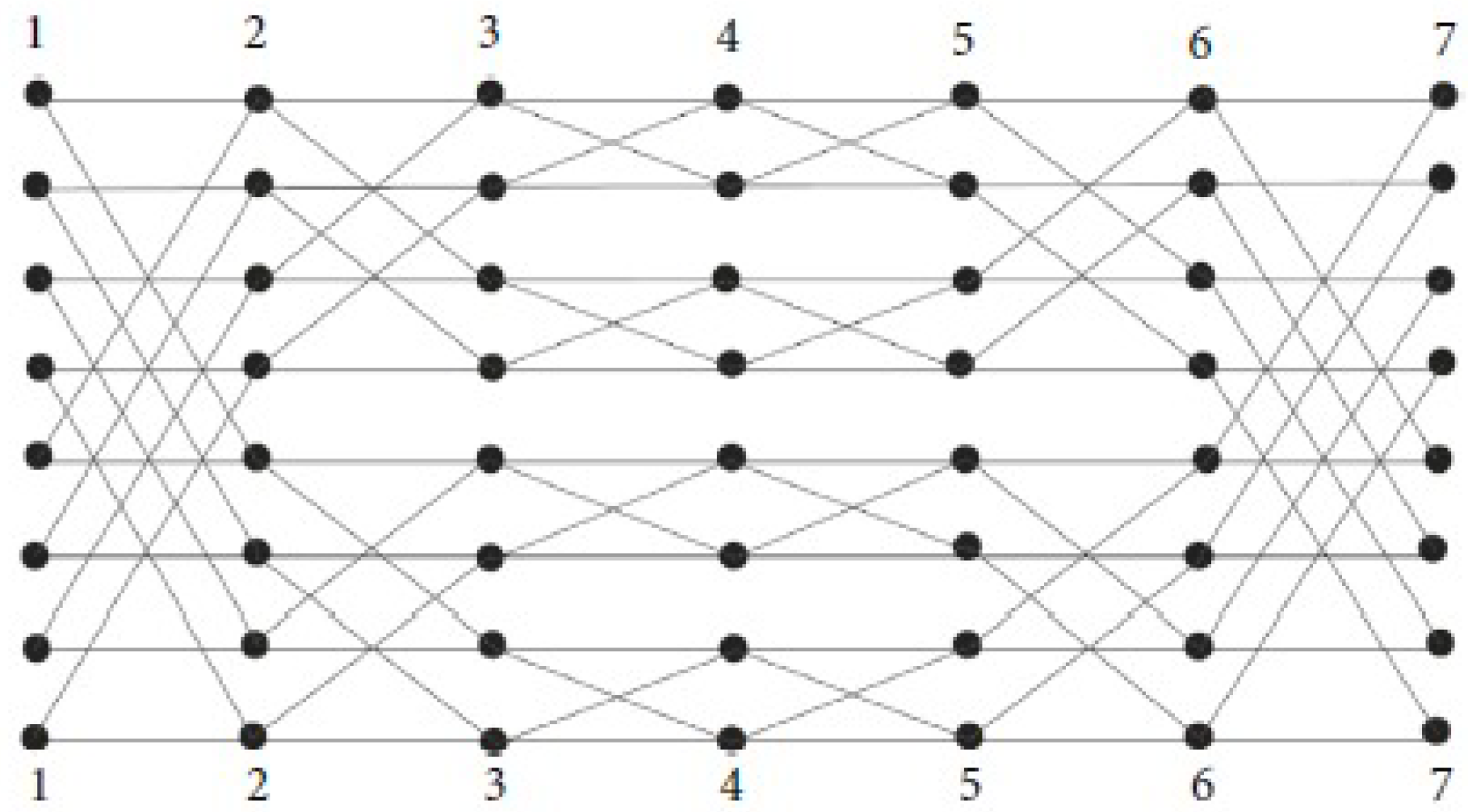
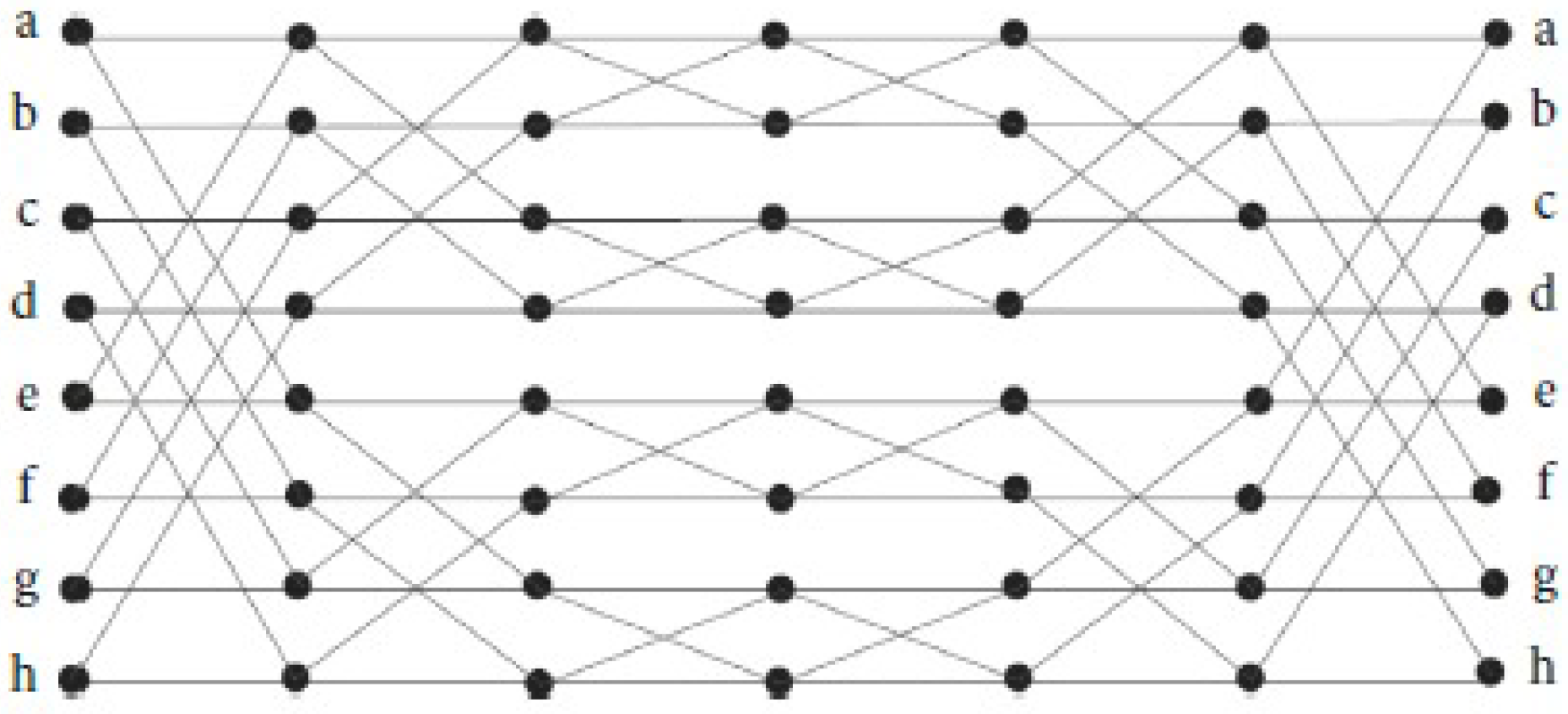
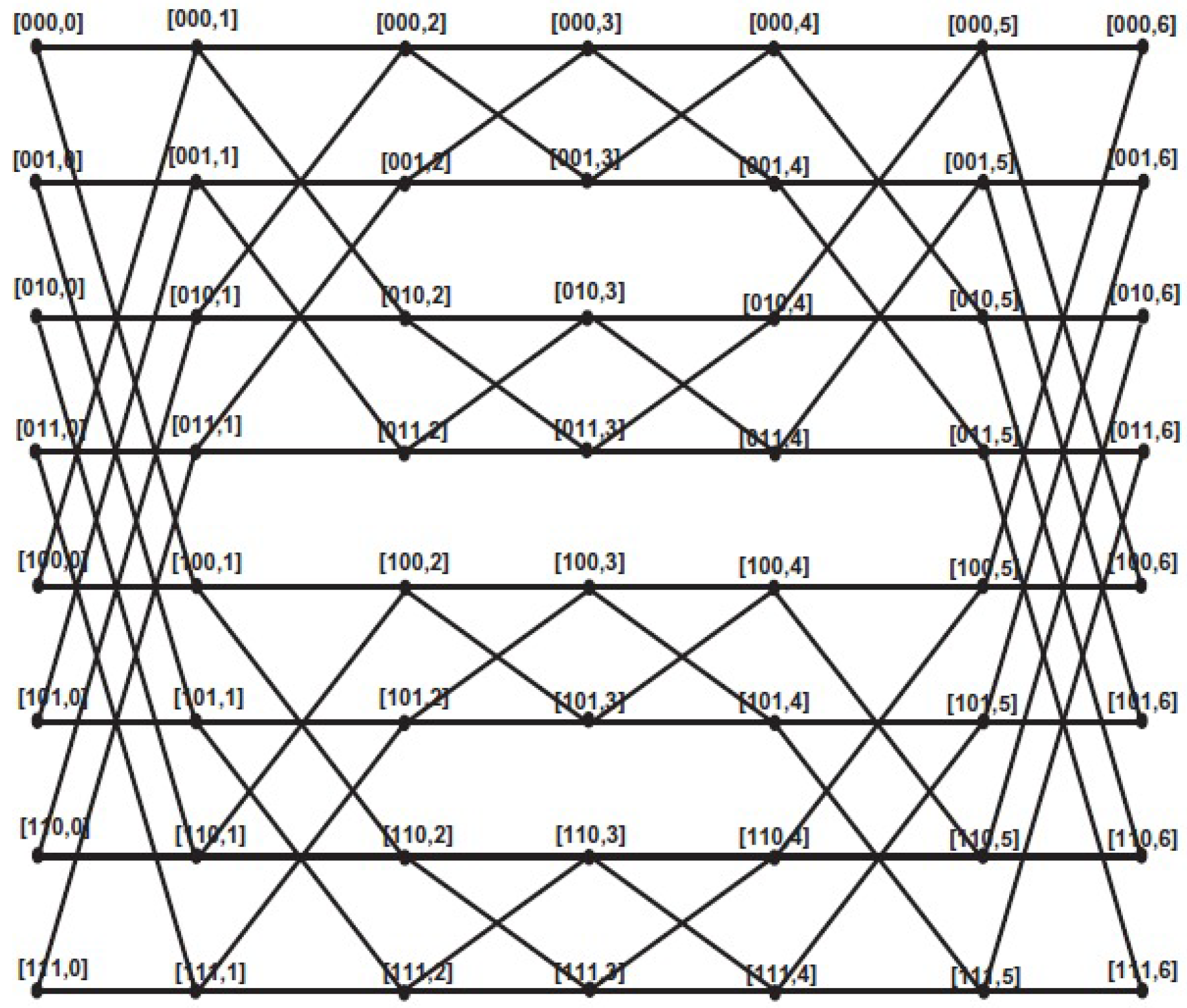
Before proceeding further, we describe the graph associated to networks , , and , with . An -dimensional butterfly network consists of the vertex set V with elements in which v is an -bit binary number representing the row of the node and . The edge between any two vertices and exists if and only if and either or v, differ in exactly the ith bit. Clearly, for and . Further, an -dimensional Benes network is obtained by connecting back-to-back butterflies . An -dimensional Benes network is denoted by ; for example, is shown in Figure 1. Further, and . For more regarding the structure and construction of butterfly and Benes networks, we refer the readers to [13]. By keeping in view the importance of these networks, Hussain et al. recently introduced some families of graphs obtained by Horizontal and vertical identifications of the Benes network; these new graphs are known as Horizontal Cylindrical and Vertical Cylindrical . In these networks, , , and . For the complete details regarding the structures and , see [20,21] and Figure 2 and Figure 3.
Figure 1.
Normal representation of B(3).
Figure 2.
Normal representation of .
Figure 3.
Normal representation of .
From the TIs given in Table 1, the for was formulated and proved in [19].
Theorem 1
([19]). For a Benes network ,
Here, in this paper, we study , , and via different entropy measures based on information functionals given in Table 2. The information functionals implemented are dependent on the EDIs of Table 1. In the first step, we derive formulae for the EDIs and then, via these EDIs, we generate information functionals. By using the general framework defined in Equation (1), we apply these information functionals to construct formulae for entropies (given in Table 2) and derive formulae for , , and . Further, we the present numerical applications of our findings in understanding network complexity. We also classify information functionals which describe the studied networks more appropriately and may be applied to other networks. The strategies used in our measures are combinatorial registering, vertex partition scheme, and eccentricity-counting of vertices. Moreover, we utilised Maple for computations and Chemsketch for drawing the Figures. Partition is a vital topic in graph theory, and it also plays an essential role in numerous other graph problems in various settings. For example, labelling is a classical vertex partition problem that gives all the vertices in the graph a positive integer related to special needs. It is a suitable tool which is widely used in computer networks.
4. Results
In this section, we prove the main results of this paper in three subsections corresponding to , , and .
4.1. Eccentricity Based Indices and Entropies for Benes Network
The current subsection is devoted to the study of Benes networks through eccentricity dependent TIs and entropy measures. In , among vertices, vertices are of degree 4, whereas vertices are of degree 2. On the other hand, the eccentricity for each vertex v in is . The cardinality of edge set in is . Furthermore, a partition of on the basis of and is given in Table 3.
Table 3.
Vertex partition of on the basis of their neighbours.
Theorem 2.
For with , we have:
- (only this part is also given in [19]).
- .
Proof.
The parts , , and follow directly from the definitions given in Table 1 and the facts that and for each . For the remaining two parts, we use Table 1 and Table 3, that is
and
□
Now, we extend our findings in this section by formulating and proving analytical formulae for the eccentricity-dependent entropies defined in Table 2.
Theorem 3.
For with , we have
- .
4.2. Eccentricity Based Indices and Entropies for
In this subsection, we develop analytical formulae of eccentricity-dependent TIs and entropies for the network . The key to proving these results is to develop partitions of the vertex set in terms of degree, eccentricity, , and . See Table 4 and Table 5.
Table 4.
A partition of in terms of eccentricity and degree.
Table 5.
A partition of in terms of eccentricity, , and .
In the next theorem, we prove eccentricity dependent TIs for with .
Theorem 4.
For with , we have:
- .
Proof.
□
4.3. Eccentricity Based Indices and Entropies for
Similar to the results obtained in previous subsections, the formulae for the eccentricity dependent TIs and entropy measures for are obtained in this subsection. The results are can be proved on the same lines after observing that the eccentricity of for each vertex v in is .
Theorem 6.
For with , we have:
- .
Theorem 7.
For with , we have:
- .
- .
- .
- .
- .
5. Complexity Analysis via Numeric Tables and Graphs
In the current section, we present the complexity analysis by implementing the formulae proved in this manuscript. Similar to the work of Dehmer [44], we apply the formulae of entropy to compare the complexity of the studied networks. Since the Benes network is the core network and the networks and are produced from via horizontal and vertical identifications, the natural comparison could be between the complexity of and , and . In step 1, we present the comparisons of eccentricity-dependent TIs of with corresponding TIs of and via Table 6. It appears that the values of TIs , , and for tend to remain higher than the corresponding values for . However, this trend is reversed for and . The comparison of trends of values of these TIs is similar for and , except the fact that corresponding values remain the same in the case of , and the trend is reversed for .
Table 6.
Numerical values of eccentricity-dependent TIs for , , and .
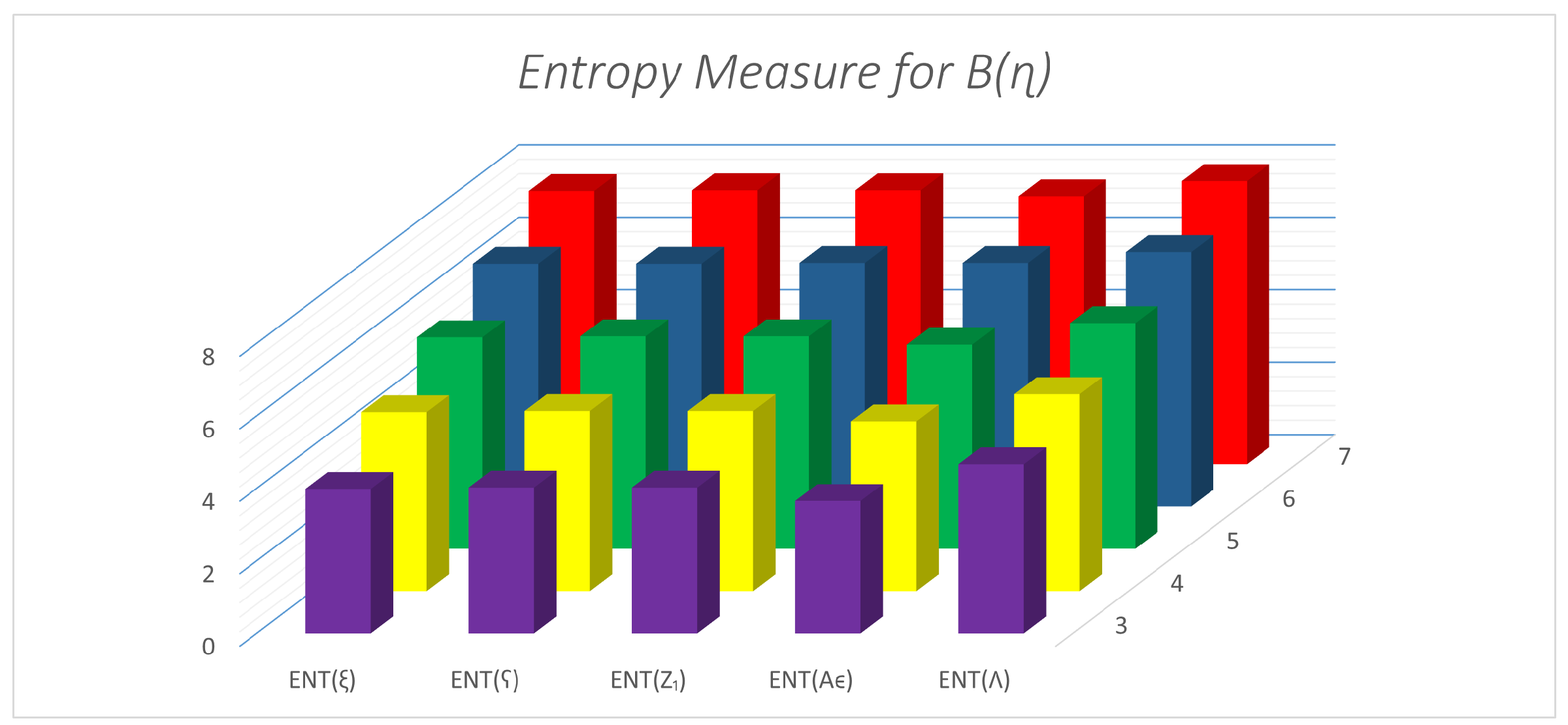
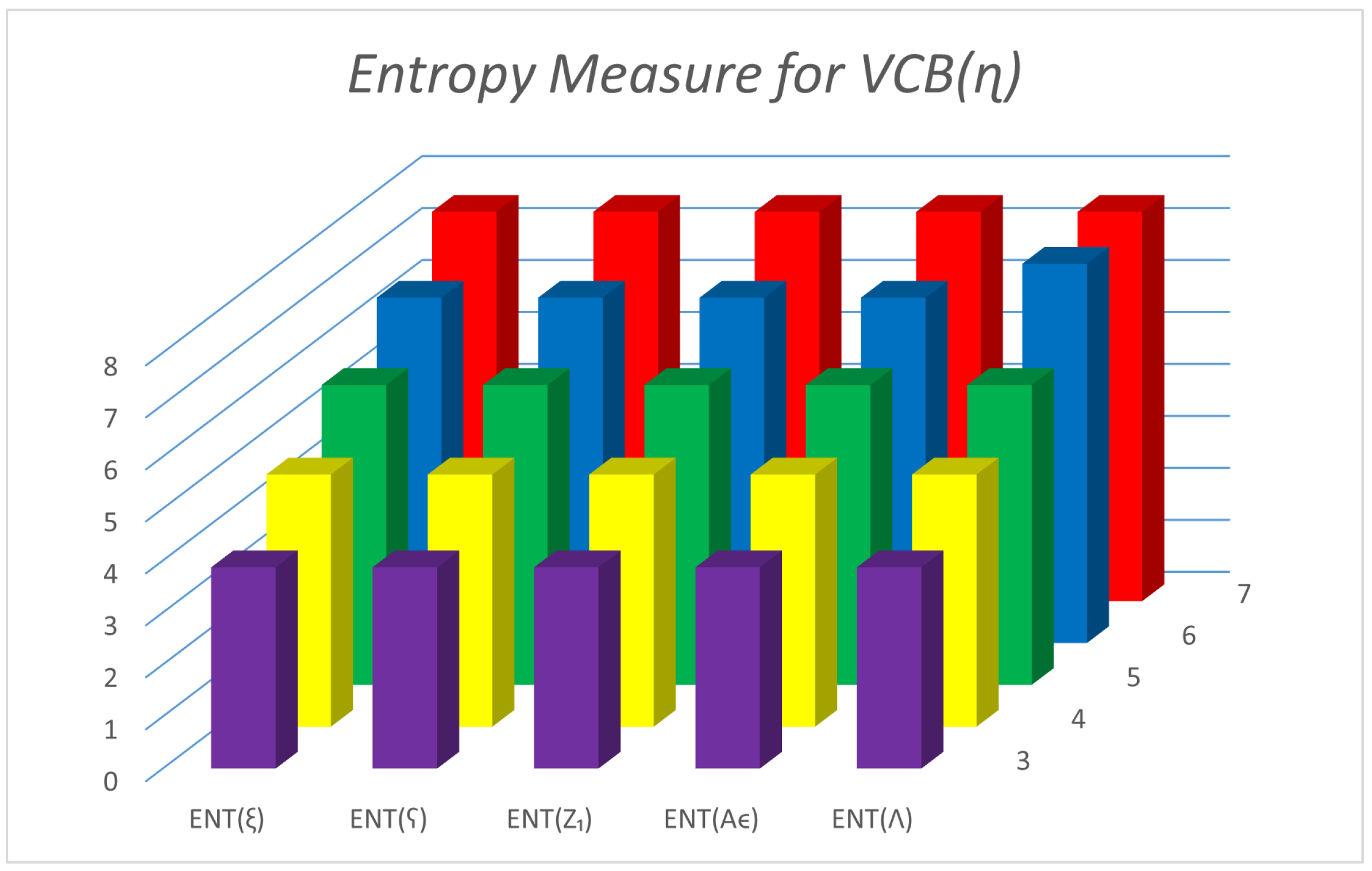
The step 2 analysis is rather more conclusive and informative as it shows applications of the computed formulae of this manuscript in understanding the complexity of the studied networks , and, . The objective is to compare complexities of the network with its derived networks and , separately, by using Table 7. Figure 4 presents the behaviour of entropies from information functionals based on the eccentricity-dependent TIs for , and Figure 5 and Figure 6 show the corresponding trends of entropies for and . Note that these entropies are based on eccentricity-dependent information functionals, and since the Equation (1) proposes a mechanism of producing different entropy formulae, it is also important to know which functionals are more appropriate compared to others so that the more appropriate ones can be promoted to investigate the entropy measures or implicative complexity or other properties of other significant families of the networks. While analysing entropies of and , we note that the entropies produced from , , , and demonstrate a significant pattern. Elaborating this pattern in terms of complexity suggests that the structure is less complex compared to . However, this pattern is opposed when we use an information functional based on . Similarly, while comparing the complexities of and , the trends show that is less complex when we use , , , and TIs-based information functionals. However, the trend is the opposite for . As a result, we conclude that information functionals based on , , and produce a significant trend and elaborate complexity comparisons very effectively. Lastly, we point out that the difference of all the entropies is decreasing when we increase the value of . It is also a true reflection because when is large, networks are the same for the most part and only differ on boundaries (Horizontal and vertical).
Table 7.
Numerical values of eccentricity-dependent Entropies for , , and .
Figure 4.
The patterns of Entropies of from information functionals based on eccentricity-dependent TIs.
Figure 5.
The patterns of Entropies of from information functionals based on eccentricity-dependent TIs.
Figure 6.
The patterns of Entropies of from information functionals based on eccentricity-dependent TIs.
6. Conclusions
In models reflecting real-world problems, the classification of networks based on their complexity levels is vital due to its influence on information diffusion, failure propagation, control-related actions, and resilience preservation. Through topological indices and information functional-based entropies, graph theory provides a relatively concise way to describe the network complexity. The information functional-based entropies provide a formula for computing the entropies of graphs/networks and produce a mechanism for obtaining a model to compute entropy measures. Thus, from the family of ICNs, the butterfly and Benes networks are vital due to their role in optical coupler internal constructions as well as parallel computer systems IBM, SP1/SP2, MIT Transit Project, and NEC Cenju-3. Thus, their complexity measures are crucial to know. In this paper, we obtained a comparison of complexity measures between the Benes network’s and its derived classes. It has been achieved in two steps: in the first step, we obtained analytical formulae for eccentricity-dependent TIs; in the second step, we defined information functionals based on these TIs and computed entropies corresponding to each information functional, which, by [44], enable us to know the complexity measures. While analysing entropies of and , we note that the entropies produced from , , , and demonstrate a significant pattern. Elaborating this pattern in terms of complexity suggests that the structure is less complex than . However, this pattern is opposed when we use information functionals based on . Similarly, while comparing the complexities of and , the trends show that is less complex when we use , , , and TIs-based information functionals. However, the trend is the opposite for . As a result, we conclude that information functionals based on , , and produce a significant trend and detailed complexity comparisons much more effectively. Lastly, we point out that the difference of all the entropies decreases when we increase the value of . It is also a true reflection because when is large, networks are mostly the same and only differ in terms of boundaries (Horizontal and vertical).
One potential future direction is to analyse these networks’ complexity via the information functionals defined in [44] to compute the entropies. This will allow us to compare the results/complexities with the results/complexities achieved in this paper. In the case, if both the results/complexity measures are consistent with each other, then the functionals defined in this paper along with the functionals of Dehmer [44], and can be assumed as a standard for developing the appropriate entropies (and consequent complexity) of other networks from Equation (1).
Author Contributions
Conceptualisation, J.Y. and M.M.; methodology, J.Y., M.A. and A.S.; validation, Z.I. and A.F.; investigation, A.F. and J.Y.; writing—original draft preparation, A.F., M.A., A.S. and M.M.; writing—review and editing, A.F. and Z.I.; visualisation, A.F.; supervision, A.F.; project administration, A.F. All authors have read and agreed to the published version of the manuscript.
Funding
This research received no external funding.
Data Availability Statement
Not applicable.
Acknowledgments
All authors are thankful to their respective institutes. Moreover, this research was also supported by International Joint Laboratory for Multidimensional Topology and Carcinogenic Characteristics Analysis of Atmospheric Particulate Matter PM2.5, Henan, China.
Conflicts of Interest
The authors declare no conflict of interest.
References
- Veldhuizen, L.T. Softare libraries and their reuse: Entropy, kolmogorov complexity, and zipf’s law. arXiv 2005, arXiv:cs/0508023. [Google Scholar]
- Bonchev, D.; Buck, G.A. Quantitative measures of network complexity. In Complexity in Chemistry, Biology, and Ecology; Springer: Boston, MA, USA, 2005; pp. 191–235. [Google Scholar]
- Cardoso, J.; Mendling, J.; Neumann, G.; Reijers, H.A. A discourse on complexity of process models. In Business Process Management Workshops; 4103 of Lecture Notes in Computer Science; Springer: Berlin/Heidelberg, Germany, 2006; pp. 117–128. [Google Scholar]
- Cardoso, J. Complexity analysis of BPEL web processes. Softw. Process. Improv. Pract. 2007, 12, 35–49. [Google Scholar] [CrossRef]
- Koivisto, A.M.L. Finding a Complexity Measure for Business Process Models; Individual Research Projects in applied Mathematics; Helsinki University of Technology, Systems Analysis Laboratory: Helsinki, Finland, 2001; pp. 1–26. [Google Scholar]
- Constantine, G.M. Graph complexity and the Laplacian matrix in blocked experiments. Linear Multilinear Algebra 1990, 28, 49–56. [Google Scholar] [CrossRef]
- Neel, D.; Orrison, M. The linear complexity of a graph. Electron. J. Comb. 2006, 13, 1–19. [Google Scholar] [CrossRef] [PubMed]
- Trobec, R.; Vasiljevic, R.; Tomasevic, M.; Milutinovic, V.; Beivide, R.; Valero, M. Interconnection Networks in Petascale Computer Systems: A Survey. ACM Comput. Surv. 2016, 49, 1–24. [Google Scholar] [CrossRef]
- Prabhu, S.; Manimozhi, V.; Arulperumjothi, M.; Klavžar, S. Twin vertices in fault-tolerant metric sets and fault-tolerant metric dimension of multistage interconnection networks. Appl. Math. Comput. 2022, 420, 126897. [Google Scholar] [CrossRef]
- Liu, J.B.; Bao, Y.; Zheng, W.T. Analyses of some structural properties on a class of hierarchical scale-free networks. Fractals 2022, 30, 2250136. [Google Scholar] [CrossRef]
- Shang, Y. Sombor index and degree-related properties of simplicial networks. Appl. Math. Comput. 2022, 419, 126881. [Google Scholar] [CrossRef]
- Liu, J.B.; Xie, Q.; Gu, J. Statistical Analyses of a Class of Random Pentagonal Chain Networks with respect to Several Topological Properties. J. Funct. Spaces 2023, 2023, 6675966. [Google Scholar] [CrossRef]
- Imran, M.; Hayat, S.; Mailk, M. On topological indices of certain interconnection networks. Appl. Math. Comput. 2014, 244, 936–951. [Google Scholar] [CrossRef]
- Lu, P.; Lai, M.; Chang, J. A Survey of High-Performance Interconnection Networks in High-Performance Computer Systems. Electronics 2022, 11, 1369. [Google Scholar] [CrossRef]
- Benes, V.E. Some inequalities in the theory of telephone traffic. Bell Syst. Tech. J. 1965, 44, 1941–1975. [Google Scholar] [CrossRef]
- Manuel, P.; Abd-El-Barr, M.I.; Rajasingh, I.; Rajan, B. An efficient representation of Benes networks and its applications. J. Discret. Algorithms 2008, 6, 11–19. [Google Scholar] [CrossRef]
- Liu, X.; Gu, Q. Multicasts on WDM all-optical butterfly networks. J. Inf. Sci. Eng. 2002, 18, 1049–1058. [Google Scholar]
- Konstantinidou, S. The selective extra-stage butterfly. In Proceedings of the 1992 IEEE International Conference on Computer Design: VLSI in Computers Processors, Cambridge, MA, USA, 11–14 October 1992; pp. 502–503. [Google Scholar]
- Zhang, M.; Razzaq, A.; Rizvi, S.T.R.; Farhani, M.R. A new approach to find eccentric indices of some graphs. J. Inf. Optim. Sci. 2020, 41, 865–877. [Google Scholar] [CrossRef]
- Hussain, A.; Nauman, M.; Naz, N.; Butt, S.I.; Aslam, A.; Fahad, A. On topological indices for new classes of Benes network. J. Math. 2022, 2022, 6690053. [Google Scholar] [CrossRef]
- Wang, W.; Nisar, A.; Fahad, A.; Qureshi, M.I.; Alameri, A. Modified Zagreb Connection Indices for Benes Network and Related Classes. J. Math. 2022, 2022, 8547332. [Google Scholar] [CrossRef]
- Wang, W.; Arshad, H.; Fahad, A.; Javaid, I. On Some Ev-Degree and Ve-Degree Dependent Indices of Benes Network and Its Derived Classes. Comput. Model. Eng. Sci. 2023, 135, 1685–1699. [Google Scholar]
- Kao, Y.; Yang, M.; Artan, N.S.; Chao, H.J. CNoC: High-radix Clos network-on-chip. IEEE Trans. Comput. Aided Des. Integr. Circuits Syst. 2011, 30, 1897–1910. [Google Scholar] [CrossRef]
- Liu, H.; Xie, L.; Liu, J.; Ding, L. Application of butterfly Clos-network in network-on-Chip. Sci. World J. 2014, 2014, 102651. [Google Scholar] [CrossRef]
- Levitt, K.N.; Green, M.W.; Goldberg, J. A study of the data commutation problems in a self-repairable mutiprocessor. In Proceedings of the Spring Joint Computer Conference, Atlantic City, NJ, USA, 30 April–2 May 1968; pp. 515–527. [Google Scholar]
- Nikolaidis, D.; Groumas, P.; Kouloumentas, C.; Avramopoulos, H. Novel Benes Network Routing Algorithm and Hardware Implementation. Technologies 2022, 10, 16. [Google Scholar] [CrossRef]
- Wazzan, S.; Saleh, A. New Versions of Locating Indices and Their Significance in Predicting the Physicochemical Properties of Benzenoid Hydrocarbons. Symmetry 2022, 14, 1022. [Google Scholar] [CrossRef]
- Balasubramanian, K. Topological Indices, Graph Spectra, Entropies, Laplacians, and Matching Polynomials of n-Dimensional Hypercubes. Symmetry 2023, 15, 557. [Google Scholar] [CrossRef]
- Arockiaraj, M.; Fiona, J.C.; Kavitha, S.R.J.; Shalini, A.J.; Balasubramanian, K. Topological and Spectral Properties of Wavy Zigzag Nanoribbons. Molecules 2023, 28, 152. [Google Scholar] [CrossRef] [PubMed]
- Wang, Y.; Hafeez, S.; Akhter, S.; Iqbal, Z.; Aslam, A. The Generalised Inverse Sum Indeg Index of Some Graph Operations. Symmetry 2022, 14, 2349. [Google Scholar] [CrossRef]
- Das, K.C.; Mondal, S. On ve-Degree Irregularity Index of Graphs and Its Applications as Molecular Descriptor. Symmetry 2022, 14, 2406. [Google Scholar] [CrossRef]
- Mondal, S.; Some, B.; Pal, A.; Das, K.C. On neighbourhood inverse sum indeg energy of molecular graphs. Symmetry 2022, 14, 2147. [Google Scholar] [CrossRef]
- Zhang, L.; Qiu, T.; Lin, Z.; Zou, S.; Bai, X. Construction and Application of Functional Brain Network Based on Entropy. Entropy 2020, 22, 1234. [Google Scholar] [CrossRef]
- Ghavasieh, A.; De Domenico, M. Multiscale Information Propagation in Emergent Functional Networks. Entropy 2021, 23, 1369. [Google Scholar] [CrossRef]
- Lesniak, L. Eccentric sequences in graphs. Period. Math. Hung. 1975, 6, 287–293. [Google Scholar] [CrossRef]
- Hage, P.; Harary, F. Eccentricity and centrality in networks. Soc. Netw. 1995, 17, 57–63. [Google Scholar] [CrossRef]
- Imran, M.; Siddiqui, M.K.; Abunamous, A.A.E.; Adi, D.; Rafique, S.H.; Baig, A.Q. Eccentricity Based Topological Indices of an Oxide Network. Mathematics 2018, 6, 126. [Google Scholar] [CrossRef]
- Takes, F.W.; Kosters, W.A. Computing the Eccentricity Distribution of Large Graphs. Algorithms 2013, 6, 100–118. [Google Scholar] [CrossRef]
- Kang, S.M.; Iqbal, Z.; Ishaq, M.; Sarfraz, R.; Aslam, A.; Nazeer, W. On Eccentricity-Based Topological Indices and Polynomials of Phosphorus-Containing Dendrimers. Symmetry 2018, 10, 237. [Google Scholar] [CrossRef]
- Khabyah, A.A.; Zaman, S.; Koam, A.N.A.; Ahmad, A.; Ullah, A. Minimum Zagreb Eccentricity Indices of Two-Mode Network with Applications in Boiling Point and Benzenoid Hydrocarbons. Mathematics 2022, 10, 1393. [Google Scholar] [CrossRef]
- Li, X.; Yu, G.; Das, K.C. The Average Eccentricity of Block Graphs: A Block Order Sequence Perspective. Axioms 2022, 11, 114. [Google Scholar] [CrossRef]
- Shannon, C.E. A mathematical theory of communication. Bell Syst. Tech. J. 1948, 27, 379–423. [Google Scholar] [CrossRef]
- Dehmer, M. A novel method for measuring the structural information content of networks. Cybern. Syst. Int. J. 2008, 39, 825–842. [Google Scholar] [CrossRef]
- Dehmer, M. Information processing in complex networks: Graph entropy and information functionals. Appl. Math. Comput. 2008, 201, 82–94. [Google Scholar] [CrossRef]
- Wilson, R.J. Introduction to Graph Theory; Prentice Hall: Hoboken, NJ, USA, 1996; pp. 1–180. [Google Scholar]
- Sharma, V.; Goswami, R.; Madan, A.K. Eccentric-connectivity index: A novel highly discriminating topological descriptor for structure property and structure activity studies. J. Chem. Inf. Comput. Sci. 1997, 37, 273–282. [Google Scholar] [CrossRef]
- Ashrafi, A.R.; Ghorbani, M.; Hossein-Zadeh, M.A. The eccentric-connectivity polynomial of some graph operations. Serdica J. Comput. 2011, 5, 101–116. [Google Scholar] [CrossRef]
- Ghorbani, M.; Hosseinzadeh, M.A. A new version of Zagreb indices. Filomat 2012, 26, 93–100. [Google Scholar] [CrossRef]
- Gupta, S.; Singh, M.; Madan, A.K. Connective eccentricity index: A novel topological descriptor for predicting biological activity. J. Mol. Graph. Model. 2000, 18, 18–25. [Google Scholar] [CrossRef] [PubMed]
- De, N.; Nayeem, S.M.A.; Pal, A. Modified eccentric-connectivity of Generalized Thorn Graphs. Int. J. Comput. Math. 2014, 2014, 436140. [Google Scholar] [CrossRef]
- Rongbing, H.; Siddiqui, M.K.; Manzoor, S.; Ahmad, S.; Cancan, M. On eccentricity-based entropy measures for dendrimers. Heliyon 2021, 7, 07762. [Google Scholar]
Disclaimer/Publisher’s Note: The statements, opinions and data contained in all publications are solely those of the individual author(s) and contributor(s) and not of MDPI and/or the editor(s). MDPI and/or the editor(s) disclaim responsibility for any injury to people or property resulting from any ideas, methods, instructions or products referred to in the content. |
© 2023 by the authors. Licensee MDPI, Basel, Switzerland. This article is an open access article distributed under the terms and conditions of the Creative Commons Attribution (CC BY) license (https://creativecommons.org/licenses/by/4.0/).