Abstract
The magnetohydrodynamics (1 + 1) dimension equation, with a force and force-free term, is analysed with respect to its point symmetries. Interestingly, it reduces to an Abel’s Equation of the second kind and, under certain conditions, to equations specified in Gambier’s family. The symmetry analysis for the force-free term leads to Euler’s Equation and to a system of reduced second-order odes for which singularity analysis is performed to determine their integrability.
1. Introduction
In this paper, we focus on the magnetohydrodynamics (MHD) -dimension equation, as proposed in reference [1]. Fleischer et al. presents the effect of intermittency in the turbulence of plasmas, by specifying a replica of the Burger’s equation for the magnetohydrodynamics (MHD) equation. This paper discusses in detail the physical significance of each parameter and the impact on the properties of the dimensional MHD under a nonzero external force. It is to be noted here that the model proposed by Fleischer and Diamond is a plainer version of the presence of magnetic field to -dimensional MHD equation. As suggested in reference [1], it is to be considered as an enhanced model in comparison to the one cited in reference [2]. Later on, Basu et al. [3] discussed in detail the physical significance of the equation and its corresponding similarity to certain well-known equations. Moreover, a comprehensive list of historical details of the equation are provided in references [3,4,5,6,7,8,9]. The equation in dimension is of the following form:
where and are external forces, , are fluid kinematic viscosity and magnetic diffusivity, respectively. u and v are velocity field and magnetic field, respectively. is a mean magnetic field (independent of x and t).
In the literature, a comprehensive work has been carried out on the various dimensions of MHD equations. In reference [10], Fuchs discussed the symmetries and the corresponding reductions at a stretch for the three-dimensional MHD equation. The references of the paper also cited some interesting work done by Nucci [11] on the group analysis of dimensional MHD equations along with the equations with respect to its magnetic component. Further, we suggest that readers consult references [12,13] for an in-depth study. We also recommend references [14,15] which discuss the impact of symmetries on the stabilitiy of the MHD equations. Also, in references [16,17] the constitution of the MHD equation is specified elaborately.
Our main objective in this work is to compute certain new similarity reductions and solutions for Equation (1) using Lie group analysis. The Lie point symmetry analysis does provide new results for Equation (1). The equation reduces to Abel’s equation of the second kind and, under certain conditions, leads to Gambier’s equation [18], the classification number of which is presented against each equation. Also, we performed a symmetry analysis of the force-free term. The subsequent reductions leads to an Euler’s equation and to a system of second-order odes, with respect to travelling-wave, for which we conduct a singularity analysis.
The application of the symmetry analysis can also be extended to problems consisting of boundary conditions. The main criteria is that the equation under study remains invariant under the transformations and all the properties of the domain are preserved. It is to be noted that, for certain equations, a composition of solutions can be constructed from the derived invariant solutions and that particular composition could possibly satisfy the boundary conditions. Here, it is important to emphasize that the invaraint solutions obtained by the symmetries can be considered to be more general, which remains valid for any bounded or unbounded domain and, hence, it describes the system properly and efficiently. Therefore, our main objective of the computation of solutions through the similarity transformations is more generic, which could possibly satisfy the boundary conditions.
This paper is organised as follows. In Section 2, the preliminaries of the computation of the point symmetries are mentioned. In Section 3, the point symmetries and subsequent computations are done for the external forces. In Section 4, the reduction to the corresponding odes and its symmetries, which are used for further reductions, are mentioned. In Section 5 and Section 6, the particular cases of a second-order equation obtained in Section 4 is discussed in detail. Finally, in Section 7, a symmetry analysis of the Equation (1) without an external force is presented and a singularity analysis test for certain reduced equations is elaborated. The conclusion, acknowledgements, and proper references follow henceforth.
2. Preliminaries
Any differential equation is understood to possess a symmetry, provided the equation possesses its basic properties and characteristics, even after undergoing a transformation with respect to its coordinates. Mathematically, it can be explained as follows:
Consider a PDE of the form , where represents the array of independent variables, u represents the dependent variable, and represents the array of derivatives of the dependent variable. Our objective is to compute the point symmetries of the PDE. First of all, certain transformations need to be defined as follows:
The transformations with respect to the each derivative term in can be derived easily using (2) with the aid of the Chain rule. Now, the PDE, to be invariant, need to satisfy the condition
The set of transformations (2) forms a one-parameter Lie group, the generator of which is represented as
The operator (3) is the generator of the infinitesimal transformations and . This opertor is being used to define the characteristics using the method of the associated Lagarange’s system and it is to be considered a point symmetry of the PDE under study. Further, these generators are mainly used to reduce the order of the PDE, to compute conservation laws, and, also, it has been used recently to derive nonlocal symmetries. The reader can follow references [19,20,21,22,23,24,25] to understand the basics of point symmetries and the procedure of computation.
3. Lie Symmetries of the Magnetohydrodynamics Equation
Corresponding to the differential Equation (1), we write a general element of the symmetry vector field of Equation (1), in the form
where , , , and are functions of , and v.
Requiring that the second prolongation of Equation (4) should annihilate (1) on the solution set, we obtain the determining equations for the coefficients ,,, and . The solution of the determining equations are given by
Provided and satisfies the following linear partial differential equations,
where and are arbitrary functions of t. Then, the Lie symmetry algebra of Equation (1) is
Since (11) is a first-order partial differential equation, the equation of the characteristic curve may be expressed invariantly using the Lagrange–Charpit method. Equation (11) can be rewritten in the Lagrange form.
The characteristic systems are
The first equation gives a characteristic , where and .
Then, the Equation (14) becomes
and gives the characteristic
Similarly,
is the solution of Equation (10), where is an arbitrary function of its argument.
It is important to note, here, that the analysis of the linear counterpart of Equation (1) leads to certain important observations. The linear counterpart of Equation (1) is obtained by considering the terms , and equal to zero. The subsequent search for symmetries lists certain trivial and nontrivial symmetries and certain equations similar to (9) and (10). The explicit symmetries are as follows:
Now, along with these symmetries, certain arbitrary functions representing infinite-dimensional symmetries are also obtained, which can be used productively to obtain the reduced ordinary differential equations of the subsequent linear counterpart of Equation (1). It is also important to note here that the symmetries mentioned as , and are the trivial symmetries inherent to any linear equations and, hence, forms the main difference between the linear and nonlinear equations. The reduced equations, using these symmetries, may lead to certain trivial equations which are easily solvable and, hence, the plot of these solutions can be easily understood.
4. Reduction to an Ordinary Differential Equation
The characteristics corresponding to the generator (4) are found by solving the equation
The first characteristic for the Equation (18) is , which is the new similarity variable, where and are defined as and . The second characteristic can be obtained by solving the equation
The solution is
From the above solution, u can be written as
The third characteristic can be obtained by solving the equation
The solution is
From the above solution, v can be written as
In the above, and are similarity functions, when one substitutes the values of , and g into Equation (1), we have
Letting and and integrating (25) with respect to z, we have a system of first-order ordinary differential equations:
We can find the value of from Equation (27) and, substituting into Equation (26), we get the second-order ordinary differential equation:
Now, apply the transformation and the above equation becomes
The general case does not fit into the known equation. However, we perform another symmetry reduction and identify it to an Abel’s Equation of the second kind.
The infinitesimal generator is
provided and .
The canonical coordinates corresponding to the vector field (31) are
Then, it is easy to see that
If we choose v to be
5. Particular Cases of Equation (28)
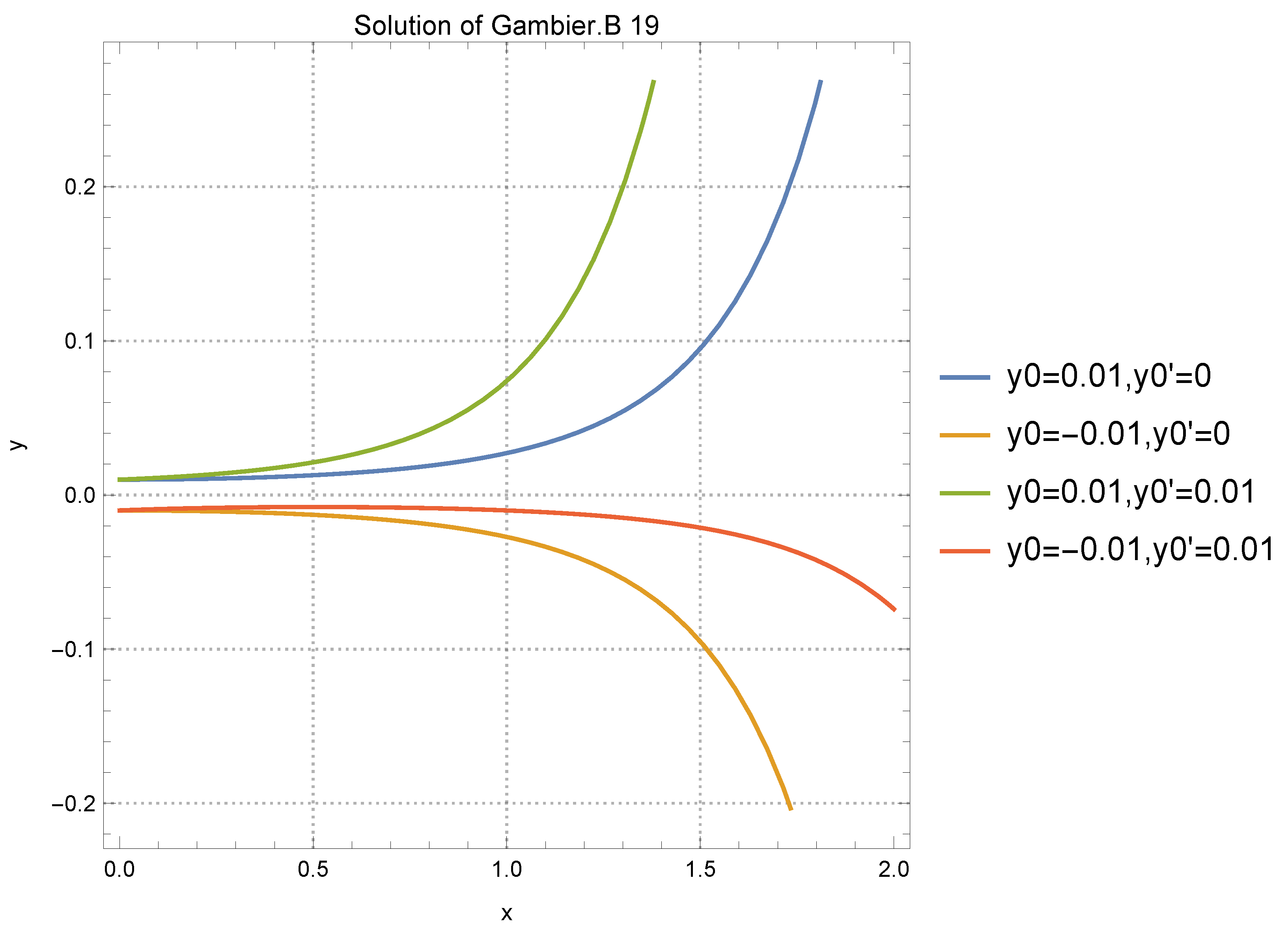
5.1. Case 1 (Gambier.B 19)
Let and apply the transformation , , we obtain
with the analytic solution
The numerical evolution of the latter equation is presented in Figure 1.
Figure 1.
Qualitative evolution of the Gambier.B 19 equation.
5.2. Case 2 (Gambier.B 29)
Let and apply the transformation , , we obtain
with the analytic solution
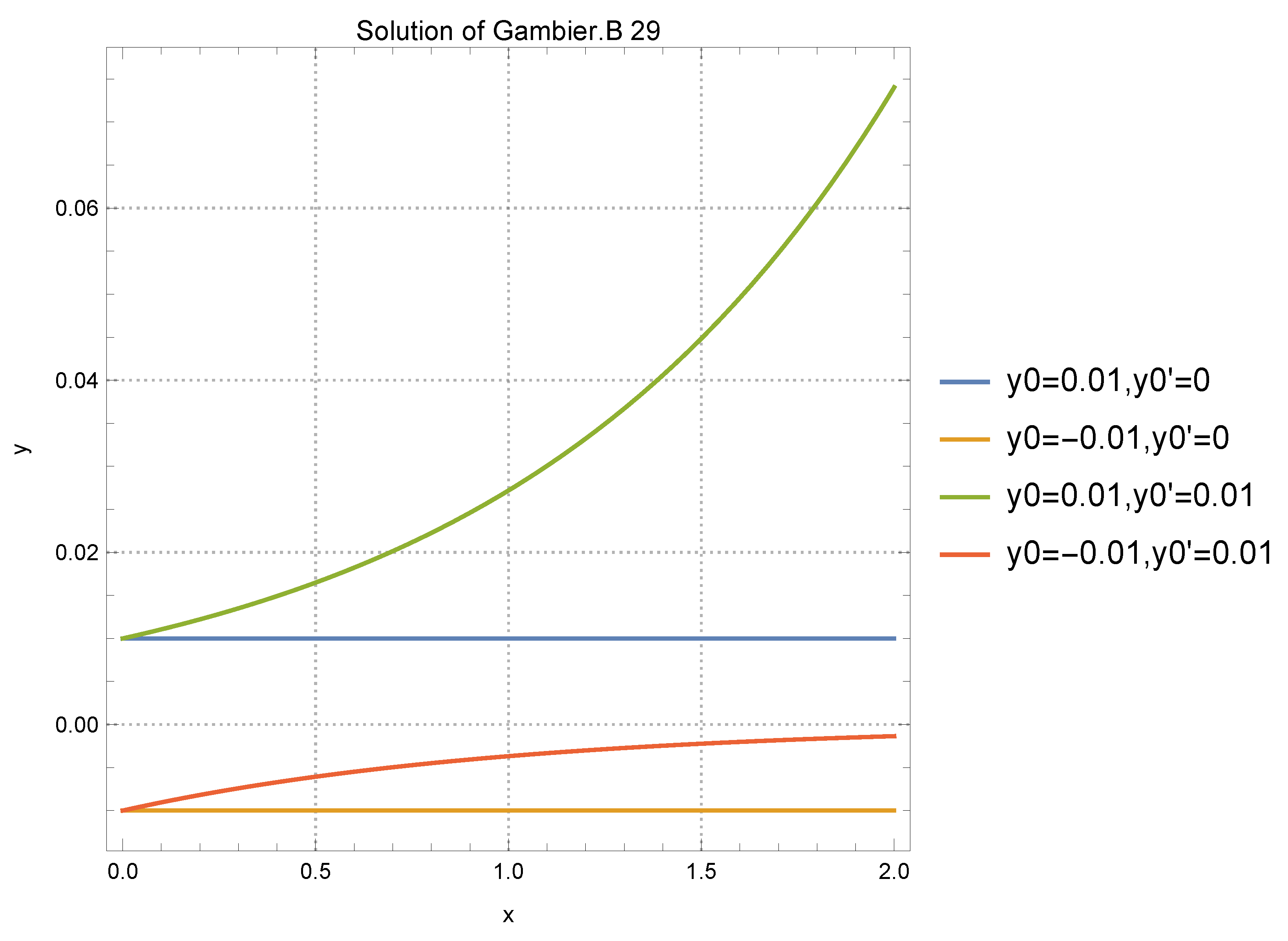
The numerical evolution of the latter equation is presented in Figure 2.
Figure 2.
Qualitative evolution of the Gambier.B 29 equation.
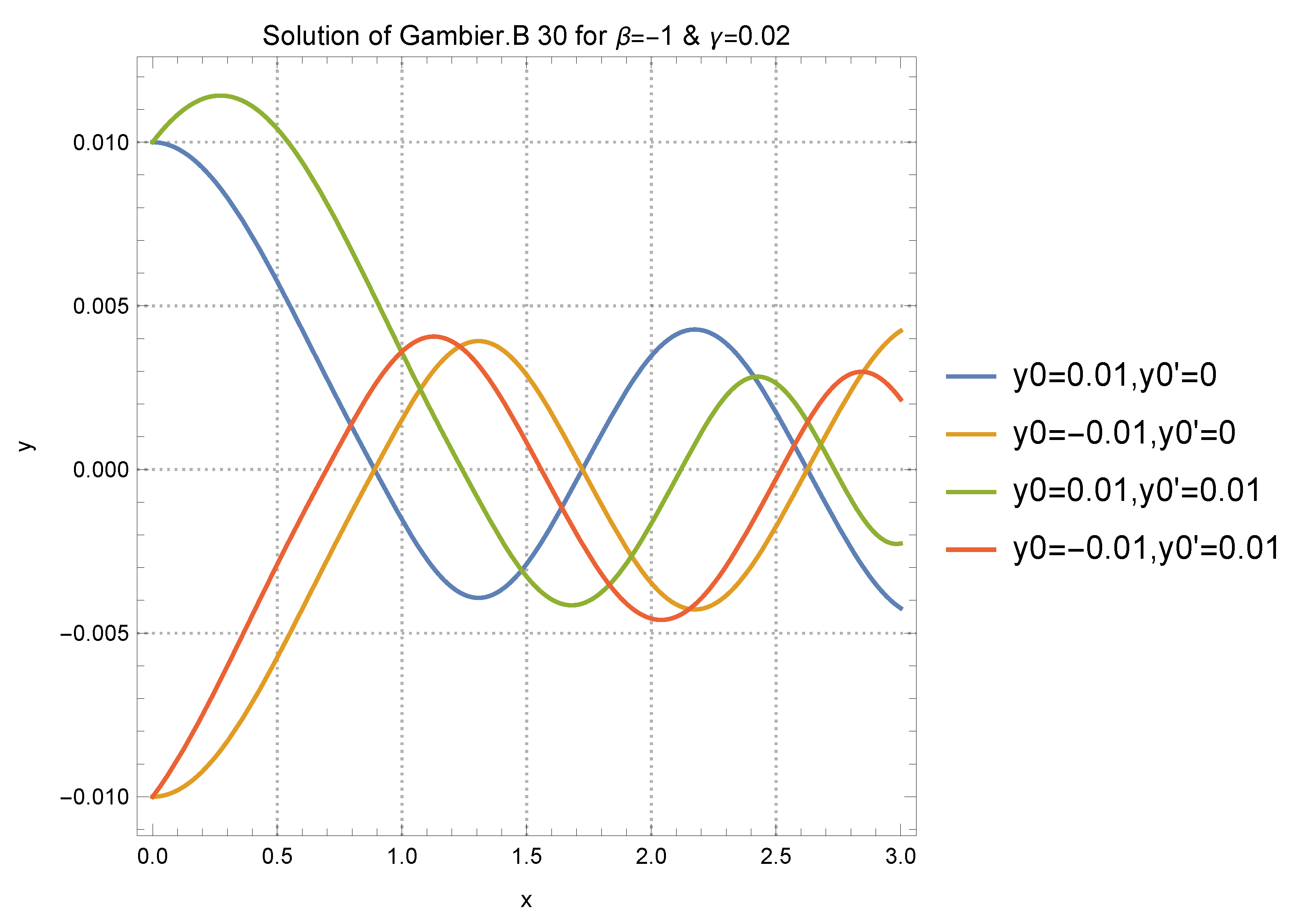
5.3. Case 3 (Gambier.B 30)
Let , and apply the transformation , , we obtain
where the solution is given in terms of the elliptic integral
This can be considered a variant of Gambier.B 30 for ,
The numerical evolution of the latter equation is presented in Figure 3.
Figure 3.
Qualitative evolution of the Gambier.B 30 equation.
5.4. Case 4 (Second Painlevé Transcendent)
Let and apply the transformation . We obtain the second Painlevé transcendent:
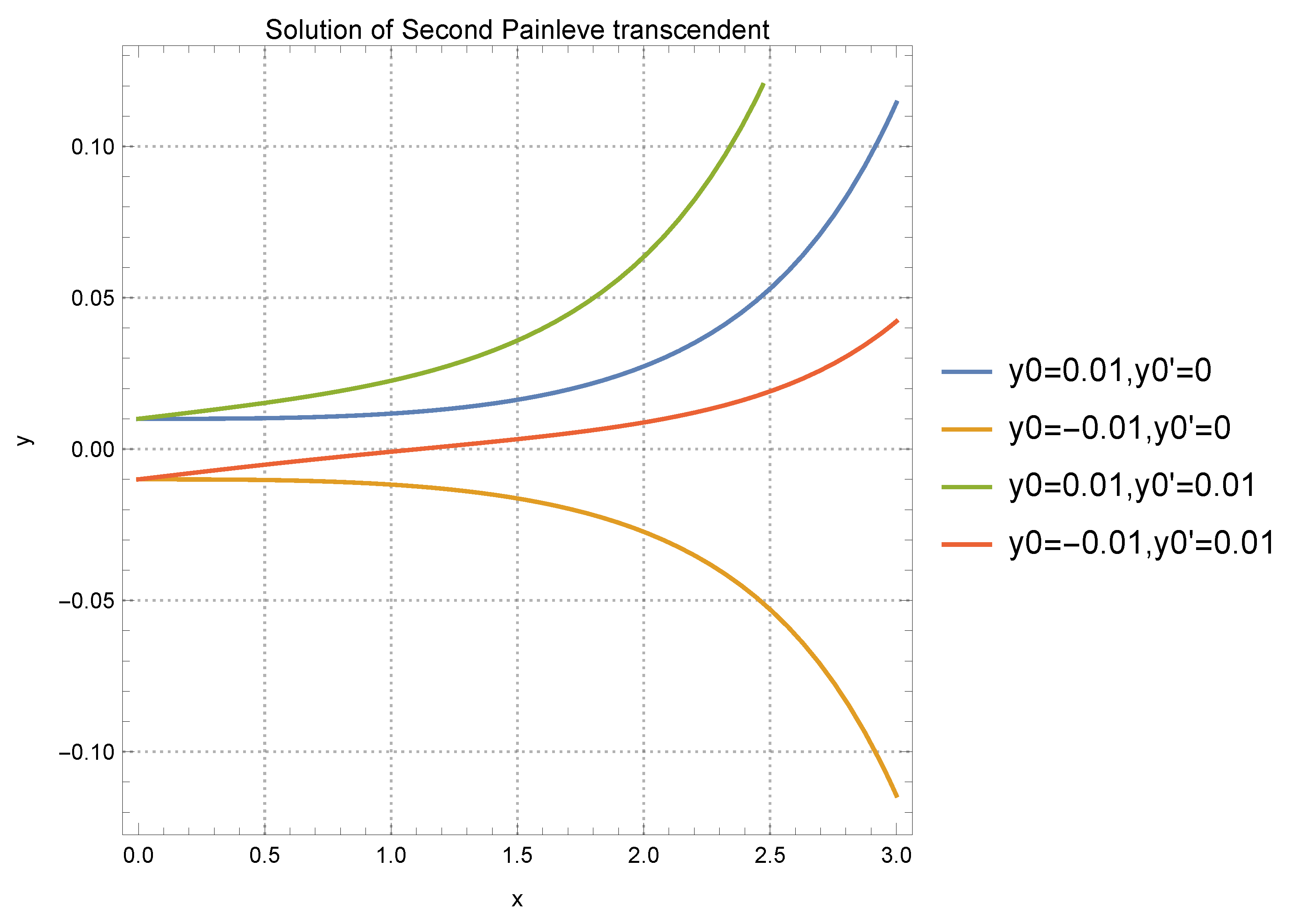
The numerical evolution of the latter equation is presented in Figure 4.
Figure 4.
Qualitative evolution of the second Painlevé transcendent equation.
5.5. Case 5 (Kummer–Schwarz Equation)
If and , and apply the transformation , , we obtain the second-order Kummer–Schwarz equation
.
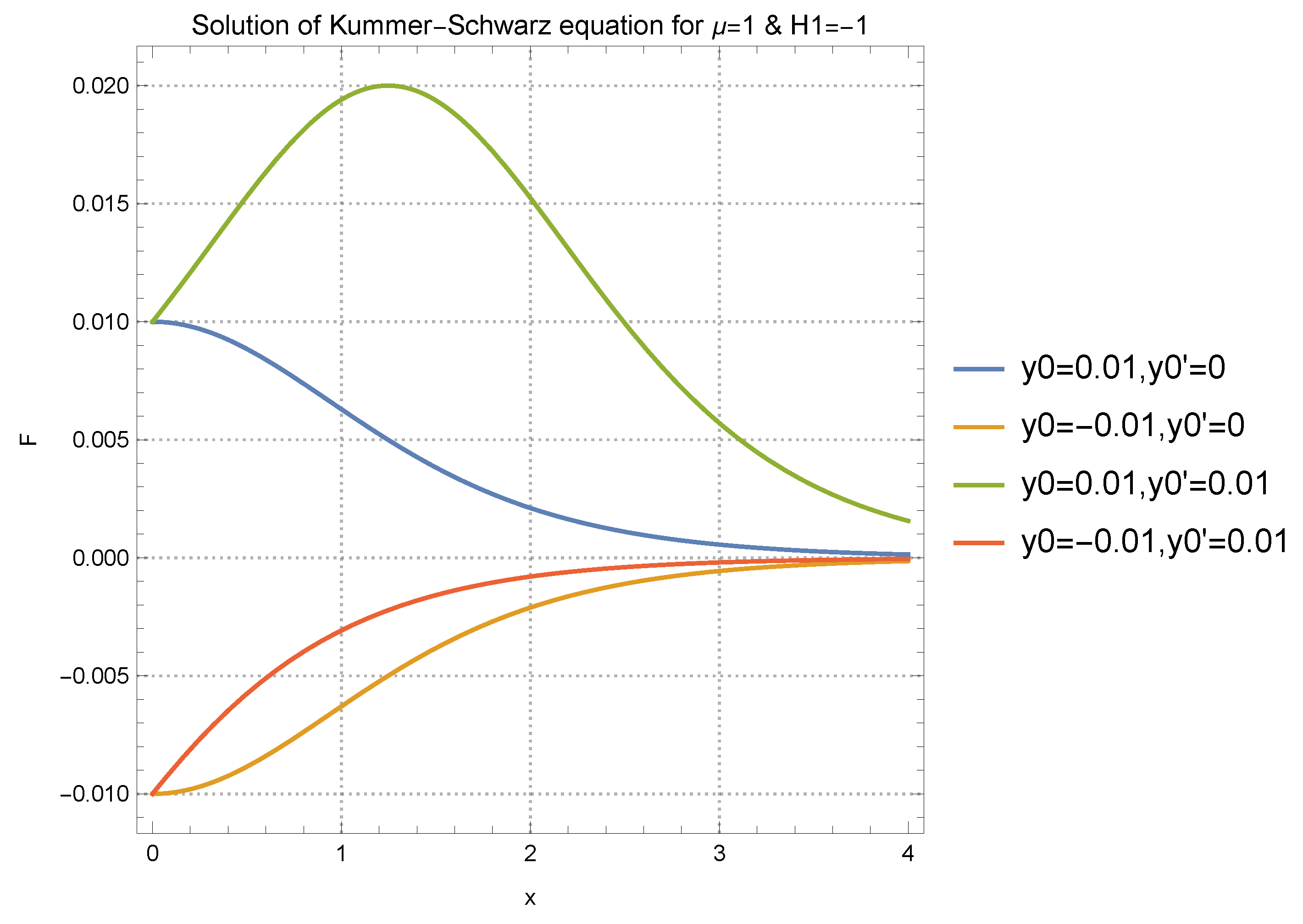
The numerical evolution of the latter equation is presented in Figure 5.
Figure 5.
Qualitative evolution of the Kummer–Schwarz equation.
5.6. Case 6 (Duffing Equation)
If is constant and , and apply the transformation , , we obtain the undamped and unforced Duffing equation:
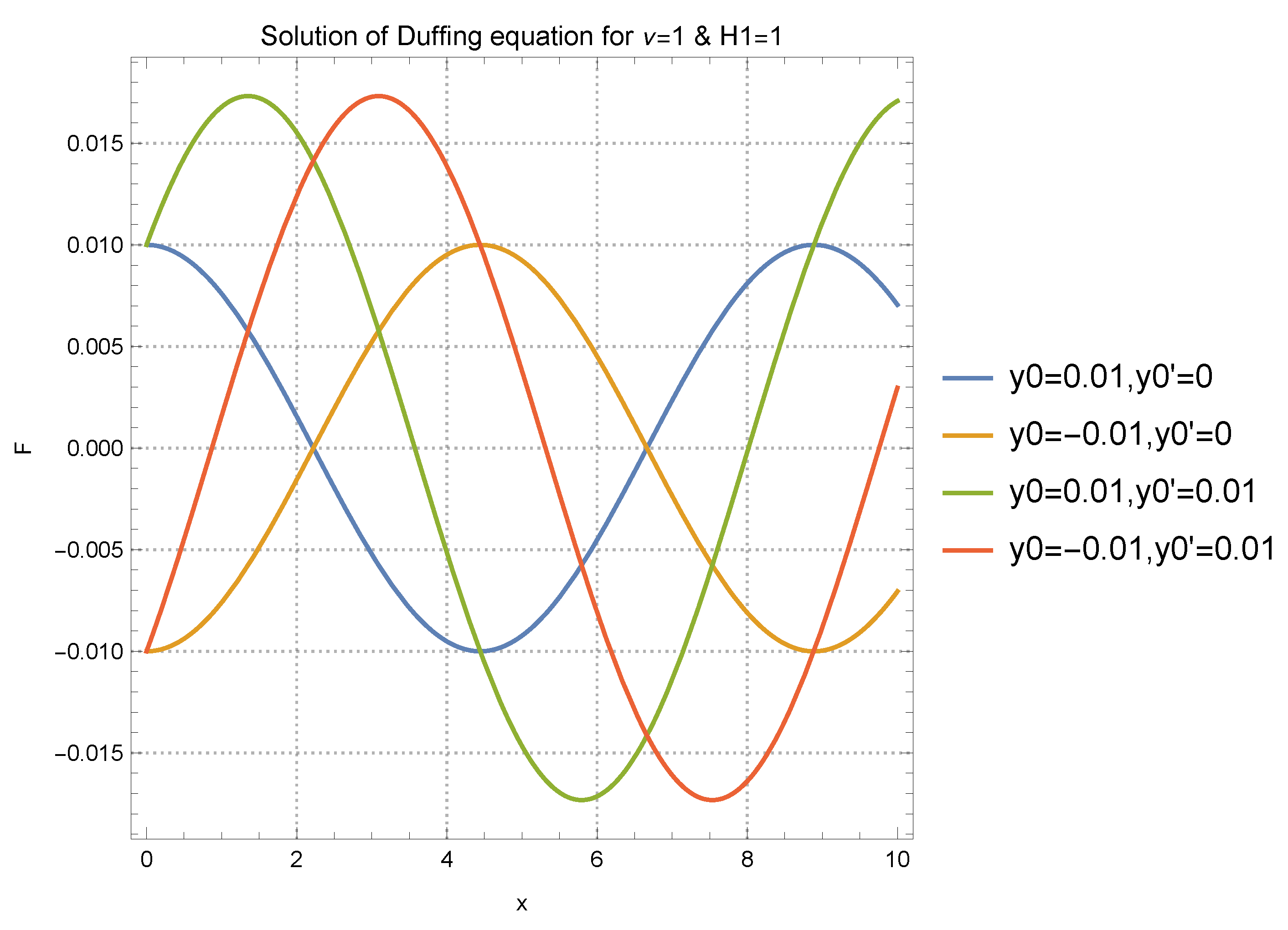
The numerical evolution of the latter equation is presented in Figure 6.
Figure 6.
Qualitative evolution of the Duffing equation.
6. General Cases of Equation (29)
Equation (29) can be considered as a particular case of the following two Gambier’s equations:
6.1. Case 7 Gambier.B 28
6.2. Case 8 Gambier.B 27
7. The Case f = 0, g = 0
The equation has the Lie point symmetries
In the subsequent subsections, we study the reductions with respect to , and the travelling-wave. In Section 7.2, the singularity analysis of the reduced ode is also mentioned explicitly.
7.1. Case 6a
The reduction, with respect to leads to the reduced ode
where and The point symmetries of Equation (35) are
The reductions with respect to and does not yield any positive result. The singularity analysis of the Equation (35), too, does not provide any fruitful result.
Next, we look for the reduction with respect to which leads to the simpler first-order ode and where and
Further, the reduction with respect to leads to an Euler’s equation, which is
where and
7.2. Case 6b
In this subsection, we perform the reductions with respect to the travelling-wave. The reduction leads to a system of two second-order odes, which are
where the similarity variables are
The Lie point symmetries of equation (38) are
The reduction, with respect to and does not provide any fruitful result, similar to Equation (35). Therefore, we dwell on the singularity analysis to comprehend its integrability.
Singularity Analysis of Equation (38).
We substitute and in Equation (38). The substitution leads to
One of the possible values for the exponents p and q is After substituting the values of p and q in Equation (39), we use the dominant terms to compute the leading-order coefficients and . The terms are
Solving Equation (40) for and leads to the following possible values
Next, to compute the resonance, we substitute in Equation (38). The substitution leads to
We select the linear terms with respect to and corresponding to various powers of For , we have
For system (43) to possess a non-trivial solution, the necessary requirement is
The possible values of Similarly, for we have
Similarly to Equation (43), for the existence of a non-trivial solution, the system
leads to the following possible values of s.
Now, for the possible values of s are
For the possible values of s are
Similar results are obtained for The generic value of the resonance s being is not obtained for both the computations, and, hence, as cited in references [26,27,28,29], the integrability of Equation (38) cannot be determined.
Still, a possibility exists when , fluid kinematic viscosity, and magnetic diffusivity are equal. This leads to . Therefore, under a special circumstance of we have and from the analysis of Equation (44) s also takes the value 2. The readers can easily verify the consistency test and, hence, we conclude that the Laurent expansion leads to a right Painlevé series.
8. Conclusions
In this work, reductions concerned with that of the arbitrary functions are deduced for the magnetohydrodynamics(MHD) -dimension equation. The reduction leads to a certain well-known family of equations which are connected to Gambier’s, Abel’s, and Kummer–Schwarz equations. The reductions of the force-free equation are generally trivial but the traveling-wave reduction leads to equations which are devoid of point symmetries. Hence, the computation of a series solution using singularity analysis leads to a right Painlevé series, provided the kinematic viscosity and magnetic diffusivity parameters are equal. The physical significance of such a situation is yet to be ascertained and forms the basis of our future work.
Author Contributions
Methodology, R.S. (Rangasamy Sinuvasan), A.K.H. and P.G.L.L.; Investigation, A.K.H. and R.S. (R. Seshadri); Writing—original draft, A.K.H. and A.P.; Writing #x2014;review & editing, A.P. and P.G.L.L.; Supervision, A.P. and P.G.L.L. All authors have read and agreed to the published version of the manuscript.
Funding
PGLL acknowledges the support of the National Research Foundation of South Africa, the University of KwaZulu-Natal, and the Durban University of Technology.
Data Availability Statement
The authors declare that no datasets were used in the study.
Conflicts of Interest
The authors declare no conflict of interest.
References
- Fleischer, J.; Diamond, P.H. Compressible Alfven turbulence in one dimension. Phys. Rev. E 1998, 58, R2709. [Google Scholar] [CrossRef]
- Politano, H.; Pouquet, A. Model of intermittency in magnetohydrodynamic turbulence. Phys. Rev. E 1995, 52, 636. [Google Scholar] [CrossRef] [PubMed]
- Basu, A.; Bhattacharjee, J.K.; Ramaswamy, S. Mean magnetic field and noise cross-correlation in magnetohydrodynamic turbulence: Results from a one-dimensional model. Eur. J. B Condens. Matter Complex Syst. 1999, 9, 725–730. [Google Scholar] [CrossRef]
- Basu, A.; Sain, A.; Dhar, S.K.; Pandit, R. Multiscaling in models of magnetohydrodynamic turbulence. Phys. Rev. Lett. 1998, 81, 2687. [Google Scholar] [CrossRef]
- Bhattacharjee, J.K. Randomly stirred fluids, mode coupling theories and the turbulent Prandtl number. J. Phys. A Math. Gen. 1988, 21, L551. [Google Scholar] [CrossRef]
- Camargo, S.J.; Tasso, H. Renormalization group in magnetohydrodynamic turbulence. Phys. Fluids B Plasma Phys. 1992, 4, 1199–1212. [Google Scholar] [CrossRef]
- Forster, D.; Nelson, D.R.; Stephen, M.J. Large-distance and long-time properties of a randomly stirred fluid. Phys. Rev. A 1977, 16, 732. [Google Scholar] [CrossRef]
- Lahiri, R.; Ramaswamy, S. Are steadily moving crystals unstable? Phys. Rev. Lett. 1997, 79, 1150. [Google Scholar] [CrossRef]
- Yakhot, V.; Orszag, S.A. Renormalization group analysis of turbulence. I. Basic theory. J. Sci. Comput. 1986, 1, 3–51. [Google Scholar] [CrossRef]
- Fuchs, J.C. Symmetry groups and similarity solutions of MHD equations. J. Math. Phys. 1991, 32, 1703–1708. [Google Scholar] [CrossRef]
- Nucci, M.C. Group analysis for MHD equations. Atti Sem. Mat. Fis. Univ. Modena 1984, 33, 21–34. [Google Scholar]
- Gross, J. Invariante L Sungen der Eindimensionalen Nichtstationa ren Realen MHD-Gleichungen; Technische Universita t Carolo-Wilhelmina zu Braunschweig: Braunschweig, Germany, 1983. [Google Scholar]
- Grundland, A.M.; Lalague, L. Lie subgroups of symmetry groups of fluid dynamics and magnetohydro-dynamics equations. Can. Phys. 1995, 73, 463–477. [Google Scholar] [CrossRef]
- Goedbloed, J.; Lifschitz, A. Stationary symmetric magnetohydrodynamic flows. Phys. Plasmas 1997, 4, 3544–3564. [Google Scholar] [CrossRef]
- Knobloch, E. Symmetry and instability in rotating hydrodynamic and magnetohydrodynamic flows. Phys. Fluids 1996, 8, 1446–1454. [Google Scholar] [CrossRef]
- Kraichnan, R.H. Inertial-range spectrum of hydromagnetic turbulence. Phys. Fluids 1965, 8, 1385–1387. [Google Scholar] [CrossRef]
- She, Z.S.; Leveque, E. Universal scaling laws in fully developed turbulence. Phys. Rev. Lett. 1994, 72, 336. [Google Scholar] [CrossRef]
- Gambier, B. Sur les equations differentielles du second ordre et du premier degre dont l’integrale generale est a points critiques fixes. Acta Math. 1910, 33, 1–55. [Google Scholar] [CrossRef]
- Meleshko, S.V. Methods for Constructing Exact Solutions of Partial Differential Equations; Springer Science: New York, NY, USA, 2005. [Google Scholar]
- Dimas, S.; Tsoubelis, D. A new Mathematica-based program for solving overdetermined systems of PDEs. In Proceedings of the 8th International Mathematica Symposium, Avignon, France, 19–23 June 2006. [Google Scholar]
- Polyanin, A.D.; Zaitsev, V.F. Handbook of Nonlinear Equations of Mathematical Physics. Exact Solutions; Fizmatlit: Moscow, Russia, 2002. (In Russian) [Google Scholar]
- Dimas, S.; Tsoubelis, D. SYM: A new symmetry-finding package for Mathematica. In Proceedings of the 10th International Conference in Modern Group Analysis; University of Cyprus: Nicosia, Cyprus, 2004; pp. 64–70. [Google Scholar]
- Ince, E.L. Ordinary Differential Equations; Longmans, Green & Co.: London, UK, 1927. [Google Scholar]
- Dimas, S. Partial differential equations, algebraic computing and nonlinear systems. Ph.D. Thesis, University of Patras, Patras, Greece, 2008. [Google Scholar]
- Bluman, G.W.; Kumei, S. Symmetries and Differential Equations; Springer: New York, NY, USA, 1989. [Google Scholar]
- Andriopoulos, K.; Leach, P.G.L. An interpretation of the presence of both positive and negative nongeneric resonances in the singularity analysis. Phys. Lett. A 2006, 359, 199–203. [Google Scholar] [CrossRef]
- Andriopoulos, K.; Leach, P.G.L. Singularity analysis for autonomous and nonautonomous differential equations. Appl. Discret. Math. 2011, 5, 230–239. [Google Scholar] [CrossRef]
- Andriopoulos, K.; Leach, P.G.L. The occurrence of a triple-1 resonance in the standard singularity. Nuovo C. Della Societa Ital. Fis. B Gen. Phys. Relativ. Astron. Math. Phys. Methods 2009, 124, 1–11. [Google Scholar]
- Andriopoulos, K.; Leach, P.G.L. Symmetry and singularity properties of second-order ordinary differential equation of Lie’s Type III. J. Math. Anal. Appl. 2007, 328, 860–875. [Google Scholar] [CrossRef][Green Version]
Disclaimer/Publisher’s Note: The statements, opinions and data contained in all publications are solely those of the individual author(s) and contributor(s) and not of MDPI and/or the editor(s). MDPI and/or the editor(s) disclaim responsibility for any injury to people or property resulting from any ideas, methods, instructions or products referred to in the content. |
© 2023 by the authors. Licensee MDPI, Basel, Switzerland. This article is an open access article distributed under the terms and conditions of the Creative Commons Attribution (CC BY) license (https://creativecommons.org/licenses/by/4.0/).