1. Introduction
In traditional set theory, an element is either in or out of the set. Fuzzy set theory, on the other hand, allows for a gradual determination of the membership of elements in a set, which is represented using a membership function having a value in the real unit interval
. To deal with real-world uncertain and ambiguous problems, the strategies commonly used in classical mathematics are not always useful. In
Zadeh [
1] proposed the concept of fuzzy set (FS) as an extension of the classical notion of sets. In many cases, however, because the membership function is a single-valued function, it cannot be used to represent both support and objection evidences. The intuitionistic fuzzy set (IFS), which is a generalization of Zadeh’s fuzzy set, was introduced by Atanassov [
2]. IFS has both a membership and a non-membership function, allowing it to better express the fuzzy character of data than Zadeh’s fuzzy set, which only has a membership function. In some real-life scenarios, however, the sum of membership and non-membership degrees acquired by alternatives satisfying a decision-maker (DM) characteristic may be larger than 1, while their sum of squares is less than or equal to 1. Therefore, Yager [
3] introduced the idea of Pythagorean fuzzy set (PFS) with membership and non-membership degrees that fulfill the condition that the total of squares of their membership and non-membership degrees is less than or equal to 1. By Atanassov [
4], PFS is also known as IFS of type 2. Many scholars have researched another model known as q-rung orthopair fuzzy set (q-ROFS) to expand the space of IFS and PFS [
5,
6,
7].
In real life, variations in the cycle (periodicity) of the data happen simultaneously as vagueness and uncertainty in the data. However, existing theories are insufficient to evaluate this information, resulting in some information loss during the process. To overthrow it, the concept of the complex fuzzy set (CFS) was presented by Ramot et al. [
8]. CFS differs from FS in that its range is not limited to
, but instead extends into a unit disc on a complex plane. In the context of FS theory, the CFS has received more attention. Later, Alkouri et al. [
9] proposed the concept of a complex intuitionistic fuzzy set (CIFS) to capture undefined and ill-defined judgment information in most cases. The CIFS is made up of polar coordinates that represent complex-valued membership functions and complex-valued non-membership functions. Ullah et al. [
10] proposed the concept of complex Pythagorean fuzzy set (CPFS) to generalize the concept of CIFS and extended several distance measurements to accept complex Pythagorean fuzzy values. Similarly, Liu et al. [
11] defined complex q-ROFS (Cq-ROFS) and Cq-ROFLS set (Cq-ROFLS), as well as multiple Cq-ROFL Heronian mean (HM) operators, in order to construct a decision model.
The concept of linear Diophantine fuzzy sets (LDFSs) [
12] is a novel way to express uncertainty in decision making. LDFS is more versatile and dependable than current ideas, such as intuitionistic fuzzy sets (IFSs), Pythagorean fuzzy sets (PFSs), and q-rung orthopair fuzzy sets (q-ROFSs) because it includes reference or control factors with membership and non-membership functions. Almagrabi et al. suggested a new generalization of the Pythagorean fuzzy set, q-rung orthopair fuzzy set, and linear Diophantine fuzzy set, named q-linear Diophantine fuzzy set (q-LDFS), and analyzed its key properties in [
13].
The existing concepts and approaches available for the complex fuzzy information are not capable of dealing with complex membership and non-membership functions taken from any part of the space; rather, they impose strict conditions on them. To fill this research gap, this paper introduces the concept of complex linear Diophantine fuzzy set (CLDFS) and gives some characterization problems in terms of different novel ideals constructed using the notions of CLDFS and score function.
The idea of CLDFS become the source of motivation. CLDFS allows us to do the following:
In view of the above motivation, the objectives of this paper are as follows:
Some practical applications of CLDFS are also thoroughly discussed from the field of civil engineering. Two practical examples, one from structural engineering, particularly about concrete selection and the other from transportation engineering specifically about road network development, are considered. Moreover, the proposed methods could also be applied to diversified fields, such as hardware acceleration for COVID-19 mitigation (such as face mask detection) [
14] and the ranking of probabilistic approaches for neural networks in structural engineering [
15].
Apart from the above-mentioned problems and for the interest of the reader, some notable recent developments in fuzzy set theory can be found, for example, in artificial intelligence [
16], supply chain [
17], symmetry [
18], computational intelligence [
19], etc.
2. Background
In this section, we will review the basic understanding of complex intuitionistic fuzzy set (CIFS), complex Pythagorean fuzzy set (CPFS), complex q-rung orthopair fuzzy set (Cq-ROFS) and linear Diophantine fuzzy set (LDFS) in order to develop a novel idea of a complex linear Diophantine fuzzy set (CLDFS). We will also give the required knowledge about a non-associative algebraic structure called an AG-groupoid.
Definition 1 ([
20])
. Let X be the non-empty reference set. A complex intuitionistic fuzzy set CIFS is an object of the formwhere the membership function and non-membership function defined asrespectively, lie within a unit disk in complex plane with and being real-valued functions satisfying the conditions Definition 2 ([
10])
. For a non-empty reference set X. The CPFS is defined aswheredenote complex-valued membership and non-membership functions respectively, satisfying the conditions Definition 3 ([
11])
. Let X be the non-empty reference set. The Cq-ROFS is given bywheredenote complex-valued membership and non-membership functions, respectively, satisfying the conditions The superiority of CPFS over CIFS can be established by considering the following example.
Consider , then clearly and so this is not a CIFS, but and so it is a CPFS. Hence, CPFS can take more points. On the other hand, Cq-ROFS can be considered a generalization of CPFS, as CPFS is a particular case of Cq-ROFS for .
To develop the generalization of the above-mentioned complex sets, we consider the recent article by Riaz et al. [
12], in which they introduced the notion of the linear Diophantine fuzzy set and discussed its algebraic structure, topological structure and applications for decision making.
Definition 4 ([
12])
. A linear Diophantine fuzzy set (LDFS) on a universal set is defined ashere is called a membership function, is called a non-membership function, and are reference parameters with , satisfying and . Definition 4 generalizes the fuzzy sets, intuitionistic fuzzy sets, Pythagorean fuzzy sets and q-rung orthopair fuzzy sets. In the next section, we generalized Definition 4 when the universal set is a complex set and developed the complex linear Diophantine fuzzy set, which generalizes the notion of CFs, CIFs, CPFs and Cq-ROFs by adding reference parameters to it.
In ternary operations, the commutative law is given by
By putting brackets on the left of this equation, that is,
M. A. Kazim and M. Naseeruddin proposed a new algebraic structure named a left almost semigroup, abbreviated as an LA-semigroup [
21]. This identity is known as the left invertive law. P. V. Protic and N. Stevanovic referred to the same structure as an Abel–Grassmann groupoid, abbreviated as an AG-groupoid [
22]. An AG-groupoid is a non-associative and non-commutative algebraic structure that falls in between a groupoid and a commutative semigroup [
23]. An AG-groupoid with a left identity is called an AG-group if it has inverses [
24]. In [
21], it was shown that AG-groupoid
S is medial, that is,
holds for all
A left identity may or may not exist in an AG-groupoid. The left identity of an AG-groupoid allows the inverses of elements. If an AG-groupoid has a left identity, then it is unique [
23]. The paramedial law
holds for all
in an AG-groupoid
S with a left identity. We can obtain
for all
by applying the medial law with left identity.
In [
25], Q. Mushtaq and S. M. Yusuf introduced the concept of a locally associative AG-groupoid. P. V. Protic and N. Stevanovic carried out a detailed research on AG-groupoids. They proved that there is no non-associative left simple (right simple, simple) AG*-groupoid [
26]. In [
27,
28], they also introduced congruences in AG*-groupoids, AG**-groupoids, and AG-bands and decomposed the structures using these congruences. P. V. Protic and N. Stevanovic pioneered a method for verifying AG**-groupoids, AG*-groupoids, and AG-groupoids [
22]. In [
29], they defined ideals, and in [
22], they introduced several important findings in the theory of AG-groupoids. Dudek et al. determined several basic congruences on a completely inverse AG**-groupoid in [
30,
31], notably the greatest idempotent separating congruence, the least AG-group congruence, and the least E-unitary congruence. They studied the whole lattice of congruences of a completely inverse AG**-groupoid. Other results on AG-groupoids can be found in [
32,
33,
34].
3. Complex Linear Diophantine Fuzzy Sets
In this section, we propose the concept of complex linear Diophantine fuzzy set (CLDFS) and study some of its structural properties. In number theory, the proposed model is similar to the well-known linear Diophantine equation . We also discuss the score and accuracy functions for the comparative analysis of complex linear Diophantine fuzzy numbers (CLDFNs). Finally, we give some practical applications of CLDFNs.
Now we introduce the concept of CLDFS as follows.
Definition 5. Let X be the non-empty reference set. A complex linear Diophantine fuzzy set (CLDFS) is an object of the form:where and are complex valued membership and non-membership functions respectively such thatsatisfying For convenience, let be a complex linear Diophantine fuzzy number (CLDFN), where and are reference parameters. These reference parameters can contribute to the categorization of a particular system. By altering the physical meaning of these parameters, we can categorize the system.
The hesitancy part can be summed up as follows:
Definition 6. Let , be CLDFNs. Then
Theorem 1. Let Then are CLDFNs.
Proof. First we will prove that
is a CLDFN. As
are CLDFNs, so
Now by using Definition 6
we have
Hence is a CLDFN. We can prove is a CLDFN on similar lines. □
The following theorem establishes the generalization of CLDFNs over CIFNs and CPFNs.
Remark 1. The space of CLDFN is larger than the space of CIFN and CPFN.
Proof. Let be a CLDFN with the conditions and where This is obvious that for arbitrary set of reference parameters, the above ineqaulities holds for every CIFN and CPFN. □
The converse is not true in general, for example, if we take and then one can verify that it forms a CLDFN but not CIFN and CPFN.
Score and accuracy functions were specified in [
3,
29] for IFSs, and in [
35] for CIFSs. The concept of score and accuracy functions for CLDFNs presented, can be considered a generalization of respective functions for LDFNs [
12].
In order to rank the CLDFNs, we now introduce the score function as follows:
Definition 7. Let S be an AG-groupoid and A be the set of all CLDFNs. The score function on A can be defined by the mapping and given bywhere Ω is the score function, and is the score of In particular, if then the CLDFN takes the largest value , and . On the other hand, if the score function attains the minimum value i.e., if then the CLDFN takes the smallest value , and .
Let
A and
B be two CLDFS on a domain
U then for
,
and
are CLDFN. Let
and
be given as follows:
then by Definition 7,
and
implying that
. Note that the above is a comparison of CLDFN and not that of CLDFS.
If we now define another CLDFN,
as follows,
then, again by Definition 7,
. From here, we see
. To distinguish score-equivalent CLDFNs, we give the following definition.
Definition 8. Let S be an AG-groupoid and A be the set of all CLDFNs. The accuracy function on A can be defined by the mapping and given bywhere Π is the score function, and is the accuracy degree of Considering the same CLDFN and given above, by Definition 8, we see that and implying that, although , we have .
The relationship between the score function and the accuracy function was established to be similar to the relationship between the mean and variance in statistics [
36]. In statistics, an efficient estimator is described as a measure of the variance of an estimate’s sampling distribution; the lower the variance, the better the estimator’s performance. On this basis, it is reasonable and appropriate to say that the higher the CLDFN accuracy degree, the better the CLDFN.
In [
37,
38], the techniques were developed for comparing and rating two IFNs and IVIFNs respectively based on the score and accuracy functions, which were motivated by the aforementioned study. A similar technique was developed in 2019 for comparing and rating two LDFNs [
12] based on the score and accuracy functions. We can now compare and rate two CLDFNs in the same way using the score and accuracy functions, as shown below:
Definition 9. Let then the comparison of and is given as follows:
If then
If then
If then
If then
Remark 2. Let A be a set of all CLDFNs and be a score function, then
is increasing with respect to the complex membership function and
is decreasing with respect to the complex non-membership function and .
4. CLDF-Score Ideals in Strongly Regular
AG-Groupoids
In this section, we use the concept of a score function to introduce the notions of complex linear Diophantine fuzzy score (CLDF-score) left (right) ideals and complex linear Diophantine fuzzy score (CLDF-score) -ideals in an AG-groupoid. Several characterization problems based on CLDF-score left (right) ideals and CLDF-score -ideals of an AG-groupoid are discussed. The relationship between the CLDF-score left (right) ideals and CLDF-score -ideals of an AG-groupoid is also given.
The LDFS [
12] is a particular case of CLDFS for
. Hence, CLDFS generalizes the concept of LDFS by considering the complex membership grades.
Definition 10. Let Ω be a score function of an AG-groupoid S and Then Ω is called a CLDF-score left (right) ideal of if The proof of the following three lemmas are the same as in [
39].
Lemma 1. Let S be an AG-groupoid. For the following holds.
Lemma 2. If Ω is any score function of an AG-groupoid then Ω is a CLDF-score right (left) ideal of S if and only if
Lemma 3. Let S be an AG-groupoid and Then A is a right (left) ideal of S if and only if is a CLDF-score right (left) ideal of
Remark 3. Assume S is an AG-groupoid with left identity and The smallest left ideal of S containing a is thus and the smallest right ideal of S containing is .
Definition 11 ([
40])
. An AG-groupoid S is called a regular AG-groupoid (briefly, an r-AG-groupoid) if for each there is an which is called a pseudoinverse of with . Definition 12 ([
40])
. An AG-groupoid S is called a strongly regular AG-groupoid (briefly, an -AG-groupoid) if for each there exists such that and where x is called a strong pseudoinverse of Lemma 4. If S is a strongly regular AG-groupoid with left identity and Υ is a CLDF-score left (right) ideal of then
Proof. It is straightforward. □
Theorem 2. Let S be an AG-groupoid with left identity. Then the following conditions are equivalent:
S is strongly regular;
where is the smallest left ideal of S containing
where both and are any left ideals of
where both Ω and Υ are any CLDF-score left ideals of
Proof. Let
and
be the CLDF-score left ideals of a strongly regular
S with left identity
e. Now, for
there exists some
such that
This shows that
. It is clear that
by applying Lemmas 2 and 4. As a result,
Let
and
be any left ideals of
S. Then, according to Lemma 3,
and
are the CLDF-score left ideals of
If we take
and apply Lemma 1, we obtain
It implies and, as a result, It is simple to understand how and therefore go together.
It is obvious.
Since
is the smallest left ideal of
S that contains
Therefore,
This indicates that for some We can obtain in a similar way. As a result, S is strongly regular. □
Theorem 3. Assume S is an AG-group. Then the following conditions are equivalent:
S is strongly regular;
where is the smallest right ideal of S containing
where both and are any right ideals of
where both Ω and Υ are any CLDF-score right ideals of
Proof. Let
and
be both CLDF-score right ideals of a strongly regular
S with left identity
e. Now for
there exist some
such that
Thus by using Lemmas 2 and 4, we get
Let
and
be any right ideals of
S. Then by Lemma 3,
and
are CLDF-score right ideals of
Let
Then by using Lemma 1, we have
which implies that
and therefore
It is easy to see that
and therefore
It is obvious.
Since
is the smallest right ideal of
S containing
. Therefore,
which implies
for some
Similarly, we can obtain Hence, S is strongly regular. □
Definition 13 ([
41])
. A non-empty subset A of an AG-groupoid S is called a -ideal of if Definition 14. Let Θ be a score function of an AG-groupoid S and Then Θ is called a CLDF-score -ideal of if The proof of the following two lemmas are same as in [
42].
Lemma 5. If Θ is any score function of an AG-groupoid then Θ is a CLDF-score -ideal of S if and only if
Lemma 6. Let S be an AG-groupoid and Then O is a -ideal of S if and only if is a CLDF-score -ideal of S.
In the following theorem, we intend to respond to a question about the relationship between CLDF-idempotent subsets of an AG-groupoid S and its CLDF-score -ideals, especially when a CLDF-idempotent subset of S will be a CLDF-score -ideal in terms of a CLDF-score right ideal and a CLDF-score left ideal of S.
Theorem 4. Let Θ be a -idempotent subset of an AG-groupoid S with left identity. Then the following conditions are equivalent:
where Ω is a -score right ideal and Υ is a -score left ideal of
Θ is a -score -ideal of
Proof. We can obtain the following by using Lemma 2.
As a result of Lemma 5, is a CLDF-score -ideal of
Setting
and
, then using Lemma 5, we obtain
This competes the proof. □
Definition 15. An AG-groupoid S is called left (right) duo if every left (right) of S is an ideal of S, and it is called duo if it is both left and right duo. Similarly, an AG-groupoid S is called score-left (right) duo if every CLDF-score left (right) of S is a CLDF-score ideal of S and is called score-duo if it is both score-left and score-right duo.
Theorem 5. The following conditions are equivalent for a strongly regular AG-groupoid S with a left identity:
S is left duo;
Every IF-score left ideal of S is a CLDF-score -ideal of
Proof. Let a strongly regular
S with left identity be a left duo, and assume that
is any CLDF-score left ideal of
S. Let
then
and
for some
. Since
is a left ideal of
S so by using hypothesis,
is a right ideal of
S as well. Therefore
Thus,
for some
Now
Similarly we can show that
Hence we can obtain
which implies that
is a CLDF-score
-ideal of
Let O be any left ideal of a left regular S with left identity. Now by Lemma 3 , the characteristic function of O is a CLDF-score left ideal of S. Thus by hypothesis, is a CLDF-score -ideal of S and by using Lemma 3 , O is a -ideal of S. It is easy to show that Thus This shows that S is left duo. □
The left-right dual of Theorem 5 reads as follows:
Theorem 6. The following conditions are equivalent for a strongly regular AG-groupoid S with left identity:
S is right duo;
Every -score right ideal of S is a CLDF-score -ideal of
Lemma 7. A non-empty subset A of strongly regular AG-groupoid S with left identity is a left (right) ideal of S if and only if it is a -ideal of
Proof. It is straightforward. □
Theorem 7. For a strongly regular AG-groupoid S with left identity, the following conditions are equivalent:
S is score-left duo;
Every left ideal of S is a -ideal of
Proof. It can be followed from Lemmas 3 and 7.
: It is straightforward. □
The left-right dual of Theorem 7 reads as follows:
Theorem 8. For a strongly regular AG-groupoid S with left identity, the following conditions are equivalent:
S is score-right duo;
Every right ideal of S is a -ideal of
5. Applications of CLDFS and CLDF-Score Ideals in Civil Engineering
Complex fuzzy sets are utilized to handle a variety of real-world problems, particularly those involving several periodic features and prediction challenges. One of the many implications of researching the CFS is that they effectively illustrate data with uncertainty and periodicity [
43]. CLDFS can be utilized to solve more general problems with periodic phenomena because it is a more generalized form of existing CFS.
There can be numerous physical applications of CLDFS (particularly, CLDF-score ideals) in the fields of engineering, artificial intelligence, economics, management, medicine, etc. The focus of this article is to discuss their applications in the area of civil engineering.
5.1. Application of CLDFS in Structural Engineering
Concrete’s strength, durability, reflectivity, and versatility make it a popular choice for a variety of construction projects. These features make it a durable and long-lasting option for a wide range of residential and commercial applications. Consider an engineer working for a construction company who is tasked with choosing the right type of concrete for a construction project. He has four actual choices: . Here, stands for regular strength concrete, for high strength concrete, for extremely high strength concrete, and for ultra high strength concrete.
A range of reference parameters
and
can be selected for the design of CLDFS. In the
Table 1 there are a few of reference parameters:
In civil engineering, bridge construction is among the most demanding task a civil engineer is required to perform. Suppose a construction company wants to construct bridges for a highway project. Let
be the set of some bridge designs such that
represents the arch design,
represents the truss design,
represents the suspension design,
represents the beam design and
represents the cantilever design. For the construction of CLDFS, a variety of reference parameters
and
can be selected. Some of them are listed in the
Table 2:
The reference parameters are crucial in this case. They reflect a distinctive characteristic of bridge designs. As can be seen from the table, the values of parameters alter for each bridge design as the variety of the bridge designs changes.
The parameters and in above examples are chosen based on the preferences of the decision-makers, whereas attribute functions are determined based on the actual facts. The primary advantage of reference parameters is that we can choose the attribute functions we want without being constrained by the and conditions. The evaluation is parameterized by these parameters, which expand the space of our mathematical model. On the same reference set , we can define various CLDFSs for distinct sets of parameters.
A country’s economic prosperity is dependent on its road network. To maintain quality connections between various sectors of a geographical territory, it is necessary to foresee a purposeful and continuous extension as well as proper upkeep of these networks. They connect people to businesses, schools, and hospitals, among other things, and permit global distribution of goods and services. Road infrastructure boosts a country’s efficacy and efficiency while also improving people’s living conditions and making life easier. Infrastructure-rich countries are better positioned to gain from internal and international trade, improving their economic prospects.
5.2. Application of CLDF-Score Ideals in Transportation Engineering
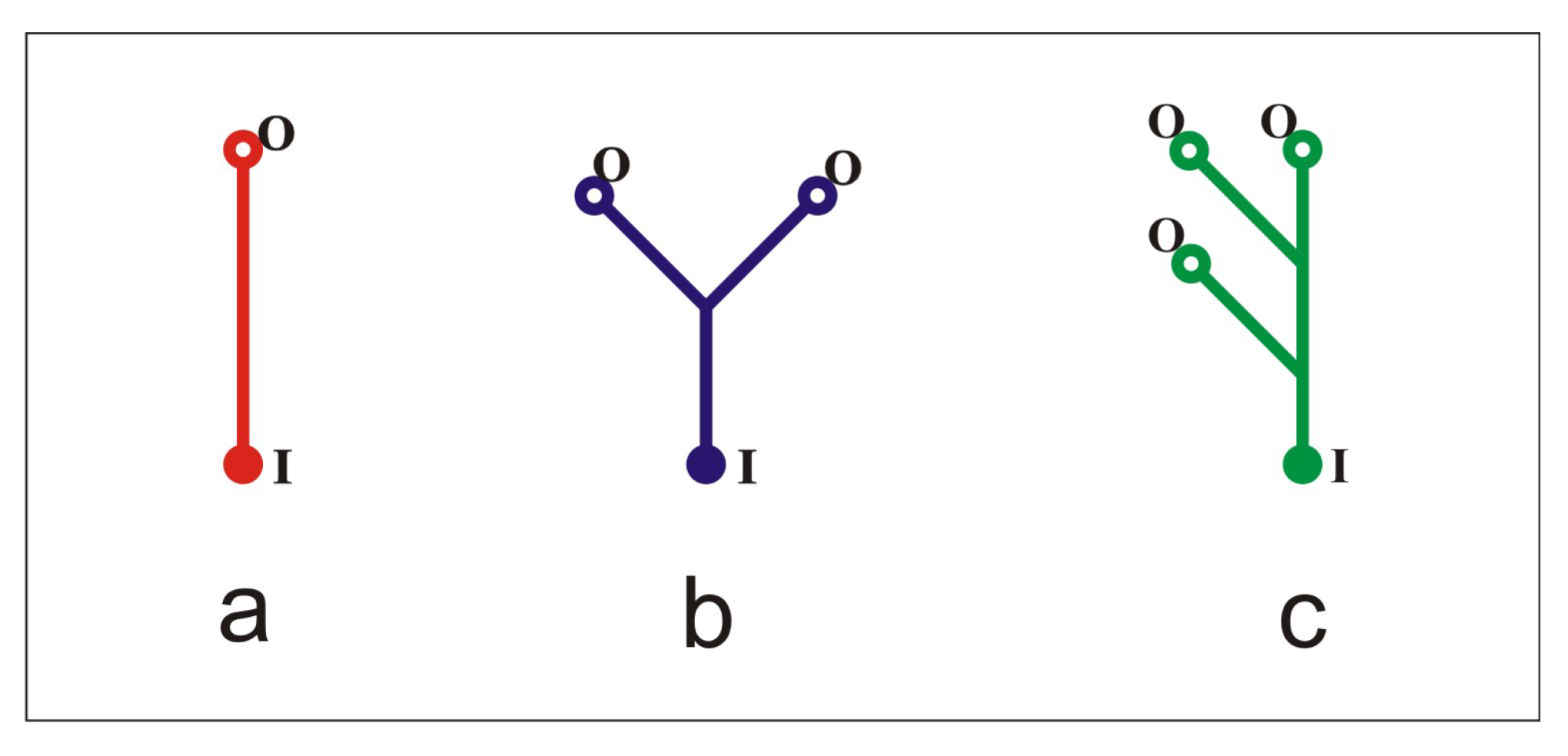
Consider the scenario of creating a road network from predefined patterns of road patches; the pattern development process could be non-commutative and non-associative depending on how the predefined patches are combined. For example, consider the three road patches
a,
b, and
c of one-way roads shown in the
Figure 1, with the inlet represented by “I” and the outlet represented by “O”. Then, according to the rule, each road pattern is connected to every exit of the previous pattern.
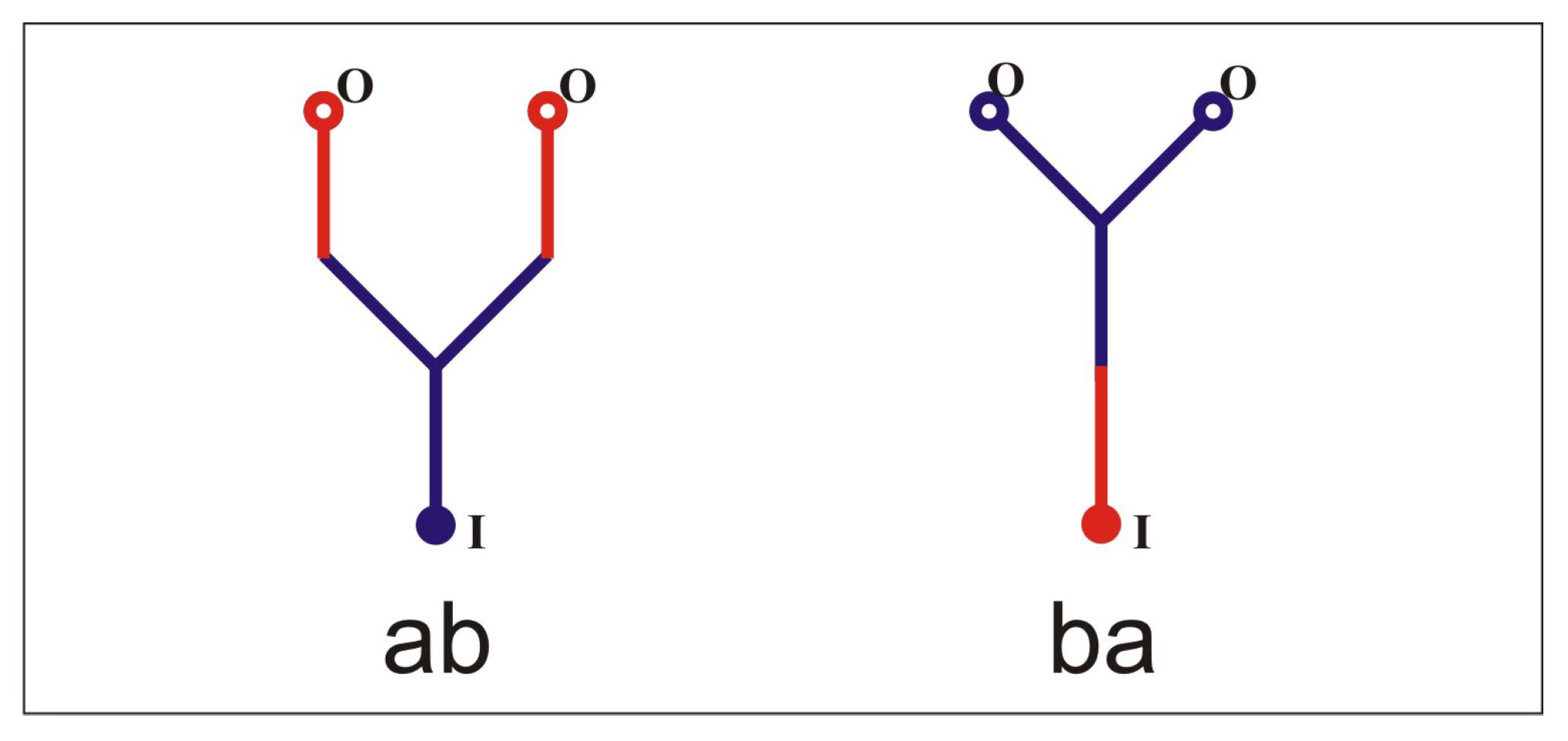
Based on this rule, the shape of the road network is non-commutative, as it can be seen in the
Figure 2.
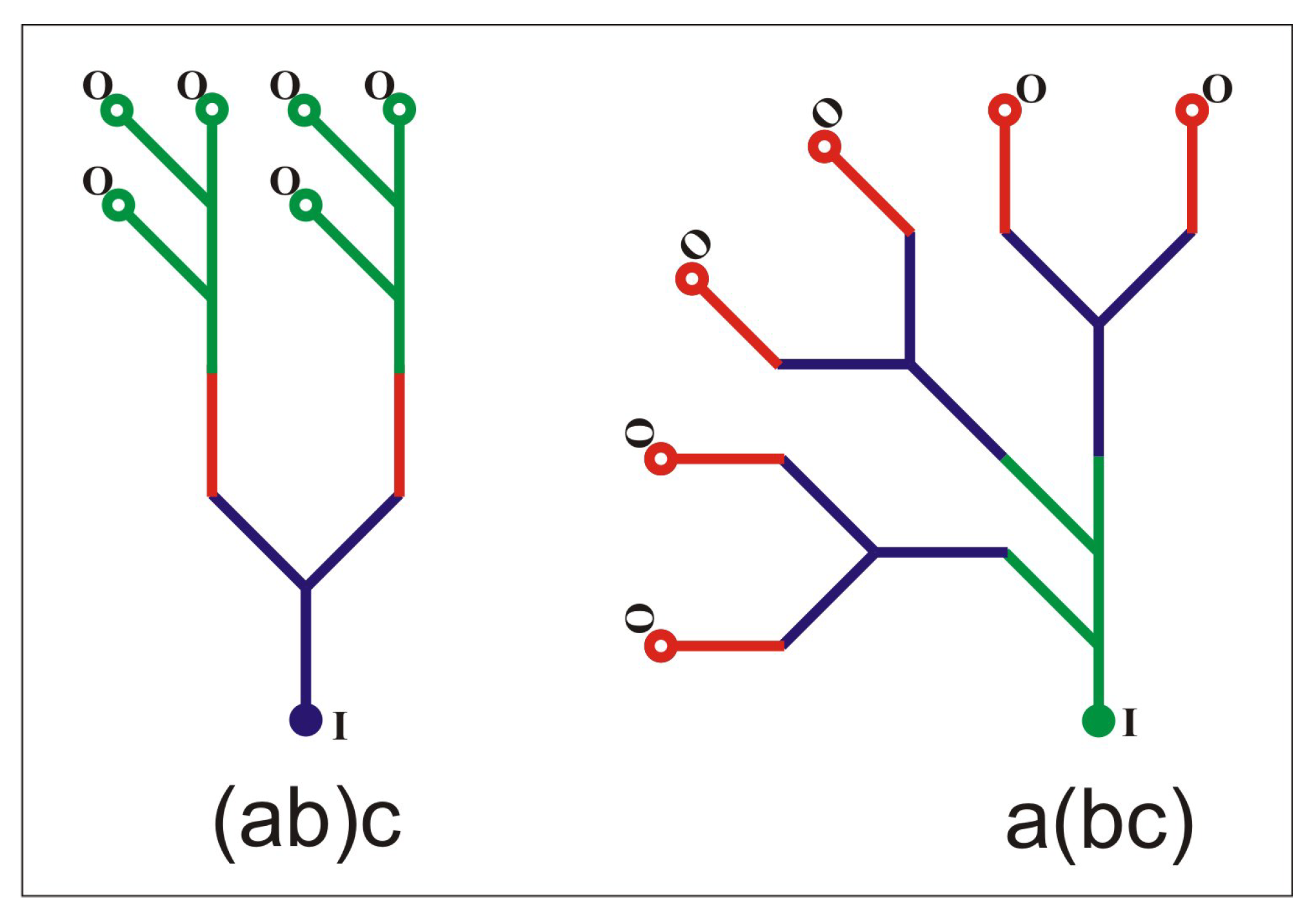
The shape of the road network is also non-associative; an illustration is given in the
Figure 3.
Several such rules can be defined.
Let us consider five road patterns, denoted by
with rule “·”given in the
Table 3. Consider second collection having five road patterns represented by
with rule “⊛” given in the
Table 3.
Note that
and
are clearly AG-groupoids with left identities
and
, respectively. As the selection of road patches is a periodic process, such processes are best represented with complex fuzzy environment (see [
43]).
To see which AG-groupoid is a good choice (generalized) for further analysis, we devise a technique in which we consider two or more AG-groupoids. In each AG-groupoid, consider the collection of CLDFNs that forms a CLDF-score left (right) ideal, then determine the ranking of CLDFN in each AG-groupoid. Once the rankings are obtained, compare them and count the number of places they hold in each AG-groupoid. An AG-groupoid with fewer places of CLDFNs will be a generalized class of an AG-groupoid, followed by another class of an AG-groupoid with fewer places for CLDFNs, and so on.
We now define CLDF-score left ideals for each of these compositions as shown below.
Consider the following CLDFS on
:
where
s are CLDFNs as given in the following
Table 4.
We see that is a CLDF-score left ideal. Note that implying that is not a CLDF-score right ideal.
Now, define a CLDFS on
as follows:
where
s are CLDFNs and are provided in the following
Table 5:
It is obvious from the above table that
is also a CLDF-score left ideal of
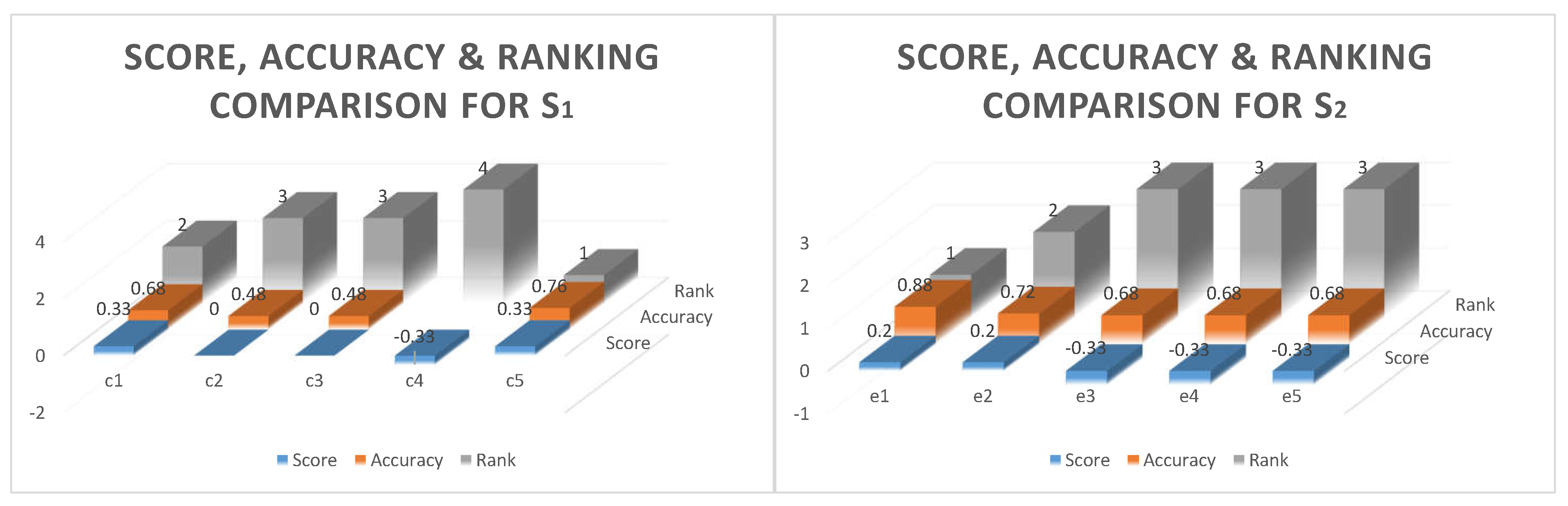
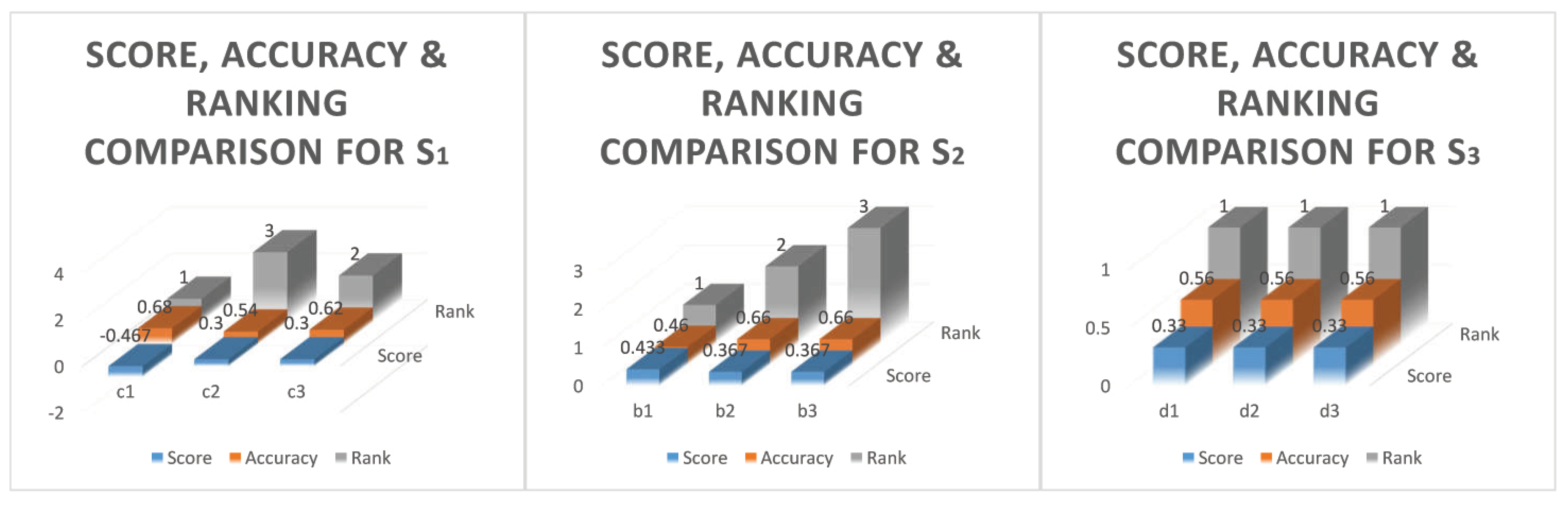
The scores, accuracy and rankings for
and
can be visualized as in
Figure 4:
It can be observed that the s from have 4 distinct positions, and the ’s from have 3 distinct positions. This demonstrates that is the most generalized class of an AG-groupoid, followed by By routine calculations, one can also observe that is not strongly regular, while an AG-groupoids is strongly regular.
Therefore, is not a generalized class and hence is not a good choice for generating a road network. It is suggested that the road pattern set under the composition “⊛” is more suitable for further analysis of road network development, because is a more flexible (generalized) road network than
The number of rankings in each composition can be described tabularly as in the
Table 6:
The same decision mechanism can be applied if we have more than two patterns of road patches. Let us explain this using the following example.
Let us consider the following three AG-groupoids
and
(see
Table 7) representing the patterns of road patches.
Next, we generate CLDF-score right ideals on all of these three representations, of road patches, in the following.
Let
be defined as follows:
be a collection of CLDFNs
, where
s are as defined in the
Table 8:
The
Table 8 shows that
is a CLDF-score right ideal on
.
Defining a CLDFS,
on
and listing the corresponding values in the
Table 9:
It can be seen that is a CLDF-score right ideal on .
Continuing in the same fashion, we use the
Table 10 to give a CLDF-score right ideal
on
.
The scores, accuracy and rankings for
,
and
can be visualized as in
Figure 5:
The positions of
s in each composition, as well as the choices, are given as in the
Table 11:
6. Discussion and Comparison
In this section, we discuss the superiority and comparability of the proposed method with other methods, as well as its validity.
CFS, CIFS, CPFS, and Cq-ROFS are well-known approaches for dealing with complex fuzzy information. However, they have some restrictions, such as the inability of CFS to handle complex non-membership functions. This limitation was overcome by CIFS, though it imposed very strict conditions on membership and non-membership complex functions, minimizing the viable space. To address this limitation, CPFS and Cq-ROFS extended the possible space even further, though the large bulk of the space remained unused. Our method utilizes the entire region, allowing users to freely select membership and non-membership complex functions from anywhere in the space.
6.1. Authenticity and Applicability of the Method
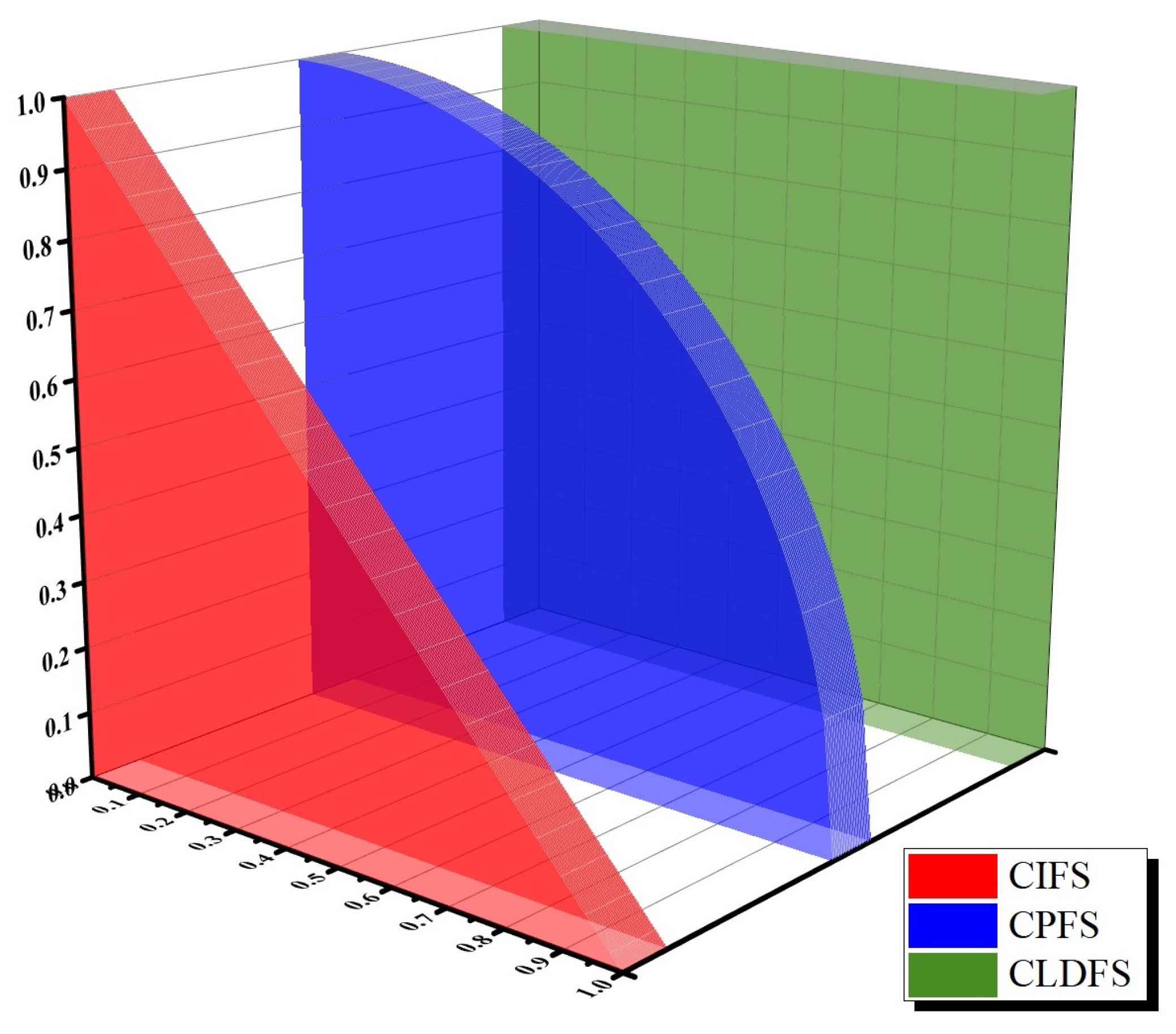
In various situations, several types of criteria and input data are required, depending on the scenario. The suggested CLDFS concept is simple, valid, and easy to apply to a wide range of alternatives and qualities. It covers the region of CIFS, CPFS, and CqROFS with the addition of reference parameters (see
Figure 6). We are able to adapt our framework to a number of situations by changing the physical interpretation of these parameters, which broaden the scope of membership and non-membership complex functions.
In some decision-making problems, we encounter various types of criteria and input data, depending on the scenario.
6.2. Advantages and Limitations of the Method
The proposed CLDFS based algorithms are simple, valid, and straightforward to apply to a wide range of alternatives and attributes. It covers the CIFS, CPFS, and Cq-ROFS regions with the addition of reference parameters. These parameters extend the range of membership and non-membership complex functions, allowing us to apply our framework to a wide range of situations by changing their physical interpretation.
The algorithms proposed in this article could also be extended to complex linear Diophantine fuzzy soft sets, complex linear Diophantine fuzzy rough sets, complex linear Diophantine m-polar valued fuzzy sets etc.




 ,
,