Abstract
E. Study map is one of the most basic and powerful mathematical tools to study lines in line geometry, it has symmetry property. In this paper, based on the E. Study map, clear expressions were developed for the differential properties of one-parameter Lorentzian dual spherical movements that are coordinate systems independent. This eliminates the requirement of demanding coordinates transformations necessary in the determination of the canonical systems. With the proposed technique, new proofs for Euler–Savary, and Disteli’s formulae were derived.
MSC:
53A04; 53A05; 53A17
1. Introduction
Line families in 3-dim space are investigated widely in line geometry studies. The whole space could be either Euclidean or non-Euclidean. The interesting part of differential geometry is how extensively it has been applied in mechanism design and robot kinematics due to its direct relation to spatial motion (kinematics) [1,2,3,4,5]. However, in spatial kinematics, it is motivated to address the intrinsic ownerships of the line trajectory in view of ruled surfaces. In addition, it is famed that the instantaneous screw axis ) of a moving body traces a pair of ruled surfaces, fixed axodes and named the moving, with as their ruling in the fixed space and the moving space, respectively. Through the movement, the axodes slide and roll with respect to each other in a way that the tangential contact between them is constantly preserved on the entire length of the two matting rulings (one being in each axode) that together locate the at any instant. It is considered that a particular movement gives rise to a unique set of axodes and the other way around applies as well. Consider the axodes of any movement are known, then this yields that the specific movement can be rebuilt without knowing the physical elements of the mechanism, their arrangement, particular dimensions, or the method by which they are joined. In the process of synthesis, the characteristic of axodes has become evident in the realization that the axodes are a go-between in the middle of the physical mechanism and the actual movement of its members (see References [1,2,3,4,5]).
One of the most convenient manners to discuss the movement of line space is to link such space and dual numbers. W. Clifford considered dual numbers after them E. Study. He utilized it as an intermediary for their realization of kinematics and differential line geometry. He gave particular notice to the parametrization of directed lines by dual unit vectors and definition of E. Study map; The set of all directed lines in Euclidean three-space is represented set of points on the dual unit sphere in the dual three-space . The fundamental idea and philosophy of E. Study map related to symmetry. Because E. Study map gives the symmetry property between the directed lines in Euclidean three-space are the corresponding points on the dual unit sphere in the dual three-space. More details on screw calculus and E. Study map can be found in [1,2,3,4,5].
Inspired by such works, if we consider (the Minkowski 3-space ) instead of then the study would be much more motivated utilizing the property that the distance function can be zero, negative or positive, whilst the distance function in the Euclidean case is only positive. In such a case, we need to disconnect directed lines on account of whether the distance function is zero, negative, or positive. Directed lines with are named null lines, and directed lines with (resp are named timelike (resp. spacelike) directed lines. In consideration of its link to the physical science of Minkowski space and engineering, many engineers and geometers have addressed curves and straight surfaces and different surfaces and have observed many different aspects (see [6,7,8,9,10,11,12,13,14,15,16,17,18,19,20]).
In this study, we used the E. Study map in order to give a direct manner for handling the kinematic-geometry of one parameter Lorentzian dual spherical movements by using the aspects of axodes with analogizing to Lorentzian spherical kinematic. Then, new proofs of Disteli and Euler–Savary formulae are given which demonstrate the efficiency and elegance of the E. Study map in Lorentzian spatial kinematics. Furthermore, interdisciplinary research can provide valuable new insights, but synthesizing articles across disciplines with highly varied standards, formats, terminology, and methods required an adapted approach. Recently, many interesting papers related to symmetry, Bertrand curves, submanifold theory, singularity theory and harmonic quasiconformal mappings etc. [21,22,23,24,25,26,27,28,29,30,31,32,33,34,35,36,37,38,39,40,41,42,43,44,45,46,47,48,49,50,51,52,53,54]. In future work, we plan to study the one-parameter Lorentzian dual spherical movements and invariants of the axodes for different queries and further improve the results in this paper combine with the technics and results in [21,22,23,24,25,26,27,28,29,30,31,32,33,34,35,36,37,38,39,40,41,42,43,44,45,46,47,48,49,50,51,52,53,54]. We intend to do the implementation of those results in our following papers.
2. Preliminaries
In this section, we provide a brief introduction to the theory of dual numbers and dual Lorentzian vectors [1,2,3,4,5,16,17,18,19,20]. Let and be real numbers, then the expression: is named a dual number, such that and . This is in fact very comparable to the idea of a complex number, the major distinction being than in a complex number . Then the set
together with the Lorentzian inner product
is referred to as dual Lorentzian 3-space . Hence,
Here, , , and , are the dual base at the origin point of the dual Lorentzian 3-space . Therefore, is a point whose dual coordinates are . If the norm of is given as
Thus, is named a timelike (resp. spacelike) dual unit vector if (resp. ). It is evident that
The Lorentzian (de Sitter space) and hyperbolic dual unit spheres, respectively, are:
and
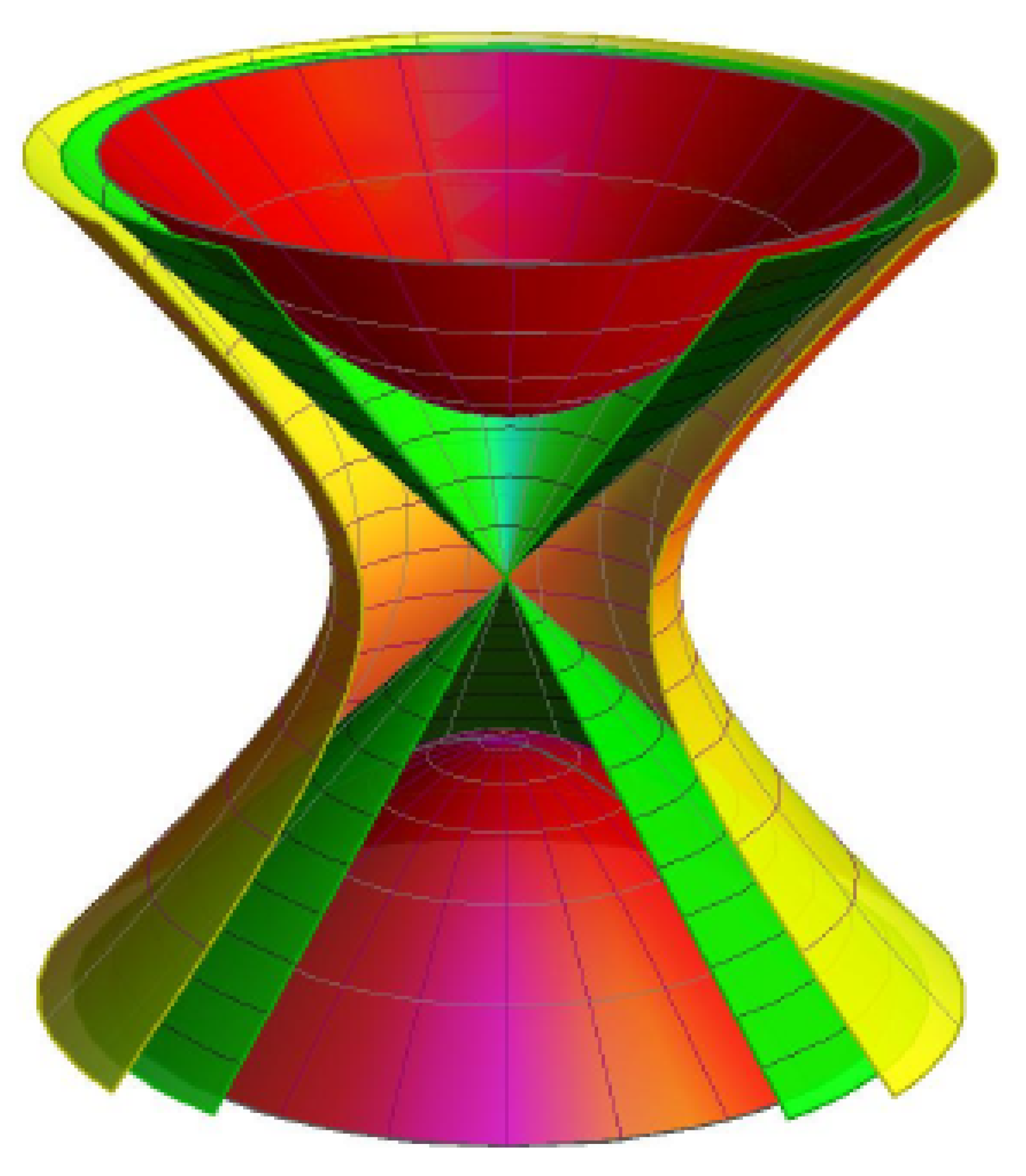
respectively. Then the E. Study map can be stated as follows: The ring shaped hyperboloid correspondence with the set of spacelike lines, the common (shared) asymptotic cone correspondence with the set of null-lines, and the oval shaped hyperboloid correspondence with the set of timelike lines (see Figure 1).
Figure 1.
The dual Lorentzian and dual hyperbolic unit spheres.
In view of the E. Study map, a regular curve on the dual unit sphere (or ) can locally be null (lightlike), spacelike or timelike if all of its velocity vectors are null (lightlike), spacelike or, timelike, respectively. The differentiable curve or , corresponds to a timelike ruled surface in Minkowski 3-space . In a similar way, the dual curve on corresponds to a spacelike or timelike ruled surface in . are determined by the rulings of the surface and from now on we do not characterize between ruled surface and its explaining dual curve.
Definition 1.
Let and be non-null dual vectors in . Then [55],
- (i)
- If and are spacelike dual vectors, then
- In case they span a spacelike dual plane, there exists a unique dual number ; , and in which . Such number is named the spacelike dual angle between and .
- In case they span a timelike dual plane, then there exists a unique dual number in which , such that or based to or , respectively. Such number is named the central dual angle between and .
- (ii)
- If and are timelike dual vectors, then there exists a unique dual number in which , such that or based on and having the same time-orientation or different time-orientation, respectively. This dual number is named the Lorentzian timelike dual angle between and .
- (iii)
- Let be spacelike dual, and be timelike dual, then there exists a unique 0 in which , such that or based on whether or . Such number is named the Lorentzian timelike dual angle between and .
3. One-Parameter Lorentzian Dual Spherical Movements
Consider and as Lorentzian dual unit spheres with as a common center in . We suppose that {,(timelike),} and (timelike) be two orthonormal dual bases rigidly associated with and , respectively. In case that we let fixed, whereas the components of the set { are functions of a real parameter (say the time). Here, we say that moves according to Such movement is named a one-parameter Lorentzian dual spherical movement which is denoted by . If the Lorentzian dual unit spheres and correspond to the line spaces and , respectively, then represents the one-parameter Lorentzian spatial movement Therefore, is the moving Lorentzian space with respect to the Lorentzian fixed space .
Since each of these orthonormal dual frames has the same orientation, one frame is obtained by using another when rotated about . Putting and introducing the dual matrix . It then follows that the signature matrix , describing the inner product of dual Lorentzian 3-space , is given by
Thus, the dual matrix satisfy the equations , and . Hence, we have
which means it is a Lorentzian orthogonal matrix. Such a finding tells that if a one-parameter Lorentzian spatial movement is given in , we can find the associated dual Lorentzian orthogonal matrix , in which are dual functions of one variable . As the set of real Lorentzian orthogonal matrices, the set of Lorentzian dual orthogonal matrices form a group with matrix multiplication (real Lorentzian orthogonal matrices are a subgroup of Lorentzian dual orthogonal matrices). The identity element of is the unit matrix. The transformation group in (the image of Lorentzian movements in the Minkowski 3-space does not contain any translations since the center of the Lorentzian dual unit sphere in should stay fixed. Therefore, in order to perform the Lorentzian movements in , we can state the next theorem:
Theorem 1.
The set of all one-parameter Lorentzian spatial movements in -space is in one-to-one correspondence with the set of Lorentzian dual orthogonal matrices in -space.
To derive the form of an element of the dual Lie algebra of the dual group , we take a dual curve of such dual matrices such that is the identity. By taking the derivative of Equation (1) with respect to t, we obtain:
By choosing , we see that , that is, the matrix is a skew-adjoint matrix. Thus, according to Theorem 1, the dual Lie algebra of the dual Lorentzian group is the dual algebra of skew-adjoint dual matrices
Suppose that and represent a spacelike dual unit vector expressed in and , respectively, then we may express their relationship as:
The inverse transformation is
Equation (2), by differentiation with respect to t, yields
Then, we have
where , and represent the absolute time derivatives of in and , respectively. Furthermore, we obtain , and as below:
and
From the above two equations, we have
3.1. Lorentzian Spatial Kinematics and Invariants of the Axodes
In this subsection, we consider the Lorentzian spatial kinematics and invariants of the axodes by bearing in mind the E. Study map. Therefore, the dual curve (polode) represents the locus of the instantaneous screw axis ) on . This locus is timelike or spacelike moving axode in -space. This moving axode is the locus of the as viewed from the moving space . It will be assumed a spacelike ruled surface in our study, and let us denote this surface by . Similarly, the on is also a dual curve (polode) . This curve like-wise corresponds to the fixed axode . This fixed axode is made up of those lines in the fixed space which at some instant coincides with a line in the moving space having zero dual velocity. It is important to note that is the dual angular speed of the movement . and correspond, respectively, to the rotation movements and the translation movements of the movement Hence, the one-parameter Lorentzian spatial movement can be described by rotation about and translation along the . Thus, the pitch of the movement is defined by
Corollary 1.
During a one-parameter Lorentzian dual spherical movement , the tangent vectors of the fixed and moving timelike polodes are joined as:
Proof.
Without loss of generality, we take the parameter as the canonical parameter of the movement , that is, . Then:
Furthermore, we have:
and
Furthermore, we find
From the relation , we obtain . Substituting into the expression for , we obtain:
This completes the proof. □
Equation (7) contains only first order derivatives of , it is a first-order property of the axodes, in particular is its dual unit speed. More explicitly, we have that
The above relation has only first-order derivatives of ; it is a first-order property of the fixed (moving) axode, particularly its dual unit speed. It follows from Equation (8) that and can replaced them by for short hereinafter. Thus, we can take the dual arc-length parameter to replace the arbitrary parameter, t.
Hence, the common distribution parameter of the axodes is
Therefore, tangent conditions between the axodes and can be given by the following corollary:
Corollary 2.
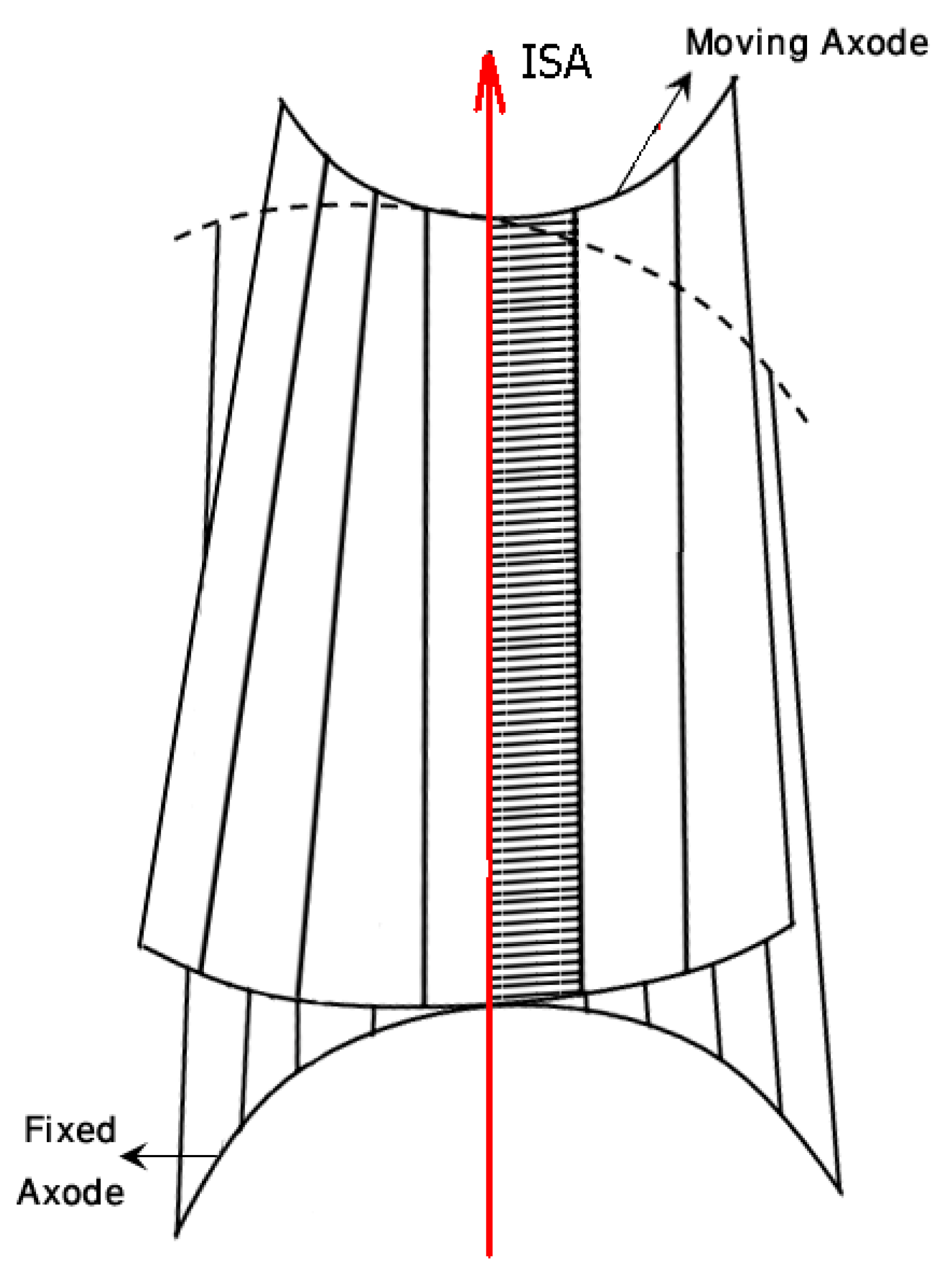
During a one-parameter Lorentzian spatial movement , the spacelike axodes contact each other along and rolls around the in the first order (Figure 2).
Figure 2.
Typical portions of spacelike axodes.
3.2. Euler–Savary Formula for the Spacelike Axodes
We now shall deduce the Euler–Savary and Disteli formulae for the spacelike axodes by using the apparatus just derived above. Thus, as in spherical geometry, we introduce a Lorentzian Blaschke frame
of the polode on (). Such that
, and correspond to three concurrent mutually orthogonal lines, and their point of intersection is the central point on the the ruling . is the limit position of mutual orthogonal to and and is named the central tangent of the spacelike axode at the central point and is named its central normal. By construction, the Blaschke formula is (11)–(14):
where , and
are invariants of the movement . We shall neglect the pure translational movements, that is, . Furthermore, we eliminate zero divisors, that is, . The evolute of the spacelike axode is obtained as
It is obvious that is the Disteli-axis (curvature axis or striction axis) of the spacelike axode . If ; , and is the radius of curvature between and , then we obtain
Here,
is the dual geodesic curvature of the spacelike axode . In view of Equation (15), we conclude the equality:
This is a dual Lorentzian formula of Euler–Savary formula for the polodes of real spherical movement (compare with [1,2,3]). Equation (16) shows a relationship among the two spacelike axodes in direct contact and the kinematic-geometry representing the instantaneous invariants of the movement . By separating the real and dual parts of Equation (16), respectively, we find:
and
The Eqsuations (17) and (18) are new Disteli’s formulae for the spacelike axodes. Observe that the scalars and h are invariants of the choice of the reference point.
Velocity and Acceleration for a Spacelike Line Trajectory
Through the movement , each fixed spacelike line adjoint with the moving spacelike axode, generally, will trace a timelike or spacelike ruled surface in the fixed space . It will be assumed a spacelike ruled surface in our study. In kinematics, this spacelike ruled surface is referred to as spacelike line trajectory. The vector equation of is represented by
Here are its dual coordinates with respect to the axode . By Equation (11), the first derivative of with respect to is
In particular, if is a fixed spacelike line in , we have , which implies
Substituting Equation (21) into Equation (20) and simplifying it, we rewrite Equation (20) as
where is the relative dual geodesic curvature. In order to show the kinematic meaning of , another expressions of can be derived by Equation (11), which is
From Equations (22) and (23), it follows that:
which reveals the kinematic meaning of the relative curvature . By differentiating Equation (22) with respect to again and simplifying it, we get:
3.3. Disteli Formulae for a Spacelike Line Trajectory
In planar kinematics, at each point of a regular curve, there exist only one curvature circle of the curve. The radius and center of this circle can be determined by the famous Euler–Savary formula; if the position of the point is given in the moving plane. Although the Disteli formulae of a line trajectory had been introduced for various types of geometry, we find our motivation in this fact.
Now, we are searching the Disteli’s axis of the spacelike ruled surface (X) by using the tools just derived. The significance of Disteli’s axis is that it is the axis of osculating helicoidal surface is obtained by the helical motion of a line, that is, the generating line is always at the same angle with the Disteli’s axis and always at the same distance from it. Therefore, we consider a timelike circle on the fixed Lorentzian dual unit sphere given by the equation
where is a given dual spherical radius of curvature and is a fixed spacelike dual unit vector which determines the circle’s center. According to E. Study’s map, this equation represents a set of all spacelike oriented lines which forms the given spacelike dual angle with the Disteli’s axis . Such a set of spacelike lines depend on two parameters and are named spacelike line congruence (it is specified by two linear equations of the Plucker coordinates) [1,2,3]. Thus, the timelike osculating circle of this curve is specified by the equations:
which are obtained from the condition that the osculating circle should have contact of at least second order with the curve.
Let us define the Blaschke frame as follows:
At any instant, it is seen from Equations (26) and (27) that:
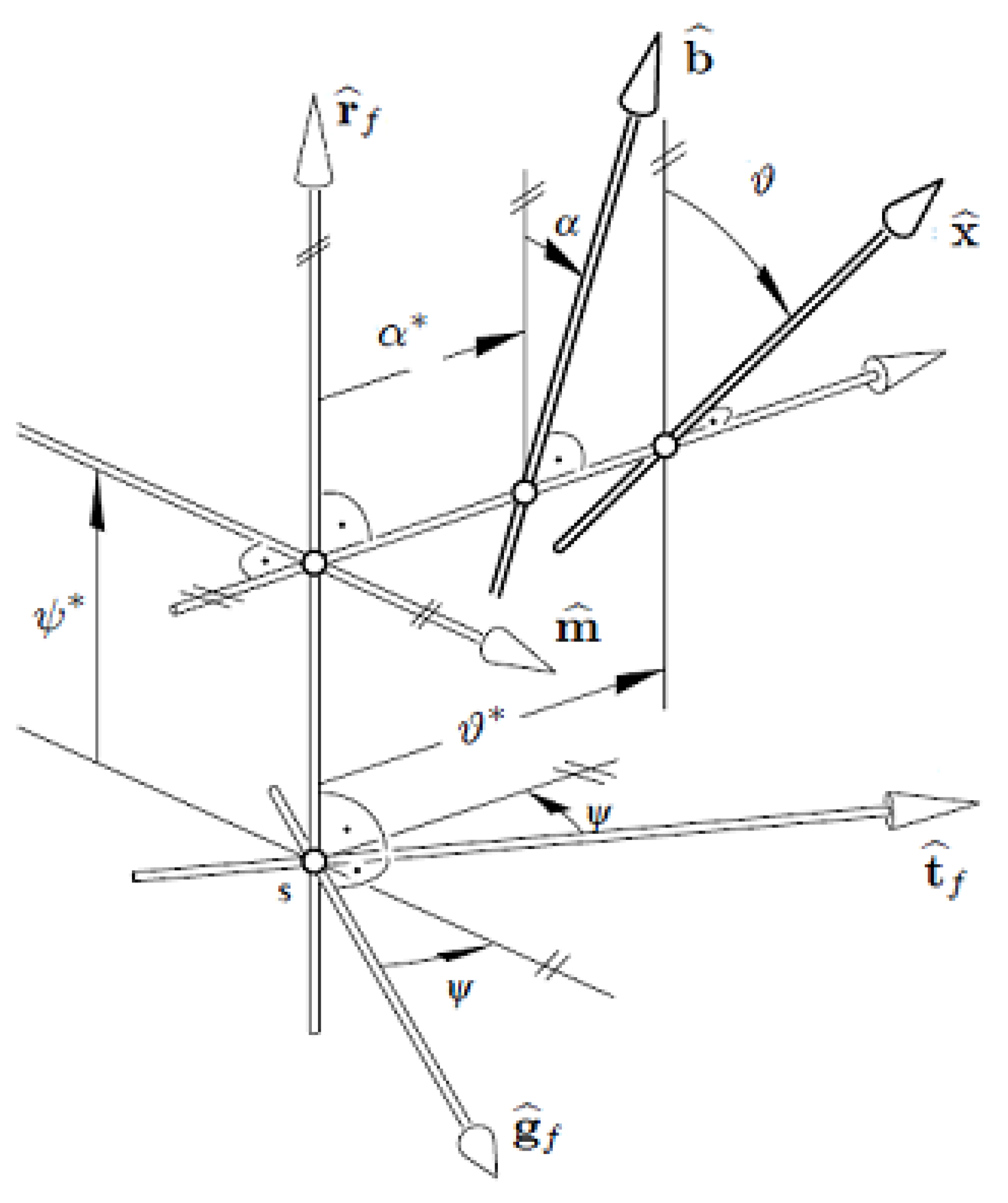
Then, all these three spacelike oriented lines , and constitute a spacelike normal net, that is, they belong to a spacelike line congruence whose focus line is the timelike line . We locate relative to the set by its intercept distance , measured along the and the angle , measured with respect to . We introduce the dual angles and which define the positions of and , along . These dual angles are all measured relative to the (see Figure 3). The following convention governs the signs: and are according to the right-hand Lorentzian screw movement with the thumb pointing along ; the sense of is such that are defined with the thumb in the direction of the . Since is a spacelike dual unit vector, we can write out the components of in the following form:
Figure 3.
Illustrations of and the Disteli-axis .
Furthermore, a set of coordinates may be used to match the Disteli’s axis by the equation
Substituting from Equations (25) and (30) into Equation (26), yields
Into Equation (31) we substitute from Equation (29) to obtain
This is precisely a new dual extension of the Euler–Savary formula from ordinary spherical kinematics (compare with [1,2,3]). By separating the real and the dual parts, respectively, we get:
and
The Euler–Savary formula in Equation (33) together with Equation (34) are new the Disteli formulae of Lorentzian spatial kinematics. Once the angles and are known, Equation (34) gives the correspondence between and in terms of and and the second order invariant . According to Figure 3, the sign of (+ or −) in Equation (34) indicates that the positions of the Disteli’s axis are located on the positive or negative direction along the common central normal .
Once again, we can derive (32) as follows: From Equations (23), (27) and (29), we have:
By construction, the Blaschke formula is:
where
By Equations (30), and (35), moreover, we have
Note that = is the dual radius of curvature of . It follows from the differentiations of Equations (38) that:
The spacelike dual vector is also called the evolute of Therefore, the following condition should be satisfied
which leads to
This equation gives the linkage among the dual spherical curvature and the dual radius of curvature . By Equation (39), we also obtain
Furthermore, from Equations (37), (40) and (41), a simple calculation shows that:
On the other hand, we have
Thus, we get
Upon substitution of Equation (43) into Equation (42), we have Equation (32), as claimed.
On the other hand, we can derive another version of the dual Euler–Savary formula in Equation (32) as follows: From Equations (37) and (40) one finds easily
This is a new Lorentzian dual spherical Euler–Savary formula for the timelike dual curve which corresponds to a spacelike ruled surface and its osculating circle in terms of the dual angle as well as the second order invariant . By separating the real and the dual parts, respectively, we get:
and
The above equations are new Disteli’s formulae of a spacelike line trajectory; According to Figure 3, the sign of (+ or −) in the above equation indicates that the position of the Disteli’s axis is located in the positive or negative direction of the central normal at the central point . Since the central points of are on the normal plane, the Disteli’s formulae can be displayed in the timelike plane ( or ). Hence, any arbitrary point on the timelike plane is defined as central point of the spacelike line trajectory whose generator is the spacelike oriented line and the radius can be calculated by Equation (34); its length which is the line segment from to the point on the plane . Meanwhile, the central point is in the direction of if and in the opposite direction of if . The central point can be on the if ( and on the Disteli’s axis if . In the latter case the central point can be located by letting in Equation (44) which is simplified as a linear equation
Equation (45) is linear in the position coordinates and of the spacelike oriented line . Hence, for the spacelike lines in a given direction fixed in -space lies on a timelike plane. The line L would change its position if has different value, but constant. Nevertheless, a family of line envelope a spacelike curve on the timelike plane . Meanwhile, if the parameter of a spacelike line has a different value but consent, the position of the timelike plane is different. Hence, the set of all spacelike lines L given in Equation (45) is a spacelike line congruence for all values of .
At the end of this section, we want to derive another Lorentzian dual Euler–Savary formula for the spacelike axodes as follows: Substituting , , and into Equation (32), we attain, after some calculations, that
which is the associated dual Euler–Savary formula. By separating the last equation into real and dual parts we obtain
and
The above two equations give new Lorentzian Disteli formulae for the axodes .
4. Conclusions
The main advantage of the work is to consider one-parameter Lorentzian spatial movements in terms of the E. Study map. With the proposed technique, new proofs for Disteli’s, and Euler–Savary formulae were derived. In addition, new metric aspects are defined for the Disteli axis of a spacelike trajectory ruled surface under a one-parameter Lorentzian spatial movement of a body in Minkowski 3-space.
Hopefully, our work may give a productive contribution to the application of four-bar mechanisms, dual Lorentzian spherical motions, theory of mechanism synthesis for higher order approximations, spatial mechanisms in engineering design and gear theory.
Author Contributions
Conceptualization, Y.L., N.A. and R.A.A.-B.; methodology, Y.L., N.A. and R.A.A.-B.; investigation, Y.L., N.A. and R.A.A.-B.; writing—original draft preparation, Y.L., N.A. and R.A.A.-B.; writing—review and editing, Y.L., N.A. and R.A.A.-B.; All authors have read and agreed to the published version of the manuscript.
Funding
This research was funded by National Natural Science Foundation of China (Grant No. 12101168) and Zhejiang Provincial Natural Science Foundation of China (Grant No. LQ22A010014).
Institutional Review Board Statement
Not applicable.
Informed Consent Statement
Not applicable.
Data Availability Statement
Not applicable.
Acknowledgments
We gratefully acknowledge the constructive comments from the editor and the anonymous referees.
Conflicts of Interest
The authors declare no conflict of interest.
References
- Bottema, O.; Roth, B. Theoretical Kinematics; North-Holland Press: New York, NY, USA, 1979. [Google Scholar]
- Karger, A.; Novak, J. Space Kinematics and Lie Groups; Gordon and Breach Science Publishers: New York, NY, USA, 1985. [Google Scholar]
- Pottman, H.; Wallner, J. Computational Line Geometry; Springer: Berlin/Heidelberg, Germany, 2001. [Google Scholar]
- Aslan, M.C.; Sekerci, G.A. Dual curves associated with the Bonnet ruled surfaces. Int. J. Geom. Methods Mod. Phys. 2020, 17, 2050204. [Google Scholar] [CrossRef]
- Alluhaibi, N. Ruled surfaces with constant Disteli-axis. AIMS Math. 2020, 5, 7678–7694. [Google Scholar] [CrossRef]
- Ali, A.T. Non-lightlike constant angle ruled surfaces in Minkowski 3-space. J. Geom. Phys. 2020, 157, 103833. [Google Scholar] [CrossRef]
- Ali, A.T. A constant angle ruled surfaces. Int. J. Geom. 2018, 7, 69–80. [Google Scholar]
- Ali, A.T. Non-lightlike ruled surfaces with constant curvatures in Minkowski 3-space. Int. J. Geom. Methods Mod. Phys. 2018, 15, 1850068. [Google Scholar] [CrossRef]
- Ali, A.T.; Hamdoon, F.M. Surfaces foliated by ellipses with constant Gaussian curvature in Euclidean 3-space. Korean J. Math. 2017, 25, 537–554. [Google Scholar]
- Ali, A.T.; Abdel Aziz, H.S.; Sorour, A.H. On some geometric properties of quadric surfaces in Euclidean space. Honam Math. J. 2016, 38, 593–611. [Google Scholar] [CrossRef]
- Ali, A.T.; Abdel Aziz, H.S.; Sorour, A.H. On curvatures and points of the translation surfaces in Euclidean 3-space. J. Egyptian Math. Soc. 2015, 23, 167–172. [Google Scholar] [CrossRef]
- Saracoglu, S.; Yayli, Y. Ruled Surfaces and Dual Spherical Curves. Acta Univ. Apulensis 2012, 20, 337–354. [Google Scholar]
- Sarioglugil, A.; Senyurt, S.; Kuruoglu, N. On The Integral Invariants of The Closed Ruled Surfaces Generated by a Parallel p-Equidistant Dual Centroit Curve in the Line Space. Hadron. J. 2011, 34, 34–47. [Google Scholar]
- Schaaf, A.; Ravani, B. Geometric Continuity of Ruled Surfaces. Comput. Aided Geom. Des. 1998, 15, 289–310. [Google Scholar] [CrossRef]
- Senyurt, S.; Gur Mazlum, S.; Grilli, G. Gaussian curvatures of parallel ruled surfaces. Appl. Math. Sci. 2020, 14, 171–183. [Google Scholar] [CrossRef]
- López, R. Differential geometry of curves and surfaces in Lorentz-Minkowski space. Int. Electron. J. Geom. 2014, 7, 44–107. [Google Scholar] [CrossRef]
- O’Neil, B. Semi-Riemannian Geometry Geometry, with Applications to Relativity; Academic Press: New York, NY, USA, 1983. [Google Scholar]
- Walfare, J. Curves and Surfaces in Minkowski Space. Ph.D. Thesis, K.U. Leuven. Faculty of Science, Leuven, Belgium, 1995. [Google Scholar]
- Pekmen, U.; Pasali, S. Some characterizations of Lorentzian spherical spacelike curves. Math. Morav. 1999, 3, 31–37. [Google Scholar]
- Study, E. Geometric der Dynamen; Verlag: Leipzig, Germany, 1903. [Google Scholar]
- Li, Y.; Ganguly, D.; Dey, S.; Bhattacharyya, A. Conformal η-Ricci solitons within the framework of indefinite Kenmotsu manifolds. AIMS Math. 2022, 7, 5408–5430. [Google Scholar] [CrossRef]
- Li, Y.; Abolarinwa, A.; Azami, S.; Ali, A. Yamabe constant evolution and monotonicity along the conformal Ricci flow. AIMS Math. 2022, 7, 12077–12090. [Google Scholar] [CrossRef]
- Li, Y.; Khatri, M.; Singh, J.P.; Chaubey, S.K. Improved Chen’s Inequalities for Submanifolds of Generalized Sasakian-Space-Forms. Axioms 2022, 11, 324. [Google Scholar] [CrossRef]
- Li, Y.; Mofarreh, F.; Agrawal, R.P.; Ali, A. Reilly-type inequality for the ϕ-Laplace operator on semislant submanifolds of Sasakian space forms. J. Inequal. Appl. 2022, 1, 102. [Google Scholar] [CrossRef]
- Li, Y.; Mofarreh, F.; Dey, S.; Roy, S.; Ali, A. General Relativistic Space-Time with η1-Einstein Metrics. Mathematics 2022, 10, 2530. [Google Scholar] [CrossRef]
- Li, Y.; Dey, S.; Pahan, S.; Ali, A. Geometry of conformal η-Ricci solitons and conformal η-Ricci almost solitons on Paracontact geometry. Open Math. 2022, 20, 574–589. [Google Scholar] [CrossRef]
- Li, Y.; Uçum, A.; İlarslan, K.; Camcı, Ç. A New Class of Bertrand Curves in Euclidean 4-Space. Symmetry 2022, 14, 1191. [Google Scholar] [CrossRef]
- Li, Y.; Şenyurt, S.; Özduran, A.; Canlı, D. The Characterizations of Parallel q-Equidistant Ruled Surfaces. Symmetry 2022, 14, 1879. [Google Scholar] [CrossRef]
- Li, Y.; Haseeb, A.; Ali, M. LP-Kenmotsu manifolds admitting η-Ricci solitons and spacetime. J. Math. 2022, 2022, 6605127. [Google Scholar]
- Li, Y.; Mofarreh, F.; Abdel-Baky, R.A. Timelike Circular Surfaces and Singularities in Minkowski 3-Space. Symmetry 2022, 14, 1914. [Google Scholar] [CrossRef]
- Yang, Z.C.; Li, Y.; Erdoǧdub, M.; Zhu, Y.S. Evolving evolutoids and pedaloids from viewpoints of envelope and singularity theory in Minkowski plane. J. Geom. Phys. 2022, 176, 104513. [Google Scholar] [CrossRef]
- Gür, S.; Şenyurt, S.; Grilli, L. The Dual Expression of Parallel Equidistant Ruled Surfaces in Euclidean 3-Space. Symmetry 2022, 14, 1062. [Google Scholar]
- Çalışkan, A.; Şenyurt, S. Curves and ruled surfaces according to alternative frame in dual space. Commun. Fac. Sci. Univ. 2020, 69, 684–698. [Google Scholar] [CrossRef]
- Çalışkan, A.; Şenyurt, S. The dual spatial quaternionic expression of ruled surfaces. Therm. Sci. 2019, 23, 403–411. [Google Scholar] [CrossRef]
- Şenyurt, S.; Çalışkan, A. The quaternionic expression of ruled surfaces. Filomat 2018, 32, 5753–5766. [Google Scholar] [CrossRef]
- Şenyurt, S.; Gür, S. Spacelike surface geometry. Int. J. Geom. Methods M. 2017, 14, 1750118. [Google Scholar] [CrossRef]
- As, E.; Şenyurt, S. Some Characteristic Properties of Parallel-Equidistant Ruled Surfaces. Math. Probl. Eng. 2013, 2013. [Google Scholar] [CrossRef][Green Version]
- Özcan, B.; Şenyurt, S. On Some Characterizations of Ruled Surface of a Closed Timelike Curve in Dual Lorentzian Space. Adv. Appl. Clifford Al. 2012, 22, 939–953. [Google Scholar]
- Antić, M.; Moruz, M.; Van, J. H-Umbilical Lagrangian Submanifolds of the Nearly Kähler × . Mathematics 2020, 8, 1427. [Google Scholar] [CrossRef]
- Antić, M.; Djordje, K. Non-Existence of Real Hypersurfaces with Parallel Structure Jacobi Operator in S6(1). Mathematics 2022, 10, 2271. [Google Scholar] [CrossRef]
- Antić, M. Characterization of Warped Product Lagrangian Submanifolds in ℂn. Results Math. 2022, 77, 106. [Google Scholar] [CrossRef]
- Antić, M.; Vrancken, L. Conformally flat, minimal, Lagrangian submanifolds in complex space forms. Sci. China Math. 2022, 65, 1641–1660. [Google Scholar] [CrossRef]
- Antić, M.; Hu, Z.; Moruz, M.; Vrancken, L. Surfaces of the nearly Kähler × preserved by the almost product structure. Math. Nachr. 2021, 294, 2286–2301. [Google Scholar] [CrossRef]
- Antić, M. A class of four-dimensional CR submanifolds in six dimensional nearly Kähler manifolds. Math. Slovaca 2018, 68, 1129–1140. [Google Scholar] [CrossRef]
- Antić, M. A class of four dimensional CR submanifolds of the sphere S6(1). J. Geom. Phys. 2016, 110, 78–89. [Google Scholar] [CrossRef]
- Todorčević, V. Harmonic Quasiconformal Mappings and Hyperbolic Type Metrics; Springer International Publishing: Berlin/Heidelberg, Germany, 2019. [Google Scholar]
- Todorčević, V. Subharmonic behavior and quasiconformal mappings. Anal. Math. Phys. 2019, 9, 1211–1225. [Google Scholar] [CrossRef]
- Kojić, V.; Pavlović, M. Subharmonicity of |f|p for quasiregular harmonic functions, with applications. J. Math. Anal. Appl. 2008, 342, 742–746. [Google Scholar] [CrossRef]
- Kojić, V. Quasi-nearly subharmonic functions and conformal mappings. Filomat 2007, 21, 243–249. [Google Scholar] [CrossRef]
- Manojlović, V.; Vuorinen, M. On quasiconformal maps with identity boundary values. Trans. Am. Math. Soc. 2011, 363, 2367–2479. [Google Scholar] [CrossRef]
- Manojlović, V. On bilipschicity of quasiconformal harmonic mappings. Novi Sad J. Math. 2015, 45, 105–109. [Google Scholar] [CrossRef]
- Manojlović, V. Bilipschitz mappings between sectors in planes and quasi-conformality. Funct. Anal. Approx. Comput. 2009, 1, 1–6. [Google Scholar]
- Manojlović, V. Bi-Lipschicity of quasiconformal harmonic mappings in the plane. Filomat 2009, 23, 85–89. [Google Scholar] [CrossRef]
- Manojlović, V. On conformally invariant extremal problems. Appl. Anal. Discret. Math. 2009, 3, 97–119. [Google Scholar] [CrossRef]
- Gungor, M.A.; Ersoy, S.; Tosun, M. Dual Lorentzian spherical motions and dual Euler–Savary formula. Eur. J. Mech. Solids. 2009, 28, 820–826. [Google Scholar] [CrossRef]
Publisher’s Note: MDPI stays neutral with regard to jurisdictional claims in published maps and institutional affiliations. |
© 2022 by the authors. Licensee MDPI, Basel, Switzerland. This article is an open access article distributed under the terms and conditions of the Creative Commons Attribution (CC BY) license (https://creativecommons.org/licenses/by/4.0/).