1. Introduction
Casson liquids are suitable for heating/cooling operations due to its efficient impact on the energy transmission rate. The rheological model of Casson fluid [
1], used to model the flow of pigment suspensions in the production of printing ink, is also capable of effectively describing the flow characteristics of polymers, human blood, starch suspensions, foams, molten cosmetics, paints, synthetic lubricants etc. [
2]. In view of the multiple practical applications of the Casson fluids, several studies have been conducted on flows of these fluids.
Unsteady flows of a viscous, incompressible and electrically conducting Casson fluid past a moving vertical cylinder with time-variable temperature under the impact of mass diffusion, transversely uniform magnetic field, and chemical reaction have been studied by Kumar and Rizvi [
3]. Using a numerical scheme based on the Crank-Nicolson implicit finite differences, the authors analyzed fluid motion and heat and mass transfer.
Reddy at al. [
4] numerically studied the entropy generation in the heat and momentum transfer in time-dependent boundary layer flow of a Casson viscoplastic fluid over a uniformly heated vertical cylinder embedded in an isotropic, homogenous porous medium. The hydrodynamic flow of incompressible Casson fluids over a yawed cylinder is investigated by Khan et al. [
5] using the homotopy analysis method. Sarkar et al. [
6] investigated magnetohydrodynamics boundary layer flows of Casson and Williamson nanofluids over an inclined cylindrical surface. The impact of linear order chemical reaction and thermal radiation has been considered in the mathematical model.
The flow of Casson fluids mixed with nano size metallic particles, under the influence of an external magnetic field and thermal radiation, owing to a moving boundary cylinder have been studied by Naqvi et al. [
7]. The Joule heating and dissipation are considered in convective heat transfer. Numerical solutions of the governing equations have been obtained and results are presented in graphical illustrations to analyze the fluid motion and heat transfer. Ullah et al. [
8] have studied flows of Casson fluids over a non-isothermal cylinder subject to suction/blowing and to the nonlinear stretching. The effects of porous medium, chemical reaction, viscous dissipation, and heat generation/absorption on the flow fields have been considered in this study. The numerical solutions are obtained using the similarity transformations and the Keller box method.
The classical heat flow, based on the Fourier law leads to a parabolic differential equation of heat transfer. Later, some nonclassical theories of heat flow described by hyperbolic-type equations have been developed.
Recent developments in technology of measurements highlighted some anomalous in heat transport that cannot be explained by the classical mathematical models of heat transport. Researchers in the field of heat transfer have developed other mathematical models that are able to describe the complex phenomena of diffusion processes. So, the mathematical models of heat transfer based on constitutive equations with fractional derivatives in time or space have been developed and studied.
The models using fractional derivatives are considered to be an excellent tool for describing the memory and hereditary properties of various materials and processes [
9]. For these reasons, the fractional models are used in the modeling of various phenomena in thermoelasticity, physics, mechanics, control theory, biochemistry, bioengineering, economics, etc. Povstenko [
10] proposed a quasi-static uncoupled theory of thermoelasticity based on the heat conduction equation with a time-fractional Caputo derivative. The thermal stresses corresponding to the fundamental solutions of a Cauchy problem for the fractional heat conduction equation are found in one-dimensional and two-dimensional cases. An interesting review about anomalous energy transport in one dimensional region and several models of the non-local fractional heat conduction can be found in the reference [
11]. The maximum temperature propagation in a finite medium using a single-phase-lag of heat equation with fractional Caputo derivatives has been studied by Kukla and Siedlecka [
12]. The authors proposed Robotnov functions and a harmonically ambient temperature to study the heat source problems. The problem has been solved by using the eigenfunction expansion method and the Laplace transform technique with time-dependent Robin and homogenous Neumann boundary conditions. The obtained solutions were used for determination of the maximum temperature trajectories. Liu et al. [
13] have investigated the influence of the hall effect and radiation heat on unsteady fractional Maxwell fluids of magnetohydrodynamic flows and heat transfer in a square cavity. The coupled model is formed from the momentum equation based on the Fourier law derivation of fractional heat-conduction equation and the fractional constitutive relationship. They obtained numerical solutions using the weighted and shifted Grünwald difference method in the temporal direction with the spectral method based on Lagrange-basis polynomials in the spatial direction. The stability and convergence of the numerical schemes are proved. Wang et al. [
14] formulated a finite difference algorithm on bioheat transfer process during laser irradiation on the living biological tissues. The authors implemented the L1 approximation for the Caputo time fractional derivative. At the same time, they also applied central difference scheme for the Riesz fractional derivative to solve their problem. Effects of time and phase lag time, space fractional parameters and blood perfusion rate on temperature distribution within living biological tissues have been examined by numerical simulations and graphical illustrations. Other interesting results about the fractional heat conduction equation can be found in the papers [
15,
16].
The aim of this paper is to investigate unsteady axial symmetric flows of incompressible and electrically conducting Casson fluids over a vertical cylinder with time-variable temperature, under influence of an external transversely magnetic field. The thermal transport is described by a generalized mathematical model based on the time-fractional differential equation of Cattaneo’s law with the Caputo derivative. In this way, our model is able to highlight the effect of the temperature gradient history on heat transport and fluid motion. The generalized mathematical model of thermal transport can be particularized to obtain the classical Cattaneo’s law, respectively the classical Fourier’s law.
In this article, we used the Caputo fractional derivative because many theoretical and experimental studies have shown that mathematical models based on this fractional derivative lead to results that are in good agreement with the theoretical results. However, in a later study, the authors intend to study a model based on the generalized Atangana-Baleanu derivative [
17]. This fractional derivative generates by particularization the Caputo, Caputo-Fabrizio and Atangana-Baleanu derivatives. The study of such a model will lead to a good comparison between the described model of whole order derivatives and the four fractional derivatives.
The effect of the history of the temperature gradient on the thermal transport and the fluid movement has been highlighted by numerical simulations and graphic illustrations by considering the temperature of the cylindrical surface varying exponentially with time. A comparison of the three models, the generalized Cattaneo, the classic Cattaneo, and the Fourier, gives information on the optimal choice of the thermal transport model.
2. Statement of the Problem
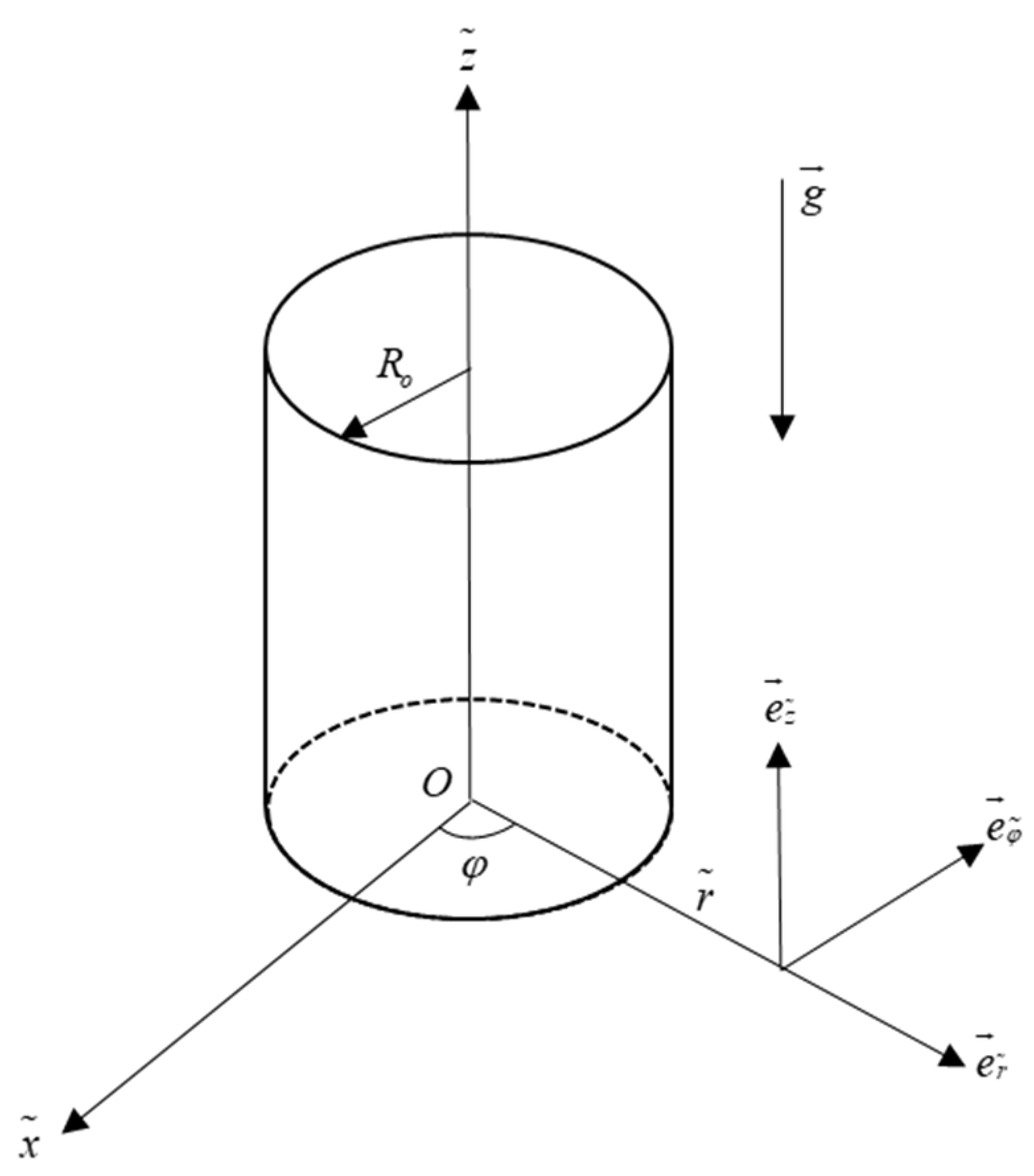
Consider the unsteady flow of an incompressible, electrically conducting Casson fluid over a semi-infinite vertical circular cylinder of radius
Ro. The
-axis of a cylindrical coordinate system
is taken along the axis of cylinder in the vertical upward direction. The gravitational acceleration
g is acting downward,
(
Figure 1). A magnetic field
,
constant is applied to the fluid.
The rheological equation of state for the Cauchy stress tensor of Casson fluid is given by
where
,
is the shear stress tensor,
,
is the
component of the deformation rate tensor,
is a critical value of the product
,
is a plastic dynamic viscosity of the non-Newtonian fluid,
where
denotes the yield stress of the fluid. If a shear stress less than the yield stress is applied to the fluid it behaves like a solid, whereas if a shear stress greater than yield stress is applied, the fluid starts to move. The non-Newtonian Casson fluids flow if
. Denoting
the dynamic viscosity, we obtain the kinematic viscosity
where
is the mass density and
is called the Casson parameter.
In this paper, we consider the velocity field of the form . The fluid temperature is considered as function of , therefore , and the heat flux vector is given by . Taking into consideration the above assumption and the Boussinesq’s approximation, the flow and heat transfer are governed by the following partial differential equations [1, 2]:
The
-component of the linear momentum equation
The balance energy equation
The Cattaneo-Vernotte’s constitutive equation
where
is the thermal expansion coefficient,
is the electrical conductivity of the fluid,
is the specific heat,
is the thermal relaxation time and
is the thermal conductivity of the fluid. Under the velocity field assumption, we have
, therefore the continuity Equation (5) is identically satisfied.
The divergence operator in cylindrical coordinate is
. Since
,
,
, we obtain
Also,
. Therefore,
Along with the above equation, we consider the initial-boundary conditions
In the above relations function
is a piecewise function of exponential order to infinity. Using the following dimensionless parameters and functions,
We obtain the non-dimensional equations:
The non-dimensional forms of Equation (11) are
The Generalized Fractional Mathematical Model
In this paper, we consider a generalized Cattaneo’s law given by the constitutive equation of the thermal flux,
where
denotes the Caputo time-fractional derivative operator defined as [
18,
19]
Let
be the Caputo kernel given by
Using (19) and (20), the time-fractional Caputo derivative is written as a convolution, namely,
Using (19), (21) and the properties of the Laplace transform [
20], we obtain
where
denotes the Laplace transform of function
.
4. Discussion
The unsteady axial symmetric flow of an incompressible and electrically conducting Casson fluid over a vertical cylinder with time-variable temperature, in the presence of a transversely applied magnetic field is studied. The temperature of the cylinder surface is described by a function of time that is a piecewise continuous function for and of exponential order to infinity.
In this study, we have considered a fractional generalized mathematical model based on the time-fractional differential equation of Cattaneo’s law with the Caputo derivative. In this way, our model is able to highlight the effect of the temperature gradient history on the heat transport and fluid motion.
The generalized mathematical model of thermal transport can be particularized to obtain the classical Cattaneo’ law, when the memory parameter is , respectively the classical Fourier’s law when the thermal relaxation time is equal to zero. In this way, the comparison of the three models leads to choose the optimal model of the heat transport.
In order to analyze the influence of several system parameters on the heat transfer and fluid flow some numerical simulations are made considering the nondimensional cylinder temperature given by the function
whose Laplace transform is
. The numerical results are presented in graphical illustrations in
Figure 2,
Figure 3,
Figure 4,
Figure 5,
Figure 6,
Figure 7,
Figure 8 and
Figure 9.
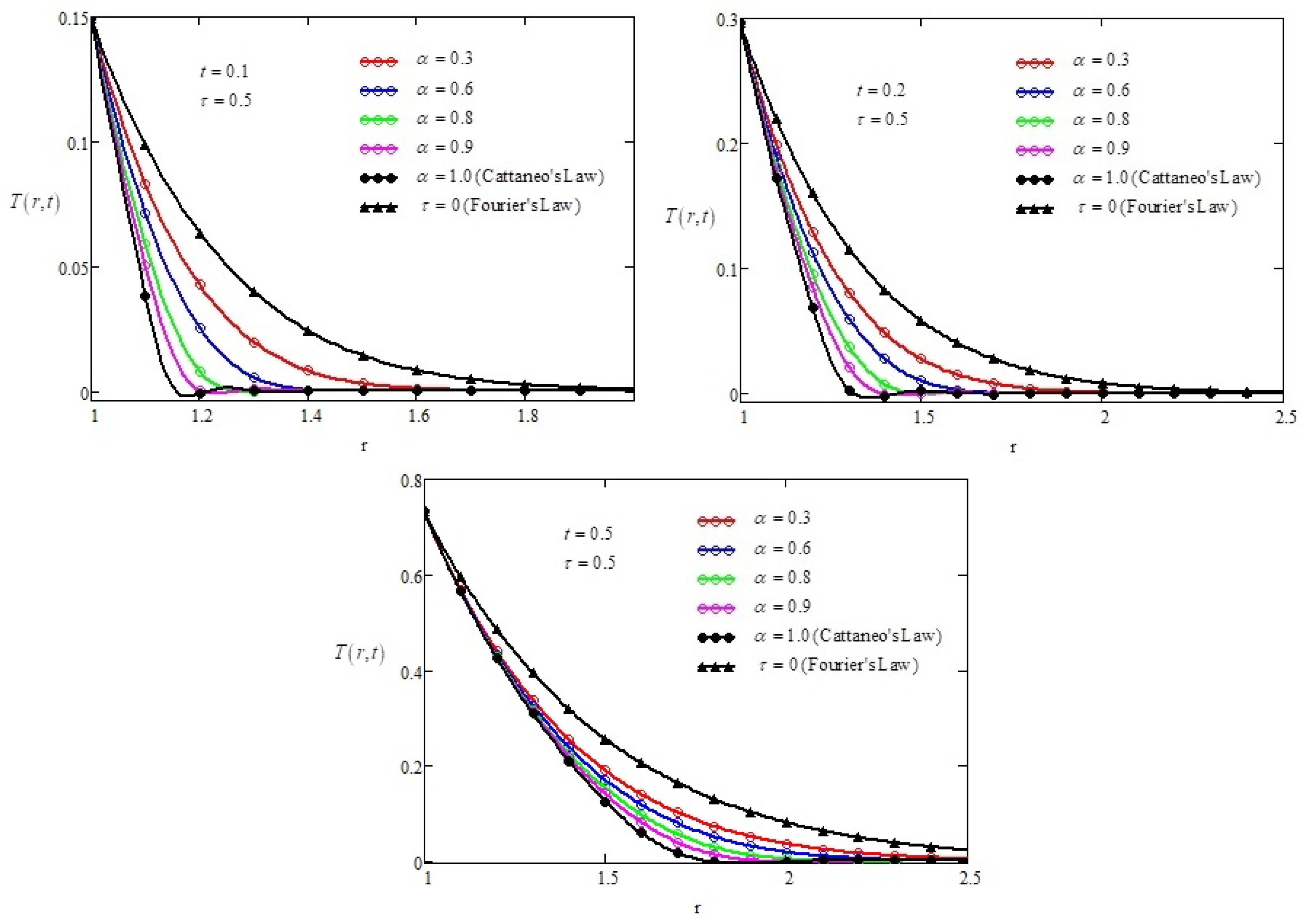
The variation of the dimensionless temperature
, for small values of time and for different values of the fractional parameter
are shown in
Figure 2. The temperature profiles were drawn for three cases corresponding to the fractional mathematical model but also for the classic cases of thermal transport Cattaneo, respectively Fourier.
As expected, the Fourier heat transfer model generates higher temperatures than the fractional and classic Cattaneo models. This is due to the fact that in the case of the latter models the history of the temperature gradient influences the evolution in time of the thermal flux, so the whole process of thermal transport. It should also be noted that the weight function that affects the temperature gradient in the case of the classic Cattaneo model is
while in the fractional Cattaneo model it is
where,
is two-parameters Mittag-Leffler function [
24]. Obviously,
. This is visible in
Figure 2 where, for
the temperature profile is close to that corresponding to
.
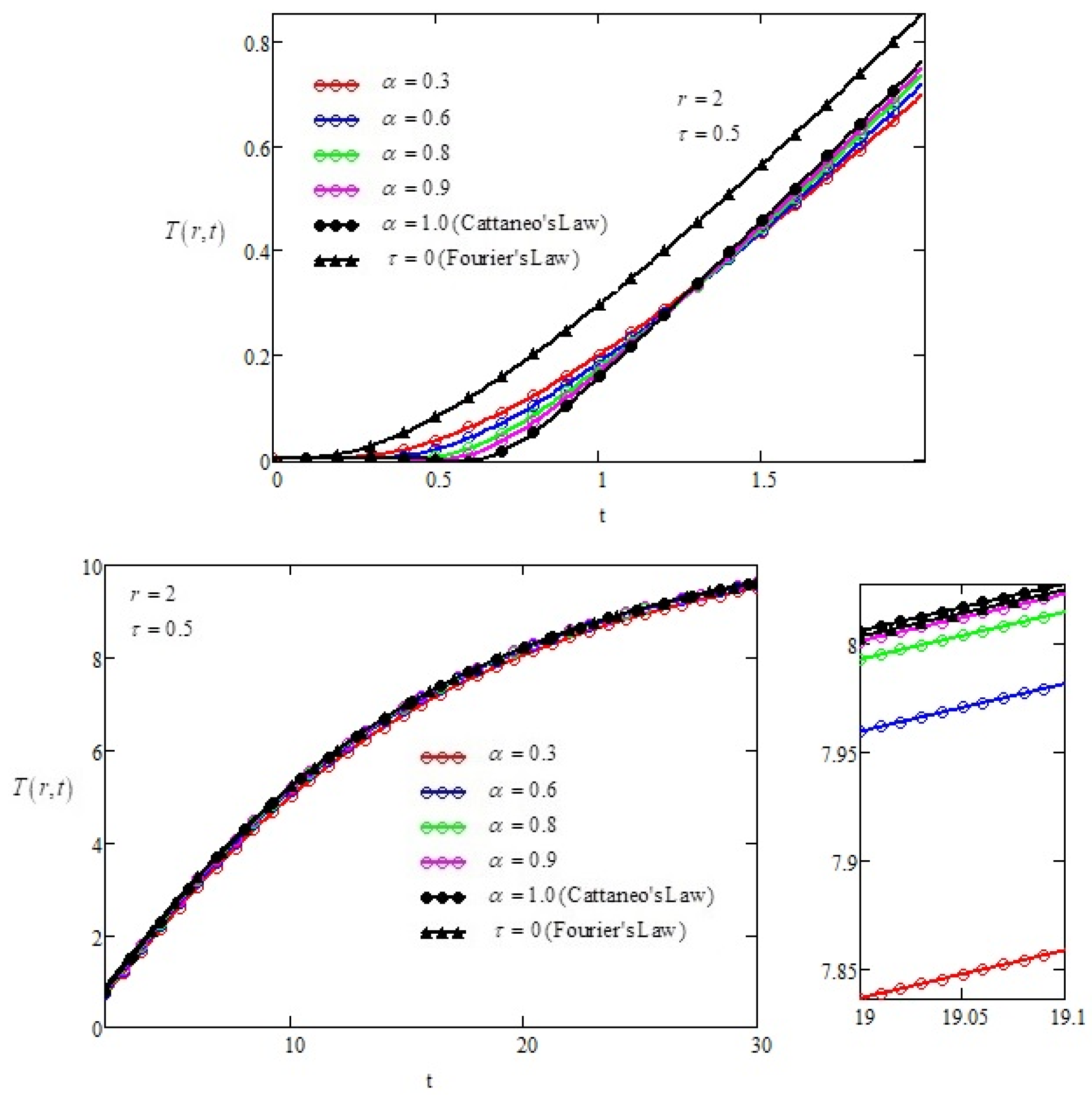
The time variation of the nondimensional temperature
is shown in
Figure 3. As we discussed results obtained in
Figure 2, it is more clearly in
Figure 3 that the memory effects have different influences for small values of time, respectively large values of the time
t. It is observed in
Figure 3 that at small values of the time
t, the fractional Cattaneo’s law leads to higher temperatures than that corresponding to the classical Cattaneo’s law, but, for large values of time, the fractional models generate the smallest temperatures. Moreover, for high values of time
t, the temperature field tends to have a constant value. This value is the same for all the analyzed models. On the one hand, this property results from numerical simulation, but it can also be justified theoretically using the following property:
Using Equation (32) and the property (43), we obtain
Using the asymptotic approximations of Bessel functions [
25]
if
, we get
, therefore,
. In the considered case
.
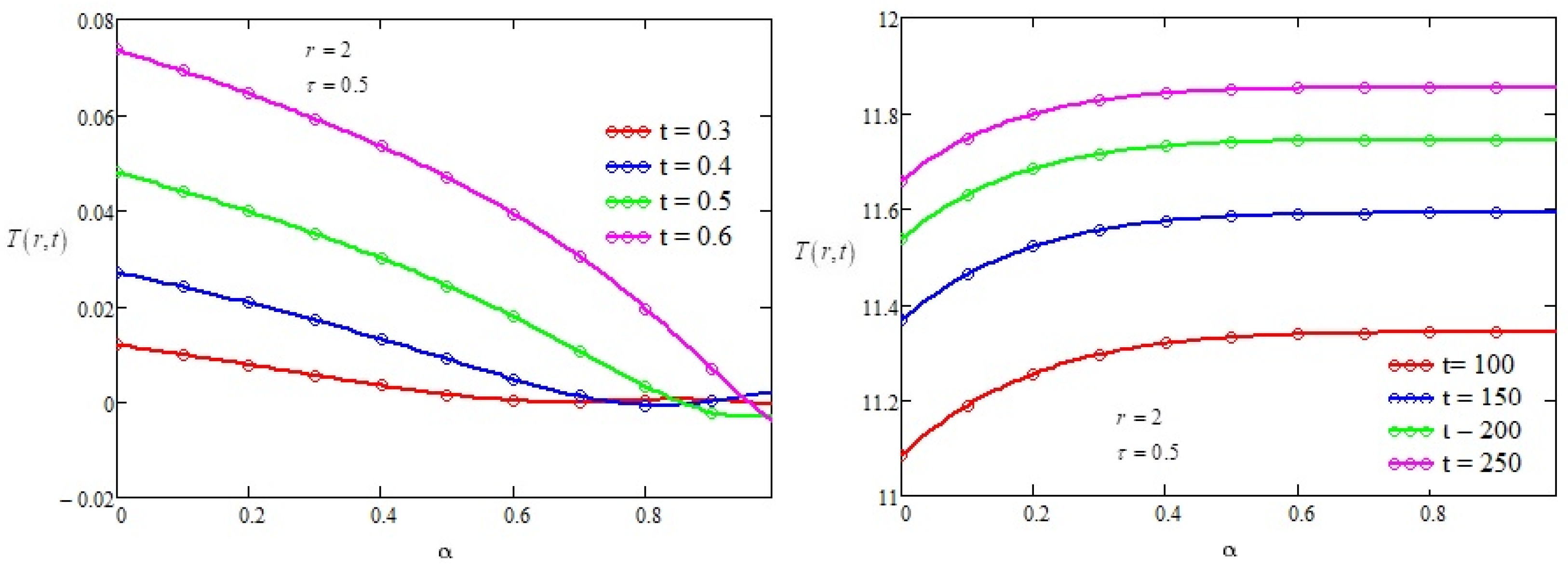
The variation of dimensionless temperature
with the fractional parameter
is shown in
Figure 4. It is seen in this figure that the temperature is increasing with the fractional parameter. However, for high values of time, the influence of the fractional parameter on the temperature is insignificant. This is due to the time evolution of the fractional kernel
that decreases to zero when
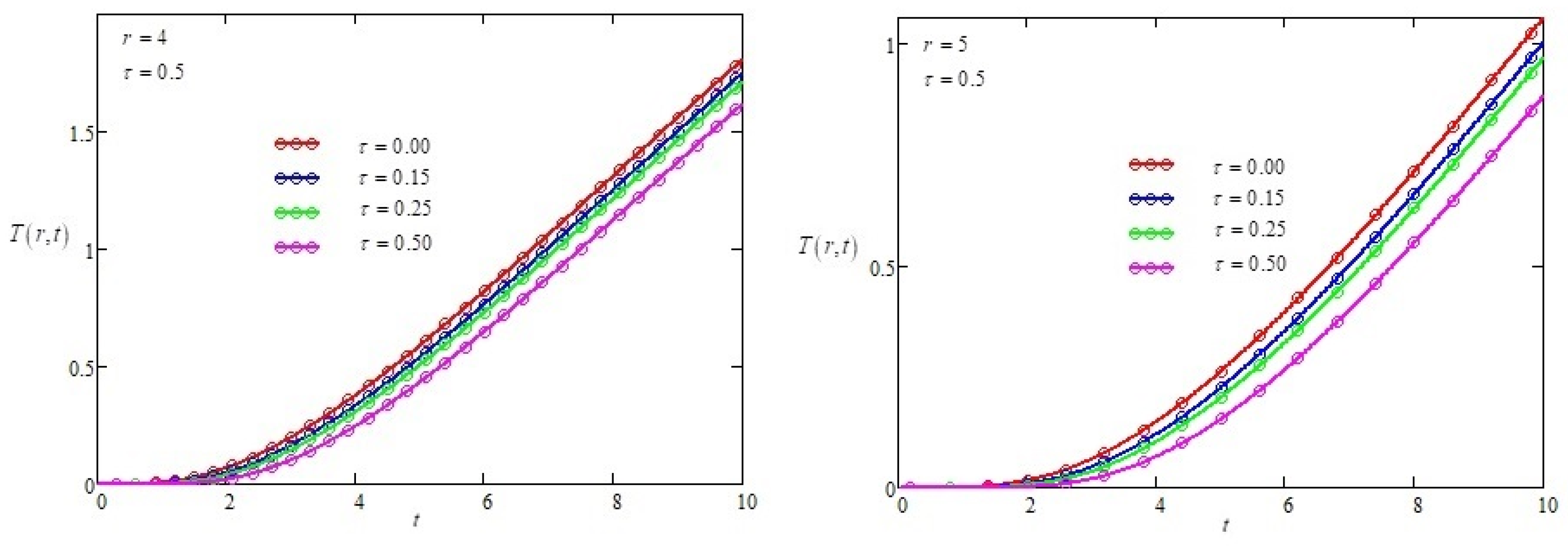
.The influence of the thermal relaxation time on the thermal field is shown in
Figure 5. It is seen that the temperature decreases with the relaxation time
.
Fluid motion is analyzed by the graphs in
Figure 6,
Figure 7,
Figure 8 and
Figure 9.
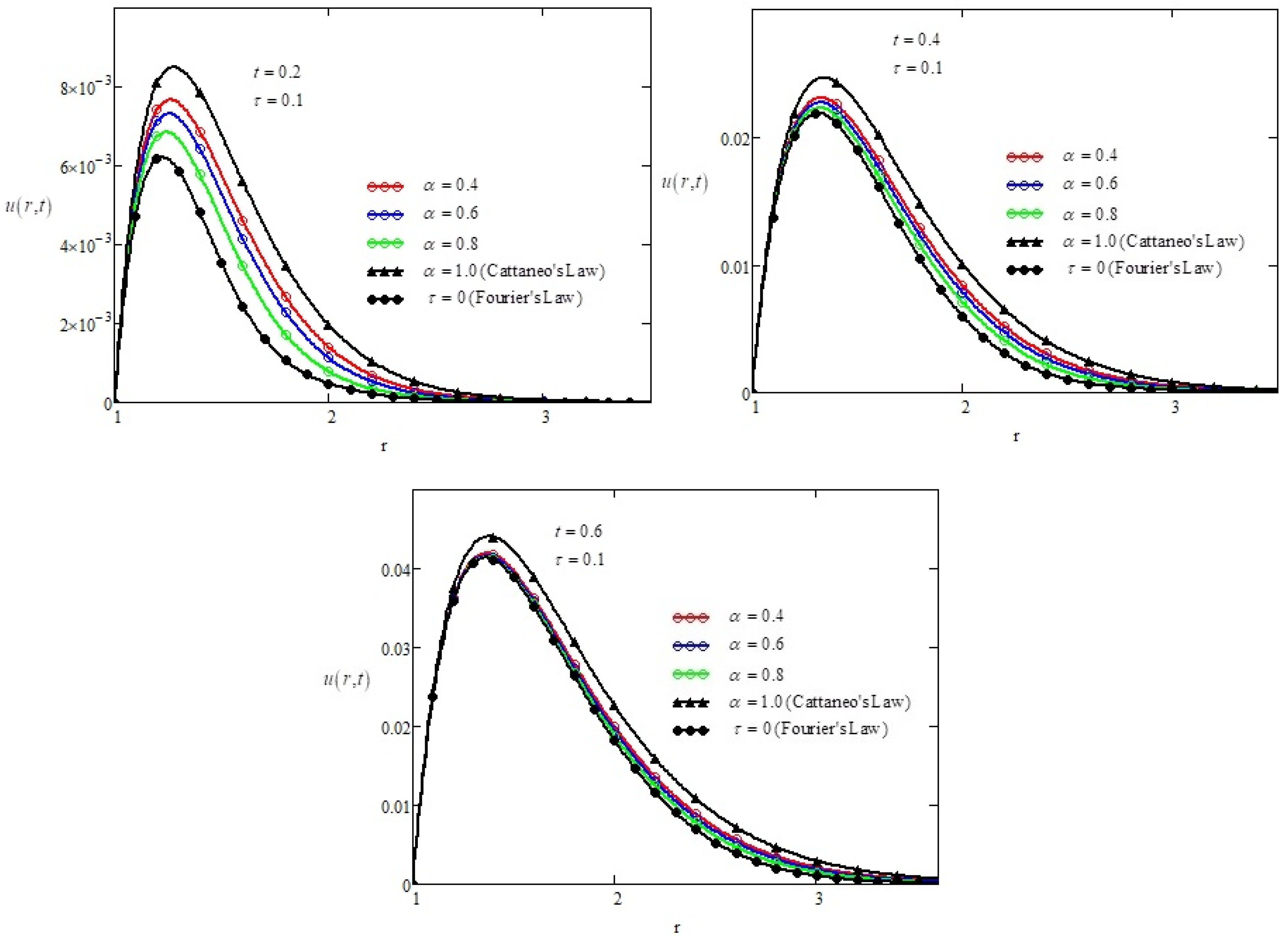
Figure 6 shows the velocity profiles versus the radial variable
r, for different values of the fractional parameter
. It is observed that there is a perfect correlation between the evolution of fluid temperature and velocity concerning the memory parameter
, namely, the velocity values decrease with the memory parameter
. On the other hand, the velocity has a maximum value near the cylindrical surface and tends to zero away from it.
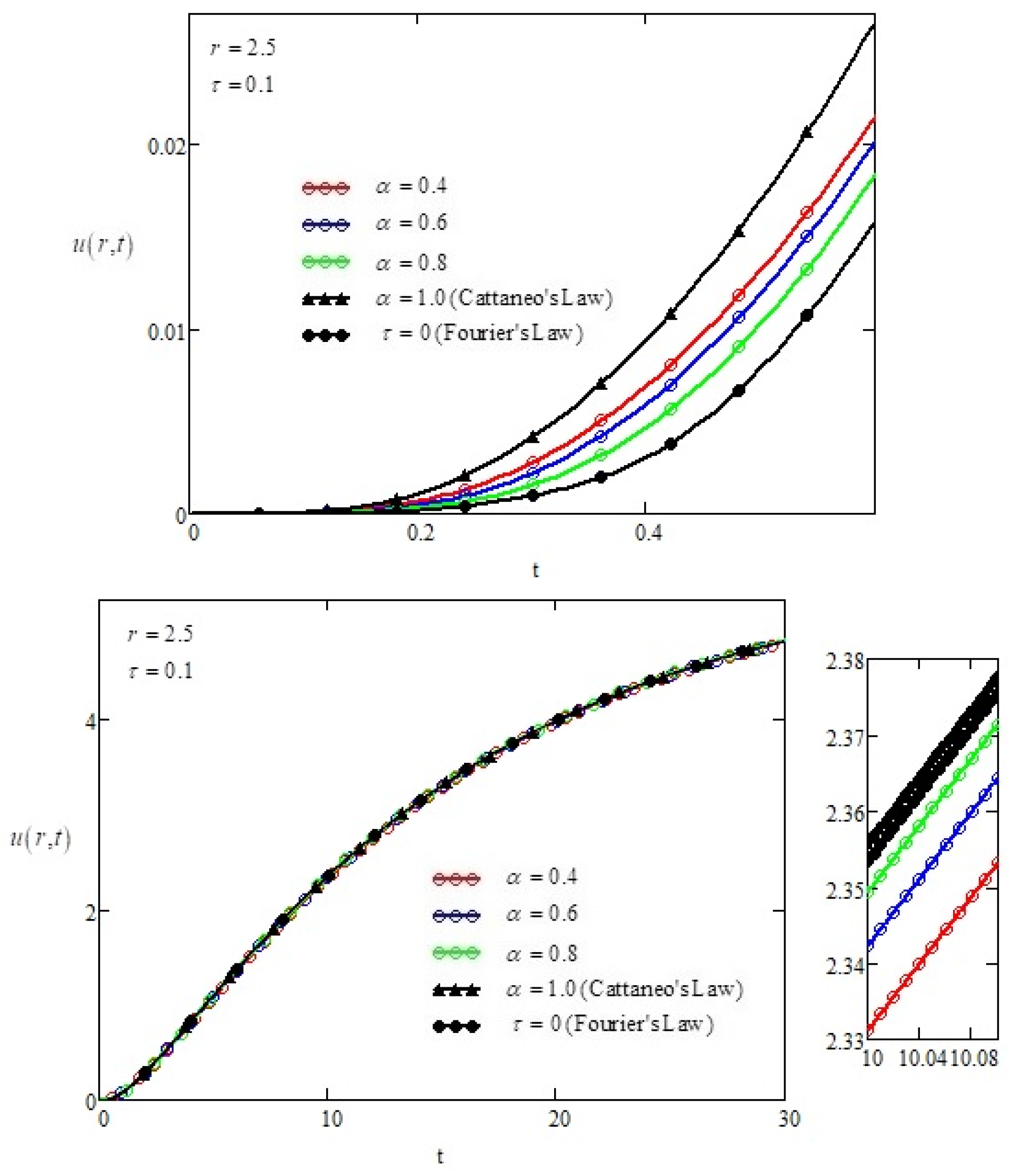
Figure 7 shows the time variation of the fluid velocity in several spatial positions for different values of the time-variation. As in the case of temperature, for small values of time, the influence of thermal memory is significant, but it decreases for large values of time. Note that using Equations (41) and (43), we obtain the following expression for the velocity of the fluid for high values of time
t:
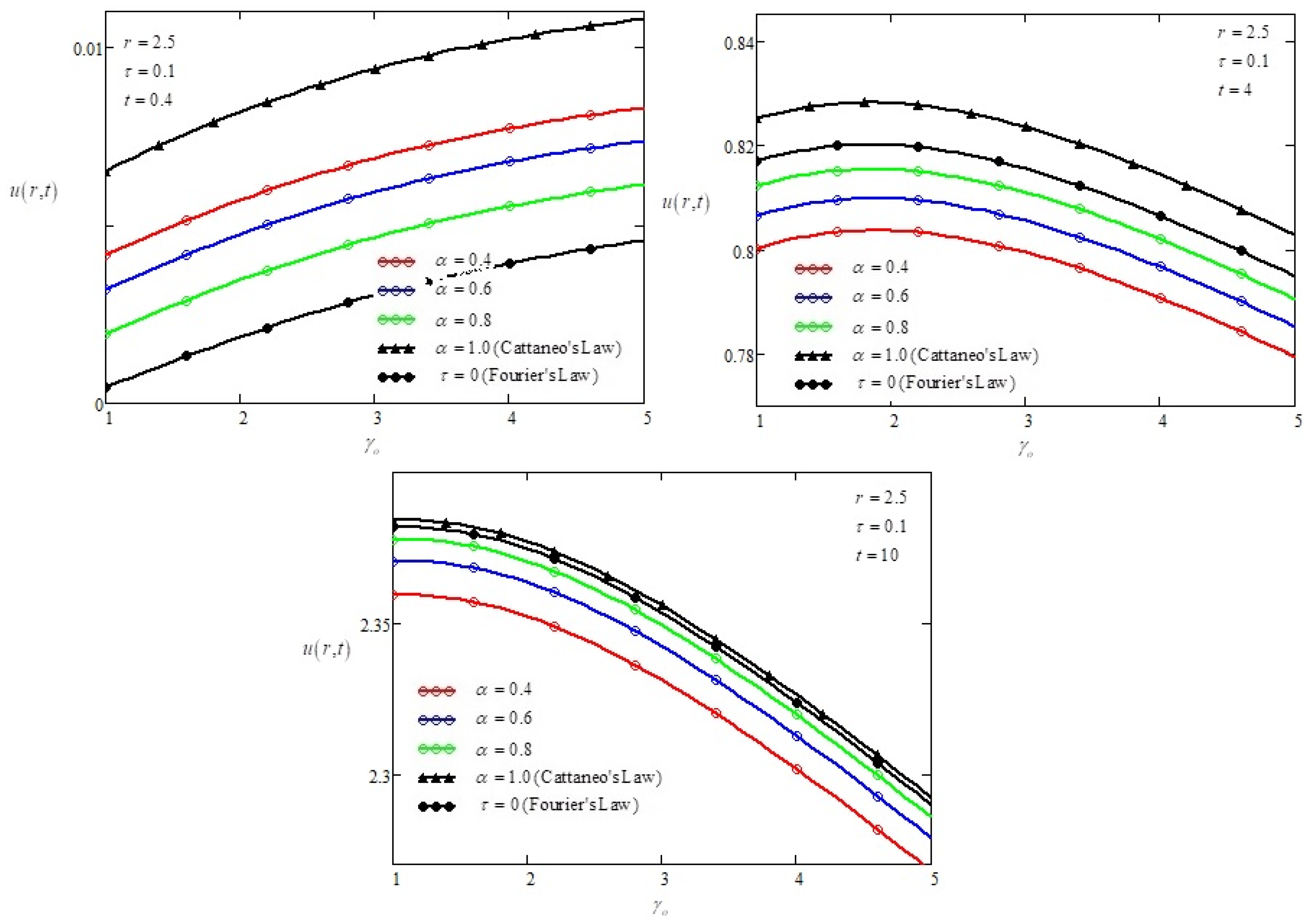
The influence of the Casson parameter
on the fluid motion is shown in
Figure 8. It can be seen that at low values of time, the fluid velocity is increasing with the Casson parameter
, but has an opposite character for high values of the Casson parameter. This fact is due to for increasing of Casson parameter the fluid viscosity increases, therefore the fluid motion is slowed down.
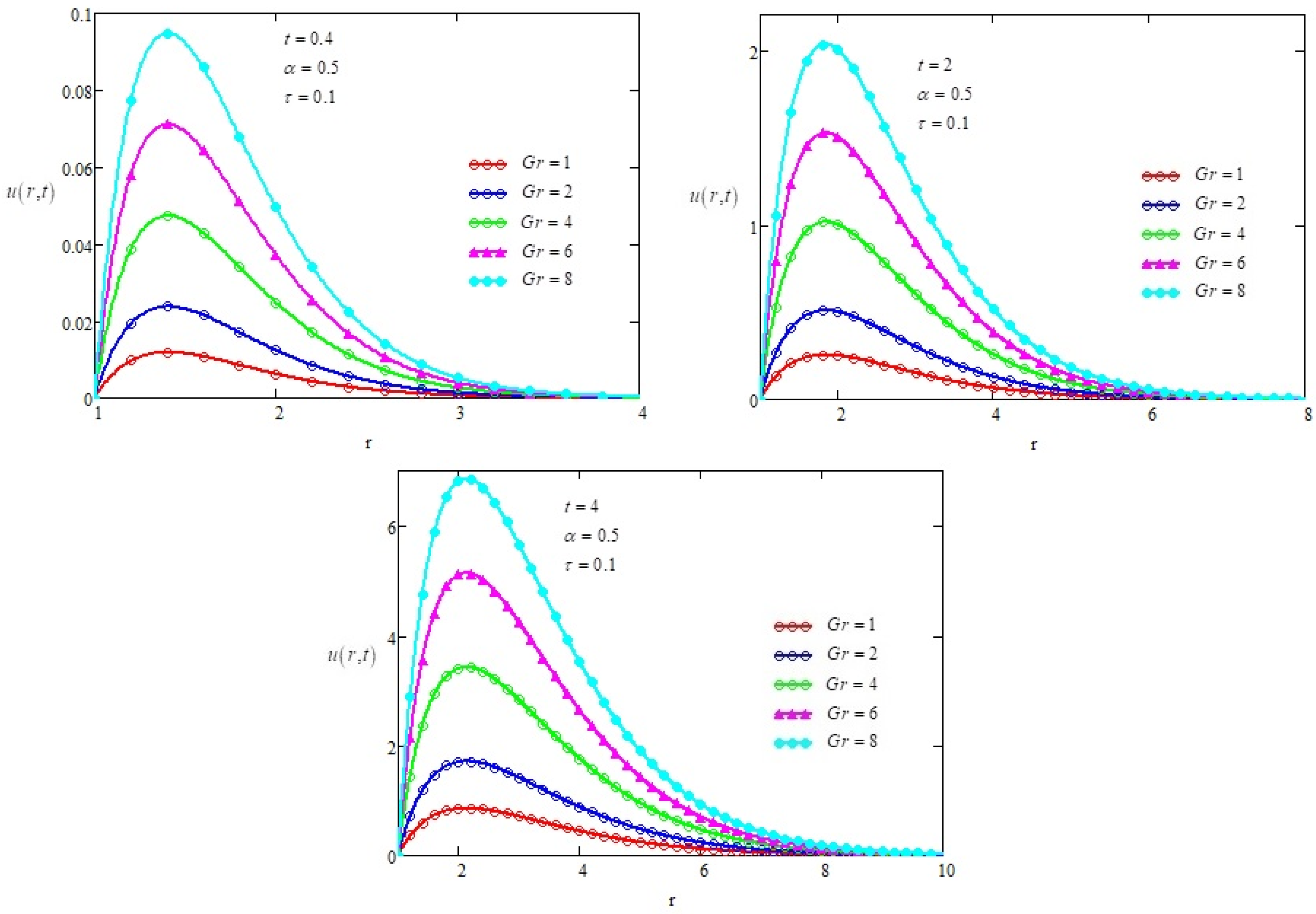
Figure 9 is drawn to highlight the influence of the Grashof number on fluid motion. Note that the fluid velocity increases with the Grashof number. This is obvious because increasing the value of the Grashof number leads to an increase in buoyancy.