1. Introduction
In this semi-review article, which generalizes our previous work [
1], we deal with the so-called Einstein–Gauss–Bonnet (EGB) gravitational model in dimensions
, which contains the Gauss–Bonnet term and the cosmological term
. The model also includes two non-zero constants:
and
, corresponding to Einstein and Gauss–Bonnet terms, respectively. It is well-known that the equations of motion for this model are of the second order (as it appears in General Relativity). The so-called Gauss–Bonnet term has appeared in (super)string theory as a second order correction in curvature to the effective (super)string effective action [
2,
3].
At present, the EGB gravitational model, e.g., with a cosmological term, and its modifications [
4,
5,
6,
7,
8,
9,
10,
11,
12,
13,
14,
15,
16,
17,
18,
19,
20,
21,
22,
23,
24,
25], are under intensive studies in cosmology and astrophysics, aimed at a solution of the dark energy problem, i.e., a possible explanation for the accelerating expansion of the Universe, which follows from supernovae (type Ia) observational data [
26,
27], and the search for a possible local manifestation of dark energy (related to black holes, wormholes etc.).
In this article we start with the so-called cosmological type solutions with “diagonal” metric
, governed by
scale factors (
,
,
) depending upon one variable
u, which is the synchronous time variable for the cosmological case, when
. For the case
and
,
(
) we get static configurations described by space-like variable (coordinate)
u and time-like coordinate
. In the cosmological case the equations of motion are governed by an effective Lagrangian which contains a 2-metric (or minisupermetric)
and a finslerian metric
, see Refs. [
13,
14] for
and Ref. [
28] for
.
Here we consider the cosmological type solutions with exponential dependence of scale factors (upon
u-variable) and obtain a class of solutions with three scale factors, governed by three non-coinciding Hubble-like parameters—
H,
and
—corresponding to factor spaces of dimensions
,
and
, respectively (
). Here we impose the following restriction
, excluding the solutions with constant volume factor and addressing a classification theorem which tells us that for generic anisotropic exponential solutions with Hubble-like parameters
obeying
the number of different (real) numbers among
may be 1, or 2, or 3 [
21]. The main goal of this paper is to extend the results of Ref. [
1] to a class of cosmological type solutions, which include static ones (with
).
Here, as in Ref. [
1], we consider without loss of generality two cases: (i)
and (ii)
,
. (In the case
, the solutions are absent due to our restrictions.) For
in both cases the solutions exist only if
,
and multidimensional cosmological term
obeys the bounds:
. For
, the solutions exist only when
,
,
and
. We note that here, as in Ref. [
1], we use the Chirkov–Pavluchenko–Toporensky scheme of reduction of the set of polynomial equations [
17]. As in Ref. [
1] we reduce the problem in the generic
case to solutions of a single polynomial master equation of the fourth order or less, which may be solved in radicals for all
,
and
. In the case (ii)
,
(
), the solutions for Hubble-like parameters are found explicitly (see
Section 4).
We also study (in
Section 5) the stability of the solutions for
in a class of cosmological type solutions with diagonal metrics by using an extension of the results of Refs. [
1,
21] (see also the approach of Ref. [
18]) and single out the subclasses of stable/non-stable solutions.
We note that the exponential cosmological type solutions with two non-coinciding Hubble-like parameters
and
h obeying
with
,
were studied earlier in Ref. [
29]. In that case there were two sets of solutions obeying: (a)
,
and (b)
,
, where
and
.
It should be noted that, recently, EGB models were used for constricting certain 4-dimensional gravitational models (so-called 4DEGB theories, e.g., belonging to Horndeski class) by using ideas of Glavan–Lin rescaling [
30] and/or dimensional reductions. These 4D modified models of gravity are (at the moment) under intensive study and have numerous applications in gravitational physics and cosmology, for a review see Ref. [
31].
2. The Cosmological Model
We start with the model governed by the action:
Here,
is the metric on a manifold
M (
),
,
is the cosmological term,
is scalar curvature,
is the Gauss–Bonnet term and
,
are certain nonzero constants.
Our choice of the manifold is following:
In what follows we deal with the metric:
Here,
are arbitrary constants,
,
,
(
) and
are chosen to be 1-dimensional manifolds (either non-compact (
) or compact (
) ones). The cosmological case (
) was considered in detail in Ref. [
1]. The case
may describe certain static configurations.
The action (
1) with the ansatz for the metric (
1) imposed gives rise to the equations of motion which are of polynomial type [
20]:
. Here we denote
and
Refs. [
13,
14]. For
, we have a set of polynomial equations of order 4.
For the case
,
and
the set of Equations (
4) and (
5) has a trivial (isotropic) solution:
[
13,
14], which was generalized in Ref. [
16] to the case
.
In Refs. [
13,
14], the following proposition was proved: there are no more than three different numbers among
if
. This proposition was generalised in Ref. [
21] for
, when the following condition is imposed
.
In this paper we study solutions to Equations (
4) and (
5) by using the following ansatz:
Here, H is the Hubble-like parameter which corresponds to an m-dimensional factor space with inequality imposed, while is the Hubble-like parameter which is related to an -dimensional factor space with and is the Hubble-like parameter assigned to an -dimensional factor space with .
In what follows we add additional restrictions to our ansatz (
7):
It was shown in Ref. [
22] that the set of
polynomial Equations (
4) and (
5) under ansatz (
7) and restrictions (
8) obeyed are equivalent to a set of polynomial equations:
which are of fourth, second and first orders, respectively. Here,
E is defined in (
4) and
where
For more general prescription of a scheme of the reduction of polynomial equations of motion see Ref. [
17] (the so-called Chirkov–Pavluchenko–Toporensky trick).
Relation (
10) is a special case of more general relations [
22]:
, with notation
used.
Relation (
8) excludes the following case
. In the main body of the paper we put:
As in Ref. [
1] we denote:
In terms of dimensionless parameters the restrictions (
8) may rewritten as follows:
Equation (
11) is equivalent to the following one:
In what follows we do not consider the case,
which lead us to the empty set of solutions, since we find for
from restriction (
17):
, while (
18) implies
.
Due to (
10) and (
12) we obtain:
where
The relation (
20) is valid for
. It can be readily proved that [
1]:
for
,
,
. Indeed [
1],
It follows from (
22) that:
Equation (
9) reads [
1]:
where
and
Here, .
Due to (
20) we obtain:
or
Owing to Equation (
18) we get:
Hence, from Equation (
29) we get a master equation in
variable:
This polynomial equation is of fourth order or less (this depends upon the value of ). One may solve it in radicals for all , and .
Relations (
23) and (
30) imply the identity:
which will be used below.
4. The Case
We will now turn our attention to the case
,
and
. Due to (
18) we obtain:
It follows from (
23) that:
Since the case of equal factor-space dimensions is excluded from our consideration (see
Section 2) we put:
and
.
, we obtain from (
20) that
Plugging the relations (
66), (
67) into (
26), (
27) we obtain
By virtue relation (
70), we present relation (
28) as:
or in an equivalent manner as:
It follows from (
68) that
. The calculation of the discriminant
leads us to the following identity:
where we denote
It was verified in Ref. [
1] that
for all
,
and
.
By solving Equation (
75) we get [
1]:
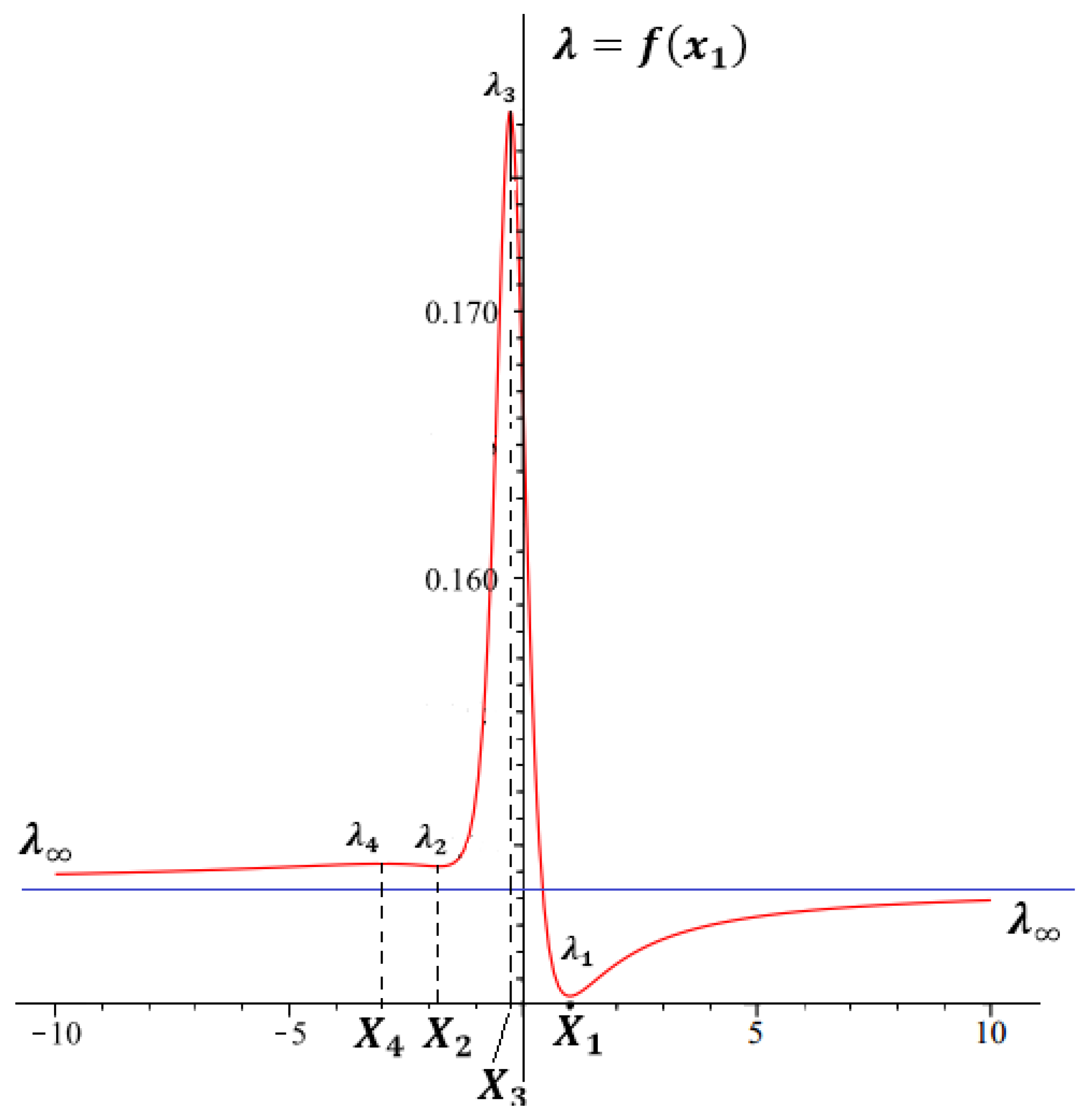
We seek real solutions obeying:
The case
should be excluded [
1]. Indeed,
implies either
or
, which is in contradiction with (
17).
Here, we rewrite the inequality (
83) as:
where
Equations (
66) and (
67) may be resolved as:
where
and
Here, one should consider the case:
Indeed,
implies
, which is not allowed by (
17). Due to (
84) and (
91) we obtain:
It was verified in Ref. [
1] that relations (
88), (
89) and (
92) imply all four inequalities in (
17).
Now we proceed with inequalities in (
92). By introducing the parameter:
we rewrite relation (
82) in the following form:
.
First, we consider the case
. The second inequality in (
92)
is valid due to
. As to the first inequality
, we obtain:
Due to definition of
D in (
79) we get:
Relations (
96) may be presented in the following form:
By using relations:
where
is defined in (
49), and (
87) and (
100) one can present relations (
97), (
98) in the following form:
Now, we consider the case
. Since the inequality
is obeyed in this case, one should verify the inequality
. We find:
or
We write relations (
104) in the following form:
where
Here one can verify that:
Due to (
87) and (
108) we rewrite relations (
105), (
106) in the following form:
Here,
for
, while
for
. The inequalities in (
112) just follow from inequalities
for
.
Thus, we are led to the following generalisation of the Proposition 2 from Ref. [
1].
Proposition 2. The solutions to Equations (4) and (5) for ansatz (7) imposed with , , , obeying the inequalities , , , , do exist if and only if ,for andwhere , are defined in (41) and (43). In this case H satisfies the relation (71) with X from (94), and are given by relations (88) and (89), λ obeys (101), (102) for and (109), (110) for with . The case . For
and
the solutions under consideration obeying restrictions (
8) are absent [
1].
5. The Analysis of Stability
Here, we analyse the stability of our solutions along a line as was done in Refs. [
20,
21,
22].
We impose the following restriction:
where
Here, one should deal with general cosmological type setup with the metric:
where
,
,
. For the equations of motion we obtain [
28]:
where
,
.
According to previous consideration of Ref. [
21] the solution
(
;
) to Equations (
118) and (
119) which obeys the restrictions (
115) is stable under perturbations:
, as
, if and only if
and it is unstable, as
, if and only if
In the limit
, the stability condition is given by (
123) while the instability condition reads as (
122). These conditions just follow from solutions for perturbations
(
) which are valid in the leading order.
Here, a key point is the verification of the relation (
115). It was fulfilled in Ref. [
22] by using first three relations in (
8) and (
14) and
,
and
.
First we consider the case
. By using (
18) we find that for
the condition (
122) may be written as:
or, equivalently,
For
the stability condition (
122) is as follows:
The non-stability condition (
123) for
reads as (
126) for
and as (
125) for
. These conditions are reversed in case
.
Proposition 3. Let us consider cosmological type solutions to Equations (4) and (5) for ansatz (7) with , obeying the inequalities , , , , . - (a)
Let . For the solutions are stable if and unstable if , while for they are stable if and unstable if ;
- (b)
Let . For the solutions are stable if and unstable if , while for they are stable if and unstable if .
Now we proceed with considering the case
,
,
,
. Since
,
and
the exact solutions under consideration obey the first three relations in (
8), which imply the validity of the key restriction (
115).
For the stability condition (
122) as
in this case we get:
or, equivalently,
The non-stability condition (
123) for
may be written as:
Thus, we have the following proposition.
Proposition 4. Let us consider cosmological type solutions (4), (5) for ansatz (7) with , , , obeying the inequalities , , , , , is stable, as , if and only if and it is unstable, as , if and only if . - (c)
Let . For the solutions are stable if and unstable if , while for they are stable if and unstable if .
- (d)
Let . For the solutions are stable if and unstable if , while for they are stable if and unstable if
The case . For a completeness we consider the solutions with
and
,
from (
64) and (
65), where
,
,
,
and
is given by (
63). We get:
Here, ± is a sign parameter in (
64) and (
65). By using our analysis presented above we obtain that the solution with
is stable, as
. This occurs if either
and the sign
are selected in (
64) and (
65), or if
and the sign
are chosen. For the case
our solution is unstable, as
. (Here we also assume the restriction
). These conditions are reversed in case
.
6. Conclusions
We have studied the D-dimensional Einstein–Gauss–Bonnet (EGB) model with the -term and two non-zero constants and . By dealing with diagonal cosmological type metrics, we have considered a class of solutions with exponential dependence of three scale factors (upon u-variable) for any , signature parameter and generic dimensionless parameter .
More precisely speaking, we have described a class of cosmological type solutions with exponential dependence of three scale factors, governed by three non-coinciding Hubble-like parameters H, and . These parameters correspond, respectively, to factor spaces of dimensions , and (), and obey the following restriction . We have analyzed two cases: (i) and (ii) . This choice does not restrict the generality, since, as it was shown, there are no solutions under consideration for ). It was shown that the solutions exist only if and the (dimensionless) parameter obey certain restrictions, e.g., upper and lower bounds for , which depend upon dimensions m, and (Proposition 1). In case (ii) we have presented explicit solutions for all and ( Proposition 2).
By using the Chirkov–Pavluchenko–Toporensky splitting trick from Ref. [
17], we have reduced the problem for
to a master equation on the dimensionless variable
. This equation is of the fourth order (in the generic case) or less (depending on
), and may be solved in radicals for all
,
,
and
. The master equation does not depend upon the signature parameter
which only controls the sign of
according to inequality
. Due to bounds obtained
. (This is valid also for
). Hence the solutions under consideration do exist if
, i.e., when
in the cosmological case (
) and
in the static case (
). Here there are no solutions under consideration for
—contrary to the case of two factor spaces [
29,
32].
Here we have analyzed the stability of solutions as in a class of cosmological type solutions with diagonal metrics. In both cases ((i) and (ii)) for , the “islands” of stability and instability were singled out. (The case was also analysed.) We have shown that in case (i) the solutions with are stable as for and unstable as for (see Proposition 3). These conditions should be reversed when we consider the case , or we deal with , (see Proposition 3). It was proved that in case (ii), the solutions with are stable as for and unstable as for (see Proposition 4). For a given choice of asymptotic , the stability condition for is equivalent to the instability conditions for and vice versa.
We have also found that the solution with exists only for , and a fixed value of depending upon and . Here we have two opposite in sign solutions for with one solution being stable () and the second one unstable, depending upon the sign of .
Some cosmological applications of the model (
), e.g., in the context of the variation of the gravitational constant, were considered in Refs. [
1,
33,
34]. For the static case (
), possible applications of the obtained solutions may be a subject of a further research, aimed towards a search for topological black hole solutions (with flat horizon) or wormhole solutions, which are coinciding asymptotically (for (
)) with our solutions.