1. Introduction
Graphs that are considered in this paper are finite, undirected, connected, and simple. The concept of antimagic labeling of a graph was introduced by Hartsfield and Ringel [
1].
An antimagic labeling of a graph G with m edges and n vertices is a one-to-one correspondence f between the edge set of G to the label set such that , for any two distinct vertices of in , where is defined as the sum of the labels of the edges that are incident to a vertex v in G. A graph that has at least one antimagic labeling is called an antimagic graph.
It is clear that
does not have any antimagic labeling. Except for
, it is believed that all other connected graphs admit at least some antimagic labeling. This is proposed as a conjecture by Hartsfield and Ringel [
1] which states that “Every connected graph other than
are antimagic”. Hartsfield and Ringel [
1] proved that stars, paths, cycles, wheels, complete graphs and complete bipartite graphs,
admit antimagic labeling. By also using an antimagic labeling of a graph
G, we can give a proper colouring to the graph
G. For the study on antimagic labeling and its connection with the vertex colouring, refer to [
2,
3,
4].
Alon et al. [
5] confirmed that the conjecture stands true for some classes of graphs. That is, if
G is a graph with
n vertices and there exist a absolute constant
c such that either
or
, then the graph
G admits an antimagic labeling. Later, Yilma [
6] proved that a graph with maximum degree greater than or equal to
is antimagic.
Researchers have adopted various new techniques to prove some interesting classes of graphs that have an antimagic labeling. Such as, Barrus [
7] proved for class of split graphs, antimagic labeling with a regular dominating subgraph [
8], Lattice and prism grids [
9], regular bipartite graphs [
10], trees [
11], cubic graphs [
12], Spider graphs [
13], Toroidal grids [
14]. For detailed survey, one can refer to [
15]. Although researchers studied the antimagicness of several classes of graph, the conjecture of Hartsfield and Ringel still remains open, even for trees.
Studying the antimagicness for product of regular graphs is more attractive. Initially, the antimagicness of regular graphs were extensively studied by many researchers and finally, in 2016, it was shown that all regular graphs are antimagic. Cranston et al. [
16] proved that all odd regular graphs are antimagic, while the antimagicness of the even regular graphs were verified by Chang et al. [
17] in 2016. In 2015, Bèrczi et al. [
18] gave proof of the antimagicness of k-regular graphs but they realized that the proof of the main theorem of the step uses an invalid assumption. Hence, 4 years later in 2019 [
19], they rectified the error and given the proof.
Theorem 1 (See [
17]).
For every k-regular graph is antimagic. Once regular graphs were proven to be antimagic, researchers focused on proving the antimagicness of graph products using the base as a regular graphs. Liang and Zhu [
20] proved that if
G is a
k-regular graph and
H is any arbitrary graph with
, then the Cartesian product of graph
G and
H admits an antimagic labeling. Cheng [
21] considers a regular graph
and
that has the degree bounded with some inequality, and in this case the Cartesian product of
and
again admits antimagic labeling. In addition, they investigated whether two or more regular graphs with positive degree (mandatorily not connected) admit an antimagic labeling. Wang and Hsiao [
22] explored new classes of sparse antimagic graphs through Cartesian products. Additionally, Wang and Hsiao [
22] considers
G as an arbitrary graph and
H as a
regular graph with
, and then they proved that the lexicographic product of graph
G and
H admits an antimagic labeling. Oudone Phanalasy et al. [
23] proved that certain families of Cartesian products of regular graphs are antimagic. Daykin et al. [
24] constructed two families of graphs known to be antimagic, namely sequential generalized corona graph and generalized snowflake graph. Wenhui et al. [
25] investigated antimagicness for lexicographic product
and
where
. Yingyu et al. [
26] assumed
G as a complete bipartite graph
and
H as a path graph
, and then they proved that the lexicographic product of graph
G and
H admits an antimagic labeling. Recently, Yingyu et al. [
27] constructed oriented Eulerian circuit and used Siamese method to achieve an antimagic labeling for the composition of graph
G and
. The antimagicness of joined graphs is considered by Wang et al. [
28]. If
G is a graph with minimum degree of at least
r and
H is a graph with maximum degree of at most
then the join of
G and
H admits an antimagic labeling for
. Bača et al. [
29] used the antimagic labeling of join graphs to prove the antimagicness of complete multi-partite graphs.
A rooted graph
H is a graph that has one vertex, named a root vertex, as its fixed vertex. Let
G be a
n vertex graph and
be a sequence of
n rooted graphs
such that
and
v is the root vertex of
H. The rooted product of the graphs
G and
H obtained from
G such that
by identifying the root vertex of
to the
ith vertex of
G. The rooted product of graph
G and
H is denoted by
[
30]. If
G be a connected regular of order
n and size
m and
be a sequence of regular graph, where
and each
vertex of
G is joined with all the vertices belongs to the
copy of
. Then the graph is known as corona product of graph [
31]. The corona product of graph
G and
is denoted by
For more information on product graphs, refer to [
32].
Inspired by the results of Daykin et al. [
24], we further extended their results for the antimagicness of rooted products of regular graphs. More particularly, we proved that if we let
G be a connected
t-regular graph and
H be a connected
k-regular graph, then the rooted product of
G and
H admits antimagic labeling for
for some
We also proved that if we let
G be a connected regular graph and
be a sequence of regular connected graph under certain conditions, then the corona product of
admits an antimagic labeling.
2. Main Results
In this section, we prove our main results. Before proving the main result, we present the following lemma which is trivial for antimagicness of regular graphs. For proving the main result, the below lemma is provided.
Lemma 1. If G is a k-regular graph with m edges, then for any vertex u in , , where f is an antimagic labeling of G.
Proof. Let G be a k-regular graph with m edges. By Theorem 1 it admits an antimagic labeling. Let f be an antimagic labeling of G, then for any vertex u in , takes minimum when their incident edges obtain labels from the set and take the maximum value when their incident edges obtain labels from the set .
Hence, . □
From Lemma 1, we have the following observation.
Observation 1. If G be a k-regular graph with f as its antimagic labeling. Let be any two vertices of G such that if then .
The Generalized version of rooted product of graph
G and
H is proved in lemma
[
24]. For the convenience of readers, the lemma
[
24] is given below:
Lemma 2. [24] Let G be any graph with vertices Let the graphs with vertices, have and each be antimagic. Further suppose that , and Then the compounding of given by merging vertex in with the corresponding in is antimagic. From the above lemma, we noticed that only for particular graphs that is, if both the graphs are regular and each copy of for is isomorphic to H then the rooted product of graph G and H is antimagic even when for for some
Theorem 2. Let G be a connected t-regular graph and let H be a connected k-regular graph, then the rooted product of G and H admits antimagic labeling for for some
Proof. Let G be a t-regular graph with n vertices and m edges and let H be a k-regular graph with p vertices and q edges. By Theorem 1, the graphs G and H admit antimagic labeling. Let f and g be the antimagic labeling of G and H respectively. By definition of f, such that for any two distinct vertices u and v in G. By definition of g, such that for any two distinct vertices x and y in H.
Let us name the vertices of
G as
such that,
and also name the vertices of
H as
such that,
Construct the rooted product of
G and
H,
by fixing the root vertex of
H as
. Note that the number of edges in
is
. Let us name the vertices of
as follows. The vertices of
G are named as the same as the earlier, that is
and then name the vertices of
, for
(
isomorphic copy of H) as
. That is the vertex
in
H is now has the name
in
for
. Note that
. That is, the set of vertices
induces the graph
G. Before defining the antimagic labeling of
, we label the edges of
by using the edge labeling
g of
H as follows:
for an edge
in
,
where
as an edge
in
H. Then by definition of
g and (
2) for each
.
where
are the vertices of
in
.
Now we define
by,
From the above labeling
h, we observe that, for all
and
In order to prove that h is an antimagic labeling of , we need to prove that for any two distinct vertices x and y in such that We consider the following possible cases on the vertices of x and the vertices of y in .
- (i)
x in and y in for and & .
- (ii)
x in G and y in when ,
- (iii)
x and y are the vertices of G.
Case 1. For any two distinct vertices x and y in , where x is in and y in , for and .
Case 1.1. When
, then both the vertex
x and
y are from
. By definition on the naming of the vertices of
,
and
for some
Then by definition of
h and by (
7) we have,
Without loss of generality, we assume that
. By (
4), we have
, therefore
. Hence
Case 1.2. When , then the vertex x in and the vertex y in .
By definition on the naming of vertices of and , and for some .
Without loss of generality we assume
. Then by definition of
h and by (
7) we have,
Case 1.2.1. If
. Then by (
2),
Case 1.2.2. If
. Then by (
2),
Since
and
are antimagic labeling of
and
respectively, by Observation 2, we have,
Case 2. For any two distinct vertices x and y in such that x in G and y in for such that .
By definition on naming the vertices of
G,
and by definition on the naming of the vertices of
,
for some
r,
. Then by definition of
h and by (
6) and (
7). We have
Case 2.1. When
for
. Consider
Since, , , . Hence, .
Case 2.2. When
for
. Consider,
We apply the maximum value for the negative terms and the minimum value for the positive terms in the above equations, i.e.,
and
By the definition of
f,
for any
, and by Lemma 1, we have the following:
If then .
If
and if we let
for some constant
then Equation (11) is reduced into the following:
In particular, if
we get,
By applying in Equation (13), we obtain, .
Case 3. Both the vertices are from
G. By definition on the naming of the vertices of
G,
and
for some
&
. By (
6),
Without loss of generality, we consider
, therefore by (
1) and
and by (
4),
. Consider,
Since, . Hence, . □
Figure 1,
Figure 2,
Figure 3 and
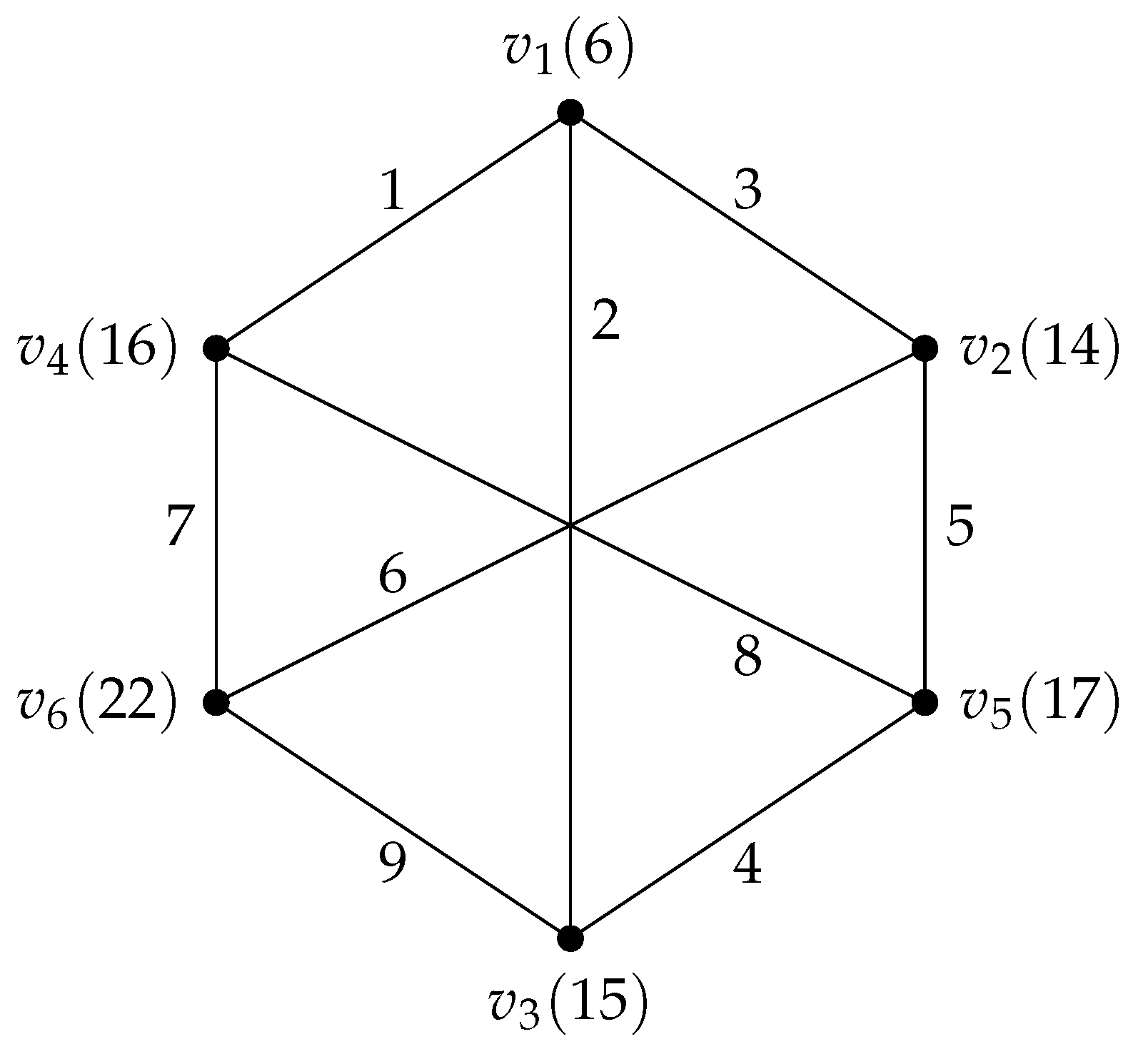
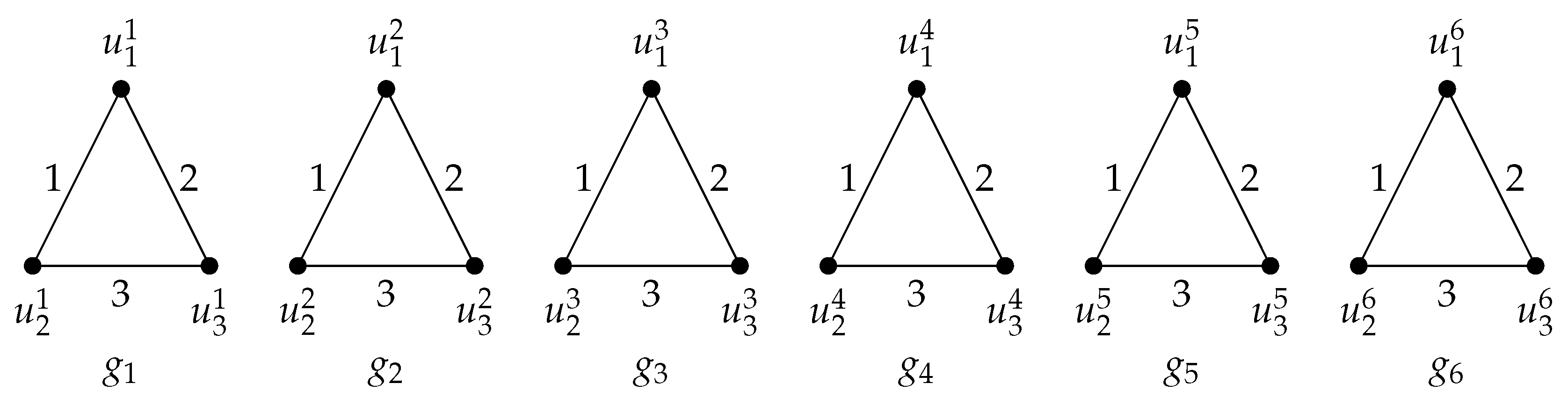
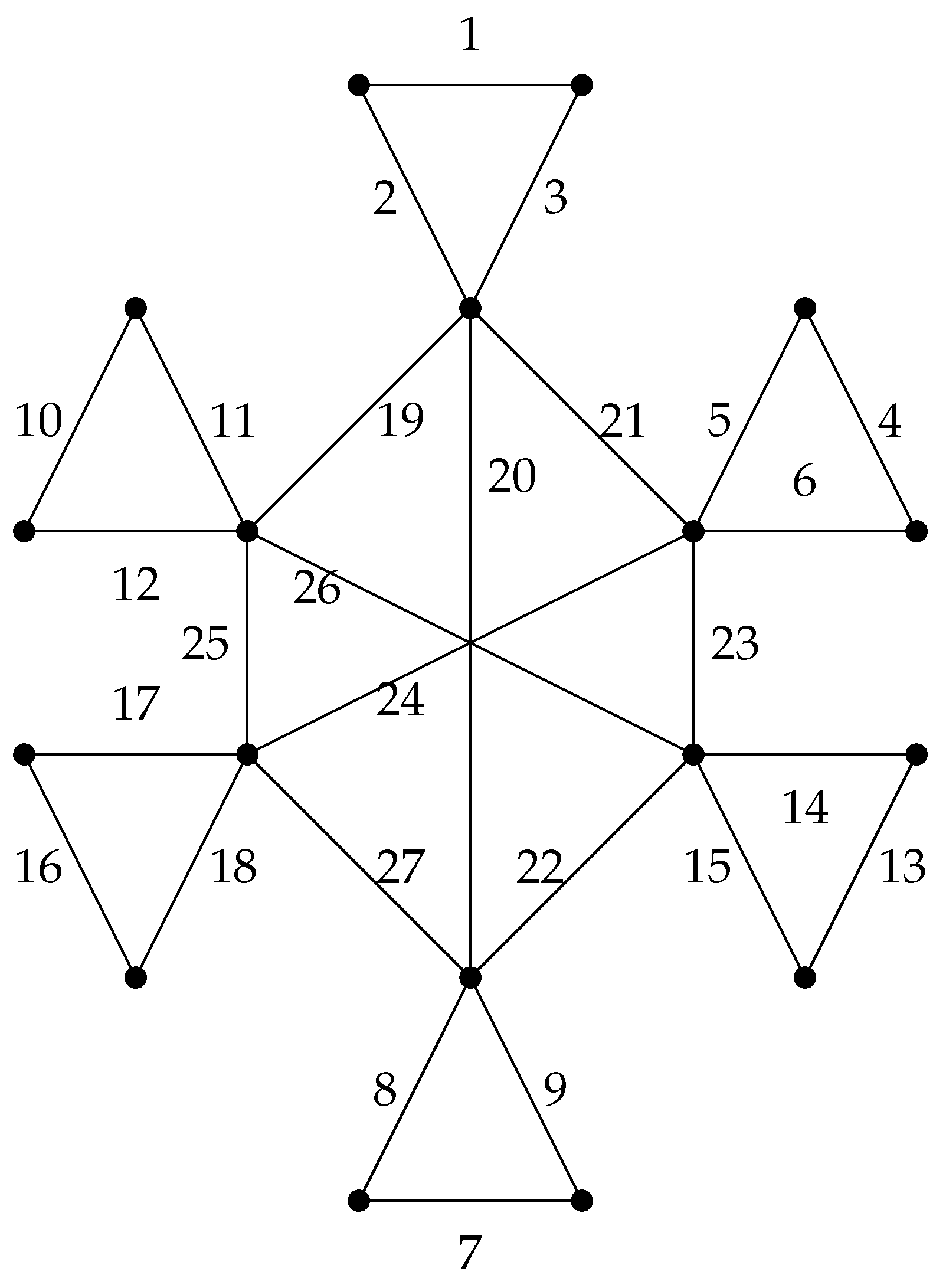
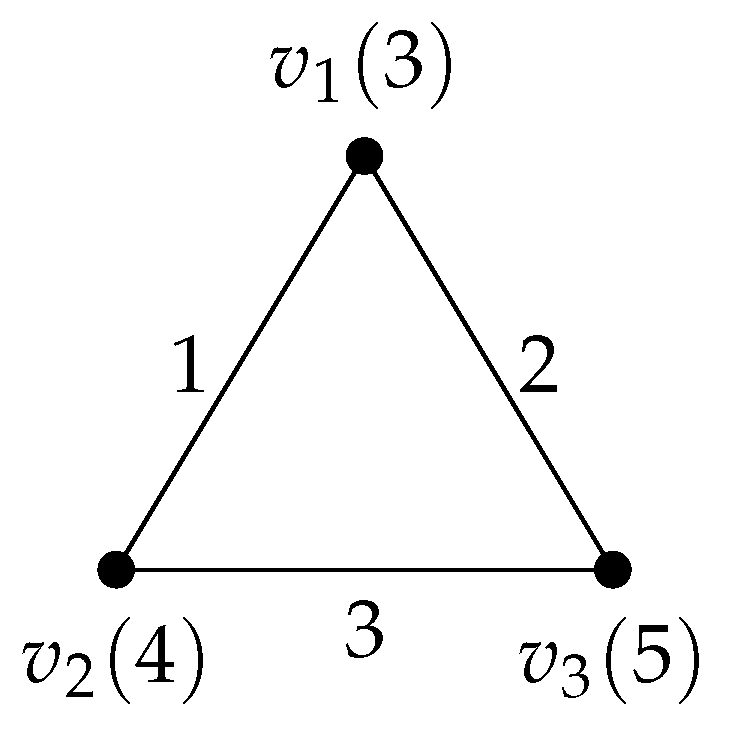
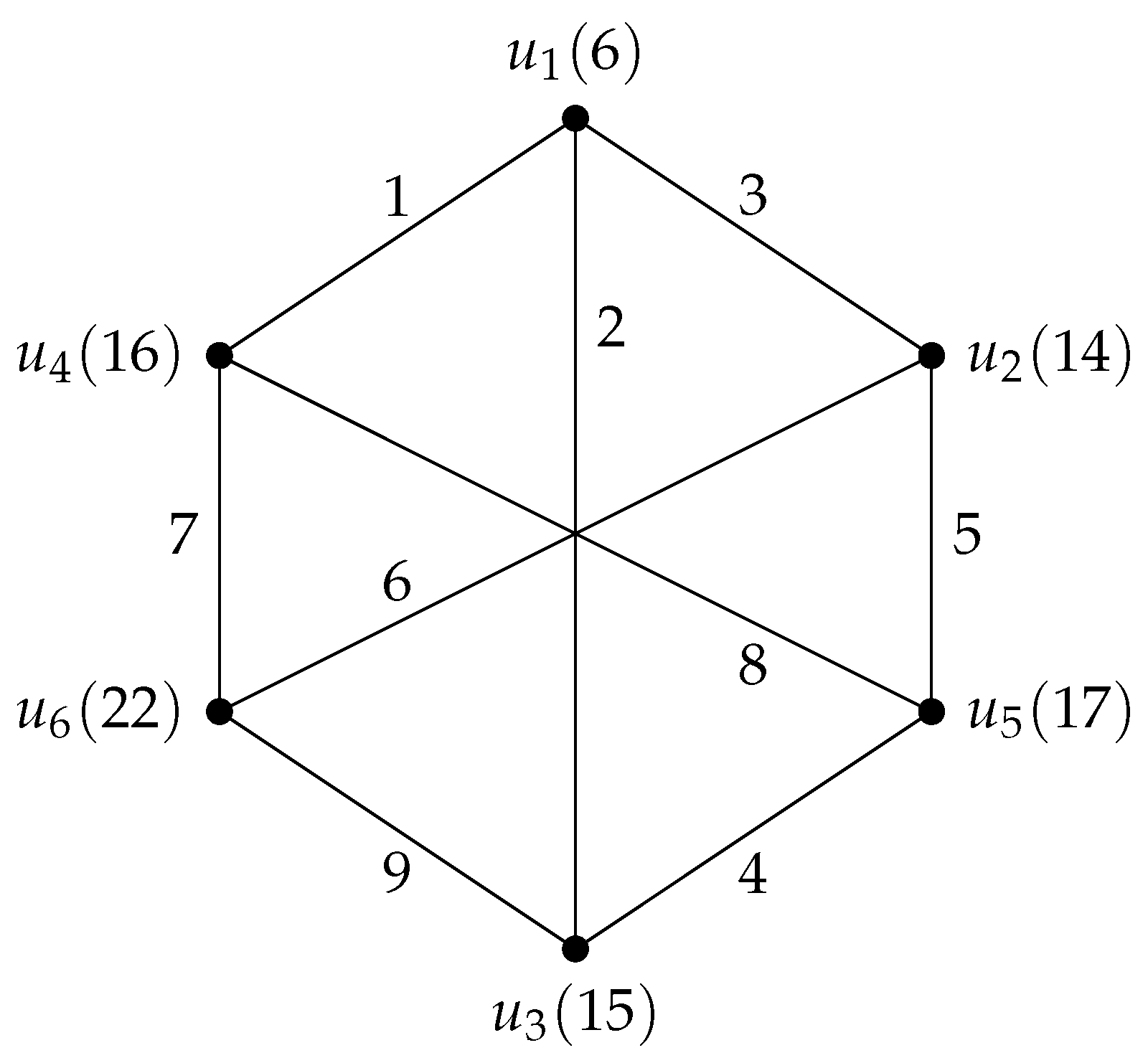
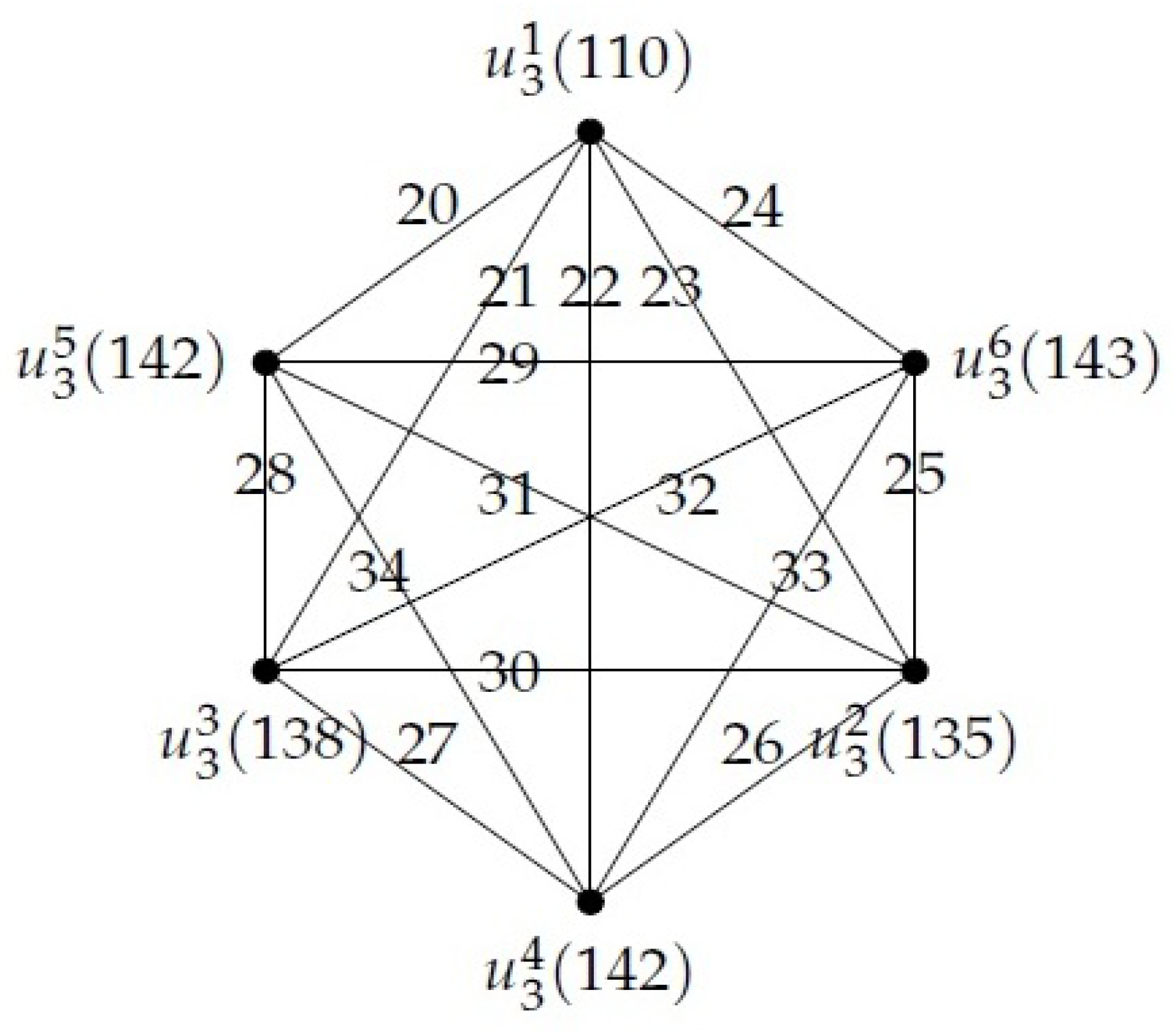
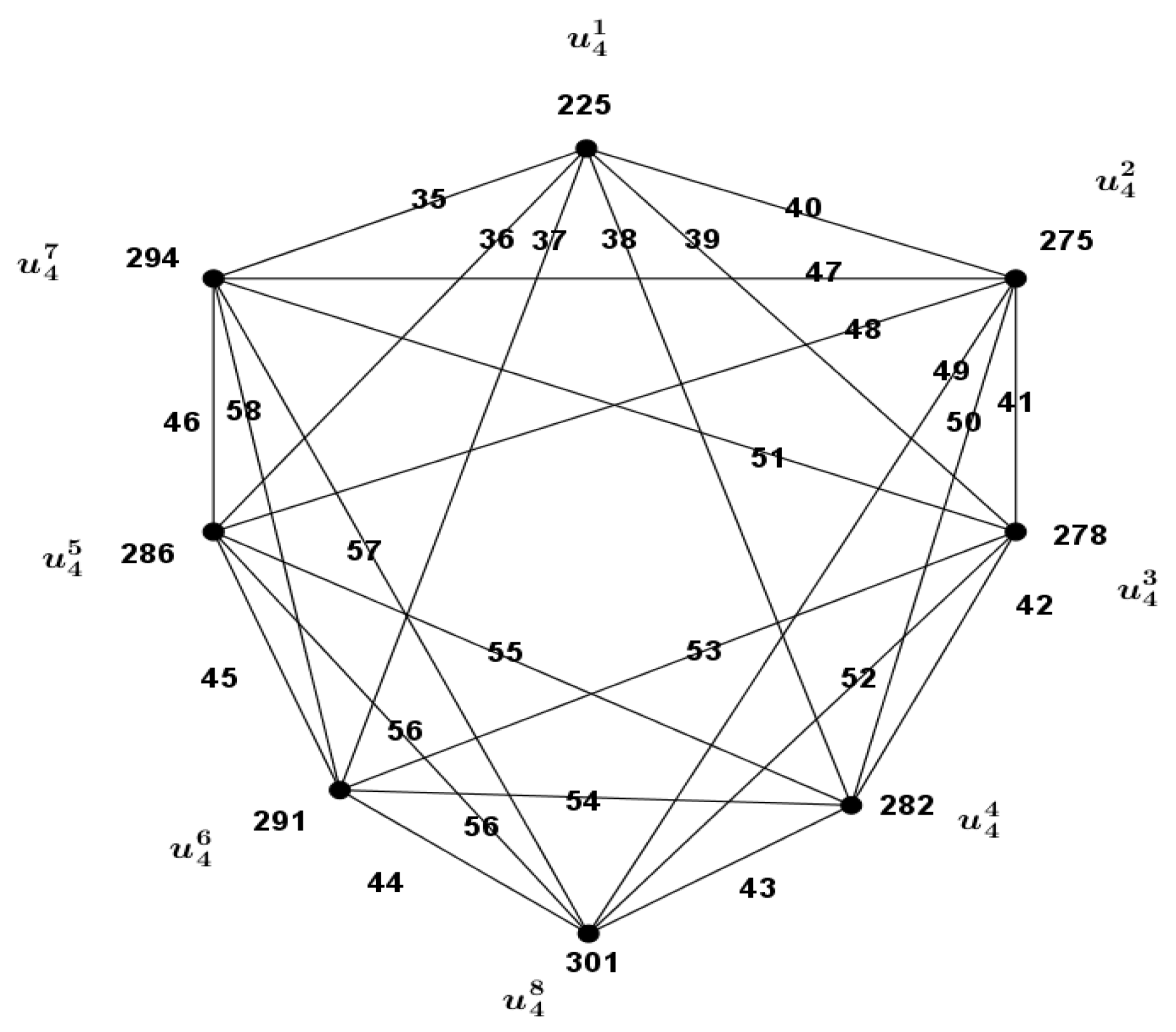
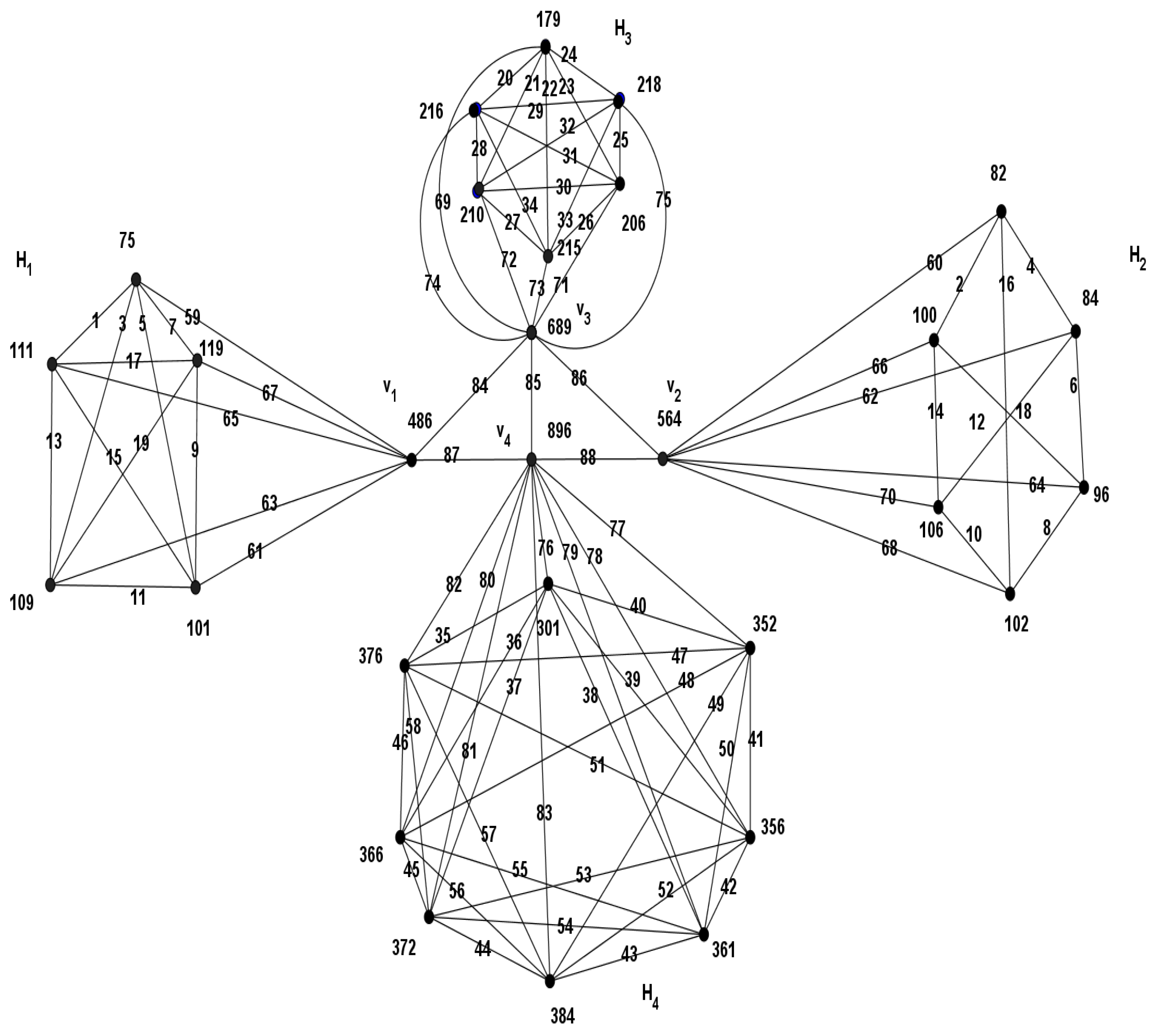
Figure 4 illustrate the proof of Theorem 2. An antimagic labeling of a 2-regular graph
G and the antimagic labeling of a 3-regular graph
H are given in
Figure 1 and
Figure 2, respectively. In
Figure 3, the three copies of the graph
H are considered with their labeling function
. The rooted product of the graph
G and
H with their antimagic labeling is given in
Figure 4. Here, the root vertex of the graph
H is chosen as
.
In [
24], they call the graph
to be a generalized corona graph
, where
and each
be any graph with
. Then, the
is antimagic under certain conditions. That is,
(i) for and,
(ii)
From this result, we observed that there exists antimagic labeling for corona product of regular graphs which does not falls under the above conditions given in theorem
[
24].
Before proving, we let define the construction of corona product of graph G and
Let G be a connected graph of order n and size m, and let with each are connected regular graph of order and size .
The minimum and maximum degree of the graph G is denoted as and . For ; then, consider , where are called the pair of . Then the following are true:
- (i)
For each pair must be a complete graph of odd order and is a regular graph of order and
- (ii)
For any consecutive pairs, and , we must have and .
Furthermore, if , we have and .
- (iii)
The sum of the edges of the graphs in each pair is divisible by 2. Moreover, the sum of the edges in the graphs are also divisible by 2.
- (iv)
Note that, means, x is divisible by
Theorem 3. Let G be a connected graph of order n and size m, and let be a sequence of regular graphs under the conditions as defined above; then, the corona product of is antimagic.
Proof. Let G be a connected graph of order n and size Let , with each being a connected regular graph of order and size . Then, construct the corona graph by the above construction. We have . Now, we give the labels of the edges of using the following steps:
First, we label the edges of and then, we give labels to the edges that are incidents from the vertices of G to the vertices of . Finally, we label the edges of G.
Case (i). If then Label the edges of each pair as follows:
The edges of
are labeled randomly from the set,
Then, the edges of
are labeled randomly from the set,
The edges of
are labeled randomly from the set,
Next, we label the edges of G randomly, from the set .
Before labeling the remaining edges, we name the vertices of and G based on the partial sum of their vertices, using the labeling defined above. The partial vertex sum for any vertex v is denoted as and the vertex sum for any vertex v is denoted as .
We name the vertices of as if .
We name the vertices of G as if .
Now, we label the edges, incident to the vertex of and of G, as
, which is defined as follows:
For each pair
, the edge
of
for
is labelled as
The edge
of
for
is labelled as
The edge of is labelled in the following way. If , then the label of is and for , then the label of is .
If , then the edge is labelled as , .
First, we label the edges of and G, and their incident edges, from to G, as done in case (i).
Now, we label the edges of randomly from the set . We name the vertices of using the partial sum as if ≤.
Then, label the edge of as for .
First, we label the edges of and G, and the incident edges, from to G, as done in case (ii).
We label the edges of randomly from the set . Then, we name the vertices of using the partial vertex sum as , if .
Then, we label the edge of as for .
From the above labeling scheme, we can easily observe the following:
For each pair we have,
Observation 2. The vertex sum of , is odd, .
Observation 3. The vertex sum of , is even, .
Claim: The above labeling of is antimagic.
From the above labeling, we can easily observe that the vertex sum of the vertices of G satisfies . Therefore, any two vertices in G are different.
For any we observe that the vertices in satisfy . From observation 2 and 3, we conclude that, for each pair , then , where and . Also, we have . .
For any consecutive pairs and , we have .
When , then we have .
Thus, any two vertices in are distinct.
Now, we will prove that any vertex in
achieves a different vertex sum compared to any vertex sum in
G. In order to prove this, we consider the minimum vertex sum in
G and the maximum vertex sum in
. From the labeling, the vertex
gets the minimum sum in
G, as follows:
and the vertex
gets the maximum vertex sum in
, as follows:
Therefore, from Equations (14) and (15),
By applying to Equation (16), we obtain . Therefore, any two vertices in receive distinct sums. □
Illustration for theorem 3: A graph
G shown in
Figure 5 with their respective labelings as defined in the Theorem 3 and the graph
as shown in
Figure 6,
Figure 7,
Figure 8 and
Figure 9 with their respective labelings as defined in the Theorem 3. An antimagic labeling of graph
is shown in
Figure 10.