1. Introduction
The research concerning developable surfaces has many applications. For instance, in industrial design and modelling, P. Bo et al. proposed a method to create seamless, smooth, multi-strip developable surfaces from some design curves in [
1]. By curve modifications, their work achieved high accuracy of developability with the controllable error. The superior performance of their method was demonstrated by the fabrication of some paper industrial products. In [
2], P. Bo et al. also provided a method to compute design curves to define surfaces with large developability. The surfaces generated by this method do not need any explicit curve interpolation procedure. In mathematics, developable surfaces can be developed into planes without distorting the surface metric. There are many literature studies about developable surfaces (see e.g., [
3,
4,
5,
6,
7]). A tangent developable surface is a special developable surface, which is formed by a spatial curve and its tangent lines. In classical algebraic geometry, the tangent developable surface plays an important role in the spatial curve duality theory [
8]. In [
4], the rectifying developable surface of a regular curve was introduced by S. Izumiya et al.; they proved that a regular curve is always the geodesic of its rectifying developable surface. The geodesic properties of a regular curve on its rectifying developable surface were also studied in [
9]. For a given geodesic curve, P. Bo and W. Wang showed the expression of the rectifying developable surface of the geodesic curve. In addition, Frenet type framed base curves are smooth curves with moving frames, which may have singular points. S. Honda gave the existence and uniqueness for Frenet type framed base curves in Euclidean space [
10]. Here, we study one-parameter developable surfaces, which are generated by Frenet type framed base curves, as a primary case for the study of singular manifolds in Euclidean 3-space.
Singularity theory is a direct descendant of differential calculus, with interest in equations, geometry, astronomy, physics, and other disciplines. There are some research studies about hypersurfaces immersed in different spaces from the viewpoint of singularity theory [
11,
12,
13,
14]. Furthermore, some of the latest research about singularity theory and the submanifold theory can be seen in [
3,
4,
15,
16,
17,
18,
19,
20,
21,
22,
23,
24,
25,
26,
27]. For instance, J. Sun and D. Pei considered the Lorentzian hypersurface on the pseudo n-sphere and classified the singularities of this hypersurface in [
11]. They also studied the geometric properties of lightlike hypersurfaces, which are degenerate submanifolds in the Minkowski 4-space [
12]. In addition, one-parameter developable surfaces are hypersurface families. They can also be seen as bundles along a Frenet type framed base curve, whose fibers are developable surfaces, and the ‘normals’ of these developable surfaces are located in the normal planes of the Frenet type framed base curve. Rectifying developable surfaces and tangent developable surfaces of the Frenet type framed base curve are two sections of one-parameter developable surfaces. We prove that Frenet type framed base curves have similar properties to regular curves in their rectifying developable and tangent developable surfaces. We also define one-parameter support functions on the Frenet type framed base curves to investigate the singularities of one-parameter developable surfaces. By using the unfolding theory of functions, the one-parameter support functions can be used to analyze the geometric properties of one-parameter developable surfaces. One-parameter developable surfaces are the discriminant sets of one-parameter support functions. The singularities of developable surfaces are
-singularities
of these functions. Since Frenet type framed base curves may have singular points, the situation presents some differences when compared with the regular case in [
28]. For instance, three cases for developable surfaces have cuspidal edge singularities in the present paper. Theorems 1 and 2 are the main results of this paper.
The organization of this paper is as follows. In
Section 2, we review the concepts of Euclidean space that we used in this paper. We define one-parameter developable surfaces of a Frenet type framed base curve and obtain two geometric invariants of the base curve in
Section 3. The geometric meaning of these two invariants (Theorem 1) and the classification of singularities of one-parameter developable surfaces (Theorem 2) are also shown in this section. The preparations for the proof of Theorem 2 are in
Section 4 and
Section 5. In
Section 6, we provide an example to illustrate the main results in this paper.
All manifolds and maps considered in this paper are differentiable of class .
2. Basic Notions
In this paper, we suppose that a curve
may have singular points. We cannot define the Frenet frame along
if
has singular points. Fortunately, S. Honda defined a
Frenet type framed base curve under a certain condition, as follows [
10].
Definition 1. We say that is a Frenet type framed base curve if there exists a regular spherical curve and a smooth function , such that for all . Then we call a unit tangent vector and a speed function of .
Obviously,
has singular point at
if and only if
. We define a
unit principal normal vector by
and a
unit binormal vector by
, respectively. Then an orthonormal frame
along
is obtained and we call it the
Frenet type frame along
. We have the following formula:
where
The functions and are called the curvature function and the torsion function of the Frenet type framed base curve , respectively.
Now we briefly review the basic notions of developable surfaces and ruled surfaces. Suppose
and
are
-mappings. Consider a mapping
, which is defined by
We call
a
director curve,
a
base curve, and
a
ruled surface, respectively. For a fixed
,
is a
ruling when
u varies. A
developable surface is a ruled surface with the vanishing Gaussian curvature. We know that a ruled surface
is a developable surface if
Specifically,
is called a
cylinder if the direction of
is fixed. We denote
and it follows that
. Then
is a cylinder if and only if
. If
, we say that
is
non-cylindrical. In this case, a
striction curve of
is defined by
We know that the singular points of a non-cylindrical ruled surface are located on the striction curve. A cone is a non-cylindrical ruled surface whose striction curve is constant.
3. One-Parameter Developable Surfaces
We study one-parameter developable surfaces of a Frenet type framed base curve in this section. Let
be a Frenet type framed base curve. A spherical vector field
is defined by
where
. We assume throughout the whole paper that
for any
. We denote
and consider a surface
, which is defined by
We call
one-parameter developable surfaces of
. For any
, we have
Then it follows
for all
, where
It means
is a developable surface. So we call
the one-parameter developable surfaces of
. If
, we have the following proposition.
Proposition 1. Let be a Frenet type framed base curve. Then we have the following:
- (1)
The normal vector field of along is parallel to the unit principal normal vector field of .
- (2)
If is not a plane curve, then is the singularities of
Proof. By the definition of
, we have
We can calculate that
And
Therefore, statements (1) and (2) hold. □
If
is a regular curve, we can easily check that
and
are the rectifying developable surface and tangent developable surface of
, respectively. The regular curve is always the geodesic of its rectifying developable surface (see [
4,
9]), and it is also always the singularities of its tangent developable surface (see [
3]). Here, we call
and
the rectifying developable surface and tangent developable surface of the Frenet type framed base curve
, respectively. By Proposition 1, the Frenet type framed base curve has similar properties to a regular curve in its rectifying developable and tangent developable surfaces.
In addition, we define two invariants, as follows:
Since
then
if and only if
. By calculation, we have that
Therefore,
is a singular point of
if and only if
If
and
has singular point at
, then we have
. It means that
has no singularities on the base curve
. For the geometric meaning of the above two invariants, we have the following theorem.
Theorem 1. Let be a Frenet type framed base curve. Then we have the following:
- (A)
For any , the following statements are equivalent:
- (1)
for all .
- (2)
is a cylinder.
- (B)
If for all , then the following statements are equivalent:
- (3)
for all .
- (4)
is a conical surface.
- (C)
The singular points of one-parameter developable surfaces are , and
Proof. (A) By the definition,
is a cylinder if and only if
is a constant vector. Since
is a constant vector if and only if
for all
.
(B) The striction curve
of
is expressed by
Then (B)-(4) is equivalent to
for all
. We can calculate that
This means (B)-(4) and (B)-(3) are equivalent.
(C) By straightforward calculations, we have
The above three vectors are linearly dependent at the singularities of
. So that we can obtain these singularities if
It follows that
or
or
Therefore (C) holds. □
Next, we show the relationships between the above two invariants and the singularities of one-parameter developable surfaces, as follows.
Theorem 2. Let be a Frenet type framed base curve. Then we have the following:
- (1)
is a regular point of if and only if - (2)
Suppose is a singular point of , then is locally diffeomorphic to the cuspidal edge at if
- (i)
, andor - (ii)
andor - (iii)
and
- (3)
Suppose is a singular point of , then is locally diffeomorphic to the swallowtail at if , , and
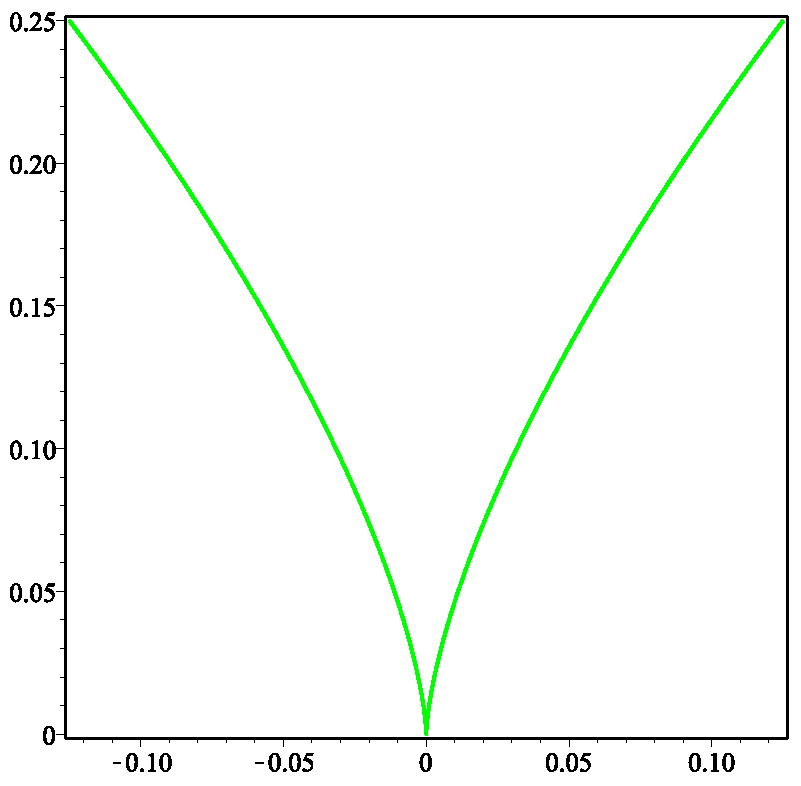
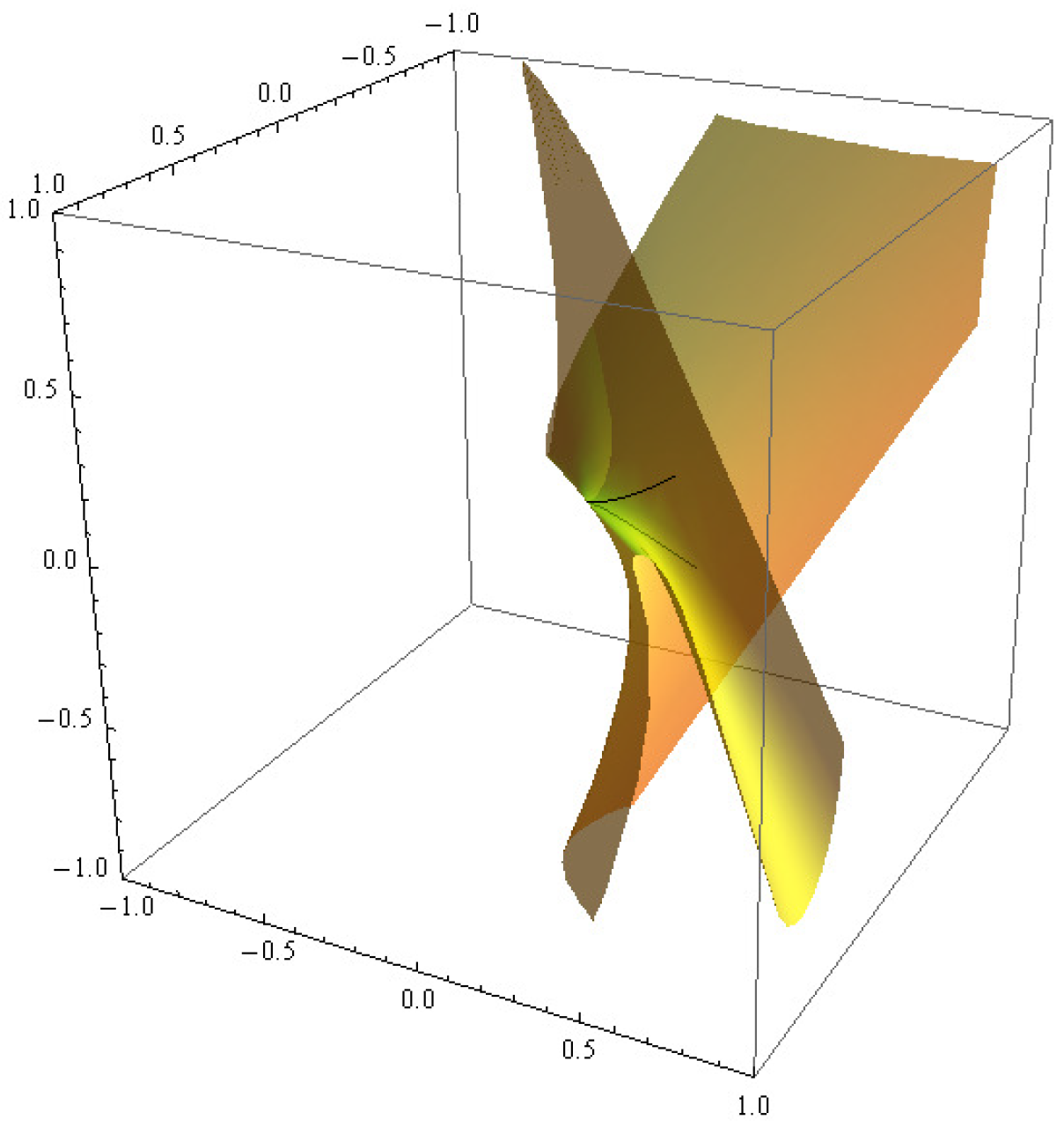
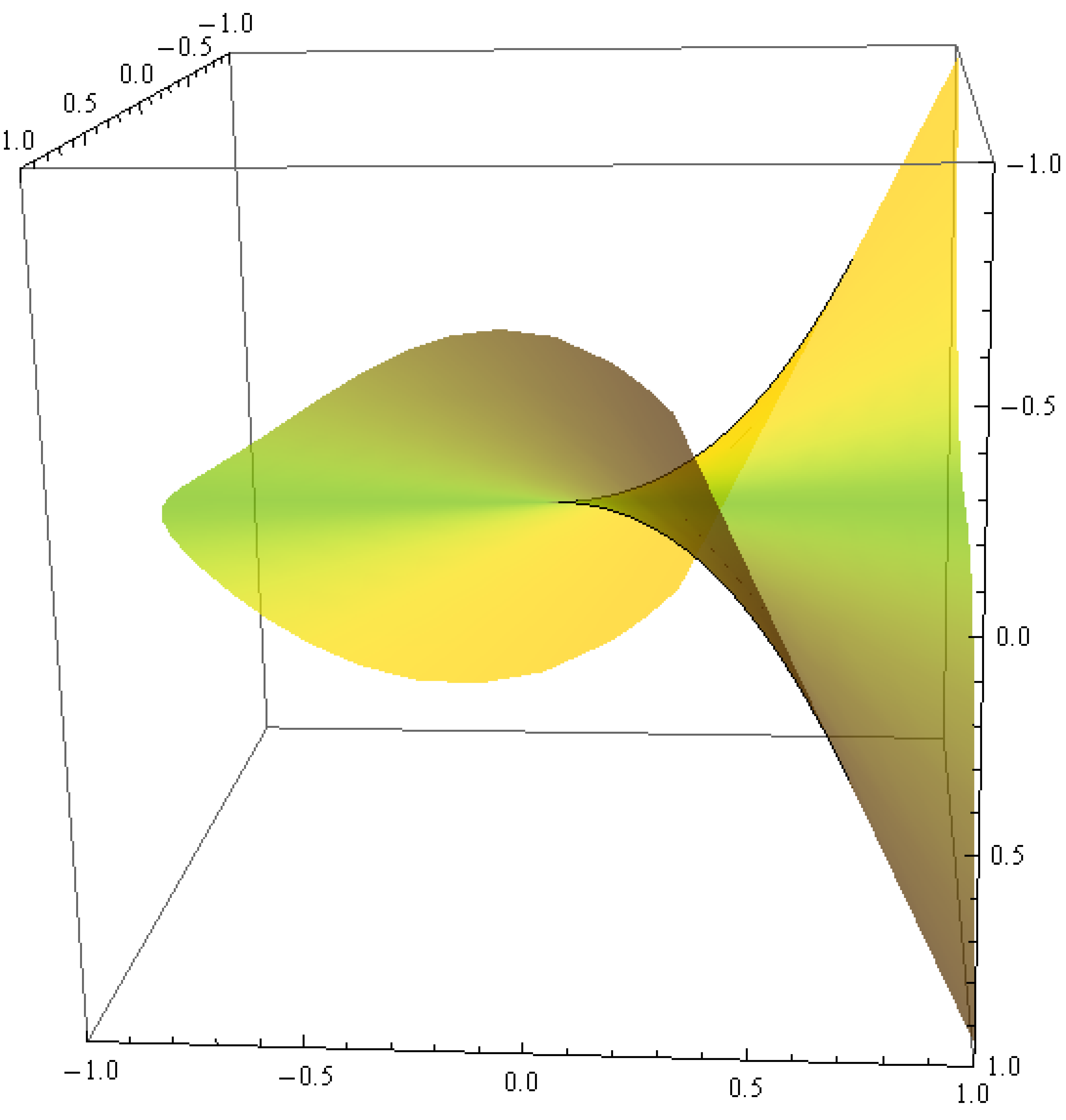
Here is the cusp (see Figure 1), is the cuspidal edge (see Figure 2), is the swallowtail (see Figure 3). 5. Unfolding of Functions
We classify the singularities of one-parameter developable surfaces by using the unfolding theory of functions in this section.
Let
be a function germ and
, then
F is called an
r-parameter unfolding of
f. We say that
f has
-singularity at
if
for all
and
. We also say that
f has
-singularity at
if
for all
. If
f has
-singularity
at
and
F is an
r-parameter unfolding of
f, the
-jet of the partial derivative
at
is defined by
We call
F an
R-
of
f if the rank of
matrix
is
k, where
. The
of
F is defined to be
There is the following classification theorem in [
29].
Theorem 3. Let be an r-parameter unfolding of f which has -singularity at . Suppose F is an R-versal unfolding of f. Then is locally diffeomorphic to if ; is locally diffeomorphic to if .
By Proposition 2, the discriminant set of the one-parameter support functions
is
We have the following proposition for the proof of Theorem 2.
Proposition 3. Let be a Frenet type framed base curve. If has the -singularity at , then G is an R-versal unfolding of . Here, we assume for .
Proof. We write
,
and
. Then we have
and
Therefore the 2-jet is as following:
We consider the following
matrix:
By the Frenet type formula, we have
Since
is an orthonormal basis of
, then the rank of
is equal to the rank of
It means rank
if and only if
The above inequality is equivalent to the condition
. Moreover, the rank of
is always two under the condition
.
Then G is an R-versal unfolding of if has -singularity at . This completes the proof. □
Proof of Theorem 2. By straightforward calculations, we have
Then
is a regular point of
if and only if
The assertion (1) holds.
By Proposition 2-(2), the image of one-parameter developable surfaces of is the discriminant set of the one-parameter support functions G.
If
, by Proposition 2-(A)-(3), (4) and (5),
has the
-type singularity (respectively, the
-type singularity) at
if and only if
and
(respectively,
,
and
). It follows from Theorem 3 and Proposition 3 that assertions (2)-(i) and (3) hold.
If
, by Proposition 2-(B)-(6) and (7),
has the
-type singularity if and only if
and
It follows from Theorem 3 and Proposition 3 that assertion (2)-(ii) holds. This completes the proof. □
6. Example
In this section, we define a Frenet type framed base curve that has a singular point, and consider the one-parameter developable surfaces associated with this curve. We study two sections of the one-parameter developable surfaces of the base curve. They are the rectifying developable surface and tangent developable surface. These two developable surfaces can also be seen as the wavefronts of the base curve.
Let
be a Frenet type framed base curve with a singular point. Then we have
and
We can calculate that
Since
, so that
is a singular point of
. We also have
and
. The tangent developable surface of
is as follows:
By Theorem 2, the tangent developable surface
is locally diffeomorphic to the cuspidal edge at
(
Figure 4).
The expression of the rectifying developable surface is as follows:
By Theorem 2, the rectifying developable surface
has cuspidal edge singularities at
(
Figure 5).