Abstract
We propose a phenomenological model of two-zeros Majorana neutrino mass matrix based on the symmetry, where the structure of mixing matrix is a unimodular second scheme of trimaximal , and the charged lepton mass matrix is diagonal. We show that, among seven possible two-zero textures with symmetry, only two textures, namely the texture with and and its permutation, are acceptable in the non-perturbation method, since the results associated with these two textures are consistent with the experimental data. We obtain a unique relation between our phases, namely , and an effective equation where . Then, only by using the experimental ranges of , we obtain the allowable range of the unknown parameter as the phase of mixing matrix, which leads to obtaining not only the ranges of all neutrino oscillation parameters of the model (which agree well with experimental data) but also with the masses of neutrinos, the Dirac and Majorana phases and the Jarlskog parameter, and to predict the normal neutrino mass hierarchy. Finally, we show that all the predictions regarding our two specific textures agree with the corresponding data reported from neutrino oscillation, cosmic microwave background and neutrinoless double beta decay.
1. Introduction
One of the successful phenomenological neutrino mass models with flavor symmetry, which is an appropriate framework towards understanding the family structure of charged-lepton and of neutrino mass matrices, is based upon the group [1,2,3,4,5,6,7,8,9,10,11,12]. The is a symmetry group of the tetrahedron, whose introduction was primarily motivated so that a tribimaximal (TBM) [13] mixing matrix [6] could be considered to explore the implications of the mentioned charged-lepton and neutrino mass matrices. The TBM mixing matrix is
where, regardless of the model, the mixing angles are , , and [13]. In the last decade, significant consequences were extracted from neutrino experiments, such as T2K [14], RENO [15], DOUBLE-CHOOZ [16], and DAYA-BAY [17,18], which have indicated that there are a nonzero mixing angle (at a significance level higher than ) and a possible nonzero Dirac CP-violation phase . Therefore, the TBM mixing matrix as above had to be rejected [19,20]. This consequence is in our opinion of particular interest, being at the core motivation and purpose of our paper, which we elaborate as follows.
According to the standard parametrization, the unitary lepton mixing matrix, which connects the neutrino mass eigenstates to flavor eigenstates, is given by [21,22,23]
where (for ); denotes the Dirac phase similar to the CKM phase; and stand for the Majorana phases that are applicable to the Majorana neutrinos. Furthermore, as reported from experiments, the number of the known available neutrino oscillation parameters approaches five. In Table 1, information concerning neutrino masses and mixing provided is summarized [24].
Table 1.
The experimental data associated with the neutrinos oscillation parameters. When multiple sets of allowed ranges are stated, the upper row and the lower row correspond to normal hierarchy and inverted hierarchy, respectively ( and ).
In order to meet these experimental results, several models with a discrete flavor symmetry [25,26,27,28], including an flavor symmetry, have been proposed [1,2,4,5,6,7,8,9,10,11,12,25,29,30,31,32,33,34,35,36,37]. Although the original objective of the models was to substantiate a TBM mixing matrix [6], in view of the disagreeing observational data [14,15,16,17,18], considerable efforts have been made to set up a description conveying instead a non-TBM mixing matrix; see, e.g., [4,5,7,8,9,10,11,12,25,30,31,33,34,35,36,38].
is the smallest non-Abelian group; it is the group of even permutations of four objects with a three one-dimensional, irreducible representation. It has 12 elements and 4 irreducible representations: 1, , , and 3, with the multiplication rule
which is the reason why it is one of the most popular groups in neutrino mass models.
The Yukawa interaction of the left-handed lepton doublets fields of the model and a Higgs scalar triplet (Neutrinos are massless in the standard model because there is no Higgs scalar triplet and there are no right-handed singlet neutrinos; therefore, one of the easiest ways to expand the standard model is to add a Higgs scalar triplet [39]) is:
The second term in (4) would generate a non-zero Majorana neutrino mass matrix if the neutral component of the triplet Higgs has a small non-zero vacuum expectation value. Here, the leptons are assumed to transform under as , , , and the Higgs doublets .
Now,
Spontaneous symmetry breaking leads to . Therefore, the charged lepton mass matrix is given by
where the minimum of the Higgs potential is given by [1]. In that case, the charged lepton mass matrix is diagonalized by the transformation
is the diagonal form of , and
where .
Therefore, we can obtain as
Let , , , and , where . Now, we have
Therefore, the Majourana mass matrix in the original basis is:
Let us assume we have a natural minimum of Higgs potential for a continuous range of parameter values. Therefore, we can set , , , , and .
Let us continue by choosing a basis where the charged-lepton mass matrix is diagonal; a particular representation for is [3]:
is invariant under the transformation , i.e., , where . The transformation corresponds to the magic symmetry [40] (Magic symmetry is a symmetry in which the sum of elements in either any row or any column of the neutrino mass matrix is equal [41]). Thus, also has magic symmetry. Therefore, the mixing matrix corresponding to (as given by (12)) could be the second scheme of trimaximal mixing (The mixing matrix corresponding to the magic symmetry is called the second scheme of trimaximal mixing) [42], i.e.,
where and are two free parameters. The first matrix on the right-hand side of (13) represents , which corresponds to the magic symmetry and, for the particular case where and , reduces to given by (1).
In (12), by assuming the Majorana type nature of neutrinos and an based symmetry for , at least nine free real parameters can be obtained: three flavor mixing angles , three CP violating phases and three neutrino masses . Additional predictions are produced when we combine an symmetry with additional constraints applied to the elements of as given by (12)presence of zeros in . Various phenomenological textures, specifically texture zeros [43,44,45,46,47,48,49,50,51], have been investigated in both flavor and non-flavor basis. Such texture zeros not only cause the number of free parameters of neutrino mass matrix to be reduced, but also assists in establishing important relations between mixing angles. Recently, by employing the zero texture introduced in [52] as well as the texture proposed in [53], several parameters have been extracted as well as computed within a novel phenomenological approach to neutrino physics.
Within the context conveyed through the preceding paragraphs, the purpose of our paper is to investigate effects arisen from using the two-zero textures on given by (12). Specifically, assuming a Majorana (However, we should mention that establishing the nature of neutrinos is still a controversial subject, which could eventually be decided by experimental observation. In particular, by means of the nonzero magnetic dipole moment of neutrinos ruling out Majorana neutrinos or neutrinoless double beta decay [54] ruling out Dirac neutrinos) nature for neutrinos, where the charged-lepton mass matrix is diagonal, we aim to explore the phenomenological implications of seven two-zero textures of neutrino mass matrix together with symmetry, in a scenario where . This is a valuable procedure that enables obtaining a unique relation between the phases present in the mixing matrix, therefore allowing for extracting the parameters based on a global fit of the neutrino oscillation data [24]. This is the main contribution of our work. Moreover, let us also point out that it has been believed that a two-zero texture of symmetry can further assist with explaining a Majorana neutrino mass matrix. Therefore, in our paper, we also proceed systematically by employing two-zero textures of symmetry and comparing them with experimental data, so that, consequently, we additionally show that only the predictions for two-zero textures , and are consistent with the experimental data, whilst the results of others are not.
Our paper is hence organized as follows: In Section 2, we consider a methodology by which we reconstruct the Majorana neutrino mass matrix with symmetry when the charged-lepton mass matrix is diagonal and imposes two-zero textures. Specifically, we study all seven possible two-zero textures of symmetry. In Section 2.1, we will investigate texture along with a unimodular condition, by which we obtain constraints on Majorana phases. Moreover, we obtain some useful relations for neutrino masses, Majorana phases and mixing angles. Subsequently, we not only compare the consequences of the texture with the recent experimental data but also present our predictions based on the actual masses and CP-violation parameters. In Section 2.2, we will discuss and explore the texture as well as the permutation symmetry between it and the . Furthermore, by applying a numerical analysis, we will discuss the predictions of the texture for neutrino parameters. In Section 2.3 and Section 2.4, the other two-zero textures will be studied. We will show that their corresponding consequences are not in agreement with the experimental data. In Section 3, we present our conclusions.
2. Methodology
By considering the Majorana nature of neutrinos, the mass matrix in (12) is a complex symmetric matrix. In this respect, we have shown that applying the analysis of two-zero texture for the Majorana neutrino mass matrix based on symmetry, the number of distinct cases of in (12) will be restricted to seven. In what follows, respecting the distinguishing properties of these seven two-zero textures, we would classify them into three categories. Here, we first introduce them, briefly. Then, in the following subsections, we will explain in detail how we can establish their corresponding models.
- Category I:In this category, by applying the two-zero texture of symmetry for in (12), we will consider only and textures, which are obtained by imposing and , respectively:It has been shown that there is a permutation symmetry between and , such that the phenomenological predictions of texture can be generated from those of the texture [51].
- Category II:In this category, we propose four two-zero textures based on symmetry for in (12). Namely, the textures , , and , which are constructed from imposing , , and , respectively:We should note that the textures and are related through permutation symmetry to and , respectively.
- Category III:Finally, another two-zero texture based on symmetry for in (12), , is obtained from assuming :which has symmetry.
2.1. Formalism of Texture
In the basis where the charged lepton mass matrix is diagonal, by employing ŀinebreak , we reorganize the neutrino mass matrix of the texture as
where we adopted the mixing matrix given by (13); and , and . Now, using assumptions and , associated with the texture , provides two complex equations. Using the former yields
and
From Equations (19) and (20), we can obtain the ratio of two neutrino mass-squared differences (where and ) as
We should note that is independent of phase parameter, .
Furthermore, complex equation yields relations
and
Substituting the expressions associated with two Majorana phases from (24) and (25) into (21), we obtain an interesting relation between mixing angle parameter and :
which plays an essential role within our work, as we will now elaborate.
Let us also impose (For the unitary neutrino mixing matrix, without loss of generality, we can impose the condition . This is a unimodularity condition of mixing matrix [55,56,57,58,59,60]). Concretely, in our herein paper, the physics of neutrino will be governed by the mixing matrix of (13), which is unitary, unimodular and rephasing invariant. Therefore, we obtain an important relation between the phases of , and , which is:
where and . We should note that Equation (29), which is obtained only from imposing unimodularity condition for the mixing matrix , is independent of the neutrino mass zero texture.
Substituting Majorana phases (27) and (28) into (29), the most significant consequence of our model is obtained:
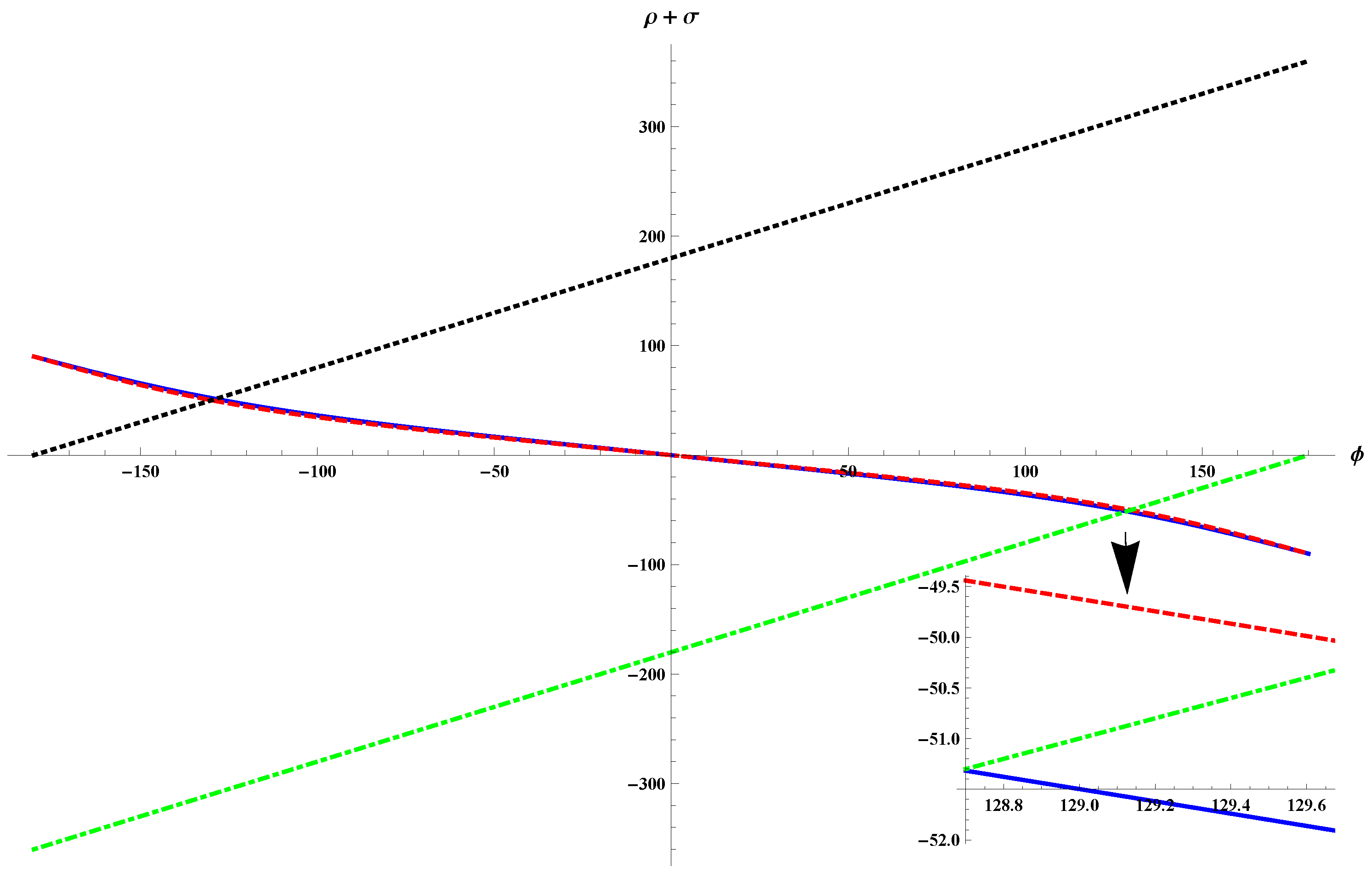
which is rewritten as a functions of only phase parameter . Our endeavors have shown that Equation (30) yields acceptable results for only ; see, for instance, Figure 1.
Figure 1.
In this figure, we show that coincides with the lines and , in which the coincident points illustrate the allowed range of the phase parameter . The black dotted line indicates the line , and the green dot-dashed line indicates the line . The blue solid curve and the red dashed curve display for and , respectively. All phases and angles are in degrees.
Moreover, employing (27), (28), (19) and (20) as well as the definitions associated with and , the neutrino masses can be expressed with more convenient relations. More concretely, , and are related to the unknown phase parameter and the experimental parameters and as
where . Therefore, according to (31), our prediction is normal neutrino mass hierarchy.
Furthermore, from comparing Equations (13) and (2) and using (26), we easily obtain all the mixing angles , and in terms of and :
According to (32), the deviation of from depends on the value of , where depends only on . Moreover, we obtain
which implies that the deviation of from depends on the phase parameter . Using (33), we can easily show .
Moreover, and are the necessary conditions to obtain CP-violation within the standard parametrization given by (2). Four independent CP-even quadratic invariants have been known, which can conveniently be chosen as , , and . Furthermore, there is an independent CP-odd quadratic invariant, which is called Jarlskog re-phasing invariant parameter J [61]. The Jarlskog parameter is relevant to the CP violation in lepton number conserving processes like neutrino oscillations:
By parameterizing the mixing matrix given by (2), the analytical expression for J can be rewritten as
In addition, in the scheme of the of mixing matrix given by (13), the analytical expression for J is:
where we have used (26).
Comparing relations (35) and (36), as well as reemploying (26), the expression for the CP violating Dirac phase , in the scheme of the of mixing matrix, can be written as
In the present work, since we have considered massive neutrinos as the Majorana particles, we can therefore obtain nine physical parameters: three neutrino masses given by (31); three flavor mixing angles given by (32) and (33); one CP-violating Dirac phase given by (37); two CP-violating Majorana phases given by (27) and (28). Surprisingly, solving Equation (30) leads to the prediction of the range of all nine physical neutrino parameters, which were mentioned earlier in the texture . Let us be more precise. The value of the phase parameter can be calculated by using two experimental data and , which yield . By substituting the value of [24] into Equation (30), we obtain the allowed range for the phase parameter as
Moreover, in order to depict the allowed range of the phase parameter , let us plot and against according to (30); see Figure 1. Obviously, the allowed range of phase parameter seen in Figure 1 is exactly the same as the one specified in (38).
By substituting and from (38) into relations (27), (28), (31), (33), (36) and (37), we can not only obtain the ranges of the five neutrino oscillation parameters (it is seen that these are consistent with the experimental range of neutrino oscillation parameters in Table 1), but we can also predict the masses of the neutrinos, the CP violation parameters, the Dirac phase , the Majorana phases and and the Jarlskog invariant parameter (which may be measured by the future neutrino experiments).
Let us now proceed our discussions by obtaining the range of predicted values of neutrino oscillation parameters for the texture .
By taking and form (38), our herein model yields the following values for five neutrino oscillation parameters:
which are in agreement with the available experimental data for neutrino parameters in Table 1.
Moreover, as mentioned, our model yields the following consequences, which may be tested by future experiments:
Consequently, according to the allowed ranges for the values of three neutrino masses in (40), our model successfully predicts that the neutrino mass hierarchy is normal. However, the corresponding relations obtained from (31) emphasizes enough this fact. Note that the results of the texture endorse our prediction for the neutrino mass hierarchy, which subsequently pinpoints the corresponding relevant neutrino parameters for that mass hierarchy.
It is worth mentioning that the texture , together with using , assisted us with predicting all the neutrino parameters (see relations (39) and (40)), which are in good agreement with the available experimental data. It is worth noting that such an ability is a distinguishing feature of the neutrino mass matrix models.
In what follows, let us outline further predictions of our herein model which can be a test on the accuracy and precision of our predictions in (40)
- Regarding the sum of the three light neutrino masses, it should be noted that the significant experimental results were reported by Planck’s measurements of the cosmic microwave background (CMB) [62]:In our model, this quantity is predicted as eV, which is in agreement with (41).
- As for the flavor eigenstates, we are able to obtain solely the expectation values of the masses:where . Regarding these expectation values, our predictions are:
- The Majorana neutrinos can violate lepton number, for instance, the neutrinoless double beta decay was referred [54]. Such a process has not been observed yet, but an upper bound has been set for the relevant quantity, i.e., . For instance, the results associated with the first phase of the KamLAND-Zen experiment set a constraint as eV at 90 present CL [63]. Concerning this quantity, our model predicts: eV, which is consistent with the result of the kamLAND-Zen experiment.
Up to now, our herein predictions of the texture may suggest it as an appropriate neutrino mass model. Notwithstanding, it would be considered as a more successful model if its predictions will also be supported by the cosmological and the neutrinoless double beta decay forthcoming experiments.
It is worth noting that the results associated with the texture are only applicable for the Majorana neutrinos, whilst they are not valid for the Dirac neutrinos.
2.2. Formalism of Texture
There is a 2–3 permutation symmetry between the textures (The 2–3 permutation symmetry explains that and are related by the exchange of 2–3 rows and 2–3 columns of the neutrino mass matrix.) and . Concretely, the corresponding permutation matrix is
The 2–3 permutation symmetry given by (44) indicates the following relations among their corresponding oscillation parameters [51]:
Moreover, textures and have the same eigenvalues (for ). Consequently, except for and , the other predictions for neutrino oscillation parameters associated with the texture (calculated by our model) are the same as those predicted by the texture (cf Section 2.1). These exceptions in the texture are:
2.3. Formalism of Textures , , , and
The mass matrix of textures (see Equation (15)) has two conditions and , which imply the following complex equations
and
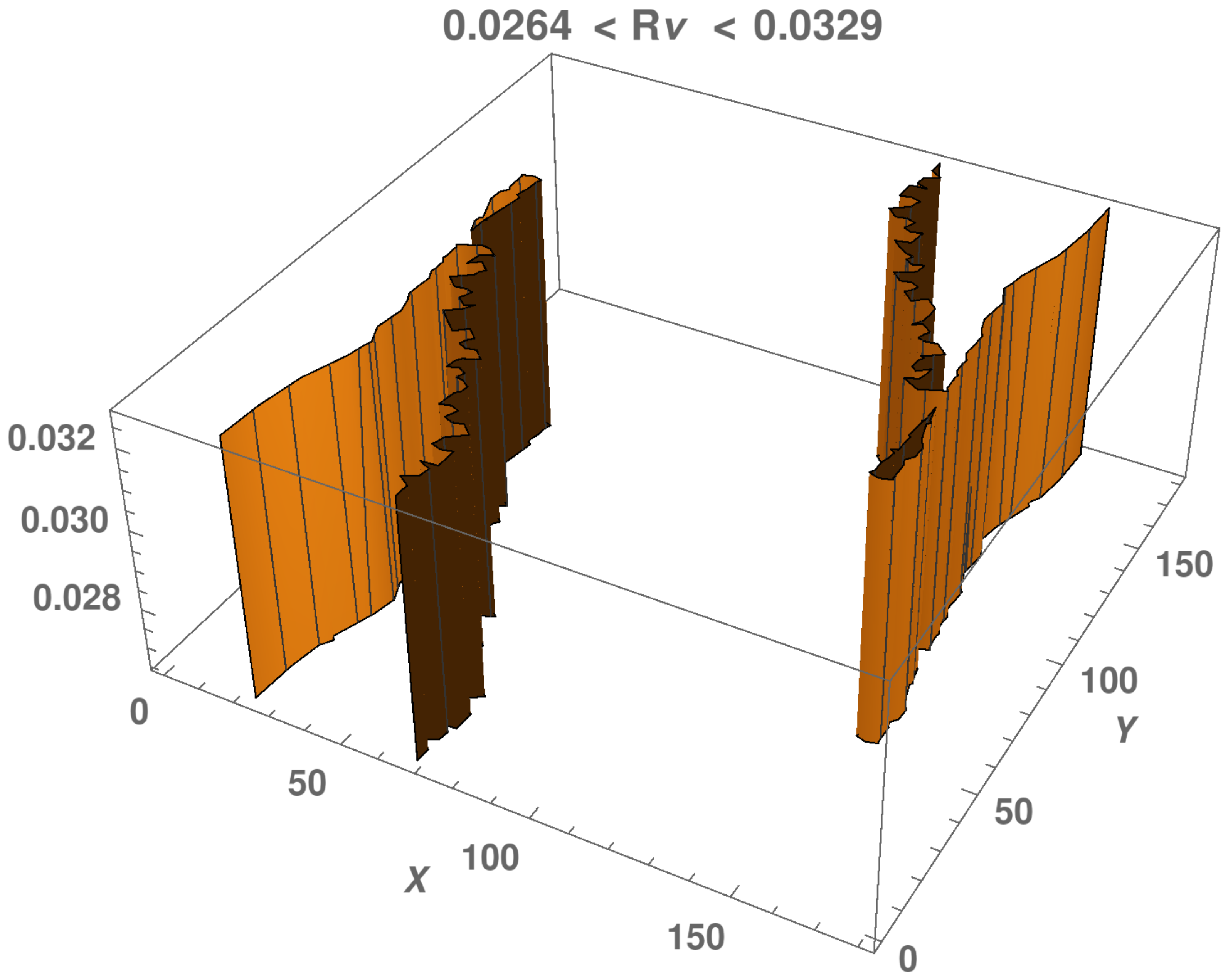
by which we can calculate . In Figure 2, by depicting the experimental value of as a function of and , we have obtained the allowed range of around and . We substitute the value of in the expression of , which, in turn, is obtained from comparing the in Equations (2) with (13) as . Finally, for the texture , we obtain , which is inconsistent with the experimental data. From a phenomenological point of view, the consequences associated with the textures and are equivalent. For the experimental values of , we have shown that these textures predict a very large values of , which is not allowed.
Figure 2.
In this figure, we show the experimental value of as a function of and for the texture . and are in degrees.
Concerning the textures and (see (16)), we find that they predict , which is not allowed.
Consequently, all the textures associated with the Category II are ruled out completely by the experimental data listed in Table 1 [24].
2.4. Formalism of Texture
3. Discussion and Conclusions
Matrix models are of particular importance for the phenomenological evaluation of neutrino physics. The choice of symmetries for the mass matrix can lead to specific states in the mixture matrix, which can lead to results consistent with the corresponding experimental data. Such consequences are significant as we can make additional predictions about neutrinos and their flavor symmetries.
A salient feature of the study of the neutrino mass matrix phenomenon is that it could, in principle, provide new clues for understanding the flavor problem; in particular, its mixing matrix, which, in contrast to the quark sector, has large (mixing) angles. In addition, the discrepancy between the masses of charged neutrinos and leptons are more pronounced than the corresponding features in the quark sector. Indeed, the mass and mixing problem in the lepton sector is a fundamental problem. Furthermore, the following important questions should be answered by future experiments: What are the masses of the different neutrinos? What is the nature of neutrinos? How close to is ? What are the values of three CP-violating phases associated with the neutrino mixing matrix (i.e., the Dirac phase and the Majorana phases and )?
In our work, we applied two-zero textures within the neutrino mass matrix with symmetry, along with imposing on the neutrino mixing matrix, where the charged lepton mass matrix is diagonal and the nature of neutrinos are Majorana. Concretely, we have retrieved seven viable two-zero textures such that the mixing matrix could be the second scheme of trimaximal mixing matrix. Then, assuming the unimodular property of the , we determined algebraic relations for the Majorana phases , together with the phase parameter ; cf. relation (29).
Based on the common physical properties of these seven textures, we classified them into three categories. We investigated the phenomenological properties of all these textures and then compared them with the available experimental data. Among these textures, we have shown (in the non-perturbation method) that only and have properties that may agree with the experimental data. It is worth noting that applying a perturbation analysis to may result in agreement with the experimental data. However, such an investigation was not in the scope of our current work.
Let us be more precise. Regarding the texture , we have shown that (i) and (ii) . This is an original result that leads to an innovative and simple way of calculating accurate predictions for neutrino parameters. Subsequently, employing the allowed ranges and , we have obtained the allowed ranges of . Then, we presented the predictions of our model for the values of neutrino parameters such as mixing angles, the neutrino masses, the expectation value of neutrino masses in the flavor bases i.e., , the CP violation parameters , , , and J. We emphasize that the values of all these parameters are retrieved by merely using the allowed ranges of and and nothing else. Finally, we compare our predictions to recently reported data. We found that there is a good agreement. In addition, the predictions for the texture agree with the observational data of the CMB and the neutrinoless double beta decay experiments; see relations (40). Furthermore, concerning the texture , we found that our prediction for neutrino mass hierarchy is quite satisfactory.
We expect that our model results for neutrino masses, their hierarchy, CP–violation parameters , , and J are in good agreement with future experiments. We have shown that there is a 2–3 permutation symmetry between the textures. Disregarding the values of and , the mentioned symmetry yields a similarity for the rest of predictions associated with the textures and .
In summary, by applying the symmetry, two-zero texture assumption, and specially including the unimodular feature of the mixing matrix, we have provided the textures and .
In our next investigation into neutrino physics, we will focus on perturbation theory to assess states ruled out by experimental data in other frames. More specifically, we will examine the texture in the perturbation method to assess whether or not the corresponding one agrees with the experimental data.
Author Contributions
Conceptualization, N.R., S.M.M.R., P.P. and P.M.; Formal analysis, N.R., S.M.M.R., P.P. and P.M.; Methodology, N.R., S.M.M.R., P.P. and P.M.; Writing–original draft, N.R., S.M.M.R., P.P. and P.M.; Writing–review and editing, N.R., S.M.M.R., P.P. and P.M. All authors have read and agreed to the published version of the manuscript.
Funding
This research received no external funding.
Institutional Review Board Statement
Not applicable.
Informed Consent Statement
Not applicable.
Data Availability Statement
Not applicable.
Acknowledgments
SMMR and PVM acknowledge the FCT grants UID-B-MAT/00212/2020 and UID-P-MAT/00212/2020 at CMA-UBI plus the COST Action CA18108 (Quantum gravity phenomenology in the multi-messenger approach).
Conflicts of Interest
The authors declare no conflict of interest.
References
- Ma, E.; Rajasekaran, G. Softly broken A4 symmetry for nearly degenerate neutrino masses. G. Phys. Rev. D 2001, 64, 113012. [Google Scholar] [CrossRef]
- Babu, K.S.; Ma, E.; Valle, J.W.F. Underlying A4 Symmetry for the Neutrino Mass Matrix and the Quark Mixing Matrix. Phys. Lett. B 2003, 552, 207. [Google Scholar] [CrossRef]
- Ma, E. Aspects of the Tetrahedral Neutrino Mass Matrix. Phys. Rev. D 2005, 72, 37301. [Google Scholar] [CrossRef]
- Altarelli, G.; Feruglio, F. Discrete flavor symmetries and models of neutrino mixing. Rev. Mod. Phys. 2010, 82, 2701. [Google Scholar] [CrossRef]
- Hirsch, M.; Joshipura, A.S.; Kaneko, S.; Valle, J.W.F. Predictive Flavor Symmetries of the Neutrino Mass Matrix. Phys. Rev. Lett. 2007, 99, 151802. [Google Scholar] [CrossRef]
- Altarelli, G.; Feruglio, F. Tri-Bimaximal Neutrino Mixing, A4 and the Modular Symmetry. Nucl. Phys. B 2006, 741, 215. [Google Scholar] [CrossRef]
- Altarelli, G.; Meloni, D. A simplest A4 model for tri-bimaximal neutrino mixing. J. Phys. G 2009, 36, 85005. [Google Scholar] [CrossRef]
- Parattu, K.M.; Wingerter, A. Tribimaximal mixing from small groups. Phys. Rev. D 2011, 84, 13011. [Google Scholar] [CrossRef]
- King, S.F.; Luhn, C. A4 models of tri-bimaximal-reactor mixing. J. High Energy Phys. 2012, 3, 36. [Google Scholar] [CrossRef]
- Altarelli, G.; Feruglio, F.; Merlo, L.; Stamou, E. Discrete Flavour Groups. θ13 and Lepton Flavour Violation. J. High Energy Phys. 2012, 8, 21. [Google Scholar] [CrossRef]
- Altarelli, G.; Feruglio, F.; Merlo, L. Tri-bimaximal neutrino mixing and discrete flavour symmetries. Fortschr. Phys. 2013, 61, 507. [Google Scholar] [CrossRef]
- Ferreira, P.M.; Lavoura, L.; Ludl, P.O. A new A4 model for lepton mixing. Phys. Lett. B 2013, 726, 767. [Google Scholar] [CrossRef]
- Harrison, P.F. Tri-Bimaximal Mixing and the Neutrino Oscillation Data. Phys. Lett. B 2002, 530, 167. [Google Scholar] [CrossRef]
- Abe, K.; Adam, J.; Aihara, H.; Akiri, T.; Andreopoulos, C.; Aoki, S.; Ariga, A.; Ariga, T.; Assylbekov, S.; Autiero, D.; et al. Observation of Electron Neutrino Appearance in a Muon Neutrino Beam. Phys. Rev. Lett. 2014, 112, 181801. [Google Scholar] [CrossRef]
- Ahn, J.K.; Chebotaryov, S.; Choi, J.H.; Choi, S.; Choi, W.; Choi, Y.; Jang, H.I.; Jang, J.S.; Jeon, E.J.; Jeong, I.S.; et al. Observation of Reactor Electron Antineutrinos Disappearance in the RENO Experiment. Phys. Rev. Lett. 2012, 108, 191802. [Google Scholar] [CrossRef] [PubMed]
- Abe, Y. Double Chooz Collaboration. Reactor ν¯e disappearance in the Double Chooz experiment. Phys. Rev. D 2012, 86, 52008. [Google Scholar] [CrossRef]
- An, F.P.; Balantekin, A.B.; Band, H.R.; Beriguete, W.; Bishai, M.; Blyth, S.; Brown, R.L.; Butorov, I.; Cao, G.F.; Cao, J.; et al. Spectral Measurement of Electron Antineutrino Oscillation Amplitude and Frequency at Daya Bay. Phys. Rev. Lett. 2014, 112, 61801. [Google Scholar] [CrossRef]
- Hu, B.Z. Daya Bay Collaboration. New Results from the Daya Bay Reactor Neutrino Experiment. arXiv 2014, arXiv:1402.6439. [Google Scholar]
- Capozzi, F.; Fogli, G.L.; Lisi, E.; Marrone, A.; Montanino, D.; Palazzo, A. Neutrino masses and mixings: Status of known and unknown 3ν parameters. Phys. Rev. D 2014, 89, 93018. [Google Scholar] [CrossRef]
- Olive, K.A.; Nakamura, K.; Petcov, S.T.; Particle Data Group Collaboration. Review of particle physics. Chin. Phys. C 2014, 38, 90001. [Google Scholar] [CrossRef]
- Schechter, J.; Valle, J.W.F. Neutrino masses in SU(2)⊗U(1) theories. Phys.Rev. D 1980, 22, 2227. [Google Scholar] [CrossRef]
- Fritzsch, H.; Xing, Z.Z. How to Describe Neutrino Mixing and CP Violation. Phys. Lett. B 2001, 517, 363. [Google Scholar] [CrossRef][Green Version]
- Particle Data Group; Yao, W.M. Review of Particle Physics. J. Phys. G 2006, 33, 1. [Google Scholar] [CrossRef]
- De Salas, P.F.; Forero, D.V.; Gariazzo, S.; Martinez-Mirave, P.; Mena, O.; Ternes, C.A.; Tortola, M.; Valle, J.W.F. Global reassessment of the neutrino oscillation picture. J. High Energ. Phys. 2021, 2021, 71. [Google Scholar] [CrossRef]
- Ishimori, H.; Kobayashi, T.; Ohki, H.; Shimizu, Y.; Okada, H.; Tanimoto, M. Non-Abelian Discrete Symmetries in Particle Physics. Prog. Theor. Phys. Suppl. 2010, 183, 1. [Google Scholar] [CrossRef]
- Adhikary, B.; Chakraborty, M.; Ghosal, A. Masses, mixing angles and phases of general Majorana neutrino mass matrix. J. High Energy Phys. 2013, 2013, 43. [Google Scholar] [CrossRef]
- Hernandez, D.; Smirnov, A.Y. Relating neutrino masses and mixings by discrete symmetries. Phys. Rev. D 2013, 88, 93007. [Google Scholar] [CrossRef]
- Hernandez, D.; Smirnov, A.Y. Lepton mixing and discrete symmetries. Phys. Rev. D 2012, 86, 53014. [Google Scholar] [CrossRef]
- Ma, E. A4 symmetry and neutrinos with very different masses. Phys. Rev. D 2004, 70, 31901. [Google Scholar] [CrossRef]
- Barry, J.; Rodejohann, W. Deviations from tribimaximal mixing due to the vacuum expectation value misalignment in A4 models. Phys. Rev. D 2010, 81, 93002. [Google Scholar] [CrossRef]
- Ahn, Y.H.; Kang, S.K. Nonzero θ13 and violation CP in a model with A4 flavor symmetry. Phys. Rev. D 2012, 86, 93003. [Google Scholar] [CrossRef]
- Frampton, P.H.; Glashow, S.L.; Marfatia, D. Zeroes of the neutrino mass matrix. Phys. Lett. B 2002, 536, 79. [Google Scholar] [CrossRef]
- Ishimori, H.; Ma, E. New simple A4 neutrino model for nonzero θ13 and large δCP. Phys. Rev. D 2012, 86, 45030. [Google Scholar] [CrossRef]
- Ma, E.; Natale, A.; Rashed, A. Scotogenic A4 Neutrino Model for Nonzero θ13 and Large δCP. Int. J. Mod. Phys. A 2012, 27, 1250134. [Google Scholar] [CrossRef]
- Dinh, D.N.; Ky, N.A.; Vn, P.Q.; Van, N.T.H. A prediction of δCP for a normal neutrino mass ordering in an extended standard model with an A4 flavour symmetry. J. Phys. Conf. Ser. 2015, 627, 12003. [Google Scholar] [CrossRef]
- Dinh, D.N.; Ky, N.A.; Van, P.Q.; Van, N.T.H. A see-saw scenario of an A4 flavour symmetric standard model. arXiv 2016, arXiv:1602.07437. [Google Scholar]
- Hung, P.Q.; Le, T. On neutrino and charged lepton masses and mixings: A view from the electroweak-scale right-handed neutrino model. J. High Energy Phys. 2015, 9, 001. [Google Scholar]
- Razzaghi, N.; Rasouli, S.M.M.; Parada, P.; Moniz, P. Generating CP Violation from a Modified Fridberg-Lee Model. Universe 2022, 8, 448. [Google Scholar] [CrossRef]
- Gelmini, G.B.; Roncadelli, M. Left-handed neutrino mass scale and spontaneously broken lepton number. Phys. Lett. B 1981, 99, 411. [Google Scholar] [CrossRef]
- Lam, C.S. Unique horizontal symmetry of leptons. Phys. Rev. D 2008, 78, 73015. [Google Scholar] [CrossRef]
- Lam, C.S. Magic neutrino mass matrix and the Bjorken–Harrison–Scott parameterization. Phys. Lett. B 2006, 640, 260–262. [Google Scholar] [CrossRef]
- Kumar, S.; Gautam, R.R. Implications of texture zeros for a variant of tribimaximal mixing. Phys. Rev. D 2017, 96, 15020. [Google Scholar] [CrossRef]
- Gautam, R.R.; Kumar, S. Zeros in the magic neutrino mass matrix. Phys. Rev. D 2016, 94, 36004. [Google Scholar] [CrossRef]
- Fritzsch, H. Quark masses and flavor mixing. Nucl. Phys. B 1979, 155, 18. [Google Scholar] [CrossRef]
- Xing, Z.Z. Flavor mixing and CP violation of massive neutrinos. Int. J. Mod. Phys. A 2004, 19, 1. [Google Scholar] [CrossRef]
- Xing, Z.-Z. Texture zeros and Majorana phases of the neutrino mass matrix. Phys. Lett. B 2002, 530, 159. [Google Scholar] [CrossRef]
- Singh, M. Texture one zero Dirac neutrino mass matrix with vanishing determinant or trace condition. Adv. High Energy Phys. 2018, 2018, 2863184. [Google Scholar] [CrossRef]
- Hagedorn, C.; Rodejohann, W. Minimal mass matrices for Dirac neutrinos. J. High Energy Phys. 2005, 507, 34. [Google Scholar] [CrossRef]
- Liu, X.; Zhou, S. Texture zeros for Dirac neutrinos and current experimental tests. Int. J. Mod. Phys. A 2013, 28, 1350040. [Google Scholar] [CrossRef]
- Lashin, E.I.; Chamoun, N. One-zero textures of Majorana neutrino mass matrix and current experimental tests. Phys. Rev. D 2012, 85, 113011. [Google Scholar] [CrossRef]
- Fritzsch, H.; Xing, Z.-Z.; Zhou, S. Two-zero textures of the Majorana neutrino mass matrix and current experimental tests. J. High Energy Phys. 2011, 9, 83. [Google Scholar] [CrossRef]
- Zhao, Z.; Zhao, X.Y.; Bao, H.C. Simplified textures of the seesaw model for trimaximal neutrino mixing. Phys. Rev. D 2022, 105, 35011. [Google Scholar] [CrossRef]
- Ismael, A.; Lashin, E.I.; Al Khateeb, M.; Chamoun, N. Texture of one equality in neutrino mass matrix. Nucl Phys B 2021, 971, 115541. [Google Scholar] [CrossRef]
- Wolfenestein, L. Neutrino oscillations in matter. Phys. Rev. D 1978, 17, 2369. [Google Scholar] [CrossRef]
- Fukugita, M.; Yanagida, T. Physics of Neutrinos and Applications to Astrophysics; Springer: New York, NY, USA, 2003. [Google Scholar]
- Nasri, S.; Schechter, J.; Moussa, S. Leptonic CP violation phases using an ansatz for the neutrino mass matrix and application to leptogenesis. Phys. Rev. D 2004, 70, 53005. [Google Scholar] [CrossRef]
- Kuo, T.K.; Lee, T.-H. Rephasing invariant parametrization of flavor mixing matrices. Phys. Rev. D 2005, 71, 93011. [Google Scholar] [CrossRef]
- Chiu, S.H.; Kuo, T.K. Rephasing invariance and neutrino mixing. J. High Energy Phys. 2010, 11, 80. [Google Scholar] [CrossRef]
- Chiu, S.H.; Kuo, T.K. Properties of the neutrino mixing matrix. Eur. Phys. J. C 2013, 73, 2579. [Google Scholar] [CrossRef][Green Version]
- Razzaghi, N.; Gousheh, S.S. Generalized Friedberg-Lee model for CP violation in neutrino physics. Phys. Rev. D 2012, 86, 53006. [Google Scholar] [CrossRef]
- Jarlskog, C. Commutator of the Quark Mass Matrices in the Standard Electroweak Model and a Measure of Maximal Nonconservation. Phys. Rev. Lett. 1985, 55, 1039. [Google Scholar] [CrossRef]
- Aghanim, N.; Akrami, Y.; Ashdown, M.; Aumont, J.; Baccigalupi, C.; Ballardini, M.; Banday, A.J.; Barreiro, R.B.; Bartolo, N.; Basak, S.; et al. Planck 2018 results-VI. Cosmological parameters. Astron. Astrophys. 2020, 641, A6. [Google Scholar]
- Gando, Y. et al. [KamLAND-Zen Collaboration]. Neutrinoless double beta decay search with liquid scintillator experiments. arXiv 2018, arXiv:1904.06655. [Google Scholar]
Publisher’s Note: MDPI stays neutral with regard to jurisdictional claims in published maps and institutional affiliations. |
© 2022 by the authors. Licensee MDPI, Basel, Switzerland. This article is an open access article distributed under the terms and conditions of the Creative Commons Attribution (CC BY) license (https://creativecommons.org/licenses/by/4.0/).