1. Introduction
The partially linear varying coefficient model, originally proposed by [
1], is a very important semi-parametric model, and it has not only the flexibility of the semi-parametric model, but also the easy interpretation of the parametric model. In recent years, the model has been studied by many scholars. Zhou and You [
2] combined wavelet and least squares to estimate the parameter part and the varying coefficient part of the model. Zhang et al. [
3] proposed a method for estimating the parameter part and the varying coefficient part of the model, and derived the asymptotic conditional bias and variance to give some idea about the mean square error of the estimator. Xia et al. [
4] investigated variable selection for semi-parametric varying coefficient partially linear models with random missing responses. Then, they presented a bias-corrected variable selection procedure and established the oracle property of the regularized estimators.
On the other hand, the quantile regression (QR) model, proposed by [
5], has been extensively applied in environmental monitoring, population census, biomedicine, etc. One significant reason is that compared to the mean model, the effects of the covariates at different quantiles is able to be estimated directly by quantile regression such that the quantile regression estimator has an important role in characterizing the entire conditional distribution of a dependent variable, given regressors and the robustness property to outlier observations. Cai and Xiao [
6] studied quantile regression under the dynamics of this model, and pointed out that its coefficient values are functions of covariates, and the estimation of parametric and nonparametric function coefficients is recommended. Jin et al. [
7] studied partially linear varying coefficient models with missing covariates. Then, they proposed a weighted B-spline composite quantile regression method based on inverse probability-weighting and B-spline approximations to estimate the non-parametric function and the regression coefficients.
Despite significant advances in QR theory and its applications, QR analysis has received little attention when data samples contain missing values. In many practical problems, such as clinical trials and medical tracking trials, it is easy to generate a large number of missing data due to various human or other unknown factors. Considering this problem, there are some methods, such as the complete-case (CC) analysis method [
8], imputation method [
9,
10,
11], inverse probability weighted method (IPW) [
12,
13,
14] and likelihood-based method [
15] to handle the missing data problem. Among these methods, the imputation method is the most popular and effective method for managing missing data under missing at random (MAR). In this paper, the partially linear varying coefficient quantile regression model with missing response variables was studied, propose an imputation-based empirical likelihood inference method, which can full utilize the information of the non-missing data in the observation data with missing data at a specific time point.
The empirical likelihood method has been widely researched in recent years. Owen [
16] firstly proposed the empirical likelihood method to deal with nonparametric statistical problems. Under certain regular conditions, the estimators obtained by this method have good statistical properties. Thus, this method has attracted the interest of many statisticians and is applied in various statistical fields. You and Zhou [
17] investigated the empirical likelihood inference of the parameter component in the partially linear varying coefficient model and obtained some results. Huang and Zhang [
18] considered the statistical inference for nonparametric component in the partially linear varying coefficient model and showed that the proposed method can obtain more desirable coverage probabilities and average areas of confidence regions. Chen [
19] investigated the empirical likelihood estimator based on the imputation method of missing value using quantile regression, and showed that the proposed method has competitive advantages over some of the most widely used parametric and non-parametric imputation estimators. Wang and Rao [
20] constructed empirical likelihood confidence intervals of the mean of the response variable for linear models and nonparametric regression models under random design and missing data. Their results show that the adjusted empirical likelihood method performs competitively and the use of auxiliary information improves inferences.
The rest of this paper is organized as follows. In
Section 2, the confidence interval construction method based on imputation empirical likelihood is presented for the parametric component, and the varying coefficient component and some asymptotic properties of the proposed empirical log-likelihood ratio are investigated. In
Section 3, some simulation studies are conducted to assess the performances of the proposed method. In addition, the proofs of the main results are given in
Section 4.
2. Quantile Regression Estimates for Partially Linear Varying Coefficient Model
We consider the partially linear varying coefficient regression model:
where
Y is a response data,
X is a
p-dimensional covariate vector,
is an unknown smooth coefficient function vector,
and
Z are
q-dimensional vectors, and
U is a covariate; in order to avoid the curse of dimensional, without loss of generality, it is assumed to be the unit interval
. In addition,
is the model error with
, and
and
are independent of each other. Suppose
are random samples, then we have
Throughout this paper, an indicator variable
such that
means that
is observed and
indicates that
is missing. We assume that the data missing mechanism follows
Due to
, we have
where
is an indicator function. Then, we approximate
by means of basis functions. Generally, let
be B-spline basis functions with the order of
M, where
, and K denotes the number of interior knots. Then,
can be approximated by
where
is a vector of basis function coefficients. Further, the quantile regression estimation of
and
under complete data can be obtained by solving the following equation:
where
is the quantile loss function. Then, the model (
6) can be written as
where
. Derive the model (
7) with respect to the parameters to obtain
Let
and
be the solution of (
8), then
is the estimator of
, and the estimator of
can be given by
. Use
to estimate the missing
, and give an imputation for the responses as
2.1. The Imputation Empirical Likelihood for
In order to construct a confidence interval for
based on the empirical likelihood method, we define the following imputation-based auxiliary random vector
The empirical log-likelihood ratio for
is as follows:
If zero is inside the convex hull of the point
, a unique value for
exists. By using the Lagrange multiplier method and some calculations,
can be written as follows:
where
is a Lagrange multiplier, which satisfies
Under some regularity conditions, we can show that is the asymptotically Chi-square distribution with q degrees of freedom when is the true parameter.
2.2. The Imputation Empirical Likelihood for
In this section, we construct the confidence interval for
based on the empirical likelihood method. Due to
, it is easy to prove that
where
is the density function of
. Then we construct the empirical log-likelihood ratio for
according to a similar method, and we use the following imputation-based auxiliary random vector
where
is given by (
8),
and
is a kernel function. However, using the existing conclusions, we can prove that
is not asymptotic Chi-squared. To solve this problem, we use some undersmoothing technologies.
We propose a bias correction for
as follows:
where
,
and
are obtained by (
8). In what follows, we define a bias correction based empirical log-likelihood ratio function for
as follows:
2.3. Asymptotic Properties of Estimators
To prove the asymptotic properties, we suppose that the following regularity conditions hold. For convenience and brevity, let c denote a positive constant, where this constant represents different values on different occasions.
C1. The function has continuous rth derivatives, where .
C2. Let be the conditional density function of given and Z. Then has continuous and uniformly bounded first-order and second-order derivatives.
C3. If
are the interior knots of [0, 1], there exists a constant
such that
where
and
.
C4. Suppose , then have bounded partial derivatives up to the order , where . We let for all and z.
C5. Assuming holds.
C6. We assume the matrix is a non-singular and finite matrix, where T represents the transpose of the matrix.
Theorem 1. Suppose that conditions C1–C6 hold, and the number of knots satisfies . Then
(1) ,
(2) ,
where means convergence in distribution, .
Theorem 2. Suppose that conditions C1–C6 hold. If β is the true value of the parameter, thenwhere means convergence in distribution, and is the Chi-square distribution with q degrees of freedom. Based on the results, we can construct a confidence region for
. For a given
with
, let
satisfy
. Then the approximate
confidence region for
can be defined as
Theorem 3. Suppose that conditions C1–C6 hold. If is the true value of the parameter of u, thenwhere means convergence in distribution, and is the Chi-square distribution with p degrees of freedom. Based on Theorem 3, we can obtain an approximate
confidence interval for
. For a given
with
, let
satisfy
. Then the approximate
confidence region for
can be defined as
The proof of the theorem relies on the lemmas of the
Section 4.
3. Simulation Studies
To demonstrate the finite sample performance of the proposed method, we consider the following partially linear varying coefficient model:
where
,
,
,
. The response
is generated according to the model. The model error
is generated according to
, where
follows the Chi-square distribution with one degree of freedom, and
is the
th quantile of
. It is easy to obtain
. In the following simulation, we take
. Consider the following two cases of selection probability
: (1)
; (2)
. Then, the missing rates corresponding to the two scenarios are approximately 0.1 and 0.3, respectively. In the following simulation, we take
, where
c is chosen as the standard deviation of
. The number of interior knots
K is used in (
5) and the bandwidth
h is used in (
14). Further,
K is estimated by minimizing the cross-validation score:
where
is the quantile loss function, and
and
are the estimators of
and
, which are obtained by (
8) after deleting the
ith subject.
We compared the following three methods to evaluate the performance of the proposed statistical inference method: the imputation-based empirical likelihood method (IEL) proposed by this paper, the complete data-based empirical likelihood method (CEL), and the full data set (i.e., no missing data)–based empirical likelihood method (FEL). In this simulation, the sample size is set to be 100, 500 and 1000, and we take 500 simulation runs for each case. Based on the run results, the averages of the confidence intervals for the parametric component
are summarized in
Table 1, and the corresponding coverage probabilities are summarized in
Table 2.
(1) The IEL method is better than the CEL method, because the IEL method yields a smaller confidence interval and higher coverage probabilities.
(2) With the same missing rate, as the sample size increases, the confidence intervals for both the IEL method and the CEL method become smaller, but the confidence interval for the IEL method is always smaller than the confidence interval for the CEL method.
(3) As n increases, the performance of the IEL method becomes closer and closer to that of the FEL estimation process. These results suggest that the proposed IEL process can weaken the effect of the missing rate compared to the CEL method.
For the varying coefficient part, we compare the IEL method with the CEL method. Here, we compare the case of
with the case of
. Because the situations of
and
have not much difference between them, we will not show them here.
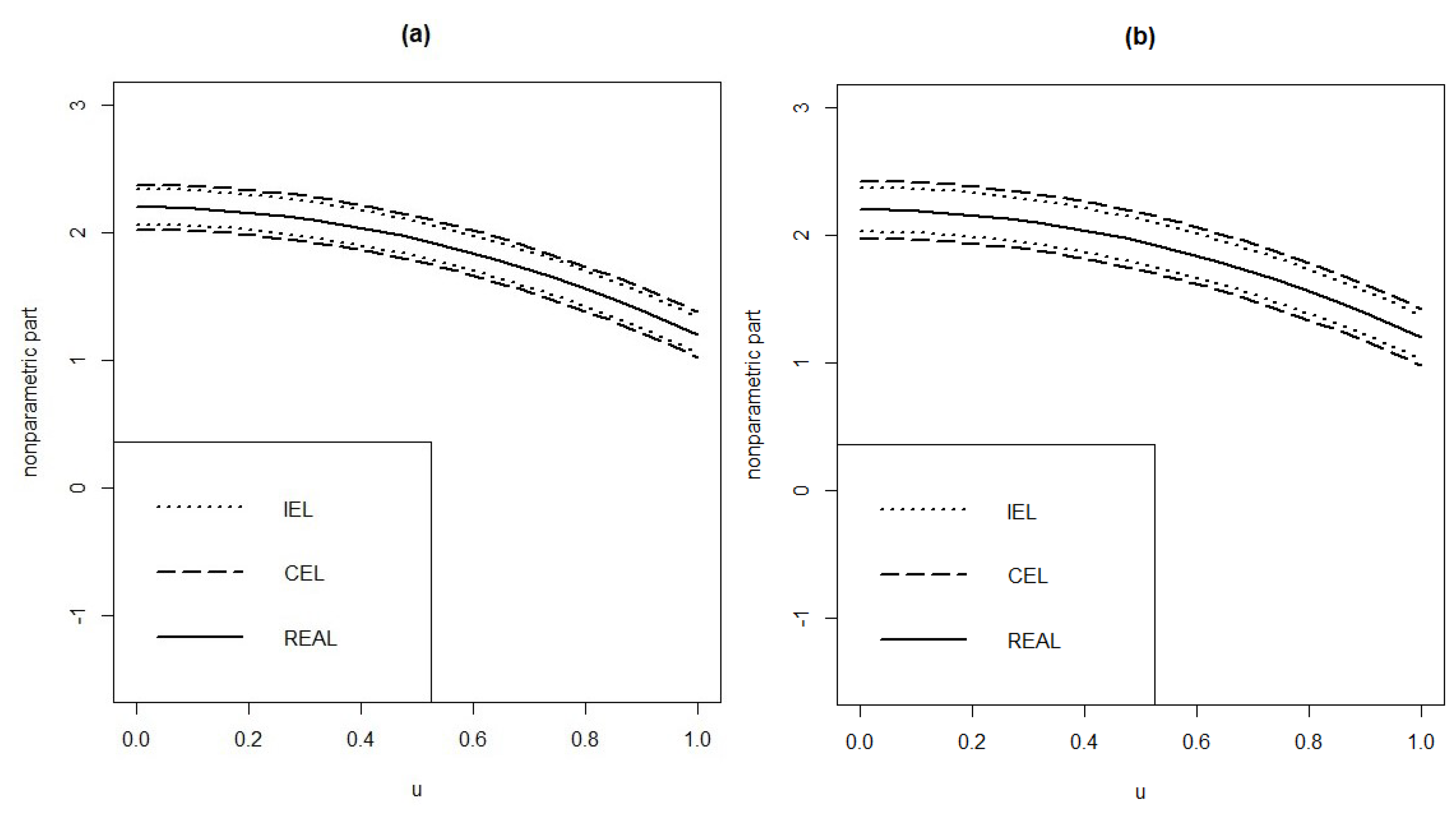
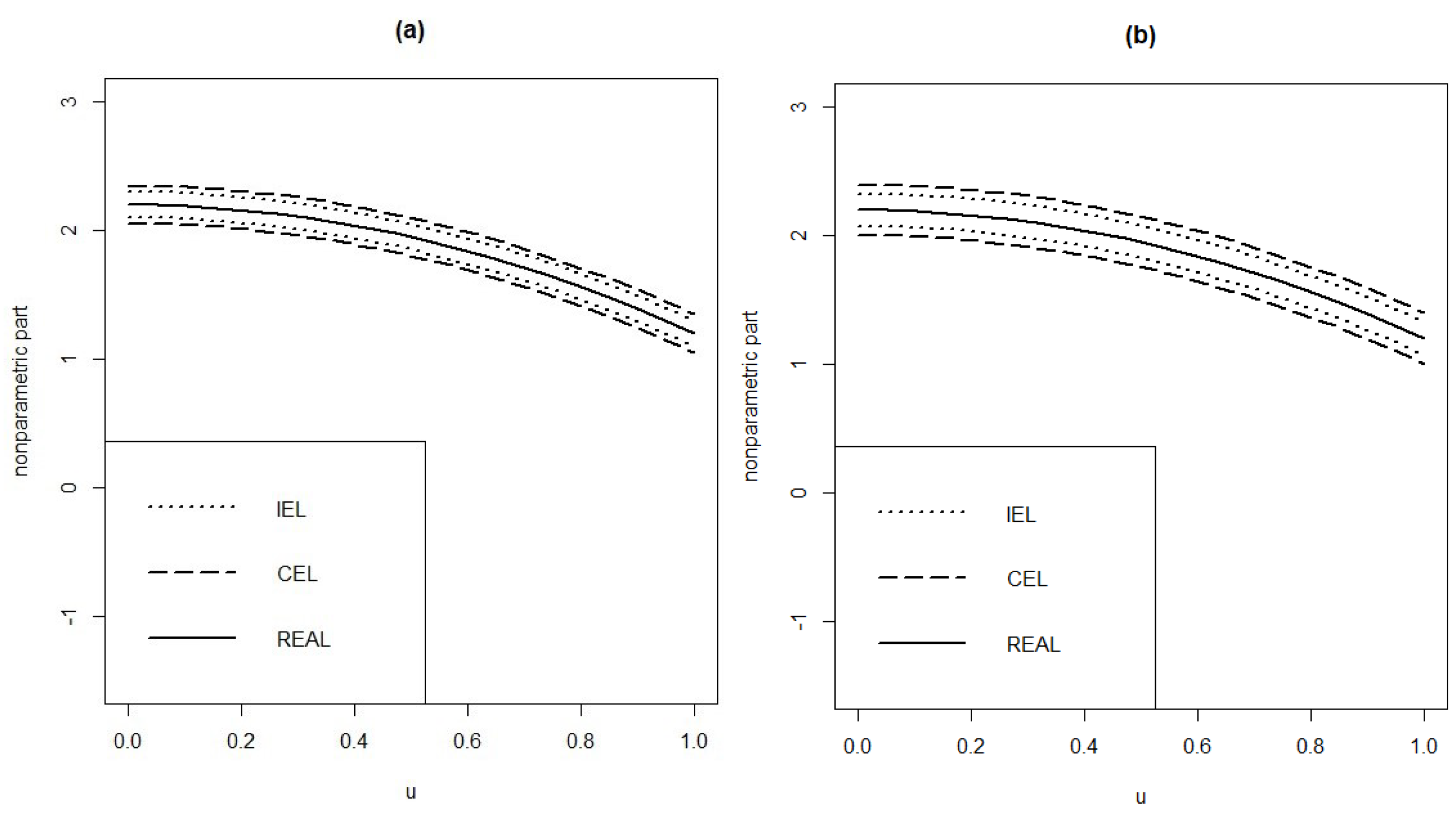
Figure 1 and
Figure 2 summarize the finite sample performances of the IEL and CEL methods for the varying coefficient part under different levels of missing rates and different sample sizes. The figure of (a) shows the averages of pointwise confidence intervals with 500 simulation runs under the first missing rate
, and the figure of (b) shows the averages of pointwise confidence intervals with 500 simulation runs under the second missing rate
.
For the varying coefficient part, the following can be seen from the figures:
(1) With the same missing rate, the IEL method is better than the CEL method because the IEL method gives a smaller interval length.
(2) As the missing rate increases, the pointwise confidence intervals for both the IEL method and the CEL method become larger, but the confidence interval for the IEL method is always smaller than that for the CEL method.
(3) As the sample size increases, the pointwise confidence intervals for both the IEL method and the CEL method become smaller. The pointwise confidence interval for the IEL method is always smaller than the pointwise confidence interval for the CEL method.