1. Introduction
The origin of the representation theory of finite groups goes way back to a correspondence between R. Dedekind and F. G. Frobenius that took place around a century ago [
1,
2]. This theory studies abstract algebraic structures by representing their elements as linear transformations of vector spaces. Specifically, a representation is a way of making an abstract algebraic object more solid by defining its elements by matrices and arithmetic operations on matrices. Linear algebra and matrix theory are well-known and less abstract, so understanding more abstract objects using familiar linear algebra objects can be helpful in deriving properties and simplifying calculations in more abstract settings. Representation theory is a branch of abstract mathematics with many important applications not only in mathematics but in other sciences as well, including chemistry, physics, computing and statistics. To name a few examples: in [
3], an algorithm to construct skew-symmetric matrices is developed by using real irreducible representations of
(application in Lie theory); in [
4], a non-Abelian 4 dimensional unitary representation of the Braid group is used to obtain a totally leakage-free braiding (application in computer science); and in [
5], applications of the group representation theory in various branches of physics and quantum chemistry, in particular nuclear and molecular physics, are discussed. The motivation for this work was to use representation theory to give a topological proof for an abstract problem. We explain the method of research below: for
X, a finite cell complex, let
be the cellular chain complex with complex coefficients where each of the
s is a complex vector space with the
i-cells as a basis. Now, suppose a finite group
G acts cellularly on
X. Then, each
is a representation of
G, and we can make a more accurate Euler characteristic for
X with
G acting by taking
The dimension of this virtual representation is just the ordinary Euler characteristic of
X. We claim there is another definition of
as follows,
, where
is the
ith homology group of
X with
G acting on it. In this paper, we will work on the following problems. We will try to adapt the ordinary proof that
to give a similar formula with equality as elements of
when
G acts on
X. We will also look for a formula for the character of
in terms of the ordinary Euler characteristic of
. Finally, with the help of these results, we give a topological proof of a version of Artin’s induction theorem. Artin’s induction theorem says that any character of a finite group can be expressed as a rational linear combination of characters that are induced from the cyclic subgroups. In this work, we prove a version of this theorem; more precisely, we show that if
G is a group with an irreducible representation of dimension greater than 1, then each character of
G can be expressed as a rational linear combination of characters that are induced up from characters of proper subgroups of
G.
The structure of the paper is as follows.
Section 2 will give the preliminaries on representation theory and topology.
Section 3 and
Section 4 will give examples for the Euler characteristic computation using definition with the chain groups and the homology groups, respectively. Finally, we give the results in
Section 5.
This work is presented in International Congress of Mathematicians, ICM2014, which took place in Seoul, South Korea in 2014.
2. Preliminaries
Our main references here are [
6,
7,
8]. Note that the underlying field is the field of complex numbers.
Definition 1. Let be a linear representation, and let W be a subspace of V. Suppose that W is invariant under the action of G, that is to say, suppose that implies that for all . The restriction of to W is then an isomorphism of W onto itself. Thus, is a linear representation of G in W and is said to be a subrepresentation of G.
Definition 2. A non-zero linear representation is said to be irreducible if it has no proper non-trivial subrepresentation.
Definition 3. Let G be a finite group, let H be a subgroup of index n, and let be any representation of H. Let be representatives in G of the cosets in . The induced representation acts on , where i ranges over the coset representatives, and via this, G acts on W as follows: for .
Below, we state some well-known theorems on representation theory that will be useful in the coming sections.
Theorem 1 (Fixed-Point Formula). Let V be a representation of a finite group G, and let X be a finite G-set. Then, the number of left fixed elements (by the action of g) in X is for every .
Theorem 2. The number of conjugacy classes of G is the same as the number of irreducible representations of G, up to isomorphism.
Theorem 3. Group G is Abelian if and only if all irreducible representations have degree 1.
Theorem 4. The sum of the squares of the dimensions of distinct irreducible representations is the same as the order of the given group G.
Theorem 5. Let V be a linear representation of G with character ϕ, and suppose V decomposes into a direct sum of irreducible representations . Then, if W is an irreducible representation with character χ, the number of isomorphic to W is equal to the scalar product , where Next, we state some well-known theorems in algebraic topology. K below is a finite simplicial complex.
Theorem 6. is a free Abelian group whose rank is the number of connected components of .
Theorem 7. If is connected, Abelianizing its fundamental group gives the first homology group of K.
Theorem 8. if is an orientable surface and is 0 if it is not.
3. Evaluating Using the Definition with the Chain
Groups
In this section, we evaluate for some examples using its definition with the chain groups.
Example 1. acting on the equilateral triangle as the group of symmetries.
here stands for the dihedral group of degree 3, or in other words, the dihedral group of order 6. It is the group of 6 symmetry transformations of an equilateral triangle. They are reflections in the axes through 3 vertices and also rotations around the center by multiples of
. Let us denote the rotations by
and the reflections by
. The group
has 2 one-dimensional (trivial and alternating), and 1 two-dimensional (standard) irreducible representations; see [
7,
8]. Let us call them
, respectively. For the trivial representation,
for all
. Character values of the alternating representation are given by
for
and
for
. Finally, the 2 dimensional
has character values
,
and
.
Here,
is the representation space of dimension 3, which is the number of 0-cells. Let
P be the representation corresponding to this. By the fixed-point formula, Theorem 1, the character values of this representation are shown in
Table 1.
By Theorem 5, the number of irreducibles isomorphic to is , where stands for the character of the trivial representation. Similarly, and , where and are the characters of and , respectively. Therefore,
Similarly,
is the representation space of dimension 3. Let us call this representation
Q. The character values for
Q are presented in
Table 2.
The scalar products are given by , and . Hence,
Finally,
is a 1-dimensional representation space, which we shall call
R. The character values of
R are given in
Table 3.
Here, the scalar products have values , and . Therefore
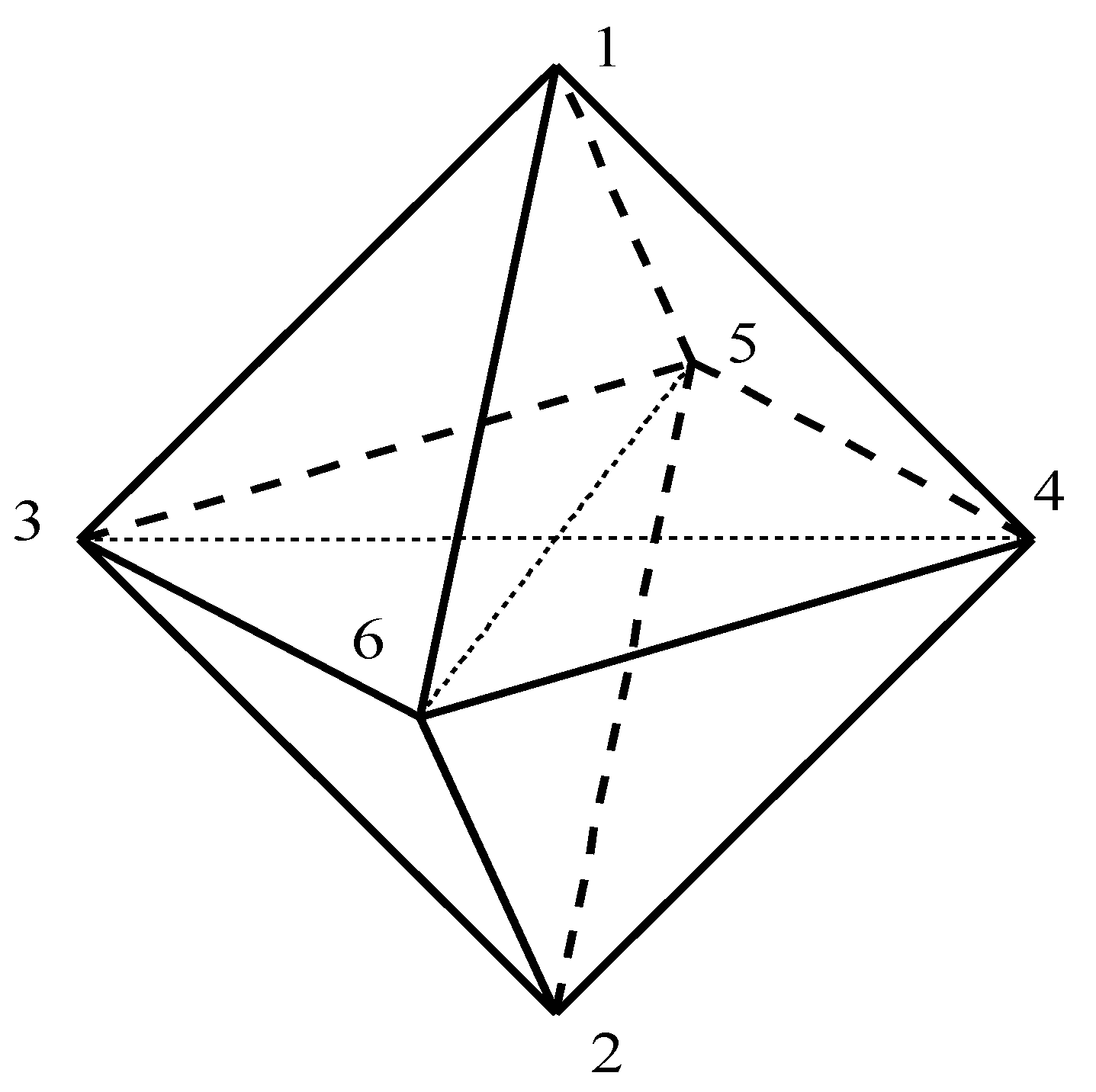
Example 2. acting on an octahedron as rotations through π degrees about the three axes through opposite vertices.
here represents the cyclic group of order 2. Thus the Abelian group
has four elements, identity element of order 1, and the remaining three elements of order 2. Let us represent these elements by
, where
is the axis joining vertices 5 and 6,
is the axis joining vertices 3 and 4, and finally
is the axis joining vertices 1 and 2; see
Figure 1.
As this group is Abelian, all the irreducible representations have a degree of 1. Furthermore, as the sum of the squares of dimensions of distinct irreducible representations is on the order of
, there must be 4 of them. By [
7,
8], these are shown in
Table 4.
Let
P be the representation corresponding to the space
of dimension 6. Similar work to the previous example shows that
Next, let
Q be the representation corresponding to the space
of dimension 12. We obtain
Finally, if
R is the representation corresponding to the space
, of dimension 8, then
Thus, we obtain
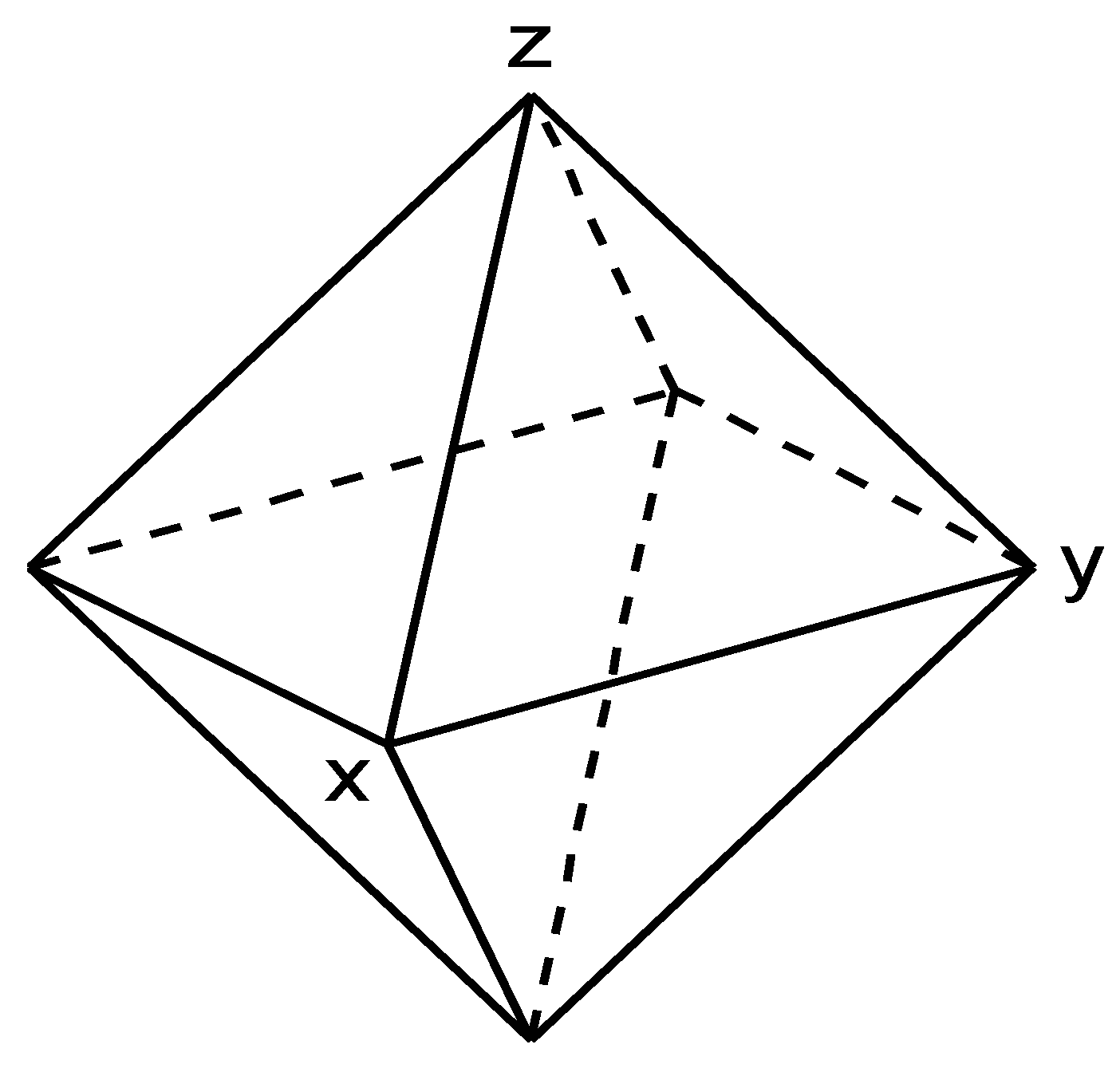
Example 3. acting on the octahedron via reflections in the three coordinate planes.
Following from the previous example,
is an Abelian group of order 8 with an identity element of order 1 and the remaining seven elements of order 2. Call the
reflection in the
-plane,
reflection in the
-plane, and
reflection in the
-plane; see
Figure 2. Hence, the elements of
are
e,
,
,
,
,
,
,
(we will use the notation
for the element
). Similar calculations to previous examples show that
, where
is the trivial representation, and
is the one mapping
e,
,
,
to 1 and the rest of the elements to
. (The group
is Abelian; therefore, it has 8 irreducible representations of degree 1; see
Table 5 [
7,
8]).
4. Evaluating the Using the Definition with the Homology
Groups
In this section, we will evaluate for the examples above, this time by using its definition with the homology groups.
Example 4. The group acting on the equilateral triangle as the group of symmetries.
Irreducible representations are
,
,
. We use the formulae
No transformation affects connectedness; thus group , with dimension 1, contributes to . The group with dimension 0; therefore, there is no contribution to . Finally, the second homology group is also 0; thus, there is no contribution to either. Hence,
Example 5. The group acting on the octahedron as the group of rotations.
Irreducible representations are .
For the group of dimension 1, as in the previous example, the contribution to is . The first homology group is 0, so there is no contribution to . Finally, , generated by the sum of all the triangles in the triangulation of the octahedron. If we call this representation P, again, by the fixed-point formula, the character values for P are given by , so contributes to . Hence,
Example 6. The group acting via reflections of the octahedron in the three coordinate planes.
The group is isomorphic to contributing to . , so there is no contribution to , and finally, with dimension 1. If P is the representation corresponding to this, then P has character values 1 and for the rotations and the reflections, respectively. As stated earlier, this representation is . Hence,